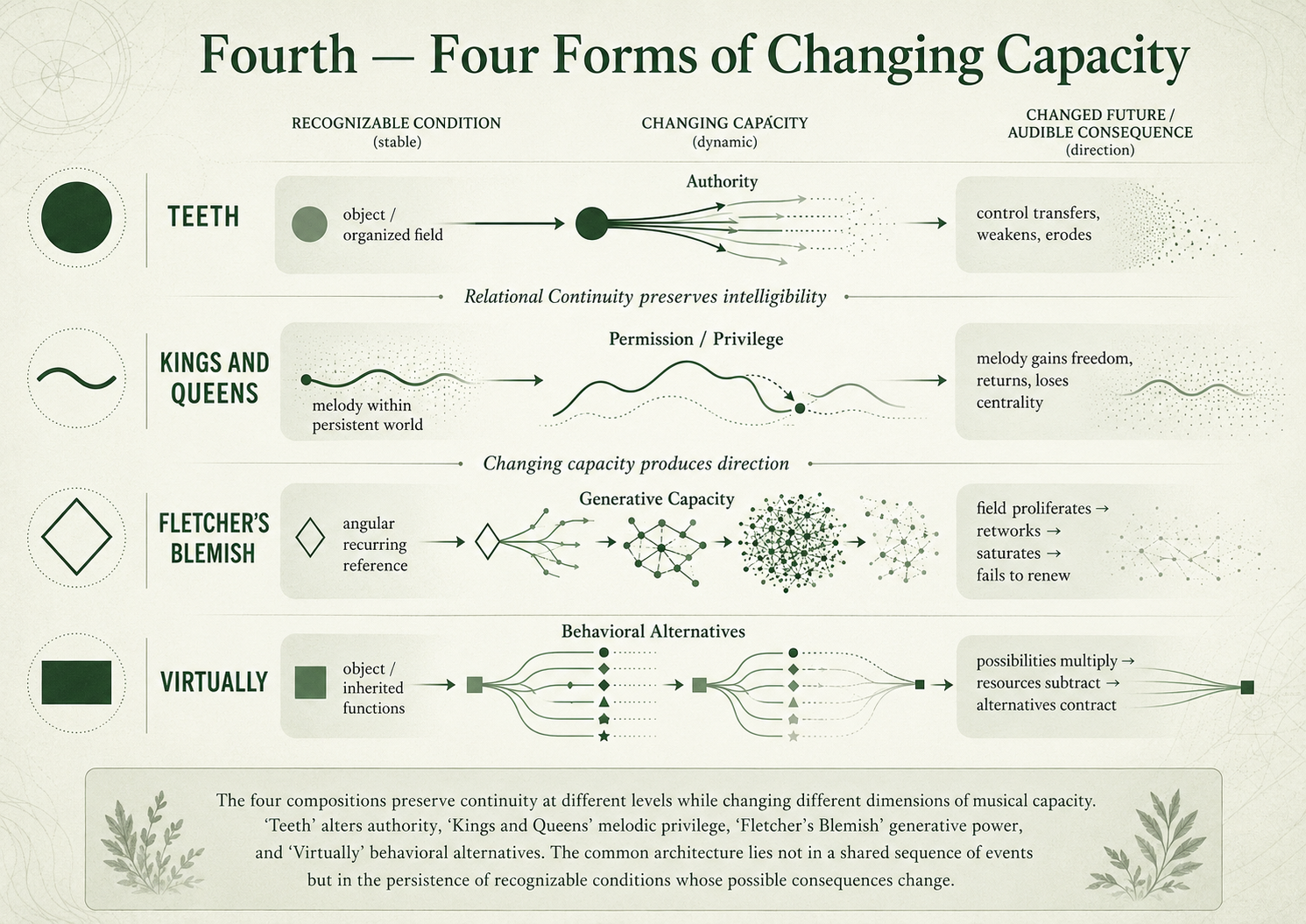
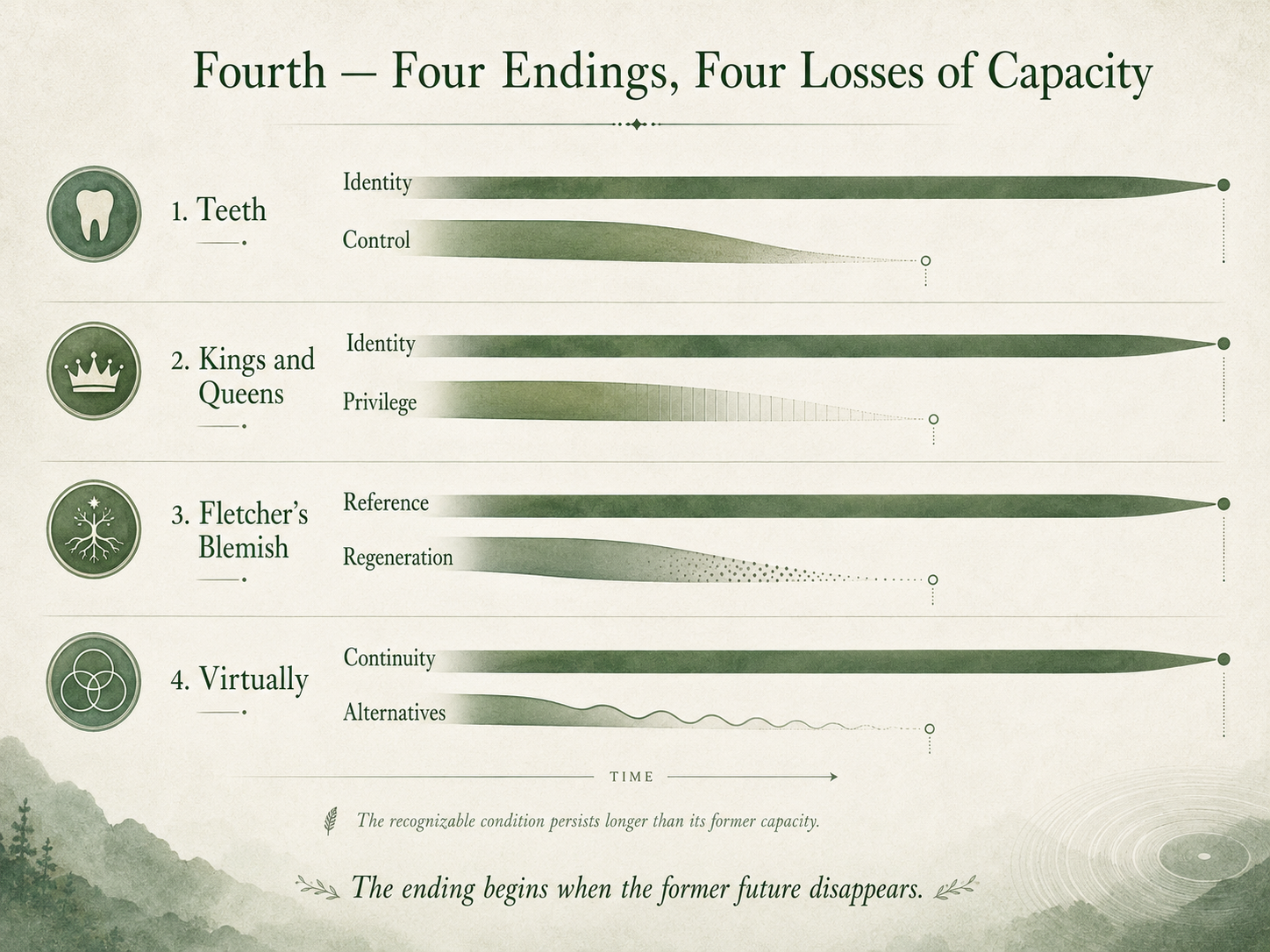
Four distinct architectures keep enough musical identity in view for the listener to hear its capacity change—through authority, privilege, generative power, and the narrowing or expansion of possible futures.
On Fourth, Soft Machine turns inward without becoming smaller. The dramatic expansion of Third has already happened; what matters now is how much change can occur while a musical world remains recognizably itself. Across the album, recurring objects, melodies, ensemble fields, and instrumental relationships stay in the ear even as their authority, freedom, density, and possible continuations begin to shift. The four compositions move through very different landscapes—tightly coordinated, spacious, volatile, extended—but each tests the same unsettling possibility: that continuity can survive after the conditions once attached to it have begun to change. Fourth is therefore less an album of formal departure than of altered consequence, where the music often changes most profoundly without needing to leave its own ground.
Within This AlbumFourth (1971)
1. Personnel
On Fourth, Soft Machine remains the same central quartet that recorded Third: Mike Ratledge, Hugh Hopper, Robert Wyatt, and Elton Dean. Yet the continuity of personnel conceals a considerable change in the way the ensemble is used. The quartet is the album’s stable institutional core, but it is not always the complete sounding group. Roy Babbington, Mark Charig, Nick Evans, Jimmy Hastings, and Alan Skidmore enter in different combinations from composition to composition, sometimes thickening the lower register, sometimes multiplying the available wind voices, and sometimes enlarging the ensemble into a field in which several independent lines can remain active at once. The result is not one expanded Soft Machine but a series of differently proportioned versions of the group.
That distinction matters because the additional musicians are not distributed evenly across the record. “Teeth” adds Babbington, Evans, Hastings, and Skidmore; “Kings and Queens” adds Charig and Evans; “Fletcher’s Blemish” adds Babbington and Charig. “Virtually” changes configuration internally: Babbington, Charig, and Evans appear in Part 1; Parts 2 and 4 return to the quartet; Part 3 expands again with Babbington, Hastings, and Skidmore. Contemporary and discographical credits support this track-specific distribution rather than a single seven- or nine-piece ensemble operating throughout the album. Personnel on Fourth is therefore not merely a question of who participated in the sessions. Ensemble size, register, instrumental doubling, and the number of simultaneously available voices become compositional resources whose use changes from one formal problem to another.
Mike Ratledge — organ, electric piano, piano
Ratledge remains one of the principal sources of harmonic orientation, attack, recurrence, and sustained instrumental weight on Fourth. His keyboard role, however, cannot be reduced to the familiar image of the organ soloist set against a rhythm section. Across the album, keyboards can establish coordinated material, reinforce a repeating framework, occupy a middle register between bass and winds, sustain a harmonic region while other parts become freer, or withdraw sufficiently for another instrumental relationship to determine the direction of the music.
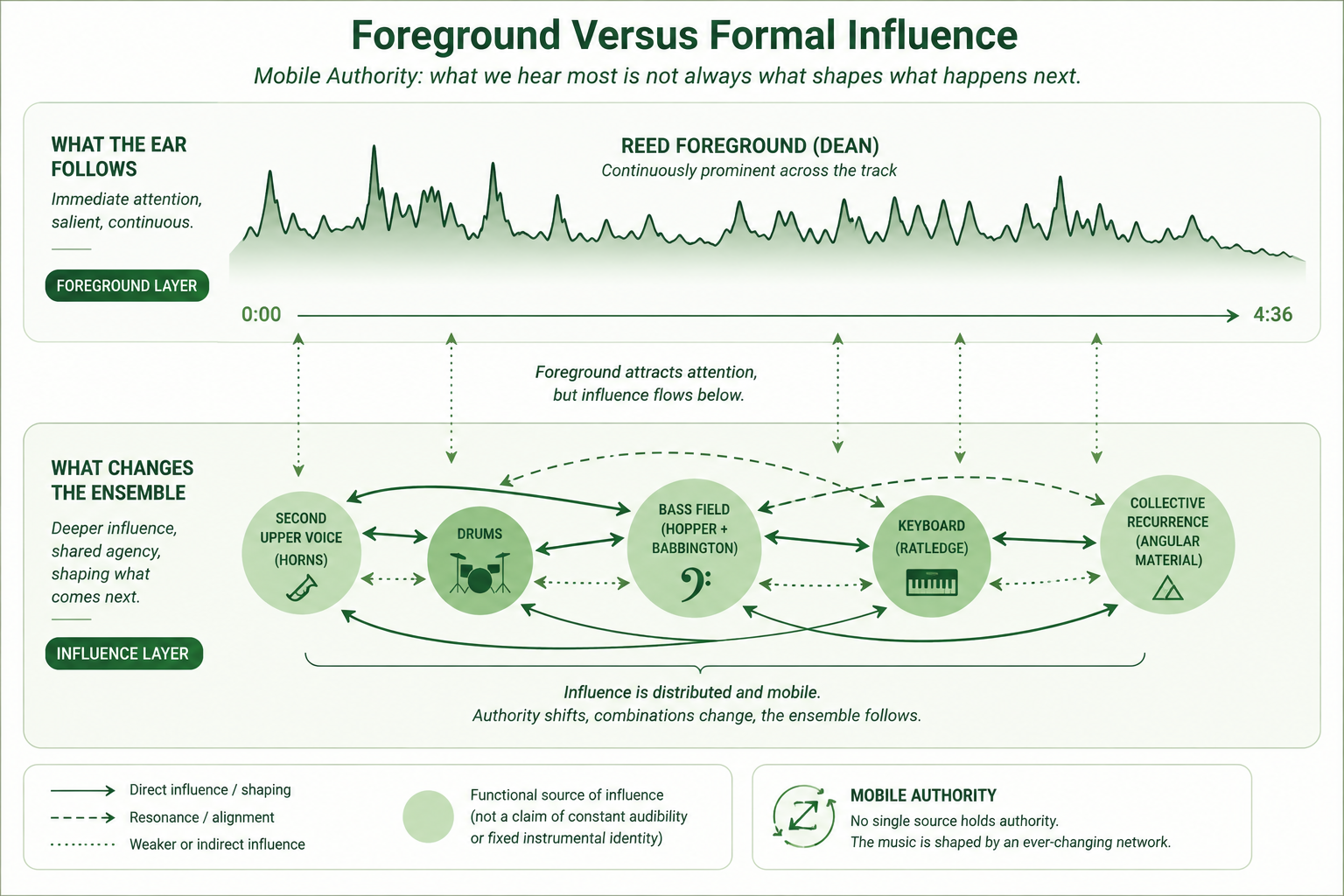
“Teeth” makes this mobility especially apparent. Its sharply organized passages depend partly on the capacity of keyboard writing to participate in dense ensemble articulation, yet the music repeatedly moves away from those moments into conditions in which no single instrumental layer permanently owns the form. Ratledge can become prominent without remaining continuously authoritative; equally, keyboard material can continue to matter after it has ceased to occupy the foreground. The distinction between audible prominence and structural consequence becomes central to the track.
Elsewhere his function is often less declarative. In “Kings and Queens,” a sustained electric-keyboard sonority helps establish the harmonic interior before the principal melody appears, then continues to provide a comparatively stable middle-register field while bass, percussion, and melodic activity change around it. The contribution is structurally important precisely because it does not need to become foreground. In “Fletcher’s Blemish,” keyboard identity is sometimes difficult to separate securely from the surrounding texture. Where the exact instrument cannot be established, it is better to speak of sustained or chordal keyboard activity than to force a distinction between organ and piano that the recording does not make certain. That uncertainty does not diminish Ratledge’s importance. It clarifies the level at which his role can safely be described: as one of the strands through which density, continuity, and collective pressure are shaped.
Hugh Hopper — bass guitar, fuzz bass
Hopper provides the album with its most persistent source of low-register continuity, but Fourth repeatedly complicates the idea that the bass has one permanent function. His instrument can define a ground, articulate recurrence, maintain direction beneath freer upper activity, or enter into a more mobile relationship with drums and keyboards. At several points the bass is not simply supporting an event occurring elsewhere; it is one of the means by which the ensemble remembers what kind of musical world it occupies.
That role is clearest in “Kings and Queens.” Hopper’s score and the LP both show that continuity does not depend upon one invariant bass ostinato. Instead, a family of related low-register configurations can change in pitch, rhythm, contour, and articulation while preserving the bass’s responsibility for orientation. This allows the principal melody to change its degree of freedom without requiring the surrounding musical world to be replaced. Hopper preserves the function of the ground more consistently than its literal material, making the bass one of the clearest demonstrations on the album of continuity through changing realization.
His contribution becomes different when Roy Babbington is present. On “Teeth,” “Fletcher’s Blemish,” and portions of “Virtually,” the existence of a second bass instrument enlarges the low register without automatically producing one doubled bass line. Electric bass and double bass can assume different rhythmic, registral, or sustaining responsibilities, and the presence of two low voices allows the ensemble to separate functions that a single bassist might otherwise have to combine. Because the precise identity of every low-register gesture is not always recoverable from the recording, those passages should not be reduced to an artificially exact division of labor. What can be heard securely is the expansion of the lower field itself.
Hopper’s importance to Fourth extends beyond performance. He composed “Kings and Queens” and all four parts of “Virtually,” giving him responsibility for the entire second side as well as one of Side One’s most concentrated pieces. Yet these works do not impose one Hopper method on the album. “Kings and Queens” draws extraordinary consequence from persistence and economy; “Virtually” sustains much greater duration through redistribution, expansion, subtraction, and contraction. His compositional presence therefore reinforces one of the first things personnel reveals about Fourth: continuity of authorship does not necessarily entail continuity of formal procedure.
Robert Wyatt — drums
Wyatt is the only member of the quartet without a composition credited to him on Fourth, and unlike Third, the album gives him no vocal feature. His presence is consequently concentrated almost entirely in the act of ensemble performance. That apparent narrowing of role makes the sophistication of his drumming more, rather than less, important. Across the record, rhythmic continuity rarely means mechanical repetition. Wyatt can sustain a pulse while altering its internal balance, disturb an apparently settled metre through accent and subdivision, increase intensity without forcing a sectional break, or make a transition perceptible before any change of thematic material announces it.
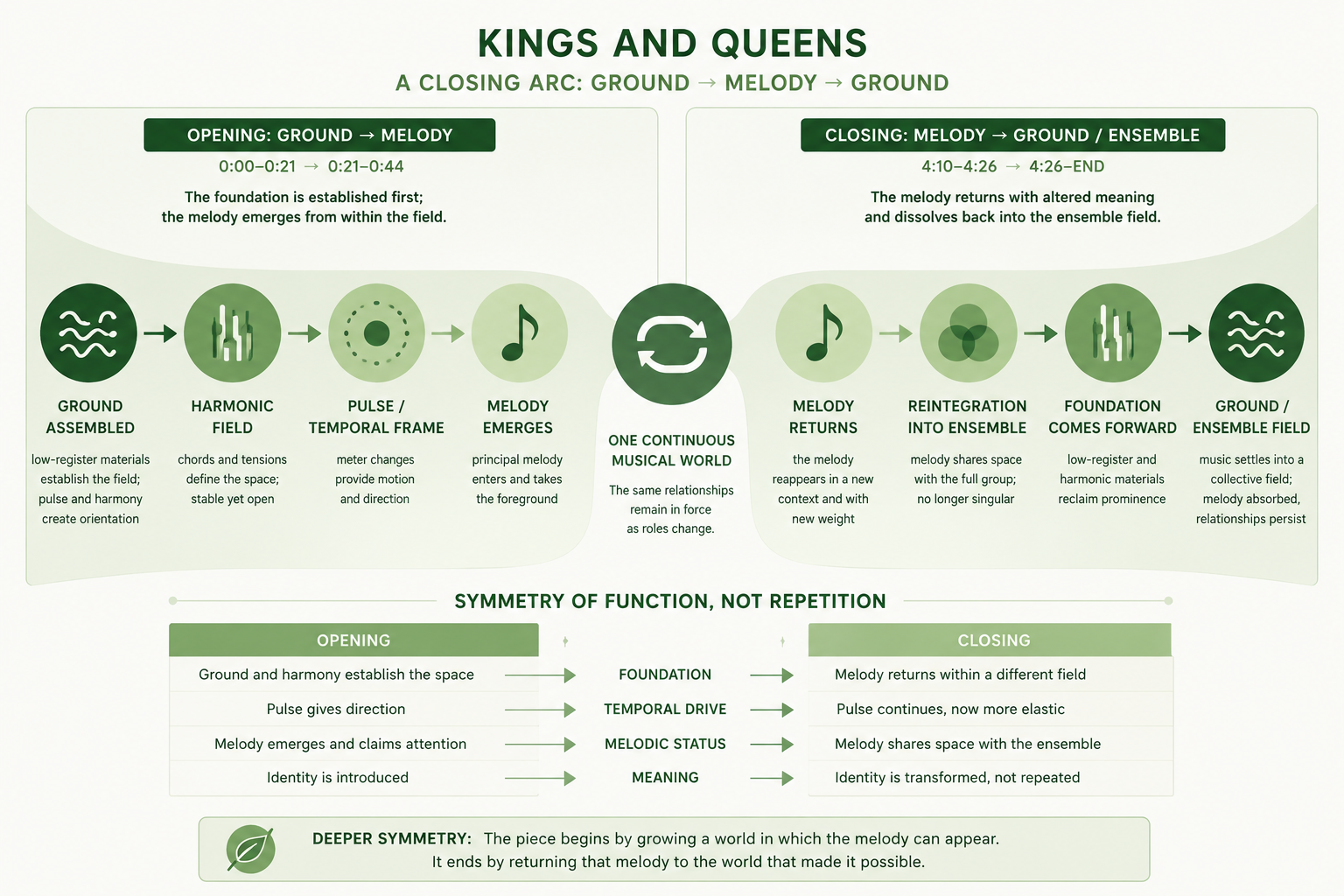
“Kings and Queens” is particularly revealing. The opening begins with softly articulated cymbal and mallet work before Wyatt gradually gives the temporal field greater definition. From there, the piece retains a stable broad tactus while accents, subdivisions, attack density, and local rhythmic pressure continually change. Wyatt therefore prevents stability from becoming immobility without needing to replace one groove with another. His contribution helps explain how the piece can remain recognizably itself while continually altering the freedom available to the melody.
In the more open environments of “Fletcher’s Blemish,” rhythmic responsibility becomes still less reducible to timekeeping. Wyatt can contribute impulses to a collective field without dictating a permanent meter to it; moments of convergence become meaningful partly because the preceding activity has allowed instrumental trajectories greater independence. In “Teeth” and “Virtually,” meanwhile, his role participates in the larger redistribution of authority characteristic of those pieces: drums may propel, react, destabilize, or momentarily organize the ensemble without becoming its fixed center.
This is also the final Soft Machine studio album on which Wyatt appears as a member of the group. That historical fact will become important in the following section, but musically it should not tempt us to hear every gesture retrospectively as evidence of departure. Within the record itself, the more immediate fact is that Wyatt remains fully embedded in the ensemble’s changing logic. His drumming is one of the principal mechanisms by which fixed material can remain alive, freer passages can acquire direction, and continuity can persist without rhythmic sameness.
Elton Dean — alto saxophone, saxello
Dean occupies the most consistently recognizable upper-register voice in the quartet, but Fourth repeatedly refuses to equate that perceptual prominence with permanent formal control. His alto saxophone and saxello can carry composed material, project a melodic identity, move into freer improvisational activity, or become one participant among several independent wind voices. The difference among those roles is essential to understanding both his playing and the album’s larger ensemble organization.
“Fletcher’s Blemish,” Dean’s own composition, makes the distinction unusually clear. Dean often remains one of the easiest musicians to follow through the surrounding improvisational fields, yet the track does not behave as an extended solo with accompaniment. Other trajectories acquire increasing independence; relationships form and dissolve across the ensemble; and the recurring coordinated material interrupts or reorganizes the field without permanently subordinating it to a single lead voice. Dean’s foreground presence is therefore perceptual before it is hierarchical. He can remain central to what the ear follows while formal consequence is distributed much more widely.
The expanded wind configurations elsewhere on the album further alter his position. With Evans, Hastings, Skidmore, or Charig present, Dean is no longer the quartet’s sole upper wind identity. Additional players allow lines to overlap across register, coordinated passages to acquire greater internal differentiation, and improvisational fields to contain several potentially consequential voices at once. In “Kings and Queens,” the distinction is especially clear: Dean’s principal melodic line remains legible within the enlarged six-player texture, while the exact ownership of some supporting wind and brass details remains less certain. Rather than diminishing Dean, these enlargements reveal how adaptable his place in Soft Machine had become. He can function as principal reed voice without requiring the ensemble to organize itself permanently around a conventional soloist.
Roy Babbington — double bass
Babbington appears on “Teeth,” “Fletcher’s Blemish,” “Virtually Part 1,” and “Virtually Part 3.” His presence gives Fourth something the quartet alone cannot supply: two independent instruments capable of occupying the lower register simultaneously.
The importance of that addition lies less in sheer weight than in differentiation. With Hopper on electric bass and Babbington on double bass, one low-register strand can sustain or articulate a foundation while another behaves more freely; one can reinforce pulse while another complicates it; or the two can become sufficiently independent that the listener encounters a layered low field rather than a single bass function. “Virtually Part 1” makes this especially useful, since its formal argument depends repeatedly upon the redistribution of responsibility among recurring material and instrumental layers. Two basses allow that redistribution to extend all the way into the foundation of the ensemble.
“Fletcher’s Blemish” uses the expanded low register differently. As the improvisational fields become increasingly differentiated, the possibility of more than one independent lower trajectory contributes to a network in which no simple foreground-versus-accompaniment model is adequate. Yet the recording does not always permit every low gesture to be assigned securely to Hopper or Babbington. The documentary credit establishes Babbington’s participation; it does not justify identifying every audible low line by player. That distinction is particularly important on an album whose textures often depend upon simultaneous activity rather than easily isolated instrumental roles.
Mark Charig — cornet
Charig appears on “Kings and Queens,” “Fletcher’s Blemish,” and “Virtually Part 1.” His cornet expands the upper ensemble in a direction quite different from the additional reeds. Its more compact brass attack and distinctive timbral edge can enter a coordinated sonority without simply duplicating Dean’s role, while in freer settings it supplies another independent trajectory whose identity is determined as much by interaction as by instrumental color.
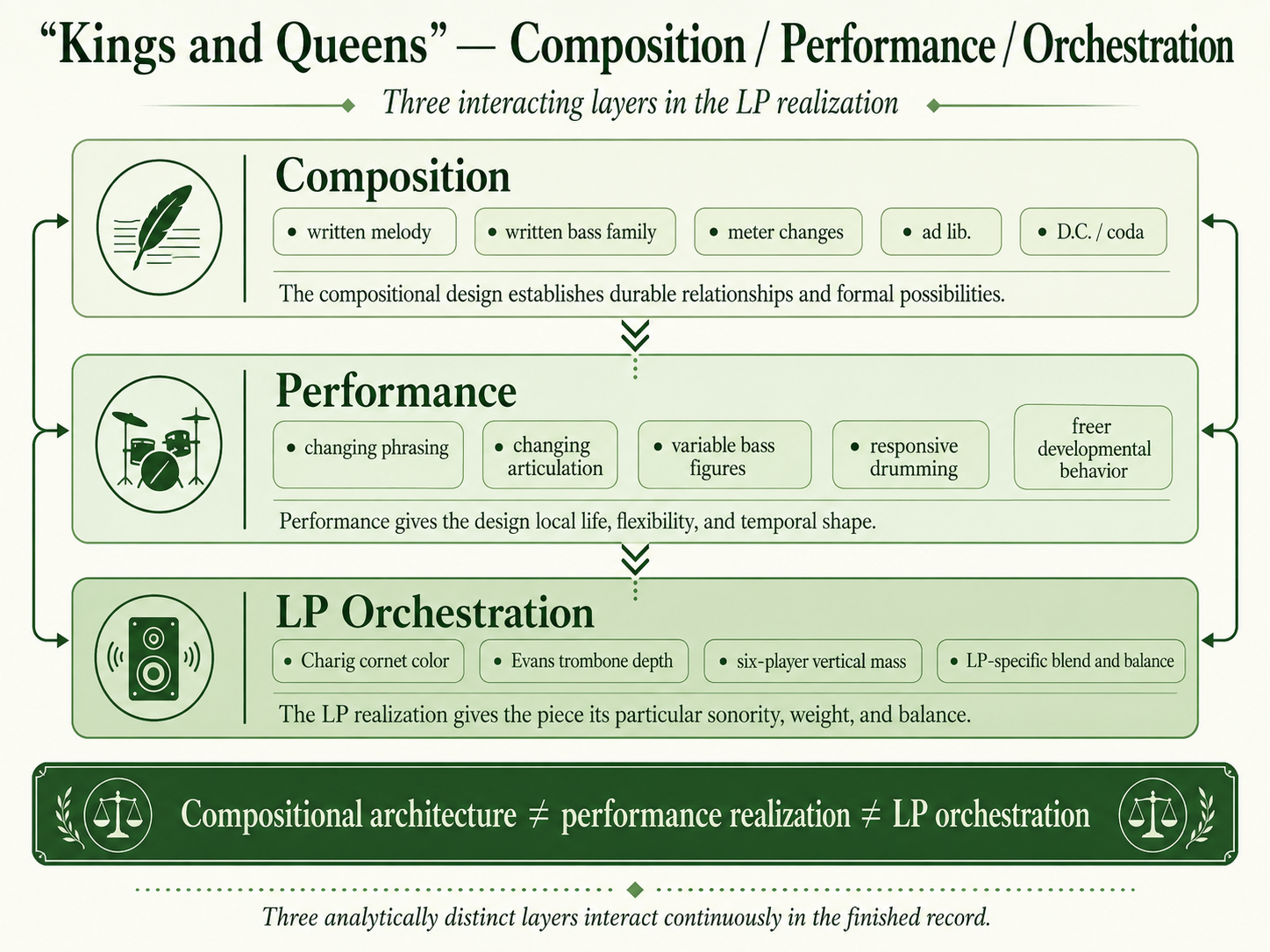
The contrast between “Kings and Queens” and “Fletcher’s Blemish” is instructive. In “Kings and Queens,” Charig’s participation is securely documented, while the exact assignment of every blended upper line is not. The recording most plausibly places the cornet in functions of upper reinforcement, harmonic support, and brass coloration around the written melodic field, enlarging Dean’s contour without establishing a second continuous melodic owner. In “Fletcher’s Blemish,” the same additional brass voice participates in a much less settled environment, where coordinated recurrence alternates with increasingly independent improvisational behavior. Personnel alone therefore cannot determine formal function. The same player can enlarge two pieces whose governing logics are almost opposite.
Charig’s presence in “Virtually Part 1” adds a further variation. There he belongs to an expanded configuration whose importance lies in mobility itself: instrumental responsibilities move, recurring material changes position, and foreground can become increasingly plural. Across his three appearances, the cornet is consequently less a fixed orchestral color than one of the means by which the quartet’s upper register can be reorganized.
Nick Evans — trombone
Evans appears on “Teeth,” “Kings and Queens,” and “Virtually Part 1.” The trombone gives the album’s expanded wind writing a lower brass voice capable of occupying the space between the quartet’s upper reeds and its bass foundation. That additional register matters particularly when the ensemble is densely coordinated: the wind body can acquire depth rather than merely accumulating more voices in the same range.
As on Third, Evans should not be treated as a permanent second front-line player. His contribution is selective, and even where the documentary credit is secure, individual gestures within crowded textures are not always identifiable with equal confidence. In “Kings and Queens,” the recording supports hearing the trombone primarily as lower-middle depth, inner harmonic weight, and vertical reinforcement rather than as a second bass or continuous melodic lead. The personnel evidence establishes Evans’s presence securely, while exact ownership of individual blended notes, doublings, entrances, and withdrawals remains less certain.
That expanded middle-to-lower wind register is particularly useful in “Teeth,” where strongly organized material repeatedly gives way to altered configurations of authority. The trombone can participate in ensemble mass without requiring the piece to become a brass-led arrangement. Its significance lies in helping create a larger field through which formal responsibility can move.
Jimmy Hastings — alto flute, bass clarinet
Hastings appears on “Teeth” and “Virtually Part 3,” with the credits associating bass clarinet with both appearances and alto flute with Part 3 of “Virtually.” These instruments extend the ensemble in opposite registral directions. Bass clarinet adds a dark reed sonority capable of linking the wind ensemble to the lower instrumental field, while alto flute contributes a softer and less penetrating upper voice than the saxophones.
That breadth makes Hastings particularly valuable in music whose organization depends upon changing density rather than simply accumulating instrumental power. On “Teeth,” the additional reed color participates in an ensemble capable of moving between compact coordinated statements and more open distributions of responsibility. In “Virtually Part 3,” the context is markedly different: the composition has crossed its strongest large-scale rupture, the earlier ground falls away, and the texture enters a more atmospheric condition in which subtraction and dispersion matter as much as accumulation. Here a lighter or darker wind color can reshape the field without needing to dominate it.
Hastings therefore exemplifies the precision with which Fourth uses its guests. His presence does not establish a recurring album-wide wind section. It becomes available at two carefully delimited points whose formal environments demand different kinds of registral and timbral extension.
Alan Skidmore — tenor saxophone
Skidmore appears on “Teeth” and “Virtually Part 3.” The tenor saxophone introduces another independent reed voice below Dean’s principal alto range, increasing both the thickness of coordinated wind writing and the number of distinguishable trajectories available when the texture becomes more open.
On “Teeth,” this contributes to an unusually broad ensemble configuration: the quartet is joined by double bass, trombone, bass clarinet, and tenor saxophone. The consequence is not simply orchestral magnitude. Multiple registers and instrumental identities can remain active together, making it possible for a tightly coordinated object to dissolve into a field whose internal responsibilities are less centralized without requiring the ensemble itself to disappear.
Skidmore returns in “Virtually Part 3,” but into a radically changed formal environment. Here the larger wind palette operates after the more grounded organization of the preceding parts has been disrupted. The resulting atmospheric dispersion demonstrates once again that instrumentation on Fourth has no single predetermined function. The same tenor saxophone that can contribute to dense ensemble definition in one composition can help sustain openness and separation in another.
Taken together, the personnel of Fourth reveal an ensemble whose identity is stable at its center but deliberately variable at its edges. Ratledge, Hopper, Wyatt, and Dean remain present throughout, yet the album repeatedly changes what that quartet is asked to become. Sometimes it stands alone. Elsewhere a second bass divides the lower register, brass widens the middle of the ensemble, additional reeds multiply possible foregrounds, or several of these resources appear simultaneously. Even “Virtually,” occupying the entire second side, does not preserve one instrumentation from beginning to end: it expands, contracts to the quartet, expands differently, and contracts again.
These changes do not by themselves explain the album’s form, and they should not be mistaken for a hidden orchestration plan that determines every composition in advance. They establish something more basic. Fourth treats the performing ensemble itself as variable material. The quartet supplies continuity of identity; the guests alter the number and kinds of relationships that can exist around it. From one track to another—and, in “Virtually,” within a single extended composition—the available musical body changes. What those changing bodies ultimately have in common is a question for the album’s later architectural argument. At the level of personnel, it is enough to recognize that Fourth never asks one fixed version of Soft Machine to solve every musical problem.
2. Historical Context
Fourth emerged not from a new beginning but from the rapid consolidation of changes already underway on Third. By the second half of 1970, the Ratledge–Hopper–Wyatt–Dean quartet was no longer an experimental enlargement of Soft Machine’s earlier trio but the working identity of the group. Elton Dean had become fully integrated into an ensemble whose music increasingly depended upon the interaction of keyboards, electric bass, drums, and reeds, while the compact songs that had once shared space with instrumental development had almost disappeared from the group’s recorded work. Third had allowed that transformation to occupy an unusually generous physical form: four compositions, each given an entire LP side. Fourth retained the instrumental freedom made possible by that expansion but returned it to the dimensions of a single album. The question was no longer simply how Soft Machine might sustain twenty minutes of music. It was how composition and improvisation could be organized differently from piece to piece once extended instrumental thinking had become normal practice.
The months between the two albums also altered the group’s cultural position. On 13 August 1970, Soft Machine appeared at the Royal Albert Hall as the first rock group invited to perform at the BBC Proms, a concert subsequently broadcast on national television. The invitation testified to the difficulty of placing the group within established categories: Soft Machine had emerged through the British psychedelic and underground circuit, yet its current music increasingly intersected with contemporary jazz and composition rather than the song-centered expectations attached to a rock group. The band’s own attitude toward that recognition was considerably less solemn than some of the surrounding publicity suggested. Looking back only months later, Wyatt described the attempt to make Soft Machine respectable through the Proms as something of a failed exercise and objected to promotional imagery that presented the musicians as a grave, conventional pop group. The Proms therefore belongs to the history of Fourth less as a ceremonial arrival than as evidence of the unusual cultural space the group now occupied.
That space was increasingly shared with musicians from British modern jazz. Mark Charig, Nick Evans, Roy Babbington, Jimmy Hastings, and Alan Skidmore were not assembled into a permanent Soft Machine horn section. They entered particular compositions in particular combinations, extending a practice that had already taken several forms during the making of Third. The difference on Fourth is the precision with which those resources are deployed. The quartet can remain alone, acquire a second bass, expand into brass and reed combinations, or enlarge and contract within the course of “Virtually” itself. The guest network connected Soft Machine directly to a wider British jazz environment, but the resulting music did not simply adopt the structure of a jazz ensemble. Additional players were absorbed into compositions whose organizing principles might involve recurring angular passages, persistent bass grounds, written ensemble objects, changing instrumental relationships, or extended fields of improvisation.
This increasing proximity to jazz should not be described as a conversion from rock into jazz-rock. The musicians themselves carried different and overlapping musical histories. In a 1971 interview, Wyatt remembered Ratledge’s early interests ranging from European modernism to Monk, Mingus, and Dolphy, while recalling his own encounters with Ornette Coleman, Cecil Taylor, and Terry Riley and Hopper’s attempts to learn Charlie Haden bass lines. Such references had been present in the group’s musical environment long before Fourth. What changed was their relative weight inside Soft Machine’s practice. By 1970, extended improvisation, complex written figures, freer collective playing, recurring electric patterns, and increasingly jazz-associated instrumental sonorities no longer needed to coexist with a substantial body of conventional songs. They could constitute the album itself.
Contemporary evidence also gives a clearer view of how consciously some of that complexity was being constructed. Ratledge described his compositional practice as beginning from a “given concept”—for example, a harmonic progression or a time signature—which could provide the premise from which a larger structure developed. He also spoke during this period of writing increasingly complex structures. The significance of those remarks is methodological rather than track-specific: they show that the growing intricacy of Soft Machine’s instrumental music did not arise simply from freer improvisation or from increasing ensemble size. Composition could begin with deliberately defined constraints whose consequences were then worked out through performance. The evidence surrounding Hopper and Dean points to different solutions rather than one common method. Hopper’s surviving score for “Kings and Queens” distinguishes written material, changing metre, greater improvisational latitude, return, and coda while allowing considerable flexibility in instrumental realization; documentary evidence for “Fletcher’s Blemish,” by contrast, describes four brief riff fragments within an otherwise substantially improvisatory design. Fourth therefore brings together composers who were all negotiating the relation between specification and freedom, but were not negotiating it in the same way.
The distinction is especially important because Fourth is Soft Machine’s first completely instrumental studio album. Third had come close, but “Moon in June” still gave Wyatt’s voice an entire side on which the group’s song history remained audible inside an enlarged formal world. Nothing comparable appears on Fourth. Ratledge composed “Teeth,” Dean contributed “Fletcher’s Blemish,” and Hopper supplied both “Kings and Queens” and the four-part “Virtually”; Wyatt contributed no composition to the album. The absence is historically significant, but its meaning is more complicated than a simple exclusion of the drummer from the group’s developing direction. Soft Machine’s official history identifies Fourth as the first fully instrumental album and the last to feature Wyatt, but the contemporary testimony reveals a situation still in motion rather than a separation already completed.
Wyatt had already found another outlet for music that did not fit easily into the group. His first solo album, The End of an Ear, recorded in 1970, carried the deliberately pointed description “out of work pop singer, currently on drums with Soft Machine.” The phrase has often been read retrospectively as a declaration that his relationship with the band was already finished. Yet Wyatt’s own comments shortly after Fourth was released are more revealing. Asked why he had contributed an entire side to Third but nothing to the new album, he proposed that The End of an Ear and Fourth could almost be regarded as parts of a double album: he had made his own contribution separately, leaving Hopper room to extend “Virtually” across the second side. The parallel is revealing. Wyatt’s solution to extended form was moving toward spontaneous studio construction, multitracked voice, and an intensely personal use of recording; the music written by his colleagues was becoming increasingly dependent upon instrumental composition and ensemble realization. These were divergent possibilities, but in late 1970 they had not yet become mutually exclusive histories.
Nor should Wyatt’s dissatisfaction with certain aspects of Soft Machine obscure his continuing engagement with the quartet. In April 1971 he described the group as highly demanding and admitted that interpersonal frustration was recurrent, yet in the same interview he said that Soft Machine had become more fully a quartet rather than simply “the three of us plus Elton.” He singled out the developing relationship between Dean and Ratledge as having made Ratledge a freer player, and said that he felt more confident about the group than he had previously. Such testimony makes it difficult to treat Fourth as the straightforward document of an inevitable breakup. Tensions over composition, spontaneity, song, instrumental complexity, and individual musical priorities were real. But they existed inside a functioning ensemble whose members could still recognize productive consequences in one another’s differences.
Those differences were also being carried into performance while the album was taking shape. Documentary records show that by 25 October 1970 a concert at Amsterdam’s Concertgebouw included “Virtually,” “Teeth,” and “Kings and Queens” alongside earlier Soft Machine material; “Virtually” and “Fletcher’s Blemish” were also recorded for a BBC Top Gear session in December. These records establish that composition, rehearsal, live performance, broadcasting, and studio recording were overlapping activities rather than neatly separated stages. They do not by themselves tell us how those particular performances differed formally from the LP versions; that requires analysis of the recordings themselves. Historically, however, they show that the material of Fourth was already circulating as performed repertoire while the album was being completed.
Recording took place at Olympic Studios in London during the autumn of 1970, with George Chkiantz engineering and Soft Machine credited as producer. The strongest surviving chronology places the album sessions between 13 October and 18 November, with documented studio blocks on 13–16 October, 27–28 October, 9 November, and 16–18 November. Those dates establish the album’s recording period without securely assigning every composition to a particular session. The studio work was interleaved with concerts rather than conducted as one uninterrupted recording block.
That working pattern differs importantly from the construction of “Facelift” on Third. There is no comparable need on Fourth to explain the album’s large-scale forms through conspicuous reversal, speed alteration, or montage of concert material. Studio technique remains part of the recorded result, but the evidence accumulated across the individual tracks points primarily toward performed musical relationships: recurring material, ensemble coordination, changing degrees of improvisational freedom, instrumental doubling, density, and changing distributions of responsibility. Even where production determines the recorded boundary of a performance—as with the fade at the end of “Virtually”—it need not have generated the musical process leading to that boundary. The distinction between performance structure and LP realization is therefore particularly important on this album.
The compression from Third’s double LP to Fourth’s single disc also changes the scale on which those relationships can operate. Side One contains three pieces of sharply different character. Ratledge’s “Teeth” moves repeatedly between strongly organized material and conditions in which authority becomes more mobile. Hopper’s “Kings and Queens” achieves continuity through striking economy, allowing related bass configurations, harmonic support, pulse, and a durable principal melody to change function without requiring the musical world to be replaced. Dean’s “Fletcher’s Blemish” places four brief, documentarily supported riff fragments within substantially improvisatory fields whose internal relationships change across the performance. Side Two gives Hopper the album’s largest uninterrupted canvas in the four-part “Virtually,” but even here duration does not produce one continuous behavioral state. The composition changes its ensemble configuration and repeatedly redistributes the function of recurring material, foreground voices, bass activity, and collective texture.
This diversity is historically significant because Fourth does not simply refine one successful technique discovered on Third. The previous album had demonstrated that Soft Machine could sustain an LP side without depending upon conventional song form, but its four sides did so through markedly different architectures. Fourth retains that plurality while placing its contrasts closer together. Side One can move from Ratledge’s tightly articulated complexity to Hopper’s restrained continuity and then to Dean’s much freer collective environment in less than twenty minutes. The second side expands again, but not toward the almost side-long autonomy characteristic of Third: “Virtually” explicitly divides its duration into four parts, even as the audible strength of those boundaries varies considerably.
The album appeared on CBS in 1971; contemporary discographical chronologies place the UK release on 12 March. By then Soft Machine was established enough for Fourth to be heard not as an isolated experiment but as the next statement from a group whose movement beyond its psychedelic origins had become unmistakable. Contemporary reception nevertheless continued to reveal uncertainty about what kind of group this now was. A DownBeat review later that year approached the album from a jazz publication while explicitly comparing it with the earlier Soft Machine of comic and collage-like songs—a reminder that the band’s previous identities had not vanished from critical memory merely because the new record contained no vocals.
What happened later in 1971 makes the album appear more terminal in retrospect than it necessarily did when it was recorded. Wyatt left Soft Machine in August, ending the quartet that had made both Third and Fourth. His departure would make the album the final studio document of the Ratledge–Hopper–Wyatt–Dean configuration and accelerate the group’s subsequent movement into other rhythmic and instrumental relationships. But hearing Fourth only as the record before Wyatt left reverses the historical order. During its creation, the quartet was still working, touring, revising material, incorporating outside musicians, and negotiating differences from inside the ensemble. Its instability was productive before it became terminal.
Fourth therefore occupies a narrower but in some respects more revealing historical threshold than Third. The dramatic outward transformation had already happened: songs had receded, Dean was established, extended instrumental writing had become normal, and Soft Machine’s contact with modern jazz was no longer incidental. What remained unsettled was how those resources should be organized and who, within an increasingly sophisticated instrumental language, could determine their direction. Ratledge, Hopper, and Dean brought different compositional priorities and different balances between written specification and improvisational freedom; Wyatt supplied a rhythmic imagination deeply embedded in the ensemble while increasingly seeking other spaces for the musical impulses that Soft Machine could not easily contain. Guest musicians widened the available ensemble without stabilizing it into a permanent larger band. Live performance and studio recording continued to overlap without becoming analytically interchangeable.
The historical condition of Fourth is therefore not simply “Soft Machine becomes jazz,” nor “Robert Wyatt prepares to leave.” It is a moment of concentrated plurality after the expansion of Third: an established quartet discovering that greater instrumental fluency does not require greater formal uniformity. The group had acquired a larger vocabulary, a wider circle of collaborators, and greater freedom from its earlier song-based identity. Fourth records what happened when those possibilities ceased to be novelties and became the working materials of the band itself. The question the album leaves for its musical architecture is no longer whether Soft Machine can sustain instrumental form beyond the song, but how several fundamentally different kinds of continuity, freedom, recurrence, and ensemble responsibility can coexist under the name of a single group.
3. Musical Architecture — What Continuity Makes Possible
The four compositions on Fourth do not share a single formal method. One may hold continuity through changing authority, another through a persistent ground, another through recurring reference inside increasingly differentiated freedom, and another through the redistribution and eventual contraction of musical function. Yet beneath those differences lies a common problem. Again and again, the album keeps enough of a musical identity in the ear for the listener to recognize a material, a field, a relationship, or a mode of ensemble behavior even as its capacity changes. What returns or persists is therefore only part of the story. The deeper movement of Fourth lies in what those recognizable conditions can still generate, support, control, release, or become. Continuity matters because it keeps the past sounding inside the present; form emerges from the changing possibilities attached to what survives.
That shared problem becomes clearest when the four pieces are placed beside one another rather than simply followed in sequence. Their surfaces, proportions, degrees of prescription, and ensemble behaviors remain markedly different, yet each keeps something audible long enough for the listener to hear its consequences change. The point is not that Fourth reduces those differences to one system. It is that the album repeatedly tests the same deeper question through different architectures: how much can a recognizable musical condition change what it is capable of doing before continuity itself gives way?
Musical Architecture
I. Four Different Architectures, One Shared Question
The four compositions on Fourth do not behave as variations on one formal design. Their differences are too fundamental for that. They distribute stability and freedom differently, give recurrence different responsibilities, organize instrumental hierarchy in different ways, and arrive at closure through different kinds of loss. What binds them is therefore not a common surface vocabulary or a single method of construction. The stronger connection appears at another level: each piece keeps some aspect of its musical world sufficiently recognizable for changes in that world’s capacity to become audible. The identity may belong to a compact object, a melody, a ground, a recurrent procedure, a field, or a network of relationships; what changes is what that identity can still release, support, govern, generate, or become.
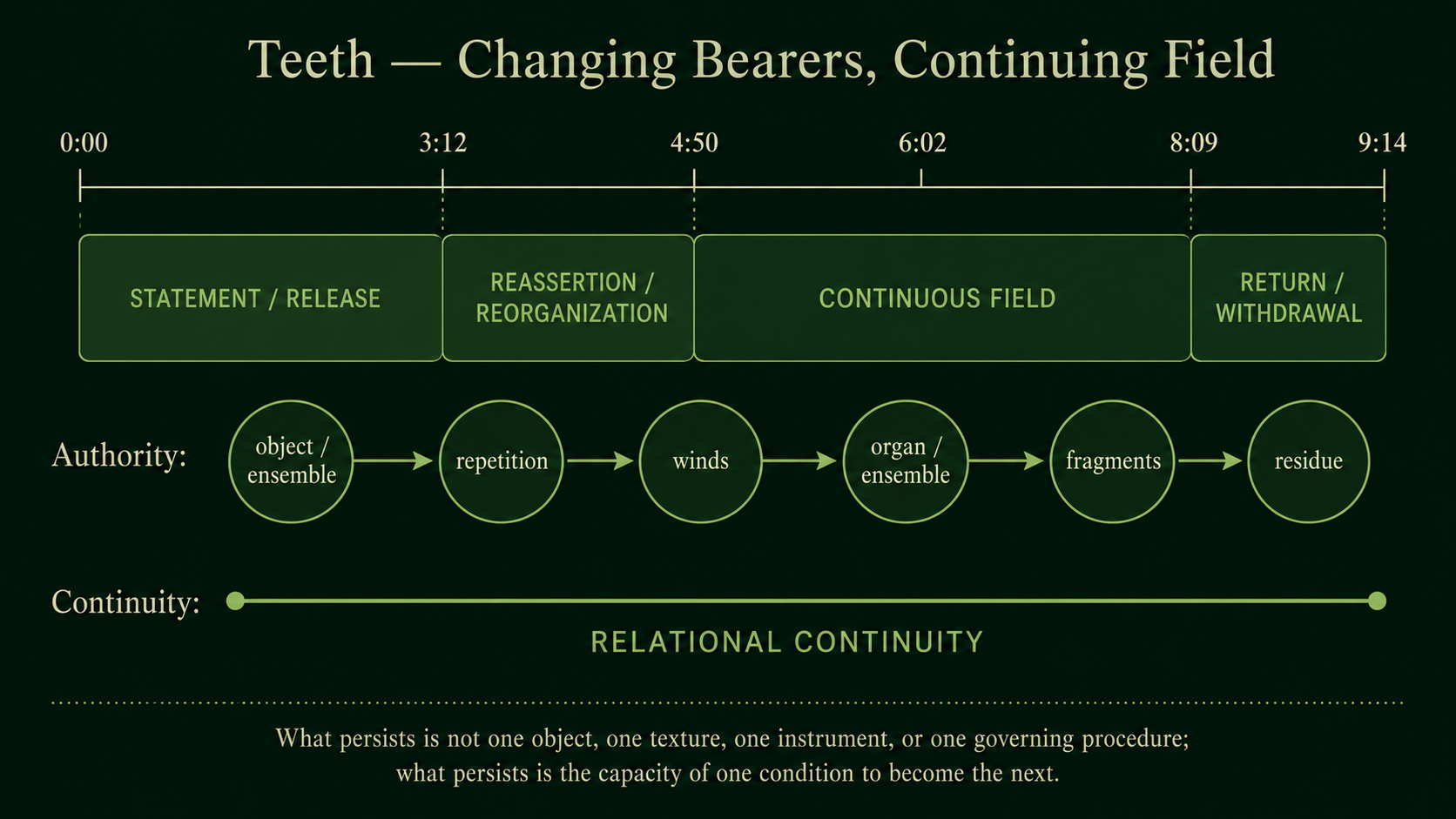
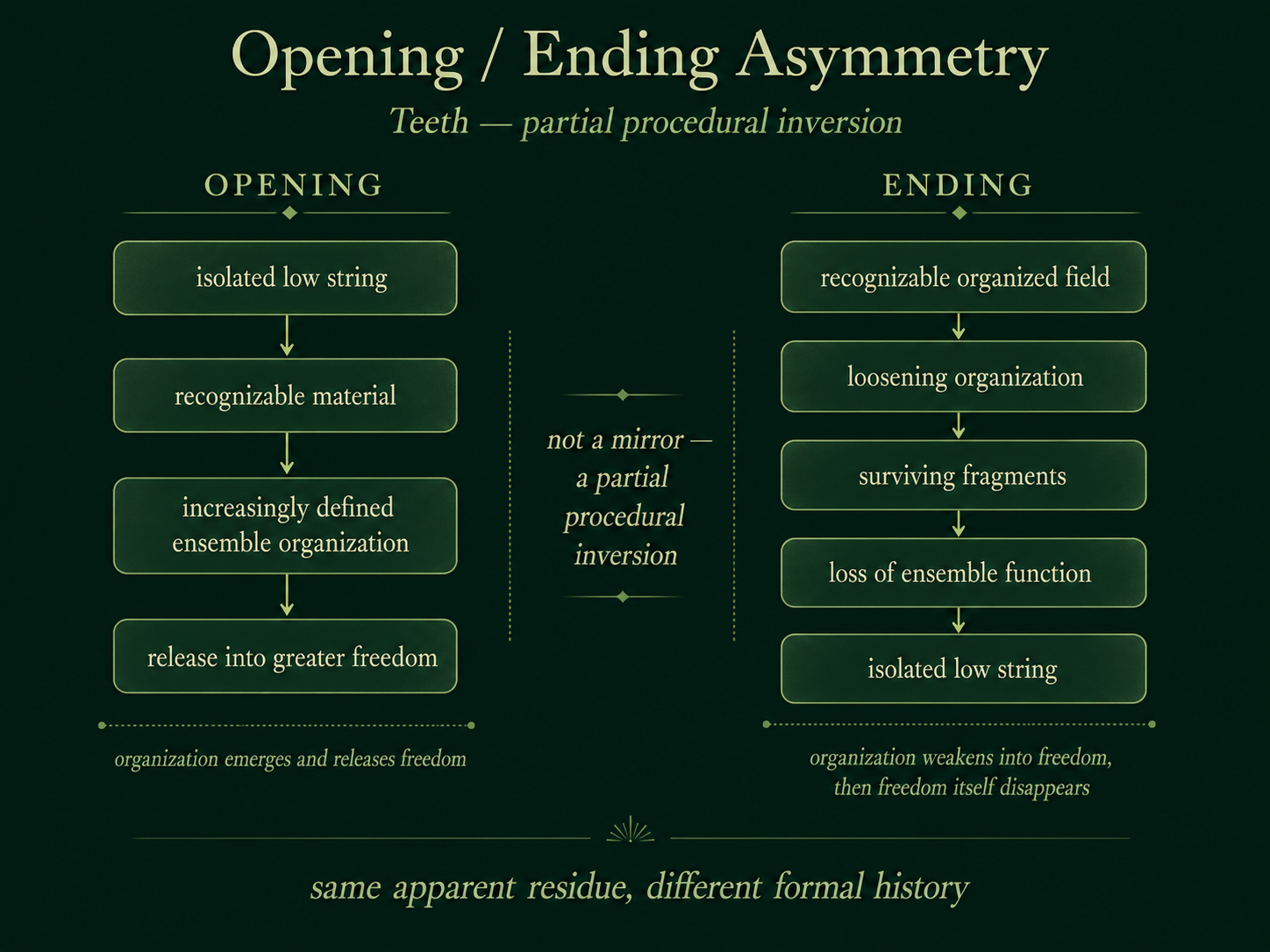
In “Teeth,” that problem is heard most clearly as a question of authority. Its compact opening saxophone object remains strikingly stable while the freedom released around it expands, already separating material identity from formal consequence. That distinction continues beyond the object itself: organized fields can remain recognizable while their relation to control changes, and a foreground can pass from winds to organ without breaking the deeper continuity of the music. By the close, recognizability and authority have separated almost completely, with fragments of an established world remaining after their power to govern the larger texture has begun to weaken. “Teeth” thus presents Fourth’s shared problem in one of its most dynamic forms—continuity surviving while the means of control are redistributed and finally eroded.
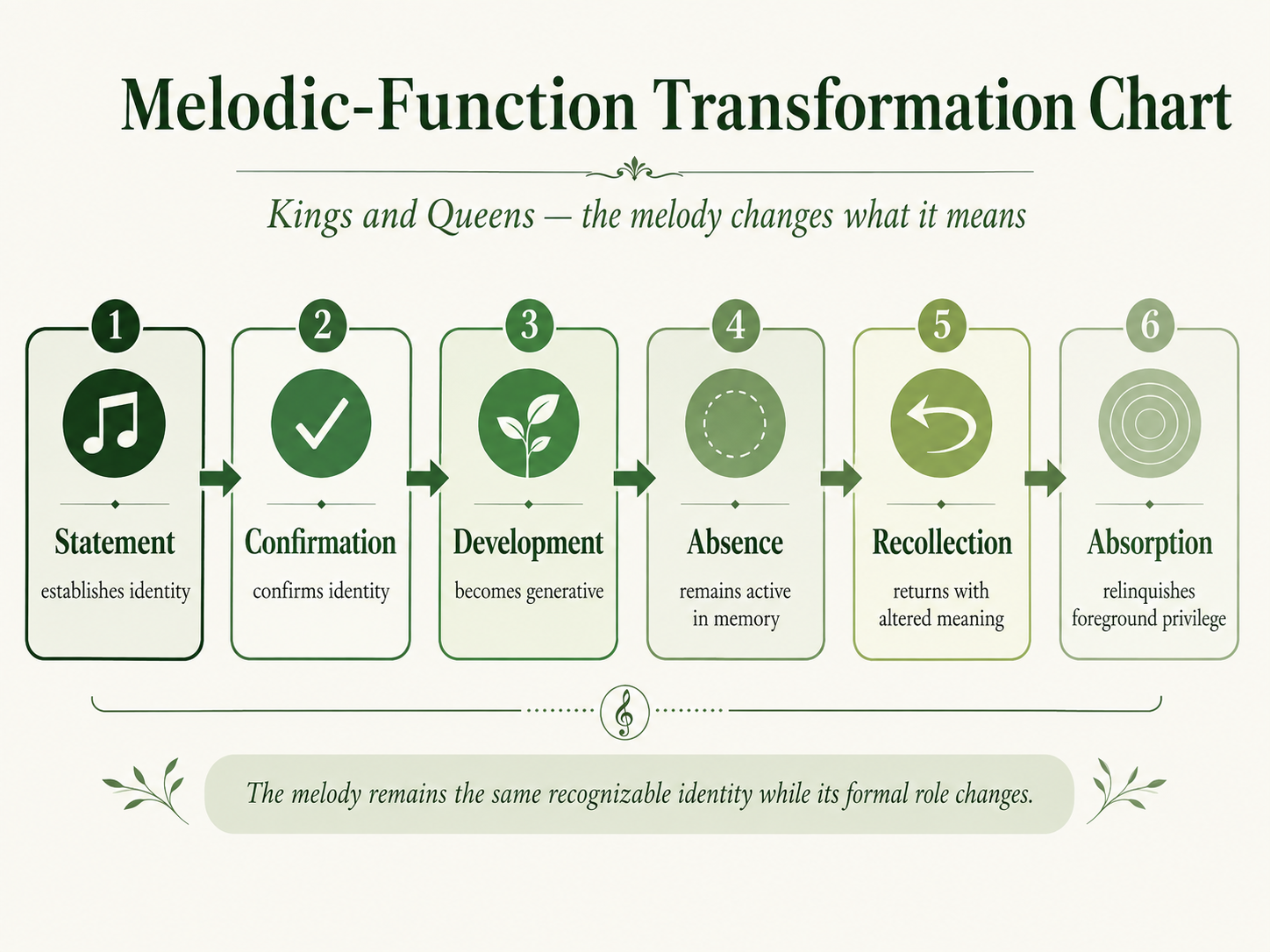
“Kings and Queens” approaches the same problem from almost the opposite direction. Its low-register, harmonic, and temporal environment is unusually persistent, and the principal melody is strong enough to retain its identity through development, absence, and return. Because so much of that world remains available, the piece can draw formal consequence from comparatively subtle reallocations. The ground can become more perceptually prominent without becoming a new theme, and the melody can return unmistakably while no longer possessing the same privilege it held at the beginning. Here continuity is not chiefly something that survives repeated transformation. It is the condition that makes smaller changes of permission and responsibility matter. In this sense, “Kings and Queens” reverses the emphasis of “Teeth”: where “Teeth” demonstrates how continuity can survive transformation, “Kings and Queens” shows how continuity can make transformation possible in the first place.
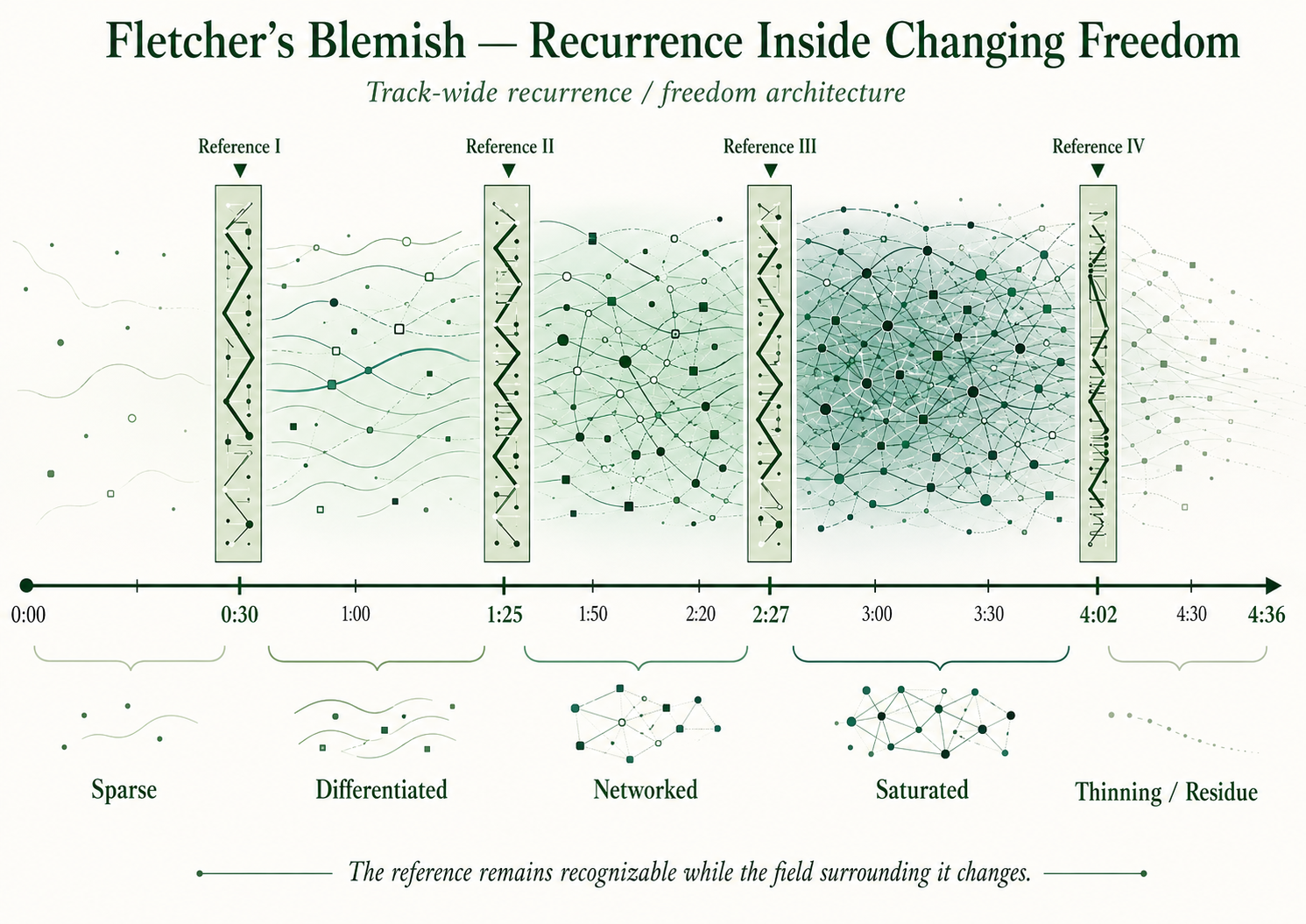
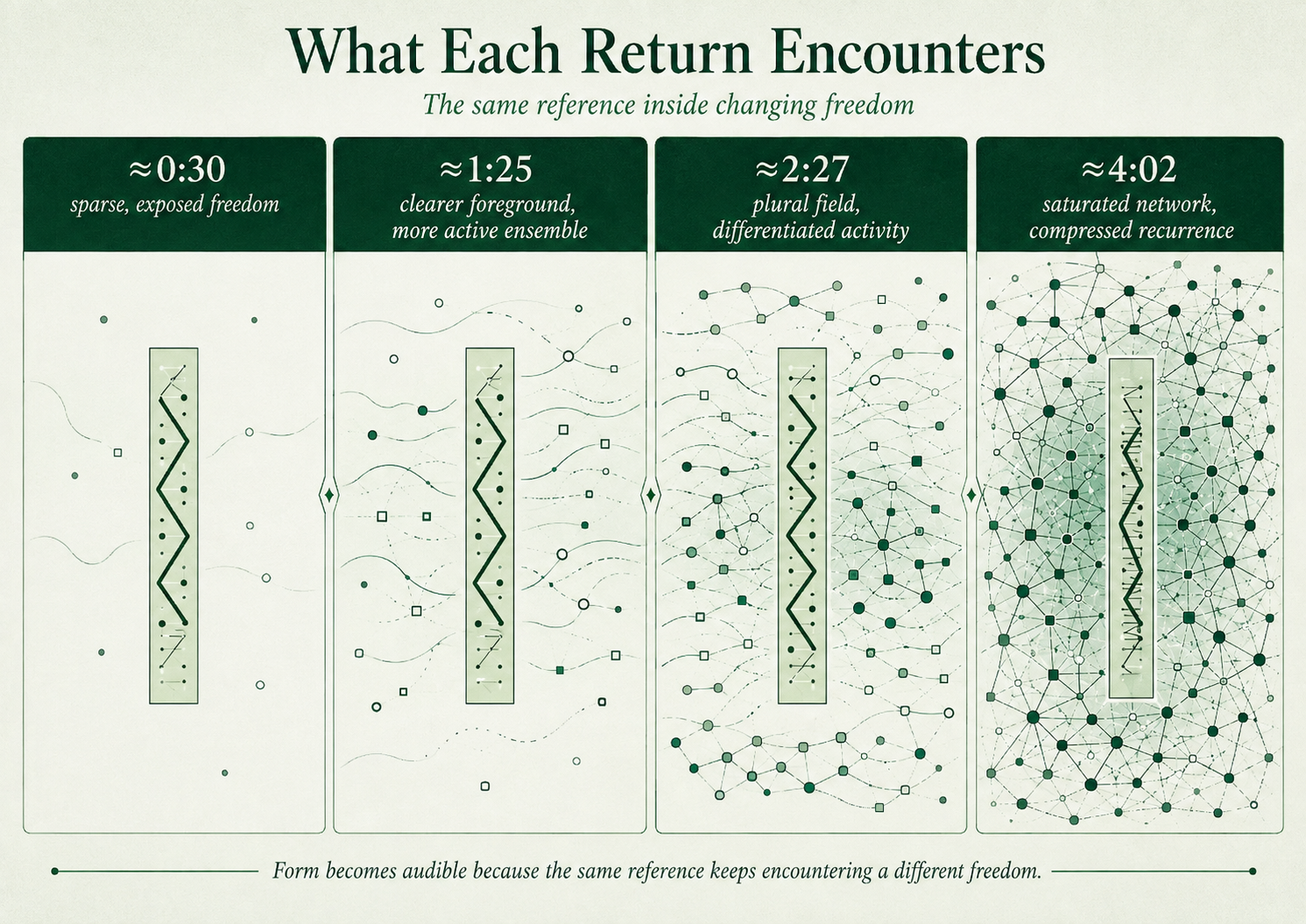
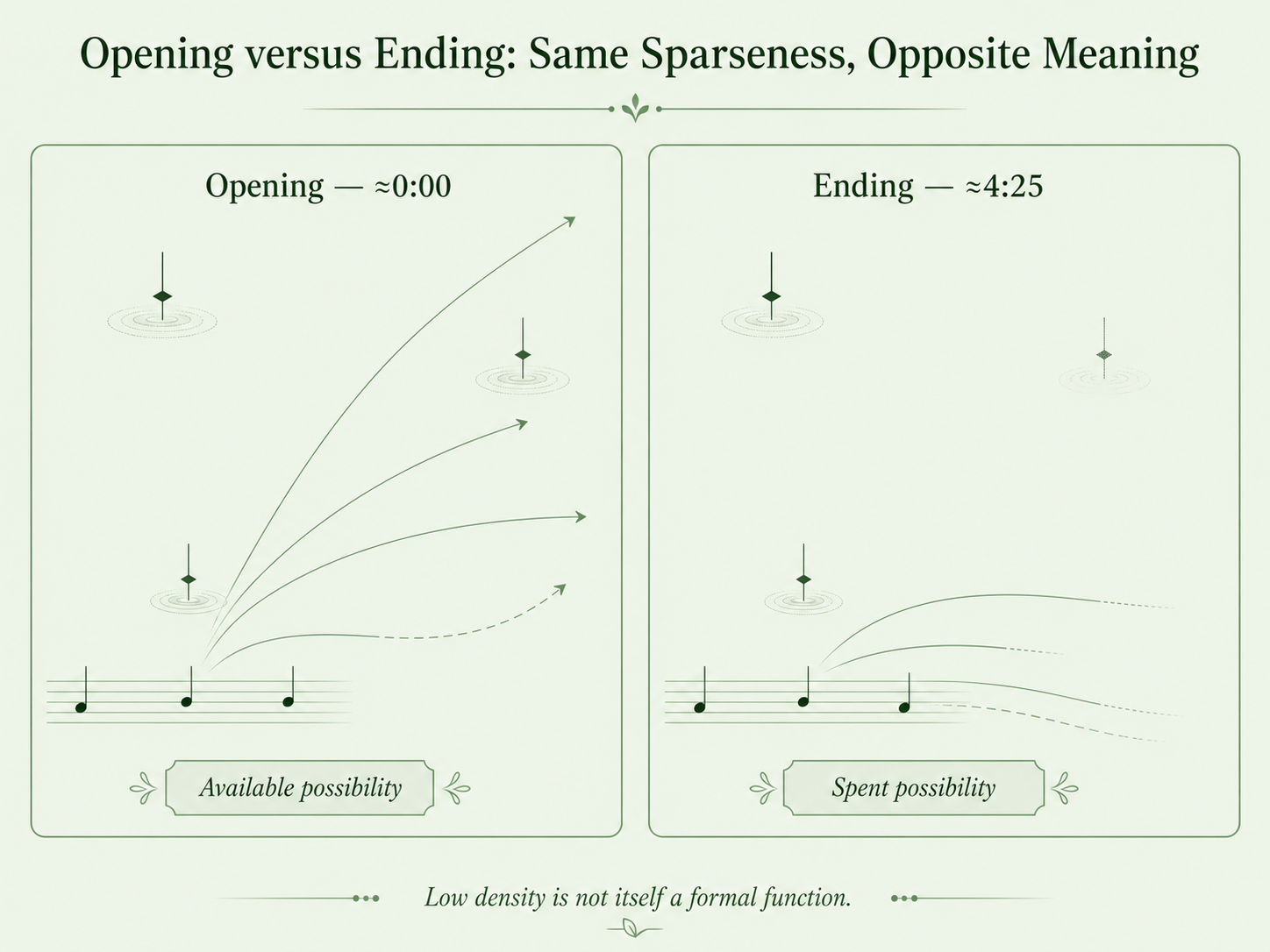
“Fletcher’s Blemish” pushes the distinction somewhere neither of those pieces quite reaches. Its recurring angular passages provide unmistakable reference, but the deepest development does not lie primarily in changing the formal job of that recurring material. The angular family continues broadly to gather the ensemble into moments of shared agreement before releasing it again. What changes more radically is the freedom surrounding those returns. The improvisational fields become progressively more differentiated, developing from relatively legible exchanges into a network of simultaneous relationships and eventually reaching saturation, where individual gestures remain vivid but possess less power to redirect the whole. The recurring reference therefore functions less as a developing theme than as a stable measuring point. By the final release, the reference still works and freedom still follows, but that freedom can no longer regenerate another substantial field. “Fletcher’s Blemish” thus reveals why Fourth cannot be described simply as an album in which familiar material changes function: sometimes the recognizable object remains comparatively stable while the generative capacity of the surrounding musical condition is what changes.
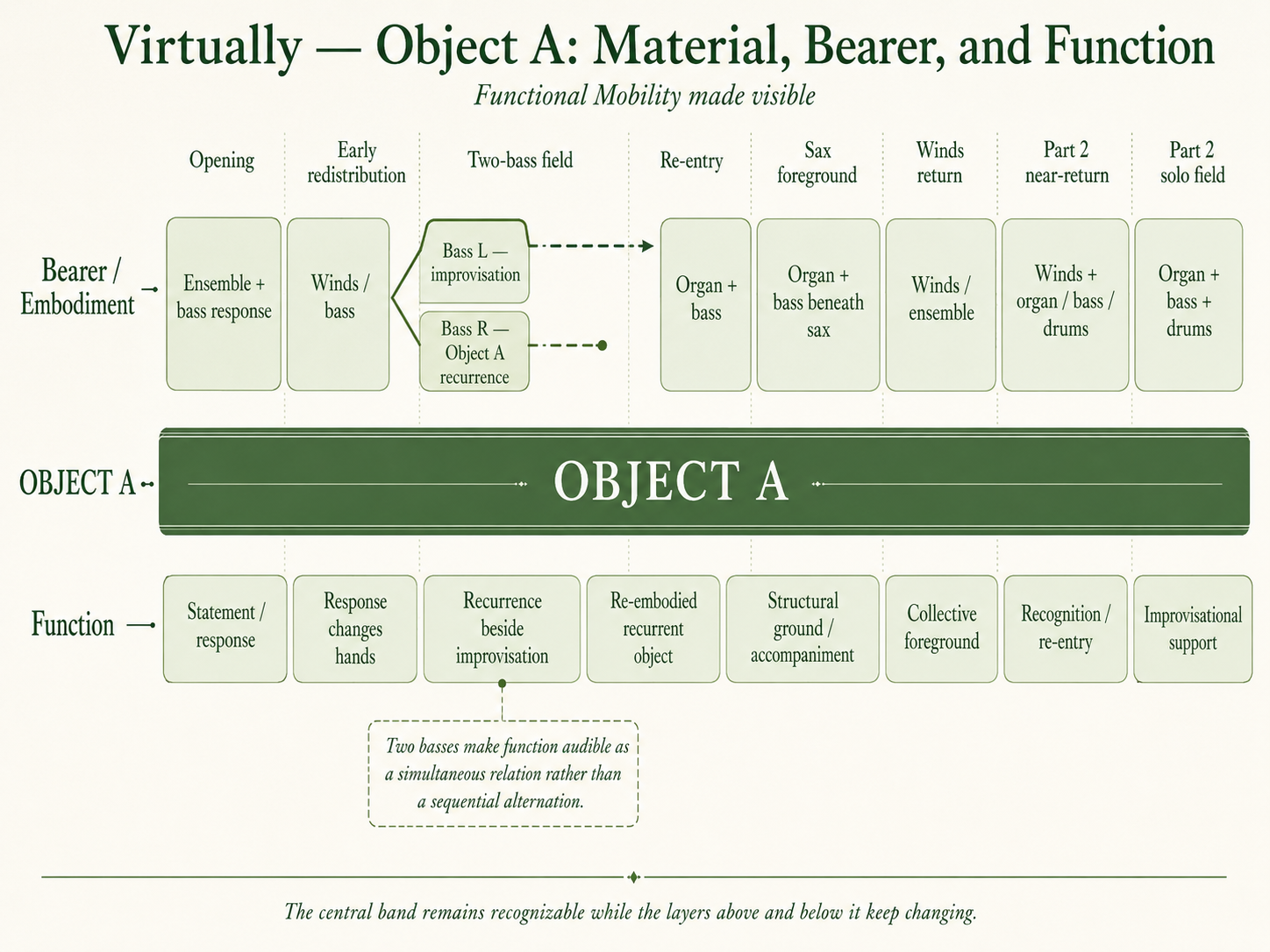
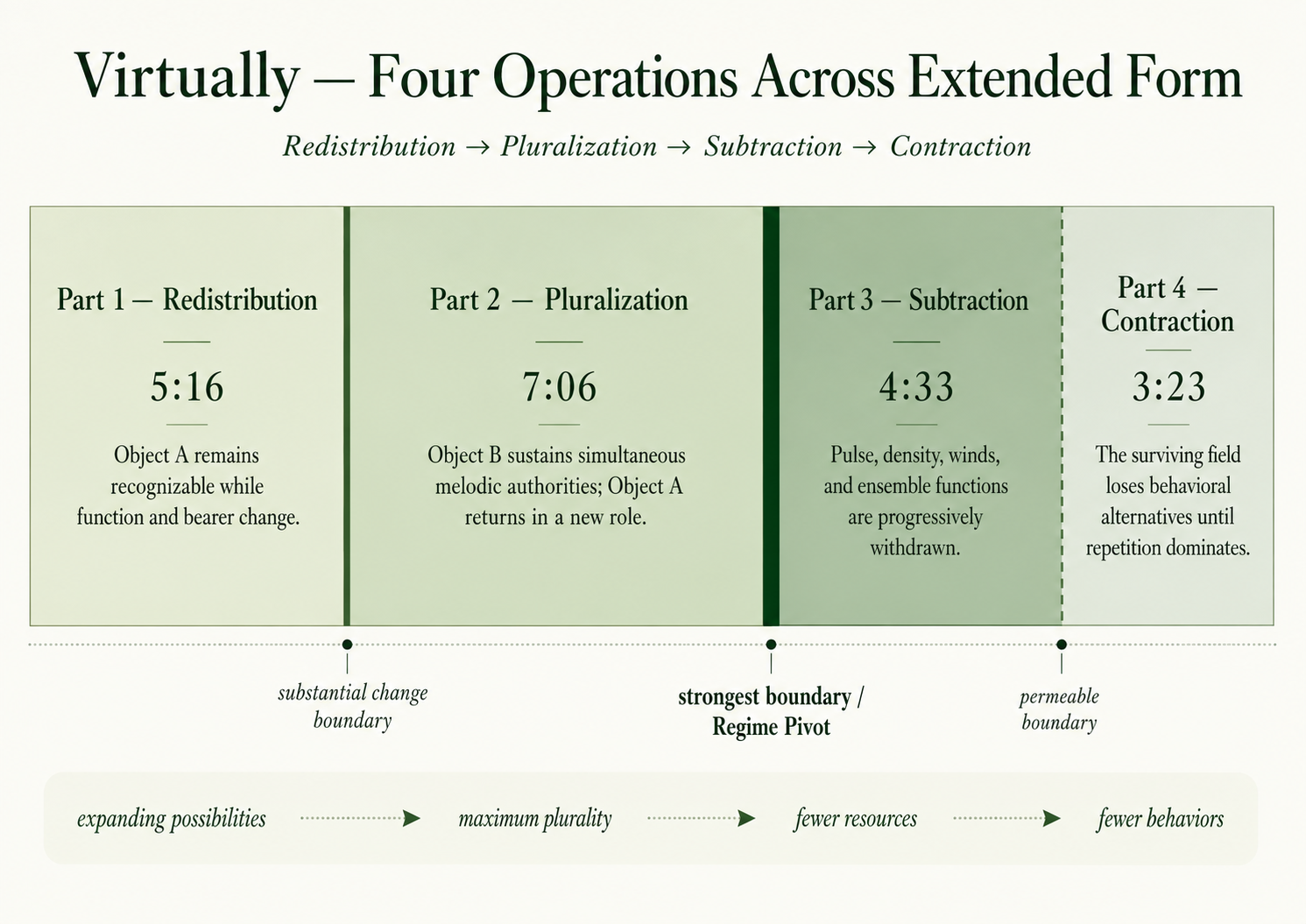
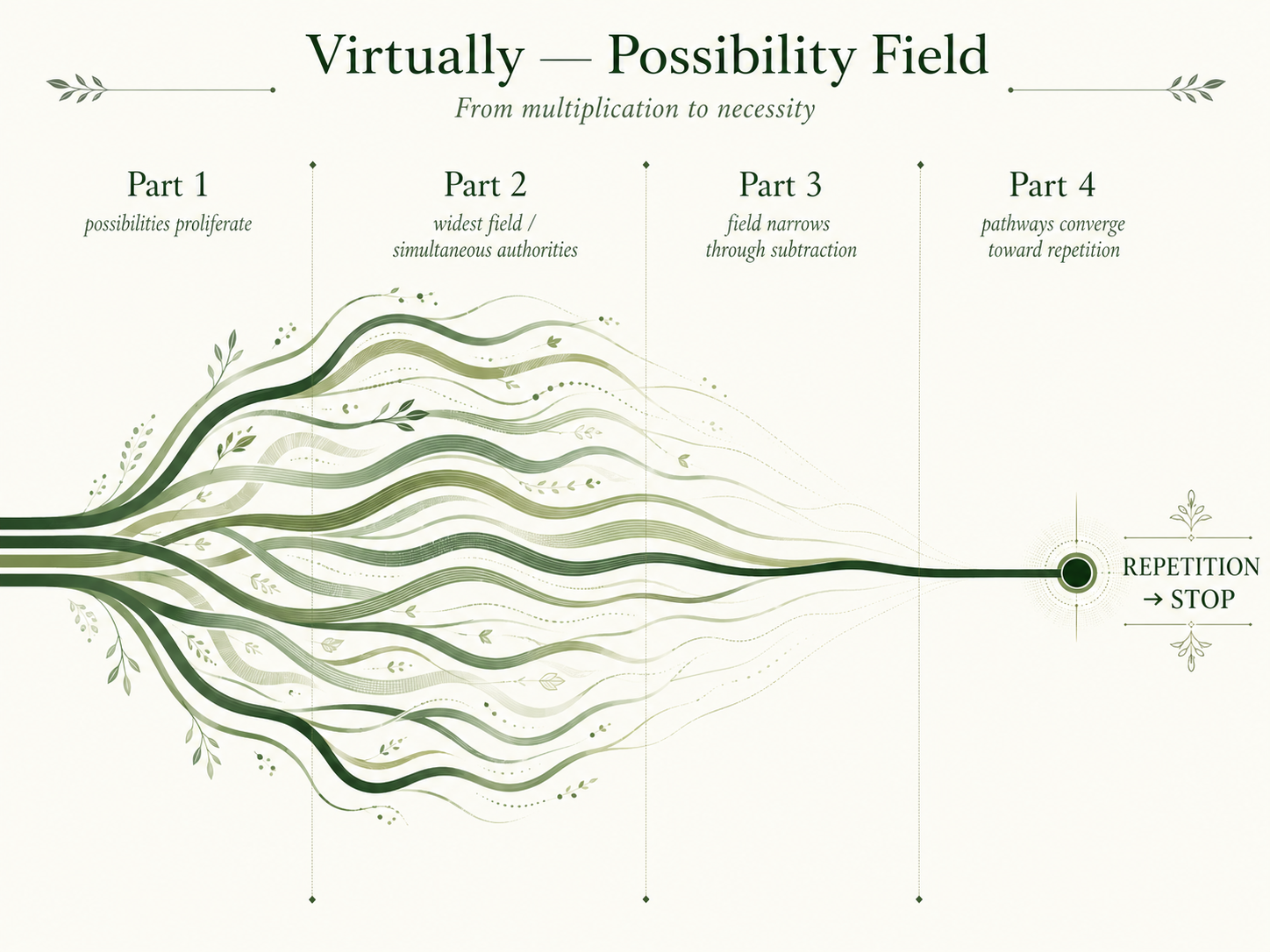
“Virtually” broadens the problem again by extending it across almost an entire LP side. Object A remains recognizable while changing bearer and function: material that begins in the foreground can later become structural ground, recurrence can coexist with improvisation, and responsibility can divide among simultaneous voices. The second half reverses that expansion. Functions and bearers are progressively removed, then the surviving field itself loses behavioral range. The resulting large-scale movement—Redistribution → Pluralization → Subtraction → Contraction—is therefore not simply a succession of contrasting textures. It is a history of changing possibilities. Early in the piece, familiar material acquires more possible functions and embodiments; later, fewer resources remain, and finally what survives has fewer possible ways to continue. “Virtually” makes explicit on the largest scale what the shorter tracks establish in different ways: formal direction can arise because the available future of a recognizable musical condition changes.
Placed beside one another, these architectures resist reduction to a single mechanism. Mobile Authority is central to “Teeth” and important elsewhere, but it cannot account for the relatively persistent world of “Kings and Queens” or for the changing generative condition of freedom in “Fletcher’s Blemish.” Recurrence is pervasive, but it can release freedom, reactivate memory, measure transformation, become structural support, or persist after its earlier consequences have weakened. Nor does the opposition between composition and improvisation explain the larger pattern. Written material can remain behaviorally mobile, freer passages can retain inherited organization, and recognizable frameworks can continue while the degrees of freedom available inside them change. The four pieces are therefore unified less by what kind of material they contain than by what happens to the possibilities attached to musical conditions that remain legible.
That is where their differences begin to converge. In “Teeth,” capacity is heard chiefly as the power to control or release continuation. In “Kings and Queens,” it appears as permission, prominence, and melodic privilege inside a durable framework. In “Fletcher’s Blemish,” it becomes the ability of a collective field to generate relationships and later to renew itself after saturation. In “Virtually,” it expands into the number of functions, bearers, simultaneous authorities, and behavioral alternatives available before those alternatives begin to disappear. None of these is reducible to the others, and that irreducibility is crucial. Fourth does not repeat one answer four times. It repeatedly asks the same deeper question from different formal positions: how can a musical condition remain recognizable while what it can make possible changes?
Sectional Conclusion. The architectural unity of Fourth therefore lies neither in thematic sameness nor in a shared sequence of formal events. “Teeth,” “Kings and Queens,” “Fletcher’s Blemish,” and “Virtually” preserve continuity at different levels and generate direction through different mechanisms, but all depend on a separation between musical identity and musical capacity. An object can remain stable while releasing greater freedom; a melody can retain its identity while losing privilege; a recurring reference can remain intact while the field it releases changes its ability to generate relationships; and a familiar riff can multiply its functions before the surviving field loses alternative ways to continue. The album’s coherence emerges from these differences rather than despite them. What persists provides the listener with orientation; what changes is the range of consequences that persistence can still produce.
From Shared Question to Durable Identity. Recognizing that common problem does not yet explain how the four compositions remain intelligible while so much about their behavior changes. The next step is therefore to separate more carefully what the listener recognizes from what that recognition is capable of doing. On Fourth, identity can survive changes of function, authority, privilege, and generative power—and that durability is what allows changing capacity to become audible as form.
II. Identity Is More Durable Than Its Consequence
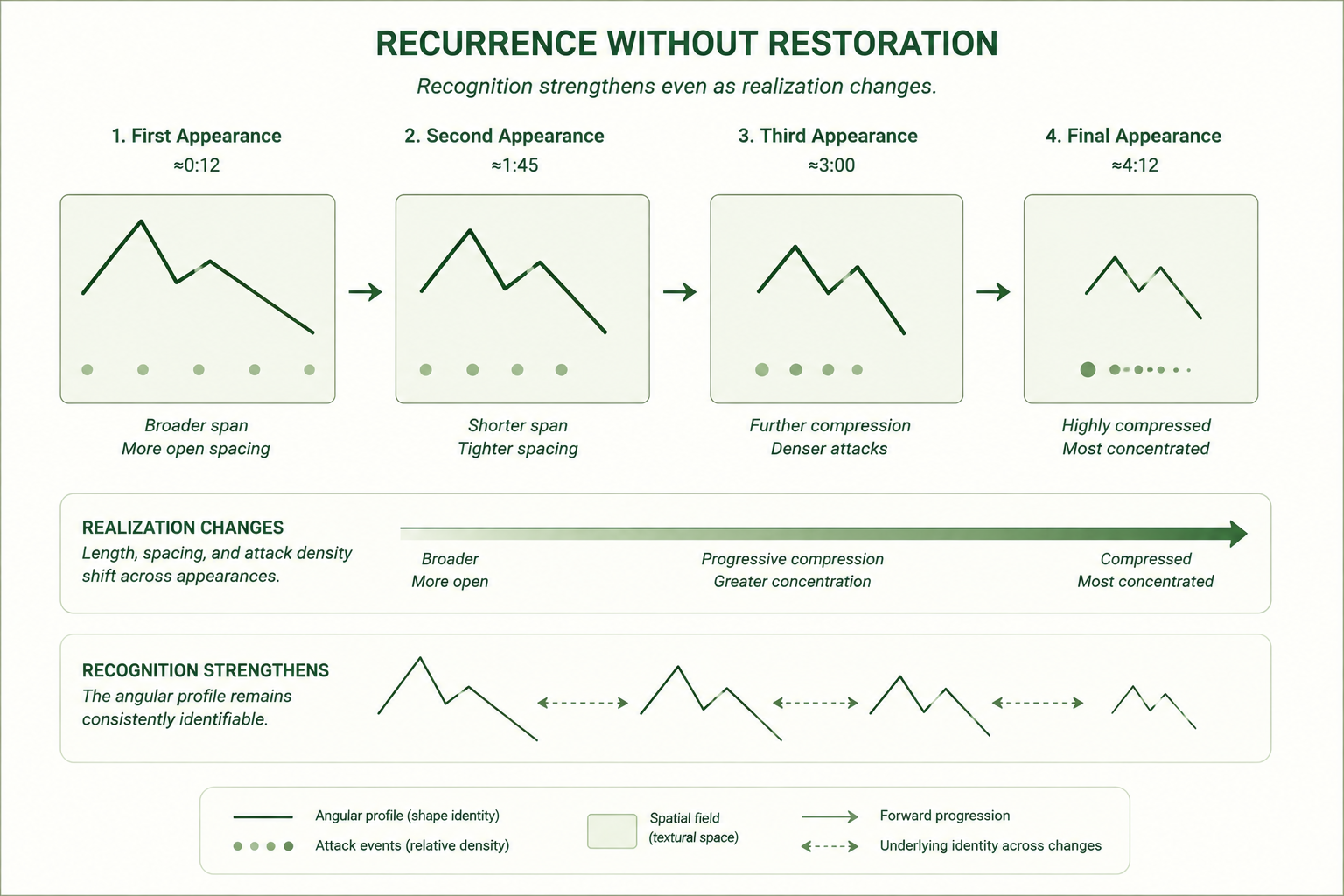
The shared question established by the four compositions becomes sharper once identity is separated from consequence. On Fourth, something can remain recognizable long after the conditions that first gave it meaning have changed. A melody may return without recovering its earlier privilege; a recurrent object may survive while moving between statement, support, and structural ground; an organized field may remain audible after its power to govern has weakened; and a recurring reference may continue to perform its identifying function even when the freedom it releases no longer produces the same kind of world. Recognition, in other words, does not guarantee restoration. The listener may know exactly what has returned and still find that its formal future has changed.
This distinction is crucial because much of Fourth’s movement occurs without requiring material to lose its identity. The album repeatedly allows recognizable conditions to outlive the particular jobs, powers, or possibilities once attached to them. That durability gives the music an unusually precise way of making transformation audible. If everything changed at once—material, role, hierarchy, surrounding field, and consequence—there would be little against which the change could be measured. Instead, Fourth often keeps one dimension comparatively stable while altering another. The persistence of identity becomes the fixed point from which differences of function, authority, privilege, freedom, or generative power can be heard.
Yet even function is too narrow a term for what changes across the album. In “Teeth” and “Virtually,” familiar material can indeed assume different formal roles, but “Fletcher’s Blemish” reveals a broader possibility: the recurring angular material can retain much the same broad operation while the capacity of the surrounding free field changes dramatically. “Kings and Queens” makes a related point from another direction, since the principal melody can remain itself while the degree of freedom and privilege attached to that identity shifts within a persistent musical world. What changes across Fourth, then, is not merely what recognizable things do, but what they are still able to make possible.
That broader category is musical capacity. Capacity includes function, but also authority, prominence, permission, generative power, relational reach, possible embodiment, and the range of continuations available from a given condition. To hear Fourth at this level is to stop asking only whether a theme, riff, ground, or field has returned and to ask instead what that return can now accomplish. The album’s formal imagination lies precisely in the gap between those two questions: what remains recognizable, and what has changed in the consequences that recognition can still produce?
a. When Familiar Material Changes Its Job
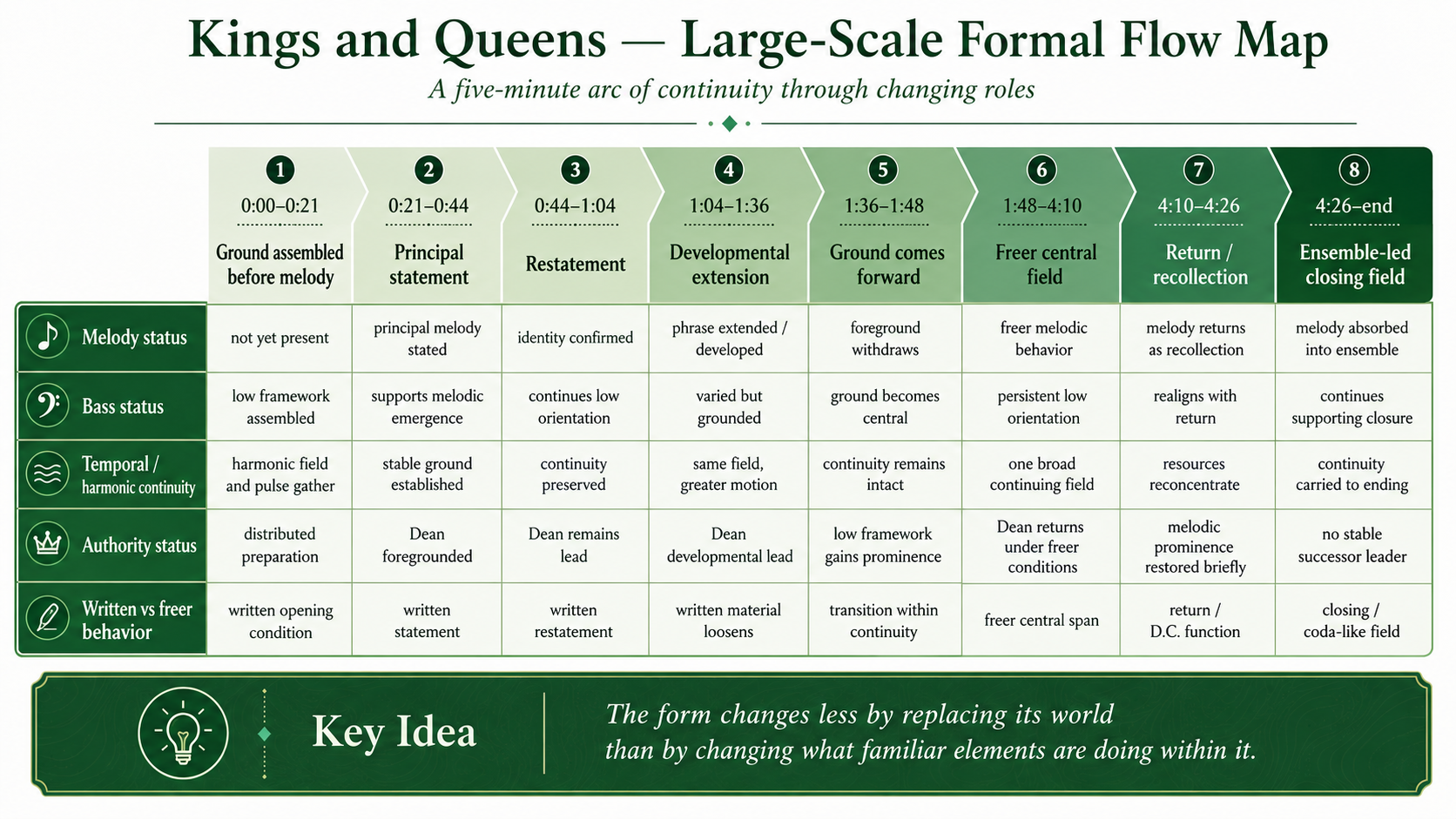
“Kings and Queens” and “Virtually” offer the clearest paired demonstration that recognition on Fourth does not determine function. In both pieces, familiar material remains sufficiently stable for the listener to know what it is, yet that familiarity does not oblige the music to use it in the same way. The principal melody of “Kings and Queens” can establish identity, confirm it, become generative, recede from explicit foreground, return as recollection, and finally become absorbed into the ensemble world from which it first emerged. Its contour and broad phrase identity remain durable enough for those changes to register as changes of role rather than as the introduction of entirely new material. The important continuity therefore lies not in preserving one fixed task for the melody, but in preserving enough of its identity for different formal responsibilities to become audible against it.
“Virtually” makes the same separation even more explicit because Object A can change not only what it does but how and by whom it is embodied. The recurrent riff can function as principal statement, as part of a statement–response relation, as structural ground beneath freer melodic activity, as collective foreground, or as support for another voice. Its instrumental realization changes as well, yet the object remains recognizable across those transfers. The formal consequence is decisive: recurrence no longer means restoration of a previous hierarchy. Familiar material can return in another body and for another purpose. What persists is the object’s identity; what changes is the network of responsibilities attached to it.
Placed beside “Kings and Queens,” this reveals two different ways in which identity can outlast function. Hopper’s melody remains tied to one unusually persistent musical world, so its changing roles are heard as reallocations within that world: what changes is how much freedom, prominence, or privilege the melody possesses at a given moment. Object A in “Virtually,” by contrast, survives much more radical redistribution. Its bearer can change, its place in the hierarchy can change, and its relation to improvisation can change, yet the listener can still hear those functions as belonging to the same recognizable material. One piece therefore derives formal consequence from changing the status of a melody inside a stable environment; the other from allowing a recurrent object to become structurally mobile across changing instrumental and functional configurations.
“Teeth” sharpens the principle from another direction. Its opening saxophone object changes comparatively little in material identity, yet the consequences attached to successive appearances expand considerably. The object does not need to be transformed in order for the form to move. Its importance lies in the different degrees of freedom it can release and, more broadly, in the way organized material throughout the track can change its relation to control without ceasing to be recognizable. Here again, the listener’s knowledge of what the material is becomes useful precisely because that knowledge remains steadier than what the material is doing.
These comparisons show why recurrence on Fourth cannot be understood merely as the return of musical content. Recognition creates continuity, but it does not dictate formal responsibility. A melody can come back and no longer lead; a riff can return and become support; a stable object can recur while releasing a different amount of freedom. The shared principle is therefore not simply that familiar material is transformed, but that familiarity itself becomes a platform from which changing function can be heard. Because the listener still recognizes the object, melody, or phrase-family, the change in its role does not disappear into surface novelty. It becomes one of the principal sources of formal direction.
What this reveals at album scale is a form of durability deeper than repetition. Identity can remain intact while formal purpose changes around it. On Fourth, recognition therefore does not fix function; it makes functional change audible.
b. When the Recurring Object Is Not Where the Development Happens
“Fletcher’s Blemish” complicates the principle established by “Kings and Queens,” “Virtually,” and “Teeth” because its recurring material does not carry the main burden of transformation. The angular statements remain recognizable enough to anchor the form, and their broad operation changes comparatively little: they gather the ensemble into a moment of coordinated reference and then release it again. What develops most radically is not the object itself, but the musical field that each return encounters. The recurring material therefore provides continuity without becoming the principal site of formal motion.
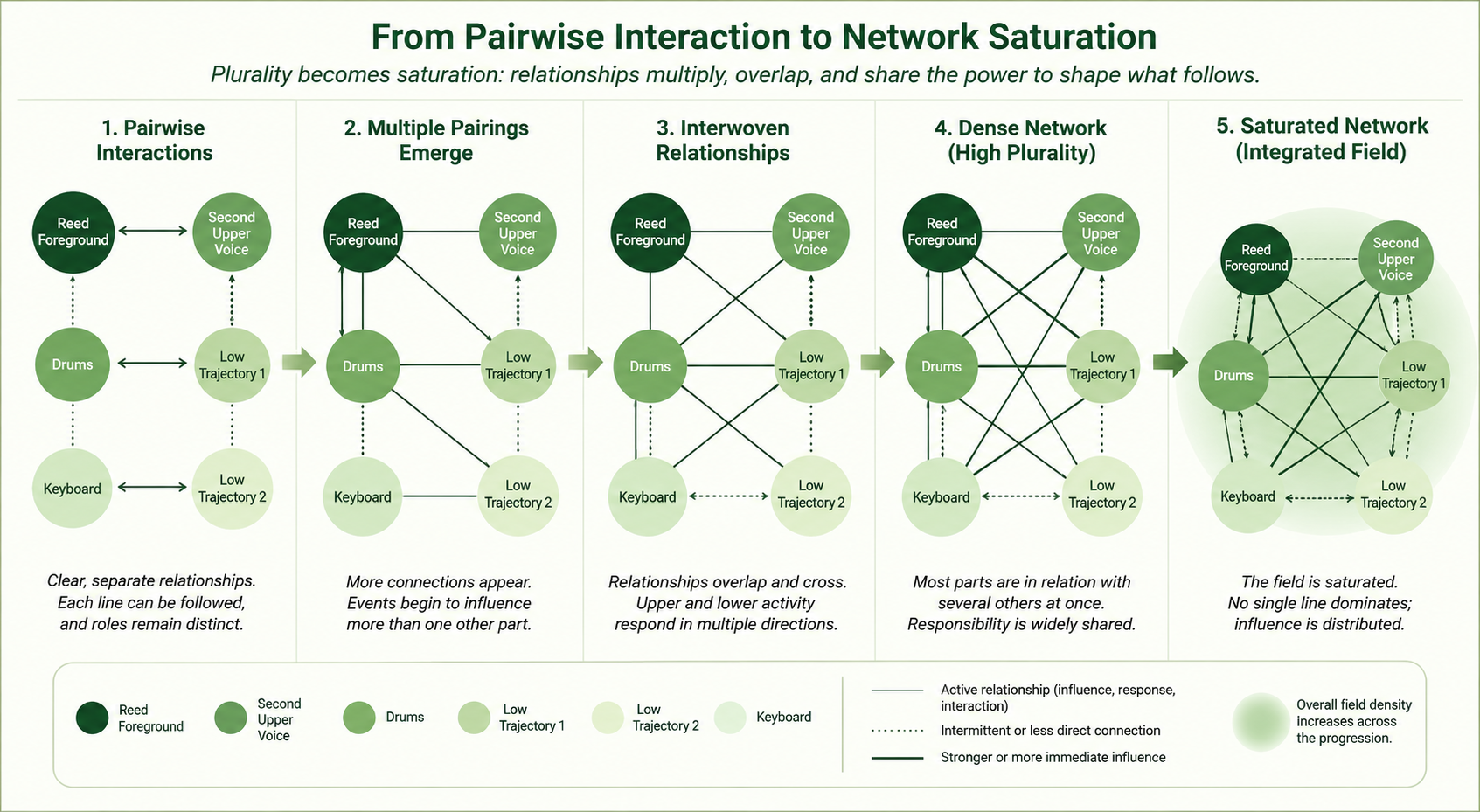
The distinction matters because it shows where a reading of Fourth based only on changing function begins to fall short. In “Virtually,” Object A can move through strikingly different roles; in “Kings and Queens,” the principal melody can acquire different degrees of freedom and privilege; in “Teeth,” a stable object can release progressively different consequences. “Fletcher’s Blemish” behaves differently. Its angular recurrence remains comparatively consistent as a point of reference while the freer ensemble around it becomes increasingly differentiated. Independent trajectories multiply, relationships that can initially be followed as relatively discrete exchanges begin to overlap, and the field gradually thickens into a denser network. The object keeps returning, but the world into which it returns is doing the developing.
This changes the meaning of recurrence. The angular material does not function primarily as a theme being progressively transformed; it acts more like a stable point of comparison. Because the listener recognizes it, each return makes the altered condition of the surrounding freedom easier to hear. What begins as relatively sparse and exposed interaction becomes increasingly plural and networked, eventually reaching a condition in which individual gestures remain audible but possess less leverage over the whole. The reference itself has not become weaker. Its recognizability helps expose how much the field around it has changed. Recurrence here measures transformation more effectively than it carries that transformation within itself.
The final recurrence makes that distinction especially clear. The angular material still performs its familiar operation: it briefly reconcentrates the ensemble and releases the music back into freedom. Yet the consequence of that release is no longer what it was earlier. The field does not proliferate again, and no new configuration gathers enough momentum to rebuild the kind of relational world that earlier releases could sustain. The recurring procedure therefore remains viable even as the generative capacity of the field it releases has diminished. Identity survives; the future available to that identity has changed.
Beside the other tracks, this broadens the album argument considerably. “Teeth” often locates development in changing authority attached to recognizable conditions. “Kings and Queens” locates it in changing permission and privilege inside a persistent world. “Virtually” repeatedly changes the functions and bearers available to its materials. “Fletcher’s Blemish” shows that development can continue even when the recurring object itself changes comparatively little in formal role. What changes instead is what the surrounding ensemble can generate each time that recurrence opens the field again.
That is why capacity is a more accurate album-level category than function alone. Function asks what a material or voice is doing at a given moment. Capacity asks something broader: what can this condition still produce, sustain, permit, organize, or become? In “Fletcher’s Blemish,” the most important transformation lies in that broader domain. The same reference can continue to return while the surrounding freedom first sustains more relationships and later becomes less capable of renewing them. What changes is not only the job of an object, but the productive potential of the musical world surrounding it.
“Fletcher’s Blemish” therefore provides the necessary corrective to any reading of Fourth centered too narrowly on thematic refunctionalization. The album’s deeper formal concern is not simply that recognizable things acquire new roles. It is that recognizable conditions allow the listener to hear changes in what a field can generate, what a relationship can sustain, and what an ensemble can still become.
c. Capacity as the Broadest Category
The comparisons above make clear why capacity has to remain broader than any one of the more familiar analytical categories. Identity tells us what remains recognizable. Function tells us what a material or voice is doing. Authority tells us how much control it exercises over what follows. Privilege concerns how strongly a material is allowed to occupy the foreground or organize attention. Generative potential concerns what kinds of new relationships or continuations a field can still produce. Behavioral alternatives concern how many different futures remain open to the music. These categories overlap, but they are not interchangeable, and Fourth repeatedly depends on their separation.
“Teeth” makes the distinction between function and authority especially clear. Organized material may continue to perform an identifiable role even after its ability to govern the larger field has weakened. A recurring object can remain structurally meaningful without possessing lasting control, and a foreground voice can become newly prominent without creating a new formal condition. The piece therefore shows that formal presence is not the same as formal power. What matters is not only whether an object or field remains active, but how much leverage it still possesses over continuation.
“Kings and Queens” exposes another dimension. Its principal melody can remain unmistakable while the privilege attached to that identity changes. At first it organizes attention almost by definition; later it can return as remembered material without recovering the same degree of formal centrality. The surrounding ground does not need to disappear for this change to matter. Because the low, harmonic, and temporal world remains durable, a change in melodic privilege becomes audible as a structural event in its own right. Here capacity is not chiefly a question of control, but of what a familiar identity is permitted to do inside an already intelligible environment.
“Fletcher’s Blemish” moves beyond both of those cases. Its recurring angular material remains comparatively stable as reference, while the more important changes occur in the relational reach of the free field itself. At one point, individual gestures can still provoke clearly audible responses or local reorientations; later, several trajectories coexist so densely that no single gesture has the same ability to redirect the whole. The field may therefore contain more activity while possessing less regenerative leverage. This is not adequately described as a change of function or authority alone. What has changed is the field’s capacity to generate consequence.
“Virtually” expands the same logic into the domain of behavioral alternatives. Early in the piece, material can occupy multiple roles, migrate between bearers, coexist with improvisation, and support several simultaneous authorities. Later, the number of active resources diminishes; later still, the surviving field remains in place while the range of possible behaviors contracts. The important distinction is that fewer instruments or functions do not automatically mean less form. The deeper shift occurs when what remains has fewer ways to continue. Capacity here is therefore heard as the narrowing or expansion of possible futures available to the music.
Seen together, these cases show why the broader category matters. A musical condition may preserve its identity while changing its function; preserve its function while losing authority; retain authority locally while losing privilege globally; remain active while generating fewer relationships; or survive in reduced form while its behavioral alternatives collapse. None of those transformations can be captured fully by asking only whether the material has changed or whether it still occupies the foreground. What matters is the changing range of consequences attached to what remains.
Capacity therefore gives the album argument its widest reach. It allows “Teeth,” “Kings and Queens,” “Fletcher’s Blemish,” and “Virtually” to remain formally distinct while still participating in one larger problem. Their differences are not exceptions to the argument; they are the evidence for it. One track makes authority the decisive variable, another privilege, another generative potential, another behavioral range. The shared concern lies at a deeper level: recognizable musical conditions remain in view long enough for the listener to hear their powers change.
Sectional Conclusion. The distinction between identity and consequence is therefore only the beginning. On Fourth, function, authority, privilege, generative potential, and behavioral alternatives can all change independently enough to become formally meaningful, while the musical condition carrying them remains recognizable. Capacity is the broadest useful category because it names not one specific role, but the changing range of things a material, field, relationship, or ensemble condition can still make happen. On Fourth, identity often persists long enough for the listener to hear its capacity change.
From Capacity to Continuity. Once identity and capacity are separated, a further question becomes unavoidable: what allows those changes to remain intelligible as part of one continuing form rather than as a succession of replacements? The next section turns to the album’s deeper infrastructure—the relationships that persist across changing materials, roles, and degrees of freedom, and that make transformation audible without requiring literal sameness.
III. Relational Continuity — The Infrastructure Beneath
the Four Forms
If changing capacity gives Fourth its direction, Relational Continuity is what allows that direction to remain intelligible. The album does not preserve continuity by keeping the same material, texture, hierarchy, or degree of freedom in place. Instead, it repeatedly allows one musical condition to become another while enough of the underlying relationships survive for the listener to hear consequence rather than replacement. Sometimes that continuity is carried by a recognizable object; sometimes by a persistent ground or harmonic-temporal environment; sometimes by a recurring pattern of interaction; sometimes by a function that remains legible even after the material that first embodied it has disappeared. What persists, then, is not one fixed substance but a network of connections strong enough to keep transformation inside the same formal world.
That distinction is essential because Relational Continuity does not by itself explain why the music moves. It explains why the movement remains connected. “Teeth” can pass through changing forms of authority because one state leaves audible consequences in the next. “Kings and Queens” can alter melodic freedom and privilege because the ground beneath those changes remains intelligible. “Fletcher’s Blemish” can move from sparse interaction toward networked saturation because recurring relational behaviors continue to make the field legible even when pulse, harmony, and hierarchy remain unstable. “Virtually” can retain coherence after Object A has largely disappeared because functional responsibilities continue to be inherited, reassigned, reduced, and carried forward. The four pieces therefore preserve continuity at different levels, but in each case that continuity provides the listener with the memory against which changing capacity can be heard.
Relational Continuity is thus the album’s infrastructure rather than its destination. It keeps identities, functions, and consequences connected across change; changing capacity determines what those connections come to mean. Without that underlying continuity, the transformations of Fourth would register mainly as succession. Because it is present, they register as development.
a. Different Things Can Carry Continuity
Relational Continuity on Fourth does not reside in the same kind of musical thing from track to track. That variability is part of what makes the album’s architecture so distinctive. In one piece, continuity may depend initially on the persistence of a compact object; in another, on a ground that remains perceptible beneath changing melodic behavior; elsewhere, on recurring patterns of interaction rather than on any stable pitch material; and in the longest composition, on functions and responsibilities that remain intelligible even after the recurrent object that first made them audible has largely disappeared. The album therefore does not merely demonstrate that continuity can survive change. It demonstrates that the carrier of continuity itself can change from one architecture to another.
“Teeth” makes this especially clear because the basis of recognition broadens as the piece proceeds. Early continuity is easy to locate in the recurring saxophone object: its material identity is stable enough to connect successive releases into freedom. Later, however, recognition no longer depends on one compact statement. A broader melodic-harmonic field can return without literal melodic restoration, and continuity can pass through changes of instrumental bearer while the deeper environment remains intelligible. Even recurring formal operations—the contraction of a complex field to one surviving pitch, for example—can create resemblance without requiring the same instrument or the same surface. What persists across “Teeth,” then, gradually shifts from object to field to relation. Continuity becomes less dependent on identifying a single recurring thing and more dependent on hearing how one condition carries consequence into the next.
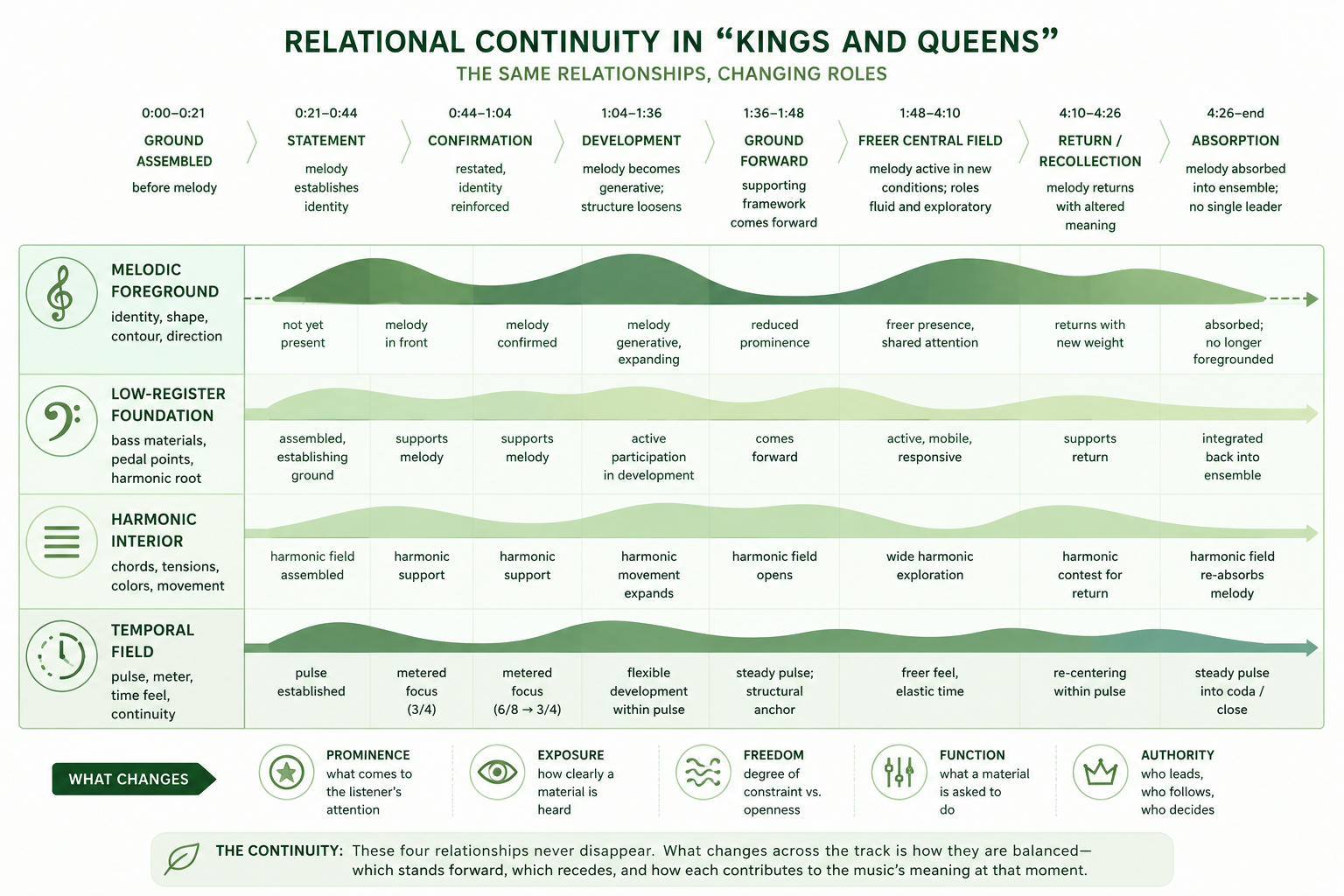
“Kings and Queens” achieves continuity through a different distribution of stability. Its principal melody is exceptionally memorable, but the piece would not remain coherent through changes of melodic freedom on melody alone. Hopper’s low-register orientation, Ratledge’s harmonic interior, and Wyatt’s temporal field provide a durable environment in which Dean’s line can change its degree of prescription, prominence, and privilege without losing location. None of these layers is literally fixed. The bass varies, the harmonic support breathes, the rhythmic surface remains flexible, and the melody itself changes substantially. Yet their relationships remain stable enough for the listener to recognize one continuing musical world. Here continuity is carried less by the persistence of an object through radical transformation than by the durability of the environment in which transformation occurs.
The contrast with “Fletcher’s Blemish” is instructive because that piece lacks just such a stable harmonic-temporal ground. Pitch center, pulse, density, and hierarchy remain far more volatile. The angular recurrence supplies the clearest material reference, but continuity between those appearances cannot be attributed to recurrence alone. The free fields also preserve characteristic relational behaviors: voices answer and overlap, counterstatements emerge, upper and lower trajectories differentiate, temporary convergences form and disperse, and changes in rhythmic pressure alter the field without fixing it into one stable regime. What gives these free regions coherence is therefore not a continuing bass pattern, harmonic frame, or thematic ground, but the recurrence of ways in which the ensemble relates. Even when the actual events change, the listener can continue to hear recognizable forms of interaction.
That distinction becomes especially important once the free fields grow denser. The music does not remain continuous because the same gestures recur in the same order. It remains continuous because previously established relationships become more numerous and increasingly interdependent. Pairwise exchange develops into overlapping interaction; differentiated voices become a network; the network eventually reaches saturation. The material surface is constantly renewed, but the relational logic remains audible enough for that growth to register as cumulative rather than arbitrary. In “Fletcher’s Blemish,” continuity is therefore partly behavioral: the field remains intelligible because the kinds of relationships it can sustain have a history, even when the notes and local hierarchies do not.
“Virtually” pushes continuity one step farther by showing that even recognizable recurring material need not remain present for the form to retain consequence. Object A supplies an exceptionally clear reference during the first half, but the deeper coherence of the twenty-minute design eventually resides in the functions and responsibilities that the object has helped establish. Roles can migrate between instruments, divide among simultaneous bearers, become plural, disappear, or be concentrated among what remains. By Part 3, thematic recurrence is no longer sufficient to account for continuity, yet the form remains legible because low-register weight, harmonic presence, melodic mobility, and other responsibilities continue to be redistributed and inherited. The listener may no longer hear the original object, but can still hear what has become of the functions it helped organize.
Placed together, these four solutions reveal why Relational Continuity is a more useful album-level concept than thematic recurrence alone. In “Teeth,” continuity can migrate from object to field to consequence. In “Kings and Queens,” it resides strongly in the persistence of an entire musical environment. In “Fletcher’s Blemish,” it survives through recurring modes of interaction inside unstable pitch and temporal conditions. In “Virtually,” it can persist as functional inheritance after the recurrent material that initially carried it has receded. The tracks do not merely preserve different materials; they preserve different kinds of relationship to the past.
The level at which continuity resides is therefore itself variable across Fourth. Sometimes the listener recognizes a thing; sometimes a place; sometimes a way of interacting; sometimes a responsibility whose bearer has changed. That flexibility is essential to the album’s scale. It allows the four compositions to remain formally unlike one another without abandoning the deeper principle that makes changing capacity audible: something always carries enough consequence forward for the present to remain connected to what came before.
b. Continuity Does Not Require Literal Sameness
If continuity on Fourth can reside at different levels, then it follows that persistence need not mean exact repetition. The album repeatedly preserves enough of a musical condition for recognition to survive even when the surface has changed substantially. Sometimes the listener recognizes a field rather than a phrase; sometimes a melody returns with altered proportions and formal purpose; sometimes a recurrent family remains identifiable despite changing realization; sometimes the same object reappears in a different instrumental body. What matters is not literal duplication, but the survival of relationships strong enough to make difference intelligible as transformation rather than replacement.
“Teeth” and “Kings and Queens” make that distinction audible in contrasting ways. In “Teeth,” one of the most consequential late recognitions is not the return of an exact melody, but the reappearance of a broader melodic-harmonic field. Its pacing, harmonic atmosphere, and behavioral identity are close enough to an earlier condition for the listener to know that something familiar has returned, even though the local melodic surface is newly realized. This is where Recognition Without Restoration becomes especially precise: the music recovers a place without reconstructing every event that first made that place recognizable. The continuity is therefore field-level rather than phrase-level.
“Kings and Queens,” by contrast, can rely on a more explicitly melodic kind of recognition. Its principal phrase remains strongly profiled enough to survive altered articulation, phrasing, developmental freedom, and prolonged absence. When it returns, the listener does not require a mechanical duplication of its first statement in order to hear it as the same melody. Contour, pacing, internal hierarchy, and its relation to the persistent ground carry enough identity for recognition to be immediate. Yet precisely because the surrounding framework and the melody’s formal status have changed, recurrence does not reproduce the opening condition. The phrase can be the same in identity while no longer meaning the same thing.
Placed side by side, the two tracks show two different scales of nonliteral persistence. “Teeth” asks the ear to recognize a field whose local content has changed; “Kings and Queens” asks it to recognize a melody whose realization and formal privilege have changed. In one case, identity broadens beyond a specific phrase; in the other, a specific phrase proves durable enough to withstand flexible realization. Both reject the idea that continuity depends on exact restoration.
“Fletcher’s Blemish” pushes nonliteral identity into still another domain. Its angular passages form a recurring family rather than a sequence of exact copies. Their realizations vary, yet the shared angular character and coordinated ensemble behavior remain strong enough for recognition to accumulate across the performance. The object becomes clearer as a recurring identity precisely because several nonidentical appearances teach the listener what belongs to the family. Continuity therefore emerges from resemblance across variation rather than from literal repetition.
“Virtually” demonstrates the complementary possibility: an object can remain materially recognizable even when the body carrying it changes. Object A does not depend on one fixed instrumentation for its identity. It can move between different bearers and formal roles without becoming a different object each time. Instrumentation, hierarchy, and responsibility can change while enough of the riff’s defining relation remains intact for the listener to hear re-embodiment rather than replacement.
The contrast between “Fletcher’s Blemish” and “Virtually” is especially revealing. In “Fletcher’s Blemish,” the recurring family tolerates change within the object’s realization; in “Virtually,” Object A tolerates change around the object’s bearer and function. One preserves identity through family resemblance, the other through re-embodiment. Together they show that recurrence on Fourth is not bound to one criterion of sameness.
This flexibility is one of the reasons the album can sustain so much formal change without sounding arbitrary. Literal sameness would be too restrictive for what these pieces need to accomplish. Instead, Fourth preserves identity at whatever level is sufficient for memory to remain active while allowing the surface, bearer, hierarchy, or surrounding field to change.
Continuity on Fourth therefore does not mean that the music comes back unchanged. It means that enough survives for the listener to hear how it has changed.
c. Continuity Creates the Possibility of Comparison
Relational Continuity matters on Fourth for more than coherence. It gives the listener memory, and memory turns persistence into a means of comparison. A recurring object, a durable ground, a recognizable field, or an inherited function does not simply tell us that the music still belongs to the same piece. It allows us to hear how the present differs from what that same condition previously made possible. Without such continuity, change would register mainly as succession. Because something remains legible, the listener can hear transformation as altered consequence.
That is why recurrence and persistence carry so much analytical weight across the album even when they operate differently from track to track. In “Teeth,” the stability of the opening saxophone object makes the changing freedom released around it audible, and the later return of a broader field allows the weakening of organizational control to be heard against an earlier condition in which that field had greater formal leverage. The continuity does not itself create the direction; it supplies the reference from which changes in authority can be judged. The same principle is at work in “Kings and Queens,” though the reference is more environmental. Because the low-register, harmonic, and temporal world remains so durable, the listener can hear changes in the melody’s freedom and privilege without needing a new musical world to announce them.
“Fletcher’s Blemish” makes the comparative function of continuity even more explicit. The recurring angular material matters partly because each appearance allows the surrounding improvisational field to be heard against what came before. The reference remains recognizable enough to act as a measuring point, while the free fields become more differentiated, more networked, more saturated, and finally less capable of renewal. The returns do not cause that transformation. They reveal it. Because the listener knows what has come back, attention can shift to what the surrounding freedom has become. Recurrence here is therefore not merely structural punctuation; it is a device for making accumulated change perceptible.
“Virtually” extends the same logic beyond thematic recurrence. Early in the piece, Object A provides an obvious basis for comparison as its bearers and functions change. Later, however, even when the object itself is no longer the principal source of continuity, inherited responsibilities still allow the listener to compare successive states. The movement from pluralization to subtraction and then contraction remains intelligible because the functions established earlier do not vanish without consequence; they are redistributed, removed, or restricted. What the listener compares is therefore not only material identity, but what has happened to the range of musical possibilities that identity and its inherited relationships once supported.
Placed together, these cases show that persistence on Fourth is active rather than merely stabilizing. A familiar condition carries information about its own past. Each reappearance or continuation therefore arrives with an implicit history: what this object once released, what this melody once commanded, what this field once sustained, what this ensemble relation once allowed. Formal change becomes especially legible when the present condition no longer produces the same consequences as that remembered one.
This is the deeper value of Relational Continuity across the album. It does more than keep the music from breaking into disconnected episodes. It preserves enough of the past in the ear for changes in function, authority, privilege, generative power, and behavioral range to be heard against something remembered. Continuity supplies the point of comparison; capacity is what changes against it.
Sectional Conclusion.Relational Continuity is therefore the infrastructure that makes Fourth’s changing capacities audible as form. Objects, grounds, fields, relationships, and functions persist at different levels across the four compositions, not merely to preserve identity but to preserve memory. That memory allows the listener to hear when a familiar condition acquires greater freedom, loses authority, relinquishes privilege, sustains more relationships, or finds fewer ways to continue. Relational Continuity preserves intelligibility; changing capacity produces direction.
From Continuity to Consequence. Once continuity is heard as a basis for comparison, the next question is simple: what changes while that continuity remains? Across Fourth, the answer is never just one thing. Authority can shift, permission can expand or contract, a field can gain or lose generative power, and the range of available behaviors can widen or narrow. The next section follows those different forms of capacity as they become the music’s principal sources of forward motion.
IV. Changing Capacity — Four Ways Form Can Move
If Relational Continuity explains how Fourth preserves intelligibility, changing capacity explains why its forms do not simply remain in place. Across the album, movement often arises not because new material replaces old material, but because an already recognizable condition begins to exercise a different kind or degree of power. A recurrent object may gain or lose control over what follows; a melody may retain its identity while being granted more freedom or less privilege; an improvisational field may become capable of sustaining more simultaneous relationships before losing the ability to regenerate them; a reduced ensemble may remain active while the number of behaviors still available to it steadily contracts. The audible materials can remain familiar while the future they make possible changes around them.
Those changes do not belong to one common mechanism. “Teeth” makes authority the most decisive variable: the question is repeatedly who or what governs continuation, and how long that control can be maintained. “Kings and Queens” works more through permission and privilege, allowing familiar material to occupy different degrees of freedom and prominence inside a remarkably durable framework. “Fletcher’s Blemish” shifts the problem into the generative capacity of collective freedom itself, where the number and density of relationships can expand even as the leverage of individual gestures eventually diminishes. “Virtually,” finally, makes the range of available alternatives almost tangible, first multiplying functions and simultaneous authorities, then removing resources, and finally restricting what the surviving field can still do.
Taken together, these are four distinct ways in which capacity can move a form. Authority concerns the power to shape what happens next. Permission and privilege concern what a recognizable material is allowed to do inside a continuing world. Generative capacity concerns how much new relational life a field can still produce. Behavioral alternatives concern how many different futures remain open at all. None can stand in for the others, but all belong to the larger question Fourth keeps testing: not merely what remains, but what the remaining condition can still make happen.
a. Authority — What Controls What Happens Next?
Among the different forms of capacity at work on Fourth, authority is most clearly exposed in “Teeth.” The piece repeatedly separates what is present from what is actually determining continuation. A recognizable object can establish a point of order and then relinquish control to freer activity; repetition can later become authoritative not because it introduces fundamentally new material, but because recurrence itself begins to regulate what follows; organized material can remain audible even after its ability to govern the larger field has weakened. Authority in “Teeth” is therefore not attached permanently to an object, an instrument, or even a single mode of organization. It belongs to whatever condition is currently most capable of shaping what can happen next.
That distinction is crucial because authority is not identical with function. A material can continue to perform an identifiable role after losing much of its leverage over continuation, just as a recurring process can gain authority without becoming new material. “Teeth” repeatedly makes that separation audible. Fixed material can release freedom; repetition can reclaim control; a developmental field can remain coherent while the specific bearer of attention changes; and late organized fragments can preserve identity after their global authority has begun to erode. The question is therefore not simply what a material is doing, but how much consequence its activity still carries.
This is where Mobile Authority becomes useful. The term does not mean that every instrument takes turns leading, nor that the form can be reduced to a sequence of foreground transfers. It names something more structural: the capacity for formal initiative to pass among different kinds of organization without breaking continuity. In “Teeth,” authority can reside in pre-organized material, in recurrent syntax, in a developmental field, or in a more distributed ensemble relation. By the close, no single organizing condition retains enough leverage to stabilize continuation for long.
The other pieces sharpen the category by showing what authority is not. “Kings and Queens” generates much of its movement through changing melodic privilege inside a persistent framework rather than through continuous transfers of control. “Fletcher’s Blemish” can sustain intense activity even when no individual gesture possesses enough leverage to redirect the whole field. “Virtually” can preserve several consequential functions simultaneously rather than concentrating formal initiative in one place. These differences prevent authority from becoming a catch-all explanation for the album.
Placed together, the four tracks show that authority is one particular dimension of musical capacity: the power to shape continuation. It may be strong or weak, concentrated or distributed, temporarily reclaimed or gradually lost, but it should not be confused with mere presence, recognizability, or prominence. Fourth repeatedly makes changes in that power audible because recognizable musical conditions survive long enough for the listener to hear how much leverage they still possess.
Authority is therefore a function, not a possession. It belongs not automatically to the principal theme, the most audible instrument, or the most obviously composed material, but to whatever condition is currently most responsible for determining what the music can still do.
b. Permission and Privilege — What Is Familiar Material Allowed to Do?
“Kings and Queens” shows that changing capacity can be heard not only as a transfer of control, but as a change in what familiar material is permitted to do inside a world that remains recognizably stable. Its principal melody does not need to lose its identity for its formal status to change. At first, the phrase establishes the piece’s clearest melodic reference and occupies an unmistakably privileged position within the texture. Later, the same identity can become more developmental, less tightly specified, temporarily absent, recollected, and finally absorbed back into the ensemble. What changes is not whether the melody is still itself, but how much freedom, prominence, and formal consequence that identity is allowed to carry.
The persistence of the surrounding framework is crucial to making that change audible. Hopper’s low-register orientation, Ratledge’s harmonic interior, and Wyatt’s temporal field remain sufficiently durable that the melody’s changing status does not have to be announced through wholesale replacement of the musical environment. The piece can therefore generate direction through relatively fine shifts in permission. Dean can move from a more prescribed melodic role into freer continuation without leaving the established world; when the principal phrase returns, it can reactivate memory without regaining exactly the same structural privilege it possessed at the beginning. The framework makes that difference legible because the listener can hear the melody changing within continuity rather than being replaced by another condition.
This is where privilege must be distinguished from authority. The melody is often the most memorable and perceptually dominant element in “Kings and Queens,” but it does not carry every dimension of the form. The low register, harmonic interior, and temporal organization remain active whether Dean is stating the principal phrase, developing it more freely, or receding from continuous foreground. The melody’s privilege therefore concerns its degree of prominence and formal centrality, not exclusive control over continuation. When that privilege diminishes near the close, the piece does not simply hand authority to another soloist. Instead, the melody becomes part of the ensemble world that had sustained it all along.
“Virtually” offers a useful comparison because familiar material there undergoes a more explicit change of permission. Object A begins as something the listener follows directly, but later the same material can move behind another voice and function as structural support. The riff remains recognizable, yet it is no longer required to occupy the foreground in order to remain formally consequential. A material that once demanded attention can become the condition that makes someone else’s freedom possible. In that sense, “Virtually” separates identity from privilege even more starkly: the object retains its structural importance while surrendering the right to remain the principal thing being heard.
Placed beside “Kings and Queens,” this reveals two complementary forms of changing permission. In Hopper’s shorter composition, the melody gains and loses degrees of freedom and prominence inside a remarkably persistent musical world. In “Virtually,” recurrent material can move from foreground statement to supporting ground, allowing another voice to exercise melodic freedom above it. One track alters the status of a melody within continuity; the other alters the status of a recurrent object by changing what position it is allowed to occupy in the hierarchy.
At the album level, that difference matters because capacity is not only about control. A musical identity can remain intact while gaining or losing the right to lead, support, recede, become generative, or make room for another voice. The form moves through those changing permissions. What the listener recognizes may remain stable; what changes is the degree of privilege attached to that recognition.
A material on Fourth, then, can keep its identity while losing or gaining permission to occupy the foreground, determine continuation, or become generative. In “Kings and Queens” and “Virtually,” familiarity does not guarantee privilege. It makes changes of privilege audible.
c. Generative Capacity — How Much Can a Field Still Produce?
“Fletcher’s Blemish” makes visible a form of capacity that neither authority nor privilege can fully describe. The recurring angular material remains important because it gives the listener a point of reference, but the deeper formal movement lies in what happens between those moments of agreement. The free fields do not simply become louder, denser, or more animated. They become capable of sustaining more independent relationships at once. What begins as relatively exposed interaction gradually acquires additional trajectories, differentiated upper voices, separate low-register functions, greater rhythmic pressure, and increasingly overlapping exchanges. The development is therefore relational before it is thematic: the field itself becomes more capable of producing simultaneous consequence.
That growth changes the way individual gestures behave. In the earlier free fields, a phrase can stand out clearly enough to provoke a response, create a local reorientation, or temporarily draw several players into a more legible relationship. As more trajectories become active, those interactions no longer occur one at a time. A reed phrase can overlap with a second upper voice while the low register remains internally divided, Wyatt alters the temporal pressure, and keyboard activity adds another layer of friction or response. What had been heard as relatively discrete pairings becomes a network. The ensemble does not merely contain more sound; it contains more active relationships.
This is why density alone is an inadequate description of the process. A texture can become denser without becoming more relationally complex, just as a sparse texture can contain highly consequential interaction. In “Fletcher’s Blemish,” the crucial development is that more parts acquire enough independence to participate in several relationships simultaneously. The field becomes capable of carrying multiple chains of response, overlap, counterstatement, and convergence at the same time. Its generative capacity expands because one event can now enter a web of consequences rather than a single exchange.
But that expansion does not continue indefinitely. As the network becomes saturated, the multiplication of relationships begins to alter what an individual gesture can accomplish. Dean may remain one of the clearest foreground voices, and other lines remain independently audible, yet a striking phrase increasingly enters a texture already dense with activity. It can still attract attention without necessarily redirecting the ensemble. Local convergences can still occur without becoming structural turns. The very abundance of simultaneous consequence begins to reduce the leverage of any one contribution.
That reversal is one of the most important findings the track contributes to the album. More activity does not necessarily mean more possibility. At first, increasing plurality enlarges what the field can generate. Later, once enough independent trajectories are already active, further activity can make the field less susceptible to redirection. Saturation therefore represents not the maximum of formal possibility, but the point at which abundance begins to limit the consequence of individual events. Generative capacity has reached a threshold where adding more activity no longer produces a proportionate increase in new directions.
The final release exposes that change with unusual clarity. The recurring angular reference still performs its established broad operation: it gathers the ensemble into a recognizable point of coordination and then opens again into freedom. Yet the freedom that follows no longer develops into another expanding relational network. Activity continues briefly, but responses thin rather than multiply; the foreground narrows rather than provoking renewed proliferation; and no new configuration gathers enough momentum to reopen the field on the scale heard earlier. The recurrence has not failed. What has diminished is the field’s ability to turn release into further consequence.
This is what makes “Fletcher’s Blemish” so important to the album’s idea of capacity. The question is not only whether a musical condition remains recognizable, or even whether its function has changed, but whether it can still produce a viable next stage. A field may remain active, interactive, and governed by a familiar procedure while losing the power to generate another substantial development. Generative capacity therefore concerns the productive reach of a musical condition: how many relationships it can sustain, how much consequence individual events can still set in motion, and whether the field can renew itself after recurrence.
Late “Teeth” approaches the same problem from a different architecture. There, recognizable organization remains locally audible after its ability to govern the whole has begun to weaken, while freer collective interaction increasingly occupies the surrounding space. Yet that freer activity does not become a stable successor. It too begins to withdraw, leaving fragments and eventually residue. The important parallel with “Fletcher’s Blemish” is not that the endings sound alike, but that both distinguish continued activity from continued generative power. In one, a free field released by recurrence can no longer rebuild itself; in the other, neither weakened organization nor the freer interaction surrounding it remains capable of sustaining continuation indefinitely.
The comparison reveals a deeper album-level distinction. Authority asks what controls what happens next. Generative capacity asks whether the musical field can produce a meaningful next at all. A condition may possess less centralized authority yet remain highly generative, as the increasingly plural middle of “Fletcher’s Blemish” demonstrates. Conversely, a field may remain active and populated with recognizable gestures while its capacity to produce new relational consequences has already begun to decline.
Generative capacity is therefore not measured simply by how much is happening. It is measured by how much future the activity can still create. On Fourth, a field can become richer in relationships, reach a point where those relationships begin to absorb rather than amplify individual gestures, and finally remain audible after its power to renew itself has weakened. More activity does not necessarily mean more possibility; what matters is how much consequence the field can still generate.
d. Behavioral Alternatives — How Many Futures Remain Available?
“Virtually” makes the question of capacity especially concrete because its large-scale form can be heard as a changing range of available alternatives. Early in the piece, familiar material is not confined to one role or one bearer. Object A can be stated, answered, redistributed, carried by different instruments, separated from simultaneous improvisation, or placed beneath another voice as structural ground. The music therefore begins from abundance not simply of material, but of possible uses. A recognizable object remains in view while the number of things it can do—and the number of ways the ensemble can organize itself around it—continues to expand.
Part 2 enlarges that field in another direction. Instead of concentrating responsibility around one recurrent object, the music becomes capable of sustaining several melodic authorities at once. Saxophone and organ can move independently inside a shared field, bass and drums remain structurally consequential, and earlier material can return without reclaiming its former status. The important change is therefore not just a denser texture or a more open passage. The ensemble possesses more simultaneous ways of being organized. Several functions that might otherwise succeed one another can coexist. The available future of the music becomes broader because no single relation has to exclude the others.
The second half of “Virtually” reverses that expansion, but in two distinct stages. Part 3 removes resources: pulse-bearing functions fall away, recurrent grounds disappear, ensemble density is reduced, and responsibilities become concentrated among fewer surviving elements. This is subtraction. Yet subtraction alone does not imply that the remaining field has become behaviorally narrow. A reduced ensemble can still sustain multiple possibilities, and in Part 3 the exposed relationships among bass, organ, and saxophone remain flexible enough to generate a substantial range of local behavior.
Part 4 applies a different pressure. The surviving configuration remains recognizable, but its room to maneuver steadily diminishes. Variation gives way to recurrence, recurrence becomes increasingly directive, and the field finds fewer ways to continue without repeating itself. The decisive distinction is therefore not merely between many instruments and few, or between dense and sparse textures. It lies in the difference between the resources present and the behavioral range those resources still possess.
That is why the distinction between subtraction and contraction is so important:
Subtraction changes what remains. Contraction changes what the remaining material can still do.
The two may sound superficially similar because both can produce reduction, but formally they are different. Subtraction removes components or functions from a field. Contraction narrows the possible future of whatever survives. A texture may become smaller yet remain highly open; conversely, a relatively stable set of materials may become increasingly restricted because fewer continuations remain audible within it. “Virtually” closes by making that second condition increasingly clear. The music does not simply run out of players or material. Its audible behavioral range becomes progressively narrower.
This gives “Virtually” a particularly clear place within the larger architecture of Fourth. “Teeth” changes what can govern continuation; “Kings and Queens” changes what familiar material is permitted to do; “Fletcher’s Blemish” changes what a free field can generate; “Virtually” changes the range of futures still being realized by the musical system itself. Each track therefore alters possibility at a different level, and none of those levels can be reduced to another.
The comparison also clarifies why possibility must be understood dynamically rather than quantitatively. More instruments do not automatically create more alternatives. Greater density does not guarantee greater relational freedom. A sparse texture may remain full of potential if several kinds of continuation are still available, while a fuller texture may already be behaviorally restricted if its possible responses have narrowed. What matters is not how much is sounding, but how many different ways the sounding condition can still become something else.
Seen this way, the ending of “Virtually” is not only a local closing device. It reveals something fundamental about the album’s formal imagination. A musical condition can remain audible, coherent, and even active while its future contracts around it. Repetition becomes increasingly closing not because repetition itself is inherently terminal, but because fewer alternative behaviors continue to emerge around it. By the point at which the LP fades, recurrence has become markedly more dominant than it was earlier. Hopper’s later recollection that the musicians were still playing, however, means that this recorded boundary cannot be treated as proof that every possible continuation had been exhausted.
That same question—what futures remain available?—can be asked across the other tracks even when behavioral alternatives are not their principal variable. The stable object in “Teeth” initially opens onto increasingly expansive freedom, but later the available forms of control themselves weaken. The melody in “Kings and Queens” can move through several possible degrees of freedom and privilege before being absorbed into the ensemble. The free fields of “Fletcher’s Blemish” become capable of sustaining more relationships before saturation and depletion reduce their ability to regenerate another state. In each case, form is shaped not simply by what is present, but by the range of continuations that presence still makes possible.
Fourth — Four Forms of Changing Capacity.
A visual summary of the album’s main architectural principle. Each composition preserves continuity at
a different level while changing a different kind of musical capacity: “Teeth” redistributes and
weakens authority, “Kings and Queens” changes melodic freedom and privilege within a persistent world,
“Fletcher’s Blemish” alters the generative power of the field surrounding its recurring reference, and
“Virtually” expands and then contracts the range of behavioral alternatives. The shared architecture
lies not in one formal sequence, but in recognizable conditions whose consequences change through
Relational Continuity.
Sectional Conclusion. Across Fourth, changing capacity takes several distinct forms. In “Teeth,” it is heard most clearly as authority—the changing power to govern what happens next. In “Kings and Queens,” it appears as permission and privilege—the changing freedom and prominence granted to familiar material inside a persistent world. In “Fletcher’s Blemish,” it becomes generative capacity—the changing ability of an improvisational field to sustain relationships, redirect itself, and renew its own activity. In “Virtually,” it becomes behavioral alternatives—the expansion and eventual contraction of the futures realized within the surviving musical condition. These are not separate album themes. They are four ways in which musical capacity becomes form.
From Capacity to Return. Once these different forms of capacity are heard beside one another, recurrence takes on a new weight. A return does more than reconnect the present to the past; it lets the listener hear what a familiar condition once opened onto and what it opens onto now. The next section therefore treats recurrence not as restoration, but as one of the album’s sharpest ways of making change audible.
V. Recurrence — Memory as a Formal Instrument
Recurrence matters throughout Fourth, but not because the album repeatedly returns to fixed points of origin. Its deeper importance is that a return gives the listener something against which change can be measured. Once an object, melody, field, or mode of ensemble behavior has become recognizable, its reappearance carries memory with it. The listener hears not only that something familiar has returned, but also what that familiarity can now do, what surrounds it, how much authority it retains, how freely it can move, and what kinds of continuation remain available. Recurrence therefore becomes one of the album’s clearest ways of exposing changed consequence.
The four compositions use this principle differently. In “Teeth,” recurrence can release freedom, constrain it, restore local order, or survive as residue after broader control has weakened. In “Kings and Queens,” the principal melody returns into a world that has remembered it, but that return does not restore the melody’s original privilege. In “Fletcher’s Blemish,” the angular reference remains comparatively stable while the free fields between its appearances acquire radically different generative capacities. In “Virtually,” Object A can recur in new bearers and functions until continuity itself no longer depends on the object’s literal return. These are not four versions of the same recurrent form. They are four different ways of using memory to make formal distance audible.
That distinction is crucial. Recurrence on Fourth does not necessarily undo what has happened between appearances. A familiar object may return after the surrounding hierarchy has changed; a melody may reappear after its formal centrality has diminished; a coordinated reference may still work even when the field it releases can no longer regenerate itself; a riff may remain recognizable while the ensemble has discovered entirely different uses for it. What returns can therefore be stable in identity while unstable in consequence.
That is why recurrence sits so close to the album’s larger architecture without becoming its governing principle. Relational Continuity keeps enough identity alive for memory to work; changing capacity gives that memory something to reveal. A return becomes a point of comparison, letting the listener hear the distance between what a condition once made possible and what it can make possible now.
On Fourth, then, recurrence often functions less as restoration than as measurement. The familiar does not simply come back. It comes back carrying evidence of everything that has changed around it.
a. Recurrence Does Not Mean the Same Thing in Each Piece
Recurrence is one of the most persistent formal resources on Fourth, but its meaning changes from piece to piece. The album does not treat return as a neutral sign of coherence, and it does not use familiar material simply to remind the listener where the music began. A recurring object can reopen freedom, restrict it, recover local order, measure transformation, shift its role, or survive after much of its former power has disappeared. What matters is not the fact of return alone, but the consequence that return has acquired within the architecture that surrounds it.
In “Teeth,” recurrence is unusually active because recognizable material can participate in several kinds of formal work. A recurring object may establish order and release the ensemble into freer behavior; repetition can later become a means of constraint; still later, organized material can remain audible after its ability to govern the whole has weakened. Recurrence therefore does not carry one fixed function. Its authority changes according to what the surrounding field has become.
That flexibility makes “Teeth” almost the opposite of “Fletcher’s Blemish.” There, the angular returns retain a comparatively stable broad operation: they gather the ensemble into a coordinated reference and then reopen the field. The deeper development takes place in the freedom between those returns. Each recurrence therefore makes the altered condition of the surrounding field easier to hear, from increasing differentiation and networked interaction toward saturation and eventual depletion. The return is less an agent of transformation than a point from which transformation elsewhere can be perceived.
“Kings and Queens” uses recurrence more selectively and more intimately. Its principal melody establishes a strong enough memory that its later reappearance can reactivate identity without restarting the opening condition. Because the low-register, harmonic, and temporal world has persisted through the intervening development, the returning melody arrives with a changed status. It can be recognized immediately while occupying less privilege than before. Recurrence here works through recollection rather than reset.
“Virtually” makes recurrence more mobile. Object A can return through different bearers and in different formal roles, moving between foreground and support without losing its identity. The piece eventually goes further still: continuity remains intelligible even when Object A is no longer required as the principal reference, because functions and responsibilities established earlier continue to be inherited by the larger field. Recurrence helps establish continuity, but continuity ultimately exceeds literal recurrence.
Placed together, these four cases show why recurrence cannot serve as a single explanatory mechanism for Fourth. In “Teeth,” return can change function and authority. In “Kings and Queens,” it activates memory inside a persistent world. In “Fletcher’s Blemish,” comparatively stable recurrence exposes the changing condition of what lies between appearances. In “Virtually,” recurrent material can change embodiment and role before the piece proves capable of sustaining continuity beyond its explicit return.
The album therefore treats recurrence less as a fixed formal category than as a changing relation between memory and present consequence. A familiar event matters because the listener has heard it before, but what that familiarity means now depends on everything that has happened since. A return can organize, recollect, measure, redistribute, or merely survive. The past remains audible; the present decides what the past can still do.
b. Recognition Without Restoration
The strongest case of Recognition Without Restoration on Fourth comes in “Teeth,” where a familiar field returns late enough for the listener to recognize its earlier identity without recovering the earlier balance of authority. The resemblance is real: pacing, harmonic atmosphere, and broader behavioral character reconnect the music to a previously established condition. But the return does not undo what has happened in between. Recognition is immediate while restoration is incomplete.
This matters because the late field carries its earlier history with it. The listener can hear continuity and loss at once: the field remains intelligible, yet its capacity to organize the whole has weakened. The Compass concept is precise here because the return itself exposes the changed consequence. The past is recognizable, but it no longer possesses the same power in the present.
The other tracks participate in related behavior without requiring the term in quite the same strict sense. In “Kings and Queens,” the principal melody returns with its identity intact while no longer recovering the same degree of privilege. Its remembered profile survives absence, but the persistent world beneath it has continued to change the meaning of that profile. The return recalls the opening without recreating its hierarchy.
“Virtually” makes a related distinction through re-embodiment and refunctioning. Object A can return in a different instrumental configuration or move into a supporting role while remaining recognizable. What comes back is the object; what does not necessarily return is the instrumentation, hierarchy, or formal purpose through which it was first encountered.
“Fletcher’s Blemish” works differently. Its angular reference remains comparatively stable in broad function, while the field it releases changes. The final recurrence can still gather and reopen the ensemble, yet the freedom that follows no longer regenerates the relational abundance heard earlier. The return remains effective; its consequence has changed.
Placed together, these cases show why recurrence on Fourth so often feels retrospective without becoming restorative. A familiar field can return after losing authority, a melody after losing privilege, a riff in another body or role, a recurring reference before a diminished future. In each case, enough identity survives for memory to remain active.
That survival is what allows difference to become formal rather than merely local. Fourth repeatedly occupies the space between exact restoration and complete replacement: the return is recognizable enough to carry memory, but changed enough in function, authority, privilege, embodiment, or consequence to reveal how far the music has moved.
Return preserves enough identity for difference to become audible. That is the broader album-level principle. Recognition Without Restoration names its most concentrated form in “Teeth,” while the wider practice runs across Fourth: the past remains legible, but it is not allowed to erase what the music has become.
c. Recurrence as Measurement
The deepest value of recurrence on Fourth is not that it brings the listener back, but that it gives the listener something stable enough to compare. Once a melody, object, field, or recurring behavior has entered memory, its later appearance can reveal how much the surrounding musical world has changed. The return becomes a reference point against which differences in authority, privilege, freedom, generative power, or available continuation become audible. Recurrence therefore acquires analytical force not from sameness alone, but from the tension between what remains recognizable and what that recognizable condition now produces.
“Fletcher’s Blemish” makes this function unusually clear because the angular material itself changes less radically than the fields that surround it. Its successive appearances repeatedly reconcentrate the ensemble and reopen freedom, but the freedom released on each occasion is not equivalent. Earlier fields can support relatively exposed exchanges; later ones sustain several independent trajectories at once; still later the network reaches a point of saturation where individual gestures carry less leverage; the final release opens onto a field that can no longer regenerate comparable relational complexity. The recurrence therefore acts almost like a repeated question posed to changing circumstances. The object remains recognizable enough that the answer can be heard in what follows.
That distinction turns recurrence into a measure of generative distance. The listener does not need the angular reference itself to undergo continuous thematic development, because its relative stability allows the surrounding development to become more legible. If the reference changed as radically as the free fields, the comparison would be less precise. By returning with enough identity intact, it exposes the changing capacity of the ensemble around it. What was once capable of opening outward into new relationships eventually opens onto depletion. The recurrence tells us where we are not by restoring an earlier state, but by revealing how differently the same broad act of release now behaves.
“Kings and Queens” measures distance in a quieter way. The principal melody provides a strong memory against which its later status can be judged. Because its identity remains clear, the listener can hear that its reappearance does not carry the same degree of privilege it possessed when first established. The surrounding world has remained recognizably continuous, yet the melody’s place within that world has changed. Recurrence therefore measures not a transformation of the ground, but a transformation in what the melody is allowed to mean and do inside it. The difference is formal precisely because memory makes comparison possible.
“Teeth” measures distance at another level. When recognizable organized material or a familiar broader field reappears, the important question is not simply whether it has returned, but how much control it can still exercise. Earlier recurrence may release or constrain freedom; later resemblance can survive after the power to organize the whole has weakened. The listener hears continuity and diminished authority at once because the returning condition carries evidence of its former capacity. Recurrence becomes a way of hearing Functional Attrition: what persists remains recognizable enough for the loss of formal leverage to be audible.
“Virtually” extends measurement through re-embodiment and changing role. Object A remains recognizable across different bearers and functions, allowing the listener to compare not only one statement with another but one use of the object with another. A riff first heard as foreground material can later become support, coexist with independent melodic activity, or withdraw while responsibilities it helped establish continue elsewhere. The return therefore measures changes in function and hierarchy, while its eventual absence reveals something equally important: by that point, continuity has become strong enough to survive without literal recurrence. The object has helped establish a system of relationships that can outlive its own repeated presence.
These examples show why recurrence and development are not opposites on Fourth. Development does not require the disappearance of familiar material, and recurrence does not cancel what has happened since the material was first heard. In fact, the album often depends on recurrence precisely because development has occurred. A return acquires meaning from the distance between its earlier and present consequences. The more the surrounding conditions have changed while identity remains legible, the more precisely recurrence can expose that change.
This is also why recurrence should not be mistaken for the album’s governing mechanism. Some of the most consequential transformations on Fourth occur between returns or eventually continue without them. “Fletcher’s Blemish” develops primarily in its free fields; “Virtually” ultimately carries continuity through inherited functions rather than continued thematic recurrence; “Kings and Queens” depends as much on its persistent environment as on melodic recollection; “Teeth” broadens recognition beyond a single recurring object. Recurrence matters because it intersects with those deeper continuities. It is one of the ways the album places memory inside an evolving form.
What recurrence finally measures is not simply the amount of alteration in the material itself, but the changing future attached to recognition. A familiar object may now release less freedom, a melody may return with less privilege, an angular reference may open onto a less regenerative field, or a riff may survive in a role that once would have seemed secondary. The listener recognizes the past and simultaneously hears that the past no longer carries the same range of consequences.
Sectional Conclusion. Recurrence on Fourth is therefore most powerful when understood as an instrument of comparison. Its appearances can organize, recollect, constrain, re-embody, or simply provide a stable reference, but across those different uses the underlying value is the same: memory allows changed consequence to become audible. The album does not depend on return to restore earlier conditions. It depends on return to reveal what those conditions have become. On Fourth, recurrence often measures distance travelled more effectively than it restores a point of origin.
From Memory to the Ensemble That Carries It. Once recurrence is heard as a measure rather than a reset, attention shifts from the returning material to the players and relationships that give it consequence. Across Fourth, a remembered object can change bearer, a foreground voice can remain vivid without controlling the form, and expanded or reduced ensembles can redistribute responsibility while a deeper field stays recognizable. The next section turns to that moving relationship between foreground, authority, and ensemble configuration.
VI. Foreground, Authority, and the Variable Ensemble
One of the most persistent perceptual traps on Fourth is the temptation to identify the most audible voice with the formal center of the music. The album repeatedly works against that assumption. A saxophone can dominate the ear while control is distributed elsewhere; an organ can inherit the foreground without creating a new formal regime; a melody can remain the principal object of attention after losing some of its structural privilege; several instruments can sound at once without producing genuine plurality of authority. What the listener hears most clearly and what actually determines the course of the music are often related, but they are not the same thing.
That separation becomes even more important because the sounding ensemble itself is variable. The quartet remains the album’s institutional core, yet the LP repeatedly expands or contracts that core with additional brass, reeds, or double bass. Those changes enlarge the available resources, but they do not carry a fixed formal meaning. A larger ensemble may intensify a coordinated object, thicken a harmonic field, create more independent trajectories, or allow several responsibilities to coexist. A reduced ensemble may narrow the field—or, just as importantly, remain behaviorally open despite having fewer players. Ensemble size is therefore not a formal category in itself. Its significance depends on what kinds of responsibility the available voices are actually able to assume.
Taken together, these two questions—who draws the ear, and how many players are sounding—lead to a more revealing one: where does formal consequence reside at any given moment? Across Fourth, responsibility can be concentrated in one object, distributed among several functions, inherited by a new bearer, shared across simultaneous voices, or diffused so thoroughly that no single foreground agent controls the whole. The variable ensemble matters because it creates different conditions for those relationships; the foreground matters because it is where the listener first encounters them.
For that reason, the movement of authority across Fourth cannot be reduced either to a succession of soloists or to changes of instrumentation. The decisive issue is not simply who is playing, how loudly, or in how large a group, but how responsibility is distributed among what is sounding. An ensemble change becomes formally consequential only when it changes what the music can sustain, coordinate, release, or continue.
a. The Loudest or Clearest Voice Is Not Necessarily the Formal Center
One of the most useful ways to hear Fourth is to resist the instinct to equate the clearest foreground voice with the source of formal control. The album repeatedly separates perceptual prominence from structural consequence. A saxophone can dominate the surface while the surrounding field is being organized through a wider network; an organ can take over the foreground without creating a new regime; a familiar melody can remain the most recognizable element after losing some of its formal privilege. The foreground tells us where the ear is drawn. It does not necessarily tell us where the music’s capacity to continue is being determined.
“Fletcher’s Blemish” makes that separation especially vivid. Dean often remains the most readily followed voice in the free fields, but his prominence does not amount to consistent control over the ensemble. As the texture grows more relationally dense, other upper voices, differentiated low-register activity, drums, and keyboard participation create a field in which Dean’s gestures can remain conspicuous without redirecting the whole. A phrase may stand out and still become only one consequential event among several. What the listener hears most clearly is therefore not necessarily what the ensemble is structurally organized around.
“Teeth” presents the same distinction from another angle. The transfer of foreground from winds to organ is perceptually obvious, yet the deeper melodic-harmonic field remains continuous through that change of bearer. Timbre and registral focus shift enough to make the surface feel newly centered, but the formal condition itself does not reset. The organ becomes prominent because it inherits an already active responsibility; it does not create that responsibility merely by becoming audible. Foreground changes while the deeper field continues.
“Kings and Queens” complicates the issue because Dean’s melody possesses such a strong identity that it can easily seem synonymous with the piece’s center of gravity. Yet the durability of the low-register, harmonic, and temporal framework shows otherwise. Near the close, the melody can remain recognizable while relinquishing privilege and becoming absorbed into the world that has supported it throughout. No new voice has to replace it as sovereign foreground because the form was never dependent on melodic prominence alone.
These cases reveal why perceptual hierarchy and formal hierarchy must be kept separate. The instrument most easily followed may articulate the field, color it, or temporarily dominate attention without possessing the greatest leverage over continuation. Conversely, a less conspicuous ground or recurring relation may exert considerable formal consequence while remaining outside the immediate foreground.
This also guards against an easy listening mistake. To say that Dean is in the foreground, that the organ has become more prominent, or that a returning melody is unmistakable tells us where attention is drawn first. It does not yet tell us what is shaping the next stretch of music. For that, a second question is needed: what condition is actually determining what the music can still do?
On Fourth, the answer frequently lies beneath or around the most conspicuous voice—in a persistent ground, a recurrent field, a network of relationships, or a distribution of responsibilities that remains active even as the foreground changes. Perceptual prominence and formal consequence repeatedly separate. That separation is one of the means by which the album can change melodic focus without requiring its deeper architecture to change with it.
b. Authority Can Be Transferred, Shared, or Dissolved
Once foreground prominence is separated from formal consequence, authority on Fourth can be heard not as a fixed center but as something capable of assuming several organizational forms. It can pass from one condition to another, be shared among simultaneous agents, spread across a network of relationships, or recede without being cleanly inherited by anyone else. These are not merely different textures. They are different ways of organizing the power to shape continuation.
“Teeth” gives the clearest example of transfer. A fixed or strongly organized condition can establish control and release it; recurrence can later reclaim leverage after freer activity has expanded; an organized field can continue through changes in instrumental embodiment without surrendering its deeper identity. What transfers is therefore not simply foreground attention but formal initiative. One condition becomes more capable than another of determining what follows, while continuity remains strong enough for the change to register as redistribution rather than rupture.
“Virtually” shows a different possibility: authority can be shared. Its more plural fields allow saxophone and organ to sustain independent melodic functions simultaneously while bass, recurrent material, and drums continue to shape the larger environment. Several responsibilities remain formally active at once. The significance lies not in the number of players sounding, but in the coexistence of distinguishable functions that can each affect continuation without being subordinated to one dominant line.
The point matters because shared authority is not the same thing as having more players. A large ensemble can remain strongly hierarchical, while a smaller configuration can sustain several independent responsibilities. “Virtually” becomes plural because those functions remain active alongside one another, not simply because the texture is thick.
“Fletcher’s Blemish” pushes the process further toward distribution. Its free fields increasingly depend on interactions among upper voices, differentiated low-register trajectories, drums, and keyboard activity. As those relationships become more networked, authority resides less in any one bearer than in the accumulated pattern of exchange among them. Individual gestures can provoke, overlap, resist, or briefly redirect, but the field as a whole is shaped by their interaction.
This is not the disappearance of organization. The network remains highly consequential even when no individual line commands it. What changes is the location of control. Instead of being concentrated in a single object or foreground voice, formal initiative is distributed through the relationships themselves.
“Kings and Queens” provides the complementary case in which foreground authority can recede without being transferred to a successor. As the principal melody loses privilege near the close, no new instrumental voice simply takes possession of the form. The persistent low-register, harmonic, and temporal environment continues to sustain the music while the foreground is gradually absorbed back into that world. Authority is not handed from one leader to another; it diffuses into a condition that had been carrying structural responsibility all along.
Seen together, the four pieces form not a single model but a set of organizational possibilities. In “Teeth,” authority is often transferred. In “Virtually,” it can become genuinely shared. In “Fletcher’s Blemish,” it can be distributed across networked interaction. In “Kings and Queens,” it can recede from the foreground without succession. These differences show that formal control on Fourth is not tied to one ideal hierarchy.
This is where Mobile Authority becomes most useful at album scale. Its value is not that every piece behaves identically, but that it names the possibility that formal initiative need not stay fixed in one material, instrument, or layer. On Fourth, continuity is strong enough for authority to move without destroying identity—and flexible enough for authority sometimes to divide, disperse, or recede instead of simply passing from one leader to another.
Authority, then, is not merely transferred. It can be shared among concurrent functions, distributed across relationships, or dissolved back into a continuing field. What Fourth makes audible is not simply who controls the form, but how many different ways control itself can be organized.
c. Ensemble Size Is Not the Same as Ensemble Complexity
The variable ensemble of Fourth can easily suggest a simple equation: more players produce more complexity, fewer players produce greater simplicity. The album repeatedly disproves that assumption. Additional instruments certainly enlarge the available palette, but they do not determine how many independent functions the music contains, how authority is distributed, or how many relationships are formally active at once. A sextet can behave with remarkable economy, while a smaller configuration can sustain several independent trajectories. What matters is not the number of musicians sounding, but the way musical responsibilities are divided among them.
“Kings and Queens” provides the clearest corrective to any equation between ensemble size and formal plurality. Its expanded six-player sonority can be rich and vertically dense, yet the music remains functionally disciplined. The principal melody retains a strong identity, the low register remains coherent, the harmonic interior is stable enough to orient the listener, and Wyatt’s temporal field continues to bind the ensemble without forcing every added voice into an independent formal role. Brass and reeds can enlarge the sonority without dissolving the underlying hierarchy. The ensemble sounds broader than the quartet, but its responsibilities remain comparatively economical.
That economy becomes more revealing when placed beside “Fletcher’s Blemish.” There, the additional voices do not merely thicken an existing framework. They help create the possibility of genuinely independent relationships. Upper lines can separate, converge, overlap, and counterstate; the low register can divide into distinct trajectories; drums can increase pressure without stabilizing the texture into a fixed metric frame. As those lines gain independence, the ensemble becomes increasingly networked. The formal consequence of the larger group lies not in the richness of its sonority but in the multiplication of relationships that can exist simultaneously.
The contrast is decisive. Both pieces can employ a similarly expanded sounding ensemble, yet they use that resource toward very different ends. “Kings and Queens” demonstrates that a large ensemble can remain hierarchically clear and functionally economical. “Fletcher’s Blemish” demonstrates that the same basic increase in personnel can become a means of relational proliferation. The difference lies not in headcount, but in whether the added voices reinforce, color, support, or independently redirect the musical field.
“Virtually” broadens the comparison because its expanded and reduced configurations solve different formal problems within the same large design. When additional voices are present, they can enlarge the number of simultaneous functions and allow melodic responsibility to become plural. Yet when those resources disappear, the music does not immediately become formally simple. The reduced field can remain behaviorally open, sustaining differentiated relationships among the surviving players. Only later does contraction narrow the range of what those remaining materials can still do. The piece therefore separates three things that are easy to confuse: ensemble size, number of active functions, and number of available continuations.
That distinction is especially important because Part 3 of “Virtually” shows that subtraction is not itself equivalent to contraction. Fewer players can mean fewer resources without yet meaning fewer possibilities. A reduced ensemble can still retain a wide behavioral range if its surviving functions remain flexible. Only when those functions themselves lose alternatives does the form truly contract. Ensemble size changes the resources available to the music; it does not by itself determine the capacities those resources retain.
“Teeth” offers another version of the same problem. Its expanded orchestration can intensify coordinated objects, broaden harmonic fields, and change the color and weight of ensemble events without requiring every guest voice to function as an independent structural agent. A denser or more richly orchestrated passage may therefore increase perceptual mass without increasing the number of governing relationships. The added voices matter, but their formal consequence depends on whether they reinforce an existing object, participate in a shared field, or assume genuinely separate responsibilities.
Seen together, the four pieces reveal several different uses of ensemble expansion. It can thicken a stable hierarchy, as in “Kings and Queens”; multiply independent relations, as in “Fletcher’s Blemish”; increase the number of simultaneous functions, as in parts of “Virtually”; or intensify and recolor an existing architecture, as in “Teeth.” None of those effects follows automatically from the number of players present.
The same caution applies in reverse. Reduction is not automatically simplification. A smaller ensemble may expose relationships more clearly, redistribute responsibility among fewer bearers, or even increase the perceptual independence of the surviving voices. What matters is the functional structure of the field, not its numerical size.
Sectional Conclusion. The variable ensemble of Fourth is best heard as a changing set of resources rather than a sequence of fixed formal categories. Additional players can reinforce an existing hierarchy, multiply independent relationships, pluralize simultaneous functions, or intensify a field already in motion; fewer players can reduce the available resources without immediately reducing the music’s behavioral range. Ensemble size and ensemble complexity therefore remain distinct. The album treats ensemble expansion as a resource whose formal consequence depends on how responsibilities are distributed.
From Ensemble Configuration to the Question of Realization. Once personnel, prominence, and formal responsibility have been separated, another layer comes into focus. The way a passage sounds on the LP does not by itself tell us how much of it was written, cued, improvised, or shaped through orchestration. The next section turns from who carries responsibility to the different ways that responsibility can be composed, realized, and finally heard.
VII. Composition, Improvisation, and Realization — Three Different Questions
One of the easiest ways to misread Fourth is to hear the finished performance and assume that it tells us, by itself, how the music was composed. It does not. A passage may sound tightly coordinated without revealing how much was predetermined; a score may mark written, solo, or open regions without telling us how sharply those differences will register in performance; an expanded LP texture may change the weight or color of a passage without showing whether those layers belong to the underlying composition or to this particular realization. Three questions therefore have to remain separate: what was prescribed, how the musicians made use of that prescription in performance, and how the finished recording presents the result.
Those questions do not always produce the same answer. “Kings and Queens” and “Virtually” provide documentary evidence of written and more open materials, but the heard boundaries of their forms do not map mechanically onto score labels. “Fletcher’s Blemish” presents audible coordination corresponding closely to four documented riff fragments, while the exact method and degree of their prescription and realization remain unresolved. “Teeth,” meanwhile, shows how orchestration can intensify objects and fields without proving that every audible layer belongs to the composition at the same structural level. Across the album, prescription, realization, and orchestration remain related, but they are not interchangeable.
What matters here is that formal behavior is something the listener hears, not something documentary labels can settle in advance. A written passage may breathe freely in performance; an improvised region may settle into a remarkably stable behavior; a coordinated ensemble event may become a formal hinge even when its exact notated shape is unknown. Conversely, a sudden thickening of reeds or brass may sound momentous while the deeper musical process continues unchanged. The task is therefore not to decide whether Fourth is “composed” or “improvised,” but to hear what different degrees of prescription actually become in sound.
The music becomes clearer when those layers are allowed to remain distinct. Compositional architecture is not the same thing as performance realization, and performance realization is not the same thing as LP orchestration. Keeping them separate does not distance the analysis from the music; it brings us closer to what the record actually does with written material, improvisational freedom, ensemble coordination, and instrumental color.
a. Prescription Does Not Predict Heard Behavior
The surviving score evidence for “Kings and Queens” and “Virtually” is valuable precisely because it allows composition and heard form to be compared rather than collapsed into one another. In both pieces, the notated distinctions matter. They tell us that the composers differentiated between written material, designated solo or open regions, returns, and larger sectional procedures. But those categories do not map one-to-one onto the stability, continuity, or formal weight the listener actually hears on the LP.
“Kings and Queens” makes this especially clear. The score distinguishes written material, changes of meter, a “Solo ad lib.” region, a D.C., and a coda, yet the performance does not sound like a succession of sharply segregated states. The persistent low-register orientation, harmonic interior, and temporal field continue across those notational distinctions, allowing the piece to remain remarkably coherent as the melody moves between greater and lesser degrees of prescription. The score tells us that the compositional instructions change; the recording shows that the musical world can remain behaviorally continuous through those changes.
That difference is analytically important. A notated shift into greater freedom does not automatically constitute a formal rupture if the surrounding relationships remain stable enough to preserve continuity. Nor does a return to more explicitly prescribed material necessarily restore an earlier condition, because the material now enters a field altered by everything that has happened since. Prescription helps define what the performers are given to work with, but it does not determine in advance the formal consequence of the result.
“Virtually” demonstrates the same principle on a larger scale. Its score distinguishes written passages, “Solo” regions, “Organ Solo” indications, and more extensible material, yet the audible architecture exceeds those labels. Object A can remain formally active beneath improvisation, melodic authority can become plural, and functional continuity can survive after the most obvious recurring material has receded. The listener hears redistribution, pluralization, subtraction, and contraction because responsibilities change in performance, not because the score names those processes.
Hopper’s recollection of the ending sharpens that distinction further. Although the score contains written material toward the close, he later recalled that he had not conceived a fixed stopping point and that the musicians were still playing the end section when the LP was faded. A written closing region therefore does not necessarily determine a performed endpoint, just as the performed process does not by itself determine where the finished record will end. In “Virtually,” prescription, behavior, and recorded closure become three genuinely separate variables.
The contrast between the two pieces is useful. “Kings and Queens” often sounds more behaviorally stable than its changing prescriptions might suggest because its underlying world remains so durable. “Virtually,” by contrast, undergoes much larger shifts in functional organization while still preserving continuity across written and open regions. The same documentary distinction—written versus more open—therefore produces different formal consequences because the surrounding architecture is different.
Across the album, the broader lesson is clear: degree of prescription does not predict degree of behavioral stability. Written and open distinctions matter compositionally, but they do not map one-to-one onto what the listener hears. Fourth repeatedly allows comparatively open conditions to settle into strong behavioral continuity, while written material can return to a field whose role and balance have already changed.
b. Coordination Does Not Prove Exact Prescription
“Fletcher’s Blemish” provides the clearest case on Fourth where audible coordination has to be distinguished from exact prescription. Documentary evidence establishes that Dean’s composition included four brief riff fragments within otherwise substantially free improvisation, and the LP contains four especially strong coordinated angular passages that correspond closely to that documented framework. The existence of shared predetermined material is therefore no longer merely plausible. What remains uncertain is the exact content of those fragments, how they were communicated to the players, how much of each passage was prescribed, and how literally the LP realization follows whatever underlying material Dean supplied.
That uncertainty still matters. The four fragments may have been notated in detail, reduced to memorized cells, communicated through verbal instruction, tied to agreed entry points, introduced by gestural cue, or realized through some combination of these means. The surviving evidence does not establish that mechanism. To reconstruct a precise cue sheet from the LP, or to assume that every audible pitch, rhythm, duration, and orchestral detail was fixed in advance, would therefore go beyond what the evidence supports. What can now be said with greater confidence is more specific: the recurring angular passages are audible realizations of a documented four-fragment compositional framework, while the exact degree and method of prescription remain unresolved.
The formal role of those passages does not depend on knowing that finer level of detail. Whether every pitch and rhythm was specified, only a contour or cell was fixed, or the players were given a shared fragment whose realization remained flexible, the heard consequence is clear at the level relevant to the album’s architecture: differentiated activity can be drawn temporarily into coordinated concentration and then released again.
This separates two questions that are easy to confuse. One asks, what compositional framework is documented? The answer is now comparatively firm: four brief riff fragments embedded within substantially free improvisation. The other asks, how exactly were those fragments prescribed and realized? Here the evidence remains incomplete.
Beside “Kings and Queens” and “Virtually,” the problem in “Fletcher’s Blemish” comes into sharper focus. In the first two pieces, documentary score evidence confirms differing degrees of prescription, yet the written categories do not map mechanically onto the behavior heard on the LP. “Fletcher’s Blemish” gives us a complementary situation: documentary evidence confirms the existence of four compositional fragments, while the recording reveals how those fragments become coordinated ensemble events without telling us exactly how their details were specified. One case warns against reading performance straight from notation; the other warns against reconstructing notation from performance.
That distinction protects the track’s analysis rather than weakening it. The angular references still provide continuity and concentration; the changing free fields still carry the major development; the final release still exposes diminished regenerative capacity. None of those conclusions depends on pretending that the exact cue content is known.
The broader principle therefore becomes more precise. Coordination can confirm the realization of shared organization without revealing the exact terms of its prescription. On Fourth, the ensemble can sound unmistakably together at the level of form even when the compositional instructions behind that agreement remain only partly recoverable.
c. Orchestration Does Not Equal Architecture
The sounding surface of Fourth is rich enough to tempt the listener into treating orchestration as form. Changes of register, instrumental weight, density, or color can make one passage feel more decisive than another, especially when additional reeds, brass, or double bass enlarge the quartet’s basic palette. But those changes do not necessarily define the underlying architecture. Orchestration can sharpen a formal relation, intensify an object, redistribute perceptual emphasis, or alter the scale of a field without changing the deeper logic that connects one state to the next.
“Teeth” is the clearest case. Its expanded LP sonority can make coordinated material sound more massive, deepen contrasts between foreground and background, and give returning fields a different registral or timbral profile. Yet none of those qualities proves that the formal design depends on each added instrumental layer as an independent structural agent. The architecture lies in the changing relations among object, release, field, repetition, authority, and withdrawal; orchestration determines how those relations are embodied and projected on the LP.
The wind-to-organ transfer makes the distinction audible. The surface changes unmistakably as timbre and registral focus shift, yet the deeper melodic-harmonic field remains continuous. The new instrumental bearer therefore changes the realization of the field without necessarily creating a new architecture. Orchestration changes who or what carries a function; it does not automatically change the function itself.
“Kings and Queens” offers the complementary example. Its expanded ensemble broadens the LP sonority, but the formal economy remains remarkably clear. Brass and additional voices can deepen the harmonic interior, reinforce coordinated events, or enlarge the vertical spectrum without turning every layer into an independent source of formal direction. The persistent low-register orientation, temporal field, and principal melody remain the decisive relationships. Here orchestral richness and functional plurality are not the same thing.
Placed beside “Teeth,” this reveals two different ways orchestration can amplify form without becoming its source. In “Teeth,” added colors intensify and redistribute a changing field; in “Kings and Queens,” expanded sonority enriches an architecture that remains comparatively economical and hierarchically legible. In neither case is it safe to infer compositional complexity directly from the number or color of voices audible on the recording.
The reverse is equally important. A formally consequential change may occur without spectacular orchestrational change. A melody can lose privilege while remaining recognizable; a field can lose authority while much of its surface persists; familiar material can move from foreground to support without acquiring a radically new sound. If orchestration and architecture are treated as equivalent, these quieter changes in function, authority, or available continuation become easy to underestimate.
The LP is therefore best understood as a particular realization of the compositions rather than as a transparent map of their underlying design. Register, density, timbral contrast, doubling, and foreground assignment are analytically important because they determine how formal relationships become audible, but they do not by themselves tell us which of those relationships belong most fundamentally to the composition.
The methodological principle can therefore be stated directly:
Those levels interact constantly on Fourth, but preserving the distinction among them protects the larger analysis from a common error. A thicker sonority does not automatically mean a more complex architecture. A new timbre does not automatically mark a new formal state. And a particular LP arrangement does not by itself reveal which relationships were fundamental before performance and orchestration gave them their recorded form.
Sectional Conclusion.Fourth therefore asks for three related but separate kinds of listening. Scores and compositional indications tell us something about what was prescribed; the performances show what the musicians made of those possibilities; the LP’s orchestration shapes how those realizations arrive in register, density, color, and instrumental weight. None can stand in for the others. Keeping them distinct lets the formal relationships remain audible without mistaking notation for behavior, coordination for exact prescription, or orchestration for architecture.
From Realization to Ending. Once those layers are separated, the endings become especially revealing. Each track closes through a different kind of loss, yet in all four cases something recognizable is still sounding after part of its former capacity has begun to fade. The next section turns to those endings as the clearest evidence that, on Fourth, identity can outlast what that identity is still able to do.
VIII. The Endings — Four Different Losses of Capacity
The endings of Fourth provide the album’s clearest evidence that musical identity and musical capacity are not the same thing. None of the four pieces simply stops because its materials disappear. Instead, closure begins while something familiar is still sounding but can no longer exercise the same degree of authority, privilege, generative power, or behavioral freedom it possessed earlier. Identity lingers while possibility narrows.
That shared condition should not be mistaken for a common ending procedure. “Teeth” closes through the erosion of control: organized material remains audible after its power to govern the whole has weakened, and freer interaction itself eventually loses the ability to sustain continuation. “Kings and Queens” reaches closure through absorption rather than collapse: the principal melody remains recognizable but relinquishes the privilege that once placed it at the center of the form. “Fletcher’s Blemish” preserves its recurring angular reference almost to the end, yet the freedom released by that reference no longer regenerates another relational field. “Virtually” contracts the behavioral range of what remains until repetition ceases to open outward and becomes increasingly dominant.
These are four different losses, and their differences matter. Authority is not the same as privilege; generative power is not the same as the number of behavioral alternatives; withdrawal is not the same as absorption. Yet each ending lets the listener hear the same deeper separation from a different angle: something survives after part of what it once could do has already been spent. What remains becomes the audible measure of what has been lost.
That is what makes the endings more than the final stage of each track. They bring processes heard throughout the album into unusually sharp focus. Earlier changes in authority, permission, relational density, or functional range can still feel reversible because another continuation remains imaginable. Near the end, those openings begin to close. A recognizable object no longer regains global control; a melody no longer needs to reclaim the foreground; a free field no longer renews itself; a recurrent behavior no longer branches into alternatives. The music does not merely move toward silence. It moves toward a condition in which fewer meaningful futures can still be heard.
Across Fourth, then, an ending often begins before recognizable material disappears. It begins when that material or field can no longer do what it once could. The former future narrows first; the sound follows later.
a. “Teeth” — Capacity as Control
The ending of “Teeth” makes the distinction between identity and capacity unusually stark because recognizable organization survives after it has ceased to govern the whole. The late return of the earlier slow field is unmistakable enough to reactivate memory, yet it does not restore the authority that field once possessed. Its harmonic and melodic character remains legible while the surrounding texture begins to loosen from within. What persists is therefore not an intact formal regime, but an increasingly fragile organizational presence whose ability to control continuation has already begun to erode.
This is the point at which Functional Attrition becomes more than a local descriptive term. The organized field does not disappear at the moment its authority weakens. Fragments remain, recognizable gestures recur, and traces of earlier organization continue to surface inside freer collective activity. The crucial change is one of leverage. Material that once helped define the conditions of continuation can now survive only locally. It still tells the listener where the music has come from, but it no longer determines where the ensemble must go next.
That distinction is central to the album-level argument. If identity and authority vanished at the same instant, the ending would register simply as replacement. Instead, “Teeth” allows the listener to hear the interval between those events. Organization remains recognizable after losing global control. The persistence of identity therefore becomes the evidence by which diminished capacity can be perceived. Loss of authority precedes disappearance.
Yet the ending does not resolve into a victory of improvisation over organization. The freer interaction that surrounds the weakened field also fails to become a durable successor. It expands as organized authority recedes, but it does not establish a new stable center capable of sustaining continuation indefinitely. Eventually the field itself begins to withdraw.
This makes the ending fundamentally different from a simple composed-to-free trajectory. The music moves first from organized control toward diminished control, then from freer interaction toward the loss of any sufficiently productive ensemble condition. Terminal Withdrawal names that final stage because closure arrives not through the triumph of another authority, but through the progressive disappearance of the functions through which either order or freedom might still generate continuation.
At album scale, “Teeth” therefore defines one kind of ending through the exhaustion of control. Its materials do not need to become unrecognizable before closure begins. Their lingering recognizability is what makes the ending so revealing: the listener can still hear the organizational past after that past has lost the power to govern the present.
The ending of “Teeth” thus demonstrates capacity as control in its negative form. What remains audible and what remains capable of governing are no longer the same thing. Identity outlasts authority, and the form closes only after both organized and freer processes have exhausted their ability to determine what can happen next.
b. “Kings and Queens” — Capacity as Privilege
The ending of “Kings and Queens” reaches closure through a very different kind of loss from “Teeth.” Nothing comparable to the erosion of global control is required. The persistent low-register, harmonic, and temporal world remains intact enough to sustain continuity, and the principal melody remains recognizable when it returns. What changes is the melody’s privilege within that world. Its identity survives; its right to occupy the center does not.
That distinction is crucial because the return initially seems capable of restoring the earlier hierarchy. The melody is strong enough to reactivate memory immediately, yet the surrounding framework has continued to exist without depending on its constant presence. By the time the phrase returns, the listener already knows that the musical world can sustain itself independently of continuous melodic foreground. The return therefore recalls the opening without recreating its original balance.
What diminishes is not melodic identity but formal privilege. The phrase remains recognizable, but it no longer stands apart from the ensemble in the way it did when first established. Instead of reclaiming the entire foreground, it becomes increasingly absorbed into the world that has carried it through absence. The melody remains audible while the distinction between melody and environment begins to soften.
That absorption matters because it is not the same as disappearance. “Kings and Queens” allows the melody to remain present while relinquishing the special status that had made it the principal carrier of identity. Closure is achieved by changing the relation between foreground and ground rather than by eliminating either one.
Placed beside “Teeth,” the contrast sharpens the album-level argument. “Teeth” closes because recognizable organization loses the capacity to govern, and freer activity eventually fails to sustain a successor. “Kings and Queens” requires no comparable collapse. Its framework remains viable. What closes is the asymmetry between the remembered melody and the world beneath it. One ending loses control; the other relinquishes privilege.
The persistent ground makes that absorption possible without threatening continuity. Because the low-register, harmonic, and temporal world can sustain the piece independently of continuous melodic foreground, the ending does not require a new leader. The framework simply continues to hold what was previously privileged.
At album scale, this provides a complementary model of closure. A recognizable musical condition need not lose all authority for its capacity to diminish. It may instead lose exclusivity: the right to dominate attention, stand apart from the ensemble, or define the hierarchy of what is heard.
The ending of “Kings and Queens” therefore does not negate the melody that gave the piece its strongest identity. It changes what that identity is allowed to be. Memory remains active, but privilege is surrendered. The melody returns to the world that made it possible and, by being absorbed into that world rather than restored above it, completes the form.
c. “Fletcher’s Blemish” — Capacity as Regeneration
The ending of “Fletcher’s Blemish” is revealing because the recurring angular reference does not fail. It still performs its broad familiar operation: it concentrates the ensemble into a recognizable point of shared reference and then releases the music back into freedom. The object remains intelligible. What changes is the consequence of that release. The field that follows can no longer renew itself with the same relational abundance.
That distinction separates the survival of a procedure from the survival of its generative power. Earlier releases open onto fields capable of producing new pairings, overlaps, counterstatements, and increasingly complex networks of interaction. By the final recurrence, the same broad act of release leads somewhere different. Activity continues, but it no longer gathers enough relational momentum to generate another comparably fertile state.
The ending is therefore not a simple reduction in density. Sparse textures occur earlier in the piece too, but early sparseness carries openness: individual gestures remain exposed enough to provoke response and establish new relations. Late sparseness carries a different meaning. By then, the networked field has already expanded, saturated, and begun to lose regenerative leverage. What remains exposed at the end is not untouched possibility, but the residue of a field whose capacity for further renewal has been spent.
The contrast can be stated plainly: opening sparseness is available possibility; ending sparseness is spent possibility.
This is one of the strongest demonstrations on Fourth that surface similarity does not guarantee functional equivalence. Two sparse states can resemble one another while possessing almost opposite formal capacities. In the opening condition, space means that relationships can still be formed. At the end, space means that relationships are no longer being replenished. The difference lies not in how much is sounding, but in what the field can still make happen.
That is why the final recurrence is so important. Because the angular reference still succeeds, closure cannot be attributed to the collapse of formal identity. The shared reference remains viable. What fails is what that reference is capable of generating afterward. Recurrence therefore measures depletion with unusual precision: the listener hears a familiar operation produce a markedly diminished future.
Placed beside “Teeth” and “Kings and Queens,” the distinction becomes sharper. “Teeth” closes through the erosion of control; “Kings and Queens” through the loss of melodic privilege. “Fletcher’s Blemish” closes through the loss of regeneration. The ensemble can still recognize, coordinate, and release, but it can no longer turn that release into another expanding relational field.
“Fletcher’s Blemish” therefore reaches closure when continuity survives but regeneration does not. The recurring procedure remains intact; the field’s future does not. What persists becomes the measure of what can no longer be renewed.
d. “Virtually” — Capacity as Alternatives
The ending of “Virtually” reaches closure on the LP not by exhausting authority, dissolving privilege, or failing to regenerate a free field, but by narrowing the range of behaviors still available to what remains. The surviving material continues to sound; the field remains active; continuity is not in doubt. What changes is the number of meaningful directions the music audibly continues to take. The form contracts around its remaining possibilities until repetition becomes less one option among several than the increasingly dominant behavior of the surviving system.
That distinction is essential because reduction alone does not explain the ending. Earlier in “Virtually,” subtraction removes resources without immediately closing the field. Fewer active functions can still leave the music behaviorally open if the surviving materials retain several ways of relating, redirecting, or developing. The final contraction is different. Here the resources that remain become progressively less able, within the audible LP span, to generate alternative continuations. The music has not simply become smaller; its future has become narrower.
This is why the difference between subtraction and contraction remains so important at the close. Subtraction changes what remains. Contraction changes what the remaining material can still do. The former may expose new relationships precisely because fewer elements are present. The latter reduces the space in which those relationships can behave differently.
Repetition makes that change audible. Earlier recurrence in the piece can support redistribution, re-embodiment, or changing function. Near the end, repetition loses much of that outward capacity. The repeated behavior remains coherent and recognizable, but it generates fewer new consequences. Its identity survives even as its behavioral reach contracts.
The crucial point is therefore not that repetition itself is terminal. In the audible closing field, repetition becomes increasingly closing because fewer alternatives continue to emerge around it. What had once been one possibility among many becomes progressively more dominant. Hopper’s later recollection, however, prevents that audible contraction from being treated as proof of complete exhaustion. He recalled that he had not conceived a fixed ending for “Virtually” and that the musicians were still playing the end section when the LP was faded. The contraction is therefore real, but the fade determines where the record stops allowing us to hear it.
Placed beside the other endings, the distinction becomes sharper. “Teeth” loses the power to govern; “Kings and Queens” loses melodic privilege; “Fletcher’s Blemish” loses regenerative capacity. “Virtually” loses behavioral alternatives within the audible LP realization. Its surviving field still possesses local activity and recognizable identity, but the range of behavior it presents becomes increasingly narrow as repetition assumes greater weight.
At album scale, this is perhaps the clearest demonstration that capacity includes possibility itself. A musical condition does not need to disappear or become unrecognizable before its form begins to close. It can continue while the range of audible futures steadily diminishes. What the LP does not establish is that every possible future of the performance had actually disappeared by the moment the recording fades.
“Virtually” therefore closes on record through contraction rather than collapse. The music remains itself while displaying fewer ways of continuing to be itself differently; the fade fixes the recorded boundary of that narrowing process without proving that the process had reached a necessary musical endpoint.
Fourth — Four Endings, Four Losses of Capacity.
The four compositions do not close through the same procedure. “Teeth” loses control, “Kings and
Queens” relinquishes melodic privilege, “Fletcher’s Blemish” loses regenerative power, and “Virtually”
loses behavioral alternatives. In each case, a recognizable condition persists after part of its
former capacity has begun to fade. The ending begins not when identity disappears, but when the range
of futures once available to that identity has narrowed decisively.
e. What the Four Endings Share
Placed beside one another, the four endings reveal the strongest common principle in Fourth’s architecture. They do not close because musical identity simply vanishes. In each case, something remains recognizable long enough for the listener to hear that its former capacity has diminished. “Teeth” preserves organization after its authority has weakened. “Kings and Queens” preserves melodic identity after its privilege has receded. “Fletcher’s Blemish” preserves its recurring reference after the surrounding field has lost regenerative power. “Virtually” preserves an active field while its behavioral alternatives become increasingly restricted. The endings are therefore united not by a common sound or procedure, but by a common separation between persistence and possibility.
That separation matters because it changes what closure means across the album. The decisive moment is often not the disappearance of material, but the decisive narrowing of the future attached to that material. A field may still sound, a melody may still return, a recurring object may still function as reference, a repeated behavior may still continue. Yet if that condition loses enough of its ability to govern, renew, remain privileged, or branch into alternative continuations, the ending has already begun.
The comparison also clarifies why the four losses must remain distinct. In “Teeth,” diminished control is the crucial fact; in “Kings and Queens,” the melody does not fail but is absorbed; in “Fletcher’s Blemish,” the recurring procedure remains viable while the released freedom loses the power to regenerate; in “Virtually,” repetition becomes increasingly closing because fewer other behaviors remain audible around it. To collapse these into a single idea of “exhaustion” would lose what is most revealing. The album reaches closure through different kinds of reduced capacity, and those differences are precisely what make the shared principle convincing.
What unites them is that identity outlives part of its former consequence. The listener is therefore able to hear loss rather than merely infer it after the fact. In “Teeth,” recognizable organization becomes the measure of diminished authority. In “Kings and Queens,” the remembered melody makes loss of privilege audible. In “Fletcher’s Blemish,” the continuing angular reference reveals the failure of renewed proliferation. In “Virtually,” continuing activity exposes the contraction of alternatives within the audible LP realization. Continuity is what makes each ending legible as a reduction of possibility rather than a simple stop.
This is the point at which the album’s earlier distinctions—identity from function, function from authority, prominence from formal consequence, recurrence from restoration—converge most powerfully. The endings demonstrate that a musical condition can remain present while the set of consequences once attached to it has changed fundamentally. Presence is therefore not enough to guarantee viability. Recognition is not enough to guarantee renewal. Continuity is not enough to guarantee an open future.
That is why the endings provide the strongest confirmation of the governing argument. Throughout Fourth, recognizable musical conditions persist while their capacities change; at the endings, those changes become decisive enough to produce closure. Earlier in a piece, diminished authority may be recovered, privilege may expand again, a free field may regenerate, or a reduced configuration may still open onto alternatives. Near the end, those possibilities narrow sharply. In “Teeth,” “Kings and Queens,” and “Fletcher’s Blemish,” that narrowing reaches a form-specific terminal condition; in “Virtually,” the LP captures an increasingly contracted field but fades while the musicians are still playing. The shared point is therefore not that every possible future has vanished, but that the range of futures attached to what remains has become decisively reduced.
Sectional Conclusion. The four endings therefore converge on one album-level truth without sharing one closing method. “Teeth” loses control, “Kings and Queens” relinquishes privilege, “Fletcher’s Blemish” loses regenerative power, and “Virtually” loses behavioral range within the audible LP realization. In every case, recognizable identity survives long enough for the loss to become audible. Across Fourth, identity can outlast the set of consequences once attached to it. The endings often begin before recognizable material disappears; they begin when the future attached to that material has narrowed decisively.
From Four Endings to One Architecture. The endings make visible what the entire album has been doing all along. Continuity preserves enough identity for the listener to know what remains, while changing capacity determines what that remaining condition can still make possible. The next section can therefore draw the four pieces together at the highest level—not by reducing their architectures to one method, but by showing how each turns the changing future of recognizable musical conditions into form.
IX. The Album-Level Architecture — Changing Possibility Within Continuity
By this point, the four compositions can be heard as belonging to the same album without requiring them to share a common formal design. Their differences remain substantial. “Teeth” organizes continuity around changing authority; “Kings and Queens” around a persistent world that permits its melody to change status; “Fletcher’s Blemish” around recurring reference and the changing generative power of free interaction; “Virtually” around redistribution, pluralization, subtraction, and contraction. What binds them is not a common sequence of events, but a common architectural problem: how to preserve enough identity for change to remain audible while altering what that identity can still make possible.
That is the work of Relational Continuity. It keeps one state connected to another without demanding literal sameness. It may be carried by a recurring object, a persistent ground, a family of related returns, a recognizable field, an inherited function, or a durable way of interacting. Because something survives across the change, the listener retains memory; because memory remains active, later states can be heard against earlier ones rather than as isolated events.
But continuity alone does not move the music forward. If the same relationships simply persisted with the same consequences, the result would be coherent but comparatively static. Direction appears when the capacities attached to those recognizable conditions begin to change. Authority can migrate or weaken. Privilege can be granted and later relinquished. A free field can grow more generative, reach saturation, and then fail to renew itself. A surviving configuration can remain active while its behavioral alternatives contract. The form moves because what persists no longer carries exactly the same future.
For that reason, Fourth cannot be reduced to recurrence, Mobile Authority, or the opposition between composition and improvisation. Each reveals something important, but none can contain the album by itself. Recurrence supplies memory, yet “Virtually” eventually sustains continuity beyond literal return. Mobile Authority explains how formal initiative can move, yet “Kings and Queens” often develops through changing privilege inside a stable world. Written and open materials clearly matter, but score categories do not predict how stable or fluid the performance will sound, and “Fletcher’s Blemish” remains formally intelligible even where exact prescription is unresolved.
The deeper unity lies in the relation between persistence and possibility. In each composition, enough identity remains in the ear for the listener to hear what has changed around it: authority weakens, privilege recedes, regenerative power diminishes, behavioral alternatives contract. Continuity gives the listener the reference; changing capacity gives the music its motion.
That relation also explains how the album can sustain such different surfaces without losing coherence. One piece may sound tightly coordinated, another spacious and melodic, another volatile and collectively improvised, another extended and continually reorganizing. Those differences are real, and the album does not need to smooth them away. Each composition works through the shared problem at a different level and in a different sound world.
The result is an architecture in which musical possibility itself becomes something the listener can hear changing. A familiar object is defined not only by what it is, but by what it can still release. A melody matters not only for its contour, but for how much freedom or privilege it still carries. A field is heard not only through its density, but through how many relationships it can still bring into play. A surviving ensemble condition matters not only because certain voices remain, but because of how many meaningful continuations still seem open to them.
Seen this way, the album’s recurring materials matter because they expose altered possibility rather than merely repeat identity. A return can reveal that authority has shifted, privilege has diminished, a field has become less regenerative, or a familiar behavior now opens onto fewer alternatives. Recurrence makes memory structural: the past stays audible long enough for the listener to hear how differently the present can now proceed.
The endings make this architecture clearest because they expose the point at which the range of recoverable capacity has narrowed decisively. Recognizable organization can remain after control has weakened; melody can remain after losing foreground privilege; recurring reference can survive after the field it releases can no longer renew itself; continuity can persist while behavioral alternatives contract toward repetition. In each case, identity outlasts part of the future once attached to it.
That shared condition is the proper album-level conclusion. Fourth is not unified by one theme, one formal template, one kind of recurrence, one distribution of authority, or one relation between writing and improvisation. Its coherence lies in four distinct architectures that repeatedly make musical possibility itself audible as a formal variable.
The album keeps enough identity in view for the listener to hear when the future available to that identity changes.
X. From Third to Fourth
On Third, formal plurality is most strikingly embodied in four autonomous extended architectures, each finding its own way of sustaining duration. The album’s side-long scale is itself one of its principal formal problems: how can a design remain consequential across such a span without depending on one common method? Each piece answers differently, through its own balance of object, improvisation, recurrence, studio construction, and ensemble responsibility. What Third establishes most forcefully is that extended duration can be held together by radically different autonomous systems.
Fourth preserves that plurality, but draws the four pieces toward a tighter common question: what can an established musical condition still do once its identity has become secure? Authority can weaken, privilege can shift, generative power can expand and fail, behavioral alternatives can multiply and contract. In that sense, Third asks how different architectures can sustain duration; Fourth asks how different architectures can alter the possibilities available inside continuity. The distinction is developmental rather than hierarchical. Fourth is not “more advanced” than Third; it simply concentrates the band’s formal attention differently, moving from the problem of sustaining autonomous extended forms toward the changing capacities of recognizable conditions within them.
4. Four Different Ways Continuity Can Change
The architecture described above becomes clearest when the four compositions are allowed to unfold on their own terms. From a distance, they share obvious traits: all four are instrumentally dense, all make substantial use of improvisational freedom, all depend on recurrence or persistence in some form, and all continually redistribute attention across the ensemble. Once inside them, however, those similarities begin to separate. The pieces do not solve one common formal problem by varying the same method. Each builds continuity differently, places pressure on a different kind of musical capacity, and reaches closure by allowing a different part of that capacity to diminish.
“Teeth” asks how control can move without breaking the continuity of the music. A compact object can establish order and then release freedom; repetition can later reclaim authority; a broader field can survive changes of instrumental bearer; and recognizable organization can remain audible even after its power to govern the whole has begun to weaken. “Kings and Queens” begins from almost the opposite condition. Its musical world is unusually stable, allowing a strongly profiled melody to change its degree of freedom, prominence, and privilege without needing the ground beneath it to be replaced. “Fletcher’s Blemish” makes recurrence itself comparatively stable while the freedom between its returns changes more radically, moving from exposed interaction toward increasingly networked activity and finally toward a field no longer capable of renewing itself. “Virtually,” stretched across almost an entire LP side, repeatedly redistributes musical responsibility before expanding it into simultaneous functions, removing resources, and finally narrowing the behavioral possibilities of what remains.
These are not four versions of the same architecture. Their differences are precisely what make the album’s larger concern audible. A recurring object, a melody, an ensemble field, or an inherited function can remain recognizable while the consequences attached to it change. What matters from track to track is therefore not only what survives, but what that surviving condition is still able to do: how much freedom it can release, how strongly it can govern, how many relationships it can generate, how much privilege it retains, or how many possible continuations remain open.
The table below is intended as a set of listening orientations rather than as a substitute for the studies themselves. It identifies the musical world each composition first establishes, the question that gradually becomes important inside that world, and the larger journey through which that question becomes audible.
Track
The world we enter
What gradually comes to matter
The larger journey
“Teeth”
A compact, strongly profiled musical object surrounded by an ensemble capable of opening rapidly
into freer activity
Where control resides as fixed material, repetition, improvisational fields, and instrumental
bearers change their relation to one another
From stable object and expanding release, through the reassertion and redistribution of order,
toward a late field whose identity survives after its authority begins to fail
“Kings and Queens”
A spacious, persistent world of low-register orientation, harmonic interior, slow temporal
continuity, and a strongly memorable melody
How much freedom, prominence, and privilege a melody can gain or lose while remaining inside the
same musical world
From ground before melody, through statement, development, freer continuation, and return, toward
a closing absorption in which the melody remains recognizable but no longer stands above its
environment
“Fletcher’s Blemish”
An initially sparse and unstable free field in which coordinated angular material emerges only as
recurring reference
What the improvisational field can generate between returns, and how that generative power changes
as relationships become more numerous and eventually saturated
From exposed interaction through differentiation and networked plurality, toward a final
recurrence that still releases freedom but no longer opens onto another fully regenerative field
“Virtually”
A recurrent object whose identity is immediately clear enough to survive changes of bearer,
function, and instrumental setting
How many different responsibilities, simultaneous authorities, resources, and behavioral
alternatives the music can sustain before those possibilities begin to narrow
From redistribution of functions through pluralization, then subtraction, and finally contraction,
as the surviving field retains continuity while its audible range of alternative behaviors
progressively narrows
These descriptions remain deliberately broad. Once each piece begins to unfold, the relationships become less tidy. The loudest instrument may not be the one shaping continuation. A return may reactivate memory without restoring an earlier hierarchy. A larger ensemble may remain functionally economical, while a reduced one can still contain several viable paths forward. A highly coordinated passage may realize documented shared material without telling us exactly how that material was prescribed or how literally the performance follows it. The analytical concepts developed earlier in the chapter will therefore reappear only where they clarify what the ear is already being asked to follow. They are ways of naming musical behavior, not templates into which the performances must be forced.
The studies follow the sequence of Side One before turning to the side-long span of “Virtually.” That order matters because Fourth changes scale as it proceeds. “Teeth” begins by making shifts of authority unusually exposed. “Kings and Queens” then shows how much formal change can occur inside a world that barely seems to move at all. “Fletcher’s Blemish” removes much of that stability and lets the changing density and relational life of collective improvisation carry the form. “Virtually” takes many of the album’s concerns—recurrence, re-embodiment, shared authority, subtraction, and changing possibility—and stretches them across a much longer arc in which expansion eventually turns toward restriction.
The studies therefore begin with the particular demands of each composition rather than with a theory the album is presumed to prove. Their purpose is not to make the music more orderly than it sounds, nor to reduce every return, improvisation, or ensemble change to the same formal mechanism. It is to stay close enough to each performance to hear what remains recognizable, what changes around it, and when the consequences once attached to that continuity begin to shift.
Fourth does not offer four demonstrations of one compositional idea. It offers four distinct musical worlds in which continuity remains audible long enough for its possibilities to change.
Four Track Studies
Track Study
“Teeth”
Continuous Transformation Under Changing Authority
“Teeth” begins with almost nothing: an exposed low string, a brief ensemble response, then a short saxophone phrase that seems to know exactly where it belongs. But the certainty does not last. Each time the phrase returns, the music around it opens a little farther, and before long the track has moved into a world far less stable than the object that first set it in motion.
That tension between what remains recognizable and what begins to change shapes the whole piece. Order returns in different forms, instrumental roles shift, textures expand and contract, and familiar musical ground can reappear without ever being restored exactly as before. “Teeth” keeps moving without repeatedly wiping the slate clean; one condition seems to grow out of another even when the surface has changed dramatically.
What ultimately gives the track its continuity is not one recurring theme, one instrumental leader, or one fixed method of organization, but the changing way control passes through the music. “Teeth” is a form in which stability can release freedom, order can transform itself, and continuity can survive even as the forces that once held it together begin to loosen.
Within This Track Study
I. Opening — When the Material Stays Put but the Form Moves
Once the opening has begun to unfold, the difficulty is deciding what exactly has changed. In “Teeth,” a recurring musical object may remain materially stable while its formal function changes, just as an instrument may move into the foreground without assuming control of the larger process. These distinctions—between material identity and formal function, and between foreground authority and formal authority—are essential to hearing the track’s continuity. A new instrumental bearer, a denser texture, or a more active rhythmic surface does not necessarily announce a new formal state; the deeper relationship may persist even as its realization changes around it.
Mobile Authority describes the way formal initiative can pass among fixed or strongly pre-organized material, improvisatory development, repetition, and ensemble interaction without settling permanently in any one of them. Relational Continuity describes the complementary process by which coherence survives those transfers. Continuity may reside not in literal thematic sameness, but in a shared field, a preserved relationship, a continuing function, or a consequence carried forward from what preceded it. Together, the two ideas make it possible to hear transformation in “Teeth” without assuming that every conspicuous change of texture, activity, or instrumental foreground creates a new formal state.
That is also why the familiar opposition between composition and improvisation is too blunt for this piece. Fixed material can open directly into freedom; repetition can emerge inside an ongoing development rather than interrupt it; and a strongly organized field can continue even while the instrument carrying its foreground changes. The more useful question is not simply whether a passage is “composed” or “improvised,” but how organization is operating at that moment, where its authority resides, and what remains continuous as that authority changes hands.
The LP realization makes those questions especially rich. “Teeth” is a Mike Ratledge composition performed by the Soft Machine quartet of Ratledge, Hugh Hopper, Robert Wyatt, and Elton Dean, augmented in the studio by Roy Babbington, Nick Evans, Jimmy Hastings, and Alan Skidmore. Yet that expanded instrumentation should not automatically be equated with the composition itself. The LP’s reed, brass, and low-string colors are better understood as one realization of a structure whose relationship to its particular orchestration will need to be considered separately. Orchestration can intensify the form, redistribute its functions, and alter the weight of particular moments without necessarily defining the relationships on which the form depends.
That distinction becomes audible almost immediately. Before any large ensemble process has established itself, “Teeth” opens with an exposed low string. Soon afterward comes a compact saxophone statement whose identity will remain strikingly stable even as the consequences of its return begin to change. The piece’s central problem is therefore present almost from the start: what happens when the material stays put, but the form begins to move?
II. The Fixed Object Learns to Let Go
Approximately 0:00–3:12
The opening of “Teeth” builds its continuity around a short recurring saxophone statement whose identity remains remarkably stable even as its formal role changes. Rather than developing the object itself, the music repeatedly changes what can follow from it: each return restores the same point of reference, while the space released afterward becomes progressively less constrained. The object’s importance therefore lies not in how much it changes, but in how much freedom an unchanged statement can generate.
a. Before the Argument Begins
Approximately 0:00–0:06
“Teeth” does not begin by displaying the complexity of its expanded ensemble. It begins with almost the opposite: a plucked low string, exposed enough that its isolation becomes the first structural fact of the piece. The sound is most plausibly acoustic or double bass; Babbington is documented on the track and is therefore a plausible player, though the recording does not justify treating that attribution as certain.
For these few seconds, the bass possesses authority simply because nothing competes with it. But its authority here is merely presentational, not yet the deeper formal authority that will organize the track. The gesture does not establish a recurring system or initiate a developed process; it opens the space in which such processes can begin. When the brief coordinated ensemble announcement follows, isolation immediately gives way to collective organization, and the exposed low string becomes a threshold rather than a self-contained regime.
“Teeth” therefore begins not with complexity already in motion, but with a single voice standing just outside it. Only after that threshold does the recurring saxophone object arrive and the track’s central argument begin.
b. The Statement Returns, the Consequence Changes
Approximately 0:06–0:43
At about 0:06, the first clearly recurring object of “Teeth” appears: a short saxophone statement, compact enough to function almost like a fixed marker within the opening texture. The same statement returns around 0:23 and again around 0:39. What matters is how little the object itself changes. Its contour and identity remain stable enough for each recurrence to be recognized immediately, while the music that follows behaves differently each time.
The development therefore lies less in the statement than in its consequences. Each return re-establishes the same point of reference, but the continuation opens differently around it. The saxophone object is best understood as fixed or strongly pre-organized material, yet its formal function is not to impose a complete structure on what follows. Instead, it repeatedly creates the conditions from which freer activity can emerge. The statement returns, establishes order, and then relinquishes control.
This is the first clear instance of Mobile Authority in the track. Formal initiative passes from a recognizable pre-organized object into a more variable continuation without requiring a new thematic idea. At the same time, Relational Continuity keeps the opening intelligible: the repeated statement binds the successive expansions together even as those expansions become less tightly constrained. The crucial transformation is therefore functional rather than thematic. The object does not need to change for the form to move; what changes is how much freedom the same object is allowed to release.
c. Repetition Tightens the Frame
Approximately 0:43–0:50
At about 0:43, the opening changes its method of control. The freer continuations that have followed the recurring saxophone statement give way to a compact keyboard-led exchange: a short electric-piano figure is answered by the ensemble, and the relation repeats several times with only minor variation.
What matters is not simply that another organized passage has appeared. The governing force is now the recurrence of the exchange itself. The material is probably fixed or strongly pre-organized, but repetition is what makes its syntax authoritative in real time. Each return reinforces the same relation—keyboard statement, ensemble answer—until the pattern temporarily constrains the freedom that had been opening around the saxophone object.
Repetition has therefore changed function. Earlier, recurrence restored a familiar object before allowing the music to move outward again. Here, recurrence becomes an organizing mechanism in its own right. For the first time, the opening is held together not merely by the return of something recognizable, but by the repeated enforcement of a relation.
d. The Frame Begins to Give Way
Approximately 0:50–0:59
The repeated exchange does not simply stop. It begins to loosen. The recurrence that had briefly stabilized the passage weakens, the responses become less tightly bounded, and the saxophone starts to move more freely through the texture. What had been a compact recurrent syntax gradually loses its ability to regulate what follows.
This short transition matters because it shows that authority in “Teeth” can diminish before another behavior fully takes its place. The frame does not break; it loses its grip. By the time the saxophone object returns at 0:59, the opening has already begun moving away from the tightly controlled relation heard only seconds earlier.
e. The Fourth Statement Opens the Field
Approximately 0:59–3:12
At about 0:59, the short saxophone object returns for the fourth time. For a moment, the opening’s fixed point is restored. What follows, however, is no longer another compact expansion around it. The statement opens into more than two minutes of continuous improvisatory development, by far the most extensive release of freedom the object has yet produced.
The saxophone occupies the perceptual foreground, but the passage is not simply a solo laid over stable accompaniment. Ratledge’s organ supplies changing harmonic support; Hopper’s probable electric bass moves melodically rather than maintaining a fixed ground; and Wyatt remains highly active, continually reshaping the passage’s momentum. No recurring bass ostinato has been established, nor does a stable repeating harmonic cycle appear to govern the field. The music remains in motion because the ensemble keeps responding to itself.
That distinction is essential. The saxophone may be the most immediately prominent voice, but prominence does not amount to formal ownership. Its line develops within a network of changing harmonic, rhythmic, and melodic responses, so the improvisatory field is produced relationally even while one instrument remains in front. Mobile Authority therefore operates at more than one level: the fixed object relinquishes control to improvisation, while responsibility within that improvisation is distributed across the ensemble. In this more limited sense, the passage also approaches Composite Instrumental Authority—not because every player is equally foregrounded, but because no single voice can account for the development on its own.
The fourth statement completes the process begun by the first. The object itself has scarcely needed to change; what has changed is the extent of the world it can release. By 3:12, the fixed statement has yielded more control than at any earlier point in the track, while Relational Continuity still allows the long improvisatory field to be heard as a consequence of the recurring object that organized the opening. The process has reached its widest expansion. What follows will not extend that freedom further. It will stop it.
Sectional Conclusion. The opening of “Teeth” establishes continuity by keeping its central object stable while changing the degree of freedom that object can release. The short saxophone statement remains recognizable across its returns, but its formal function expands: first as a point of departure for bounded continuation, then as the source of a much longer improvisatory field. What develops is therefore not primarily the object itself but the authority attached to it. Stability repeatedly gives way to freedom without disappearing as the condition that makes that freedom intelligible.
From Release to Reassertion. By 3:12, the opening process has reached its widest expansion. The recurring object has yielded immediate control to sustained ensemble improvisation, and the music has become continuously variable. Section III begins by reversing that direction. Instead of allowing freedom to expand further, a compact repeated bass-and-ensemble relation abruptly restores fixed syntax and re-establishes order through recurrence.
III. Order Returns, Then Changes Its Method
Approximately 3:12–4:50
At 3:12, “Teeth” reverses the opening trajectory. The long improvisatory field is cut off by a compact repeated bass-and-ensemble relation, and organization returns with unusual force. Yet the restored order does not settle into one stable method. Recurrence gives way to long-form development; repetition then grows inside that development; the foreground shifts without breaking the larger process; and the field contracts before related material reappears in a different syntax. The importance of this span lies precisely in that mobility. In “Teeth,” organization is not simply the opposite of freedom; it can change the way it operates while remaining formally continuous.
a. Repetition Reclaims Control
Approximately 3:12–3:25
At 3:12, the continuously changing improvisatory field stops with unusual decisiveness. In its place comes a short plucked acoustic-bass gesture, repeated roughly four times and answered each time by essentially the same ensemble response. The contrast is immediate: continuous change gives way to recurrence.
The bass initiates each cycle, but the organizing force is larger than the instrument itself. Order is re-established through the fixed relation between statement and response—the bass gesture returning, the ensemble answering, and the whole unit recurring with little change. Repetition now does more than recall familiar material; it becomes the mechanism through which formal control is restored. This is one of the clearest Regime Pivots in “Teeth.” Unlike the gradual loosening heard around 0:50, the governing behavior changes abruptly as improvisatory continuity yields to a compact, strongly pre-organized syntax whose authority depends on recurrence.
The acoustic bass also begins to acquire a secondary structural significance. It first appeared as the isolated opening voice; here it returns not as threshold but as an agent of reorganization. The instrumental color is similar, but its formal responsibility has changed.
b. A Melody Takes the Long Way Forward
Approximately 3:25–4:04
At about 3:25, the compact repeated module opens into a much broader kind of organization. The winds move into the foreground in a slow, continuously developing melody whose coherence depends not on immediate recurrence but on sustained direction. The ensemble thickens around that line, producing a dense low- and middle-register sonority in which the winds remain the clearest melodic body while the surrounding texture supplies harmonic weight and color.
The contrast with 3:12 is fundamental. There, order was made audible through exact recurrence: the same bass gesture, the same response, the same fixed relation. Here, organization works across a longer span. The melody unfolds continuously, and the harmonic environment evolves with it. This passage and the increasingly repetitive music that follows remain within the same evolving pitch and harmonic environment, making them better understood as phases of one developing field than as separate blocks. What holds the span together is therefore developmental continuity rather than repetition alone.
A conspicuous fuzzy or distorted sonority adds density to the middle of the texture, though its source remains unresolved; keyboard contribution or a composite low-middle sonority remains at least as plausible as Hopper’s bass alone. Nor does the absence of an authoritative score allow us to say exactly how much of the passage was fully notated. What matters more is that the music is strongly organized and that its broad melody is not simply an enlarged version of the opening saxophone object. Some affinity of pitch vocabulary may exist, but direct thematic derivation has not been demonstrated. What begins at 3:25 is better heard as a new extended melodic construction—one in which order governs through sustained development rather than fixed recurrence.
c. Repetition Enters the Development
Approximately 4:04–4:28
Around 4:04, the broad melodic field does not give way to a new section. Its behavior begins to change from within. Repetition becomes more insistent, rhythmic activity grows more concentrated, and the ensemble starts to articulate the same larger field with greater pressure and regularity. The pitch and harmonic environment remains continuous with the 3:25–4:04 span rather than opening into a separate musical world.
The crucial point is that repetition does not replace the developmental field; it grows inside it. What had unfolded through longer melodic motion becomes increasingly organized by recurrence and rhythmic insistence, while the deeper material remains continuous with what came before. This is precisely the kind of change for which a Surface Pivot is useful: the audible behavior shifts conspicuously without producing a deeper formal reset.
By about 4:23, the bass contributes a more clearly repeating rhythmic figure, further concentrating the field. That figure should not, however, be confused with the piano material that soon moves into the foreground. The two are rhythmically related, not identical. What carries forward is therefore not a literal motive transferred from bass to piano, but a shared tendency toward tighter rhythmic organization. Repetition gains greater authority from within the continuing development rather than by replacing it.
d. The Foreground Changes, the Process Does Not
Approximately 4:28–4:37
At about 4:28, the piano moves decisively into the foreground. Heard in isolation, the change might suggest the beginning of a new keyboard-led section. In context, however, it is better understood as the culmination of the development already under way. The rhythmic concentration building since about 4:04 continues, and the larger melodic-harmonic field remains connected to what preceded it.
What changes is therefore the bearer of attention rather than the governing process. The piano becomes the most prominent voice without establishing a new formal condition. This is another clear Surface Pivot: the audible surface shifts sharply while the deeper organization remains intact. The distinction will become still more important later, when the foreground passes from winds to organ without interrupting the larger field. Here, the piano concentrates the existing process rather than replacing it.
e. The Bass Narrows the Field
Approximately 4:37–4:40
At about 4:37, the ensemble contracts abruptly to an exposed plucked acoustic-bass voice. After the dense developmental span and its piano-led culmination, the reduction is striking: a single low-register gesture is left to carry the transition.
The bass has already occupied important structural positions in “Teeth,” but never with exactly the same function. At the opening, it served as an exposed threshold; at 3:12, it initiated the repeated module that restored order. Here, it does something different again. It does not begin another recurrent syntax but briefly carries the form by itself, narrowing the field before the next ensemble relation appears.
This is a particularly clear local instance of Instrumental Self-Sufficiency. After the larger texture has withdrawn, one voice is enough to preserve formal consequence. The acoustic bass is becoming a recurring structural presence, but its significance lies precisely in the fact that each appearance performs a different job.
f. The Same World, a Different Syntax
Approximately 4:40–4:50
At about 4:40, the music rebuilds from the bass hinge into a compact exchange between two contrasting functions. A stable lower unit—bass, drums, and possibly organ—responds with substantial regularity, while the winds answer with greater local variation. The result is neither simple repetition nor free interaction. Stability and variability coexist within the same syntax.
The passage remains strongly related to the material heard just before it, especially the 4:04–4:28 span, without reproducing that material literally. What returns is not a conventional theme but a familiar musical environment reorganized according to a different behavioral logic. Related material is reorganized into a new syntax: the earlier developmental field has been compressed into a dialogue between a recurrent lower response and a more flexible wind answer.
That makes the passage a particularly clear instance of Relational Continuity. Its connection to the preceding harmonic and pitch environment survives even as the material begins to behave differently. Authority is likewise divided: repetition stabilizes the lower unit, variation remains active in the winds, and the larger form belongs to the relation between them rather than to either side alone. In this local sense, the passage also exemplifies Composite Instrumental Authority. No single voice governs it independently; the syntax emerges from the cooperation of fixed and variable functions, allowing the same musical world to persist under a new organizational method.
Sectional Conclusion. Section III shows that the return of order does not mean the return of one fixed mode of organization. Repetition first reclaims control through the compact bass-and-ensemble module, then gives way to long-range development; within that development, recurrence grows increasingly insistent, the foreground shifts to piano without breaking the larger process, and the ensemble contracts before related material reappears in a different syntax. What changes across the span is not simply the material, but the method by which organization makes itself felt. “Teeth” remains coherent while order itself passes through recurrence, development, rhythmic concentration, redistribution, and reduction.
From Reorganization to Continuity by Transfer. At 4:50, that mobility reaches a more radical threshold. The compact exchange does not lead directly into another articulated ensemble state; it contracts until a single sustained pitch remains. Section IV asks whether continuity can survive when almost everything that has carried it—syntax, density, and instrumental foreground—falls away, and when the field that emerges from that reduction later passes from winds to organ without breaking.
IV. Continuity Changes Bearers
Approximately 4:50–8:09
The next span pushes continuity further than anything heard so far. What survives from one state to the next is no longer secured mainly by a recurring object or a stable syntax, but by a field capable of changing almost every aspect of its realization without losing its identity. The ensemble can contract to a single sustained pitch, expand again around the winds, pass its foreground to organ, and accelerate into a far more active texture while the underlying melodic-harmonic environment remains continuous. Here, “Teeth” makes one of its strongest claims: formal continuity can persist even when its bearer, density, activity, and speed all change.
Just as important, continuity can become almost minimal. At both ends of this span, a complex ensemble process contracts until one surviving pitch is enough to carry consequence forward. Between those reductions, the music demonstrates that a field need not depend on one instrument, one texture, or one level of activity in order to remain itself. What persists is the relationship that allows one realization to grow into another.
a. When One Pitch Is Enough
Approximately 4:50–4:57
At about 4:50, the compact call-and-response relation collapses until only a single sustained pitch remains. The note is closely related to the end of the preceding wind phrase and retains a wind-like timbral quality, though its exact source cannot be identified with confidence. That uncertainty matters less than the formal effect: what had been carried by an exchange among several ensemble functions is suddenly entrusted to one continuous sound.
The reduction is extreme, but it does not produce a break. Persistence itself becomes the carrier of continuity. The sustained pitch preserves enough of the preceding field to make the transition audible as consequence rather than interruption, even after the syntax that produced it has disappeared. A complex ensemble relation has been reduced to the smallest form in which continuity can still survive.
This is a particularly concentrated instance of Instrumental Self-Sufficiency, understood functionally rather than as a claim about a specific player or instrument. For these few seconds, one surviving pitch is enough to hold the form together until a new field begins to gather around it.
b. The Field Re-Forms Around the Winds
Approximately 4:57–6:02
Around 4:57, the sustained pitch begins to gather a new environment around itself. The winds move into the foreground, shaping a slow, continuously developing melodic-harmonic field whose organization is clear even if its exact balance of notation and improvisation cannot be established. The passage is therefore better heard not as obvious free improvisation or demonstrably fully written composition, but as an organized continuous field with the winds in the foreground.
The surviving pitch has not functioned as a dead stop. It has carried enough consequence across the reduction for the new field to emerge as continuation rather than restart. What changes at 4:57 is the governing behavior: persistence gives way to sustained melodic development, while the relation between the two states remains audible.
That makes this a defensible Regime Pivot, but one whose force depends equally on Relational Continuity. The music enters a new mode of organization without severing what came before. Authority passes from a residual carrier to a broader wind-led field, and continuity survives the transfer.
c. The Field Changes Hands Without Breaking
Approximately 6:02–6:30
Around 6:02, the organ moves into the foreground, taking over a melodic responsibility previously carried by the winds. The change is immediately audible, but the deeper field does not reset. The same melodic-harmonic environment continues through the transfer, now realized through a different instrumental bearer.
This is one of the clearest places in “Teeth” where foreground authority and formal authority diverge. The organ becomes more prominent, but it does not create a new section by doing so. It assumes a function that is already active. The bearer changes; the field does not.
The moment therefore provides perhaps the strongest local demonstration of Mobile Authority in the track. Formal initiative can pass from one instrumental voice to another without breaking the larger process, while Relational Continuity preserves the connection across the transfer. The change of foreground is best understood as a Surface Pivot rather than a deeper formal replacement: what changes is who carries the field; what remains stable is the field’s identity and direction.
d. Acceleration Without Replacement
Approximately 6:30–8:03
Around 6:30, the field becomes dramatically more active. Ratledge’s organ intensifies its motion, the winds join, answer, and harmonize more insistently, and the rhythm section contributes increasing momentum. The surface is transformed, but the underlying melodic-harmonic environment remains continuous with what preceded it.
Greater speed and activity do not, by themselves, create a new formal state. Here they alter the behavior of an existing field rather than replace it. The organ remains the principal foreground voice, but the surrounding ensemble becomes increasingly consequential, so authority broadens from a single bearer toward a more interactive collective realization.
This is another clear Surface Pivot: activity, density, and instrumental interaction change sharply while deeper continuity persists. The passage also exerts a form of Sustained Functional Pressure. Acceleration, fuller ensemble participation, and increasing rhythmic energy progressively intensify the field without dislodging the organization already in place. What changes most radically is the way the field is realized, not the field itself.
e. The Field Contracts to Its Last Note
Approximately 8:03–8:09
At about 8:03, the accelerated ensemble field contracts again until only one sustained pitch remains. This time the surviving tone is much more securely identifiable as organ: Ratledge appears to hold the final pitch of the preceding development after the surrounding activity has fallen away.
The procedure recalls the reduction at 4:50, but the instrumental bearer is different. Earlier, a probable wind-related tone survived the collapse of the call-and-response; here, organ alone carries the consequence of a much more active ensemble field. The recurrence therefore lies not in instrumentation but in function: an active ensemble contracts until only one pitch survives.
That distinction is central to the span. “Teeth” can repeat a formal operation without repeating the voice responsible for it. Instrumental Self-Sufficiency again becomes audible at the point of maximum reduction, while Relational Continuity allows the sustained note to preserve consequence across the contraction.
As at 4:50, however, reduction points forward as much as backward. The pitch does not merely close the preceding field; it becomes the threshold through which an earlier musical condition can return.
Sectional Conclusion. Section IV demonstrates that continuity in “Teeth” can survive transformations far more radical than thematic variation alone. The field contracts to a single pitch, re-forms around the winds, passes its foreground to organ, accelerates into a denser and more interactive texture, and finally contracts once more to one surviving tone. Across those changes, the deeper melodic-harmonic environment remains intelligible. Continuity therefore depends less on preserving a fixed bearer or surface behavior than on preserving the relationships that allow one state to grow from another.
From Transfer to Return. By 8:03, continuity has again been reduced to its minimum: one sustained organ pitch carrying the consequence of the preceding field. Section V begins when that residue opens not into an entirely new environment, but into the return of an earlier one. The problem now changes. Continuity no longer depends primarily on surviving a transfer of bearer or speed, but on whether a familiar condition can return without literal restoration—and what happens when that recovered order begins to lose its grip.
V. The Field Returns to Lose Its Grip
Approximately 8:09–end
At 8:09, “Teeth” does not simply move on. The slow melodic-harmonic environment heard earlier returns strongly enough to be recognized, yet without literal restoration of the same melody. The piece therefore re-enters a familiar condition rather than restating a fixed object. What matters is the return of a field—its harmonic world, pacing, and broad behavioral identity—even as the surface is newly realized.
But the restored order is temporary. From this point onward, the music begins to loosen from within: recognizable patterns persist, yet their ability to govern the whole texture weakens as freer interaction grows around them. The ending is therefore not a clean passage from composition into improvisation, but a gradual erosion in which organized material remains locally audible after it has ceased to control the whole. What begins as the recovery of a familiar field becomes a study in how long that field can remain recognizable while its authority progressively weakens.
a. The Return Is Recognizable but Not Restored
Approximately 8:09–8:31
At about 8:09, the sustained organ pitch opens into a slow melodic-harmonic environment that is immediately familiar. Its resemblance to the earlier 4:57–6:02 field is exceptionally strong at the level of broad pitch organization and harmonic atmosphere, yet the melody itself is not literally restated. What returns is therefore not the earlier object in fixed form, but the condition that made that earlier field recognizable.
This matters because recurrence in “Teeth” operates at more than one level. In the opening, continuity depended on the literal return of the same short saxophone statement. Here, the local melodic surface has changed, but the broader harmonic and behavioral world has returned closely enough for the ear to recognize where it has arrived.
This is where Recognition Without Restoration becomes the most precise description. The music recovers identity without reproducing exact material, while Relational Continuity allows the connection to survive through similarity of field rather than sameness of phrase. What comes back is not the melody itself, but the network of relationships that made the earlier passage sound like a coherent place.
For a brief moment, the restored field appears capable of re-establishing order. But that recovery will not hold. The very patterns that make the return recognizable are about to begin losing their authority from within.
b. Order Begins to Loosen From Within
From approximately 8:31
From about 8:31, the restored field begins to lose stability without disappearing outright. Recognizable patterns remain audible, but they no longer organize the whole texture with the same consistency. Their recurrence becomes less secure, responses overlap more freely, and collective interaction begins to loosen the framework from within.
The change is gradual rather than sectional. There is no convincing point at which organized material simply stops and a separate free-improvisation episode begins. Instead, the earlier field remains locally recognizable even as its ability to govern the ensemble as a whole weakens. In that sense, the passage magnifies a process already glimpsed around 0:50: authority can diminish before another behavior fully takes its place.
Here, however, the consequences are greater. Organization loses global control before it loses local recognizability. Fragments of the established field continue to surface, but they no longer determine everything around them. This is the clearest instance of Functional Attrition in “Teeth”: the functions that once held the field together are not removed all at once, but weaken unevenly, leaving recognizable material behind after its larger organizing force has begun to fail.
c. Fragments Survive Inside Freedom
Within the same closing erosion, freer collective interaction becomes increasingly prominent. Yet the organized field does not simply vanish. Organ and winds continue to produce recognizable fragments, traces of the earlier melodic-harmonic world surfacing inside a texture no longer governed by that world as a whole.
This is where the distinction between presence and authority becomes especially important. Pre-organized material can remain audible after it has ceased to control the larger continuation. The fragments still matter because they preserve memory and local identity, but they no longer determine the behavior of everything around them. What survives is residue rather than command.
The governing argument of “Teeth” reaches one of its most revealing forms here. Organization does not disappear at the moment it loses control; it persists locally after its larger authority has begun to disperse. The earlier field therefore remains audible not as a restored structure, but as fragments carried inside a freer interaction that increasingly determines the surrounding texture.
d. What Is Left After Authority Withdraws
Final phase
The closing process does not end with freer interaction simply taking over from organization. That freer interaction also begins to disappear. Winds, organ, drums, and the other active ensemble functions progressively withdraw, leaving fewer and fewer agents capable of sustaining either organized pattern or collective improvisation.
Final Trajectory
organized field
freer collective interaction
surviving fragments
loss of ensemble functions
isolated low string
This is where Terminal Withdrawal becomes the strongest description. Formal activity is reduced not by one abrupt cutoff, but through successive disappearance until only a bowed low acoustic string remains. Double bass is the most plausible instrumental identification, and Babbington is a possible player, but neither attribution is secure enough to state as fact; some degree of processing also remains possible.
The surviving low string can be heard as a final instance of Instrumental Self-Sufficiency, but its deeper significance lies in what has vanished around it. By the end, authority has not passed to another system. It has withdrawn from the ensemble almost entirely, leaving one residual voice after the larger structures of both organization and improvisation have fallen away.
Sectional Conclusion. Section V completes the closing process by showing that continuity can survive even after organization has begun to lose its governing force. The earlier slow field returns without literal melodic restoration, then weakens gradually from within as freer interaction becomes more prominent. Yet organized material does not vanish when its authority begins to fail: fragments remain recognizable after the larger field has ceased to control the whole texture. Eventually both organized pattern and improvisatory interaction recede through successive withdrawal, leaving only a residual low-string voice.
From Erosion to Identity. With the audible form now complete, the question changes from how “Teeth” behaves to what belongs to “Teeth” as a composition. The LP’s expanded winds, brass, double bass, keyboard colors, and possible studio treatments give this realization much of its character, but the piece also existed in reduced performance configurations. Section VI therefore asks which formal operations are likely to belong to Ratledge’s underlying design, and which may belong specifically to the orchestration and studio realization heard on Fourth.
VI. Composition and Orchestration — What Belongs to “Teeth”?
The LP recording makes “Teeth” sound inseparable from its expanded ensemble. Reeds and brass thicken the middle register, double bass adds another low-string color, and changing instrumental combinations continually reshape the surface. But none of that tells us, by itself, which features belong to Ratledge’s composition and which belong specifically to this studio realization.
In a work with an authoritative score, that distinction could be tested directly against notation. Here, no such source is presently available, so the evidence has to work in the opposite direction: from the audible architecture outward. The question is not what a score prescribes, but which formal operations seem persistent enough to belong to the piece’s structural identity, and which may depend on the particular orchestration heard on Fourth.
That distinction matters because documentary evidence establishes that “Teeth” was performed outside this exact instrumental configuration. A quartet performance took place in Amsterdam on 25 October 1970, close to the period in which Fourth was being recorded, without the LP’s additional guests. That fact is enough to show that the expanded studio sonority should not automatically be treated as identical with the composition itself. It does not, without analysis of the alternate performance, establish which specific formal operations survived unchanged or how the quartet realization differed from the LP. Documentary evidence can establish which musicians and instruments were involved in particular realizations, but it should not determine formal invariants that listening has not established. The task, then, is to separate structure from embodiment as cautiously as the evidence allows: to ask what appears essential to the way “Teeth” unfolds on the LP, what may belong to its orchestral realization, and what the studio need not be invoked to explain at all.
a. What Seems Structurally Compositional
Without an authoritative score, the strongest candidates for the compositional identity of “Teeth” are not individual voicings or instrumental colors, but the formal operations that shape the track’s course.
The contemporaneous quartet performance provides a useful documentary limit on that inference. Its existence establishes that “Teeth” was performed without the LP’s expanded guest ensemble, but without detailed analysis of that realization it cannot tell us which formal operations remained invariant, which were altered, or how closely its architecture corresponded to the LP. The evidence therefore supports distinguishing the composition from the LP’s specific orchestration without using the alternate performance to define the composition’s structural identity.
The opening saxophone object is one such candidate. Its repeated return, and especially the ordering of those returns before increasingly expansive continuations, is too structurally consequential to treat as incidental orchestration. The same is true of the compact bass-and-ensemble syntax at 3:12, where fixed recurrence abruptly restores organization after the long improvisatory field.
The larger developmental span from 3:25 to 4:37 also appears likely to belong to the underlying design. What matters is not only the broad melody itself, but the way its behavior changes: long-form development gradually admits greater repetition and rhythmic concentration before culminating in a change of foreground. Likewise, the call-and-response relation at 4:40 seems more structurally significant than the exact instruments assigned to its two sides.
From 4:57 onward, the strongest candidates become broader still. The slow melodic-harmonic field, its continuity through the wind-to-organ foreground transfer, its later acceleration without replacement, and the return of a closely related field around 8:09 all describe relationships that appear structural rather than merely orchestral. Even the closing destabilization may belong to that identity if the progressive weakening of organization forms part of the design rather than arising only from this particular performance.
Contemporary comments by Ratledge also support a broader compositional practice built from given structural premises and increasingly complex structures. They provide useful context for the kind of organization heard in “Teeth,” but they cannot be tied securely enough to this particular piece to establish which passages were written, cued, or otherwise fixed.
These remain probable structural features rather than notation-level facts. Until an authoritative Ratledge score is found—or alternate realizations are compared closely enough to show which operations persist across different configurations—we cannot say exactly what was written, what was cued, or what was left open. But the recurring objects, developmental trajectories, changes of syntax, transfers, returns, and erosions heard on the LP remain the strongest candidates for what “Teeth” is beneath this particular orchestration.
b. What May Belong to the LP Orchestration
If those larger operations are candidates for the identity of the composition, many of the LP’s most vivid details belong more plausibly to its particular orchestral realization. The exact reed and brass doublings are the clearest example. Nick Evans on trombone, Jimmy Hastings on bass clarinet, and Alan Skidmore on tenor saxophone are documented participants, but the recording does not allow their individual lines to be mapped securely enough to treat those assignments as structural necessities of the piece itself.
The performance history strengthens the need to keep composition and LP orchestration separate at the documentary level. The October 1970 performance used the quartet without the LP guest complement, while a BBC performance at the Paris Theatre on 11 March 1971 used a different expanded lineup, including Roy Babbington, Mark Charig, Paul Niemann, and Ronnie Scott. These records establish that “Teeth” was performed under substantially different personnel configurations. They do not, without analysis of those recordings, establish what formal relationships survived from one realization to another. What they do show securely is that the LP’s specific reed, brass, and low-string configuration was not the only personnel configuration in which the composition was performed.
The same caution applies to Roy Babbington’s role on the LP. His double-bass participation is documented, and several exposed acoustic-bass moments are plausible points of involvement, but the exact distribution of those gestures—and any moments of simultaneous electric and acoustic bass—remains unresolved. Those low-string colors may sharpen important structural hinges without being indispensable to the underlying design.
The dense sonority around 3:25 is similarly difficult to divide cleanly between composition and orchestration. Its broad low- and middle-register mass is clearly part of the LP’s dramatic character, but the exact register distribution, reed-and-brass weighting, and source of the conspicuous fuzzy sonority remain uncertain. That fuzz may involve keyboard, bass, or a composite texture; none of those possibilities should be promoted into a compositional claim.
Other details belong even more clearly to the level of realization rather than demonstrated structure: the precise source of the sustained pitch at 4:50, the instrumental balance within the 4:40 call-and-response, and any processing applied to the final bowed low string. These details may intensify transitions and shape their perceptual effect, but the form does not depend on our identifying them exactly.
The distinction is therefore less between important and unimportant details than between function and embodiment. The LP orchestration can magnify, distribute, or color the formal process without necessarily creating it. The performance history reinforces the need for that distinction by documenting substantially different personnel configurations, while leaving open which formal relationships remained constant across them.
c. What the Studio Does Not Need to Explain
The LP realization belongs to the broader production context of the Fourth sessions at Olympic Studios, engineered by George Chkiantz and produced by Soft Machine. That establishes the environment in which the recording was made, but it does not identify any track-specific editing, overdubbing, tape assembly, or other studio procedure responsible for the form of “Teeth.” The exact recording date of the track and its detailed construction history remain unresolved.
The form itself does not presently require a studio-built explanation. The two transitions most likely to invite such an interpretation already possess convincing musical continuity. Around 4:50, a wind phrase contracts to a related sustained pitch before the next field forms; around 8:03, the organ-led development contracts to its final note before the slower related field returns. Neither passage requires a hard splice, montage, or edit-controlled sectional succession in order to make formal sense.
Studio construction may therefore shape the realization of “Teeth” through timbre, layering, distortion, instrumental balance, or other recording decisions without acting as an independent formal authority. Nothing in the current evidence supports tape-loop architecture or splice-built form, and no demonstrated editing or overdubbing process is needed to explain the track’s succession of states. The continuity already established by listening can be accounted for through musical relationships alone.
Sectional Conclusion. Section VI separates the structural identity of “Teeth” from the particular richness of its LP realization. Documentary evidence establishes that the piece was performed both by the quartet and later with a differently augmented BBC lineup, confirming that the LP’s personnel configuration was not the only one associated with the composition; without detailed analysis of those alternate recordings, however, it does not establish which specific formal relationships remained invariant. The recurring objects, developmental spans, changes of syntax, continuity across foreground transfer, large-scale return, and final erosion heard on the LP therefore remain the strongest candidates for features of the underlying design. By contrast, the LP’s particular reed and brass deployment, double-bass contribution, register distribution, fuzzy sonorities, sustained-tone color, and terminal low-string treatment belong more plausibly to the level of orchestral and studio realization. The distinction remains provisional, but the central point is clear: the LP’s expanded instrumentation intensifies and colors the form without, by itself, defining the relationships on which that form depends.
From Embodiment to Principle. Once structure has been separated from its particular orchestral realization, the larger question can come fully into view. What holds “Teeth” together is not one instrument, one texture, or one permanent method of organization, but the movement of function across changing musical conditions. Section VII turns from the question of what the composition is made of to the deeper question of how continuity survives while authority keeps moving.
VII. Changing Authority — What Holds the Nine Minutes Together
By this point, the central problem of “Teeth” is no longer how to divide the track, but how to explain its coherence. Material changes, instrumental roles shift, density expands and contracts, activity accelerates, fixed organization gives way to improvisation and later reappears in altered form. Yet these changes do not accumulate into a sequence of disconnected states.
What holds the nine minutes together is not one theme, one texture, or one permanent hierarchy of instruments, but the persistence of relationships across changing forms of control. A fixed object can release freedom; repetition can reclaim or concentrate order; a melodic field can pass from winds to organ; and organized material can remain recognizable after it has ceased to govern the whole texture. The means of control keep changing, but the consequences of one state remain audible in the next.
This is where Mobile Authority and Relational Continuity finally converge as the track’s deepest organizing principles. Authority remains mobile because no single bearer or process owns the form for long; continuity remains relational because coherence survives through preserved functions, fields, and consequences rather than through literal sameness alone.
Heard across the full span of “Teeth,” those two principles can be seen operating together:
“Teeth” — Changing Bearers, Continuing Field.
The diagram combines the track’s large-scale phases with its changing centers of authority. Above,
local prominence passes from recurring material and ensemble organization to repetition, winds,
organ, fragments, and residue. Below, the uninterrupted line represents
Relational Continuity: what persists in “Teeth” is
not one object, texture, instrument, or governing procedure, but the capacity of one musical
condition to become the next without continuity breaking.
a. Authority Is a Function, Not a Possession
The deepest implication of Mobile Authority in “Teeth” is that formal control never belongs permanently to a single instrument or musical process. Authority is better understood as a function that can be assumed, shared, relinquished, concentrated, or weakened as the piece moves forward.
The opening saxophone object provides the clearest early example. Its fixed identity briefly establishes control, but its real formal power lies in what it releases: increasingly expansive improvisatory continuation. At 3:12, that freedom is checked when repetition itself becomes authoritative, restoring order through the fixed bass-and-ensemble relation. Later, the piano can move into the foreground without creating a new formal field, and around 6:02 the organ can take over from the winds while the underlying melodic-harmonic environment continues unchanged.
These moments make an essential distinction audible: foreground authority and formal authority repeatedly diverge. The instrument most prominent to the ear is not necessarily the force controlling the continuation. A voice may carry the surface while deeper coherence resides in recurrence, ensemble relation, or a field that survives the change of bearer.
Near the ending, authority becomes less possessive still. As the restored field erodes, no single instrument or process simply takes control in its place. Formal initiative becomes increasingly diffuse before withdrawing almost entirely. What “Teeth” demonstrates across these changes is that authority is not something an instrument owns; it is a function the music continually redistributes.
b. Continuity Does Not Require Sameness
If Mobile Authority explains how control moves, Relational Continuity explains why the music does not fall apart when it does. “Teeth” repeatedly remains intelligible across changes that might otherwise suggest a new section: a familiar object produces a different consequence, repetition grows inside an existing field, related material adopts a new syntax, or a different instrument carries a function already in progress.
The opening establishes this principle in its simplest form. The short saxophone object returns with remarkable stability, yet each recurrence releases a different continuation. Later, the broad developmental span from 3:25 remains coherent even as repetition becomes more insistent and the piano moves into the foreground. At 4:40, related material is reorganized into call-and-response without losing its connection to what preceded it. Around 6:02, the winds yield the foreground to organ while the field continues; around 6:30, that same field accelerates without being replaced.
The return at 8:09 pushes the principle furthest. The earlier slow melodic-harmonic environment becomes recognizable again even though the precise melody does not. Literal thematic identity has weakened, yet formal recognition survives because the broader relationships have returned.
Continuity in “Teeth,” then, does not depend on preserving sameness at every level. Material can change function, foreground can change bearer, surface behavior can intensify or contract, and literal recurrence can give way to resemblance of field. What remains stable is the network of relations and consequences that allows one state to be heard as emerging from another.
c. Repetition Changes What It Does
Repetition is one of the most persistent organizing forces in “Teeth,” but it never performs only one job. Its importance lies precisely in the way its function changes from one context to another.
At the opening, recurrence acts as a launching condition: the same saxophone object repeatedly re-establishes stability before releasing a new continuation. Around 0:43, repetition briefly does the opposite, tightening the frame and limiting the freedom that had begun to expand around it. At 3:12, it becomes more decisive still, abruptly restoring order after the long improvisatory field through the repeated bass-and-ensemble module.
Later, repetition no longer arrives as a separate controlling block. From about 4:04, it grows inside the existing developmental field, concentrating its rhythmic behavior without replacing the larger melodic-harmonic environment. At 4:40, recurrence becomes one half of a more complex relation: the lower ensemble unit remains stable while the winds answer with greater variability. Stability and change are now built into the same syntax.
By the closing passage, repetition has changed function once again. Familiar patterns still surface, but their recurrence becomes less secure as the field erodes. What once launched freedom, constrained it, restored order, and stabilized ensemble relations now survives only fragmentarily inside a texture it can no longer govern.
Repetition in “Teeth” therefore cannot be treated as a single formal principle. It repeatedly changes what it does: launching condition → temporary constraint → restoration of order → rhythmic concentration → stable half of a fixed/variable dialogue → unstable residue. Its changing function is one of the clearest demonstrations that material identity and formal function are separable.
d. Continuity Can Become Minimal
One of the most distinctive features of “Teeth” is its ability to reduce continuity almost to nothing without actually breaking it. Several of the track’s most important transitions occur not through accumulation or replacement, but through extreme contraction.
At 4:37, the ensemble narrows to exposed acoustic bass. At 4:50, an even more radical reduction leaves only a sustained pitch. At 8:03, the accelerated field again contracts to a single surviving organ tone. In each case, a complex ensemble condition gives way to one residual carrier that preserves enough consequence to connect what has just happened with what follows.
The procedure reaches its most austere form at the ending, when the ensemble itself withdraws and a bowed low-string residue remains. By then, continuity has ceased to depend on sustained collective activity altogether. One gesture, one pitch, or one isolated voice can temporarily carry the form on its own.
This is another expression of Relational Continuity, and locally of Instrumental Self-Sufficiency. The important point is not that reduction creates a new formal system, but that the track can contract almost to emptiness while preserving a meaningful relation across the gap. In “Teeth,” continuity does not require continuous ensemble presence; sometimes the smallest surviving trace is enough.
Sectional Conclusion. Section VII brings the track’s governing principles into focus. What holds “Teeth” together is not one recurring object, one instrumental leader, or one permanent method of organization, but the mobility of function across changing musical conditions. Authority can pass from fixed material to improvisation, from repetition to developmental process, from one instrumental bearer to another, or into a single residual pitch. At the same time, continuity survives because relationships, consequences, and fields remain intelligible across those changes. Even repetition changes function, and even extreme reduction need not produce discontinuity. The form remains coherent because control keeps moving without erasing what one state leaves behind for the next.
From Principle to Experience. The final section no longer needs to prove these mechanisms individually. It can ask what they add up to when the track is heard as one continuous trajectory. The Closing Movement returns to the exposed low string at either end and considers what becomes audible when these movements of authority are heard not as separate analytical events, but as the larger experience of “Teeth.”
Closing Movement — Control Changes Before the Music Does
Heard as a whole, “Teeth” does not travel from one stable state to another so much as through changing degrees of control. Its most consequential transformations often begin before the music has clearly become something else: a fixed object starts releasing more freedom, repetition begins to reshape a field from within, a new instrument takes the foreground while the underlying process continues, and organized material remains recognizable even after it has begun to lose its governing force. The form does not wait for one condition to disappear completely before another begins. Control shifts first, and the audible surface catches up afterward, so that what we experience is not a sequence of separate blocks but a succession of overlapping states in which one way of organizing the music is already weakening, expanding, or changing hands before the next has fully emerged.
Seen from that distance, the opening and ending finally belong to the same trajectory. At the beginning, “Teeth” seems to know exactly where it is. The short saxophone statement returns with almost stubborn clarity, each appearance restoring the same small point of stability even as the space beyond it grows progressively less constrained. By the fourth return, what began as a compact recurring object has opened into the long improvisatory field. The object itself scarcely needs to change; what changes is what it permits. Stability becomes a source of possibility rather than a defense against change, and the more securely the statement can return, the farther the music can move beyond it. The opening therefore asks how much freedom stable organization can release without ceasing to provide the point from which that freedom becomes intelligible.
When organization reasserts itself at 3:12, however, it no longer arrives in a single recognizable form. Exact recurrence can restore control, long melodic development can sustain it, and repetition can grow inside that development without forcing the field to become something else. The foreground can shift to piano and later from winds to organ while the deeper process continues; acceleration can transform the surface without replacing the field beneath it; and, at the most extreme points of reduction, a complex ensemble condition can contract until one sustained pitch is enough to carry consequence forward. The middle of “Teeth” therefore makes any simple opposition between composition and improvisation increasingly inadequate. Organization is not one fixed state from which freedom departs, but something capable of changing method, bearer, density, and degree of explicit control while remaining formally consequential.
At 8:09, the direction begins to turn. The earlier slow field becomes recognizable again without literally returning: its broad harmonic and melodic condition is restored closely enough for the ear to recover the same world, though the precise surface has changed. What follows is not another abrupt replacement but a gradual weakening from within. Patterns lose stability, freer interaction grows around them, and fragments of the established field remain audible even after they have ceased to govern the texture as a whole. In this sense, the closing reverses the opening process. There, stable organization repeatedly made greater freedom possible; here, organization survives increasingly as a local trace inside freedom after its larger authority has begun to fail.
Yet the ending does not stage a simple victory of improvisation over composition. Improvisatory interaction becomes increasingly prominent, but it too is temporary. As the ensemble withdraws, freer interaction disappears along with the organized patterns it had begun to overtake. Winds, organ, drums, and the remaining active layers fall away until neither fixed organization nor collective improvisation remains capable of governing the field. What remains is not a new dominant system but residue—the sound left after both order and freedom have lost their hold.
That residue gains particular force because another exposed low string stood at the beginning. “Teeth” opens with a plucked acoustic-bass-like presence and ends with a bowed, possibly transformed low acoustic string. The exact player, and even the precise instrumental identity of the final sound, remain uncertain, but the formal relation does not depend on resolving them. Across the track, that broad low-string presence repeatedly changes function: at the beginning it acts as threshold; at 3:12 it helps reorganize the music through fixed recurrence; at 4:37 it becomes an isolated hinge; and at the end it remains after the larger ensemble has withdrawn. The instrumental family may recur, but its formal responsibility never remains the same. Articulated opening presence becomes abstract terminal residue.
The opening and ending therefore face one another without forming a perfect mirror. Early in the piece, stable organization repeatedly releases freer continuation. Near the end, established organization is progressively absorbed into freer interaction before freedom itself disappears through withdrawal. Between those poles lies the larger movement of “Teeth”: the many intermediate ways control can be restored, redistributed, concentrated, weakened, or transferred without forcing continuity to break. The middle is what prevents the outer relation from becoming schematic. The piece does not move simply from order to freedom or from stability to dissolution; it explores how one condition can begin changing into another while still carrying something of its previous function forward.
The resulting relation is therefore one of partial procedural inversion rather than symmetry:
“Teeth” — Opening / Ending Asymmetry.
The beginning and ending of “Teeth” arrive at related low-string states through different formal
processes. The opening moves from sparse, incompletely defined organization toward increasingly
articulated ensemble identity before releasing greater freedom; the ending begins from an already
established musical world and progressively removes organization, surviving fragments, and ensemble
function. The relation is therefore a
partial procedural inversion rather than a literal mirror:
similar surface residue carries a different formal consequence because it has been reached through a
different history.
What makes “Teeth” difficult to divide, then, is not an absence of articulation but the fact that its deepest changes so often begin before continuity has disappeared. A melodic field can become increasingly repetitive without ceasing to be the same field; another instrument can take the foreground without creating a new formal state; a single sustained pitch can preserve consequence after the ensemble has fallen away; and organized material can remain recognizable even after it has lost the power to govern everything around it. The track’s continuity resides less in the persistence of fixed objects than in the persistence of relationships through changing conditions. Its form moves because control moves first, and by the time the surface has clearly altered, the deeper transfer is often already under way.
The isolated bass that opens “Teeth” appears before this movement of authority has begun; the low string that remains at the end arrives after every larger system of control has withdrawn.
Track Study
“Kings and Queens”
The Melody Returns to the World That Made It
“Kings and Queens” does not announce its complexity. It moves slowly, almost patiently, giving the impression that very little needs to happen for the music to remain alive. A melody rises out of an already settled world of bass, harmony, and pulse; it is clear enough to be remembered almost immediately, yet spacious enough to change without losing itself. As the piece unfolds, Dean can restate it, stretch it, relinquish it, move into freer development, and eventually bring it back, while Hopper, Ratledge, and Wyatt keep enough of the surrounding musical world intact for each change to feel connected to what came before.
That is where the track’s richness lies. Hopper does not fill these five minutes with a succession of new themes or sharply contrasting environments. Instead, he draws remarkable consequence from a small number of clearly defined materials and relationships. The bass can vary without losing its grounding role; the harmonic and temporal field can remain recognizable without becoming static; the melody can change its phrasing, freedom, and formal purpose while still carrying the memory of its first appearance. What initially sounds simple is therefore anything but empty. “Kings and Queens” finds its depth in discovering how many different things familiar material can become without ceasing to belong to the same musical world.
Within This Track Study
I. Opening — A Form Built from Changing Roles
“Kings and Queens” presents a peculiar kind of formal richness. Hugh Hopper’s composition contains genuine written distinctions, changes of meter, passages of greater improvisational freedom, recurrence, shifts in orchestral weight, and a separately conceived closing procedure. Yet the LP does not sound like a succession of sharply contrasted sections. It unfolds instead as an unusually continuous five-minute world, one in which change is often registered not because the underlying environment has been replaced, but because something already present has begun to do a different job.
That continuity depends partly on the economy of Hopper’s materials. The piece does not require a large inventory of competing themes, bass patterns, harmonic regions, or rhythmic systems. A strongly identifiable principal melody, a family of related bass figures, a slowly moving harmonic environment, and a remarkably persistent temporal ground provide much of what the form needs. But persistence here is not immobility. Hopper’s bass does not repeat one invariant ostinato; Wyatt does not reproduce one fixed rhythmic pattern; Ratledge’s harmonic support can change in voicing and exposure; and the principal melody itself remains recognizable through changes of articulation, duration, continuation, and purpose. What persists most securely is often not the literal event, but the relationship that allows a changing event to remain intelligible.
The melody is crucial because its identity is unusually durable. It is not a compact riff whose recognizability depends mainly on immediate repetition, but a long-breathed phrase whose contour, pacing, internal punctuation, and alternation of motion with sustained arrival give it a profile strong enough to survive transformation and absence. That strength allows the same material to acquire different meanings as the piece proceeds. It can establish identity, confirm it, become generative, recede from explicit foreground, and later return without behaving as though the intervening music had never occurred. Recognition and formal function are therefore not the same thing: something can come back unmistakably while no longer doing what it did before.
The ensemble operates by the same principle of differentiated responsibility. Dean can dominate the melodic foreground without carrying every dimension of the form. Hopper preserves low-register orientation; Ratledge sustains the harmonic interior; Wyatt keeps the temporal field legible while continually varying its local articulation. Nor does greater orchestral weight necessarily produce congestion. The LP enlarges the quartet with Mark Charig and Nick Evans, and the written passages can become vertically dense, yet their richness remains transparent because the parts occupy complementary rather than competing functions. Precision here is therefore not literal duplication. It is the ability to preserve structural relationships while allowing phrasing, attack, duration, density, balance, and orchestral detail to remain alive.
The score and personnel evidence sharpen that picture without displacing the recording itself. “Kings and Queens” is a Hugh Hopper composition performed by the Soft Machine quartet of Mike Ratledge, Hugh Hopper, Robert Wyatt, and Elton Dean, with Mark Charig on cornet and Nick Evans on trombone enlarging the LP ensemble. Hopper’s surviving score reveals a more explicitly organized design than the recording’s smooth surface might at first suggest, but it tells us how the composition is constructed rather than exactly how every written part is distributed among the instruments on the record. The analysis that follows therefore stays with the recorded performance first, turning to the score when its written structure, metric design, or changing degrees of freedom help clarify what we hear.
What makes that continuity remarkable is how much formal consequence Hopper draws from so few durable resources. Hopper’s economy makes subtle change easier to perceive. When melody, bass, harmonic support, and pulse remain familiar, changes in their exposure, freedom, prominence, or responsibility acquire unusual weight. A reassignment of function can therefore matter as much as the arrival of new material would in a more sectional design. The apparent simplicity of “Kings and Queens” is achieved rather than given.
And the piece demonstrates that principle before its principal melody has even arrived. By the time Dean gives the composition its most memorable identity, the musical environment in which that identity will operate is already being assembled.
Before following “Kings and Queens” through its successive changes, it helps to see how little of its musical world is ever truly discarded. The track moves by allowing familiar materials to change their place in the listener’s attention: the ground gathers before the melody arrives, the melody takes shape and begins to loosen, the supporting framework briefly steps forward, and the returning phrase is finally absorbed back into the ensemble that made it possible. The map below traces that larger movement across the five minutes, showing how melody, bass, temporal and harmonic continuity, authority, and degrees of freedom continually change their balance without breaking the sense of one continuous musical world.
“Kings and Queens” — Large-Scale Formal Flow Map.
The five-minute form as a changing distribution of roles. Rather than moving through sharply
separated musical worlds, “Kings and Queens” repeatedly alters the prominence, freedom, and
responsibility of materials that remain familiar: ground becomes foreground, melody moves from
statement to freedom and recollection, and the closing ensemble absorbs what had once stood apart.
II. The Ground Appears Before the Melody
Approximately 0:00–1:36
The first minute and a half of “Kings and Queens” establishes considerably more than a theme. It begins by assembling the harmonic, low-register, and temporal conditions in which that theme will matter, then introduces a principal melody strong enough to remain recognizable even as its function begins to change. Statement, close restatement, and development consequently belong to one continuous opening process. The melody first acquires identity, then confirms that identity without being mechanically reproduced, and finally begins to generate further music from within the world that has already formed around it. Hopper, Ratledge, Wyatt, and the expanded wind-brass ensemble preserve that world with remarkable clarity even while articulation, duration, rhythmic detail, voicing, and local balance remain flexible. From the outset, the music therefore establishes a principle that will govern much of what follows: continuity depends less on repeating events exactly than on preserving the relationships through which their differences can still be understood.
a. Before the Melody Has a Name
Approximately 0:00–0:21
“Kings and Queens” begins before its principal melody does. Ratledge’s sustained electric-keyboard sonority first gives the opening a harmonic interior; Hopper then supplies a low-register orientation, while Wyatt’s softly articulated cymbal and mallet work, followed by gradually fuller percussion, makes the slow temporal organization increasingly legible. The score confirms that this is already composed material rather than a free prelude, but the recording allows it to function perceptually as a process of establishment. No single entrance declares that the piece has begun in earnest. Instead, the conditions that will make everything later intelligible emerge in stages.
Ratledge is particularly important here because his contribution becomes structurally consequential without ever needing melodic prominence. His sustained middle-register electric-keyboard sonority establishes harmonic location before there is yet a principal line to accompany, filling the space between Hopper’s emerging bass foundation and the register Dean will soon occupy. Hopper gives that environment a firmer floor through more articulated low attacks, while Wyatt does more than append rhythm to a texture that has already been defined. His softly articulated percussion gradually converts sonority into temporal orientation: the music begins not only to occupy a harmonic space but to move within a clearly felt, unhurried span of time.
By the time the first major melodic entrance arrives, the listener therefore already knows a surprising amount. The harmonic interior is present; the low foundation has acquired definition; the temporal field has become intelligible. What is still missing is the line that will give this environment a memorable face. The first structural fact of the piece is thus not the melody itself, but the world prepared to receive it. The conditions of continuity become audible before the principal melody does.
b. A Melody Strong Enough to Carry the Form
Approximately 0:21–0:44
When Dean’s principal phrase enters, it does not displace the world assembled during the opening twenty seconds. Hopper’s low framework, Ratledge’s sustained harmonic interior, and Wyatt’s slow temporal organization remain in place. What changes is the hierarchy of attention: an environment that had previously been defined mainly by ground, sonority, and pulse acquires a melodic identity. Upper ensemble support enlarges that identity without obscuring it, while Dean’s line occupies a clear middle-to-upper register above Hopper’s articulated bass. The transition is therefore additive rather than substitutive. The underlying world persists; what has appeared is something distinctive enough for the listener to remember against it.
That distinctiveness does not arise from the kind of compact repetition associated with a riff. The full statement takes roughly twenty-three seconds to unfold, and its identity accumulates across that duration. The line initially moves downward toward a lower settling point, then recovers height, develops into a broader rising trajectory, and eventually arrives on a sustained upper tone. Smaller reversals complicate the path without weakening its direction. Much of that journey proceeds through relatively connected motion, with modest skips redirecting the contour rather than breaking it into spectacular leaps. The line therefore remains singable as one continuous thought even while its direction repeatedly changes. What the ear retains is not merely a collection of characteristic pitches, but the memory of a phrase that has travelled somewhere.
Its pacing matters just as much as its contour. Shorter moving tones alternate with longer-held notes, allowing some pitches to carry the line forward while others are given time to register as temporary destinations. Internal spaces divide the melody into connected gestures without breaking the continuity of the larger phrase. Those pauses and sustained points of arrival are especially important against the comparatively slow harmonic and temporal environment beneath them. The surrounding music does not hurry Dean toward the next event; it gives each turn of the phrase enough space to acquire weight before the next gesture changes its direction.
Dean’s attacks reinforce that internal hierarchy. They do not give every note equal emphasis: some simply carry the line onward, while others more clearly initiate a gesture or give weight to a point of arrival. The phrase is therefore shaped not only by what pitches occur and how long they last, but by the changing degree of emphasis with which its successive gestures enter the musical field.
The result is a melody whose spaciousness gives it unusual formal flexibility. Its longer tones can feel like arrivals without bringing the larger field to a decisive close, so the phrase can settle for a moment and still remain open to restatement, extension, or transformation. Its identity therefore lives not in a single cell, but in the larger shape created by contour, pacing, internal punctuation, and proportion. The principal melody derives its identity from a shaped phrase trajectory rather than from mechanical repetition of a compact cell.
That gives Hopper an unusually durable formal resource. Because the phrase is so strongly profiled, it can later survive altered articulation, freer continuation, prolonged absence, and eventual return without needing to be continually restated in full. “Kings and Queens” can afford architectural economy precisely because its principal melody carries enough perceptual identity to remain consequential long after its first appearance has ended.
c. The Same Statement, Not Quite the Same Event
Approximately 0:44–1:04
The second presentation returns so closely to the first that its identity is immediate, yet the resemblance is anything but mechanical. Dean preserves the large contour, the ordering of the principal gestures, the relative weight of moving tones and sustained arrivals, and the same broad relationship to Hopper’s bass and Ratledge’s harmonic support. The internal grouping remains equally recognizable. But the performance itself breathes differently. Attacks change; individual tones receive different lengths; the spacing between gestures shifts; phrase endings are released somewhat differently; Wyatt reshapes his accents and fills; and the keyboard and surrounding ensemble do not reproduce the first realization in detail. The second statement is also somewhat more compressed. What returns is therefore not a frozen event, but a clearly preserved melodic architecture.
That distinction matters because it tells us what the melody actually needs in order to remain itself. Dean does not have to reproduce every attack or duration literally. The deeper proportions of the phrase are sufficiently strong that its internal hierarchy survives those changes. Moving notes still behave as movement; sustained tones still carry greater weight; the principal gestures retain their ordering even though their exact temporal dimensions shift. Durational identity is proportional rather than literal. The phrase can inhabit time differently and still preserve the shape by which it is known.
Wyatt’s changing detail makes the same point from another direction. The slow tactus remains stable, but the drumming beneath the restatement is not a copy of the first pass. Accents, fills, and local attack density are redistributed around the recurring phrase. Dean therefore phrases flexibly inside a stable temporal environment rather than against an unstable one, while Wyatt maintains the underlying sense of time without reducing his contribution to a repeated accompaniment pattern. The same melodic structure can consequently sit within a different rhythmic realization and remain fully coherent.
This is the opening’s first decisive demonstration of precision without rigidity. The restatement proves the melody’s identity without freezing its performance. What is reproduced precisely is the hierarchy that makes the phrase recognizable, not every event through which that hierarchy is realized. By the end of the second statement, the listener has learned more than what the melody is. The listener has learned that it can alter its breath, attack, and local timing while remaining unmistakably itself.
d. Restatement Becomes Development
Approximately 1:04–1:25
After the close restatement, the principal phrase no longer behaves chiefly as something to be confirmed. Dean remains in the foreground, and the melodic language is still recognizably descended from the material established at 0:21, but the line begins to move beyond the proportions that had previously defined it. Continuations lengthen, the contour is redirected, and the phrase-family starts to behave less like an object being shown again than like a source from which further motion can be generated.
The surrounding ensemble adjusts to that change without abandoning the established world. Additional wind and brass color adds weight around Dean, while Hopper and Ratledge continue to maintain the slow-moving low and harmonic framework. Wyatt’s role also begins to change subtly. During the initial statement his playing had helped articulate a relatively bounded written phrase; now, as Dean’s line becomes more developmental, the rhythmic surface grows correspondingly more responsive. Wyatt can fill more actively around extensions, vary subdivision, and alter attack density while preserving the same broad tactus underneath.
Nothing here requires a new theme, a new harmonic environment, or a new rhythmic regime. The form advances because familiar material has begun to behave differently. The melody that first established identity and then proved that identity capable of surviving rephrasing now becomes capable of producing consequences beyond its own restatement. The same melodic identity is no longer merely being reaffirmed; it is becoming generative material.
That change is modest in outward scale but crucial in formal meaning. “Kings and Queens” has begun opening itself outward without needing to introduce a second durable thematic object. The phrase does not disappear in order for development to begin; development grows from the accumulated knowledge of what the phrase already is.
e. A Written Detour Before the Ground Steps Forward
Approximately 1:26–1:36
The next ten seconds introduce genuine contrast, though not a new musical world. Dean remains the principal foreground voice while the texture around him is redirected: Ratledge becomes more chordal, the surrounding wind and brass writing adds weight, and Hopper’s low material shifts into a locally different configuration. The score confirms that this passage still belongs to the coordinated written complex. Its significance therefore lies less in sectional separation than in the way an established hierarchy can be altered from within.
Hopper’s part makes that distinction particularly clear. The exact bass figure changes, and the local pitch emphasis is genuinely redirected, but his responsibility for defining the low register does not disappear. Ratledge likewise changes local harmonic detail without becoming the agent of a wholesale harmonic break. His sustained interior continues through a passage whose contrast is being generated elsewhere. The ensemble voicing is therefore different enough to be heard as a redirection, yet the principal relationships remain readable: Dean is still the melodic foreground, Hopper still defines the floor, and Ratledge continues to bind the interior of the texture.
This is one of the first places where the track shows how much difference it can produce without complete replacement. Bass material, chordal weight, and orchestral balance all change, but none of those changes destroys the responsibilities already established. The passage is therefore more consequential than incidental coloration, yet less categorical than a new regime. Its importance lies partly in what it prepares. At 1:36, the music will no longer merely alter the configuration beneath Dean; it will allow the low framework itself to occupy the listener’s attention.
f. Six Players, One Clear Hierarchy
Across approximately 0:21–1:36
The written opening can become surprisingly full without becoming difficult to follow. Dean carries the principal melodic trajectory, but the other players do not simply crowd around him with competing lines. Each adds something different to the texture. Charig most plausibly enlarges the upper contour and adds brass color; Evans is most plausibly heard contributing lower-middle harmonic depth and inner weight; Ratledge sustains the harmonic interior; Hopper articulates the low foundation; and Wyatt gives the phrase temporal definition through pulse, accent, punctuation, and changing degrees of rhythmic activity. The result is a rich ensemble sound in which several layers can remain active at once without competing equally for the listener’s attention.
Part of that lucidity comes from register. Hopper remains sufficiently low for his articulated line to stay distinct from Evans’s darker inner support and Ratledge’s sustained middle-register sonority. Above them, Dean’s phrase remains legible not only because its contour has already been strongly defined, but because the surrounding voices generally reinforce or frame that contour rather than continually competing with it. Charig can enlarge the upper profile without becoming a second continuous melodic owner. Evans’s probable contribution strengthens the depth of the sonority without functioning as another bass. Charig enlarges contour and color; Evans enlarges depth. Between them, Ratledge occupies one of the most structurally useful positions in the whole arrangement: he fills the interior of the texture without filling the foreground.
But vertical spacing is only part of the explanation. The players are also differentiated by activity, duration, and degree of independence. Some lines move while others sustain; some reinforce a melodic direction while others provide harmonic weight. Hopper’s articulated attacks remain legible beneath the more sustained layers above him. Wyatt contributes density selectively, becoming more active around phrase events without turning the drums into an unbroken screen of rhythmic information. Ratledge, by contrast, can sustain through places that Wyatt articulates more strongly. The two therefore provide different kinds of continuity: Wyatt helps shape phrase boundaries, while Ratledge prevents every phrase boundary from becoming a harmonic boundary.
This is why the opening can be vertically dense without becoming contrapuntally confused. The written ensemble distributes density across complementary roles rather than multiplying equivalent melodic claims. Its richness comes from several kinds of activity fitting together without competing for the same space or function. The six-player texture is dense in sonority but economical in function.
The close restatement reveals that organization especially clearly. What the ensemble reproduces most faithfully is not every attack, duration, fill, voicing detail, or local balance, but the hierarchy itself. Dean remains the melodic center; Hopper preserves the low orientation; Ratledge maintains the harmonic interior; Wyatt keeps the temporal field intelligible while changing its surface articulation; the surrounding winds and brass continue to enlarge rather than obscure the phrase. The restatement reproduces the ensemble relationship more precisely than it reproduces the ensemble events.
This establishes an important distinction for everything that follows: density and hierarchy are separate variables. The opening can be vertically rich and highly integrated because the musicians’ responsibilities are clearly differentiated. Later, the center of the track will become more rhythmically and contrapuntally active while those relationships loosen in other ways. That increase in activity will matter, but it will not automatically mean that the form has entered a new state. The opening has already taught the listener that complexity of surface and clarity of organization can coexist.
Sectional Conclusion. The first ninety-six seconds do more than establish a ground and place a melody above it. They assemble almost all the durable resources from which the rest of “Kings and Queens” will be made. A low, harmonic, and temporal environment first becomes perceptible; into it enters a long-breathed principal phrase whose contour, pacing, internal punctuation, and sustained points of arrival give it enough identity to remain memorable across later transformation and absence. That phrase is then restated without mechanical duplication, allowed to grow into development, and carried through a brief written redirection in which bass material, harmonic weight, and ensemble voicing can change without destroying the hierarchy already established. Around it, the expanded texture remains lucid because its density is distributed among distinct responsibilities rather than competing foregrounds. The opening therefore establishes not only the track’s principal materials but the manner in which they will continue to live: relationships remain clear while their local realizations remain flexible.
From Statement to Reallocation. Up to this point, Dean’s melody has remained the clearest foreground even as its behavior changes from statement to close restatement, development, and brief written redirection. Beneath it, Hopper, Ratledge, and Wyatt have kept the low, harmonic, and temporal framework sufficiently stable for those changes to register without breaking the musical world apart. At 1:36, the composition alters that balance more fundamentally. Nothing entirely new needs to enter. Instead, a layer that has been carrying structural responsibility from underneath is suddenly allowed to become the event itself.
III. When the Ground Steps Forward
Approximately 1:36–4:10
At 1:36, “Kings and Queens” reveals that the continuity established in the opening does not depend on Dean remaining continuously in front. The principal melodic foreground withdraws, and material that had functioned mainly as support becomes newly exposed. When Dean returns shortly afterward, he does so in a freer developmental role rather than by restoring the opening statement. From that point to the late return, the music remains one broad field whose coherence depends on several different kinds of persistence operating at once. Hopper keeps the low register intelligible while varying his actual figures; Ratledge sustains the harmonic interior without continually redrawing it; Wyatt preserves the temporal world while changing subdivision, density, and articulation around Dean’s increasingly flexible phrasing. The center therefore gains freedom without requiring a succession of new formal states. What changes most is the relationship among melodic foreground, structural ground, and temporal activity, while enough of the framework remains in place for each local intensification to register as development within the same musical world.
a. The Background Becomes the Event
Approximately 1:36–1:48
At 1:36, the piece changes without introducing a new musical world. Dean’s continuous melodic foreground falls away, and the low-register framework that had previously supported him becomes newly exposed. Hopper’s bass, Ratledge’s sustained harmonic interior, and the surrounding ensemble bring that lower material into perceptual focus while Wyatt preserves the slow tactus beneath the change. The passage therefore does not replace the principal melody with a second theme. It changes the status of material that was already present.
The distinction matters because the low framework is related to bass material heard earlier without being a literal note-for-note recurrence. Hopper’s exact configuration changes, but the family resemblance is strong enough for the listener to hear continuity rather than substitution. The important event is not the arrival of a new object but the sudden exposure of an existing structural resource in a role it had not previously occupied. Material normally functioning as support becomes foreground.
Ratledge’s contribution makes the transition especially clear because he does not announce it. There is no conspicuous new keyboard gesture that tells the listener the form has turned. His importance is almost the opposite: while Dean withdraws and Hopper’s material acquires greater perceptual consequence, Ratledge continues to hold the harmonic interior together. Wyatt likewise keeps the temporal world intelligible beneath the change. The shift is therefore heard sharply precisely because several other dimensions remain familiar.
This is one of the track’s clearest instances of functional reassignment. Dean’s thematic prominence recedes; the low framework assumes greater weight; yet the harmonic and temporal conditions remain recognizably continuous. That reassignment is audible only because the original low-register function was established clearly enough to become a stable expectation. The music does not need to invent a new section in order to alter its hierarchy. It simply allows the background to become the event.
b. The Melody Returns with More Freedom
Approximately 1:48–2:19
When Dean re-enters at 1:48, the principal melodic foreground returns, but not in the form it had taken earlier. Hopper’s low framework remains in place, Ratledge continues to sustain the harmonic interior, and Wyatt preserves the same broad temporal world. Nothing beneath the saxophone needs to disappear or be rebuilt. The framework simply resumes its supporting role as Dean moves back into prominence.
What changes is the degree of freedom attached to that prominence. Earlier, Dean had carried a strongly specified principal statement whose identity depended on a clearly shaped written phrase. Now the saxophone line is more developmental and improvisational: phrase length, density, continuation, and local contour become less tightly bounded, while the underlying framework remains sufficiently stable to keep the music located. The return of the melodic voice is therefore not a restoration of the opening condition. It is the reappearance of melodic agency under looser constraints.
The force of the transition lies in that asymmetry. At 1:36, Dean’s withdrawal exposed the framework that had been supporting him. At 1:48, the same framework does not have to be displaced so that the saxophone can return. It merely recedes once more into structural support while Dean acquires a new degree of behavioral freedom above it. The transition changes what Dean is allowed to do without changing the world in which he does it.
c. Wyatt Makes the Ground Responsive
Within approximately 1:48–4:10
The central field is not adequately described as a saxophone solo laid over passive accompaniment. Dean remains the principal melodic and developmental foreground, but Wyatt continually shapes the way that foreground inhabits time. The underlying tactus remains remarkably stable while his subdivisions, accents, attack density, and degree of activity change around Dean’s phrasing. What persists, then, is not one repeated drum pattern but a temporal framework flexible enough to respond without losing orientation.
That responsiveness was already present in the written opening, where Wyatt helped articulate phrase endings without mechanically duplicating his part from one statement to the next. In the freer central span, the same capacity becomes more consequential. Around 2:18–2:26, Dean’s melodic activity grows markedly denser and Wyatt’s rhythmic activity rises with it, creating a clear local co-intensification without producing a new formal state. Comparable waves occur later, around 3:14–3:22 and again near 3:40–3:48. In each case, rhythmic pressure increases and then relaxes while the same broad temporal ground remains recoverable underneath.
The important point is not that every drum gesture answers a particular saxophone note. Their interaction operates at the level of phrase shape, density, and momentum. Dean can lengthen or compress a phrase, increase activity, leave more space, or intensify locally; Wyatt can thicken subdivision, sharpen accents, open space, or reduce attack density without needing to establish a new groove. The central field consequently breathes through coordinated changes in melodic and rhythmic activity while remaining formally continuous.
Their responsibilities are complementary rather than equivalent. Dean gives the central span its melodic direction, while Wyatt continually shapes the way that direction moves through time. The saxophone carries most of what the listener follows as developing melodic thought, while the drums determine how firmly, loosely, densely, or spaciously that thought sits inside the pulse. Dean carries the principal melodic trajectory while Wyatt continually adjusts the temporal articulation around that trajectory.
Wyatt’s precision is therefore quite different from mechanical regularity. It lies not in repeating a rhythmic pattern, but in keeping the temporal field clear while continually adjusting his articulation to Dean’s changing melodic behavior. Through that responsiveness, the ground becomes an active part of the development without ceasing to function as ground.
d. The Ground Moves Without Leaving
Within approximately 1:48–4:10
The stability of the central field does not come from a single unchanging accompaniment. Hopper and Ratledge preserve different dimensions of the music, and they do so by contrasting means. Hopper keeps the low register oriented through a family of related figures whose exact pitches, spacing, articulation, and rhythmic shape can change substantially from moment to moment. Ratledge changes less dramatically. His sustained middle-register presence continues to bind the bass to the upper voices even as local voicing, attack density, and exposure shift around it.
Hopper’s role is therefore one of controlled variation. He does not repeat one fixed ostinato beneath Dean’s improvisation; he continually reconfigures the bass while preserving the responsibility that allows those changes to belong to the same structural ground. Hopper preserves function more consistently than material. The line remains flexible enough to breathe with the ensemble, yet stable enough in register, orientation, and harmonic relation to keep the field from losing its location.
Ratledge achieves continuity almost by the opposite method. His harmonic layer is less volatile than the melodic and rhythmic surface above it, and that relative restraint is structurally useful. He can alter voicing, add or withhold attacks, or become more audible as other layers thin without needing to redefine the harmonic environment. Those local attacks can sharpen an accent or add momentary density, but the sustained layer carries the deeper continuity: articulation changes on the surface without replacing the harmonic function underneath. Ratledge supports change by remaining comparatively stable through it. His harmonic support changes less than the surface above it, and that difference in rate of change helps preserve coherence through Dean’s greater freedom.
Together, Hopper and Ratledge make the central field mobile without making it unstable. Hopper supplies articulated low orientation through controlled variation; Ratledge supplies sustained harmonic continuity through restraint. Because those responsibilities are different, the music can become more active, spacious, or unsettled above them without forcing the ensemble to establish a new structural ground every time the surface changes.
e. Intensity Changes, the Field Does Not
Approximately 2:19–4:10
The long central span repeatedly grows more active without breaking into a succession of new formal states. Dean’s note density rises in local waves; Wyatt answers with greater subdivision and attack density; additional breath-driven lines become more audible; contrapuntal activity thickens and thins; guest responses surface and recede; and the sense of meter comes in and out of sharper focus. Yet none of those changes dislodges the framework established after Dean’s freer re-entry. Hopper continues to define the low register, Ratledge preserves the harmonic interior, the tactus remains recoverable, and Dean remains the principal melodic and developmental foreground.
The distinction is clearest in the local intensifications. Around 2:18–2:26, Dean and Wyatt rise together in activity, and similar surges recur later around 3:14–3:22 and 3:40–3:48. These moments matter because they alter the pressure of the music, but they do so inside a continuing field. Wyatt’s responsiveness differentiates the surface without installing a new rhythmic regime, just as increased guest activity or thicker wind interaction does not create a stable collective foreground. The music becomes more animated without changing who carries its principal structural responsibilities.
This also clarifies what kind of density the center produces. The written opening can be vertically rich while remaining highly integrated: several players sound together, but their roles are tightly coordinated and clearly differentiated. The center can feel busier even when its vertical organization is looser because rhythmic and contrapuntal activity have become more independent. The opening is vertically dense but highly integrated; the center can become rhythmically and contrapuntally denser while remaining less vertically integrated.
What changes, then, is intensity rather than the governing condition. Surface activity expands and contracts, but there is no durable replacement of the sax-led developmental field by a new collective regime. Greater activity is not equivalent to new form. The long center remains coherent because its principal responsibilities persist even as energy is continually redistributed among them.
f. One Framework, Different Degrees of Freedom
Across the central field
The score draws distinctions inside this long span more sharply than the recording does. Hopper marks a Solo ad lib. region, later moves into 6/8 organization, and eventually returns to 3/4. Those categories matter compositionally because they show that both meter and degree of prescription are changing. But the LP does not convert each written distinction into an equally strong audible boundary. The broad temporal world remains related, Hopper continues to provide low-register orientation, Ratledge sustains a connected harmonic interior, and Dean’s developmental line carries across the written divisions rather than repeatedly stopping and restarting with them.
Wyatt is crucial to that continuity. His playing allows accent, subdivision, and phrase articulation to change without making every metric or prescriptive shift sound like the beginning of a new section. The written framework can therefore become looser or more explicit while the heard field remains recognizably continuous. What changes most is not the identity of the musical world but the amount and kind of freedom available inside it.
Heard this way, the center remains continuous even as the amount of freedom written into it changes. Degree of prescription changes more than the heard musical world does. The improvisational freedom of “Kings and Queens” comes not from leaving the framework behind, but from loosening some of its constraints while other parts remain stable enough to keep the music oriented. Freedom is generated by loosening specification within an existing framework rather than by abandoning the framework.
Sectional Conclusion. The central span reveals why “Kings and Queens” cannot be understood as a simple alternation between written material and improvisation. At 1:36, the low framework becomes perceptually central without becoming a new theme; when Dean returns, he resumes the foreground in a freer role while the musical world beneath him remains intact. From there, Hopper, Ratledge, and Wyatt preserve different dimensions of continuity: Hopper maintains low-register orientation through controlled variation, Ratledge sustains harmonic location through comparative restraint, and Wyatt keeps the temporal field intelligible while continually reshaping its articulation around Dean’s phrasing. Local surges of rhythmic, contrapuntal, and ensemble activity consequently create motion within the same broad field rather than a sequence of new formal worlds. Even the score’s changes in meter and degree of prescription are smoothed into the heard continuity because freedom is generated by loosening parts of an existing framework rather than discarding it. The center remains alive because each player preserves a different structural responsibility while allowing the local realization of that responsibility to keep changing.
From Freedom to Recognition. Nothing in the central field requires “Kings and Queens” to abandon the musical world established at the beginning. Hopper’s low orientation, Ratledge’s harmonic interior, and Wyatt’s temporal continuity remain available even as Dean’s phrasing becomes progressively freer and the ensemble surface grows more active. Their persistence is precisely what makes the late return possible. At 4:10, however, recognition comes from more than the reappearance of a familiar melody. Several relationships that have remained continuous or comparatively loose through the center tighten around that melody at once. The next section therefore begins not with the reconstruction of something that had vanished, but with a reconcentration of resources that had remained present all along.
IV. The Melody Returns to Lose Its Lead
Approximately 4:10–end
The return at 4:10 is unmistakable precisely because the principal melody has been absent as explicit written identity for so long. More than two minutes of developmental freedom have passed without erasing its contoural memory, and when Dean brings that material back into focus the effect is immediate. Yet the music does not rebuild the opening from scratch. Hopper’s low orientation, Ratledge’s harmonic interior, and Wyatt’s temporal framework have remained consequential throughout the central field; the return works by drawing those persistent resources into a more tightly coordinated relationship around the melody.
Recognition, however, is only the first part of the ending. Almost as soon as the principal phrase regains its earlier clarity, the hierarchy begins to loosen again. Dean ceases to remain the continuous foreground, the low and middle registers acquire greater consequence, and no new soloist steps forward to inherit his place. Recurrence therefore becomes the point of departure for another transformation. A melody strong enough to reactivate the memory of the opening returns only to surrender the position that once made it dominant there. The final problem of “Kings and Queens” is thus not whether the melody comes back, but what happens when a genuine return is allowed to lose its lead.
a. The Return Is a Reconcentration
Approximately 4:10–4:26
At 4:10, the principal melodic material returns explicitly. The resemblance to the opening is not vague or merely atmospheric: its contour, internal profile, characteristic alternation of motion and sustained arrival, and familiar relation to the underlying framework make recognition immediate. The score’s D.C. procedure strongly supports hearing the passage as part of Hopper’s prescribed return design, although the exact bar-to-timestamp alignment remains unresolved.
What changes between the two appearances is not the identity of the melody but the work that identity now performs. At 0:21, the phrase gives the listener a first clear melodic reference point and establishes the profile by which later recurrence can be recognized. At 4:10, the same material arrives carrying the memory of everything that has happened since: close restatement, development, withdrawal, framework exposure, and more than two minutes of freer sax-led activity. At 0:21 the melody creates identity; at 4:10 it activates memory. The written correspondence can therefore be strong while the formal meaning is entirely different.
That difference is reinforced by the ensemble around Dean. Hopper’s bass settles back into the familiar low relationship; Wyatt’s previously flexible rhythmic articulation becomes more closely aligned with the phrase; Ratledge helps the harmony gather again around the returning line. None of those resources has had to return from absence. They have remained active throughout the central field, but in looser and more open relationships, less explicitly organized around the principal written material. At 4:10, several of those relationships tighten at once.
This is why the return can feel decisive without sounding like a restart. The music sounds as though something has returned even though most of the ensemble never left. The bass, harmonic interior, and tactus have persisted through the developmental span; what changes is the degree to which those resources once again converge around a familiar melodic configuration. The return is achieved by tightening relationships rather than rebuilding the ensemble.
As the returned phrase approaches its end, Wyatt’s articulation also helps release that reconcentrated state rather than prolong it into another developmental climax. The same temporal agency that helped gather the return now helps open it into the closing field.
b. Recurrence Is Not Restoration
Approximately 4:26 onward
The principal melody has already returned. What changes after approximately 4:26 is not the fact of recurrence but the amount of formal privilege that recurrence is allowed to retain. Dean ceases to operate as a continuous foreground. His line becomes more intermittent and more embedded within the surrounding texture, while low- and middle-register material gains proportionally greater consequence. The ensemble grows more atmospheric, but no new soloist steps forward to inherit the role Dean has relinquished.
That shift prevents the return from becoming simple recapitulation. The melody has reactivated the opening strongly enough for recognition to be secure, but the music does not remain organized around its renewed prominence. Instead, the returned material begins to be absorbed into a broader ensemble condition in which the resources that had supported it once again become increasingly audible in their own right. Recognition has occurred; what now changes is the hierarchy through which that recognition is presented.
The returned melody does not end; its privilege ends. The distinction matters. Dean’s material does not simply vanish at the boundary, nor is it replaced by a second thematic object. Its foreground status loosens while the rest of the ensemble remains active around it. The return therefore completes one formal task—making identity explicit again—only to initiate another, in which that identity can become part of the closing texture rather than continue to govern it.
c. The Ensemble Takes Over Without a New Leader
Across the closing field
Once Dean’s continuous foreground recedes, “Kings and Queens” does not solve the resulting vacancy by appointing another leader. Low- and middle-register material becomes more prominent; Ratledge’s sustained presence is easier to hear; individual wind or brass gestures can briefly attract attention. But none of those events establishes a durable replacement foreground. The hierarchy has changed more fundamentally than a simple transfer from one soloist to another. The music moves from a clearly centered melodic lead toward an ensemble-led process in which closure itself becomes the principal organizing tendency.
Ratledge is particularly easy to misread here. As the texture thins, his harmonic layer becomes more exposed, but that increased audibility does not amount to a new keyboard-led state. Greater exposure does not imply new authority. His role remains largely continuous with what it has been throughout the piece: sustaining the interior of the harmonic field while other layers change around him. The closing texture simply removes enough surrounding activity for that longstanding responsibility to become more obvious.
A probable Charig cornet gesture around 4:47.5–4:52 offers a similar lesson. It rises briefly from within the ensemble and acquires local prominence, but it does not reorganize the music around itself. The line is best heard as a momentary emergence within the closing field rather than as a transfer of leadership from Dean to Charig. Other exposed details should be treated with the same care. A voice can become more audible because the texture has changed around it without thereby becoming the principal determinant of the form.
The ending therefore does not move from saxophone authority to cornet authority, or from saxophone authority to organ authority. It moves instead toward a condition in which no single voice consistently carries the listener’s attention. The ensemble has not lost its organization; rather, the music no longer needs a stable foreground to make its direction clear. What earlier depended on the presence of a strongly profiled melody can now be carried by the changing balance of the ensemble as a whole.
d. Closure by Reduction, Not Deceleration
Across the final moments
The closing field does not reach its end by allowing the basic temporal world to collapse. Wyatt’s tactus remains perceptible while the quantity and density of activity carried by the ensemble gradually diminish. Fewer events insist on the foreground, the texture becomes more porous, and the spaces between gestures acquire increasing weight. The sense of ending therefore comes not from a major slowing of the pulse, but from the gradual reduction of what the music continues to generate within that pulse.
This distinction matters because temporal persistence has been one of the track’s most durable structural conditions. To close by radically changing the basic pace would introduce a new principle at the very moment the piece is gathering its existing resources toward cessation. Instead, the coda-like passage narrows the possibilities available inside a familiar temporal environment. Dean no longer sustains developmental continuity, no replacement lead emerges, and the remaining gestures begin to feel less like openings onto further development than like sounds being allowed to settle, recede, and leave space behind them.
The result is an atmospheric contraction toward cessation. Time remains intelligible even as the amount of musical consequence placed within it diminishes. What disappears first is not pulse but developmental possibility. The ending becomes terminal because each new gesture sounds less capable of opening another path forward.
“Kings and Queens” therefore closes through reduction rather than deceleration. The underlying temporal world survives long enough for the listener to hear the music withdrawing from it.
e. The Opening and Ending Use the Same World Differently
Across the large-scale form
The opening and ending of “Kings and Queens” are related because they organize the same durable resources in opposite directions. At the beginning, the low, harmonic, and temporal environment becomes perceptible first, and the principal melody then emerges from within it. Near the end, that melody returns strongly enough to reactivate the listener’s memory almost immediately, but it does not retain the foreground it has recovered. Instead, it recedes into an ensemble-led closing field in which the low and middle registers once again acquire greater structural consequence.
That relationship should not be mistaken for symmetry. The opening is generative. Its framework creates the conditions from which melodic identity can emerge, be confirmed, and begin to generate development. The ending is terminal. Melodic identity returns carrying the accumulated history of the piece, then relinquishes its privilege as the ensemble contracts toward cessation. The brief foregrounding of the framework at 1:36–1:48 anticipates this logic in miniature, since Dean’s dominance also decreases there while lower material becomes more consequential. But the two passages lead in opposite directions. Earlier, exposing the framework prepares a freer return of the saxophone; at the end, the renewed prominence of the surrounding ensemble closes off the possibility of further development.
The resemblance is therefore functional correspondence, not literal recurrence. The same broad resources can participate in different formal consequences because their relationship has changed.
The force of that final transformation depends upon how securely the principal phrase has established itself in memory. The listener does not require another complete twenty-three-second statement before recognizing it at 4:10. Enough of its contour, pacing, characteristic sustained arrivals, and familiar relation to the low and harmonic environment reappears for identity to become explicit quickly. The phrase can therefore return in compressed form because the opening has already taught the listener how to hear it.
The large-scale arc can consequently be understood as two related but unequal processes: ground → melody at the beginning, and melody → ground/ensemble at the end. What makes the closing convincing is not restoration of the opening, but the discovery that the same musical world can support a radically different distribution of consequence. The melody that once gave that world its most memorable face finally becomes part of the world again.
Sectional Conclusion. The late principal phrase is a genuine return, but its significance reaches beyond the recurrence of familiar written material. Its long-breathed identity has survived development and absence strongly enough to reactivate memory almost immediately, while Hopper, Ratledge, and Wyatt tighten relationships that have remained consequential throughout the central field. The return is therefore achieved by reconcentration rather than reconstruction. Yet the recovered hierarchy lasts only briefly. Dean loses continuous foreground privilege, Ratledge becomes more exposed without assuming leadership, local brass gestures surface without reorganizing the form, and the ensemble gradually contracts while the underlying temporal world remains intelligible. The ending completes the track’s economy by showing how the same durable resources can create both recognition and closure through a change in relationship: the melody first returns to the world that has sustained it, then relinquishes its privileged place and becomes part of that world again.
From Chronology to Construction. By the end of the recording, the audible argument has run its course. The principal melody has emerged from an already active framework, moved through restatement and development, receded from explicit written foreground, returned in freer form, recovered its written identity, and finally surrendered its lead to the ensemble. The remaining question is no longer what happens, but how those transformations are built. Section V therefore turns from chronology to construction: from the track’s unfolding in time to the distinction among Hopper’s compositional design, the musicians’ realization of that design in performance, and the particular orchestral sonority through which those relationships are heard on the LP.
V. Hopper’s Design and the LP Realization
The continuity heard across “Kings and Queens” is not simply the result of an ensemble smoothing over a loose compositional sketch. Hopper’s surviving score shows a design with substantial written specificity: melodic and bass materials are notated, degrees of freedom are explicitly differentiated, metric organization changes, and return and coda procedures are built into the composition itself. Yet the LP also makes clear that prescription is only one level of the piece. Written relationships can remain recognizable while their articulation, duration, balance, rhythmic detail, and degree of exposure change in performance. The recording therefore preserves those relationships without sounding like a literal realization of fixed events.
The expanded LP ensemble adds another layer that must be kept distinct from both composition and performance. Charig and Evans enlarge Hopper’s written relationships through brass color, reinforcement, and inner harmonic weight, producing a six-player sonority richer than the underlying architecture requires in order to remain intelligible. The score can tell us which relationships Hopper prescribed, but it cannot by itself determine every instrumental assignment heard on the record. Conversely, the richness of the recorded texture should not be mistaken for evidence that every orchestral detail belongs to the composition’s irreducible structure.
The more revealing distinction, then, is not simply between what is written and what is improvised. It lies in hearing how three layers continually meet without becoming identical: Hopper’s compositional design, the musicians’ flexible realization of that design, and the LP’s particular orchestral enlargement of it. Distinguishing them reveals that the track’s economy is not a lack of specification. Hopper specifies enough to make its essential relationships durable, then leaves enough room for those relationships to remain responsive in performance.
a. What the Score Makes Certain
The surviving Hopper score confirms that much of the architecture heard on the LP is compositionally specified rather than improvised into existence. The opening material is written, including the upper-line relationships and an active bass part; the initial condition is notated in 3/4; a later Solo ad lib. designation explicitly changes the degree of freedom; a subsequent framework is written in 6/8 before the score returns to 3/4; and the large-scale design includes both D.C. al Coda and a separately written coda. Written statement, greater openness, recurrence, and closure are therefore not merely categories imposed afterward by analysis. Hopper has already differentiated them within the design.
The bass writing is especially revealing. The score does not establish one figure and ask the rhythm section to preserve it unchanged. It contains several related configurations whose pitches, rhythms, and contours differ while remaining part of the same broader low-register language. That written variability supports what the recording has already made audible: the bass framework is designed to retain structural responsibility without becoming an invariant ostinato. Hopper can alter and redirect low material without forcing the composition to acquire a wholly new foundation every time the surrounding function changes.
The score also clarifies something more fundamental about the relationship between freedom and design. Greater improvisational latitude is not simply something the musicians impose on an otherwise fixed composition. Hopper explicitly builds changes of specification into the piece. Some dimensions become freer while others remain written: even after the Solo ad lib. designation, the score introduces a 6/8 framework with specifically notated bass material, so melodic freedom continues inside a compositional scaffold rather than replacing it. Metric organization can remain defined while foreground behavior opens, and bass responsibility can remain prescribed while the upper line becomes less constrained. Openness and organization therefore coexist inside the same architecture rather than appearing as mutually exclusive states.
Hopper’s own compositional context helps place that economy in perspective. His acknowledged interest in Erik Satie is relevant here not as a claim of direct stylistic imitation, but as evidence of an attraction to clarity, economy, and the formal consequence that can arise from relatively spare materials. “Kings and Queens” remains unmistakably Hopper’s own construction, but the comparison helps explain why its apparent simplicity should not be confused with structural thinness. The score shows a composer drawing large-scale consequence from a deliberately limited set of materials, clearly differentiated functions, and carefully controlled changes in freedom.
What the score cannot provide is a literal map of how those written distinctions must sound on the LP. Its upper parts reflect an adaptable instrumental conception rather than a fixed transcription of the Dean–Charig–Evans combination heard on the album, so written relationships among voices cannot automatically be converted into exact instrumental assignments. More broadly, the notation tells us what Hopper has fixed, what he has left more open, and where those conditions change; it does not tell us how strongly each change must register as a formal boundary in the listener’s ear. The score therefore shows how Hopper has differentiated the design, while the recording reveals how those distinctions are realized, blended, and carried through in performance.
b. What the Recording Smooths Together
On the page, several conditions are more sharply separated than they are in the performance. The composition moves through written 3/4, explicitly freer ad-lib territory, a later 6/8 framework, a return to 3/4, the D.C. procedure, and the coda. Heard on the LP, however, these categories do not become a procession of equally strong formal boundaries. The basic temporal world remains closely related, Hopper continues to supply low-register orientation, Ratledge preserves a connected harmonic interior, and Dean’s developmental line can pass across changes of notation without sounding as though one musical environment has been discarded and another installed in its place.
Wyatt is central to that continuity. He does not react to every change of written category by resetting the rhythmic surface. Subdivision, accent, attack density, and phrase articulation remain flexible around a tactus that continues to be felt. A written metric distinction can therefore become a change in emphasis or organization inside an existing temporal world rather than the declaration of a new section. The notation differentiates conditions that the performance allows to overlap.
That is why the long span from approximately 1:48 to 4:10 remains one formal field despite the score’s internal distinctions. Different degrees of freedom and different metric categories are real, but the LP preserves enough low-register, harmonic, temporal, and melodic continuity to bind them together perceptually. Two score-defined conditions can belong to one audible behavioral field. The recording does not erase Hopper’s design; it allows categorical distinctions on the page to become behavioral differences inside a larger continuity.
The score may mark these conditions separately, but the recording allows the music to move through them without repeatedly sounding as though it has crossed into a new section. Hopper can alter the conditions under which the musicians operate while the bass, harmony, pulse, and developing melodic line continue to carry the listener across the change. Written differentiation remains real, but performance carries it through a continuity strong enough for one condition to grow out of another.
c. What Performance Keeps Alive
The LP also makes clear that fidelity to Hopper’s design does not require literal reproduction. What matters is that different dimensions of the composition remain secure even as their local realization changes. Melodic identity, low-register orientation, temporal intelligibility, and harmonic location can each be preserved without fixing every phrase, figure, accent, voicing, or attack. What persists most consistently is therefore not a stable surface, but the way the players continue to hold the same musical responsibilities even as the details through which they carry them out keep changing.
The close restatement offers the clearest early demonstration of that principle. Its importance here lies not in rehearsing the differences between the two statements, but in recognizing what those differences make possible. The melodic architecture and ensemble hierarchy remain secure even though the realization breathes differently. Variation at the level of event does not threaten identity because the relationships that make the phrase intelligible remain stable enough to absorb it.
The freer central field extends the same principle into a more open condition. As Dean’s phrasing becomes less tightly bounded, the surrounding framework does not have to become less precise. Instead, different dimensions of stability continue to operate underneath greater melodic freedom. The bass can move without surrendering its grounding role, the harmonic interior can remain comparatively steady while the surface becomes more mobile, and the temporal field can respond without losing orientation. Freedom therefore emerges not from weakening structure, but from allowing some responsibilities to remain dependable while others become more flexible.
This is why precision in “Kings and Queens” cannot be assigned to a single kind of exactness. Precision is distributed by function. No single player has to preserve every dimension of the music, and that division of responsibility is precisely what allows the ensemble to remain responsive without making the form unstable.
The performance remains exact at the level of relationship while remaining flexible at the level of event. Hopper’s design is therefore neither mechanically reproduced nor simply loosened in performance. What performance keeps alive is not a fixed version of the composition, but the network of relationships through which the composition can continue to remain itself.
d. What Belongs to the LP’s Orchestral Enlargement
The LP’s six-player sonority adds weight, breadth, and dimensionality to Hopper’s design, but that richness should not be mistaken for the form itself. Documentary evidence securely establishes Mark Charig on cornet and Nick Evans on trombone as the two track-specific guests, alongside the core quartet of Ratledge, Hopper, Wyatt, and Dean. What the documentation does not establish is their exact audible deployment: personnel credits tell us who participated, not which player owns every inner line, doubling, entrance, or withdrawal heard in the recording.
Within that limitation, the recording supports a broader functional distinction. Charig’s cornet is most plausibly heard as upper reinforcement, harmonic support, and brass coloration around the written melodic field, while Evans’s trombone adds a lower brass register capable of occupying the space between the upper reeds and Hopper’s bass foundation. Evans’s contribution is therefore especially useful as vertical depth rather than as a second bass or permanent front-line voice, while Charig can enlarge the upper contour without simply duplicating Dean’s role. These are stronger claims about register and function than about ownership of individual notes, which often remains partly blended in the LP texture.
The written opening makes that distinction especially clear. Dean’s principal line remains legible even as Charig and Evans enlarge the ensemble around it. Charig can brighten or reinforce the upper contour without becoming a second continuous melodic owner; Evans can deepen the lower-middle sonority without becoming an alternative formal lead. The additional voices enrich the vertical field while leaving its hierarchy readable. The six-player texture is dense in sonority but economical in function.
This is also why the score cannot be treated as a literal orchestration chart for the LP. Its upper writing belongs to an adaptable instrumental conception rather than a fixed transcription of the particular Dean–Charig–Evans combination heard on the record. The published arrangement itself preserves that flexibility: the original conception involved two alto flutes, while the published version substitutes two B-flat instruments and permits alternative combinations. The score therefore establishes relationships among written voices without determining the LP’s precise instrumental realization.
More broadly, the guests can materially affect brightness, depth, vertical mass, and local balance without becoming necessary explanations for the form beneath those changes. Local prominences can emerge from within the enlarged sonority without amounting to a transfer of structural control.
Charig and Evans therefore enlarge the LP realization rather than define the composition’s irreducible architecture. Their documented presence helps explain why the recording can sound far richer than its relatively small structural inventory might suggest, while the governing relationships remain intelligible through the ensemble roles established elsewhere in the track. What belongs specifically to the LP is not the existence of the form, but the distinctive way its written relationships are distributed through cornet, trombone, reeds, keyboards, bass, and drums.
e. What the Studio Does Not Need to Explain
Nothing in the present evidence requires studio construction to account for the track’s form. No hard edit, splice-built architecture, impossible overdub, abrupt ambience reset, montage procedure, or repeated identical recorded block has been demonstrated. The layering is real, but the documented ensemble is already sufficient to account for the number and type of functional parts heard on the LP.
That matters because the recording’s smoothness might otherwise invite an editorial explanation for its continuity. Yet the form is already intelligible through the musical relationships established elsewhere in the track. Changes of foreground, recurrence, metric organization, and degree of prescription can all be heard as transformations within an ongoing ensemble process rather than as evidence of hidden reconstruction.
Studio intervention remains possible in the ordinary sense that any recorded performance may involve production choices not recoverable from listening alone. But no current formal argument depends on such an explanation. The demonstrated form can be explained musically without assigning formal authority to studio construction.
That distinction would remain important even if later documentary evidence revealed an overdub or edit. Technical construction and perceived musical construction are different analytical levels. A studio procedure would still need to be understood in relation to the audible form rather than substituted for it.
f. Composition, Performance, Orchestration
By this point, three different layers of “Kings and Queens” have come into clearer view, even though they remain closely intertwined in the finished record. The point is not to pull them apart artificially, but to hear the different work each one does. Hopper’s score establishes the compositional relationships from which the piece proceeds; performance determines how those relationships live and change in time; and the LP gives them the particular instrumental weight, balance, and color through which we finally hear them.
“Kings and Queens” — Composition / Performance / Orchestration.
Three interacting layers in the LP realization. The composition provides durable melodic, bass,
metric, and return relationships; performance gives those relationships phrasing, flexibility, and
temporal life; and the LP orchestration gives them the particular color, weight, and balance of the
six-player recording. The point is not that these layers are heard separately, but that the finished
track draws its richness from their continual interaction.
At the compositional level, Hopper defines the architecture the musicians inherit: principal melodic and bass materials, written upper relationships, metric organization, changing degrees of prescription, recurrence, and coda. Those elements establish durable constraints and possibilities without fixing every detail of their realization. The score determines what must remain structurally available, but not the exact shape every event will take in performance.
Performance turns that architecture into a living process. Written relationships can be stretched, rearticulated, intensified, exposed differently, or carried through freer behavior without losing their identity. The significance of performance therefore lies not in decorating a fixed structure, but in determining how that structure breathes—how long events last, how strongly they are articulated, how players respond to one another, and how much freedom particular relationships can absorb while remaining legible.
Orchestration adds a further dimension without changing the underlying distinction. Charig and Evans enlarge the written texture through brass color, vertical depth, and inner weight, while their blend with Dean, Ratledge, Hopper, and Wyatt gives the LP a sonority that belongs specifically to this recorded realization. The composition can prescribe relationships among voices without prescribing the exact instrumental balance through which those relationships will be heard on Fourth.
Keeping the three levels distinct prevents several kinds of analytical confusion. Something can belong firmly to Hopper’s design without being reproduced literally; something can arise through performance without becoming arbitrary; and something can be specific to the LP’s timbre or balance without generating the form beneath it. Yet the finished recording never presents these levels separately. Composition supplies the durable relationships, performance gives them temporal life, and orchestration gives that life its particular physical presence.
In the finished track, those three levels are never heard apart; their force comes from how completely they work together. None is sufficient by itself: the score provides the durable architecture, performance keeps that architecture responsive in time, and orchestration gives the resulting relationships their particular physical presence on the LP. What the listener finally encounters is therefore one continuous musical object whose richness comes from layers that can be distinguished in analysis but are never heard in isolation.
Sectional Conclusion. Hopper’s score confirms that “Kings and Queens” is carefully differentiated at the compositional level, but the LP does not translate every written distinction into an equally strong heard boundary. Instead, compositional design, performance realization, and orchestration remain distinct while continually interacting. Hopper provides the relationships that give the piece its architecture; the musicians preserve those relationships without reproducing their surface mechanically; and the expanded LP ensemble gives them a particular depth, color, and weight without becoming necessary to explain the underlying form. The recording’s continuity therefore arises not from collapsing these levels into one fixed object, but from allowing each to contribute differently while the essential relationships remain clear. Nothing in the audible evidence requires studio construction to account for that architecture. What the track finally demonstrates is a design specific enough to remain intelligible, flexible enough to remain alive in performance, and open enough to acquire a recorded sonority richer than its underlying structural economy might initially suggest.
From Design to Principle. The chronological analysis has shown how “Kings and Queens” changes over time, while the score and LP have clarified how composition, performance, and orchestration participate differently in that process. What remains is to ask why so little material can sustain so much consequence. Section VI therefore turns from construction to principle: from the sources of the track’s organization to the way a small set of durable relationships can continue to acquire new functions without exhausting their identity.
VI. What Holds the Five Minutes Together
Across the complete track
By this point, the continuity of “Kings and Queens” can no longer be explained simply by saying that a theme returns or that the rhythm section maintains a steady ground. Its coherence depends on something more economical and more flexible: a limited set of relationships remains intelligible even as the functions carried by those relationships continue to change.
What holds the five minutes together, then, is not invariance but the clarity with which change occurs inside persistence. Materials can move between foreground and background, degrees of freedom can expand or contract, and familiar relationships can assume new formal responsibilities without losing their identity. Because so much remains legible, relatively small shifts of prominence, function, or realization can carry unusual weight.
The apparent simplicity of “Kings and Queens” is therefore not the absence of formal complexity. It is the result of making a limited set of relationships clear enough that their changing functions can become the form itself.
a. A Ground Can Persist Without Staying Still
The continuity of “Kings and Queens” depends on a ground that remains recognizable without becoming fixed. Hopper and Ratledge sustain that continuity in contrasting ways. Hopper’s bass remains active and changeable, yet its changing figures continue to orient the low register. Ratledge, by contrast, preserves the harmonic interior through comparative restraint, allowing voicing, articulation, and exposure to shift without continually redefining the field. Hopper preserves function more consistently than material; Ratledge preserves harmonic location more consistently than surface detail.
What matters here is the different way each player makes persistence possible. Hopper keeps the lower frame alive through controlled movement, showing how a foundation can remain recognizable while its details continue to change. Ratledge provides continuity by moving less: his comparative stability holds the harmonic interior together even as the melodic and rhythmic surface becomes more mobile.
Together, those two kinds of persistence give the listener a remarkably stable sense of place. Even when what is happening there changes substantially, the music still feels located. The ground can alter its figures, degree of exposure, and local weight without becoming a new foundation. It can support, step forward, recede, and later realign with returning melodic material while remaining part of the same structural field.
Persistence in “Kings and Queens” therefore cannot mean the survival of identical events. Persistence is functional, not literal. What endures is a network of relationships strong enough to remain legible while its components change at different rates. A bass figure can vary without ceasing to ground; a harmonic interior can shift without creating a new harmonic world; material can move between background and foreground without losing its structural identity.
This is where Relational Continuity becomes especially useful. The track remains coherent because low foundation, harmonic interior, melodic foreground, and temporal field continue to define one another even as their local realization and relative prominence change. The ground is therefore not a stationary layer beneath the form, but a durable relationship capable of movement, exposure, withdrawal, and renewed consequence. What holds the piece together is not that the ground stays the same, but that it can keep changing without ceasing to provide the bearings from which the rest of the music is understood.
By this point, the continuity of “Kings and Queens” can be understood less as the persistence of any single event than as the persistence of a set of relationships. Melody, bass, harmonic interior, and temporal field do not remain fixed in one form, but they continue to define one another even as their prominence, freedom, exposure, and authority change. The diagram below gathers those layers into a single view. It shows why the piece can keep changing without losing its identity: what survives is not a rigid surface, but a network of musical roles that remains recognizable while its balance keeps shifting.
“Kings and Queens” —
Relational Continuity.
A schematic view of the track’s four persistent layers—melodic foreground, low-register foundation,
harmonic interior, and temporal field. What changes across the five minutes is not the existence of
these relationships, but their balance: one layer can come forward while another recedes, freedom
can expand while orientation remains secure, and authority can shift locally without dissolving the
continuity of the whole.
Seen this way, the track’s coherence comes not from sameness, but from the listener’s continuing ability to hear how these four layers remain related while their roles keep changing.
b. The Melody Changes What It Means
The principal melody carries so much of “Kings and Queens” because its identity is strong enough to survive changes in use. Its long-breathed shape, internal pacing, and alternation between motion and sustained arrival give it a profile that can remain recognizable even when its exact realization changes. What matters at this stage is less the specific contour already established in the opening than the fact that the phrase has become durable enough to persist in memory without constant restatement.
That durability allows the same phrase-family to perform a sequence of different formal jobs. It first establishes identity, then confirms that identity through close restatement. From there it becomes generative material, disappears as explicit foreground, returns in a freer developmental and improvisational role, later reappears as recollection, and finally loses its privileged status as it is absorbed into the closing ensemble. The material remains related to itself across those stages, but what the piece asks that material to do changes dramatically.
The principal melody does not remain formally important because it is repeated without change. Its strength lies in the opposite possibility: once its identity has been established clearly enough, the same phrase can pass through several different roles without losing its connection to what the listener first heard. Statement becomes confirmation, confirmation opens into development, explicit presence gives way to memory, recollection returns under altered conditions, and the melody is finally absorbed into the ensemble rather than restored to permanent command. The figure below traces that changing formal life, showing how one recognizable identity can remain continuous while what it means to the form keeps changing.
“Kings and Queens” — Melodic-Function Transformation.
The principal melody remains recognizable while its formal role continually changes. It first
establishes and confirms identity, then becomes generative, persists in memory during its absence,
returns carrying the history of what has happened in between, and finally relinquishes foreground
privilege as it is absorbed into the closing ensemble.
This is one of the reasons the track can remain so economical without becoming static. Hopper does not need a succession of new themes to mark every formal development. Once the principal phrase has been established strongly enough, its remembered profile becomes a resource in its own right. It can be absent yet consequential and transformed yet traceable because the listener no longer needs its identity to be continually refreshed.
The value of that durability becomes clearest when the melody falls silent. Once the phrase has been established, the music can withdraw it from the foreground without removing it from the listener’s sense of the form. Its remembered shape remains available while the ensemble explores other possibilities within the surrounding field, so absence itself becomes part of the melody’s formal life rather than a break in it. By the time the phrase returns, the listener already carries enough of its identity forward for a relatively compressed reappearance to become immediately meaningful.
What matters at this stage is that the melody can remain present in memory even while it is absent from the sound. Its remembered shape can bridge statement, transformation, disappearance, and eventual return, allowing all four conditions to remain attached to the same identity.
The melody can carry so much formal responsibility because it remains recognizable without requiring literal repetition. Its memorability is therefore not an ornamental quality added to the structure. It is one of the conditions that makes the structure possible.
c. Precision Without Rigidity
Precision in “Kings and Queens” does not come from holding every detail still. It comes from knowing what must remain clear even as the surface continues to change. Dean can preserve melodic identity without fixing every attack or duration; Hopper can maintain low-register orientation through changing figures; Wyatt can keep the temporal field intelligible while reshaping its surface; Ratledge can sustain harmonic location without reproducing every voicing or articulation. Stability at the level of form therefore coexists with considerable freedom at the level of event.
The opening restatement first demonstrates that principle, but its importance here lies in what it reveals rather than in the details of the comparison itself. What returns most precisely is not the complete acoustic event but the organization behind it. The phrase remains intelligible because its hierarchy and ensemble relationships remain intact even while the realization changes. The restatement reproduces the ensemble relationship more precisely than it reproduces the ensemble events.
The central field carries the same principle into a more open condition. Dean can move far beyond the proportions of the opening statement because the surrounding relationships remain secure enough to support greater freedom. Precision has not disappeared; it has shifted away from the reproduction of local events toward the preservation of the conditions that keep those events intelligible. The same is true of the six-player opening, where density remains lucid because the layers are differentiated strongly enough to coexist without making equivalent claims on the listener’s attention.
These examples point to the same underlying distinction. Precision in “Kings and Queens” is relational rather than mechanical. The musicians do not need to preserve every detail in order to preserve the form; they need to preserve the relationships through which variation continues to make sense. That leaves room for phrasing to breathe, rhythmic activity to intensify or recede, harmonic support to change in exposure, and orchestral density to expand without making the organization ambiguous.
The musicians do not create variety by constantly abandoning their structural responsibilities. They create variety by realizing those responsibilities differently. The clarity of “Kings and Queens” does not come from rigidity. It comes from preserving enough structural certainty for local freedom to remain meaningful.
d. Economy Makes Change Audible
The formal richness of “Kings and Queens” depends partly on how little material Hopper needs to keep in circulation. The track’s durable inventory is small: one principal melodic phrase-family, one related bass-framework family, a slowly changing harmonic field, a stable temporal ground, a clearly differentiated ensemble texture, a framework capable of supporting greater developmental freedom, and a return/coda procedure. These are not seven equivalent themes or motifs. They operate at different levels of the design. Their importance lies in the fact that the piece rarely needs to replace all of them at once.
That economy becomes clearest at the major articulations. At 0:21, melodic identity is added to a ground already in place. At 0:44, the same phrase returns through varied realization. At 1:04, familiar material becomes developmental rather than confirmatory. At 1:36, low material that had served as support becomes perceptually central. At 1:48, Dean returns without restoring his earlier written role. At 4:10, resources that have persisted through the central span reconcentrate around the returning melody. Shortly afterward, that melody loses its privilege and becomes part of the closing ensemble.
What changes from one point to the next is usually not the entire inventory but the relationship among a few of its members. A foreground is added or removed; a supporting layer becomes exposed; a familiar phrase becomes freer; several persistent resources tighten around recurrence; an established lead dissolves into the ensemble. Formal change is therefore achieved by reallocating consequence rather than by continually introducing new objects.
This economy increases rather than reduces formal legibility. If Hopper continually introduced new themes, new bass grounds, new harmonic regions, and new rhythmic systems, the listener would have more objects to identify but fewer opportunities to hear subtle changes in what any one of them means. Here, the opposite is true. The smaller the inventory of durable resources, the more clearly the listener can hear changes in what those resources are doing.
That economy is not something the performance has to overcome. It is what allows small differences to carry so much weight. A change of phrasing matters because the melodic identity remains secure; a shift in low-register prominence matters because the ground has already become familiar; a local intensification matters because the temporal world does not have to be rebuilt around it. The piece can therefore generate substantial formal distance from comparatively modest adjustments in function, exposure, and degree of freedom.
The same principle shapes the transitions themselves. Most preserve several dimensions while changing only one or two decisive relationships: a foreground is added, withdrawn, loosened, restored, or absorbed while bass, harmony, pulse, or ensemble organization continues across the boundary. Precision at the joins means changing exactly enough to alter the formal relationship while preserving enough to maintain continuity. The transitions feel economical because they rarely announce themselves with more information than they need.
In “Kings and Queens,” formal depth comes not from multiplying resources, but from making each change in their relationship matter.
e. Authority Matters Most When Roles Change
“Kings and Queens” does not continually pass authority from one player to another. Most of the time, its responsibilities remain differentiated: Dean carries the principal melodic trajectory, Hopper preserves low-register orientation, Ratledge sustains the harmonic interior, and Wyatt keeps the temporal field intelligible. Authority becomes most revealing at the moments when that established hierarchy changes—when a familiar layer acquires new prominence, when a foreground returns under altered conditions, or when leadership itself begins to dissolve.
The shift at 1:36 provides the clearest early example. Dean’s continuous melodic foreground withdraws, allowing the low framework to become perceptually central without requiring the rest of the musical environment to be rebuilt. When Dean resumes the foreground shortly afterward, he returns under different conditions, with greater developmental freedom than before. What changes across these moments is therefore less the identity of the underlying field than the status attached to particular layers within it.
The late return sharpens that distinction. At 4:10, the principal melody again acquires clear thematic prominence as several persistent resources reconcentrate around it. Yet that regained privilege is temporary. As Dean ceases to function as a continuous lead, the piece does not replace him with another dominant voice. Instead, melodic authority gradually gives way to an ensemble-led closing process in which structural responsibility remains distributed even as stable foreground leadership disappears.
These changes reveal why foreground prominence and structural responsibility are different variables. A layer can become more audible without taking control of the form, just as material that normally serves as support can acquire temporary foreground consequence without ceasing to belong to the underlying framework. Local prominences therefore matter only when they alter the relationships through which the music is organized; increased exposure by itself is not enough.
Authority in “Kings and Queens” is thus less a chain of leadership transfers than a way of hearing changes in status. What matters is not simply who is most audible, but whether a change of prominence redistributes formal responsibility. Some moments do so decisively; others merely expose a layer that was already structurally active. Hearing that difference is crucial: some changes of prominence reshape the hierarchy of the music, while others simply bring an already active layer into clearer view.
Mobile Authority is useful for describing these selective shifts of status, but it does not define the track as a whole. The deeper condition is the continuity of the relationships against which those shifts become legible. Authority matters here precisely because it moves only at certain consequential moments, and because those movements acquire their force from a musical field that otherwise remains remarkably continuous.
f. Recurrence Changes Function
The return at 4:10 is one of the clearest structural events in “Kings and Queens,” but recurrence alone does not explain the form. The principal melody is recognized quickly because its identity has already become durable enough to survive prolonged absence. By 4:10, the listener no longer needs the opening evidence repeated in full: the melody returns carrying a history it did not possess at 0:21. It has already been confirmed, developed, withdrawn, and transformed into freer melodic behavior, and that accumulated history changes what recurrence can mean.
The ensemble makes that difference audible. Hopper, Ratledge, and Wyatt do not reconstruct an opening state that had disappeared; they reconcentrate around the returning phrase from relationships that have remained active in more flexible form throughout the central span. The return therefore feels decisive because familiar materials and familiar responsibilities momentarily tighten around one another again.
But that recovered hierarchy lasts only briefly. After approximately 4:26, Dean no longer remains the continuous foreground, and the returned material is absorbed into the ensemble-led closing process rather than allowed to govern an extended recapitulation. The same phrase that once established the piece’s first durable melodic identity now becomes the means by which memory is activated before stable melodic leadership is relinquished.
Recurrence therefore changes function. What comes back carries its earlier identity but not its earlier responsibility. What returns matters, but what the return is allowed to do matters more.
g. Written Difference, Heard Continuity
The same principle of continuity can be heard in the relationship between Hopper’s score and the LP. Hopper’s score and the recording do not offer competing accounts of the form; they reveal different levels of it. The score marks changes of meter, prescription, return, and coda with compositional clarity, while the recording allows several of those distinctions to pass within a more continuous heard process. Both can be true because degree of compositional specification and degree of perceptual/formal separation are different variables.
A written change can matter structurally without producing an equally strong audible boundary. A shift in meter can be compositionally real while the tactus remains closely related, and an ad-lib designation can alter the amount of melodic freedom while bass, harmony, and temporal orientation continue underneath. The exact LP timestamps of the written metric changes remain unresolved, and the analysis does not depend on forcing them onto artificial perceptual boundaries. Likewise, a D.C. can prescribe recurrence without requiring the LP to sound like an abrupt reconstruction of the opening.
Conversely, the recording can preserve continuity without erasing Hopper’s distinctions. What the LP smooths is not the existence of written difference, but how strongly that difference is heard as separation. Those distinctions still matter, yet the performance carries them through relationships stable enough for one condition to grow naturally out of another rather than simply replace it. Heard continuity therefore does not contradict the score’s differentiation; it shows how those written changes are absorbed into the life of the performance.
This is another expression of the track’s economy. Hopper can change the terms under which the musicians operate without requiring the listener to experience each change as the beginning of a new musical world. Written differentiation and heard continuity are therefore not opposing descriptions of “Kings and Queens.” They are two views of the same design: one reveals how carefully Hopper changes the conditions of the music, while the other reveals how successfully those changes can be carried through relationships that remain recognizable across them.
Sectional Conclusion. The continuity of “Kings and Queens” does not depend on one unchanged riff, one permanent hierarchy, one meter, or a fixed boundary between composition and improvisation. It resides instead in a small set of exceptionally legible relationships that remain intelligible even as their realization, prominence, and formal function change. The ground can move without ceasing to ground; the principal melody can retain its identity while acquiring different formal meanings; performance can remain precise without becoming mechanically fixed; and written distinctions can remain compositionally real without dividing the LP into equally strong perceptual sections. Because those relationships are established so clearly, Hopper can draw unusual consequence from a remarkably economical design. A supporting layer can become foreground without becoming a new object, a familiar melody can return without restoring its former function, and changes of prescription or authority can matter precisely because so much of the surrounding musical world remains recognizable. The small inventory of durable resources does not limit the form. It makes changes in what those resources are doing unusually easy to hear. The track’s economy is therefore not a lack of architecture, but the condition that allows subtle changes of function, prominence, freedom, and recurrence to acquire architectural weight. Relational Continuity names the deeper principle beneath those changes: identity survives not because events remain the same, but because the relationships that make those events intelligible remain available as the music continually reconfigures them. What holds the five minutes together is not sameness, but the persistent intelligibility of relationships through change.
From Analysis to Experience. The analytical argument is now complete. What remains is to return to the track as it unfolds in time—not as a sequence of mechanisms, but as the experience those mechanisms create: a musical world quietly assembled before its principal melody appears, a phrase spacious enough to become memory, freedom opening outward without severing continuity, and a return that closes the piece not by restoring the beginning, but by allowing the melody to become part of the ensemble from which it first emerged.
Closing Movement — The Melody Returns to the World That Made It
By the time “Kings and Queens” ends, its five minutes feel less like a sequence of sections than like the life of one musical environment. It begins by assembling that environment quietly, before its most memorable voice has appeared. A harmonic and low-register field gathers itself first; time gradually becomes audible within it; only then does the principal phrase step forward. The order matters. The melody does not arrive as an isolated theme laid over an empty background, but as the first fully memorable shape to emerge from conditions already capable of sustaining it.
And the shape itself seems made to be remembered. The line unfolds slowly enough for its gestures to register as parts of a larger motion: movement gives way to sustained tones, those sustained tones become temporary points of arrival, and the spaces within the phrase allow it to breathe rather than press continuously forward. Its identity accumulates through direction, pacing, and proportion. The ear remembers less a sequence of individual notes than the sense of a phrase travelling through space and gradually finding its points of rest. Even before the music begins to transform it, the melody already sounds capable of carrying memory.
Yet the melody never becomes independent of the environment that made it possible. Hopper’s low foundation, Ratledge’s harmonic interior, and Wyatt’s living sense of time remain part of how the line is heard, while the surrounding ensemble gives its pauses, movements, and arrivals greater scale. The melody gives that world a memorable face, but the world gives the melody its spaciousness and its ability to remain consequential beyond the moment of statement. From the beginning, each defines the other.
That relationship is tested almost immediately. The close restatement confirms the identity the listener has just learned, but it does not turn that identity into something rigid. The phrase returns with the unmistakable familiarity of something already known, yet it breathes as a new event. What the ensemble preserves is less a fixed surface than a shared sense of how the material belongs together. Recognition does not depend on copying.
From there, the melody’s role begins to loosen. What had first appeared as a clearly bounded statement becomes capable of extension and development; then, for a brief moment, the melody recedes and the ground itself comes forward. That shift reveals how much of the piece had already been present beneath Dean’s foreground. The low framework does not suddenly arrive—it becomes visible because the melodic layer that had drawn attention away from it has stepped aside.
When Dean returns, he does so with more freedom. The center of “Kings and Queens” opens outward, but it never feels unmoored. The saxophone can move farther from the proportions of the opening phrase because the field beneath it remains recognizable enough to sustain that freedom. Wyatt keeps time alive rather than merely fixed; the lower and middle layers retain a sense of location even when the surface becomes more mobile. The foundations do not disappear. They become spacious enough to support behavior that could not have occurred at the beginning.
The freedom of the central span therefore feels less like escape than expansion. The music can travel farther because the listener has already learned what belongs to it. Familiar relationships do not need to be restated continually in order to remain active in memory. Their presence can become less explicit while still giving the developing music a sense of location, as though the track were testing how far it can move without losing contact with the conditions from which it began.
That is why the late return can be understood before it has fully explained itself. The music does not need to reconstruct the whole opening before the earlier identity comes suddenly into focus; the listener has carried enough of the phrase forward for recognition to precede explanation. What was once heard as the creation of a melodic world is now heard as recollection. But recollection does not turn the piece backward. The phrase has already lived through too much to become simply what it was at the beginning. Its renewed clarity carries the memory of development, withdrawal, freedom, and absence with it.
Almost as soon as the melody has reclaimed its identity, it begins to relinquish the foreground again. Dean becomes less continuously dominant, the surrounding ensemble absorbs more of the musical weight, and the low and middle registers regain consequence. The melody that once gave the piece its clearest face no longer needs to remain separate from the environment around it. Its return is therefore not the restoration of an earlier state, but the moment at which a remembered identity can finally be heard differently.
The ending completes a relation that was present from the first moments. At the opening, the world comes first and the melody grows out of it: ground → melody. Near the end, that melody returns and is gradually given back to the world that sustained it: melody → ground/ensemble.
The relationship is easier to hear if the opening and ending are placed beside one another. At the beginning, bass, harmony, and pulse gather first, creating a field from which the principal melody can emerge and claim attention. Near the end, the direction is reversed: the melody returns with its identity intact, but instead of remaining apart from the ensemble, it is gradually folded back into the low, harmonic, and temporal world that had sustained it from the start. The figure below shows that the resemblance is not literal symmetry, but a deeper correspondence of function—one process brings the melody into the world, while the other returns it to that world.
“Kings and Queens” — Ground → Melody / Melody → Ground.
The opening and ending form a symmetry of function rather than repetition. The piece begins by
assembling a low, harmonic, and temporal field from which the principal melody can emerge; near the
end, that melody returns carrying altered meaning and is gradually reintegrated into the ensemble.
What begins as the creation of melodic identity closes as the return of that identity to the musical
world that made it possible.
The two processes answer one another, but they are not mirror images. The opening is generative; it creates the conditions from which melodic identity can emerge and begin to expand. The ending gathers toward closure; the recovered identity is folded back into the ensemble as the possibilities for further development gradually contract.
What initially seemed like the track’s central object is therefore revealed as one possibility contained within a larger continuity. That does not diminish the melody. It explains why it can bear so much weight. Its identity is strong enough to emerge from the ground, survive variation, remain present in memory during prolonged freedom, return unmistakably, and finally cease to require the privilege of standing apart.
The journey of “Kings and Queens” has never depended on a succession of dramatically contrasting formal objects. Its depth comes from hearing familiar relationships become capable of different things. The same melody can define, loosen, disappear, return, and recede; the same broad ground can support, step forward, and finally absorb; the same temporal and harmonic field can remain recognizable while the music above it acquires very different degrees of freedom. Formal distance is created not by replacing one environment with another, but by discovering new possibilities inside conditions the listener already knows.
That is why the track’s economy never feels impoverished. Familiarity gives consequence to small changes. Because so much remains recognizable, the music does not need wholesale replacement in order to travel a considerable formal distance. A slight redistribution of weight, a loosening of melodic behavior, a renewed recognition, or a gradual surrender of foreground can matter as deeply as a new section would elsewhere. The apparent simplicity of “Kings and Queens” is therefore achieved rather than given.
Its continuity does not come from preventing change. It comes from allowing change to occur without destroying the relationships from which the music derives its meaning. The melody can matter differently at every stage because enough of the surrounding world remains recognizable for those differences to be heard.
The melody enters a world already in motion; five minutes later, after statement, freedom, and return, it disappears back into that world.
Track Study
“Fletcher’s Blemish”
Recurrence Inside Changing Freedom
“Fletcher’s Blemish” is one of the most open and volatile performances on Fourth, yet its freedom is not without memory. Across its four and a half minutes, moments of striking ensemble agreement repeatedly emerge from textures in which the players otherwise move with considerable independence. What makes the piece difficult—and ultimately compelling—is that those moments of recognition never return us to the same place. Each time the ensemble gathers, it does so inside a musical world that has already changed.
Within This Track Study
I. Opening — A Reference Point Inside Freedom
“Fletcher’s Blemish” begins by withholding the very thing that will later make its form easiest to recognize. For roughly half a minute, there is no stable melody to seize, no dependable harmonic foundation, and no persistent pulse. Cymbal activity and low-register sound stand out within a sparse, exposed field, but the music does not yet present a recurring object around which those events can be organized. It begins instead with openness: isolated gestures, changing degrees of overlap, and a sense that relationships are being discovered in real time.
Composed by Elton Dean, the LP performance places the Soft Machine quartet alongside two track-specific guests, Roy Babbington on double bass and Mark Charig on cornet. Much of the piece is substantially free, while documentary evidence describes four brief riff fragments embedded within that improvisational design. No surviving score or cue sheet has been identified, however, and the exact content of those fragments, the mechanism by which they were introduced, and the degree to which their details were prescribed remain unresolved. The recording therefore gives us a clearer view of the relationship between recurrence and freedom than of the instructions that may have produced it.
Four passages—around 0:30, 1:25, 2:27, and 4:02—form the audible family that most closely corresponds to those four documented riff fragments. They are recognizably related without being literal repetitions, and the first is less closely matched to the later three. Their function is not to establish a conventional theme or tonal center, but to provide moments of shared reference inside a performance whose surrounding conditions keep changing.
The free fields between those appearances are therefore just as important as the returns themselves. They do not simply resume in the same state each time; their density, internal relationships, and the amount of weight any one gesture can carry continue to change. The central listening problem is not merely how often the angular material comes back, but what kind of ensemble each return encounters.
Before that question can be answered, however, the piece first establishes a world in which reference does not yet exist. The opening thirty seconds give us freedom before identity—a field whose organization must initially be heard without the help of a recognizable object.
The track’s large-scale continuity is easiest to grasp once the recurring angular material is heard not as a separate compositional layer standing outside the improvisation, but as a set of returning reference points whose meaning changes with the field around them. The following diagram maps that relationship across the full span of “Fletcher’s Blemish.” The four coordinated angular passages remain recognizable enough to anchor memory, yet each return encounters a different condition of freedom: first sparse and exposed, then more differentiated, then increasingly networked, then saturated, and finally thinned into residue. What the figure makes visible is the study’s central claim: recurrence supplies reference, but changing freedom supplies direction.
“Fletcher’s Blemish” — Recurrence Inside Changing Freedom.
The full form as a changing relationship between recurring reference and improvisational freedom.
Four coordinated angular passages, strongly supported by documentary evidence describing four brief
riff fragments, return across the track, but the free fields surrounding them do not recur in the
same condition: they move from sparse exposure to greater differentiation, then toward networked
plurality, saturation, and finally thinning residue. The recurring material remains recognizable
while the field around it keeps changing.
II. Freedom Finds Its First Reference
Approximately 0:00–1:34
The first minute and a half establishes the grammar from which the rest of “Fletcher’s Blemish” will unfold. The piece begins without the recurring angular material that will later provide its clearest points of recognition, allowing the opening field to exist before any such reference has been established. At roughly 0:30, that openness is interrupted by a sudden concentration of ensemble agreement: the first coordinated angular statement gathers a previously dispersed texture into something recognizably shared. Yet the music does not remain there. The statement releases almost immediately into a freer field, now fuller and more internally active than the one that preceded it, and when the angular material returns around 1:25 it does so already changed. The first recurrence therefore establishes a crucial principle: recognition in this piece will not depend on restoration. What returns can remain identifiable even as its realization—and the freedom surrounding it—continues to move.
a. Before the Object Can Be Recognized
Approximately 0:00–0:30
The opening of “Fletcher’s Blemish” does not begin by presenting the material that will later organize recognition. Instead, it gives us a sparse and exposed field in which cymbal activity and what is probably Babbington’s double bass—possibly bowed—are among the most immediately audible elements, while other gestures appear without settling into a stable melodic, harmonic, or rhythmic framework. There is no durable pulse to orient the ear, no conventional harmonic foundation, and no recurring line that can yet function as an identifiable object. The music feels improvisational not because nothing holds it together, but because its coherence initially resides in the way isolated events enter, overlap, recede, and leave space for one another.
That distinction matters. The opening does contain interaction, and some gestures can be heard as answers, interruptions, or temporary alignments, but those relationships should not be mistaken for a recurring formal object already in place. Dean’s role, in particular, is not yet sufficiently dominant to define the field around a continuous reed foreground. The low register is more conspicuous than it will often be later, but its individual gestures remain difficult to assign with confidence.
What the first thirty seconds establish, then, is not thematic identity but the kind of open space in which a recognizable event can later matter. The listener is given freedom before recurrence, relation before recognizable material. When the coordinated angular passage enters around 0:30, it therefore does more than add density or produce a momentary ensemble accent: it introduces a new category of event into the piece, something shared enough to be remembered and, later, recognized when it returns. The music begins by establishing openness before establishing identity.
b. The Ensemble Suddenly Agrees
Approximately 0:30–0:41
Around 0:30, the opening field changes character with striking immediacy. The previously dispersed texture gathers into a dense angular passage in which several parts move with a degree of coordination not heard in the first half-minute. A saxophone line is prominent, with what is probably Charig’s cornet closely related to it in the right channel; cymbal activity continues underneath, while additional wind or keyboard reinforcement may also contribute to the thickness of the sonority. The effect is not simply one of increased volume or activity. What changes most decisively is the relationship among the parts: independent events momentarily cohere around shared material.
This is the first coordinated angular statement, but it should not yet be treated as a fixed theme announced in definitive form. Later comparison shows that it belongs to the same recurring family as the passages at 1:25, 2:27, and 4:02, while also remaining the least pitch-identical of the four. Its broader pitch emphasis differs from the tighter chromatic concentration of the later returns, and its relationship to that later cluster is therefore not completely clear: it may be the first version of the same underlying object, a related prototype, or an introductory variant whose family resemblance only becomes clear in retrospect.
That retrospective recognition is crucial. At the moment of first hearing, the passage cannot yet function as a recurrence, because nothing comparable has preceded it. What it can do is establish a new category of event: a brief concentration of ensemble agreement sharply distinguishable from the freedom around it. Only when related material returns later does this first appearance acquire its full formal identity.
Recognition in “Fletcher’s Blemish,” then, begins not with exact repetition but with a kind of coordinated behavior that subsequent recurrence teaches the listener how to hear. The passage at 0:30 is memorable not because it fixes the piece around a stable theme, but because it gives the music its first shared reference point.
c. Reference Gives Way to Freedom
Approximately 0:41–1:25
The first angular statement does not lead into a stable continuation of its own material. Around 0:41, the concentrated agreement breaks open. Strong chords, probably organ, help articulate the release, Wyatt briefly answers with heavier drumming, and the texture expands into a freer collective field in which the individual parts recover considerably more independence. Dean now becomes the most immediately audible saxophone foreground, but what follows is not a conventional solo section. The ensemble does not retreat into accompaniment; it reorganizes around a different distribution of attention.
Charig’s cornet remains independently active on the right rather than simply shadowing Dean, while the low register contributes a slower, more resonant layer, probably involving Babbington’s double bass. Ratledge, meanwhile, supplies atonal chordal support, helping to thicken and color the field without turning the passage into a keyboard-centered section. The surrounding players remain independently active rather than settling into a conventional accompanying role. What emerges is therefore not a hierarchy of lead voice plus support, but a freer collective texture in which several instruments remain capable of affecting the direction of the music.
Dean is nevertheless easier to follow here than in the opening. His line gives the ear a strong local foreground and can make the passage sound, superficially, like a saxophone feature after a more coordinated ensemble episode. But that description would simplify the actual behavior too far. The cornet, basses, drums, and keyboard continue to generate events with their own timing and consequence, and Dean’s prominence does not make him the sole source of formal continuation. He occupies the front of the texture without fully determining what the texture becomes.
That distinction is one of the first important lessons the track teaches. The coordinated statement at 0:30 briefly gathers the ensemble around shared material; its release does not dissolve organization, but changes the kind of organization in play. Agreement gives way to plurality, and plurality remains structured through response, overlap, support, interruption, and changing degrees of independence. The first free field therefore does more than separate one recurrence from the next. It demonstrates that once reference has been established, freedom can return without restoring the conditions that existed before it.
d. The First Return Is Already Different
Approximately 1:25–1:34
When the angular material returns around 1:25, the resemblance to the earlier statement is unmistakable, but the realization has already changed. The passage is more rhythmically active, Wyatt is more involved, and the ensemble articulation is tighter and more attack-dense. Its pitch profile also moves more decisively into the chromatic field around E, F, F♯, and E♭, placing it much closer to the later recurrences than to the broader profile of the first statement.
That combination of similarity and change is the crucial point. The music does not restore the passage at 0:30 in literal form; instead, it lets the object remain recognizable even as its rhythm, weight, and surface change around it. The return therefore feels less like repetition than like recognition within a family of related shapes. What persists is enough angular contour, chromatic concentration, and coordinated ensemble behavior to make the material recognizable despite differences in rhythm, density, and realization.
In that sense, the recurring object becomes more recognizable precisely as its realization changes. The first appearance established a shared event whose full identity could only be understood retrospectively; this return confirms that the event belongs to a recurring family. What the recording establishes securely here is recurrence without literal restoration.
Seen across the track, the four angular passages are related strongly enough to be recognized as one recurring family, but they do not return as literal copies. Their span, spacing, attack density, and degree of compression continue to change across the track. The first appearance is broader and less tightly concentrated; the middle returns draw the profile into a closer relationship; and the final statement is the most compressed of all. The figure below isolates that principle visually. What persists is not an exact surface but a recognizable angular identity whose realization keeps shifting—allowing recurrence to strengthen memory without restoring an earlier state.
“Fletcher’s Blemish” — Recurrence Without Restoration.
The four coordinated angular appearances as a family of related shapes rather than literal reprises.
Their length, internal spacing, and attack density change across the track, with the later
statements becoming increasingly concentrated and the final return especially compressed.
Recognition strengthens even as realization changes.
Sectional Conclusion. The opening movement establishes the basic grammar from which the rest of “Fletcher’s Blemish” will unfold. The piece first presents freedom without an established reference object, then introduces the coordinated angular material as a new category of event: a brief concentration of ensemble agreement inside an otherwise open field. That agreement does not produce a lasting hierarchy. Once the passage releases, Dean becomes the clearest foreground voice without becoming the sole source of continuation, while cornet, basses, drums, and keyboard retain independent consequence within a freer collective texture. When the angular material returns around 1:25, it is more compressed, more rhythmically active, and more strongly concentrated in its chromatic pitch profile, yet still recognizably belongs to the same family. The first recurrence therefore confirms the principle that will govern everything that follows: identity can survive transformation, and reference can persist even as the freedom around it refuses to return to an earlier condition.
From Recognition to Proliferation. By 1:34, the angular material has done more than establish a point of recognition: its first return has already shown that identity can survive alteration, while the freer field around it has demonstrated that foreground prominence need not produce a fixed hierarchy. The listening problem now shifts from establishing reference to hearing how much changing activity that reference can still gather around itself. As the ensemble releases again, its independent trajectories become more numerous and more clearly differentiated—upper voices separate, the low register divides internally, and rhythmic pressure increases without settling into a stable grid. The next phase therefore asks not simply how freedom resumes, but how far that freedom can proliferate before the recurring material returns again.
III. Freedom Becomes Plural
Approximately 1:34–2:37
The field that opens after the second angular statement is not simply a larger dose of the same freedom heard earlier. Its internal organization becomes more differentiated. Dean may still occupy the most obvious foreground, but that foreground is now surrounded by other lines whose independence is increasingly difficult to treat as accompaniment: a cornet line, probably Charig’s, develops a separate upper trajectory, the low register begins to suggest more than one simultaneously active function, and Wyatt adds temporal pressure without converting the ensemble into a stable metric framework. What changes, then, is not only density but how many lines can act independently and still be heard as shaping the whole at once. The LP sextet begins to sound less like an enlarged lineup and more like a network, with upper, lower, rhythmic, and harmonic trajectories capable of acting independently while still affecting one another. By the time the angular material returns around 2:27, it must reassert recognition from within a field already crowded by the freedoms that the previous recurrence helped release.
a. A Foreground Surrounded by Other Freedoms
Approximately 1:34–1:45
When the second angular statement releases, Dean’s saxophone again moves into the most immediately audible foreground. On the surface, the relationship resembles the earlier free field after 0:41: a prominent reed line unfolds against a freer ensemble. But the resemblance is only partial. The field around Dean is now fuller, the drums are more heavily involved, low-register activity—probably including double bass—is more persistent, and the surrounding parts occupy a broader and more continuously active space.
What changes most is not simply the amount of sound, but how widely that independence is spread through the texture. Individual functions are becoming easier to distinguish even as the ensemble grows denser. Dean remains the clearest line to follow, yet the music is increasingly resistant to a simple division between foreground and accompaniment. The saxophone returns to the front of a field that has become harder to reduce to foreground and background.
That difference marks the beginning of a new stage in the track’s freedom. The first free field established that Dean could become prominent without monopolizing continuation; this one extends the idea by surrounding that prominence with more persistent and more independently consequential activity. What has returned is the broad condition of saxophone foreground within collective improvisation. What has not returned is the earlier balance among the parts.
b. Two Upper Voices, Not One Lead and a Shadow
Approximately 1:45–2:05
The growing plurality of the field becomes clearest in the upper register. Here, two horn-like voices can be heard articulating with enough independence that the texture no longer supports a simple reading of Dean as lead and the second horn as coloristic reinforcement. Dean’s reed and a cornet line, probably Charig’s, differ in phrase shape, timing, and articulation; one may answer the other, overlap it, cut across its trajectory, or briefly converge before separating again. Their relationship is therefore active rather than subordinate.
This matters because the upper register now contains more than one independently consequential line. Dean may remain easier to follow, but the cornet does not merely thicken or echo the saxophone. It establishes a second trajectory capable of generating its own local direction. At times the two voices seem to converse; at others they coexist without obvious dependence, producing a texture in which response and counterstatement can give way to overlap or temporary alignment.
Not every phrase can be assigned with confidence, but the larger relationship is clear: what has changed is the way the two voices occupy the space together. The upper field has ceased to behave as a single foreground voice with a secondary shadow and has become a space in which at least two lines can act with meaningful independence. That expansion of upper-register agency is one of the first concrete signs that the freedom released after 1:34 is becoming genuinely plural.
c. The Ground Divides From Within
Approximately 1:34–2:27
The same multiplication of independence that becomes audible in the upper register also reaches downward. In the broader field around 1:34–2:27, the low end does not behave like a single foundation reinforced by two players. Instead, the evidence points to at least two distinguishable trajectories: a more mobile plucked bass line, probably Hopper, and a softer, more resonant low strand, probably Babbington. At times one appears to move while the other sustains or changes more slowly; at others their activities overlap without settling into a common rhythmic function. The result is not a unified bass ground, but a low register capable of internal counterpoint.
That distinction is important because a second bass does not automatically make the music more stable. In a conventional arrangement, doubling the low register might strengthen pulse, reinforce harmony, or consolidate a single foundation. Here, the opposite possibility is more revealing. The added bass allows continuity itself to become plural. One low line can maintain motion while another supplies resonance or sustain; one can momentarily reinforce a shared direction while the other remains rhythmically independent. Even where the exact local ownership of events is uncertain, the texture supports the idea of differentiated low-register functions rather than simple doubling.
Some of the more sustained sounds in this area suggest possible Babbington arco, but that remains a listening hypothesis rather than a secure orchestration fact. The larger point does not depend on settling that question. Whether the secondary strand is bowed or produced by another sustained acoustic-bass behavior, the low field can remain continuous without becoming singular.
That is one of the clearest LP-specific consequences of the sextet realization. The ensemble has not merely added weight beneath Dean and Charig; it has multiplied the number of independently consequential layers from top to bottom. By this point, plurality is no longer confined to competing foreground voices. It has entered the ground itself.
d. Wyatt Adds Pressure Without Making a Grid
Approximately 1:34–2:27
Wyatt’s role in this second free field is crucial because the music becomes more active without becoming more metrically fixed. His drumming is no longer limited to the cymbal-dominated punctuation that helped define the opening. Across this span, the kit becomes more assertive, producing a stronger sense of momentum and intermittent pulse while stopping short of establishing a durable meter. The result is temporal pressure rather than a conventional groove.
That distinction allows the ensemble to intensify without losing the independence of its individual lines. Wyatt and Hopper’s bass can create moments of propulsion together, but their interaction does not settle into a recurring rhythmic pattern that organizes the rest of the group from underneath. Dean, Charig, the differentiated low-register activity, and Ratledge remain free to phrase across or against that pressure. Wyatt contributes motion, but not a grid to which every other part must submit.
His importance therefore lies less in direct response to any one player than in the way he changes the feel of time across the field as a whole. Increased drum activity narrows the amount of empty space, raises the rate at which events can accumulate, and makes overlapping gestures feel more urgent. Yet because the pulse remains unstable, that urgency does not simplify the music into a clear metric hierarchy.
Wyatt thus adds another dimension to the growing plurality of the section. The upper voices have separated into independently articulated trajectories, the low register has divided into more than one function, and now time itself becomes active without becoming fixed. The field gains propulsion while preserving freedom: more events can happen, more relationships can coexist, and the ensemble can become denser without surrendering the instability that makes those relationships consequential.
e. The Reference Surfaces Through the Field
Approximately 2:27–2:37
When the angular material returns around 2:27, its function has changed because the world around it has changed. The saxophone line is immediately recognizable, and Charig’s cornet appears closely related to it in the right channel, but the passage no longer arrives against a sparse or sharply cleared background. The ensemble remains dense around the recurrence, with active rhythmic and low-register material continuing underneath. The reference therefore has to be heard through the field rather than against an emptied space.
Its pitch profile is especially close to the recurrence at 1:25–1:34, strengthening the sense that these later appearances belong to a tightly related family. But the importance of this third statement lies less in increased similarity than in context. At 0:30, the angular material created the first strong reference. At 1:25, it returned after a comparatively legible free field. Here, it emerges from a texture in which upper voices, low-register trajectories, and temporal activity have already become more numerous and more independently consequential.
The recurring material no longer interrupts complexity from outside; it has to surface through complexity that the previous recurrence helped release. That makes the act of recognition itself more demanding. The listener is not given a clean contrast between shared material and freedom, but a coordinated object asserting itself from within a field that retains much of its accumulated density.
This is the point at which recurrence and plurality become fully interdependent. The angular passage remains recognizable enough to gather attention, yet it does not erase the network that has formed around it. Instead, it briefly concentrates that network before releasing it again. What follows after 2:37 will therefore not be a return to openness in the earlier sense, but the largest and most saturated free field the track has yet produced.
Sectional Conclusion. After the second angular statement, freedom becomes not merely more active but more internally plural. Dean remains the clearest foreground voice, yet that foreground is increasingly surrounded by other lines with their own timing and consequence: Charig’s cornet separates into an independent upper trajectory; the low register divides into differentiated Hopper and Babbington functions rather than consolidating into a single ground; and Wyatt intensifies temporal pressure without fixing the ensemble into a durable metric grid. The result is a texture in which plurality extends from foreground to foundation and from pitch space into time itself. By the time the angular material returns at 2:27, it no longer arrives against a relatively open field or clears the ensemble around it. It has to become recognizable from within a network already dense with independent activity. The third recurrence therefore marks an important shift in the track’s grammar: reference can still gather the ensemble, but it now does so without erasing the complexity that previous freedom has allowed to accumulate.
From Plurality to Saturation. By 2:37, the ensemble has become too internally differentiated to be heard as a foreground laid over a supporting background. Upper voices act independently, the low register has divided into more than one function, and Wyatt’s increasing activity has raised temporal pressure without fixing the music into meter. The third angular recurrence briefly gathers that plurality without clearing it away; when the music releases again, the accumulated relationships remain active and begin to overlap on a larger scale. The next stage therefore asks what happens when a network of independent trajectories becomes so dense that individuality is still present, but increasingly difficult to separate from the collective mass.
IV. Plurality Reaches Saturation
Approximately 2:37–4:08
The field released after the third angular recurrence is the longest and most sustained improvisational span in the track, and it carries the logic of the previous section to its limit. Dean can still remain the clearest foreground voice, but he now moves inside a texture where Charig’s cornet, the divided low register, Wyatt’s increasingly active temporal pressure, and Ratledge’s more audible keyboard presence are all contributing at once. The result is not simply greater loudness or a larger ensemble sound. What changes is the amount of room each contribution has to stand apart in the ear.
As the field fills, individual gestures remain audible but increasingly enter an environment already active with competing trajectories. The music therefore approaches a paradoxical condition: more lines remain independently consequential, yet fewer events can stand apart strongly enough to redirect the whole. When the angular material returns at 4:02, it emerges from that accumulated density not as a restoration of order, but as a brief point of collective concentration inside the fullest world the track has yet produced.
a. The Longest Release
Approximately 2:37–3:00
When the third angular recurrence releases at approximately 2:37, the procedure is by now familiar: coordinated material gives way once more to substantially freer improvisation. But the result is no longer familiar in scale. Dean resumes a prominent reed trajectory, Charig remains independently active to the right, Wyatt is heavily involved, and the low register continues to carry sustained or resonant activity. At the same time, Ratledge becomes much more audible, with piano contributing atonal arpeggiated and chordal material. The register broadens quickly, and the texture fills.
This is not simply another passage of saxophone foreground released from a coordinated statement. Dean may still provide the clearest line to follow, but cornet, keyboard, drums, and low-register activity do not settle into subordinate support. The field becomes more crowded because several previously established functions are now present with greater continuity at the same time.
The important change, then, is not that freedom has returned, but that the field it opens is broader, busier, and harder to hear as a set of isolated exchanges. Earlier free fields allowed individual pairings or responses to stand out with relative clarity. Here, several kinds of activity begin to coexist more continuously. Ratledge adds another source of pitch activity and harmonic friction; Wyatt sustains temporal pressure; the upper voices retain their independence; and the low register remains internally divided.
The third recurrence therefore releases not a fresh field stripped back to openness, but one already carrying the weight and motion accumulated in the previous sections. The texture does not begin again. It resumes at a higher level of internal activity.
b. Ratledge Enters the Argument Without Taking It Over
Approximately 2:37–4:02
Ratledge’s role becomes more explicit in this longest free field. Piano activity is easier to hear than in the earlier dense passages, contributing atonal arpeggiated motion, chordal support, and moments of direct interaction with Dean. The keyboard adds another active middle-register strand to a texture that is already carrying independent upper voices, divided low-register activity, and Wyatt’s increasingly forceful temporal pressure.
What matters is not simply that the piano becomes more audible, but what that audibility does to the field. Ratledge increases pitch density and internal harmonic friction without stabilizing the music around a fixed harmonic center. His part can fill spaces between the horn lines, press against them, or momentarily reinforce their direction, yet it does not reorganize the passage into a keyboard-led section. No single part pulls the texture into its orbit.
The keyboard therefore becomes clearer without becoming the new formal center. Ratledge adds another consequential presence at precisely the point when the texture is already becoming harder to hear in terms of a single foreground-and-support relationship. His increased audibility enlarges the field rather than simplifying it.
The keyboard color may shift within the span, and not every moment can be identified with equal confidence. What remains clear is Ratledge’s growing presence in the field. He is no longer merely part of the background environment; he has become an active participant without taking possession of the form.
c. The Foreground Persists While Its Consequence Changes
Approximately 2:37–4:02
Dean remains one of the most immediately audible presences in the long free field. His reed line is loud, mobile, and registrally prominent, and it often remains the easiest strand for the listener to follow through the surrounding density. Yet that perceptual prominence no longer gives his gestures the same power to make the ensemble turn with them.
At lower density, a Dean phrase can stand out clearly enough to provoke an audible chain of response: another horn answers, Wyatt alters the temporal pressure, a bass line shifts, or the ensemble briefly converges around the gesture. In the field after 2:37, comparable events enter a texture in which several other trajectories are already unfolding at once. A phrase may remain vivid without becoming structurally decisive. It can be heard distinctly and still fail to reorganize the ensemble around itself.
This is an important distinction because it separates foreground from control. Dean does not disappear into the texture; on the contrary, his prominence often persists. What changes is the environment into which that prominence enters. Charig, Ratledge, Wyatt, and the low-register voices have accumulated enough independent activity that formal continuation no longer depends on any one strand, however conspicuous.
Dean’s changing role therefore gives saturation one of its clearest perceptual signs. The foreground remains audible while losing some of its leverage.
d. When Relationships Become a Network
Approximately 2:37–4:02
Earlier in the track, many interactions can still be heard as relatively discrete relationships: Dean against Charig, Dean against Wyatt, Hopper against Wyatt, or the two basses occupying different low-register functions. In the long free field after 2:37, those relationships no longer arrive one at a time. They begin to coexist.
The two upper voices can interact while Wyatt simultaneously changes the temporal pressure; one low trajectory can remain active beneath that exchange while another sustains or redirects the low field; Ratledge can add a further middle-register strand that affects the balance of the upper voices without becoming their accompaniment. The complexity lies not simply in the number of instruments sounding, but in the number of relationships that can remain active at once.
This changes the way one event seems to lead to another. In the earlier fields, it is often possible to follow a local chain—gesture, answer, adjustment, convergence. Here, those chains overlap. One contribution may enter several relationships simultaneously, and no single interaction remains privileged for long.
The ensemble has therefore moved beyond the feeling of one exchange giving way neatly to the next. Individual lines remain distinguishable, but their significance increasingly depends on the web of relationships in which they participate.
The change described above becomes easier to see when the relationships are considered together rather than one at a time. The diagram below follows the movement from relatively legible pairings toward an increasingly interwoven field, where individual lines remain distinct but participate in several relationships at once. What grows is not simply density, but the number of connections the ear must hold simultaneously.
“Fletcher’s Blemish” — From Relationships to Network to Saturation.
The growth of plurality across the freer fields. Relatively legible pairings gradually become
overlapping relationships among upper voices, drums, keyboard, and two differentiated low-register
trajectories. By the saturated field, the individual strands remain audible, but each participates
in several interactions at once, making influence increasingly distributed rather than centered in
any single line.
e. Saturation Changes What a Gesture Can Do
Approximately 3:00–4:02
By around 3:00, the long improvisational field has reached its greatest sustained density. The register is broad, rhythmic activity remains high, and several independently active trajectories continue at once. The crucial change is now perceptual. The accumulation of activity begins to reduce how clearly any one event can separate itself from the whole.
That change alters the consequence of local gestures. In earlier fields, a sudden convergence or strongly articulated phrase could momentarily redirect attention and create a clearly audible shift in collective behavior. Here, similar events occur around 2:55, 3:16, and 3:32–3:35, but none securely pulls the music into a new direction. They may tighten the field, briefly align several players, or create a momentary sense of collective emphasis, yet the surrounding texture absorbs them.
This is where the distinction between recurring angular reference material and other moments of coordination becomes essential. Not every convergence belongs to the same formal category as the passages at 0:30, 1:25, 2:27, and 4:02. In this dense environment, locally coordinated alignments can arise and disappear again without becoming recognizable returns of the angular family. Their importance is local rather than structural: they may momentarily gather the texture, but they do not restore the recurring reference.
Saturation therefore changes not the existence of independent gestures but how much power each one has to redirect the field. More can be happening at once while fewer events can stand apart strongly enough to reorganize the whole. The very abundance of the field now makes it harder for any single contribution to stand clear enough to turn the music.
f. The Last Reference Is Shorter Because the World Is Fuller
Approximately 4:02–4:08
When the angular material returns for the final time, it does so in its most compressed form. The passage lasts only a few seconds, yet its identity is unmistakable. Its chromatic profile remains closely aligned with the later recurrence family around E, F, F♯, and E♭, and its attack density is extremely high. What returns is not the original statement intact, but a concentrated realization of material that has already accumulated enough history to be recognized almost immediately.
That brevity is analytically important. Earlier appearances needed more space to establish the family resemblance and its function as a coordinated reference. By 4:02, the listener has already encountered the object several times in different contexts. The final recurrence can therefore do more with less. Its identity no longer depends on duration or exact surface reproduction; recognition has become strong enough that compression does not weaken it.
The timing of the return matters just as much as its shape. It arrives after the track’s fullest field, where local gestures have become increasingly difficult to hear as independent formal redirections. The angular material therefore does not arrive as a clean restoration of order after chaos. It emerges as a brief act of collective concentration, making the shared reference legible again without undoing the complexity that precedes it.
The final recurrence needs less duration to establish identity because the track has already taught the listener what to recognize. Its compression is therefore not simply abbreviation; it is the consequence of accumulated memory. The reference has become strong enough to survive in reduced form, and that makes its next function all the more important: what matters now is not whether the material can return, but what kind of freedom can still emerge after it.
Sectional Conclusion. The long field after 2:37 carries the track’s accumulating plurality to its limit. Ratledge’s piano becomes a clearly audible participant without taking possession of the form; Dean remains perceptually prominent even as that prominence loses some of its power to redirect the ensemble; and relationships that earlier appeared as separate exchanges now overlap continuously. The resulting saturation is not merely an increase in density. It changes what a gesture can still do once it enters the texture: individual activity remains abundant, but the field has become so full that local events are increasingly absorbed rather than allowed to reorganize the whole. When the angular material returns at 4:02, it does not clear that complexity away. It appears instead as a compressed final reference whose identity is strong enough to register inside the fullest environment the track has produced.
Seen side by side, the four appearances reveal something that chronology can make harder to notice: the reference remains recognizable while the musical world around it changes dramatically. The diagram below compares those environments directly, from the exposed freedom surrounding the first appearance to the saturated network through which the final recurrence has to register.
“Fletcher’s Blemish” — What Each Return Encounters.
Four appearances of the recurring angular reference inside progressively changing improvisational
fields. The first stands against sparse, exposed freedom; the second encounters a clearer foreground
and more active ensemble; the third surfaces through a more plural and internally differentiated
field; and the final compressed recurrence appears inside the track’s most saturated network. Form
becomes audible because the same reference keeps encountering a different freedom.
From Saturation to Dissolution. By 4:02, the ensemble has reached a condition in which recognition remains possible even though the field around it has become harder for any single gesture to redirect. The final angular recurrence briefly reconcentrates that world without restoring an earlier balance. Its compressed form confirms that the reference still survives; what remains uncertain is whether the freedom it releases can still renew itself. After 4:08, that question becomes the track’s final formal problem.
V. The Last Return Cannot Renew the Field
Approximately 4:08–end
The final angular recurrence preserves the track’s established procedure only long enough to reveal that its consequence has changed. After 4:08, freedom returns once more: Dean remains briefly in the foreground, chordal keyboard activity continues around him, and the ensemble still possesses enough momentum to avoid an immediate collapse. But this field does not proliferate the way the earlier ones did. Its density falls, responses thin, and the network that had reached saturation only moments before begins to lose its ability to gather itself into another expanding field.
Dean’s withdrawal around 4:25 makes that change unmistakable. His reed line narrows toward a sustained tone and then disappears, yet the ending does not transfer authority cleanly to another player. Drums, double bass, and a sustained middle-to-low sonority remain, the last possibly organ-like, but they do not reconstruct a new foreground hierarchy or reopen another large improvisational field. What survives is residue rather than renewal. The final recurrence therefore changes the meaning of release: freedom still follows recognition, but it no longer generates another expanding world.
a. Freedom Returns One Last Time
Approximately 4:08–4:25
The final angular statement does not close the piece. It releases the ensemble once more. Dean resumes freer saxophone activity, piano-like atonal chords continue around him, and the texture remains active enough that the register does not immediately contract into an ending. For a brief span, the familiar procedure still holds: coordinated reference gives way to collective freedom.
What changes is the field’s capacity to sustain that freedom. Instead of rebuilding the dense network heard before 4:02, the texture begins to thin progressively. The number of simultaneous relationships falls, responses become less insistent, and the surrounding activity no longer accumulates into another large collective expansion. Dean remains audible at the front of the field, but his line increasingly moves toward a long sustained tone rather than provoking renewed proliferation around it.
This makes the closing logic more subtle than a simple final cue. The recurrence at 4:02–4:08 still opens rather than closes; closure emerges from what that reopened freedom is no longer able to produce. The ensemble continues, but the responses, overlaps, and accumulating activity that had previously turned release into expansion are beginning to weaken. By the time Dean settles into the sustained tone that leads toward his withdrawal, freedom is still present, but its generative power is already receding.
b. The Long Note Stops Generating Consequence
Toward approximately 4:25
As Dean’s line narrows toward a sustained tone, the saxophone becomes increasingly exposed. Earlier in the track, a prominent reed gesture could trigger a chain of consequences around it: another horn might answer or overlap, Wyatt might intensify the temporal field, a bass trajectory might shift, or the ensemble might gather briefly into a denser collective response. Here, the long note persists without producing that kind of renewal. The surrounding activity diminishes instead of proliferating.
That change matters because the long note now lands in a field that no longer answers it in the same way. Dean remains in the foreground, but the field around him no longer responds with the same regenerative force. The sustained tone draws attention precisely as the network that once gave foreground gestures wider consequence begins to recede.
The result is a striking separation between audibility and formal power. The saxophone can still command attention while losing its ability to reorganize the ensemble. A foreground voice remains present after the relational network that once amplified its gestures has begun to disappear. When Dean finally drops out around 4:25, the withdrawal therefore feels less like an abrupt ending than the completion of a process already audible in the long note itself.
c. No One Inherits the Foreground
Approximately 4:25–end
When Dean finally withdraws, the texture does not reorganize around a new dominant voice. Drums remain, double bass continues in the low register, and a sustained middle-to-low sonority, possibly organ-like, becomes more exposed simply because the saxophone is no longer occupying the foreground. Greater exposure, however, is not the same thing as hearing another player take over.
Nothing in the residual field behaves like a newly established lead. The drums continue without defining a new center, the low register persists without becoming a governing ground, and the sustained sonority remains part of the reduced texture rather than assuming control of it. The ending is therefore not best understood as a transfer from saxophone to organ, bass, or percussion. What recedes is the usefulness of foreground hierarchy itself.
That distinction completes the track’s closing reduction. Earlier sections repeatedly redistributed attention among independently active players, but even those shifts occurred inside fields capable of generating further consequences. Here, the remaining sounds no longer assemble themselves into another comparable network. They persist as residue: still audible, still texturally meaningful, but no longer organizing the piece toward renewed expansion.
The identity of the sustained low-frequency tone remains uncertain, but its role is clearer than its source. What matters is not which instrument owns it, but what it fails to become. After Dean disappears, no replacement foreground emerges. The ensemble continues for a few moments without rebuilding the hierarchy that has just fallen away.
d. A Reduced Ensemble Is Not the Opening Restored
Approximately 4:25–end
The reduced texture at the end of “Fletcher’s Blemish” can recall the sparseness of the opening, but the resemblance is functional rather than literal. At the beginning, cymbal activity and low-register sound occupy an exposed field in which very little has yet been fixed. That sparseness is generative: it leaves room for relationships to form, for coordination to emerge, and eventually for the first angular statement to acquire the force of a recognizable event.
The closing reduction does something different. After Dean withdraws, drums, double bass, and the remaining sustained middle-to-low sonority continue in an exposed texture, but the openness no longer carries the same sense of possibility. The ensemble does not begin assembling another network of independent trajectories, and no new reference material gathers the residue into a further phase. The same broad profile of low density now has the opposite consequence.
That difference prevents the ending from becoming a simple return to the beginning. Opening sparseness precedes a form that has not yet unfolded; closing sparseness follows a form whose possibilities for new interaction have already been spent. One points forward, the other backward. The first is generative, the last residual.
The track therefore ends not by restoring its original condition, but by revealing how much the meaning of openness has changed. What was once available space for new relationships has become the remainder left after those relationships can no longer regenerate themselves.
Placed side by side, the opening and ending reveal how little density alone tells us about formal function. Both are sparse and exposed, yet their trajectories point in opposite directions: the opening leaves space for relationships to emerge, while the ending lets the remaining activity fade without replacement. The diagram makes that difference visible as available possibility versus spent possibility.
“Fletcher’s Blemish” — Opening versus Ending: Same Sparseness, Opposite Meaning.
The opening and ending both reduce the texture to exposed, low-density activity, but their formal
functions are opposite. At the beginning, empty space still points forward toward new relationships
and the emergence of recognizable reference; at the end, the remaining trajectories fade without
rebuilding the field. Low density is therefore not itself a formal function: the opening contains
available possibility, while the ending carries spent possibility.
Sectional Conclusion. The final angular recurrence preserves the track’s established movement from coordinated reference back into freedom, but by this point release no longer means renewal. After 4:08, Dean resumes the foreground and the ensemble remains active, yet the field progressively loses the density and relational energy that had previously allowed freedom to proliferate. Dean’s line narrows into a sustained tone whose prominence persists even as its capacity to provoke further consequence diminishes; when he finally withdraws around 4:25, no other instrument inherits his position. Drums, double bass, and the remaining sustained middle-to-low sonority continue only as a reduced residue, and the ending’s sparseness recalls the opening without restoring its function. The opening was generative because its emptiness still contained the possibility of new relationships; the closing is residual because those relationships no longer rebuild themselves. The track therefore ends not because recurrence disappears, but because the freedom released by the final recurrence can no longer regenerate the ensemble.
From Chronology to Construction. The chronology has now established the track’s audible process: recurring angular material repeatedly gathers a changing ensemble, the intervening freedoms become progressively more differentiated and saturated, and the final release ends not in another expansion but in residual depletion. The next task is to separate that audible architecture from the mechanisms we can only infer. How securely can the recurring passages be treated as predetermined or cued material? What belongs to Dean’s underlying compositional framework, what emerges from the specific interactions of this performance, and what is contributed by the LP sextet itself? Those questions require a shift from describing what the recording does to asking how much of that behavior can responsibly be assigned to composition, cueing, orchestration, and realization.
VI. Cued Material, Free Fields, and the LP Sextet
The chronology has established a recurring relationship between coordinated angular material and substantially freer ensemble fields, but the recording alone cannot tell us exactly how that relationship was constructed. In studies supported by an authoritative score, notation can help separate fixed material from performance realization. No surviving Dean score or cue sheet is currently available for “Fletcher’s Blemish,” so the distinction must still be drawn cautiously here. The documentary record is now more specific, however: it describes four brief riff fragments within an otherwise substantially improvisatory design. The LP likewise presents four especially strong coordinated angular passages. That correspondence materially strengthens the connection between the audible recurrences and Dean’s compositional framework without revealing exactly what was prescribed, how it was communicated, or how much freedom remained inside the coordinated passages themselves.
The six-player LP realization complicates the question further. Dean’s composition is performed by the Soft Machine quartet with Mark Charig and Roy Babbington, and those additional voices materially enlarge both sides of the track’s design: coordination can involve a broader ensemble, while freedom can divide into more independent upper- and low-register trajectories. But what is audible in this particular realization should not automatically be projected backward into the underlying composition. This section therefore needs to keep three levels apart that the chronology alone cannot separate: the framework of four brief recurring reference fragments within substantial freedom, the local interactions through which the musicians realize that framework, and the particular sextet sonority through which the LP makes those relationships audible.
a. What the Documentary Record Supports
The documentary evidence establishes the basic compositional frame without giving us a detailed map of how it was executed. “Fletcher’s Blemish” is an Elton Dean composition, and the LP performance is documented for the Soft Machine quartet with two track-specific additions: Mark Charig on cornet and Roy Babbington on double bass. Nick Evans, Jimmy Hastings, and Alan Skidmore are not assigned to this track by the strongest track-specific personnel evidence. That gives us a documented sextet realization, but not proof that all six players are continuously active or that every audible layer can be assigned without ambiguity.
More importantly, the documentary description identifies four brief riff fragments within substantially free improvisation. That is a stronger and more specific statement than a general description of cued passages linking freer spans, because the number of documented fragments corresponds closely to the four recurring coordinated angular passages heard on the LP. The recording repeatedly moves from those concentrated points of shared material into freer collective activity, making the documentary framework and the audible architecture unusually well aligned.
Even so, the documentary record does not tell us exactly what those fragments contained or how they were realized in performance. No surviving score or cue sheet has been identified, and nothing currently establishes whether the material was fully notated, memorized, signalled visually, agreed verbally, or initiated through some other musical cue. Nor can we determine from the description alone how much rhythmic, pitch, or ensemble detail remained open within each fragment.
The clearest conclusion is therefore structural rather than notational. The documentary evidence supports a compositional framework containing four brief riff fragments within substantial improvisational freedom, while the LP gives us four especially strong audible candidates for those fragments. What was fixed, how precisely it was fixed, and how much local freedom remained inside their realization all remain open. The recording can show us what the framework became in performance; it cannot recover the missing instructions behind it.
b. What the Four Angular Passages Make Plausible
The four recurring angular passages provide the strongest audible bridge between the documentary description of four riff fragments and the behavior of the LP performance. Each is substantially more coordinated than the freer field around it, each carries recognizably related angular pitch behavior, and each helps articulate a transition back into greater ensemble independence. The numerical correspondence is especially significant: the documentary account identifies four brief fragments, and the recording presents four unusually conspicuous coordinated angular passages at approximately 0:30, 1:25, 2:27, and 4:02. The connection between the two is therefore considerably stronger than audible coordination alone would allow us to infer.
That correspondence should still not be pushed into literal identity. The first statement at 0:30 is less closely matched to the later three, and none of the four returns with identical pitches, rhythm, duration, or attack pattern. The later passages become more compressed and more chromatically concentrated, so the LP presents a family of related realizations rather than a fixed surface reproduced exactly. Without the underlying notation, we cannot tell whether those differences were themselves prescribed, permitted within the fragments, or generated during performance.
The strongest responsible conclusion is therefore that the four audible angular passages correspond closely to the four riff fragments described in the documentary record and are very likely the principal recurring reference points associated with Dean’s documented framework. What remains unresolved is the degree of prescription within them: whether Dean specified exact notes and rhythms, approximate cells or contours, ensemble entry points, or some looser combination of these. The documentary evidence strengthens the compositional status of the four passages; it does not reconstruct their notation.
c. Not Every Agreement Is a Cue
The chronology has already identified several local convergences beyond the four principal angular passages. Their presence matters here less as additional formal events than as a methodological caution: audible coordination does not by itself establish predetermination.
The new documentary evidence sharpens that distinction. Because the source identifies four brief riff fragments, the four principal recurrent angular passages acquire greater weight relative to the many other moments of agreement heard across the performance. Their significance rests not on coordination alone, but on the convergence of several kinds of evidence: there are four of them, they recur in comparable formal positions, they share a recognizable angular profile, and their number corresponds to the four fragments described independently in the documentary record.
Other local alignments may involve punctuation, spontaneous convergence, rehearsed agreement, or additional forms of coordination, but the recording cannot distinguish among those possibilities securely. They should therefore remain at a lower level of certainty unless further documentary evidence supports a stronger claim.
The distinction remains simple but essential: coordination is audible; predetermination requires additional evidence. In the case of the four principal angular passages, that additional evidence now exists strongly enough to make their connection with Dean’s documented framework highly persuasive. It does not extend automatically to every moment when the ensemble happens to agree.
d. What Charig and Babbington Add
The two track-specific guests enlarge the LP realization in complementary ways. Charig’s cornet, as identified in the upper field, adds a second independently consequential trajectory: a voice capable of counterstatement, overlap, temporary convergence, and participation in the coordinated angular passages without collapsing into simple doubling. Babbington, by contrast, expands the low register. His documented double bass makes possible a second low trajectory alongside Hopper’s bass, adding resonance, sustain, and the possibility of low-register counterpoint.
Together, these additions sharpen one of the track’s most important contrasts. In the coordinated passages, the augmented ensemble can briefly converge around shared material. In the freer fields, the same larger instrumentation allows upper and lower registers to divide into more independent functions. The guests therefore do more than thicken the sonority: they increase the distance the performance can travel between collective agreement and plural improvisational independence.
That does not mean Charig and Babbington define the underlying composition itself. The present study is limited to the LP realization, and without alternate-version analysis we cannot responsibly infer what remains invariant when the piece is performed by a different lineup. What the evidence supports is more modest and more precise: Charig and Babbington materially enlarge the LP’s realization of Dean’s framework, especially by increasing the number of independently active trajectories available between the recurring coordinated reference points.
e. What the Studio Does Not Need to Explain
Nothing in the audible architecture of “Fletcher’s Blemish” requires the studio to function as an independent formal agent. The major transitions can be accounted for through changes in ensemble coordination, density, interaction, and release; the documented sextet is sufficient to explain the principal layering without invoking montage, hard splices, impossible overdubbing, or section-building edits.
That does not prove the LP is an unedited single take. Studio intervention remains possible, and the available evidence does not resolve the exact editing history. But the form itself does not depend on a tape-generated succession of sections. The architecture can be explained musically without making the studio responsible for creating it.
f. Composition, Framework, and LP Realization
The evidence is strongest when “Fletcher’s Blemish” is understood on three distinct levels rather than collapsed into a single idea of composition. At the broadest level, the documentary record supports a framework containing four brief riff fragments within substantially free improvisation, while the recording presents four coordinated angular passages that correspond closely to that description. Those recurring reference points repeatedly articulate the improvisational flow, but the surviving evidence does not tell us how precisely their internal details were fixed or how they were initiated in performance.
A second level belongs to performance realization. The exact duration of each free field, the specific trajectories taken by the upper voices, the differentiated low-register strands, Ratledge’s keyboard activity, and Wyatt’s drumming, together with the local convergences and changing density that arise inside the improvisation, all belong to what this performance actually does with the framework. The changing shapes of the four angular passages themselves may also belong partly to this level: without notation, we cannot determine which differences were prescribed and which emerged through realization. Those details may be structurally consequential, but they should not automatically be promoted to composition-level invariants.
The third level is the specific orchestration of the LP realization itself. The six-player texture, the differentiated upper-field voices, the divided two-bass field, Ratledge’s keyboard color and density, and the stereo placement all contribute to the particular way the piece exists on this recording. They shape how the contrast between coordination and independence becomes audible, but they remain features of this realization unless comparative evidence demonstrates otherwise.
Keeping those three levels separate keeps the argument close to what the recording and documents can actually support. The documentary evidence now gives the compositional framework greater definition: four brief reference fragments are embedded within substantial improvisational freedom. The LP shows how one particular sextet realizes that framework, presenting four recognizably related but nonidentical angular passages that correspond closely to the documented fragments and filling the spaces between them with changing relational fields. What neither source supports is a reconstruction of Dean’s complete compositional instructions or a list of LP-specific features that can be assumed to remain invariant beyond this recording.
Sectional Conclusion. The documentary record and the LP evidence now converge more strongly than before on the broad construction of “Fletcher’s Blemish.” Dean’s composition incorporates four brief riff fragments within substantially free improvisation, and the four coordinated angular passages heard at approximately 0:30, 1:25, 2:27, and 4:02 correspond closely enough in number, recurrence, profile, and formal position to be treated as the most persuasive audible counterparts to those documented riff fragments. That stronger connection still does not reveal exactly what was fixed, how the fragments were communicated, or how much local detail remained open to performance. The LP sextet realization expands both sides of the framework: Charig and Babbington increase the number of independently consequential trajectories available between the coordinated passages, while Ratledge, Wyatt, Hopper, and Dean help determine the exact density, duration, and interaction of each free field. The studio need not be invoked as a separate formal agent to explain the architecture, and nothing in the evidence justifies reconstructing a detailed notated scheme or projecting LP-specific features into the composition as invariants. What the evidence supports most clearly, then, is a three-level distinction between compositional framework, performance realization, and LP orchestration—and it is that distinction that allows the recurring material and the changing freedom around it to be understood without forcing either into a certainty the sources do not support.
From Framework to Principle. Section VI has separated the levels that the chronology alone could not: Dean’s compositional framework; the specific performance choices through which it unfolds; and the sextet orchestration that gives the LP its particular density, color, and relational breadth. With those distinctions in place, the study no longer needs to speculate about an unavailable score in order to explain the track’s coherence. The remaining question is analytical rather than documentary: how can recognizable reference continue to orient the listener when the free fields around it change so radically in density, internal relationship, and distribution of consequence—and why does that changing freedom remain intelligible as part of one continuous form?
VII. What Holds the Four and a Half Minutes Together
The coherence of “Fletcher’s Blemish” does not depend on one stable theme, one continuous pulse, or one fixed hierarchy of instrumental roles. It emerges from a more mobile relationship between recurrence and freedom. The angular passages provide enough identity to make comparison possible, while the free fields around them carry the accumulating transformation: relationships multiply, foreground and consequence separate, independent lines become a network, and that network eventually reaches saturation before dissolving. What holds the track together, then, is not the preservation of one musical state but a handful of recurring ways of behaving that remain audible even as the musical surface changes radically.
Those principles can now be stated without replaying the chronology. Recurrence remains recognizable without requiring literal restoration; freedom accumulates history rather than resetting; coordination and independence continually define one another; plurality can become so extensive that it alters the formal power of individual gestures; and continuity survives even when exact notes, densities, and local hierarchies remain unstable. The larger form becomes audible in the way those conditions keep reshaping one another. Reference makes change audible, while changing freedom determines what each return can still mean.
a. Reference Does Not Require Restoration
The recurring angular material gives “Fletcher’s Blemish” continuity without behaving like a theme that returns intact. Across its four appearances, identity survives changes in pitch weighting, duration, attack density, ensemble context, and local function. The first statement is the least exact member of the family; the later three are more tightly related. Yet the ear does not need literal duplication in order to recognize continuity. What persists is a sufficiently stable profile of coordinated angular behavior for each return to recall what came before.
That distinction is important because recurrence here does not restore an earlier musical condition. The material can become shorter, denser, or differently weighted while remaining legible as the same family, and each appearance enters a field whose internal organization has already changed. Recognition therefore does not depend on the recovery of a fixed surface. It depends on enough shared identity surviving transformation for the listener to orient within a moving form.
Recurrence supplies orientation without requiring literal return. The angular material matters because it remains recognizable while refusing to freeze the track around one definitive version of itself. The ear recognizes it through recurring profile and relationship rather than mechanical duplication, and that allows each recurrence to measure change instead of cancelling it.
b. Freedom Has a History
The free fields in “Fletcher’s Blemish” are not neutral intervals between recurring statements. Each one carries forward conditions established by what has already happened, so freedom never returns as a blank state. Independence can become more differentiated, relationships can multiply, density can increase, and the consequence of individual gestures can change. What persists from one field to the next is therefore not necessarily particular material, but a growing memory of how the players can answer, overlap, reinforce, or crowd one another.
That cumulative process is why the improvisation cannot be treated as connective space. Each free field alters the conditions under which the next one can unfold and under which the next recurrence will be heard. The ensemble seems to remember through what each gesture is still able to set in motion: how many relationships can remain active, how independently they can behave, how much perceptual space any one gesture still commands, and whether local actions can reorganize the whole. Freedom inherits its own history even when its immediate material remains open.
Freedom is therefore not the absence of form; it is where the form changes most substantially. The recurring angular material supplies points of comparison, but the free fields give those points an accumulating history. The reference may return, yet the freedom that receives it never begins again from zero.
c. Coordination and Independence Define Each Other
The recurring angular passages and the free fields around them are not separate formal systems laid side by side. Each makes the other easier to hear. The coordinated statements matter because they momentarily increase agreement: several players converge around related material, individual trajectories tighten, and the ensemble acquires a shared reference. The freer fields matter because they reveal what has happened to the ensemble once that agreement loosens—how many independent lines can remain active, how those lines interact, and how far their relationships have expanded since the previous return.
That reciprocity is central to the track’s coherence. Without the free fields, the angular passages would lose much of their formal force because there would be less difference for them to concentrate. Without the recurring angular material, the changing improvisational fields would be harder to compare because the listener would have fewer stable points against which to measure transformation. The coordinated statements become legible partly because freedom surrounds them; the changing freedom becomes measurable partly because coordinated statements keep returning.
The form therefore depends on a continuous tension between collective agreement and plural independence. Coordination periodically gathers the ensemble, while freedom reveals what that ensemble has become. Neither condition is sufficient by itself. Their meaning emerges through alternation, comparison, and accumulation, and it is this reciprocal relationship that allows a highly unstable performance to remain formally intelligible.
d. Plurality Can Become Saturation
Plurality in “Fletcher’s Blemish” does not increase indefinitely without consequence. As more independently active voices enter the field, the number of simultaneous relationships also increases: upper lines answer and overlap, bass functions differentiate, drums intensify temporal pressure, and keyboard activity adds further harmonic and registral friction. At first, that multiplication makes the ensemble easier to hear as a collection of distinct trajectories. Beyond a certain point, however, the same process begins to work in the opposite direction.
Once those trajectories become densely networked, independence no longer guarantees separability. Several lines can remain active on their own terms while occupying so much shared perceptual space that the listener can no longer follow each relationship with equal clarity. The ensemble becomes more internally plural even as its individual strands become less perceptually separable. Saturation is therefore not simply a louder or busier version of plurality; it is the point at which so many independent strands occupy the same space that each gesture has less room to alter what follows.
That change explains why individual gestures lose some of their formal leverage in the long field after 2:37. A phrase, accent, or local convergence may still be vivid, but it enters an environment already crowded with active trajectories and overlapping responses. More independent voices produce more simultaneous relationships; those relationships form a network; the network reaches saturation; and saturation reduces the amount of space available for any one event to redirect the whole. The paradox is central to the track’s middle: greater independence ultimately produces a more collective perceptual mass.
e. Foreground Is Not Formal Control
Dean’s prominence across the free fields makes “Fletcher’s Blemish” an especially clear case of the difference between being heard first and governing what happens next. His reed line often occupies the most obvious foreground, but the ensemble around him remains independently consequential: Charig’s cornet can answer, overlap, or counterstate; the two-bass field can divide the low register into different kinds of continuity; Wyatt can alter temporal pressure without fixing a meter; Ratledge can reshape pitch density and harmonic friction from within the texture. The power to redirect the music therefore moves through the ensemble even when the ear remains locally centered on Dean.
The angular passages make that circulation especially visible. When the recurring material appears, authority briefly becomes more collective because several players converge around a shared object. Once the field opens again, that concentration loosens and the power to shape what follows disperses among independently active parts. The track therefore does not replace one stable leader with another. Instead, formal initiative moves according to changing ensemble conditions.
This is where Mobile Authority becomes useful as a descriptive concept. It names a pattern already demonstrated in the chronology: authority can pass among foreground reed, rhythmic pressure, low-register activity, keyboard intervention, and collective coordination without settling permanently in any one place. Even the ending preserves that mobility by refusing a final transfer. When Dean withdraws, no instrument inherits his position; authority dissipates along with the field itself.
Foreground, then, is only one way of shaping what happens next. What matters more is whether a gesture can still alter the behavior of the ensemble around it. In “Fletcher’s Blemish,” that capacity is distributed, concentrated, dispersed, and finally exhausted without ever belonging exclusively to the instrument that happens to be easiest to hear.
The distinction becomes clearer if perceptual foreground and formal influence are separated visually. Dean’s reed can remain the line the ear follows most readily even while the forces shaping what happens next move among drums, bass activity, keyboard, another upper voice, and moments of collective recurrence. The diagram below places those two layers alongside one another.
“Fletcher’s Blemish” — Foreground Is Not Formal Control.
A compact view of the distinction between perceptual prominence and formal agency. Dean’s reed line
often remains the easiest foreground for the ear to follow, but the forces that shape the ensemble
are more widely distributed: other upper activity, drums, the bass field, keyboard presence, and the
recurring angular material can all redirect the music. Foreground remains audible; influence remains
mobile.
f. Relational Continuity Survives Material Freedom
The free fields of “Fletcher’s Blemish” remain intelligible even when exact notes, pulse, harmonic orientation, and local hierarchy are unstable because the ensemble repeatedly returns to recognizable ways of relating. One player answers another; lines overlap without merging; a second voice counters rather than doubles; the bass field divides into contrasting functions; local convergences gather the texture before it disperses again; and rhythmic or registral activity can intensify reciprocally across several parts. Those behaviors persist even when the musical material itself remains fluid.
That persistence gives the improvisation a kind of continuity different from thematic or harmonic continuity. The listener may not know exactly which pitch, rhythm, or phrase will come next, but the ways the players answer, overlap, reinforce, and resist one another remain easy to hear. Dean and Charig can move between response, counterstatement, overlap, and temporary convergence; the two bass trajectories can differentiate or reinforce the low register; Wyatt can increase pressure around several trajectories at once; Ratledge can add friction or support without fixing the field. What changes is the local realization. What remains recognizable is the way those parts can behave toward one another.
This is the point at which Relational Continuity becomes analytically useful. The concept does not replace the audible evidence; it names the continuity that the evidence has already demonstrated. The notes may remain free while the ensemble’s ways of relating remain recognizable. That continuity helps explain why the free fields never sound like unrelated episodes, even as their density, hierarchy, and degree of independence change so radically.
g. The Last Return Changes the Meaning of Release
The final recurrence matters not because the angular material has changed beyond recognition, but because the consequence of its return has changed most radically. Earlier appearances repeatedly reopen the field into further activity: coordination gives way to freedom, and freedom generates new relationships, greater differentiation, or increasing saturation. The pattern has repeated often enough that the ear begins to expect each release to open into another stretch of collective activity.
After the final recurrence, that expectation is broken. Freedom returns, but only briefly. Dean remains audible, then narrows toward a sustained tone; the surrounding responses diminish rather than multiply; the reed withdraws; and the remaining ensemble persists as a reduced residue before cessation. The recurrence therefore still performs its familiar act of opening the field, but the field it opens can no longer rebuild itself.
This is the point at which the governing argument reaches its clearest form. Recurrence has supplied reference throughout the track, but the meaning of that reference has always depended on the changing condition of the freedom around it. By the final return, the same broad gesture of collective agreement no longer leads to renewal. What a recurrence means, then, depends not only on what comes back, but on what the music can still make out of the space that follows it.
Sectional Conclusion. The continuity of “Fletcher’s Blemish” does not reside in the angular material alone, nor in the improvisation considered as an independent domain. It emerges from the way each continually defines the other. The recurring passages provide enough shared identity for change to become audible, while the free fields give that identity different consequences each time it returns. Because those fields accumulate history rather than reset, recurrence becomes a measure of transformation: upper and lower trajectories differentiate, relationships multiply, local pairings become a network, and networked plurality eventually reaches a saturation in which individual gestures remain active but lose some of their capacity to redirect the whole. Within that process, perceptual foreground never guarantees formal control, and continuity survives not through stable notes, meter, or harmony but through recurring ways of relating—response, overlap, counterstatement, convergence, dispersion, and reciprocal intensification. The final recurrence brings all of these principles to their limit. It still provides recognition and still releases freedom, but the field that follows can no longer reconstruct the network that earlier releases sustained. Recurrence supplies reference; changing freedom supplies direction.
From Analysis to Experience. The analytical work has shown why “Fletcher’s Blemish” remains coherent without settling into a stable theme, pulse, hierarchy, or harmonic ground. Recurrence provides enough memory for the listener to recognize where the ensemble has been, while the free fields accumulate enough history to ensure that no return can mean quite the same thing twice. Coordination and independence continually define one another; plurality grows into saturation; formal consequence moves through the ensemble rather than remaining attached to the loudest voice; and relational habits survive even when the musical material itself remains free. The final recurrence brings those principles to their limit by releasing a freedom that can no longer renew itself. What remains is to hear that process as an experience: not a sequence of cues alternating with improvisation, but a succession of recognizable returns, each encountering a different field of possibility.
Closing Movement — What the Reference Finds Each Time It Returns
At the beginning of “Fletcher’s Blemish,” there is almost nothing for the listener to hold onto. No melody has yet emerged strongly enough to organize memory, and no recurring object has been established against which later events can be compared. Cymbals, low strings, isolated gestures, and open space create a field whose logic seems to reside in attention itself—in how one sound enters, another answers or overlaps, and silence remains part of the texture—rather than in thematic identity. Then, around 0:30, the ensemble suddenly converges. The angular statement does not abolish the freedom that preceded it or replace it with a stable new order. It gives that freedom something it did not have before: a point of comparison.
Once that reference exists, every later return changes the way the surrounding music can be heard. Recognition becomes possible, but recognition immediately begins to reveal difference. The free field that follows the first appearance is already not the same as the one that preceded it. It feels more inhabited, more directed, more capable of producing continuing motion without becoming fixed. When the angular material comes back, the listener does not simply hear “the same thing again.” What becomes audible instead is the distance the music has travelled since the last point of agreement. The reference begins to function like a marker passed more than once along a changing landscape: familiar enough to orient the ear, yet never surrounded by the same terrain.
By the next appearance, that difference has become harder to ignore. The angular material no longer stands against anything like the exposed openness that first made it so conspicuous. It has to emerge through a field already crowded with activity, briefly gathering attention before releasing the music again. Afterward, the texture grows fuller still. What had once felt like individual exchanges becomes increasingly difficult to separate into distinct strands. Events overlap more continuously, reactions arrive before earlier gestures have fully disappeared, and the sense of one action followed by another gives way to something denser and more simultaneous. The music begins to feel less like a series of conversations and more like a space in which many conversations are happening at once.
That change matters because the recurring material remains recognizable even as the world around it becomes less easily divided. Each return therefore sharpens the listener’s awareness of accumulation. The reference itself does not need to grow larger or more emphatic in order to matter more. On the contrary, its function becomes clearer precisely because the surrounding freedom has become more complex. What had first appeared as a striking moment of agreement inside openness now arrives inside a field whose history is already audible in its density. The return briefly restores a common point of recognition, but it cannot erase everything that has happened since the previous one.
The final statement is brief, and by this point that brevity feels earned rather than merely abbreviated. The listener no longer needs the longer span of the first appearance in order to understand what has returned. Recognition has accumulated. A few compressed seconds are enough to bring the reference back into focus, because the piece has already taught the ear how to hear it. What matters now is not whether the material can still be recognized, but what recognition is still capable of doing.
For one last time, the statement releases the music back into freedom. Yet the freedom that follows is no longer able to build itself outward in the way the earlier fields did. It opens, but it does not expand. Activity remains for a moment, then begins to lose its momentum. A sustained tone hangs in the texture, and what once might have generated another chain of consequences now feels increasingly exposed. The field does not reorganize around it. Instead, the surrounding motion thins, and eventually even the sense of a foreground disappears. What remains is not a new beginning waiting to form, but the residue of a process that has run through its available possibilities.
This makes the relationship between the opening and the ending especially revealing. They can sound related because both are sparse, but they are not symmetrical. At the beginning, freedom comes before recognizable reference. The field is open because almost nothing has yet been gathered into memory; its sparseness contains the possibility that relationships may form, accumulate, and eventually produce something that can be recognized when it returns. At the end, freedom comes after the final reference has already lost its capacity to generate another expanding field. The reduction is therefore not a restoration of the opening condition. It carries the weight of everything that has happened between the two.
The difference is one of possibility. The opening contains available possibility. Its emptiness points forward. The ending contains spent possibility. Its emptiness points back toward a field whose relationships have already multiplied, thickened, reached saturation, and then failed to regenerate after the final release. The surface may thin in both places, but the ear hears them differently because the form has changed what sparseness means.
The angular material never needs to dominate “Fletcher’s Blemish” in order to hold it together. Its recurrence gives the listener a way to hear change elsewhere. Each return brings back enough shared identity to make comparison possible, but what it encounters is never the same: first an exposed field still rich with possibility, then freedom that has begun to acquire greater internal momentum, then a world crowded by accumulated interaction, and finally a field that can no longer turn another release into renewal. The form therefore does not lie in choosing between composition and improvisation, or between fixed material and open behavior. It lies in allowing recognizable material to return often enough to reveal what freedom has become.
What returns is the reference; what never returns is the freedom around it.
Track Study
“Virtually”
A Field That Keeps Rewriting Itself
“Virtually” occupies almost an entire LP side, yet its twenty-minute span never settles into a single way of continuing. Recurring material changes shape and responsibility, improvisation opens and closes around shifting instrumental relationships, and textures that initially seem capable of continual expansion are eventually stripped toward increasingly dominant repetition. The four indexed Parts divide that journey unevenly. What joins them is less a continuous surface than a persistent capacity for the music to reorganize itself while remaining recognizably part of the same design.
Within This Track Study
I. Opening — One Composition, Four Unequal Parts
“Virtually” appears on Fourth as four separately indexed tracks, but they do not behave like four independent compositions—or even like four equivalent movements within one. Part 1 lasts 5:16, Part 2 7:06, Part 3 4:33, and Part 4 3:23, yet those durations conceal striking differences in formal weight. Some of the indexed boundaries coincide with substantial changes of material and behavior; elsewhere, enough survives the division that the new track begins inside a process already under way. The four Parts matter, but they matter differently.
Hugh Hopper’s published score confirms that the work was conceived as a continuous composition and distinguishes broadly among more fully written passages, open or Solo regions, a later Organ Solo, and written material toward the close. That information is valuable, but it answers only one kind of question. It tells us something about how tightly particular regions were prescribed; it does not determine how those regions behave in performance. A written passage can alter its formal role as the ensemble reshapes it, while an open passage can remain strongly organized by recurrent material or by relationships among the instruments.
The recording therefore resists a simple alternation between composition and improvisation. More revealing is what happens to musical responsibilities as the piece proceeds. Material that begins as a statement may later become support; an answering voice may be absorbed into the statement itself; a function associated with one instrument may pass to another while the larger relationship remains recognizable. These possibilities are not yet an abstract system at the beginning of “Virtually.” They are introduced as something much more immediate: a sound and its answer.
Part 1 opens with the reference from which everything else will begin to move: two ensemble chords, followed by a bass response.
II. Part 1 — The Riff Changes Hands
Part 1 builds its continuity around a recurrent two-chord riff—Object A—whose identity remains recognizable even as its instrumental setting and formal role keep changing. Rather than belonging permanently to one voice or one arrangement, the riff passes through different configurations, sometimes occupying the foreground and sometimes helping organize activity around it. Its durability will depend not on remaining unchanged, but on how much change it can absorb.
a. The Answer Changes Hands
Approximately 0:00–1:00
“Virtually” begins with a compact relation: two coordinated ensemble chords answered by plucked double bass. The sequence repeats, establishing a clear contrast between collective statement and low-register response.
From about 0:12, that relation begins to move. The riff quickens, and the winds assume the answering role previously carried by double bass. The bass remains active, but its responsibility changes, shifting into a more melodic supporting position beneath the exchange. The material remains recognizable and the statement–response relation survives, even though one of its functions has passed to a different bearer.
By roughly 0:42, double bass reclaims the response as the drums become increasingly involved. What first sounds like a change of orchestration therefore proves more consequential. Response persists even when the instrument responsible for it changes, while the bass itself can move from response to support and back again. From the opening minute, Object A is already showing that its identity does not depend on a fixed instrumental arrangement.
b. The Answer Enters the Riff
Approximately 1:00–1:23
The exchange established during the opening minute now begins to lose its clean division between statement and response. Short harmonized wind figures enter around Object A, but the winds no longer function only as an answering voice. They begin to participate in the recurring two-chord gesture itself, folding material that had occupied the responsive side of the texture into the collective statement.
The change is subtle but more consequential than another transfer of responsibility between instruments. Until this point, the response could migrate while the underlying relation remained intact: one layer stated the riff and another answered it. Here, that relation itself begins to change. The winds contribute to Object A while retaining traces of the answering role they had just assumed, making the distinction between primary gesture and response increasingly permeable.
The functions themselves are beginning to reorganize. A voice that had answered Object A becomes part of its composite embodiment, and what began as a relatively clear call-and-response structure starts to behave as a more integrated ensemble field.
c. Two Basses, Two Responsibilities
Approximately 1:23–2:45
The clearest early demonstration of “Virtually” separating musical function from instrumental identity arrives when the bass itself divides into two simultaneous responsibilities. From about 1:23, one bass voice, heard toward the left, moves freely through an improvising line while a second, toward the right, continues to carry Object A. Cymbals remain around them, but the essential formal distinction is now internal to the low register: recurrence persists in one bass while improvisational freedom unfolds in another.
A published account independently describes this passage in terms of Roy Babbington and Hugh Hopper conversing on acoustic and electric bass. That identification strengthens the audible evidence for two distinct bass presences without requiring every stereo position or moment-to-moment line to be assigned with certainty. What matters formally is already clear in the recording: two instruments from the same broad family sustain different responsibilities simultaneously.
That separation overturns any simple equation of written material with collective statement and improvisation with an individually foregrounded soloist. Here composition and improvisation do not alternate. They coexist. More strikingly, they coexist through two instruments of the same broad family, making their difference primarily functional rather than timbral. One bass preserves the recurrent object as a strong point of formal reference; the other moves freely around it without severing the connection to the larger field. Responsibility has been distributed rather than transferred.
At roughly 2:00, the balance changes again. The riff-bearing bass drops out, but the improvising bass remains. Object A is no longer continuously present, yet the texture does not collapse with its disappearance. The music removes the bearer of recurrence while preserving the bearer of freedom, revealing that two functions which had coexisted can also be separated by subtraction.
This is the first point in “Virtually” where subtraction becomes formally consequential, though it is not yet the governing process it will become later. For the moment, it functions as a local test of what the music can lose without losing continuity. The recurrent ground disappears; the improvisational line remains.
d. The Riff Returns in Another Body
Approximately 2:45–3:20
Object A returns, but not by restoring the arrangement that first defined it. The right-channel bass re-enters, organ joins the recurrent figure, and the low-register texture reorganizes around a new division of responsibility. What had begun as an ensemble statement answered by plucked bass is now carried through an organ-and-bass configuration, while the other bass contributes a responding or harmonically complementary role.
The importance of the return lies in that altered embodiment. The riff is recognizable enough to recover its structural presence, yet the functions surrounding it have been reassigned. Recurrence no longer depends on the original collective attack, and bass no longer occupies only the answering position established at the opening. Organ has entered the embodiment of Object A itself, while the two bass voices assume differentiated responsibilities around it.
“Virtually” therefore restores the recurrent object without restoring its original configuration. What comes back is the object, not the instrumental arrangement that first carried it. Continuity is preserved through re-embodiment: familiar material returns in a new instrumental body, bringing with it a newly distributed set of functions.
e. The Riff Moves Behind the Music
Approximately 3:20–4:40
At about 3:20, Object A undergoes a more consequential transformation than any change of instrumentation heard so far. Saxophone enters melodically into the foreground while organ and bass retain the riff-derived pattern beneath it. The recurring object has not disappeared, but its formal role has changed. What had functioned as the principal statement of the music now becomes structural ground: a recognizable support over which another voice can assume greater melodic freedom. As the drums intensify, the riff remains essential without needing to remain prominent.
Around 4:00, that relationship begins to reverse. The winds take up Object A more directly, drawing the recurrent material back toward the foreground. The saxophone briefly withdraws and then returns in a more improvisational capacity, while the bass becomes increasingly mobile beneath the ensemble. The same object that had receded into accompaniment can therefore reclaim a more exposed collective role without restoring the instrumental arrangement of the opening.
This is the central discovery of Part 1. Object A survives because its identity can remain stable while its formal role changes: statement, response, structural ground, accompaniment, and collective foreground are not permanent properties of the material but functions it can successively assume. By this point, “Virtually” has moved beyond changing who carries the riff. The riff itself can now change what it is for.
Object A becomes most intelligible when heard not simply as a recurring riff, but as a stable material identity whose instrumental embodiment and formal responsibility keep changing. Across Part 1 and into Part 2, the object remains recognizable while the layers around it are repeatedly reorganized: the answering role changes hands, the two-bass passage separates recurrence from improvisation, organ and bass reconstruct the object in a new body, and later the same material recedes into structural support beneath a foregrounded saxophone line. What gives the music continuity is therefore not a fixed arrangement, but the capacity of one object to persist through changing bearers and changing functions.
“Virtually” — Object A: Material, Bearer, and Function.
The central band represents the continuing recognizability of Object A, while the upper layer tracks
its changing instrumental embodiment and the lower layer tracks its changing formal role. The figure
makes visible the distinction between material, bearer, and function that governs the opening half
of “Virtually”: the object remains identifiable even as response changes hands, recurrence coexists
with improvisation in the two-bass passage, the riff is re-embodied through organ and bass, and
later returns in altered formal capacities ranging from structural ground to improvisational
support.
f. Saturation of a Mobile Object
Approximately 4:40–5:16
The closing stretch of Part 1 does not introduce a new formal idea so much as intensify the possibilities Object A has already acquired. Winds enter and withdraw around the riff, bowed double bass adds another register and timbral weight, and the ensemble grows increasingly active without abandoning the recurrent object that has organized the Part from the beginning. The sense of culmination comes from accumulation rather than replacement.
By this point, Object A can be stated collectively, answered, supported, transferred, submerged beneath improvisation, and recovered in the foreground. In the closing span, several of those possibilities begin to crowd together. The result is a denser and more saturated ensemble state in which the riff remains identifiable even as its instrumental embodiment and surrounding functions multiply.
Part 1 therefore reaches its peak not through the arrival of fresh thematic material, but through the expansion of functional embodiment around an already established object. What began as a compact statement-and-response relation has become a mobile field of instrumental possibilities, preparing the way for the more plural organization of melodic authority that follows.
Sectional Conclusion. Part 1 preserves identity by refusing fixed embodiment. Object A remains recognizable while statement, response, support, improvisational ground, and collective foreground repeatedly change hands, separate, and recombine. Its continuity depends less on stable instrumentation than on the capacity of an established object to survive functional reassignment. By the end of the Part, the riff has accumulated an expanding range of possible embodiments; Part 2 will test continuity under more radical conditions, when the governing material itself changes.
From Mobile Riff to New Field. Part 1 has tested how far a recurrent object can change bearer and function without losing its identity. Part 2 begins by removing that object from the foreground altogether. Continuity must now survive not another redistribution of the same riff, but the emergence of a different modal field with a different organization of melodic responsibility.
III. Part 2 — A New Field, Then an Old Riff in a New Role
Part 2 begins by removing the object that had organized nearly every transformation of Part 1. In place of Object A, saxophone and organ enter a new modal field, moving independently through the same underlying material and periodically approaching one another before separating again. Bass and drums remain active beneath and around them, but the melodic foreground is no longer organized around a single recurrent gesture or a single dominant voice. Part 2 opens instead into a more plural field of simultaneous activity.
A published account of the recording characterizes this opening as a long, improvised, slow-tempo organ-led passage colored by saxophone and bass, with Wyatt filling around the other players. That description supports the distinction already audible in the performance: openness here does not mean the absence of organization, but a field in which several instrumental functions remain active without being subordinated to one recurrent object.
The later reappearance of riff-derived material reconnects this new environment to Part 1 without restoring the earlier order. Object A becomes recognizable again, but it returns to a field whose relationships have already changed. The question is no longer simply how the riff can change hands, but what can happen when familiar material re-enters a musical world organized according to different principles.
a. One Field, More Than One Voice
Approximately 0:00–3:37
Part 2 replaces the compact recurrence of Object A with a more spacious modal field. Saxophone and organ move through the same underlying melodic environment, but they do not settle into a conventional soloist-and-accompaniment relationship. Each sustains an independent line, sometimes approaching the same pattern closely enough to create momentary convergence before separating again into distinct trajectories. Their relationship is shared without becoming fixed: both voices inhabit Object B while preserving considerable freedom within it.
Bass and drums remain strongly involved in shaping the field. They do more than sustain a neutral background beneath the two upper voices; their activity continually alters the weight, direction, and density of the texture, and at moments the bass itself enters the melodic discourse. Object B provides these simultaneous lines with a common modal orientation without forcing them into unison or a single hierarchy.
The formal difference from Part 1 is significant. There, a recurrent object could migrate among successive bearers and assume different functions. Here, one melodic field can sustain simultaneous independent realizations. Melodic authority is no longer simply transferred from one voice to another; saxophone and organ can exercise it at the same time, while bass and drums remain consequential participants in the larger field.
b. The Old Riff Enters a New World
Approximately 3:37–4:15
Near 3:37, the modal field begins to turn smoothly toward something already familiar. The change is not abrupt enough to feel imposed from outside the ongoing improvisation, yet the emerging chordal-rhythmic pattern is strongly related to Object A. Winds bring the recurrence into clearer focus while organ, bass, and drums gather around it, restoring a degree of coordinated ensemble definition after the more independent melodic trajectories of the preceding minutes. The relationship is close enough to register as a near-return of the opening riff, though not as an exact note-for-note restatement.
Recognition, however, is only the first consequence. Object A reappears after Object B has established a different organization of the musical field, one in which melodic authority has been shared among independent voices rather than concentrated in a recurrent ensemble gesture. The earlier material therefore cannot simply resume its original role. It enters a texture whose expectations have already changed.
This makes the passage the hinge of Part 2. The recurrence reconnects the new modal environment to the material of Part 1 without restoring the earlier formal order. The old riff returns to a musical world that has learned to use it differently. What began “Virtually” as a principal statement is now poised to become the ground beneath continuing improvisation.
c. The Riff Steps Behind the Soloist
Approximately 4:15–6:38
As the additional winds recede, saxophone assumes a clearer melodic foreground, but the material beneath it is anything but neutral. Organ, bass, and drums continue to work with variations of Object A, preserving the earlier riff as an active structural ground while the saxophone moves more freely above it. The increasing motion of the ensemble does not displace the recurrent object; instead, recurrence becomes the condition that allows another voice to occupy the foreground.
A published description similarly hears this later span as centered increasingly on Dean’s saxophone above a simple keyboard figure and descending bass motion. Its comparison with “Out-Bloody-Rageous” is best treated as a stylistic observation rather than a claim of thematic identity, but the underlying instrumental relation is useful corroboration: the saxophone becomes the most conspicuous melodic voice while keyboard and bass continue to provide a consequential supporting field.
This is a more fundamental transformation than the changes of bearer heard in Part 1. There, Object A was repeatedly stated, answered, redistributed, reconstructed, or brought back into collective prominence. Here, the riff is no longer principally what the listener is being asked to follow. Its recognizable identity persists beneath the saxophone, but its formal purpose has changed: it now supports and organizes improvisational activity whose melodic surface belongs elsewhere.
The most consequential return in “Virtually” is therefore not a recapitulation but a change of status. Material that once occupied the center of the form becomes the ground beneath another voice. Object A has already survived changes of instrumentation; now it survives a change in formal purpose. Recurrence and identity remain intact even as prominence and responsibility separate, allowing the riff to organize the form without continuing to command its foreground.
Part 2 thus carries the mobility established in Part 1 into a more consequential domain. The riff does not merely return in altered form: what once had to be stated can now make someone else’s improvisation possible.
d. The Soloist Becomes a Crowd
Approximately 6:38–7:06
The closing seconds of Part 2 loosen the saxophone-centered hierarchy that emerged after the riff moved into a supporting role. Additional wind-like voices enter the field, joining the saxophone in closely related variations and thickening the melodic surface into something increasingly collective. What had been organized around a clearer foreground line begins to spread laterally across several simultaneous pitched voices.
The change is gradual rather than abrupt. Individual contours remain audible at first, but the voices increasingly approach one another until the final moments move toward a more unified, near-unison statement. Part 2 therefore closes by partially reversing the hierarchy of its middle span: a single dominant melodic foreground gives way first to plural activity and then to increasing coordination among the upper voices.
The currently documented personnel for Part 2 list only the core quartet, and the new documentary description likewise names saxophone, organ or piano, bass, and drums rather than identifying additional guest winds. The multiple pitched voices heard near the close therefore remain an audible fact whose precise instrumental or production origin is unresolved. They should not be converted into additional personnel assignments without stronger evidence.
Formally, the passage completes Part 2’s movement toward pluralized melodic authority. The saxophone does not simply relinquish the foreground; the foreground itself becomes collective. What had been concentrated in one voice spreads across several simultaneous lines before converging, allowing Part 2 to end not with a restoration of the earlier hierarchy but with a temporary coordination of previously differentiated melodic functions.
Sectional Conclusion. Part 2 expands the mobility established in Part 1 into pluralization. Where the first Part kept a recurrent object recognizable while its bearers and responsibilities changed, the second allows a new melodic field to sustain several independent authorities at once, then brings earlier material back with a different formal purpose. Documentary evidence that the Part was realized through an improvised organ-, saxophone-, bass-, and drum-centered field reinforces rather than replaces that audible architecture. Continuity now depends not only on who carries the material, but on how several voices and functions can coexist within the same field.
From Pluralization to Rupture. By the end of Part 2, the musical field has become crowded with possibilities: independent voices coexist, familiar material can return in a new role, and the foreground itself can become collective. Part 3 breaks that expansion. The accumulated density suddenly gives way to a more exposed world in which the question is no longer how many relationships the music can sustain, but what can remain when those relationships begin to disappear.
IV. Part 3 — Rupture and Subtraction
Part 3 opens by suspending the recurrent grounds and instrumental relationships that had carried continuity through the first half of “Virtually.” Familiar points of reference disappear, pulse loses its previous security, and processed sound with freer wind activity takes their place.
From that rupture onward, the music does not rebuild the earlier system. It moves in the opposite direction. Rhythmic, timbral, and ensemble functions are progressively withdrawn until the texture settles into a much more reduced field, where coherence depends less on recurrence than on what remains after so many earlier resources have fallen away.
a. The Ground Falls Away
Approximately 0:00–0:26
Part 3 begins by removing the conditions that had made the first half of “Virtually” intelligible. The riff-based organization of Part 1 and the modal solo-ground relationships of Part 2 vanish almost at once. In their place comes a short, unstable field of reversed-sounding, loop-like processed material and freely sounding winds. Drums and cymbals are absent, and with them disappears the pulse-bearing framework that had helped organize even the most open passages.
The processing intensifies the rupture, but it is not the principal formal event. More consequential is the simultaneous loss of several functions that had previously anchored the music: recurrent ground, sustained pulse, and a stable distinction between foreground improvisation and supporting ensemble. What had been redistributed or pluralized across Parts 1 and 2 is no longer reassigned. It is suspended.
For these few seconds, continuity is carried less by recognizable material than by the force of its removal. The probable brief tape manipulation contributes to that dislocation, but the deeper change is structural: the ground itself has fallen away.
b. Free Atmospheric Dispersion
Approximately 0:26–1:55
Once the brief processed rupture subsides, Part 3 does not recover the rhythmic and recurrent organization that preceded it. Instead, the music opens into a more spacious field: organ hangs in the texture with a diffuse, atmospheric presence, bass remains active toward the right, and saxophone and other wind voices move freely across the middle and upper registers. Bowed double bass further loosens the sense of attack and release, while light cymbal coloration provides only intermittent temporal definition.
A published description of this movement similarly emphasizes improvised clarinet and double-bass activity before the texture turns toward a more exposed fuzz-bass field. The exact identity of every wind line remains difficult to establish from the recording alone, but the documentary account strengthens the broader picture of a region organized through dispersed instrumental activity rather than through the stable recurrent mechanisms of the earlier Parts.
The result is not formlessness. Relationships remain audible, but they are no longer coordinated by the mechanisms that governed Parts 1 and 2. Harmonic atmosphere persists without a strongly directive progression; low-register activity continues without hardening into a fixed recurrent ground; wind lines enter and withdraw without settling into a stable foreground hierarchy. Formal responsibility is therefore dispersed rather than hierarchically distributed.
Part 3 changes the terms under which organization can be heard. Instead of recurrence, pulse, or a clear solo-support relation holding the field together, continuity now depends on the coexistence of timbral, registral, and harmonic tendencies whose connections remain perceptible even as their functions become less securely assigned.
c. Subtraction Clarifies the Field
Approximately 1:55–4:33
From about 1:55, the dispersed texture of Part 3 begins to lose voices. Multiple winds recede until one clear saxophone remains, while fuzz bass becomes more prominent on the right and organ assumes greater weight on the left. Drums and cymbals are absent. What emerges is not emptiness but a more sharply differentiated three-part field, with saxophone near the center moving melodically between two strong instrumental poles.
The identification of the right-channel bass as Hopper’s fuzz bass is strengthened by documentary description of a fuzz-bass solo over sustained organ chords in the third movement. That evidence does not determine every moment of the passage, but it supports the audible division of responsibility already present in the recording: bass becomes increasingly exposed as an independent foreground force while organ sustains the broader harmonic field.
The paradox is that the music becomes more defined as it becomes less populated. Bass supplies low-register and harmonic weight while also assuming greater melodic independence; organ sustains a broad spatial and harmonic presence while pressing toward the foreground; saxophone retains considerable melodic mobility. None of these functions settles into an absolute hierarchy. Bass and organ both exert substantial perceptual force, while the saxophone remains freer in contour and movement. Clarity arises from differentiation rather than domination.
There is an audible modal affinity with the environment established earlier in Part 2, but not enough evidence to claim a literal return of Object B. What survives is better understood as a shared atmosphere than as thematic recurrence. The formal change lies elsewhere: Part 3 no longer organizes continuity by multiplying functions around recognizable objects. It begins to clarify the field through their removal.
Subtraction here is constructive rather than merely reductive. As layers disappear, the remaining responsibilities become easier to hear. Part 3 achieves a new kind of coherence not by rebuilding the ensemble, but by narrowing it until bass, organ, and saxophone stand in increasingly exposed relation to one another.
Sectional Conclusion. Part 3 is governed by subtraction. Pulse, wind density, ensemble weight, and the number of simultaneous functional possibilities are progressively reduced, yet the music does not become less organized. As layers fall away, the responsibilities that remain become more exposed and more clearly differentiated. Subtraction concentrates the field rather than emptying it, preparing the reduced configuration that will continue across the boundary into Part 4.
From Subtraction to Contraction. By the close of Part 3, bass, organ, and saxophone occupy a stripped field whose relationships have become clearer precisely because so much surrounding activity has disappeared. Part 4 does not overturn that condition. It carries the reduced configuration forward and subjects it to a different pressure: not further removal of instrumental layers, but the gradual narrowing of what the surviving material can still do.
V. Part 4 — When Variation Becomes Repetition
Part 4 does not establish a new field so much as inherit the reduced one already formed at the end of Part 3. Organ and bass remain the principal anchors, saxophone continues to enter intermittently, and the underlying harmonic atmosphere changes less than the new track index might suggest. The boundary therefore marks continuation more than rupture.
What changes is the range of behavior available within that surviving field. Variation, interaction, and local freedom remain possible at first, but their scope gradually narrows. Part 4 is governed not by further subtraction of instrumental layers, but by a contraction of possibility in which repetition increasingly determines what the remaining material can still do.
a. The Boundary That Barely Divides
Approximately 0:00–1:40
The beginning of Part 4 is less a new departure than a continuation of the reduced field already established at the end of Part 3. Organ and bass remain the principal points of weight, while saxophone appears intermittently with repeated melodic figures rather than reasserting a sustained solo foreground. The modal atmosphere also persists, so the change of LP index is heard more as further thinning and rebalancing than as the opening of a fundamentally different behavioral world.
That continuity makes the Part 3→4 boundary the most permeable of the three divisions within “Virtually.” The index remains meaningful as a practical and perceptual marker, but it does not correspond to a deep formal reset. Unlike the earlier boundaries, which introduced stronger changes of material or behavior, this one allows an already-reduced configuration to continue almost intact across the division.
Part 4 therefore begins by sustaining variation within conditions already narrowed by Part 3. The new process will emerge not from another large-scale change of field, but from what happens as the remaining range of variation itself begins to contract.
b. When Possibility Narrows to Repetition
Approximately 1:40–end
The final contraction does not announce itself with another boundary. It emerges gradually from the reduced field already in motion. Organ, bass, and intermittent saxophone continue to vary their material, but the range of those variations begins to narrow. Patterns that had remained flexible start to recur with greater insistence, and the music increasingly exchanges open-ended interaction for repetition. The change is behavioral rather than thematic: no new object arrives to impose closure, and no earlier state is restored.
This narrowing reverses much of what “Virtually” has made possible. Earlier, recognizable material could migrate between instruments, divide statement from response, retreat into structural ground, or support independent improvisational voices. Even after Part 3 removed many of those layers, the surviving instruments retained considerable freedom within the reduced field. Now that freedom itself begins to diminish. Repetition increasingly determines what can happen next because fewer alternatives remain available within the configuration that survives.
The closing texture nevertheless remains internally differentiated. Sustained organ sonority, floating fuzz-bass activity, restrained hi-hat, and repeated saxophone figures continue to occupy distinct roles within the increasingly recurrent field. Repetition becomes more directive without reducing the ensemble to a single literally identical gesture. Light rolling drums and cymbal activity add temporal definition without reversing the contraction, while a very brief reversed-sounding disturbance near the close momentarily unsettles the surface without redirecting the process.
The new documentary evidence changes how the recorded endpoint must be understood. Hopper later recalled that he had not conceived a fixed ending for “Virtually,” and that the musicians were still playing the end section essentially live when the record was faded. The contraction heard in Part 4 is therefore real, but the point at which the LP ends does not prove that the performance itself had exhausted every remaining possibility. What the recording establishes securely is a narrowing field in which repetition becomes increasingly dominant; the fade determines where that audible process is cut off on record.
The ending of “Virtually” is therefore best understood as a contraction of possibility within the audible LP realization. Material that earlier supported an expanding range of instrumental and formal functions is progressively confined to fewer behaviors until repetition becomes the dominant remaining condition. The piece does not close by recovering its beginning, and the recorded ending should not be treated as evidence that the surviving relationships had literally reached a necessary point of cessation. The contraction is internal to the performance; the final stopping point belongs to the way that performance was realized on the LP.
Sectional Conclusion. Part 4 is governed by contraction rather than further subtraction. In Part 3, instruments and functions disappeared, concentrating responsibility among what remained. Here, the surviving material itself loses behavioral range: variation diminishes, repetition becomes increasingly dominant, and the field narrows without requiring another major reduction in personnel. The distinction is crucial. Subtraction changes what remains; contraction changes what the remaining material can still do. Hopper’s account of the fade further clarifies that this contraction should not be confused with a demonstrably exhausted or predetermined endpoint.
From Chronology to Architecture. Across the four Parts, a recurrent object changes hands, melodic authority becomes plural, ensemble functions are stripped away, and the surviving field loses behavioral range. These are not four arbitrary labels attached to four LP indexes, but four different responses to successive formal problems. Heard together, they reveal the larger architecture of “Virtually”: not a sequence of equivalent movements, but a continuous design in which each stage changes the conditions inherited from the one before it.
VI. Four Parts, Four Operations
Heard across the full span of “Virtually,” the four Parts do more than present contrasting textures. Each responds to a different formal problem created by what precedes it. Part 1 asks how a recurrent object can remain identifiable while its bearers and responsibilities change; Part 2 asks how continuity can survive when a new field supports several independent melodic authorities and earlier material returns with a different role; Part 3 asks what remains when pulse, density, and ensemble functions begin to disappear; Part 4 asks how a reduced field can narrow without restoring what has been lost.
The resulting architecture can be summarized as:
Complete Architecture
Redistribution
Pluralization
Subtraction
Contraction
These are four distinct operations. Each reorganizes the relationship among material, function, and possibility in a different way, while carrying forward conditions created by the stage before it.
The four-part design of “Virtually” becomes clearer when its operations are viewed across the unequal spans of the LP indexes. Part 1 redistributes responsibility around a recurrent object; Part 2 expands the field into simultaneous melodic authorities; Part 3 reduces the number of active resources; and Part 4 narrows the behavioral range of what survives. The boundaries between those Parts are equally unequal: the first marks a substantial change of material and organization, the second produces the composition’s strongest behavioral rupture, and the third allows an already reduced field to continue almost intact. Seen together, the four operations describe not a sequence of equivalent movements but a changing field of possibility—first expanding, then pluralizing, then losing resources, and finally losing alternatives.
“Virtually” — Four Operations Across Extended Form.
The widths of the four fields reflect the relative durations of the LP Parts, while the boundary
treatments indicate their differing formal strength. Part 1 redistributes functions around Object A;
Part 2 pluralizes melodic authority and returns Object A in a changed role; Part 3 withdraws pulse,
density, and ensemble functions; and Part 4 contracts the behavioral possibilities of the surviving
field toward increasingly dominant repetition. The lower trajectory summarizes the larger movement
from expanding possibilities through maximum plurality to fewer resources and, finally, fewer
available behaviors.
a. Redistribution — Part 1
Part 1 tests how many different functions a single recurrent object can assume without losing its identity. Object A remains recognizable while responsibility around it is repeatedly reassigned: response changes hands, recurrence and improvisation divide between simultaneous bass voices, the riff acquires a new instrumental embodiment, and later the same material becomes structural support beneath saxophone improvisation.
Redistribution therefore concerns more than the movement of material among instruments. It describes the mobility of formal responsibility around an object stable enough to survive changes of function. Object A retains continuity not because its role is fixed, but because statement, response, support, recurrence, and foreground prominence can all be reorganized around it.
b. Pluralization — Part 2
Part 2 changes the terms of that mobility. Object B does not circulate through successive bearers in the manner of the opening riff; it permits several independent realizations to coexist within the same modal field. Saxophone and organ can both exercise melodic authority without collapsing into a single line, while bass and drums remain consequential enough to prevent the texture from resolving into a simple foreground-background hierarchy.
Pluralization therefore names an expansion in the number of simultaneous authorities the field can sustain. The later near-return of Object A sharpens that principle: familiar material can enter this expanded environment without reclaiming its former status, becoming support beneath improvisation rather than restoring the hierarchy of Part 1.
c. Subtraction — Part 3
Part 3 reverses the previous expansion by testing what can remain after structural resources begin to disappear. Pulse, recurrent ground, ensemble density, and multiple wind layers are no longer redistributed among a full field; they are progressively withdrawn.
Subtraction does not produce formal collapse. It concentrates responsibility among fewer surviving elements. As the texture narrows toward bass, organ, and saxophone, harmonic weight, spatial presence, and melodic mobility become more exposed. The field grows clearer not through the addition of new organizing material, but through the removal of competing functions and bearers.
d. Contraction — Part 4
Part 4 inherits that reduced field and applies a different pressure. The surviving instruments remain capable of interaction and local variation, but the range of possible behavior progressively narrows. Repetition becomes increasingly directive, not because more elements disappear, but because the elements that remain have fewer available ways to continue.
Contraction therefore concerns the restriction of possibility rather than the removal of resources. Part 3 changes what remains; Part 4 changes what the remaining material can still do. The movement from variation toward increasingly dominant repetition brings that distinction to its audible limit on the LP, while the fade determines where that narrowing process ceases to be heard.
e. The Unequal LP Boundaries
The four indexed Parts of “Virtually” are musically meaningful, but they do not function as equivalent autonomous movements. Each boundary marks a change, yet the depth and character of those changes differ substantially. The move from Part 1 into Part 2 replaces the recurrent logic of Object A with a new modal field and a more plural organization of melodic authority, making the boundary a strong change of both material and behavior.
The transition from Part 2 into Part 3 is more radical. Here the accumulated resources of the first half—stable pulse, recurrent ground, and clearly distributed solo-support relations—are suspended together. The processed opening and freely sounding winds do not simply introduce new material; they establish the strongest behavioral discontinuity in the composition. Of the three indexed joins, this is the clearest candidate for a true Regime Pivot.
The Part 3→4 boundary behaves almost oppositely. Rather than replacing one field with another, it allows the reduced bass–organ–sax configuration to continue across the index with further thinning and rebalancing. The formal process is already under way before the track number changes, making this the most permeable boundary in the work.
The LP divisions therefore reveal four distinct phases without imposing four equal formal units. Their significance lies not in equivalent autonomy, but in the different kinds of transition they articulate: change, rupture, and continuation.
From Behavior to Prescription. The four-part architecture emerges from the recording’s changing distribution of material, function, and possibility. Hopper’s score confirms that these changes unfold within a single continuous composition, but its categories of written material, Solo, and Organ Solo describe only part of what the performance actually becomes. The next question is therefore not whether the score matches the recording, but what kind of information each can legitimately provide.
VII. Hopper’s Score — Prescription Is Not Behavior
Hugh Hopper’s score clarifies the compositional framework of “Virtually,” but it does not provide a complete account of the form heard on the LP. In broad outline, the notation moves through written ensemble material, a more open Solo field, written material again, a later Organ Solo or open region, and written material toward the close. That sequence is valuable because it establishes differing degrees of prescription within a single continuous composition.
The recording, however, has already shown that prescription and behavior are not the same thing. Written material can change function once it enters performance; open regions can remain strongly organized by inherited material and distributed instrumental responsibility; and a nominal solo field can contain several simultaneous centers of activity. Hopper’s later recollection of the ending introduces a further distinction: a written closing region need not imply a fixed performed endpoint. He recalled that he had not conceived a definite ending for the piece and that the musicians were still playing the final section essentially live when the LP was faded. The score is therefore most useful not as a map to be imposed on the recording, but as one layer of evidence within a form whose prescription, performed behavior, and recorded realization do not always coincide.
a. What the Score Confirms
The score confirms that “Virtually” was conceived as a single continuous composition whose internal regions differ substantially in their degree of prescription. The material associated with Part 1 is substantially specified, while the area corresponding broadly to Part 2 belongs to a deliberately more extensible Solo or open domain. Later regions return to more explicitly written material, and Hopper also marks an Organ Solo as a distinct open field within the larger design.
Just as importantly, the score builds elasticity into the composition rather than treating duration as fixed. Repeat-count instructions allow certain passages to expand or contract in performance, confirming that openness is part of the work’s design rather than merely a by-product of improvisation. The notation therefore describes a continuous form in which tightly specified writing and extensible regions coexist by design rather than a sequence of rigidly bounded episodes.
That evidence gives the LP a useful compositional frame. It confirms that the contrast between written and open behavior is intentional and structurally embedded, while leaving unresolved the more difficult question of how those prescribed categories are transformed and prolonged in performance.
b. What the Recording Adds
The recording complicates each of the score’s broad categories by showing that degrees of prescription do not determine degrees of behavioral stability. Part 1 may be substantially written, but its internal life is anything but fixed: Object A continually changes bearer and function, moving among statement, response, structural ground, and accompaniment. The notated status of the material therefore says little by itself about how mobile its formal responsibilities can become in performance.
The distinction becomes even clearer in Part 2. A Solo or open designation might suggest a single improvising foreground above relatively stable support, but the LP produces something more plural. Saxophone and organ occupy the same modal field as independent melodic authorities, bass and drums remain highly active, and the near-return of Object A later changes the function of earlier material from principal statement to improvisational support. Openness here concerns more than freedom of invention; it allows the relationships among material, hierarchy, and responsibility to be reorganized.
Part 3 resists an equally simple description as a written re-entry. Its processed opening, free wind activity, loss of pulse-bearing drums, and subsequent reduction toward bass, organ, and saxophone create a behavioral world defined less by renewed specification than by subtraction. The score may indicate where more prescribed material resumes, but the recording determines how that return is experienced—and the audible result is not a reconstruction of the earlier ensemble order.
The later Organ Solo presents the same problem from another angle. Organ is certainly prominent, but it does not possess sole formal authority. The field continues from the reduced configuration of late Part 3, with bass and intermittent saxophone remaining consequential, while the late process is heard not as the assertion of a single solo voice but as a gradual contraction of variation toward increasingly dominant repetition.
The ending makes the separation between prescription and behavior clearest of all. On the LP, the surviving field narrows audibly around repeated behavior, but Hopper’s testimony shows that the recorded endpoint was not simply the inevitable completion of that contraction. The musicians were still playing the end section when the fade was applied, and Hopper recalled that the passage could have continued longer. The recording therefore contributes something neither the score nor the performed process alone supplies: the point at which the LP realization ends an ongoing musical condition.
The score and recording therefore describe different dimensions of the same composition. The score tells us how material is prescribed, made extensible, or explicitly opened for solo activity; the recording reveals how those conditions become changing relationships among instruments, materials, and functions; and Hopper’s testimony clarifies that the recorded endpoint can belong to realization rather than compositional necessity. Degree of prescription, degree of behavioral change, and recorded closure are different variables.
c. What the Score Cannot Resolve
The score leaves several questions open that the recording alone does not fully settle. The riff-derived passage near Part 2 3:37 is strongly related to Object A, but neither notation nor listening establishes exact note-for-note identity. The precise correspondence between score bars and LP index points likewise remains uncertain, making any exact one-to-one mapping premature.
Other ambiguities lie outside what the score can explain at all. The closing passage of Part 2 contains multiple simultaneous pitched voices heard as wind-like, yet the currently documented personnel for the track lists only the core quartet. The exact procedure behind the reversed-sounding or loop-like processing at the opening of Part 3 also remains unresolved.
The new evidence does, however, narrow one earlier uncertainty. Hopper’s testimony establishes that the final recorded section was still being performed when the LP faded and that he had not conceived a fixed stopping point for the composition. What remains unresolved is the exact relationship between the repeated behavior heard near the end, the written closing material in the score, and the amount of further development that the live performance might have sustained. The evidence therefore clarifies how the recording ends without establishing that the underlying musical process had reached a necessary terminal state.
These uncertainties do not weaken the larger reading. They simply mark the boundary between what notation, documentation, listening, and production history can each establish securely.
From Prescription to Function. The score clarifies how “Virtually” distributes written and open material, but those categories do not by themselves explain what sustains the piece across twenty minutes—or where the performed process itself had to end. The recording points instead toward a deeper continuity in the changing distribution of musical responsibility, while Hopper’s testimony distinguishes that continuity from the point at which the LP chooses to leave it. The next step is not to revisit the chronology, but to isolate the different ways that responsibility can migrate, divide, persist, or remain consequential after recurring material has disappeared.
VIII. Functional Mobility — What Actually Holds the Twenty Minutes Together
What holds “Virtually” together across twenty minutes is not the persistence of one theme, one instrumental hierarchy, or one stable relationship between written and improvised material. Its deeper continuity lies in the mobility of musical responsibility itself. A recurrent object can change bearer without losing identity; a familiar bearer can assume a different formal role; several voices can share authority without collapsing into a single foreground; and later the music can remain coherent even after recognizable recurrence has largely fallen away.
Musical function is never permanently bound to one material, one bearer, or one degree of improvisational freedom. That principle has already shaped the piece at every scale. The task now is to isolate its clearest manifestations and show how they account for continuity even when the materials, hierarchies, and behavioral conditions of “Virtually” keep changing.
a. Material Without a Fixed Bearer
Object A provides the clearest example of bearer mobility. Its identity remains recognizable while its instrumental embodiment changes repeatedly: first as an ensemble gesture, then through double-bass response, later through wind participation, and eventually through an organ-and-bass reconstruction. None of these configurations possesses the material permanently. What remains stable is the object itself; what changes is the instrumental body through which it is heard.
That mobility matters because “Virtually” never treats instrumentation as the guarantor of identity. The riff can survive transfer from collective statement to low-register response, from wind articulation to an organ-and-bass realization, without losing its formal recognizability. Material continuity therefore depends on the capacity of an object to persist through changing bearers rather than through fixed possession by any one of them.
b. Bearers Without Fixed Functions
Functional mobility also works in the opposite direction: an instrument can remain present while its responsibility changes. The bass makes this especially clear. Across “Virtually,” it can answer Object A, move into melodic support, become an independent improvising voice, or carry the recurrent riff itself. Its continuity as an instrumental presence therefore does not depend on a permanent formal task; the bass remains consequential precisely because its role can change with the relationships around it.
Organ undergoes an equally revealing transformation. In Part 1 it participates in the embodiment of Object A; in Part 2 it becomes an independent melodic voice within the shared modal field; later, after much of the ensemble has been stripped away, it helps sustain the harmonic and spatial field itself. The same instrumental voice can thus move from carrying recurrent material to exercising melodic independence and finally to becoming one of the principal structural presences in a reduced texture.
The continuity of “Virtually” consequently depends on more than material migrating among instruments. The instruments themselves remain formally mobile. Bass and organ persist across radically different environments because their responsibilities are not fixed: they remain part of the larger design by changing what they do within it.
c. Foreground Without Sole Formal Authority
“Virtually” repeatedly separates what is most prominent from what is most formally responsible. Part 2 makes that distinction especially clear. Saxophone and organ can occupy the melodic foreground simultaneously, moving independently within the same modal field rather than resolving into a single soloist–accompaniment hierarchy. Authority is therefore composite: neither voice possesses the field exclusively, and the form depends on their simultaneous but differentiated activity.
Later, when saxophone becomes the clearest foreground voice above organ, bass, and drums working with riff-derived material, prominence and structural responsibility separate still further. The saxophone commands attention, but the recurrent ground beneath it continues to organize the field and make that improvisational freedom possible. What is most audible is not necessarily what carries the greatest formal weight.
This distinction is central to the piece’s Mobile Authority. Foreground position can migrate, divide, or become shared, while formal responsibility remains distributed across several layers. “Virtually” therefore resists any reading in which the most exposed voice automatically becomes the sole center of the form.
d. Function Without Recurring Material
Part 3 reveals why thematic recurrence alone cannot account for the continuity of “Virtually.” Object A has disappeared, and the modal relationship to Object B remains an affinity rather than a secure return. Yet the music does not become formally indeterminate. Its organization shifts to other kinds of relationship: voices withdraw, the field concentrates, and the responsibilities that survive become more exposed as the ensemble thins.
What remains coherent is therefore not a recurring object but a changing distribution of function. Bass retains low-register and harmonic weight, organ sustains a spatial and harmonic field, and saxophone preserves melodic mobility even as earlier pulse and ensemble mechanisms fall away. The form continues to articulate difference, hierarchy, and consequence without depending on thematic recognition.
This makes Functional Mobility a deeper principle than recurrence. Recurring material is one way the piece carries function forward, but it is not the only one. Even after recognizable objects disappear, continuity can survive through the withdrawal, concentration, and reassignment of the functions that remain.
e. When Repetition Becomes Authority
Part 4 carries Functional Mobility toward its most restrictive audible condition. Earlier in “Virtually,” instruments carried functions through changing material relationships: a riff could move between bearers, become support, divide authority, or disappear while other responsibilities survived. Near the end, that flexibility contracts. The surviving pattern repeats with increasing insistence, and repetition itself begins to determine the range of what the remaining instruments can do.
Authority has therefore shifted again. It no longer belongs primarily to a particular instrument, nor even to a recurrent object in the earlier sense. Instead, the repeated behavior of the field increasingly governs the music from within. Variation remains possible, but only within a progressively narrowing set of choices.
The late state is therefore not simply repetitive; it is structurally restrictive. A system that once generated expanding functional possibilities now permits fewer and fewer alternatives until recurrence becomes the dominant remaining condition within the audible LP span. Hopper’s recollection that the musicians were still playing the end section when the record was faded prevents that dominance from being treated as proof that no further transformation was possible. The field has narrowed substantially, but the fade—not an internally demonstrated exhaustion of behavior—determines where the recorded realization ends.
From Function to Experience. Functional Mobility explains how “Virtually” sustains continuity while material, bearer, authority, and degree of freedom keep changing. What remains is to hear the cumulative effect of those changes across the full span of the piece—not as another analytical sequence, but as a changing sense of musical possibility.
Closing Movement — From Multiplication to Contraction
For much of its first half, “Virtually” seems continually to discover new things its material can become. A bass can answer a riff, preserve it while another bass moves freely beside it, abandon it, or help re-embody it in another instrumental form. Winds can answer the same object and then enter into its statement; organ can reinforce it before emerging into a melodic freedom shared with saxophone. Nothing seems confined to a single permanent purpose. Each new configuration enlarges the field of possibility because an established relationship can always be redistributed, divided, or heard from another angle.
The effect is not simply one of increasing complexity, but of available alternatives. A recurrent object does not dictate one future; it opens several. An instrument entering the foreground does not require the others to become passive. Even repetition can change its meaning according to what surrounds it. The first half of “Virtually” consequently feels expansive not because it moves continuously outward, but because each established condition seems capable of becoming something else.
Part 3 changes that direction. The sudden loss of the earlier ground is followed not by another proliferation but by a gradual thinning of the world that had made proliferation possible. Pulse becomes less secure. Voices disappear. Relationships once crowded with overlapping responsibilities become exposed between fewer instruments. Freedom remains within that reduced space, but it no longer generates the same breadth of alternatives; it is increasingly confined to what survives.
The final Part carries that narrowing further without requiring another rupture. Organ, bass, and intermittent saxophone continue to move, but increasingly within boundaries that seem to close around them. Variation begins to circle back upon itself. Repetition, which earlier could serve as statement, support, memory, or point of departure, becomes progressively more directive. It increasingly defines the path the music is taking.
The large-scale trajectory of “Virtually” can therefore be heard as a changing field of possibility. During Parts 1 and 2, musical relationships proliferate: materials change function, authority divides among simultaneous voices, and established patterns repeatedly open into new configurations. Part 3 reverses that expansion by removing layers and concentrating responsibility among fewer surviving elements. Part 4 narrows the field further, not principally by removing more instruments, but by reducing the range of behaviors still available to what remains. The movement across the full composition is therefore experiential as well as structural: the first half continually generates alternatives, while the second progressively restricts them.
Hopper’s later account of the ending places an important limit on that trajectory. He recalled that he had not conceived a fixed ending for “Virtually,” and that the musicians were still playing the end section essentially live when the record was faded. The contraction heard in Part 4 is therefore not evidence that the music had reached an absolute state in which no further transformation was possible. What the LP preserves is a field whose behavioral range has narrowed substantially and in which repetition has become increasingly dominant; the fade determines where that process ceases to be audible.
“Virtually” — Possibility Field: From Multiplication to Contraction.
The branching pathways represent the expanding range of musical possibilities through Parts 1 and 2,
reaching their greatest breadth when several authorities and functions can coexist simultaneously.
In Part 3, pathways progressively disappear as pulse, density, and ensemble resources are withdrawn;
in Part 4, those that remain contract toward an increasingly narrow field in which repetition
becomes the dominant audible condition. The LP fade marks the recorded boundary of
that process rather than its necessary musical exhaustion: the faint continuation beyond it reflects
Hopper’s recollection that the musicians were still playing when the record faded, leaving open what
the performance itself might still have become.
That reversal gives the twenty-minute form its particular emotional weight. “Virtually” begins with material capable of multiplying its own uses and ends on record in a field where those uses have progressively narrowed. The movement is not simply from freedom to rigidity, nor from improvisation back to composition. It is from an abundance of possible relationships toward a condition in which fewer alternatives remain and repetition carries increasing structural weight.
“Virtually” closes on the LP after material that once supported an expanding range of functions has contracted toward increasingly dominant repetition. The narrowing is audible; the fade leaves open what the performance itself might still have become.
5. Legacy
The significance of Fourth lies partly in what it no longer needs. After the four side-long architectures of Third, Soft Machine does not have to preserve extended duration as the principal arena of formal experiment. Three compositions on the first side are comparatively compact, while “Virtually” retains the longer span, yet all four can sustain complex transformations without depending on the same scale, the same continuity mechanism, or the same relation between composition and improvisation. The freedom opened by Third has not disappeared. It has moved inward, into the behavior of musical materials and the relationships among the players.
That concentration changes the nature of formal consequence. A melody can remain recognizably itself while losing privilege. A recurring object can keep returning while the field around it develops. An instrumental foreground can change without resetting the music beneath it. A reduced ensemble can remain open, while a fuller one may already be running out of possible directions. Fourth repeatedly finds form not by replacing one musical world with another, but by allowing something familiar to remain in the ear while its power, freedom, relational reach, or available future changes.
This makes the album a distinctive point in Soft Machine’s development. It is the group’s first fully instrumental studio album and the last to feature Robert Wyatt, placing it at once inside the continuity of the Ratledge–Hopper–Wyatt–Dean quartet and at the edge of the personnel change that would reshape the band immediately afterward. The quartet itself remains the institutional center of the recording, but the LP also draws repeatedly on Roy Babbington, Mark Charig, Nick Evans, Jimmy Hastings, and Alan Skidmore, extending the ensemble through musicians whose presence connects Soft Machine ever more closely to the British jazz world around it.
The legacy of Fourth therefore lies neither in a single formal innovation nor in a claim that it completes the trajectory begun on the earlier albums. It lies in concentration, clarification, and transition. The album shows how much formal movement can be generated inside continuity itself; how completely instrumental relationships can carry an identity once shared with song, studio experiment, and psychedelic collage; and how a band can remain recognizably itself even as the musical capacities associated with that identity are already changing.
I. From Formal Permission to Formal Concentration
If Third established formal permission—the freedom for four autonomous compositions to discover four different ways of sustaining extended form—Fourth begins from a different position. That permission has already been won. The question is no longer whether Soft Machine can sustain radically different architectures across an album. The more revealing question is what can happen inside an architecture once enough of its musical world has become recognizable.
This change can be heard in the scale of the record itself. “Teeth,” “Kings and Queens,” and “Fletcher’s Blemish” occupy the first side without behaving like reduced versions of the side-long pieces on Third. Their shorter spans do not require simpler formal lives. “Teeth” can move through changing forms of control, redistribution, return, and erosion in little more than nine minutes. “Kings and Queens” draws structural consequence from minute shifts in the status of a melody against a persistent environment. “Fletcher’s Blemish” allows an improvisational field to pass from exposure through relational abundance toward saturation and depletion in less than five minutes. “Virtually” retains the longer duration, but even there the principal movement is not duration for its own sake. It lies in the changing range of functions and behaviors available to what survives.
The result is a different kind of formal confidence. Fourth does not continually need new material, new sections, or spectacular ruptures in order to make change consequential. Much of its motion can occur while something important remains recognizably in place. A recurring object changes what it releases; a melody changes what it is allowed to do; a field changes how many relationships it can sustain; a reduced configuration changes how many futures remain open to it.
If Third enlarges the number of viable formal architectures, Fourth shows how much transformation can occur without abandoning a recognizable musical condition.
That is a quieter achievement than the four side-long designs of its predecessor, but not a smaller one. The music no longer has to demonstrate its freedom through scale alone. Formal possibility has become internal enough that a change in privilege, responsibility, or consequence can carry the weight once associated with a change of section or musical world.
II. Composition and Improvisation Become Less Oppositional
The relationship between composition and improvisation also becomes more integrated on Fourth. The album certainly preserves differences in prescription. The surviving materials for “Kings and Queens” and “Virtually” distinguish written regions from areas of greater freedom, while documentary evidence for “Fletcher’s Blemish” establishes four brief riff fragments within substantially free improvisation, without resolving exactly how those fragments were prescribed or realized. Yet the recording repeatedly makes those distinctions less categorical than the words written and improvised might suggest.
A written object can release a field whose behavior becomes substantially freer without disappearing from the history of that field. An improvisational region can remain held inside a durable low-register, harmonic, or recurrent environment. Shared material can coexist with independent melodic activity rather than waiting for improvisation to finish before returning. In “Virtually,” recurrence and freedom can even sound simultaneously through separate instrumental functions. In “Kings and Queens,” a change in the degree of prescription can pass almost seamlessly through a musical world whose bass, harmony, and temporal orientation remain intact.
What emerges is not the disappearance of composition into improvisation, or improvisation into composition, but a growing independence between how tightly something was specified and how stable or unstable it sounds in performance. An open field can become behaviorally coherent. Written material can become fluid in function. A coordinated recurrence can organize the ear even when the exact terms of its prescription remain only partly recoverable.
This is one reason Fourth sounds less like an album alternating between composed themes and jazz solos than like an ensemble continually adjusting how much freedom different materials and players are allowed to carry. Improvisation is no longer interesting chiefly because it escapes composition. It becomes one of the conditions through which an already recognizable musical world can change its internal balance.
The distinction matters for Soft Machine’s development because it points toward an increasingly instrumental conception of form. Structure does not have to announce itself through song form, sectional contrast, or even the visible return of written material. It can live in the amount of freedom available inside a persistent condition and in the changing relationships through which that freedom is realized.
III. The Ensemble Becomes the Principal Formal Medium
The strongest bearer of that change is the ensemble itself. Fourth repeatedly depends on musicians who can preserve continuity while altering their responsibilities inside it. Hopper can provide ground, melodic motion, recurrent material, or one side of a divided low register. Ratledge can sustain harmonic interior, carry a foreground previously associated with the winds, participate in recurrent material, or become one pole of a reduced field. Dean can remain perceptually dominant without possessing exclusive formal authority. Wyatt can intensify motion without forcing the music into a fixed metric grid, or preserve temporal orientation while the melodic surface becomes freer.
The guests enlarge that flexibility rather than simply decorating it. Brass, additional reeds, and double bass can thicken a highly ordered hierarchy in one composition and multiply independent trajectories in another. “Kings and Queens” demonstrates how six players can produce considerable vertical richness while maintaining an economical distribution of functions. “Fletcher’s Blemish” shows nearly the opposite possibility: a similarly expanded ensemble can create several independent relationships at once until the texture behaves less like foreground with accompaniment than like a network. “Teeth” uses expanded color to intensify objects and fields whose architecture cannot simply be equated with the number of players sounding.
What matters historically is not merely that Soft Machine has become a larger or more jazz-like ensemble. The deeper development is that ensemble configuration itself has become variable without ensemble identity becoming unstable. A musical responsibility can pass between instruments; several responsibilities can coexist; a prominent voice can withdraw without requiring a successor; reduced personnel can remain formally active after a fuller configuration has disappeared.
The quartet of Ratledge, Hopper, Wyatt, and Dean was later described in retrospective accounts as a “classic” Soft Machine formation, and Fourth is one of only two studio albums built around that exact core quartet. AllMusic likewise notes the importance of Dean’s saxophone alongside Ratledge’s organ and Hopper’s fuzz bass to the instrumental Soft Machine sound that developed from this period.
Yet what makes the quartet especially important on Fourth is not a fixed signature arrangement of those sounds. It is precisely the opposite: the players can continually redistribute musical weight without losing the sense of one ensemble. Soft Machine’s identity is becoming less dependent on permanent instrumental roles and more dependent on a shared ability to reorganize those roles while the music is under way.
IV. The Studio Recedes as Formal Authority
One of the most revealing differences between Third and Fourth lies in what the latter does not require from the studio. On Third, recording technology can become an active formal agent: “Facelift” depends substantially on transformation and editing of live material, the opening of “Moon in June” depends on Wyatt’s multitracked self-ensemble, and “Out-Bloody-Rageous” uses processed recurrence in ways that can organize musical time independently of a conventional live ensemble.
Nothing comparable needs to become an album-wide explanation for Fourth. The record certainly has a studio realization: instrumental balance, guest deployment, register, timbre, and occasional processing all shape what the listener hears. “Virtually” includes brief processed or reversed-sounding material, and individual sonorities elsewhere remain difficult to identify securely. But the principal architectures of the four pieces do not depend on treating editing or tape construction as an independent source of formal authority.
That difference matters because it reveals where more of the burden of form has moved. The wind-to-organ transfer in “Teeth” can be understood through musical continuity rather than studio montage. The persistent environment of “Kings and Queens” is sustained through ensemble relationships. The changing fields of “Fletcher’s Blemish” depend on the interaction among players rather than on a constructed studio succession. Even the large architecture of “Virtually” can be followed primarily through redistribution, pluralization, subtraction, and contraction rather than through recording technique.
The studio has not become irrelevant. It determines the particular embodiment in which these relationships reach the listener. But recording no longer needs to act as one of the album’s principal formal protagonists.
That withdrawal is itself part of Fourth’s legacy. The formal freedoms demonstrated on Third have become sufficiently internalized that Soft Machine can generate comparable complexity through instrumental interaction, recurrence, changing hierarchy, and degrees of freedom alone. The studio remains the place where the performance is captured and shaped; increasingly, the ensemble is where the architecture happens.
V. The Instrumental Soft Machine at a Threshold
Fourth also occupies a uniquely exposed place in the history of the group because it is both the first fully instrumental Soft Machine studio album and Robert Wyatt’s last with the band. The official Soft Machine history describes the Ratledge–Hopper–Wyatt–Dean quartet as extending through Third and Fourth, with Fourth marking both the completion of the move to a fully instrumental album and the end of Wyatt’s tenure.
Those facts should not be turned into a simple story in which Fourth “causes” Wyatt’s departure or inevitably predicts everything that follows. But they do give the record a particular historical weight. Wyatt is still central to the album’s temporal life: his drumming can preserve orientation without reducing time to a repeated pattern, increase pressure without closing improvisational freedom, and participate in collective textures without insisting on a permanent hierarchy. Yet the part of his musical identity that had once made Soft Machine unmistakably a vocal as well as instrumental group is now absent from the record.
The album therefore preserves one kind of Soft Machine identity while relinquishing another. Ratledge’s keyboards, Hopper’s bass language, Dean’s reeds, Wyatt’s drumming, and the expanded jazz instrumentation create a sound that remains immediately continuous with Third, but the center of gravity has moved decisively toward instrumental ensemble composition and improvisation. Contemporary and retrospective descriptions have consequently tended to place Fourth more firmly in jazz-rock, fusion, or jazz-oriented territory than the earlier records.
What followed makes the threshold clearer without turning it into destiny. By the sessions for Fifth, Wyatt had left, and AllMusic describes the succeeding record as moving still farther from rock and almost completely into a jazz idiom. Fourth therefore belongs to a narrow historical interval: the ensemble that had created Third is still intact, but the musical language already points toward a Soft Machine whose identity will no longer depend on all four of those musicians remaining present.
Seen from the album’s own formal argument, the irony is striking. Fourth repeatedly explores how identity can survive while the capacities attached to it change. The band itself is about to face a related question. The name, repertory, instrumental language, and many of the musical relationships will continue, but the human configuration capable of producing them is about to change.
VI. Historical Position and Afterlife
Historically, Fourth occupies a less spectacular but revealing position than Third. It did not reproduce its predecessor’s commercial reach, but it was not invisible: the album entered the UK Albums Chart in April 1971, peaked at number 32, and remained on the chart for two weeks. Third, by comparison, had reached number 18 and spent six weeks on the chart. The figures suggest that Soft Machine could still bring demanding, predominantly jazz-oriented instrumental music into the British album market even as the band’s language moved farther from conventional rock song.
Its historical identity is also more concentrated than Third’s. Third remains especially easy to place at the intersection of progressive rock, jazz-rock, minimalism, psychedelic inheritance, song, and studio experiment. Fourth removes several of those visible points of stylistic tension. There are no vocals, the psychedelic inheritance has receded much farther from the surface, and recording technology no longer plays so conspicuous a compositional role. What remains is a more consistently instrumental language in which jazz composition, collective improvisation, electric sonority, free interaction, and strongly organized recurrence can coexist without needing to be balanced against a surviving pop or psychedelic identity.
That concentration helps explain why later accounts often hear Fourth as a threshold between Soft Machine’s earlier hybrid identity and its later, more explicitly jazz-centered phases. Such descriptions should not be taken to mean that the album has become stylistically pure. “Teeth,” “Kings and Queens,” “Fletcher’s Blemish,” and “Virtually” remain too formally different for that. What has narrowed is not the album’s architectural imagination, but the broad cultural field from which its most audible materials are drawn.
Its afterlife also survives in more concrete ways. When former Soft Machine musicians later formed Soft Machine Legacy, “Kings and Queens” was among the older Soft Machine compositions returned to the repertory; AllMusic specifically notes its presence in the later group’s set and describes Fourth as a record some listeners regard as a peak document of the Ratledge–Hopper–Dean–Wyatt quartet. Archival releases from 1971 likewise document the continued presence of the Third–Fourth repertory in performance, showing that this material remained part of Soft Machine’s active concert language during the period.
That kind of survival is more useful than making a broad claim that Fourth directly “influenced” later fusion or progressive jazz. What can be heard and documented more securely is the persistence of a musical possibility: composition and improvisation can remain distinct without becoming opposites; ensemble identity can survive changing distributions of authority; recurrent material can carry memory without restoring an earlier state; and instrumental form can derive direction from changes in what recognizable materials are still able to do.
The album’s historical importance therefore lies partly in consolidation. Fourth does not need to announce a new genre or supply a model that later musicians reproduce literally. It demonstrates a mature instrumental language in which continuity itself can become a field of transformation.
VII. Closing — The Same Band, a Different Future
Fourth leaves Soft Machine in a different position from the one created by Third. The earlier album opened outward, proving that four radically different autonomous architectures could coexist and leaving the group with an unusually wide field of formal possibilities. Fourth does not close that field, but it concentrates it. The band no longer needs four side-long worlds, conspicuous studio construction, or a surviving vocal identity to make formal difference consequential. Change can happen inside continuity itself.
That concentration is the album’s deepest legacy. A musical condition can remain recognizable while losing control, privilege, or regenerative power, or while its range of behavioral alternatives narrows. The ensemble can preserve identity while responsibility moves among its members. Improvisation can alter the consequences of composition without requiring the two to become opposed formal states. A return can carry memory without returning the music to where it began.
The historical moment gives those findings an additional resonance. Fourth preserves the Ratledge–Hopper–Wyatt–Dean quartet at the point where Soft Machine has become fully instrumental, yet it is also the final studio record on which that quartet exists. What the album discovers formally—that identity can persist even when the future attached to it changes—will soon become a question for the band itself.
The next Soft Machine will still inherit this music, but it will not inherit the exact ensemble that made it. That makes Fourth neither a final statement nor merely a bridge to what follows. It is the sound of one Soft Machine identity becoming completely viable at the same moment that the conditions sustaining that identity are about to change.
Its legacy therefore lies in a paradox already audible throughout the album: continuity can be strongest precisely when change has become unavoidable.