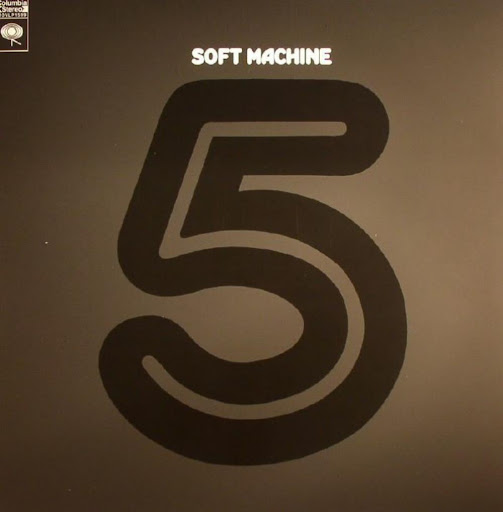
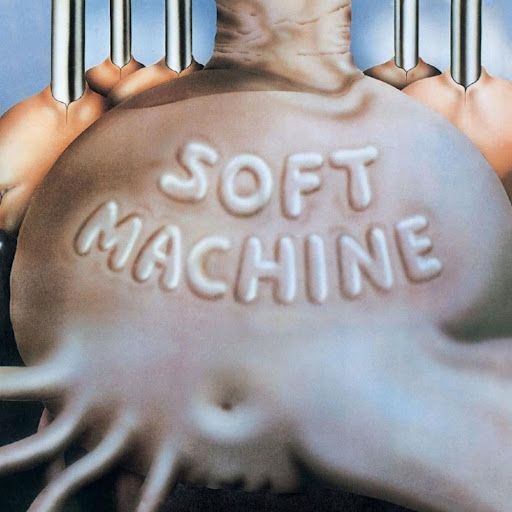
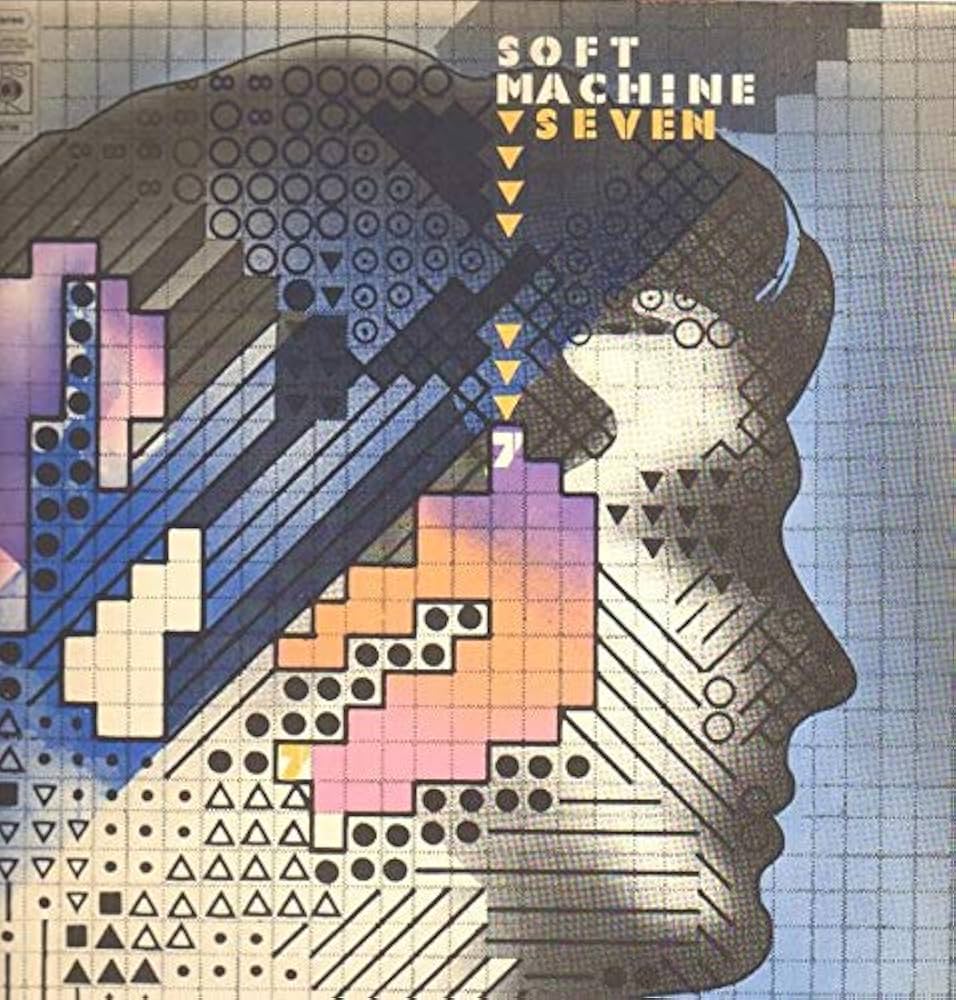
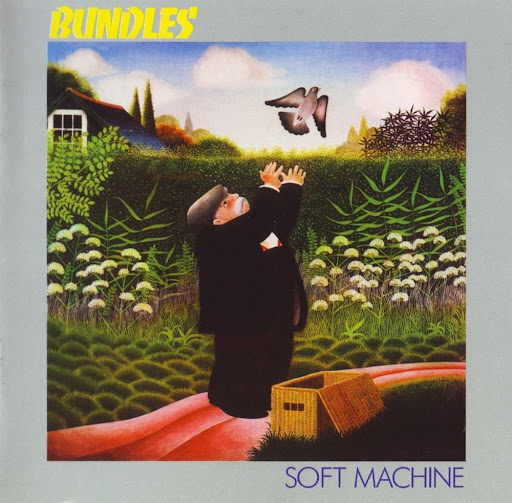
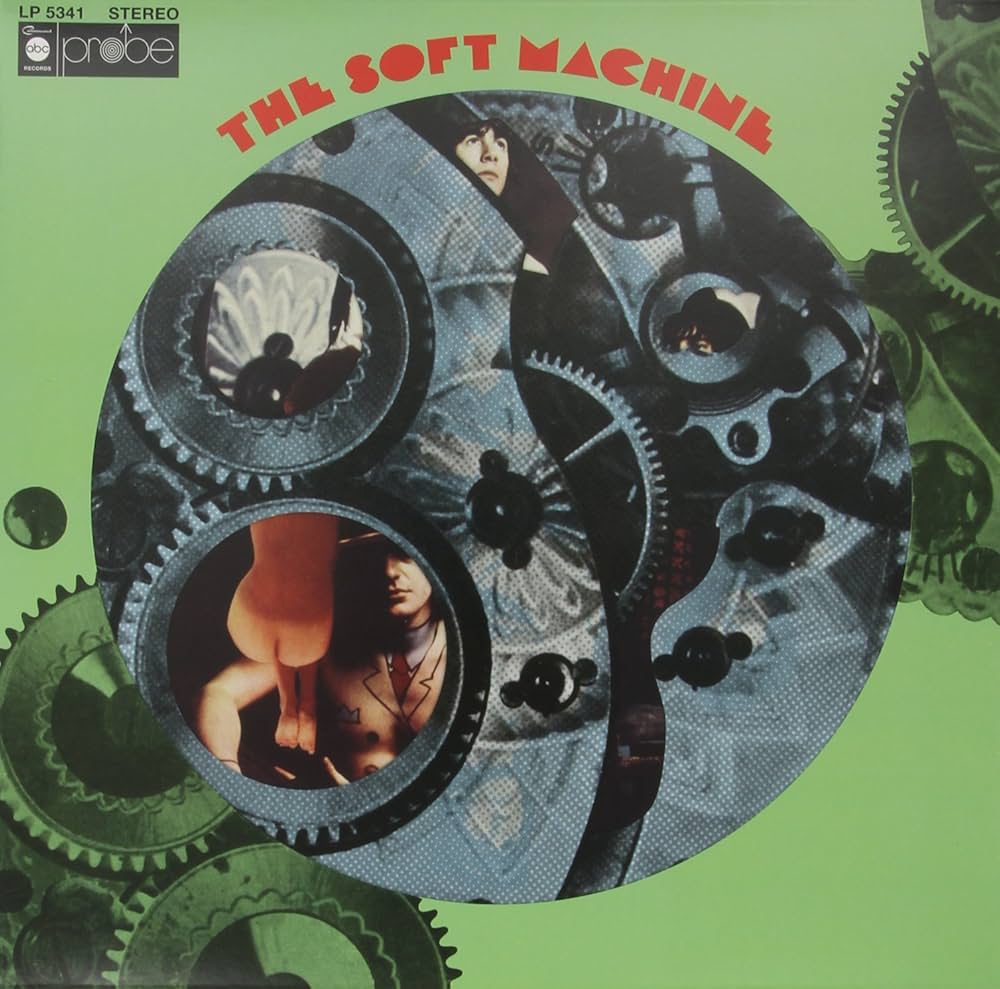
Soft Machine were one of the central groups of the Canterbury Scene and one of the most radically evolving ensembles in British progressive music. Beginning in the psychedelic underground of the 1960s, their music moved from psychedelic song through jazz-rock, extended composition, improvisation, electronic sound, and increasingly instrumental forms. This study follows that musical evolution across the albums, examining how changes in composition, instrumentation, rhythm, improvisational practice, studio process, and ensemble organization repeatedly transformed the musical identity of Soft Machine.
Soft Machine did not travel through history by preserving a single shape. It survived by entering each new configuration as though entering another chamber of the labyrinth—carrying traces of what had come before while altering the walls, the pathways, and even the laws of movement within them. Every threshold changed the proportions of the music. Psychedelic song gave way to extended instrumental landscapes; voices receded as keyboards, reeds, bass, and drums acquired new forms of speech; compact melodies opened into continuous structures whose destinations could not always be predicted from their beginnings. Yet the past was never entirely abandoned. It remained beneath the surface like an earlier map, partially erased but still legible in a melodic turn, a rhythmic habit, an atmosphere, or a sudden glimmer of absurdity.
To follow Soft Machine is therefore to encounter a music perpetually rebuilding itself from within. Repetition became architecture; improvisation entered that architecture, tested its strength, and sometimes changed its design in the act of moving through it. New musicians did more than replace those who had departed: they altered the ensemble’s center of gravity, opening corridors that had not previously existed. What first appeared playful and songlike could become austere, turbulent, luminous, or densely contrapuntal; what seemed to be a stable identity could dissolve and reappear in another register. Each album offered not merely a new style, but a new answer to the question of what the machine might be.
This is the fascination at the heart of the Soft Machine story. Its history is not a straight passage from simplicity to complexity, nor a sequence in which one incarnation corrects or completes another. It is a history of mutation: of musical materials placed under pressure until they disclose unfamiliar possibilities. Along the way, pop concision, jazz practice, electronic sound, Dadaist humor, compositional rigor, and open improvisation meet without ever settling into permanent agreement. Their tensions become productive. The music advances because its contradictions are not resolved, but continually reorganized.
What endured, then, was not a fixed style, personnel, or compositional method, but a restless impulse toward transformation. Soft Machine remained recognizable not because it guarded an unchanging musical core, but because it repeatedly subjected its own identity to experiment. To enter this chapter is to follow that experiment through its many chambers—to listen as familiar materials change their function, as old pathways disappear behind new walls, and as the labyrinth quietly redesigns itself around the traveler. Soft Machine remained itself precisely by refusing to remain the same.
1. The Machine That Would Not Remain Itself
Few groups changed as radically as Soft Machine while continuing to insist upon the same name. Over the years, the ensemble shed nearly every feature by which a band is ordinarily recognized. Voices disappeared; songs gave way to suites, extended instrumental environments, and increasingly concentrated compositions. Psychedelic collage opened into jazz improvisation; successive rhythmic bodies reorganized the relation among pulse, freedom, coordination, and ensemble control; and the instrumental palette expanded far beyond the group’s original organ-centered sound. The compositional center moved from one musician to another, the rhythm section was repeatedly rebuilt, and eventually every founding member was gone. Yet the name remained.
That persistence poses the central question of the chapter: what remains “Soft Machine” when the voice disappears, the instrumental hierarchy changes, the compositional center migrates, and eventually every founding member leaves?
There is no single musical object that can answer the question. No timbre, rhythmic vocabulary, harmonic language, formal design, or constellation of personalities remains intact across the entire journey. To listen to the compact, volatile songs of the debut and then to the lucid instrumental expanses of Bundles or Softs is to encounter not merely two phases of one group, but two very different ideas of what an ensemble might be. Their relationship cannot be explained by surface resemblance alone. The later music does not sound like the early music with its psychedelic clothing removed, nor can the early work be treated merely as an immature prelude to the instrumental band that followed. Each formation possesses its own balance of personalities and its own way of organizing musical time. Some possibilities are inherited and transformed; others disappear completely.
Soft Machine preserved its identity not by maintaining a stable sound, personnel, or compositional method, but by repeatedly rebuilding the musical conditions under which the ensemble could exist. This does not mean that every change was planned, painless, or welcomed by everyone involved. The group’s history contains genuine ruptures: incompatible ambitions, departures that closed entire musical paths, and changes that altered not only how the band played but what it was capable of imagining. Mutation should not be romanticized as a seamless ascent toward greater sophistication. Something was gained at each stage, but something was also relinquished. The disappearance of the voice created new instrumental freedoms, yet it removed Wyatt’s lyrical intimacy, humor, and emotional exposure. Later formations could coordinate complex materials with increasing precision, but they did so through different balances of prescription, performance, rhythmic definition, and collective freedom rather than through a simple replacement of permeability by discipline. The arrival of new instruments opened fresh pathways while rendering older balances impossible to restore.
What makes the story compelling is not that Soft Machine continually “progressed,” but that it repeatedly discovered a viable music on the far side of loss. When Kevin Ayers departed, Hugh Hopper did not simply replace one bass player with another; his fuzz tone, looping imagination, and ostinato-based thinking helped reconstruct the band’s low register and its approach to continuity. When Elton Dean entered, the reeds did more than enlarge the palette; they opened the ensemble to a new degree of melodic abstraction and improvisational autonomy. When Robert Wyatt’s voice receded and then vanished, Soft Machine did not merely become an instrumental group. It lost one of its founding sources of personality and found itself compelled to develop another basis for coherence. The changes from Wyatt to Phil Howard and then to John Marshall did not amount to substitutions behind the drum kit: they successively transformed the nature of pulse, density, freedom, rhythmic definition, and ensemble interaction. Karl Jenkins’s arrival gradually relocated compositional authority, while Allan Holdsworth and John Etheridge introduced guitar into a musical space whose architecture had been formed through years of functioning without it.
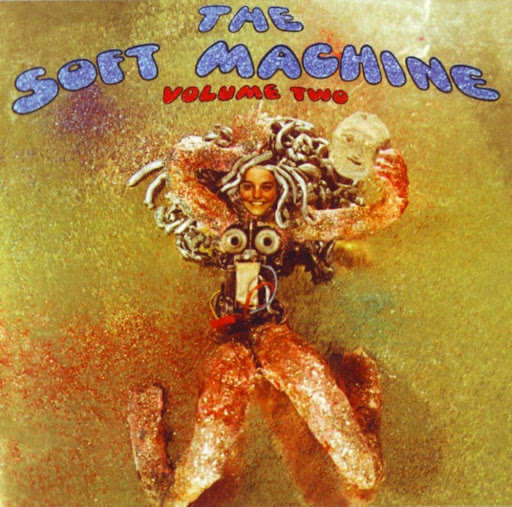
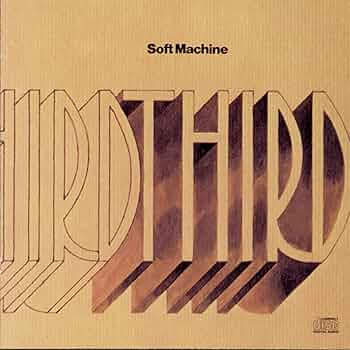
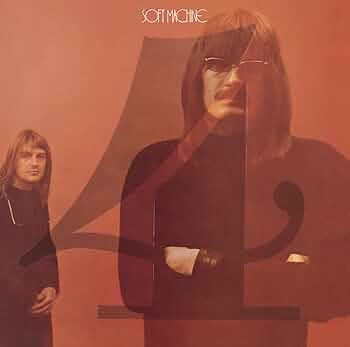
The band’s development is therefore best heard not as a straight passage from psychedelia to jazz, but as a sequence of internal reconstructions. Soft Machine did not leave one clearly bounded style and arrive at another. Its early music already contained jazz practice, electronic timbre, extended improvisation, pop concision, absurdist interruption, and the desire to exceed song form. Its later music, for all its increased instrumental precision, never became reducible to a single stable model of jazz-rock or fusion. Between those points lie the interconnected miniatures and extended constructions of Volume Two, the four autonomous approaches to extended form on Third, the four distinct architectures of Fourth in which recognizable musical conditions persist while their authority, privilege, generative consequence, or behavioral possibilities change, the divided rhythmic body of Fifth, the live and studio systems of Six, and the modular consolidation of Seven. Bundles and Softs do not resolve that history so much as reopen it through a new instrumental hierarchy.
The labyrinth offers a useful image for this process, provided we do not imagine it as a finished structure through which the musicians merely travel. Soft Machine rebuilt the labyrinth from within. A passage created on one album might be widened on the next, redirected toward an unfamiliar chamber, or closed altogether. Song fragments became connective corridors. Repeated figures became fields through which improvisers could move. Abrupt montage expanded into side-long construction. Harmonic suspension provided temporary rooms in which very different soloistic languages could unfold. Personnel changes altered the placement of walls, the distribution of weight, and the routes available to the ensemble. The musicians inherited a structure, but inheritance never required obedience. Each formation entered a musical interior already marked by what had come before and then changed the terms of habitation.
This is why Soft Machine’s continuity cannot be located exclusively in sound. It resides partly in a recurring set of musical habits: an attraction to continuity without conventional song form; a fascination with repetition, suspension, and modular construction; a willingness to place predetermined conditions and performed behavior into consequential relation; and an unusual fluidity in the roles assigned to individual instruments. Yet even these principles are not present with equal force throughout the band’s history. Some recede for several albums before returning in altered form. Others belong more clearly to particular composers than to the ensemble as a whole. What sounds like a collective Soft Machine language is often the temporary result of competing musical imaginations held together long enough to produce a functioning system.
The name consequently changes its meaning as the story unfolds. At first, Soft Machine denotes a particular meeting of personalities: Wyatt’s vulnerable and unruly expressiveness, Ratledge’s organ architecture, and Ayers’s melodic economy and oblique songcraft. With Hopper and Dean, it increasingly denotes a field of transferable procedures—a way of linking fragments, extending time, preserving continuity across changing instrumental relations, and allowing functions to shift among different bearers. Under Jenkins and Marshall, the name comes to signify a more consolidated ensemble method, one capable of surviving the departure of musicians who had once seemed indispensable. By Softs, institutional continuity becomes impossible to ignore. But “institutional” need not mean empty or merely commercial. The inherited name still carries musical expectations, pressures, and possibilities. The question is whether those possibilities constitute a living grammar or only the memory of one.
To ask what remains Soft Machine is therefore not to search for an essence hidden beneath the changes. It is to follow the changes themselves: to hear where continuity is preserved, where it is reinvented, where it becomes fragile, and where it may finally survive more in method than in recognizable sound. The answer will not be identical on every album. Third may reveal coexistence more than synthesis; Fourth may reveal how recognizable musical conditions can remain intact while what they are able to control, permit, generate, or become changes; Seven may consolidate an already emerging language; and Softs may test the point at which the continuity of the name begins to exceed that of the founding musical body. The mutation thesis must remain open to these complications. Otherwise, “mutation” becomes only an attractive word for change rather than a way of understanding how the music actually reorganizes itself.
The chapters that preceded this one have already encountered the shared Canterbury environment from which Soft Machine emerged, including the formative importance of the Wilde Flowers. That history need not be retold here. Our concern now is with what Soft Machine made from its inheritance—and with how quickly it began to transform it. We will listen first for the contradictions embedded in the original group: song and abstraction, humor and severity, intimacy and impersonality, fragmentation and continuity, collective interaction and composer-defined form. We will then trace how those tensions were redistributed as the voice withdrew, improvisation changed its place inside the architecture, rhythmic authority passed from one drummer to another, and new instruments altered the shape of the ensemble. The album studies will take us inside each successive musical interior, where the larger argument must finally answer to the particular sound and movement of the records themselves.
Soft Machine’s history is often narrated through departures, as though the band can be understood by listing what and whom it lost. But listening reveals a more intricate story. Every departure leaves an absence; every absence changes the behavior of those who remain; and every new arrival brings not only another voice but another conception of the whole. The ensemble survives neither by defending its original design nor by forgetting it. It survives by placing that design under continuous pressure—sometimes extending it, sometimes dismantling it, sometimes building over its ruins.
The machine would not remain itself. That refusal was its instability, its wound, and its peculiar creative strength. Soft Machine endured by repeatedly becoming a different answer to the question posed by its own name: not a fixed mechanism, but a musical system capable of rebuilding the labyrinth while still moving through it.
2. Soft Machine and the Canterbury Matrix
Soft Machine did not emerge from an isolated act of invention. Its earliest musical language took shape within the unusually fertile environment surrounding Canterbury in the early and mid-1960s: a close network of friendships, shared houses, informal rehearsals, record collections, literary interests, and overlapping groups in which musical ideas circulated as freely as musicians themselves. Jazz, rhythm and blues, pop, modern composition, improvisation, and playful experiment were not yet separated into fixed stylistic territories. They existed together as possibilities to be tested, combined, or set against one another.
The importance of this environment lies not in its having produced a single recognizable “Canterbury sound,” but in the habits of musical thought it encouraged: stylistic openness, melodic individuality, harmonic curiosity, collective exchange, and a willingness to treat humor, eccentricity, and structural experiment as natural parts of serious music-making. Soft Machine would transform these shared resources with exceptional intensity, but the band’s impulse toward reinvention began within this matrix of personal relationships and musical permeability.
Within This Section
I. The Wilde Flowers and the Shared Musical Environment
The Wilde Flowers were not an early version of Soft Machine, nor were they simply a rough sketch of Caravan. They were the room in which several possible futures could still be heard together.
Their history has already been considered in the preceding chapter. What matters here is the musical environment they embodied. Rhythm and blues supplied songs, riffs, vocal attitudes, and the physical pleasure of ensemble playing. Jazz introduced another conception of musical attention: the expectation that an arrangement should remain responsive from within, and that phrasing, accent, and interaction could keep a familiar structure alive. Pop songwriting provided memorable objects around which these more mobile behaviors could gather. The group’s importance lies in allowing these tendencies to coexist before any one of them had acquired enough authority to define what the others must become.
The surviving repertoire makes that coexistence audible. R&B and rock-and-roll numbers offered recognizable frameworks, but the musicians did not approach them only as models to be reproduced. They became places in which phrasing, rhythmic placement, instrumental balance, and the elasticity of an arrangement could be tested. Jazz first entered this world less as a repertory or instrumentation than as a mode of behavior. Robert Wyatt’s drumming already suggested that pulse need not be a neutral platform beneath a song. It could breathe with a vocal phrase, answer an instrumental gesture, lean forward, or momentarily loosen while the ensemble remained intact. The arrangement survived, but it was no longer inert.
An equal devotion to songs prevented this responsiveness from becoming a simple escape into instrumental freedom. Hugh Hopper’s “Memories” and Kevin Ayers’s “She’s Gone” reveal different kinds of melodic imagination: one emotionally direct and harmonically unsettled, the other economical, languid, and oblique. Their importance is not that they predict complete later careers. They demonstrate that experimentation in Canterbury did not begin with the rejection of melody. Melody was one of the things being experimented with.
The song could therefore remain tender, concise, and memorable without becoming a sealed container. An unusual harmonic movement might alter its emotional balance; a lyric could be intimate, comic, dreamlike, or evasive; an instrumental passage might acquire enough independence to change the scale of the whole performance. Songwriting and improvisational responsiveness were not yet opposing camps. The song supplied an identity around which musicians could gather, while interaction prevented that identity from becoming fixed. What the shared environment made available was not the destruction of song but the question of how much freedom it could bear before it became something else.
Soft Machine did not arise solely from the division of the Wilde Flowers. Wyatt and Ayers passed directly through that group, but Mike Ratledge and Daevid Allen entered from the surrounding network of friendship, listening, study, and earlier collaboration. Hugh Hopper remained a source of compositions and tape experiments before becoming Soft Machine’s bassist; Brian Hopper connected the same environment to reeds, guitar, arrangement, and jazz-inflected writing. The founding ensemble appeared where several histories met, not where a single predecessor divided cleanly into successors.
This is why the familiar family tree must be treated cautiously. Caravan would cultivate a particularly inviting relation among melody, voice, organ color, ensemble warmth, and formal subtlety. Soft Machine would place the shared materials under more violent internal pressure, moving toward collage, instrumental abstraction, extended composition, and improvisational intensity while remaining, at first, inseparable from songs, humor, and the contrasting voices of Wyatt and Ayers. Other possibilities dispersed through Ayers’s solo work, Wyatt’s later music, Hopper’s compositional practice, and Allen’s transformation of improvisation, psychedelia, humor, and communal mythology into Gong. A common environment did not yield a common destiny. It released several personal and organizational languages that had briefly occupied the same space.
The Wilde Flowers are therefore best understood as a field of latent choices rather than a blueprint. Their world held jazz and R&B, composition and spontaneity, emotional candor and comic distance, melodic intimacy and structural curiosity in an unresolved but fruitful balance. What Soft Machine inherited was not a finished style. It inherited permission: permission to let a song open into an instrumental passage, to allow rhythmic conversation to disturb a regular pulse, to place humor beside formal ambition, and to draw upon jazz, pop, R&B, modern composition, and experiment without treating their boundaries as inviolable.
Inheritance, however, establishes conditions rather than outcomes. Once Wyatt, Ayers, Ratledge, and Allen came together, the shared environment ceased to be merely a meeting place. Its possibilities became active forces inside a new collective body, and those forces began to pull toward different conceptions of form, expression, duration, and authority.
II. The Founding Materials
Soft Machine began not with a unified style but with materials that did not naturally belong together. Psychedelic song, rhythm and blues, jazz practice, twentieth-century modernism, Dada and literary play, tape and electronic sound, extended improvisation, and the opposed attractions of pop concision and large-form ambition each introduced a different organizational possibility. None was merely decorative. Each implied something about how music should move, how long it might last, where its identity should reside, and who or what should control its development.
The band’s originality did not arise simply from the number of influences it absorbed. It arose because the materials retained their different pressures. A tune might seek closure while improvisation demanded continuation. A repeating riff could behave as hook, ground, mechanism, and joke. Tape could produce continuity without harmonic development. Absurdity could interrupt formal authority without destroying formal intelligence. The founding materials mattered because they gave Soft Machine several incompatible ways of becoming coherent.
a. Psychedelic Song
Soft Machine belonged to the British psychedelic underground before it became associated primarily with jazz-rock. Psychedelia offered more than a social location or visual atmosphere. It allowed the song to be treated as an altered space rather than a fixed sequence of verse, chorus, and instrumental break. Form could stretch, contract, double back, or dissolve; repetition could create suspension rather than merely reinforce a refrain; words could operate through sound and association instead of linear explanation. A performance might be humorous, dreamlike, unstable, and physically forceful at once.
The group’s first single reveals how broad that permission could be. Ayers’s “Love Makes Sweet Music” is bright, direct, and immediately memorable. Its melodic ease and compact construction show that accessibility was not treated as an artistic compromise. “Feelin’ Reelin’ Squeelin’,” on the reverse, enters a less stable psychological space of distortion, theatrical unease, fractured vocal identity, and an uncertain boundary between song and sonic event. The two sides do not simply display versatility. They expose different possibilities inside psychedelic song: melodic concentration, emotional volatility, verbal estrangement, timbral abrasion, and structural opening.
Psychedelia temporarily allowed these differences to coexist within a recognizable outer form. On the debut, songs spill into one another; themes vanish and return in altered surroundings; brief pieces behave as entrances, exits, or passages within a broader current. The individual melody retains its pleasure, yet its boundaries become provisional. Psychedelia therefore introduced an organizational permission that would outlast its overt style: identity, sequence, and proportion could remain unstable. Later instrumental works would pursue that permission through other means, but the possibility that one musical environment might open unexpectedly into another had already been established.
The altered scale of attention was equally important. Psychedelic form encouraged listeners to hear texture, repetition, and transition as events in their own right rather than as decoration surrounding a song. A sustained organ sonority could become a location; a distorted vocal entrance could recast everything before it; apparent stasis could intensify because its smallest internal changes became perceptually enlarged. This did not yet amount to the later architecture of harmonic fields, but it prepared both ear and ensemble for music in which atmosphere and process carried structural responsibility.
The song continued to provide resistance. Its tune, words, and compact identity prevented the surrounding experiment from becoming an undifferentiated environment. Psychedelic song therefore introduced a double demand: form should be open enough to change state, yet recognizable enough for that change to matter. Soft Machine would repeatedly alter the balance between those terms, but their first encounter established transformation without complete erasure as an available procedure.
b. Rhythm and Blues: The Physical Foundation
Rhythm and blues supplied the early music with attack, repetition, groove, and the bodily intensification of limited material. It entered most directly through the Wilde Flowers and through the broader British R&B practice from which many psychedelic groups emerged. Soft Machine moved quickly beyond recognizable R&B forms, but it did not abandon their physical logic.
Wyatt’s drumming made that inheritance unusually flexible. His accents possessed force, repeated patterns accumulated pressure, and fills altered momentum instead of merely decorating it. Jazz would enlarge his rhythmic mobility, but the playing retained a bodily propulsion that prevented experiment from becoming purely cerebral. Ayers offered a complementary economy in the low register. A clear bass shape could stabilize the music without crowding it, preserving the physical identity of a riff while voice, organ, guitar, and drums moved more freely around it.
“We Did It Again” reduces this inheritance to an elemental principle: a blunt riff, a short verbal statement, and repetition extended beyond the needs of ordinary song form. The repeated figure remains groove, but it also becomes joke, structure, and the basis of an expanding performance. R&B thus introduced more than a stylistic residue. It demonstrated that limited material could accumulate force through duration, and that abstraction need not sever the music from physical experience. Repetition could be felt before it was interpreted.
R&B also placed a useful limit upon abstraction. A musical idea had to survive contact with bodies: the players’ attack, the audience’s sense of pulse, and the cumulative force of recurrence. Even when harmonic direction weakened or formal proportions grew unusual, the music could retain an immediate kinetic argument. This helps explain why Soft Machine’s repetition rarely functions as neutral pattern. It carries pressure. The repeated unit does not merely remain present; it changes the physical conditions around it.
That pressure would later be redistributed among bass ostinato, organ attack, reed articulation, and increasingly specialized rhythmic systems. Those later forms should not be read backward as though they were already complete. The founding consequence is more basic: R&B taught the ensemble that economy could generate intensity, and that a small cell, forcefully inhabited, might support far more structural weight than its size appeared to promise.
c. Jazz Practice
If psychedelia loosened the boundaries of the song, jazz changed the behavior of musicians inside those boundaries. Jazz was not merely a harmonic vocabulary, a collection of admired records, or permission to take solos. It offered a model of collective attention. An arrangement could be remade through phrasing, rhythmic placement, dynamic response, and the changing relationship among the players.
This distinction matters because the founding Soft Machine did not resemble a conventional jazz ensemble. It belonged socially to the psychedelic underground, retained songs and voices, and used instrumentation associated with rock. Yet the players increasingly acted according to jazz-derived expectations. Wyatt animated and questioned the pulse rather than treating it as neutral timekeeping. Ratledge’s organ could establish a harmonic environment, attack as a lead voice, or generate recurring figures against which the ensemble defined itself. Allen brought an appetite for open performance and free-form exploration. The material might be a song, but the behavior inside it could already generate another kind of form.
Jazz also supplied several possible futures. Bebop suggested velocity, asymmetrical phrasing, and harmonic intelligence. Modal practice demonstrated how restricted harmonic material could sustain extended concentration. Freer improvisation proposed that density, timbre, and collective response might organize performance even when regular pulse or predetermined sequence weakened. These possibilities entered the group unevenly, and that unevenness created pressure. Ratledge increasingly imagined written structures through which improvisation could move; Wyatt’s responsiveness resisted excessive containment; Allen treated openness as an environmental condition; Hugh Hopper would connect recurrence, modal suspension, and low-register mass to extended development.
Jazz practice therefore introduced both mobility and a question of authority. Once instrumental interaction could generate continuity, the song no longer had to carry the whole burden of coherence. But the expansion of collective agency also made it necessary to decide how composition and improvisation would share control. That problem would become one of the ensemble’s longest-running structural tensions.
The pressure was not simply between writing and freedom. It concerned several possible locations of musical intelligence. A composition might establish theme, field, sequence, or duration; performers could clarify, complicate, or redirect those conditions. Conversely, an improvised event might reveal a formal potential that later composition could stabilize. Jazz made the work porous in both directions. Written material influenced behavior, but behavior could change what counted as viable written material.
This is why the growing presence of jazz cannot be described adequately as a genre change. The decisive inheritance was procedural. Musicians listened across fixed roles; time became negotiable from within; accompaniment could become commentary; and a supposedly secondary voice might reorganize the ensemble’s balance. Even when later formations placed improvisation inside more exact architectures, the music continued to depend upon the idea that structure is not merely occupied by performers but activated through their relations.
d. Twentieth-Century Modernism
Twentieth-century European modernism entered the founding environment most decisively through Mike Ratledge. His musical formation joined jazz to a serious engagement with modern composition, enlarging the emerging group’s sense of what could count as coherence. Dissonance did not require conventional tonal resolution; simultaneous lines need not settle into melody and accompaniment; form could be organized by interval, register, rhythmic cell, timbral identity, recurrence, and controlled contrast.
This inheritance introduced a pressure distinct from jazz. Jazz asked how musicians might act responsively within a structure. Modernist composition asked how the structure itself might be built. Ratledge’s early musical formation, shared in important part with Brian Hopper, included sustained exposure to Bartók, Hindemith, Messiaen, Varèse, Stockhausen, Berio, Boulez, Debussy, and related modern practices. Ratledge later identified Messiaen more specifically as his first important encounter with a composer who had thought deeply about irregular meter. The wider field supplied compositional permissions rather than a set of templates: nonfunctional harmonic color, independent lines, asymmetrical rhythmic cells, blocks and modules, discontinuity, and sound treated as organized material.
Within that field, Hindemith is especially useful here as an analytical model of practical modernism: contrapuntal writing in which voices retain independence, harmonic tension remains intelligible without familiar resolution, and complex structures preserve definition. Bartók provides an illuminating comparison for the growth of large form from compact rhythmic and intervallic cells. Messiaen invites attention to recurrence, suspension, harmonic color, and rhythmic cycles; Varèse and Stockhausen help illuminate register, density, timbre, and spatial placement. These are not claims that Soft Machine reproduced named compositional systems. They identify a documented modernist environment and a set of analytical relationships through which Ratledge’s architectural intelligence becomes more legible.
Ratledge’s organ made such ideas physically available to the ensemble. It could be harmonic foundation, contrapuntal line, sustained mass, or distorted lead instrument. Held sonorities allowed harmony to become a field rather than a sequence of attacks. Registral breadth divided musical space into layers; amplification changed warmth into glare, pressure, and nearly electronic abrasion. Modernist construction and psychedelic sound became contiguous in a single instrument.
The organizational possibility was powerful but not neutral. Defined modules could give improvisation something resistant to encounter, while also limiting the performers’ authority to determine form collectively. Harmonic fields could free the music from conventional progressions while establishing new kinds of control. Counterpoint could multiply active lines while making individual roles more specialized. Modernism therefore introduced a discipline of organized tension. It allowed abrasive harmony, independent voices, rhythmic cells, and contrasting blocks to form a coherent structure without smoothing away their differences.
Counterpoint was especially consequential because it challenged the hierarchy of melody over accompaniment. Even when one instrument became prominent, bass, organ, reeds, and drums could retain separate rhythmic and registral identities. A bass pattern might act as structural rail; organ voicings might establish harmonic mass; a reed line could cross the field obliquely; drums might regulate or disturb their relation. Complexity arose not only from the number of notes but from the number of simultaneous functions.
The same principle applied at larger scale. A compact rhythmic or intervallic cell could recur, collide with another cell, change register, or acquire a new instrumental carrier. Development did not require continuous melodic narrative. It could occur through reweighting: the same material becoming newly important because its position, density, or relation to other planes had changed. This possibility would later become central to the group’s extended works, but its founding consequence was already profound. It made architecture conceivable without stylistic homogeneity.
Modernism therefore did not merely add “serious” harmony to psychedelic rock or jazz. It introduced another account of responsibility. The composer could design a field whose tensions persisted rather than resolved, and performers could make those tensions audible without dissolving the field’s identity. The friction between architectural resistance and performative mobility would prove productive precisely because neither could permanently subsume the other.
e. Dada, Absurdism, and Literary Play
Soft Machine’s early music was intellectually ambitious but rarely reverent. Humor entered titles, lyrics, transitions, vocal delivery, and formal proportion. A complex passage might lead into a pun, a nonsense syllable, an exaggerated announcement, or a miniature whose brevity made the surrounding grandeur seem faintly ridiculous. Serious construction and deliberate foolishness could occupy adjacent moments without requiring either to apologize for the other.
These affiliations entered through several routes. Allen brought direct contact with the Beat milieu and introduced Ayers, Wyatt, and Ratledge to American Beat writing; the name Soft Machine, taken from William S. Burroughs, placed the ensemble within a literary field of fragmentation, recombination, bodily machinery, and unstable identity. Pataphysics acquired a more specific place in 1967, when the group supplied music for Jarry’s Ubu Enchaîné, and it became explicit on Volume Two. Dada, Surrealism, absurdist comedy, linguistic games, and English verbal eccentricity formed a wider field of affinity rather than a single program. Together they made it possible for intellectual seriousness, nonsense, theatrical interruption, and exact formal placement to coexist.
The Burroughs title was not a complete musical program, but it became uncannily appropriate for a group that would repeatedly dismantle and reconstruct itself.
Dada’s principal organizational pressure was its refusal of hierarchy. A joke could carry formal weight; nonsense could acquire exact placement; a title could disturb the dignity of the composition it named. On Volume Two, announcements, miniatures, references, abrupt junctions, and false starts would show how humor could shape architecture rather than merely ornament it. The joke helps determine how one section meets another. Complexity remains real, but its authority is challengeable.
Wyatt’s voice and Ayers’s verbal manner gave this play contrasting human forms. Wyatt could make tenderness, embarrassment, absurdity, and exposure permeable; Ayers delivered surreal images with a cooler, more languid evasiveness. The later withdrawal of voice would reduce the overt literary presence, yet some of its structural consequences would survive in abrupt proportion, peculiar titles, juxtaposition, and a refusal of conventional decorum. Dada introduced the possibility that music could interrupt its own claims to seriousness without surrendering rigor.
This self-interruption mattered organizationally because it prevented any single language from becoming unquestionable. Modernist construction might claim authority through complexity; improvisation through spontaneity; song through emotional immediacy. Humor could alter the frame in which each claim was heard. It did not defeat the music’s seriousness, but it denied seriousness the right to present itself as the only legitimate mode of attention.
Absurdity also changed the status of fragments. A miniature, announcement, syllable, or verbal aside could be more than connective tissue between substantial pieces. Its disproportion could itself become compositional information, redirecting scale and expectation. Literary play joined tape and montage in weakening the hierarchy between principal event and transition. The supposedly marginal could reorganize the whole.
f. Tape Manipulation and Electronic Sound
Tape introduced a different conception of musical time. Unlike improvisation, which transforms an event during performance, tape allows an event already produced to be isolated, repeated, layered, reversed, interrupted, or placed inside another sequence. Recorded sound becomes material rather than documentation.
Tape entered the Canterbury environment through intersecting routes rather than a single act of introduction. Hugh and Brian Hopper and Mike Ratledge made rudimentary loop experiments in the early 1960s; in Paris, Daevid Allen encountered Terry Riley and explored tape-loop procedures within a wider experimental and Beat milieu. Hugh Hopper’s contact with that Paris environment intensified a fascination he would pursue through extensive independent experiments and, later, through Soft Machine’s studio practice. Exact dates differ among retrospective accounts, but the shared consequence is secure: familiar sound could be detached from its source and made to behave according to another logic.
A loop can create continuity without conventional harmonic development. The music remains inside a field while attack, density, register, and surrounding activity accumulate. Repetition may stabilize the ensemble, induce trance, build pressure, or produce perceptual disorientation. Eventually the repeated fragment ceases to sound like a statement being made again and becomes an environment in which other events occur.
Electronic sound extended this possibility into performance. Ratledge’s sustained and overdriven organ could blur instrument and sonic surface; fuzz bass, electric keyboards, effects, and later synthesizers could create layers whose identities were not immediately separable. The ensemble could sound larger than its personnel, and harmony could be felt as physical mass.
Tape also weakened the assumption that a work must preserve the continuity of a single performance. Recorded events from different circumstances could be assembled into a new form; live energy and studio intervention need not be opposites. Later works would use montage and loops in sharply different ways, but the founding permission was already present: musical time could be composed after it had been played.
That permission altered the meaning of recurrence. A performer repeats an action and inevitably changes it; a loop repeats an event while preserving its internal shape. The contrast allowed several kinds of repetition to coexist: bodily repetition animated by attack and accent, compositional recurrence whose position changes its function, and mechanical return that creates pressure through apparent sameness. These were not interchangeable techniques. Their coexistence made recurrence itself a field of compositional choice.
Tape further encouraged a nonhierarchical relation among sources. A casually recorded fragment could become a formal junction; an event originating in performance could be cut away from its original trajectory; sonic residue could acquire more weight than the complete gesture from which it came. The studio did not merely polish the ensemble’s work. It made selection, displacement, and recombination part of composition.
g. Extended Improvisation
Soft Machine’s movement toward longer forms began in performance before it became a matter of extended written architecture. Brief pieces could expand beyond their recorded dimensions. A repeated figure supplied a ground; improvisation tested how long that ground could remain productive and how extensively the ensemble could transform its internal life without replacing it.
Extended duration changed the scale on which musical evidence operated. In a concise song, a shift of accent or timbre may be expressive detail. Inside a prolonged field, the same shift may become a formal event. Small changes in density, register, attack, and interaction acquire structural weight because recurrence makes them perceptible. Improvisation can therefore extend a form, interrupt it, connect otherwise separate materials, or temporarily replace conventional development.
Allen encouraged an outward, environmental conception of performance in which the boundaries of the written object became permeable. Wyatt’s drumming could reorganize recurring material from within, making a stable pulse feel continuously alive. Ratledge supplied cells and harmonic fields resistant enough to give free movement consequence. Improvisation did not simply oppose composition; it required something sufficiently defined for departure, friction, and return to become audible.
This material introduced a lasting pressure. If performance could generate its own proportions, the composer no longer possessed exclusive authority over duration and development. Yet unlimited openness could weaken identity and exhaust a field’s generative potential. Soft Machine’s later history would repeatedly relocate the relationship between freedom, continuity, and formal definition, but extended improvisation established the problem at the beginning: form might be discovered through action rather than delivered complete in advance.
Long duration also revealed that coherence need not depend upon constant novelty. A performance could remain within limited harmonic or thematic conditions while the ensemble redistributed attention among pulse, density, contour, timbre, and register. The resulting form was behavioral: listeners followed changes in what the musicians were doing and in how their functions related, even when there was no conventional progression toward a thematic goal.
Improvisation could therefore test how much repeated activation composed material could sustain. Some cells sustained repeated activation; others required interruption, contrast, or release. Performing them at length supplied practical knowledge about density, pacing, and instrumental authority. Later composition could draw upon that knowledge without merely transcribing the improvisation. Openness became a laboratory in which architectural possibilities were discovered.
The risk remained real. Expansion could magnify productive tension, but it could also expose the poverty of an idea or allow one instrumental personality to dominate by endurance. Extended improvisation introduced both freedom and the need for regulation. The history that follows is partly the history of where that regulating authority came to reside.
h. Pop Concision and Large-Form Ambition
The final founding pressure lay between the compact object and the extended process. Soft Machine never simply exchanged short songs for long compositions. Its larger forms grew from habits of miniature thinking: riffs, cells, fragments, announcements, abrupt transitions, concise melodic objects, and recurring sonorities. The question was how these small units might be enlarged, connected, recalled, or made to open onto musical spaces larger than their original proportions.
Pop concision offered immediacy, identity, and economy. A melodic phrase, verbal hook, or riff could be apprehended quickly and remembered after a single hearing. This mnemonic strength remained important even as the ensemble became increasingly interested in music that exceeded autonomous song form. Large-form ambition introduced a contrary demand: music might need enough duration for repetition to change perceptual function, improvisation to acquire a trajectory, and instrumental processes to develop beyond the dimensions initially implied by a compact object.
Soft Machine’s solution was often cellular rather than symphonic in the conventional sense. A short piece could become a module; modules could form a sequence; the sequence could acquire large-scale continuity through placement, recurrence, interruption, and direct transition. Large form did not abolish the miniature. It allowed miniature thinking to operate across a wider span.
This created two complementary organizational possibilities. A small amount of material could become an extended field, as recurrence magnified internal change. Conversely, many short and contrasting objects could be connected into a larger route whose continuity arose from transitions, reprises, and the absence of neutral space between them. The album itself could consequently behave as a constructed journey: rooms remained distinct, but their doors, corridors, and unexpected reappearances made the act of moving among them part of the architecture.
The pressure between concision and expansion would never disappear. Extended architecture risked suppressing the memorable autonomy of song; compact form could limit the time needed for instrumental processes to become self-sustaining. Yet their encounter gave Soft Machine one of its most durable procedures: the ability to enlarge musical scale without losing the force of the cell.
Sequence supplied a crucial middle term. A fragment did not have to become a large form through internal development alone. It could serve as an entrance, interruption, transition, reprise, or structural marker within a broader sequence. One section might lead directly into another, preserve momentum across a change of musical condition, or prepare the recognition of material heard earlier. Transitions ceased to be neutral corridors between complete rooms. The act of crossing from one identifiable object to another could itself become part of the composition.
This assembled continuity allowed formal ambition without demanding a single governing syntax. Songs, instrumental passages, loops, announcements, and improvised fields could retain their differences while participating in a larger sequence through adjacency, recurrence, timbral memory, and transition. The larger structure cohered not because every component had been assimilated to the same style, but because sharply differentiated objects could remain connected without requiring the musical flow to begin again from nothing at each boundary.
Here pop concision became a compositional advantage rather than an embarrassment to be outgrown. A sharply profiled miniature remained perceptible within a dense sequence and could return as memory, interruption, or structural marker. The cell carried identity; the larger sequence discovered ways of connecting such identities without erasing them. Later Soft Machine would make those relations increasingly consequential, but the founding possibility was already clear: concentration and connection need not be opposing principles.
These eight founding materials did not yet constitute a style. They supplied competing methods of continuity: melody, groove, interaction, intervallic construction, comic interruption, recorded recurrence, improvisational process, and modular sequence. Soft Machine did not first discover a coherent identity and then gradually depart from it. The ensemble began inside a field in which several possible identities were already active. Formation would not reconcile them; it would give their conflict a body.
III. The Formation of Soft Machine
Soft Machine formed in 1966 at the intersection of the Canterbury network and the London underground. The precise status and duration of Larry Nowlin’s participation require a dedicated historical check, but the configuration that established the group’s first durable identity brought together Robert Wyatt, Kevin Ayers, Mike Ratledge, and Daevid Allen. They did not arrive as four representatives of a common style. Each carried a different organizing tendency, and the ensemble became distinctive because none could initially absorb the others.
Wyatt brought a rare conjunction of functions. As drummer, he could provide physical propulsion while keeping pulse responsive and permeable. As singer, he introduced vulnerability, comic instability, and a recognizably human presence into music already attracted to amplified mass and formal mechanism. His role was not simply to mediate between song and abstraction. He made their contact audible in his own divided position: the rhythmic body of the ensemble and one of its least impersonal voices.
Ayers supplied melodic economy, verbal obliqueness, and a resistance to elaboration for its own sake. His songs could be self-contained without being conventional, and his bass could stabilize limited material while leaving space around it. He gave the group memorable objects—tunes, riffs, phrases, moods—whose concentration made expansion possible and whose autonomy also placed a limit upon expansion. His restraint was therefore structural, not merely temperamental.
Ratledge brought the most explicit architectural intelligence. Jazz interaction and modernist composition met in his treatment of harmony, register, interval, module, and sustained sonority. His structures gave spontaneity something resistant to encounter. The organ could support song, organize a field, provide a repeated mechanism, or occupy the ensemble with abrasive harmonic mass. Ratledge did not eliminate openness; he made its relation to construction unavoidable.
Allen’s tenure was brief but structurally significant. He introduced a destabilizing presence into an ensemble already moving toward formal coherence: guitar as a destabilizing edge rather than a conventional center, open-ended improvisation, tape-oriented thinking, theatricality, and a conception of performance as environment. His role was not merely stylistic contrast. It was conceptual disruption operating as a compositional force. Soft Machine became the first environment in which Allen’s disruptive logic came into contact with an emerging structural discipline. The tension would not remain balanced for long, but it established outward expansion as one of the original group’s active possibilities.
The unusual instrumental body intensified these differences. Once guitar ceased to function as a conventional harmonic center—or disappeared from the performing configuration—the organ acquired disproportionate authority. Bass and drums could no longer assume that a guitarist would mediate among chordal support, riff, and lead voice. The ensemble became at once more open and more exposed: a small group in which every part carried several functions, and in which a change of touch, density, or register could alter the entire balance.
The London underground provided an environment in which such imbalance could become an advantage. Long performances, multimedia presentation, psychedelic clubs, literary affiliations, and audiences receptive to experiment allowed the band to test music whose identity was not confined to the individual song. The name drawn from Burroughs reinforced the sense that body, language, machinery, fragmentation, and recombination might belong to the same imaginative field.
This setting did not create the group’s contradictions, but it gave them room to become performative. Duration could expand without advance justification; transitions could be discovered before an audience; theatrical event, amplified sound, verbal play, and instrumental experiment could share one frame. The ensemble learned that coherence need not precede performance as a complete plan. It could emerge from the players’ ability to maintain a charged relation among heterogeneous activities.
The group’s early identity was consequently inseparable from both composition and circumstance. The same written object could assume a different scale according to venue, duration, and collective response. A song might retain its recognizable cell while becoming the entrance to a larger environment. This variability did not make form arbitrary. It located form at several levels: in composed material, in the functions carried by individual musicians, and in the trajectory produced by a particular performance.
The quartet should not be romanticized as an ideal body whose later history represents only loss. Nor should it be treated as an immature preface to the instrumental ensemble. It was the first provisional machine: a circuit in which economy, construction, expansion, rhythmic responsiveness, and vocal personality remained simultaneously active. Its coherence arose from relation rather than fusion. Each musician interpreted even a repeated procedure differently—Ayers as concentration, Ratledge as mechanism, Wyatt as changing rhythmic condition, Allen as an opening into duration and timbre. Their materials cohered because they acted upon one another, not because they blended into a settled style.
This arrangement was elastic because limited material could support several simultaneous functions. A riff might stabilize Ayers’s bass role, give Ratledge a mechanism to articulate, provide Wyatt with a rhythmic condition to vary, and offer Allen a ground from which to depart. The players did not need to agree upon a single meaning for the material in order to perform it coherently. Their interpretations became mutually limiting and mutually enabling.
Several forms of coherence could therefore operate at once. Song supplied melody and verbal recurrence; jazz practice supplied responsive relation; repetition supplied persistence; modernist construction supplied interval, counterpoint, and proportion; tape supplied manipulated continuity; humor supplied framing and self-interruption. The group’s mobility arose from the fact that no principle entirely governed the others. Its instability arose from the same fact.
That relational success contained its limit. The more fully each function developed, the harder it became for one formation to sustain them all. The founding ensemble did not fail to discover its true identity. It discovered that its identity was provisional from the beginning.
IV. A Music Built from Incompatibilities
Eclecticism describes the presence of diverse materials. Incompatibility describes what happens when those materials imply different systems of musical authority. Early Soft Machine was not distinctive merely because psychedelic song, R&B, jazz, modernism, improvisation, tape, and humor appeared in proximity. Its music allowed them to remain active enough to compete over duration, form, expression, and control.
“We Did It Again” provides a concentrated demonstration because its radically limited song materials do not remain confined to one function. A blunt riff and short verbal statement initially register as pop concision pushed toward absurdity; prolonged beyond the needs of ordinary song form, however, they make continuation itself the compositional problem. Shifts of attack, accent, density, register, and intensity become significant; the riff turns into a field. Ayers’s economy and Allen’s appetite for duration can coexist because the cell remains both compact object and open environment. Ratledge can hear mechanism in it, while Wyatt animates it as a changing rhythmic condition.
The result is workable coexistence, not seamless synthesis. The disproportion between minimal content and excessive duration remains audible. Repetition is simultaneously song, joke, pulse, structure, and occasion for expansion, and the performance derives its identity from the friction among those functions.
The deeper contradictions therefore concern authority. Does form belong to the song, the composer, the repeated mechanism, the performers’ interaction, or the circumstances of a particular performance? Is improvisation an activity inside a composition, or can it reorganize the composition from within? Does voice command the ensemble, or become one material among several? Early Soft Machine kept several answers available because its vitality depended upon their competition.
This music should not be heard as an immature version of the instrumental group that followed. Its instability was already a complete musical condition. The first music did not solve the contradictions established by the founding materials. It demonstrated that they could coexist, at least temporarily, without solution. Song could remain memorable while its boundaries dissolved; repetition could be comic and architecturally productive; modernist structure could support psychedelic excess; improvisational freedom could operate inside defined cells; emotional vulnerability could inhabit mechanical process.
That collision was Soft Machine’s first compositional principle. The original formation established the field in which the forces could act upon one another; its limit was that no single configuration could preserve their equilibrium indefinitely. Subsequent continuity would depend upon redistribution—some procedures retained, others relinquished, and the remainder made to function inside another musical body.
V. The Canterbury Protocol: Mutation as Musical Method
The instability of early Soft Machine was not unique to the group, although Soft Machine gave it an exceptionally consequential form. Related tensions recur throughout the music associated with Canterbury, yet their recurrence did not produce a single style. What connects the ensembles is a shared organizational problem. The term Canterbury Protocol names the procedures through which musicians selected, combined, regulated, transformed, or discarded heterogeneous materials in order to construct a workable musical identity.
a. Defining the Canterbury Protocol
The Canterbury Protocol is not a fixed sound, a repertory of traits, or a purity test. No combination of organ timbre, complex meter, whimsical language, jazz improvisation, or pastoral melody is either necessary or sufficient. Such features identify recurring resources, not the principle connecting the music.
The word protocol refers to a method of managing relationships among materials. It identifies how an ensemble determines what may coexist, which element temporarily governs the music, how authority can pass from composition to performance, and what must change when an existing balance becomes unsustainable. A protocol does not prescribe content. It regulates how content is combined, how contradictions remain productive, and how coherence can arise among elements that preserve distinct identities.
The term is useful because neither style nor influence reaches this organizational level. Style describes recurring audible features; influence identifies sources, affinities, and transmissions. Protocol concerns what an ensemble does when its materials make incompatible demands. It asks how a song admits improvisation without losing identity, how written architecture preserves performer agency, how humor enters an ambitious structure without becoming detachable commentary, and how personnel-specific functions can be redistributed when their original carrier disappears.
A protocol is therefore audible indirectly, through decisions and relations. It appears in what receives structural priority, which boundaries remain permeable, how long a process may continue, and whether contradiction is maintained, negotiated, recursively contained, or answered through reconstruction. Two ensembles may use similar instruments and harmonic resources while operating according to different protocols; two recordings with unlike surfaces may be related because they solve the same organizational problem by comparable means.
This definition explains why Canterbury ensembles may sound markedly different while remaining historically and conceptually related. They inherit overlapping possibilities but organize them according to different principles. The field is therefore best understood as a family of organizational responses to a common field of tensions.
b. The Canterbury Paradox
The Canterbury Paradox, introduced elsewhere in this project through the relation between narrowness and openness, discipline and freedom, appears here in broader form. Song and process, composition and improvisation, fragmentation and continuity, personality and specialized function are not simple opposites. Each side requires something from the other while threatening to limit it. Song gives process an identity to transform; process prevents song from becoming inert. Composition creates consequential conditions for improvisation; improvisation keeps composition open to discovery. Fragmentation can create continuity through recurrence and placement. Individual personality gives the ensemble distinctive internal motion, while collective architecture converts personality into function.
The paradox can therefore be stated through one governing question:
How can heterogeneous musical behaviors coexist without being reduced to stylistic uniformity?
The objective is not a seamless synthesis in which differences disappear. It is enough coherence for contrasting behaviors to participate in the same system while retaining distinct purposes and forms of authority. Different Canterbury groups produced different provisional answers. Soft Machine’s was unusually volatile: when the existing ensemble could no longer sustain its contradictions, it altered the conditions of the ensemble itself.
The paradox is productive because neither complete openness nor complete control is sufficient. Unlimited openness risks weakening the identities whose coexistence gives the field meaning. Total regulation may preserve clarity while neutralizing the differences that made regulation necessary. Canterbury music repeatedly inhabits the interval between these failures. Its characteristic intelligence lies in constructing forms strong enough to hold divergent behaviors and flexible enough to let their divergence remain audible.
This also explains why eccentricity cannot be reduced to surface charm. The unusual title, fragile voice, skewed transition, irregular proportion, or harmonically suspended passage often marks a deeper refusal of uniform function. Eccentricity is what difference sounds like when an ensemble allows it to remain structurally consequential.
c. Soft Machine’s Evolutionary Protocol
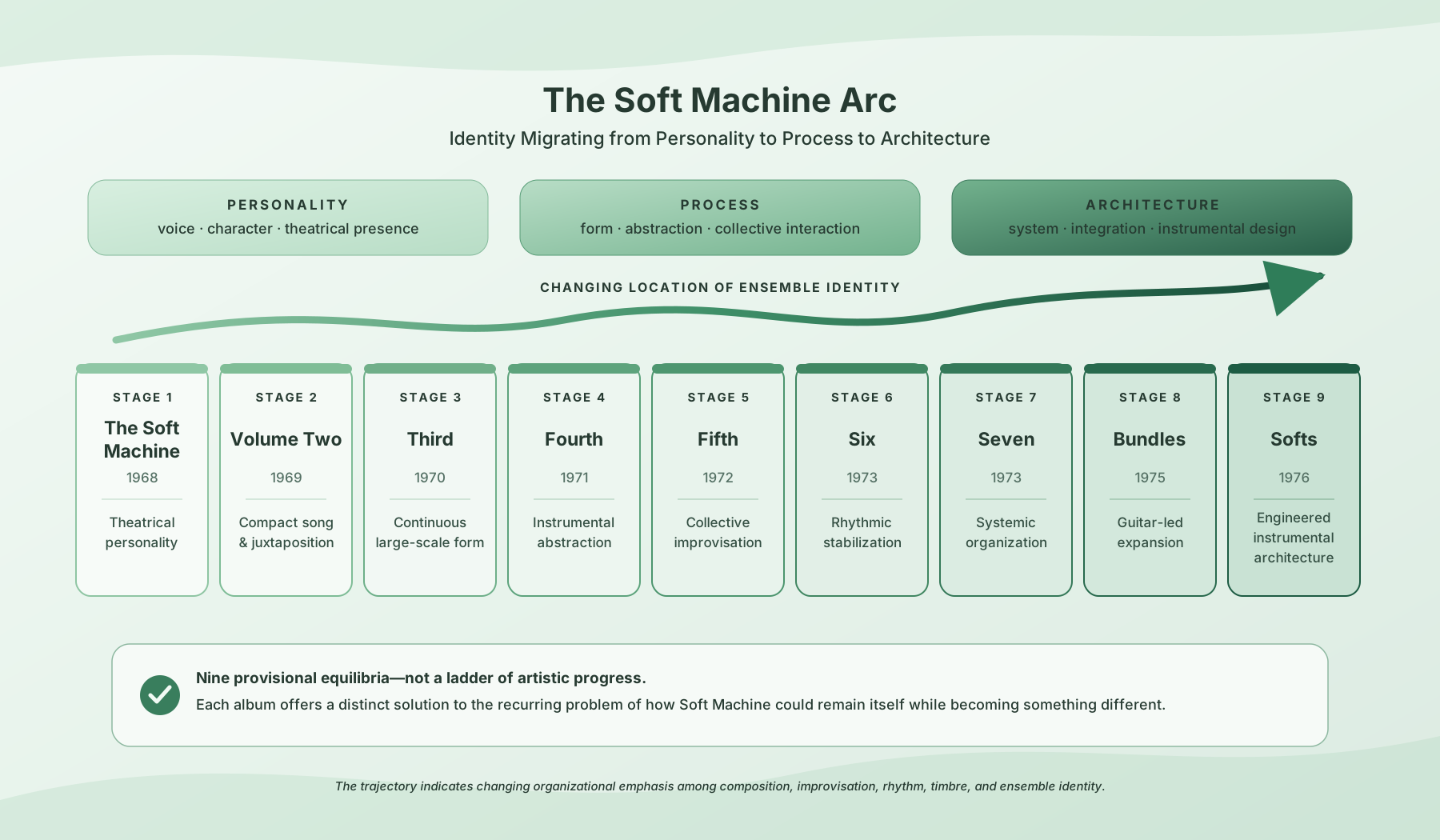
Soft Machine’s response was evolutionary. The group repeatedly changed personnel, redistributed authority, abandoned functions, and converted surviving procedures into the basis of another identity. Mutation was not merely an accidental result of instability. It became a method.
This was not a teleological progression from immature psychedelia to mature instrumental jazz. Each configuration eventually encountered limits in its ability to sustain competing behaviors. Departure, arrival, or internal marginalization altered the available functions. Some procedures disappeared; others survived and were reassigned, intensified, or given new structural meanings. A provisional equilibrium emerged from that redistribution, and the new balance eventually generated pressures of its own.
Personnel mattered because musicians carried organizing functions and practices, not merely instrumental colors. A departure could remove a conception of song, duration, timbre, rhythm, or collective action; an arrival could make possible another distribution of those functions. The later sections will trace that history in detail. Here the essential point is that musical identity changed when the system carrying it changed.
The evolutionary sequence nevertheless preserves memory. A later formation need not sound like the founding quartet in order to inherit one of its procedures. Repetition, modular connection, harmonic suspension, or improvisation inside resistant material may continue after the personalities and aesthetics that first animated them have disappeared. But inheritance is selective and consequential. What survives may gain authority precisely because a competing function has been lost.
Loss, in this model, is not an interruption of development from outside. It becomes one of the conditions under which development occurs. The ensemble answers absence by reconstructing its internal relations. That answer can be coherent and fertile without restoring what vanished, and the new coherence can eventually create another exclusion. Evolution names this recursive production of possibility and limit.
d. Mutation versus Ordinary Stylistic Development
Ordinary stylistic development presumes a comparatively continuous musical subject that acquires new techniques and absorbs new influences. Mutation changes the system carrying the identity. The inherited material may remain audible, yet its function alters because its carrier, context, and relation to other forms of authority have changed.
Repetition offers the clearest example. Under Ayers, a recurring figure could preserve melodic economy, stabilize an autonomous song, or turn deliberately limited material into an immediate performance. After his departure, repetition remained central, but its connection to self-contained pop form weakened. In Hugh Hopper’s bass writing and the increasingly instrumental ensemble, ostinato could establish harmonic mass, regulate duration, support improvisation, and organize a field beneath changing activity. The procedure survived; the musical world determining its meaning did not.
This distinction prevents continuity from being confused with sonic sameness. Materials may transfer, change function, lose authority, or disappear. Every mutation opens possibilities while closing others. Greater architectural concentration may diminish theatrical expansion; extended instrumental development may displace autonomous song; increased contrapuntal density may reduce the space available to voice. No change is adequately described as simple improvement or decline.
Soft Machine’s continuity consequently resides in transformed procedures rather than invariant sound. Each configuration inherits operative possibilities from its predecessor and reorganizes them within another system. Mutation names that combination of retention and functional change: something survives, the relations around it alter, and a new identity emerges from the discrepancy between what has been preserved and what has been lost.
e. Provisional Equilibria
Soft Machine’s formations should be understood as provisional equilibria: temporary solutions to competing musical behaviors. Each establishes a workable balance among composition, improvisation, song, repetition, timbre, instrumental specialization, and individual authority. No formation is final or ideal. Each enables particular actions and excludes others.
The history therefore forms a sequence of equilibria rather than a march toward a definitive style. Every solution changes the ensemble’s internal proportions and generates another problem. The appropriate question is not which formation is the “true” Soft Machine, but what each makes possible, what it can no longer accommodate, and which procedures remain available for transformation.
This approach does not erase qualitative distinction or ask every configuration to be valued for the same reasons. It makes comparison more exact. A formation can be considered according to the musical problems it accepts, the possibilities it develops, and the exclusions its solution produces. The early ensemble’s permeability, the later groups’ instrumental concentration, and the changing locations of compositional and rhythmic authority become historically related without being treated as interchangeable.
Provisional equilibrium also clarifies how identity can survive discontinuity. Continuity does not require a hidden essence remaining untouched beneath every change. It requires an intelligible relation between one distribution of functions and the next. Procedures are retained, altered, transferred, or abandoned; the resulting configuration answers problems inherited from its predecessor even when it answers them by changing the terms. Historical identity resides in that chain of consequential responses.
Soft Machine’s evolutionary protocol is one answer to the Canterbury Paradox, not a universal solution. Within the three principal case studies of Mapping the Labyrinth, the distinction can be summarized as follows:
Ensemble
Protocol
Treatment of contradiction
Soft Machine
Evolutionary
Changes configuration, redistributes authority, and sheds
earlier identities
National Health
Dialogical
Preserves competing systems through friction and negotiation
Gilgamesh
Recursive
Retains its materials within a comparatively bounded system of
internal reconfiguration
These protocols do not designate three Canterbury styles. They describe three organizational answers to the same problem. Soft Machine changes the body carrying the tensions. National Health sustains competing systems through dialogue. Gilgamesh reorganizes a more bounded field from within. Their relation lies not in surface resemblance but in the different ways each makes heterogeneity coherent without reducing it to uniformity.
The Canterbury Matrix therefore did not produce a unified style. It created the conditions under which lyrical song and jazz interaction, R&B propulsion and modernist construction, improvisational freedom and formal control, comic irreverence and artistic seriousness could encounter one another. Shared places, friendships, listening habits, and overlapping personnel allowed these materials to circulate, but proximity did not resolve their differences. It made those differences musically available.
The matrix was generative precisely because it brought incompatible conceptions of form, expression, authority, and collective action into sustained contact. The next task is to move from the network that enabled those encounters to the founding contradictions that gave them creative force.
3. The Founding Musical Contradictions
The Canterbury Matrix brought heterogeneous musical materials into contact, but contact did not produce immediate synthesis. Song, instrumental abstraction, composition, improvisation, melodic continuity, rhythmic propulsion, and formal experimentation embodied different assumptions about how music should develop, where its identity should reside, and who should control its direction. These tensions would not remain fixed: some would disappear when their principal carriers departed, others would be redistributed among new personnel, and still others would return in altered forms within later configurations. Soft Machine’s history begins, therefore, not with a stable stylistic identity but with a field of founding contradictions whose changing balance would repeatedly redefine the ensemble. The most fundamental of these concerned the relationship between song and instrumental abstraction.
Within This Section
I. Song and Instrumental Abstraction
Song supplied early Soft Machine with its most immediate form of musical identity. Melody, voice, lyric, and repetition could establish a recognizable object within a few moments, even when that object was harmonically unusual or theatrically unstable. Kevin Ayers’s economical writing made this function especially clear. His songs often depended upon limited material, sharply defined melodic profiles, and an apparent reluctance to develop an idea beyond the point required to establish its character. Robert Wyatt’s singing provided a contrasting form of song identity: more emotionally exposed, rhythmically flexible, and capable of turning melodic directness into vulnerability, irony, or dramatic instability. In both cases, however, the voice gave the music a human center and made formal identity perceptible through utterance and return.
Instrumental abstraction operated according to a different principle. Rather than preserving the song as a self-contained object, it treated themes, riffs, harmonic fields, rhythmic cells, and timbral gestures as materials available for extension and reorganization. A melodic idea could be detached from its lyric, prolonged beyond its original proportions, or subordinated to an instrumental process whose direction no longer depended upon song form. Ratledge’s organ increasingly encouraged this transformation. Harmonic suspension, intervallic patterning, and repeated structures could replace conventional progression, allowing continuity to arise through accumulation, density, and changing instrumental interaction. Allen’s guitar and tape-oriented experimentation opened another path toward abstraction, dissolving the boundaries of the song through texture, improvisation, and psychedelic expansion.
This contradiction would become one of the principal engines of Soft Machine’s mutation. Ayers’s departure weakened the ensemble’s strongest commitment to autonomous song, but it did not eliminate melody, repetition, or economy. Those procedures survived and were redirected toward ostinato, thematic recurrence, harmonic suspension, and extended instrumental construction. Wyatt’s voice preserved a residual song-centered authority for longer, even as it occupied diminishing structural space within an increasingly specialized instrumental system. Song did not simply disappear as the group “became jazz.” Its constituent functions were separated: some were abandoned, some marginalized, and others absorbed into forms of abstraction that changed their original meaning.
The founding tension between song and instrumental abstraction therefore established a pattern that would recur throughout Soft Machine’s history. Contradictory behaviors did not have to be reconciled permanently in order to generate coherent music. They could coexist provisionally, act upon one another, and produce new forms precisely because neither fully surrendered its identity. When that balance became unsustainable, the group did not resolve the contradiction within an invariant style. It redistributed the musical functions through which the contradiction had been expressed.
II. Voice and Ensemble Impersonality
The tension between song and instrumental abstraction concerned the form of the music; the tension between voice and ensemble impersonality concerned the kind of presence through which that form became perceptible. In early Soft Machine, the voice did more than carry melody and words. It introduced bodily presence, linguistic character, humor, vulnerability, and theatrical address into the ensemble. Singing made the identity of a particular performer inseparable from the musical material. Ensemble impersonality, by contrast, emerged when individual expression became subordinate to specialized instrumental function and coherence depended less upon recognizable personalities than upon the coordinated operation of the group.
The early ensemble contained several distinct forms of vocal presence. Kevin Ayers’s voice reinforced the economy and autonomy of his songs. Its restraint could make repetition appear deliberate rather than deficient, preserving the identity of limited material without demanding extensive development. Robert Wyatt’s singing operated differently. Its exposed timbre, flexible phrasing, and emotional immediacy could make even unconventional melodic material feel personally inhabited. Daevid Allen added another dimension through spoken intervention, absurdist language, and theatrical delivery. Voice was therefore not a uniform stylistic feature. It was the principal medium through which incompatible personalities entered the music without losing their differences.
Ensemble impersonality created genuine structural possibilities. It allowed longer instrumental processes to unfold without repeated recentering by the voice; enabled more complex relations among organ, bass, drums, and reeds; and permitted authority to circulate through composed lines, solos, ostinatos, and collective improvisation. At the same time, it narrowed the range of contradictions the ensemble could contain. The music gained a more integrated instrumental apparatus by relinquishing one of its strongest sources of humor, fragility, theatrical disruption, and direct human address.
Voice and ensemble impersonality therefore represented competing distributions of musical authority. Voice concentrated identity in a recognizable performer and made expression inseparable from personal presence. Ensemble impersonality distributed identity among interdependent functions and located coherence in the operation of the collective system. Early Soft Machine attempted to sustain both. Its later evolution increasingly favored the second, not because individuality disappeared, but because individuality became acceptable primarily when it could be converted into instrumental function. The changing balance between these principles prepared another founding contradiction: whether the ensemble would develop through collective improvisational freedom or through increasingly composed architecture.
III. Composition and Improvisation
The tension between voice and ensemble impersonality concerned the distribution of musical presence; the tension between composition and improvisation concerned the distribution of musical control. Composition could establish thematic material, harmonic fields, formal proportions, transitions, and coordinated relations among instruments. Improvisation allowed performers to determine duration, density, emphasis, and immediate direction from within those conditions. Early Soft Machine depended upon both, but the boundary between them remained unstable. Composed material needed performance to become mobile, while improvisation required sufficient structural definition for departure, interaction, and return to become perceptible.
Composition did not initially operate only through complete, self-contained works. It could reside in a song, riff, bass figure, intervallic pattern, harmonic environment, or predetermined sequence of contrasting modules. These elements established local identities and supplied points of collective orientation. Even when the ensemble moved far from an opening theme, the composed material could continue to govern the performance by defining its harmonic limits, rhythmic character, or anticipated destination. Architecture therefore preceded complete formal determination: the musicians might know the conditions of the field without knowing every event that would occur within it.
The movement from “Hibou, Anemone and Bear” through “Facelift” and “Slightly All the Time” to “Virtually” clarifies this change. In “Hibou, Anemone and Bear,” composed identity provides a flexible basis for collective interaction. In “Facelift,” improvised performance is retrospectively subjected to recorded construction. In “Slightly All the Time,” improvisation becomes an internal component of a projected extended architecture. By “Virtually,” local freedom remains substantial, but its formal consequence becomes increasingly intelligible through the larger relationships in which it occurs: recurrent material, changing instrumental functions, and the redistribution of responsibility across the ensemble. The development does not represent the disappearance of improvisation or a simple transfer of authority to composition. It represents a growing independence between degree of prescription and heard behavior, as written and open conditions become different ways of organizing possibility within one continuous architecture.
Composition and improvisation therefore constituted a founding contradiction not because Soft Machine alternated between written and spontaneous music, but because the two principles proposed different locations for musical decision-making. Composition projected relations across the duration of the work; improvisation generated relations from within the unfolding present. The group’s changing identity depended upon how much authority each configuration granted to those forms of control and upon whether their interaction could remain productive. That interaction also produced competing models of continuity: one based upon architectural relation and return, the other upon the immediate persistence of performance.
IV. Humor and Severity
The tension between composition and improvisation concerned the location of musical control; the tension between humor and severity concerned the interpretive character of that control. Early Soft Machine could present intricate, extended, or highly disciplined music without allowing complexity to acquire an exclusively solemn identity. Absurdist language, theatrical behavior, comic repetition, exaggerated delivery, and abrupt stylistic contrasts coexisted with formal concentration and instrumental rigor. Humor did not stand outside the music as decoration or relief. It made the music capable of self-interruption: a joke could interrupt, redirect, or even invalidate a solemn development, keeping complexity from claiming absolute authority.
Humor entered the ensemble through several distinct channels. Daevid Allen contributed an anarchic and theatrical sensibility in which performance could become play, provocation, or deliberate disruption. Kevin Ayers’s economy could give songs a deadpan quality, as though elaborate musical expectations were being answered by material of calculated simplicity. Robert Wyatt’s vocal delivery joined vulnerability to comic instability: an exposed or emotionally direct utterance could coexist with nonsense syllables, eccentric diction, or sudden changes of tone. Their humor differed in character, but each resisted the transformation of musical sophistication into cultural gravity.
As humor receded, the loss was deeper than the disappearance of jokes, whimsical titles, or eccentric stage behavior. Humor had enabled Soft Machine to preserve a contradiction between intellectual ambition and resistance to cultural solemnity. It allowed complexity to remain connected to personality, social exchange, and the possibility that the performance might question its own authority. Severity concentrated the music’s architectural power, but humor prevented that power from becoming its only interpretive frame.
Humor and severity thus represented competing attitudes toward musical authority. Severity asked the listener to inhabit the consequences of a rigorously maintained process. Humor exposed the contingency of that process and refused to let its discipline become absolute. Early Soft Machine could sustain both because its sharply differentiated personalities prevented any single attitude from controlling the ensemble completely. As those personalities departed and instrumental functions became more specialized, severity increasingly ceased to be counterbalanced by comic disruption. The contradiction was not resolved through synthesis; one of its terms gradually lost the structural agents capable of sustaining it.
V. Fragmentation and Continuity
The tension between humor and severity concerned the interpretive character of musical authority; the tension between fragmentation and continuity concerned how that authority operated across time. Early Soft Machine frequently assembled music from brief songs, recurring figures, abrupt transitions, improvisational passages, verbal interruptions, contrasting modules, and materials whose identities remained sharply differentiated. Continuity could not therefore depend solely upon uninterrupted thematic development or stylistic uniformity. It had to arise through the management of discontinuity: through the placement, recurrence, transformation, and cumulative interaction of fragments that did not cease to sound separate merely because they participated in a larger sequence.
Fragmentation assumed several forms. A composition could be extremely brief, preserving the concentration of a miniature rather than expanding into a conventionally proportioned song. A continuous performance could move abruptly between vocal, instrumental, comic, and abstract materials. A recurring figure could be detached from its original context and used as a transition or point of return. Improvisation could interrupt a composed sequence, while tape editing could place events beside one another that had not occurred within the same uninterrupted performance. Fragmentation was therefore not one formal technique. It described any condition in which the local identity of musical material remained more immediately perceptible than its membership in a continuous whole.
Fragmentation and continuity therefore did not represent mutually exclusive formal outcomes. They described competing levels of identity. Fragmentation preserved the autonomy of local materials, personalities, and musical conditions; continuity made those differences participate in a temporal whole. Early Soft Machine generated coherence by allowing fragments to remain capable of challenging the sequence that contained them. Later configurations generated continuity more securely by assigning differentiated materials functions within an increasingly integrated architecture.
The contradiction was never eliminated. Even the most extended instrumental works required internal differentiation, while the briefest and most discontinuous early sequences depended upon recurrence, momentum, and placement. What changed was the location of authority. Fragmentation gradually ceased to represent the coexistence of competing conceptions of the ensemble and became a compositional resource governed by the ensemble’s dominant architecture. Soft Machine’s history can therefore be understood not as a movement from discontinuity to continuity, but as a transformation in the kind of difference that continuity was capable of containing.
VI. Harmonic Suspension and Rhythmic Propulsion
The tension between fragmentation and continuity concerned the kinds of difference that a temporal whole could contain; the tension between harmonic suspension and rhythmic propulsion concerned how such a whole continued to move when harmony did not provide a decisive sense of destination. Soft Machine frequently organized extended passages around ostinatos, restricted pitch collections, sustained sonorities, repeated harmonic fields, and slowly changing registral structures. These conditions weakened the directional authority conventionally associated with harmonic progression. Yet the music rarely became static. Bass repetition, drumming, internal accentuation, textural accumulation, and changes of density generated forward pressure within environments whose harmonic identities remained comparatively stable.
Harmonic suspension did not mean the absence of harmonic activity. Chords could change, lines could introduce chromatic friction, and improvised parts could continuously alter the vertical result. Suspension arose when those events failed to establish an unequivocal progression toward cadence or tonal resolution. Harmony defined a field more readily than a route. It established boundaries, degrees of pressure, registral zones, and characteristic intervallic relations, but it did not necessarily determine when the music should leave one condition or where it must arrive next.
Harmonic suspension and rhythmic propulsion therefore represented complementary but competing sources of temporal authority. Suspension allowed a musical condition to persist and made duration available for internal exploration. Propulsion made persistence directional by continually altering the energy, density, and perceptual weight of that condition. Neither principle was sufficient alone. Suspension without propulsion risked inertia; propulsion without a durable field risked expending itself without establishing structural identity.
Soft Machine’s achievement lay in making the contradiction productive. The group could remain harmonically in place while moving intensely through time, and it could generate large-scale form by distinguishing between motion within a field and movement from one field to another. What changed historically was the agency responsible for that motion. Rhythmic propulsion gradually ceased to depend primarily upon the disruptive responsiveness of individual performers and became a coordinated function of the instrumental system. Harmonic suspension likewise changed from a condition available for personality and interaction into a principal component of extended architecture. The resulting music gained unprecedented control over duration, but that control brought the ensemble closer to the point at which its founding contradictions would no longer coexist as equal forces.
VII. Collective Performance and Composer-Defined Structure
The tension between harmonic suspension and rhythmic propulsion concerned the sources of movement within extended duration; the tension between collective performance and composer-defined structure concerned who possessed authority over that movement. Soft Machine’s music depended upon the ensemble’s ability to transform written, repeated, or otherwise predetermined materials through interaction. At the same time, its increasingly extended forms required structures capable of coordinating that interaction across durations no individual performer could govern alone. The group’s development therefore involved a continuing negotiation between form as something enacted collectively in the present and form as something projected in advance by a composer.
Collective performance did not mean the absence of prior organization. Musicians could perform a composed theme, maintain an ostinato, follow a harmonic field, or move through an agreed sequence while still determining the immediate character of the music together. Their choices of articulation, density, emphasis, register, timing, and response could alter the weight and direction of the material without changing its identifying structure. Collective authority operated most strongly at the level of realization: it determined what a compositional condition became in performance.
As composer-defined structure gained authority, Soft Machine approached the limit of its founding identity. The ensemble gained the ability to sustain extended instrumental architectures, coordinate high-density textures, integrate improvisation with predetermined form, and preserve continuity despite personnel change. At the same time, it lost part of the openness through which radically different personalities had once been able to redefine the group from within.
The contradiction was therefore not resolved by a final synthesis of composition and collectivity. It was reorganized through hierarchy. Collective performance became the active medium of composer-defined structure, preserving local unpredictability while surrendering increasing control over large-scale identity. Soft Machine’s history can consequently be heard as a movement from an ensemble whose structure emerged through the contested coexistence of its members toward an apparatus in which members collectively executed a more stable architectural conception. The music remained collective in sound and operation, but the authority to define what that collectivity meant had increasingly moved elsewhere.
VIII. Live Expansion and Studio Construction
The tension between collective performance and composer-defined structure concerned where authority resided within the ensemble; the tension between live expansion and studio construction concerned when the final identity of the music came into being. Soft Machine’s work repeatedly moved between materials developed through performance and forms made possible only through recording, editing, overdubbing, tape manipulation, and the retrospective organization of recorded events. The concert stage allowed structures to expand through duration, interaction, and improvisation. The studio allowed those expansions to be selected, rearranged, transformed, layered, and assigned relations they had not necessarily possessed when performed. Neither environment merely reproduced what originated in the other. Each exposed a different conception of the musical work.
Live expansion treated composition as a condition capable of generating more music than it explicitly contained. A theme, bass ostinato, harmonic field, repeated phrase, or sectional sequence could provide the basis for performances whose durations and internal proportions remained variable. Musicians could prolong a region, intensify its texture, redirect its immediate momentum, or allow improvisation to alter the balance among instrumental functions. The identity of the piece persisted, but its realization remained contingent upon the decisions made during performance.
What diminished was the possibility that performance might redirect the ensemble beyond the terms of its dominant architecture. Once studio logic had become compositional logic and compositional logic had become executable ensemble discipline, expansion increasingly meant elaboration within the system rather than transformation of the system itself. The musicians could generate different events, but the range of identities those events could produce had narrowed.
The contradiction between live expansion and studio construction was therefore not resolved by making performance fixed or recording spontaneous. It was reorganized through the emergence of executable architecture. Studio construction identified, intensified, and formalized relations generated through performance; composition translated those relations into structures that musicians could enact again. Soft Machine moved from a group whose recordings captured and arranged an unstable live identity toward an apparatus capable of performing its own constructive logic. The work no longer needed to choose between event and object because the object had become a system for producing events.
IX. Contradiction as Generative Pressure
The tension between live expansion and studio construction concerned whether musical identity emerged through continuous performance or retrospective organization. More broadly, however, Soft Machine’s history was shaped by a series of contradictions that could not be reduced to differences of medium, technique, or personnel. Song and abstraction, personality and system, improvisation and architecture, harmonic suspension and rhythmic propulsion, collective performance and composer-defined structure, live expansion and studio construction: each pair represented competing principles that the group required but could never hold in stable equilibrium. Their incompatibility did not initially weaken the ensemble. It generated the pressure through which Soft Machine continually transformed itself.
Contradiction in this context does not mean simple inconsistency. The group did not alternate arbitrarily between unrelated styles, nor did its development result from a failure to choose among clearly defined alternatives. Its opposing tendencies were mutually productive. Song gave abstraction a human point of reference; abstraction prevented song from determining the limits of the music. Improvisation animated composed structures; composition gave improvisation a larger temporal consequence. Harmonic suspension created durable environments; rhythmic propulsion prevented those environments from becoming inert. Collective performance supplied volatility and local intelligence; composer-defined structure coordinated that intelligence across extended duration. Live expansion generated possibilities; studio construction selected, transformed, and stabilized them.
This configuration was not yet a fully unified architecture. Each function could support the others, resist them, or temporarily redefine the music’s center. Voice might transform an instrumental field into personal utterance; organ might absorb a song into harmonic process; bass might turn a local figure into an environment; drums might destabilize repetition without destroying its identity. Coherence emerged from their continual adjustment rather than from the authority of a single organizing principle.
Soft Machine’s first durable solution to its founding instability was consequently neither a settled style nor a compositional doctrine. It was a performing apparatus: voice, organ, bass, and drums arranged as an interdependent but internally divided system. To understand how contradiction first became executable musical form, it is necessary to examine this machine in operation.
4. The First Machine: Voice, Organ, Ayers’s Bass, and Drums
Soft Machine’s first stable ensemble configuration transformed its founding contradictions into an interacting musical organism. Voice, organ, bass, and drums did not merely occupy conventional roles within a rhythm section supporting songs. Each carried a distinct principle of organization. Voice introduced language, personality, vulnerability, and theatrical immediacy; organ established harmonic fields and instrumental continuity; bass converted recurring figures into durable temporal environments; drums animated those environments through accent, interruption, and responsive motion. The music arose from the continual negotiation among these functions.
This configuration may be understood as the group’s first machine because its coherence depended upon interaction rather than stylistic uniformity. No single part contained the ensemble’s identity. Voice could become the center of attention without fully subordinating the instrumental field; organ could establish the harmonic environment without determining every local event; bass could stabilize duration without eliminating mobility; drums could disrupt the surface while preserving collective momentum. Each function required the others, yet none was merely reducible to support.
The machine was therefore neither hierarchical nor fully democratic. Authority shifted according to the material and the moment. A song might begin under the apparent control of voice, only for organ harmony or rhythmic repetition to redefine its proportions. An instrumental passage might be organized by an ostinato, while drumming determined its changing intensity and internal direction. What appeared compositionally stable could become behaviorally unstable through performance; what appeared locally volatile could remain coherent because bass and organ preserved the underlying field.
This mobility distinguished the ensemble from a conventional organ trio with vocals added. The voice was not simply placed above an autonomous instrumental foundation, and the instruments did not merely accompany a succession of vocal statements. Wyatt’s singing could alter the social and emotional meaning of the entire texture. Ratledge’s organ could extend a harmonic condition beyond the requirements of song. Ayers’s or Hopper’s bass could turn repetition into an organizing environment. Wyatt’s drumming could make that environment breathe, resist, accelerate, or fracture without necessarily replacing its foundational material.
The four-part configuration also allowed different conceptions of musical time to coexist. Voice tended toward phrase, statement, and semantic consequence. Organ could suspend time within sustained harmony or extend it through linear improvisation. Bass established recurrence and continuity. Drums generated immediate motion through continually changing relations among pulse, accent, density, and attack. Their interaction made it possible for concise songs to open into extended processes and for instrumental abstraction to retain traces of bodily and personal presence.
The first machine was consequently less a fixed arrangement of parts than a system of transferable pressures. Its components could exchange prominence, alter one another’s functions, and produce forms not fully specified by any individual contribution. The group’s early coherence depended upon this principle of mutual transformation: voice humanized abstraction, organ expanded song into harmonic space, bass made duration inhabitable, and drums kept stable conditions behaviorally alive.
The most mobile element within this system was Robert Wyatt. His importance cannot be divided cleanly between vocalist and drummer, because the same responsiveness governed both roles. Through voice he brought language, personality, and exposed physical presence into the ensemble; through drumming he converted structural conditions into immediate action. He did not simply occupy two positions within the machine. He moved between personal utterance and collective propulsion, connecting forms of musical identity that the group’s later architecture would increasingly separate.
Within This Section
I. Robert Wyatt: Voice and Rhythmic Mobility
Robert Wyatt occupied a singular position within Soft Machine’s first musical apparatus because he joined two functions that later instrumental ensembles would tend to separate: the projection of an individual presence and the regulation of collective motion. As vocalist, he introduced language, character, vulnerability, humor, and bodily immediacy. As drummer, he shaped pulse, accent, density, and transition from within the ensemble. These roles were not merely combined in one performer. They arose from the same underlying musical disposition: an ability to make established material feel provisional, responsive, and open to sudden change.
His voice functioned first as an unmistakable personality. It did not aspire to the impersonal authority of a conventionally polished rock singer, nor did it remain a neutral carrier of composed melody. Its high register, exposed tone, flexible intonation, and conversational articulation preserved the physical presence of the person producing it. Breath, strain, hesitation, humor, and emphasis remained audible as components of meaning. The listener encountered not only a vocal line but an individual negotiating that line in real time.
This quality made Wyatt’s singing structurally consequential. Because the voice carried such a strong personal identity, its entrance could redefine the musical environment around it. An organ harmony that had functioned as an instrumental field could become intimate or vulnerable when occupied by the voice. A repeated bass figure could acquire the character of song, ritual, insistence, or parody according to the manner in which words were projected across it. The voice did not simply add expression to an existing structure; it changed what kind of structure the listener perceived.
“A Certain Kind” demonstrates this effect with particular clarity. Its sustained harmonic environment and measured melodic movement provide a relatively stable frame, but Wyatt’s performance prevents that stability from becoming emotionally settled. His tone carries fragility without abandoning melodic control. The result is a productive disparity between the security of the composition and the exposed quality of its realization. Harmonic continuity supports the voice, yet the voice makes that continuity sound less like resolution than like a space within which uncertainty can remain audible.
The structural importance of this performance lies partly in its resistance to abstraction. The organ may establish a durable harmonic field, and the melody may possess a recognizable compositional identity, but Wyatt’s vocal presence keeps the music attached to an individual body. The song cannot be understood solely as a set of harmonic and melodic relations because its meaning depends upon the particular vulnerability with which those relations are enacted. Personality becomes part of the form.
This position would become increasingly difficult to preserve as the group’s architecture grew more specialized. A more fully instrumental system could retain Wyatt’s rhythmic intelligence by assigning him the function of drummer, but it could not as easily contain the broader principle embodied by his voice. Personality, language, humor, and vulnerability were not simply additional timbres; they could redefine the purpose and public identity of the whole ensemble.
Within the first machine, however, that redefining power remained central. Wyatt’s voice made musical structure personal, while his drumming made structural stability mobile. His abrupt ruptures ensured that no established condition became entirely self-sufficient. He did not merely animate the apparatus. He kept it vulnerable to transformation. That mobility operated against—and depended upon—the more sustained harmonic authority of Mike Ratledge’s organ.
II. Mike Ratledge: Harmonic Field and Organ Attack
Mike Ratledge supplied the first machine with its most durable harmonic environment and its strongest movement toward instrumental architecture. Where Wyatt made established conditions mobile through vocal presence and rhythmic response, Ratledge created conditions capable of persisting beyond the proportions of song. His organ could sustain a harmonic region, concentrate ensemble activity around a limited collection of pitches, or impose a sharply articulated line upon the texture. It functioned not only as a keyboard instrument but as a means of regulating musical space.
This role distinguished Ratledge’s harmonic thinking from conventional chordal accompaniment. The organ did not simply confirm changes implied by a melody or provide a background beneath the voice. It could establish a field whose internal relations remained active even when functional harmonic progression slowed or disappeared. Chords became less important as steps toward cadential destinations than as registral and intervallic configurations capable of supporting extended behavior.
A harmonic field in this sense is neither a static chord nor an unrestricted modal space. It is a defined environment containing characteristic tensions, available routes, and limits of motion. Particular pitches may be emphasized without resolving conventionally; intervallic structures may recur in different registers; lines may move within the field without changing its underlying identity. The music acquires continuity through persistence of condition rather than continuous progression toward arrival.
Ratledge’s organ was especially suited to this function. Its ability to sustain indefinitely allowed harmony to remain present without repeated physical attack. A sonority could continue beneath melodic, rhythmic, or improvisational activity and preserve the identity of the environment while its surface changed. Unlike the rapid decay of a piano, the organ did not require continual rearticulation to maintain harmonic weight. It could make a chord behave like an occupied space.
Sustain also separated structural duration from instrumental gesture. Ratledge could establish a harmonic plane and allow other parts to move against it without requiring the organ itself to remain continuously active. Bass might articulate recurrence beneath the plane, drums might alter its density and pressure, and voice or reeds might trace changing contours across it. The harmony persisted as a condition shared by activities whose temporal behaviors differed.
Ratledge’s organ ultimately gave Soft Machine a means of moving from song-bearing ensemble toward executable architecture. It could retain the harmonic residue of a song after the voice withdrew, transform repetition into a formal condition, and organize improvisational activity without prescribing every local event. Its distorted attack ensured that this movement toward architecture did not sound detached or academic. Structure acquired abrasion, weight, and physical force.
Yet the organ could not create duration alone. A harmonic field requires a lower boundary, a recurring temporal reference, or some other means of maintaining identity beneath its changing surface. In the first machine, that stabilizing function belonged increasingly to the bass: first through Kevin Ayers’s economy and melodic directness, and later through Hugh Hopper’s transformation of repetition into an extended structural environment.
III. Kevin Ayers: Melodic Economy and Oblique Songcraft
Kevin Ayers supplied Soft Machine’s first machine with a principle distinct from both Wyatt’s behavioral mobility and Ratledge’s architectural pressure. His bass playing favored melodic economy, tonal clarity, and immediately recognizable contour. His songs similarly depended upon concise identities: a memorable melodic shape, a limited harmonic frame, a characteristic verbal attitude, or a small formal premise sufficient to establish the work’s world. Where Ratledge extended material into durable harmonic environments and Wyatt made structures vulnerable to expressive rupture, Ayers concentrated musical meaning into gestures capable of becoming recognizable almost at once.
Economy did not mean simplicity in the sense of conventional directness. Ayers’s materials were often economical precisely because their apparent clarity supported more ambiguous relations among language, mood, and musical behavior. A bass line might be plainly profiled yet occupy an unusual position between foundation and melody. A song might present an accessible tune while its words displaced emotional meaning through irony, detachment, fantasy, or understatement. Concision established identity; displacement prevented that identity from becoming psychologically transparent.
His bass was crucial to this balance. In the first machine, the instrument did more than reinforce Ratledge’s harmonic roots or provide a stable pulse beneath Wyatt’s drumming. Ayers frequently treated the bass as a melodic participant whose line could define the character of a passage through contour rather than weight. The instrument’s lower register supplied grounding, but its movement could retain the independence and memorability of a composed voice.
This melodic function differentiated Ayers from a bassist whose primary task is to confirm harmonic progression. His lines could select a few decisive pitches, repeat a compact figure, or move with a vocal directness that gave the lower register its own identity. The bass did not need to articulate every harmonic implication of the organ. By limiting its information, it could leave Ratledge’s sonorities partially open while establishing a clear path through them.
Economy therefore created structural space. A densely specified bass part would have competed with the organ’s intervallic activity and constrained Wyatt’s rhythmic freedom. Ayers’s more selective approach allowed the bass to stabilize the music without saturating it. A small number of notes, carefully placed, could define pulse, lower boundary, and melodic character simultaneously.
Ayers’s importance lies precisely in the alternative he made audible before that transformation. His bass gave the first machine clarity without rigidity. His songs created identity without exhaustive development. His lyrics introduced personality without requiring direct confession. Through economy and displacement, he demonstrated that complexity could reside not only in dense architecture or volatile behavior but in the unstable relation between a memorable surface and an elusive meaning.
Within Soft Machine’s founding configuration, this principle prevented musical significance from becoming synonymous with expansion. Ratledge could extend harmony into architecture, and Wyatt could turn performance into continuous behavioral change. Ayers showed that a few notes, a concise melody, or an oblique phrase could establish a world that neither architecture nor improvisation could entirely absorb. His economy formed the first machine’s third source of coherence—and the possibility it would lose as Hugh Hopper transformed the bass from melodic counterweight into structural engine.
IV. The Productive Absence of Guitar
Soft Machine’s first durable instrumental configuration was shaped as decisively by what it lacked as by the functions it contained. After Daevid Allen’s departure, the group developed without a conventional guitarist occupying the middle register, articulating chordal rhythm, doubling the bass, or assuming the expected role of principal soloist. This absence did not leave an empty position waiting to be filled. It altered the distribution of musical responsibility across the ensemble and encouraged organ, bass, drums, and voice to interact in ways that a conventional guitar role might have stabilized or separated.
The distinction is important. Guitar was not wholly absent from Soft Machine’s formative history. Allen’s playing belonged to the group’s original psychedelic and improvisational identity, operating as lateral complication rather than conventional lead: glissando, drone, noise, and spatial coloration displaced the chordal and rhythmic functions associated with rock guitar. The productive absence considered here therefore concerns not the complete historical exclusion of the instrument but the disappearance of a conventional guitar role from the ensemble’s durable operating system.
In most contemporary rock groups, guitar helped organize several musical dimensions simultaneously. It occupied the central register between bass and voice, clarified harmonic rhythm through repeated chordal attacks, reinforced the pulse, supplied riffs, and moved naturally into the foreground during instrumental passages. These functions established a familiar hierarchy: bass and drums constituted the rhythm section, guitar mediated between rhythm and harmony, and voice or lead guitar occupied the expressive foreground.
Soft Machine lacked that mediating layer. The resulting texture was not simply thinner. It was differently organized. No instrument remained permanently responsible for binding the lower register to the harmonic field, translating chord changes into regular rhythmic articulation, or filling the space between foundational recurrence and melodic projection. Those responsibilities had to be redistributed, transferred, or left deliberately incomplete.
Ratledge’s organ absorbed the greatest share of the available harmonic space, but it did not reproduce the guitar’s conventional role without alteration. The organ could supply chordal attacks, repeated patterns, sustained harmony, contrapuntal lines, distortion, and solos. Yet its physical and temporal behavior differed fundamentally from that of an amplified guitar. A guitar chord begins to decay immediately, making repeated attack a natural means of sustaining harmonic presence. An organ can preserve a sonority indefinitely. It therefore allows harmony to remain active even when rhythmic articulation temporarily ceases.
Within the first machine, however, these consequences remained fluid. The missing conventional guitar role did not produce a void but a field of transferable responsibilities. Register became a negotiated resource; harmony emerged through relations among organ, bass, and voice; texture changed through occupation and withdrawal; instrumental interaction replaced fixed accompaniment as the primary means of connection. The ensemble acquired coherence not by recreating the absent role but by making its incompleteness productive.
This organization placed unusual pressure upon the songs. Without a fixed guitar-led accompaniment pattern preserving their original proportions, vocal forms could be accelerated, interrupted, linked, expanded, or absorbed into instrumental continuity. The song remained an identifiable object, but the apparatus surrounding it already possessed forms of motion that exceeded the requirements of verse, refrain, and lyrical statement. The next development was therefore not the abandonment of song, but its exposure to instrumental forces capable of transforming it from within.
V. Song Form Under Instrumental Pressure
The early Soft Machine did not abandon song form by simply replacing songs with instrumental compositions. The more consequential transformation occurred inside the songs themselves. Concise vocal materials remained present, but they were increasingly subjected to forces whose behavior exceeded the proportions and expectations of conventional song: instrumental acceleration, collage, abrupt linkage, harmonic expansion, repetition, and the transfer of structural authority from voice to ensemble. Song persisted, but no longer functioned as an unquestioned container for everything surrounding it.
This distinction matters because the group’s early development cannot be described adequately as a linear movement from pop song to jazz-rock instrumentalism. Songs and instrumental processes coexist from the beginning. What changes is their relation. At first, instrumental activity may appear to elaborate, interrupt, or extend a song whose identity remains primary. Gradually, however, the instrumental apparatus becomes capable of determining duration, continuity, and formal consequence for itself. The song remains recognizable, yet its boundaries become permeable and its proportions increasingly provisional.
Conventional song form ordinarily coordinates several kinds of expectation. Vocal phrases define local units; lyrics establish sequence and identity; harmonic progressions support departure and return; instrumental accompaniment confirms meter and sectional boundaries. Even when verses and refrains are not entirely regular, the song tends to establish a scale appropriate to human breath, verbal memory, and repeated melodic statement. Instrumental passages occur within this framework and ordinarily return control to the voice.
Soft Machine destabilized this hierarchy without immediately eliminating it. A vocal melody might still provide the most memorable material, but the ensemble could accelerate beneath it, detach a harmonic figure from its accompanying function, prolong a repeated condition, or move directly into contrasting material before the song had produced a conventional sense of closure. The listener could identify the song while becoming uncertain about where its authority ended.
Instrumental acceleration was one of the principal sources of pressure. Acceleration need not mean only an increase in tempo. It may also involve faster subdivision, denser articulation, more rapid exchange among instruments, compressed harmonic rhythm, or an intensified rate of formal events. Wyatt’s drumming could make a stable passage feel as though it were moving beyond its original frame even when the vocal melody and underlying pulse remained recognizable. Ratledge could increase the rate and force of organ attacks until accompaniment became an independent kinetic layer. Bass could transform a supporting figure into a persistent engine.
That instability defined the first machine’s creative achievement. Soft Machine discovered how to preserve song while denying it exclusive control over musical time. The group could move beyond verse and refrain without requiring an immediate break with melody, voice, or concise identity. Instrumental architecture emerged not outside the song but through sustained pressure upon its boundaries.
Once those boundaries had become permeable, the ensemble could imagine a larger continuity in which vocal sections, repeated mechanisms, harmonic fields, abrupt modules, and instrumental expansions belonged to one executable sequence. The decisive question was no longer whether a passage remained a song. It was which principle—voice, behavior, repetition, harmonic field, or modular architecture—would control the passage’s duration and determine what could follow it.
VI. The Original Soft Machine Grammar—and Its Limits
The Ayers-era recording Soft Machine formation did not possess a single compositional language shared equally by all its members. Its identity arose from the interaction of several distinct principles: Mike Ratledge’s harmonic and modular organization, Robert Wyatt’s rhythmic and vocal instability, Kevin Ayers’s melodic economy and oblique songcraft, and the registral and functional openness created by the absence of a conventional guitar role. These principles did not converge into a unified style by eliminating their differences. They formed a grammar because the ensemble developed repeatable ways of making those differences interact.
Grammar, in this context, does not mean a fixed vocabulary of chords, rhythms, or formal patterns. Nor does it imply that the group’s music followed rules comparable to those of a settled genre. It refers instead to a system of musical relationships: which materials could occupy structural authority, how instrumental functions could be transferred, how continuity could survive abrupt contrast, and how locally complete songs could enter larger instrumental processes without disappearing entirely.
The original Soft Machine grammar was therefore relational before it was stylistic. Distorted organ, melodic bass, elastic drumming, exposed voice, concise songs, repeated figures, and abrupt sectional cuts became characteristic not simply because they recurred, but because each could alter the function of the others. A sustained organ sonority changed meaning according to the bass beneath it, the activity of the drums, and the presence or absence of voice. A repeated bass figure might define a song, stabilize an ambiguous harmonic field, or become the lower boundary of an instrumental process. A vocal phrase could provide local identity while remaining unable to control the duration of the surrounding performance.
No single component was sufficient to produce the group’s identity. Ratledge’s harmonic severity without Wyatt’s behavioral mobility might have become static architecture. Wyatt’s volatility without Ratledge’s durable fields might have lacked a sufficiently resistant structure against which to register. Ayers’s concise songs without the instrumental apparatus might have remained autonomous eccentric miniatures. The distinctive language emerged because each principle encountered another that it could neither absorb nor ignore.
This interaction may be understood through four primary relationships: field and behavior, architecture and personality, economy and expansion, and local identity and continuous sequence. These relationships operated simultaneously. They allowed a small ensemble to generate substantial differentiation without depending upon orchestration, conventional guitar hierarchy, or elaborate thematic development.
Ayers’s departure would consequently alter more than the ensemble’s personnel. It would remove one of the principal sources of concise melodic identity, locally complete song form, and personality-centered organization. Because these functions were concentrated partly in the bass, Hugh Hopper’s arrival would make the low register a crucial site of transformation. Bass could now assume a more cyclical, persistent, and architecturally connective role without simply reproducing the function Ayers had performed.
The next stage begins with that reorganization. Soft Machine does not immediately abandon song; it changes the conditions under which songs, fragments, repeated figures, and instrumental episodes can belong to a larger whole. The original grammar had made song permeable. The music of Volume Two would turn that permeability into a system of continuous form.
5. From Song to Continuous Form
Soft Machine’s movement from the debut through Volume Two, Third, and Fourth is best understood as a transformation in the level at which musical continuity becomes formally consequential. On the debut, songs and other compact materials remain recognizable local objects even as repetition, instrumental expansion, and abrupt linkage strain their boundaries. Volume Two converts that instability into relation: brief songs, fragments, recurrences, transitions, and instrumental modules form larger sequences whose continuity exceeds any individual component. On Third, each LP side becomes capable of establishing an autonomous architecture, defining its own conditions of identity, development, memory, return, and closure. Fourth does not simply enlarge that achievement again. Once autonomous instrumental form has become secure, the music turns inward toward another question: what can happen to the capacities of a musical condition that remains recognizable while its role, authority, freedom, relational reach, or possible future changes?
The resulting trajectory is therefore not simply one of increasing scale. It moves from object, through relation, to autonomous architecture, and then to changing capacity. Each stage retains possibilities discovered earlier while altering the level at which formal consequence is heard. The compact object does not disappear when relations become more important; relational continuity does not disappear when the LP side acquires architectural autonomy; and the autonomous architectures of Third do not disappear on Fourth. What changes is the question being asked of them. By 1971, Soft Machine can keep a musical identity, field, ground, or ensemble relation sufficiently intelligible for the listener to hear not merely that it has changed, but that what it is capable of controlling, permitting, generating, or becoming has changed with it.
Within This Section
I. The Destabilization of Song
The debut does not replace song with continuous instrumental architecture. Its decisive achievement is to place the song under structural pressure. Melodies, lyrics, refrains, and vocal identities remain central, but they no longer possess exclusive authority over duration, transition, or closure. Songs are compressed into concentrated statements, interrupted by contrasting events, linked to adjacent materials, and sometimes opened into instrumental motion that continues beyond the vocal form. The song remains audible as the principal local object even when the processes surrounding it exceed its customary proportions.
Compression makes this possible. A melodic contour, bass figure, harmonic color, or vocal attitude can establish identity almost immediately. Because the defining features of a song are concentrated, the music can leave it quickly without making it indistinct. A song may be interrupted, recalled, placed beside another object, or carried into a broader sequence while remaining recognizable. Its compactness allows the surrounding music to move rapidly without requiring the object itself to lose definition.
Interruption places that definition under further pressure. A vocal region may be cut short, a new texture may arrive without gradual preparation, or instrumental activity may redirect attention before the expected closure. What has just been heard remains available to memory, so the contrast acquires force from the identity that precedes it. The boundary ceases to be merely a neutral passage between self-contained songs. It becomes an audible point at which one musical condition opens onto another.
The crucial distinction is therefore between local identity and the continuation that can occur beyond its immediate boundaries. A song may complete its compact action while allowing an instrumental process to continue from it; another may be interrupted yet remain recognizable enough for a later return to register as memory. Soft Machine’s first extended procedures arise from this permeability. The group does not initially make the completed song subordinate to a larger relational system. It discovers that a recognizable musical object can remain intact while its borders become increasingly open to continuation, interruption, and return.
II. Hugh Hopper and the Reorganization of the Low Register
Hugh Hopper’s arrival changes what the bass can do formally. Kevin Ayers’s melodic economy had helped preserve the local identity of individual songs. Hopper increasingly makes the low register capable of preserving a condition across changes of theme, texture, and foreground. The distinction is not a simple opposition between melody and repetition: Hopper’s cycles remain melodic, and Ayers had already used recurrence powerfully. What changes is the scale and function of recurrence.
Once established, a Hopper figure need not continually declare a melody or follow the expressive trajectory of a lyric. It can persist as an environment within which other events enter, collide, develop, and disappear. Ratledge may alter the harmonic pressure above it, Wyatt may disturb its metric emphasis, and winds may introduce mobile foreground lines, while the low register preserves the sense that the ensemble remains inside the same operative field.
Bass thereby separates surface mobility from structural persistence. Themes can be shortened, textures enlarged, and modules juxtaposed without requiring every change in the foreground to create a new formal region. The bass is no longer merely accompaniment to successive objects. It helps define the common condition that makes their succession intelligible.
Hopper’s continuity is behavioral rather than mechanically invariant. A figure may be transposed, compressed, interrupted, or replaced while the low register retains its commitment to recurrence. This is why his contribution reaches beyond instrumental style. The bass becomes a compositional premise: a repeatable object from which duration, layering, and contrast can be organized. It makes discontinuity sustainable.
III. Collage as Continuity
If destabilized song weakens the authority of the individual section, collage supplies another way of holding music together. Songs, instrumental fragments, repeated mechanisms, and sharply contrasting modules can be placed beside one another without disguising their differences. The local passages remain discontinuous, but their succession becomes formally irreversible. Each acquires meaning through its position among the others.
Connection therefore need not reside inside the materials. It can reside in the act of placement. A section belongs to the whole because its entrance redirects the accumulated trajectory and its departure alters what follows. This allows the incompatible temporal proportions of Ayers’s songs, Ratledge’s fields, Hopper’s cycles, and Wyatt’s volatile performance behavior to remain audible without fragmenting the performance into unrelated pieces.
The abrupt cut can stop a process before its energy is exhausted, insert concision into an extended span, or replace one mode of organization with another. Such cuts make compositional authority audible: the material may imply continuation, but the sequence overrules it. Conversely, a locally complete song can be carried immediately into another region, demonstrating that closure at one level does not determine the boundary of the whole.
Collage thus turns discontinuity into a method of continuity. Its success depends upon strongly profiled local objects and an accumulated route large enough to contain their differences. The debut discovers this possibility; Volume Two makes it systematic.
IV. The Album Becomes a Circuit
On Volume Two, relation becomes more consequential than the autonomy of the individual musical object, but the two sides realize that principle differently. On Rivmic Melodies, short songs, verbal miniatures, instrumental passages, and recurring procedures behave like nodes in a circuit: recurrence, transition, interruption, and placement allow locally completed events to acquire consequences beyond their boundaries. Side Two extends relational continuity through another construction. Two autonomous songs lead into Esther’s Nose Job, where consequence is carried forward through changing internal states of one extended composition rather than principally through relations among independent miniature objects.
A circuit differs from a conventional suite because it need not depend upon balanced movements or thematic development across clearly bounded sections. Its continuity arises from activation and transfer. One object releases energy into another; a brief idea returns after displacement; a transition becomes a functional pathway rather than connective decoration. Materials acquire importance through what they initiate, interrupt, or reactivate.
This construction preserves plurality. Song, instrumental mechanism, humor, abstraction, and studio intervention do not need to merge into a uniform style. Their relations are designed at a higher level. The circuit does not reconcile every contradiction inside each local passage; it makes the passage of energy among contradictory materials into the form itself.
The result is a decisive change in scale. Individual songs remain recognizable, but the album teaches the listener to hear beyond their boundaries. Memory belongs increasingly to the sequence: an earlier object matters because of how it is recalled, transformed, or retrospectively repositioned. Continuity has migrated from the completeness of the song to the behavior of the system.
V. From Circuit to Macroform
Third changes the scale and conditions of formal organization. Volume Two had made relations among compact objects increasingly consequential; on Third, each LP side becomes capable of establishing its own extended architecture. The shift is therefore not simply from shorter to longer form, nor from a small circuit to a larger one. Identity, continuity, transformation, return, and closure can now be organized across an entire side according to principles that differ from one composition to the next.
This autonomy becomes audible in four distinct constructions. “Facelift” turns performed materials into a studio-shaped architecture in which processed emergence, ensemble embodiment, reconstruction, recognizable return, and tape transformation acquire formal consequence. “Slightly All the Time” sustains local continuity through changing composed frameworks and distributions of authority, reaches a genuine rupture between “Noisette” and “Backwards,” and establishes larger coherence through procedural inheritance and return. “Moon in June” begins from a vocal-centered musical body whose functions become increasingly separable from their initial bearers and available for redistribution across changing performing constitutions. “Out-Bloody-Rageous” makes recurrence its broadest organizing capacity, allowing recurrent information to generate and reconstruct different kinds of musical order as bearer, prominence, hierarchy, meter, and function change; after collective recurrence collapses, the closing keyboard cycles accumulate toward saturation, loss of separateness, and final withdrawal.
The album side consequently becomes a domain of long-range consequence without requiring a single album-wide mechanism of continuity. An opening condition may remain perceptually active after its literal material has disappeared; authority may pass among instruments or processes; recurrence may return without restoring an earlier state; and improvisation may alter the history through which later events are understood. What matters is not that all four compositions perform these actions in the same way, but that each possesses enough duration and internal organization to establish its own criteria for what counts as persistence, transformation, memory, and return.
This expanded scale therefore changes the meaning of composition. Large form no longer requires either continuous thematic development or a circuit linking numerous compact objects. It may arise through studio construction, relational continuity, genuine rupture, procedural inheritance, successive reconstruction, recurrence, changing instrumental authority, or combinations of these procedures. Third is unified not by a single macroformal syntax but by the new formal permission it demonstrates: an LP side can function as an autonomous musical architecture whose continuity must be understood according to the particular processes that sustain it.
VI. Four Autonomous Architectures
a. Studio-Shaped Reconstruction: “Facelift”
“Facelift” constructs extended form through a changing relation between performed material and studio organization. Its opening does not simply present a theme and develop it. Processed sound gradually gives way to a more securely embodied ensemble, after which instrumental authority is redistributed through improvisation, reduction, reconstruction, and renewed saturation. The composition’s continuity therefore depends not upon uninterrupted development but upon the listener’s ability to hear successive states as transformations of an accumulating history.
Studio agency becomes especially decisive because it acts at both ends of that history. The opening makes instrumental identity initially unstable; the ending subjects recognizable returning material to tape transformation until performance itself ceases to remain the dominant formal authority. Montage is consequently one procedure inside the work, not its complete architecture. “Facelift” sustains duration by moving from processed emergence through ensemble embodiment and reconstruction toward a return whose recognizability survives even as its musical body is transformed.
b. Transfer and Return: “Slightly All the Time”
“Slightly All the Time” sustains extended form through several different relationships among composed identity, improvisational enlargement, recurrence, instrumental function, and changing foreground authority. The opening eleven-based world expands through improvisation; a flute-led transitional field redistributes melodic and repetitive functions; and “Mousetrap” establishes a recurring composed environment within which foreground authority can move without displacing the framework beneath it. “Noisette” then condenses composed identity into a compact statement before “Backwards” establishes a genuine rupture across which no secure theme, meter, pulse condition, harmonic progression, or ensemble configuration needs to survive. Larger coherence persists through procedural inheritance, and the final return of “Noisette” brings the separated histories into consequential relation through Recognition Without Restoration.
This becomes especially important when the large-scale sequence passes from “Noisette” into “Backwards.” The change constitutes a genuine rupture rather than a seamless continuation, yet the return of “Noisette” near the end makes the earlier material newly recognizable without restoring its former position. Extended form therefore arises through transfer, interruption, and consequential return. The route matters, but so does the altered meaning acquired by material when it reappears after having passed through another formal regime.
c. Functional Redistribution: “Moon in June”
“Moon in June” begins from the most explicitly song-centered world on Third, but its side-long architecture develops by separating and redistributing functions initially coordinated around Wyatt’s voice. Melody, rhythmic articulation, repetition, harmonic support, expressive foreground, and continuity do not disappear when language recedes. They migrate into organ, drums, bass, wordless voice, studio layers, and later instrumental processes.
The composition therefore does more than enlarge a song until it becomes a suite. Its long form emerges through Successive Reconstruction through Functional Redistribution. Melody, tactus, recurrence, harmonic support, continuation, and human presence become increasingly separable from the bearers and configurations that first make them audible. That independence is prepared within Wyatt’s principally multitracked opening before the later trio enters, with Hopper’s documented melodic contribution providing an important early exception to any completely self-contained account. The music then passes into the interacting Ratledge–Hopper–Wyatt trio and later into a Wyatt-centered studio construction with Rab Spall’s violin. “Moon in June” makes the redistribution of musical functions across different performing constitutions the substance of extended form.
d. Successive Reconstruction Through Recurrence: “Out-Bloody-Rageous”
“Out-Bloody-Rageous” organizes time through recurrence, but recurrence does not remain attached to one invariant figure, instrumental bearer, or formal function. Processed keyboard cycles establish the opening condition; the 15/8 bass framework gives recurrence explicit low-register and rhythmic embodiment; inherited material later returns on piano; and thematic variation and repeated instrumental activity draw the ensemble toward increasingly collective organization. Recurrence is the piece’s broadest organizing capacity, but it is not continuously present or necessary at every moment: after collective recurrence stops, a brief sustained residue preserves continuity without recurrent attack before cyclic keyboard activity returns. What persists is therefore not one stable object or an uninterrupted requirement for repetition, but the capacity of recurrent information to generate and reconstruct musical order under changed conditions.
The track’s large-scale history emerges from these changes of bearer and function. Recurrence may occupy the foreground, provide rhythmic and harmonic ground, recede behind improvisation, return through studio intervention, or be rebuilt by the ensemble under altered conditions. Each reappearance preserves enough continuity for recognition while changing the relation among pulse, density, register, timbre, and instrumental authority. The form consequently advances through successive reconstruction: continuity survives because recurrence is repeatedly made operative in a different musical body, not because one repetitive field remains unchanged throughout.
e. Four Autonomous Architectures
The four sides of Third therefore do not present four versions of one extended-form solution. “Facelift” makes the changing relation between musical function, bearer, performance, and studio construction formally decisive. “Slightly All the Time” allows local relational continuity to coexist with genuine rupture, procedural inheritance, and consequential return. “Moon in June” develops through functions initially coordinated around the voice becoming independently sustainable and available for redistribution across changing performing constitutions. “Out-Bloody-Rageous” makes recurrence the principal means through which different kinds of musical order can be generated and reconstructed while specific compositional information changes bearer, register, meter, medium, and function.
Their coexistence is the point. Each side establishes its own conditions for identity, continuity, transformation, authority, memory, return, and closure. Recurrence, improvisation, changing instrumental authority, studio intervention, and reconstruction may appear in more than one composition, but they do not perform the same structural work in each. A shared behavior therefore does not imply a shared mechanism. Third is unified by the formal permission it demonstrates: an LP side can sustain an autonomous architecture without belonging to one album-wide continuity system.
VII. Expansion Without a Single Unified Method
From the debut to Third, the decisive change is not simply an increase in formal scale. It is a change in what counts as the principal unit of organization. On the debut, the recognizable song or compact composition remains the primary object even as its boundaries are placed under pressure. On Volume Two, locally complete objects acquire consequences that exceed those boundaries, and continuity increasingly resides in the relations among them. On Third, each LP side establishes an autonomous architecture capable of defining its own conditions of identity, continuity, transformation, return, and closure.
This trajectory should not be mistaken for the gradual perfection or enlargement of a single method. The four sides of Third demonstrate precisely the opposite. Studio construction, relational continuity, genuine rupture, procedural inheritance, functional redistribution, recurrence, improvisational expansion, and changing instrumental authority operate in different combinations and with different formal consequences from one composition to another. Shared behaviors do not imply a shared mechanism. What the album establishes is a new degree of formal permission: extended duration can sustain several independently coherent ways of organizing musical time.
By Third, song has therefore ceased to be the default measure of the whole without becoming irrelevant. It can survive as origin, memory, local object, or expressive exception, as “Moon in June” most clearly demonstrates, but it no longer determines the proportions within which every other process must operate. Extended musical time has become a compositional domain in its own right, and each side can establish the particular relations through which that duration becomes intelligible.
That formal transformation creates the condition for another question. Once an LP side can sustain continuity, identity, memory, and long-range consequence through its own autonomous architecture, greater duration is no longer the only frontier. The music can begin to place pressure upon the conditions already established inside those forms. A recognizable object may remain intact while its authority changes; a persistent world may survive while a melody acquires or loses privilege; recurrence may continue while the field it releases changes what it can generate; familiar functions may remain intelligible while the number of futures available to them expands or contracts. Fourth begins from the formal autonomy achieved on Third and asks what can change within continuity once that continuity no longer needs to be proved.
VIII. From Autonomous Architecture to Changing Capacity
Fourth does not retreat from the formal plurality of Third, nor does it replace four autonomous architectures with one newly unified method. Its four compositions remain strikingly different. “Teeth” moves through changing relations of organization, release, recurrence, and control. “Kings and Queens” inhabits a far more persistent musical world, allowing a strongly profiled melody to change its degree of freedom and privilege without requiring the environment beneath it to be replaced. “Fletcher’s Blemish” places recurring coordinated reference inside free fields whose relational life becomes progressively more differentiated, saturated, and finally less capable of renewal. “Virtually” distributes familiar material among changing functions and bearers before progressively reducing the resources and behavioral alternatives available to what remains.
What connects these forms is therefore not one kind of recurrence, one relation between composition and improvisation, or one distribution of instrumental authority. Their deeper common ground lies in a separation that Third had made increasingly possible: musical identity need not determine musical consequence. Something can remain recognizable while what it is able to do changes. A compact object can continue to sound like itself while releasing different degrees of freedom. A melody can retain its contour and memory while gaining or losing formal privilege. A recurring reference can remain viable while the field opened by that reference changes its capacity to generate relationships. An inherited function can remain intelligible even when fewer possible continuations remain available to it.
This is why changing capacity provides the most useful description of Fourth’s place in the developmental sequence. Capacity is broader than function alone. It includes the power to govern continuation, the permission to occupy a particular role or degree of prominence, the ability of a field to generate further relationships, and the range of alternative behaviors still available from a given condition. These capacities can change while the identity carrying them remains sufficiently intact for the listener to compare one state with another. Formal movement therefore does not always require replacement. It can arise because something familiar now possesses a different future.
Relational Continuity makes that distinction audible. What persists need not be a literal theme or invariant object. Continuity may reside in a ground, a field, a recurrent family, an instrumental relationship, or a function inherited by another bearer. Its importance is not that it keeps the music unchanged, but that it preserves enough memory for changed consequence to become perceptible. Continuity supplies the point of comparison; changing capacity supplies the direction. On Fourth, the listener often knows that the music remains inside the same world precisely well enough to hear that the possibilities of that world have altered.
Recurrence becomes particularly revealing under these conditions, but it does not provide a single album-wide mechanism. A return in “Teeth” can release freedom, reclaim order, or remain audible after broader authority has weakened. In “Kings and Queens,” melodic return reactivates memory without restoring the melody’s earlier privilege. In “Fletcher’s Blemish,” recurring angular reference allows the changing generative condition of the free fields to be measured from one release to the next. In “Virtually,” familiar material can change bearer and function before continuity eventually becomes capable of surviving beyond its literal recurrence. Return matters because memory permits comparison, not because the past is restored unchanged.
The endings make this development especially clear. “Teeth” allows recognizable organization to survive after losing much of its power to govern. “Kings and Queens” allows melodic identity to survive after foreground privilege has begun to recede. “Fletcher’s Blemish” preserves the recurring procedure even when the freedom it releases can no longer regenerate another substantial field. “Virtually” allows activity and continuity to persist while the number of viable behavioral alternatives contracts toward repetition. In each case, something remains long enough for the listener to hear that part of its former capacity has already disappeared. The ending begins before identity itself is gone.
The formal sequence from the debut to Fourth can therefore be stated more precisely. The debut establishes the object: recognizable songs, riffs, phrases, and compact materials whose boundaries can be pressured without immediately losing identity. Volume Two makes relation increasingly decisive, allowing the consequences between objects to create continuities larger than any one component. Third establishes autonomous architecture, granting each LP side the ability to define its own conditions of extended identity, transformation, memory, and closure. Fourth turns toward changing capacity: once a musical world can remain intelligible across substantial transformation, form can arise from changes in what that world is still capable of making happen.
This sequence should not be heard as a ladder of increasing sophistication. Each stage opens possibilities that also entail losses, exclusions, or altered priorities, and earlier procedures remain available long after they cease to occupy the center of the music. What changes is the level at which Soft Machine places its principal formal pressure. By Fourth, that pressure has moved from the problem of constructing a durable extended form toward the changing consequences of continuity itself. The music keeps enough of its identity in view for the listener to hear when the same condition no longer possesses the same possibilities.
This development also clarifies the changing place of the voice. Once musical identity, continuity, and formal direction can be carried by objects, relations, autonomous architectures, and finally by the changing capacities of instrumental conditions themselves, voice is no longer required to guarantee coherence. Its withdrawal nevertheless remains consequential, because it removes the ensemble’s most concentrated source of language, personality, and human address. The next section therefore turns from the formal system that has become capable of proceeding without voice to what is actually lost, redistributed, and newly made possible when the voice recedes.
6. The Withdrawal of the Voice
The preceding section established how Soft Machine’s forms outgrew the song. This section begins from that result. It does not retrace the emergence of continuous form; it asks what happens when voice, having lost its formal sovereignty, also ceases to organize the ensemble’s identity.
The withdrawal is gradual. Voice first remains central inside unstable songs, then circulates among the fragments of Volume Two, and finally occupies one exceptional side of Third. During that passage it changes function before it disappears. The decisive story is therefore not a simple movement from vocal to instrumental music. It is the redistribution of structural presence, personality, and agency from a recognizable speaker into the collective operations of the band.
Within This Section
I. Voice as Structural Presence
In early Soft Machine, Wyatt’s voice does more than carry melody and words. It establishes a human point of orientation inside music already inclined toward repetition, interruption, instrumental pressure, and electronic abrasion. Singing identifies someone within the mechanism. Instrumental activity can accompany, obstruct, answer, surround, or outlast that presence, and those relations give formal changes an immediate dramatic meaning.
The voice concentrates several functions at once. It supplies melodic identity, linguistic sequence, theatrical character, bodily vulnerability, and direct address. Even when a song is fragmented, the return of Wyatt’s timbre can reactivate its world with an immediacy that an abstract instrumental recurrence does not duplicate. His presence makes discontinuity personal: the listener hears not only a change of texture or module but the appearance, displacement, or return of a speaker.
This centrality does not mean that the instruments remain subordinate. The early music derives much of its force from the mismatch between vocal presence and instrumental independence. The voice is structurally important precisely because it can be placed under pressure. It gives the ensemble a center that the surrounding machinery continually tests.
II. The Changing Place of Song
As Section 5 has shown, song becomes progressively less capable of determining the scale of the whole. The corresponding vocal change can be stated more narrowly: the voice moves from being the presumed center of a composition to being one possible state within it.
On the debut, vocal identity can still define the immediate object even when its boundaries are unstable. On Volume Two, songs and verbal fragments enter larger relational structures whose continuity is maintained by recurrence, juxtaposition, transition, and inherited consequence. Voice remains abundant, but abundance no longer guarantees sovereignty. A vocal passage may orient one region without controlling the sequence through which that region is reached or left.
By Third, the redistribution is explicit. Three sides establish extended identity through instrumental means, while “Moon in June” preserves a vocal center as a singular compositional possibility. The album does not present song and instrumental form as equal default options. It places the vocal work inside a field whose prevailing scale has already become instrumental.
The changing place of song therefore prepares withdrawal without making it inevitable. Soft Machine could in principle have continued to incorporate voice within large forms. What has changed is that the music no longer requires song to remain coherent. The formal system has become capable of surviving its absence.
III. Voice Becoming Instrument
Before withdrawing, the voice relinquishes some of the functions that distinguish it from the ensemble. Language becomes phonetic, rhythmic, timbral, and textural; singing moves among speech, declamation, murmured utterance, repeated syllables, and melodic statement. Meaning remains, but it no longer arises only from a lyric unfolding through syntax.
This instrumentalization does not make Wyatt’s voice less human. Its breath, fragility, accent, humor, and physical exposure remain unmistakable. Instead, the voice acquires additional ways of acting upon form. It can articulate attacks, establish rhythmic patterns, occupy a register, create timbral contrast, or serve as a transitional medium between song, theater, and instrumental interruption.
That doubled identity allows voice to survive inside forms no longer governed by complete lyrics or self-contained melodies. On Volume Two, brief verbal units and compressed vocal objects circulate through an architecture of recurring motifs and studio interventions. The voice remains recognizable as a speaker while also becoming material that can be placed, repeated, cut, and transformed.
The change contains an unresolved tension. By adapting voice to this expanding relational architecture, Soft Machine preserves it within a broader formal language; by treating it as one layer among others, the group also makes its removal structurally conceivable. Once the ensemble can distribute rhythm, identity, recurrence, and contrast without relying on linguistic continuity, voice becomes a powerful option rather than an indispensable foundation.
IV. “Moon in June” as Culmination and Boundary
“Moon in June” gathers Wyatt’s principal contributions to Soft Machine—personal address, melodic identity, vulnerability, humor, rhythmic elasticity, and resistance to formal containment—and gives them their largest form. Yet the composition sustains that world across an LP side by allowing functions initially coordinated around the voice to become separable from it. Melody, tactus, recurrence, harmonic support, continuation, and human presence acquire increasingly independent bearers, and instrumental self-sufficiency is prepared within Wyatt’s own multitracked construction before the later trio enters. Song reaches its greatest scale at the moment when it demonstrates that its musical functions can continue beyond sustained lyric governance.
The opening establishes a privileged human center. Melody and lyric concentrate attention around a recognizable speaker, and subsequent changes acquire expressive force because they alter the position of that speaker. Repetition extends the vocal world, instrumental activity gains independence, and studio construction redistributes the composition’s center. Later continuity is heard not as a neutral new section but as music becoming capable of proceeding beyond the agency that first made it intelligible.
This is why the work is both culmination and boundary. It is not the last vocal composition merely in chronological terms. It dramatizes the structural passage that the album as a whole enacts: voice can initiate macroform, but it can no longer guarantee or contain everything macroform becomes. The composition honors the song-world by allowing its disappearance to matter while demonstrating that continuity can be carried by other musical relationships once the speaker recedes.
The boundary is also historical. Wyatt’s vocal imagination remains inseparable from his wider rhythmic and compositional presence, yet Soft Machine’s emerging instrumental center does not simply replace the voice with one new organizing principle. As the ensemble becomes increasingly instrumental, identity and continuity can be carried by different combinations of recurring material, harmonic field, rhythmic behavior, instrumental relation, and collective interaction. “Moon in June” does not resolve that transition. It gives the loss of the vocal center its most complete musical form while opening onto a future in which the ensemble can remain coherent through more than one kind of instrumental architecture.
V. The Instrumentalization of the Ensemble
When voice withdraws, the ensemble no longer acts around a human center. It becomes the principal medium through which identity, continuity, contrast, and direction are carried. This is the instrumentalization of Soft Machine: not merely an increase in instrumental passages, but the collective assumption of responsibilities once concentrated more strongly in song and speaker.
Those responsibilities do not migrate into one fixed instrumental hierarchy. Identity and memory may be carried by a recurring bass figure, a melody, a harmonic field, an ensemble texture, a coordinated object, or a relationship among several parts. Direction may arise through changing density, shifting instrumental roles, recurrence, accumulation, release, or the changing behavior of a persistent field. No single instrument replaces Wyatt, and no single organizing principle replaces the voice. Organ, reeds, bass, and drums can each move between foreground and support, while formal consequence increasingly depends upon the relations among them rather than upon one permanently privileged center.
The loss is real. Instrumental architecture cannot reproduce language’s directness, Wyatt’s theatrical flexibility, or the bodily intimacy of a familiar singer. Without words, time no longer advances through syntax, image, address, or verbal return. The music must create direction without saying what its movement means.
The gain is equally consequential. Instruments no longer need to regulate their behavior around lyrical comprehensibility or anticipated vocal return. Duration can be governed by the persistence of a field, the exhaustion or renewal of a process, the succession of modules, the return of recognizable material, or the changing possibilities available within an established condition. Character can arise from instrumental interaction; narrative can emerge as the memory of changing states and of altered consequences within states that remain recognizable.
The ensemble therefore becomes an impersonal apparatus without becoming expressionless or formally uniform. Agency is distributed rather than erased, but its distribution can take different forms from one composition to another. A bass cycle may preserve memory in one context and relinquish control in another; an organ field may define the harmonic environment without remaining the formal center; reeds may dominate the listener’s attention without governing the whole; drums may stabilize, activate, or destabilize the temporal field. Instrumentalization does not produce one Soft Machine architecture. It makes the ensemble itself capable of sustaining several different architectures, each with its own balance of continuity, authority, freedom, and transformation.
VI. The Machine After Speech
After speech, Soft Machine’s identity no longer depends upon a recognizable speaker. It resides increasingly in operations: establishing fields, allocating and transferring roles, preserving or altering recurring conditions, regulating density and register, and sustaining continuity while materials, functions, and personnel change.
This changes the meaning of the machine metaphor. In the early music, mechanism and personality often confronted one another directly: repeated figures, abrupt constructions, and electronic sonorities surrounded the vulnerable, comic, unstable presence of Wyatt’s voice. Once that voice withdraws, softness and machinery become properties of the instrumental system itself.
The machine remains soft not because every hierarchy is continually mobile or every structure equally open to improvisational pressure, but because its musical conditions can remain intelligible while their internal relations change. A recurring figure may preserve identity while acquiring another function; a melody may remain recognizable while its privilege changes; a field may persist while the freedoms available within it expand or contract; an instrumental role may pass to another bearer without requiring the music to begin again. The machine remains machinic because cycles, modules, fields, recurring objects, and ensemble relations can continue beyond the foreground of any single personality. The founding contradiction has not disappeared; it has been internalized as the tension between durable conditions and the changing behaviors they are capable of sustaining.
This new identity is durable because it is no longer stored in one timbre, one performer, or one formal procedure. It is also precarious because distributed operations can be reorganized, narrowed, or transferred. Changes in reeds, keyboards, bass, drums, guitar, and compositional authority will repeatedly alter not only the sound of the instrumental machine but the range of actions available within it. The withdrawal of voice therefore does not conclude Soft Machine’s transformation. It creates an ensemble capable of surviving further substitutions while making every substitution consequential.
The next question concerns how improvisation behaves inside such an instrumental system. If continuity no longer depends upon song or speaker, and if recognizable fields, objects, and relations can remain active while their functions change, improvisation cannot be treated simply as an escape from form. It may activate an established condition, test its limits, alter the distribution of authority within it, or participate in creating the relations through which the condition remains intelligible. Section 7 turns to that changing relationship: improvisation inside architecture.
7. Improvisation Inside Architecture
Soft Machine does not simply move from improvisation toward composition. The location, function, and formal consequence of improvisation repeatedly change. The governing question is not only how much freedom a passage contains, but what work that freedom performs: whether it extends development, interrupts it, connects otherwise discontinuous regions, activates a recurring field, changes the distribution of instrumental authority, or helps generate the relations through which a larger form becomes intelligible. In the early music, improvisation often enters as a destabilizing force: it breaks through the compact identity of the song, intensifies its theatrical volatility, and exposes instrumental energies that the local form can accommodate only temporarily. As collage becomes more systematic, repetition more structurally persistent, and instrumental design more extended, improvisation is no longer confined to such moments of rupture. It can occupy a designated region, unfold within a recurring condition, participate in the transfer between composed materials, generate events later reorganized through studio construction, or act upon an established field strongly enough to change what that field can still sustain. The history is therefore not one of freedom gradually yielding to control, nor simply of freedom being placed inside increasingly explicit architectures. It is a history of changing relations between designed conditions and emergent behavior, in which composition may establish identities, limits, and points of return while performance determines how those conditions are inhabited, transformed, or occasionally redefined from within.
The earliest stage of that history is the most visibly disruptive. Before improvisation becomes an inhabitable region within the form, or one of the means through which an instrumental condition can change internally, it appears most clearly as an event that strains or exceeds the song’s boundaries: improvisation as eruption.
Within This Section
I. Improvisation as Eruption
In the early music, improvisation emerges from song, collage, and compressed structures. It does not yet ordinarily possess an autonomous formal territory. A vocal statement, concise instrumental module, repeated figure, or sharply defined ensemble condition establishes the local identity; improvisation then exceeds, destabilizes, or temporarily suspends that identity. Its force derives partly from this asymmetry. The composed object is compact and recognizable, while the improvised event opens a less predictable field whose duration and internal behavior cannot be explained entirely by the material from which it emerged.
During the Ayers period, this eruption remains closely bound to the song-world it disrupts. Ayers’s melodic economy, vocal presence, and concise bass figures help establish locally complete identities against which instrumental expansion becomes perceptible as departure. Ratledge’s organ or Wyatt’s drumming may intensify beyond the immediate requirements of the song, but the song continues to supply the frame: improvisation acquires meaning through the pressure it exerts upon a structure whose thematic, harmonic, and performative identity has already been clearly stated.
Hopper’s arrival changes the conditions under which such eruption can occur. His repeated low-register behaviors can preserve an operative environment while Ratledge, Wyatt, and the expanding wind language become more mobile above it. Improvisation may still register as an intensification or disturbance, but it no longer necessarily abandons the structure that preceded it. A bass cycle can sustain memory across changes of texture, density, instrumental leadership, and thematic clarity, allowing the upper surface to become volatile while the underlying condition remains legible.
This is an important intermediate stage. Hopper does not simply replace eruption with containment, nor does his bass predetermine the course of the improvisation. Rather, his cyclical persistence makes eruption inhabitable for longer periods. The improvised event can expand without becoming formally detached, because continuity survives at another level of the ensemble. What had previously appeared chiefly as a temporary escape from song begins to function as a variable behavior occurring within a persistent environment.
On Volume Two, this development intersects with collage. Improvisation can arise between concise modules, enlarge one of them from within, or transmit energy across a boundary whose thematic materials remain discontinuous. Hopper’s bass is only one connective mechanism—Wyatt’s rhythmic momentum, Ratledge’s harmonic fields, and the placement of the modules are equally important—but it supplies a particularly durable form of persistence. The music can change rapidly above the low register without requiring every change to constitute a new formal beginning.
This prepares the later transformation without completing it. On Third, improvisation acquires larger territories and different architectural functions: it can enlarge a composed environment, redistribute foreground authority above a persistent recurrent framework, intensify a musical condition until differentiated forces acquire composite authority, or provide collectively generated material later subjected to studio construction in “Facelift.” “Slightly All the Time” demonstrates that these relationships need not follow one model: the opening composition generates improvisational enlargement, “Mousetrap” sustains changing foreground authority over recurring organization, and “Backwards” grows from spacious composed definition toward collective intensification after a genuine rupture. In the earlier music, however, improvisation’s identity remains most clearly audible when established form is placed under pressure. Improvisation first becomes structurally consequential not because it has escaped architecture altogether, but because it acts upon an architecture whose boundaries remain perceptible.
II. Improvisation Inside Macroform
On Third and Fourth, improvisation occupies extended musical environments whose identities can survive substantial internal change. It no longer appears chiefly as an eruption from a locally complete song or compressed module. On Third, large-scale architecture increasingly establishes the conditions within which improvisation can enter, expand, redirect attention, and alter the behavior of the ensemble without suspending the identity of the composition. Written themes, recurring cycles, harmonic fields, registral distributions, studio procedures, and large-scale sequences may preserve continuity while improvised activity changes what happens within them. By Fourth, however, the relationship becomes still less reducible to a simple distinction between predetermined structure and improvisational freedom. What matters increasingly is how recognizable musical conditions and emergent ensemble behavior act upon one another, and how that interaction changes what those conditions can still do.
This does not produce a single standardized relationship between composition and improvisation. Each side of Third locates formal authority differently. In Hopper’s “Facelift,” collective improvisation generates the performed states from which he constructs the finished montage. The musicians determine the internal behavior of those states in real time, but Hopper’s subsequent selection, transformation, and placement of recorded material determine their macroformal relations. Improvisation supplies masses, intensities, grooves, and discontinuities; tape construction converts them into composed time. Here improvisation lies inside macroform retrospectively: the architecture is imposed not by prescribing every event in advance but by reorganizing collectively generated events after performance.
Ratledge’s “Slightly All the Time” establishes a different relationship. Composed themes and harmonic-rhythmic environments articulate a sequence of regions through which the ensemble moves. Improvisation does not merely interrupt those identities; it extends, destabilizes, or redirects them. A composed statement can establish the character of a region, after which instrumental interaction determines its duration, density, and trajectory. The return of thematic material does not simply terminate an autonomous solo. It reclassifies what has occurred by placing improvisational expansion within a larger itinerary of departure, accumulation, and renewed definition.
Hopper’s bass is one mechanism through which this itinerary remains coherent. A recurring low-register behavior can preserve an underlying kinetic condition while thematic clarity diminishes and the foreground passes among organ, saxophone, drums, and bass. Hopper does not determine Ratledge’s complete macroformal design, nor does he constrain improvisation to a predetermined course. His persistence allows continuity to survive at one level while interaction remains volatile at another. Improvisation can therefore occupy substantial duration without becoming detached from the environment through which it emerged.
In Ratledge’s “Out-Bloody-Rageous,” improvisation participates in a continuity maintained through changing forms of recurrence rather than through one persistent repetitive field. Processed keyboard cycles, bass and rhythmic ground, composed reeds, organ improvisation, studio return, and later ensemble reconstruction successively carry or reshape the work of continuity. Improvisation therefore unfolds against conditions that may remain recognizable without remaining materially identical. Hopper and Wyatt can reinforce, redirect, or destabilize those conditions, while the foreground shifts among reeds, organ, and other ensemble functions. Freedom does not require the disappearance of recurrence; it acts within a form in which recurrence itself can change bearer, prominence, and function.
Wyatt’s “Moon in June” retains a stronger connection to song, but improvisation belongs to a side-long process whose scale exceeds the locally complete vocal form. Vocal identity, instrumental repetition, ensemble expansion, and studio construction occupy successive or overlapping territories. Improvisation participates in the gradual displacement of the singer rather than appearing only as a temporary departure from him. The side’s macroform can absorb this transfer of authority because continuity resides across several interacting levels: personal utterance, recurring material, instrumental behavior, and recorded assembly.
Fourth begins from this ability to preserve identity across extended instrumental processes, but it does not simply make architectural containment more normative. The four compositions establish different kinds of continuity, and the improvisational behavior within them acquires meaning from what those continuities allow to change. In “Teeth,” strongly organized material repeatedly releases freer activity, reasserts control, and eventually remains recognizable after its capacity to govern the whole has weakened. Improvisation matters not merely because it occupies space inside a written design, but because the relation between organized material and freer behavior changes the location and strength of formal authority.
“Kings and Queens” presents almost the opposite condition. Its persistent ground and harmonic world remain sufficiently stable that comparatively small changes in melodic freedom, phrasing, placement, and ensemble relation can become formally consequential. The principal melody does not need to dissolve for transformation to occur. It can remain recognizable while its degree of privilege changes, moving from clear statement through development and freer presence toward recollection and eventual absorption into the world that has supported it throughout. Improvisation here does not primarily destabilize architecture; it reveals how much behavioral change a durable framework can admit without ceasing to be itself.
“Fletcher’s Blemish” places freedom in a more exposed relation to recurring coordinated material. Angular ensemble references return at several points, but their importance lies less in establishing one fixed container than in providing moments of collective concentration from which changing free fields are released. Between those returns, the music moves from sparse and exposed interaction toward greater differentiation, plurality, networking, saturation, and finally depletion. The developmental variable is therefore not simply the amount of freedom or density. It is the changing generative capacity of the field: how many independent relationships can remain consequential, how strongly one gesture can redirect another, and whether a release can still produce another viable region of collective activity. The recurring material supplies reference; the changing freedom supplies direction.
“Virtually” extends the question across an entire LP side. Recurring material, instrumental functions, melodic responsibility, bass behavior, harmonic support, and foreground authority repeatedly change bearer and relation. In the earlier parts, the music can support an increasing number of simultaneous functions and viable continuations; later, subtraction removes resources, and contraction narrows what the surviving material can still do. Improvisation therefore participates in a larger process of functional redistribution and changing behavioral possibility. The crucial development is not that freedom is progressively contained, but that the range of available actions expands, becomes plural, and then contracts until repetition remains with fewer alternatives around it.
These four pieces make clear why composition and improvisation cannot serve as the sole explanatory axis for Fourth. Degree of prescription does not reliably predict heard behavioral stability, and audible coordination does not by itself reveal how exactly a passage was predetermined. More importantly, the same broad category of improvisational freedom can perform very different formal work depending upon the continuity around it. It may expose a loss of authority, alter melodic privilege, increase or exhaust relational potential, or enlarge and later reduce the range of possible behaviors. The question is therefore not simply where improvisation begins and composed architecture ends, but what changes become audible because some musical condition remains intelligible while freedom acts within, around, or through it.
Improvisation inside macroform therefore does not mean freedom subordinated to an inflexible plan. Nor does it always mean that architecture exists first and performance merely activates it. Composition may establish themes, fields, recurrences, sequences, or points of collective reference; performance determines how those conditions are inhabited, how authority is distributed among them, and how much further relational or behavioral possibility they can still sustain. In some cases the underlying condition remains remarkably stable while the foreground changes. In others, interaction itself becomes the principal means through which the condition acquires form. What persists is enough continuity for those differences to matter.
The transformation from the earlier music is consequently more than one of location or degree. Improvisation first becomes conspicuous by straining the boundaries of compact song; on Third, it can occupy autonomous extended architectures whose larger continuity survives substantial local freedom; on Fourth, its formal consequence depends increasingly upon the changing capacities of the musical conditions through which it moves. Freedom has not simply acquired more territory. It has become one of the means by which the listener can hear that a recognizable world no longer possesses exactly the same authority, privilege, generative power, or range of possible futures.
III. Reed Mobility and Free-Jazz Permeability
Elton Dean expands the ensemble’s registral and melodic freedom. His alto saxophone and saxello do not merely add another instrumental color to structures whose identity has already been established by organ, bass, and drums. They introduce a mobile upper-register intelligence capable of traversing harmonic fields, destabilizing repeated environments, and redirecting ensemble attention. Dean’s lines can preserve thematic definition, but they can also loosen it through registral leaps, compressed motivic cells, timbral pressure, and melodic trajectories that resist predictable resolution. The reed voice therefore becomes one of the principal means by which Soft Machine allows strongly defined musical conditions to remain intelligible while behavior within them becomes less predictable.
This mobility differs from the earlier eruption of improvisation. Dean does not simply break through a song and then withdraw so that the original form can resume. On Third and Fourth, he can inhabit extended instrumental environments whose continuity does not depend upon melodic closure. A harmonic field, bass cycle, rhythmic condition, recurring object, or larger sequence may establish enough continuity for Dean to move within and across it without making every departure a formal rupture. His freedom is perceptible not because the surrounding condition disappears, but because something remains sufficiently durable for changes of register, contour, pacing, and relation to become consequential.
In Ratledge’s “Slightly All the Time,” this relationship develops across a succession of composed and improvised regions. Dean can articulate thematic identity with precision and then extend its implications beyond the written statement. His improvisation does not remain confined to ornamental elaboration. It changes the distribution of attention, opens the upper register, and creates transitional energy between modules. As thematic definition recedes, the reeds may become the principal carrier of forward motion, drawing the ensemble away from one region before another has fully declared itself.
Hopper’s bass helps make this mobility formally sustainable. A recurring low-register behavior can preserve pulse orientation, weight, or environmental memory while Dean’s line becomes increasingly independent above it. The two musicians do not occupy a simple accompaniment-and-solo hierarchy. Hopper may stabilize the lower field, modify its pressure, or redirect its momentum in response to Dean, while Dean tests how far melodic freedom can extend without severing contact with that field. Continuity and mobility are therefore distributed between interacting agents rather than assigned permanently to bass and saxophone.
Wyatt’s drumming further complicates the relationship. Instead of merely securing the pulse beneath Dean’s improvisation, Wyatt can fragment it, intensify it, or create competing layers of rhythmic activity. Dean’s melodic trajectory may respond to this volatility through acceleration, repetition, registral displacement, or timbral force. The improvisational field becomes triangular: Hopper can preserve or reshape the underlying condition, Wyatt changes its activation, and Dean gives its upper surface direction and permeability. Architecture survives, but its internal behavior is collectively negotiated.
In Hopper’s “Facelift,” Dean’s mobility enters a different formal system. The reeds contribute to the collectively generated performance states from which Hopper constructs the finished montage. Dean’s improvisation produces local trajectories, intensities, and collisions in performed time, but tape selection and transformation reposition those behaviors within composed time. Reed freedom becomes material for retrospective architecture. Its original course may be interrupted, displaced, reversed, or placed beside a contrasting state, allowing improvisational behavior to acquire formal consequences unavailable within the chronology of the performance itself.
“Out-Bloody-Rageous” demonstrates how reed mobility can participate in a continuity whose recurrent basis is itself repeatedly reconstructed. Dean does not improvise against one invariant ostinato or a single persistent field. Instead, recurring functions pass among processed keyboard cycles, bass and rhythmic ground, reeds, organ, studio return, and later ensemble reconstruction. Within that changing continuity, Dean’s lines can intensify a recurrent condition, pull attention away from it, or help redefine the relation between foreground activity and the structures carrying persistence. Hopper and Wyatt likewise alter the weight, pulse orientation, and degree of stability available at any given stage. Reed freedom is therefore measured not against one unchanged repetitive object, but against a form in which recurrence remains consequential precisely because its bearer and function can change.
On Fourth, Dean remains the ensemble’s principal regular reed voice after Lyn Dobson’s departure, while guest winds and brass enlarge particular textures and ensemble situations. Yet the four compositions do not place his mobility inside one common kind of architecture. In “Teeth,” strongly organized material can concentrate the ensemble, release freer motion, and later reassert or lose control; Dean’s prominence belongs to a larger redistribution of authority rather than to a simple opposition between saxophone freedom and fixed writing. In “Kings and Queens,” the surrounding ground remains unusually persistent, allowing changes in Dean’s melodic freedom, phrasing, register, and relation to the principal melody to become significant without destabilizing the world beneath them. In “Virtually,” reed activity participates in a more extended redistribution of functions, moving among recurring material, shared foregrounds, instrumental transfer, and later conditions in which fewer resources and behavioral alternatives remain available.
Dean’s own “Fletcher’s Blemish” places reed mobility inside the most openly relational environment on the album, but even here collective freedom does not mean the absence of recurring organization. Coordinated angular material returns at several points as a shared reference, concentrating the ensemble before releasing it into another free field. The exact degree and mechanism of predetermination behind those returns remain uncertain; audible coordination establishes collective reference without by itself proving a fully specified cue structure. What can be heard more securely is that the free regions between the returns do not behave alike. They move from sparseness and exposure toward increasing differentiation, plurality, networking, saturation, and finally depletion.
Dean is often the most readily followed voice within those fields, but perceptual prominence does not make him their sole formal authority. Hopper and Babbington can create different kinds of low-register pressure or independence; Wyatt can gather or disperse temporal alignment; Ratledge can add sustained or concentrated sonority; Charig can introduce another mobile upper voice. Dean may initiate, intensify, answer, or withdraw from these relationships, but the field develops through the changing leverage of several simultaneous agents. What matters is not simply how dense or volatile the music becomes. It is how many relationships remain independently consequential, how strongly one gesture can redirect another, and whether the field can continue to generate fresh interactions from the activity already present.
The recurring angular material makes those changes especially perceptible. Its broad function remains comparatively stable: collective concentration followed by release. Because that reference persists, the listener can hear how different the freedom surrounding each appearance has become. Early sparseness leaves possibilities open; later plurality multiplies simultaneous relations; saturation eventually reduces the leverage of individual gestures; and after the final recurrence, release no longer produces another comparably regenerative field. The procedure survives, but its consequence changes. Reed mobility therefore participates in a larger trajectory of changing generative capacity rather than simply carrying the music toward progressively greater freedom.
Dean’s importance to Soft Machine consequently lies not merely in increasing the quantity of improvisation or making a previously rigid architecture more permeable. He enlarges the range of relations through which instrumental continuity can be activated. On Third, his mobility can extend themes, traverse modular structures, destabilize recurring conditions, and supply volatile material for studio reconstruction. On Fourth, the same reed presence acquires different formal consequences according to the world around it: it can participate in changing authority, inhabit a durable melodic ground, share in the redistribution and later contraction of functional possibilities, or become one highly audible agent inside a field whose relational capacity is itself changing. Form no longer needs to control every melodic path in order to preserve identity, but neither does freedom alone explain what happens. The crucial question is what the surrounding continuity allows Dean’s mobility—and the ensemble’s response to it—to become.
IV. The Dean–Howard Volatility
Improvisational pressure increases decisively when Phil Howard enters Soft Machine. Dean had already made the ensemble capable of sustaining substantial melodic and relational freedom, and Fourth had demonstrated that such freedom could perform very different formal work depending upon the continuity surrounding it. In “Fletcher’s Blemish,” collective interaction becomes especially exposed, but the album as a whole does not move toward one common model of instability. With Howard, by contrast, volatility becomes less a property of one particular formal situation and more a recurrent condition of the ensemble itself. Pulse, density, accentual hierarchy, and momentum become increasingly susceptible to moment-to-moment renegotiation. Dean remains the mobile upper-register agent, but his mobility now meets a drummer whose responses can alter the condition of the entire field.
The transition is most clearly heard on the first side of Fifth. Dean’s saxophone and saxello no longer move above a rhythmic environment whose stability can be assumed in advance. A line may accelerate, fragment, repeat a compressed cell, or rise into greater timbral pressure, and Howard can answer not merely by intensifying an existing pulse but by changing how pulse is distributed. Accents gather and disperse; subdivisions cease to imply a single underlying hierarchy; density may become the principal source of momentum. Dean’s trajectory and Howard’s rhythmic behavior act upon one another until it becomes difficult to identify either as foreground or support.
Howard’s importance therefore lies not simply in playing more freely than Wyatt. Wyatt’s drumming had always been mobile, responsive, and capable of placing pulse under expressive pressure. Yet his volatility remained connected to a distinctive rhythmic personality that could preserve continuity even while unsettling it. Howard more readily allows temporal identity itself to become provisional. The ensemble may not begin with a fully stabilized rhythmic condition that improvisation subsequently activates. That condition can emerge, mutate, or dissolve through the interaction.
This changes the formal consequence of Dean’s improvisation. Under more durable rhythmic conditions, a reed line can stretch away from the prevailing field while its independence remains legible against a persistent ground. With Howard, Dean’s movement can help transform the ground itself. Registral ascent may produce a corresponding increase in rhythmic fragmentation; repeated saxophone cells may concentrate the drums around a temporary activation; a reduction in melodic force may release density without establishing a conventional boundary. Improvisation does not merely occupy time. It participates in determining what kind of time the ensemble is producing.
Ratledge’s keyboards enter this volatility as neither fixed harmony nor detached color. Organ or electric-piano formations can supply momentary mass, registral concentration, or harmonic resistance, but they need not stabilize a complete environment. Howard may articulate their attacks, work against their internal proportions, or surround them with competing rhythmic activity. Dean can then treat those formations as temporary surfaces to traverse rather than permanent coordinates. The harmonic field remains architecturally significant, but its duration and degree of authority are collectively negotiated.
Hopper’s bass is equally crucial, precisely because its usual role in preserving environmental memory is placed under greater pressure. He may establish a repeated low-register behavior, but Howard’s changing articulation can weaken its metric certainty, redistribute its accents, or absorb it into a denser collective surface. Hopper can respond by reinforcing recurrence, varying duration and emphasis, shifting register, or relinquishing repetition altogether. The bass does not stand outside the volatility as an unchanged foundation. It participates in deciding how much ground remains available.
The Dean–Howard relationship is therefore inseparable from Hopper and Ratledge. Dean may provide a directional line and Howard may destabilize temporal hierarchy, but collective volatility arises because all four musicians can change function. Hopper can move from continuity to turbulence; Ratledge from harmonic field to concentrated attack; Dean from melodic leadership to timbral mass; Howard from pulse implication to rhythmic dispersion. No role remains permanently assigned, and formal behavior emerges from the transfer of responsibility among them.
This distinguishes the Howard formation from the Dean–Dobson multiplicity of Third. Dobson had made the upper field internally multiple, creating simultaneous reed trajectories to which the rhythm section responded. Howard transforms a different structural level. Even with Dean as the single regular reed voice, the entire ensemble can become multiply directed because rhythm no longer consolidates the competing activities into a stable hierarchy. Volatility is not a consequence of instrumental number but of the field’s reduced obligation to preserve fixed functions.
The first side of Fifth consequently represents more than a continuation of a general freedom reached on Fourth. The preceding album had distributed freedom among several different formal situations: “Teeth” repeatedly altered the relation between organized material and freer activity; “Kings and Queens” allowed melodic freedom to change inside a persistent ground; “Fletcher’s Blemish” made the generative capacity of free interaction itself a principal developmental variable; and “Virtually” placed improvisational behavior inside an expanding and later contracting field of functional possibilities. Howard takes most directly from the possibility exposed in “Fletcher’s Blemish”: that rhythmic and relational conditions can be generated, transformed, and relinquished through interaction. What had been one distinctive compositional environment now becomes a more general ensemble resource.
Howard does not eliminate architecture. Themes, harmonic formations, bass behaviors, and local points of coordination remain audible. What changes is their status. They function less as permanent containers than as temporary agreements whose authority depends upon continued collective reinforcement. A composed object may concentrate the musicians without determining how long the concentration will last; a pulse may become clear without governing every layer; a transition may arise because the ensemble’s distribution of attention has changed rather than because a predetermined boundary has been reached.
This makes the Howard period one of Soft Machine’s clearest demonstrations of form produced through response. One musician alters density or direction; the others reinforce, resist, redirect, or disperse the change. Momentum can accumulate without a predesigned crescendo, and coherence can survive without a single agent continuously preserving it. Architecture becomes provisional—not absent, but repeatedly assembled from local continuities, pressures, and alignments.
The Dean–Howard volatility therefore marks a specific stage in the history of improvisation inside Soft Machine. Dean’s mobility had already shown that continuity could survive melodic paths not fully prescribed in advance, and Fourth had demonstrated that such freedom could acquire different formal consequences according to the condition and organization of the surrounding field. Howard changes the balance again by making the supporting rhythmic condition itself more negotiable. Hopper and Ratledge remain essential, but neither cyclical continuity nor harmonic mass is guaranteed permanent authority. The ensemble becomes capable of producing, testing, and relinquishing its operative conditions in performance. That achievement also clarifies the contrast with the next transformation: when John Marshall replaces Howard on the second side of Fifth, he does not introduce improvisation into a previously rigid system. He brings a more continuously articulated temporal framework into a system whose rhythmic relations had become unusually open to collective negotiation.
V. Marshall and Rhythmic Reorientation
John Marshall’s arrival changes the temporal conditions within which improvisation operates. Where Phil Howard’s drumming often intensifies collective volatility by allowing pulse, density, and accentual hierarchy to remain fluid, Marshall establishes a more continuously articulated rhythmic environment. His playing does not eliminate interaction or reduce improvisation to ornament. It provides a durable temporal orientation within which considerable melodic, harmonic, and textural freedom can unfold without requiring every local disturbance to redefine the ensemble’s larger direction.
The contrast is audible within Fifth itself. Howard appears on the album’s first side, Marshall on its second, making the record a document of two different relationships between rhythm and improvisation. Under Howard, momentum can emerge from the accumulation of local responses. Pulse is susceptible to fragmentation, density can become self-propelling, and the ensemble may appear to discover its operative condition while performing it. Marshall more readily maintains a persistent temporal reference. Time acquires firmer edges, transitions can become more decisively articulated, and fluctuations of surface activity remain legible against an underlying rhythmic order.
The distinction is not between freedom and restriction. Marshall can play with considerable openness. His particular strength lies in preserving temporal orientation while varying articulation, subdivision, accent, and intensity. A pulse may remain legible without being stated uniformly; a recurring pattern may support displacement without losing its identity; a change of density may intensify the field without necessarily altering its proportions. Improvisation retains mobility, but that mobility becomes audible against a rhythmic structure whose continuity is more persistently maintained.
This changes the function of the drums within the ensemble. Wyatt frequently made rhythm inseparable from theatrical personality and could place pulse itself under expressive pressure. Howard intensified the collective permeability that followed, allowing rhythmic identity to arise provisionally through interaction. Marshall treats rhythm more explicitly as an organizing medium. His drumming can distinguish structural levels, clarify the scale of an improvisational region, and articulate passages between activation and release. Rather than continually placing the persistence of the field itself in question, he can maintain a recognizable temporal condition while allowing substantial variation to occur within it.
Hopper’s bass enters a correspondingly altered relationship with the drums. Under conditions of greater volatility, his cycles could preserve memory while the rhythmic surface fragmented around them. With Marshall, low-register recurrence and percussion can form a more closely coordinated temporal infrastructure. Hopper supplies weight, repetition, and kinetic identity; Marshall clarifies their proportions and reshapes their activation through accent, subdivision, and articulation. The result is not a simple bass-and-drums accompaniment layer. It is a jointly produced ground whose continuity can remain perceptible while organ and reeds pursue less predictable paths above it.
The distinction between their functions remains important. Hopper’s recurring behavior may establish the identity of a field, while Marshall helps determine how strongly and in what manner that identity is articulated in time. He can strengthen its metric profile, divide it into smaller units, redirect its accents, or alter its pressure without requiring Hopper to abandon the underlying figure. Conversely, Hopper can modify register, duration, emphasis, or harmonic weight while Marshall preserves temporal orientation. Continuity is no longer entrusted principally to one persistent bass object; it can be distributed across an interlocking rhythmic relationship.
For Ratledge, this greater rhythmic definition creates a more sharply articulated environment for harmonic and keyboard activity. Organ masses, electric-piano figures, and composed modules can enter with increased temporal precision, while improvisational lines remain free to stretch across the prevailing pulse or subdivision. Marshall’s articulation makes the distinction between structural placement and surface mobility especially clear. A keyboard gesture can be rhythmically located without becoming melodically closed, and a harmonic field can intensify through repeated attacks without requiring functional progression.
Dean’s reed mobility is likewise reframed. Against Howard’s volatility, Dean could participate in a collective field whose pulse and hierarchy were themselves continually negotiable. Against Marshall’s stronger temporal definition, the reeds encounter a more persistent ground. Registral leaps, compressed cells, extended lines, and timbral pressure become especially vivid because the rhythmic condition beneath them remains comparatively legible. Dean’s freedom may therefore appear more sharply profiled precisely because the ensemble is less likely to follow every melodic disturbance into a new operative condition.
The later portions of Fifth therefore do not simply contain less freedom than the Howard performances. They redistribute freedom. Rhythmic organization becomes more persistent, while melodic invention, harmonic tension, articulation, internal subdivision, and local interaction remain variable. Not every instrumental response acquires the same power to alter the complete field. Some changes transform the prevailing organization; others intensify, complicate, or redirect it from within. Improvisation can become highly mobile without every increase of activity producing a formal rupture.
On Six, this principle extends across both live and studio construction. Marshall’s rhythmic authority helps composed themes, repeated mechanisms, improvisational regions, and transitions coexist within a more continuously articulated instrumental surface. His precision does not make those regions identical; it provides temporal relations through which their differences can remain coordinated. Improvisation becomes less dependent upon collective instability as its source of momentum because momentum can also be sustained through persistent rhythmic organization.
Hopper remains essential during this stage, both as bassist and composer. His low-register cycles continue to establish environments that can survive changing foreground activity, while his written materials provide conditions within which Marshall’s temporal articulation can operate. Marshall does not replace Hopper’s principle of persistence. He gives it a different rhythmic definition. What Hopper supplies as recurrence, environmental memory, and low-register continuity, Marshall can clarify through duration, accent, subdivision, and release.
This partnership also marks a limit as well as an opening. Greater rhythmic definition can make extended improvisation sustainable while reducing the likelihood that every fluctuation of ensemble activity will redefine the architecture from within. The music gains a stronger distinction between persistent conditions and local departures from them, but this does not amount to the elimination of risk or freedom. It produces another kind of freedom: one in which performers can vary articulation, intensity, trajectory, and interaction against conditions that remain sufficiently intelligible for those variations to acquire specific formal weight.
Marshall therefore marks another important reconfiguration in the history of improvisation inside Soft Machine. Across that history, improvisation had appeared as an eruption from compact structures, occupied extended macroforms, and participated in increasingly permeable collective fields; these possibilities did not simply replace one another, but established different relations between performed freedom and the conditions surrounding it. With Marshall, improvisation operates within a rhythmic environment capable of preserving orientation under substantial internal variation. Architecture no longer merely survives improvisation, but neither does it simply contain it. Rhythmic organization and improvised behavior become more clearly distinguishable layers of the same performed system, each capable of altering the consequence of the other.
VI. Improvisation in the Jenkins-Led Formation
Soloistic expansion becomes increasingly integrated into defined themes, modular forms, and coordinated ensemble arrangements. With Karl Jenkins’s arrival, improvisation does not disappear, but it less often determines the ensemble’s complete operative condition on its own. Composed identity becomes more explicit: themes are sharply profiled, rhythmic frameworks more durable, transitions more deliberately prepared, and contrasting regions more clearly assigned their places within the larger design. Improvisation unfolds within those defined conditions while retaining substantial influence over articulation, trajectory, intensity, and local interaction.
Jenkins brings a different conception of instrumental form from the one associated with Dean’s free-jazz permeability. His oboe and saxophone playing can retain melodic mobility, yet his growing importance as keyboardist and composer increasingly places that mobility inside a planned succession of thematic statements, recurring patterns, solo environments, and arranged returns. A written identity may generate an improvisational extension, but the extension normally remains answerable to the module from which it emerged and to the formal destination toward which the arrangement directs it.
This development is already audible on Six. Jenkins enters an ensemble whose rhythmic organization has become more continuously articulated under Marshall and whose low-register continuity still depends substantially upon Hopper. His presence does not immediately establish a wholly new system. Instead, it adds a more explicitly melodic and organizational intelligence to the architecture developed across Third, Fourth, and Fifth. Improvisation can still occupy extended regions, but those regions increasingly acquire their meaning through contrast with recognizable themes, clearly articulated transitions, and recurrent ensemble configurations.
The live and studio portions of Six reveal different aspects of this transition. In performance, the ensemble can prolong a condition through interaction, allowing soloistic activity to modify its density, pressure, and instrumental hierarchy. In the studio constructions, sonic identity, thematic definition, and formal placement become more deliberately differentiated. Improvisation remains part of the music’s behavior, but arrangement increasingly determines the sequence of environments through which that behavior passes.
Hopper remains essential to this intermediate formation. His bass can preserve environmental memory beneath Jenkins’s thematic material and provide continuity while the foreground transfers among reeds, keyboards, and percussion. In Hopper’s compositions, recurring low-register conditions and suspended harmonic identities continue to generate the spaces within which improvisation operates. Jenkins does not simply replace this logic. On Six and Seven, the two composers coexist, producing a transitional architecture in which Hopper’s cyclical persistence and Jenkins’s growing preference for thematic and modular definition interact.
Their difference concerns the location of formal authority. Hopper often permits identity to reside in an operative field whose surface can change substantially while its underlying behavior remains recognizable. Jenkins more readily concentrates identity in a theme, riff, harmonic-rhythmic formation, or coordinated ensemble statement. Improvisation may extend that object, intensify it, or connect it to another, but it is less likely to become the sole source of the composition’s continuity. The composed module assumes greater responsibility for telling the listener where the music is and how one region relates to the next.
Marshall’s drumming makes this arrangement sustainable. His rhythmic precision can define the boundaries of a solo region without making its internal behavior predictable. He can maintain pulse, clarify subdivision, regulate increases of density, and articulate the return of composed material while responding actively to the soloist. Improvisation therefore remains dynamic, but the rhythmic apparatus distinguishes more clearly between transformation within a module and transition into another one.
On Seven, Jenkins’s compositional authority becomes more pronounced while Hopper’s presence preserves continuity with the preceding period. The album does not abandon open instrumental behavior, but it increasingly organizes that behavior through concise thematic materials, recurring grooves, electronic textures, and arranged sequences. Soloistic freedom occurs within a stronger distribution of functions: one formation establishes identity, another opens it to expansion, and a coordinated transition restores or replaces the composed foreground.
Hopper’s departure removes one of the ensemble’s principal sources of cyclical and low-register authorship. Roy Babbington brings exceptional mobility, weight, and responsiveness, but his role develops inside an apparatus whose compositional direction is increasingly controlled by Jenkins. This changes the relationship between bass continuity and macroform. The bassist remains crucial to the activation of riffs, meters, and improvisational fields, yet the larger sequence of themes, solos, returns, and contrasts is less likely to arise from a Hopper-designed environment.
With Bundles, this principle is joined to a more explicit soloistic foreground. Allan Holdsworth’s guitar greatly expands the music’s melodic range, velocity, and timbral intensity, but his freedom is embedded within strongly characterized compositions. A riff, ostinato, written theme, metric design, or harmonic field establishes the identity of a module; the guitar then opens that module from within. Holdsworth may stretch across bar lines, accelerate beyond the apparent density of the accompaniment, or generate long melodic trajectories, but the arrangement retains its power to restore the theme, redirect the ensemble, or initiate the next region.
The result is not a conventional opposition between a fixed accompaniment and an unrestricted soloist. Marshall and Babbington continually modify articulation, emphasis, and pressure beneath the guitar, while Jenkins’s keyboards can reinforce, complicate, or temporarily suspend the harmonic identity of the module. The composed environment remains active during the solo. Improvisation does not occur over an inert structure; it activates a coordinated apparatus whose internal parts can respond without surrendering the arrangement’s larger direction.
The same principle continues after Holdsworth’s departure. John Etheridge brings a different guitar identity—more sharply articulated, rhythmically pointed, and integrated into the ensemble’s changing textures—but soloistic expansion remains closely related to the larger compositional design. On Softs, improvised mobility unfolds through a sequence of clearly differentiated instrumental environments rather than through a continuously negotiable collective field. The soloist may dominate the foreground temporarily, while larger proportions, thematic returns, and the distribution of ensemble roles remain more explicitly organized across the composition.
Jenkins’s leadership therefore changes the meaning of architecture around improvisation. On Third and Fourth, architecture often had to remain intelligible while improvisational behavior tested or transformed its internal limits. In the Jenkins-led formation, more of those limits and points of orientation are established in advance. Themes, riffs, metric frameworks, timbral assignments, and modular sequences give the music a more explicitly organized field, while improvisation shapes how that field is articulated, intensified, connected, and differentiated in performance.
This does not mean that the later music simply subordinates freedom to composition. Its achievement lies in making virtuoso freedom compatible with a highly coordinated ensemble design. A solo can travel far from the thematic surface while rhythmic orientation, harmonic identity, or formal expectation remains active underneath it. The architecture gives that freedom a larger field of consequence: contrasts, peaks, returns, and transitions can emerge from the interaction between improvisational trajectory and the composition’s broader design.
The historical movement is therefore not from freedom toward containment, but through a succession of changing relationships between improvisation and the conditions that surround it. Improvisation first strains the boundaries of compact form; it then inhabits extended environments, participates in volatile collective behavior, and operates against the more continuously articulated rhythmic framework associated with Marshall. Under Jenkins, it is increasingly placed in relation to clearly profiled themes, modules, ensemble configurations, and transitions. Freedom remains essential, but its formal consequence changes according to the architecture in which it appears: at different moments it may disrupt, extend, redirect, intensify, or temporarily redistribute the functions established by the surrounding material.
VII. The Guitar as a New Improvisational Pathway
Holdsworth and Etheridge introduce new relationships among linear freedom, harmonic structure, and rhythmic propulsion. The guitar does not merely replace the reeds as the ensemble’s principal solo voice. It changes how improvisational movement can pass through the architecture. Sustained tone, rapid articulation, registral reach, chordal range, and timbral transformation allow a single instrument to operate simultaneously as melodic foreground, harmonic extension, rhythmic agent, and textural layer. Improvisation acquires a pathway capable of crossing functions that had previously been more clearly distributed among saxophone, organ, and bass.
Allan Holdsworth’s arrival on Bundles makes this change immediately perceptible. His lines can travel across the ensemble’s metric and harmonic divisions without sounding detached from them. Rather than constructing a solo principally through short motivic assertions or blues-derived call and response, Holdsworth develops extended trajectories whose continuity often exceeds the local phrase structure. Notes appear to lead into one another through registral attraction and changing harmonic implication, creating the impression of a line discovering its route while remaining responsive to the composed field beneath it.
This produces a distinctive relationship between freedom and structural definition. Jenkins’s themes, recurring figures, and modular arrangements establish clearly differentiated environments, while Marshall and Babbington preserve rhythmic direction and low-register weight. Holdsworth does not need to destabilize that framework in order to improvise freely. He moves through it. His phrasing may cross bar lines, delay points of arrival, accelerate independently of the accompaniment’s surface rhythm, or connect chordal regions through pitches not emphasized by the written material. The architecture remains intact, but the guitar reveals pathways through it that the architecture itself does not explicitly prescribe.
In “Hazard Profile, Part One,” this mobility unfolds inside one of the Jenkins-led formation’s most strongly coordinated designs. Riff, meter, keyboard texture, bass, and drums establish a powerful collective mechanism, yet the guitar is not reduced to decorating its surface. Holdsworth converts the mechanism into a field for continuous traversal. His line can align with its propulsion, move obliquely across it, or briefly seem to suspend itself above it before being drawn back into the ensemble’s forward motion. Improvisation becomes neither eruption nor collective dissolution, but an independent trajectory conducted through a durable rhythmic machine.
Marshall’s drumming is essential to this possibility. Because rhythmic orientation remains secure, the guitar can exercise considerable phrase-level freedom without requiring the rest of the ensemble to follow every displacement. Marshall responds through accent, subdivision, and intensity while preserving the proportions of the larger field. Babbington similarly combines low-register mobility with structural clarity. The rhythm section does not merely accompany Holdsworth; it supplies a moving coordinate system against which the guitar’s independence becomes legible.
Holdsworth also complicates the division between solo line and harmonic environment. His guitar can articulate chords, spread voicings across registers, sustain pitches into changing harmonies, or make a melodic trajectory imply extensions beyond the keyboard-defined field. Harmonic freedom therefore no longer belongs exclusively to the relation between a mobile reed line and a relatively stable organ or electric-piano environment. The improvising instrument can carry part of that environment within its own voicing and sustain. The pathway modifies the space through which it moves.
His compositions on Bundles further demonstrate that the guitar is not merely an imported virtuoso foreground. “Land of the Bag Snake” places guitar language inside a compact, rhythmically activated ensemble design, while “Gone Sailing” reveals a more exposed acoustic and textural identity. Together they broaden the instrument’s role beyond extended electric soloing. Holdsworth contributes to the definition of compositional environments as well as to their improvisational expansion.
John Etheridge inherits this newly opened guitar pathway on Softs, but he does not simply reproduce Holdsworth’s language. His playing more readily foregrounds attack, rhythmic incision, timbral contrast, and the articulated construction of phrases. Where Holdsworth’s lines can suggest a nearly continuous melodic current crossing the divisions of the underlying form, Etheridge often makes those divisions productive. He can engage a riff directly, emphasize or disrupt an accentual pattern, construct momentum through repeated figures, or move between sharply differentiated degrees of melodic and timbral intensity.
This difference changes the guitar’s relationship to ensemble propulsion. Etheridge’s improvisation often appears more visibly connected to the immediate activity of Marshall and Babbington. Rhythmic response becomes part of the solo’s identity: a phrase may lock into the ensemble, pull against it, fragment into shorter attacks, or intensify through repeated articulation. The guitar does not merely travel above the rhythmic apparatus. It enters that apparatus as one of its active components, temporarily reinforcing its direction before separating from it again.
On Softs, this interaction occurs within an ensemble whose architecture has changed further. Ratledge’s withdrawal from regular ensemble participation removes the organ-centered function that had long supplied one of Soft Machine’s defining harmonic masses, while Alan Wakeman’s reeds restore a mobile wind presence beside the guitar. Etheridge consequently occupies neither Holdsworth’s exact position on Bundles nor the earlier position held by Dean. Guitar, reeds, keyboards, bass, and drums participate in a more distributed foreground whose leadership can change from one module to another.
Jenkins’s compositions regulate this distribution through themes, riffs, coordinated ensemble passages, and clearly differentiated solo regions. Etheridge may take temporary command of the music’s surface, but his improvisation remains connected to the identity of the surrounding module. The theme can supply motivic material, the groove can determine the solo’s kinetic character, and the arrangement can redirect accumulated energy into a return or transition. Individual expansion is substantial, yet its formal consequences remain coordinated by the composition.
The contrast between Holdsworth and Etheridge should therefore not be reduced to greater fluidity in one and greater attack in the other. They embody two ways of activating the same historical development. Holdsworth demonstrates how the guitar can sustain a long, harmonically mobile pathway through a metrically durable architecture. Etheridge demonstrates how it can become more directly entangled with rhythmic articulation, modular contrast, and the changing distribution of ensemble roles. One often makes the architecture feel traversable; the other makes its internal joints and pressures newly active.
Both guitarists also alter the relation between individuality and collective identity. Earlier Soft Machine improvisation frequently derived its tension from the interaction of strongly differentiated operational roles: organ field, bass persistence, rhythmic volatility, and reed mobility. The guitar can gather several of those functions into one voice. It can generate line, harmony, rhythm, mass, and color without permanently assuming any one of them. The improviser consequently acquires unusual functional mobility even when the larger arrangement remains tightly controlled.
This concentration of functions brings the Jenkins-led formation close to a virtuoso-soloist model, but the music does not entirely become one. Marshall and Babbington remain active regulators of momentum; keyboards and reeds continue to define or modify the harmonic and registral field; composed modules retain authority over proportion and succession. Holdsworth and Etheridge may dominate attention, but they do so inside an apparatus that responds to them and eventually redirects them. The guitar is a pathway through the architecture, not an escape from ensemble form.
The historical significance of this pathway lies in the freedom it permits without requiring either formal rupture or collective instability. Improvisation can now travel across strongly defined themes, meters, harmonic fields, and modular boundaries while the composition preserves its identity. With Holdsworth, this freedom assumes the form of extended harmonic-melodic traversal. With Etheridge, it becomes more sharply integrated with rhythmic propulsion and ensemble exchange. In both cases, the later Soft Machine discovers that architecture can remain determinate while the route taken through it remains profoundly individual.
VIII. A Moving Boundary
The composition–improvisation relationship is one of Soft Machine’s principal sites of continual redesign, but it does not explain the music by itself. Across the ensemble’s history, the boundary between the two does not simply move in one direction—from open freedom toward increasing compositional control. Its location, permeability, and formal consequence change with alterations in personnel, instrumental language, studio practice, and formal scale. Material may be composed before performance, generated through collective interaction, stabilized through repetition, reorganized through editing, or retrospectively understood as structural because of the behavior it produces. Composition and improvisation remain distinguishable, but the music repeatedly changes what each is capable of doing within the larger form.
The preceding stages reveal that this boundary is best understood through several related questions: where continuity resides, which decisions remain open, who or what can alter their consequences, and at what stage the music acquires its definitive relations. In the early song-based work, continuity remains concentrated in themes, voices, and compact modules while improvisation presses beyond their local limits. With Hopper, it may instead reside in cycle, register, pulse orientation, or environmental memory, allowing the foreground to become exploratory without leaving the established condition entirely behind. On Third, extended macroform distributes responsibility across larger trajectories: themes, fields, recurrences, studio procedures, and ensemble behavior combine differently from one composition to another, and no single relation between writing and freedom governs all four sides.
The location of decision can also shift between stages of musical production. In “Facelift,” collective improvisation generates performed materials that are subsequently selected, relocated, replaced, reversed, and transformed through tape construction. Performance determines the sounding activity from which the track is built; retrospective studio organization creates chronology and formal relations unavailable within the performances’ original sequence. The documentary evidence does not require every editing decision to be assigned personally to Hopper. Elsewhere on Third, recurrence, composed frameworks, instrumental redistribution, multitracking, procedural inheritance, and studio intervention establish other balances between projected architecture and behavior discovered in performance. The boundary is therefore distributed across instruments, processes, and moments rather than located simply between a written passage and an improvised one.
Fourth makes the limitation of that binary still clearer. Its four compositions differ not only in how much is written or improvised, but in what continuing musical conditions are capable of supporting. In “Teeth,” freer behavior helps reveal changes in the authority of strongly organized material. In “Kings and Queens,” a persistent world permits the principal melody to change its degree of freedom and privilege without losing identity. In “Fletcher’s Blemish,” recurring coordinated reference remains audible while the relational and generative capacity of the intervening free fields changes from one release to the next. In “Virtually,” functional possibilities multiply, redistribute, and eventually contract. Improvisation is important in each case, but its formal meaning comes from the continuity around it and from the changing possibilities that continuity makes audible.
This is why degree of prescription cannot be treated as a reliable measure of heard stability. A strongly defined compositional object may release highly mobile behavior; a passage containing substantial performer freedom may preserve a remarkably stable world; audible coordination may reveal shared reference without proving exactly how much was predetermined. The decisive issue is therefore not only whether a passage is composed or improvised, but what remains recognizable while behavior changes and what consequences that behavior can still produce.
The Howard–Marshall transition alters the balance again. With Howard, rhythmic and relational conditions become more susceptible to collective renegotiation, so that temporal identity itself may emerge, change, or dissolve through response. Marshall does not simply reduce that freedom. He establishes a more durable rhythmic framework within which considerable melodic, harmonic, and textural variation can occur without repeatedly redefining the complete field. The boundary between composition and improvisation therefore continues to move, but so does the level at which change becomes formally consequential.
The later Jenkins-led formations relocate responsibility without making performance incidental. Themes, riffs, meters, modular sequences, and arranged returns more clearly determine the itinerary, while improvisers and the rhythm section continue to shape articulation, pressure, density, and the internal trajectory of designated regions. Hopper’s recurring behavior, Howard’s volatility, Marshall’s regulation, and the guitarists’ individual routes each demonstrate that a musical element can be compositionally bounded yet behaviorally open. Determinacy at one level does not require determinacy at every other.
Soft Machine’s historical development should consequently not be described as the progressive suppression of improvisation by composition. Formal responsibility is repeatedly redistributed between them. Improvisation may disrupt a composed object, inhabit a recurring environment, connect written modules, generate collectively negotiated relations, supply material for retrospective studio construction, expose a change of authority, alter the privilege of a foreground voice, or reveal whether an established field still possesses enough relational capacity to produce another viable state. Composition may provide a theme, a cycle, a harmonic field, a sequence of conditions, a rhythmically articulated framework, a point of collective reference, or an act of studio reconstruction.
Nor does the boundary become completely fixed within any single period. A composed theme can change function through performance; a repeated cycle can become responsive rather than mechanical; an improvised gesture can redirect ensemble pressure without altering macroform; a collectively generated state can become compositional material through editing; a recognizable object can survive while losing the authority or range of consequences it once possessed. The decisive question is therefore how responsibility for continuity, intervention, transformation, and consequence is distributed across the compositional process.
Soft Machine’s history can thus be heard as a succession of answers to a persistent problem: how much of form must be established before musical behavior begins, and how much can be discovered, negotiated, transformed, or reconstructed through that behavior? Yet Fourth adds an equally important question: once a musical condition has become sufficiently secure to remain recognizable, how much can its capacities change before its identity itself disappears? The ensemble never settles either question permanently. Each formation redraws the relation between what persists and what remains open to alteration.
The result is not a compromise between composition and improvisation but a changing system of relations among designed conditions, performer behavior, memory, and consequence. Freedom can erupt through form, operate within it, generate it provisionally, or become the substance from which it is later constructed. Architecture can precede performance, survive its volatility, arise through collective response, or act retrospectively upon recorded behavior. What matters is not simply where the boundary lies, but what kind of musical future remains available on either side of it.
Taken as a whole, these changing improvisational systems reveal more than a shifting balance between freedom and control. They show the ensemble repeatedly relocating the sources through which formal continuity and consequence become audible. At different moments, continuity may be carried by the compact identity of the song, Hopper’s cyclical persistence, Ratledge’s harmonic fields and modular designs, an autonomous side-long architecture, a persistent melodic world, a recurring ensemble reference, the collective responsiveness of the Dean–Howard formation, Marshall’s increasingly explicit rhythmic definition, or Jenkins’s increasingly articulated arrangements. Improvisation changes function because the conditions surrounding it change—and because those conditions do not always retain the same authority, privilege, generative power, or range of possible continuations.
This relocation affects the meaning of authorship itself. The compositional center is not always identical with the credited composer, nor is it necessarily occupied by a single musician. It may emerge through the interaction of a written theme with a particular bass behavior, through the transformation of an environment by collective performance, through the drummer’s regulation of duration and pressure, through the persistence of a relationship across changing instrumental bearers, or through studio procedures that reorganize improvised material after the event. Formal authority can be concentrated, distributed, contested, transferred, or gradually lost while the musical identity carrying it remains audible.
Improvisation thus provides one of the clearest means of detecting where such authority and possibility reside, but not because the improviser automatically becomes the formal center. A perceptually dominant voice may leave the underlying organization intact; a seemingly secondary bass, rhythmic, or harmonic behavior may preserve the condition upon which the foreground depends. What matters is which elements determine what can remain stable, what may vary, how strongly one event can redirect another, and what kinds of continuation remain possible from the state the ensemble has reached.
The next stage of the argument must therefore follow that distribution of responsibility directly. If composition and improvisation continually renegotiate how musical conditions are established and transformed, then the compositional center cannot be assumed to remain in one place either. Soft Machine’s development is not only a history of changing forms; it is a history of agency migrating among voices, instruments, ensemble relationships, recurring conditions, and technologies—and of those forms of agency sometimes remaining audible even as their capacity to determine what happens next begins to change.
8. The Migration of the Compositional Center
Soft Machine’s personnel changes were never merely changes of personnel. Each arrival and departure altered the distribution of musical authority: who generated material, who sustained continuity, who defined the ensemble’s structural logic, and who opened new possibilities for its development. The compositional center did not always belong exclusively to the credited composer, nor did it pass cleanly from one musician to another. It could be shared, contested, or dispersed across instrumental roles, collective relationships, and studio processes. Personnel history must therefore be understood as musical history—not as a succession of personalities, but as the changing embodiment of compositional method. To trace that migration, we must first follow the evolution of the ensemble itself: the changing musical body through which each new structural possibility became audible.
Within This Section
I. Lineup Evolution: The Changing Musical Body
Soft Machine’s changing lineups provide the most visible record of its internal reconstruction, but personnel chronology alone cannot explain what changed. A departure mattered because a musical function disappeared, weakened, or became available for reassignment. An arrival mattered because it introduced a new way of organizing register, rhythm, thematic identity, improvisation, or ensemble interaction. The group’s history is therefore best understood not as a sequence of names but as a succession of musical bodies, each capable of producing forms unavailable to the one before it.
The principal recording formations reveal this migration with unusual clarity:
Principal recording formation
Album association
Recording overlaps and additional contributors
Musical consequence
Wyatt–Ratledge–Ayers
The Soft Machine
Hugh Hopper plays fuzz bass on “Box 25/4 Lid”; the Cake
contributes backing vocals to “Why Are We Sleeping?”
Voice, song, organ attack, melodic bass, and collage coexist
Wyatt–Ratledge–Hopper
Volume Two
Brian Hopper contributes soprano and tenor saxophones
Fuzz bass, ostinato, looping procedure, and relational construction across miniatures and extended form become central; reeds begin enlarging the
instrumental field
Wyatt–Ratledge–Hopper–Dean
Third
“Facelift” preserves the earlier five-piece formation with Lyn
Dobson; Jimmy Hastings, Nick Evans, and Rab Spall contribute to
selected pieces
Reeds become structurally autonomous while side-long macroforms
redistribute authority among composition, improvisation, and
studio construction
Wyatt–Ratledge–Hopper–Dean
Fourth
Roy Babbington, Mark Charig, Nick Evans, Jimmy Hastings, and
Alan Skidmore contribute track-specific double bass, brass, and
wind resources
The regular quartet remains the core while additional players
expand the available registral, timbral, and relational
possibilities in different ways from piece to piece
Ratledge–Hopper–Dean–Howard
Fifth, Side One
Transitional post-Wyatt formation
Howard intensifies free-jazz volatility, allowing pulse,
density, and hierarchy to become collectively negotiable
Ratledge–Hopper–Dean–Marshall
Fifth, Side Two
Roy Babbington contributes double bass
Marshall restores firmer temporal definition and contains
improvisational mobility within a more durable rhythmic field
Ratledge–Hopper–Jenkins–Marshall
Six
Jenkins replaces Dean and divides his activity among reeds,
keyboards, and composition
Thematic writing, multi-keyboard color, increasingly explicit
rhythmic definition, and modular ensemble arrangement form a new balance
Ratledge–Hopper–Jenkins–Marshall
Seven
Roy Babbington replaces Hopper during the transition surrounding
the album and becomes the continuing bassist thereafter
Compositional authority moves increasingly toward Jenkins while
the change in bassist begins redistributing low-register
behavior
Ratledge–Jenkins–Marshall–Babbington–Holdsworth
Bundles
Ray Warleigh contributes alto and bass flute to “The Floating
World”
Guitar reorganizes register, linear movement, harmonic mobility,
and soloistic hierarchy
Jenkins–Marshall–Babbington–Etheridge–Wakeman
Softs
Ratledge makes limited contributions despite having withdrawn
from regular participation; Ric Sanders contributes violin
The ensemble continues without a founding member or its former
organ-centered architecture; musical identity is redistributed
among Jenkins’s compositions, guitar, reeds, violin, bass, and
drums
This sequence is not a simple chain in which one musician replaces another and inherits the same position. Ayers and Hopper are both bassists, but they organize the ensemble differently. Ayers’s bass belongs to a world of song, melodic personality, vocal authorship, and juxtaposed modules. Hopper’s bass increasingly functions as recurrence, pressure, environmental memory, and structural ground. The instrumental position remains nominally the same, but its compositional meaning changes.
The expansion from trio to reed-enlarged ensemble produces a different kind of transformation. Brian Hopper’s contributions to Volume Two foreshadow a new registral possibility without yet changing the identity of the permanent trio. Dean’s arrival makes that possibility internal to the group. The reed voice no longer appears only as added color; it acquires the freedom to extend, contest, and reorganize conditions established by bass, keyboards, and drums. On Third, this helps make the ensemble increasingly capable of sustaining partially independent activity across several registers. Fourth retains that possibility but realizes it less uniformly: low register, keyboards, drums, reeds, brass, and additional bass may separate into independent functions, reinforce a persistent world, concentrate into coordinated material, or redistribute responsibility according to the needs of the individual composition. Instrumental differentiation therefore enlarges the ensemble’s available possibilities without guaranteeing that every piece will realize the same degree of structural plurality.
Guests complicate this history because an album does not always document only the touring formation that bears the group’s name. “Facelift” retains Lyn Dobson from the earlier five-piece lineup, while “Slightly All the Time” and “Out-Bloody-Rageous” draw upon the Dean–Ratledge–Hopper–Wyatt quartet with selected additional performers. “Moon in June” creates a different history of performing constitutions: its opening is principally a Wyatt-built multitracked body, with Hopper’s documented melodic contribution providing an important exception; this gives way to the Ratledge–Hopper–Wyatt trio and later to a processed Wyatt-centered coda with Rab Spall’s violin. Fourth preserves the Dean–Ratledge–Hopper–Wyatt core while drawing upon winds, brass, and double bass in track-specific ways. These contributors enlarge the recorded orchestration and make additional registers, colors, doublings, contrasts, and relationships available, but their presence does not by itself establish greater formal plurality or reveal the underlying compositional architecture. Exact personnel therefore matter, but so does the distinction among compositional design, performing constitution, realization in performance, and the orchestration preserved on the LP.
Wyatt’s departure produces one of the most consequential breaks because no incoming musician replaces the complete range of functions he had embodied. Howard and Marshall occupy the drum chair, but neither inherits Wyatt’s voice, theatricality, songwriting identity, or peculiar ability to make rhythmic behavior inseparable from expressive personality. The change is consequently larger than a substitution of drummers. Vocal authorship disappears, instrumental hierarchy is redrawn, and rhythm becomes available for two sharply contrasting post-Wyatt solutions.
Fifth makes this contrast unusually legible because its two sides preserve successive formations. With Howard, Dean’s mobility enters a rhythmically volatile field in which density and pulse may be renegotiated through collective interaction. With Marshall, comparable improvisational freedom encounters a more persistent and explicitly articulated temporal infrastructure. The album therefore records not one settled post-Wyatt identity but the passage between two possible musical bodies: one organized through collective permeability and rapidly negotiated rhythmic relations, the other through clearer metric definition and a more continuously maintained temporal framework.
Jenkins’s replacement of Dean changes more than the identity of the principal reed player. Because Jenkins also contributes keyboards and increasingly important compositions, the incoming musician crosses several previously differentiated functions. Reed mobility, thematic authorship, harmonic support, and ensemble arrangement begin to converge within one role. On Six, this authority coexists with Hopper’s compositional environments and Ratledge’s continuing keyboard presence. It is not yet exclusive, but the center has begun to move.
The transition from Hopper to Babbington on Seven must likewise be understood as a redistribution rather than a neutral replacement. Babbington brings weight, fluency, and considerable rhythmic responsiveness, but he does not inherit Hopper’s complete function as composer of persistent low-register environments. Bass remains structurally indispensable, yet it operates increasingly within forms whose thematic sequence and large-scale direction are established elsewhere. The change in the musical body therefore contributes to the migration of authority toward Jenkins.
Holdsworth’s arrival on Bundles transforms the ensemble’s registral and soloistic proportions. Guitar introduces a sustained, harmonically mobile line capable of crossing the divisions established by riff, meter, keyboard field, and written theme. It also creates a commanding foreground that the earlier organ–reed architecture had not contained in the same form. The musical body expands laterally: instead of assigning harmonic mass primarily to keyboards and linear freedom principally to reeds, it gains an instrument able to move continuously between line, harmony, texture, and rhythmic propulsion.
The formation heard on Softs completes the removal of the original body without making the music functionless or anonymous. Wakeman’s reeds and Sanders’s violin diversify the upper field; Etheridge gives guitar a more rhythmically articulated ensemble role; Marshall and Babbington preserve a powerful rhythmic infrastructure; and Jenkins supplies most of the compositional direction. Ratledge’s limited contributions do not restore his former governing function. The organ-centered architecture has ceased to define the group even before every trace of its sound has vanished.
The changing lineup is therefore not merely the external circumstance through which Soft Machine’s development occurred. It is one of the principal means by which that development became possible. Every formation altered the available distribution of continuity, initiative, pressure, color, and formal decision. The body changed because authority moved; authority moved because the body changed. The remaining task is to follow that movement more closely—not only through who entered and departed, but through the successive locations in which compositional agency came to reside.
Personnel Continuity Across the Album Sequence
The succession of principal formations can also be viewed longitudinally, by following each musician’s presence across the album sequence. The pattern reveals both the disappearance of the founding ensemble and the overlapping transitions through which new musical functions entered the group.
Musician
The Soft Machine 1968
Volume Two 1969
Third 1970
Fourth 1971
Fifth 1972
Six 1973
Seven 1973
Bundles 1975
Softs 1976
Robert Wyatt
✓
✓
✓
✓
—
—
—
—
—
Kevin Ayers
✓
—
—
—
—
—
—
—
—
Mike Ratledge
✓
✓
✓
✓
✓
✓
✓
✓
◐︎
Hugh Hopper
◐︎
✓
✓
✓
✓
✓
—
—
—
Elton Dean
—
—
✓
✓
✓
—
—
—
—
Lyn Dobson
—
—
◐︎
—
—
—
—
—
—
Phil Howard
—
—
—
—
✓
—
—
—
—
John Marshall
—
—
—
—
✓
✓
✓
✓
✓
Karl Jenkins
—
—
—
—
—
✓
✓
✓
✓
Roy Babbington
—
—
—
◐︎
◐︎
◐︎
✓
✓
✓
Allan Holdsworth
—
—
—
—
—
—
—
✓
—
John Etheridge
—
—
—
—
—
—
—
—
✓
Alan Wakeman
—
—
—
—
—
—
—
—
✓
Legend
✓Principal album participation◐︎Limited, guest, transitional, or track-specific participation—No participation
II. The Original Plural Center: Wyatt, Ratledge, and Ayers
Three contrasting compositional identities coexist inside the first formation. Soft Machine does not begin with a unified authorial voice gradually diversified by collaboration. It begins as a plural center: Robert Wyatt, Mike Ratledge, and Kevin Ayers bring different assumptions about what a composition should do, how long it should remain stable, and where its expressive weight should fall. Their music holds these assumptions together without requiring them to resolve into a common style.
This plurality is essential to the character of the first album. Its rapid succession of songs, instrumental passages, repetitions, interruptions, spoken fragments, and connective materials can initially sound like the exuberant disorder of psychedelia. Yet the disorder is not arbitrary. It arises because three distinct compositional imaginations occupy the same musical body. Wyatt pulls the music toward vocal immediacy, rhythmic instability, emotional exposure, and theatrical transformation. Ratledge supplies harmonic pressure, instrumental rigor, structural extension, and a more impersonal modernist force. Ayers favors melodic economy, tonal directness, verbal absurdity, and repetition capable of becoming both comic and hypnotic.
None of these identities is complete in isolation. Each is altered by being performed through the others.
a. Wyatt: Expressive Instability
Wyatt’s compositional identity begins with the voice, but not with the voice understood merely as the carrier of a lyric. Singing, speech, exclamation, falsetto, rhythmic displacement, and drumming all belong to a continuous field of expressive behavior. The voice may lead the music, destabilize it, comment upon it, or suddenly expose an emotional depth concealed by the surrounding absurdity. His performances repeatedly blur the boundary between composition and embodiment: a passage becomes structurally convincing because of the way he inhabits it.
This gives Wyatt’s music a peculiar instability. Tenderness and parody remain close to one another. A melodic phrase can sound sincere without becoming solemn; a comic gesture can remain musically exact without being reduced to novelty. Even when the material is concise, Wyatt resists allowing it to settle into a single emotional category. Vulnerability, wit, impatience, and rhythmic vitality circulate through the same surface.
His drumming reinforces this mobility. Rather than separating the timekeeping function from the vocal and theatrical functions, Wyatt makes them interdependent. Accents, fills, interruptions, and changes of pressure behave like extensions of the singing voice. Rhythm does not simply support the composition from beneath; it participates in its language of hesitation, excitement, fracture, and release.
Wyatt therefore contributes more than songs or vocals to the original formation. He supplies a principle of expressive permeability. Musical roles can cross into one another, and formally distinct materials can be joined through personality, gesture, and momentum.
b. Ratledge: Harmonic Pressure and Instrumental Architecture
Ratledge enters from a markedly different direction. His contribution is less theatrical and more architectural: sharply voiced organ sonorities, disciplined linear writing, irregular phrase structures, and a harmonic language shaped by jazz and twentieth-century modernism. This may be understood as a practical modernism: independent voices retain their definition, harmonic tension remains intelligible without requiring familiar resolution, and structural complexity does not dissolve into obscurity. Where Wyatt makes musical boundaries permeable, Ratledge gives the ensemble resistant surfaces against which that mobility can act.
The Lowrey organ is central to this function. In Ratledge’s hands it is neither a conventional accompanying keyboard nor a decorative psychedelic color. Its sustained tone can establish harmonic mass; its overdriven attack can cut through bass and drums with almost physical force. Chords become slabs, lines become vectors, and repeated figures create fields of pressure rather than neutral backgrounds.
Ratledge’s compositions also point beyond the dimensions of the psychedelic song. Even on the first album, his instrumental thinking suggests that material can be developed through extension, superimposition, metric disturbance, and changing ensemble density. The music need not depend upon a lyric or refrain to remain coherent. It can sustain itself through the interaction of harmonic fields, recurring figures, and directed instrumental motion.
Yet Ratledge’s rigor does not dominate the early group. It is interrupted by Wyatt’s theatrical fluidity and compressed by Ayers’s preference for memorable, economical ideas. This is precisely what makes the original balance so productive. Ratledge gives the music structural resistance, but the surrounding ensemble prevents that resistance from hardening into a closed system.
c. Ayers: Melodic Economy and Repetition
Ayers occupies a third position. His songs often appear simpler than either Wyatt’s expressive constructions or Ratledge’s instrumental designs, but their simplicity is active rather than naïve. Ayers has an acute sense of how little material a piece may require. A short melodic idea, a laconic lyric, or a repeated declaration can become the entire compositional environment.
“We Did It Again” offers the clearest early example. Its extreme repetition does not merely reinforce a chorus; it replaces ordinary song development. The same verbal and musical unit returns until familiarity becomes estrangement. What begins as direct, almost childlike pop gradually acquires the quality of a ritual, a mechanical loop, or a collective test of endurance. Repetition changes the listener’s relation to the material even when the material itself scarcely changes.
This procedure anticipates an important part of Soft Machine’s later vocabulary. A repeated unit can function as more than accompaniment or refrain: it can become structural ground, perceptual pressure, and a field through which other events are measured. Hopper will later transform recurrence into a more explicitly instrumental and architectural principle, but Ayers already demonstrates its radical potential inside the compact language of song.
Ayers also brings tonal and melodic accessibility into contact with verbal detachment and absurdity. His bass playing tends toward identifiable shapes and direct motion; his vocal manner often appears relaxed, even when the surrounding music is unstable. This creates a productive mismatch between surface ease and structural peculiarity. The music can be immediately graspable without becoming conventional.
His role is therefore not simply that of the group’s pop songwriter. Ayers represents compositional economy: the ability to build a distinctive musical world from a deliberately restricted amount of material. His songs place limits on development, and those limits become generative.
d. Coexistence Without Synthesis
The importance of the trio lies not merely in the strength of its individual writers but in the absence of a settled hierarchy among them. Wyatt, Ratledge, and Ayers do not contribute interchangeable pieces to a stable collective style. Each changes the conditions under which the others are heard.
A Ratledge instrumental passage acquires additional volatility when driven by Wyatt’s drumming. An Ayers repetition becomes stranger when surrounded by Ratledge’s harmonic severity. Wyatt’s emotional directness gains force because it emerges from an environment equally capable of abstraction and absurdity. The ensemble’s identity resides in these collisions.
The first album’s connected construction makes the principle audible at the largest scale. Pieces do not always present themselves as independent, self-contained songs. They flow into one another, are interrupted by brief instrumental links, or appear as adjacent modules inside a larger sequence. Continuity is produced without stylistic uniformity. The album moves forward because contrasting materials are placed into contact, not because they have been reconciled.
This is Soft Machine’s original plural center: not a democratic blend in which every difference disappears, but a shared space capable of sustaining several compositional logics at once. Wyatt governs expressive transformation; Ratledge supplies harmonic and instrumental architecture; Ayers concentrates music into song, repetition, and melodic economy. No single identity explains the whole.
The balance is also inherently temporary. Ayers’s departure will remove one of its three poles, and Hugh Hopper’s arrival will transform repetition from an eccentric song procedure into a deeper principle of instrumental organization. Ratledge’s architectural tendencies will gain more space, while Wyatt’s vocal and theatrical identity will operate within increasingly extended structures. Soft Machine’s first major reconstruction therefore begins not because the original center failed, but because its plurality made change possible. Once one component disappeared, the remaining functions could not simply close the gap. They had to reorganize the entire machine.
III. Hopper and the Reconstruction of the Low Register
Hugh Hopper’s arrival does more than replace Kevin Ayers on bass. It changes what the low register is capable of doing inside Soft Machine. Under Ayers, the bass often supplies melodic directness, rhythmic buoyancy, and the compact grounding appropriate to psychedelic song. Hopper retains the instrument’s anchoring function but enlarges it until the bass becomes an independent compositional layer. It can establish mass, generate repetition, connect contrasting modules, resist the harmony above it, and maintain continuity while the remainder of the ensemble changes direction.
This reconstruction begins even before Hopper formally joins the group. His bass appears on “Box 25/4 Lid” from the debut, where its concentrated repeating figure already suggests a different conception of low-register activity. The line does not merely accompany a completed harmonic design. It behaves as a persistent object around which the music organizes itself. With Volume Two, this principle enters the center of the ensemble.
The result is not simply a heavier Soft Machine. Hopper gives the group a new structural resource: a low register sufficiently stable to support extension, yet sufficiently independent to prevent stability from becoming harmonic submission. His bass can hold the music together and argue with it at the same time.
a. Fuzz-Bass Mass
The most immediately recognizable sign of Hopper’s transformation is his fuzz-bass sound. Distortion alters more than timbre. It changes the apparent size and position of the instrument within the ensemble.
A clean electric bass tends to clarify pitch, attack, and rhythmic foundation. Hopper’s fuzz tone thickens that identity. Harmonics accumulate around the played note; the edges of the sound become roughened; sustained tones occupy a wider band of the spectrum. The bass begins to approach the density of the organ without ceasing to function as bass. Low notes acquire an upper crust of distortion that allows them to remain audible through Ratledge’s saturated keyboards and Wyatt’s forceful drumming.
The effect is a form of musical mass. Hopper does not need to play continuously or ornament every measure to dominate the lower field. A restricted figure, repeated with the right tone and pressure, can become a load-bearing presence. The listener perceives not only a sequence of notes but a durable material body.
This mass changes the ensemble’s internal balance. Ratledge’s organ no longer descends into an empty or compliant foundation. It encounters another electrically amplified surface, darker in register but comparable in density. Organ and fuzz bass may reinforce one another, but they can also create friction: sustained harmonic pressure above, concentrated repetitive weight below. The trio consequently acquires a vertical depth that the original song-centered formation had only intermittently possessed.
Fuzz is therefore not an ornamental psychedelic effect added to Hopper’s playing. It is part of his structural method. It gives the low register sufficient physical presence to operate as an architectural plane.
b. Ostinato as Generative Ground
Hopper’s characteristic use of ostinato provides the second part of this reconstruction. His recurring figures rarely behave as passive patterns laid beneath the “real” musical action. They generate the conditions under which that action can occur.
An ostinato may establish meter, tonal focus, registral position, and phrase length simultaneously. Once introduced, it creates a field of expectation. The listener learns its contour and anticipates its return, while drums, organ, reeds, or voice alter the surface above it. Development can then occur through changes in density, articulation, instrumentation, or rhythmic alignment rather than through the abandonment of the original figure.
This gives Soft Machine a way to extend material without depending upon conventional thematic development. A comparatively small bass cell can support a long span because repetition does not leave the surrounding music unchanged. Each recurrence is heard through a newly configured ensemble. The bass remains identifiable while its meaning is continuously revised.
Hopper’s ostinati are also rarely neutral grooves. Their contours often contain internal asymmetries: unexpected accents, angular intervals, compressed chromatic motion, or phrase lengths that do not settle comfortably into ordinary rock periodicity. Repetition strengthens these peculiarities. What might have sounded like a momentary irregularity becomes the governing geometry of the passage.
The bass thus establishes ground without offering repose. It stabilizes the music locally while keeping the larger field under pressure.
c. Looping Logic
Hopper’s repeated figures introduce a looping logic into the ensemble, although this must be distinguished from the literal use of recorded tape loops. Soft Machine would employ studio loops and cyclical montage procedures in other contexts, and Hopper would explore tape manipulation extensively in his independent work. Within the rhythm section, however, looping is first a compositional behavior: the return of a bounded unit whose repetition reorganizes perception.
A loop does not need to progress in the conventional sense. Its power lies in recurrence. As the same unit continues, the listener’s attention shifts from asking where the phrase is going to noticing what is changing around it. Minute alterations in attack, synchronization, register, orchestration, or density become structurally significant.
This principle extends the radical possibility already present in Ayers’s “We Did It Again.” Ayers uses repetition to suspend ordinary song development until a simple refrain becomes ritualistic and strange. Hopper transfers that discovery into the instrumental body of the group. Repetition is no longer principally a vocal statement or an eccentric song premise. It becomes a means of constructing large-scale musical time.
The difference is important. Ayers’s loop tends to foreground the stubborn identity of the repeated object. Hopper’s loops more often function as generative environments. They allow other processes to unfold while preserving an audible center. The repeated figure remains materially constant enough to orient the listener but open enough to absorb continuous transformation.
Soft Machine can consequently move forward without requiring every layer to move forward in the same way. The bass may cycle while the organ expands harmonically, the drums alter the distribution of accents, and the reeds pass from thematic statement into improvisation. Several temporal behaviors can coexist because the loop provides a common field against which their differences remain intelligible.
d. Compositional Linkage
Hopper’s importance is not confined to individual bass patterns. His low-register thinking helps solve one of the central problems created by Soft Machine’s expanding forms: how to connect heterogeneous materials without forcing them into conventional song architecture.
The first album had frequently produced continuity through juxtaposition, theatrical interruption, and rapid succession. With Volume Two, the group begins to organize short pieces and contrasting episodes into more extended composite sequences. Hopper’s bass becomes one of the principal agents of that organization. A returning contour can connect passages whose melody, texture, or harmonic emphasis has changed. A held or repeated low-register identity can carry the listener across an abrupt transition. A bass figure can disappear, remain latent, and return as evidence that seemingly separate events belong to the same compositional field.
This linkage need not be literal. Hopper does not always repeat an identical riff to announce formal unity. Connections may arise through shared interval shapes, comparable rhythmic cells, recurring tonal centers, or related patterns of low-register pressure. What matters is the sense that the bass remembers earlier conditions.
His compositional contributions to Volume Two make this broader role especially clear. Hopper is not merely performing lines beneath structures conceived elsewhere. He helps design the modular relationships through which the album proceeds. Concise songs, instrumental links, comic fragments, recurring materials, and larger relational continuities become parts of the same organizational imagination. His bass playing and his composing are therefore inseparable: both treat recurrence as a means of joining unlike events.
The low register becomes a carrier of memory. Even when the upper surface mutates, the bass can preserve a trace of what preceded it and prepare the conditions for what follows.
e. The Low Register as Counterstructure
The deepest consequence of Hopper’s arrival is that the bass ceases to function merely as foundation. It becomes a counterstructure.
A foundation supports an architecture whose design is determined elsewhere. A counterstructure possesses its own contour, momentum, repetitions, and points of tension. It may coincide with the upper architecture, but its meaning does not depend entirely upon that alignment. Hopper’s bass frequently behaves in precisely this way.
Against Ratledge’s harmonic fields, it may maintain a narrower and more insistent tonal identity. Against Wyatt’s volatile drumming, it may preserve a repeated unit while rhythmic stresses shift around it. Beneath a reed line, it may establish a second melodic trajectory rather than merely supplying roots. The layers remain functionally related, but the bass is no longer absorbed into the activity above it.
This independence produces a new kind of ensemble coherence. The group no longer needs to agree vertically at every moment. Organ, bass, drums, and reeds can inhabit partially divergent systems, provided that their interaction generates sufficient pressure and continuity. Coherence emerges through negotiated coexistence rather than complete alignment.
Hopper’s apparent restraint is crucial to this effect. Counterstructure does not require constant virtuoso display. Its authority often depends upon refusing to follow every event occurring above it. When Hopper repeats a figure while the surrounding music changes, he makes the low register audible as an autonomous decision. Persistence itself becomes a compositional act.
The bass can consequently perform several functions at once. It supplies physical and registral weight while generating rhythmic continuity through ostinato. Its loops can suspend ordinary development, allowing the music to remain active without advancing toward a conventional destination. Through recurrence and transformation, those same figures can preserve identity across contrasting sections. At the same time, the bass can resist the upper ensemble, operating not simply as support but as an independent structural voice.
This convergence of functions explains why Hopper’s arrival must be understood as a reconstruction rather than a substitution. Ayers’s departure removes melodic economy, vocal detachment, and song-centered repetition from the original plural center. Hopper does not assume those responsibilities unchanged. He relocates repetition into the low register, intensifies it through the mass and abrasion of fuzz bass, and converts it into a principle of extended instrumental organization.
Soft Machine’s center consequently shifts. Ratledge’s architecture acquires a low-register counterpart. Wyatt’s rhythmic instability gains a persistent object against which it can act, while the group’s increasingly extended forms receive a means of preserving identity through internal change. The ensemble becomes capable of sustaining larger structures because its ground is no longer merely supportive. It has begun to compose from below.
Hopper reconstructs the low register as the machine’s memory, weight, and counterargument. What lies beneath the music is now one of the principal forces determining where the music can go.
IV. Dean and the Expansion of the Improvisational Field
Elton Dean’s arrival transforms Soft Machine’s upper register as decisively as Hugh Hopper’s arrival reconstructs its lower one. Hopper gives the ensemble weight, recurrence, and a counterstructure capable of organizing from below. Dean introduces a contrasting principle: melodic mobility. His alto saxophone and saxello can move across the music’s established layers, detach themselves from fixed harmonic functions, and redirect attention through the force of an improvised line.
Dean therefore does more than add reeds to an existing keyboard trio. He changes the ensemble’s conception of musical space. Before his arrival, Soft Machine’s instrumental development is governed principally by Ratledge’s keyboards, Hopper’s bass, and Wyatt’s drums. These forces can already create considerable freedom, but Dean adds a voice whose continuity can be carried by contour, register, articulation, and instrumental identity even when the surrounding harmonic or rhythmic condition is changing. He can enter an established environment, traverse it, test its limits, or become one of the agents through which its internal relationships are altered.
A reed line does not occupy space in the same way as a sustained organ chord or repeated bass figure. It can pass rapidly between registers, articulate pitches outside the prevailing harmonic field, fragment a composed melody, or continue into regions where the original theme no longer provides an adequate map. Its mobility makes changes of relation especially audible: the line may remain recognizable as a foreground voice while the ground beneath it shifts, or it may be absorbed into a collective texture in which prominence and formal authority no longer coincide.
The consequences become fully audible on Third and Fourth, but not through one uniform process. On Third, Dean’s mobility often helps enlarge the space between composed identity and improvised continuation inside four autonomous side-long forms. On Fourth, the same reed presence enters four more sharply differentiated formal worlds. Dean can participate in the redistribution of authority, inhabit a persistent melodic environment, become one prominent agent inside changing collective freedom, or share in a larger movement of functional transfer and contraction. His importance lies not in making every structure equally permeable, but in making melodic and relational mobility available to compositions that use it for different purposes.
a. From Solo Space to Improvisational Field
Dean’s arrival also changes the meaning of improvisation within Soft Machine. Improvisation is no longer confined to a designated solo passage performed above a supporting rhythm section. It can become a property of the larger musical field, although the degree and function of that freedom vary from one composition to another.
A conventional solo arrangement preserves a relatively clear hierarchy: the composition establishes the framework, the rhythm section maintains it, and the soloist occupies a temporary foreground. Soft Machine increasingly allows those responsibilities to separate. Hopper’s ostinato may remain fixed while Ratledge alters the harmonic field. Wyatt may answer the saxophone’s articulation rather than preserve a neutral pulse. The organ may move from support into a competing linear or harmonic role. Dean’s line may dominate attention without determining the behavior of the complete ensemble. Improvisation therefore becomes one process among several that can remain active simultaneously.
The distinction between foreground and background consequently becomes less reliable as a guide to formal authority. A saxophone phrase may initially dominate perception, only to be absorbed into an exchange with organ, bass, and drums. Conversely, a line emerging from within a collective texture may suddenly become the event around which other parts reorganize. What sounds most prominent is not always what preserves continuity or determines what happens next.
Improvisation can therefore operate as a field rather than a spotlight.
Within that field, musicians do not simply take turns. They can revise one another’s functions. Wyatt may convert a melodic accent into a rhythmic rupture. Hopper may preserve an established ground despite the implied motion of the reed line, or alter that ground in response to it. Ratledge may answer Dean with harmonic mass, linear counterpoint, repetition, or withdrawal. Each response changes the conditions under which the next gesture will be understood.
This form of interaction permits several degrees and kinds of freedom to coexist. One layer may remain highly constrained while another becomes mobile; a persistent ground may support substantial melodic independence; several players may become active without each acquiring equal formal consequence. The ensemble does not need to become equally free in every layer, nor does greater activity necessarily mean greater structural plurality. What matters is how much leverage each part retains over the condition as a whole.
Dean is crucial because his playing makes these differences especially audible. He can press against an established condition without requiring it to disappear, but he can also inhabit a condition whose persistence is precisely what makes his changing degree of freedom perceptible.
b. Freedom Inside the Machine
Dean’s contribution can therefore be understood as the introduction of a new kind of freedom inside the machine rather than freedom from it. That freedom, however, does not have one fixed relationship to the structures around it. Sometimes it tests an established framework; sometimes it helps redistribute authority within one; sometimes it becomes part of the relational process through which the framework itself acquires shape.
Ratledge provides harmonic and structural resources capable of sustaining extended duration. Hopper reconstructs the low register as a carrier of memory, recurrence, and independent pressure. Wyatt keeps rhythm responsive, embodied, and potentially disruptive. Dean adds a mobile melodic intelligence that can cross these layers without simply replacing any of them. His lines introduce events whose consequences cannot always be predicted from the surrounding material, but those consequences depend upon what the rest of the ensemble preserves, changes, or releases in response.
This is why the reeds cannot be understood as an ornamental addition or merely as evidence that Soft Machine had “become jazz.” Dean changes the group’s internal logic. Through him, melody becomes capable of continuing beyond thematic statement. Register becomes a traversable space rather than merely a fixed division of instrumental roles. Improvisation can spread outward from the designated soloist into the ensemble field, allowing several instruments to participate in the production of formal consequence.
On Third, this frequently means that composed identities, recurring environments, and large-scale sequences can remain intelligible while Dean and the ensemble discover substantial portions of their internal trajectory in performance. The side-long forms are strong enough to absorb local volatility without losing their larger identity. Dean’s mobility enlarges what those architectures can contain.
Fourth complicates the relationship further because the four compositions do not use freedom in the same way. In “Teeth,” Dean’s activity belongs to a changing distribution of authority: strongly organized material can release freer motion, regain control, or remain recognizable after losing its former governing power. In “Kings and Queens,” the persistent ground and harmonic world allow melodic freedom to increase without requiring the environment itself to become unstable; what changes most consequentially is the degree of privilege available to the melody within that world.
“Fletcher’s Blemish” places Dean in the album’s most openly collective environment, but even here his prominence should not be mistaken for sole formal control. Recurring coordinated angular material provides shared reference, while the free fields between its appearances change from sparse and exposed interaction toward greater differentiation, plurality, networking, saturation, and finally depletion. Dean may be the easiest voice to follow, yet the developmental process belongs to the changing relations among the ensemble. Hopper, Babbington, Wyatt, Ratledge, Charig, and Dean can each alter the leverage available to the others. The decisive variable is not simply how free or dense the music becomes, but how much generative consequence remains available inside the field.
“Virtually” uses Dean’s mobility differently again. Reed activity participates in a larger redistribution of functions and bearers, at times sharing foreground authority and at other times operating within conditions whose resources and possible continuations are being reduced. The important formal movement is not toward ever greater improvisational freedom. It is from expanding functional alternatives through plurality toward subtraction and contraction. Dean’s freedom remains meaningful because the field around it changes what kinds of action can still lead somewhere.
These differences reveal why Dean’s contribution cannot be reduced to making Soft Machine’s structures increasingly permeable. He enlarges the ensemble’s behavioral vocabulary, but the formal meaning of that vocabulary depends upon the continuity in which it is heard. A reed line can expose a shift of authority, acquire freedom within a persistent world, become one agent inside a collectively generated network, or participate in the redistribution and contraction of functional possibilities. The same instrumental mobility can therefore produce very different kinds of form.
Dean expands Soft Machine horizontally, vertically, and behaviorally. Horizontally, his lines can extend beyond the immediate limits of thematic statement and sustain melodic motion across substantial durations. Vertically, they traverse the registral system, moving through and above layers established by bass, keyboards, drums, and, when present, additional winds or brass. Behaviorally, they introduce gestures whose consequences emerge through interaction rather than being exhausted by their initial statement.
His reeds carry melody beyond its composed boundaries and connect the group to the volatile energies of British free jazz, yet they do so without requiring Soft Machine to relinquish continuity. Dean does not oppose the machine from outside. He introduces into it a principle of internal mobility: recognizable conditions can remain present while melodic paths, instrumental relationships, and degrees of freedom change around and within them.
Through him, the ensemble discovers not simply that an extended composition can contain both structure and freedom, but that their relationship can itself become variable. Freedom may test a structure, depend upon it, reorganize relations inside it, or help reveal that something recognizable no longer possesses the same authority or range of possible consequences. Dean’s importance lies in making those changes audible without requiring continuity to disappear.
V. Ratledge at Macrostructural Scale
Mike Ratledge’s architectural importance becomes fully visible when Soft Machine begins composing across durations larger than the individual song. His harmonic language, already present in concentrated form on the first two albums, acquires a new function on Third and continues to shape important parts of Fourth. It no longer operates only at the level of chords, themes, or instrumental passages. In Ratledge’s own extended designs, and in the ensemble environments his keyboards help sustain elsewhere, harmony can become one of the principal means through which a musical world retains identity across substantial change.
Ratledge does not approach extended form by enlarging conventional song structures. He rarely treats duration as a matter of adding more themes, extending a sequence of chord changes, or arranging contrasting episodes into a familiar dramatic arc. Instead, he often builds large forms from persistent conditions: harmonic fields, repeated modules, ostinati, textural states, ensemble configurations, and transitions whose significance lies in how one condition is transformed into another.
This produces a distinctive kind of scale. A Ratledge composition can remain in one harmonic region for a considerable time while changing continuously in density, register, instrumentation, and pressure. Conversely, it can move through sharply contrasted modules without losing coherence because the modules participate in a larger architectural design. Form arises neither from uninterrupted development nor from simple juxtaposition. It emerges from the management and transformation of musical states.
The keyboard occupies a central position in this process without becoming the universal center of Soft Machine’s instrumental language. Ratledge’s Lowrey organ and electric piano do more than supply harmony or featured solos. They can establish the planes through which the rest of the ensemble moves, intensify or withdraw from a field, divide it into layers, or return later as a structural memory. In Ratledge’s own compositions, this often amounts to a keyboard-centered conception of musical space. Elsewhere, the same instruments may serve one function among several within a form whose continuity is carried by bass, melody, recurrence, ensemble relation, or some combination of these.
a. Harmonic Fields
Ratledge’s harmony is most clearly understood not as a sequence of chords but as the construction of fields.
A chord sequence ordinarily encourages the listener to follow directed movement. One harmony creates an expectation that another will fulfill, delay, or redirect. Ratledge often suspends this logic. A sonority, collection of pitches, or restricted harmonic region may persist long enough to become an environment rather than an event. The listener no longer asks only where the harmony is going. Attention shifts toward what is happening within it.
This persistence does not imply stasis. A harmonic field can change internally while preserving its identity. Notes may be added or removed, the bass may emphasize different areas of the collection, reeds may introduce pitches that stretch its boundaries, and organ voicings may alter its registral weight. The field remains recognizable even as the balance of forces within it changes.
Ratledge’s characteristic voicings are central to this effect. Closely packed intervals, ambiguous tonal relationships, and sharply differentiated registers allow a single sonority to contain several possible directions. The harmony may suggest a center without confirming conventional major-minor stability. Dissonance need not be prepared and resolved because it is no longer merely an interruption of harmonic order. It can become part of the field’s permanent material, helping to define the environment itself.
The Lowrey organ gives these constructions physical presence. Sustained pitches remain audible long enough for their intervallic friction to accumulate. When overdriven, the instrument converts harmony into mass: a chord seems to occupy space rather than merely pass through time. Its internal tensions become almost architectural, as though different pitches were exerting pressure upon one another inside a single structure.
The electric piano offers a complementary possibility. Its clearer attack can articulate harmonic cells, repeated figures, and more transparent layers without surrendering Ratledge’s characteristic ambiguity. Where the organ establishes continuity through sustain and density, the electric piano can disclose the internal components of the field. Individual notes and figures become more distinct, yet they continue to belong to a harmonic region whose direction remains unresolved.
A harmonic field can consequently establish a recognizable environment while providing continuity without conventional progression. Because it is defined strongly enough to retain its identity, it permits improvisation without becoming harmonically neutral. Musicians may move within, around, or against the field, but their actions remain perceptible in relation to it. Development can therefore occur through changes of density, register, voicing, timbre, and instrumental emphasis rather than through a succession of functional chords.
This also allows contrasting instrumental behaviors to inhabit a common harmonic region without requiring complete agreement. Hopper’s bass may stabilize one portion of the field while Dean’s reeds test its outer limits. Wyatt may redistribute rhythmic emphasis without disturbing its underlying identity. Ratledge can modify the weight or transparency of the sonority while preserving enough of its intervallic character for the listener to recognize the same environment.
The field thus becomes both setting and active structure. It holds the ensemble together, but it also supplies the resistance against which instrumental independence becomes meaningful. A reed pitch can sound disruptive because the field has established a boundary; a bass note can redirect perception because it illuminates a different internal center; a change of register can transform the sonority’s weight without replacing its fundamental identity.
This explains why Ratledge’s extended writing can remain coherent even when thematic activity temporarily recedes. The listener may continue to inhabit the same harmonic world because enough of its intervallic, registral, or timbral character remains active. Continuity then resides not primarily in the repetition of a melody or the fulfillment of a progression, but in the persistence of an environment whose internal relationships can continue to change.
Ratledge’s harmonic fields therefore provide one powerful way of preserving identity while other parameters move. Harmony ceases to be merely a path through the music. In these passages, it becomes the space in which the music learns how to move.
b. Architecture Without Closure
Ratledge’s macrostructures are rigorous, but they are not closed machines. Their strength lies in their ability to remain coherent while admitting events that cannot be entirely predicted from the initial design.
A harmonic field can accommodate pitches that press against its boundaries. A repeated module can support rhythmic behavior that destabilizes its apparent meter. A composed sequence can open into improvisation without surrendering its identity. A keyboard-centered architecture can remain intact while bass and reeds establish partially independent structures within it. The form persists not because every layer agrees, but because it is sufficiently resilient to contain their divergence.
This openness distinguishes Ratledge’s work from a purely deterministic conception of composition. His structures do not dictate every surface event. They can regulate scale, proportion, recurrence, density, and the range of behaviors available within a given environment. They establish some of what may persist and some of what may change without requiring every consequence to be specified in advance.
Macrostructure therefore emerges from a balance between durable organization and behavioral openness. Too little organization would allow the extended form to disperse into unrelated episodes. Too much would prevent the ensemble’s own activity from altering the weight, duration, or internal direction of the conditions Ratledge establishes. His structures can withstand pressure precisely because they do not depend upon complete agreement among their parts.
Several interdependent principles make this balance possible. Harmonic fields replace constant chord progression with sustained environments in which internal relationships can continue to change. Extended form develops through shifts in ensemble condition rather than through thematic succession alone. Repetition supplies structural memory, enabling earlier materials to remain perceptually active after the music has moved elsewhere. Modules allow contrasting materials and different kinds of instrumental behavior to coexist within the same large design. In Ratledge’s own extended works, keyboards often establish the principal harmonic and registral planes through which those processes become audible.
These principles allow Soft Machine to operate at a genuinely macrostructural scale. The group can sustain an entire LP side without relying upon song form, continuous thematic development, or an unbroken improvisational flow. Musical time becomes architectural: divided into regions, connected through recurrence, weighted by density, and activated by instrumental behavior.
Yet the architecture does not become a succession of sealed rooms. Recurrence allows one region to remain present in the memory of another. Improvisation can stretch a module beyond its expected proportions. Bass, reeds, and drums can introduce independent trajectories without destroying the larger design. The form remains identifiable even when its internal relationships become unstable.
This is the essential achievement of Ratledge’s macrostructure. It is strong enough to preserve identity without requiring obedience from every event it contains. Its rigor lies not in complete control but in the careful distribution of constraints. Some elements remain fixed while others are permitted to move; some recur literally while others return in altered form; some boundaries resist pressure while others become temporarily permeable.
Ratledge does not simply make Soft Machine’s compositions longer. He changes what length means. Duration becomes a space in which harmonic fields can be inhabited, modules can be rearranged in memory, repetitions can accumulate new functions, and improvisation can exert pressure upon structures large enough to resist it.
Through Ratledge, the machine acquires its largest early rooms. Their walls establish proportion and continuity, but their doors remain open.
VI. Jenkins and the New Compositional Center
Karl Jenkins’s arrival marks another reconstruction of Soft Machine’s internal organization. The change is immediately audible in the ensemble’s instrumentation: oboe, baritone saxophone, soprano saxophone, and electric piano introduce a different distribution of register and color. Its deeper significance, however, is compositional. Jenkins brings a method based on compressed thematic cells, sharply differentiated sections, deliberate ensemble arrangement, and close coordination between written material and improvisational space.
Earlier Soft Machine often generates form through productive incompatibility. Wyatt, Ratledge, Ayers, Hopper, and Dean contribute distinct musical logics whose friction becomes part of the group’s identity. Jenkins works differently. He tends to consolidate. Themes, timbres, rhythms, and instrumental roles are organized into clearly defined ensemble states. Contrasts remain strong, but they are increasingly framed by arrangement rather than allowed to spread across the entire musical field.
This does not mean that Soft Machine suddenly abandons its earlier complexity or that Jenkins simply replaces Ratledge as sole architect. Six still depends upon Ratledge’s keyboard language, Hopper’s low-register counterstructure, and John Marshall’s mobile rhythmic intelligence. The new center emerges gradually from their interaction. Jenkins’s compositions provide a framework especially suited to the post-Wyatt ensemble: instrumental, timbrally controlled, rhythmically precise, and capable of moving between detailed writing and open improvisation without losing sectional clarity.
The result is a different kind of machine. Ratledge’s large forms often create expansive environments that can be inhabited, traversed, and destabilized. Jenkins more frequently constructs articulated sequences whose components possess distinct functions. The music becomes less dependent upon continuous architectural extension and more concerned with the exact placement, proportion, and instrumental realization of concentrated musical ideas.
a. Compressed Themes
Jenkins’s themes are frequently compact. They may consist of a short melodic contour, a rhythmic cell, a repeated intervallic shape, or a tightly bounded phrase whose identity is immediately clear. Instead of presenting a long melody that unfolds toward completion, he often concentrates the composition into a small amount of highly recognizable material.
Compression gives these themes unusual structural strength. Because the material is concise, it can survive changes in instrumentation, register, density, and rhythmic treatment. A phrase may first appear in reeds, return in keyboards, be reduced to a bass contour, or remain latent beneath an improvisation. Its identity does not depend upon an elaborate original statement.
This economy resembles Hopper’s reliance on recurring cells, but the two composers use compression differently. Hopper’s patterns often create continuous ground. Their repetitions establish a field over which the ensemble can develop independently. Jenkins’s themes more often define sectional identity. A particular cell announces that the ensemble has entered a specific compositional region.
The theme can therefore behave as a structural marker. Its entrance establishes orientation; its withdrawal opens space; its return closes, redirects, or reframes what has occurred between appearances. Even when the larger composition contains several contrasting environments, the listener can recognize each one through a small amount of characteristic material.
Compression also intensifies rhythmic definition. A short phrase makes every accent, duration, and point of articulation significant. Slight changes in synchronization can transform the theme’s weight. Played in exact unison, it becomes a solid ensemble object. Distributed among instruments, it can generate counterpoint or call-and-response. Placed against a conflicting bass or drum cycle, it becomes a source of metric tension.
Jenkins does not require extensive thematic development to sustain interest because the theme functions as executable material. Its meaning changes according to how the ensemble realizes it.
b. Sectional Definition
Jenkins’s compressed themes participate in a broader tendency toward sectional definition. His compositions frequently proceed through clearly differentiated regions, each possessing a recognizable combination of material, texture, pulse, and instrumental function.
Soft Machine had always employed sections. The connected songs of the debut, the composite construction of Volume Two, and the side-long architectures of Third all depend upon the placement of contrasting modules. Under Jenkins, however, sectional boundaries acquire a new degree of precision. The music more frequently announces that one state has ended and another has begun.
A new thematic cell may establish the change, or the full ensemble may contract into a reduced texture. One keyboard color may replace another, rhythmic articulation may shift, fixed pulse may open into improvisation, or a previously stated ensemble configuration may return. These are not merely surface contrasts. They redefine the conditions under which the music operates, making the transition itself a significant compositional event.
The section consequently becomes more than a span of time occupied by particular material. It assumes a specific function within the larger design. One region may establish thematic identity, another release a soloist, another intensify ensemble density, and another restore written alignment after a period of greater freedom. Form emerges through the controlled distribution of these functions.
This sharper definition does not necessarily make the music conventional. Sections may remain asymmetrical, harmonically ambiguous, or internally unstable. Their sequence need not resemble verse and chorus, nor follow the developmental logic of classical form. Jenkins preserves Soft Machine’s modular intelligence while making its internal divisions more immediately legible.
This legibility changes the relationship between composition and improvisation. An improvisation no longer needs to arise through the gradual loosening of an extended ensemble process. It may be assigned a clearly bounded region with a specific role in the composition. Written material can establish the threshold, determine the surrounding texture, and later return to close or redirect the improvisational space. Freedom remains possible, but its position within the design becomes more explicit.
Because a new region is defined through several coordinated changes—theme, texture, timbre, pulse, and instrumental function—even a small cell can announce a major structural transition. Sectional reconfiguration therefore allows concise material to carry substantial formal weight without conventional thematic expansion. The listener is therefore less likely to experience the composition as a single environment undergoing continuous transformation. Instead, the music presents a succession of constructed spaces. Each has its own behavioral rules, foreground relationships, and degree of openness. The transition between them becomes not merely a passage from one kind of material to another but a change in the governing conditions of the music.
Jenkins’s sectional precision gives Soft Machine a new kind of formal clarity. The composition no longer depends primarily upon the gradual evolution of a field or the accumulated memory of an extended process. It can establish identity by building distinct regions, assigning each a function, and controlling the order in which the listener enters, leaves, and remembers them.
c. Ensemble Arrangement as Composition
Jenkins’s writing is inseparable from arrangement. A musical idea is not fully defined by its pitches and rhythms alone; it is defined by the instruments that carry it, the register in which it appears, the thickness of the texture, and the relationship between foreground and supporting layers.
This becomes particularly important in the ensemble heard on Six. With Jenkins, Ratledge, Hopper, and Marshall, Soft Machine possesses no conventional front-line soloist supported by a fixed rhythm section. Keyboards, reeds, bass, and drums can all participate in the definition of the musical architecture. The group’s identity must therefore be composed through changing instrumental configurations.
Jenkins’s multi-instrumental role gives him a broad timbral vocabulary. Electric piano can blend with Ratledge’s keyboards, producing a layered harmonic surface rather than a simple distinction between soloist and accompanist. Oboe can introduce a narrow, penetrating melodic color that remains distinct from the more familiar saxophone sonority. Baritone saxophone can reinforce the lower-middle register, linking reed articulation to Hopper’s bass mass. Soprano saxophone can occupy a more mobile upper position.
These colors are not interchangeable. Each changes the apparent shape of the composition.
A theme voiced by oboe and electric piano may sound lean, precise, and slightly detached. The same material reinforced by baritone saxophone and bass acquires bodily weight. A passage led by keyboards may emphasize harmonic space; transferred to reeds, it becomes more linear and directional. Jenkins uses these distinctions to clarify the internal organization of a piece.
Arrangement also controls the transition between composition and improvisation. The written ensemble may gradually thin until one instrument remains in the foreground. A solo may emerge from a composed line rather than begin after it. Conversely, improvised activity may be gathered back into formal alignment through the re-entry of a precisely voiced theme.
The arrangement therefore does not decorate a structure conceived in abstract form. It creates the structure. Instrumental distribution becomes one of the primary means by which sections acquire identity and relationships become audible.
d. Timbral Consolidation
Jenkins’s arrival contributes to a broader timbral consolidation within Soft Machine. The expanded wind and brass resources heard across Third and Fourth had given the ensemble access to a wider range of registers, colors, doublings, contrasts, and possible instrumental relationships. Their formal consequences varied from piece to piece: additional players might multiply independent activity, reinforce an existing field, concentrate a coordinated object, or simply alter the weight and color of an established texture. Expanded instrumentation therefore enlarged the ensemble’s available resources without producing one consistent increase in structural plurality.
The later formation concentrates many of those possibilities into a smaller, more stable instrumental body.
This consolidation should not be mistaken for simple reduction. The palette remains broad, but it is more tightly integrated into the permanent ensemble. Instead of drawing as frequently upon track-specific additional players to extend the recorded orchestration, Soft Machine increasingly produces differentiated color through the multi-instrumental resources of its core members and through studio layering where required. Timbre becomes less dependent upon the presence of a larger sounding ensemble and more continuously available within the working group itself.
Jenkins’s electric piano is especially important. Ratledge had already used electric piano alongside organ, but the presence of two keyboard players turns the keyboard field into an ensemble within the ensemble. The instruments can reinforce one another, occupy separate registers, establish interlocking figures, or divide harmonic and linear responsibilities.
This creates a more consolidated middle register. Earlier formations often derive their central tension from the contrast between Ratledge’s keyboard mass and Dean’s traversing reed line. Under Jenkins, keyboard and reed functions may originate from the same compositional imagination. The vertical architecture becomes more coordinated: melodic contour, harmonic voicing, and instrumental color can be designed as parts of one arrangement.
The result is a smoother but not necessarily softer surface. Timbral contrasts remain pronounced, yet they tend to belong to the composition’s sectional logic. A change of color clarifies a formal change. A new instrumental combination marks a new state. Timbre becomes less likely to behave as an independent disruptive force and more likely to serve as an organizing parameter.
Soft Machine’s sound consequently becomes more unified. The music retains its unusual registers and electric intensity, but those elements are gathered into a more consistent ensemble identity.
e. John Marshall and the Reorganized Rhythmic Field
The effectiveness of Jenkins’s writing is inseparable from John Marshall’s drumming. Marshall had joined before Jenkins, replacing Phil Howard during the recording of Fifth, but the Jenkins–Marshall relationship becomes one of the defining forces of the subsequent ensemble.
Marshall’s precision gives compressed themes and sectional transitions a sharply articulated rhythmic body. He can execute irregular figures with clarity, reinforce sudden changes of ensemble state, and maintain continuity through passages whose surface details are highly differentiated. Yet his playing is not mechanically subordinate to the written structure. His jazz experience allows him to preserve mobility inside precisely organized forms and to shape how strongly those forms are felt in performance.
This produces another decisive change in Soft Machine’s rhythmic identity. Wyatt’s drumming had made rhythm expressive, theatrical, and permeable. His accents could appear inseparable from vocal gesture and emotional pressure. Marshall brings a more explicitly instrumental conception. Pulse, subdivision, accent, and ensemble synchronization can become more sharply defined, but their formal weight still depends upon how they are articulated in performance.
The difference is not between freedom and rigidity. Marshall can play with considerable openness. The change concerns the relationship between rhythm and arrangement. Under Marshall, rhythmic definition can make sectional form unusually legible. A shift in pattern may clarify a boundary; a particular cymbal texture may alter the weight of a keyboard passage; a return to coordinated ensemble attack may reorient the listener after a more open region without implying that the preceding freedom has simply been brought back under control.
Jenkins’s concise writing benefits from this degree of rhythmic definition. A compressed theme requires a sufficiently clear rhythmic identity if it is to remain recognizable through transformation, and Marshall can preserve that identity while continuously changing the pressure, articulation, and momentum surrounding it. The written object remains intelligible, but its performed character is never reducible to the notation alone.
Together, Jenkins and Marshall establish a new operational center in which compositional design and rhythmic realization become unusually compatible. Written relations can be articulated with precision, while performance continues to determine their weight, energy, and local consequence.
f. Written Form and Improvisational Space
Jenkins does not eliminate improvisation. He changes the conditions under which it becomes formally consequential.
Under Dean, improvisation had acquired substantial freedom in several different kinds of formal environment. Reed lines could loosen thematic identity, cross registral boundaries, intensify recurring conditions, or participate in fields whose internal relations were generated collectively. The distinction between predetermined material and emergent continuation could therefore become locally uncertain, but not every Dean-era passage distributed freedom or authority in the same way.
Jenkins more frequently establishes clearly profiled environments in which greater and lesser degrees of freedom can be heard against one another. A written section may define thematic material, instrumentation, rhythmic condition, or sectional position; the texture may then open into a region in which one or more performers acquire greater latitude. When coordinated material returns, it can re-establish a recognizable point of reference and alter the listener’s understanding of the more open activity that has occurred between those statements.
This creates a different balance rather than a simple increase in compositional control. Improvisation may still generate local direction, intensity, interaction, and surprise, but its formal consequence is often shaped by the clarity of the conditions surrounding it. Entrance, duration, texture, and departure may be more explicitly organized in some pieces, while in others performance retains considerable influence over proportion and internal weighting. Freedom becomes differently distributed rather than merely confined to predetermined sections.
Such framing does not necessarily reduce the improviser’s importance. It can sharpen it. When a more open passage is heard against tightly coordinated ensemble writing, changes in pulse, thematic constraint, density, register, or instrumental independence become especially perceptible. Improvisation can function as release, expansion, destabilization, transition, sustained foreground, or a means of changing the weight of the surrounding design.
Predetermined and improvised materials therefore do not simply divide authority between them. They establish different kinds of conditions and consequences whose relation is completed in performance. Composed material may provide identity, route, recurrence, or sectional proportion; improvisation may enlarge, inflect, redirect, or temporarily redistribute the functions established by that material. A return to coordinated writing need not erase what has happened in the freer region. It can make that history newly consequential by placing it against a recognizable collective state.
This balance is particularly compatible with Jenkins’s compressed themes. Because the composed material is concise and memorable, it does not need to remain continuously present. It can disappear for an extended passage and still provide orientation when it returns, while the intervening performance can change the weight and meaning that return acquires.
g. Six and the Emergence of the New Center
Six documents the new compositional center while it is still forming. Its division between live and studio material makes the transformation especially revealing. The live performances preserve the exploratory continuity of the working ensemble, while the studio compositions display a more concentrated approach to thematic organization, timbre, and sectional design.
The album is not stylistically uniform. Ratledge, Hopper, and Jenkins continue to contribute distinct materials, and the group’s earlier procedures remain audible. Yet Jenkins’s pieces increasingly provide a model for how the new quartet can function: concise written identities, carefully allocated instrumental colors, clearly bounded improvisational spaces, and transitions defined through arrangement.
The emergence of this model does not require the immediate disappearance of Ratledge’s influence. Ratledge remains essential to the ensemble’s harmonic character and keyboard sound. His organ gives the music a pressure and spectral intensity that Jenkins’s compositions can incorporate but do not duplicate. Hopper continues to provide independent low-register structures, while Marshall ensures that the sectional sequence remains rhythmically alive.
What changes is the location of compositional initiative. Ratledge’s architecture had supplied the largest early environments through which the ensemble could move. Jenkins begins to supply the most adaptable procedures for organizing the current formation. His method corresponds to the group that Soft Machine has become: fully instrumental, rhythmically disciplined, timbrally integrated, and less dependent upon the volatile coexistence of strongly opposed personalities.
The new center is therefore practical as well as aesthetic. Jenkins writes music that this ensemble can execute with exceptional precision while retaining enough openness for individual invention.
h. From Expansive Architecture to Articulated Design
The difference between Ratledge and Jenkins can be understood as a shift from expansive architecture toward articulated design.
Ratledge often begins by establishing a large harmonic or processual environment. Repetition, instrumental layering, and modular continuity allow that environment to sustain extended duration. Its boundaries may remain permeable, while improvisers reshape the listener’s experience of the architecture from within.
Jenkins more often begins with defined objects and relationships. A thematic cell, rhythmic configuration, instrumental color, and sectional function are coordinated into a compact compositional unit. Large form arises through the ordering, contrast, and proportion of these units.
This distinction should not be exaggerated into an absolute opposition. Ratledge can write compressed themes and sharply divided modules; Jenkins can sustain atmospheric fields and accommodate extended improvisational passages. The transformation is one of emphasis rather than complete replacement.
Ratledge asks how a musical environment can preserve its identity across expansion. Jenkins asks how a sequence of differentiated environments can be made maximally clear, balanced, and executable.
The consequences extend throughout the ensemble. Themes become shorter and more structurally concentrated, while sections acquire increasingly explicit identities and boundaries. Instrumental color is integrated with formal function: a change of timbre may announce not merely a new sound but a new compositional condition. Written ensemble passages assume greater authority, and improvisation is more often framed by composed entrances, textures, harmonic limits, and points of return. Large form consequently depends less upon the prolonged inhabitation of a single environment and more upon arrangement, contrast, and proportion.
This does not mean that Jenkins reduces composition to a sequence of sealed compartments. His sections may contain considerable internal freedom, and an improviser may enlarge or destabilize the space assigned to them. The crucial change is that such freedom is increasingly made legible through its position within the design. The surrounding composition clarifies where the opening occurs, what conditions govern it, and how its consequences are absorbed into the next region.
Under Ratledge, continuity often precedes differentiation: the large environment is established first, and contrasting behaviors emerge within it. Under Jenkins, differentiation more often becomes the basis of continuity. Distinct regions are connected because their proportions, functions, colors, and transitions have been deliberately coordinated. Coherence no longer depends primarily upon remaining inside the same architectural field. It can arise from the intelligible relationship among spaces that are meant to sound different.
Soft Machine does not cease mutating when Jenkins becomes its principal compositional center. The mechanism of mutation changes. Earlier transformations frequently arose through collision, departure, replacement, and the redistribution of incompatible musical functions. Under Jenkins, mutation becomes more controlled and increasingly compositional. New sounds and procedures are incorporated through arrangement, revision, and the deliberate rebalancing of the ensemble.
The machine still transforms, but it does so with a new awareness of proportion. Ratledge builds environments capable of surviving expansion. Jenkins constructs differentiated spaces whose sequence makes change itself unmistakably clear.
i. Consolidation Without Finality
It would be misleading to treat Jenkins’s arrival as the inevitable completion of Soft Machine’s evolution. The new center does not reveal what the group had always been trying to become. It answers the particular compositional problem created by its latest reconstruction.
Wyatt is gone. Dean’s free-jazz permeability is no longer the principal force in the upper register. Marshall has replaced expressive volatility with a more disciplined but still flexible rhythmic language. Ratledge remains, but the ensemble around him now operates according to different assumptions. A new method is required to turn these altered materials into a coherent musical body.
Jenkins provides that method through consolidation.
He compresses themes so that they can survive rapid reconfiguration. He defines sections so that contrasting behaviors remain legible. He treats instrumental arrangement as a primary dimension of composition. He gathers reeds and keyboards into a coordinated timbral system. He establishes a balance in which improvisation remains vital but is increasingly placed within written form.
This consolidation gives Soft Machine renewed stability, but stability here does not mean immobility. It creates the basis for further transformation. The Jenkins-centered group will continue to alter its instrumentation, personnel, rhythmic emphasis, production, and relationship to jazz-rock. Its identity will again be rebuilt, but the principle of controlled ensemble design will remain increasingly important.
Jenkins becomes the new compositional center because his writing supplies the clearest organizing logic for the reconstructed machine. The music no longer depends primarily upon a plural center of incompatible songwriters, Hopper’s reconstruction of the low register, Dean’s expansion of the improvisational field, or Ratledge’s macrostructural architecture—though none of these histories disappears. Their traces remain embedded within the ensemble.
What changes is how those traces are governed. Under Jenkins, Soft Machine begins to gather its accumulated languages into tightly arranged, sectionally articulated form. The machine does not close. It acquires a new system of internal control.
VII. Allan Holdsworth and the Liberation of the Upper Register
Karl Jenkins gives the reconstructed Soft Machine a new compositional framework, but Allan Holdsworth changes the dimensions within which that framework can operate. His arrival does not merely add guitar to an established instrumental arrangement. It introduces a new kind of mobility into the ensemble: a sustained upper-register voice capable of passing through densely written structures without becoming trapped inside their sectional boundaries.
Before Holdsworth, Soft Machine had never been absolutely without guitar. Daevid Allen’s presence in the group’s earliest formation and the instrumental practices surrounding Kevin Ayers placed guitar within its prehistory. Yet the instrument had not become part of the central grammar through which the mature ensemble organized composition, improvisation, and timbre. The defining instrumental relationships had instead developed among Ratledge’s keyboards, Hopper’s bass, Wyatt’s drums, and, later, Dean’s reeds. Guitar remained peripheral because the functions it conventionally performed were already occupied—and because its most familiar rock functions were poorly suited to the music Soft Machine had become.
Holdsworth changes this situation by refusing nearly every conventional role the electric guitar might have assumed. He does not enter primarily as a chordal accompanist, a blues-based soloist, a provider of rock riffs, or a source of ornamental virtuosity. He treats the guitar as a continuous melodic medium. His lines possess the breath-like continuity of reeds, the sustain of keyboards, and a degree of registral and directional freedom that neither instrument had previously combined in quite the same way.
His tenure is brief, but its consequences are structural. Bundles does not merely document Soft Machine with a guitarist. It reveals that guitar can reorganize the ensemble’s entire foreground.
a. “Hazard Profile”: Flight Within Articulated Design
“Hazard Profile” provides the clearest demonstration of the new relationship between Jenkins’s compositional method and Holdsworth’s spatial mobility. The multi-part work is organized through strongly differentiated regions. Its themes are compressed, its rhythmic identities are pronounced, and its transitions establish a succession of clearly articulated ensemble states. Yet Holdsworth’s playing prevents this sectional design from becoming merely a sequence of closed compartments.
The opening part establishes the fundamental principle. Jenkins provides a concentrated thematic and rhythmic framework, adapted from material he had previously used in “Song for the Bearded Lady” with Nucleus. In its Soft Machine transformation, the framework becomes the launching structure for an extended guitar flight.
Holdsworth’s solo does not abandon the composition after the theme has completed its formal duty. It remains shaped by the harmonic and rhythmic conditions the ensemble has established. Ratledge’s shifting keyboard sonorities alter the field beneath him. Babbington preserves the low-register direction. Marshall gives the irregular and changing surface a degree of physical clarity that allows the guitar to extend phrases across local boundaries.
The solo’s most striking characteristic is the way it produces expansion without dispersal. Holdsworth moves through rapid scalar shapes, wide intervallic connections, sustained tones, bends, and cascading legato passages, but the music does not lose its compositional center. His lines continually enlarge the foreground while the ensemble preserves orientation beneath them.
Marshall is crucial to this balance. He does not simply maintain a pulse over which Holdsworth plays. His drumming clarifies the local organization of energy. Cymbal patterns, accents, changes of density, and points of ensemble alignment make the underlying form perceptible even when the guitar line refuses to divide itself according to every metric boundary.
This allows Holdsworth to create the illusion of temporal suspension. A phrase can accelerate across the bar line without making the meter disappear. A sustained pitch can hover while the rhythm section moves through several articulations beneath it. A run can begin as a response to one harmonic condition and arrive inside another. Marshall makes these freedoms intelligible because the rhythmic environment remains sharply enough defined to register the distance the guitar has traveled.
Babbington performs an equally important but less spectacular function. His bass playing gives the ensemble a clear, mobile lower boundary. Unlike Hopper’s fuzz-bass structures, which could become independent fields or challenge the apparent harmonic ground, Babbington more often supplies linear clarity within the articulated design. His movement is flexible, but it remains closely integrated with the rhythmic and harmonic sequence.
This clarity enables Holdsworth’s vertical freedom. The guitar can occupy an ambiguous position relative to the bar or chord because bass and drums preserve enough structural information to prevent disorientation. The apparent weightlessness of the upper line is produced by the precision of the lower structure.
The later parts of “Hazard Profile” place this principle in changing environments. Reflective, tightly written, rhythmically irregular, and more openly energetic regions succeed one another. Holdsworth’s prominence varies, but the possibility introduced in the opening remains active: melodic continuity can connect spaces that the composition has deliberately differentiated.
This is where the distinction between sectional design and fragmentation becomes important. Jenkins’s modules possess clear boundaries, but Holdsworth allows the listener to hear movement across them. His line is not always literally continuous throughout the suite. Rather, the kind of mobility he establishes in the opening changes how the entire sequence is perceived. Each new region appears capable of releasing another trajectory.
“Hazard Profile” therefore stages a productive division of authority. Jenkins determines the architecture: the materials, sequence, contrast, and points of ensemble coordination. Holdsworth determines the scale of movement that can occur inside it. The composition remains articulated, but the guitar refuses to let articulation become confinement.
Flight does not replace design. It reveals the volume of space contained within it.
b. “Gone Sailing”: Holdsworth as Composer
If “Hazard Profile” demonstrates what Holdsworth can do inside Jenkins’s architecture, “Gone Sailing” reveals a different aspect of his musical identity. The brief acoustic miniature does not attempt to reproduce the velocity, electric sustain, or large-scale improvisational flight that dominates the preceding suite. It withdraws into a concentrated atmosphere of resonance, voicing, and touch.
Its placement is significant. After the density and breadth of “Hazard Profile,” “Gone Sailing” creates a sudden change of scale. The full ensemble disappears, rhythmic pressure subsides, and the guitar is heard not as a traversing foreground voice but as a self-sufficient environment.
This is not merely an interlude included to provide contrast. It demonstrates that Holdsworth’s musical imagination is not reducible to solo technique. His compositional identity includes an acute sensitivity to harmonic spacing and resonance. The acoustic guitar permits him to place sonorities in a more exposed field, where the decay of each note becomes part of the form.
The piece’s brevity intensifies that exposure. There is no need to develop the material into a conventional composition or use it as the beginning of an extended solo. Its identity lies in the completeness of a small atmospheric gesture. Voicing, register, and duration are sufficient to create a distinct chamber within the album.
“Gone Sailing” also complicates the idea that Holdsworth simply hardens Soft Machine’s sound or pulls it toward jazz-rock virtuosity. His contribution includes delicacy, suspension, and restraint. The same musician who opens vast melodic space over the ensemble can construct a miniature from closely heard acoustic resonance.
The piece suggests that Holdsworth thinks compositionally through the physical character of the instrument. On electric guitar, sustain and legato allow the line to exceed ordinary points of articulation. On acoustic guitar, decay and resonance become equally important. In both cases, the music arises from the way sound inhabits time rather than from the presentation of an elaborate theme.
“Gone Sailing” therefore offers a small but essential piece of evidence. Holdsworth does not merely execute the spatial possibilities created by other composers. He possesses his own conception of musical space: intimate as well as expansive, atmospheric as well as linear.
His authorship elsewhere on the album, particularly in “Land of the Bag Snake,” confirms that he can also create a more rhythmically activated setting for the ensemble. Yet “Gone Sailing” is especially revealing because it removes the spectacular surface most readily associated with his playing. What remains is an imagination organized around touch, resonance, voicing, and suspended motion.
c. A Brief Presence with Permanent Consequences
Holdsworth does not remain long enough to become Soft Machine’s new compositional center. That distinction is important. Bundles is shaped primarily by Jenkins’s writing, and the group’s durable later organization will depend more upon the Jenkins–Marshall partnership than upon Holdsworth’s temporary presence.
Yet duration and structural importance are not identical.
Holdsworth changes what Soft Machine can accommodate. Before him, guitar remained outside the mature ensemble’s central grammar. After him, it becomes one of the principal instruments through which that grammar can be renewed. His successor does not need to reproduce his exact tone or legato language for the transformation to persist. John Etheridge will define the guitar role differently, with a more sharply articulated and rhythmically embedded approach, but he enters a space that Holdsworth has already made structurally available.
This is the permanent consequence of the brief tenure. Holdsworth establishes guitar not as an imported stylistic emblem but as a viable carrier of Soft Machine functions. It can sustain melodic continuity, participate in irregular written material, extend harmonic color, assume the improvisational foreground, and coexist with keyboards without reducing them to accompaniment.
His presence also reveals the strength of Jenkins’s compositional method. A weaker framework might have been overwhelmed by so distinctive a soloist. Jenkins’s sectional designs instead provide Holdsworth with precisely the resistance his lines require. Their clarity makes expansion audible. Because the composition defines its boundaries so firmly, the guitar’s ability to move across and above them acquires meaning.
The relationship is complementary without being equal in kind. Jenkins determines how the composition is assembled. Holdsworth alters how large it appears from within.
Ratledge’s continued presence makes this change historically decisive. Bundles is not yet the post-Ratledge machine. It is the moment when the old keyboard architecture encounters a new upper-register freedom and discovers that the two can coexist. Ratledge’s organ mass, Jenkins’s articulated design, Holdsworth’s melodic flight, Babbington’s low-register clarity, and Marshall’s rhythmic precision form a temporary equilibrium that could not have existed in any previous Soft Machine lineup.
The group’s movement toward jazz-rock should therefore be understood as a consequence of deeper structural changes, not as their complete explanation. Holdsworth certainly intensifies the music’s relationship to the developing fusion language, but he does so through a profoundly individual approach to the guitar. His legato phrasing does not conventionalize Soft Machine’s instrumental voice. It gives the ensemble another way of escaping conventional instrumental categories.
He is neither a rock guitarist placed inside a jazz group nor a substitute saxophonist using different equipment. His guitar joins linear mobility, harmonic sustain, timbral force, and continuous melodic shaping in a single voice. That combination allows Soft Machine to redistribute functions that had previously depended upon the separation of reeds and keyboards.
Holdsworth therefore occupies a distinctive position in the group’s evolutionary history. He does not redirect the entire ensemble through long-term compositional authority, as Jenkins does. He does not remain long enough to build a permanent personal territory within it. Instead, he appears at the exact moment when Soft Machine has acquired a more controlled compositional architecture and demonstrates that this architecture can support an unprecedented degree of melodic expansion.
His departure removes the particular sound but not the discovery.
Jenkins creates the compositional framework of the new Soft Machine. Holdsworth changes its spatial possibilities. His guitar introduces an upper-register voice capable of combining the mobility once associated with reeds, the sustained harmonic force associated with organ, and a newly continuous form of melodic flight. He does not become the ensemble’s new center. He alters the dimensions within which that center can operate.
For one album, the machine discovers weightlessness.
VIII. The Post-Ratledge Machine
Mike Ratledge’s departure creates a problem more fundamental than the loss of Soft Machine’s last founding member. It removes the musician whose keyboard language had supplied the group with its most persistent architectural signature: compressed organ sonorities, ambiguous harmonic fields, irregular thematic constructions, and extended forms built through repetition and modular continuity.
If Soft Machine had depended upon an unchanging essence, Ratledge’s departure should have made continuation impossible. The group no longer contains Wyatt’s embodied rhythmic instability, Ayers’s melodic and vocal economy, Hopper’s low-register counterstructure, Dean’s free-jazz permeability, or Ratledge’s keyboard-centered architecture. Nearly every musical function associated with the formative ensemble has now either disappeared or been transferred to another player.
Yet Soft Machine continues.
This continuation raises the central question of the group’s later history. Does Soft Machine remain a shared musical grammar, preserved even when the musicians who developed it have gone? Does it survive as a transferable structural method that new members can apply to different materials? Does the name become an institutional identity capable of containing music whose connection to the original ensemble is increasingly historical? Or does the post-Ratledge group exist through some changing combination of all three?
The answer cannot be reduced to a simple choice between authenticity and illegitimacy. Soft Machine had never possessed a single stable identity that could either be preserved or betrayed. From its beginning, it had survived by redistributing functions after departures. What changes after Ratledge is the degree of that redistribution. Earlier reconstructions still contained one or more musicians who had participated in the group’s formative conflicts. The post-Ratledge ensemble must continue without any founding member present.
The machine is no longer rebuilding itself around an original component. It is now testing whether its procedures can outlive their originators.
a. The Departure of the Final Founder
Ratledge’s withdrawal occurs gradually rather than as a single dramatic break. By the time of Bundles, Karl Jenkins has already assumed much of the compositional initiative. Allan Holdsworth’s guitar has transformed the ensemble’s foreground, John Marshall has established a new rhythmic identity, and Roy Babbington has replaced Hopper’s fuzz-bass counterstructure with a more mobile and conventionally jazz-oriented low register.
The center of Soft Machine has therefore shifted before Ratledge completely disappears. His presence on Bundles remains unmistakable. The organ continues to supply harmonic mass, timbral abrasion, and continuity with the group’s earlier architecture. Yet the album no longer depends upon keyboards as its exclusive structural center. Guitar occupies territory previously controlled by organ and reeds, while Jenkins’s writing coordinates the ensemble through increasingly precise sectional design.
Ratledge’s role is further reduced on Softs, and his departure during the album’s production makes the transfer of authority visible. Jenkins becomes the principal keyboardist and compositional organizer. John Etheridge succeeds Holdsworth as the primary guitarist, while Alan Wakeman’s saxophones temporarily reopen a reed dimension within the ensemble. The resulting music retains recognizable Soft Machine materials, but the relationships among them have changed decisively.
Ratledge’s departure differs from every earlier personnel change because no remaining musician can claim direct continuity with the original quartet. Jenkins, Marshall, Babbington, Etheridge, and Wakeman all entered during later phases of the group’s evolution. They inherit an ensemble whose identity has already been repeatedly dismantled, redistributed, and reconstructed.
What they inherit, however, is substantial. Soft Machine retains its preference for instrumental composition over conventional song, its attraction to irregular themes and asymmetrical phrasing, and its use of repeated cells as structural anchors. Written ensemble passages continue to interact with improvisation, while unusual keyboard and reed timbres preserve the group’s resistance to standardized instrumental color. Extended form remains modular, and personnel change is still understood as a possible source of transformation rather than an automatic reason for dissolution.
None of these principles belongs exclusively to Ratledge. Together, however, they constitute a historical grammar whose most recognizable early forms had been inseparable from his presence. His harmonic fields, organ sonority, compositional scale, and methods of modular construction had helped establish the conditions under which these practices became identifiable as Soft Machine.
Once he leaves, that grammar can no longer be preserved through personal continuity. It must be consciously or unconsciously reenacted by musicians who received it from the evolving ensemble rather than from its point of origin. Soft Machine’s identity consequently enters a new condition: it survives not because a founder remains to embody its history, but because later members have learned how to reactivate selected principles of that history through their own musical languages.
The departure of the final founder therefore does not simply remove the last surviving connection to the original quartet. It reveals how thoroughly the group’s identity has migrated from individuals into procedures. What began as the interaction of particular personalities has become a transmissible way of organizing instruments, materials, and change.
Ratledge leaves the ensemble, but the machine has already learned how to remember him without reproducing him.
b. Jenkins and Marshall as the Operational Core
After Ratledge, continuity increasingly resides in the relationship between Karl Jenkins and John Marshall.
Jenkins provides the compositional and timbral framework; Marshall supplies the rhythmic intelligence required to make that framework active. Together they establish a center based not upon founding membership or the preservation of an original sound, but upon operational compatibility. Their partnership demonstrates that Soft Machine can sustain a recognizable identity through the coordinated execution of inherited procedures by musicians who did not participate in the group’s formation.
This center differs fundamentally from the earlier Ratledge–Wyatt relationship. Ratledge and Wyatt frequently generated energy through tension. Keyboard architecture and rhythmic embodiment did not always confirm one another: Wyatt might intensify, loosen, or destabilize the apparent boundaries of a composition, making rhythm an independent expressive force within the design. Jenkins and Marshall more often generate energy through coordinated execution. Written form and rhythmic articulation reinforce the identity of each section, while transitions acquire force because both musicians participate in making the change unmistakable.
The distinction is not between expressive freedom and mechanical precision. Marshall’s playing remains far too responsive to be reduced to technical correctness. He can loosen the pulse, redistribute accents, reshape ensemble weight, and sustain open improvisation without making the rhythm feel predetermined. His precision is active rather than merely metronomic. It consists in recognizing what a section requires, how firmly its pulse must be stated, where its internal stresses should fall, and how its momentum can be altered without weakening its formal position.
Marshall therefore does not merely accompany Jenkins’s structures. He makes their internal proportions audible.
A compressed theme becomes more sharply defined when its irregular accents are embodied by the drums. A transition gains formal weight when Marshall reorganizes the ensemble’s momentum at the boundary. A reduced passage becomes perceptibly lighter because he changes not only volume but the density and placement of rhythmic information. When written material returns after improvisation, his reestablishment of pulse can make the recovery of collective alignment physical before the complete theme has even reappeared.
Jenkins, in turn, writes for this degree of rhythmic definition. His thematic cells can remain concentrated because Marshall can clarify their asymmetrical organization without simplifying it. Sections can change rapidly because the drums are capable of announcing a new operational condition almost immediately. Improvisational passages can expand without losing their place in the larger design because Marshall preserves—or reconstructs—the rhythmic circumstances required for the composition to resume.
Their partnership consequently operates across several levels at once. Jenkins defines the identities through themes, harmony, timbre, and arrangement. Marshall converts those identities into differentiated forms of ensemble motion. Jenkins determines the proportions of the constructed spaces; Marshall gives those proportions bodily presence. One establishes the design, while the other ensures that the ensemble can inhabit, leave, and reenter it without obscuring its boundaries.
The relationship creates a durable post-founder logic:
composition establishes concentrated identities;
arrangement distributes those identities across the ensemble;
rhythm makes their boundaries physical;
improvisation enlarges the interior of the section;
recurring material restores collective alignment.
These procedures allow individual freedom to remain active without requiring the collision of autonomous personal systems that had characterized earlier Soft Machine configurations. Improvisation does not disappear, nor does the music cease to depend upon distinctive personalities. The change lies in how individuality enters the ensemble. A player’s initiative is increasingly exercised within a shared understanding of sectional function, formal proportion, and the requirements of return.
This shared professionalism should not be mistaken for impersonality. On the contrary, it permits considerable individual expression because the composition’s structural responsibilities are so clearly distributed. Marshall can vary density, accent, and pulse without causing the form to lose definition. Jenkins can construct abrupt contrasts without making the music sound fragmented. Their compatibility gives the surrounding musicians a stable but flexible framework within which to extend, intensify, or temporarily resist the written design.
The operational core is therefore not simply a partnership between composer and drummer. It is a method for translating composition into ensemble behavior. The score or thematic plan does not become form by itself; it must be activated through timing, weight, articulation, and collective response. Jenkins supplies a design capable of execution, while Marshall ensures that execution remains dynamic rather than merely obedient.
Soft Machine consequently becomes less dependent upon the productive instability created by competing personal systems. Its later coherence increasingly arises from coordinated adaptability: the ability of highly individual musicians to realize a complex arrangement, preserve its proportions, and retain improvisational initiative within it.
The center has shifted from unstable coexistence to coordinated adaptability. What holds the machine together is no longer the tension among founders, but the operational understanding through which Jenkins and Marshall make structure behave.
c. Continuity Without Original Substance
The post-Ratledge period reveals that Soft Machine does not possess an original substance that can be extracted from its earliest lineup and preserved intact.
There is no single element whose continued presence guarantees identity. Not vocals. Not organ. Not fuzz bass. Not reeds. Not free improvisation. Not side-long composition. Not even a particular balance between composition and improvisation.
Each has at some point been central. Each can also disappear.
What persists is the practice of reassigning musical functions when their previous carriers are lost. This practice constitutes the deepest transferable principle in Soft Machine’s history. The ensemble maintains continuity not by protecting its materials from change but by reorganizing the relationships among them.
This produces a paradox. The more successfully Soft Machine transfers its method, the less it may resemble the ensemble that created it. Continuity of procedure can generate discontinuity of sound.
The post-Ratledge machine lives inside this paradox. Its legitimacy cannot depend upon perfect resemblance, because perfect resemblance would contradict the group’s history of mutation. Yet difference alone is not sufficient. Any music could claim continuity if change itself were the only criterion.
The later ensemble remains Soft Machine when transformation is constrained by accumulated practice. New materials must enter into relationships shaped by the group’s history. They must encounter the inherited demands of modular form, instrumental mobility, rhythmic intelligence, harmonic ambiguity, and improvisational function.
The machine may replace every component, but it cannot become completely indifferent to how the components interact.
d. A Changing Combination of the Three
Soft Machine after Ratledge remains a shared grammar, a transferable structural method, and an institutional identity—but never in equal proportions. These three forms of continuity coexist, support one another, and change in relative importance as the ensemble moves further from its founding configurations.
Immediately after Ratledge’s departure, grammar and method remain especially strong. Jenkins, Marshall, Babbington, Etheridge, and Wakeman have all participated directly in the group’s recent transformations. They do not inherit Soft Machine solely as a historical name or a repertoire to be preserved. They inherit active musical procedures learned through participation in the ensemble: compressed thematic construction, sectional organization, flexible instrumental roles, designed spaces for improvisation, and the integration of timbre with form.
Institutional continuity supports this configuration, but it does not yet provide its primary justification. The musicians can demonstrate their connection to Soft Machine through the organization of the music itself. The name identifies a lineage, but the procedures make that lineage audible.
As the group moves further from its founding formations, however, the shared grammar becomes more selective. Certain relationships persist while others disappear, weaken, or become absorbed into a broader jazz-rock language. Irregular thematic cells, modular construction, timbral differentiation, and movement between written and improvised conditions may remain recognizable, but they no longer necessarily occur with the same harmonic language, registral organization, or degree of structural tension found in earlier versions of the ensemble.
Grammar therefore survives through selection rather than complete preservation. Later Soft Machine does not carry every previous feature forward. It identifies—or inherits without explicitly identifying—the relationships that remain productive under new instrumental and historical conditions.
The transferable method becomes increasingly important because it explains how unfamiliar timbres, altered stylistic emphases, and new personnel can still be organized according to Soft Machine principles. A guitarist need not reproduce Dean’s melodic behavior or Ratledge’s harmonic mass, yet guitar can assume portions of both their structural responsibilities. A new keyboard language need not imitate Ratledge’s Lowrey sonority, provided that it continues to regulate harmony, texture, and sectional identity. The surface changes while the practice of functional redistribution remains active beneath it.
Method thus provides continuity where grammar alone may be insufficient. It allows the ensemble to reconstruct recognizable relationships without reproducing an earlier sound. More importantly, it establishes a criterion for distinguishing transformation from arbitrary replacement: change belongs to the Soft Machine lineage when personnel difference is converted into a new structural balance.
Institutional identity grows in importance as direct musical and personal connection recedes. The name preserves the lineage, gathers changing musicians and repertoire into a common history, and invites the listener to hear later work in relation to the group’s previous transformations. It creates a space in which continuity can be proposed, tested, and renewed.
This institutional function is not inherently false or merely commercial. Every long-lived ensemble depends to some extent upon a name capable of outlasting a particular configuration. In Soft Machine’s case, the institutional identity also preserves the expectation of mutation. The name does not refer only to a stable collection of musicians or stylistic traits; it refers to a history in which instability has repeatedly become the means of continuation.
Institution becomes problematic only when the name ceases to be supported by grammatical or procedural continuity. Historical authorization cannot by itself make every later configuration equally persuasive. The name can preserve the possibility of reconstruction, but it cannot perform that reconstruction on the musicians’ behalf.
The three forms of continuity therefore interact dynamically:
Method enables those relationships to be reconstructed by new
players.
Institution preserves the historical space in which reconstruction
can continue.
No one of them is sufficient alone.
Grammar without transferability would turn Soft Machine into a fixed historical style, authentic only when its established features were reproduced. Method without grammar would make any successful act of personnel change equally representative of the group, leaving no particular musical inheritance to reconstruct. Institution without either would reduce Soft Machine to a name whose history remained available but whose organizing principles had ceased to operate.
Their relative weight may change without breaking the connection among them. In one configuration, recognizable grammar may dominate. In another, continuity may depend principally upon the structural method through which unfamiliar materials are organized. At a still greater historical distance, institutional identity may become the most immediately visible bond, while grammar and method survive in more selective or reconstructed forms.
The post-Ratledge machine survives because the three remain connected, even as their proportions change. Its identity is neither perfectly stable nor infinitely elastic. It persists through an ongoing negotiation among what the music remembers, how new musicians rebuild it, and what the name asks listeners to hear across those transformations.
Soft Machine no longer possesses a founder who can guarantee its continuity simply by remaining present. Instead, continuity must be produced anew by every configuration. Grammar supplies the memory, method supplies the means of reconstruction, and institution keeps the laboratory open.
e. The Machine That Learned to Outlive Itself
Soft Machine’s most radical achievement may not be any single album, lineup, or stylistic transformation. It may be the discovery that an ensemble can preserve identity after relinquishing nearly every material through which that identity first became audible.
The original group had been held together by incompatibility: psychedelic song, jazz practice, Dadaist performance, electronic experiment, repetition, and improvisational expansion. Later formations did not preserve that plural center intact. They extracted procedures from it, redistributed them, and built new configurations.
After Ratledge, this process reaches its most difficult stage. There is no founder left to embody historical continuity. The group must become transferable without becoming generic, institutional without becoming empty, and recognizable without resorting to self-imitation.
It does not solve this problem once and permanently. Different post-Ratledge formations balance continuity and change with varying degrees of tension. At times the inherited grammar remains strongly audible. At others, structural method carries more of the identity. Elsewhere, the institution of Soft Machine becomes the principal frame through which the music is understood.
That instability is not a flaw in the answer. It is the answer.
Soft Machine remains neither a fixed essence nor a name without musical obligations. It becomes a historical system whose identity resides in the changing relationship among grammar, method, and institution. The machine continues because its deepest rule was never the preservation of a particular sound. Its deepest rule was the principle of rebuilding the conditions under which a new sound could still belong to its history.
The post-Ratledge ensemble is therefore not simply Soft Machine after Soft Machine. It is the moment when the group’s evolutionary protocol separates from its founders and becomes transmissible.
The machine has learned to continue beyond its original body, making continuity itself an act of reconstruction.
The migration of the compositional center therefore changes more than the identity of Soft Machine’s principal writer. It changes the way musical authority is distributed throughout the ensemble. Under Ratledge, large harmonic fields and extended architectures establish environments within which independent instrumental behaviors can collide, coexist, and exert pressure. Under Jenkins, authority becomes more explicitly embedded in thematic concentration, sectional definition, arrangement, and proportion. The composition increasingly specifies not only the materials to be played but the ensemble condition through which each region becomes recognizable.
Yet such a transfer cannot occur at the level of composition alone. Every architectural idea must be converted into motion. Harmonic fields require a rhythmic body capable of sustaining their duration without making them inert. Sectional designs require articulation strong enough to make their boundaries physical. Improvisational openings require musicians who can loosen, suspend, or reconstruct pulse without losing their position within the larger form. As the compositional center migrates from Ratledge’s expansive environments toward Jenkins’s articulated designs, the rhythmic system must be rebuilt to serve a different conception of musical time.
This is why the transition from Robert Wyatt to John Marshall cannot be treated merely as another personnel change within the rhythm section. Wyatt and Marshall do not simply offer contrasting drumming styles beneath an otherwise continuous compositional history. Each gives the machine a different kind of body. Wyatt makes rhythm volatile, vocal, and psychologically exposed; his playing can press against the architecture as an independent expressive force. Marshall makes rhythm spatially precise, dynamically responsive, and operationally coordinated; his playing clarifies the architecture by translating its proportions into ensemble motion.
The migration of the compositional center and the changing rhythmic body are therefore inseparable. Ratledge and Jenkins redefine how Soft Machine is organized from above, but Wyatt and Marshall determine how those organizations are inhabited from within. To understand how the machine’s architecture changes, we must now follow the transformation of the body that carries its weight.
9. The Changing Rhythmic Body
Soft Machine’s transformation cannot be understood solely through its composers or harmonic language. Every version of the group also possesses a rhythmic body: a characteristic way of occupying time, distributing energy, coordinating instrumental movement, and converting musical conditions into physical behavior. Harmony may define an environment and composition may establish some of its proportions, but rhythm determines how the ensemble inhabits that environment—whether it surges, floats, fractures, resists, stabilizes, or locks into collective motion.
This body changes as profoundly as the group’s personnel and compositional center. Robert Wyatt, Phil Howard, and John Marshall do not represent successive occupants of an otherwise stable drumming role. Each reorganizes the relationship among pulse, texture, instrumental interaction, and form. Wyatt makes rhythm elastic and expressive, allowing the drums to breathe with the music while alternately reinforcing, complicating, or redirecting the conditions around them. Howard intensifies the ensemble’s openness, loosening the connection between rhythmic action and continuously maintained metric structure. Marshall establishes a more spatially precise and operationally coordinated system capable of articulating complex writing without surrendering responsiveness or improvisational mobility.
The transition is therefore not a simple movement from looseness to precision, or from eccentricity to professionalism. All three drummers possess discipline, responsiveness, and freedom, but they distribute those qualities differently. What changes is the function of rhythm within the ensemble. At one moment it may act as a semi-independent expressive voice; at another it becomes a field through which collective relationships are continually renegotiated; later it serves as one of the principal means by which sectional boundaries, irregular themes, and rapidly changing ensemble states acquire physical clarity.
To follow Soft Machine’s rhythmic history is consequently to trace a changing conception of musical embodiment. The machine does not merely acquire different drummers. It learns different ways to move, carry weight, preserve orientation, and experience time. That transformation begins with Robert Wyatt, whose rhythmic intelligence is inseparable from elasticity, vulnerability, and the expressive life of the whole performing body.
Within This Section
I. Wyatt’s Elastic Rhythmic Intelligence
Robert Wyatt’s drumming is often described as loose, but the word can mislead. His playing is not loose because it lacks control. It is elastic because pulse remains responsive to phrasing, ensemble pressure, and expressive need. Time is clearly present, yet it is rarely treated as a rigid grid to which every event must submit. It can stretch, compress, tilt, and briefly appear to lose its balance without ceasing to organize the music.
This elasticity is fundamental to early Soft Machine. The group’s materials frequently place incompatible demands upon the drummer. Psychedelic songs require lift and immediacy; irregular instrumental passages require structural clarity; extended improvisations require sensitivity to events that cannot be predicted; persistent bass figures, harmonic fields, recurring objects, and changing ensemble textures require enough rhythmic continuity for their identities to remain audible while the behavior around them changes. Wyatt answers these demands not by adopting a neutral versatility but by allowing each of them to pass through the same unmistakably personal rhythmic intelligence.
In Wyatt’s playing, this jazz inheritance becomes a rhythmic practice of continuous negotiation: listening, answering, shifting emphasis, reinforcing or disturbing an existing condition, and allowing performance decisions to alter the weight and direction of musical material as it unfolds in time.
a. Conversational Pulse
Wyatt treats pulse less as a fixed background than as an ongoing conversation with the ensemble. He listens for the direction of a bass figure, the contour of an organ phrase, the attack of a reed line, or the cadence of a vocal gesture and adjusts the weight of the beat accordingly. The rhythmic foundation is therefore continually being negotiated rather than simply maintained.
This conversational quality can make the meter feel alive even when the underlying pattern is stable. Wyatt may answer an instrumental phrase with a cymbal accent, allow a bass movement to pull the pulse forward, or leave space where a more conventional drummer might reinforce the bar line. His playing acknowledges the music’s immediate behavior. It does not merely tell the ensemble where it is in the measure; it comments upon what the other musicians are doing there.
The result is a form of rhythmic continuity based upon attention. Pulse persists because the musicians remain in active relation to one another, not because the drums insist upon an unchanging grid. Wyatt can maintain momentum while varying the degree to which that momentum is explicitly stated. At one moment the beat may be physically present in repeated cymbal or snare articulation; at another it survives primarily through shared implication.
This is especially important in extended structures. A stable pulse can provide orientation, but Wyatt rarely allows stability to determine the complete character of the music. His conversational playing preserves direction while leaving the rhythmic condition responsive to changes in phrasing, density, register, and ensemble relation. The music can become denser, more open, more agitated, or more suspended without requiring a complete rhythmic reset, and a persistent ground can remain recognizable while its expressive and formal consequences change around it.
b. Displacement
Wyatt’s elasticity frequently operates through displacement. Accents arrive where the listener does not expect them, fills cross the apparent boundaries of the measure, and rhythmic emphasis may temporarily detach itself from the most obvious pulse. These actions do not necessarily destroy the meter. They make it perceptible as something capable of being resisted.
Displacement gives Wyatt’s drumming its characteristic sense of imbalance. The beat may appear to lean forward or fall behind; an accent can redirect attention from the structural downbeat toward an interior point in the phrase. Even when the ensemble remains aligned, the drums may suggest a competing organization of time.
This creates rhythmic depth. Rather than presenting a single layer in which meter, accent, and phrase all coincide, Wyatt allows several temporal interpretations to coexist. The bass may articulate one pattern, the keyboards another, and the drums a third pattern that moves between support and contradiction. The listener hears not only pulse but the pressure exerted upon it.
His fills are particularly important in this respect. They do not always function as conventional signals that a phrase is ending. A fill may begin before the expected boundary, continue across it, or place its strongest event after the ensemble has already entered the next region. Transition becomes less a clean seam than a moment in which two rhythmic conditions overlap.
Displacement therefore connects Wyatt’s drumming to Soft Machine’s larger musical identity. The group repeatedly constructs coherence from incompatible materials and partially independent behaviors. Wyatt performs this principle inside the meter itself. He preserves temporal continuity while refusing to let rhythmic organization become singular or completely settled.
c. Responsiveness
Wyatt’s playing is intensely responsive, but responsiveness does not mean passive accommodation. He does not merely follow the ensemble’s changing dynamics and textures. His reactions can confirm, intensify, question, or redirect them.
When Ratledge increases harmonic density, Wyatt may add rhythmic pressure and make the accumulation feel inevitable. He may instead thin the texture, allowing the weight of the keyboards to become more exposed. When Hopper establishes an insistent ostinato, Wyatt can lock into its repetitions, articulate a counter-pattern around them, or destabilize their apparent regularity through displaced accents. With Dean, he can shadow the contour of an improvisation without reducing the drums to accompaniment.
This responsiveness depends upon a broad conception of rhythmic information. Wyatt reacts not only to tempo and meter but to timbre, register, density, articulation, and expressive intensity. A cymbal texture may answer the brightness of an organ voicing; a tom-tom figure may deepen the physical weight of the bass; silence may create room around a fragile vocal entrance. The drums participate in the ensemble’s total surface.
Because his responses are immediate, the music often sounds as though it is discovering its form while being played. Written structure remains present, but its realization is not predetermined in every detail. Wyatt turns composition into a field of live decisions. The same passage can feel stable, precarious, playful, or urgent according to the rhythmic behavior through which he inhabits it.
His responsiveness consequently contributes to formal coherence. By recognizing changes in ensemble condition and translating them into rhythmic action, Wyatt helps the listener perceive large-scale transformations even when sectional boundaries are not sharply announced. The drums register changes from within the process.
d. Destabilization
Wyatt’s drumming does more than enliven existing structures. It can destabilize them.
This destabilization is rarely equivalent to rhythmic disorder. Wyatt usually preserves enough information for the ensemble to remain oriented. What he unsettles is the listener’s confidence that the most obvious organization is the only one operating. A repeated figure may continue while the drums shift its apparent accent pattern. A stable meter may remain intact while fills obscure its boundaries. A composed passage may retain its proportions even as Wyatt’s phrasing makes those proportions feel temporarily vulnerable.
The effect is especially powerful when another part of the ensemble supplies a durable point of reference. That reference may be a Ratledge harmonic field, a Hopper bass figure, a recurring ensemble object, or a more persistent rhythmic and melodic environment. Wyatt gives such conditions a body that need not remain entirely subordinate to their most obvious organization. His playing may reinforce them, complicate their internal balance, or test how much rhythmic independence they can absorb while remaining recognizable. The surrounding condition becomes audible not as a fixed container but as something whose identity can survive more than one way of being inhabited.
Destabilization also prevents repetition from becoming inert. When a module or recurring condition returns, Wyatt need not reproduce his earlier rhythmic behavior. He can redistribute accents, change cymbal weight, alter the density of fills, or reposition the relationship between pulse and phrase. The repeated material remains recognizable, but its bodily character and formal consequence can change.
This ability is central to Soft Machine’s early mutation. Wyatt makes instability productive, but he does not require every musical condition to become unstable. By altering the immediate surface while preserving enough continuity for comparison, he allows the ensemble to remain coherent while the meaning of that coherence changes from within.
e. Voice and Drumming as Related Expressive Activities
Wyatt’s singing and drumming should not be understood as separate talents that happen to belong to the same musician. They arise from a related expressive conception of breath, phrasing, vulnerability, and bodily timing.
His voice rarely behaves like a polished layer placed above the instrumental ensemble. It bends around syllables, strains toward notes, retreats into fragility, and allows the physical effort of expression to remain audible. His drumming possesses a similar quality. Accents feel spoken rather than mechanically assigned; phrases seem to inhale and exhale; sudden bursts of activity resemble interruptions, exclamations, or laughter.
Both activities depend upon the expressive potential of instability. In the voice, a wavering tone or exposed register can communicate intimacy that technical smoothness would diminish. In the drums, a displaced accent or irregular fill can reveal the human body negotiating with the composition in real time. Precision remains present, but it is never permitted to erase vulnerability.
Wyatt also understands silence vocally. A singer must shape not only sounds but the spaces required for breath, anticipation, and response. His drumming often reflects the same awareness. He can leave a beat underarticulated, withdraw from a dense texture, or delay an expected accent so that absence becomes expressive. Space is not an interruption of rhythm; it is part of the phrase.
This connection helps explain why his drums can retain a recognizable personality even in fully instrumental music. They speak. Their conversational quality, shifting emphasis, and sensitivity to the contour of other instruments produce the impression of an embodied voice operating within the ensemble.
Wyatt therefore gives early Soft Machine more than a distinctive drum style. He gives it a rhythmic consciousness in which pulse can listen, answer, hesitate, resist, and expose itself. His playing binds musical time to the expressive behavior of the body.
The machine moves through him, but it never moves mechanically.
II. Phil Howard and Open Rhythmic Density
Phil Howard’s brief presence in Soft Machine produces one of the most radical rhythmic states in the group’s history. He should not be understood merely as a transitional figure between Robert Wyatt and John Marshall. His playing does not continue Wyatt’s elastic pulse in a slightly freer form, nor does it anticipate Marshall’s more precisely coordinated articulation. It reorganizes the ensemble around open rhythmic density.
With Howard, the drums cease to function primarily as a negotiable version of the metric foundation. They become a continuously active field of cymbal resonance, percussive color, fluctuating pressure, and multidirectional response. Pulse may still emerge, and composed material may still provide orientation, but neither consistently governs the complete rhythmic surface. The music is held together increasingly through collective attention rather than recurrent metrical confirmation.
Howard had already worked closely with Elton Dean, and Dean reportedly recommended him to Soft Machine. Their shared free-jazz orientation becomes central to the group’s late-1971 configuration and to the Howard-recorded first side of Fifth.
a. Cymbal Field
The cymbals form the principal environment of Howard’s drumming. Rather than using ride patterns chiefly to state pulse or crashes to punctuate formal boundaries, he creates a broad metallic field within which rhythmic events appear, overlap, and dissolve.
This field has depth. Sustained resonance occupies the background while sharper attacks briefly emerge into the foreground. A cymbal stroke may activate a region of sound without identifying a beat; successive attacks may increase intensity without consolidating into a repeated pattern. The listener hears rhythmic movement, but its organization is distributed across resonance, timbre, density, and decay.
The drums consequently become less object-like. With Wyatt, a fill, accent, or displaced phrase often retains the character of an expressive utterance: an identifiable rhythmic gesture spoken into the ensemble. Howard’s playing more readily surrounds the other instruments. Individual attacks remain audible, but they contribute to a larger atmosphere whose edges are difficult to isolate.
This changes the ensemble’s sense of space. Cymbal resonance removes some of the silence that might otherwise separate bass, organ, and reeds, yet it does not necessarily make the music feel enclosed. The sustained metallic surface can create openness by weakening the distinction between one rhythmic event and the next. Sounds remain suspended long enough to interact with events that arrive after them.
Howard’s cymbal field therefore performs more than a coloristic role. It becomes a form of temporal organization. Continuity is produced not only by pulse or repetition but by overlapping decay. One event persists inside another, allowing musical time to remain active even when the drums provide few conventional markers of meter or phrase.
b. Free-Jazz Volatility
Howard introduces a degree of free-jazz volatility that changes the balance between composition and improvisation. His playing can shift rapidly among sparse cymbal movement, concentrated snare and tom-tom activity, rolling accumulations, and sudden percussive eruption. These changes need not correspond to predetermined sectional boundaries. Rhythmic intensity develops according to the immediate behavior of the ensemble.
Volatility does not mean randomness. Howard’s activity is highly responsive to changes in instrumental pressure. A rising reed line may provoke greater density; a bass attack may release a cluster of percussive responses; an opening in Ratledge’s keyboard texture may be occupied by a sudden expansion of drums. What disappears is not interaction but the expectation that interaction must preserve a stable hierarchy.
Any instrument can momentarily redirect the music. Dean may initiate an acceleration of activity, Howard may intensify it, Hopper may establish a temporary center, and Ratledge may either stabilize the emerging field or increase its harmonic pressure. Leadership becomes mobile because no single layer continuously defines the governing time.
This creates a different kind of instability from Wyatt’s. Wyatt often destabilizes an identifiable pulse through displacement, expressive phrasing, and conflicting accent. The meter remains perceptible as the structure being tested. Howard’s volatility can weaken the listener’s confidence that meter is the music’s primary rhythmic condition at all. The question is no longer simply where the beat has moved. It is whether the ensemble presently requires a beat to organize its activity.
The result is one of Soft Machine’s most exposed improvisational configurations. The composition supplies material and memory, but it does not completely contain the present moment. Form must be continually rediscovered through interaction.
c. Reduced Metric Definition
Howard’s playing reduces the authority of continuous metric definition without eliminating rhythmic coherence. This distinction is essential. The music does not become rhythmically empty or indifferent to time. On the contrary, it can be extraordinarily active. What diminishes is the authority of a recurring metric framework to determine how that activity should be heard.
Pulse may appear locally. Hopper can establish a repeated bass figure, Ratledge can introduce a clearly articulated module, or the ensemble can briefly align around a common movement. Howard may reinforce such moments, but he does not always convert them into permanent rhythmic conditions. A center can form and then disperse before it becomes a stable groove.
The listener therefore encounters islands of metric definition within a larger open field. Alignment is provisional. It arises when several instrumental behaviors temporarily converge and recedes when their trajectories separate. The ensemble does not necessarily move from fixed time into free time as though crossing a clear boundary. The degree of metric definition fluctuates continuously.
This makes sectional proportions less explicit. Under a strongly articulated pulse, duration can be measured through repetition, harmonic rhythm, and the accumulation of bars. In Howard’s rhythmic field, duration is experienced more through changing density and interaction. A region feels prolonged because a particular degree of pressure is sustained, or transformed because the distribution of activity has changed—not necessarily because a new theme or meter has announced another section.
Ratledge’s composed materials remain capable of establishing recognizable structure, but they now enter a rhythmic environment less inclined to preserve their boundaries. A theme may provide a temporary alignment point before the ensemble opens around it. A repeated module may persist while the drums deny it a single stable accentual interpretation. Written architecture remains present, but its walls become unusually permeable.
Howard thus brings Soft Machine close to a condition in which form is generated from the changing intensity of collective behavior. The music remains organized, but rhythmic organization becomes less dependent upon continuous metric definition and more dependent upon density, timbre, response, and the temporary formation of centers.
d. Intensified Interaction with Dean
Howard’s most consequential relationship within this configuration is with Elton Dean. Their interaction intensifies tendencies already present in Dean’s playing: rapid registral movement, compressed motivic development, timbral extremity, and the ability to redirect an improvisation through contour rather than through harmonic declaration.
Howard does not treat Dean as a soloist positioned above accompaniment. The drums enter the same field of invention. A saxophone phrase may produce an immediate percussive answer, but the response need not imitate its rhythm or merely increase its emphasis. Howard may answer contour with density, register with cymbal color, or sustained tone with fragmented attack. The two musicians communicate across different kinds of musical information.
At times their relationship becomes almost self-accelerating. Dean increases linear intensity; Howard expands the percussive field; the denser rhythmic environment encourages still greater urgency from the reeds. Neither musician merely follows the other. Each alters the conditions under which the other’s next action will be heard.
This reciprocal intensification gives the music a strong lateral mobility. Instead of moving toward a predetermined climax, the improvisation can spread across the ensemble through successive acts of activation. Dean and Howard open possibilities that Hopper and Ratledge may stabilize, oppose, or further complicate. The direction of the music is discovered through the circulation of pressure.
Their interaction also weakens the conventional distinction between foreground and background. Dean may remain the most immediately identifiable linear voice, but Howard’s activity is too independent and structurally consequential to function as accompaniment. The listener’s attention moves between reed contour and percussive density—or hears them together as a composite improvisational system.
For a brief period, Soft Machine therefore approaches an ensemble model in which architecture is subjected to unusually sustained internal openness. Ratledge’s harmonic materials and Hopper’s bass structures continue to provide memory and resistance, but Dean and Howard repeatedly pull the music toward a present tense governed by immediate interaction.
Howard’s importance lies precisely in the extremity and brevity of this experiment. He reveals how far Soft Machine can reduce metric containment without abandoning collective identity. The machine becomes a field of interacting energies: cymbal resonance replaces the stable grid, density replaces regular recurrence, and ensemble attention replaces predetermined rhythmic hierarchy.
This condition could not easily support every direction in which Soft Machine was about to move. Increasingly concentrated composition, sharper sectional boundaries, and more explicitly coordinated ensemble writing would require a rhythmic body capable of making complex structures physically unmistakable. With John Marshall, the drums would regain metric authority—but without surrendering responsiveness or improvisational intelligence.
Howard opens the rhythmic field almost as far as it can go. Marshall will enter that openness and begin giving it articulated form.
III. John Marshall and Metric Definition
John Marshall’s arrival gives Soft Machine a new kind of rhythmic clarity. Where Robert Wyatt treats pulse as an elastic conversation and Phil Howard disperses it into an open field of interacting densities, Marshall restores meter as a strong organizing presence. He does not simply make the music more regular. He makes its rhythmic structure more legible.
This distinction is crucial. Marshall’s playing is neither rigid nor narrowly metronomic. His time is stable enough to orient the ensemble, yet flexible enough to accommodate irregular themes, changing phrase lengths, open improvisation, and sudden shifts of density. Metric definition does not mean that every beat receives equal emphasis. It means that the ensemble’s position within the rhythmic design remains intelligible even when the surface becomes complex.
Marshall therefore gives Soft Machine a body capable of carrying increasingly articulated composition. Themes can become more compressed, sectional changes more abrupt, and ensemble figures more intricate because the drums clarify how those materials occupy time. His playing supplies the rhythmic infrastructure through which written complexity becomes physically coherent.
a. Precision
Marshall’s precision begins with placement. Attacks arrive with enough exactness to establish the internal shape of a figure, distinguish its principal stresses, and coordinate musicians moving through difficult material together. In an ensemble increasingly concerned with compressed themes and sectional definition, this precision is not merely a technical virtue. It is a structural resource.
Irregularity becomes clearer under Marshall because he does not smooth it into conventional symmetry. Uneven groupings, displaced accents, and asymmetrical phrases retain their distinctive profiles. The drums identify where their weight lies and how their parts fit together. A complex passage can therefore sound forceful without becoming blurred, and intricate writing can retain momentum without sacrificing detail.
His precision also strengthens collective attack. When keyboards, reeds or guitar, bass, and drums converge upon a concentrated figure, Marshall gives the event a sharply defined edge. The ensemble sounds coordinated not simply because the musicians begin together, but because the rhythmic proportions of the material are collectively embodied. Its subdivisions, accents, and release points become audible as features of a single constructed object.
This produces a different relationship between drumming and composition from the one heard under Wyatt. Wyatt may expose the tension between the composed phrase and the body performing it. Marshall more often reveals the phrase’s latent physical design. He makes the written structure sound inhabitable.
Yet precision does not eliminate responsiveness. Marshall can alter articulation, cymbal weight, subdivision, and accentual emphasis while preserving the underlying design. Exactness establishes a shared location from which variation becomes possible. Because the ensemble knows where it stands, it can tolerate considerable activity around that position without losing coordination.
Marshall’s precision is therefore enabling rather than restrictive. It does not close the music around a fixed grid. It creates a sufficiently clear rhythmic environment for complex materials and individual actions to coexist without obscuring one another.
b. Propulsion
Marshall’s pulse possesses a strong forward orientation. It does more than maintain tempo; it converts metric definition into propulsion. Repeated figures accumulate direction, thematic cells acquire kinetic force, and transitions can feel driven toward their destination even when the harmony remains suspended or the phrase structure is irregular.
This propulsion differs from Wyatt’s volatility. Wyatt may make the music surge by pressing against the pulse, displacing emphasis, or allowing expressive excitement to overtake regularity. Marshall more often generates momentum through the controlled distribution of energy inside the meter. The pulse remains clearly articulated while accents, subdivisions, and drum-set orchestration determine how strongly it advances.
His relationship with the bass is especially important. Whether working with Hugh Hopper’s repeated counterstructures or Roy Babbington’s more mobile jazz-oriented lines, Marshall can establish a rhythmic foundation that is firm without being reductive. Bass and drums may lock tightly, but the resulting motion need not become a conventional groove. Their coordination can emphasize irregular groupings, reinforce changing sectional identities, or support rapidly shifting ensemble figures.
Propulsion also gives Jenkins’s sectional writing continuity. A composition built from differentiated regions risks sounding episodic if each transition requires the music to restart. Marshall can carry momentum across the boundary even while changing the character of the pulse. A new section is heard as a reorganization of energy rather than an interruption of the larger movement.
At other moments, he can withhold propulsion deliberately. A reduced passage may retain metric clarity while losing much of its forward pressure. The listener still senses the pulse, but its energy has been suspended. When propulsion returns, the change is therefore structural as well as dynamic: the ensemble regains direction.
Marshall makes motion available as a compositional parameter. The music can advance, hover, contract, accelerate, or reassemble without surrendering its metric identity. Pulse becomes not only a means of coordination but a controllable source of trajectory.
c. Dynamic Control
Marshall’s authority is equally apparent in his control of ensemble weight. Dynamics in his playing are not limited to changes in loudness. They involve the distribution of attacks, the density of subdivision, the choice of instrumental color, the amount of resonance permitted to accumulate, and the degree to which the pulse is brought into the foreground.
He can intensify a passage without simply playing louder. Additional cymbal motion may widen the rhythmic field; denser snare and tom-tom activity may increase internal pressure; more explicit subdivision may make the pulse feel urgent. Conversely, he can reduce ensemble weight while preserving orientation through a lightly articulated ride pattern, sparse accents, or carefully placed percussion.
This control is essential to music organized through sharply differentiated ensemble states. A sectional change becomes audible not only because the theme or harmony changes, but because Marshall alters the physical behavior of time. He can make one region feel compressed and forceful, another spacious and suspended, and a third rhythmically mobile without allowing their connection to disappear.
His dynamic intelligence also regulates instrumental balance. Marshall rarely treats the drums as having a single fixed position behind the ensemble. He can move forward to sharpen a written passage, recede beneath a guitar or reed improvisation, or redistribute his activity so that the drums surround the other instruments without overwhelming them. Projection and restraint become compositional choices.
This control distinguishes regulation from containment. Marshall does not prevent intensity from developing; he shapes its scale and timing. Climaxes gain force because their approach has been graded, while moments of release feel consequential because the preceding density has been carefully sustained. The drums participate in the music’s larger arc rather than reacting only to its immediate surface.
Dynamic control therefore allows Soft Machine to sustain contrast without fragmentation. Marshall gives each region an appropriate rhythmic weight while maintaining enough continuity for the sequence to remain coherent. The ensemble can change its physical state rapidly because the drummer controls not only how much energy is present, but how that energy is organized.
d. Clearer Pulse Architecture
Under Marshall, pulse becomes architectural. It establishes a system of orientation through which themes, sections, and improvisations acquire definite positions. The beat is not merely a recurring event beneath the music; it is a framework that reveals how different kinds of rhythmic activity relate to one another.
This architecture can remain present even when the pulse is not continuously stated. Marshall may imply it through cymbal placement, recurring accent patterns, or the shape of a phrase rather than through an explicit beat on every subdivision. The listener senses an underlying metric design capable of supporting surface freedom.
Such clarity is particularly important in irregular writing. Complex meters can sound arbitrary if their accents and internal groupings are not physically differentiated. Marshall makes their logic perceptible. A phrase in an uneven meter does not merely contain an unusual number of beats; it has a recognizable profile, a pattern of tension and release, and a specific relationship to what follows.
Pulse architecture also clarifies sectional boundaries. Marshall can announce a new ensemble state by changing subdivision, attack, cymbal texture, or accentual organization. Even before the full thematic identity of the next region becomes apparent, the drums indicate that the temporal conditions have changed. Form becomes audible as a sequence of differently organized rhythmic spaces.
This marks a decisive departure from Howard’s open density. Under Howard, metric centers may emerge provisionally within a broader improvisational field. Under Marshall, metric organization more often constitutes the field within which openness occurs. Pulse can loosen or recede, but it remains available as an underlying structure and as a reliable means of collective return.
Marshall does not eliminate ambiguity. He relocates it. Instead of uncertainty about whether a metric framework continues to govern the music, ambiguity can operate through cross-accent, subdivision, polymetric suggestion, or the temporary concealment of a clearly recoverable pulse. Rhythmic complexity becomes legible as complexity within a design.
The result is a more explicit relationship between time and form. Sections are not merely distinguished by thematic or harmonic material; they possess different pulse architectures. Marshall makes these architectures tangible, giving Soft Machine’s increasingly articulated composition a rhythmic counterpart equal to its structural demands.
e. Reorganization of Improvisational Space
Metric definition changes the nature of improvisation within Soft Machine. Under Howard, improvisational freedom can weaken the distinction between rhythmic foreground and background until the ensemble becomes a field of simultaneous invention. Under Marshall, improvisation more often occupies a designed space whose boundaries, internal conditions, and route of return remain perceptible.
This does not reduce improvisation to decoration between composed passages. Marshall can sustain considerable openness, respond immediately to a soloist, and allow the rhythmic surface to move far from a literal statement of the theme. What changes is the relationship between freedom and formal location. Improvisation expands inside an architecture that remains recoverable.
A stable or implied pulse gives the soloist a surface against which to act. Guitar, reeds, keyboards, or bass may align with it, stretch across it, subdivide it, or temporarily obscure it. Because the metric field retains definition, such departures become clearly expressive. Freedom is heard not as the absence of structure but as mobility in relation to structure.
Marshall can also vary the degree of containment during an improvisation. He may begin with an explicit rhythmic framework, gradually loosen its articulation as interaction intensifies, and later reconstruct the pulse before the composed material returns. The passage develops through changing relationships to meter rather than through a simple opposition between fixed and free time.
This is especially compatible with Jenkins’s compositional method. Improvisation can enlarge the interior of a section without dissolving its identity. The written material establishes a concentrated environment; Marshall preserves enough of its rhythmic conditions for expansion to remain connected to that environment. When the theme returns, it does not necessarily interrupt the improvisation from outside. It can emerge as the reassembly of structural features that the rhythm has kept latent.
The drummer therefore assumes a crucial formal responsibility. He regulates the distance between the improvising musician and the composition. He can allow that distance to widen without making return arbitrary, or narrow it gradually until collective alignment becomes inevitable.
Marshall’s contribution is not a retreat from the freedom opened by Wyatt and Howard. It is a reorganization of that freedom. Wyatt makes pulse elastic; Howard allows it to disperse into density; Marshall demonstrates how openness can be retained within a more explicitly articulated metric system.
With Marshall, Soft Machine gains a rhythmic body capable of making complex composition move with clarity, force, and control. Precision defines the figure, propulsion gives it direction, dynamic control regulates its weight, and pulse architecture establishes its formal position. Improvisation remains active, but it now unfolds within a space whose proportions can be heard.
The machine has not become mechanical. It has learned to make its complexity physically legible.
IV. Hugh Hopper: Foundation as Counterstructure
Hugh Hopper transforms the bass from a neutral foundation into a rhythmic counterstructure. His repeated figures can establish pulse, duration, and lower-register weight, yet they retain enough independence to exert pressure upon the ensemble above them. The bass supports the music not merely by confirming what is already present, but by becoming an active condition with which the other instruments must negotiate.
This is the rhythmic significance of Hopper’s mass, distortion, and recurrence, but recurrence is only one form that his structural role can take. A short ostinato may preserve orientation through harmonic ambiguity, changing density, or improvisational expansion; elsewhere the bass may alter its function, share responsibility with another low-register voice, or participate in a field whose continuity is carried by several relationships at once. When a figure does persist, the freedom around it becomes audible as freedom in relation to something. The ground can be stable without becoming passive, but Hopper’s deeper importance lies in making the low register capable of carrying memory, resistance, and formal consequence in more than one way.
a. Recurrence as Rhythmic Ground
Hopper’s ostinatos organize time without requiring every layer to share the same accent pattern. A recurring cell may serve simultaneously as pulse, formal marker, harmonic boundary, and source of ensemble resistance. Its identity remains clear while drums, keyboards, and reeds alter their relationship to it.
Repetition therefore produces development relationally. Wyatt can displace the figure’s emphasis; Dean can cut across its periodicity; Ratledge can change the harmonic pressure above it; Howard can surround it with activity whose direction is not metrically contained; Marshall can expose its internal subdivisions and make its asymmetry physically explicit. The bass pattern need not change substantially for its rhythmic meaning and formal consequence to be transformed.
This durable ground can allow long passages to evolve without conventional sectional punctuation. Changes of density, register, timbre, and improvisational intensity remain connected because the bass preserves a recurring point of reference. Each return confirms the figure but also reveals whether the ensemble now aligns with it, resists it, reorganizes around it, or assigns it a different function. Recurrence therefore preserves memory without guaranteeing restoration: the same ground can remain recognizable while the behavior and possibilities surrounding it change.
b. Resistance as Rhythmic Information
Hopper’s bass often supports the ensemble by refusing complete agreement with it. Persistence, contrary motion, accentual independence, and the physical insistence of his amplified tone prevent the lower register from collapsing into collective gesture. The rhythm section can remain coherent without behaving as a single synchronized block.
Resistance is not an interruption of pulse. It supplies information about pulse by revealing the distance between the recurring ground and the activity around it. When the drums displace an accent or loosen phrase boundaries, Hopper’s figure makes that displacement legible. When the ensemble returns to alignment, the return carries formal force because independence has been sustained rather than merely implied.
The bass can also initiate change. A shift of contour, register, density, or activity may redirect the ensemble before a new section is fully established. Hopper does not need to seize the foreground to alter the music’s trajectory; changing the ground changes every action available above it.
c. One Foundation, Three Rhythmic Bodies
Hopper’s importance becomes clearest across his relationships with Wyatt, Howard, and Marshall. The low register remains a major source of continuity, weight, and resistance, but each drummer reveals a different rhythmic possibility within it.
With Wyatt, recurrence often becomes the ground of elasticity. Hopper supplies a strongly profiled object while Wyatt converses around it, displaces its emphasis, or carries a fill across its apparent boundary. Stability and vulnerability coexist. The bass preserves enough orientation for the drums to challenge the local organization of time without dissolving it.
With Howard, Hopper can become a concentrated structure inside an open field. Cymbal resonance and free-jazz volatility reduce metric containment, but the bass may retain pitch identity, recurring contour, and lower-register weight. It does not impose a conventional groove upon the improvisation. Instead, it can preserve a material difference between the openness of the field and a more resistant low-register presence within it.
With Marshall, Hopper’s figures acquire sharper metric definition and greater propulsion. Marshall clarifies their internal organization and coordinates them with increasingly concentrated ensemble writing. Yet the bass retains sufficient angularity and independence to keep precision from becoming uniformity. The rhythm section is integrated enough to articulate complex form but divided enough to preserve internal pressure.
Hopper consequently links three rhythmic bodies without making them equivalent. His continuity allows their differences to be heard: conversational displacement under Wyatt, stability within openness under Howard, and counterstructural resistance within Marshall’s metric architecture. What remains consistent is not one immutable bass function, but Hopper’s ability to make the low register structurally consequential under changing rhythmic conditions.
The foundation is therefore also a counterforce, but not always in exactly the same way. It can bear the music’s weight, preserve memory, resist the surrounding field, or alter its relationship to the ensemble as conditions change. Soft Machine can change so radically around Hopper because his bass supplies not an inert floor but a low-register intelligence capable of participating in the change.
V. Roy Babbington: Redistribution of the Low Register
Roy Babbington does not simply replace Hopper as bassist. He changes the rhythmic organization of the lower register. Weight, pulse, harmonic support, and continuity remain, but they are distributed through the ensemble differently. Where Hopper often establishes a resistant object around which other parts organize themselves, Babbington more readily circulates through Marshall’s pulse architecture and Jenkins’s sectional designs.
This is not a contrast between an experimental bassist and a conventional jazz bassist. Babbington can be contrapuntal, rhythmically intricate, and structurally decisive. The difference lies in how independence operates. Hopper often sustains a distinct lower trajectory against the surrounding field; Babbington more frequently redirects the field from within its coordinated motion.
a. Pulse as Shared Construction
Babbington develops pulse collaboratively with Marshall. The drums may articulate the metric framework, but the bass determines how that framework moves through the lower register. It can reinforce the beat, clarify subdivisions, delay emphasis, or introduce a secondary current whose contour complicates the apparent ground.
The result is neither simple locking nor passive accompaniment. Information passes rapidly between bass and drums. A bass attack can sharpen a drum accent; a cymbal pattern can expose the internal shape of a line; both can withdraw simultaneously to make a sectional change audible. Pulse becomes a shared construction whose degree of explicitness can change without loss of coordination.
This relationship is especially effective in irregular or rapidly changing material. Rather than preserving orientation through one obstinately recurring figure, Babbington can carry continuity across changes in harmonic rhythm, thematic profile, or metric emphasis. The ground moves with the composition.
b. Mobile Weight
Babbington retains low-register weight without concentrating it into the same resistant mass associated with Hopper. His foundation can be firm, but it is often more permeable: attacks, rests, contour, and register allow the bass to participate in the ensemble’s changing density rather than remaining a constant block beneath it.
This mobility gives Jenkins’s concise themes and sharply differentiated sections a responsive lower architecture. The bass may reinforce a thematic profile, connect two modules through voice leading, or reduce its activity so that a new instrumental layer changes the ensemble’s center of gravity. Weight can be added, transferred, or withdrawn according to formal need.
Harmonic support is similarly active. Babbington can confirm a center, approach it obliquely, or create forward motion through a line whose destination becomes clear only as the ensemble arrives. Harmony is not merely placed above the bass; it is navigated through it.
c. Forward Motion and Sectional Articulation
Babbington’s lines often convert written structure into forward motion. Their rhythmic profile can make a concise theme feel directional, while their responsiveness to Marshall allows transitions to be prepared physically before every instrumental part has changed.
This matters in a music increasingly dependent upon clear sectional reconfiguration. A new region need not be announced only by melody or harmony. The relationship between bass and drums can alter first: subdivision tightens, weight shifts, attacks become more coordinated, or the lower register opens. The listener feels the architecture changing before all of its materials have been replaced.
Because Babbington can move between grounding, propulsion, harmonic connection, and contrapuntal activity, the bass helps coordinate the ensemble’s differentiated roles. Its mobility does not erase independence; it places independence inside a more explicitly integrated system.
d. From Counterstructure to Integrated Motion
The transition from Hopper to Babbington changes the kind of rhythmic freedom available to Soft Machine. Hopper’s counterstructure permits other layers to define themselves against a durable and sometimes oppositional ground. Babbington’s integration permits roles to be redistributed more quickly within a coordinated field.
Under Hopper, tension often arises from persistence: the bass retains its identity while the music changes around it. Under Babbington, tension and release can arise through motion among positions. The bass can join the metric mechanism, detach into a line, reinforce harmony, or prepare a new section without making these functions sound like separate assignments.
Neither conception supersedes the other. Each solves a different organizational problem. Hopper gives elasticity and openness something substantial to resist. Babbington gives Marshall’s precision and Jenkins’s sectional writing a lower register capable of moving with their changes while preserving continuity.
The later rhythm section therefore becomes integrated without becoming homogeneous. Marshall and Babbington clarify the relations among pulse, weight, and form, but they do not require every instrumental layer to behave identically. Their coordination establishes a framework within which differentiated roles can circulate.
The low register has not become less structural. Its structural force has changed location. It no longer acts principally as a counterforce beneath the ensemble; it becomes one of the chief means by which the ensemble moves as a connected, reconfigurable body.
VI. Rhythm as Ensemble Governance
The succession from Robert Wyatt and Hugh Hopper, through Phil Howard and Hopper, to John Marshall with Hopper and later Roy Babbington should not be understood merely as a series of changes in rhythmic style. Each formation establishes a different system of ensemble governance. It shapes how pulse is maintained or allowed to recede, how leadership circulates, how much independence individual instruments can sustain, which kinds of interaction remain consequential, and how readily the music can move from one ensemble condition into another.
Rhythm, in this sense, is not simply one layer of the ensemble. It is one of the principal systems through which relationships among the layers are regulated. A drummer’s conception of time affects what the bass can repeat, resist, or relinquish, how firmly keyboard harmony can define a region, how freely reeds or guitar can move, how strongly one gesture can redirect another, and how much ambiguity the ensemble can sustain without losing orientation. The rhythm section helps establish the conditions under which every other instrument acts, but those conditions remain subject to response from the ensemble as a whole.
This does not mean that the drummer and bassist exercise authority in a conventional hierarchical sense. Soft Machine’s rhythm sections govern by creating possibilities and limits. They make certain forms of interaction sustainable while rendering others difficult, unstable, or unnecessary. Wyatt and Hopper permit continuity to survive while internal layers differ in emphasis, freedom, and degree of alignment. Howard and Hopper allow metric authority to recede while density, timbre, and immediate response assume greater organizational weight. Marshall and Hopper restore more precise temporal definition without removing the resistant independence of the lower register. Marshall and Babbington integrate pulse, harmonic motion, ensemble weight, and sectional articulation into a more coordinated system of forward movement.
Each formation therefore produces a different answer to the same fundamental question: what kinds of internal difference can the ensemble sustain, which relationships remain capable of directing the music, and through what rhythmic means can those differences remain coherent?
a. Wyatt and Hopper: Elastic Governance
The Wyatt–Hopper rhythm section often governs through a tension between recurrence and responsiveness. Hopper can supply weight, ostinato, timbral identity, and lower-register resistance, while Wyatt treats that foundation as something to inhabit, question, stretch, reinforce, or reinterpret. Their relationship can preserve pulse without requiring the rhythmic surface to conform continuously to it, but neither musician is confined to one permanent role.
This formation permits a high degree of expressive independence. A harmonic field, bass figure, recurring object, or melodic environment may provide continuity while Wyatt alters the way that continuity is physically felt. He may intensify an accumulation, leave space around it, obscure its metric profile, reinforce its stability, or create a conflicting accentual current. Hopper, meanwhile, may preserve a lower-register identity, modify it, or allow its function to change as the surrounding ensemble reorganizes. The drums and bass do not need to state the same interpretation of the music for the ensemble to remain coherent.
Dean and the other foreground voices are consequently given a rhythmically elastic environment. A line can move across the bar, interrupt a recurring pattern, or intensify independently of the harmonic rhythm because the rhythm section does not insist upon a single surface alignment. Hopper may preserve continuity while Wyatt changes the degree to which it is articulated, but in other situations rhythmic and low-register responsibility can be more widely distributed across the ensemble.
The ensemble is therefore permitted to sound unstable without becoming structurally unmoored, but instability is not the only outcome. Wyatt’s displacement can become legible against Hopper’s recurrence, yet the same rhythm section can also sustain a remarkably persistent world in which comparatively small changes of phrasing, emphasis, or melodic freedom become formally significant. Their elasticity lies in the fact that continuity can remain audible without requiring its bodily character to remain fixed.
This creates a distinctive distribution of authority. Hopper may govern through persistence, Wyatt through response, but neither function is absolute. Ratledge can establish an important harmonic environment without controlling the complete form; Dean can dominate the foreground without becoming the sole formal center; the bass can retain a resistant identity or become one participant in a more distributed field. No single layer completely controls the ensemble’s time.
Under this regime, formal identity remains open at the level of realization. Written proportions, recurring modules, harmonic fields, bass figures, or other persistent conditions may provide continuity, yet their expressive and formal consequences can change from moment to moment. A passage may become urgent, precarious, playful, suspended, or unexpectedly stable according to the rhythm section’s behavior within it. Wyatt and Hopper allow the ensemble to discover not simply how a form will sound, but what a continuing musical condition will be capable of sustaining in performance.
The Wyatt–Hopper formation consequently permits contradiction without making contradiction mandatory. Pulse and displacement, mass and mobility, stability and vulnerability, persistence and transformation can coexist without being reconciled into a single system. Its governance is elastic because continuity survives negotiation rather than depending upon complete coordination or fixed instrumental roles.
b. Howard and Hopper: Governance Through Collective Attention
With Phil Howard, the balance changes radically. Hopper continues to provide concentrated lower-register structure, but the drums no longer maintain the same conversational relationship to an identifiable pulse. Howard disperses rhythmic activity across cymbal resonance, fluctuating density, timbral response, and rapidly changing percussive pressure. Governance shifts from elastic negotiation around a recurring center toward collective attention within an open field.
This formation permits the ensemble to loosen its dependence upon meter. Pulse may emerge through Hopper’s bass, a Ratledge module, or temporary collective alignment, but it no longer needs to remain the principal framework through which every event is understood. The musicians can organize themselves through density, contour, register, timbre, and immediate response.
Dean benefits most directly from this opening. His improvisational lines no longer need to operate above a rhythm section whose foundational and destabilizing functions remain clearly differentiated. Howard enters the same field of invention. Reeds and drums can intensify one another until their interaction becomes the principal source of direction. Leadership circulates through acts of activation rather than through established instrumental roles.
Hopper’s continued presence prevents this openness from becoming undifferentiated. His bass can retain pitch identity, recurrence, and material weight while Howard allows metric containment to weaken. The contrast gives the music definition: an open percussive field surrounds a concentrated lower structure. The bass does not necessarily impose order upon the drums, but it provides an object whose persistence makes the extent of rhythmic dispersion audible.
Ratledge’s architecture becomes more permeable under these conditions. A composed theme can still create temporary alignment, but it cannot assume that the drums will preserve its boundaries or maintain its accentual profile. Written material enters the improvisational field as one organizing force among several. Its authority must be established through the ensemble’s response rather than presumed from its compositional status.
This formation therefore permits the greatest degree of simultaneous invention. Any instrument can redirect the music, and any local center can dissolve when collective attention moves elsewhere. What it permits less readily is prolonged, sharply articulated sectional complexity. The more thoroughly the rhythmic field is opened, the more difficult it becomes for intricately coordinated writing to retain unmistakable physical boundaries without imposing a different kind of metric authority.
Howard and Hopper govern through a productive asymmetry. Hopper preserves structural resistance while Howard removes much of the temporal enclosure surrounding it. The ensemble remains coherent because the musicians listen intensely enough to convert immediate response into form. Time is governed not by a continuously maintained grid but by the changing concentration of collective attention.
c. Marshall and Hopper: Precision Against Resistance
John Marshall’s arrival restores metric definition, but Hopper’s presence ensures that this definition does not immediately produce complete rhythmic integration. Their formation combines a precisely articulated temporal framework with a bass conception still grounded in mass, repetition, distortion, and independent motion.
Marshall makes complex writing physically legible. He clarifies internal groupings, differentiates sectional pulse architectures, controls dynamic weight, and preserves orientation through rapid transitions. The ensemble is now permitted to execute concentrated figures with far greater collective precision because the drums state or imply their temporal design.
Hopper, however, does not become merely the lower component of Marshall’s metric system. His figures retain their counterstructural force. An ostinato may align with the drums while remaining sufficiently distinctive to function as an independent object. A distorted bass tone may thicken the ensemble attack but preserve its own material identity. A line may enter Marshall’s pulse architecture without surrendering its contrary motion or harmonic resistance.
This creates a productive friction between definition and mass. Marshall reveals the rhythmic design of Hopper’s figures; Hopper prevents that design from becoming a neutral grid. The bass gives metric precision something substantial to articulate, while the drums give resistant repetition clearer direction and greater kinetic force.
For the ensemble, this formation permits intricacy without complete homogenization. Ratledge and Jenkins can write more concentrated thematic material because Marshall makes its proportions clear. Dean or another soloist can move freely against a recoverable pulse. Hopper can continue to oppose, stabilize, or redirect the upper layers from below. Composed structure gains authority, but the lower register remains capable of acting upon it.
Improvisational space also changes. Under Howard, freedom can become the ensemble’s primary condition. Under Marshall and Hopper, freedom operates in relation to a more definite rhythmic architecture. The improviser can stretch, obscure, or temporarily resist the pulse, but the rhythm section retains a credible means of reconstructing formal alignment.
This does not simply restrict improvisation. It makes distance from structure measurable. A departure acquires expressive force because the listener can sense the framework from which it departs. A return can be prepared gradually as Marshall reasserts subdivision, accentual organization, or ensemble weight. Hopper may preserve a recurring fragment through the open region, allowing the composed identity to remain latent even while the foreground moves away from it.
The Marshall–Hopper formation governs through a balance of metric authority and foundational autonomy. It permits Soft Machine to become more structurally explicit without immediately relinquishing the internal resistance central to its earlier identity. Precision enters the machine, but it must coexist with a lower register that still pushes back.
d. Marshall and Babbington: Integrated Governance
With Roy Babbington, the rhythm section becomes more fully integrated. Marshall’s pulse architecture remains strong, but the bass now participates more readily in its internal movement. Foundation is no longer defined primarily by the persistence of a resistant lower object. It is distributed across coordinated attacks, harmonic navigation, changing bass functions, and the continuous circulation of rhythmic energy.
This formation permits the ensemble to change state rapidly. Babbington can reinforce a concentrated written figure, move into contrapuntal activity, support an improvisational passage, prepare a harmonic transition, and return to explicit pulse articulation without requiring the lower register to preserve the same identity throughout. Marshall maintains temporal orientation while the bass changes function.
The result is a more mobile system of ensemble weight. Density can be assembled through collective attack and released just as quickly. A forceful passage does not require a continuous low-register mass to retain authority. Bass and drums can establish its physical scale at the moment of articulation, then redistribute their activity as the music moves into another state.
Jenkins’s sectional writing is especially compatible with this rhythm section. Different regions can possess sharply differentiated rhythmic characters while remaining connected through forward motion. Marshall defines their pulse architecture; Babbington helps carry harmonic and kinetic energy across their boundaries. The ensemble can therefore sound highly sectional without necessarily becoming episodic.
Guitar also benefits from this redistribution. As the instrument assumes greater prominence, the bass does not need to oppose it from a fixed counterstructural position. Babbington can create complementary motion, reinforce selected accents, leave registral space, or join the guitar in coordinated linear activity. The rhythm section allows the foreground to change without losing the music’s center of gravity.
Improvisation remains possible, but it is more clearly situated within designed formal space. Marshall can regulate the degree of metric containment, while Babbington can preserve harmonic direction or forward motion without repeating a fixed ground. Return does not depend upon rediscovering an ostinato or reimposing order upon an open field. It can emerge through the gradual convergence of several already connected behaviors.
This formation therefore permits a higher degree of coordinated complexity. Themes can be intricate, transitions sharply controlled, and ensemble roles rapidly redistributed because pulse and foundation no longer operate as partially separate structures. They belong to a common system whose components remain individually responsive.
The cost of this integration is not a loss of freedom so much as a change in where freedom resides. It becomes less strongly associated with resistance between layers and more closely associated with mobility inside the system. Instruments are free to change function, move across the pulse, and occupy different positions in the ensemble, but their actions remain connected to a more explicit collective trajectory.
Marshall and Babbington govern through integration. They do not require every instrument to behave identically, but they make the relationships among those behaviors unusually clear. The rhythm section becomes the mechanism through which complexity is coordinated, weighted, and directed.
e. What Each Formation Permits
The four principal rhythm-section formations do not represent a simple movement from freedom to control or from instability to precision. Each makes possible a different kind of freedom and imposes a different kind of limit.
Wyatt and Hopper permit expressive contradiction. Their elasticity allows pulse to remain present without governing every accent, gesture, or phrase. The ensemble can sustain friction between composed architecture and bodily response, but it depends upon musicians capable of negotiating instability without losing the underlying form.
Howard and Hopper permit radical openness. Metric containment can recede while density, timbre, and immediate interaction generate direction. The ensemble can approach collective improvisation without abandoning its identity, but highly concentrated written structures become more difficult to preserve as governing objects.
Marshall and Hopper permit structural clarity without eliminating resistance. Complex material can acquire precise physical form while the bass retains an autonomous and sometimes oppositional role. The ensemble gains control over sectional articulation and metric return, though its lower foundation remains deliberately less permeable than it will become under Babbington.
Marshall and Babbington permit integrated mobility. Pulse, harmonic support, ensemble weight, and forward motion can be redistributed rapidly as the composition changes state. This supports sharper formal definition and coordinated complexity, while relocating improvisational freedom inside a more explicitly governed architecture.
None of these formations merely accompanies the music Soft Machine has already decided to make. Each helps determine what kind of music can be made. The rhythm section establishes the ensemble’s tolerance for ambiguity, the durability of its formal boundaries, the mobility of leadership, and the relationship between composition and the present moment.
Rhythmic change is therefore also institutional change within the ensemble. It alters where authority resides and how that authority is exercised. Under Wyatt, time listens and argues. Under Howard, it disperses into collective activity. Under Marshall with Hopper, it defines structure while encountering resistance. Under Marshall with Babbington, it coordinates a mobile network of interdependent roles.
Soft Machine’s changing rhythm sections do not simply give successive periods different grooves. They redefine the ensemble’s internal laws. Each formation establishes what may remain stable, what may become independent, how far improvisation may travel, and by what means the musicians can find one another again.
Rhythm governs the machine because rhythm determines the conditions under which all its other parts are free to move.
VII. The Changing Rhythmic Body
Soft Machine’s rhythmic history is not a secondary history unfolding beneath changes in composition, personnel, and style. It is one of the principal means through which those changes become possible. Every alteration in the relationship among drums, bass, pulse, and ensemble weight gives the group a different physical body: a different range of possibilities for balancing, accelerating, dispersing, resisting, coordinating, preserving orientation, and recovering its form.
With Robert Wyatt and Hugh Hopper, that body remains elastic and internally differentiated. Hopper can supply mass, recurrence, and lower-register continuity, while Wyatt changes how firmly those conditions are articulated and how freely the ensemble can move around them. Stability and instability do not simply alternate as separate conditions. A persistent ground may support displacement and contradiction, but it may also remain sufficiently durable for comparatively small changes of phrasing, emphasis, or instrumental freedom to become significant. Pulse can be felt without becoming sovereign, and rhythmic identity can remain recognizable while its expressive and formal consequences change.
Phil Howard stretches that organism toward its point of greatest openness. Rhythmic identity migrates from continuously asserted meter toward density, timbre, resonance, and collective response. Hopper’s bass can continue to provide material resistance, but the drums no longer guarantee that events will be understood through a continuously recoverable pulse. The ensemble becomes a field in which direction is produced through changing concentrations of attention and through the ability of one action to alter the conditions surrounding the next.
John Marshall rebuilds rhythmic definition without simply reversing that opening. His precision does not return Soft Machine to an earlier stability. It gives the group a new body capable of carrying more concentrated themes, sharper sectional contrasts, and increasingly coordinated ensemble structures. Meter becomes more explicitly available as a source of orientation, yet it retains the flexibility needed to support irregularity, changing density, and improvisational mobility.
The transition from Hopper to Roy Babbington completes another stage of this reorganization. The low register becomes less dependent upon resistant mass as its principal structural identity and more mobile within the ensemble’s coordinated motion. Foundation can now travel through the composition, changing its relationship to pulse, harmony, density, and foreground activity without losing continuity. Marshall and Babbington give the later group a rhythm section capable of redistributing its functions almost as quickly as the music changes state.
These transformations cannot be reduced to a movement from freedom toward discipline. Wyatt’s elasticity is disciplined; Howard’s openness possesses its own forms of concentration; Marshall’s precision remains responsive; Babbington’s integration does not erase independence. What changes is the location of freedom and the means by which coherence is maintained. Freedom may arise through displacement around a persistent ground, collective invention inside an open field, resistance within metric clarity, or mobility throughout an integrated system.
The changing rhythmic body therefore provides one of the clearest demonstrations of the Canterbury Protocol at work. Soft Machine preserves its identity not by retaining a characteristic groove, a permanent rhythm section, or a single relationship between composition and improvisation. It preserves identity by repeatedly reconstructing the conditions under which rhythmic difference can remain coherent. Every new formation inherits possibilities and constraints from the preceding one, preserves some, relinquishes others, and establishes a different balance among pulse, weight, responsiveness, independence, and control. Continuity survives, but what that continuity permits the ensemble to do changes with the body carrying it.
The rhythm section does more than adapt to Soft Machine’s changing language. It changes what that language can make possible. Wyatt and Hopper allow persistent rhythmic conditions to remain responsive enough for stability, displacement, and changing instrumental freedom to coexist. Howard and Hopper allow immediate interaction, density, and timbral response to assume greater responsibility for producing direction. Marshall and Hopper make concentrated rhythmic organization physically legible while preserving an independently consequential lower register. Marshall and Babbington allow pulse, harmonic motion, ensemble weight, and instrumental roles to circulate through a more integrated rhythmic architecture.
By the end of this sequence, the machine has occupied several different bodies without settling upon any one of them as definitive. Rhythm has been conversation, fracture, field, architecture, counterforce, and coordinated motion. Each body has altered the scale and character of the ensemble’s possible actions.
Yet a body is not composed of rhythm alone. These changing rhythmic systems also transform the space in which every instrument is heard. When pulse loosens, keyboards, reeds, and bass may acquire different degrees of independence without necessarily acquiring equal formal authority. When metric architecture strengthens, coordinated figures can become sharper and sectional identities more pronounced. When the lower register changes from resistant mass to integrated motion, the balance among harmony, melody, texture, and propulsion changes with it. Rhythmic governance continually redraws not only the positions available to the ensemble’s other voices, but the kinds of relationships those voices can sustain.
10. The Instrumental Field
Having traced Soft Machine’s changing rhythmic body, we can now enter the instrumental field through which that body acquires color, depth, pressure, and form. The group’s history is often told through substitutions: Ayers gives way to Hopper; the original quartet becomes a trio; reeds expand and contract; Jenkins replaces Dean; Babbington replaces Hopper; Holdsworth introduces guitar; Etheridge redefines it; Ratledge withdraws. Yet a list of personnel changes cannot explain what the music becomes. Each change modifies the distribution of musical space. It alters which sounds can sustain, attack, repeat, connect, divide, penetrate, or withdraw, and it changes what the instruments already present are able—or required—to do.
An instrumental field is therefore more than an instrumentation. It is the total environment created by the coexistence of particular timbres, registers, modes of articulation, and forms of musical agency. It shapes whether harmony is heard as a surrounding plane or a succession of attacks; whether the low register supports the music, resists it, or acquires another function; whether the foreground belongs to a voice, a reed line, an organ solo, a guitar trajectory, a rhythmic mechanism, several interacting sources, or no single source at all. A change of instrument may transform the behavior of the whole ensemble even when the compositional material remains recognizably related to what came before.
Soft Machine makes this principle unusually audible because instrumental roles are rarely permanent. Ratledge’s organ can establish harmony, articulate rhythm, project a solo line, or accumulate into electrical mass. Hopper’s bass can provide foundation, preserve a recurring cycle, resist the upper field, or become a second center of distortion. Reeds can carry one contour, reinforce an existing line or sonority, divide into several simultaneous trajectories, gather into collective pressure, or open a texture through breath and register. Electric piano replaces continuous enclosure with attack, resonance, and decay. Synthesizer can sustain an electronic horizon without occupying the entire harmonic middle. Guitar can carry a line across metric divisions while also joining the ensemble’s written mechanisms. The presence of several instruments in one register therefore enlarges the available field without determining in advance how many independent functions the music will actually sustain.
When one instrument disappears, its responsibilities do not pass intact to a successor. They may be divided among several players, redefined through another material, or abandoned because the ensemble has adopted a different way of organizing itself. The disappearance of the voice does not create one vacant melodic position. The contraction of the reed ensemble does not merely reduce orchestral color. The arrival of guitar does not simply install a new soloist. Each event changes the relations through which the music moves.
These fields also overlap historically. The organ-centered logic survives after the Lowrey ceases to dominate because Soft Machine continues to think in harmonic planes, repeated mechanisms, and amplified environments. Reed expansion leaves behind an awareness of registral layering, contrasting instrumental identities, and the possibility that foreground responsibility may be shared or transferred without requiring it always to circulate. Tape, distortion, and studio construction prepare the group to treat electronics as structural materials rather than decorative effects. Guitar enters an ensemble already accustomed to allowing an instrument to move among melody, harmony, rhythm, and texture.
The band’s sound-world therefore changes through redistribution as much as through substitution. Soft Machine remains recognizable not because it preserves one signature instrumentation, but because it repeatedly asks the same deeper question of different resources: how can distinct materials retain their identity, alter one another, and still produce a coherent musical object? The answer depends not simply upon how many resources are present, but upon what relationships among them become formally consequential.
Each configuration offers another answer.
Within This Section
I. The Organ-Centered Field
Soft Machine’s first unmistakably distinctive instrumental environment is organized around Mike Ratledge’s Lowrey organ. The description organ-centered does not imply that the keyboard always dominates the foreground. Wyatt’s voice and drums, Ayers’s or Hopper’s bass, Allen’s early guitar, and the later reeds can redirect the music decisively. The Lowrey is central because it supplies a medium through which those differences can coexist. It can establish harmonic space, generate rhythmic force, sustain continuity, project an improvising line, or broaden until it becomes the principal mass of the ensemble.
Ratledge does not treat the organ primarily as a substitute for piano or as a conventional provider of chordal accompaniment. Its power lies in its ability to change function without leaving the texture. A sonority can remain in place while its internal pressure changes; a repeated figure can be heard simultaneously as harmony and rhythm; a distorted line can retain the weight of the harmonic field from which it emerged. The organ gives a small ensemble an interior much larger than its personnel would suggest.
a. Harmony as a Plane
Ratledge frequently presents harmony as a plane rather than as a clearly punctuated sequence of supporting chords. A sonority may be sustained, repeated, or gradually modified while bass, drums, voice, or reeds move across it. Harmony becomes a region in which activity occurs.
This changes the listener’s sense of motion. Development need not depend upon a rapid succession of harmonic destinations. It can arise through alterations of register, density, voicing, distortion, rhythmic emphasis, and instrumental hierarchy inside a continuing condition. A pitch shifts within the sonority; the register widens; the organ thickens; the bass begins to oppose rather than reinforce it; the drums intensify a field whose harmonic identity remains largely stable.
Several temporal scales can consequently remain active at once. The organ sustains. Bass repeats or moves. Drums continually revise the surface. Voice or reeds follow contours whose phrase lengths do not need to coincide with the duration of the harmonic condition. Stability at one layer permits activity at another.
This ability to sustain a durable harmonic plane becomes increasingly important as Soft Machine moves from compact song toward extended construction. A durable harmonic plane can support a long span without constant thematic replacement. It allows development to occur through the behavior of the ensemble rather than through harmonic succession alone.
Harmony is no longer only a sequence. It is an environment that can be occupied, pressurized, opened, and transformed.
b. The Harmonic Plane Becomes Mobile
The same instrument that surrounds the ensemble can detach itself from that environment and become a projected lead voice. Ratledge’s organ solos do not sound like melodies transferred neutrally to a keyboard. Their identity emerges from the encounter among line, amplification, sustain, and distortion.
The distorted Lowrey possesses unusual physical force. Sustained notes can intensify after their attack, while rapid figures blur into energized bands of sound. Even a single line retains traces of harmonic mass because its overtone density gives it more weight than an unamplified monophonic voice. Double notes, compressed cells, and intervallic shapes allow line to behave like mobile harmony; sharply directed chordal attacks can behave like melody.
This produces a characteristic reversal. The material that previously surrounded the ensemble begins to cut a path through it. The harmonic plane has not been replaced by a solo voice. It has become mobile.
Ratledge’s phrasing strengthens the effect. A limited figure may be repeated, displaced, compressed, extended, or forced into another register. Improvisation becomes the activation of a concentrated object under changing pressure. The organ can therefore move between architecture and foreground freedom without abandoning the identity of the field.
c. Attack, Repetition, and Mass
Although the organ can sustain indefinitely, Ratledge often treats it as an instrument of attack. Short chords and sharply articulated figures become rhythmic events whose timing is as consequential as their pitch. Repetition connects the organ’s harmonic, percussive, and textural functions.
A repeated figure can define a harmonic region, establish pulse, accumulate density, and create a mechanism against which the other musicians measure their freedom. Under Wyatt, the figure may be made elastic by displaced accents, surges, and sudden changes of surface activity. Under Marshall, its proportions can become more precisely exposed. In both cases, repetition preserves identity while performance changes its meaning.
Amplification and distortion can turn this recurrence into mass. Sustained tones and compact voicings fill the middle register, sometimes binding the bass below to the reeds or cymbals above. Yet the mass is not homogeneous. Close intervals beat against one another; overtones collide; bass may fuse with the keyboard or remain a resistant lower body; drums can strike openings into the sound.
The organ thus connects pitch to pressure. Harmony, rhythm, timbre, and amplification become aspects of the same event.
d. Concentrated Architecture
The organ-centered ensemble is a concentrated architecture: a small number of highly charged sources carry several functions at once. Ratledge can supply harmonic continuity, rhythmic articulation, electronic identity, and foreground projection. Hopper can act as foundation, counterline, recurring mechanism, and a second source of electrical pressure. Wyatt can propel, interrupt, answer, destabilize, and change the emotional temperature of the entire field.
Because responsibilities are concentrated, every alteration has extensive consequences. A new registration can change the apparent dimensions of the ensemble. A bass ostinato can become the principal memory of a passage. A change in drumming can redirect the form immediately because relatively few layers insulate the event.
The result is not instrumental sparseness but functional compression. The ensemble can pivot from song to mechanism, from mechanism to improvisation, and from improvisation to distorted mass because the same instruments change their behavior without requiring a new orchestration.
The organ-centered field is therefore not merely an early sound that the group later abandons. It is Soft Machine’s first complete demonstration that instrumentation itself can behave as mutable form.
II. Fuzz Bass and Low-Register Mass
Hugh Hopper transforms the lower register from an unobtrusive foundation into an independent structural region. This transformation involves pitch, repetition, attack, amplification, and distortion. Bass can still ground the ensemble, but it can also preserve formal memory, resist the upper field, generate a recurring mechanism, or expand into a mass approaching the density of Ratledge’s organ.
Here the concern is specifically instrumental: what happens to the field when the lowest voice becomes perceptually independent? The answer is a divided center. The organ no longer has exclusive control over amplified mass. The low register acquires its own grain, mechanisms, and claim upon the listener’s attention.
a. Foundation as Audible Material
Hopper’s bass does not disappear beneath the ensemble. Its attack, register, and timbre make foundation audible as material. Fuzz is decisive because it enlarges the overtone structure of the instrument, allowing a low pitch to radiate activity higher in the spectrum and enter direct contact with organ or reeds.
The bass remains grounded, but it is no longer confined to the bottom of the texture. When fuzz bass and organ sound together, the ensemble can appear compressed between two electrical masses. At other moments their separation is essential: the organ creates a harmonic interior while the bass pushes against it as a darker and more resistant body.
This changes the scale of the group. The listener hears not only the pitches of the bass but the weight and texture of the lower field. Foundation becomes something to examine, follow, and remember rather than merely rely upon.
b. Ostinato as Counterstructure
A recurring bass figure can become the principal mechanism of a passage. It preserves identity while drums, keyboards, and reeds change around it. Its repetition does not simply stabilize the music; it creates a counterstructure with which every other layer must negotiate.
The cycle may reinforce the prevailing meter, but it can also distribute its accents in a way that resists the most obvious grouping. Drums can align with it, expose another subdivision, or move across it. A keyboard plane that initially appears stable may acquire a different pressure when the bass reveals an independent pattern beneath it. A reed line may detach itself from the cycle while remaining audibly measured against its recurrence.
The ostinato therefore creates continuity and friction at the same time. It holds the passage together without becoming neutral. Its persistence can make even intense improvisational activity sound tethered to an object that continues to insist upon its own identity.
c. A Second Electrical Center
Through fuzz, repetition, and registral weight, Hopper can become a second center of the ensemble. Ratledge may define the harmonic interior, but Hopper determines the physical ground against which that interior is perceived.
The two sources need not agree. Bass can reinforce the organ, constrict the space beneath it, or oppose it with an independent cycle. When reeds multiply, the bass can preserve a lower memory beneath several mobile contours. When keyboard textures become more transparent, its harmonic and contrapuntal significance becomes easier to hear. The instrumental meaning of bass changes with each configuration, but it never becomes an invisible floor.
Hopper’s importance to the instrumental field lies precisely here: foundation becomes active, audible, and capable of resistance.
III. The Reed Aperture
Reeds open Soft Machine’s electrically saturated field from within. Their importance is not exhausted by the arrival of jazz vocabulary or a new class of soloist. They introduce another physical logic: breath-shaped articulation, mobile contour, registral penetration, and the possibility of dividing melodic activity among several partly independent trajectories.
The credits themselves reveal the range of this aperture. Across Third, Fourth, and Fifth, the instrumental field can include alto saxophone, saxello, soprano and tenor saxophones, flute, bass clarinet, trumpet, and trombone, although several of these appear through guest participation rather than as permanent components of the touring group. Later, Karl Jenkins brings oboe, baritone and soprano saxophones, and recorder into the changing keyboard-and-reed environment. These distinctions matter. “Reeds” is not one timbre, and the expanded field is not one stable lineup.
Here the reed field matters specifically for the structural possibilities created by breath, register, articulation, and the coexistence of differently profiled lines. Breath-driven instruments can create a mobile upper region, contrasting phrase boundaries, independent contours, coordinated blocks, doublings, or temporary concentrations of ensemble weight. Several wind or brass voices may multiply active trajectories, but they may also reinforce a single melodic or harmonic function. Their presence therefore enlarges the range of available relationships without determining in advance whether foreground authority will circulate, remain concentrated, or be shared only locally.
a. Breath Within Electrical Continuity
Organ can sustain a plane whose duration seems independent of breath. Fuzz bass can repeat with mechanical persistence. A reed phrase begins, expends energy, and releases. Even a long tone retains the sense of a body shaping its duration.
Placed inside electrical continuity, this finite gesture becomes a new means of marking musical time. A phrase can open a region without requiring a harmonic or metric change. Its withdrawal can create space even while the organ and bass continue. Several wind voices can stagger their entrances and releases so that collective activity persists while individual lines remain distinct.
The ensemble acquires new kinds of boundary. A transition can occur through the appearance of a contour, the thinning of a block to one exposed line, or the accumulation of several breath-shaped attacks into collective pressure. Breath becomes a formal resource.
b. Line Against Plane
A single reed voice can separate itself from the organ-centered environment without leaving it. Elton Dean’s alto or saxello may cross the register, challenge the implied harmony, or project an intervallic identity not contained in the keyboard field. The relationship is not simply soloist and accompaniment. It is line against plane.
The contrast in articulation keeps the sources perceptually distinct. Organ surrounds and presses; reed attacks, bends, releases, and redirects. Even when pitches align, their physical behavior produces friction. The saxello gives Dean a penetrating upper presence whose vocal irregularity remains distinct from both organ saturation and the cymbal spectrum.
The aperture changes the instruments around it. Bass becomes more clearly audible as resistant ground. Drums negotiate the phrase lengths of a breath-driven foreground. Organ can thicken around the line, oppose it, or withdraw enough to expose its independence. The reed does not merely fill available space; it causes the ensemble to redraw its boundaries.
c. From Reed Voice to Reed Field
When the wind and brass resources expand, linear activity no longer needs to be concentrated in one principal voice. Several contours can proceed simultaneously, producing imitation, agreement, friction, or divergence, but the same resources can also reinforce a shared line, articulate a coordinated block, or concentrate weight in one region of the ensemble. The field can move from block sonority to counterpoint, from counterpoint to one exposed line, or from clear separation toward near-saturation.
At its most differentiated, this multiplication can produce polycentric motion in which no single trajectory carries the complete direction of a passage. Drums may negotiate several phrase structures at once; bass may preserve a recurring lower condition or join the mobile activity; organ may enclose the lines, oppose them, or leave enough space for their differentiation to remain audible. But the same enlarged instrumentation can also behave as a comparatively unified body. The number of sounding voices therefore does not by itself determine the number of independent formal functions in play.
It is important not to mistake this expanded palette for a permanently institutionalized reed section. Some of its most vivid colors arise from particular recording configurations and guest musicians. Its lasting consequence is methodological: Soft Machine learns that wind and brass resources can create intensity through the independence and interaction of lines, but also through coordinated reinforcement, registral contrast, and changing degrees of collective concentration. What matters is not simply how many voices are present, but how much relational independence the music allows them to acquire.
d. Circulating Foreground Authority
Reed expansion weakens the assumption that one voice must remain permanently in front. Leadership can move from one reed to another, from a single line to a collective block, or from the winds back to organ, bass, or drums. A contour can emerge, be absorbed into ensemble density, and reappear through another register or timbre.
Foreground and background can therefore become temporary conditions, but they do not always do so to the same degree. An enlarged wind-and-brass field may distribute initiative among several voices, yet it may also concentrate attention in one line, reinforce a coordinated object, or support a hierarchy that remains relatively stable for a time. The listener may follow changing relations rather than one fixed foreground, but perceptual prominence does not by itself establish formal authority.
This remains important after the expanded wind-and-brass field contracts. Guitar and synthesizer later enter an ensemble already accustomed to registral differentiation, changing instrumental roles, and the possibility that foreground responsibility may pass among different sources. The reed aperture survives not as a fixed orchestration or a permanent condition of mobile authority, but as a way of organizing instrumental difference and making changes of role audible.
IV. Electronic Interiors and the Opening of Harmonic Space
The movement from organ dominance toward electric piano, synthesizer, and more differentiated studio space changes the interior of the ensemble. Harmonic continuity no longer needs to emanate from one saturated middle-register source. Attack, resonance, sustain, atmosphere, and chordal definition can be divided among several materials.
This is not a simple historical movement from density to transparency. Later lineups can produce immense mass, and the early organ field frequently opens into clear space. The more important change concerns how weight is constructed. What had often been concentrated in the Lowrey can now be assembled from separate layers whose attacks and durations remain audible.
a. Electric-Piano Transparency
Electric piano articulates harmony differently from organ. Its notes begin clearly, resonate, and decay. A chord appears as an event with an audible afterlife rather than as an indefinitely sustained enclosure.
The spaces between attacks allow other details to emerge. Bass articulation becomes clearer. Cymbal decay and drum voicing occupy more of the perceived field. Reeds and, later, guitar can sustain lines through the keyboard register without immediately being absorbed into continuous organ mass.
This transparency changes harmonic motion as well. An organ chord can persist as a condition. An electric-piano chord illuminates a condition and then recedes. The listener hears not only the voicing but the relation between its decay and the continuing motion of the other instruments.
On Six, the doubling of keyboard responsibilities between Ratledge and Jenkins makes this differentiation especially significant. Organ, electric piano, grand piano, and celeste are available, but they do not form a permanently thick keyboard wall. Their contrasting attacks and resonances allow the harmonic middle to be redistributed from passage to passage. Celeste is a real but localized color within that album’s palette; it should not be mistaken for a continuing structural center of the band.
Electric piano therefore offers another theory of continuity: not sustained occupation, but the connection of articulated events through resonance, recurrence, and ensemble memory.
b. Synthesizer and Mobile Sustain
On Seven and Bundles, Ratledge’s EMS Synthi AKS allows electronic continuity to separate from the organ’s chordal identity. Synthesizer can provide a hovering pitch, a narrow signal, a swelling atmosphere, or a layer whose spatial effect matters as much as its harmonic content.
Electronic sustain can now be placed rather than spread across the entire middle register. Electric piano may articulate harmony while synthesizer preserves continuity. Reeds or guitar may carry the principal contour while an electronic layer establishes a more distant horizon. Bass and drums can remain active beneath a sound that appears nearly stationary.
Synthesizer also changes the scale of transition. A new region need not begin with a decisive attack. A layer can emerge gradually, changing the apparent depth of the field before its structural importance becomes obvious. It may bridge contrasting materials or remain after more sharply articulated voices withdraw.
The instrument therefore acts not only within musical space but upon the listener’s perception of that space.
c. Doubling and Internal Reconfiguration
Instrumental change does not always require a personnel change. Ratledge’s movement among organ, acoustic piano, electric piano, celeste, and synthesizer alters the balance of sustain and attack. Jenkins’s movement among oboe, saxophones, recorder, and keyboards changes register, breath, harmonic presence, and foreground identity while the lineup remains nominally constant.
On Six, Jenkins can enter as a reed voice or participate in the keyboard field. On Seven, his recorder creates a lighter and more fragile upper color than the baritone saxophone or oboe, while Ratledge’s synthesizer can supply electronic continuity independently of organ. Such doublings prevent a player from possessing one permanent structural function.
The ensemble can therefore be rebuilt internally without anyone entering or leaving. A change of instrument alters which pairings are available, which registers are occupied, and how clearly the sources separate. Personnel may remain stable while the architecture changes around them.
d. The Studio as Part of the Field
The recorded ensemble possesses more structural resources than its personnel list reveals. Amplification, distortion, balance, spatial placement, tape, overdubbing, and processing change what an instrument can do and how its function is perceived.
The tape introduction to “Out-Bloody-Rageous” establishes repetition whose regularity and layering do not behave like an ordinary live ensemble gesture. Hopper’s “1983” on Six makes sound effects and studio construction central to the identity of the piece rather than treating them as decoration around a conventional performance. These are not interchangeable techniques, but both demonstrate that recorded manipulation can create formal conditions the performing lineup alone does not explain.
Production also controls separation and fusion. Distinct placement can make simultaneous parts analytically legible; blended resonance can convert them into a composite body. Distortion expands bass and organ beyond their nominal registers. Reverberation can extend an articulated sound until it behaves like a layer. Editing and superimposition can assign structural consequence to events that did not originally occur as one continuous performance.
The studio is therefore not external to the instrumental field. It enlarges the actions instruments can perform and creates relations unavailable through instrumentation alone.
V. The Guitar Aperture
Guitar belongs to Soft Machine’s origin: Daevid Allen was part of the founding quartet, and guitar is present within the early history rather than wholly alien to it. Yet the band’s best-known organ–bass–drums and reed-expanded architectures developed for years without a permanent guitarist. The arrival of Allan Holdsworth for Bundles therefore does not simply restore a missing original component. It introduces guitar into an ensemble whose procedures have been radically transformed since 1967.
Within this later field, guitar has no single predetermined function. It can sustain a foreground line, articulate a rhythmic cell, thicken the harmonic middle, join a written ensemble block, bridge contrasting regions, or convert composed material into continuous improvisational motion.
a. Contour Across the Metric Grid
Guitar can carry a mobile contour across changes of meter, harmony, and sectional design. A line may pass through several compositional modules without allowing every boundary to terminate its motion.
This gives the listener a new route through form. Marshall can articulate changing subdivisions with precision while guitar moves across them in longer arcs. The written proportions remain audible, yet the sustained trajectory suggests continuity beyond each local division.
Holdsworth’s playing on “Hazard Profile, Part One” makes this possibility especially vivid. Jenkins’s composition establishes a sequence of sharply defined materials and changing metric pressures, but the guitar does not merely decorate those structures. Its line reveals connective space within them. The composed object seems larger inside than its external dimensions first suggest.
b. Touch Within an Electronic Field
Guitar can approach the sustain of organ or synthesizer while preserving an audible relation to touch. A note may be bent, linked by legato, sharpened by attack, thickened into a chord, or allowed to decay into the electronic surroundings.
This bodily trace differentiates guitar from the other amplified voices. Against electric piano, it can sustain where the keyboard decays. Against synthesizer, it can reveal the physical gesture that initiates continuity. Against drums, it can cross subdivisions while remaining capable of immediate rhythmic contact. Against reeds, it can form a parallel contour without reproducing breath-shaped phrasing.
The guitar aperture exists because the instrument belongs to several regions at once: electronic and bodily, harmonic and linear, sustained and percussive.
c. From Foreground Voice to Integrated Field
Holdsworth’s extraordinary foreground mobility initially makes guitar conspicuous as a solo voice. Yet the instrument’s longer consequence lies in the relationships it can form. It can align with bass and drums inside a metric mechanism, share harmonic responsibility with keyboards, unite with saxophone in written lines, or continue a theme into a more open passage.
By Softs, guitar is no longer simply an aperture through which one exceptional soloist moves beyond the ensemble. Under John Etheridge it becomes more visibly involved in the articulation of ensemble events. The nominal position remains “guitar,” but its structural meaning changes through touch, attack, phrasing, and interaction.
VI. Holdsworth and Etheridge: One Position, Two Fields
Allan Holdsworth and John Etheridge demonstrate why a personnel replacement cannot restore or preserve an instrumental field intact. Both bring amplification, sustain, mobility, and improvisational authority to Soft Machine, but they distribute those resources differently.
Holdsworth tends to make the line feel continuous across the composed object. Etheridge gives attack and rhythmic contact a more conspicuous role within it. Holdsworth opens the architecture through flight; Etheridge opens it through contact.
This is not a judgment between freedom and discipline. Both musicians possess formidable freedom and precision. The distinction concerns the relation among continuity, attack, metric articulation, and collective authority.
a. Holdsworth’s Line as Continuous Space
Holdsworth’s legato can make separate notes feel like points within one movement. Attacks are softened, transitions connected, and the line appears to generate its own spatial continuity.
This allows guitar to cross metric changes without being segmented into their smallest units. Marshall’s drums articulate the underlying structure, but the guitar establishes another temporal layer above it. Harmonic changes can emerge within an already moving contour rather than being marked by new attacks.
The result is unusual foreground autonomy. The written mechanisms remain intact, yet their interiors appear open. Holdsworth shows that precisely organized structures need not become closed constructions. They can support a line whose continuity enlarges the perceived dimensions of the form.
b. Etheridge’s Line as Articulated Motion
Etheridge retains guitar’s resources of sustain and connection, but attack becomes more explicitly structural. Notes, chords, rhythmic fragments, and changes of articulation remain legible as events. The line moves through a succession of contacts with the ensemble.
This makes rhythmic dialogue particularly vivid. Guitar can lock into a cell, answer a drum accent, reinforce a theme, or detach from the mechanism through a change of articulation. Chordal force and timbral friction also become more prominent. The instrument can thicken the middle register, punctuate a transition, or turn a written fragment into collective exchange.
Etheridge does not merely travel through an architecture defined elsewhere. He participates audibly in building, reinforcing, and redirecting its surfaces.
c. Marshall Under Two Kinds of Guitar
John Marshall provides the clearest point of comparison because his metric precision remains central under both guitarists. With Holdsworth, drums can form an articulated ground beneath a line that seems to flow across local divisions. The clearer the grid becomes, the more legible the guitar’s continuity is.
With Etheridge, the relationship becomes more conversational. Attack meets attack. A figure can be exchanged, reinforced, interrupted, or redirected. Guitar does not depend upon drums only to preserve the structure; it joins in the act of articulation.
Marshall is not passive in either field. He controls density and proportion and gives local gestures formal consequence. But guitar changes what his precision means. Under Holdsworth, definition makes flight audible. Under Etheridge, it becomes the basis of contact.
d. Keyboards Under Two Kinds of Guitar
Electric piano also acquires different meanings under the two guitarists. Its attack and decay leave space for sustained contour, but the nature of that contour changes the perceived division of harmonic responsibility.
Under Holdsworth, keyboard attacks often illuminate regions through which guitar continues to move. The keyboard defines conditions while the line exposes connections among them. Under Etheridge, the relationship can become more reciprocal: guitar may reinforce a chord, answer a keyboard figure, introduce another rhythmic layer, or share the middle register without dissolving into keyboard resonance.
The keyboard does not remain unchanged beside a new guitar voice. Its space, duration, and authority are reinterpreted.
e. One Aperture, Two Paths
Holdsworth opens a path by making motion continuous. Etheridge keeps the aperture open by making motion participatory. One allows the line to travel through the composed object as though discovering hidden space inside it. The other turns the object into a surface of articulation and exchange.
What persists is not one guitar sound or one theory of the soloist. It is an enlarged range of ensemble possibilities. Guitar can carry contour across the structure, but it can also help construct, punctuate, and redirect that structure.
The same instrumental position leads through the machine in two different directions.
VII. Instrumental Change as Structural Change
New instruments do more than add color. They change which actions are available, how responsibilities are distributed, and what the ensemble can become.
Soft Machine makes this principle unusually clear because its history is not one of steady orchestral enlargement. Instruments enter, disappear, multiply, change hands, and divide functions that were once concentrated in a single source. Each configuration changes the conditions under which musical actions acquire weight, continuity, independence, and formal consequence.
The revealing question is therefore not merely what an instrument sounds like. It is what becomes possible when that instrument enters the field—and what every other instrument can now do differently because it is there.
a. Instrumentation as Possible Action
An instrumentation list identifies physical resources but not structural potential. Organ, bass, drums, reeds, electric piano, synthesizer, guitar, and studio electronics offer different resources for sustaining, attacking, repeating, connecting, dividing, and occupying space.
These possibilities influence form because form is made through actions over time. An organ can preserve a harmonic condition beneath changing surface activity. A bass ostinato can maintain memory while foreground authority migrates. A reed can create a boundary through breath and release. Electric piano can articulate harmony while leaving space between its decays. Synthesizer can connect regions through a sustained layer. Guitar can carry one trajectory across several metric modules.
Instrumentation is not a passive medium through which an already completed form is expressed. It helps determine which forms can exist.
b. A New Instrument Changes the Existing Ones
An arriving voice alters more than its own part of the spectrum. Reeds make organ continuity audible as a plane against breath-shaped motion. Electric piano exposes bass articulation and cymbal decay. Guitar releases keyboards from the need to provide every form of amplified foreground projection. Synthesizer separates electronic sustain from complete chordal enclosure.
The existing instruments respond by changing behavior. Bass may acquire greater harmonic prominence in a transparent keyboard texture. Drums may define transitions more strongly when no continuous organ field automatically bridges them. Keyboards may withdraw from foreground improvisation or become more clearly audible as compositional anchors because another instrument now carries directional motion.
Instrumental history is therefore a history of networks. A new voice creates new pairings, competitions, gaps, and dependencies. The decisive question is not only what the newcomer does, but what the ensemble can now do differently.
c. Temporary Sub-Ensembles
As the field differentiates, Soft Machine can create temporary ensembles inside the ensemble. Bass and drums may establish an independent mechanism. Guitar and electric piano may form a harmonic-linear region. Several reeds may create a mobile upper body. Synthesizer may preserve a distant layer while sharply articulated instruments reorganize beneath it.
These coalitions allow the center to migrate without requiring the full group to stop and restart. A layer can withdraw and expose a relationship already operating below it. A duet can expand into a larger mechanism without losing its identity. Instruments can pair through similarity or productive difference: guitar and saxophone as parallel contours; bass and organ as competing electrical masses; electric piano and synthesizer as articulated harmony and suspended continuation.
The field becomes increasingly combinatorial. Its range of possible relationships grows not merely because more instruments are present, but because their functions and alliances need not remain permanently assigned. Yet availability is not the same as formal consequence: a temporary pairing may become a governing mechanism, remain a local color, reinforce an existing function, or disappear before acquiring wider structural weight. What matters is not simply how many combinations the ensemble can produce, but which of them become consequential enough to redirect the music.
d. Subtraction and Productive Absence
Departure can be as consequential as arrival. When the expanded reed apparatus contracts, collective breath-driven counterpoint loses its former scale. When organ recedes, continuous harmonic enclosure is no longer automatically available. When Ratledge withdraws during the making of Softs, the group loses not only a keyboard timbre but a distinctive compositional intelligence and a particular way of joining written mechanism to electronic space.
The remaining musicians must decide whether to replace an absent function, distribute it, or let its disappearance produce a genuinely different organization. Jenkins’s keyboards, Etheridge’s guitar, Wakeman’s saxophones, Babbington’s bass, and Marshall’s drums do not recreate the Ratledge-centered field. They produce another field whose responsibilities and internal seams are differently located.
Absence can open space. Rhythmic interaction becomes more exposed. Guitar and saxophone acquire greater formal prominence. Continuity depends less upon one surrounding source and more upon coordination among differentiated parts.
To survive subtraction, the ensemble cannot preserve every former function. It must discover another way to organize itself after a sound once treated as central has gone.
e. Replacement as Reinterpretation
A new musician playing the same nominal instrument does not restore the previous system. Instrumental identity includes attack, phrasing, register, timing, touch, preferred function, and the player’s relation to collective authority.
Holdsworth and Etheridge make this visible, but the principle extends beyond guitar. Roy Babbington does not reproduce Hopper’s relationship among fuzz, ostinato, and resistance. Jenkins does not reproduce Dean’s relationship to line, volatility, and open improvisation. John Marshall does not reproduce Wyatt’s elastic and theatrical way of animating pulse.
Certain functions persist: bass connects weight to motion; reeds provide breath-driven contour; drums organize density and proportion; guitar sustains a mobile foreground. But those functions are activated differently by different musicians.
Soft Machine does not replace components in order to return the machine to a previous condition. Each replacement reinterprets the position and changes the operating logic of the whole.
f. Timbre as Structural Information
The consequences of instrumental change are perceived through timbre. Timbre allows the listener to distinguish layers, follow the migration of functions, and recognize when a familiar responsibility has passed to another source.
A sustained upper tone means something different when produced by saxello, synthesizer, organ, recorder, or guitar. Each may preserve continuity, but each conveys different information about breath, touch, electronic construction, harmonic implication, and likely motion. The listener hears not only that a sound continues but what kind of agency is continuing it.
Timbral differentiation also determines whether density remains intelligible. Instruments can occupy related registers without collapsing into uniformity when their attacks, overtones, and durations remain distinct. Conversely, amplification and studio balance can encourage them to merge into a composite body.
Timbre is not decorative surface applied to a deeper form. It is one of the means through which form becomes perceptible.
g. Concentrated and Distributed Architecture
Across Soft Machine’s mutations, responsibility moves between concentrated and distributed architectures.
The organ-centered formations place many functions inside a small number of charged sources. Harmonic mass, electronic identity, foreground projection, lower-register pressure, and rhythmic volatility are concentrated. A change in one instrument can transform the field immediately because that instrument carries several responsibilities.
Later configurations often make a wider range of differentiated materials available, but those materials do not always divide responsibility in the same way. Electric piano may articulate harmony; synthesizer may sustain or alter spatial depth; guitar may traverse or articulate the field; reeds may provide contrasting contours or reinforce a coordinated object; bass may negotiate foundation, resistance, or mobility; drums may clarify, propel, redirect, or sometimes deliberately loosen metric structure. The instrumental palette becomes more differentiated, but the resulting formal organization may still be concentrated, shared only locally, or genuinely distributed.
This is not a progression from primitive to sophisticated, nor from dense to transparent, nor even from concentrated to distributed organization. Concentrated formations can be extraordinarily complex, and an ensemble containing many differentiated voices can remain functionally economical. What changes is the location of responsibility and the number of relationships that become consequential at a given moment.
In a genuinely distributed architecture, continuity depends less upon one privileged source and more upon coordination among independently consequential parts. Counterpoint here is not simply a melody placed over passive accompaniment. Even when one instrument becomes temporarily prominent, other lines may retain distinct rhythmic, registral, or formal identities and continue to participate in shaping the music. The crucial issue is therefore not the number of sounding parts, but how many different functions remain active enough to influence what can happen next.
Soft Machine explores both concentrated and distributed conditions without treating either as final: it contracts and expands, centralizes and redistributes, saturates and separates.
h. The Ensemble as Rebuildable Instrument
The deepest consequence of Soft Machine’s instrumental history is that the ensemble itself begins to function as a rebuildable instrument. Its identity does not depend upon one permanent arrangement of players and timbres. It depends upon the ability to reconstruct relationships among sustain, attack, mass, line, register, meter, and space.
Each configuration is another design of that larger instrument. The organ-centered group concentrates its mechanisms. Reed expansion enlarges the range of available contours, registers, doublings, and collective sonorities without determining how independently those resources must behave. Electric piano opens the harmonic interior. Synthesizer separates electronic continuity from organ mass. Guitar creates new paths through metric and harmonic structures. Successive bassists and drummers redefine the weight and physical behavior of movement.
No formation is merely another orchestration of unchanged underlying music. The music itself changes because the available relationships have changed. Materials are conceived, combined, and realized differently; transitions carry different kinds of force; instrumental responsibilities acquire different weights; the listener encounters form through different perceptual routes.
What persists is a practice of testing, transferring, dividing, and rebuilding functions. A new instrument is not required to imitate the sound it replaces. It enters the ensemble’s existing structural problems and makes other solutions possible.
This is why continuity can survive radical timbral change. Harmonic enclosure persists after organ saturation recedes, but it is reconstructed through several lighter layers. The possibility of mobile foreground responsibility persists after the expanded reed field contracts, but guitar, synthesizer, keyboards, and other voices activate that possibility differently. Rhythmic complexity persists across changes of personnel, yet its relations to elasticity, precision, propulsion, and interaction are transformed. What survives is therefore not a fixed distribution of functions, but the ensemble’s ability to make familiar responsibilities consequential in new relationships.
Soft Machine’s identity resides neither in one instrument nor in an abstract system detached from sound. It resides in the repeated willingness to reorganize musical thought through sound.
The machine survives because it can be dismantled without becoming inert and rebuilt without pretending to remain the same.
11. Soft Machine Albums: A History of Reconfiguration
The album sequence offers the clearest map of Soft Machine’s repeated reconstruction, but it should not be mistaken for the detailed evidence itself. The studies that follow will examine each record’s internal design, compositional voices, instrumental behavior, and historical pressures. The present section has a narrower purpose: to identify the principal change registered by each album, locate that change within the larger arc, and establish the questions through which the individual records will later be heard.
The sequence does not describe a single stylistic journey. It moves through song, collage, extended composition, free mobility, instrumental concentration, metric consolidation, guitar-led fusion, and institutional continuation, yet none of these states simply cancels what preceded it. Procedures migrate even when their original sonorities disappear. Repetition survives different composers; linked construction persists after song; improvisation remains central while its permitted space changes; and ensemble identity gradually becomes capable of outliving the musicians who first embodied it. The albums therefore form neither a ladder of improvement nor a decline from an authentic beginning. They record a succession of provisional answers to the same underlying problem: how can the ensemble remain historically continuous when its musical body must be rebuilt?
Within This Section
I. Album Arc
The Soft Machine (1968) presents the
founding instability in its most exposed form. Songs remain the
primary units, but they are continually opened by instrumental
acceleration, tape intervention, theatrical interruption, abrupt
linkage, and Ratledge’s abrasive organ. Wyatt, Ratledge, and Ayers
do not yet possess a unified language so much as a shared
environment in which incompatible languages collide. The album’s
decisive contribution is therefore not a finished style but a
condition: musical identity can arise from the connection of
materials that refuse stable synthesis.
Volume Two (1969) turns that instability
into method. With Hugh Hopper replacing Ayers, the ensemble
acquires greater low-register weight and a more relational
instrumental foundation. On Side One, brief songs, fragments,
spoken episodes, absurdist gestures, fuzz bass, and irregular
rhythmic passages are gathered into Rivmic Melodies, where
recurrence and reframing allow locally complete events to acquire
consequences beyond their immediate boundaries. Side Two follows a
different construction: two autonomous songs precede Ratledge’s
Esther’s Nose Job, one extended composition whose five named
regions carry altered capacities and limitations forward through
successive internal states. Discontinuity no longer threatens the
form from outside; relation itself becomes a means by which formal
continuity is produced.
Third (1970) enlarges that circuit to
the scale of the album side without imposing a single solution
upon extended duration. Montage, modular continuity, expanded
song, looping, and slowly changing harmonic fields coexist as
distinct compositional propositions. The ensemble supplies
physical continuity, but the four works retain the identities of
their principal makers. Third is therefore less the
arrival of one mature Soft Machine style than the moment at which
the group proves capable of containing several competing ideas of
large form. Its unity lies in the ensemble’s ability to inhabit
difference.
Fourth (1971) carries Soft Machine into a fully instrumental language, but its deepest transformation lies not simply in the disappearance of the voice or the concentration of the ensemble. Across four distinct architectures, recognizable musical conditions persist while their functions, authority, freedom, and generative possibilities change. In “Teeth,” organization remains audible after losing the capacity to govern the whole; in “Kings and Queens,” a persistent melodic world survives while the melody’s formal privilege changes; in “Fletcher’s Blemish,” recurrence continues to provide reference even as the surrounding freedom exhausts its ability to regenerate; and in “Virtually,” inherited materials remain recognizable while the range of behaviors available to them gradually contracts. Fourth therefore extends the plurality of Third in a new direction. Instead of asking primarily how different architectures can sustain extended duration, it asks how continuity can remain intelligible while what that continuity can control, permit, generate, or become is transformed.
Fifth (1972) makes rhythmic organization
itself the site of reconstruction. Phil Howard’s open, volatile
drumming and John Marshall’s greater metric definition belong to
different conceptions of ensemble motion, while Elton Dean’s departure alters the relation between reed freedom and more explicitly articulated form. The album does not settle into a single post-Wyatt
identity. It records a body suspended between rhythmic
permeability and rhythmic definition, making audible the fact that
personnel change transforms not only sound but the conditions
under which every other musician can act.
Six (1973) introduces Karl Jenkins into
a system whose compositional and rhythmic authority is already
being redistributed. Its live and studio halves present
complementary forms of organization: performance links written
materials through momentum and collective transformation, while
studio construction favors concentrated themes, layered keyboards,
electronic color, and more clearly differentiated sections.
Six is therefore a hinge rather than a completed new
order. Earlier methods remain active, but they are being
reorganized around Jenkins’s growing compositional presence and
Marshall’s increasingly decisive rhythmic framework.
Seven (1973) consolidates the
post-Hopper formation. Roy Babbington’s mobile, integrated bass
works closely with Marshall’s metric precision; Jenkins assumes
greater compositional authority; and Ratledge’s keyboards and
synthesizer extend the music into spacious harmonic and electronic
fields. Shorter forms and clearer functional distribution do not
signify immobility. They show that discoveries produced through
earlier instability can become an executable grammar.
Seven asks whether consolidation should be heard as the
end of mutation or as one of mutation’s possible results.
Bundles (1975) opens that consolidated
grammar to guitar. Allan Holdsworth does not merely add another
timbre: his sustained tone, rapid linearity, and foreground
autonomy reorganize a space previously defined by keyboards and
reeds. Jenkins’s composed mechanisms and the Marshall–Babbington
rhythmic foundation remain strong enough to support this new
hierarchy, while Ratledge’s presence becomes more selective. The
album demonstrates functional migration at its clearest. A new
instrument can inherit foreground responsibilities without
reproducing the sound or behavior of the instruments that formerly
carried them.
Softs (1976) continues the
guitar-centered reconstruction after John Etheridge replaces
Holdsworth and Ratledge’s final presence recedes. Jenkins,
Marshall, Babbington, Etheridge, and Alan Wakeman preserve
thematic compression, metric definition, layered writing, and
controlled improvisational expansion without any founding member
remaining at the center of the ensemble. The album consequently
makes the institutional question unavoidable. Soft Machine can no
longer be defined by the survival of its original body; the name
must now depend upon a transferable relation among inherited
procedures, new personalities, and accumulated history.
Hidden Details (2018) treats that
institutional inheritance as material for renewed construction
rather than nostalgic restoration. John Etheridge, John Marshall,
Roy Babbington, and Theo Travis reconnect atmospheric electronics,
articulated ensemble writing, guitar–reed interaction, and framed
improvisation with procedures audible across earlier formations.
The historical distance matters. Continuity is no longer carried
by an unbroken founding genealogy, but by musicians who understand
the ensemble as an active practice with a memory.
Thirteen (2026) introduces another
complete rhythmic and compositional configuration through John
Etheridge, Theo Travis, Fred Thelonious Baker, and Asaf Sirkis.
Shared compositional responsibility, electronic color, atmospheric
keyboards, ensemble precision, renewed rock force, and expansive
improvisation again alter the distribution of authority. Daevid
Allen’s posthumous appearance supplies a symbolic connection to
the beginning, but the surrounding music cannot depend upon
symbolic return alone. The album extends the central test of the
sequence: whether the name remains meaningful when continuity must
be enacted by reconstruction rather than secured by resemblance.
II. How to Read the Sequence
The album studies should not be approached as eleven demonstrations of one predetermined thesis. Certain principles recur, but they do not carry identical meanings in every formation. Linked construction, harmonic suspension, transformational repetition, composer-specific design, instrumental redistribution, changing distributions of authority, and the interaction between established musical conditions and the behaviors they permit form the sequence’s most persistent organizational vocabulary. Their surfaces change because their functions change. An early suite assembled from songs, interruptions, and fragments does not operate like a Jenkins-led sequence of concise thematic modules, even though both resist the isolation of the self-contained piece. Ratledge’s organ field, Hopper’s recurring bass mass, a keyboard ostinato under Holdsworth, and a later atmospheric electronic region may all suspend harmonic destination, but they distribute activity, authority, and formal consequence differently.
Continuity must therefore be located at the level of relations rather than inventory. No particular instrument, meter, formal scale, sonority, or balance between composition and improvisation appears on every record. Even apparently durable features can become misleading when detached from their historical function. Repetition may create instability under Wyatt, resistance under Hopper, architectural pressure under Ratledge, or executable clarity under Jenkins and Marshall. Improvisation may enter as collective disruption, melodic foreground, porous dialogue, or controlled expansion within a defined module. Guitar may inherit some of the freedom formerly associated with reeds while simultaneously changing the spatial hierarchy that made that freedom possible.
The detailed studies will consequently ask what each album makes its materials do. Which element establishes continuity? Where does formal authority reside? What kind of rhythmic floor supports, redirects, or unsettles the ensemble? What behaviors do recurring or persistent materials still permit as the form develops? How permeable is the boundary between written and improvised behavior where that distinction is structurally consequential? Which inherited functions remain embodied by the musicians who created them, which migrate elsewhere, which change their formal weight, and which disappear altogether? These questions allow resemblance and difference to be assessed without requiring every record to sound like the debut or treating every change of personnel as a total rupture.
Loss is as important to this map as inheritance. Ayers’s departure removes a particular kind of concise song, vocal gravity, and oblique economy. Allen’s absence closes one route between psychedelic theater, improvisational freedom, and the band’s founding mythology. Wyatt’s departure eliminates a uniquely permeable relation among voice, drums, humor, vulnerability, and structural disruption. Dean’s absence alters the mobility and resistance of the reed field. Hopper’s departure removes not only fuzz bass but a particular way of making recurrence behave as physical counterstructure. Ratledge’s withdrawal ends the founding keyboard authority even when aspects of harmonic suspension and modular construction remain available to later writers.
These losses should not be converted too quickly into abstract functions. A function can migrate; a presence cannot. Later guitar may occupy the foreground without becoming Dean’s reeds. Jenkins’s keyboards may organize harmonic space without reproducing Ratledge’s organ-centered pressure. Another drummer may preserve asymmetry or responsiveness without recreating Wyatt’s relation to pulse. Soft Machine continues because later formations find new solutions to problems left by earlier bodies, not because every vanished musician remains secretly present in another instrumental disguise.
Inheritance is therefore partial and transformative. Suite construction survives the disappearance of song by moving from vocal collage toward modular instrumental linkage. Ratledge’s harmonic fields enter Jenkins-led structures with greater thematic definition and more explicit sectional control. Hopper’s looping and ostinato logic persists when repetition becomes distributed across keyboards, bass, and ensemble patterning. Marshall does not eliminate improvisation; he changes its ground, placing freedom within a more stable metric and sectional environment. Holdsworth and Etheridge open the inherited keyboard–reed architecture to a foreground voice whose mobility changes the balance of the entire system.
The sequence is most coherent when these migrations are heard alongside what they cannot preserve. Every successful transfer opens new possibilities while relinquishing an older density of meaning. Greater metric definition enables precision while reducing certain kinds of rhythmic permeability. A more transferable compositional grammar allows the ensemble to survive personnel change while weakening the direct dependence of structure upon founding personalities. Guitar renews the foreground but changes the dialogue between reeds and keyboards. Institutional continuity permits the name to travel farther than its original body, yet it also raises the possibility that historical procedure might harden into recognizable style.
The album studies will test these exchanges in musical detail. Their purpose is not to assign each record a position on a scale from mutation to stasis. Coexistence, concentration, narrowing, consolidation, succession, and reconstruction are different historical motions, and more than one may operate within the same album. Mutation is decisive when a change reorganizes the relations that produce coherence. It should not become a label automatically attached to every new sound.
III. Albums That Complicate the Arc
Several records are especially important because they resist a simple account of continuous transformation. Third contains radical enlargement without synthesis. Its four side-long works do not reveal a single language into which the earlier contradictions have matured; they preserve different compositional systems within one performing body. The album therefore complicates any evolutionary narrative that expects difference to converge. Its achievement is coexistence itself.
Fourth presents a different difficulty. After the architectural plurality of Third, the album does not simply concentrate the ensemble into one new instrumental system. Its four pieces remain formally distinct, but each examines a related problem: how a recognizable musical condition can persist while its authority, privilege, generative force, or range of possible continuations changes. In “Teeth,” organization remains audible after losing control of the whole; in “Kings and Queens,” melodic identity survives while foreground privilege changes; in “Fletcher’s Blemish,” recurrence continues to provide reference even as the surrounding field loses its power to regenerate; and in “Virtually,” recognizable functions persist while their behavioral alternatives progressively contract. The disappearance of voice and theatrical collage certainly closes earlier possibilities, but Fourth cannot be understood simply as a narrowing of what came before. Its deeper achievement is to make continuity itself measurable through changing consequence: musical identity can remain present after some of the possibilities once attached to it have disappeared.
Seven complicates the expectation that mutation must always sound turbulent. Its clarity, concision, and functional stability emerge from profound changes in personnel and authority. Consolidation can be historically transformative when it converts unstable discoveries into portable ensemble knowledge. The important question is not whether Seven changes as dramatically as Third or Fifth, but what becomes possible once the post-founding system can operate with greater compatibility.
Softs presents the sharpest institutional test. No founding musician is required for the music to remain meaningfully connected to the Soft Machine history, yet the absence of the founders prevents continuity from being assumed. The album must establish its relation through practice: through the organization of themes, meter, instrumental layers, transitions, and improvisational space. If the name denotes only personnel genealogy, Softs marks a termination. If it denotes unlimited stylistic freedom, the name becomes empty. Its significance lies between those extremes, where institutional succession must remain audibly answerable to inherited musical problems.
The later albums intensify rather than settle this issue. Historical memory is now explicit, but memory alone cannot constitute identity. A modern formation establishes continuity when it renews inherited procedures through the demands of its own personnel and time. Reconstruction must produce a living musical relation, not merely quote recognizable features or invoke the authority of the name. This criterion keeps the sequence open without making it arbitrary.
IV. From Album Map to Album Studies
Across the sequence, three dimensions of identity gradually change their relative weight. Soft Machine possesses a musical grammar: linked and modular construction, suspended fields, active recurrence, changing instrumental roles, and a persistent negotiation between design and improvisation. It also possesses a method: reorganizing those procedures when personnel, instrumentation, or compositional authority changes. Finally, it becomes an institution: a historical site able to carry grammar and method beyond the founding body.
None of these dimensions is sufficient by itself. Grammar without method reduces the group to a catalogue of devices. Method without grammar makes mutation so general that almost any changing ensemble could qualify. Institution without either leaves only administrative succession. The name remains musically meaningful where memory, reconstruction, and historical continuity interact—where inherited relations can be altered without becoming unrecognizable, and where recognition does not require the restoration of a vanished sound.
The proportions are uneven. In the first albums, identity resides primarily in the encounter among particular personalities and in the method generated by their incompatibility. By Third, that method has expanded into several autonomous architectures, each capable of sustaining extended duration through its own internal logic. Fourth takes the next step: recognizable musical identities remain continuous while their authority, function, freedom, and generative possibilities change. The movement is therefore not toward one increasingly settled instrumental grammar, but through successive problems of object, relation, autonomous architecture, and changing capacity. Fifth and Six expose reconstruction in progress. Seven converts parts of the inherited system into more transferable procedures; Bundles reorganizes those procedures around guitar; and Softs demonstrates that institutional continuity can carry them beyond the founders. The later albums work inside that accumulated history while remaining responsible for making it active again.
This outline deliberately leaves the musical proof to the studies that follow. Each album must now be allowed to complicate the position assigned to it here. Individual compositions may resist the dominant tendency of their record; a departing musician may remain structurally decisive; a supposedly consolidated formation may contain unresolved friction; and a moment of apparent continuity may conceal a deeper redistribution of power. The map identifies the route, but it should not predetermine what close listening will discover along it.
Taken together, the albums trace a history in which every solution changes the next problem. Linked song-collage makes extended construction imaginable. Large-form plurality gives way to a new question: how can recognizable musical conditions remain continuous while their authority, function, and range of possible consequences change? The withdrawal of voice changes the expressive burden placed upon reeds, keyboards, bass, and drums. New rhythmic systems alter which kinds of independence, coordination, and formal consequence the ensemble can sustain. Consolidated procedures permit instrumental and compositional functions to migrate. Transferability makes institutional survival possible, while institutional survival forces the final question of what the name can continue to denote.
That question cannot be answered by chronology alone. The sequence shows that continuity is made from selective inheritance, irreversible loss, and repeated reconstruction, but it does not yet explain what conception of musical identity such a history implies. The next section therefore moves from the albums as historical evidence to mutation as a musical philosophy. The detailed studies will later return to the records themselves, where that philosophy must submit to the evidence of actual sound.
12. Mutation as Musical Philosophy
Soft Machine’s history makes possible a claim larger than the chronology from which it emerges. Mutation is not merely the name for the changes the group underwent. It is a musical philosophy: a way of understanding identity, continuity, and form as products of ongoing reorganization. The ensemble does not begin with a stable essence that later transformations either preserve or betray. Its identity is repeatedly created through decisions about what can remain, what must disappear, what can change function, and what inherited materials can become under altered conditions.
This philosophy treats instability as one important generative condition, but not the only one. A musical system becomes especially revealing when the relations that have sustained it begin to change their consequences: when song can no longer contain instrumental expansion, when an improvised action acquires more or less formal leverage, when a departing musician removes several interdependent functions, when a new instrumental voice alters the ensemble’s center of gravity, or when a recognizable musical condition persists while losing some of the authority or possibility once attached to it. Such moments expose how identity was constructed because they separate what remains recognizable from what that recognizable material is still able to do.
Mutation therefore differs from novelty. A new timbre, style, or lineup may leave the underlying organization largely intact, while a subtler redistribution of authority, function, or relational consequence may transform the behavior of the whole. The significance of mutation lies not in audible difference alone, nor does it require every transformation to sound unstable. It lies in the refusal to treat any present arrangement of roles and possibilities as the only legitimate form the music can take. Every configuration remains provisional: not disposable, but historically contingent and capable of revision when its existing relations no longer produce the same consequences.
Provisionality does not eliminate continuity. It relocates it. Continuity no longer depends upon preserving the same personnel, instrumentation, genre, or sonic profile. It arises through meaningful engagement with inheritance. The past survives as a collection of possibilities, constraints, unresolved tensions, acquired procedures, and recognizable conditions whose functions may continue to change. Some inheritances are retained, others redistributed, and still others transformed into absences whose consequences continue to shape the music. Identity becomes neither possession nor resemblance, but a sustained relation between memory and reconstruction.
This understanding also changes the meaning of form. Form is not only the completed architecture of an individual composition, nor only the ensemble’s ability to generate a new architecture when its musical body changes. Form also lies in the changing consequences of conditions that remain recognizable: which materials can still govern, support, redirect, regenerate, or open further possibilities as a piece or an ensemble evolves. Personnel, authorship, instrumental function, rhythmic organization, and performance practice become formal forces because they affect not only what coherence is possible, but what continuing musical identities are still capable of doing. The changing group is not an external circumstance surrounding the music. It is one of the materials through which the music thinks.
Within This Section
I. Beyond Personnel Instability
Personnel instability is the visible condition of Soft Machine’s history, but it is not yet an explanation of that history. Many ensembles undergo departures and replacements while preserving a recognizable distribution of roles. The singer remains the principal bearer of identity, the rhythm section continues to support a familiar repertoire, and new musicians enter positions whose functions have already been defined. In such cases the personnel changes, but the musical constitution remains substantially intact.
Soft Machine presents a different problem because individual musicians often carry several structural functions at once. A departure may remove not only an instrumental sound but a particular conjunction of rhythmic behavior, compositional intelligence, improvisational practice, theatrical presence, register, timbre, and formal responsibility. The vacancy cannot be filled simply by locating another player of the same instrument. What has disappeared is a network of related functions, and the ensemble must decide which of them can be preserved, divided, transferred, reinterpreted, or abandoned.
This is why the group’s history cannot be reduced to a chain of substitutions. The relevant question is not simply who follows whom, but what becomes musically possible after each change. When an inherited function migrates, it may acquire a different meaning in its new location. Rhythmic instability can give way to metric design; vocal foreground can be replaced by different forms of instrumental prominence; recurrent bass architecture can become an ensemble pattern; keyboard-centered harmony can survive as a general method of organizing space even after its most commanding embodiment has vanished. Continuity is produced through these translations, not guaranteed by the continuity of the name.
Loss thus acts as a diagnostic force. While a configuration remains intact, its internal dependencies can appear natural. A musician departs, and the ensemble discovers which functions depended upon that person’s particular conjunction of sound and behavior, which were shared, and which can be abstracted into method. Absence reveals structure. It shows that a role once treated as singular may have contained several different responsibilities, or that a supposedly supporting instrument had regulated the proportions, possibilities, or direction of the whole.
Yet loss does not automatically generate fruitful mutation. It may simply diminish the music, leave an unfilled absence, or produce continuity that is administrative rather than musical. Mutation begins only when the ensemble converts the altered condition into another organization. The new configuration must do more than compensate for what has gone. It must establish relations through which the remaining and arriving musicians can act with structural consequence.
The distinction between compensation and reconstruction is essential. Compensation attempts to preserve an earlier system by replacing a missing element as closely as possible. Reconstruction accepts that the earlier system depended upon conditions that no longer exist. It asks what kind of ensemble can now be built from the available bodies, instruments, compositional intelligences, and accumulated practices. The result may retain important features of the past, but those features no longer perform exactly the same work.
Personnel instability therefore becomes philosophically significant only because Soft Machine repeatedly treats the ensemble itself as revisable form. Its changing membership is not a biographical disturbance behind the musical development. It participates directly in that development. The group’s history shows how musical identity can be generated through the redistribution, transformation, and sometimes disappearance of functions that once appeared inseparable from particular people.
II. Identity Without Stylistic Permanence
A musical identity can persist without a fixed sound. Soft Machine makes this proposition unusually difficult to avoid because nearly every readily audible marker of the group proves temporary. Voice disappears. Instrumental hierarchies change. Organ, reeds, bass, drums, and guitar acquire different degrees of structural authority. Psychedelic song gives way to extended instrumental construction; collective interaction can become more open, more coordinated, or differently bounded; rhythmic elasticity can coexist with persistent ground, give way to greater metric definition, or reappear inside another organization. No single descriptive vocabulary encompasses the entire sequence.
If identity depended upon stylistic permanence, the group would cease to exist whenever one of these transformations crossed an imagined boundary of resemblance. Yet treating the successive formations as unrelated is equally inadequate. Their differences are historically connected. One configuration emerges by acting upon the possibilities and limitations of another. Extended form develops from pressures already present within compressed material. Rhythmic reorganization answers problems produced by earlier ways of coordinating pulse and freedom. New instrumental voices enter a field prepared by previous negotiations among recurrence, register, density, authority, and ensemble relation.
Identity must therefore be sought not only in what remains unchanged but in the way change becomes consequential. Soft Machine is continuous because each configuration reorganizes an inherited musical situation. The recurrent questions concern how contrasting regions can belong to one duration, how repetition can support movement without conventional progression, how recognizable material can change function without losing identity, how instrumental responsibilities can migrate or disappear, how authority can be redistributed, and how coherence can survive the loss of those who previously produced it.
These questions do not constitute a secret, invariant style beneath the audible styles. They recur as problems, not as rules. Each formation answers them according to the musicians and materials available, and an answer that once generated possibility may later become insufficient. Identity resides in the historical relation among the answers: in the fact that each new solution remains intelligible as a response to a field already shaped by earlier solutions and their limits. A recognizable condition may persist while the range of consequences once attached to it narrows, expands, or changes direction. Continuity can therefore survive even when function does not.
This gives memory an active rather than archival role. The past is not preserved as a complete inventory that every later formation must display. It is preserved through consequences. A vanished voice changes what instrumental expression must accomplish. A departed improviser changes the kinds of mobility available to the ensemble. A lost sonority alters the distribution of harmonic weight. A recurring figure may remain identifiable while its authority or generative force changes. What is absent, diminished, or transformed remains historically present because later music develops within conditions produced by those changes.
Such identity is neither limitless nor self-validating. The persistence of a name cannot make every alteration coherent. A later formation substantiates continuity only when its difference engages the inherited field rather than treating it as irrelevant. The connection may be audible in method, formal behavior, ensemble relations, or the transformation of an earlier function; it need not take the form of stylistic imitation. But without an active relation to inheritance, mutation gives way to mere succession.
This distinction also prevents fidelity from being confused with resemblance. An ensemble might reproduce organ distortion, irregular meter, repeating figures, reed textures, and long instrumental forms while reducing once-active discoveries to period signs. Another formation might sound markedly different while continuing to address the structural questions that produced those signs. The first preserves vocabulary; the second may preserve the deeper historical work.
Soft Machine’s identity is therefore strong precisely because it is not tied to one sonic body. It possesses enough memory to make transformation legible and enough openness to permit that transformation to alter the terms of recognition. The name does not denote a permanent style or unlimited freedom. It denotes a history in which coherence must repeatedly be rebuilt when the existing relation between memory, function, and possibility can no longer hold.
III. Continuity Through Method
Structural practices may survive even when instruments, composers, and surface styles change. They survive not as fixed musical objects but as ways of organizing activity: procedures for joining regions, sustaining duration, distributing authority, establishing degrees of freedom, preserving orientation, and converting repetition into movement. A sonority may disappear with the musician who produced it while part of the organizational principle embodied in that sonority migrates elsewhere. Continuity then resides less in what the music sounds like than in how it makes its materials cohere and what kinds of consequence those materials can acquire.
Method names this mobile level of identity. A feature can be heard directly: an organ timbre, an ostinato, an asymmetrical meter, a reed texture, a guitar line. A method concerns the work that feature performs. It asks how an ostinato regulates duration, how a harmonic field creates space for linear movement, how an instrumental voice enters or leaves the foreground, how authority passes among layers, and how recognizable material can remain present while its function or range of possible consequences changes.
The distinction explains how continuity can survive the loss of its most recognizable embodiments without pretending that those embodiments are replaceable. A repeating bass figure carries attack, weight, resistance, timbre, and personality that cannot be abstracted without remainder. Yet recurrence can continue to provide temporal foundation or formal reference after that exact sound is gone. It may migrate into keyboards, become distributed across the rhythm section, or appear as a pattern coordinated by the ensemble. The original act is not preserved, but the method of making recurrence consequential remains available.
Harmonic fields undergo a comparable transfer. A particular keyboard sonority may create suspended environments in which lines unfold without conventional harmonic destination. Later writing can preserve the conception of harmony as an inhabitable condition while changing its voicing, pressure, instrumentation, and source of authority. What travels is not the totality of a personal language. It is a structural possibility discovered through that language.
Method must therefore be distinguished from formula. A formula specifies repeatable results and encourages recognition through similarity. A method organizes inquiry without determining what the result must sound like. It provides a way of acting upon changing materials. When an expressive foreground disappears, another relation between prominence and formal responsibility must be formed. When the rhythmic foundation changes, pulse, independence, and ensemble coordination must be renegotiated. When a new instrument enters, foreground, background, density, and formal proportion must be reconsidered.
This continuity can be heard in the persistent treatment of sections as relational objects. Distinct musical regions acquire meaning through placement, recurrence, interruption, transformation, and their effect upon surrounding regions. The mechanisms connecting those regions change across the history. Local objects first become consequential through their relation to one another; those relations can then sustain extended durations organized as autonomous architectures; and Fourth reveals a further possibility, in which recognizable conditions persist while their authority, function, freedom, or generative consequence changes. The historical movement can therefore be heard as Object → Relation → Autonomous Architecture → Changing Capacity. The forms sound different, but they remain concerned with making identity intelligible through changing relations rather than simply applying an inherited formal template.
Repetition provides another methodological thread. Its local character changes, as does the authority attached to it. A recurring figure may resist surrounding activity, suspend progression, establish an autonomous temporal environment, provide a shared framework, or return after its former function has changed. These uses are not equivalent, yet all understand repetition as more than reiteration. Recurrence creates a reference against which difference can be perceived, and its return often measures the distance the music has travelled more clearly than it restores an earlier state.
The same principle applies to rhythm. Different drummers produce irreducibly different temporal worlds, but rhythm remains structurally consequential throughout the succession. It affects whether sections feel porous or bounded, whether recurrence produces pressure, propulsion, or orientation, how strongly metric structure is asserted, and how much independence different layers can sustain without losing coherence. Continuity lies not in one rhythmic personality but in the ensemble’s recurrent use of temporal organization as a primary means of shaping musical relations.
Methodological transfer is always incomplete. Timbre, bodily presence, personal risk, and the chemistry among particular musicians cannot migrate as abstract functions. A transferred procedure carries memory and loss together. It preserves some part of an earlier organizational discovery while confirming that its first embodiment is absent. Method makes continuity legible without confusing transfer with equivalence.
This incompleteness is productive because it prevents inheritance from becoming replication. A method that survives must be reactivated by another body and therefore exposed to another set of possibilities, limitations, and relationships. The past supplies a problem and a range of possible actions, not a command to reproduce its surface. Continuity through method allows the ensemble to remember without requiring it to become a museum of its own solutions.
IV. Migrating Authority
Compositional authority can move without immediately erasing inherited grammar. A new organizing intelligence may begin to determine proportions, instrumental functions, and future direction while procedures associated with an earlier authority remain audible. The transition is not necessarily a clean replacement of one language by another. It may be a change in who possesses the power to interpret and reorganize a language that has become collective history.
Authority must first be distinguished from authorship. Authorship identifies who supplied a composition or its primary material. Authority concerns the broader power to determine what the ensemble recognizes as a viable form. A musician may contribute pieces without reorganizing the group around a new conception. Another may supply only part of the repertoire yet alter the standards by which every composition is arranged, rehearsed, performed, and understood.
Authority is not identical to visibility either. A prominent soloist may occupy the foreground without controlling the architecture that makes the foreground possible. A keyboardist may remain sonically conspicuous while another composer increasingly determines the proportions surrounding the keyboard. A drummer may provide little thematic material yet, through rhythmic precision, elasticity, or responsiveness, make some forms of metric organization practical and others difficult to sustain. Such capability can shape the available field without making the drummer the sole formal authority. Authority may instead be distributed among composition, performance, instrumentation, and collective expectation.
Migration occurs when this distribution changes. It can begin before it is publicly obvious and continue after an earlier center remains audibly present. New musicians often enter an inherited system before acquiring the power to reshape it. At first they may answer questions posed by the existing repertoire. Gradually their particular skills, habits, and musical priorities alter which questions the group finds worth asking. What began as participation becomes interpretation; interpretation becomes organization.
The migration is musical rather than merely social. Authority becomes audible in scale, density, formal sequence, the treatment of transitions, the allocation of solo space, and the degree to which metric or harmonic conditions remain negotiable. A change in authorship becomes a change in compositional center only when the ensemble’s behavior begins to be organized according to another imagination.
This process complicates any simple division between founding and later identity. An inherited grammar can outlive the musician who gave it its most concentrated form because it has already entered collective practice. Conversely, the presence of a founder does not guarantee that the ensemble remains governed by the founder’s conception. Historical continuity and present authority can diverge. The music may still contain earlier procedures while their meaning is increasingly determined by another center.
Migrating authority also reveals how an institution becomes possible. A group dependent upon one composer’s active control may end when that control disappears. A group whose procedures have become transmissible can admit another organizing intelligence. The successor does not inherit a neutral ensemble. He inherits accumulated methods, expectations, and unresolved problems, then decides which will remain central and how they will function under the new order.
The danger is that transmissibility can harden into convention. Once an ensemble knows how to coordinate recurrence, asymmetrical rhythm, harmonic suspension, modular form, and framed improvisation, these relations may become reproducible without undergoing foundational reconsideration. The institution survives, but the method of survival can itself stabilize. Mutation may then occur increasingly within a durable grammar rather than requiring that grammar to be rebuilt each time, although behavioral transformation can itself become formally decisive when it changes what persistent materials or relationships are still able to do.
This does not invalidate later continuity. It clarifies the different scales on which mutation can operate. At some moments transformation alters the constitution of the ensemble itself; at others it alters the functions, authority, and possible consequences operating within an already recognizable system. These modes are not confined to separate historical periods: Fourth, for example, already makes transformation within continuity one of its central problems. Migrating authority is therefore both a mechanism of renewal and one means by which changing musical relations can remain historically intelligible.
V. Rebuilding the Composition–Improvisation Boundary
The boundary between predetermined and spontaneous action is not permanently given. Music produces it through decisions about which events or conditions must remain stable, which may change, who possesses the freedom to change them, and how far a performed action may affect what follows. Composition and improvisation are therefore not opposed substances. They are different means of establishing and altering musical conditions, and their relation can be redesigned from piece to piece.
The boundary is not simply quantitative. A long improvised passage does not necessarily grant the improviser formal authority, and a densely coordinated passage does not necessarily eliminate performer agency. Nor does audible stability prove that every detail was prescribed. The decisive question is what a given degree of freedom or coordination is allowed to accomplish. Improvisation may decorate a secure design, inhabit a persistent field, negotiate with other independently active layers, redirect the course of the piece, or gradually lose the ability to generate further change. Predetermined material may specify events, establish conditions, distribute roles, mark destinations, provide recurrent reference, or leave substantial aspects of realization open.
Soft Machine’s continuity does not lie in preserving one balance between these possibilities. It lies partly in the repeated willingness to redefine which aspects of a musical situation are fixed, which remain negotiable, and which acquire formal consequence through performance. Written or otherwise predetermined material may create important conditions, but those conditions do not determine in advance how stable the resulting behavior will be. Likewise, spontaneous action may sound highly mobile while remaining unable to redirect the larger form. The composition–improvisation boundary therefore intersects with rhythm, instrumental role, recurrence, and authority rather than standing above them as a single explanation.
Where the boundary is highly permeable, performance can make a formal design feel provisional. Timing, duration, instrumental collision, dynamic disruption, and the prolongation of transitions may alter the balance among regions or change the consequences attached to recurring material. Improvisation is then not merely a region inserted into form, but one possible force through which the form is realized and transformed. Yet permeability should not automatically be equated with instability: a freely responsive field may preserve a remarkably durable ground, while a tightly coordinated passage may contain tensions that redirect the music sharply.
Extended architecture can therefore support several different relations between identity and freedom. Repetition, suspended harmony, registral limits, sectional design, or a recurring ensemble object may establish conditions that remain recognizable while local behavior changes extensively. An improviser may gain considerable temporal and expressive freedom without acquiring control over the larger route; elsewhere an apparently modest intervention may alter how the entire field is understood. What matters is not how much freedom is present in the abstract, but what consequences that freedom can produce within the surrounding organization.
Greater metric or thematic definition creates another set of possibilities rather than one inevitable degree of containment. Improvisation may be framed, proportioned, or directed toward a known return, and such framing can make individual deviations more legible. But a precisely defined environment can still redistribute authority internally, while a loosely defined one can remain surprisingly resistant to redirection. Formal security and improvisational consequence therefore cannot be inferred from surface freedom alone.
The historical movement is consequently not a simple passage from freedom into control, nor even from permeability toward containment. Soft Machine repeatedly rearranges the relation among prescription, realization, authority, and consequence. Some formations depend heavily upon moment-to-moment negotiation; others make more of their architecture repeatable; still others preserve strongly coordinated reference points inside fields whose local behavior remains difficult to classify cleanly as written or free. Each arrangement makes certain actions possible while limiting others, but the limits do not fall along one continuous scale.
This boundary remains historically important because it joins musical form to institutional form. An ensemble whose coherence depends upon a highly specific chemistry of spontaneous negotiation may be difficult to reproduce when that chemistry disappears. More transmissible structures can preserve destinations, roles, recurring materials, or zones of freedom across personnel change. Yet transmissibility does not require every performed relation to be predetermined. Composition can preserve enough of a field for another musician to enter it without prescribing exactly how that musician must behave there.
The result is a form of memory, but not a complete script. A composed or otherwise predetermined field may remember a recurring object, a destination, a harmonic condition, a distribution of roles, or a region in which greater freedom becomes possible. Performance determines how those conditions are inhabited and how consequential particular actions become. The composition–improvisation boundary is therefore neither a fixed compromise nor a stylistic label. It is one record among several of how the ensemble distributes stability, freedom, authority, and risk.
VI. Instrumental Replacement and Musical Possibility
Changing an instrument or player alters the conditions under which the entire ensemble operates. A replacement does not simply insert a different personality into a structurally unchanged role. It modifies the role itself: what the instrument can initiate, what the other musicians must support, which formal designs become practical, and which possibilities cease to arise naturally. The group may preserve its name and general instrumentation while its network of relations has already been rebuilt.
The word replacement suggests equivalence, yet musicians are not interchangeable carriers of instrumental function or possibility. Each brings a particular relation to time, register, density, articulation, composition, and collective authority. Instruments are equally unstable as categories. Bass may provide foundation, counterline, repetitive architecture, timbral pressure, or an independent formal process. Drums may maintain pulse, fracture it, articulate written meter, generate transitions, or contest the ensemble’s temporal direction. Keyboards may create atmosphere, harmonic field, rhythmic mechanism, orchestral mass, or the principal architecture of a piece. Guitar may supply color, sustained space, interlocking pattern, or dominant linear foreground.
Instrumental identity is therefore defined as much by function as by nominal category. To preserve an instrument while changing the player can transform its meaning more decisively than changing the instrumentation. Conversely, a function associated with one instrument may migrate into another: recurrence can leave the bass and become distributed; expressive foreground can pass from voice to reeds or guitar; harmonic alignment can cease to belong to a single keyboard and become an ensemble condition.
Such migrations reveal that a musical possibility is relational. A new instrument does not contribute a fixed set of options to an otherwise stable group. Its possibilities depend upon the space made available by other instruments and upon the ensemble’s willingness to reorganize around it. Guitar can enter as an additional color without disturbing the existing hierarchy, or it can create another axis of form, changing how keyboards, reeds, bass, and drums understand foreground and support.
The same is true of a new drummer, bassist, reed player, or keyboardist. Each arrival changes what the surrounding musicians can presume. A precise rhythmic foundation may permit composed asymmetry to become more elaborate, while reducing the need for every player to negotiate pulse continuously. A more stable low-register framework may allow upper voices greater freedom, yet may also transform recurrence from independent resistance into shared propulsion. New possibilities and new constraints arise together.
Replacement thus creates a counterfactual pressure within the music. The ensemble must decide whether to reconstruct the absent musician’s functions, allow them to disappear, or build forms that no longer require them. No response is neutral. An attempted imitation declares the old function essential; a redistribution treats it as transferable; an abandonment makes the absence constitutive of the new identity.
These responses are analytically different processes. Replacement introduces another musician or instrument into a role whose name may remain unchanged, but it does not guarantee that the role’s function survives. Transfer carries a function from one player or instrument to another with a substantial degree of continuity. Redistribution divides that function among several parts, changing it through the relations required to sustain it. Disappearance accepts that the function itself will no longer organize the ensemble. A single personnel change may set several of these processes in motion at once: one responsibility may be transferred, another distributed, and another allowed to vanish. Mutation becomes legible through the particular balance among them, not through replacement alone.
This is one of the central operations of mutation. Loss becomes productive when the ensemble does not conceal it. The missing musician leaves responsibilities, habits, pressures, and possibilities that must be reconsidered. Some can be divided among several players. Some can be abstracted into collective method. Others vanish because they depended upon a singular conjunction of body, instrument, and imagination.
The new formation is coherent when it does not pretend that redistribution is equivalence. It must make the altered balance meaningful on its own terms while allowing its relation to earlier balances to remain audible. Instrumental replacement then becomes more than personnel history. It becomes a method of composing the ensemble itself.
VII. Mutation as Coherence
Soft Machine’s deepest continuity lies in its recurrent ability to become structurally other without requiring every trace of the earlier condition to disappear. The ensemble remains historically recognizable not because it preserves one sound, lineup, compositional method, or balance between writing and improvisation, but because it repeatedly reorganizes the relations among those elements and allows recognizable materials, roles, and procedures to acquire different consequences. Change does not merely happen to Soft Machine. Change becomes one of the means by which Soft Machine remains coherent.
This proposition does not imply that every transformation is equally persuasive, that every lineup represents an inevitable stage of development, or that any music issued under the same name automatically belongs to a continuous organism. Mutation creates continuity only when a new condition remains intelligible as an action upon inherited musical problems. The name asserts connection; the music must substantiate it.
A mutation is more than difference. It acts upon an existing organization, preserving enough for the transformation to remain historically legible while altering the relations that determine what the preserved material can still do. Sometimes this produces another field of possibility; sometimes it narrows one; sometimes a familiar procedure survives after losing part of its former authority or generative force. If nothing consequential changes, there is variation inside a stable system. If no active relation remains, there may be rupture or succession, but not mutation in the stronger sense developed here.
The relevant continuity is relational rather than merely material. Sounds disappear; instruments enter and leave; authority migrates; degrees of freedom change; formal scale expands and contracts; recurring materials acquire different functions. Yet each configuration inherits possibilities, constraints, procedures, and unresolved tensions from what preceded it. The inheritance may survive as method, as altered function, as recurring reference, as constraint, or as an absence that later music must answer.
Coherence therefore arises from the intelligibility of transformation. A new rhythmic body is coherent when it changes how pulse, independence, responsiveness, and ensemble coordination relate rather than merely replacing one drummer’s sound. A new compositional center is coherent when it interprets the ensemble’s accumulated methods while redirecting their purpose. A new instrumental foreground is coherent when it changes the balance of the whole rather than appearing as detachable color. A recurring object is coherent with its earlier appearances when recognition survives even though its authority or consequence has changed. The change belongs to the identity because it acts upon the relations through which that identity had previously been made.
This model also explains why mutation can operate at different scales. At some moments transformation rebuilds the constitution of the ensemble: personnel, authorship, instrumental hierarchy, or rhythmic organization change together. At others, the surrounding system remains recognizable while the functions and possibilities operating within it are redistributed, narrowed, intensified, or exhausted. These modes are not confined to separate historical periods. Fourth already demonstrates that profound transformation can occur without requiring the underlying condition to disappear: identity may persist while what that identity can still control, permit, generate, or become changes around it.
The emergence of more transferable procedures is both achievement and danger. A musical identity can survive the disappearance of its originating musicians, but the practices that permit survival may become conventions. A group can vary timbre, repertoire, soloists, and local form while preserving the same distribution of authority beneath them. The music changes, yet its method of changing may itself stabilize. A durable grammar can therefore support genuine invention, but it can also absorb difference without allowing that difference to become structurally consequential.
Mutation as coherence must therefore remain a critical principle, not a celebration of change for its own sake. Stability can be generative; novelty can be superficial. The important question is whether a difference alters the relations through which the ensemble acts and understands itself. A radical new sound may leave the architecture untouched, while a quiet redistribution of authority may transform the musical body at its deepest level. Conversely, a recognizable condition may remain almost unchanged on the surface while its former possibilities gradually disappear.
Soft Machine’s history repeatedly exposes this distinction. Its most consequential changes occur not only when inherited procedures cease to support the musicians present, but also when those procedures remain audible while their consequences change. Identity survives because continuity is allowed to alter its own function. What persists is neither a sonic fingerprint nor an immutable foundation, but a practice of recognizing when existing relations no longer produce the same possibilities and of making that change formally meaningful.
Such continuity is never self-evident. Every formation carries the burden of making its relation to the past audible without simply repeating the past. Recognition becomes an act of tracing consequences rather than matching features. The listener hears how recurrence has changed function, how authority has moved, how degrees of freedom have narrowed or expanded, how a new instrument has altered the ensemble’s geometry, and how losses remain active inside later structures. Sometimes the most decisive transformation begins before recognizable material disappears: the sound remains, but the future once attached to it has already changed.
This is the philosophical force of mutation. Musical identity need not be an essence protected from change. It may be a continuity produced through change: a historically formed practice of reorganizing memory, function, authority, and possibility when previous relations no longer carry the same consequences. Such identity does not exist behind the music as an invisible permanent object. It exists in the succession of musical acts through which the ensemble makes each altered body intelligible. Identity can therefore outlast function, authority, or generative consequence without becoming merely residual; what matters is whether the transformation remains legible as part of the history that produced it.
The seven propositions developed here describe different dimensions of the same process. Personnel instability becomes structurally significant when functions are reconstructed rather than merely refilled. Identity persists without stylistic permanence because inheritance survives through historical consequence. Method transfers organizational knowledge while acknowledging the loss of its original embodiment. Authority migrates as new musicians acquire the power to interpret the shared grammar. Composition and improvisation continually redefine one boundary between stability, freedom, and formal consequence. Instrumental replacement changes the ensemble’s field of possibility. Coherence arises when these transformations remain legible as acts upon an inherited system.
Mutation is therefore neither the opposite of identity nor the force that identity somehow withstands. It is one way identity can be made. Soft Machine does not carry an intact musical body through time; it carries the accumulated problem of how another body may be organized from what remains, and how what remains may itself acquire another function. Each solution is provisional, yet none begins from nothing. The past persists as pressure upon the present, and the present becomes continuous by giving that pressure another form.
The philosophical synthesis is now complete. What follows is not another historical proof but a compressed view of the transformations themselves: the sequence through which musical objects become consequential through relation, relational continuity expands into autonomous long form, autonomous architectures reveal the possibility of changing capacity within continuity, authority migrates, the founding body disappears, and the machine continues. The arc can therefore be heard as Object → Relation → Autonomous Architecture → Changing Capacity, followed by the increasingly transferable and institutional forms through which those discoveries are carried forward. Mutation becomes audible not as an abstraction above the history, but as the route the history repeatedly constructs.
13. The Soft Machine Arc
Soft Machine’s arc is not a sequence of albums accumulating toward a perfected style. It is a succession of relocations in musical identity. Across the band’s history, the functions through which the ensemble becomes recognizable repeatedly change their address: from voice, song, and theatrical personality to instrumental process; from compact objects to relations among them; from relational continuity to autonomous long-form architectures; from those autonomous architectures to conditions whose identity persists while their authority, function, and possible consequences change; from changing rhythmic bodies and compositional centers to more transferable ensemble systems; from a keyboard–reed field to a guitar-enabled mobile foreground; and finally from reconstruction undertaken by musicians close to the founding body to reconstruction carried by an institution. No single relocation contains the whole history, and none should be mistaken for an inevitable advance. Each opens new possibilities while relinquishing relations that cannot survive the altered balance.
The purpose of this synthesis is therefore not to narrate the albums again. The preceding sections have already established the historical changes, compositional practices, instrumental roles, and rhythmic transformations in detail. What remains is to follow their cumulative logic. Each stage of the arc identifies a change in where musical identity resides, how continuity is maintained, and what kind of transformation becomes possible next. The stages overlap because Soft Machine never crosses a boundary all at once. An earlier principle may continue after losing its governing position, while a later principle may emerge before the ensemble is ready to organize itself around it. The arc describes changes of structural emphasis rather than a neat succession of sealed periods.
Its first movement begins with the most immediately human center of the early group. Before Soft Machine could become the instrumental organism of its later history, voice had to cease functioning only as voice. Its inflection, disruption, compression, and expressive agency had to migrate into the instruments themselves.
The nine-album sequence can be viewed as a single arc of continual reconfiguration. The diagram below does not present that history as a linear progression toward a definitive form of Soft Machine. Instead, it traces the changing location of the group’s musical identity: initially concentrated in voice, personality, and theatrical presence; increasingly transferred into compositional and improvisational process; and finally embedded within the architecture of the instrumental ensemble. Each album represents a provisional equilibrium—a distinct solution to the recurring problem of how Soft Machine could remain itself while becoming something different.
The Soft Machine Arc.
Across nine stages, the group’s identity moves from personality and compact musical objects toward relational continuity, autonomous architecture, changing capacity, and increasingly transferable forms of ensemble organization. The trajectory indicates changing organizational emphasis rather than artistic progress: each stage alters how continuity, authority, function, rhythm, timbre, and instrumental relation become formally consequential.
Within This Section
I. Voice Becomes Instrument
In the earliest Soft Machine, voices do far more than deliver words. Robert Wyatt’s exposed mobility, Kevin Ayers’s cultivated detachment, and Daevid Allen’s theatrical presence help determine what kind of event the music is. Voice carries character, irony, vulnerability, interruption, and an immediate human scale. It can establish a song, destabilize it, comment upon its conventions, or allow abrupt changes of material to belong to one unstable imaginative world. Before the ensemble possesses an extensive instrumental architecture, vocal presence carries a large share of the work by which incompatibility becomes inhabitable.
The subsequent withdrawal of singing is therefore more consequential than a transition from vocal to instrumental music. What changes is the distribution of functions that had once been concentrated around the voice. Singing gradually ceases to be the privileged bearer of identity, address, interruption, and expressive orientation, but those functions do not disappear together. Comparable forms of agency begin to operate through instrumental attack, rhythmic phrasing, melodic contour, timbral inflection, formal interruption, and the audible behavior of individual lines acting within a collective structure. The ensemble learns to carry forms of musical address without pretending that instruments and voices are interchangeable.
Wyatt occupies the threshold of this transformation. His singing joins semantic meaning to unstable rhythm, breath, timbre, and physical exposure; his drumming carries related qualities into the organization of time. Accents behave like interventions, changes of texture like changes of stance, and rhythmic displacement like a challenge addressed to the other musicians. Even when he is not singing, the drums retain something of utterance because time remains responsive and bodily rather than merely guaranteed.
The other instruments assume different portions of this redistributed expressive work. Elton Dean’s reeds establish an autonomous linear agency capable of testing the harmonic and rhythmic environment. Mike Ratledge’s organ gives harmonic mass rhetorical force: sustained fields, distorted attacks, and concentrated lines can assert, intensify, or interrupt without verbal declaration. Hugh Hopper’s recurring bass figures place identity in patterned ground, allowing memory to persist beneath changing foreground activity. These are not instrumental replacements for the singer. They are different bearers of functions that voice had helped make perceptually and formally consequential. Together they create a field in which several differentiated forms of agency can become active.
This redistribution changes the listener’s relation to expression. Lyrics can identify a subject and direct attention toward explicit meanings; instrumental agency must be inferred from behavior. A line becomes speaker-like through contour, register, breath pressure, resistance, and placement. A bass pattern acquires historical weight through recurrence. An organ field can acquire rhetorical force through weight and articulation. Drums become participatory because they alter how the ensemble inhabits time. Subjectivity no longer stands only in front of the structure. It can emerge among relations distributed across the ensemble.
The gain is an instrumental organism in which several forms of agency can remain perceptually distinct and, when the music permits, become independently consequential. The loss is equally real. The conjunction of word, breath, humor, theatricality, and personal address cannot be redistributed intact. Instrumental behavior can inherit particular functions of voice without inheriting the person who once carried them, and the gradual disappearance of singing removes a kind of intimacy that no harmonic field or improvised line can simply reproduce. Soft Machine’s continuity depends upon acknowledging that asymmetry: function can change bearer, but a new bearer does not restore the human condition from which that function first became meaningful.
Once instrumental behavior can carry memory, address, contrast, and recognizable agency, song no longer has to remain the exclusive container of musical identity. Its functions too can become distributable. Refrain can become recurrence, contrast can become juxtaposed modules, and melodic recognition can persist inside structures that no longer submit to the dimensions of a conventional song. Voice becomes instrument not because voice and instrument become equivalent, but because musical responsibilities once concentrated around vocal presence can now be sustained elsewhere. The song that once held those responsibilities begins, in turn, to become a circuit.
II. Song Opens into Circuit
The early song gives Soft Machine a compact mechanism for holding incompatibility together. Melody, lyric, character, rhythmic behavior, instrumental color, recurrence, and return can all be compressed into a bounded object whose identity remains recoverable even when its interior is placed under considerable pressure. Yet the group rarely treats that object as inviolable. Songs can be interrupted, linked, abbreviated, expanded, quoted, or made to function as components within a larger succession. Their boundaries remain audible, but those boundaries become increasingly permeable.
The circuit emerges when the relation among musical events begins to matter as much as the integrity of any one event. A short theme may establish identity and then yield to another state; a recurring figure may remain consequential after the passage that introduced it has ended; an instrumental continuation may preserve the rhythmic, harmonic, or formal consequence of a vocal event without preserving its original surface. Instead of asking every musical idea to complete its own song, the ensemble increasingly allows one event to condition what follows. Entry, exit, recurrence, overlap, interruption, and transformation become ways in which separate musical objects can remain related across their boundaries.
This change preserves several kinds of song intelligence. Concision remains valuable because a sharply profiled cell can identify a region quickly. Return remains valuable because recognition allows earlier material to become consequential again. Contrast remains valuable because one state acquires definition against another. What weakens is the requirement that these functions remain contained within verse, chorus, lyric, or a single continuous vocal perspective. Song does not disappear. Its materials and functions become available to relations that exceed the dimensions of the individual song.
The result is neither a suite in the merely additive sense nor uninterrupted improvisation. A circuit depends upon differentiated components and upon the consequences that pass among them. Its coherence may lie in recurrence, in a transition that preserves part of the preceding state, in an interruption whose effect remains active afterward, or in the way a later event changes the significance of an earlier one. Abruptness can therefore become structural without requiring complete disconnection. A boundary may remain unmistakable while something of the preceding event continues to condition what follows.
This is one reason the early experimental vocabulary survives the withdrawal of its most overtly theatrical elements. The music no longer needs a spoken intervention or absurdist lyric to declare that formal identity is provisional. Construction itself can produce interruption, reorientation, altered perspective, and delayed consequence. A composed cell may vanish before fulfilling conventional expectation; an improvisational region may enlarge implications latent within it; a later passage may inherit one of its functions without restoring the original object; a return may make an earlier event newly intelligible because of everything that has happened since. Dramaturgy becomes internal to formal relation.
Volume Two makes this relational logic especially clear while allowing the two sides to organize it differently. In Rivmic Melodies, compact units remain recognizable while recurrence, overlap, interruption, and transition repeatedly soften their boundaries. These Permeable Miniatures do not cease to be distinct objects, but neither do they become fully self-contained once they end. On Side Two, the two songs preceding Esther’s Nose Job establish contrasting forms of vocal occupation before Ratledge’s extended composition carries consequence forward through differentiated internal states. Through Cumulative Transformation, successive states inherit altered capacities, pressures, and limitations from what has occurred before them. The governing continuity remains relational, but its principal temporal direction has changed.
Repetition remains one important way of sustaining those relations, but it is not the only one. Hopper’s bass figures can provide gravitational recurrence, while Ratledge’s harmonic fields can preserve orientation across changing foreground activity. Elsewhere a rhythmic implication, instrumental function, transition, or remembered material may remain consequential after its original bearer has disappeared. What matters increasingly is not that one element must persist unchanged, but that a completed event can leave something active behind.
The circuit also changes collective responsibility. In a song, roles may remain comparatively legible: voice carries text and principal melody, accompaniment establishes harmony and pulse, and instrumental activity intensifies or redirects the central object. Once continuity becomes relational, those responsibilities can be distributed more widely and need not change together. Bass may carry recurrence or low-register orientation, organ may preserve harmonic space, drums may sustain or redirect temporal organization, and reeds may carry thematic or improvisational foreground. These differentiated functions do not necessarily possess equal formal authority, but the identity of the larger form depends increasingly upon their changing relationships rather than upon one permanent hierarchy.
This is the decisive permission established before Third. Musical form no longer has to preserve the complete object in order to preserve its consequence. A miniature can finish while remaining active in what follows; a section can relinquish its surface while passing rhythmic, harmonic, material, or functional pressure onward. The question therefore changes. The debut had asked how much transformation a recognizable object could absorb while remaining legible. Volume Two asks what can remain consequential after the event itself has finished.
Once that possibility is established, the circuit begins to exceed the scale of connection among compact objects. Recurrence, harmonic orientation, changing instrumental behavior, functional inheritance, and formal memory can now operate over spans in which no single song remains sovereign. What follows is therefore not simply a larger circuit and not yet one universal long-form method. The next development concerns what extended duration permits these resources to become—and how different large-scale forms can organize that possibility in different ways.
III. Circuit Opens into Autonomous Long Form
Once musical consequence can exceed the completed object, duration acquires a different formal power. A repeated figure heard briefly may function as a motif; sustained, relocated, or returned across a much longer span, it can become a ground, a memory, or an organizing process. A harmonic sonority presented as one event may function as a chord; prolonged, revoiced, intensified, and inhabited, it can become a region or condition. Improvisation no longer merely departs from and returns to a theme. It can alter proportion, redistribute authority, expose latent possibilities, and change what a later return is capable of meaning. Extended duration does not simply contain more events. It changes the formal status those events can acquire.
Soft Machine reaches this scale through several earlier discoveries: the expansion and permeability of song, the linking of composed materials, the persistence of recurrence, the growing formal agency of improvisation, the redistribution of instrumental responsibility, and, in some contexts, the studio’s ability to reorganize performance. These resources do not converge into one universal method of extended composition. Their importance lies instead in becoming capable of performing enough formal work that different large-scale designs can be built from different combinations of them.
Third makes that plurality unmistakable. Its four LP sides occupy comparable temporal and physical space, yet they do not remain coherent through the same internal law. “Facelift” develops through the changing relation between musical function and bearer. “Slightly All the Time” allows local continuity to coexist with genuine rupture, procedural inheritance, and return. “Moon in June” grows through Successive Reconstruction through Functional Redistribution, as functions initially coordinated around the voice become separable from their original bearers and available for reorganization across changing performing constitutions. “Out-Bloody-Rageous” makes recurrence the principal organizing means through which different kinds of musical order can be generated and rebuilt. Extended scale is common; the mechanism that activates it is not.
This is the decisive departure from the circuit. A circuit still implies that relations among differentiated events provide the primary basis of coherence. On Third, relation remains important, but no one kind of relation is required across all four sides. One piece may preserve consequential functions through changing bearers; another may permit a local system to disappear altogether; another may redistribute musical functions until an instrumental continuation becomes self-sustaining; another may allow recurrence to organize time before stable tactus or conventional ensemble hierarchy exists. The album repeats a formal frame without repeating a formal mechanism. What remains invariant is side-long autonomy; what varies is how each side uses it.
Recurrence therefore becomes more powerful without becoming a universal solution. It can provide local orientation, rhythmic ground, thematic memory, or an organizing process capable of surviving changes of bearer. But a long form need not preserve recurrence continuously in order to remain coherent. “Slightly All the Time” establishes the limit clearly: at the transition from “Noisette” to “Backwards,” no secure theme, meter, pulse condition, harmonic progression, or ensemble configuration needs to survive. Large-scale consequence can cross genuine rupture. Stability may enable transformation, but transformation does not always require one stable element to remain continuously present.
The same plurality applies to musical time and harmony. Stable tactus can support radically different experiences of motion as subdivision, attack density, articulation, phrase length, and drumming activity change around it. Tactus can also weaken or disappear while recurrence, sustained sonority, or memory provides another form of temporal orientation. Harmony can operate as modal center, pedal, suspended field, bass-defined hierarchy, or regional identity without serving as the sole source of large-scale direction. Extended duration allows these parameters to separate from one another and to change their structural importance while the piece unfolds.
Predetermined material, improvisation, recurrence, instrumental interaction, and studio construction can all acquire formal consequence under these conditions, but none possesses the same authority in every piece. Composition may establish melody, harmonic region, rhythmic organization, recurrent ground, or a recognizable environment without determining every consequence that follows. Improvisation may alter proportion, redistribute foreground prominence, intensify collective interaction, or transform the significance of what later returns. Their relation is therefore reciprocal rather than oppositional, but it is only one part of the larger distribution of formal responsibility. By Third, several different kinds of musical action can participate in generating large-scale form rather than merely modifying a structure already given.
Extended duration also makes memory structurally active. An earlier state can remain consequential after it has changed, lost its bearer, or disappeared from the surface. A theme may return after enough intervening history to perform a different formal job; a composition may become recognizable again after genuine rupture; a constellation of functions may reappear under another hierarchy; a recurring procedure may return after the ensemble that once embodied it has vanished. Return therefore need not restore an earlier condition. What matters is that later form can make the history of an earlier state active again. Time creates consequence because what has happened in between changes what recognition means.
Studio construction participates in this expanded field of formal possibilities unevenly. In “Facelift,” processing and montage can organize musical identity before stable instrumental sources are secure and later destabilize a performed object whose identity has already become recoverable. In “Out-Bloody-Rageous,” processed recurrence can organize musical time before conventional ensemble hierarchy exists, survive the disappearance of one instrumental order, and return after collective activity has collapsed. In “Moon in June,” multitracking creates a constitutive multiplicity from which later functional redistribution can grow. “Slightly All the Time,” however, demonstrates that comparable side-long complexity does not require the studio to become an independent formal agent. Recording is therefore one possible bearer of formal responsibility, not the hidden mechanism behind the album’s long forms.
The achievement of Third is consequently not one extended field in which every piece obeys the same principle. It is the permission for several irreducible conceptions of extended form to occupy equivalent scale. Their unity lies above the level at which each composition secures its own coherence: in comparable duration, shared ensemble culture, distributed formal responsibility, and the ability of musical history to remain consequential over time. The four sides share an album but not a continuity mechanism.
This plurality also prepares the next historical development without determining it in advance. Once distinct musical architectures can sustain their own identities across extended spans, another question becomes possible: what happens when a recognizable condition remains present but the authority, freedom, or generative consequence attached to it changes? Fourth answers that question through four different architectures rather than by consolidating the plurality of Third into one system. The next stage of the arc therefore does not arise from greater instrumental pressure alone. It arises when autonomous architecture becomes capable of making changing consequence within continuity itself a formal subject.
IV. Autonomous Architecture Opens into Changing Capacity
Fourth inherits Third’s permission for different compositions to sustain themselves through different formal logics, but it turns that achievement toward another problem. The question is no longer primarily how an extended architecture establishes continuity across a long duration. It is what can happen to a recognizable musical condition once that continuity has been secured. A figure, ground, melody, recurrence, instrumental role, or ensemble relationship may remain identifiable while the authority, freedom, or generative consequence attached to it changes. Identity and function begin to separate. Continuity no longer guarantees that what survives can still do what it once did.
“Teeth” makes this separation audible through changing authority. Strongly profiled material repeatedly establishes recognizable organization, but the ability to govern the whole does not remain permanently attached to that organization. Formal initiative moves among recurrence, release, instrumental transfer, repetition, and freer ensemble behavior. Later recognition therefore does not restore the earlier hierarchy. The listener can still identify the organizational world even after that world has lost part of its power to determine what follows. What survives is identity under altered authority.
“Kings and Queens” reaches the same larger problem through almost opposite means. Its persistent low-register and harmonic world supplies remarkable continuity, while a strongly profiled melody changes what it is permitted to do inside that world. Statement, restatement, development, absence, freer return, recollection, and eventual absorption do not destroy melodic identity. They alter its privilege. The melody can remain recognizable after ceasing to occupy the position from which it once directed attention. Stability therefore becomes a means of measuring transformation: because the surrounding world persists, small changes in melodic freedom and formal weight become consequential.
“Fletcher’s Blemish” shifts the question from authority and privilege toward generative consequence. Coordinated angular material returns as a recognizable family of events, repeatedly concentrating the ensemble before releasing it into freer activity. Yet the fields between those appearances do not remain equivalent. They become progressively more differentiated, networked, saturated, and finally depleted. The recurrence still works at the end: it remains identifiable and still provides reference. What changes is what the release can generate afterward. Opening sparseness contains available possibility; ending sparseness sounds spent. The procedure survives after its former regenerative consequence has begun to disappear.
“Virtually” extends the same problem across a much larger span. Materials and functions remain intelligible while responsibility is redistributed, melodic authority becomes plural, instrumental resources are removed, and surviving behaviors gradually lose alternatives. Subtraction does not simply make the texture thinner; it changes the relationships among what remains. Contraction does not simply repeat less material; it narrows what that material can still become. By the end, repetition remains recognizable but no longer opens outward into the range of consequences available earlier in the piece. Continuity persists while behavioral possibility contracts.
These four architectures therefore do not establish one instrumental hierarchy, one degree of freedom, or one relation between composition and improvisation. Nor does the album’s enlarged instrumental palette guarantee polycentric form: additional winds, brass, or double bass can reinforce a coordinated object, enlarge timbral space, multiply consequential relationships, or remain locally subordinate according to the piece. What unites Fourth lies at another level. Each work makes continuity audible enough for change to be measured against it, then changes what that continuing identity is able to accomplish. Recurrence frequently serves as a reference, but recurrence is one means of exposing the transformation rather than the album’s universal mechanism.
Fourth consequently establishes a distinction that becomes important beyond the album itself: audible identity can outlast formal consequence. Organization may remain recognizable after losing control; melody may survive after losing privilege; recurrence may remain functional as reference after losing regenerative power; repeated behavior may continue after the alternatives surrounding it have contracted. The beginnings and endings of these processes need not coincide with the appearance and disappearance of material. A musical condition can begin to end while it is still sounding, because the future once available to it has already narrowed.
This development does not abolish the rhythmic, instrumental, or improvisational tensions inherited from the earlier group. It reveals that those tensions can operate inside conditions whose identity remains surprisingly durable. The next historical problem therefore cannot be described simply as free mobility being brought under control. As Wyatt leaves and the rhythmic body changes through Phil Howard and then John Marshall, Soft Machine must discover how different organizations of time alter which relationships can remain coherent, repeatable, and consequential. Changing capacity gives way not to the suppression of freedom, but to another reconstruction of rhythmic governance.
V. Rhythmic Governance Is Reconfigured
The movement from Wyatt through Phil Howard to John Marshall should not be reduced to looseness replaced by discipline or freedom gradually brought under control. All three drummers produce forms of precision, responsiveness, and freedom, but they distribute those qualities differently. What changes is the way rhythmic organization governs the ensemble: how explicitly pulse is stated, how securely meter can be recovered, how much temporal responsibility is shared among the players, and what kinds of difference can remain coherent without requiring the same rhythmic foundation.
Under Wyatt, pulse can remain strongly present without becoming an inflexible grid. His drumming converses with bass, keyboards, reeds, and voice, sometimes reinforcing an established condition and sometimes altering how securely it is felt. A recurring ground may support displacement, but it may also remain remarkably persistent while smaller changes of phrasing and instrumental freedom become consequential around it. Wyatt’s elasticity therefore does not make instability mandatory. Its distinguishing feature is that rhythmic continuity remains responsive enough for its local meaning to change while orientation survives.
Howard shifts the balance further toward an open temporal field. Cymbal resonance, attack density, timbral activity, and immediate response can carry more of the music’s directional force while continuously asserted meter recedes. Hopper’s bass may preserve pitch identity, recurrence, or lower-register resistance, but the drums no longer guarantee that every event will be understood through a readily recoverable pulse. Coherence can emerge through changing concentrations of activity and through the consequences that one gesture creates for another. The rhythmic body becomes less dependent upon a continuously articulated grid without becoming formless.
Marshall establishes another organization. Meter and subdivision become more explicitly available as sources of orientation; transitions and coordinated figures can acquire greater physical clarity; intricate rhythmic designs can be articulated without requiring every player to negotiate the underlying pulse anew. Yet this does not mean that performance merely inhabits a metric structure whose behavior has already been decided. Marshall’s precision can sharpen a written relation, redirect ensemble weight, expose asymmetry, or make a deviation more consequential precisely because the surrounding organization is clear. Security at one layer can enable mobility at another, but the balance between them remains a performed relation.
The resulting change is therefore broader than a new division of labor between composition and improvisation. Predetermined meter, accent, sectional proportion, or coordinated material may establish important conditions, but their presence does not determine in advance how stable the sounding behavior will be. Nor does a more open surface necessarily imply greater formal freedom. A precisely organized passage may contain significant internal mobility, while a loosely articulated field may remain resistant to redirection. What changes across these rhythmic bodies is the relation among prescription, realization, pulse, independence, and consequence.
Greater rhythmic definition can nevertheless make parts of the ensemble’s knowledge more transmissible. Meter, recurring figures, sectional proportions, and coordinated entries can be rehearsed and carried across changing personnel with greater consistency when they are strongly specified or collectively internalized. But a score or remembered design preserves only part of the event. It cannot store touch, balance, interaction, timbral pressure, or the exact way one performer makes another musician’s action consequential. Compositional architecture, performance realization, and recorded orchestration therefore remain related but distinct levels of musical organization.
The historical gain is not clarity purchased simply by reducing freedom. It is a broader range of rhythmic organizations through which freedom and stability can be distributed. Wyatt allows continuity to remain elastic; Howard allows temporal orientation to recede into a more open field; Marshall makes metric relations more explicitly legible and portable. Each solution enables some forms of interaction while making others less central. Time remains one of the principal means by which Soft Machine decides how much difference the ensemble can sustain and how that difference will become formally consequential.
This reconfiguration prepares a larger institutional change because increasingly transmissible rhythmic relations can support increasingly coordinated compositional designs. Themes, harmonic routes, sectional boundaries, and instrumental roles can be organized with greater precision without eliminating the interpretive work of performance. Authority therefore begins to migrate not because rhythmic freedom has been defeated, but because more of the ensemble’s organizing knowledge can survive beyond the particular chemistry that first produced it. The compositional center migrates.
VI. The Compositional Center Migrates
Soft Machine never begins with one uncontested compositional center. Its early identity arises from several writers, contrasting personalities, and incompatible conceptions of what a musical event might be. A concise Ayers song, a Wyatt vocal construction, a Ratledge instrumental design, an Allen intervention, and a collectively activated passage do not simply express one governing method. Their coexistence is itself the method.
As the ensemble becomes instrumental, Ratledge’s harmonic and modular thinking acquires increasing structural weight. Repeating fields, asymmetrical figures, registral planes, and large formal routes become important means of sustaining continuity after voice and compact song have lost their former authority. Yet Ratledge’s writing does not become the single law of the ensemble. Hopper, Dean, and Wyatt bring other forms of continuity, resistance, recurrence, and temporal organization, and their behaviors determine what composed conditions become in performance. Ratledge supplies some of the group’s most powerful architectures, but those architectures remain dependent upon relationships the score or keyboard part alone cannot contain.
The later migration toward Karl Jenkins is therefore not a simple transfer of ownership from one composer to another. It is a change in the meaning of compositional authority. Jenkins increasingly coordinates thematic identity, harmonic movement, metric design, sectional transition, instrumental roles, and the placement of more open activity within a larger route. With Marshall’s increasingly explicit temporal organization, more of these relations can be rehearsed and reproduced with consistency across performances and personnel changes. Composition begins to preserve forms of organizational knowledge that earlier formations had depended more heavily upon collective behavior to realize.
The theme acquires renewed importance within this system, but it does not restore conventional song. It acts as compressed identity: a sharply profiled object capable of establishing a module, returning after expansion, and orienting complex instrumental activity. Harmonic sequence and metric definition give the theme a route; freer performance can enlarge, inflect, or intensify that route without necessarily changing its principal proportions. The result joins concision to duration under another logic.
This centralization should not be described as composition defeating improvisation. Its achievement lies in the increasingly explicit organization of materials, roles, destinations, and transitions while leaving important aspects of realization open to the players. Performers answer through tone, articulation, interaction, timing, and improvised movement, and those answers can alter the weight and meaning of the design even when they do not redirect its larger route. Compositional authority therefore grows without absorbing all formal consequence into the act of composition itself.
The changing relation between Ratledge and Jenkins makes the migration especially audible. Ratledge may remain a powerful historical and sonic center while prospective design increasingly passes through Jenkins’s language. The most recognizable sound is not necessarily the governing compositional center. Authority accumulates gradually through repertoire, rehearsal, instrumentation, and the growing compatibility between Jenkins’s writing and Marshall’s rhythmic organization.
This migration contributes to Soft Machine’s institutional durability. Roles become defined strongly enough to survive substitution without requiring stylistic imitation. A new soloist can transform the foreground while harmonic routes, metric conditions, thematic identities, and formal returns remain intelligible. The composition can preserve why a role exists and where it belongs in the larger design; the player determines how that role is embodied and how consequential it becomes in performance.
The gain is a more transmissible musical grammar capable of coordinating difference. The risk is that historical discovery can become available procedure. A recurrent ground no longer has to emerge as the unforeseen solution to an extended form; it can be designed as infrastructure. A region of greater freedom can be prepared rather than collectively discovered. Knowledge becomes increasingly available as design rather than having to arise from crisis. The later music finds much of its vitality in testing how far a highly articulated organization can be reinterpreted, intensified, or opened without requiring its constitution to be rebuilt each time.
This is not decline or inevitable fulfillment. It is another answer to the problem of continuity. Earlier formations often allow incompatible personalities to generate the method through their interaction; the later institution increasingly assembles musicians within methods that already possess substantial transmissible structure. Soft Machine changes from an ensemble whose organizational intelligence depends heavily upon a particular conjunction of people into one whose accumulated procedures can survive larger changes of personnel while still being altered by the musicians who inherit them.
That grammar creates the conditions for the next major transformation. A mature keyboard–reed field, supported by increasingly explicit rhythmic and compositional organization, can admit a foreground voice whose mobility changes the balance without requiring the surrounding architecture to lose its identity. Guitar does not enter an empty ensemble. It enters an architecture capable of being redrawn from within.
VII. The Keyboard–Reed Field Opens to Guitar
Soft Machine’s instrumental language had long been organized through the encounter between harmonic mass and linear pressure. Keyboards establish planes, regions, attacks, and accumulations; reeds traverse those regions through breath, contour, and resistance; bass provides ground or connective motion; drums help determine how securely time is articulated and how freely other layers can move within it. Guitar enters this mature field not as an additional color but as a new principle of traversal.
Allan Holdsworth’s importance lies in the relation his playing establishes between line and boundary. Sustain, legato articulation, registral reach, and harmonic mobility allow the guitar to appear airborne within the composition. Rather than defining a region principally through force of entry, the line can connect several regions into one long trajectory. Formally distinct areas become successive conditions encountered by a mobile foreground.
This mobility becomes especially legible against an increasingly articulated architecture. Marshall can make metric organization and transition physically clear; Jenkins’s writing supplies harmonic routes, thematic entries, sectional relations, and changing rhythmic demands; bass and keyboards establish depth, support, and resistance. The guitar can then sustain a trajectory across those conditions without requiring each local boundary to terminate its motion. Its freedom does not prove that the surrounding architecture is immovable. It reveals how a strongly profiled foreground can remain independent while enough of the larger route stays intelligible for that independence to acquire consequence.
The relation between freedom and form consequently changes. Earlier mobility could sometimes become constitutional: collective behavior might alter what kind of musical object the ensemble was inhabiting. Holdsworth’s mobility is more often trajectorial. The line moves with remarkable independence through conditions whose larger identity usually remains recoverable. The distinction does not make one freedom genuine and the other false. It identifies different levels at which transformation can occur.
Guitar also reorganizes perceptual hierarchy. Earlier instrumental Soft Machine often allows several strongly differentiated layers to remain audible even during foreground improvisation, but perceptual multiplicity does not necessarily mean that formal authority is equally distributed among them. Holdsworth can create an unusually sustained center of attention around which keyboards, reeds, bass, and drums acquire different supporting, resisting, or orienting functions. The foreground becomes what travels farthest, while the surrounding architecture becomes audible through being crossed.
John Etheridge demonstrates that the structural opening can survive without stylistic duplication. His more articulated attack, rhythmic placement, timbral contrasts, and phrase shapes create another relation to the same functional space. Guitar remains central, but mobility becomes more visibly negotiated with Marshall’s rhythmic field and with the articulated behavior of the ensemble around it. The role remembers; the player differentiates.
This difference is essential to institutional continuity. If a successor merely copied a predecessor, the ensemble would preserve style through imitation. If each successor wholly reinvented the role, continuity would disappear. The mature grammar retains a structural question while permitting another musician to answer it. Guitar can remain a principal mobile foreground without requiring one immutable vocabulary or one permanent degree of formal authority.
The keyboard–reed field does not disappear. It becomes a composite architecture in which earlier functions are redistributed around a new path. Reeds retain thematic, registral, and linear importance; keyboards preserve harmonic memory and structural depth; guitar acquires particular responsibility for sustained traversal while remaining capable of rhythmic, harmonic, and ensemble integration. The ensemble acquires another body without denying the history stored in the previous one.
This transformation reveals how far identity has moved from founding instrumentation. Soft Machine can alter its foreground timbre, hierarchy, harmonic behavior, rhythmic relationships, and distribution of instrumental responsibility while preserving an intelligible organizational lineage. The founding musicians are no longer required to guarantee continuity. Eventually, none remains. The opening to guitar therefore leads directly to the arc’s most difficult threshold: the founding body disappears.
VIII. The Founding Body Disappears
The disappearance of Soft Machine’s founding body does not occur at a single moment. It is a cumulative subtraction. Allen, Ayers, Wyatt, Hopper, and eventually Ratledge depart at different points, and each departure exposes a different layer of the ensemble’s identity. By the time no founder remains, Soft Machine has already survived several partial disappearances and learned to redistribute many functions once inseparable from particular musicians.
Continuity of personnel explains how the name travels across these changes, but overlapping membership alone cannot explain what the name continues to mean. A chain of succession can preserve administrative and historical connection while musical identity becomes unrecognizable. Conversely, a later ensemble may carry structural knowledge whose relation to Soft Machine exceeds literal similarity of sound. The disappearance of the founders forces identity to be understood as more than genealogy.
Nor can repertoire provide a complete answer. Themes, compositions, and formal procedures store musical memory, but performance always places them inside another body. Meter has another touch, harmony another weight, and improvisational space another temperament. A score can preserve relations while the social and bodily pressures that first produced them remain irretrievable. The institution inherits knowledge, not the full event of discovery.
What survives is a field of accumulated problems and procedures. Voice has taught the instruments to carry agency. Song has taught compact objects to establish identity through concentration and return. The circuit has taught locally complete events to remain consequential through their relations with what surrounds and follows them. Third has demonstrated that extended duration can sustain autonomous architectures governed by different principles of continuity. Fourth has shown that recognizable conditions can persist while their authority, privilege, generative force, or range of possible behaviors changes. Successive rhythmic bodies have reorganized how pulse, freedom, and ensemble difference remain coherent. The migrated compositional center has made more of that organizational knowledge transmissible, and guitar has demonstrated that a new foreground voice can redraw the architecture without severing its lineage.
These discoveries do not add up to a fixed Soft Machine sound. They constitute an inherited way of organizing change. Later musicians enter an ensemble whose name carries expectations, repertoire, roles, and historical tensions they did not originate. Their task is not to impersonate absent founders but to make that inheritance consequential through their own bodies. Institutional memory becomes musical only when a present ensemble activates it.
The founding body’s disappearance nevertheless marks a real loss that theory should not neutralize. Wyatt’s union of voice, drums, and exposed personhood; Ratledge’s electric harmonic severity; Hopper’s recursive mass; Dean’s urgent linearity; Ayers’s melodic distance; and Allen’s theatrical destabilization cannot be reconstructed by preserving the functions abstracted from them. The later institution may know how to organize recurrence, pressure, mobility, contrast, and changing instrumental responsibility, but it cannot recreate the exact human contradiction from which those practices first acquired meaning.
This gap between transferable function and irreducible person is not evidence that continuity is fraudulent. It is the condition that makes continuity historically meaningful. If every essential quality passed intact, nothing would truly have changed. If nothing passed, the name would identify only administrative survival. Soft Machine persists in the unstable space between those extremes: enough relation remains for history to be active, while enough has vanished for each continuation to require another act of construction.
The disappearance of the founders therefore completes one phase of the mutation principle. Earlier Soft Machine repeatedly rebuilds itself as personnel, authorship, instrumental roles, rhythmic organization, and formal priorities change around one another. Later Soft Machine inherits not the original body but accumulated knowledge of how such rebuilding can be undertaken. Mutation shifts from being carried primarily by musicians who participated directly in the group’s formative contradictions to becoming a historical practice that successors must interpret for themselves. The body disappears, but the possibility of constructing another body remains.
That possibility does not answer in advance whether every continuation will be equally consequential. A name can outlive the creative necessity that once animated it, and a durable grammar can harden into style. The final stage of the arc must therefore distinguish mere persistence from musical continuation. The machine continues only when inherited structure becomes a present problem rather than a protected solution.
IX. The Machine Continues
After the founders have gone, Soft Machine continues through a different relation between change and identity. Earlier transformations repeatedly alter the ensemble’s constitution: voice recedes, song expands, instrumental roles are rebuilt, rhythmic behavior changes, and compositional authority migrates. In the mature institution, many of these discoveries have become a grammar. Personnel can change, activity can pause and resume, earlier material can return, and new compositions can be added without requiring the ensemble to rediscover from nothing why its name remains possible.
This durability changes the stakes of mutation, but not because earlier music asks only what Soft Machine is while later music asks what it can contain. Fourth has already shown that profound transformation can occur inside a recognizable condition when its authority, function, or possible consequences change. The mature institution inherits both scales of mutation: it can alter its larger constitution, or it can test what an established grammar is still able to permit, absorb, and make consequential. A mature ensemble need not manufacture constitutional crisis to prove its vitality. Its challenge is to prevent inherited adaptability from becoming routine.
Continuation therefore depends upon more than recognizable timbre, repertoire, or stylistic reference. Familiar materials can be reproduced without reactivating their structural necessity. Conversely, music may belong convincingly to the Soft Machine lineage while avoiding obvious imitation if it renews the deeper relations the history has made available: melodic clarity against harmonic ambiguity, repetition as an enabling or measuring ground, instrumental color as structural information, changing degrees of freedom within recognizable conditions, rhythmic organization that supports differentiated motion, and personnel difference converted into formal opportunity.
Repertoire becomes especially revealing because return makes historical distance audible. A later performance cannot recover the original relation among musicians, technology, age, and circumstance. Its value lies in exposing what survives transplantation. A theme may retain its identity while acquiring another weight; a formal route may remain legible while its internal hierarchy changes; an improvisational opening may reveal possibilities unavailable to the musicians who first inhabited it. Revival becomes mutation when difference articulates continuity instead of hiding behind imitation.
Periods of inactivity intensify the same problem. Return is not simple resumption, because the ensemble re-enters a world in which its past has become history and mythology. The name may now evoke psychedelic song, Canterbury eccentricity, jazz-rock experimentation, extended composition, virtuoso fusion, or institutional survival. No present configuration can embody all these identities equally. It must decide which inherited possibilities remain generative and how they can be translated into current musical relations.
The later machine can therefore carry several former selves without pretending that they coexist unchanged. A concise theme may preserve song’s power of recognition inside an instrumental architecture learned through extended form. A reed improvisation may recover foreground urgency within a rhythmically more explicit environment. Keyboard texture may recall harmonic fields whose function has changed inside a more transparent ensemble balance. Guitar mobility may coexist with structural memory established long before guitar entered. This is not eclecticism but historical layering: earlier transformations remain present as knowledge.
Such layering gives continuation an emotional dimension obscured by purely technical description. Every stable role carries the memory of musicians who once made that function inseparable from themselves. Every performance under the name occurs in relation to absence. The later players enter structures shaped by decisions and conflicts they did not experience, then make those structures audible through their own touch, judgment, and interaction. The founding body does not return, but its disappearance remains active in the conditions inherited by the present one.
The machine continues, then, as an action rather than a possession. A name cannot guarantee that institutional memory will remain musically alive. A composition cannot guarantee that performers will inhabit its tensions, and a familiar sound cannot guarantee historical depth. Continuity must be produced whenever musicians decide how memory will become behavior, how roles will become individual acts, and how much inherited structure can be altered without losing the problem that structure was built to address.
This is the final form of the Canterbury Protocol within Soft Machine. Mutation begins not simply as the response of an unstable ensemble to crisis, but as the repeated reorganization of inherited relations when their existing arrangement no longer produces the same musical possibilities. After the founders disappear, that practice itself becomes part of the inheritance. The institution preserves not one body but the knowledge that another body can be assembled, and that continuity must be made through the consequences of how it is assembled.
The achievement contains an unavoidable paradox. Once mutation is expected and survivable, it no longer carries the same constitutional danger every time it occurs. The machine can become so adaptable that adaptation functions as maintenance. Its identity grows stronger precisely because it has learned how not to break. Later vitality must therefore be heard at several scales: in the depth of recombination, the consequences of a new instrumental personality, the renewal of collective attention, and the ability of an established grammar to disclose possibilities or relations it had not previously made consequential.
The Soft Machine arc is consequently neither ascent nor replacement, neither one continuous band in the simplest sense nor a succession of unrelated ensembles. It is a history of consequences. Each configuration inherits problems produced by earlier solutions: how to preserve identity after voice, continuity after song, openness after formal expansion, how changing organizations of rhythm redistribute freedom and coherence, and how institutional continuity can persist after the disappearance of the people who first made that continuity audible. No configuration solves these problems permanently. Each redistributes them.
Voice becomes instrument; song opens into circuit; circuit opens into autonomous long form; autonomous architecture opens into changing capacity; rhythmic governance is reconfigured; the compositional center migrates; the keyboard–reed field opens to guitar; the founding body disappears; and the machine continues. This sequence can look like a completed development only if institution is mistaken for destination. There is no final machine waiting behind the changing machines. There is accumulated structural intelligence, inseparable from accumulated loss, that must be made present again or cease to matter.
The arc therefore prepares the question of legacy without answering it through the survival of the name alone. Soft Machine’s procedures do not remain enclosed within the continuing ensemble. They travel outward through musicians who leave, groups formed beyond it, and wider practices of long-duration composition, electric improvisation, modal and repetitive organization, studio construction, and composer-specific work inside collective identity. Different branches carry different parts of the mechanism because no single continuation can contain the whole inheritance.
What disperses is not a reproducible style but a field of permissions. Soft Machine demonstrates that song can open into extended architecture without losing memory; that jazz improvisation can inhabit electric, composed environments without surrendering mobility; that rock instrumentation can sustain large formal thought without becoming merely symphonic; and that an ensemble can undergo radical changes of personnel and language without pretending that nothing essential has been lost.
The arc opens beyond the band at the moment its internal history becomes transferable possibility. The machine continues under its own name, but it also escapes that name through the musicians, methods, and structural questions it releases into other musical worlds. Section 14 follows that dispersal: not in search of replicas, but to hear how separate parts of the mechanism survive once they have left the body that first held them together.
14. Soft Machine's Legacy — The Machine Dispersed
Soft Machine’s legacy is best understood not as a single line of influence but as the dispersal of musical possibilities once held together within the band. When musicians departed, they did not carry away intact portions of a finished style. They carried methods, tensions, and unresolved possibilities into new musical bodies. Robert Wyatt extended the relation between experiment and vulnerable human presence. Hugh Hopper and Elton Dean preserved the encounter between recurrent material and improvisational freedom. Mike Ratledge transmitted the architectural intelligence of harmonic fields and modular form. Karl Jenkins and John Marshall converted part of the inherited language into a more compressed, metrically defined, and institutionally durable ensemble practice. Beyond these identifiable branches, Soft Machine left a wider set of permissions concerning duration, instrumentation, studio construction, compositional plurality, and transformation itself.
The point of these branches is therefore not to retell the musicians’ biographies or reconstruct their Soft Machine roles. Those histories have already shown how the ensemble repeatedly altered its internal balance. The question now is what became transferable once that balance broke apart. Dispersal reveals that Soft Machine had contained several possible futures at once. No later career preserves the whole, and the continuing group cannot claim exclusive ownership of everything generated within its earlier bodies. Legacy emerges through selective transformation: a possibility survives because another context discovers what else it can do.
Within This Section
I. The Wyatt Branch
Robert Wyatt carries from Soft Machine a conception of musical presence in which voice, rhythm, composition, improvisation, humor, and vulnerability remain capable of changing one another. His legacy cannot be reduced to the survival of singing after the group became instrumental. The voice is the most audible sign of a larger principle: experimental music need not protect its complexity by withdrawing from exposed human relation.
Wyatt’s singing rarely stands outside the musical field as a polished authority delivering a finished statement. Breath, effort, hesitation, tenderness, and wit remain audible within the act. The voice seems to negotiate the conditions under which it can speak, and this negotiation becomes part of the form. Harmonic ambiguity can therefore retain emotional consequence; irregular rhythm can remain bodily; discontinuity can resemble the movement of memory or consciousness rather than the operation of an impersonal design. Vulnerability is not merely expressed by the music. It reorganizes the functions around it.
The same principle had shaped Wyatt’s drumming. Pulse was present, but its authority could be questioned through displacement, interruption, unstable accent, and responsiveness to the surrounding event. What transfers into the Wyatt branch is not a repertory of characteristic drum figures so much as a belief that rhythm can possess social agency. It can reveal whether an ensemble is listening, whether a structure admits response, and whether composed conditions remain susceptible to the bodies inhabiting them. The rhythmic field is never only a grid; it is a relation among participants.
This helps explain why Wyatt’s later use of collage belongs to the same legacy as his voice and rhythm. Song fragments, instrumental passages, recordings, abrupt changes of register, intimate statements, and collective textures can be placed beside one another without acquiring a common finish. The seams remain meaningful because they record the encounter of different realities. Collage becomes a form of hospitality: unlike materials may belong to the same work without one language forcing the others into submission.
Matching Mole provides the first independent body for this inheritance, but it does not restore the early Soft Machine. Extended instrumental thought, electric timbre, rhythmic intricacy, and improvisational openness remain active; what changes is their relation to voice and personality. Singing can return to the center without requiring the music to contract into conventional song. Humor and exposed feeling can interrupt architectural seriousness. The drummer-singer again becomes a point where emotional, rhythmic, and formal life converge. Departure releases a contradiction that Soft Machine could no longer sustain in the same way.
Wyatt’s solo work carries this permeability into more intimate and politically explicit settings. Its detailed history belongs elsewhere, but its relevance here is structural. Complexity remains compatible with tenderness. Personal utterance remains dependent upon collective participation. Political consciousness enters through the music’s understanding of relation rather than as a slogan placed on top of an autonomous composition. The unmistakable voice gives the work a center, yet that center does not absorb every surrounding musician or inherited material. Authorship remains open to encounter.
This is the ethical dimension of the Wyatt branch. Exposure does not become a mythology of the self-sufficient individual. The voice reveals dependence: upon other players, other voices, remembered songs, social histories, and forms of solidarity. Fragility can organize a complex work precisely because it alters how strength is understood. Musical authority no longer requires the concealment of uncertainty.
Wyatt therefore transmits permission rather than a fixed vocabulary: permission for intricate music to remain tender, for rhythm to retain the inflection of speech, for humor to coexist with grief, for collage to preserve incompatible realities, and for an experimental structure to acknowledge the lives within it. Soft Machine learns how to continue without him, while his subsequent music reveals what could no longer continue inside the institution in precisely the same relation. The Wyatt branch carries away the part of the machine that refuses to let musical organization become detached from human contingency.
II. The Hopper–Dean Branch
The Hopper–Dean branch transmits another foundational tension: the ability to establish a durable musical field without sealing it against the unknown. Hugh Hopper contributes recurrence, material weight, and electronic transformation. Elton Dean contributes linear mobility, timbral abrasion, and the structural agency of free improvisation. Their relation is not adequately described as foundation and solo. Each changes what the other can mean. Hopper makes freedom audible against resistance; Dean prevents recurrence from becoming enclosure.
Hopper’s distorted electric bass can function simultaneously as pulse, harmonic implication, timbral identity, and formal memory. A repeated figure establishes more than accompaniment. Its electrically enlarged spectrum gives the field a recognizable material condition, one whose persistence allows changes elsewhere to acquire consequence. The figure may remain nearly constant while Dean, the drummer, or another collaborator changes density, register, articulation, or harmonic implication. Recurrence becomes a measuring device: the listener hears not only that the ground returns, but that every return has been altered by what has happened around it.
This is the deeper logic behind Hopper’s loops and loop-like patterns. Repetition does not guarantee sameness. It creates a stable difference against which other differences become perceptible. A figure first heard as propulsion may later feel like resistance, pressure, memory, or residue. Its identity persists while its function changes. The loop therefore generates history without needing to narrate that history through continuous thematic development.
Dean’s playing keeps the field permeable. Breath, unstable attack, sudden registral motion, lyrical concentration, and abrasive intensity introduce durations that the repeating system cannot entirely predict. His line may temporarily clarify the field, oppose it, or force the ensemble to reinterpret its limits. Improvisation is not expression added above an unchanged structure. It possesses the power to alter what the structure is understood to be.
The relation between Hopper and Dean avoids two closures. Recurrence is not reduced to a background over which freedom displays itself, and freedom does not require the destruction of every recurring condition. A strong ground can make departure more consequential; an exploratory line can disclose possibilities latent within the ground. The form arises from their negotiation. Stability and instability remain active simultaneously rather than alternating as separate sections.
Duration is essential to this branch because it allows the relation to change without a precomposed route determining every transition. Musicians can inhabit a condition, exhaust one interpretation of it, and discover another through listening. Saturation invites reduction; a change of register opens another path; the suspension of a bass figure alters the apparent dimensions of the whole event. Collective recognition becomes a transition mechanism. The plan may initiate the encounter, but the encounter can revise the plan.
The wider networks surrounding Hopper and Dean make this principle especially transmissible. Different drummers, keyboardists, guitarists, and reed players rebalance mass and permeability without requiring a permanent ensemble to own the result. A recurring figure behaves differently under regular pulse than under elastic time; a harmonic instrument can strengthen, complicate, or dissolve its implied field; another improviser may meet Dean through counterpoint, friction, or collective density. The branch survives through changing encounters because its identity lies in a problem rather than an instrumentation.
That mobility allows Soft Machine’s electric and compositional intelligence to enter situations less centralized than the continuing band. A named institution accumulates repertory, expectations, and an increasingly durable organizational logic. A looser network can accept singular meetings, unstable proportions, and forms whose route remains vulnerable to performance. The legacy travels by relinquishing some institutional control.
What Hopper and Dean transmit is therefore a method of holding memory and possibility in the same field. Hopper gives the music enough mass to preserve identity; Dean gives it enough permeability to be changed from within. Without the line, recurrence risks becoming self-confirming. Without the ground, freedom loses the particular resistance that gives its movement structural consequence. Between them, the machine becomes porous: organized enough to remember, open enough to discover consequences its organization did not contain in advance.
III. The Ratledge Branch
Mike Ratledge transmits Soft Machine’s most concentrated architectural intelligence: the ability to organize sonority, harmonic recurrence, instrumental function, and large-scale form as aspects of one structural problem. The importance of this branch does not depend upon a long succession of post–Soft Machine ensembles under his leadership. It lies in the transferability of a way of thinking. A keyboard can do more than accompany, decorate, or take a solo. It can imagine the field through which the entire ensemble moves.
Ratledge’s organ sonority is central because the structure is inseparable from its material embodiment. Sustained and distorted tones give harmony mass, grain, and pressure. A chord can remain present long enough to stop behaving as one event in a progression and begin functioning as an environment. Bass, drums, and reeds then act within a field whose registral density and harmonic limits are physically perceptible. Movement becomes traversal through resistance.
Repeating harmonic fields extend this sonority into time. Their identity lies less in arrival than in recurrent habitation. Harmony may remain circular or suspended while orchestration, density, accent, register, and improvisational behavior produce direction. The listener measures changing activity against a recognizable condition. Recurrence becomes harmonic memory, permitting extended duration without requiring continuous progression or thematic succession.
These fields are architectural rather than merely atmospheric. Their internal articulation creates load-bearing conditions. A strong harmonic identity allows another layer to behave radically without dissolving the whole. Reeds may press through the field, drums may redistribute its weight, and bass may reinforce or destabilize its lower contour. Stability is valuable because it makes transformation intelligible.
Ratledge’s modular forms apply the same principle on a larger scale. A module is a musical state with a particular harmonic, rhythmic, textural, and instrumental logic. Large form arises through the sequence, expansion, return, or collision of such states rather than through the continuous development of one governing melody. Local regions remain distinct, but their position changes their meaning. A returned field carries the history of what interrupted it; an improvisational region places an earlier stability under pressure; a climactic module can assemble functions previously heard apart.
Keyboard-centered thought coordinates these relations across simultaneous planes. Vertical organization does not mean static chordal thought. A voicing can contain melodic implication, an ostinato can activate a harmonic block rhythmically, and a repeating cycle can generate propulsion without conventional resolution. Bass articulates foundation, drums expose or complicate the grid, reeds traverse the upper space, and keyboard defines alignment or pressure. What begins as a keyboard conception becomes distributed ensemble behavior.
This distribution is Ratledge’s deeper legacy. A distorted organ and an asymmetrical ostinato can be copied as period vocabulary, but imitation of surfaces misses the structural relation among them. Sonority must alter function; repetition must support internal transformation; modules must acquire meaning from a larger route; and keyboard harmony must shape how the ensemble behaves. The inheritance lies in coordination, not dominance.
Because these structures define relations rather than every surface event, they can be reactivated by different performers. A module can support changing proportions of improvisation; a harmonic field can carry different densities and registral distributions; an instrumental function can migrate while the larger route remains recognizable. This durability helps explain Soft Machine’s growing ability to survive personnel change. Musical behavior can be stored in a form that another configuration is able to learn and reanimate.
The same logic extends beyond performance into arrangement and production. Once music is conceived through interacting layers, allocated functions, density, timbre, and modular proportion, the boundary between keyboard composition and studio organization becomes less absolute. Ratledge’s later movement toward arranged and production-centered activity can therefore be heard as a continuation of structural thought by other means. The organ had provided a model for hearing several planes at once; production turns that simultaneous awareness toward the complete recorded field.
Transmissibility nevertheless carries a risk. A durable architecture can survive the personalities that gave it urgency, but it may also detach procedure from the human tensions it once held. Ratledge’s own sonority resists such detachment. Attack, registration, distortion, phrasing, and accumulating pressure bear the imprint of a particular musician. The principles can travel, but their original concentration remains irreducible to a neutral system.
The Ratledge branch is therefore both architectural memory and a warning about architecture. It demonstrates how recurring fields, modular routes, and differentiated functions can sustain change across large spans. It also demonstrates that a system becomes musically alive through the bodies that load, disturb, and traverse it. Ratledge carries from Soft Machine the knowledge of how to build chambers whose walls are made of sound—durable enough to preserve a route, responsive enough to alter under the pressure of those moving through them.
IV. The Jenkins–Marshall Branch
The Jenkins–Marshall branch begins where architecture becomes more compressed and institutionally reproducible. Karl Jenkins and John Marshall do not simply preserve Ratledge’s structures after his withdrawal. They reorganize part of Soft Machine’s inherited language around thematic concentration, ensemble precision, metric definition, and improvisational expansion held within clearly profiled conditions. Their importance lies in showing how an ensemble founded upon instability can develop a form durable enough to continue beyond its founding body.
Jenkins’s themes often concentrate identity into concise cells. A strongly profiled contour, intervallic shape, rhythmic figure, or harmonic color can establish a composition quickly and remain recognizable through changing instrumentation and scale. The theme does not need to narrate an extensive developmental journey. It acts as a compressed code from which the ensemble can expand and to which it can return.
This concentration changes the relation between composition and improvisation. Written material does not merely introduce a space that is subsequently abandoned to open behavior. It defines the proportions, limits, and memory against which expansion is heard. Improvisation can intensify, elaborate, or temporarily loosen the composed identity, but the theme remains structurally available. Return is not only recollection; it demonstrates that the exploratory passage belonged to a designed world.
Marshall gives that world exact metric embodiment. His precision should not be confused with inflexibility. Clearly defined pulse and subdivision create resistance, and resistance gives articulation consequence. Accents, displacements, dynamic gradations, and changes in density become especially audible because the underlying time is strongly specified. Metric definition concentrates collective attention. The ensemble can move with unanimity without erasing the distinct character of its players.
The Jenkins–Marshall relation therefore transforms control into a condition for expansion. The theme supplies condensed identity; the rhythmic body gives it reproducible shape; improvisation enlarges the design without dissolving its perimeter. This differs from the Hopper–Dean field, where performance may substantially revise the route, and from Wyatt’s collage, where discontinuity preserves the adjacency of unlike realities. Here, freedom operates inside a structure whose authority remains deliberately audible.
Such precision supports a new kind of ensemble identity. Complex transitions, unison lines, changing meters, and sharply differentiated modules can be transmitted to incoming musicians. The music stores more of its continuity in executable relations—parts, cues, thematic profiles, rhythmic agreements, and expectations about how improvisation will rejoin composition. Individual sonority remains necessary, but the structure no longer depends upon the unrepeatable chemistry of the founders in order to stand.
This development is central to the continuation of Soft Machine as an institution. The band does not survive merely because one member overlaps with the next or because the public name remains available. It survives because the accumulated musical problem can be reformulated in procedures that another body can inhabit. Jenkins and Marshall provide a particularly durable answer: a precision ensemble in which composer-specific material, metric rigor, electric timbre, and controlled improvisation remain mutually supporting.
Institutional durability does not make every later configuration equivalent, nor does it recover what earlier departures removed. The vulnerable relation carried by Wyatt, the open recurrence cultivated by Hopper and Dean, and Ratledge’s highly personal organ architecture cannot be recreated through competent execution alone. Continuation is selective. It preserves certain functions and possibilities by changing the balance among them and by accepting the loss of others.
That selectivity is precisely what makes the branch historically important. A false continuity would imitate an earlier surface after its originating relations had vanished. The Jenkins–Marshall model instead builds a new equilibrium from the available inheritance. Thematic compression replaces some of the earlier dependence upon long unstable processes. Metric definition changes the nature of rhythmic tension. Controlled expansion gives improvisation significant space without allowing it to become the sole author of form. The institution continues because it can transform accumulated memory into a viable present practice.
This practice also clarifies the difference between an institution and an archive. An archive preserves prior materials; an institution places inherited materials under current pressure. Themes can return, repertory can connect lineups, and ensemble methods can be transmitted, but each configuration must make them behave as living conditions. Precision matters because it enables reactivation, not because it freezes the music into authorized repetition.
The Jenkins–Marshall branch thus carries the paradox of later Soft Machine. Its transmissible language makes continuity possible, yet every successful transmission confirms that the band’s identity no longer resides in one founding personality or irreplaceable configuration. The stronger the institution becomes, the more clearly the original body has disappeared. What persists is a disciplined space in which composition, ensemble exactness, and improvisation can be renegotiated by successive musicians.
V. The Wider Structural Legacy
The four branches reveal distinct transmissions, but Soft Machine’s wider legacy exceeds identifiable careers. The group demonstrated a set of structural possibilities that later music could adopt selectively, often without sounding recognizably like Soft Machine. Rock instrumentation could sustain long-duration composition; jazz improvisation could inhabit an amplified ensemble without conventional jazz instrumentation; studio montage could function as formal construction; modal and repetitive fields could organize extended time; several composers could preserve distinct worlds within one collective identity; and an ensemble could undergo radical transformation without automatically surrendering its name.
These possibilities are interdependent. Long duration requires mechanisms of memory, contrast, and changing function. Improvisation inside an electric field requires composed or recurrent conditions capable of supporting open behavior. Montage offers another means of relating incompatible materials and constructing durations that no single performance contained. Repetition supplies continuity without requiring conventional harmonic narrative. Composer-specific works allow collective identity to contain several structural imaginations. Historical mutation extends that plurality across successive versions of the ensemble.
The legacy is therefore not a stylistic package. A later group need not combine distorted organ, odd meter, extended improvisation, tape construction, and modular form to participate in it. Such a combination could reproduce the period surface while missing the underlying achievement. What transfers is the permission to treat musical parameters as relations that can reorganize one another. Instrumentation may alter the behavior of improvisation; repetition may change the meaning of development; the studio may become a compositional agent; personnel change may migrate authority; and the collective name may identify an inquiry rather than a fixed sound.
This helps explain why the influence cannot be contained comfortably within Canterbury, progressive rock, jazz-rock, or fusion. Those categories remain historically useful, but the deeper contribution concerns the design of collective musical behavior. Soft Machine showed how a rock-derived ensemble could become a laboratory for duration, recurrence, instrumental function, compositional authority, and identity itself. Later musicians could inherit one of those questions without adopting the group’s complete vocabulary.
Long-duration composition was one of the most consequential permissions. The group demonstrated that extended form need not imitate symphonic development or rely upon an uninterrupted sequence of solos. Duration could be built from modules, recurring fields, accumulations of pressure, changes in instrumentation, studio joins, and transformations in the relation between written material and open performance. The large form became a changing environment rather than simply an enlarged song.
Its use of improvisation likewise challenged inherited instrumentation and roles. Jazz-derived freedom could operate through organ, electric bass, drums, reeds, guitar, amplification, distortion, and studio intervention without becoming merely jazz played on rock instruments. The electric field changed the structural behavior of improvisation. Sustained organ harmony created resistance, fuzz bass gave recurrence material mass, and amplified density altered how lines occupied space. Instrumentation became an active part of form.
Studio montage enlarged that field beyond performance. Editing could establish contrast, fracture continuity, connect separate musical bodies, or create a macrostructure that had never existed as one uninterrupted event. The studio did not simply correct or document. It composed relations among performances and made discontinuity itself capable of carrying memory. This possibility links the group’s early tape imagination to its later large-form construction even as the audible character of the music changes.
Modal and repetitive fields offered another alternative to conventional narrative. A musical environment could remain harmonically stable while rhythm, density, register, timbre, and improvisational behavior generated history inside it. Repetition preserved identity without freezing event. This principle connects Hopper’s recurrent ground, Ratledge’s harmonic chambers, and the later use of tightly profiled thematic cells, even though each assigns recurrence a different function.
Composer-specific works placed plurality inside collective identity. Ayers, Wyatt, Ratledge, Hopper, Jenkins, and others did not contribute interchangeable examples of one house style. They brought different assumptions about song, duration, harmony, humor, rhythmic organization, and formal authority. Soft Machine’s name became capacious enough to contain those differences, though never without friction. The collective was held together not by the disappearance of individual imaginations but by their recurrent reorganization within a shared historical space.
The most radical permission followed from this plurality: a named ensemble could transform beyond any stable inventory of sound or personnel and still pose a serious claim to continuity. This claim was never automatic. An overlapping lineup or inherited name could establish succession, but musical identity required more than administration. Each configuration had to remain answerable to an accumulated problem—how to organize composition, improvisation, electric sonority, rhythmic intelligence, and collective difference under altered conditions.
Soft Machine thus makes the ensemble audible as an adaptive architecture. Certain supports persist, others are removed, and functions migrate to new materials. At some moments performance remains capable of revising the plan; at others the plan becomes more executable and carries identity across personnel change. Adaptation does not guarantee improvement, and continuity does not eliminate loss: each new possibility is purchased through the narrowing or disappearance of another.
The risks belong to the legacy as fully as the achievements. Long duration can become inert; repetition can harden into mannerism; montage can mistake juxtaposition for consequence; metric precision can reduce responsiveness; composer-specific plurality can fragment the collective; and institutional continuity can preserve a name after its musical necessity has weakened. Soft Machine matters because its history makes these dangers audible rather than resolving them in advance.
Its strongest structures convert limits into productive resistance. A bass pattern gives improvisation a ground to pressure. A harmonic module creates a field whose internal possibilities can be discovered. A precise meter makes displacement meaningful. A studio cut gives discontinuity formal weight. A collective name holds successive bodies accountable to accumulated history. Freedom acts upon material conditions, while those conditions remain vulnerable to consequence.
The dispersed branches clarify this adaptive architecture by separating problems once held within one unstable ensemble. Wyatt tests whether experiment can retain exposed human relation. Hopper and Dean test whether recurrence and freedom can transform one another. Ratledge tests whether designed harmonic and modular conditions can sustain complexity. Jenkins and Marshall test whether those conditions can become precise and transmissible enough to continue an institution. None contains the whole inheritance because the whole had never been a single solution. Soft Machine’s unity was generated by pressure among divergent answers.
Legacy therefore moves in two directions. Outside the continuing group, musical practices and possibilities remain alive by abandoning the name and entering new bodies. Within Soft Machine, the name remains alive by accepting new musicians, redistributed functions, and altered definitions of the ensemble. One continuity releases the machine into plurality; the other concentrates changing practices beneath a persistent title. Neither possesses the entire history.
The machine disperses, but it does not disappear. Its components become new ensembles, solo practices, compositional methods, studio procedures, and institutional forms. Their divergence shows that Soft Machine contained several potential futures, while their continuing relation shows that those futures emerged from a shared experiment in structural transformation. The legacy is not a monument to an unchanged body. It is a network of altered continuities.
That network also establishes the final paradox of the main chapter. Wyatt, Hopper, Dean, and Ratledge can carry essential parts of Soft Machine into music that no longer bears the name. Meanwhile the named ensemble can continue until no founding member remains. The originating possibilities travel outward without their title; the title travels forward without its originating body. Legacy and institution preserve different kinds of memory.
This section therefore ends at the boundary between dispersal and survival. The branches have shown how musical practices and possibilities can outlive the configuration that first concentrated them. What remains is to understand the opposite phenomenon: how the name Soft Machine can outlive every member of its founding body, and what kind of continuity that persistence can legitimately claim.
The machine has dispersed into other futures. The name remains to answer for the body it has become.
15. The Name That Outlived the Body
By the time the founding body of Soft Machine has disappeared, the name has acquired a life that none of its original members could entirely control. It no longer refers only to the encounter among Robert Wyatt, Kevin Ayers, Mike Ratledge, and Daevid Allen, nor even to the succession of formations through which that encounter was first transformed. It has become the title of a continuing musical institution: a structure capable of receiving new players, redistributing authority, altering its instrumental balance, and carrying accumulated expectations into circumstances increasingly distant from those in which the group began. The body changes until no original limb remains, yet the name continues to organize perception. Each new configuration enters not an empty space but a history.
That survival can appear straightforward when viewed as chronology. One lineup overlaps with the next; a departing musician is replaced; repertoire, working relationships, and professional commitments provide practical continuity; the group proceeds without a single moment at which everyone agrees that one entity has ended and another has begun. Historical succession supplies a visible chain. Yet the chain does not settle the deeper question raised by the music. Continuity of activity explains how the name was transmitted, but it does not by itself explain what the name came to mean after the musical body that first animated it had vanished.
If Soft Machine were defined by founding personnel, its identity would have weakened with Allen’s exclusion, altered decisively with Ayers’s departure, and become untenable after Wyatt left. If it were defined by its early union of psychedelic song, absurdist performance, tape experiment, and volatile improvisation, the group would have ceased to be Soft Machine while several founding members were still present. If it were defined by the keyboard–reed instrumental architecture of the middle period, then the arrival of guitar and the eventual disappearance of Ratledge would again require the declaration of a terminal boundary. Every attempt to identify the group with one body, one sound, or one formal balance produces a different moment of death.
None of those boundaries is meaningless. The departures matter, and the transformations are irreversible. The later group does not secretly preserve the founding quartet beneath altered instrumentation, just as the instrumental ensemble does not remain an early vocal group whose songs have merely been removed. To call every configuration identical would flatten the very history the name contains. Soft Machine survives, but it does not survive unchanged. The problem is therefore not how to prove that nothing essential was lost. Essential things were lost repeatedly. The problem is how loss itself became incorporated into the group’s mode of continuation.
The answer has been forming throughout the chapter. Soft Machine’s earliest identity did not rest upon a stable synthesis. It arose from incompatibilities placed under productive pressure: pop concision against extended development, lyric intimacy against instrumental abstraction, jazz improvisation against composed design, Dadaist disruption against increasing formal rigor, individual compositional languages against collective performance. The group was never a completed object whose later history could be measured simply by fidelity to an original design. Its identity emerged from the continual reorganization of materials that resisted permanent reconciliation.
This is the deeper force of the Canterbury Protocol as Soft Machine enacts it. Mutation does not occur only when personnel change or when one stylistic period replaces another. It operates whenever the ensemble rebuilds the conditions under which its contradictory materials can continue to coexist. A solution that stabilizes one period creates the pressures that make another reconstruction necessary. Each apparently stable solution generates demands it cannot indefinitely contain. Compact forms release modular relations; recurrence and improvisation enlarge the temporal field; increased density turns coexistence into sustained instrumental pressure. Mobility encounters containment; compositional power migrates; guitar reorients a keyboard–reed environment; the institution learns to continue after the musicians who founded it are gone.
Seen from this perspective, the successive Soft Machines are not held together by a concealed essence that remains untouched beneath surface change. What connects them is a recurring organizational demand. Each formation inherits a field already loaded by previous solutions, then discovers that those solutions cannot simply be preserved. Materials must be reassigned, compressed, expanded, or removed. Instrumental roles must be renegotiated. The proportion between composition and improvisation must be reset. The music remains historically continuous because each reconstruction responds to conditions produced by the preceding body, even when the audible result moves far from it.
Historical memory therefore resides in transformation itself. A later configuration need not reproduce an early texture in order to carry consequences created by that texture. The absence of the voice is meaningful because the voice once organized the ensemble. Reed expansion matters because melodic and formal functions have migrated into instrumental space. Greater metric definition is not merely a new preference; it answers problems created by extended fields and collective pressure. The appearance of guitar changes the architecture because it enters a structure previously designed around other forms of sustain, attack, and mobility. What came before remains present not as a preserved surface but as the history of why the present body has taken its particular shape.
This is why a catalogue of recurring traits cannot fully explain the continuing name. Certainly, continuities can be heard: modal and repetitive fields, asymmetrical meters, long-duration development, composer-specific structures, improvisation contained within designed environments, and a recurring interest in electrically transformed instrumental sonority. These features establish family resemblances across otherwise divergent periods. Yet none persists without interruption, and none belongs exclusively to Soft Machine. Taken individually, they are techniques. Their deeper significance lies in how each formation uses them to solve the problem of being Soft Machine under altered conditions.
The name consequently functions less like a label attached to a stable musical product than like a site of accumulated pressure. Every musician who enters must confront what has already occurred beneath it. The name carries the early promise of radical experiment, the memory of Wyatt’s voice and drumming, Ratledge’s harmonic architecture, Hopper’s recursive mass, Dean’s expanding reed field, Jenkins’s thematic concentration, Marshall’s metric precision, and the later ensemble’s increasingly controlled relationship between composition and improvisation. No lineup can activate all of these histories equally. To work beneath the name is to select, suppress, reinterpret, or extend parts of an inheritance too contradictory to be realized as a complete inventory.
The institution survives by making those selections operational. It does not preserve its entire past at every moment; it preserves access to a past that can be reconfigured. Repertoire provides one form of memory, but working method is more important. The group retains the expectation that composed material can define a field without determining every event, that improvisation can transform a structure without dissolving it, and that individual compositional identities can coexist beneath a collective name. The balance among these principles changes, yet their repeated negotiation gives the institution a recognizable way of producing music.
This distinction separates institutional continuity from mere branding. An empty name could be attached to any body regardless of its musical behavior, relying upon historical recognition while abandoning the relations that made the history significant. Soft Machine approaches that danger whenever procedure hardens into style or continuity becomes an argument based only upon succession. Yet the persistence of the institution cannot be dismissed as nominal simply because the founding musicians are absent. Later players do not inherit only a marketable title. They inherit structural problems, repertoire, ensemble disciplines, expectations of precision and openness, and a public history against which every new musical decision will be heard.
The name becomes an active constraint. It grants continuity, but it also demands an account of difference. A new formation cannot sound unlike an earlier one innocently, because alteration will be interpreted as transformation of Soft Machine. Nor can it sound similar innocently, because resemblance may be heard as conservation, revival, or imitation. The continuing ensemble operates within a doubled awareness: it must make music in the present while knowing that its present body is being measured against several incompatible past bodies. The name keeps history audible even when the repertoire does not.
This pressure can be productive. Because no single period can exhaust the identity, musicians are not required to reproduce one authorized version of the group. The name offers an archive of procedures rather than a single template. One configuration may emphasize thematic compression and metric definition; another may reopen improvisational space; another may restore the guitar as a major mobile voice; another may draw upon compositions associated with earlier periods while changing their internal balance. Continuity becomes an act of curating possibilities within a living ensemble rather than maintaining a museum reconstruction.
Yet freedom is not unlimited. If every alteration could count equally as Soft Machine, the name would cease to identify a musical institution and become only a legal or promotional continuity. The history traced here suggests that the boundary lies not in a fixed sound but in a characteristic relationship between structure and change. Soft Machine remains most fully itself when composed design creates conditions for collective transformation, when precision does not eliminate instability, and when inherited procedures are used as materials for renewed organization rather than reproduced as finished answers. The exact balance may shift, but the music must continue to expose the pressure between what has been designed and what performance can still transform.
This relationship explains why composer-specific works can remain inside the collective identity. Soft Machine was never unified by the suppression of individual authorship. Ratledge, Hopper, Jenkins, and others bring distinct formal imaginations into the ensemble, often making one composition sound unmistakably unlike another. The collective name does not erase those differences; it supplies the apparatus through which they become successive definitions of the group. Authorship changes the machine from within, while ensemble performance subjects each author’s structure to a shared physical intelligence.
The institution therefore does not possess one mind. It possesses a means of coordinating several minds across time. During any period, that coordination is embodied by particular musicians, and its character depends upon their irreducible habits of attack, listening, resistance, and invention. When those musicians leave, their precise interaction cannot be transferred. What can be transferred is the possibility of assembling another interaction around inherited structural demands. The institution preserves neither personality nor chemistry. It preserves a space in which new personality and chemistry must answer an accumulated musical problem.
This is the sense in which the name outlives the body without becoming disembodied. Soft Machine does not continue as an abstraction floating above its musicians. At every moment it requires a body: hands, breath, attack, timing, memory, disagreement, and the instantaneous judgments of ensemble performance. But it no longer requires one particular body. The name becomes capable of summoning a succession of bodies, each of which realizes the institution differently and leaves new conditions for whatever follows.
Such continuity is both genuine and unstable. It is genuine because later formations stand within an unbroken history of musical labor and inherit consequences that would not exist without earlier formations. It is unstable because no chain of succession can guarantee artistic necessity. A body may activate the inherited pressure or merely occupy the inherited name. The distinction cannot be determined by personnel arithmetic alone. It must be heard in whether the music continues to transform its conditions or merely repeats their most recognizable signs.
The risk of institutional survival is that mutation can become a doctrine after it has ceased to be an event. Once change is identified as the group’s deepest continuity, any stylistic shift might be defended as proof that the machine remains alive. That reasoning would empty the concept of force. The transformations examined in this chapter are significant not because difference is inherently valuable, but because each difference emerges from a concrete redistribution of musical function. Voice becomes instrument; accompaniment becomes field; repetition becomes architecture; improvisation becomes structural pressure; metric control becomes a means of containing expansion. Mutation is not cosmetic novelty. It is the reorganization of what the ensemble is able to do.
The later institution carries the same burden. To continue the name meaningfully is not simply to change, and it is not simply to preserve. It is to allow inherited structures to encounter musicians whose presence alters their operation. When that encounter produces new relations among theme, meter, harmony, timbre, and improvisation, the machine is reconstructed rather than merely restarted. When the encounter produces only competent reiteration, the body may continue performing while the deeper process has paused.
This distinction also protects the founding period from becoming an absolute measure of legitimacy. The first body possesses historical priority and an unrepeatable imaginative chemistry, but its value does not require every later configuration to approximate it. Indeed, faithful imitation of the founding ensemble would contradict the founding ensemble’s own refusal to remain fixed. The appropriate inheritance is not its exact vocabulary but its ability to convert incompatibility into form. A later Soft Machine honors that inheritance by discovering what must be rebuilt in its own present, not by pretending that the original crisis can be reenacted unchanged.
At the same time, recognizing later continuity does not require claiming that every transformation preserves equal proximity to the group’s originating tensions. Distance accumulates. Certain elements vanish and do not return. Theatrical absurdity, lyric exposure, psychedelic song, and the extreme personal friction of the early ensemble may survive more powerfully in the dispersed work of former members than within the continuing institution. The name does not monopolize its own legacy. Essential Soft Machine possibilities escape Soft Machine and develop elsewhere, while the group itself pursues a narrower but still historically connected line.
The result is not one continuous organism but a divided survival. Outside the name, former members and related ensembles carry away voices, methods, and contradictions that the institution can no longer contain. Inside the name, successive musicians maintain a working architecture through which another part of the history remains executable. The dispersed legacy may sometimes feel closer to the founding spirit; the continuing group may sometimes possess the stronger claim of structural succession. Neither form of survival cancels the other. Together they reveal that Soft Machine exceeded the body and the name at the same time.
This division returns us to the title’s deepest ambiguity. A soft machine is an organism understood as mechanism, or a mechanism made vulnerable to organic change. Throughout the group’s history, those terms exchange properties. Human bodies generate systems of extraordinary rigor; systems outlive the bodies that designed them; new bodies enter the systems and alter their behavior. The machine is never purely mechanical because its structures depend upon touch, temperament, and improvisational decision. The body is never purely natural because it learns to operate within modules, cycles, meters, and institutional roles that can be transmitted beyond individual memory.
The name holds this ambiguity after the original musicians no longer do. It identifies neither a permanent organism nor a fixed apparatus, but the recurrent act of joining bodies to structures under conditions of change. This is why the disappearance of the founding lineup does not provide a simple ending. The founding body was not replaced once. It was dismantled gradually, function by function, as the ensemble discovered that vocal identity, compositional authority, instrumental foreground, rhythmic control, and even historical ownership could migrate.
By the time no founder remains, the decisive transformation has already occurred. Soft Machine has learned that its continuity can be stored outside any single person. It resides in overlapping practice, shared repertoire, transmitted discipline, and the expectation that a composition is a field to be activated rather than a script to be obeyed. It resides in the institutional permission to change the ensemble’s body while retaining responsibility for its history. The final departure does not create this condition; it reveals how thoroughly the condition has developed.
The surviving name is therefore neither proof of sameness nor evidence of fraud. It is a claim continually tested by music. Each formation must demonstrate whether the inherited title still names a living relation between architecture and mutation. The answer can never be secured permanently because the institution’s deepest continuity forbids final stabilization. A successful reconstruction establishes another body, but that body, too, remains provisional.
The chapter consequently cannot close by identifying one definitive Soft Machine. The early quartet, the trio, the expanded reed ensemble, the later keyboard–reed fields, the guitar-bearing formations, and the post-founding institution each disclose a different solution to the same impossible demand: how to preserve collective identity when the materials, personnel, and organizing principles of that identity refuse to remain still. Some solutions are more expansive, more precarious, or more transformative than others, but none can be removed without making the historical logic less intelligible.
What the name finally preserves is the record of those reconstructions and the possibility that reconstruction can happen again. It carries memory without requiring restoration. It grants the present body access to an inherited architecture while withholding any guarantee that the architecture will live. It binds successive ensembles into one history while allowing the differences among them to remain real. The name endures because it becomes capacious enough to contain rupture, yet specific enough that rupture continues to matter.
Soft Machine did not preserve a stable musical body. It preserved a space in which that body could be repeatedly dismantled and reconstructed. What endured was not a fixed sound, but a recurrent pressure toward structural transformation. The machine survived by becoming other, until mutation itself became the deepest continuity carried by its name.
Detailed Studies
Album Studies
The chapter’s developmental argument continues through three dedicated album studies. Each record receives its own analytical space while remaining part of the larger musical history traced here.
This chamber of the labyrinth is still under construction.
Work in progress
Ultimately, this era of Soft Machine serves as both a triumph of technical discipline and a paradox of artistic exhaustion. By perfecting the architecture of jazz-rock to such a clinical, precise degree, the band inadvertently created the very orthodoxy that Robert Wyatt would soon feel compelled to dismantle. Their body of work stands as the definitive ‘straight’ counterpart to the Canterbury movement—a monument to structural perfection that provided the necessary tension, and the inevitable friction, to set the stage for the chaotic, detoured rebellion of Matching Mole.