Song remains recognizable while repetition, montage, instrumental pressure, and abrupt transition begin to destabilize the boundaries of the musical object.
Soft Machine’s debut album, The Soft Machine, begins with songs, but almost immediately subjects them to forces they were not designed to contain. Melodies arrive with the inviting clarity of psychedelic pop; voices carry wit, wonder, and unease; compact forms still seem to promise familiar destinations. Yet beneath them, the album is already turning. Robert Wyatt’s drumming bends the ground into restless motion; Kevin Ayers’s bass and voice introduce a languid, enigmatic gravity; Mike Ratledge’s organ spreads through the music as harmony, atmosphere, distortion, and incandescent pressure. Reprises surface like half-remembered rooms, transitions refuse to behave as empty passageways, and instrumental currents draw one composition toward the next. The result is neither simply a collection of eccentric psychedelic songs nor yet the predominantly instrumental Soft Machine that would later emerge. It is the sound of song placed under centrifugal pressure: still recognizable at the center, but stretching at its edges as rhythm, timbre, improvisation, and studio construction begin to open passages beyond its customary boundaries.
Within This AlbumThe Soft Machine (1968)
1. Personnel as Musical
Configuration
The album’s core trio consists of Robert Wyatt on drums and vocals, Kevin Ayers on bass, guitar, and vocals, and Mike Ratledge on organ and piano. This compact instrumentation gives each musician an unusually large share of the musical space and requires each role to extend beyond its conventional function.
On The Soft Machine, personnel is not merely a matter of attribution. The album’s musical identity arises from the unusual distribution of functions within its core trio: Robert Wyatt sings while playing drums, Kevin Ayers combines bass foundation and occasional guitar with a sharply contrasting vocal and compositional sensibility, and Mike Ratledge’s keyboards occupy much of the space that another group might have assigned to a dedicated guitarist or a broader orchestral palette. Each musician therefore carries several responsibilities at once. Rhythm, harmony, melody, texture, and personality do not remain securely separated; they continually overlap.
Robert Wyatt is the album’s most immediate source of motion. His drumming rarely behaves like a neutral framework placed beneath the songs. It presses against their phrasing, unsettles their symmetry, and gives even compact material the feeling of being performed at the edge of expansion. The playing can be propulsive without becoming mechanically straight, animated by accents, fills, cymbal activity, and changes of emphasis that make the pulse feel elastic. Rather than simply marking the divisions of a song, Wyatt often seems to test how much movement those divisions can withstand.
Because Wyatt is also the principal vocalist, rhythm and vocal expression are unusually close to one another. His singing has a vulnerable, open quality, but it can turn quickly toward exuberance, agitation, absurdity, or near-wordless sound. The voice does not sit above the ensemble as a polished melodic surface; it appears to emerge from the same physical energy as the drumming. Breath, syllable, accent, and percussion all participate in the album’s restless momentum. This gives the music emotional immediacy without requiring conventional dramatic grandeur. Wyatt can make a whimsical phrase sound urgent, or allow apparent playfulness to acquire an undercurrent of unease.
Kevin Ayers provides a very different kind of presence. His bass gives the trio weight and definition, yet his playing is often governed by economy rather than constant display. Repeated figures, firm outlines, and deliberately placed notes stabilize music that is being disturbed from above and within by Wyatt’s rhythmic activity and Ratledge’s expanding organ textures. The bass can function as an anchor, but it also contributes melodic shape: its lines help define a song’s character while leaving enough space for drums and organ to remain mobile.
Ayers’s vocal identity intensifies this contrast. Where Wyatt frequently sounds emotionally exposed and kinetically involved, Ayers often projects distance, composure, and understated amusement. His deeper voice can make the most peculiar material appear almost effortless, as though surreal images and unexpected turns require no special explanation. This detachment should not be mistaken for musical passivity. It is an active counterweight to Wyatt’s urgency. Ayers introduces spaciousness, melodic restraint, and an oblique theatricality that prevents the album’s energy from settling into a single expressive register. Whimsy becomes more than decoration: it becomes a way of holding the music slightly apart from its own intensity.
Mike Ratledge occupies the trio’s broadest harmonic and timbral territory. With no dedicated guitarist in the debut-album configuration, the organ must do far more than accompany the voices or supply chords. It establishes harmonic fields, fills registral space, reinforces riffs, produces sustained pressure, and moves into the foreground as a lead instrument. At some moments it gives the songs a luminous psychedelic atmosphere; at others its distorted edge introduces abrasion, density, and instrumental force. The organ can surround the vocal line, answer it, or threaten to exceed the formal space allotted to it.
Ratledge’s contribution is therefore both stabilizing and disruptive. Sustained sonorities can hold the ensemble together while Wyatt moves freely around the pulse, but the same instrument can transform harmony into a mass of sound that pushes beyond conventional accompaniment. His playing enlarges the scale of the trio without making it resemble a conventionally balanced rock group. The organ is simultaneously environment and actor: it creates the space in which the music occurs and then cuts across that space with lines, attacks, and distortion of its own.
The trio’s character emerges from these audible differences. Wyatt generates rhythmic elasticity and emotional exposure; Ayers supplies melodic economy, grounding, and ironic distance; Ratledge turns harmony into an active, expanding field. None of the three remains confined to one role, and none fully governs the resulting music. Wyatt’s activity prevents Ayers’s economy from becoming static. Ayers’s restraint prevents Wyatt’s urgency from consuming every available space. Ratledge binds both tendencies together while applying a different pressure—the pull toward instrumental development and timbral expansion.
This is the album’s first essential configuration: three musicians whose functions intersect without merging into a unified personality. Their differences do not need to be explained through extensive biography, because they are already present in the sound. The debut derives much of its vitality from the fact that rhythmic urgency, melodic detachment, psychedelic song, and instrumental abstraction remain simultaneously audible. Soft Machine does not suppress those contradictions. It makes them the engine of the music. The documented credits identify Wyatt on drums and vocals, Ayers on bass, guitar, and vocals, and Ratledge on organ and piano; the debut itself reveals how radically those roles could expand in practice.
2.
Musical-Historical Context: Psychedelic Song at the Point of
Expansion
The Soft Machine emerged at a moment when British psychedelic music was rapidly enlarging the possibilities of the pop song. By 1967 and 1968, the recording studio had become more than a place in which a performance was preserved. It could rearrange scale and perspective, join unlike materials, alter the apparent source of a sound, and create forms that could not be reproduced simply by placing musicians before microphones. Songs remained central, but their borders were becoming increasingly permeable. Introductions could detach themselves from what followed; instrumental passages could become independent environments; recurring fragments could bind distant parts of an album together; and tape effects could interrupt ordinary musical time. The compact single had opened onto the more continuous and exploratory space of the long-playing record.
Soft Machine belonged to this psychedelic world, but the group entered it with an unusually heterogeneous collection of musical materials. Pop melody and concise songwriting remained fundamental, particularly in Kevin Ayers’s instinct for economical tunes and memorable verbal images. Alongside them stood Robert Wyatt’s rhythmic vitality and emotionally exposed singing, Mike Ratledge’s modernist harmonic language, the flexibility of jazz performance, the open-endedness of improvisation, and a Dadaist delight in disrupting seriousness with absurdity. Electronic sounds, altered voices, distorted organ, loops, abrupt edits, and theatrical interruptions were not added to an otherwise settled style. They belonged to a musical identity that had never accepted a firm boundary between song, performance, sonic experiment, and comic event.
This combination distinguishes Soft Machine from psychedelic groups whose experimentation primarily enlarged the coloristic surface of conventional songwriting. On the debut, unusual timbres are certainly important, but they do more than decorate verses and refrains. They alter the behavior of form. A sound may become a transition, a transition may acquire the weight of a section, and a repeated figure may cease to function as accompaniment and begin to organize a larger span. The psychedelic vocabulary of transformation is therefore redirected toward musical structure. Studio effects do not merely make the familiar appear strange; they help loosen the distinctions among individual compositions.
At the center of this development lies the tension between compact songwriting and extended performance. Much of the album’s material originates in songs: recognizable melodies, short lyric statements, recurring refrains, sharply defined moods, and memorable instrumental figures. Yet the group’s performance practice encouraged those materials to remain open. Repetition could be prolonged, an organ figure could expand into a field for improvisation, and the rhythmic energy generated by Wyatt could carry the ensemble beyond the apparent proportions of the written song. A composition was not necessarily a closed object. It could serve as an entry point into a larger performance process.
The recording therefore contains two different senses of scale. At the local level, many of its components are remarkably concise. Themes appear quickly, lyrics may occupy only a small portion of the available time, and some musical ideas pass before they can establish the conventional weight of a complete song. At the album level, however, these compressed units accumulate into something much larger. Their brevity allows them to be combined, revisited, interrupted, or absorbed into continuous sequences. What might seem fragmentary when isolated becomes functional within the movement of the record as a whole.
This helps explain the importance of linking passages, reprises, tape manipulation, and instrumental extensions. They are not peripheral curiosities placed between the “real” compositions. They are the means by which separate pieces begin to behave as parts of a continuous musical environment. The reprise of familiar material creates memory across the album; transitions preserve momentum while changing musical direction; electronic interventions weaken the expectation that every sound must belong to a stable performing space. Even a brief fragment can acquire architectural importance if it controls how the listener leaves one musical area and enters another.
The album’s continuity is especially significant because it does not arise from a conventional narrative or a single large composition. Soft Machine does not eliminate stylistic difference in order to achieve unity. Wyatt’s urgent songs, Ayers’s poised miniatures, Ratledge’s organ-led expansions, spoken absurdities, tape effects, and instrumental episodes retain their distinct identities. Continuity emerges through proximity, recurrence, overlap, and momentum. The record holds unlike materials together without requiring them to resolve into one consistent language. Its unity is procedural rather than stylistically uniform: the music continually converts endings into entrances.
The compressed circumstances of the studio recording intensified this principle. Material that had acquired flexibility and force through performance had to be fitted into the finite dimensions of a debut LP. Rather than reproducing the full duration of the group’s live practice, the album concentrates its behavior. Instrumental expansion survives, but often as a sudden increase in density or as a compact surge of organ and drums. Improvisatory energy appears inside arrangements that move with unusual speed. Songs, fragments, transitions, and reprises are packed closely together, producing the impression of a musical system operating under pressure.
That pressure is audible in the album’s attack and pacing. Ideas frequently arrive before the previous idea has fully released its hold. Wyatt’s drumming can make a short passage feel as if it is already pushing toward an extension; Ratledge’s organ enlarges the harmonic and timbral space faster than the song can comfortably contain it; Ayers’s economical materials provide momentary clarity without permanently stabilizing the larger sequence. Compression therefore does not simply shorten the music. It increases the friction among its components. The studio album becomes a concentrated representation of an ensemble whose performance language was already beginning to exceed discrete song form.
The recording chronology places the album in New York in April 1968, at the end of the first leg of Soft Machine’s North American tour with the Jimi Hendrix Experience. The record’s tightly packed construction can therefore be heard in relation to a repertoire being performed repeatedly on tour, while the precise effect of that experience upon individual arrangements remains interpretive rather than documentary. In the studio, extension is translated into compression: songs, transitions, and instrumental passages preserve a sense of continual motion within the finite dimensions of the LP.
In this respect, The Soft Machine participates unmistakably in the psychedelic language of 1968. Its surreal imagery, electronic alteration, vocal play, saturated organ sound, abrupt transformations, and refusal of ordinary realism all belong to the experimental culture of its moment. The album shares psychedelia’s fascination with unstable identity—with voices that change character, sounds whose sources become uncertain, and familiar forms that open into unexpected spaces. Its humor also resists the solemnity that later became associated with ambitious progressive music. Absurdity is not a retreat from musical seriousness; it is one of the methods by which settled expectations are disturbed.
Yet the album also exceeds psychedelia as a period style. Its deepest experiments are not confined to atmosphere, imagery, or studio color. They concern the organization of musical time. Soft Machine begins to treat repetition as architecture, transition as compositional substance, instrumental texture as formal pressure, and the album sequence as a field in which individual songs can retain their identity while opening beyond their immediate boundaries. Jazz and improvisation do not appear merely as stylistic references; they change how written material can be inhabited and extended. Modernist harmony does not function simply as exotic coloration; through Ratledge’s organ, it creates sustained regions that compete with the directional logic of the song.
The debut consequently occupies a crucial threshold. It remains close enough to psychedelic pop for melody, voice, wit, and concise songwriting to be heard as primary materials. At the same time, those materials are being reorganized by an ensemble increasingly drawn toward continuity, improvisation, instrumental development, and large-scale process. The album does not abandon the psychedelic song. It reveals how much internal pressure that song can sustain—and how readily its openings can become entrances into another kind of musical architecture.
3. Musical Architecture
The music of The Soft Machine is built from familiar things—songs, refrains, bass figures, organ chords, drum patterns, and voices—yet none remains comfortably within its expected place. A melody may open into an instrumental current; a repeated figure may begin as accompaniment and gradually become the ground on which an entire passage rests; an ending may dissolve into a transition that proves as memorable as the song it connects. Yet the recognizable song or compact composition remains the album’s principal formal object: the point of reference against which expansion, interruption, recurrence, and instrumental independence acquire their force. Across the album, Wyatt, Ayers, and Ratledge continually place that object under pressure, stretching a compact musical language into something more spacious, fluid, and unpredictable without making its identity disappear.
The architecture that emerges is therefore not monumental or neatly symmetrical. It is alive with competing impulses: intimate yet electrically charged, playful yet restless, concise in its materials yet expansive in its movement. The album repeatedly tests how much transformation a song can absorb while still remaining recognizable as the object being transformed. Its boundaries can become thresholds; accompaniment can acquire independent formal weight; instrumental processes can continue after the voice has withdrawn; and recurrence can alter the way earlier material is remembered. But these pressures do not yet make the completed object secondary to a larger relational system. To understand how the album works is therefore to follow the music as it tests the carrying capacity of song—first through the trio’s distinctive field of sound, then through continuity, vocal contrast, instrumental expansion, and the productive instability that gradually makes its borders permeable.
This architecture begins with the sound of the trio itself. Before the album’s songs begin to flow into one another or their formal boundaries become unstable, drums, bass, organ, and voice establish a distinctive musical space—spare in its resources, vivid in its contrasts, and capable of expanding far beyond the apparent limits of three musicians.
Within Musical Architecture
I. The Album’s
Instrumental and Timbral Field
For all its eccentric variety, The Soft Machine is created from a remarkably compact instrumental palette. Its central field is built around drums, bass, organ, and voice, without a dedicated guitarist of the kind that defined so much British psychedelic rock; Ayers’s credited guitar is an additional color rather than the ensemble’s permanent center. This configuration leaves the middle and upper regions unusually open, allowing Mike Ratledge’s organ to spread across them while Robert Wyatt’s drums remain sharply exposed and Kevin Ayers’s bass carries more of the music’s grounding and melodic definition. Rather than sounding incomplete, the trio turns its limited resources into a distinctive world: lean in instrumentation, yet remarkably expansive in color and behavior.
The album’s sound is defined as much by the separation of these elements as by their combination. Ayers’s bass often gives the lower register an almost sculptural clarity. Ratledge’s organ may hover above it as a sustained harmonic atmosphere, strike through it with sharply articulated figures, or swell into a roughened electrical mass. Between them, Wyatt’s drums do not merely keep the layers aligned; they animate the entire vertical space, sending accents upward through cymbals and downward through bass drum and toms. Even when the musical material is simple, the trio can suggest several planes at once: a grounding bass figure, a restless rhythmic surface, and an organ part functioning alternately as harmony, melody, texture, or pressure.
“A Certain Kind” offers one of the album’s clearest examples of this vertical arrangement. Wyatt’s voice appears exposed and intensely human, while the organ creates a sustained harmonic space around it. The keyboard is not merely supplying chords beneath a melody. Its sonority gives the song its atmosphere, holding the voice within a field that feels at once intimate and slightly suspended. Bass and drums preserve the physical presence of the trio, but the organ determines the dimensions of the room in which the song seems to unfold.
“Hope for Happiness” reveals how quickly that room can expand. Its vocal passages retain the directness of psychedelic song, yet the ensemble repeatedly suggests that a larger instrumental force is waiting inside them. As the organ becomes more assertive and the rhythmic activity gathers momentum, the music exceeds the scale implied by the voices. What begins as song does not simply alternate with an instrumental interlude; it opens into a more forceful mode of collective behavior. The transition is achieved without adding an orchestral array of colors. The same instruments merely occupy the available space more intensely.
This gives the album its characteristic movement between spaciousness and saturation. At quieter moments, the economy of the bass and the absence of a permanent guitar role leave air around the voices. Individual notes appear clearly, and the music can feel intimate, almost conversational. Ratledge can then fill that openness with remarkable speed. Sustained tones gather around a vocal line; distortion roughens their edges; repeated figures thicken until the trio seems larger than its actual size. Delicacy can become congestion through a change of instrumental pressure rather than a change of personnel.
Wyatt’s drumming is crucial to this mobility. Its brightness and physical immediacy prevent the instrumental field from settling into a passive keyboard atmosphere. In “Joy of a Toy,” the drums give the compact instrumental figures buoyancy and forward motion. The music feels playful, but the rhythmic animation keeps that playfulness from becoming weightless. Small gestures appear to bounce between the instruments, and the trio’s economy becomes a source of wit: each entrance, accent, and change of emphasis is clearly audible because the texture is not overcrowded.
In “So Boot If at All,” Wyatt’s playing participates in a more extensive instrumental process. The drums do not merely accompany a settled tune; they help sustain the sense that the music is continuing to discover its own direction. Accents, fills, cymbal motion, and changes in rhythmic emphasis keep the field alive even where the harmonic material remains comparatively stable. Wyatt makes repetition breathe. He can open the texture by thinning his activity, disturb it with sudden movement, or drive a modest figure until it begins to imply a form larger than itself.
Ayers’s bass often responds from the opposite direction. Where Wyatt multiplies movement, Ayers clarifies it. His lines can be economical and firm, giving the listener something tangible to hold while drums and organ stretch the surrounding space. Yet the bass is not confined to support. Its repeated shapes contribute melodic identity, and its placement helps determine whether a passage feels grounded, buoyant, ominous, or strangely becalmed. Ayers’s restraint becomes a form of structural intelligence: by leaving room, he allows relatively small changes in register, articulation, and density to transform the ensemble’s character.
“We Did It Again” demonstrates how powerful this economy can become. Its materials are almost provocatively restricted, but repetition does not leave them unchanged. The recurring vocal phrase gradually loosens from ordinary verbal communication as attention shifts toward its accent, grain, insistence, and rhythmic profile. Beneath it, the limited instrumental foundation gives the repetition a tangible ground while drums and organ alter the pressure surrounding it. Voice becomes pulse; accompaniment becomes environment; recurrence becomes a method of changing perception without supplying conventionally new melodic material.
The same economy assumes a darker and more estranged character in “Why Are We Sleeping?” Ayers’s low, composed vocal presence seems to stand slightly apart from the instrumental field, while the ensemble surrounds him with a more unsettled atmosphere. The bass helps hold the musical surface together, but it does not dispel the song’s dreamlike uncertainty. Stability and strangeness coexist: the lower register provides weight while voice and organ make that weight feel theatrical, nocturnal, and faintly unreal.
Ratledge’s organ occupies the widest range of functions, but its importance begins with timbre. The sound can be warm and luminous, carrying the dreamlike coloration associated with psychedelia, yet it rarely remains decorative. There is often grain within the tone—a compressed or overdriven edge that makes sustained harmony feel physically present. Chords do not simply accompany; they press against the other instruments. Lines do not merely embellish; they cut across the music with dry, incisive force.
Across the album, the organ repeatedly changes its relation to song. In “A Certain Kind,” it creates a harmonic environment around Wyatt’s voice. In “Hope for Happiness,” it helps draw the music from vocal statement toward instrumental expansion. In “So Boot If at All,” it participates in a larger current no longer governed primarily by a sung text. By the time the album reaches “Box 25/4 Lid,” Ratledge’s keyboard playing no longer needs to surround a song: his piano can enter into direct dialogue with Hopper’s fuzz bass and help define an instrumental environment without a conventional vocal center.
At its most intense, Ratledge’s playing seems to transform electrical sound into architectural material, erecting walls and suspended planes around the comparatively human scale of the voices. Yet it can also leave openings, offer brief melodic signals, or allow its sonority to hover at the edge of perception. Its power lies not only in its recognizability but in its changeability. The same instrument can appear as atmosphere, foundation, interruption, lead voice, or expanding mass.
The voices add another dimension because they do not belong to a single expressive type. Wyatt’s higher, more exposed delivery can rise from the rhythmic activity like an extension of breath and percussion. Ayers’s lower, more composed voice settles differently into the texture, often appearing to observe the surrounding commotion from a slight distance. “A Certain Kind” draws the listener inward through Wyatt’s vulnerability; “Why Are We Sleeping?” creates a more oblique theatrical space through Ayers’s detachment. The change of singer consequently alters more than the emotional tone. It changes the apparent balance and perspective of the entire ensemble.
When voices are repeated, layered, altered, or treated primarily as sound, the human presence becomes less stable still—part narrator, part instrument, part apparition. “We Did It Again” is the most concentrated instance: semantic meaning gradually yields to rhythm and timbre. Elsewhere, brief vocal fragments seem to emerge from or disappear into the instrumental texture. Singing remains central to the album, but it is not always granted a secure position above the music. It can be surrounded, pressured, absorbed, or converted into another component of the ensemble field.
Studio manipulation expands this compact palette without concealing its essential spareness. Abrupt edits, altered perspectives, repeated material, vocal treatment, and unexpected juxtapositions allow the same body of sound to appear in different dimensions. A voice can become disembodied; a familiar passage can return like a memory; a transition can momentarily dissolve the physical space occupied by the trio. These interventions do not create a seamless illusion of orchestral abundance. The album often retains a handmade, slightly unstable quality, and that instability is part of its charm. One can feel the joins, but the joins themselves become musical events.
The album’s timbral identity therefore depends upon contrasts that remain vividly exposed. The natural and the electrical, the intimate and the abrasive, the whimsical and the severe coexist without dissolving into a uniform psychedelic haze. Wyatt’s voice can appear fragile against the organ’s hard brilliance. Ayers’s bass can maintain a patient figure beneath increasingly turbulent drumming. A simple melody can remain intact while the surrounding texture grows strange and electrically charged. One element is allowed to preserve its character while another pulls the music toward a different expressive world.
The passage from “Why Am I So Short?” into “So Boot If at All” gathers many of these tendencies into a single revealing transformation. A compact vocal composition opens into a broader instrumental current, as though the song had exposed a larger chamber hidden behind it. The change does not feel like the replacement of one musical world by another. It feels like the discovery that the first world contained greater dimensions than its surface initially revealed. Voice withdraws, but the energy stored within the song continues through drums, bass, and organ.
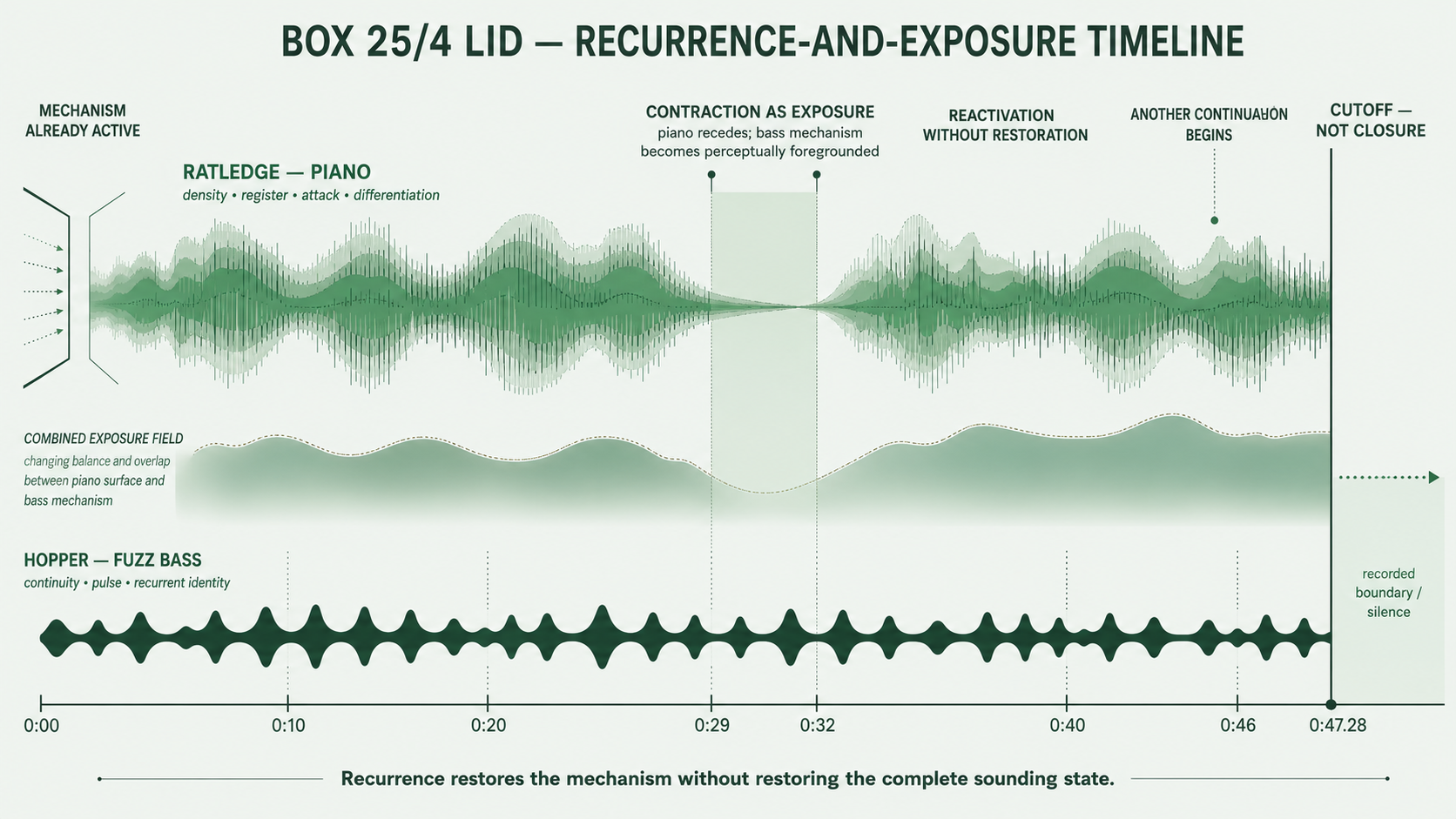
“Box 25/4 Lid” carries this discovery further. Here the album can sustain an instrumental environment without requiring a lyric or conventional song form at its center. The interest lies in the interaction of pulse, piano sonority, register, repetition, and movement between the two audible layers. What had previously appeared behind or within the songs can now occupy the foreground. Hopper’s fuzz bass and Ratledge’s piano are no longer supporting elements within a vocal piece; their relationship has become the complete musical subject.
This is why the album’s limited instrumentation feels liberating rather than restrictive. With fewer conventional roles available, every element must become several things. Bass becomes foundation and melodic profile. Drums become pulse and dramatic weather. Organ becomes harmony, atmosphere, distortion, and lead voice. Singing becomes lyric statement, characterization, rhythmic gesture, and pure sound. The album’s richness comes not from the number of colors in its palette, but from the volatility of each color—its ability to change function without losing its identity.
The instrumental and timbral field of The Soft Machine is therefore already a form of musical architecture. It is a space in which openness can suddenly become pressure, accompaniment can move into the foreground, and a compact ensemble can expand beyond the dimensions of the individual song. Before continuity and reprise begin to weaken the borders between compositions across the album, the trio’s sound has already weakened the borders between musical roles. Nothing remains only what it first appears to be, and almost every timbre contains the possibility of becoming an environment.
II. The Continuous-Album
Principle
If the trio’s instrumental palette gives The Soft Machine its distinctive space, the sequencing of the record determines how that space is travelled. The album contains identifiable songs and instrumental pieces, and those objects retain enough definition for their differences to remain audible. Yet their boundaries are rarely treated as absolute. Endings open directly into beginnings, brief fragments redirect the listener toward larger passages, and material thought to have disappeared returns in altered surroundings. The record behaves less like a row of sealed rooms than a labyrinth whose distinct chambers are connected by passages that belong fully to the architecture.
This continuity does not mean that every contrast is smoothed away. On the contrary, The Soft Machine moves through abrupt changes of mood, scale, and musical character. A delicate melody may be followed by instrumental turbulence; an emotionally exposed vocal may give way to absurdist play; a compact song may suddenly release the trio into a wider field of repetition and improvisation. What creates continuity is not stylistic uniformity but the repeated discovery that one formal object can lead directly into another without surrendering its own identity. Difference remains vivid, yet the album keeps finding ways to make difference flow.
The opening sequence establishes the principle immediately. “Hope for Happiness” presents something recognizably song-like: a memorable vocal idea, a distinct emotional atmosphere, and a shape the listener can begin to inhabit. Yet the piece does not remain enclosed within that identity. Its sung material gives way to a more forceful instrumental expansion, allowing Ratledge’s organ and Wyatt’s drums to expose energies that the song had contained but not exhausted. The album’s first composition therefore teaches the listener how to hear what follows: a song can remain recognizable while opening beyond the scale initially implied by its vocal form.
“Joy of a Toy” continues the movement without simply extending the same mood. Its compact instrumental playfulness offers a brighter and more sharply articulated world, yet the album does not present it as a neutral restart. The change is substantial, but the momentum established by the opening sequence survives it. Instrumental character becomes the means by which one distinct object can follow another without requiring the larger flow to stop and rebuild itself from the beginning.
The return of “Hope for Happiness” then transforms recurrence into memory. The reprise is brief, but its importance is greater than its duration. Familiar material reappears after the listener has already passed through another musical environment, and it can no longer be heard exactly as it was at the beginning. What first sounded like an opening statement now sounds like recollection, recognition, and partial return. The reprise folds time back upon itself, giving the album an early sense of depth: an earlier song remains available to memory even after another musical object has occupied the space.
This return does not restore the original song as though nothing had intervened. It leads onward into “Why Am I So Short?,” a miniature whose brevity makes it feel almost like a doorway. Its vocal idea is distinct and memorable, and its compact action is sufficient to give the piece a recognizable identity. Yet its ending also functions as a threshold. The song appears, speaks, and yields, allowing its boundary to become the point from which “So Boot If at All” can expand into another kind of musical space.
The passage into “So Boot If at All” is one of the album’s clearest demonstrations of the continuous-album principle. A compact vocal fragment opens directly into an extended instrumental current, as though the walls of the preceding song had become permeable. The relationship is more profound than simple juxtaposition. The smaller piece prepares a release of scale: voice withdraws, the trio expands, and musical development moves from lyric statement toward instrumental interaction. The listener hears a genuine change of formal condition, but the force of that change depends upon recognizing the compact song from which the instrumental field has emerged.
“So Boot If at All” is crucial because it allows continuity to become developmental rather than merely connective. The music is no longer moving between pieces only through edits, reprises, or transitional effects. It is sustaining direction through the behavior of the ensemble itself. Bass, drums, and organ generate a form whose course is discovered in motion. Repetition, rhythmic animation, harmonic pressure, and changes of density carry the music forward without requiring a succession of verses and choruses. The transition has opened onto an instrumental environment capable of sustaining its own development, even though its formal force remains heightened by the compact vocal object from which it has emerged.
“A Certain Kind” brings the voice back, but the preceding instrumental expansion changes the way vocal music is now perceived. Wyatt’s singing feels intimate and exposed, while Ratledge’s organ surrounds it with a sustained, almost suspended atmosphere. The song has a powerful identity, and that identity is not dissolved into the continuity around it. What the preceding sequence has taught us instead is that even a strongly defined song can occupy a larger album design without becoming sealed inside its own boundaries. Its emotional stillness is therefore not a retreat from continuity but another distinct condition within it.
The physical division between the two sides of the record necessarily interrupts this flow, but it does not destroy the governing principle. Each side forms its own extended sequence, while the album as a whole accumulates affinities through instrumental color, recurring procedures, vocal contrast, and repeated acts of transition. The interruption imposed by the LP separates the two large spans physically without reducing either side to a collection of unrelated tracks.
On the second side, continuity becomes more mercurial. “Save Yourself,” “Priscilla,” and “Lullabye Letter” move through sharply contrasting expressive territories, but their proximity makes them feel like successive turns within the same restless journey. The album can pass from urgency to miniature, from emotional directness to strangeness, without establishing a neutral space between them. Each piece retains its local character while the joins preserve enough momentum for the sequence to remain active.
This is one of the album’s great pleasures: it does not always conceal the mechanism of connection. Some transitions feel fluid; others are sudden, playful, or deliberately peculiar. Tape manipulation, edits, altered voices, reprises, and compressed fragments allow the record to behave with the freedom of memory or dream, where one place can become another without crossing the expected distance between them. The seams are not defects in an otherwise seamless work. They are moments when the album makes the act of crossing between musical objects part of the composition.
“We Did It Again” extends the principle through repetition. Here continuity is no longer primarily a matter of moving from one composition to another; it becomes the subject of the composition itself. The repeated phrase persists until its familiar meaning begins to loosen. With each return, the listener hears it slightly differently—not because the words have changed, but because duration has changed their weight. What begins as statement becomes refrain, insistence, rhythm, texture, provocation, and eventually a kind of environment.
The piece demonstrates that forward movement need not depend upon a constant supply of new material. The music advances by remaining in place long enough for perception to change. Small shifts in instrumental pressure, vocal delivery, rhythmic emphasis, and accumulated intensity become newly significant. Repetition creates its own strange continuity: not a line travelling toward a destination, but a circle whose interior keeps deepening. Yet the repeated phrase remains the identifiable object whose changing perceptual function makes that transformation audible.
“Plus Belle qu’une Poubelle” functions on an entirely different scale. Its miniature quality might appear slight if judged only by the scale expected of a conventional album track, but within the sequence it becomes a flash of color and an exquisitely odd turn of the corridor. Such fragments are essential to The Soft Machine. Their local identity can remain slight, comic, and concise while their placement changes the pacing and character of the larger sequence. Humor and brevity do not interrupt the architecture; they make it supple.
That suppleness is important because the album’s continuity is never solemnly monumental. Soft Machine does not construct a continuous form by suppressing eccentricity in the name of grandeur. The music retains its jokes, sudden changes, miniature songs, exposed edits, and moments of apparent disproportion. Its larger coherence grows from the way these distinct objects are placed, connected, recalled, and allowed to open beyond themselves. The album remains playful even as it discovers a more ambitious conception of form.
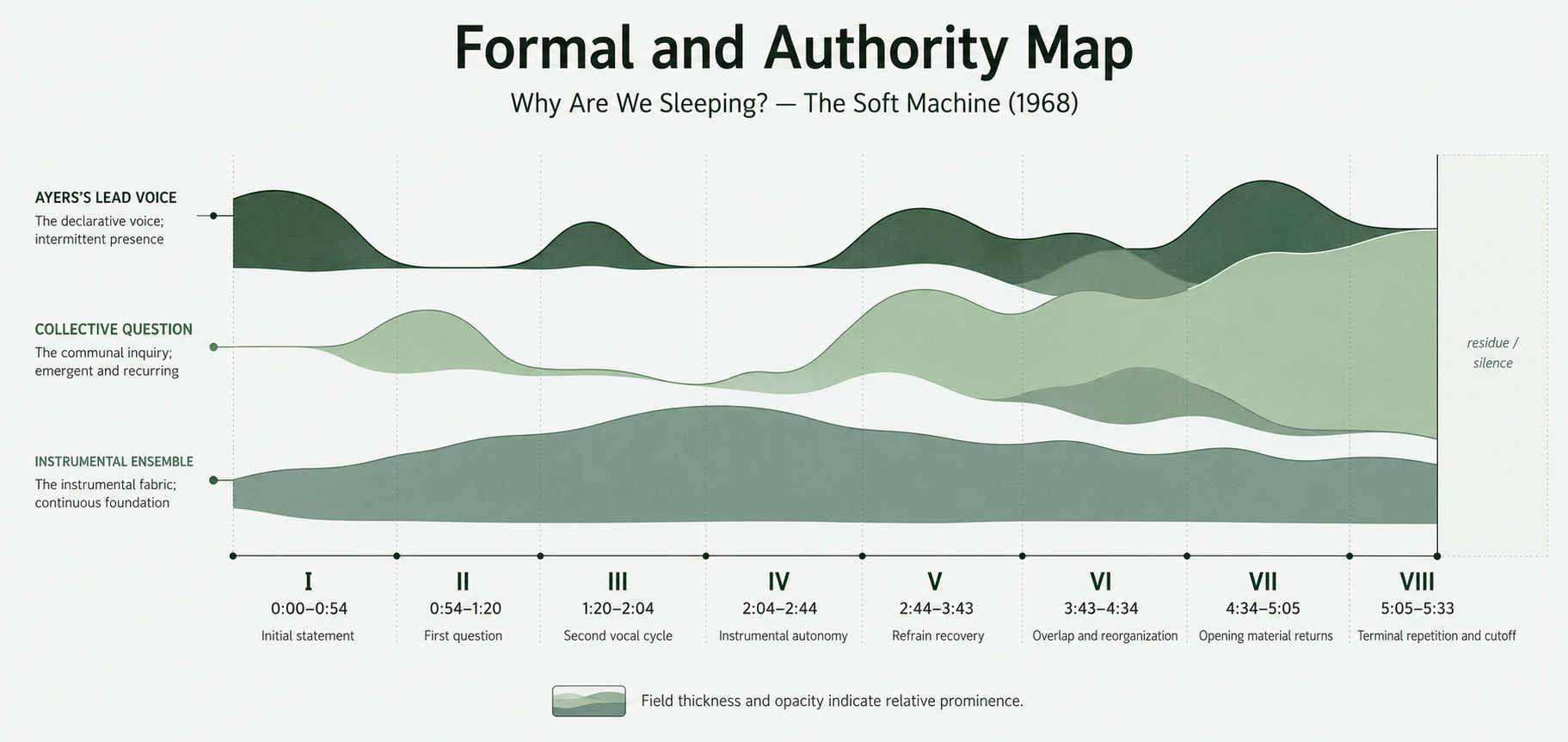
“Why Are We Sleeping?” gathers the second side into one of its most fully realized song environments. Ayers’s low, detached voice gives the piece a dreamlike gravity, while the instrumental setting creates a darker and more unsettled space around him. The track feels substantial as an individual composition, yet it also draws power from its late position in the sequence. After the urgency, repetition, miniature forms, and rapid transformations that precede it, its strange nocturnal poise feels like an arrival—not a conventional resolution, but a moment when the album’s scattered shadows collect into a single scene.
“Box 25/4 Lid” then refuses to let that scene serve as a final resting place. The voice and drums disappear, and a piano-and-fuzz-bass duo closes the album through instrumental motion. This is a quietly radical conclusion. A record that began by placing psychedelic songs under pressure ends by demonstrating that pulse, recurrence, differentiation, and direction can also be sustained without a song at their center. The instrumental field that repeatedly opened behind or beyond the vocals has contracted to its most exposed form and moved fully into the foreground.
The ending therefore gives the album a large-scale trajectory without forcing it into a rigid narrative. “Hope for Happiness” begins with song already opening toward instrumental expansion; “Box 25/4 Lid” ends in a musical environment capable of existing without conventional song form. Between those points, the album repeatedly crosses the border separating the two conditions. Voices enter and withdraw, compact forms lead into extended passages, and instrumental processes become increasingly capable of carrying musical direction on their own.
Yet it would be misleading to describe this as the simple triumph of instrumental music over song. The album does not discard its songs, and its instrumental freedom would mean less without their intimacy, wit, melodic clarity, and strongly defined identities. Instead, The Soft Machine discovers that song and instrumental process can inhabit the same continuous architecture. A song can remain a song while also serving as a threshold, a remembered object, or the source of an instrumental expansion. An instrumental passage can function as release, transition, destination, or reflection without making the song that preceded it formally obsolete.
The continuous-album principle is therefore not merely a matter of removing silence between tracks. It describes the album’s repeated testing of the boundary around the individual musical object. Pieces retain their names, personalities, and local identities, yet their entrances and exits can carry immediate momentum, their reprises can activate memory, and their transitions can expose possibilities not contained within conventional song proportions. Even the smallest fragment can matter if it changes how the listener crosses into the next musical space.
Through this principle, the album turns compression into abundance. Its songs are often concise, its instrumentation is limited, and its materials can be deliberately economical. Yet the record feels larger than the sum of those materials because its endings repeatedly prove less absolute than their local forms initially suggest. A melody may return, a rhythm may continue beyond the vocal passage that introduced it, or a brief transition may open onto an unexpectedly spacious instrumental field. The album does not dissolve its pieces into a single relational system. It keeps discovering passages between recognizable musical objects—and in those passages, Soft Machine begins to imagine the long-playing record as a composition in its own right.
III. Wyatt and Ayers:
Two Vocal Identities
The continuous architecture of The Soft Machine is held together not by a single narrator, but by two unmistakably different human presences. Robert Wyatt and Kevin Ayers do more than alternate as singers. Each changes the emotional temperature, spatial perspective, and even the apparent movement of the music. Wyatt’s voice tends to bring experience close: breath, urgency, tenderness, and strain remain audible within the sung line. Ayers often creates distance. His lower voice can sound poised, dry, dreamlike, or faintly theatrical, as though the singer were observing the song from somewhere just beyond its immediate emotions. The contrast gives the album an unusually mobile center. When the voice changes, the whole musical world seems to tilt.
Their difference begins in physical sound. Wyatt’s higher register possesses a fragile brightness that can rise through Ratledge’s organ and the activity of his own drums without becoming conventionally forceful. There is openness in the tone, but also vulnerability: the voice sometimes appears to be discovering the emotional meaning of a phrase while singing it. Ayers’s lower register has a darker grain and a more settled weight. Even when the music around him becomes peculiar or unstable, his delivery can retain an air of composure. Wyatt seems to inhabit the music from within its motion; Ayers often appears to stand inside it while maintaining a private distance from the surrounding scene.
These are tendencies rather than fixed roles. Wyatt is not simply the sincere singer and Ayers the detached one. Wyatt can be playful, rhythmically mischievous, and delightfully strange; Ayers can turn understatement into something genuinely haunting. What matters is that they approach expression from different directions. Wyatt often allows feeling to enter through exposure. Ayers allows it to gather behind restraint. One reaches outward; the other draws the listener toward an interior that remains partly concealed.
“Hope for Happiness” introduces Wyatt’s presence in a setting where optimism already feels more complicated than the title suggests. His singing carries melodic warmth, but it does not settle into uncomplicated reassurance. The slight vulnerability of the voice leaves the song emotionally open, while the surrounding organ and drums suggest energies that cannot be contained within its lyrical surface. When the ensemble expands beyond the vocal passages, the change feels like an enlargement of something already present in Wyatt’s delivery. The voice does not stand apart from the instrumental current; it seems to release that current.
This closeness between singing and instrumental motion is essential to Wyatt’s identity on the album. Because he is also the drummer, voice and rhythm often feel like related forms of bodily expression. His singing breathes, leans, and presses forward with an elasticity comparable to his playing. The vocal line may float above the drums, but it rarely feels detached from their physical impulse. Even when the words are tender, the music beneath them remains alive with movement, giving his gentleness a peculiar resilience.
In “A Certain Kind,” that vulnerability becomes more inward and luminous. Ratledge’s organ creates a broad, sustained harmonic atmosphere, while Wyatt’s voice occupies its center with remarkable emotional directness. The vocal does not dominate the setting through volume or theatrical projection. Its power comes from appearing exposed within a sound larger and more impersonal than itself. The organ seems to hold the harmony almost motionless around him, and the slight human grain of the voice becomes more affecting because it cannot completely master that surrounding space.
The result is one of the album’s most beautiful meetings of intimacy and architecture. Wyatt sings as though the melody were both a declaration and a question, something offered sincerely but never made entirely secure. The instrumental field gives his voice room to resonate, yet it also places that voice under a gentle pressure. Warmth and uncertainty are not opposites here. They become inseparable aspects of the same musical feeling.
“Save Yourself” reveals a more urgent side of Wyatt. The voice enters a tighter, more compressed environment, and its emotional force is sharpened by the speed with which the music moves. There is less space for reflection; expression arrives as impulse. Yet even here, Wyatt’s intensity does not become a polished rock gesture. The voice remains personal and slightly exposed, preserving the sense that urgency is being experienced rather than performed from a safe distance.
“Lullabye Letter” brings another shade into his vocal character. The very idea of a lullaby is unsettled by the trio’s restless musical personality. Tenderness is present, but it cannot become entirely restful. Wyatt’s voice carries the possibility of comfort while the surrounding music retains its nervous life, creating an affectionate tension between repose and motion. The song feels as though gentleness has entered a world constitutionally unable to remain still.
Ayers alters the album’s perspective almost as soon as his voice takes the foreground. Where Wyatt frequently makes the music feel immediate and permeable, Ayers introduces a more enigmatic distance. His lower register does not simply darken the timbral field; it changes the imagined character standing within it. The singer may sound like a storyteller, an amused observer, a reluctant participant, or a figure speaking from inside a dream. Emotion is present, but it is rarely presented without a veil of irony, theatricality, or reserve.
“We Did It Again” turns that reserve into one of the album’s boldest vocal ideas. The phrase itself is plain, almost provocatively so, and Ayers delivers it without trying to manufacture conventional dramatic development. Meaning is allowed to change through recurrence. At first the words may sound like a statement, a joke, or a private reference. As they continue, their semantic clarity begins to soften. Repetition exposes the voice’s rhythm, accent, weight, and grain until language becomes inseparable from sound.
A more overtly expressive singer might have made the repetitions accumulate through escalating emotion. Ayers’s comparative impassivity creates a stranger effect. Because he does not explain the phrase through dramatic emphasis, the listener must live inside its duration. The words become comic, irritating, hypnotic, absurd, and oddly liberating in turn. Ayers’s detachment is therefore not a lack of expression. It creates the open surface across which multiple meanings can pass.
The performance also reveals how naturally his voice can become part of the ensemble’s material construction. Rather than remaining a privileged message placed above bass, organ, and drums, the repeated phrase joins them as another circulating pattern. Its consonants contribute attack; its vowels extend the timbre; its recurrence becomes pulse. The singer is still recognizably present, yet the distinction between human statement and instrumental figure begins to blur.
In “Why Are We Sleeping?,” Ayers’s voice acquires greater theatrical depth. Its low, measured presence gives the song nocturnal gravity, while the question at its center opens onto something more unsettling than ordinary sleep. The delivery seems calm, but the calmness does not reassure. It makes the surrounding strangeness feel more persuasive, as though the singer had accepted a dream logic that the listener is only beginning to enter.
Here Ayers’s restraint becomes haunting. He does not need to force the mystery because his voice already seems to come from a slight remove—from another room, another state of consciousness, or a stage illuminated after the surrounding theatre has gone dark. Ratledge’s organ intensifies this atmosphere, creating a setting in which the vocal can sound simultaneously grounded and unreal. The lower register supplies weight; the performance withdraws certainty.
Ayers also brings a distinctive form of humor to the album. His wit often depends upon not announcing itself too loudly. A phrase can remain poised while its context becomes increasingly absurd, allowing comedy to arise from the gap between the singer’s composure and the instability around him. This understatement is crucial to Soft Machine’s early personality. The humor does not interrupt the music from outside; it is embedded in timing, repetition, vocal character, and the refusal to tell the listener exactly how seriously a moment should be taken.
Wyatt’s humor feels different. It is more likely to emerge through animation, suddenness, vocal play, or the sheer delight of sound taking an unexpected turn. His personality can make eccentricity feel spontaneous and bodily, as though the music had momentarily overflowed into laughter, syllable, or gesture. Ayers’s humor often retains a straight face. Wyatt invites the listener into the pleasure of disruption; Ayers may leave the disruption sitting quietly in the room until its absurdity becomes impossible to ignore.
This contrast prevents the album’s surrealism from becoming a single mannerism. Through Wyatt, strangeness can remain tender, enthusiastic, or emotionally exposed. Through Ayers, it can become languid, enigmatic, and coolly disorienting. The same surrounding instruments consequently acquire different expressive meanings. Ratledge’s organ behind Wyatt may feel like a vast electrical atmosphere gathering around a vulnerable human voice. Behind Ayers, it can resemble scenery in an oneiric theatre—darkly colored, slightly artificial, and deliberately difficult to place.
The singers also inhabit time differently. Wyatt’s phrasing often feels responsive to the immediate life of the ensemble. His voice bends toward rhythmic activity, and the emotional present of the performance remains vivid. Ayers can make time feel more suspended. His measured delivery allows a phrase to linger without fully revealing whether it is confession, observation, parody, or incantation. Wyatt tends to heighten the sensation that the music is happening now; Ayers can make it seem as though it has drifted in from somewhere else.
Yet the album does not arrange these voices as a simple opposition. Their identities gain meaning through alternation. After Wyatt’s openness, Ayers’s reserve feels especially enigmatic; after Ayers’s composure, Wyatt’s exposed tone feels newly intimate. The listener is repeatedly asked to adjust the distance from which the music is heard. One singer brings us close enough to feel breath and uncertainty; the other restores perspective, ambiguity, and shadow.
That alternation becomes one of the album’s methods of continuity. Wyatt and Ayers do not need to sing together constantly for their relationship to shape the record. Each voice remains in the listener’s memory while the other is sounding. Ayers’s nocturnal detachment casts a backward shadow over the album’s earlier warmth, while Wyatt’s vulnerability prevents Ayers’s irony from becoming emotionally closed. The two identities continue to answer one another across separate songs.
Their contrast also helps explain why the album can move so freely between sincerity and absurdity without making either feel false. Soft Machine does not divide its world into serious music and comic interruption. Wyatt can make an eccentric phrase touching; Ayers can make an apparently simple statement profoundly strange. Both singers resist the polished authority of a conventional frontman. Neither stands above the ensemble as its permanent public face, and neither reduces the album’s meanings to a single expressive position.
This shared absence of vocal authority is as important as their difference. The voice enters the trio’s field as one musical force among several. It may briefly become the center, but organ, drums, bass, repetition, or studio treatment can displace it. A sung line can open into instrumental expansion; a verbal phrase can dissolve into rhythm; a strongly characterized vocal scene can yield to music in which no singer is required. Wyatt and Ayers bring unmistakable personalities to the record, yet the architecture never belongs entirely to either of them.
Their singing therefore embodies the larger principle of The Soft Machine: identity is created through coexistence rather than uniformity. Wyatt offers warmth without security, urgency without theatrical domination, and tenderness that remains rhythmically alive. Ayers offers composure without emotional emptiness, humor without explanation, and darkness illuminated by a peculiar, dreamlike wit. Between them, the album acquires two ways of being human inside its electrical labyrinth.
The resulting vocal world is richer than a contrast between high and low voices, or between sincerity and irony. It is a changing perspective on what a song can contain. Through Wyatt, song becomes breath, motion, vulnerability, and release. Through Ayers, it becomes character, repetition, distance, and nocturnal suggestion. Their voices do not resolve the album’s contradictions. They allow those contradictions to sing.
IV. Ratledge’s Organ
as Field and Lead Voice
If Wyatt and Ayers give The Soft Machine its two human identities, Mike Ratledge’s organ gives the album its weather. It can cast a pale light behind a voice, deepen the shadows around a bass figure, or gather into a turbulent electrical front that seems to alter the scale of the entire trio. At other moments it steps out of that surrounding space and speaks with unmistakable authority: clipped, agile, brightly distorted, and sometimes almost impatient in its forward motion. Ratledge therefore does not merely alternate between accompanying and soloing. He continually changes what the organ is. It may be the room in which the music occurs, the force that disturbs that room, or the lead voice that suddenly takes possession of it.
This dual role is especially important because the group no longer possesses a dedicated guitarist. After Daevid Allen’s departure, the organ inherits much of the middle and upper space normally occupied by guitar, even though Ayers retains a credited guitar role on the album. Ratledge does not simply imitate a guitarist’s function. He turns the altered configuration into a new kind of freedom. Sustained tones can remain suspended without being crowded by continuous strummed harmony; sharply articulated lines can cross the full width of the texture; distortion can expand a single keyboard voice until it resembles an entire electrical surface. The trio’s unusual instrumentation allows the organ to become both more spacious and more physically imposing than a conventional accompanying keyboard.
Ratledge’s characteristic early setup centered on a Lowrey organ amplified through effects, including fuzz and wah-wah. That combination produced a timbral identity quite different from the rounded grandeur commonly associated with the Hammond. Its tone could be reedy, bright, and slightly uncanny even before distortion intensified it. Ratledge exploited that character rather than trying to soften it. The organ could glow, but there was nearly always some grain within the light: a hard edge, a nasal bite, or a compressed intensity waiting to break through. The effects helped turn an instrument associated with domestic or ecclesiastical stability into one of the most volatile sounds in early British progressive music. This documents the equipment behind Ratledge’s general sound; the analysis below attributes particular effects only where they are audibly evident.
Yet the fascination of Ratledge’s playing does not lie in equipment alone. Distortion enlarges the sound, but it is his sense of placement that gives the sound meaning. He understands how long a chord can hover before it becomes expectation, how a repeated figure can gather pressure without changing its basic shape, and how a line entering at the right moment can make a previously open field appear suddenly divided. The organ is expressive not simply because of its color, but because Ratledge continually reshapes the listener’s perception of musical space.
In “A Certain Kind,” the organ appears first as an environment. Its sustained harmony surrounds Wyatt’s voice with a warmth that is never entirely restful. The chords do not pull the song through a strongly directed progression so much as hold it within a luminous suspension. Wyatt seems to sing from inside the sonority rather than above an accompaniment. The organ gives his voice resonance and shelter, but its impersonal continuity also makes that voice sound more exposed. Human breath passes through an electrical atmosphere that can sustain itself long after the singer’s phrase has ended.
This is Ratledge as field: not a background layer that can be mentally removed, but the condition that determines how everything else is heard. The organ establishes distance, color, and emotional temperature. Its sustained presence slows the listener’s sense of time, allowing the smallest inflection in Wyatt’s voice to linger. Bass and drums retain the bodily reality of the trio, yet the keyboard seems to suspend that body within a larger acoustic dream. The song’s tenderness comes partly from this difference in scale—the vulnerable immediacy of the singer held against a harmonic space that feels broader, steadier, and less mortal.
Ratledge’s restraint here is as revealing as his later intensity. He does not need to fill every opening or prove the organ’s prominence through constant display. By allowing tones to remain, he makes duration itself expressive. A chord acquires color as it continues; an upper note seems to brighten the surrounding harmony; a slight roughness in the timbre prevents stillness from becoming passivity. The music breathes because the organ can hold a space without sealing it.
“Hope for Happiness” reveals the other side of Ratledge’s role. Here the organ does not remain content to define the atmosphere around the song. It begins to expose the instrumental energy concealed within it. The vocal material establishes warmth and recognizability, but Ratledge’s more assertive entries seem to press outward against the song’s dimensions. The keyboard becomes increasingly active, and the trio moves from lyrical presentation toward a state in which sound, momentum, and collective interplay matter as much as the sung idea.
The effect is not that the organ interrupts the song. It reveals another life already present inside it. Ratledge’s lines carry melodic purpose, but their distorted edge gives them physical force as well. Each phrase seems to possess both contour and mass. The listener follows the notes as a lead voice while simultaneously feeling the pressure of the sonority spreading across the middle and upper registers. Melody becomes inseparable from texture.
This is one of Ratledge’s most distinctive achievements throughout the album. When he moves into the foreground, he does not abandon the organ’s environmental power. His lead lines continue to alter the entire field around them. A guitar solo may be perceived as a mobile figure placed against an accompanying background; Ratledge’s organ can make figure and background feel electrically fused. The line travels, but its timbre leaves a wake. Even a short flourish can brighten, roughen, or momentarily saturate the whole ensemble.
Wyatt’s drumming is essential to this transformation. The drums do not merely support Ratledge’s emergence as soloist; they challenge and animate it. Cymbal accents sharpen the upper edge of the organ, rolling fills disturb its sustained mass, and changes in rhythmic density make the same keyboard tone feel alternately buoyant, urgent, or overwhelming. Ratledge may supply the field, but Wyatt keeps that field alive with internal weather. Their interaction prevents sustained keyboard sound from becoming a static psychedelic wash.
Ayers’s bass gives this volatile relationship a necessary lower boundary. His economy allows Ratledge’s organ to expand without turning the ensemble into undifferentiated density. A clear bass figure can hold its shape beneath the keyboard’s changing pressure, giving the listener a stable point from which to feel the magnitude of the transformation above it. When the bass becomes more melodic or mobile, the vertical arrangement changes again: Ratledge’s organ may cease to feel like the unquestioned center and instead become one voice in a three-way conversation.
“Joy of a Toy” presents a lighter, more playful version of that conversation. Ratledge’s organ is animated rather than monumental, moving through compact figures whose color and articulation contribute to the piece’s wit. The instrument seems capable of darting, hovering, and suddenly flashing into greater intensity. Wyatt’s buoyant drumming and Ayers’s clear lower-register presence leave each keyboard gesture exposed enough to register as character. The organ does not create a vast surrounding architecture here; it draws quick shapes within an open one.
This agility matters because it prevents Ratledge’s sound from being reduced to distortion and weight. Even at this early stage, his playing contains an unusual mixture of severity and play. A phrase may be precisely articulated yet slightly mischievous in contour. A repeated figure may establish order while its timbre introduces strangeness. The organ can sound intellectually controlled and physically unruly at the same time. Ratledge’s authority comes not from solemnity, but from the conviction with which he makes unlikely materials coexist.
In “So Boot If at All,” that coexistence is given room to unfold on a broader scale. The transition from the compact “Why Am I So Short?” releases the trio into an instrumental passage where the organ no longer needs to explain itself through relation to a vocal song. Ratledge can now participate in a form created through motion: figures recur, rhythmic relationships shift, and the relative prominence of the instruments changes as the performance proceeds. The organ serves as a source of harmonic identity, a generator of momentum, and a lead voice moving through the ensemble’s open structure.
What emerges is not simply an organ solo with bass-and-drum accompaniment. The piece feels more exploratory and collective than that description would suggest. Ratledge may take the foreground, but Wyatt continually alters the ground beneath him, while Ayers determines how firmly or loosely the music remains anchored. Leadership passes through degrees rather than absolute changes of command. The organ becomes prominent, recedes into texture, then reappears with altered force. The field and the voice exchange places without ever becoming entirely separate.
Ratledge’s classical training can be felt here less as a collection of quotations than as a way of organizing musical thought. His phrases often possess strong internal contour and a clear sense of intervallic direction. Even when the sound becomes abrasive, the playing does not feel shapeless. There is an ear for balance, recurrence, tension, and the architectural consequence of register. Yet these qualities are not imposed upon the trio as formal discipline from above. They enter the physical spontaneity of the performance, where Wyatt’s rhythmic volatility and Ayers’s economy prevent structure from becoming rigid.
This meeting of control and instability gives Ratledge’s playing its peculiar excitement. One hears a musician capable of defining a musical space with great precision, yet willing to let that space be disturbed. A sustained chord may establish a plane only for the drums to break its apparent stillness. A sharply drawn line may seem to lead decisively, then become absorbed into ensemble density. Ratledge builds structures that remain open to pressure. His organ is architectural, but the architecture is inhabited, contested, and alive.
“Save Yourself” compresses this power into a more urgent song form. Ratledge does not require an extended instrumental passage to change the scale of the music. Within a comparatively concise setting, the organ can intensify the vocal’s emotional pressure, fill the spaces between phrases, and suggest a force larger than the song has time to release fully. Its presence makes the music feel as though it is pushing against its own duration. The song moves quickly, but the keyboard gives its urgency depth as well as speed.
In “Priscilla” and “Lullabye Letter,” the organ again reveals its capacity for rapid shifts of character. It can participate in psychedelic color without dissolving into decorative haze, or introduce sharper figures that make the texture feel briefly more angular and alert. “Lullabye Letter” is especially revealing because its nominal gentleness never settles into simple repose. Ratledge’s sonority helps preserve a current of unease beneath the tenderness. The organ may cradle the voice, but the cradle remains electrically charged.
“We Did It Again” places Ratledge inside an almost radically restricted design. Here the challenge is not to lead the music through a succession of new ideas, but to change the listener’s experience of an idea that refuses to disappear. The organ contributes to the growing transformation of repetition into environment. Its role may seem subordinate to the recurring vocal phrase, yet the pressure surrounding that phrase depends greatly upon the instrumental field. Changes in density, attack, and timbral weight make each recurrence occupy a slightly altered space.
Ratledge’s organ helps reveal that stasis can contain movement. The harmonic world may remain narrow, but the sound does not remain psychologically fixed. Repetition gradually shifts attention away from what the phrase means toward how the whole ensemble bears its duration. The organ becomes part of an accumulating atmosphere—sometimes reinforcing the pattern, sometimes thickening its edges, sometimes making the familiar material feel more absurd or oppressive. It leads not through melodic succession, but through control of pressure.
Behind Ayers’s voice in “Why Are We Sleeping?,” Ratledge’s field-making power assumes one of its darkest forms. The organ does not merely accompany a singer already possessed of nocturnal mystery. It builds the theatrical space in which that mystery becomes credible. Sustained or shadowed sonorities surround Ayers’s low voice like scenery whose dimensions cannot quite be measured. The keyboard makes the song feel enclosed and expansive at once: a chamber with walls, but no clearly visible ceiling.
The contrast with “A Certain Kind” is illuminating. In both pieces the organ creates an environment around the voice, yet the emotional meaning of that environment changes with the singer. Around Wyatt, sustained harmony can feel tender, luminous, and gently exposing. Around Ayers, it becomes more oblique—part dream, part stage set, part gathering darkness. Ratledge does not merely apply a consistent keyboard sound to different songs. He allows the same fundamental function to acquire a new psychology.
By “Box 25/4 Lid,” the instrumental field no longer needs a singer to give it purpose. Ratledge’s piano and Hopper’s fuzz bass occupy the foreground as a complete two-layer system. The importance of the piece lies in their complementary behavior: the bass maintains pulse and recurrence while the piano changes the field through articulated figures, shifting register, variable density, and attack. What had repeatedly emerged from behind the songs now stands in its most reduced and exposed form.
The closing instrumental therefore reveals a different aspect of Ratledge’s field-making role. The piano does not surround a full ensemble through sustained organ sonority; it continually reshapes the exposed surface above Hopper’s repeating fuzz bass. Its figures provide direction, density, and expressive contour, yet they do not displace the low pattern that carries the piece’s temporal identity. Piano and bass remain distinct while their changing relationship becomes the foundation of the piece.
Ratledge’s relative absence as a singer makes this achievement more striking. Wyatt and Ayers enter the album through words, breath, characterization, and the unmistakable vulnerability of the human voice. Ratledge communicates through the changing behavior of electrical sound. His presence is no less personal, but it is expressed through pressure, register, attack, sustain, and the shaping of space. He does not narrate the album’s labyrinth. He illuminates its rooms, alters their dimensions, and occasionally sends a bright, abrasive line racing through their walls.
There is something deeply pleasurable in the physical character of that sound. Ratledge’s organ can be beautiful without becoming polished, forceful without losing intelligence, and distorted without surrendering clarity. Its abrasiveness is not a rejection of lyricism. It allows lyricism to acquire grain and resistance. Even the most luminous passages contain the possibility of fracture; even the most aggressive lines retain a precise melodic mind.
The organ consequently becomes one of the album’s principal agents of transformation. It allows a song to expand without ceasing to be remembered as a song. It turns repetition into atmosphere, accompaniment into pressure, and instrumental color into formal direction. When the music needs spaciousness, Ratledge can open a suspended plane around the other performers. When it needs intensity, he can fill that plane until it seems almost solid. When it needs a voice beyond language, he can step forward with a line whose authority lies equally in what it says and in the electrical world it creates while saying it.
On The Soft Machine, Ratledge has not yet constructed the more elaborate keyboard architectures that will define later stages of the group. The first album is rawer, more psychedelic, and still closely entwined with the volatile intimacy of song. But the essential principle is already unmistakable. The organ is no longer simply a keyboard placed within a rock trio. It is a mutable field capable of becoming harmony, atmosphere, disturbance, structure, and speech.
That mutability places Ratledge at the heart of the album’s emerging musical architecture. Wyatt makes the music breathe and erupt; Ayers gives it gravity, melodic economy, and enigmatic distance. Ratledge changes the space through which both are perceived. His organ can hold a voice tenderly, surround it with shadow, or open beyond it into an instrumental landscape. It can remain everywhere and suddenly become someone. In that movement from environment to utterance—from field to lead voice—the album discovers one of its deepest freedoms: sound need not choose between being the world and speaking within it.
V. Productive Instability
The Soft Machine possesses a recognizable identity, but it rarely achieves that identity by allowing its materials to settle peacefully into place. Songs open toward improvisation; tenderness is disturbed by abrasion; repetition threatens to become stasis, then reveals unexpected movement within itself. The album can be intimate and impersonal, carefully shaped and visibly assembled, playful and severe—sometimes within the same passage. These tensions do not weaken its coherence. They generate it. The music remains alive because its elements are continually adjusting to forces that prevent any single condition from becoming permanent.
This is the album’s productive instability: not disorder for its own sake, and not an inability to choose between competing styles, but a musical world whose vitality depends upon unresolved relationships. Psychedelic song, jazz-derived interaction, absurdist humor, electrical texture, repetition, studio manipulation, and instrumental expansion coexist without being blended into a smooth synthesis. Each retains enough of its original character to place pressure upon the others. The music advances through that pressure.
The trio itself embodies this condition. Wyatt’s rhythmic exuberance, Ayers’s economy, and Ratledge’s architectural keyboard presence do not suggest three musicians pursuing identical ideas by different means. They represent contrasting ways of inhabiting musical time. Wyatt can make a passage feel restless even when its harmonic materials remain stable. Ayers can preserve clarity and weight while the surrounding surface grows increasingly volatile. Ratledge can define a harmonic field with great precision and then roughen it through distortion, intensified repetition, or an assertive lead line. Their unity comes from continuous negotiation rather than uniform behavior.
That negotiation gives the album a peculiar kind of balance. The music may sound precarious, yet it does not feel arbitrary. Ayers’s bass often supplies just enough grounding for Wyatt’s drums to move with freedom. Ratledge’s organ may expand until it appears to dominate the available space, but rhythmic animation prevents that expansion from becoming static mass. Wyatt’s voice can seem vulnerable within the instrumental field, yet the same singer’s drumming may be the force that keeps the field from closing around him. Stability is present, but it is distributed across the ensemble rather than entrusted to a single permanent center.
“Hope for Happiness” introduces this unstable balance from the beginning. Its vocal material offers warmth and melodic definition, inviting the listener into something recognizably song-like. Yet the song contains more energy than its initial shape can comfortably hold. Instrumental momentum gathers around it, and the trio begins to enlarge the scale of the music from within. Ratledge’s organ presses beyond accompaniment, Wyatt’s drums intensify the sense of motion, and the piece discovers an instrumental dimension that seems both latent in the song and resistant to its boundaries.
The pleasure of the transition lies in hearing the original identity survive while its proportions change. The song is not simply abandoned when the instrumental activity expands. It remains present as memory, melodic orientation, and emotional color. Nor does the instrumental passage function merely as an interlude inserted between vocal statements. It changes what the listener believes the song is capable of containing. Stability and expansion coexist long enough for the border between them to become uncertain.
“Joy of a Toy” offers a more compact expression of the same principle. Its playfulness depends upon precision, but precision does not make the music rigid. Small instrumental gestures seem to answer, redirect, and gently unsettle one another. The piece can feel carefully designed and spontaneously animated at once. Its wit arises partly from this ambiguity: the listener hears the clarity of the construction, yet the music behaves as though it might unexpectedly dart away from its own design.
This combination of discipline and mischief is central to the album. Soft Machine’s eccentricity is not the opposite of musical control. It frequently depends upon control—upon exact timing, economical placement, sharply differentiated timbres, and an acute awareness of proportion. A miniature can be funny because it ends before its implications have been exhausted. A sudden transition can feel liberating because the preceding musical identity was so clearly established. Absurdity acquires force when it enters a structure precise enough to register the disturbance.
Even the album’s gentlest moments retain this internal unease. In “A Certain Kind,” Wyatt’s voice and Ratledge’s sustained organ create a space of extraordinary warmth, but the warmth never hardens into certainty. The voice is too exposed, the electrical atmosphere too vast, and the harmonic suspension too delicately poised. The song seems to hover between emotional declaration and inward questioning. Its beauty comes partly from the sense that the balance could be disturbed by the slightest change in pressure.
The instability here is not dramatic. Nothing needs to rupture the surface. It is felt in the relationship between a human voice that must breathe and an organ sonority that appears capable of continuing beyond breath. Wyatt’s vulnerability and Ratledge’s sustained field meet without fully resolving their difference. The organ offers shelter, yet also makes the singer seem smaller and more mortal. The song’s emotional power resides in that tender disproportion.
Elsewhere, instability becomes a question of scale. “Why Am I So Short?” is so brief that its formal identity is established almost as soon as it appears. Yet its compactness is precisely what gives the transition into “So Boot If at All” its force. The vocal miniature completes its concentrated action while allowing its ending to become a threshold into a broader instrumental process. What seemed like a small, self-contained room reveals a door in one of its walls.
“So Boot If at All” then sustains a musical environment whose direction is less dependent upon lyrical statement or conventional sectional return. The trio proceeds through interaction, repetition, rhythmic change, and shifting instrumental prominence. Its form feels discovered in motion. Ratledge may establish a figure or harmonic region, but Wyatt’s playing keeps altering its energy, while Ayers’s bass determines how firmly the surface remains attached to the ground.
The result is neither formless improvisation nor a rigidly predetermined structure. The music occupies the fertile space between them. Recognizable materials provide continuity, but their consequences remain open. A repeated figure may become a foundation, a provocation, or a field through which another instrument begins to move. Leadership changes gradually rather than ceremonially. The piece seems to know what it is made from without deciding too quickly what those materials must become.
This openness is one reason the album’s transitions feel more profound than simple crossfades between contrasting tracks. They expose identities in the process of changing. Song becomes instrumental current; accompaniment becomes foreground; melodic statement becomes remembered atmosphere. The listener hears not only one musical state followed by another, but the unstable interval in which the first begins to acquire the properties of the second.
On the album’s second side, this volatility becomes increasingly mercurial. “Save Yourself,” “Priscilla,” and “Lullabye Letter” pass through different proportions, moods, and degrees of expressive directness without allowing the record to settle into a predictable sequence of full-scale songs. Urgency can be followed by compression; tenderness can arrive with nervous energy still flickering around it. The pieces retain distinct personalities, but the album seems almost impatient with the idea that any personality should become permanent.
“Lullabye Letter” is especially characteristic. Its gentleness is real, yet it does not produce complete repose. Wyatt’s voice carries tenderness, while the trio’s underlying restlessness prevents the music from becoming a secure cradle. Affection and unease inhabit the same space. The lullaby does not fail because it cannot bring the album to rest; its beauty comes from trying to offer tenderness within a world that remains irrepressibly awake.
“We Did It Again” places instability inside repetition itself. Its materials appear almost defiantly limited, and the repeated phrase seems at first to deny the forward movement expected from a song. Yet the longer the recurrence continues, the less stable its identity becomes. Statement turns into refrain, refrain into insistence, insistence into rhythm, and rhythm into an environment whose emotional character cannot be fixed.
The words may seem comic at one moment and oppressive at another. They can sound celebratory, empty, hypnotic, irritating, or strangely communal without undergoing any obvious transformation of content. What changes is the listener’s relation to them. Duration strips away the illusion that repetition simply preserves meaning. Each recurrence arrives carrying the accumulated weight of all those that preceded it.
Ayers’s vocal restraint is crucial to this process. He does not dictate an emotional trajectory through steadily increasing drama. His relative composure leaves the phrase open to transformation by context, accumulation, and perception. The voice becomes less like a narrator guiding the music and more like an object being turned repeatedly in the light. Nothing about it changes completely, yet it never looks—or sounds—quite the same twice.
The ensemble deepens this instability through small changes in pressure. Drums, bass, and organ give the repeated phrase different degrees of weight, propulsion, and enclosure. The composition moves forward without appearing to travel. It advances vertically, into its own material, rather than horizontally toward a new theme. What might have been mere stasis becomes an experiment in how long attention can remain active within apparent sameness.
The album’s humor operates through a related uncertainty. Soft Machine rarely tells the listener precisely where seriousness ends and absurdity begins. A miniature may be lovingly shaped and inherently ridiculous. A repeated phrase may be a joke and a genuine structural principle. A sudden edit may feel comic while also changing the architecture of the album. The music does not alternate neatly between profound passages and humorous interruptions. Humor enters the methods by which the profound passages are made.
This ambiguity protects the album from solemnity without diminishing its ambition. Its continuous design, instrumental exploration, and radical treatment of repetition might have become imposing if presented as declarations of importance. Instead, the music remains light enough to surprise itself. Wit loosens the structures without destroying them. It allows formal experiment to feel like discovery rather than demonstration.
The visible seams of the recording contribute to the same effect. Transitions, reprises, abrupt changes of perspective, and studio interventions do not always disappear behind an illusion of seamlessness. At times the album allows the listener to feel the cut, the return, or the improbable joining of unlike materials. These moments give the record its handmade vitality. The labyrinth does not conceal every hinge in its doors.
Because the seams remain audible, continuity acquires a different meaning. It is not the effortless flow of a single homogeneous performance. It is the active construction of relationships among materials that might otherwise resist one another. A reprise reaches backward across difference. An edit turns discontinuity into propulsion. A miniature changes the scale of the passage that follows it. The album creates continuity not by eliminating rupture, but by teaching rupture how to carry musical memory.
“Why Are We Sleeping?” gathers many of these tensions into a darker and more spacious form. Ayers’s low voice appears calm, but the calmness opens onto uncertainty rather than reassurance. Ratledge’s organ surrounds it with a nocturnal atmosphere that feels both enclosing and strangely boundless. The bass provides weight, yet the song seems to float within a dream whose rules remain hidden.
The central question is allowed to retain its mystery. It can be heard as philosophical inquiry, surreal theatrical gesture, nocturnal incantation, or something suspended among all three. Ayers’s delivery refuses to settle the matter. The music becomes more compelling because it does not resolve whether its darkness is playful, ominous, or contemplative. Each possibility remains audible inside the others.
Yet the album does not conclude in this dream state. “Box 25/4 Lid” removes both the vocal center and the drums, reducing the instrumental field to Ratledge’s piano and Hopper’s fuzz bass. The transition is significant because it refuses to let the preceding song become a conventional culmination. After one of the album’s most complete and atmospheric vocal environments, the music opens once more through a stark two-layer mechanism of low-register recurrence and mobile piano activity.
The closing instrumental does not resolve the album’s instability by restoring order. It reveals that instability has become a sustainable musical condition even under extreme reduction. Hopper’s fuzz bass maintains pulse, recurrence, and lower-register identity without drums, while Ratledge’s piano generates direction and difference through register, density, spacing, and attack. Coherence arises from the changing relation between these two functions rather than from a singer, lyric, familiar song structure, or conventional rhythm section.
This conclusion casts the entire album in a new light. What initially appeared to be a collection of contrasting songs, fragments, instrumental passages, repetitions, and experiments gradually reveals an underlying method. Soft Machine repeatedly establishes a musical condition, places it under pressure, and listens for what it might become. The music does not preserve identity by resisting change. It preserves identity through a characteristic manner of changing.
Productive instability is therefore more than the album’s atmosphere. It is one of its deepest compositional resources. The tension between song and process creates expansion. The tension between repetition and change transforms perception. The tension between precision and eccentricity produces wit. The tension between human vulnerability and electrical sound gives the album its strange emotional scale. Even the contrast between Wyatt and Ayers allows the record to move between intimacy and distance without choosing one as its permanent voice.
This does not mean that every contradiction is reconciled. Reconciliation would diminish the energy of the music. Song remains song even as it opens into improvisation. Absurdity retains its disruptive edge even when it serves the larger form. Wyatt’s exposed warmth does not absorb Ayers’s enigmatic reserve; Ratledge’s structural intelligence does not tame Wyatt’s rhythmic volatility. The album creates a shared world spacious enough for these differences to remain active.
Its coherence is consequently closer to dynamic balance than architectural stillness. The structure holds because its pressures continue to move through it. One instrument stabilizes what another disturbs; one passage compresses energy that the next releases; a returning melody restores recognition while revealing that the listener’s perspective has changed. Stability is never absent, but it is constantly being made and remade.
There is generosity in this refusal to become fixed. The album allows tenderness to remain strange, complexity to remain playful, and experimentation to retain the warmth of human presence. Its boldness does not come from rejecting the song, nor its charm from avoiding serious musical thought. Both impulses are permitted to transform one another. The familiar becomes more spacious; the difficult becomes more inviting; the comic opens unexpectedly onto the profound.
The Soft Machine therefore does not sound uncertain because it has failed to discover what it wants to be. Its uncertainty is the sound of discovery itself. The music keeps several futures alive within the same moment and draws energy from their coexistence. Every stable identity contains an opening, every disturbance suggests a new form, and every apparent contradiction becomes another corridor through the album’s expanding labyrinth.
Productive instability is the condition under which this first Soft Machine can flourish. Without it, the songs might remain charming psychedelic artifacts, the improvisations might become detachable excursions, and the humor might appear merely ornamental. Through it, all three become parts of a single mutable imagination. The album does not overcome its incompatibilities. It learns how to make them breathe together—and in the friction between them, a new musical language begins to glow.
VI. Album Synthesis: The Borders of Song Begin to Fail
This final architectural synthesis is concerned with the album’s internal organization: how songs, reprises, instrumental continuations, miniatures, repetition, and studio links are made to function within one continuous object. It does not yet ask what the album later influenced or made historically possible. Its question is narrower and more immediate: by what musical means does The Soft Machine remain coherent when the recognizable song or compact composition remains the principal formal object, yet its borders repeatedly become permeable?
By the end of the album, the listener has not ceased to hear songs. Melodies remain memorable, voices retain their emotional force, and individual pieces preserve distinct characters. Yet the category of song no longer seems as secure as it did at the opening. A song may begin as a vocal statement and open into instrumental expansion; it may disappear and return as memory; it may contract into a fragment, subject its own materials to prolonged repetition, or yield temporarily to a musical process that no longer requires words. The album does not destroy the song. It discovers how much transformation the song can absorb while remaining recognizable as the object being transformed.
This is the first album’s central architectural achievement. Soft Machine begins with materials recognizable from psychedelic pop—concise vocal forms, memorable refrains, playful lyrics, emotional immediacy—but refuses to treat those materials as closed containers. The trio repeatedly asks what else a song may permit once its initial identity has been established. Instead of moving obediently toward conclusion, the music may open outward, allowing organ, bass, and drums to investigate energies that the vocal form has introduced but not exhausted. Song remains the point of reference, but the processes released around and within it increasingly test the limits of that reference.
“Hope for Happiness” announces this possibility immediately. It offers melody, voice, and an inviting emotional atmosphere, but its instrumental life soon exceeds the dimensions expected of a conventional opening song. Ratledge’s organ does not remain behind the vocal as accompaniment; Wyatt’s drums do not merely preserve a stable pulse; Ayers’s bass does not simply secure the harmony. The trio begins to uncover another scale of musical action within the song. What initially appears as a compact vocal object proves capable of opening onto a broader instrumental field without ceasing to be the source against which that expansion is understood.
The later reprise deepens this possibility. When “Hope for Happiness” returns, the listener recognizes the earlier song from a new position in the sequence. The material has not ceased to belong to its original object; rather, recurrence gives that object an additional album-level function. The reprise bends the sequence backward while continuing to move forward, allowing memory to become one of the means by which separated regions remain connected.
This movement between statement and return changes the listener’s understanding of musical time. A conventional song often establishes much of its identity through internal recurrence: verse follows verse, a chorus returns, and coherence is generated within the object’s own duration. The Soft Machine begins to place some acts of recognition at the scale of the album as well. Material can disappear into another composition and reappear later, allowing the sequence itself to participate in memory without making the original song formally incomplete.
“Why Am I So Short?” pushes the border from another direction. Its brevity gives it the character of a threshold, but brevity does not make it formally deficient. The piece possesses a recognizable vocal identity and performs its compact action with unusual economy. What makes it architecturally important is that its ending also becomes an opening: the boundary of the miniature provides the point from which “So Boot If at All” can move into a more extended instrumental condition.
The transition is crucial. The compact song does not simply stop so that an unrelated instrumental composition can replace it. It appears to release the instrumental passage. The difference is subtle but fundamental. Song and improvisatory process remain distinguishable, yet the boundary between them becomes permeable enough for the listener to hear one condition opening into another. The instrumental field does not erase the song; its scale is made newly perceptible because of the compact vocal object immediately behind it.
In “So Boot If at All,” that permeability becomes a form of instrumental freedom. The music no longer requires a lyric or recurring vocal melody to justify its continuation. Ratledge, Ayers, and Wyatt sustain identity through instrumental behavior: repetition, rhythmic animation, registral contrast, changing density, and the redistribution of prominence among the three performers. The music establishes an instrumental field capable of maintaining its own direction even after the vocal object has withdrawn.
This independence does not leave the listener without orientation. Ratledge’s organ establishes harmonic color and recurring figures; Ayers’s bass gives the surface weight and definition; Wyatt’s drumming supplies motion, disturbance, and renewal. Their interaction creates recognizable conditions even when it does not produce verses or choruses. The album therefore begins to teach another mode of listening: one can follow an instrumental field through its changing behavior while still remembering the song-defined environment from which that field emerged.
The album’s instrumental passages consequently do more than provide contrast or display musicianship. They test whether formal direction can remain intelligible when the conventional external frame of song is no longer active. Melody may become contour. Harmony may become atmosphere or pressure. Rhythm may become a source of formal direction. Repetition may alter the listener’s perception of duration rather than confirm a refrain. Processes first encountered within or beside song acquire increasing independence, though the album still allows their force to be measured against the song-centered forms that surround them.
“A Certain Kind” makes clear that this development does not produce a simple progression away from vocal music. After the instrumental opening of the album’s architecture, Wyatt’s voice returns with extraordinary intimacy. The song is not presented as an obsolete form that the trio has already outgrown. Its emotional concentration remains indispensable. What has changed is the listener’s awareness that such a strongly defined vocal object can coexist with musical processes whose boundaries need not coincide exactly with its own.
Ratledge’s sustained organ makes the song feel larger than its vocal outline. The harmony becomes a surrounding space rather than a sequence of supports placed beneath the melody. Wyatt’s voice occupies that space vulnerably, creating a temporary human center within an electrical field capable of exceeding the duration or prominence of the sung line. The song remains fully present, while accompaniment demonstrates a degree of formal autonomy that conventional song hierarchy would not normally grant it.
The album’s second side subjects the song to still more changes of scale and function. “Save Yourself,” “Priscilla,” and “Lullabye Letter” retain individual identities, but their compressed succession prevents any one of them from monopolizing the larger musical space. Each arrives, establishes an emotional or textural condition, and gives way. A song may be urgent, miniature, tender, or strange while also acting as one sharply defined turn within a continuously changing sequence.
Their brevity should not be mistaken for slightness. These pieces demonstrate how little material may be required to redirect the listener. A compact vocal gesture can change the emotional temperature of the sequence; a miniature can clear space after a denser event; a delicate passage can make the return of rhythmic pressure more vivid. Their placement enlarges what these objects can do without requiring us to hear them as incomplete in themselves.
This is one reason the album’s continuous design matters so deeply. Duration cannot by itself determine formal importance. A short piece can alter the pacing or perspective of the surrounding sequence. A reprise can carry considerable architectural weight because recognition occurs across distance. A momentary change of voice can redirect the listener’s sense of the album’s human center. The record discovers that compact objects can participate in large-scale form without surrendering their local identities.
“Plus Belle qu’une Poubelle” embodies this economy. Its miniature scale and comic character do not place it outside the album’s serious formal work. It changes proportion, releases pressure, and allows absurdity to become a connective force. The piece flashes past, yet its placement affects the movement surrounding it. What might appear slight when detached from the sequence becomes precise when heard as one of the album’s deliberately proportioned objects.
The album’s humor is essential to this weakening of formal borders. Soft Machine does not approach the expansion of song with ceremonial gravity. Miniatures, abrupt changes, verbal jokes, exposed transitions, and disproportionate repetitions keep interrupting any expectation that enlarged form must become monumental. The album grows by becoming more flexible, not more imposing.
This playfulness allows structural experiment to remain close to discovery. The music often seems less interested in announcing a new compositional theory than in following an enticing possibility: What happens if a phrase is repeated beyond normal usefulness? What happens if a song ends almost as soon as its identity becomes clear? What happens if familiar material returns after another musical world has intervened? What happens if the organ occupies functions conventionally associated with a vocal foreground? Each question tests the carrying capacity of the established object without requiring that object to disappear.
“We Did It Again” provides the most radical internal test. Here the border of song does not become permeable because the piece expands into a contrasting instrumental environment. Instead, repetition changes the perceptual status of the song’s own material from within. The phrase begins as language, but prolonged recurrence makes it increasingly difficult to hear only as a verbal statement. Accent, vowel, consonant, timing, and timbre move into the foreground. Words become sound; statement becomes pattern.
The piece still possesses a vocal center, but that center no longer functions conventionally. The repeated line does not develop a story, explain an emotion, or guide the listener through successive lyrical ideas. It becomes one element in a changing perceptual field. Ayers’s voice circulates with the instruments, contributing pulse, attack, and texture. The human presence remains unmistakable, yet the distinction between singer and ensemble becomes less stable with every repetition.
At the same time, the composition demonstrates that a song need not accumulate new material in order to move. Its development occurs in the listener’s changing response to recurrence. Familiarity becomes comedy, insistence, irritation, hypnosis, and abstraction. The music progresses without travelling toward another theme. It enters more deeply into what is already present.
This is a decisive enlargement of the song principle. Repetition has always belonged to song, but it often confirms identity: the return of a chorus reassures the listener that the piece remains itself. In “We Did It Again,” repetition destabilizes the function of an identity that remains perfectly recognizable. The phrase does not cease to be itself; rather, continued recurrence makes it capable of being heard simultaneously as language, rhythm, timbre, insistence, and pattern.
Wyatt and Ayers are central to this unstable vocal world because neither behaves as the album’s permanent narrator. Their contrasting voices create two expressive centers without allowing either to define the total identity of the group. Wyatt brings immediacy, vulnerability, rhythmic animation, and emotional exposure. Ayers introduces gravity, reserve, theatrical distance, and enigmatic humor. The movement between them prevents the album from acquiring a single authoritative vocal perspective.
This plurality weakens another conventional assumption of song: that the singer provides a stable identity through which the group speaks. On The Soft Machine, the vocal center keeps moving. A change from Wyatt to Ayers does more than substitute one timbre for another; it changes the distance between listener and music. The album can suddenly feel intimate, dreamlike, urgent, detached, tender, or faintly absurd because the human presence itself has been reconfigured.
Neither singer remains safely above the instruments. Wyatt’s voice can be surrounded by Ratledge’s organ, absorbed into the trio’s rhythmic life, or followed by instrumental expansion. Ayers’s repeated phrase can become a pattern within the ensemble rather than a message delivered over it. The voice retains emotional and dramatic power, but foreground prominence no longer guarantees exclusive structural responsibility.
Ratledge’s organ becomes the most important alternative center. It can accompany a voice, but it can also create the field in which the voice is perceived. It can sustain harmony after a sung phrase has ended, carry melodic purpose without words, or fill the foreground with a distorted line whose force rivals that of any vocalist. The album consequently develops forms of instrumental agency that do not merely decorate the songs but can extend, challenge, and temporarily replace functions conventionally concentrated in them.
The crucial point is not that the organ becomes a surrogate singer. Ratledge does not simply imitate vocal phrasing on a keyboard. His instrument offers another way for the music to establish identity. Through register, sustain, distortion, attack, and harmonic pressure, the organ can create character without language. It can be atmosphere and utterance simultaneously: the environment surrounding the music and an active intelligence moving through it.
Wyatt’s drumming provides another route beyond conventional song hierarchy. His playing does not always accept the subordinate position implied by vocal form. Rather than remaining beneath the singer as a stable foundation, the drums can disturb, redirect, and enlarge the surface. Rhythmic events generate their own momentum, sometimes making the transition into instrumental development feel inevitable. Wyatt’s drums do not merely carry the song through time; they expose possibilities of motion that the song’s compact sectional outline does not fully determine.
Ayers’s bass, by contrast, often makes these expansions possible through economy. Its lower-register clarity allows the organ and drums to become volatile without causing the trio’s identity to disappear. Yet grounding is not the same as confinement. The bass may stabilize a passage, but it can also participate melodically or alter the weight of a repeated figure. Ayers gives the music enough definition to cross formal borders without losing all sense of location.
The trio’s roles are therefore differentiated but never completely fixed. Organ may become lead voice, drums may become the principal source of development, and bass may provide melody as well as support. A singer may temporarily organize the texture, then withdraw while the instruments continue independently. Musical responsibility can be redistributed without requiring the album to abandon the song as its principal formal point of reference.
This redistribution explains why productive instability is not merely an expressive quality but a structural method. Song, improvisation, repetition, studio construction, and miniature form continually place pressure upon one another. None is allowed to become the album’s exclusive language. The record remains coherent because recognizable objects, recurring timbres, the trio’s distinctive interactions, and repeated acts of transformation persist across these changes, while coherence never requires the differences to disappear.
“Why Are We Sleeping?” offers one of the album’s most complete late vocal environments. Ayers’s dark, measured delivery and Ratledge’s shadowed organ give the piece a scale and atmosphere capable of functioning as a culmination. After the fragments, transitions, repetitions, and rapid changes that precede it, the song seems to gather the album into a sustained nocturnal scene.
Yet even here the song is not permitted to close the album. “Box 25/4 Lid” follows, removing the voice and drums and giving the final space to Ratledge’s piano and Hopper’s fuzz bass. This decision completes one of the album’s most important demonstrations. A record that began with a song opening toward instrumental expansion ends after an extremely reduced instrumental field has proved capable of sustaining a musical identity of its own.
The conclusion is radical precisely because it is understated. There is no need to declare that song has been surpassed. No triumphant boundary is crossed, and no earlier material is disowned. A two-instrument mechanism simply continues without singer or drummer. Fuzz bass and piano possess enough complementary behavior to sustain direction, character, recurrence, and formal purpose on their own.
The instrumental ending does not invalidate the vocal music that precedes it, nor does it retrospectively turn the complete album into an instrumental architecture. Instead, it reveals a capacity that earlier sections have gradually made audible: musical identity can sometimes be sustained by instrumental relations without requiring a song or the full trio at their center. What appeared initially as expansion within or beyond song can, in the closing piece, temporarily become the complete musical condition.
This is the deepest meaning of the failing border. Song does not disappear, and its functions do not simply dissolve into a new album-wide system. Rather, capacities conventionally concentrated within song become increasingly available to other parts of the ensemble. Melodic identity can be carried instrumentally. Expressive urgency can reside in the drums or organ. Character can emerge through timbre. Formal direction can arise through repetition, density, register, and interaction. The album broadens the number of musical processes capable of assuming responsibilities that song had previously gathered more tightly around itself.
The title The Soft Machine acquires a peculiar resonance in this context. The music behaves like a mechanism, but one made from flexible parts. Repetition, recurrence, sequencing, and instrumental roles create systems, yet those systems remain vulnerable to personality, humor, accident, and transformation. The machine does not operate by enforcing sameness. It works because its components can change function while remaining recognizably themselves.
“Softness” is therefore not weakness or gentleness alone. It is permeability. The album’s forms bend, absorb, release, and reconnect. A melody can return as memory; a fragment can act as a hinge; a voice can be heard increasingly as rhythm or timbre; accompaniment can assume foreground or formal responsibility; a song can open directly into instrumental process. The structures remain identifiable, but their borders behave more like flexible membranes than rigid walls.
This permeability distinguishes the album from a conventional collection of psychedelic songs, but it also prevents it from becoming a predetermined progressive-rock suite. Its continuity is too eccentric, its proportions too irregular, and its humor too deeply embedded in the construction. The album does not replace the compact song with an inflexible larger architecture. It allows compact objects and expanded processes to coexist, repeatedly testing the boundaries between them.
Nor does the album abandon its pop inheritance. Concision, melodic immediacy, vocal personality, and wit remain essential. Without them, the extended instrumental passages would lose much of their sense of release, and the recurrence of earlier material would possess less emotional weight. Soft Machine’s innovation comes from subjecting the song to transformation while preserving both its pleasures and its recognizable identity.
The album therefore occupies a threshold. Behind it lies a world of psychedelic song, cabaret absurdity, lyrical intimacy, and pop compression. Ahead lies a music increasingly able to organize extended regions through instrumental process, duration, rhythmic interaction, and keyboard architecture. The Soft Machine belongs completely to neither condition because its excitement comes from keeping both audible at once.
That threshold is not a moment of indecision. It is the album’s true territory. Soft Machine finds a new musical identity in the act of crossing between conditions: between song and improvisation, voice and instrument, repetition and development, tenderness and abrasion, compositional design and collective discovery. These relationships are not yet stabilized into a single alternative formal system. Their mobility is what makes the music fertile.
The first album consequently establishes a principle that will extend far beyond its particular psychedelic vocabulary. A musical identity can be established, placed under pressure, and transformed without necessarily being erased. Form need not remain fixed for recognition to survive. Accompaniment can acquire independence, boundaries can become thresholds, and a compact object can release processes larger than its initial proportions without ceasing to provide the reference against which those processes are heard.
On The Soft Machine, that method remains warm with voices, humor, compact melodies, and the intimacy of three highly distinctive musicians discovering how much space they can create together. Later transformations will alter the balance profoundly. Some materials will recede; others will move toward the center. But the mutating engine is already operating. It begins not by rejecting song, but by placing song under pressure and discovering how permeable its boundaries can become.
The borders fail gently at first: a reprise, an instrumental opening, a miniature that behaves like a doorway. Then the pressures become more radical. Repetition destabilizes the ordinary relation between language and meaning; the organ becomes both environment and voice; instrumental process acquires the capacity to sustain entire regions of the album. By the closing passage, music can establish a complete instrumental identity without requiring song at its center.
The album’s achievement is therefore neither the preservation nor the destruction of song. It is the discovery that song can remain the principal formal object while no longer monopolizing the musical processes through which identity, direction, memory, and expression are created. Songs remain places where melody, character, language, and emotion gather with particular force, but their boundaries can admit reprises, transitions, instrumental extensions, repetitions, and independent ensemble behavior. They remain rooms whose doors can now stand open.
The Soft Machine ends with those doors open. Behind them, one can still hear Wyatt’s vulnerable brightness, Ayers’s enigmatic darkness, Ratledge’s electrically illuminated spaces, and the melodic objects that first invited the listener inside. Ahead lies a more expansive and increasingly instrumental future. The album does not choose between those worlds. It constructs the passage connecting them—and begins its transformation while song remains audible within the walls.
The failure of song’s borders does not leave The Soft Machine without architecture. It reveals how much architecture can arise around recognizable objects without replacing them. Continuity is carried by direct transition, reprise, timbral memory, changes of scale, instrumental redistribution, and the pressure one musical condition can place upon another. A melody may return after its original setting has vanished; a compact song may open onto an extended instrumental current; a repeated phrase may acquire rhythmic, textural, and timbral functions in addition to its verbal identity. The album holds together because transformation itself becomes recognizable.
This is the first fully audible operation of Soft Machine’s mutating engine. The group establishes an identity, subjects it to pressure, and allows its materials to change function without losing their history. Wyatt’s voice can participate in the rhythmic surface; Ayers’s bass can move between foundation, melody, and dramatic weight; Ratledge’s organ can pass from harmonic environment to lead voice. Songs can act as thresholds as well as songs, reprises can activate structural memory, and abrupt contrasts can participate in continuity. The architecture is not imposed upon these changes from outside. It emerges through them.
The album should therefore not be understood merely as an early psychedelic phase awaiting a more mature instrumental language. Its songs, humor, miniatures, repetitions, and exposed transitions already contain important possibilities for later transformation. What changes across Soft Machine’s history will be not simply the materials placed inside an unchanged system, but the scale of the objects being organized, the relations among them, the distribution of musical authority, and eventually the criteria by which continuity itself is established.
Yet an album-wide synthesis can describe this process only in outline. Its real subtlety becomes audible inside particular tracks: in the exact moment when a vocal form begins to open, when repetition changes perceptual meaning, when accompaniment assumes greater architectural responsibility, or when a transition turns the boundary between two pieces into a formally active event. These changes do not occur uniformly. Each track discovers a different way of weakening, stretching, or crossing the boundaries it initially establishes.
The following studies therefore move from the album’s general architecture into its individual chambers. Rather than treating the selected tracks as isolated compositions, they examine them as concentrated demonstrations of the album’s larger method. Each reveals a distinct mechanism within the mutating engine—expansion, recurrence, suspension, repetition, vocal displacement, or instrumental release. Heard closely, these pieces show that The Soft Machine does not merely contain instability and transformation as expressive qualities. It composes with them.
4.
Key Track Studies: Expressive Character and Album Function
The architecture of The Soft Machine comes into clearest focus across five complementary studies, each revealing a different way in which the album stretches the possibilities of song. “Hope for Happiness” serves as an overture, introducing the movement from memorable vocal form into instrumental expansion and structural return. “Joy of a Toy” is equally revealing precisely because it works on a smaller scale: its tightly coordinated playfulness shows how Soft Machine turns instrumental color, rhythmic precision, and eccentric wit into a complete miniature form. The passage from “Why Am I So Short?” into “So Boot If at All” makes transformation itself audible, as a compact vocal fragment opens into a spacious instrumental process sustained by recurring figures and changing ensemble relationships.
“Why Are We Sleeping?” gathers the album’s darker and more theatrical qualities into a hypnotic song-world shaped by Kevin Ayers’s measured voice, ostinato-based motion, and Mike Ratledge’s enveloping organ. Finally, “Box 25/4 Lid” deserves close attention not merely as a closing instrumental, but as the culmination of the album’s gradual redistribution of musical authority: with voice and drums removed, Hopper’s fuzz bass and Ratledge’s piano demonstrate that two instrumental layers can sustain identity, direction, and expressive character without the containing frame of song. Together, these tracks trace the album’s journey from song into process, from playful compression into expansive interaction, and from vocal expression toward an instrumental language capable of speaking for itself.
Track
Expressive character
Role in the album’s transformation
“Hope for Happiness”
Inviting, luminous, gradually expansive
Establishes the movement from vocal song into instrumental
expansion; its later return creates structural memory.
“Joy of a Toy”
Playful, precise, mischievous
Demonstrates how rhythmic coordination, instrumental color, and
eccentric wit can produce a complete miniature form.
“Why Am I So Short?” into “So Boot If at All”
Intimate and compressed, then open and exploratory
Makes transformation audible as a vocal fragment becomes the
threshold to an extended instrumental process.
“Why Are We Sleeping?”
Nocturnal, hypnotic, theatrical
Creates the album’s most sustained dramatic song-world through
Ayers’s measured voice, ostinato, and enveloping organ.
Completes the redistribution of musical authority: piano and fuzz
bass sustain the album’s closing identity without either a vocal center
or a conventional rhythm section.
Key Track Studies
Track Study
“Hope for Happiness” and Reprise
The Song Remembered
“Hope for Happiness” enters The Soft Machine as an invitation: luminous, melodic, and immediately welcoming, with Robert Wyatt’s voice giving the album an emotional center before its musical world has fully revealed itself. Yet the song soon begins to open beyond the form that introduced it. The voice recedes, the trio assumes control, and a spacious instrumental current carries the music somewhere the original song alone could not have reached. When familiar material returns in the reprise, after the intervening journey through “Joy of a Toy,” it arrives from the opposite direction—from instrumental motion back toward song. What first appeared as a beginning is now heard as a recollection. The reprise restores the melody but not its original surroundings, allowing “Hope for Happiness” to become more than an opening number: it becomes the album’s first demonstration that a song can leave its boundaries, generate a new musical environment, and later return bearing the memory of where it has been.
To understand how this transformation takes place, it is helpful to begin not with formal divisions or analytical terminology, but with the experience the two appearances create for the listener. Their relationship is first perceived as a subtle change in recognition: music that initially feels present and immediate later returns with the distance, warmth, and incompleteness of something remembered.
Within This Track Study
I. A Listener’s
Introduction: The Song Remembered
“Hope for Happiness” opens the album with the brightness and immediacy of a song already in motion. Robert Wyatt’s voice rises through a gently luminous field of organ, bass, and drums, carrying images of bells, sunlight, flowers, and the uncertain distance between hope and happiness itself. The music feels welcoming, but not entirely settled. Even in these opening moments, the instruments seem to possess more energy than the song can permanently contain. Ratledge’s organ glows around the vocal line, Ayers’s bass gives the music weight and direction, and Wyatt’s drumming continually stirs the surface beneath his own singing.
As the track unfolds, the listener gradually becomes aware that the song is opening outward. This does not feel like the abrupt abandonment of one form for another. The instrumental presence gathers from within the song until voice is no longer required to hold the music together. Once the vocal material has receded, the trio continues with remarkable assurance. Organ, bass, and drums create their own momentum, passing emphasis among themselves and carrying the track into a denser, more expansive musical environment. What began as accompaniment has become the principal event.
The effect is liberating, but also slightly disorienting. The opening melody remains present in memory even though the music no longer states it. Rather than waiting for the voice to return, the listener begins to follow the changing pressure of the ensemble: the organ’s restless contours, the bass’s grounding motion, the drums’ quick and responsive transformations. The song has not been destroyed; it has released an instrumental possibility that was already latent within it.
The main track ends without returning to its opening identity. Its instrumental energy contracts, but the song itself remains unresolved, suspended in the listener’s memory. The album then passes into “Joy of a Toy,” whose compact playfulness creates both separation and continuity. By the time “Hope for Happiness” reappears, enough musical distance has opened for recognition to carry a new emotional weight.
The reprise does not begin by simply restating the familiar melody. It returns first to the instrumental condition into which the original track had expanded. Only after that activity begins to clear does the voice emerge, briefly recovering the song from within the world that has displaced it. The familiar material now sounds compressed and slightly distant. It is recognizable, but it no longer possesses the untroubled authority of an opening statement.
This is why the reprise feels less like repetition than remembrance. The melody returns carrying the experience of its absence, the instrumental expansion that followed it, and the intervening presence of another piece. Its warmth comes partly from recognition, but its poignancy comes from incompleteness: the original song-world can be recalled, yet it cannot be entered in quite the same way again. “Hope for Happiness” therefore gives the album its first profound experience of musical memory. A song opens a door, disappears beyond it, and later returns as the trace of a place the listener now remembers differently.
II. Two
Appearances, One Architectural Process
“Hope for Happiness” and its reprise are separated in the album sequence, but they belong to a single unfolding process. The opening track establishes the song’s vocal identity and then carries it across a decisive threshold into an extended instrumental field. Rather than returning to its opening material, it ends through contraction, leaving the song absent but still active in the listener’s memory. The reprise resumes that unfinished movement from the other side. It begins within the instrumental condition reached by the first appearance and only later recovers the voice. Heard together, the two pieces form a complementary design: the first moves from song into instrumental process, while the second moves from instrumental process back toward song.
“Joy of a Toy,” positioned between them, is essential to this relationship. It prevents the reprise from functioning as an immediate internal return within a single track. Its compact instrumental playfulness creates genuine temporal and stylistic distance: the listener enters another musical environment before encountering “Hope for Happiness” again. Yet this interruption does not sever continuity. Because “Joy of a Toy” is itself instrumental, it extends the album’s movement away from vocal song even while establishing its own distinct character. The absence of the voice therefore continues across the track boundary, allowing the instrumental autonomy released by “Hope for Happiness” to become an album-level condition rather than a temporary episode.
This intervening position changes the meaning of recurrence. Had the opening material returned before the end of the first track, it might have produced closure by confirming a familiar song form. Had the reprise begun immediately with the vocal melody, it might have sounded like a straightforward restatement. Instead, “Joy of a Toy” lengthens the interval of absence, loosens the listener’s attachment to the original song-world, and makes its eventual recovery feel less inevitable. Recognition must cross the memory of another complete piece.
The reprise also preserves the order of that larger experience. It does not erase the intervening instrumental journey by restoring the song at once. Its opening returns first to active ensemble motion, as though the music were resuming the condition left behind by the original track and carried forward through “Joy of a Toy.” Only after this instrumental activity contracts does the vocal identity re-emerge. The reprise therefore acknowledges what has happened between the two appearances: song can return, but only from within a musical world that has learned to continue without it.
The complete architecture extends across all three positions:
This is why the two appearances must be analyzed together without treating “Joy of a Toy” as empty space between them. The intervening track supplies the distance through which repetition becomes memory. “Hope for Happiness” first gives rise to an instrumental world; the album inhabits that world independently; the reprise then allows the song to be recovered from within it. What returns is recognizably the opening identity, but its architectural function has changed: it no longer introduces the music but reveals how profoundly the intervening music has altered the act of hearing it again.
III. The Opening Song-World
“Hope for Happiness” begins by giving the voice a clear organizing authority. Robert Wyatt does not merely sing over an established accompaniment; his vocal line defines the space in which the other instruments first become meaningful. Its elevated register and open, expressive delivery lend the music a peculiar combination of innocence and yearning. Images of bells, sunlight, flowers, and the passage of days create a world of brightness, but the brightness is never entirely secure. Hope and happiness are placed close together without becoming identical: one remains an aspiration toward the other. The song’s emotional character therefore rests between affirmation and uncertainty, animated by the possibility of happiness while quietly acknowledging its distance.
The ensemble initially supports this vocal identity with considerable restraint. Mike Ratledge’s organ supplies harmonic color and atmosphere, surrounding the melody with sustained sonorities rather than immediately competing for attention. Kevin Ayers’s bass provides grounding and forward motion, while Wyatt’s drumming keeps the surface gently active beneath his own singing. The arrangement is already richer than a simple hierarchy of melody and accompaniment, but its functions remain legible: the voice occupies the foreground, and the instruments shape the environment through which it moves.
That environment is neither static nor merely decorative. Ratledge’s organ gives the opening its luminous psychedelic color, but it also introduces a latent pressure within the song. Its sustained tones broaden the harmonic space around the vocal line, while more active figures occasionally draw attention away from the melody toward the ensemble itself. The organ seems to illuminate the song from within, yet its increasing presence also suggests that the musical field may eventually become too large to remain organized by the voice alone.
Ayers’s bass performs a different kind of expansion. Where the organ enlarges the song vertically through register and sonority, the bass gives it horizontal continuity. Its recurring motion stabilizes the music without reducing it to a passive foundation. As the passage develops, the bass becomes increasingly audible as an independent line—still supportive, but possessing its own contour and momentum. This is an early sign that the instruments are not confined to accompanying roles. Each is beginning to establish a mode of continuity that could survive the withdrawal of the vocal center.
Wyatt’s dual role as singer and drummer makes this redistribution especially subtle. His voice gives the opening its human immediacy, while his drums continually animate the music beneath it. The drumming does not simply mark a regular pulse; small accents, changing patterns, and responsive gestures prevent the accompaniment from settling into repetition. The same performer therefore occupies both sides of the emerging transformation: as vocalist, Wyatt sustains the recognizable song-world; as drummer, he helps create the instrumental mobility that will eventually carry the music beyond it.
During the opening region, these instrumental energies accumulate without breaking the song’s identity. The texture becomes fuller, rhythmic motion more insistent, and the distinction between foreground and background progressively less absolute. Ratledge’s organ claims more registral space; Ayers’s bass becomes more actively directional; Wyatt’s drums increase the sense of internal motion. The voice remains recognizable as the center, but it no longer accounts for everything the listener is following. Attention begins to circulate among the parts.
This gradual change is crucial. The later instrumental expansion is not attached to the song as an unrelated improvisatory episode, nor does it arrive from outside the opening’s expressive world. Its conditions are prepared within the song itself. What first sounds like accompaniment slowly reveals independent agency: the organ can generate contour, the bass can preserve continuity, and the drums can regulate momentum and intensity. By the time the voice approaches its withdrawal, the ensemble has already demonstrated the resources necessary to continue without it.
The opening song-world is therefore both complete and permeable. It possesses a distinctive melody, emotional atmosphere, and vocal identity, yet it also contains more instrumental activity than those elements can permanently govern. Its warmth invites the listener into the album, while its internal restlessness begins to loosen the very frame that made the invitation possible. “Hope for Happiness” does not abandon song in order to discover instrumental freedom. It allows that freedom to gather inside the song until the ensemble is ready to cross the threshold on its own.
IV. Crossing the Threshold
The decisive passage arrives between approximately 1:32 and 1:42, but it does not behave like a conventional boundary. There is no clean break at which the song stops and an instrumental section simply begins. Instead, the balance of authority changes across several seconds. The voice approaches the end of its governing role while the instrumental activity already gathering beneath it presses forward. Continuity is not interrupted; it is transferred.
At the beginning of this passage, the listener can still understand the music through the vocal form. Wyatt’s singing remains the most recognizable point of orientation, and the ensemble can still be heard in relation to it. Yet the instruments no longer sound content to remain within that hierarchy. Ratledge’s organ becomes more forceful and occupies a wider registral space. Ayers’s bass strengthens the forward current, while Wyatt’s drumming increases the surface activity and gives the approaching transition a sense of acceleration. The song does not collapse. Its instrumental contents begin to exceed the authority of the voice.
Wyatt’s double function is especially important here. As the vocal line recedes, his drumming does not withdraw with it. One form of his presence gives way while another becomes more structurally active. The transition therefore does not feel like the removal of the song’s central performer. It feels like a redistribution of that performer’s role—from the voice that articulates the song to the drummer who helps propel the ensemble beyond it. The human continuity remains, even as its musical location changes.
Ratledge’s organ supplies the most audible sign that a new condition is taking shape. Earlier, its sonority had enlarged and colored the vocal environment; now it begins to function as a foreground voice in its own right. Sustained harmonic atmosphere gives way to more assertive contour and registral movement. The organ no longer merely illuminates the space around the melody. It starts to generate the shapes through which the listener follows the music.
Ayers’s bass makes this change possible without drawing attention to itself in the same way. Its motion preserves connection across the threshold, ensuring that the instrumental expansion feels generated from the preceding song rather than attached to it. The bass provides both weight and direction as the foreground changes hands. What might otherwise have sounded like a rupture instead becomes a continuous passage into a more open musical field.
By approximately 1:42, the transfer is complete. The voice is no longer required to define identity, organize time, or promise return. Organ, bass, and drums have assumed those responsibilities collectively. Ratledge may now occupy the most prominent foreground position, but the music is not simply reorganized around an instrumental soloist. Its continuity arises from interaction: organ figures generate contour, bass motion preserves direction, and drums regulate momentum, density, and pressure. No single part replaces the voice in all its former functions. Vocal authority is distributed across the trio.
This is the track’s most consequential transformation. “Hope for Happiness” does not move from composition into an unstructured space, nor from song into an ornamental instrumental break. It crosses from one method of organization into another. Before the threshold, the listener follows a song whose instruments are acquiring independence. After it, the listener follows an ensemble whose relationships are sufficient to sustain coherence. The music remains recognizably continuous because the second condition has been prepared inside the first.
The passage therefore makes the song’s permeability audible. Its boundary is not breached from outside; it opens under the pressure of possibilities already present within it. The voice releases its organizing role without the music losing direction, and accompaniment becomes interaction without requiring a formal restart. In these ten seconds, early Soft Machine reveals one of its defining capacities: the ability to change the principle by which music holds together while allowing the unfolding sound itself to remain unbroken.
V. The Extended Trio Field
By approximately 1:42, “Hope for Happiness” has entered a musical environment no longer governed by voice, lyric, or the expectation of melodic return. Yet the track does not lose its identity when these familiar sources of orientation disappear. Ratledge, Ayers, and Wyatt sustain direction by continually redistributing musical prominence among organ, bass, and drums. The field remains coherent not because one figure replaces the song as a new theme, but because the relationship among the three instruments remains active and intelligible.
Ratledge’s organ initially provides the most obvious point of attention. Freed from its earlier role within the vocal arrangement, it moves into the foreground with greater registral reach and sharper textural definition. Its figures rise, turn, and press against the surrounding ensemble, giving the listener a contour to follow even when no conventional melody governs the passage. At moments the organ seems almost to lead; at others, its activity becomes part of a thicker collective surface. Its prominence is therefore real but variable. Ratledge supplies much of the field’s visible shape without becoming its permanent center.
Ayers’s bass maintains a different kind of continuity. It does not ordinarily compete with the organ for the upper foreground, but it prevents Ratledge’s changing gestures from becoming a succession of disconnected events. Its recurring motion gives the field weight, establishes a lower registral boundary, and carries energy from one organ contour into the next. When the upper texture becomes increasingly mobile, the bass makes that mobility legible by preserving a sense of grounded direction beneath it.
The bass is not merely an anchor, however. Its function changes with the surrounding density. At some moments it holds the lower field firmly enough for the organ to range freely above it; at others, its own movement becomes more exposed and participates directly in the forward drive. These changes in audibility and independence allow Ayers to influence the music without requiring a dramatic soloistic emergence. He regulates how securely the passage feels rooted and how strongly it seems to be moving onward.
Wyatt’s drums provide the most continuously adaptable element within the trio. His playing sustains momentum, but not by fixing the music to an unchanging rhythmic pattern. Accents shift, gestures proliferate or recede, and the perceived intensity of the pulse changes with the activity of the organ and bass. The drums can sharpen an emerging organ figure, increase pressure beneath a denser texture, or create space through momentary relaxation. Rhythm functions less as a framework laid beneath the passage than as a responsive force within it.
This responsiveness gives the field much of its vitality. Wyatt does not simply accompany Ratledge while Ayers holds the foundation. Each instrument affects the apparent role of the others. A rise in organ activity can make the bass sound more stabilizing; a more assertive bass motion can turn an organ gesture into part of a larger collective drive; a change in the drums can transform the same instrumental materials from suspended exploration into urgent forward movement. The trio’s direction emerges from these changing relationships rather than from a predetermined sequence of themes.
The passage consequently develops through fluctuations in density. At some points, organ, bass, and drums occupy the surface simultaneously, creating a compressed and highly active texture. At others, the field opens slightly, allowing one line or registral area to become more distinct. These variations perform an important structural function. Without them, the extended instrumental region might flatten into uniform intensity. Instead, increases and releases of density create local waves of arrival, pressure, and renewal.
Register contributes equally to this sense of internal movement. Ratledge can draw attention upward through bright, penetrating organ contours, while Ayers keeps the lower region materially present and Wyatt activates the space between them through rhythmic articulation. When those registral zones are strongly differentiated, the trio sounds expansive: each performer occupies a recognizable part of the field. When activity thickens and those zones press more closely together, the music acquires greater weight and volatility. Expansion and compression of registral space therefore help articulate change even when the underlying instrumental condition remains the same.
Around 2:45, the field begins a period of more pronounced internal redistribution. This does not constitute a return, a new song section, or a clean formal division. Rather, the balance among the trio’s resources becomes increasingly fluid. Foreground attention passes more rapidly among organ contour, bass motion, and rhythmic activity; textures thicken and clear; registral emphasis shifts. The music changes its internal configuration while preserving the instrumental field as its governing identity.
This ability to change without requiring a new theme is central to the passage. The trio does not sustain direction by continually introducing contrasting material. It works instead by altering the conditions under which its existing materials are heard. A recurring gesture may acquire greater urgency because Wyatt increases the rhythmic pressure beneath it. A bass figure may suddenly appear more prominent because the organ thins or moves away from its register. A dense ensemble texture may feel like an intensification even when none of its individual components is wholly new. Development occurs through changing function, weight, and relation.
From approximately 3:35, these processes produce a sustained late plateau. The texture approaches saturation, yet the music does not become static. Small changes in attack, emphasis, register, and rhythmic concentration continue to animate the surface. Ratledge’s organ remains highly conspicuous, but its energy depends upon the field created with Ayers and Wyatt. The bass prevents the upper activity from becoming weightless, while the drums continually renew the ensemble’s momentum. What is sustained here is not a single climax but a high-pressure condition kept alive through constant adjustment.
The trio’s achievement is therefore collective even when its surface appears organ-led. Ratledge provides much of the instrumental region’s expressive profile, but Ayers and Wyatt determine how that profile is supported, propelled, resisted, and transformed. None of the three can be reduced to a fixed role. Foreground and background remain provisional positions, changing according to the needs of the moment. This flexibility allows the passage to preserve identity without settling into a stable hierarchy.
At no point does the trio need to restore the opening song in order to reassure the listener that the track still has direction. The memory of the vocal material remains, but it is no longer the active source of coherence. Instead, continuity has become behavioral: it resides in the ensemble’s capacity to redistribute prominence, regulate density, reshape registral space, and alter rhythmic pressure without breaking the musical current. The listener follows not the anticipated return of a refrain, but the evolving state of the trio itself.
When the late plateau finally begins to loosen near 4:00, the contraction feels earned because the instrumental field has established its own complete trajectory. The music does not close by reversing the threshold or returning authority to the voice. It reduces the pressure generated within the trio and allows the active surface to subside. The opening song remains absent.
The extended trio field thus does more than occupy the middle and end of “Hope for Happiness.” It demonstrates that the instrumental ensemble can inherit the song’s responsibility for coherence without imitating its form. Organ, bass, and drums create direction through changing relationships rather than lyrical progression, thematic recurrence, or formal restoration. The song has opened a space beyond itself, and the trio has shown that this space possesses its own logic, momentum, and expressive life.
VI. The Reprise: Return in
Reverse
The reprise begins not by restoring “Hope for Happiness,” but by returning to the condition in which the original track left it. From its opening seconds, organ, bass, and drums are already active within a dense instrumental field. There is no introductory vocal invitation and no gradual accumulation of ensemble independence. The instrumental autonomy achieved in the main track is treated as an established fact. The music resumes on the far side of the threshold.
This opening re-entry is crucial to the reprise’s function. A conventional reprise might announce itself through immediate melodic recognition, reassuring the listener that familiar material has returned. Here, recognition is initially indirect. The listener encounters the instrumental world associated with the song’s expansion before hearing the song itself. What returns first is therefore not its melody but its consequence: the active trio environment released when vocal authority receded.
During approximately the first twenty-seven seconds, the ensemble preserves much of that inherited energy. Ratledge’s organ occupies the most conspicuous foreground position, while Ayers’s bass and Wyatt’s drums sustain the density and forward pressure beneath it. The passage does not sound like a new instrumental departure. Its brevity and placement encourage the listener to hear it retrospectively, as a concentrated recollection of the extended field that dominated the second half of the main track.
Yet the instrumental re-entry is not designed to launch another large expansion. Its direction is already different. In the original track, growing ensemble activity carried the music away from the voice and into a wider field. In the reprise, the same general condition begins to contract. What previously opened outward now prepares an inward movement toward recognizable song.
Between approximately 0:27 and 0:50, this reversal becomes increasingly audible. The ensemble remains active, but its pressure begins to loosen. Density is redistributed, the surface becomes less saturated, and space gradually opens within the texture. No single gesture announces that the voice is about to return. Instead, the instruments create the conditions in which vocal identity can become perceptible again.
This preparatory region is more than a transition between an instrumental opening and a vocal conclusion. It reverses the transfer of authority heard around 1:32–1:42 in the main track. There, the voice receded while the trio acquired the ability to sustain continuity collectively. Here, the trio does not surrender that ability, but it temporarily clears a place within its established field for the song to re-emerge. The return is made possible by instrumental contraction rather than by a formal restart.
At approximately 0:50, the voice enters and recognition becomes explicit. The effect is immediate, but the recovered song does not sound as it did at the beginning of the album. Its material is compressed, its duration reduced, and its surroundings altered. The reprise does not reconstruct the full opening song-world; it presents selected vocal material as a concentrated recollection. The listener recognizes the identity, but not the original condition in which that identity first possessed unquestioned authority.
The changed relationship between voice and ensemble is especially important. In the opening track, the instruments were initially understood through their support of the vocal line. In the reprise, the voice is heard emerging from an instrumental environment that has already demonstrated its independence. Organ, bass, and drums no longer require the song to explain their presence or organize their activity. They receive the returning voice into a field whose continuity precedes it.
The vocal passage, lasting only until approximately 1:19, therefore carries an unusual mixture of warmth and fragility. Its familiarity offers recognition, but its compression prevents recognition from becoming complete restoration. The song returns after its own disappearance, after the long trio expansion, and after the intervening autonomy of “Joy of a Toy.” Each of those absences remains audible in the changed weight of the melody. What once functioned as an opening now sounds like something briefly recovered.
This return does not reverse the entire journey. The voice cannot simply reclaim its original position and close the form from the center. Its reappearance is temporary, and the reprise soon begins to withdraw again. Around 1:19, the fuller vocal and ensemble identity recedes, leaving a short region of residual dissolution. Rather than enlarging the recovered material into a final statement, the music permits it to fade back into instrumental traces.
The final twenty seconds are therefore essential. Without them, the reprise might still be understood as a compact recovery of the opening song. The residual ending denies that degree of closure. The voice disappears, instrumental presence thins, and the music concludes through dispersal rather than confirmation. The song has been recalled, but it has not been re-established as the permanent governing condition.
The reprise thus reverses the direction of the main track without undoing its transformation:
Main track:
vocal song-world → instrumental expansion → contraction
This symmetry is deliberately incomplete. The first appearance gives the instrumental field more than half of its duration, allowing it to become a fully autonomous musical environment. The reprise recovers the song only briefly and does not permit it to generate another complete cycle. Its reverse motion is therefore compressed, selective, and asymmetrical. The music can travel back toward its opening identity, but it cannot return to the beginning as though nothing had happened.
What the reprise restores is not the original song-world but the listener’s recognition of it. By beginning with instrumental activity, preparing the voice through contraction, presenting the vocal material in abbreviated form, and ending in residue, it makes return itself the subject of the music. “Hope for Happiness” comes back not as a repeated object but as an identity recovered from within the consequences of its own expansion.
VII. Structural
Memory and the Permeable Song
The reprise remembers “Hope for Happiness,” but it cannot restore the world in which the song originally appeared. This distinction lies at the center of the combined form. The returning vocal material remains recognizable: melody, words, and expressive character reconnect the listener with the album’s opening. Yet recognition alone does not recreate an earlier musical condition. Between the two appearances, the song has crossed into an extended instrumental field, ended without returning, and remained absent throughout “Joy of a Toy.” When its identity is recovered, the listener hears not only what has returned but everything that has happened during its absence.
Structural memory is therefore more than the listener’s private recollection of a familiar melody. It is built into the organization of the album. The original track withholds vocal restoration; the intervening track prolongs the instrumental condition; and the reprise delays explicit recognition by beginning with ensemble activity. These decisions make the returning song carry a history. Its earlier appearance remains active not because it has been preserved unchanged, but because the subsequent music has altered the conditions under which it can be heard again.
A literal repetition attempts to recover an identifiable object. Structural memory preserves a relationship across change. In “Hope for Happiness,” that relationship joins the vocal song-world to the instrumental process released from within it. The reprise recalls both sides of this relationship by reversing their order. Instrumental activity now precedes the voice, so the listener encounters the consequence before recovering its source. The song is remembered from inside the world that once exceeded it.
This reversal changes the function of familiar material. At the beginning of the album, the vocal identity is present-tense music: it introduces the ensemble, defines the emotional environment, and supplies the principal means of orientation. In the reprise, the same identity points backward. It no longer establishes a world that has yet to unfold; it recalls a world whose apparent unity has already been opened and transformed. What was initially an origin becomes an object of recognition.
The return is moving partly because it reveals that musical identity can survive the loss of its original authority. The song remains unmistakably itself even though it no longer controls the larger form. Its melody can reappear, its words can be recognized, and its emotional warmth can be recovered without reinstating the opening hierarchy between voice and instruments. Identity persists, but function changes.
This is the deeper meaning of the permeable song. Permeability does not imply that song form is weak, incomplete, or merely waiting to be discarded. “Hope for Happiness” is able to open outward precisely because its initial identity is so clearly established. The listener must first recognize the song as a coherent world before experiencing the significance of its transformation. Its boundaries become permeable not because they fail, but because the instrumental forces gathered within them acquire the capacity to continue beyond them.
Nor does permeability mean that every boundary disappears. The passage into the trio field remains audible; the separation created by “Joy of a Toy” is real; and the reprise does not merge seamlessly with the opening track. What becomes permeable is the distribution of formal responsibility. Voice, melody, and lyric initially organize continuity, but that responsibility can pass to organ, bass, and drums. Later, the song can re-enter the instrumental field without displacing the autonomy the trio has acquired. The boundary between song and process remains perceptible while allowing musical functions to move across it.
The reprise demonstrates that this movement is not fully reversible. The main track grants the instrumental field sufficient duration to establish an independent logic, but the reprise gives the returning song only a brief interval before dissolution. The two appearances therefore do not form equal halves of a symmetrical design. Their directional inversion exposes a permanent change: the music can recover the song’s identity, but it cannot return the listener to a time before instrumental autonomy was known.
“Joy of a Toy” strengthens this irreversibility. During the intervening track, the album does not pause while waiting for the song to resume. It inhabits another instrumental world and proves that continuity can operate across a complete piece without vocal guidance. By the time the reprise begins, the opening song is no longer the album’s only available center. Its return must coexist with the memory of music that has already flourished beyond it.
The reprise’s compressed proportions make this altered status audible. It does not reconstruct the full path of the opening statement or permit the vocal material to regain its earlier breadth. Instead, it recovers enough of the song to awaken recognition and then allows that recognition to recede. Compression turns the material into a trace: complete enough to identify, incomplete as a restored environment.
The residual ending confirms that restoration is impossible. After the voice returns, the music does not settle securely inside the recovered song-world. It thins again into instrumental remains. This final dissolution prevents the reprise from functioning as a conventional resolution in which departure is redeemed by homecoming. The music reaches back toward its origin, touches it briefly, and then continues beyond the possibility of fully inhabiting it.
The resulting form offers neither simple return nor irreversible abandonment. “Hope for Happiness” remains available to memory while becoming unavailable as an untouched beginning. Its identity survives because it can pass through transformation, absence, and altered context without losing recognizability. At the same time, each of those experiences becomes part of what the identity now means.
The reprise therefore remembers the song in the strongest structural sense: it preserves the opening by acknowledging that the opening has been changed. It brings familiar material back without pretending that time can be reversed or that the instrumental world can be forgotten. The song returns carrying its absence within it. What the listener recognizes is still “Hope for Happiness,” but it is now heard through the distance created by everything the music has learned to become.
VIII. Final
Perspective: The First Door Opens
The conclusion of this study belongs to the opening sequence itself. “Hope for Happiness,” “Joy of a Toy,” and the reprise establish one precise listening experience: a song opens into an instrumental world, remains absent long enough for that world to acquire independence, and returns without cancelling what has happened between its two appearances. The point is not yet the album’s general method or later legacy, but the irreversible change produced by this first departure and return.
This transformation is especially significant because the album does not announce it as a manifesto. “Hope for Happiness” initially offers melody, poetic imagery, and vocal warmth rather than confrontation. Its accessibility is genuine. The music does not treat song as a convention to be mocked or discarded, nor does it require the listener to choose between melodic pleasure and instrumental exploration. Instead, it allows one to grow from the other. The album’s first radical gesture is therefore also one of hospitality: it welcomes the listener through familiar means and then quietly enlarges the meaning of what has been entered.
“Joy of a Toy” makes that enlargement tangible. Once the opening song has released the trio into instrumental autonomy, the intervening track demonstrates that this autonomy can support an entire musical world of its own. The album is no longer moving between a song and an attached instrumental episode. It has begun to discover that contrasting kinds of music can occupy the same unfolding sequence without being reduced to a single governing model. Vocal lyricism, psychedelic color, rhythmic play, organ-led intensity, and ensemble interaction become neighboring possibilities within a larger field.
The reprise then performs an important act of orientation. It looks back toward the opening, but it does not close the newly discovered space. Its return confirms that transformation need not require the destruction of what came before. The song remains available, recognizable, and emotionally resonant, even after the album has moved beyond the conditions of its first appearance. The past can be revisited without becoming the destination.
In this sense, the sequence offers an early model of the album’s larger behavior. The Soft Machine will repeatedly place unlike materials in contact: composed song and instrumental process, lyrical delicacy and abrasive intensity, comic absurdity and musical rigor, psychedelic fantasy and jazz-derived interaction. These elements do not always resolve into stable synthesis. The album’s vitality comes from the movement among them—from its willingness to let one condition interrupt, transform, or expose possibilities within another.
“Hope for Happiness” is the first place where that method becomes audible. The crucial event is not simply that an opening song is followed by improvisation, nor that its melody later returns. It is that the music changes how it sustains itself. Voice and melody initially provide coherence; ensemble interaction subsequently assumes that responsibility; the album then carries instrumental autonomy across a track boundary before allowing the voice to reappear. Form becomes something the musicians can redistribute while the music is already unfolding.
The title “Hope for Happiness” acquires an additional resonance in this context. Hope reaches toward a condition not yet possessed; it is defined by movement, distance, and possibility. The music behaves similarly. It begins within a recognizable form but does not confuse familiarity with completion. Its opening brightness becomes the point of departure for a search whose value lies not in securing a final state, but in discovering what the ensemble can become once it moves beyond the form that first gathered it together.
The reprise offers no permanent arrival. Its recovered song dissolves, and the album continues. That incompleteness is not a failure of resolution but an opening of possibility. The first sequence has taught the listener how to proceed: identities may return, but their functions can change; boundaries may remain audible, but they need not prevent passage; continuity may survive even when the principle organizing it is transformed.
The first door has therefore opened in two directions. It opens inward, inviting the listener into the distinctive world of the sequence. It also opens outward, allowing the music to escape the limits of its own beginning. What this track complex finally demonstrates is exact and local: the opening song can be remembered without being restored, because the instrumental space it released has permanently changed the conditions of its return.
Track Study
“Joy of a Toy”
Instrumental Play as Developmental Method
Between the outward instrumental expansion of “Hope for Happiness” and the song’s compressed return in the reprise, “Joy of a Toy” opens a chamber devoted entirely to ensemble play. Nothing here waits for a voice to supply identity or for a lyric to determine direction. Ratledge, Ayers, and Wyatt begin already in motion, animating a compact vocabulary of keyboard contours, bass figures, rhythmic accents, and coordinated attacks through continual changes of prominence, density, register, and pressure. The result is bright, quick-witted, and almost toy-like in its delight in movement, yet its playfulness is not the opposite of formal discipline: it is the means by which the music develops. Recurring materials are turned, displaced, exposed, compressed, and recombined until repetition itself becomes a source of transformation. Before examining that process in detail, however, it is worth encountering the track as it first presents itself to the ear—not as an analytical mechanism, but as a small musical object suddenly animated, its parts springing into motion as though the toy has come to life.
Within This Track Study
I. A
Listener’s Introduction: The Toy Comes to Life
“Joy of a Toy” begins as though someone has wound a small mechanical object and released it into motion. There is no preparatory gesture, gradual entrance, or moment in which the ensemble assembles itself before the listener. Ratledge, Ayers, and Wyatt are already active from the opening seconds, producing a bright succession of keyboard figures, bass movements, clipped accents, and rhythmic turns. The track seems to spring immediately into being: compact, alert, and full of gestures that arrive almost before the preceding ones have finished.
Its title perfectly captures this first impression. The music possesses the delight of an object that moves in unexpected ways—turning, bouncing, hesitating, accelerating, and abruptly changing direction. Ratledge’s keyboards give the track much of its animated personality. Short melodic contours and sharply defined attacks flash across the surface with the clarity of brightly colored moving parts. Some figures sound almost declarative, as though the toy were announcing itself; others dart away before they can settle into anything resembling a conventional theme.
Ayers’s bass gives these movements weight without making them heavy. Its lower-register activity prevents the keyboard figures from sounding merely decorative, while its own mobile contours add another layer of independent motion. The bass sometimes appears to follow Ratledge’s gestures, sometimes to reinforce them, and sometimes to pursue a path of its own. The effect is less like melody accompanied by a foundation than like several parts of the same mechanism moving at different speeds.
Wyatt’s drumming supplies the track’s most unpredictable animation. Accents arrive with a mixture of precision and mischief, continually altering the apparent shape of the recurring material. A keyboard figure that initially sounds neat and self-contained may become awkward, emphatic, or newly buoyant when Wyatt changes the placement and density of the attacks around it. His playing keeps the music from becoming mechanically regular even when its small figures repeat. The toy may be wound, but it never behaves exactly as expected.
This combination of clarity and unpredictability gives “Joy of a Toy” its humor. The humor does not depend upon parody, comic quotation, or an obvious musical joke. It arises from timing and behavior: a gesture is repeated with a changed emphasis, an anticipated continuation is displaced, or a dense flurry suddenly gives way to a more exposed configuration. The musicians seem to delight in discovering how much character can be drawn from a concise figure simply by changing the way it is delivered.
The track can therefore sound spontaneous, almost as if the trio were inventing its path one quick decision at a time. Ideas emerge, collide, recede, and reappear before they can be comfortably classified. Nothing is allowed to become solemn or overextended. Even the more forceful passages retain a sense of agility, as though the music could turn in another direction at any moment. Its compact duration intensifies this impression: everything happens quickly, and the listener is carried forward by the pleasure of immediate transformation.
Yet repeated listening reveals that this freedom is not shapeless. The same kinds of keyboard contours, bass motions, rhythmic profiles, and coordinated ensemble attacks recur throughout the piece. What changes is the condition in which they appear. A figure may return in another register, under greater rhythmic pressure, within a thinner texture, or with a different instrument drawing attention. The surface remains animated because recognizable materials are continually being rearranged.
The track’s playfulness is therefore more organized than it first appears. Ratledge, Ayers, and Wyatt do not produce variety by abandoning one idea after another. They keep a relatively small musical vocabulary in circulation, discovering new possibilities within it by changing balance, density, register, accent, and instrumental prominence. What resembles spontaneous mischief is supported by an unusually responsive ensemble intelligence. Each musician hears how the others are shaping the shared material and adjusts his own role accordingly.
That responsiveness allows “Joy of a Toy” to remain both compact and eventful. The piece does not need a long melodic argument, a vocal narrative, or a succession of sharply contrasting sections to create direction. Its sense of development comes from watching—or, more precisely, hearing—the musical object repeatedly alter its behavior. It grows lighter and denser, opens and compresses, redirects attention among its moving parts, and eventually gathers more pressure than its playful beginnings initially seemed to promise.
The listener’s first pleasure lies in the sheer vitality of this movement. The track is bright without being simple, humorous without becoming trivial, and spontaneous in character without surrendering control. Its gestures seem to possess lives of their own, yet they remain connected by the trio’s continual acts of response and redistribution. The toy comes to life not because its mechanism disappears, but because the mechanism proves capable of surprise.
II. An
Instrumental Chamber Between Two Memories
“Joy of a Toy” occupies one of the most carefully chosen positions on The Soft Machine. It appears between “Hope for Happiness,” which begins as a vocal song and expands into an extended trio field, and the reprise, which eventually recovers the song’s voice and melody in compressed form. The track is therefore surrounded by two appearances of the same musical identity. Yet it does not belong internally to either of them. It contains no vocal recollection, no quotation that asks to be heard as a substitute for the absent song, and no obvious preparation for its return. Between two acts of memory, the album opens a self-contained instrumental chamber.
Its independence is important. “Joy of a Toy” should not be reduced to an interlude whose purpose is merely to delay the reprise. Its compact duration, recurring materials, internal changes of density, and clearly shaped movement from immediate activity through expansion to terminal release give it a complete trajectory of its own. It establishes an instrumental world, develops that world through the changing relationships among Ratledge, Ayers, and Wyatt, and brings its accumulated pressure to a distinct conclusion. The piece does not need the surrounding songs to explain how it holds together.
Nor does it sound as though it has simply continued the instrumental ending of “Hope for Happiness.” The preceding track releases the trio from vocal organization through a gradual transfer of musical responsibility: the voice recedes, the instruments acquire greater independence, and ensemble interaction becomes sufficient to sustain direction. “Joy of a Toy,” by contrast, begins after that transfer has already occurred. There is no threshold to cross because no vocal authority remains to be displaced. Ratledge, Ayers, and Wyatt enter as an autonomous instrumental unit from the first moment.
This difference gives the track its particular album-level importance. “Hope for Happiness” demonstrates that a song can open beyond itself, but the instrumental field it releases might still be heard as one phase within the song’s transformation. “Joy of a Toy” removes that possible dependence. By giving the trio a separate track, a distinct vocabulary, and an independent beginning and ending, the album allows instrumental autonomy to become more than the consequence of vocal withdrawal. It becomes a viable compositional condition in its own right.
The voice is absent throughout, but its absence does not create a void. Nothing in the piece suggests that the musicians are waiting for Wyatt to resume his vocal role or that the album has temporarily suspended its principal identity. Instead, Ratledge, Ayers, and Wyatt occupy the available space completely. Keyboard contour, bass motion, rhythmic articulation, and collective attack perform all the work needed to establish character and sustain continuity. The absence of singing is therefore experienced positively: it creates room for another kind of musical organization to reveal its full capacity.
Wyatt’s role makes this especially striking. In “Hope for Happiness,” he participates in the passage from vocal song to instrumental process by moving from one form of presence to another. In “Joy of a Toy,” that redistribution is complete. Wyatt is present solely as a drummer, and his musical identity is no less vivid for the absence of his voice. His accents, interruptions, changes of attack density, and quick responses to Ratledge and Ayers contribute much of the track’s humor and momentum. The album does not simply silence its singer; it reveals that the same musician can remain central through an entirely different mode of action.
Ratledge likewise no longer needs to emerge gradually from behind a vocal foreground. His keyboard figures immediately furnish the piece with recognizable contour, registral brightness, and much of its animated personality. Yet this prominence does not turn “Joy of a Toy” into a keyboard feature surrounded by accompaniment. Ratledge’s gestures derive their changing character from Ayers’s lower-register movement and Wyatt’s rhythmic articulation. His foreground role is continually affirmed, complicated, or redistributed through interaction with the trio.
Ayers gives this instrumental chamber much of its material solidity. His bass connects quick events without smoothing away their irregularity, allowing the music to remain playful while preventing it from becoming a collection of detached gestures. Because no vocal melody claims the listener’s attention, the bass can be heard not merely as support but as an active participant in the track’s design. Its motion helps determine whether a recurring keyboard figure feels grounded, redirected, intensified, or newly exposed.
Together, the three musicians create a space in which instrumental identity is not measured against the missing voice. The piece does not behave like a song with its vocal part removed. It has no empty melodic center awaiting completion. Its coherence arises from circulation: materials pass among different levels of prominence, densities thicken and clear, registral areas become more or less active, and rhythmic pressure continually changes the character of recurrence. The trio’s autonomy lies not simply in playing without a singer, but in possessing a complete alternative means of organization.
At the same time, the track’s independence does not make its placement incidental. “Joy of a Toy” prolongs the period during which the voice remains absent. Had the reprise followed “Hope for Happiness” immediately, the opening song’s return might have seemed like the natural completion of a single departure-and-recovery design. The intervening instrumental composition changes that relationship. Vocal absence now lasts across a track boundary and becomes the condition of an entire separate piece. The album does not merely wander away from the song; it discovers that another musical world can be inhabited before the song is remembered.
This prolongation changes the meaning of the reprise before it has even begun. When the voice eventually returns, it does so after the listener has experienced not only the instrumental expansion within “Hope for Happiness,” but also a composition that requires no vocal origin or destination. The reprise can no longer restore the song as though the intervening space had been empty. It must return across the memory of an autonomous trio world that has acquired its own identity, trajectory, and expressive legitimacy.
“Joy of a Toy” therefore creates distance between the two appearances of “Hope for Happiness,” but the distance is productive rather than merely temporal. It enlarges the album’s field of possibility. The first appearance of the song becomes a point of departure; the reprise becomes an act of recollection; and between them lies music that belongs fully to neither. The instrumental chamber separates the two memories while also transforming the relationship between them.
Its album-level function and its internal independence are thus inseparable. Because “Joy of a Toy” succeeds as a self-contained composition, it can perform its larger structural role without seeming subordinate to it. Because it establishes the trio’s autonomy so convincingly, the return of the voice acquires historical weight: the listener has now heard what the ensemble can become in its absence. The track stands between two memories of a song, but it is not itself a memory. It is the new musical present that makes the second memory different from the first.
III. A Small
Vocabulary in Constant Motion
The abundance of activity in “Joy of a Toy” can create the impression that the trio is continually introducing new ideas. Gestures arrive quickly, instrumental relationships change almost immediately, and the music rarely allows any configuration to remain stable for long. Yet beneath this animated surface lies a comparatively small and coherent vocabulary. The track derives much of its variety not from a succession of unrelated themes, but from the repeated transformation of several recognizable kinds of material: short keyboard contours, mobile bass figures, distinctive rhythmic profiles, and sharply coordinated ensemble attacks.
Ratledge’s keyboards provide the most immediately identifiable part of this vocabulary. His figures are generally compact rather than extended, often defined by a clear contour, a concise rhythmic shape, or a strongly articulated attack. They do not unfold as long melodies demanding continuous foreground attention. Instead, they function as movable musical objects: brief configurations that can be repeated, displaced, compressed, reinforced, or transferred into another registral setting.
This compactness makes the keyboard material unusually adaptable. A short contour can act as an opening declaration when it appears within a concentrated ensemble attack, as a point of continuity when the surrounding texture becomes more fragmented, or as a source of propulsion when Wyatt intensifies the rhythmic activity beneath it. Later, the same general kind of figure can contribute to a broader and denser field without ceasing to be recognizable. Its notes or outline may remain familiar while its formal function changes.
Register plays an important role in these transformations. When Ratledge’s activity is concentrated in a brighter or higher region, the keyboard contours appear quick, exposed, and sharply etched. When the music shifts downward or acquires greater lower-register weight, similar gestures feel more grounded and forceful. The change does not necessarily require a new melodic idea. A familiar contour heard in a different registral environment can alter the scale and apparent pressure of the entire ensemble.
Ayers’s bass supplies a second recurring body of material. Its identity lies less in one easily isolated theme than in characteristic kinds of motion: compact lower-register figures, directional movements, reinforcing attacks, and lines that connect or redirect the keyboard-led surface. These motions give the track weight, but they do not function as a static foundation. The bass remains sufficiently active to create its own contour and to compete periodically for the listener’s attention.
At some moments, Ayers closely supports Ratledge, making a keyboard gesture sound more decisive by anchoring or reinforcing it from below. Elsewhere, the bass separates from the keyboard’s immediate path and creates a second line of movement. This independence changes the perceived organization of the texture. What might otherwise sound like a keyboard figure with accompaniment becomes a field of interacting contours, each contributing its own direction.
The bass can also transform familiar material without changing it directly. When Ayers becomes more mobile, a repeated keyboard gesture appears to acquire forward momentum. When he concentrates the lower register beneath a coordinated attack, the same kind of gesture gains weight and emphasis. When the bass becomes less conspicuous, more space opens around Ratledge’s figures, allowing their irregularity or brightness to become newly audible. Ayers therefore changes not only what is heard below the keyboards, but how the keyboard material itself is understood.
Wyatt’s recurring materials are similarly behavioral rather than purely thematic. His contribution is recognizable through patterns of accent, subdivision, interruption, and release. He rarely supplies an unchanging rhythmic platform over which the other musicians simply present their ideas. Instead, his drumming continually adjusts the pressure surrounding those ideas. A figure can sound stable, buoyant, awkward, urgent, or playfully exaggerated according to the rhythmic profile he creates around it.
This is one reason the track can seem to accelerate without necessarily establishing a fundamentally new tempo. Wyatt increases the rate and concentration of surface events, inserts more active subdivisions, or compresses the space between accents. The underlying pulse may remain sufficiently continuous, but the listener experiences greater urgency because more is happening within it. Conversely, when the drumming becomes more open, the music seems to breathe even if its basic motion has not been abandoned.
His accents also help give recurring figures distinct personalities. A keyboard contour that first appears neatly shaped may return under displaced or more emphatic drumming and sound less predictable. A coordinated gesture may acquire humor because Wyatt stresses it with slightly disproportionate force or answers it with an unexpected rhythmic turn. The material has not necessarily changed beyond recognition; its delivery has altered its character.
The trio’s coordinated attacks form another important part of the track’s vocabulary. At several points, keyboard, bass, and drums converge in sharply defined gestures that momentarily gather the separate instrumental lines into a single event. These attacks act as punctuation, but their function is not always the same. One may announce or reinforce a recurring contour; another may interrupt ongoing motion; another may compress the ensemble into a brief point of maximum clarity before the parts separate again.
Because these attacks are concise, they can recur without imposing a rigid sectional design. They help the listener recognize the trio’s collective identity while allowing the surrounding textures to remain fluid. Sometimes a coordinated event confirms what Ratledge has already proposed. Sometimes it redirects the music by bringing Ayers and Wyatt into sudden alignment with him. At other moments, the attack seems less like a destination than a springboard, releasing the three musicians into renewed independent activity.
The recognizable vocabulary of “Joy of a Toy” therefore exists at several interdependent levels. There are contours that can be followed melodically, bass motions that give those contours weight or an alternative direction, rhythmic profiles that alter their energy, and collective attacks that bring the ensemble briefly into focus. None of these levels alone explains the track’s identity. That identity emerges from their repeated recombination.
This is especially clear when similar material passes through contrasting textural conditions. Within a dense passage, a keyboard figure may be only one component of a crowded collective surface. When the texture thins, a related contour can suddenly appear exposed and newly prominent. If the bass then begins to move more independently, attention divides between upper and lower activity. When Wyatt increases the density of his subdivisions, the entire configuration is drawn into a more urgent condition. The vocabulary remains limited, but the relationships within it keep changing.
The distinction between material and function is therefore crucial. A gesture is not defined only by its melodic or rhythmic content; it is also defined by what it does at a particular moment. The same contour may introduce, connect, intensify, stabilize, or help release a passage. A familiar bass movement may support one event and redirect another. A rhythmic profile may provide continuity in one context and generate disruption in the next. Recurrence preserves recognition, while changing function prevents recognition from becoming predictability.
This process also explains why the piece sounds coherent without sounding repetitive. The listener repeatedly encounters enough familiarity to retain a sense of identity, but seldom hears that familiarity reproduced under identical conditions. Each recurrence carries some change of register, density, accent, instrumental balance, or degree of coordination. The track does not conceal repetition; it animates it.
Its compact scale makes this economy particularly effective. In less than three minutes, an extensive succession of contrasting themes could easily have produced fragmentation. Instead, the trio concentrates on a small body of materials capable of rapid transformation. Because those materials are concise, they can return frequently. Because their presentation is continually altered, their recurrence does not arrest the music’s movement.
The title’s image of a toy is again suggestive. A toy may possess only a small number of parts and a limited range of possible actions, yet the interaction of those parts can create an unexpectedly vivid impression of life. “Joy of a Toy” works similarly. Its keyboard contours, bass motions, rhythmic profiles, and coordinated attacks constitute a compact mechanism, but the mechanism never produces only one result. Every adjustment in balance changes how the whole object behaves.
The track’s variety is thus relational rather than accumulative. It does not become eventful by gathering an ever-larger inventory of material. It becomes eventful by discovering how many different roles a limited vocabulary can perform. Ratledge, Ayers, and Wyatt continually reposition familiar elements within the ensemble field, allowing the same materials to appear lighter or heavier, clearer or denser, stable or disruptive, exposed or collectively reinforced.
What remains constant is not a single theme presented in a succession of variations, but a recognizable family of gestures and behaviors. What remains in motion is their meaning. “Joy of a Toy” builds its identity from the tension between those two conditions: a small vocabulary that allows the listener to recognize the musical object, and a constantly changing ensemble configuration that prevents the object from behaving the same way twice.
IV. The
Opening Field: Immediate Collective Activity
0:00–0:51
“Joy of a Toy” does not begin by assembling its musical world piece by piece. There is no isolated figure waiting to be joined, no introductory texture that gradually acquires weight, and no transfer from one organizing force to another. From the first moment, Ratledge, Ayers, and Wyatt are already engaged in a fully active ensemble field. The music begins not with the promise of collective motion, but with collective motion already under way.
Ratledge supplies the most immediately recognizable foreground. His keyboard gestures are concise, brightly articulated, and sufficiently distinctive to give the opening its identity almost at once. They do not develop as a long melody whose direction governs everything beneath it. Instead, they arrive as compact contours and sharply profiled figures, each capable of being repeated, redirected, or placed under a different kind of rhythmic and registral pressure.
This keyboard prominence establishes a perceptual center without creating a fixed hierarchy. Ratledge may command the listener’s first attention, but the other musicians are not waiting for his material before acquiring their roles. Ayers and Wyatt enter the musical argument simultaneously. The opening is keyboard-led in the sense that Ratledge supplies its clearest recurring contours, not in the stronger sense that bass and drums merely accompany a completed idea.
Ayers’s bass is independent from the outset. It gives the opening lower-register substance, but it does more than anchor Ratledge’s figures harmonically or reinforce their attacks. Its movements possess contour and direction of their own. At some moments, the bass strengthens the keyboard-led foreground by bringing the ensemble into temporary alignment. At others, it moves across or away from that foreground, producing a second line of activity that prevents the texture from collapsing into melody and accompaniment.
This independence becomes especially important because Ratledge’s figures are so compact. A short keyboard contour might easily sound self-contained if the bass merely confirmed it. Ayers instead keeps the space beneath it mobile. His part can alter the apparent destination of a keyboard gesture, extend motion beyond its natural endpoint, or shift the listener’s attention toward the lower register before Ratledge reasserts the brighter surface. The bass does not wait for formal room in which to become active; its autonomy belongs to the opening condition itself.
Wyatt’s drumming further disrupts any simple foreground-and-support relationship. His accents do not merely clarify a regular pulse or mark the edges of Ratledge’s figures. They strike into the musical surface, changing the proportions and character of events that might otherwise sound neat or predictable. An accent can make a keyboard gesture feel suddenly emphatic, destabilize its apparent symmetry, or turn a recurrence into something more mischievous than declarative.
The disruptive quality of Wyatt’s playing does not mean that he works against the ensemble’s coherence. His interruptions are one of the means by which that coherence remains active rather than mechanical. Because the keyboard material is concise and recurrent, excessive rhythmic confirmation could make it sound closed or repetitive. Wyatt keeps it permeable. He supplies enough continuity for the trio to remain connected while continually disturbing the expectation that a familiar gesture will return with the same weight or internal balance.
The opening field is therefore animated by three simultaneous kinds of motion. Ratledge projects recognizable upper and middle-register contours; Ayers creates independent lower-register direction; Wyatt reorganizes the temporal pressure surrounding both. These activities are coordinated, but they are not fused into a single undifferentiated texture. The listener can hear the parts converging in collective attacks and separating again into distinct lines of action.
This alternation between convergence and independence gives the first fifty-one seconds much of their vitality. When the trio aligns, the music briefly acquires compactness and definition, as though its moving parts have locked together. Such moments might seem capable of establishing a stable pattern. Yet the alignment seldom lasts. The musicians immediately redistribute activity: the bass continues beyond the point of impact, the keyboards redirect the contour, or the drums fracture the apparent regularity of the shared gesture.
As a result, repetition never produces exact restoration. Ratledge’s recurring figures preserve the identity of the opening, but each return is heard within a newly adjusted ensemble configuration. The bass may be more assertive or more closely aligned; the drumming may be denser, more spacious, or differently accented; the keyboard may occupy a brighter or lower registral position. Familiarity remains audible, but balance is continually renegotiated.
The early changes of register are particularly important because they alter the perceived scale of the music without requiring a new thematic vocabulary. When keyboard activity is concentrated higher in the texture, the surface appears bright, agile, and exposed. Greater lower-register emphasis gives related material more weight and makes the ensemble sound momentarily broader. These changes affect not only instrumental color but also the listener’s sense of where the music’s center of gravity lies.
Around 0:35, the balance becomes more noticeably lower-centered. This does not yet constitute a fully separate region. The recurring vocabulary and collective manner remain recognizable, but their distribution changes. Ayers’s register becomes more structurally prominent, and Ratledge’s material is heard within a heavier environment. The shift demonstrates how quickly the trio can transform the character of the opening field without leaving it.
The effect is not one of orderly progression from lightness to weight. Register and prominence fluctuate locally, preventing the passage from settling into a simple directional arc. A brighter keyboard gesture can restore upper-level activity; a bass movement can pull attention downward again; a disruptive drum accent can momentarily make register secondary to attack. The field remains coherent because these changes occur within a stable family of materials, but it remains mobile because no configuration becomes permanently authoritative.
This mobility distinguishes the passage from an exposition in which each instrument is assigned a clearly defined function. Ratledge does not present a theme that Ayers and Wyatt subsequently learn to support. Ayers does not begin as a foundation and gradually become more melodic. Wyatt does not establish a neutral pulse before introducing disruption. The three musicians disclose their characteristic forms of agency immediately and then begin changing their relationships from within that already active condition.
For this reason, the opening should not be described as a process of activation. Activity certainly intensifies, relaxes, and changes location, but the ensemble does not move from dormancy into operation. Its basic capacities are audible at once: Ratledge can establish identity without monopolizing direction; Ayers can ground the music while retaining contour independence; Wyatt can sustain motion while resisting rhythmic regularization. The remainder of the track will redistribute and enlarge these capacities, not introduce them belatedly.
The passage’s humor also depends upon this immediate autonomy. The music sounds playful because each performer appears capable of responding before a gesture has settled into a fixed meaning. Ratledge proposes something recognizable; Ayers gives it an unexpected lower-register continuation; Wyatt alters its shape through accent or interruption. No single action remains isolated long enough to become a command. The trio treats each gesture as an opportunity for collective adjustment.
The approach to 0:51 therefore does not complete a conventional opening statement. By that point, the track has established its vocabulary, its instrumental personalities, and its central mode of interaction, but it has not stabilized them into a definitive arrangement. What follows is a thinning of this active field rather than a departure from it. The music will create more space between events, yet the relationships established during the opening will remain available to memory.
The first fifty-one seconds thus present “Joy of a Toy” in concentrated form. Recognizable keyboard figures provide continuity; independent bass motion prevents the foreground from becoming sovereign; disruptive drum accents keep recurrence from becoming routine; and changing balances of register and density continually revise the ensemble’s center. The toy does not awaken gradually. It enters already alive, with all its parts moving independently and the pleasure of the piece arising from the speed with which those parts begin to alter one another.
V. Thinning,
Renewal, and Circulating Prominence
0:51–1:43
At approximately 0:51, the concentrated activity of the opening begins to thin. Attacks become less crowded, more space appears between gestures, and the three instruments no longer press upon the listener with the same collective density. Yet the change does not sound like a break in the track’s continuity. No new tempo, theme, or instrumental identity announces the beginning of an independent section. The opening field remains present, but its materials are redistributed into a more exposed condition.
This distinction is essential. Thinning does not mean that the musical process has stopped. It means that fewer events occupy the foreground simultaneously. The listener can now hear more clearly the separation among keyboard contour, bass movement, and drum articulation—relationships that were already active during the opening but partially concealed by its greater concentration. Reduction functions not as interruption, but as a change in the resolution through which the ensemble can be perceived.
Ratledge’s keyboard figures remain important points of recognition. Their concise contours connect the thinned passage to the opening, even when they appear with less surrounding reinforcement. In the denser first region, a keyboard gesture could be absorbed into a coordinated trio attack or rapidly answered by bass and drums. After 0:51, related material stands more openly in the texture. Its shape becomes easier to follow because fewer competing events crowd its immediate environment.
This exposure changes the figure’s character. What previously sounded declarative or collectively driven can now seem lighter, more provisional, or more inquisitive. The material has not necessarily been transformed at the level of melodic identity; rather, its function has changed because the ensemble no longer presents it with the same weight. A familiar contour becomes newly audible when the pressure around it is reduced.
Ayers’s bass is particularly important in preserving continuity through this reduction. Even when its activity is less conspicuous, the lower register prevents the texture from losing all sense of connected motion. The bass does not need to maintain an uninterrupted line or dominate the foreground. Its selective entrances, directional figures, and points of reinforcement are sufficient to connect the more widely spaced upper gestures and to remind the listener that the trio still inhabits the same musical field.
At the same time, the thinner texture allows Ayers’s independence to become more perceptible. In the opening, bass movement often had to be heard within a crowded surface of keyboard attacks and active drumming. Here, a lower-register gesture can briefly claim attention simply because less surrounds it. The bass acquires prominence not through a dramatic soloistic assertion, but through the altered distribution of available space.
Wyatt responds to the reduction by changing the scale of his intervention. His drumming does not disappear, nor does it abandon the pulse that has carried the track forward. Instead, the relation between rhythmic articulation and silence becomes more apparent. Individual accents carry greater weight when they are no longer embedded in an almost continuous succession of ensemble events. A single attack can redirect attention or redefine the apparent shape of a keyboard or bass gesture.
The result is a passage in which the trio’s activity remains continuous even though its surface is more porous. The underlying tempo-feel survives; characteristic materials remain recognizable; and the musicians continue to answer one another. What changes is the amount of simultaneous information. The music breathes without becoming static.
This more open condition also prevents the track’s later intensification from sounding inevitable or mechanically cumulative. Had the opening density simply continued to increase, the piece might have produced a straightforward ascent toward its culminating field. The reduction around 0:51 interrupts that possible trajectory without interrupting the music itself. It resets the scale of activity, allowing renewed motion to emerge from within the existing vocabulary.
After approximately 1:05, activity begins to gather again. The change is audible not as the return of a sharply defined opening statement, but as a renewed concentration of familiar behaviors. Keyboard gestures become more active or more insistently foregrounded, bass motion contributes greater continuity and weight, and Wyatt increases the rhythmic animation surrounding them. The texture begins to fill, but it does not simply reconstruct the balance heard at the beginning.
This is why the passage should be understood as renewal rather than restart. A literal restart would restore an earlier configuration as though the intervening thinning had been a pause or parenthesis. Here, the music carries the memory of reduction into its renewed activity. The returning density feels different because the listener has heard the ensemble’s components exposed more clearly. When they begin to gather again, their combination is perceived as an active recomposition of relationships rather than the automatic resumption of an established pattern.
Ratledge may again attract attention through the clarity of his contours, but the keyboard no longer possesses quite the same perceptual status it held at the opening. Ayers and Wyatt have become more individually legible during the thinner passage, and their renewed activity cannot be heard merely as background reinforcement. The foreground is increasingly shared, even when Ratledge supplies the most recognizable material.
Ayers can pull attention downward through a mobile bass figure or give a keyboard gesture greater directional force by moving beneath it. Wyatt can momentarily become the most prominent musician by increasing attack density, sharpening an accent, or altering the rhythmic character of a recurrence. Ratledge can then reclaim attention through a brighter contour or a more exposed entrance. Prominence begins to circulate rapidly among the three performers.
This circulation does not require each instrument to introduce distinct thematic material. Much of the passage’s variety comes from changes in framing. A keyboard figure assumes one character when bass and drums reinforce its profile, another when the bass pursues an independent path, and still another when Wyatt’s accents become the most perceptually salient feature. The recognizable gesture persists, but the listener’s route through the texture changes.
The process becomes increasingly fluid after approximately 1:20. This moment can be heard as a useful local marker, but it need not be treated as the beginning of an entirely new formal section. The renewed activity already under way becomes more mobile in its distribution. Instead of returning to a stable keyboard-led arrangement, the ensemble moves through a sequence of short-lived balances. Attention passes among upper contour, lower-register motion, rhythmic articulation, and brief moments of collective alignment.
Ratledge remains central to the track’s material identity, but not continuously to its moment-to-moment direction. At one instant, a keyboard contour may provide the clearest thread through the passage. Almost immediately, Ayers’s bass can extend beyond it and make the lower line seem to carry the music forward. Wyatt can then change the perceived emphasis of both parts through a concentrated accent or a more animated subdivision. Leadership becomes an effect of temporary prominence rather than a permanently assigned role.
The trio’s coordinated attacks remain important within this circulation. They briefly gather the separate lines into a single event, restoring the compact collective identity established at the beginning. Yet these points of convergence do not arrest the exchange of prominence. Once an attack has passed, the instruments separate again, and another layer of the texture comes forward. Collective alignment serves as punctuation within a fluid field rather than as the endpoint of a phrase.
Register contributes further to these changes of attention. Brighter keyboard activity can draw the ear upward, while more assertive bass motion shifts the center of gravity downward. Wyatt’s attacks can cut across that vertical division, making temporal emphasis temporarily more important than pitch register. The music therefore circulates not only among three performers but also among different dimensions of listening: contour, weight, attack, and pulse alternately become the most salient features.
Density likewise changes locally rather than progressing in a straight line. Short increases of activity may be followed by small openings; one instrument may recede while another becomes more active; a collective gesture may compress the texture before the parts spread apart again. The renewed field is therefore not a stable plateau. It is a succession of adjustments whose continuity depends upon the persistence of shared materials and responsive ensemble behavior.
By 1:43, the trio has moved well beyond the exposed condition introduced at 0:51. Activity has been restored, attention has become increasingly mobile, and the music is ready to enter its most substantial expansion. Yet the route to that boundary has not involved abandoning one section and beginning another. The ensemble has changed the internal distribution of the same musical world: first opening space within it, then repopulating that space, and finally allowing prominence to circulate with growing speed and freedom.
The passage demonstrates that continuity in “Joy of a Toy” does not depend upon maintaining constant density or preserving one instrumental hierarchy. It survives because recognizable contours, characteristic motions, rhythmic behaviors, and modes of response remain available across changing textures. The music can become thinner without losing its identity, just as it can recover activity without returning to its point of departure.
Thinning and renewal are therefore complementary stages of the same developmental process. Reduction reveals the components of the ensemble field; renewed activity places those components into fresh relationships. As keyboard, bass, and drums move through successive degrees of prominence, familiar material acquires new character without needing to become new material. What changes most decisively is not the vocabulary itself, but who carries it, who frames it, and where the listener is invited to hear its center.
VI. Expansion Under Pressure
1:43–2:36
At approximately 1:43, “Joy of a Toy” enters its most substantial expansion. The change is immediately perceptible, yet it does not arrive as the introduction of a sharply contrasting theme or the beginning of an unrelated formal section. The trio retains the compact contours, mobile bass behavior, rhythmic animation, and coordinated attacks already established. What changes is the scale at which those materials operate. The musical field becomes broader, heavier, brighter, and increasingly compressed.
This distinction between new material and enlarged behavior is central to the passage. Ratledge, Ayers, and Wyatt do not abandon the vocabulary that has carried the track through its opening, thinning, and renewal. They intensify its existing possibilities. Register expands in both directions, the lower part of the texture acquires greater weight, upper activity becomes more vivid, and rhythmic events occur with increasing concentration. Familiar materials remain audible, but they are now placed under conditions of greater collective pressure.
Ratledge’s keyboards contribute strongly to the sense of enlargement. Earlier in the track, his compact figures could appear as sharply etched objects within a relatively transparent field. Here, related contours participate in a broader registral environment. Brighter upper-register activity extends the vertical reach of the texture, while more forceful or densely articulated gestures reduce the amount of space separating one event from the next.
The keyboard material therefore seems to grow without necessarily becoming more thematically elaborate. Its expansion is registral and textural rather than merely melodic. A concise contour can occupy more perceptual space when it is projected more brightly, reinforced more forcefully, or surrounded by a denser succession of instrumental responses. Ratledge does not need to introduce a long new line to make the music feel larger; he enlarges the field in which the existing vocabulary is heard.
Ayers simultaneously strengthens the lower part of that field. The bass becomes increasingly important not only as a source of grounding but as a counterweight to Ratledge’s brighter activity. Its lower-register presence gives the passage greater physical depth, preventing the expansion from becoming simply an accumulation of upper-level keyboard and percussion events. As the bass gains weight and mobility, the ensemble begins to sound vertically extended rather than merely busier.
This growing lower-register force changes the meaning of Ratledge’s figures. Against a lighter or more open bass environment, a keyboard contour can sound agile and exposed. When Ayers concentrates more activity beneath it, the same kind of contour becomes part of a heavier collective structure. The upper and lower registers begin to exert pressure simultaneously, making the trio sound larger than its instrumentation might suggest.
Ayers’s contribution remains mobile, however. The bass does not become a fixed pedal or immovable block supporting activity above it. Its directional figures continue to participate in the passage’s forward motion. At some moments, the bass reinforces a coordinated ensemble attack; at others, it extends beyond the keyboard gesture or establishes its own contour within the increasingly dense field. Lower-register weight and lower-register independence develop together.
Wyatt intensifies the passage primarily through subdivision, accent, and attack density. The underlying tempo need not change decisively for the music to create an impression of acceleration. Instead, more events are articulated within the continuing pulse. The spaces between attacks become increasingly occupied, rhythmic responses arrive more quickly, and accents press the instrumental figures into closer proximity.
This produces an important difference between literal speed and perceived urgency. The trio does not simply begin playing a new, faster section. Wyatt increases the internal pressure of the existing motion. Denser subdivision makes familiar keyboard and bass materials feel more urgent because they now unfold within a more crowded temporal environment. The pulse carries more information, and the listener has less time to isolate each gesture before the next one arrives.
Wyatt’s drumming also prevents the expansion from becoming a smooth crescendo. His accents create local irregularities within the larger intensification. Certain attacks suddenly sharpen the foreground; others fracture a developing continuity or redirect attention between keyboard and bass. Pressure grows, but it grows through a succession of quick adjustments rather than along a perfectly even incline.
Around 2:04, the expansion enters a brighter and more active phase. This moment is audible as an intensification within the passage, but it need not be elevated into a separate formal region. The governing vocabulary and ensemble logic remain consistent with what began around 1:43. Ratledge’s upper activity becomes more perceptually vivid, Wyatt’s articulation increases the sensation of forward motion, and Ayers continues to supply the lower weight against which the brighter surface acquires force.
The effect is one of increased internal illumination. More of the ensemble field appears active at once: the keyboards occupy a more brilliant foreground, the bass keeps the texture grounded and directional, and the drums animate the space between their gestures. The passage feels newly energized because the established dimensions of the music become more simultaneously present.
This simultaneity is crucial. Earlier portions of the track often allowed prominence to circulate clearly among the performers. Ratledge, Ayers, and Wyatt could each come forward as the most salient source of contour, weight, or rhythmic character. During the expansion, that circulation does not disappear, but the intervals of clear separation become shorter. One musician may still attract attention momentarily, yet the others remain highly active around him.
The result is growing collective compression. Compression here does not mean that the parts lose their identities or collapse into an indistinct mass. Ratledge’s contours, Ayers’s lower-register direction, and Wyatt’s rhythmic articulation remain distinguishable. What changes is the amount of space available between them. Their activities increasingly overlap, and the listener must apprehend several layers of motion at once.
The coordinated ensemble attacks acquire particular force under these conditions. Earlier in the track, such gestures could function as points of punctuation within a more fluid exchange. Here, they contribute to the accumulation of pressure by bringing already active parts into momentary alignment. Because the surrounding texture is denser, convergence no longer sounds like a brief interruption of separation; it becomes an additional compression of a field that is already approaching saturation.
At approximately 2:21, the trio reaches its most concentrated condition. Once again, the change is significant without requiring the declaration of a new section. The passage intensifies what has already been developing: lower-register weight becomes more insistent, upper activity remains bright and crowded, rhythmic subdivision is dense, and the three performers operate with increasingly little unused space between their actions.
This late phase can be heard as a culmination, but not as a conventional thematic arrival. No long-prepared melody finally appears, and no previously absent musical element enters to complete the design. The culmination is behavioral. The track’s recurring ensemble procedures—redistribution, reinforcement, registral expansion, rhythmic intensification, and coordinated attack—are brought into their most compressed combination.
The music therefore reaches maximum intensity through saturation rather than destination. Its materials have not been traveling toward a new theme; they have been acquiring greater weight, breadth, brightness, and temporal density. What culminates is not a melodic argument but the trio’s capacity to enlarge a limited vocabulary until it fills nearly the entire available field.
Even at this point, however, the passage retains the track’s agility. The density is considerable, but it does not become monumental. Gestures remain compact, attacks remain quick, and the ensemble’s responsiveness prevents the texture from hardening into an immovable block. The music feels pressurized rather than massive: energy is concentrated within a small space, and every part continues to react to the others.
That distinction preserves the piece’s characteristic humor and mobility. The expansion is forceful, but it does not ask to be heard as a grand climax in the symphonic sense. Its intensity grows from the same quick-witted exchanges and sudden adjustments that animated the opening. The toy has not transformed into something solemn or heroic; its mechanism is simply operating at the limit of its capacity.
The passage from 1:43 to 2:36 therefore constitutes one continuous enlargement rather than a chain of separate sections. The changes near 2:04 and 2:21 are important internal thresholds: the first brings greater brightness and activity, while the second produces the track’s most compressed collective condition. Yet both belong to the same developmental trajectory. Each increases the pressure within an already established field.
The trio accomplishes this expansion through coordinated changes across several dimensions. Ratledge broadens and brightens the keyboard surface. Ayers strengthens the lower register while maintaining directional independence. Wyatt increases perceived speed through subdivision and concentrated attack. Their activities overlap more closely, and moments of collective alignment become increasingly forceful. No single element alone creates the expansion; it arises from their simultaneous intensification.
By the approach to 2:36, the field has reached a degree of density that cannot be indefinitely sustained within the track’s compact proportions. Upper brightness, lower weight, rhythmic concentration, and collective compression have converged. Yet the music does not prepare an elaborate resolution for this accumulated pressure. Its next action will be to release it rapidly.
The central achievement of the passage lies in how much the trio enlarges the music without sacrificing its identity. The vocabulary remains small, the gestures remain recognizable, and the performers retain the roles established at the beginning. What changes is the capacity of those materials and roles. Through registral expansion, rhythmic subdivision, intensified bass presence, and increasingly compressed interaction, the trio reveals that the opening field contained far more latent energy than its playful scale initially suggested.
VII. Release,
Tag, and the Refusal of Monumentality
2:36–End
At approximately 2:36, the accumulated pressure of the preceding expansion is released with striking speed. Registral breadth contracts, rhythmic saturation falls away, and the instruments cease occupying the same densely compressed field. The change is not a gradual decrescendo or an orderly dismantling of the culmination. It is closer to the sudden removal of pressure: events become fewer, attacks become more widely separated, and silence returns to a surface that had grown increasingly crowded.
The force of this reduction depends upon what immediately precedes it. Between approximately 2:21 and 2:36, Ratledge’s bright upper activity, Ayers’s lower-register weight, and Wyatt’s dense rhythmic articulation had converged into the track’s most concentrated condition. Several dimensions of the ensemble were simultaneously active, leaving little unused space between gestures. After 2:36, that simultaneity breaks apart. Keyboard, bass, and drums no longer contribute continuously to one expanding field; they appear instead through concise, individually perceptible terminal actions.
These gestures do not introduce a new closing vocabulary. They retain the short contours, pointed attacks, and quick ensemble responses heard throughout the piece, but their function has changed. Earlier, a compact gesture could initiate another round of redistribution: the bass might redirect it, Wyatt might alter its emphasis, or Ratledge might project it into another registral environment. In the final seconds, similar concision becomes terminal. The gestures no longer seem to propose further development; they punctuate the dwindling extent of the track.
The passage recalls, in compressed form, the thinning heard around 0:51, but the two reductions serve different purposes. The earlier thinning opened space within the musical field so that its components could be heard more distinctly and subsequently recombined. The final thinning offers no corresponding renewal. It converts the remaining materials into closing punctuation. Continuity survives, but developmental possibility is progressively withdrawn.
Ayers’s bass contributes significantly to this change of scale. During the expansion, the lower register gave the music breadth, weight, and physical pressure. After 2:36, separated bass gestures no longer sustain that structural mass. The lower register remains present, but it ceases to propel the music toward further enlargement. Its discontinuity helps the preceding density fall away almost immediately.
Ratledge’s keyboard figures undergo a related change. Their compact contours have provided some of the track’s clearest material identity, whether exposed, reinforced, or absorbed into a denser ensemble texture. In the terminal passage, they are no longer presented as objects available for transformation. Their brevity now marks the approaching boundary of the piece. Familiar material remains recognizable, but its openness has been removed.
Wyatt likewise shifts from producing pressure to articulating release. His earlier subdivisions compressed the temporal field by filling the pulse with increasingly frequent events. Here, individual attacks regain space around them. They separate the final gestures and help define their terminal character. Rhythm no longer drives circulation among the instruments; it establishes the pauses and boundaries through which circulation comes to an end.
This rapid separation prevents the culmination from determining the emotional scale of the conclusion. A more monumental design might prolong the dense field, gather it into an emphatic final chord, or allow it to subside through an extended gesture of resolution. Any of these strategies could have made the preceding expansion sound like a grand climax toward which the whole composition had been directed. “Joy of a Toy” refuses that retrospective weight.
The culmination is not denied, but neither is it commemorated. The trio does not enlarge its significance through a correspondingly expansive conclusion. Instead, the accumulated energy is released, the remaining gestures are isolated, and the track quickly returns to the compact proportions from which it began. Intensity has occurred, but intensity is not treated as a demand for solemnity.
The brief closing tag is decisive. Rather than supplying a broad cadence or a final summary of the principal material, it offers one last concise configuration—a small terminal turn of the mechanism. The tag is unmistakably sufficient to close the piece, yet deliberately disproportionate to the pressure accumulated before it. A large culmination receives a small answer.
That disproportion gives the ending its slightly playful character. The track appears to have expanded toward something increasingly forceful and consequential, only to stop with a gesture that restores its original lightness. The tag does not parody the culmination or reveal it as false. It simply prevents density from hardening into grandeur. The trio can operate at the limit of its collective pressure and then depart without transforming that achievement into ceremony.
Timing is essential to the effect. The reduction arrives before the culmination can become heavy, and the closing tag follows before the released space can acquire a reflective or sentimental character. The listener has barely adjusted to the sudden openness when the piece ends. The cutoff feels witty because it is so precisely placed: neither premature nor prolonged, but just quick enough to deny the ending any monumental posture.
The conclusion is therefore abrupt without being incomplete. A merely arbitrary cutoff would leave the accumulated activity without a shaped terminal response. Here, release, separation, and tag form a compact closing sequence. Pressure is removed; the surviving gestures are isolated; and the tag converts cessation into unmistakable completion.
That completion is behavioral rather than grandly harmonic. The track’s central process has involved the continual redistribution of a limited vocabulary across changing registers, densities, balances, and rhythmic conditions. By 2:36, this process has reached maximum compression. The final seconds close it by reversing the conditions that sustained it: simultaneity gives way to separation, pressure to release, and open-ended circulation to a gesture that permits no further response.
“Joy of a Toy” consequently completes a genuine developmental trajectory without pretending to a larger dramatic scale than its character requires. The piece has moved from immediate collective activity through thinning and renewal into expansion and intense collective compression. Its ending confirms that trajectory while refusing to monumentalize it.
The toy stops not through exhaustion, collapse, or heroic arrival, but through a few separated motions and a compact, unmistakable halt. Its mechanism has displayed its capacity for surprise, gathered more pressure than its playful scale initially seemed able to contain, and then shut itself off with a final touch of wit. Completion is achieved; heaviness is refused.
VIII. Redistribution as Form
The formal coherence of “Joy of a Toy” does not depend upon a sequence of sharply differentiated themes. Nor does it arise from a stable hierarchy in which Ratledge presents the principal material while Ayers and Wyatt supply an essentially unchanging accompaniment. The track is organized through redistribution: recurring figures retain enough of their identity to remain recognizable, while their function changes according to the instrumental, registral, textural, and rhythmic conditions surrounding them.
This distinction between material identity and formal function is the key to the piece. A keyboard contour can recur without performing the same task twice. A bass motion may remain recognizably related to an earlier gesture while changing from reinforcement to redirection. A rhythmic profile may preserve continuity in one context and generate intensification in another. What the listener recognizes provides coherence; what the ensemble changes around it creates form.
Ratledge’s keyboard figures offer the clearest demonstration. Their concise contours give the track an immediately recognizable surface, especially because they can be retained across substantial changes in density and register. Yet their recurrence does not produce fixed thematic sections. The same kind of figure can act as an opening declaration, an exposed object within a thinned texture, a point of continuity during renewed activity, or one component of the densely compressed field near the culmination.
At the beginning, Ratledge’s material helps establish the track’s identity because it occupies the most conspicuous part of the texture. Its brightness, articulation, and compact shape make it easy to follow. But even here, its function is inseparable from the surrounding ensemble. Ayers gives the gesture lower-register direction, while Wyatt alters its weight and proportions through accent. Ratledge supplies recognizable contour, but the trio determines what that contour accomplishes.
After the thinning around 0:51, related keyboard material acquires a different role. Reduced density exposes its profile and allows it to be heard with greater independence. A figure that initially seemed declarative because it was embedded in immediate collective activity can now sound lighter, more provisional, or more open-ended. Its identity survives the reduction, but its formal function changes from establishing the field to maintaining continuity through a change in texture.
During the renewed activity after approximately 1:05, the keyboard figures change again. They no longer sound simply exposed, nor do they reproduce their original collective setting. Instead, they become points around which instrumental prominence circulates. Ayers may extend their direction from below; Wyatt may increase their urgency through subdivision; a coordinated attack may temporarily consolidate them into a stronger ensemble statement. The material remains familiar, but it now supports a fluid exchange of leadership.
In the expansion beginning around 1:43, Ratledge’s figures participate in a much larger and more pressurized environment. Registral brightness, rhythmic concentration, and denser overlap cause compact material to occupy more perceptual space. The keyboard does not need to introduce a fundamentally new idea in order to make the track sound enlarged. Its recurring vocabulary acquires an expansive function because the ensemble projects it across a broader registral and textural field.
The final reduction after 2:36 changes its role once more. Concise keyboard gestures that previously invited continuation or redistribution now become terminal. Their brevity no longer generates forward motion; it helps delimit the ending. The material remains recognizably connected to the rest of the track, but its placement within a reduced field removes its developmental openness. What once proposed further action now helps close the mechanism.
Ayers’s bass undergoes an equally important sequence of functional changes. Its recurring motions give the piece lower-register identity and continuity, but the bass does not perform one stable structural role. At times it reinforces Ratledge, lending weight and direction to a keyboard contour. At others it separates from the upper activity and establishes an independent path. Later it expands the vertical scale of the texture, and in the final seconds its discontinuity helps remove the accumulated structural weight.
The distinction between reinforcement and separation is particularly important. When Ayers aligns with Ratledge, the keyboard-led material appears more decisive. Upper contour and lower movement become parts of a single concentrated event, and the listener hears the gesture as collectively confirmed. When the bass moves independently, however, the same keyboard material appears less sovereign. Attention divides between registral levels, and what had sounded like a principal figure with support becomes one participant within a contrapuntal field.
Ayers can therefore change the function of material without altering the material itself. A recognizable keyboard contour may sound grounded when the bass supports it, redirected when the bass continues beyond it, lighter when the lower register recedes, or more pressurized when bass activity becomes dense and insistent. Formal change occurs through the relation between parts rather than through the replacement of one idea by another.
Wyatt performs a comparable transformation in the rhythmic domain. His accents and subdivisions do not merely decorate recurring figures; they determine how those figures behave in time. A keyboard contour surrounded by open drumming can appear clearly profiled and relatively self-contained. The same contour under denser subdivision seems more urgent, more continuous, and more deeply embedded in forward motion. A sharply placed accent can turn recurrence into interruption, emphasis, humor, or collective punctuation.
Rhythmic redistribution therefore changes the perceived energy of the music without requiring a new tempo or thematic identity. Wyatt can increase pressure by placing more activity within the continuing pulse, or release it by restoring space between attacks. He can reinforce the apparent boundary of a gesture or destabilize that boundary by accenting across it. Material that remains melodically familiar consequently acquires a different temporal function.
This is especially evident in the movement from the thinned field into the principal expansion. The track does not restart with a new idea at 1:05 or introduce a separate fast section at 1:43. Wyatt gradually changes the amount and concentration of rhythmic information surrounding the existing vocabulary. Familiar figures become increasingly active because their internal and external subdivisions are intensified. The transformation is one of behavioral pressure, not thematic succession.
Changing instrumental prominence provides the most immediately audible form of redistribution. Ratledge’s figures often remain the clearest markers of identity, but Ratledge does not occupy the foreground continuously. Ayers can pull attention toward the lower register through independent movement; Wyatt can become momentarily dominant through a concentrated accent or a burst of subdivision; the trio can converge so completely that individual leadership is replaced by collective impact.
These changes in prominence are not ornamental fluctuations applied to an already completed form. They are among the principal means by which the form is produced. When the keyboard dominates, the listener hears contour as the organizing dimension. When the bass moves forward, direction and lower-register weight become more important. When Wyatt’s activity becomes most salient, rhythmic pressure reorganizes the same materials. When all three align, collective attack temporarily replaces individual prominence.
The track’s formal motion can therefore be heard as a succession of perceptual centers. The music does not always change what is present; it changes what matters most within what is present. A passage may contain familiar keyboard, bass, and drum behaviors, yet sound decisively different because attention is directed toward another layer of their interaction.
Density performs a related function. In the crowded opening, recurring gestures are heard as parts of an already active collective field. During the reduction around 0:51, fewer simultaneous events allow those gestures to separate and become individually legible. The subsequent renewal brings them back into closer relation, while the expansion from 1:43 compresses them into increasingly dense overlap. After 2:36, density falls rapidly, converting the remaining gestures into terminal punctuation.
None of these density changes requires the vocabulary to be replaced. The opening, thinning, renewal, expansion, and release remain connected because recognizable materials persist across them. Yet each condition asks those materials to perform differently. In a dense texture, recurrence contributes to collective saturation. In a sparse texture, it preserves identity across exposed space. During renewed activity, it enables circulation. At maximum compression, it contributes to culmination. In the final reduction, it establishes closure.
Registral expansion and contraction produce another level of formal transformation. When Ratledge’s brighter activity occupies the upper field while Ayers becomes more assertive below, the trio acquires a breadth that exceeds the apparent scale of its compact gestures. The materials have not necessarily grown longer or more complex, but the distance and tension between registral zones make them sound larger.
Conversely, when the registral field contracts, the same materials lose some of their structural weight. The music becomes smaller not because its identity has disappeared, but because the space across which that identity operates has narrowed. Expansion and contraction therefore alter the perceived scale of recurring material. Register becomes formal because it determines how much vertical territory the ensemble activates at a given moment.
Collective reinforcement and separation complete the process. The trio frequently moves between brief moments of alignment and passages in which the instruments retain more independent trajectories. When keyboard, bass, and drums reinforce one another, a recurring gesture can acquire unusual clarity and force. The separate layers temporarily behave as one concentrated unit.
But those moments of convergence are rarely allowed to become permanent. Ayers may continue beyond the shared attack, Ratledge may introduce another contour, or Wyatt may fracture the alignment through a disruptive accent. The ensemble separates again, and the unified gesture becomes the starting point for renewed differentiation. Collective reinforcement creates definition; separation restores mobility.
This alternation has formal consequences. A coordinated attack can announce material in one context, punctuate ongoing circulation in another, increase compression during the expansion, or help articulate the closing tag. The physical character of the event may remain similar—a concise convergence of the three musicians—but its function depends upon where it occurs and what surrounds it.
The track thus demonstrates why recurrence alone cannot explain form. To identify a returning contour or rhythmic profile is to identify the material that persists, but not yet the role it plays. Formal understanding begins when the recurrence is placed within its changing ensemble configuration. Who is prominent? Which register carries the greatest weight? How crowded is the texture? Does Wyatt reinforce or destabilize the gesture? Are the instruments aligned, or are they moving along separate paths?
These questions reveal a form that is relational rather than sectional. The piece certainly passes through audible changes: immediate collective activity, thinning, renewal, expansion, culmination, and release. But those changes are not primarily containers for different themes. They are configurations through which the same limited vocabulary passes. Each configuration alters what the recurring material can accomplish.
The opening field establishes the vocabulary in a condition of immediate trio autonomy. The thinning redistributes that vocabulary into greater separation. Renewal recombines it without restoring the original hierarchy. Expansion enlarges it through registral breadth, rhythmic density, and collective pressure. Release removes those conditions, and the closing tag converts familiar concision into finality. The track’s trajectory is therefore shaped by changing functions rather than by thematic replacement.
This explains how “Joy of a Toy” can sound both economical and continuously eventful. Its economy lies in the retention of recognizable materials. Its eventfulness lies in the frequency with which their relations are revised. The listener does not need to learn an entirely new idea at every moment because familiar contours, motions, attacks, and rhythmic behaviors remain available. Yet those materials seldom return with the same balance, register, density, emphasis, or degree of collective reinforcement.
Redistribution also accounts for the equality of the trio without denying their distinct identities. Ratledge remains the primary source of recognizable keyboard contour; Ayers remains the principal source of lower-register weight and directional motion; Wyatt remains the principal organizer of accent, subdivision, and temporal pressure. Equality does not require them to exchange instruments or become functionally interchangeable. It arises because each musician can change the significance of what the others play.
Ratledge can place an upper contour into the foreground, but Ayers determines whether it feels grounded, opposed, or extended. Ayers can establish a mobile lower path, but Wyatt determines whether that path feels steady, urgent, fragmented, or emphatic. Wyatt can intensify the rhythmic surface, but the registral relationship between bass and keyboard determines whether that intensity sounds broad, compressed, bright, or heavy. Each musician retains a recognizable mode of action while participating in the continual redefinition of the whole.
Form consequently resides neither in the materials alone nor in any individual performer’s contribution. It emerges from the changing distribution of agency among them. The piece advances whenever a familiar element is made to behave differently: contour becomes punctuation, support becomes counterdirection, accent becomes interruption, density becomes pressure, and concision becomes closure.
“Joy of a Toy” therefore offers a compact but unusually clear example of redistribution as form. Its figures remain recognizable because material identity is preserved. Its trajectory remains dynamic because formal function is never guaranteed by identity alone. A gesture means what the ensemble configuration allows it to mean at that moment.
The music’s deepest continuity lies in this capacity for refunctioning. Ratledge, Ayers, and Wyatt do not merely repeat and vary a collection of motifs; they continually alter the roles those motifs can play. Through changing prominence, density, register, rhythmic pressure, and degrees of collective alignment, the trio turns a small vocabulary into a complete formal process.
The piece is therefore not organized by the arrival of increasingly important material. It is organized by the discovery that familiar material can acquire increasing numbers of purposes. Recurrence supplies memory, redistribution supplies development, and the ensemble’s changing configuration supplies form.
IX. Three Performers, No
Fixed Hierarchy
“Joy of a Toy” is unmistakably shaped by three distinct instrumental personalities. Ratledge supplies many of its most recognizable contours; Ayers gives the music grounding, lower-register direction, and an independent line of motion; Wyatt regulates pressure, momentum, articulation, and the changing rhythmic character of recurrence. These identities remain audible throughout the track. What does not remain stable is the hierarchy among them.
The piece is therefore not non-hierarchical in the sense that all three musicians perform identical functions or occupy the foreground equally at every moment. Ratledge often commands the listener’s immediate attention because the keyboards carry the clearest recurring figures. Their compactness, brightness, and registral position make them particularly effective as markers of identity. If one were asked to recall the track from memory, Ratledge’s contours might provide its most accessible outline.
Yet recognizability does not amount to permanent formal control. Ratledge may make the music identifiable without continuously determining where it goes. His figures become structurally consequential only through the ensemble conditions surrounding them: Ayers can ground or redirect them, Wyatt can reinforce or destabilize them, and the three musicians can temporarily consolidate them into a collective event. The keyboard often supplies the object of recognition, but the trio determines its function.
This distinction is already present in the opening. Ratledge projects concise gestures that appear capable of governing the surface, but Ayers and Wyatt do not wait for those gestures to establish their own agency. The bass immediately creates movement beneath and across the keyboard line, while the drums alter the timing, weight, and apparent proportions of its recurrences. Keyboard prominence establishes a perceptual center, but that center is continually acted upon by the other performers.
Ayers’s role is especially important because it combines grounding with mobility. The bass gives the track lower-register substance and prevents Ratledge’s bright, compact figures from becoming detached objects. But grounding does not mean immobility. Ayers’s lines possess contour and direction of their own, allowing the lower register to become an active route through the piece rather than a foundation placed beneath it.
When Ayers aligns with Ratledge, the keyboard figure acquires weight and apparent decisiveness. The listener may hear a single coordinated gesture extending across upper and lower registers. When the bass continues beyond the keyboard’s endpoint, moves against its contour, or becomes more prominent within a thinner texture, the balance changes. Ratledge’s material remains recognizable, but it no longer sounds self-sufficient. The bass reveals that the ensemble’s direction cannot be located exclusively in the most conspicuous melodic figure.
Ayers can therefore lead without assuming the kind of foreground normally associated with thematic presentation. His leadership often takes the form of continuation. A keyboard gesture concludes, but the bass keeps moving; an ensemble attack passes, but the lower line preserves direction; a brighter surface recedes, and the bass temporarily becomes the strongest indication of where the music is heading. Formal initiative passes downward without requiring a dramatic bass solo or a wholesale exchange of instrumental roles.
During the principal expansion, this lower-register agency becomes still more consequential. Ayers contributes the weight that allows the music to grow vertically rather than merely become busier. Ratledge’s upper activity supplies brightness and breadth, but the expansion would lack physical depth if the bass simply remained in a neutral supporting position. Ayers helps enlarge the field while continuing to move independently within it.
Wyatt’s authority is different again. He does not usually supply the track’s most easily recalled contours or its principal registral foundation. Instead, he governs the conditions under which recurrence is experienced. Through accent, subdivision, interruption, continuity, and release, he determines whether a familiar gesture feels light or forceful, stable or mischievous, exposed or compressed.
This is a substantial form of leadership because the same material can acquire a different character without changing its melodic outline. A Ratledge figure surrounded by open rhythmic space may sound concise and self-contained. Under denser subdivision, it becomes urgent and propulsive. A sharply placed accent can turn a recurrence into punctuation, disrupt its apparent symmetry, or make a coordinated event seem suddenly emphatic. Wyatt changes what the material does by changing the temporal pressure around it.
His drumming also regulates the relation between collective motion and instrumental independence. At some moments, Wyatt draws keyboard and bass into a shared rhythmic profile, giving the trio unusual compactness. At others, his accents cut across their apparent alignment and restore separation. He can make three distinct lines sound briefly like one mechanism, then prevent that mechanism from becoming regular or closed.
Wyatt’s authority becomes most audible during changes of density. In the thinning after 0:51, greater space between attacks helps expose the individual parts. During the renewal after approximately 1:05, increased rhythmic activity assists their recombination. From 1:43, denser subdivision compresses the established materials into a more urgent field, while the sudden reduction after 2:36 removes that pressure and allows terminal gestures to separate. Wyatt does not single-handedly cause these transformations, but his management of attack and temporal density makes them perceptually decisive.
The three musicians therefore exercise different kinds of authority. Ratledge often governs recognition: his contours tell the listener that the track’s material identity persists. Ayers frequently governs direction and weight: his motion determines how that material is grounded, extended, or pulled toward the lower register. Wyatt governs pressure and articulation: his playing determines how forcefully the material moves, how tightly it is compressed, and what kind of recurrence it becomes.
These functions are distinct, but they do not constitute a permanent chain of command. Recognition does not always govern direction; direction does not always determine rhythmic character; rhythmic authority does not always occupy the foreground. At any moment, one dimension can become more consequential than the others. Leadership passes among the musicians because the piece continually changes which dimension of the ensemble matters most.
When Ratledge’s contours are most exposed, melodic profile becomes the principal carrier of continuity. When Ayers’s movement becomes more prominent, the listener follows lower-register direction instead. When Wyatt intensifies subdivision or places a disruptive accent, rhythmic pressure temporarily reorganizes the field. During coordinated attacks, no single performer necessarily leads: authority becomes collective because the force of the event depends upon convergence.
These changes do not resemble orderly solo exchanges in which each musician receives an allotted turn. Prominence often circulates within a few seconds, and more than one kind of leadership can operate simultaneously. Ratledge may remain the most recognizable voice while Ayers supplies the strongest directional motion and Wyatt determines the event’s immediate force. Hierarchy becomes multidimensional rather than merely unstable.
This helps explain why the track can sound keyboard-led without becoming keyboard-dominated. Ratledge’s material supplies much of the surface identity, but identity is only one component of form. The direction of a gesture, its weight, its rhythmic urgency, and its relation to surrounding events are continually determined elsewhere in the trio. The music can preserve a recognizable keyboard center while withholding permanent sovereignty from the keyboard.
The same qualification applies to Ayers and Wyatt. The bass may temporarily carry the music forward, but it does not replace Ratledge as a new thematic ruler. Wyatt may dominate a moment through accent or rhythmic density, but the piece does not become a drum-led structure. Each performer can assume formal initiative without converting that initiative into a permanent rank.
Support is equally provisional. Ayers sometimes reinforces Ratledge, but reinforcement is one choice among several, not the bass’s fixed condition. Wyatt sometimes clarifies a shared attack, but rhythmic confirmation can immediately give way to disruption. Ratledge himself can become a framing presence when bass direction or drum articulation moves forward. Each musician can support, redirect, intensify, or temporarily lead according to the needs of the current configuration.
The concept of accompaniment is therefore inadequate unless it is understood as a temporary relationship. When Ayers and Wyatt reinforce a keyboard gesture, they may momentarily appear to accompany it. But their activity has already helped determine the gesture’s weight, duration, and formal purpose. What sounds like accompaniment at the level of immediate prominence may be structural intervention at the level of ensemble function.
The trio’s equality lies precisely here. It is not an equality of constant volume, thematic visibility, or technical display. Ratledge, Ayers, and Wyatt remain audibly different, and the track benefits from the asymmetry of their contributions. Their equality is functional: none of the three can permanently fix the meaning of the material without the others.
Ratledge can propose a contour, but he cannot determine by himself whether it will sound declarative, exposed, pressurized, playful, or terminal. Ayers can establish lower-register motion, but Ratledge and Wyatt determine whether that motion is heard as foundation, counterdirection, expansion, or release. Wyatt can intensify the surface, but the registral and melodic configuration determines what his intensity brings into prominence. Each musician acts upon a field that the others are simultaneously shaping.
This mutual dependence prevents interaction from becoming a vague description of ensemble sensitivity. The musicians are not merely listening and responding well. Their changing relationships constitute the track’s formal process. When prominence shifts, the listener’s center of attention shifts. When support becomes independence, a previously unified gesture opens into multiple directions. When rhythmic authority moves forward, recurrence acquires a new character. The circulation of roles produces audible development.
The track’s principal stages can consequently be understood as different arrangements of trio agency. The opening establishes all three forms of activity immediately: recognizable keyboard contour, autonomous bass direction, and disruptive rhythmic articulation. The thinning after 0:51 separates them more clearly. The renewal after 1:05 recombines them while allowing prominence to circulate more freely. The expansion from 1:43 places all three under increasing collective pressure. The release after 2:36 withdraws that simultaneity and converts their final actions into closure.
No stage abolishes the performers’ characteristic roles. Ratledge does not cease supplying contour, Ayers does not abandon lower-register direction, and Wyatt does not stop regulating temporal pressure. What changes is the relative importance of those roles and the relationships among them. The trio develops the music by redistributing authority without erasing identity.
This is why the culmination does not belong exclusively to any one performer. Ratledge’s upper activity contributes brightness, Ayers supplies lower-register breadth and weight, and Wyatt creates rhythmic compression. The field reaches maximum intensity because these distinct capacities become simultaneously active. The culmination is not a keyboard climax with accompaniment, a bass-driven takeover, or a percussion-led acceleration. It is a temporary convergence of three forms of authority.
The ending then dissolves that convergence almost immediately. As pressure falls and the gestures separate, the performers relinquish their compressed collective condition. The closing tag briefly fixes what the rest of the track has kept mobile: the trio arrives at a terminal action that permits no further redistribution. Its finality is effective precisely because fixed coordination has been so rare.
“Joy of a Toy” thus presents hierarchy as a local event rather than a permanent structure. Ratledge can lead because a contour becomes momentarily central. Ayers can lead because lower-register motion carries the music beyond that contour. Wyatt can lead because rhythmic pressure determines how the next recurrence will be heard. The trio can also act collectively, suspending individual prominence in a shared attack. None of these arrangements lasts long enough to become the definitive organization of the piece.
The music develops because leadership, support, and rhythmic authority circulate. Familiar materials pass through changing relations of proposal, reinforcement, redirection, interruption, and convergence. Each performer retains a recognizable identity while repeatedly acquiring a different formal responsibility.
The result is not the absence of hierarchy, but the absence of a fixed hierarchy. Ratledge, Ayers, and Wyatt continually create temporary centers, then displace them. Their roles remain provisional because every act of leadership is exposed to reinterpretation by the other two musicians. Contour can invite direction; direction can be altered by pressure; pressure can gather the parts into collective reinforcement or break them apart again.
Three performers therefore produce one coherent piece without submitting to one permanent order. Ratledge gives the music much of the shape by which it is recognized. Ayers ensures that this shape possesses weight, mobility, and more than one possible direction. Wyatt continually changes the conditions under which shape and direction are perceived. The track’s form emerges from their circulation of authority: a compact musical world governed not by a single leader, but by the ceaseless negotiation of who, at any moment, is making the music mean what it means.
X.
Final Perspective: Play Becomes an Organizing Principle
“Joy of a Toy” reaches its conclusion through the character of its own activity. The track demonstrates that instrumental autonomy need not sound solemn, expansive, or programmatically “advanced.” Its formal achievement is more particular: a compact vocabulary becomes sufficient because play continually changes what each familiar gesture can do.
The track’s playfulness is therefore more than a matter of mood. It is not simply cheerful music, nor is its title merely an invitation to hear the piece as a miniature diversion. Play becomes a genuine compositional method. Familiar materials are turned, displaced, compressed, exposed, reinforced, and recombined. Their identities remain recognizable, but their functions continually change as Ratledge, Ayers, and Wyatt alter the relationships surrounding them.
A concise keyboard contour can establish the musical field, become newly visible within a thinner texture, participate in a circulation of instrumental prominence, contribute to collective compression, and finally serve as terminal punctuation. Bass motion can ground a gesture, redirect it, continue beyond it, broaden the registral field, or withdraw the weight it previously supplied. A drum accent can reinforce recurrence, destabilize it, accelerate its perceived motion, compress it into a culmination, or separate it from what follows.
These transformations give the track its formal trajectory. Development does not depend upon replacing one theme with another or building toward an elaborate harmonic destination. It occurs through changes in what familiar material is allowed to accomplish. The musical vocabulary remains economical; the number of possible relationships within that vocabulary continually expands.
This is why the piece can sound spontaneous without being shapeless. Its freedom is not the absence of organization but the freedom to reorganize. Ratledge, Ayers, and Wyatt do not follow a permanently assigned hierarchy, yet their actions are anything but arbitrary. Each gesture enters a responsive ensemble field in which contour, weight, attack, register, and density can be redistributed almost immediately.
The track consequently distinguishes instrumental freedom from mere looseness. Its changing balances are precise enough to remain intelligible, and its intensification is carefully controlled. The thinning around 0:51, the renewal after approximately 1:05, the expansion beginning near 1:43, the increased pressure around 2:04 and 2:21, and the rapid release after 2:36 form a coherent developmental curve. Yet the curve never requires the music to surrender its flexibility to a rigid sectional plan.
Discipline is equally present, but it does not sound solemn. The trio’s control is audible in the exact placement of coordinated attacks, the calibration of density, the management of registral breadth, and the timing of the final release. The musicians know how long to sustain a configuration, when to expose its components, when to increase pressure, and when to stop. That control produces agility rather than gravity.
The closing tag encapsulates this balance. After the track has reached its most concentrated condition, it refuses an expansive resolution. Pressure is released, gestures separate, and the music ends with a compact turn that is conclusive without becoming ceremonial. The ending confirms that disciplined development need not culminate in monumentality. A carefully constructed trajectory can close with lightness intact.
Within the surrounding album sequence, this achievement acquires greater significance. “Hope for Happiness” begins as a song, but its instrumental continuation opens a space in which the group’s established relationship to song form can be loosened. The vocal frame remains part of the music’s identity, yet instrumental activity begins to claim an autonomy not fully governed by the song that initiated it.
“Joy of a Toy” enters that newly opened space and inhabits it as an independent musical world. It does not behave like an interlude waiting for the vocal material to return, nor like an improvisational bridge whose meaning depends entirely upon the pieces surrounding it. It possesses its own vocabulary, developmental process, culmination, and ending. The track demonstrates that the instrumental ensemble can generate coherence from its internal relations alone.
What it discovers in that autonomous space is not a substitute song form. The trio does not simply transfer verse-and-chorus functions to the instruments. Instead, it organizes continuity through redistribution: recurring material changes meaning as leadership, density, register, rhythmic pressure, and collective alignment circulate. Instrumental independence therefore produces a new formal logic rather than an imitation of the vocal structure that preceded it.
The reprise of “Hope for Happiness” is altered by this intervening autonomy. When the song returns, it is recognizable, but it no longer occupies the same uninterrupted world in which it first appeared. “Joy of a Toy” has created distance within the sequence. The reprise recalls the opening song across an instrumental territory that has demonstrated its own capacity for identity and form.
That distance matters. The return does not erase the independence of the intervening track or reduce it retrospectively to a digression. Instead, the reprise reveals how far the album has traveled from its point of departure. Song returns after the ensemble has shown that it can organize a complete musical process without words, narrative, or a fixed thematic hierarchy.
The sequence can therefore be heard as a compact transformation:
“Hope for Happiness” opens the door into instrumental autonomy.
“Joy of a Toy” inhabits that space as a self-sufficient musical
environment.
The reprise recalls the song across the distance that instrumental
autonomy has created.
At the same time, the track preserves qualities that might easily have been lost in the move toward instrumental complexity. Its procedures are rigorous, but its scale remains compact. Its performers exercise considerable freedom, but the result remains lucid. Its culmination is genuine, but the ending declines grandeur. The piece can be structurally inventive without presenting invention as an act of seriousness.
Playfulness is what holds these apparent opposites together. To play is to test what a material can do without abandoning its identity. A figure can be moved, compressed, exposed, or placed under pressure; a role can be assumed, exchanged, or suspended; a collective gesture can briefly stabilize the field before the parts separate again. Every transformation becomes an experiment in possibility.
“Joy of a Toy” therefore makes play an organizing principle. Its humor, mobility, and lightness are not decorations applied to an underlying structure. They arise from the structure’s refusal to become fixed. The music remains coherent because its materials persist, yet it remains alive because their purposes continually change.
The track’s importance lies precisely in this discovery. Instrumental freedom need not produce shapelessness. Disciplined development need not sound solemn. A small vocabulary, placed in the hands of three musicians without a permanent hierarchy, can generate a complete and persuasive form through the circulation of function.
“Joy of a Toy” turns the act of musical play into a method of composition. Familiar things are not discarded in the search for novelty; they are made newly consequential by being heard from another angle, carried by another instrument, placed in another register, subjected to another pressure, or released into another degree of space. What changes is not merely the material but the ensemble’s imagination of its possible uses.
The track’s conclusion should therefore remain as light as its method. It does not need to carry the album’s complete argument or forecast the group’s future. It has proved something more immediate: three players, a small collection of recurring gestures, and no permanent hierarchy can produce a complete form through curiosity, responsiveness, and disciplined play.
Track Study
“Why Am I So Short?” / “So Boot If at All”
From Vocal Center to Autonomous Instrumental Form
At first hearing, the sequence formed by “Why Am I So Short?” and “So Boot If at All” appears to stage a stark contrast: a vocal miniature lasting barely a minute and a half gives way to an instrumental field more than four times its length. The indexed boundary seems to separate two different musical worlds—the first concise, verbal, and song-centered; the second expansive, wordless, and apparently freed from the obligations of song. Yet the deeper continuity lies precisely in what crosses that boundary. “Why Am I So Short?” already contains an ensemble whose organ, bass, and drums do more than accompany the voice. Each instrument supplies its own direction, pressure, and identity within the compressed vocal frame. When the voice disappears, those capacities do not disappear with it.
“So Boot If at All” releases them into a larger temporal space and makes their changing relationships responsible for coherence. The sequence therefore traces more than a transition from song to instrumental music: it transfers formal responsibility from a recognizable vocal center to an ensemble capable of assembling, destabilizing, contracting, dispersing, and recovering its own musical field. “Why Am I So Short?” compresses instrumental independence within the song; “So Boot If at All” allows that independence to become the form itself.
The contrast between the two indexed tracks is therefore only the surface of the sequence. To understand the transformation more fully, we must begin at the point where song remains present but is already losing its exclusive claim upon musical organization. “Why Am I So Short?” does not simply precede instrumental autonomy; it contains that autonomy in compressed form and prepares the conditions under which it can be released.
Within This Track Study
I.
Introduction: When the Song Releases the Ensemble
The sequence announces its unusual proportions before its internal logic becomes fully apparent. “Why Am I So Short?” lasts approximately 1:38; “So Boot If at All” extends for approximately 7:25. Together they form a continuous span of slightly more than nine minutes, yet their indexed titles divide that span with striking asymmetry. The first is a concise vocal miniature, compressed enough to seem almost incidental. The second is a much longer instrumental performance whose scale immediately suggests a different order of musical thought.
At first, the contrast appears self-explanatory. A short song ends, the voice disappears, and the ensemble proceeds into an extended instrumental track. Heard in these terms, the boundary separates two familiar categories: composition and improvisation, song and jam, vocal statement and instrumental aftermath. “Why Am I So Short?” would function as a compact prelude, while “So Boot If at All” would begin the more expansive musical event.
The audible sequence resists so simple a division. Instrumental autonomy does not suddenly appear when “So Boot If at All” begins. It is already present within “Why Am I So Short?”—compressed by the miniature’s duration and gathered around the voice, but never entirely contained by it. Ratledge, Ayers, and Wyatt do not behave as a neutral accompaniment whose only purpose is to support a vocal line. Their parts possess distinct contours, directions, accents, and degrees of rhythmic independence. The voice provides the most recognizable center, but it does not exhaust the music’s activity.
This distinction is crucial. A perceptual center is not necessarily a source of complete formal control. The voice gives “Why Am I So Short?” its clearest foreground, articulates compact phrases, and concentrates the listener’s attention. Around it, however, the instrumental field remains mobile. Ratledge’s organ contributes a strongly identifiable surface rather than merely filling harmonic space. Ayers’s bass creates direction and lower-register continuity that cannot be reduced to passive foundation. Wyatt’s drumming shapes the weight and proportions of the vocal phrases through accents, subdivisions, interruptions, and renewed momentum.
The song is therefore already more internally divided than its brevity initially suggests. Its instrumental activity can support the voice, intensify it, cut across it, or temporarily redirect attention away from it. These relationships change rapidly within the miniature: the texture assembles, stabilizes, briefly rebalances, reduces, recompresses, and contracts toward the handoff. A considerable amount of ensemble transformation occurs inside less than two minutes.
What limits that autonomy is not an absence of instrumental initiative but the continuing presence of a vocal frame. As long as the voice remains active, its entrances, phrases, and withdrawals provide the most accessible landmarks. Instrumental independence is heard in relation to something: beneath the voice, around it, between its phrases, or in temporary tension with its prominence. The instruments already possess the capacities that will sustain the longer sequence, but those capacities remain locally oriented around a foreground whose identity is unmistakable.
The transition into “So Boot If at All” removes that organizing center. It does not remove the ensemble activity that surrounded it. Rhythmic energy, registral differentiation, instrumental identity, and the capacity for internal redistribution all pass across the boundary. What changes is the responsibility placed upon them. Behaviors that previously operated within the song must now generate continuity without the guidance of vocal phrasing.
This is why the second track should not be understood as an unrelated jam beginning after the miniature has fulfilled its purpose. “So Boot If at All” does not discard one ensemble and introduce another. It exposes the instrumental organism that was already active inside the song and gives it a much larger temporal field in which to operate. The relation between the tracks is less like replacement than release.
Release, however, does not mean freedom from form. Once the vocal center disappears, the instrumental field confronts a more demanding organizational problem. It must establish identity without words, generate duration without vocal phrases, and create large-scale development without relying upon a conventional succession of song sections. The ensemble must also preserve coherence while its own condition changes—while density loosens, registers contract, prominence shifts, gestures separate, and earlier configurations return only incompletely.
The extended duration of “So Boot If at All” makes this problem audible. The track does not maintain one homogeneous state for seven and a half minutes, nor does it proceed as a simple accumulation toward a single climax. Its field is repeatedly transformed. A bright and driven collective texture loosens; the music descends into a darker and more contracted region; registral breadth narrows while pressure remains active; brightness later returns in an altered and more dispersed form; continuity becomes vulnerable to attenuation and fragmentation; partial recoveries reconstruct the field without restoring its original stability.
These changes reveal why the instrumental continuation requires so much more time than the vocal miniature. “Why Am I So Short?” can compress multiple ensemble relations because the voice supplies an immediate point of orientation. “So Boot If at All” must allow those relations themselves to become perceptible as form. Its duration is generated by the ensemble’s repeated attempts to sustain, alter, lose, and recover collective coherence.
The contrast in length is therefore analytically meaningful. The 1:38 miniature demonstrates how much instrumental independence can exist within a voice-centered configuration. The 7:25 instrumental track examines what that independence can accomplish once it no longer functions in relation to a vocal foreground. The combined 9:03 sequence traces the passage from compressed autonomy to extended self-organization.
This passage does not require a complete rejection of the song. The instrumental track inherits several of the song’s underlying capacities: Ratledge’s power to create recognizable surface identity, Ayers’s ability to supply direction and weight, and Wyatt’s control over rhythmic pressure and collective articulation. What changes is the scale on which these capacities operate and the relationships through which they acquire formal meaning.
Nor does the voice’s departure result in the immediate installation of a new leader. Ratledge’s organ may often provide the most conspicuous contour, but it does not assume the same organizing function as the voice. Ayers can carry continuity through lower-register motion, while Wyatt can determine whether instrumental gestures gather into coordinated propulsion or separate into a more fragmented texture. Formal authority becomes distributed among dimensions that no single performer permanently controls: contour, register, density, direction, rhythmic pressure, overlap, and decay.
The title boundary consequently marks both an ending and a continuation. The song ends as an indexed object; its vocal center and compressed phrase structure do not continue. Yet the ensemble process contained within it remains active. The boundary removes the condition that had made instrumental behavior sound like accompaniment and reveals that this behavior can organize a complete musical process on its own.
The sequence thus stages a transfer rather than a substitution. Before the boundary, the voice concentrates attention while instrumental independence develops within and around its phrases. After the boundary, no permanent foreground replaces it. The ensemble must create orientation through the changing configuration of its own parts. Recurring contours, bass direction, rhythmic persistence, collective attacks, registral movement, and fluctuations of density become responsible for functions previously guaranteed more readily by the song.
The central transformation can therefore be stated precisely:
The boundary between the tracks marks not a replacement of song by improvisation, but a transfer of formal responsibility—from a voice-centered configuration to a self-organizing instrumental field.
“Why Am I So Short?” gathers the ensemble around the voice without fully subordinating it. “So Boot If at All” releases that ensemble from the vocal center and tests whether its internal relationships can carry the weight of form. The song does not vanish without consequence. It opens, and the instrumental field already moving inside it expands into a musical world of its own.
II. “Why Am I
So Short?”: Independence Inside the Song
“Why Am I So Short?” must first be heard as a complete miniature, not merely as the brief vocal entrance to the much longer instrumental process that follows. Its duration of approximately 1:38 may be modest, but brevity does not make it structurally incomplete. The track establishes a distinctive vocal and instrumental world, alters the balance within that world several times, passes through reduction and renewed concentration, and arrives at a closing gesture that is locally conclusive even as it prepares the transition into “So Boot If at All.” Its proportions are compressed, not deficient.
The miniature’s completeness is especially important because the later instrumental track can easily distort how its predecessor is heard. Once “So Boot If at All” opens the sequence into a seven-and-a-half-minute field, “Why Am I So Short?” may seem retrospectively like a preface: a small song attached to the front of the “real” instrumental event. Yet the first track does not merely announce materials whose significance will emerge elsewhere. It presents its own carefully controlled trajectory, within which voice, organ, bass, and drums continually renegotiate their relationships.
That trajectory unfolds with remarkable speed. The opening texture assembles almost immediately around the vocal entrance; the ensemble then settles into a recognizable balance without becoming static. A brief rebalancing near 0:30 exposes the parts differently before vocal continuity is renewed. Around 0:53, the texture reduces and the voice becomes more exposed; after approximately 1:03, instrumental weight gathers again. The passage beginning near 1:16 contracts the field toward its ending, while the final seconds complete the miniature and simultaneously orient the ear toward what follows.
These changes do not produce a sequence of miniature song sections in any conventional sense. Their importance lies in the shifting condition of the ensemble: how densely the parts overlap, how strongly they reinforce or interrupt one another, and how attention moves between the vocal foreground and the activity surrounding it. The track’s formal life is therefore already inseparable from redistribution. Even while the song remains compact and recognizable, its internal relationships refuse to settle into a permanent hierarchy.
The voice nevertheless remains the clearest point of orientation. It supplies words, melody, phrase boundaries, and a human presence that naturally draws the listener’s attention. The independence of Ratledge, Ayers, and Wyatt becomes audible precisely because their activity can be measured against this conspicuous center: sometimes supporting it, sometimes intensifying it, sometimes cutting across its phrasing, and sometimes briefly competing with it for perceptual prominence.
The first question, then, is not whether the voice controls everything around it. It plainly does not. The more revealing question is how a vocal line can remain the track’s perceptual center while the instrumental ensemble preserves such a high degree of initiative. Understanding that distinction is the necessary starting point for hearing how independence already operates inside the song.
a. The Voice as Perceptual
Center
The voice provides the most immediate point of entry into “Why Am I So Short?” Its presence is recognizable before the instrumental relationships surrounding it have been fully sorted by the ear. Words, melody, and human articulation naturally separate it from the organ, bass, and drums, giving the miniature a foreground whose identity remains comparatively stable even while the ensemble beneath it changes. The listener may not yet know how the instrumental parts are organized, but the voice offers something to follow.
This foreground function is strengthened by the compactness of the vocal writing. The phrases are brief, clearly articulated, and close enough together to establish continuity across the track’s rapidly changing texture. Each phrase creates a local span with an audible beginning, direction, and completion. Even when the instrumental field becomes busy, the voice divides the music into manageable perceptual units. It gives the ear short distances to traverse.
The words intensify this effect. Verbal continuity allows one phrase to be understood in relation to the next, while the melodic line preserves a recognizable identity across shifts of instrumental weight. Organ figures, bass motion, and drum accents may momentarily redirect attention, but the return or continuation of the text re-establishes the vocal thread. The voice therefore does more than add another timbre to the ensemble. It supplies a sequence that can be retained as language and melody simultaneously.
Its importance is especially apparent when the instrumental surface becomes densely active. Ratledge, Ayers, and Wyatt do not reduce themselves to a neutral background; each contributes material with sufficient character to attract attention independently. Without some perceptual center, this activity might be heard primarily as a network of competing gestures. The voice provides a point around which those gestures can be arranged by the listener. An organ figure can be heard as surrounding, answering, or pressing against a vocal phrase; a bass movement can direct the phrase from below; a drum accent can reinforce its articulation or disturb its apparent boundary.
The phrase boundaries established by the voice are therefore not impermeable structural divisions. Instrumental events do not always begin and end with the sung line. Some continue beneath a phrase ending, enter before the next vocal statement, or create accents that divide time differently from the words. Nevertheless, the voice supplies the most readily audible framework against which such independence becomes meaningful. The instruments can be perceived as crossing a boundary because the vocal phrase has made that boundary perceptually available.
This distinction is essential: the voice acts as a center of attention without becoming the sole source of organization. Its prominence does not imply that every instrumental event is derived from it, synchronized with it, or subordinated to its expressive purpose. Perceptual centrality concerns how the music is most immediately apprehended; formal control concerns how completely one element determines the behavior of the others. In “Why Am I So Short?” the first is evident, while the second is deliberately limited.
Ratledge’s organ retains a strongly marked timbral and gestural identity. It does not disappear into an undifferentiated harmonic background when the voice enters. Ayers’s bass contributes motion that can extend beyond the immediate needs of vocal support. Wyatt’s drumming supplies accents, subdivisions, and fluctuations of pressure that do not merely trace the outlines of the sung phrases. These parts acknowledge the vocal foreground, but they also preserve their own trajectories.
The result is not a conventional hierarchy in which melody commands and accompaniment obeys. It is a more flexible configuration: the voice occupies the most recognizable position, while the instruments continually alter the field in which that position is heard. They can make a phrase feel more concentrated, more exposed, more urgent, or less securely bounded without displacing the voice altogether. Vocal continuity persists, but its surrounding conditions remain mobile.
This mobility can also change the degree of vocal prominence. When instrumental density recedes, the voice appears more exposed, not because its own material has necessarily changed, but because fewer competing events surround it. When organ, bass, and drums recompress the texture, the same foreground must occupy a more crowded space. Perceptual centrality is therefore not a fixed volume relationship. It is continually renewed through changing degrees of contrast, density, and instrumental activity.
The voice holds the miniature together most effectively because it remains recognizable under these changing conditions. It provides continuity without forcing uniformity upon the ensemble. The listener can follow the vocal line while also hearing the music around it as active, differentiated, and only partially governed by the song’s phrase structure. Its centering function makes instrumental independence easier to perceive rather than concealing it.
This is the productive tension at the heart of “Why Am I So Short?” The voice gives the song its clearest identity, but the ensemble refuses to become merely what lies behind it. Vocal phrases organize attention; they do not monopolize musical action. The miniature remains voice-centered, yet its instrumental field already possesses the independence that “So Boot If at All” will bring fully into the foreground.
b. Instrumental
Autonomy Beneath the Vocal Frame
If the voice supplies the clearest perceptual center of “Why Am I So Short?,” the instrumental parts determine the changing environment in which that center is heard. Ratledge, Ayers, and Wyatt support the vocal line, but none confines himself to a fixed accompanimental function. Each establishes a recognizable mode of activity, and the interaction among those activities gives the miniature an instrumental life that cannot be reduced to harmonic backing or rhythmic support.
Ratledge’s organ is the most immediately distinctive element beneath and around the voice. Its timbre gives the track a sharply defined surface identity: bright, compressed, and slightly abrasive, with attacks and sustained sonorities that remain perceptible even when the vocal line occupies the foreground. Rather than dissolving into a neutral harmonic cushion, the organ continually marks the texture with gestures of its own.
This independence is partly timbral. The organ occupies a register and color sufficiently different from the voice to remain audible as a separate strand. Yet its autonomy is not merely a matter of sound. Ratledge’s figures possess their own contour and articulation. They may reinforce the harmonic setting of a vocal phrase, but they also create movement within it, press against its boundaries, and sustain activity across moments when the voice pauses or withdraws. The organ therefore helps define not only what supports the vocal line but what continues around it.
At times, Ratledge’s activity intensifies the vocal statement by increasing the density and brightness of its surroundings. Elsewhere, a change in organ prominence alters the balance of the entire field without requiring any comparable change in the voice. The vocal material may remain recognizable, yet its perceptual character shifts because the organ makes the surrounding space more crowded, more forceful, or more exposed. Ratledge does not replace the voice as the principal foreground, but he ensures that the foreground never exists against an inert background.
Ayers contributes a different kind of independence. His bass provides harmonic foundation, but its function extends beyond confirming roots or stabilizing the ensemble from below. The line creates lower-register direction: it gives successive moments a sense of movement, weight, and continuation that is not wholly derived from the vocal melody. Rather than remaining beneath the song as a static support, the bass helps determine where the texture appears to be going.
This directional function becomes especially important because the vocal phrases are so compact. Their brevity could divide the miniature into a series of small, self-contained statements. Ayers helps prevent that fragmentation by carrying motion beneath, between, and beyond them. The bass can connect vocal units whose verbal and melodic boundaries remain clearly audible, allowing the instrumental layer to describe a longer trajectory than any individual sung phrase.
Ayers also changes the vertical proportions of the texture. When his lower-register activity becomes more prominent, the song acquires greater depth and weight; when the bass is less perceptually dominant, the brighter organ-and-voice surface appears more exposed. These changes affect the ensemble’s condition even when they do not announce new material. The bass is therefore not merely one component of the accompaniment—it regulates how firmly the vocal foreground is grounded and how broadly the music occupies registral space.
Wyatt’s autonomy operates most conspicuously through time. His drumming does not simply maintain a pulse beneath phrases whose proportions have already been determined by the voice. Accents, subdivisions, and changes of rhythmic pressure continually reshape those proportions. A vocal phrase may be concise at the level of text and melody, yet Wyatt can make it feel internally divided, propelled beyond its apparent endpoint, or drawn into a larger span.
His accents do not invariably coincide with the most obvious verbal stresses or phrase endings. By placing emphasis within or across the vocal units, he introduces a second articulation of time. The listener hears both the compact organization supplied by the voice and the more mobile rhythmic organization produced by the drums. These layers frequently cooperate, but they are not identical.
The subdivisions are equally consequential. Wyatt can increase activity without requiring a new vocal idea, filling the space around a phrase with additional internal motion. Conversely, a reduction in drumming can expose the voice and make the same compact phrase feel more isolated. He thereby controls the amount of pressure acting upon the vocal frame. The drums can gather organ, bass, and voice into a concentrated ensemble statement or permit their individual identities to separate more clearly.
Wyatt’s role is therefore architectural as well as rhythmic. He helps determine whether the instrumental parts are perceived as a coordinated mechanism or as several independent strands temporarily sharing the same song. His playing can reinforce collective attacks, create friction between simultaneous layers, or carry momentum across a vocal pause. The pulse remains important, but what matters analytically is his ability to alter the relationships organized around it.
These three forms of autonomy are complementary. Ratledge gives the instrumental field its most recognizable surface identity; Ayers supplies lower-register direction and weight; Wyatt regulates pressure, subdivision, and collective articulation. None of these functions is completely isolated from the others. The organ’s contour acquires different force depending upon Wyatt’s accents; the bass’s direction can be intensified or loosened by the drums; and changes in the lower register affect how brightly Ratledge’s organ emerges above the ensemble.
The instruments consequently develop relationships that are not mediated entirely by the voice. Ratledge and Ayers define a changing vertical field between upper and lower registers. Ayers and Wyatt create varying degrees of forward motion through the interaction of bass direction and rhythmic pressure. Ratledge and Wyatt determine whether the surface feels continuous, sharply articulated, or internally fractured. These relationships remain audible even while the voice retains its perceptual priority.
This does not mean that the instruments ignore the song. Their autonomy is relational rather than absolute. Ratledge, Ayers, and Wyatt respond to the vocal material, reinforce it, and help preserve its continuity. The crucial point is that support does not exhaust their function. An instrumental gesture can assist a vocal phrase while also participating in a longer process of textural and rhythmic development.
The distinction between accompaniment and autonomy is therefore not a choice between obedience and independence. The same instrumental event can fulfill both functions. An organ sonority may clarify the harmonic field while giving the track its particular surface character. A bass movement may ground the voice while carrying directional energy beyond the phrase. A drum accent may strengthen a sung articulation while dividing time according to a different internal logic. Support and independence coexist within the same musical actions.
That coexistence explains why “Why Am I So Short?” contains more formal activity than its dimensions initially suggest. The voice provides continuity, but the instrumental field repeatedly changes around it. Its layers gather, separate, recede, and return; prominence shifts without eliminating the vocal center; rhythmic pressure fluctuates without dissolving the song. The miniature’s development arises from these changing relationships rather than from an accompaniment pattern held constant beneath successive vocal phrases.
Instrumental autonomy is thus not a latent possibility waiting to be introduced by “So Boot If at All.” It is already audible here, constrained primarily by duration and by the continuing presence of the voice. What the following track changes is not the musicians’ capacity for independent action but the scale and formal responsibility assigned to that capacity. In “Why Am I So Short?,” the instruments create a mobile network beneath and around the vocal frame. Once that frame disappears, the network will have to sustain the musical process by itself.
c. Compression,
Reduction, and Recompression
The instrumental autonomy of “Why Am I So Short?” does not unfold across an extended developmental span. It is compressed into a miniature lasting approximately 1:38, within which the ensemble repeatedly alters its density, balance, and degree of coordination. These changes occur too quickly to establish large, self-contained sections, yet they are substantial enough to give the song a clear internal trajectory. The miniature does not maintain one accompanimental arrangement beneath successive vocal phrases; it continually reorganizes the conditions surrounding them.
The exposed entrance makes this mobility audible from the outset. Rather than presenting a fully stabilized song texture, the opening allows the ensemble to assemble in real time. Individual elements enter with enough separation to retain their identities before becoming part of a more concentrated vocal field. The listener hears not simply the beginning of a song but the construction of the configuration that will support it.
Once the principal texture has gathered, the voice assumes its familiar perceptual position, but the ensemble does not settle into a fixed hierarchy. Ratledge’s organ supplies a recognizable surface, Ayers gives the lower register direction and weight, and Wyatt binds the parts through rhythmic pressure without making their articulations completely uniform. The established vocal texture is therefore a negotiated condition rather than a stable accompaniment pattern. Its coherence depends upon several active layers remaining sufficiently aligned while preserving different kinds of movement.
A brief rebalancing around 0:30 reveals how readily that condition can change. The song does not abandon its vocal identity, yet the relative prominence of its components shifts. Instrumental gestures become differently exposed, and the established relation between foreground and support is momentarily loosened. Because the track is so short, this local adjustment carries disproportionate perceptual weight: a small change in density or prominence can alter the character of an entire vocal phrase.
The rebalancing also demonstrates that continuity does not require every layer to remain equally present. The voice continues to provide verbal and melodic orientation, while organ, bass, and drums adjust the amount and distribution of activity around it. The ensemble can briefly loosen its compactness without losing the song’s identity. This capacity for internal redistribution anticipates the much larger changes of condition that will govern “So Boot If at All.”
A more consequential reduction occurs around 0:53. The texture thins, and the relations among the remaining elements become easier to distinguish. What had been heard as a compressed collective surface separates into more exposed strands. The voice consequently appears more prominent, but its increased prominence results partly from the withdrawal of surrounding weight rather than from any simple intensification of the vocal line itself.
Reduction is therefore not emptiness. As density decreases, each surviving gesture acquires greater perceptual consequence. A bass movement carries more directional weight when it is less densely enclosed; an organ sonority becomes more spatially distinct; a drum accent can define a larger portion of time. The ensemble’s activity has not ceased—it has become more exposed and differently distributed.
This passage clarifies the distinction between material and condition. The musicians need not introduce entirely new material for the track to enter a recognizably different state. A familiar instrumental behavior can acquire a new function when heard within reduced density. What previously contributed to a compact ensemble texture may now preserve continuity almost by itself. The formal change lies not only in what is played but in how much surrounds it, how the parts are weighted, and how directly each event reaches the listener.
After approximately 1:03, the texture recompresses. Instrumental weight gathers again around the voice, restoring a stronger sense of collective presence. Yet this is not simply a return to the earlier established texture. The reduction has changed the listener’s awareness of the individual layers, so their renewed convergence can be heard as an active reconstruction. What initially seemed like the song’s ordinary condition now reveals itself as something the ensemble must produce.
Recompression also differs from mere increase. Density returns through the renewed coordination of organ, bass, drums, and voice, but their identities do not disappear into an undifferentiated mass. Ratledge restores brightness and surface definition; Ayers renews lower-register weight; Wyatt increases rhythmic concentration and draws the layers into closer alignment. The field becomes fuller because several autonomous activities again occupy the same compressed space.
This renewed concentration gives the miniature a second surge of collective force, but it does not inaugurate a long period of stability. Around 1:16, the texture begins to contract toward the ending. The contraction is not identical to the reduction heard near 0:53. The earlier reduction temporarily opened the field and exposed its components; the later contraction redirects the entire ensemble toward termination. Activity becomes increasingly bounded, and the remaining gestures acquire the character of closing actions.
The distinction matters. Reduction changes how much of the ensemble is present and how its parts are balanced. Contraction changes the music’s temporal orientation. Events that might previously have prolonged the song now contribute to narrowing its possibilities. The ensemble no longer appears to be opening space for further redistribution; it begins gathering the miniature into a terminal phrase.
After approximately 1:28, the final vocal and instrumental actions complete this process. They provide enough punctuation for “Why Am I So Short?” to register as a finished miniature rather than as an incomplete fragment. The vocal frame reaches a locally intelligible conclusion, and the compressed sequence of assembly, rebalancing, reduction, recompression, and contraction arrives at its endpoint.
Yet the ending also functions as a handoff. What concludes is the voice-centered configuration, not the ensemble’s capacity for continued action. The instruments have already demonstrated that they can preserve continuity while changing density, redistribute prominence without abandoning identity, and reconstruct collective weight after reduction. Those capacities remain available when the indexed boundary is crossed.
Internal Trajectory
The track’s internal trajectory can therefore be summarized as a rapid sequence of changing ensemble conditions:
Exposed entrance and assembly
Establishment of the vocal texture
Local rebalancing around 0:30
Reduction around 0:53
Recompression after 1:03
Terminal contraction beginning around 1:16
Closing phrase and handoff after 1:28
These are not conventional sections arranged within a miniature song form. They are successive modifications of a single voice-centered field. Their brevity makes them easy to overlook, but their cumulative effect is decisive: “Why Am I So Short?” already organizes musical time through changes in density, prominence, exposure, and collective coordination.
The vocal frame compresses those transformations and gives them immediate orientation. Because the voice remains recognizable, the ensemble can change rapidly without forcing the listener to reconstruct the track’s identity at every moment. “So Boot If at All” will remove that guarantee and enlarge the same organizational problem across a much longer duration. Before that release occurs, however, the miniature has already established the essential principle: coherence can persist not because the ensemble remains unchanged, but because its changing conditions continue to be heard as transformations of one musical field.
“Why Am I So Short?” therefore reaches its indexed ending as both a complete miniature and an unfinished proposition. Within approximately 1:38, the ensemble has assembled, established a vocal texture, redistributed its internal weight, passed through reduction and recompression, and contracted into a locally conclusive final phrase. The song does not require the following track to supply its missing completion. Its brevity contains a coherent trajectory of its own.
What remains open is not the song’s local form but the instrumental capacity disclosed within it. Ratledge, Ayers, and Wyatt have already shown that they can generate continuity through changing relationships rather than through fixed accompaniment. The organ preserves a distinctive surface identity, the bass supplies direction beyond the limits of individual vocal phrases, and the drums continually reshape the texture’s pressure and articulation. Although the voice remains the clearest perceptual center, it does not account for everything that holds the miniature together.
The closing contraction makes this distinction especially important. As the vocal frame approaches its endpoint, the ensemble does not simply exhaust its activity beneath it. The particular configuration organized around the voice comes to an end, but the relationships developed within that configuration remain musically viable. Density can still be rebuilt, prominence can still circulate, rhythmic momentum can still continue, and the instrumental field can still reorganize itself. The song closes without rendering those capacities terminal.
The indexed boundary consequently divides two titles more decisively than it divides the underlying process. On one side, instrumental autonomy remains compressed within a song whose vocal phrases provide immediate orientation. On the other, that autonomy must operate without the center that had made its activity intelligible as accompaniment. What passes across the boundary is not a specific vocal theme or an unchanged texture, but a network of ensemble behaviors newly required to support duration on its own.
The decisive question is therefore no longer how much independence the instruments can exercise beneath a voice. It is what happens when the voice disappears and the relationships surrounding it inherit responsibility for continuity. The miniature has demonstrated that the ensemble can change condition without losing coherence. “So Boot If at All” will enlarge that principle and subject it to a far more demanding test.
The song ends, but the ensemble process it has compressed does not. The transition into the instrumental track is the moment when support becomes structure, internal mobility becomes large-scale development, and accompaniment begins to assume the burden of autonomous form.
III.
The Handoff: A Boundary That Does Not Stop the Process
The indexed boundary between “Why Am I So Short?” and “So Boot If at All” is unmistakable, but it is not a point at which every dimension of the music comes to an end. The voice disappears, the compact song frame closes, and the phrase structure that had provided the sequence’s clearest landmarks no longer operates. Yet the instrumental energy surrounding that voice does not withdraw with it. The boundary is therefore both more and less decisive than the division between two titles might suggest: it ends one source of coherence while allowing the process sustained within it to continue.
What ends is the voice-centered configuration. In “Why Am I So Short?,” the sung line supplies verbal and melodic continuity, divides the music into compact phrases, and gives the listener a recognizable foreground against which instrumental activity can be understood. Organ gestures can be heard as pressing against the voice, bass motion as carrying it from below, and drum accents as reinforcing or complicating its articulation. Even when the instruments behave independently, their independence remains perceptually defined in relation to the vocal center.
That relationship disappears at the boundary. Vocal phrasing no longer delimits the instrumental activity, and no new foreground immediately assumes an equivalent function. Ratledge’s organ may become highly conspicuous, but it does not simply replace the voice as a permanent leader. Nor do Ayers or Wyatt establish an unchanging hierarchy of their own. The transition removes the element that had made the ensemble’s organization easiest to apprehend without installing a comparable substitute.
The compact song frame also ends. “Why Am I So Short?” can gather several changes of ensemble condition into approximately 1:38 because the voice preserves identity across them. Its phrases provide short-range orientation while the surrounding texture assembles, rebalances, reduces, recompresses, and contracts. Once the song closes, the music can no longer rely upon that compact framework to concentrate its transformations. The instrumental process must begin generating its own proportions and extending them across a much larger temporal field.
What continues is not an unchanged texture but a set of active capacities. Ratledge’s distinctive surface identity remains available; Ayers’s lower-register direction continues to give the music weight and motion; Wyatt’s rhythmic pressure still gathers, separates, and rearticulates the ensemble. The instruments retain their ability to redistribute prominence, alter density, expand or contract the registral field, and preserve momentum across changes in collective balance. These behaviors were audible within the song, but they now acquire a different formal responsibility.
The transition does not require a long preparatory reset because the instrumental field is not being constructed from nothing. “So Boot If at All” activates almost immediately, as though the energy compressed inside the miniature has crossed the boundary and entered a more expansive environment. The new track does not begin by patiently introducing each performer or establishing a stable theme from which later development will depart. Organ, bass, and drums enter as already differentiated participants in a functioning collective process.
Continuity across the handoff therefore resides less in literal thematic preservation than in behavioral persistence. The indexed title changes, the voice disappears, and the texture assumes a different scale, yet the ensemble continues to operate through relationships already established in the miniature: surface against depth, contour against pulse, individual initiative against collective coordination. What had functioned as instrumental independence within the song becomes the organizational substance of the instrumental track.
The source of coherence consequently changes. Before the boundary, the voice allows instrumental actions to be perceived as surrounding, supporting, extending, or resisting a recognizable center. After it, those actions must become intelligible through their relations with one another. Bass motion must help establish direction; drumming must regulate pressure and continuity; organ contours must preserve surface identity; shifts of density and register must articulate change without the assistance of words or vocal phrases.
This transfer makes the instrumental track more demanding, not less organized. The disappearance of the song frame does not release the ensemble into a condition where coherence is unnecessary. It removes the most immediate guarantee of coherence. From this point forward, continuity must survive because the performers can sustain recognizable relations while their collective field loosens, contracts, brightens, fragments, and partially reconstructs itself.
The handoff can therefore be stated in its simplest form:
The song ends, but the ensemble process it has compressed does not.
The boundary closes “Why Am I So Short?” as a vocal miniature while opening the larger formal problem of “So Boot If at All.” Instrumental activity that had previously been heard in relation to a voice must now create its own center of gravity—or, more precisely, must proceed without any single permanent center. The sequence continues because formal responsibility passes from vocal phrasing to the changing relations among organ, bass, and drums.
“So Boot If at All” begins at the moment this transfer becomes audible. Its opening task is not to replace the departed song with another stable frame, but to establish an autonomous field in which coordinated instrumental behavior can itself generate identity, direction, and duration.
IV. “So
Boot If at All”: Establishing the Autonomous Field
“So Boot If at All” begins not by filling the space left by the voice, but by demonstrating that the instrumental ensemble was already capable of occupying that space. The transition does not produce a vacuum that must be repaired through the introduction of a new theme, leader, or formal framework. Instead, organ, bass, and drums enter the instrumental track with their identities already sharply defined and their collective energy immediately available. What had been compressed beneath and around the vocal line now expands into a field whose continuity must arise entirely from instrumental relations.
The opening is therefore less an introduction than an activation. There is no extended atmospheric prelude, gradual accumulation, or cautious search for common ground. Ratledge, Ayers, and Wyatt establish a bright, rhythmically driven collective condition almost at once. The music sounds already in motion, as though the indexed boundary has enlarged the ensemble’s operating space without interrupting the process that crossed it. The song has ended, but its released energy is rapidly reorganized into a new configuration.
This immediacy is formally important. A slower or more tentative beginning might have made “So Boot If at All” sound like an independent performance assembling itself after the conclusion of “Why Am I So Short?” Instead, the track preserves the sense of a continuous sequence. Its opening does not erase the previous miniature and start again from neutral ground. It converts the ensemble’s existing rhythmic, registral, and timbral capacities into the initial condition of an autonomous instrumental process.
No single instrument permanently replaces the voice. Ratledge’s organ may initially provide the most conspicuous surface identity, especially through its brightness, timbre, and recurring contours, but prominence is not equivalent to comprehensive control. Ayers’s bass supplies an independent lower-register pathway whose direction gives the texture depth and forward motion. Wyatt’s drumming creates rhythmic pressure, coordinates attacks, and determines how tightly the instrumental gestures gather into collective propulsion. The field acquires coherence from the interaction of these functions rather than from their submission to one governing line.
This distributed organization distinguishes the opening condition from a conventional melody-and-accompaniment hierarchy. The organ does not present a theme while bass and drums merely support it. Each part contributes a different dimension of continuity: contour, direction, pulse, articulation, register, and density. At certain moments these dimensions converge into a compact ensemble action; at others they separate enough for individual instrumental identities to emerge. The music remains coherent because those relations are recognizable even when their balance changes.
The term field is useful here because the track’s identity belongs less to a single object than to a condition created among the performers. Its opening brightness is not produced by organ timbre alone, nor is its drive simply the consequence of a fast or persistent pulse. Brightness arises from registral distribution, density, articulation, and the way Ratledge’s upper activity is grounded by Ayers and energized by Wyatt. Drive emerges from the coordination of independent motions rather than from one instrument carrying the others forward.
The autonomous field is therefore both collective and internally differentiated. Ratledge, Ayers, and Wyatt remain identifiable as separate agents, but their actions continually affect the meaning of one another. An organ contour acquires greater urgency when reinforced by Wyatt’s subdivisions; a bass movement becomes more directional when it crosses or extends the organ’s articulation; a coordinated attack briefly concentrates three distinct activities into a single event. Coherence is produced through such interactions, not through the elimination of difference.
This organization also changes how musical duration is experienced. In “Why Am I So Short?,” vocal phrases provided compact units through which the surrounding instrumental activity could be followed. Here, no comparable sequence of words or sung gestures divides the music into immediately legible spans. Duration must instead be generated by the persistence and modification of ensemble behavior: contours recur, rhythmic pressure continues, bass motion supplies direction, attacks gather the parts, and prominence circulates among instrumental layers.
The opening field is stable enough to establish identity but active enough to contain the possibility of change. It does not function as a fixed state that later passages simply abandon. Its internal balance can loosen, its density can be redistributed, and its components can separate and reassemble without requiring the track to begin again. This capacity is essential to the larger form. The ensemble must establish not only a recognizable condition, but a condition capable of transformation.
“So Boot If at All” thus begins by answering the question posed at the boundary: can the instrumental relationships previously compressed within a vocal frame sustain a larger process on their own? The answer arrives immediately—not as a declaration by any one performer, but as the audible activation of the ensemble as a self-organizing field. Before tracing how that field changes, loosens, and reassembles, we must first examine the force and coordination with which it comes into being.
a. Immediate Activation
The opening 1:12 of “So Boot If at All” does not behave like the calm presentation of a new instrumental theme. It establishes a bright, driven field almost immediately. Organ, bass, and drums do not enter as isolated components awaiting gradual assembly; they sound like participants whose functions are already active and mutually understood. The track begins inside a coordinated environment rather than at the preliminary stage of constructing one.
This abrupt activation strengthens the continuity across the indexed boundary. “Why Am I So Short?” has ended as a song, and the voice that supplied its clearest perceptual center is no longer present. Yet the instrumental process does not return to neutral ground. Rhythmic pressure, registral differentiation, and collective energy remain available, allowing the ensemble to enter the new track with little sense of interruption or hesitation.
The brightness of the opening is immediately associated with Ratledge’s organ. Its timbre illuminates the upper and middle registers, giving the instrumental field a recognizable surface identity from its first moments. The organ does not merely occupy harmonic space; it articulates contours whose clarity makes them easy to retain as the surrounding texture moves. In the absence of words or vocal melody, this distinctive surface provides the listener with an initial point of orientation.
Ratledge’s prominence, however, should not be mistaken for the installation of a permanent substitute for the departed voice. The organ is conspicuous because of its register, timbre, and gestural definition, but it does not delimit the activities of bass and drums in the way vocal phrases had organized attention in “Why Am I So Short?” Its contours participate in the field rather than standing outside it as the field’s sole governing line.
Ayers’s bass enters as an equally active source of direction. It does more than stabilize the organ harmonically or reinforce an already established progression. Its lower-register motion creates a pathway of its own, giving the opening weight while continually directing it forward. The brightness of the organ is therefore not suspended above a passive foundation. It is counterbalanced by a bass part whose movement contributes independently to the track’s momentum and vertical breadth.
This relationship between organ and bass is central to the opening environment. Ratledge defines an illuminated surface while Ayers gives that surface depth, direction, and resistance. Their parts do not need to duplicate one another in order to sound coordinated. The texture derives much of its vitality from the distance between their functions: upper-register contour and lower-register motion remain distinguishable, yet together they establish a field broad enough to possess immediate spatial identity.
Wyatt activates a third dimension. His drumming does not wait for the organ or bass to establish the music before supplying accompaniment. Rhythmic pressure is present from the outset as a constitutive element of the field. Accents and subdivisions bind the instrumental actions without reducing them to a single pattern, making the opening feel collectively driven while preserving the independence of its layers.
The drums regulate how tightly organ and bass are heard as belonging to the same action. At moments of close alignment, Wyatt’s articulation concentrates their different motions into a forceful collective gesture. Elsewhere, his subdivisions permit the parts to remain slightly displaced, sustaining propulsion without making the texture mechanically uniform. He coordinates the field by controlling degrees of convergence rather than by forcing every event into identical articulation.
The resulting drive belongs to the ensemble as a whole. It cannot be attributed solely to Wyatt’s pulse, Ratledge’s activity, or Ayers’s motion. It emerges from their interaction: organ contours create forward-facing surface events, the bass supplies lower-register direction, and the drums keep these distinct activities under continuous rhythmic pressure. The music sounds propelled because several independent forms of movement remain simultaneously active and sufficiently coordinated.
Prominence consequently circulates within the texture. Ratledge’s organ may initially attract attention through brightness and contour, but Ayers can redirect the ear downward through an assertive bass movement, while Wyatt can momentarily make rhythmic articulation the field’s most consequential feature. These shifts do not create a succession of instrumental solos. They alter which dimension of the collective process appears most exposed at a given moment.
This circulation distinguishes instrumental prominence from vocal centrality. In “Why Am I So Short?,” the voice remained recognizable across changes in surrounding density because language, melody, and phrase structure continually restored it as the primary foreground. No comparable mechanism operates here. The organ may lead the surface, but it does not possess verbal continuity or a fixed sequence of phrase boundaries capable of organizing every other action around itself.
The absence of a permanent foreground does not make the opening diffuse. On the contrary, the field is strongly coordinated. Its coherence comes from the consistency of relationships among differentiated functions: brightness remains connected to weight, contour to pulse, independent motion to collective articulation. The listener can recognize the environment even when attention shifts among its components because the underlying system of relations remains intact.
This relational coherence allows the opening to generate identity without presenting a theme in the conventional sense. A theme would normally establish a privileged musical object—a melody or clearly bounded statement whose repetition and transformation could guide the listener through subsequent events. The first 1:12 instead establishes a mode of ensemble behavior. What becomes recognizable is not only a particular contour but the way organ, bass, and drums operate together inside a bright, pressurized, and mobile texture.
The opening therefore presents a functioning condition rather than a thematic proposition. Its materials matter, but their formal significance lies in what they enable the ensemble to do: sustain motion, redistribute attention, coordinate attacks, preserve registral breadth, and vary internal emphasis without suspending the process. The track’s initial identity resides in this collective capacity.
By approximately 1:12, “So Boot If at All” has established its autonomous field without appointing a new permanent leader. Ratledge supplies illumination and recognizable contours; Ayers provides weight and independent direction; Wyatt regulates pressure and degrees of collective alignment. Each instrument is already contributing to form, and none can be reduced to support for another.
The track thus begins not with an announcement that precedes the real activity, but with the activity itself. The environment is bright, driven, differentiated, and already capable of redistributing its internal prominence. Its opening answers the disappearance of the voice not by replacing it, but by demonstrating that coherence can arise from the coordinated circulation of authority across the ensemble.
b. Continuity Without a
Vocal Center
Once the opening field has been activated, “So Boot If at All” confronts a problem that did not arise with the same urgency in “Why Am I So Short?” The vocal miniature could pass rapidly through changes of density, balance, and instrumental prominence because the voice remained available as a recognizable thread. Its words and compact phrases supplied short-range orientation even when the ensemble surrounding it became mobile. The instrumental track possesses no comparable center. If it is to sustain a duration of more than seven minutes, continuity must be generated by relationships that do not depend upon a single foreground remaining permanently in place.
The first source of continuity is the recurrence of instrumental contours. Ratledge’s organ repeatedly produces gestures whose profile can be recognized even when their precise surroundings change. These contours do not function as a conventional theme whose identity depends upon literal repetition or clearly bounded restatement. They operate more flexibly, returning as characteristic shapes, directions, and articulations within the evolving surface.
A contour can therefore preserve identity without freezing the music into a fixed arrangement. It may reappear with altered rhythmic emphasis, against a different bass direction, or within a denser or more dispersed texture. Its recognizability links one moment to another, while the changing ensemble context prevents recurrence from becoming simple repetition. The listener follows not a melody progressing through a predetermined sequence, but a family of gestures capable of surviving redistribution.
Rhythmic persistence provides a second and more continuous form of connection. Wyatt sustains a sense of active time even when the surface ceases to offer an obvious phrase structure. His playing does not merely maintain a uniform beat beneath successive organ events. Through recurring subdivisions, displaced accents, and changing degrees of pressure, he ensures that individual gestures remain part of an ongoing process.
This persistence is crucial because the absence of vocal phrases removes the most immediate distinction between beginning, continuation, and completion. A sung line can announce its own limits through breath, text, and melodic cadence. Instrumental gestures are less securely bounded. Wyatt’s drumming allows one action to retain momentum into the next, creating continuity across moments that might otherwise sound like separate statements. Even when accents divide the surface, the rhythmic field beneath them continues to imply forward motion.
Persistence does not mean rhythmic uniformity. Wyatt can intensify the pulse, loosen its apparent grip, introduce internal friction, or briefly expose a less coordinated relation among the parts. What remains continuous is not a single unchanging pattern but the presence of rhythmic negotiation itself. The ensemble’s temporal identity survives because pressure is continually being maintained, redirected, reduced, and renewed.
Ayers’s bass supplies continuity through lower-register direction. Without the voice, the organ’s recurring contours could become a series of bright but locally contained surface events. The bass gives those events a deeper trajectory. Its motion connects successive instrumental actions from below, creating a sense that the field is proceeding somewhere even when no melody describes a complete phrase above it.
This directional role differs from simple harmonic support. Ayers does not merely confirm the vertical meaning of Ratledge’s sonorities. His line establishes weight, momentum, and registral orientation that can persist independently of the organ’s immediate contour. A surface gesture may end, but the lower-register pathway can continue, carrying the ensemble beyond the limits of that gesture and into the next configuration.
The bass also stabilizes identity when prominence circulates. Ratledge may recede or change the character of his activity, and Wyatt may shift the density of rhythmic articulation, yet the lower register can preserve a directional thread across those changes. Conversely, when the bass itself becomes less active or less prominent, its withdrawal is perceptible precisely because its previous motion had helped define the field. Lower-register direction therefore contributes both through its presence and through the consequences of its reduction.
Coordinated attacks supply another kind of orientation. At moments when organ, bass, and drums converge, their separate activities become concentrated into a collective event. Such attacks act as temporary points of structural clarity. They do not create phrase boundaries equivalent to those formerly supplied by the voice, but they allow the listener to hear the ensemble gathering, punctuating, and redirecting its shared motion.
These moments are especially important in a texture whose authority is otherwise distributed. Because no instrument permanently governs the form, coordination must periodically become audible as an achievement of the group. A collective attack confirms that the differentiated strands remain capable of acting together. It briefly compresses contour, direction, and rhythmic articulation into a single perceptual focus before those dimensions separate again.
The attacks also regulate proportion. An instrumental span may not possess the obvious beginning and ending of a vocal phrase, but a coordinated event can mark a local arrival, intensification, or renewed departure. Duration becomes intelligible through the changing distance between such concentrations: the ensemble gathers, sustains activity, loosens, and gathers again. These cycles provide orientation without imposing a conventional sectional design.
Continuity also depends upon the persistence of recognizable instrumental identities. Ratledge, Ayers, and Wyatt do not merge into an anonymous collective texture. The organ retains its bright, sharply profiled surface; the bass preserves its depth and directional force; the drums remain identifiable through their articulation of pressure and subdivision. Because these identities remain distinguishable, the listener can follow changes in their relationships even when no single line dominates.
This recognizability permits substantial transformation. If every instrumental role were constantly changing beyond recognition, each redistribution would threaten to produce an unrelated field. Instead, the same agents remain audible under altered conditions. Ratledge can move from conspicuous contour to textural support; Ayers can shift from foundation to directional foreground; Wyatt can pass from propulsive coordination to a more disruptive or dispersive activity. The parts change function without losing identity.
Foreground and support therefore become provisional positions rather than permanent assignments. Ratledge’s organ may occupy the foreground when its contours are most clearly exposed, but Ayers’s bass can assume directional priority when lower-register motion becomes the strongest source of continuity. Wyatt can move perceptually forward when rhythmic articulation determines the character and proportions of the whole field. At other moments, all three contribute to a compact collective surface in which no layer can be isolated as the sole leader.
This continuing redistribution is not incidental decoration applied to an otherwise stable form. It is one of the principal means by which the track generates duration. Each change of prominence alters the listener’s perspective on materials that remain partly familiar. A contour previously heard as foreground may continue as support; a bass line previously functioning as foundation may emerge as the clearest directional element; drumming that had bound the ensemble together may become the source of internal friction. The music moves forward because the functions of its components are continually reassigned.
The resulting form depends upon persistence without fixed hierarchy. Recurring contours preserve surface memory; rhythmic activity keeps time open and active; the bass carries direction through the lower register; coordinated attacks periodically concentrate the ensemble; recognizable timbres allow individual roles to be followed; and redistribution continually renews the significance of those roles. No single element assumes responsibility for the whole span. Coherence is distributed across several behaviors whose interaction remains recognizable even as their balance changes.
This explains how “So Boot If at All” can extend beyond the compact proportions of the song without replacing the voice with an instrumental equivalent. Ratledge does not simply become the new singer, nor does the organ supply a continuous sequence of phrases around which bass and drums are organized. The ensemble instead constructs a more mobile form of orientation. At any moment, continuity may be carried most clearly by contour, pulse, bass direction, collective articulation, or timbral identity; across longer spans, it arises from the transfer of that function among them.
Duration is therefore generated through relational change. The track continues not because one phrase leads conventionally to the next, but because each ensemble condition contains pressures capable of producing another: rhythmic persistence invites renewed contour; bass direction carries the music beyond a surface ending; coordinated attacks recompress temporarily dispersed activity; shifts of prominence reveal familiar instrumental identities from altered perspectives. What follows grows from the reorganization of what is already present.
The disappearance of the voice thus changes the scale and nature of musical continuity. In “Why Am I So Short?,” the instruments could move independently because vocal phrasing remained available to gather their activity into a compact song. In “So Boot If at All,” the instruments must gather one another. They sustain the track by repeatedly creating, loosening, and reconstructing relationships among contour, register, rhythm, attack, density, and prominence.
Continuity without a vocal center is therefore not continuity without orientation. It is orientation produced collectively and transferred from one musical dimension to another. The instrumental field endures because no single gesture has to carry the entire form: each part can temporarily support the others, enter the foreground, recede, and return under altered conditions. The track’s duration emerges from this circulation of formal responsibility—a self-organizing process in which coherence survives by moving.
c. First Loosening and
Reassembly
Around 1:12, the strongly coordinated opening field begins to loosen. The change is perceptible not because the ensemble abandons its established materials, but because the relations that had held those materials in a tightly driven configuration become less compact. Organ, bass, and drums remain present as recognizable participants, yet their actions no longer converge with the same continuous pressure. The field opens internally.
This loosening is the first significant test of the continuity established during the opening 1:12. Until this point, the ensemble has demonstrated that it can sustain a bright and propulsive instrumental environment without a vocal center. Recurring organ contours, lower-register motion, rhythmic persistence, and coordinated attacks have collectively supplied orientation. Between approximately 1:12 and 1:30, however, some of that coordination relaxes. The music must now show whether its identity depends upon maintaining the opening condition unchanged.
The passage does not sound like a conventional transition from one clearly bounded section to another. No decisive cadence closes the opening, and no contrasting theme announces a new formal unit. Instead, the established field becomes more permeable. Gestures separate from the collective surface, rhythmic pressure is distributed less uniformly, and the distance between instrumental actions becomes more apparent. The listener begins to hear not only the ensemble’s coordinated drive but the individual strands from which that drive had been constructed.
Ratledge’s organ remains important to the surface, but its activity is no longer enclosed within precisely the same degree of collective reinforcement. Its contours can appear more exposed, their outlines standing apart from the surrounding motion rather than forming one component of a continuously compressed mechanism. This exposure does not transform the organ into a replacement leader. It reveals more clearly that its prominence depends upon the changing density and coordination of the entire field.
Ayers’s bass continues to preserve lower-register identity and direction, but its relation to the upper surface becomes less tightly fused. The resulting separation allows the vertical breadth of the ensemble to become more perceptible. Organ and bass remain parts of the same environment, yet the connection between upper contour and lower motion is temporarily less immediate. Their distinct trajectories come forward without severing the larger continuity.
Wyatt’s role is especially consequential during this loosening. In the opening field, rhythmic pressure had repeatedly gathered the instrumental layers into a strongly coordinated texture. Here, the drumming permits more space between them. This does not mean that pulse or temporal continuity disappears. Rather, Wyatt reduces the degree to which every gesture is drawn into the same propulsive surface. Rhythm continues, but its function shifts from continuous compression toward a more flexible regulation of separation and overlap.
The ensemble therefore changes state without ceasing to operate. The bright opening condition becomes less concentrated, but its constituent identities remain audible. Ratledge still supplies a characteristic organ surface; Ayers retains lower-register weight and direction; Wyatt continues to articulate active time. Because these functions persist even as their alignment loosens, the passage remains intelligible as a transformation of the established field rather than the appearance of unrelated material.
This distinction separates loosening from collapse. In a collapse, the relationships responsible for identity would fail so completely that continuity could no longer be sustained. Here, coordination becomes less dense, but the instrumental actions remain mutually responsive. The parts do not simply drift into independent monologues. Their greater separation exposes the elasticity of the collective organization: the field can accommodate reduced convergence without losing its sense of shared direction.
The passage also avoids the opposite extreme of a formal reset. There is no clearing of the texture followed by the deliberate presentation of a second beginning. The ensemble does not suspend its activity, return to neutral ground, and rebuild the track from elementary components. Motion continues through the loosening itself. The field changes while it remains active.
After approximately 1:30, a stronger collective continuity emerges. Organ, bass, and drums again participate in a more integrated flow, and the temporary exposure of their separate trajectories gives way to renewed interaction. Yet this is not a literal replay of the opening 1:12. The music does not restore an untouched initial state. It reassembles the field after its components have been heard under altered conditions.
The distinction between restart and reassembly is crucial. A restart would treat the opening configuration as a fixed model that could simply be reinstated. Reassembly preserves recognizable functions while changing the relations among them. Ratledge again contributes surface definition, Ayers renews lower-register direction, and Wyatt draws the parts into stronger rhythmic continuity, but their renewed coordination carries the memory of the preceding loosening. The field now sounds demonstrably constructed rather than merely given.
What returns after 1:30 is therefore collective continuity, not identical texture. The parts recover a stronger degree of mutual implication: an organ gesture again draws force from bass direction and rhythmic articulation; lower-register motion becomes more closely integrated with the surface; the drums increase the sense that separate events belong to a common trajectory. Density and coordination gather without erasing the individuality exposed during the preceding passage.
This reassembly clarifies how duration is generated in the absence of vocal phrasing. The track does not need a new theme to mark the end of one span and the beginning of another. Instead, proportion becomes audible through a cycle of collective concentration, loosening, and renewed continuity. The opening establishes a field; the passage around 1:12 tests its elasticity; the renewal after 1:30 confirms that coherence can survive the test.
The process also demonstrates that identity resides neither in an invariant texture nor in any single instrument. If the opening condition itself were the track’s identity, loosening it would risk making the music sound like something else. If Ratledge’s organ alone carried identity, renewed continuity would require the restoration of a privileged organ statement. Neither occurs. Identity survives through a network of persistent but adjustable relations: characteristic timbres, registral roles, rhythmic activity, directional motion, and the ensemble’s continuing capacity to coordinate them.
The passage from 1:12 through the renewal after 1:30 consequently introduces the central procedure of “So Boot If at All.” The collective field can alter its density, redistribute its prominence, and relax its internal coordination without either disintegrating or returning to the beginning. Change occurs inside continuity.
This first loosening is modest in scale, but analytically decisive. It establishes that the autonomous field is not merely capable of sustaining its opening condition. It can preserve identity while changing state and can recover collective force without simply repeating what came before. The track’s larger form will grow from repeated extensions of this principle: not the succession of fixed sections, but the loosening, redistribution, and reassembly of a field that remains recognizably itself throughout its transformations.
The opening span of “So Boot If at All” establishes more than an instrumental texture. It establishes a way of sustaining form after the disappearance of the voice. Organ, bass, and drums enter as already differentiated participants, and their coordination produces a bright, driven environment without requiring any one of them to assume permanent control. Ratledge gives the field its most conspicuous surface identity, Ayers supplies lower-register direction and weight, and Wyatt regulates its rhythmic pressure and degrees of collective alignment. The ensemble coheres because these functions remain mutually responsive, not because they are subordinated to a single governing line.
This distributed organization allows the track to generate duration through the circulation of formal responsibility. Recurring contours preserve surface memory; bass motion connects events from below; rhythmic persistence carries activity across local articulations; coordinated attacks periodically concentrate the texture; and shifts of prominence continually renew the listener’s perspective. What the departed voice had previously supplied through phrase-level continuity is now produced through changing relationships among the instruments themselves.
The loosening around 1:12–1:30 confirms that this coherence does not depend upon keeping the opening condition intact. As the texture becomes less compressed, its components separate without becoming unrelated. Their timbral identities, registral functions, and continuing rhythmic connections preserve the field through the change. When stronger collective continuity emerges after 1:30, the music does not simply restart or reproduce its opening. It reassembles its established capacities under altered conditions.
This is the central achievement of the track’s first large span. The ensemble has created a field recognizable enough to sustain identity, yet flexible enough to survive internal redistribution. Coherence belongs neither to an invariant theme nor to an unchanging hierarchy. It resides in the musicians’ continuing ability to loosen, redirect, and reconstruct their relations while the process remains active.
That flexibility also prepares the music for a more consequential transformation. The first loosening occurs within a field whose brightness, momentum, and registral breadth remain substantially available. Its temporary dispersal tests the elasticity of the opening condition but does not yet remove its foundations. The next stage will apply greater pressure to those foundations. Density will diminish more decisively, the registral field will narrow, and the instruments will lose some of the collective reinforcement that previously sustained their activity.
The question therefore changes. It is no longer simply whether the autonomous field can loosen and reassemble, but whether its identity can persist when the field itself becomes markedly contracted. Having established continuity through abundance, coordination, and mobile prominence, “So Boot If at All” now begins its descent into a condition where fewer resources must carry greater formal weight.
V. Descent into the
Contracted Field
Around 2:14, “So Boot If at All” begins its first large transformation. The bright, rhythmically driven field established at the opening does not disappear in a single decisive break, nor is it replaced by a clearly contrasting section. Instead, the ensemble enters a prolonged process of destabilization. The relations that had supported breadth, momentum, and collective force begin to weaken unevenly, drawing the music toward a narrower and more exposed condition.
This transformation differs in scale from the loosening heard around 1:12–1:30. There, the opening field briefly relaxed its internal coordination before recovering a stronger collective continuity. The identity of the original environment remained readily available: organ, bass, and drums separated enough to reveal their independence, but the field retained much of its brightness, rhythmic energy, and registral extent. The music demonstrated elasticity without fundamentally altering its operating conditions.
After approximately 2:14, the change penetrates more deeply. Density begins to diminish, the registral span contracts, and the instruments receive less continuous reinforcement from one another. Gestures that had previously belonged to a full and strongly coordinated surface become more isolated. Rhythmic motion persists, but it no longer guarantees the same collective propulsion. Lower-register direction remains consequential, yet it must operate within a field whose weight and breadth are being reduced.
The term descent describes both the audible trajectory and the changing distribution of musical responsibility. The ensemble moves away from the illuminated, expansive condition of the opening toward a darker and more restricted environment. This is not simply a decrease in volume or activity. It is a reorganization of the field in which fewer simultaneous resources remain available, registral space is differently occupied, and individual events acquire greater perceptual weight because less surrounds them.
The contraction therefore alters the meaning of familiar instrumental behaviors. An organ gesture heard within the opening field participated in a dense network of bass direction, rhythmic pressure, and collective articulation. A related gesture heard after that network begins to thin can appear more exposed and less securely integrated. Similarly, a bass movement or drum accent that previously contributed to an already active ensemble mechanism may now bear a larger share of continuity by itself.
This places the track’s relational coherence under greater pressure. During the opening span, formal responsibility could circulate among several strongly present dimensions: contour, pulse, registral breadth, coordinated attack, and timbral identity. As the field contracts, some of those dimensions become less continuously available. The remaining events must preserve connection across wider spaces and sustain identity without the fullness that had previously made their relationships immediately audible.
Yet the transformation does not amount to collapse. The music continues to retain traces of its established field: recognizable instrumental identities, residual rhythmic motion, contour memory, and the continuing responsiveness of the players to one another. What changes is the degree of reinforcement among them. Coherence becomes more precarious because it must be maintained through reduced means.
Nor does the passage introduce an entirely new musical world. The contracted field grows out of the opening environment through a sequence of withdrawals, redistributions, and local disruptions. Its identity depends upon the listener hearing what has been reduced as well as what remains. The narrowing of the music is perceptible precisely because the earlier breadth continues to function as a remembered condition.
The large transformation beginning around 2:14 should therefore be understood as a change of state produced from within the autonomous field. Brightness gives way to greater opacity; collective propulsion becomes less secure; registral space narrows; and exposed instrumental actions assume responsibilities once distributed across the ensemble. The track does not stop and begin again. It progressively removes the conditions that had made its opening coherence abundant and tests whether the same ensemble identity can survive in contracted form.
The first stage of this descent is not abrupt replacement but destabilization: the opening field remains partially audible even as its internal supports begin to shift, weaken, and withdraw.
a.
Destabilization Rather Than Abrupt Replacement
The transformation beginning around 2:14 does not announce itself through a clean boundary. No cadence definitively closes the bright opening field, and no new theme arrives to establish an independent contrasting section. Instead, the existing environment begins to lose the particular balance that had sustained its brightness and collective momentum. The darker condition emerges gradually, through several related changes whose cumulative effect is more consequential than any one of them heard in isolation.
The first sign is a weakening of the opening brightness. Ratledge’s organ had previously illuminated the upper and middle registers with sharply perceptible contours, while bass and drums reinforced those contours from below and within the rhythmic surface. After 2:14, that brightness becomes less secure. It does not vanish immediately, but it ceases to dominate the field with the same consistency. Familiar timbral qualities remain audible, yet they are no longer supported by the full registral and rhythmic arrangement that had made the opening sound expansive.
Brightness here is therefore a property of ensemble organization rather than organ tone alone. Ratledge may continue to produce recognizably bright sonorities, but their effect changes when the surrounding texture becomes thinner, lower-register weight becomes more prominent, or Wyatt’s drumming ceases to bind the parts with the same continuous pressure. The opening luminosity weakens because the proportions among the instruments are changing.
This changing instrumental balance is central to the destabilization. Earlier, organ, bass, and drums occupied differentiated roles within a strongly coordinated field. Ratledge defined the surface, Ayers supplied depth and direction, and Wyatt converted their distinct activities into collective propulsion. None of these functions disappears at 2:14, but their relationship becomes increasingly uneven. The upper surface receives less consistent reinforcement, the lower field assumes greater perceptual weight, and rhythmic coordination no longer guarantees that every instrumental gesture will be heard as part of one compact mechanism.
The result is not simply a transfer of leadership from organ to bass. Prominence shifts without settling permanently on a new center. Ayers’s lower-register activity becomes more consequential partly because the upper field is withdrawing or changing character. His bass does not suddenly begin presenting an unrelated body of material; rather, motion that had previously operated within a broad and illuminated texture becomes more exposed as that texture contracts around it.
The alteration of upper-register activity is especially important. During the opening span, the upper field contributed not only brightness but spatial extension. Ratledge’s contours helped make the ensemble sound vertically open, connecting rhythmic propulsion with a sense of registral lift. As these contours become less continuous, less forcefully projected, or differently integrated with the other instruments, the field begins to lose some of its height. The music appears to descend even before the lower register introduces anything categorically new.
Withdrawal does not require complete silence. Upper-register activity can remain present while losing structural priority. A contour may appear only intermittently, carry less collective reinforcement, or cease to organize the surrounding texture as effectively as before. The ear consequently begins to orient itself elsewhere. What had functioned as a bright, continuous surface becomes a more fragile or partial layer within an increasingly uneven field.
At the same time, the lower register acquires greater prominence. Ayers’s bass had always supplied direction and weight, but those functions were previously balanced by Ratledge’s illuminated surface and Wyatt’s strong coordination. As the upper field weakens, bass activity occupies a larger proportion of the perceptual space. Its depth becomes less a foundation beneath the texture than one of the texture’s defining conditions.
This growing lower-register emphasis produces darkness without requiring a sudden change of harmonic language. The darker condition arises because the field’s vertical distribution has been altered: less activity occupies or activates the upper region, while lower motion carries more of the music’s direction and identity. Darkness is therefore relational. It is heard as the consequence of diminished brightness, altered registral proportion, and the increasing exposure of the lower field.
Wyatt’s changing rhythmic pressure contributes equally to the transformation. The opening environment had depended upon his ability to draw organ and bass into a continuous, driven surface. Even when prominence circulated, rhythmic articulation kept the different instrumental motions strongly implicated in one another. During the descent, that collective coordination begins to loosen more substantially.
Rhythm does not disappear, nor does the music lose all forward movement. The destabilization operates through a change in the distribution and effect of rhythmic energy. Accents may cease to gather the entire ensemble with the same force; subdivisions may expose differences among the instrumental layers rather than compressing them; passages of continued motion may feel less like collective propulsion and more like separate strands maintaining activity under reduced coordination.
This loosening differs from the earlier passage around 1:12–1:30. The first loosening temporarily exposed the ensemble’s components while leaving the bright opening field readily recoverable. After 2:14, separation begins to alter the character of the field itself. The parts do not merely step away from one another and then resume their previous alignment. Their changing distances contribute to a more prolonged redistribution of registral weight, surface activity, and rhythmic responsibility.
The ensemble consequently sounds less like a unified apparatus without becoming incoherent. Ratledge, Ayers, and Wyatt remain responsive to one another, but their interactions no longer produce the same continuous impression of collective purpose. An organ gesture may emerge without receiving immediate reinforcement from the bass; lower-register movement may continue across a weakening upper surface; rhythmic articulation may sustain time without consolidating every layer into a single action. Coordination becomes intermittent and locally negotiated.
These changes occur at different rates. Brightness may weaken before the lower field becomes fully prominent; upper-register activity may withdraw unevenly; rhythmic pressure may persist through one passage and relax in another. Because the processes are not perfectly synchronized, the transformation possesses no single moment at which the opening field can be said to have ended and the contracted field to have begun. The music passes through an unstable intermediate condition in which characteristics of both remain audible.
This overlap is essential to the track’s continuity. The listener can hear the darker condition growing out of the brighter one because traces of the opening environment remain present during its destabilization. Ratledge’s recognizable timbre, Ayers’s continuing direction, and Wyatt’s residual momentum preserve identity even as their former balance is being dismantled. The new condition is understood partly through the audible transformation of these familiar functions.
An abrupt replacement would divide the track into two self-contained sections: one bright and driven, the other dark and contracted. The passage after 2:14 resists that interpretation. Its formal significance lies precisely in the absence of a decisive substitution. Brightness weakens rather than being switched off; the instrumental balance shifts rather than being reassigned instantaneously; the upper field recedes or changes character rather than simply disappearing; the bass acquires prominence through changing proportion; collective coordination loosens without terminating the process.
The darker field is therefore not an unrelated destination imposed upon the track from outside. It is a latent possibility within the opening field, produced when the relations responsible for brightness and breadth are altered. The same instruments, timbral identities, and behavioral capacities remain available, but their redistribution causes the ensemble to occupy a different state.
Destabilization is thus the mechanism of continuity as well as change. It permits the music to leave its opening condition without denying that condition’s identity. The bright field is not discarded; it is progressively transformed until its previous organization can no longer be maintained in the same way. What follows is darker because the upper surface has weakened, heavier because the lower register carries greater perceptual responsibility, and less collectively secure because instrumental coordination has loosened.
The contracted field emerges not at the instant one section replaces another, but through the cumulative alteration of relationships already in motion. The descent is the form of the transition: a continuous redistribution in which the opening environment becomes something it could contain, but had not yet revealed.
b. The Reduced, Darker
Environment
By approximately 2:35, the destabilization of the opening field has produced a recognizably different ensemble condition. The brightness and registral breadth that characterized the first large span have receded, the texture has become less densely reinforced, and individual instrumental gestures stand in greater relief. Yet the music has not fallen inactive. Between roughly 2:35 and 3:34, “So Boot If at All” occupies a reduced, darker environment whose continuity depends upon fewer simultaneous resources carrying more clearly exposed formal responsibilities.
This passage should not be understood merely as an interval between fuller states. Its reduction is neither empty space nor a temporary suspension of the track’s real activity. It is an active formal condition: a specific distribution of density, register, motion, and prominence through which the ensemble tests how little of its established field is required for identity to survive. The music remains continuous not because the earlier texture persists intact, but because its essential functions are redistributed among the materials that remain.
Bass motion becomes especially important. Ayers’s line had supplied lower-register direction from the beginning, but within the bright opening field that direction operated alongside Ratledge’s prominent upper surface and Wyatt’s strongly coordinated rhythmic pressure. In the reduced environment, the bass is more exposed. Its movement no longer acts merely as one layer within a broad collective mechanism; it becomes one of the principal means by which successive events are connected.
This increased responsibility does not necessarily make the bass a conventional lead voice. Ayers does not replace the departed vocal center or establish a new permanent hierarchy. Rather, his motion gives the reduced field a continuing pathway. When upper-register activity becomes intermittent and collective attacks are less frequent, the bass can carry direction across the spaces separating more isolated gestures. It preserves the sense that the music is proceeding through a coherent state rather than breaking into disconnected events.
The lower register also contributes decisively to the passage’s darker character. Darkness is not simply a matter of quieter dynamics or altered harmony. It arises from the redistribution of perceptual weight. With less continuous activity above, Ayers’s bass occupies a greater proportion of the audible field. Depth becomes more prominent than illumination, and movement is perceived increasingly from below rather than through Ratledge’s previously dominant surface contours.
Residual organ activity nevertheless remains essential. Ratledge does not disappear from the field; his presence survives in altered form. Organ gestures occur with less continuous reinforcement and are therefore heard more distinctly as individual actions. A sonority, contour, or brief intervention that might earlier have merged into the collective brightness now appears as a partially isolated event within a more open texture.
The word residual should not imply insignificance. These organ actions preserve timbral memory. Even when they no longer sustain the opening field’s luminosity, they connect the reduced condition to the instrumental identity established earlier. Ratledge’s characteristic tone remains recognizable, allowing the listener to hear the darker environment as a transformation of the same ensemble rather than as a passage constructed from unrelated material.
The organ’s intermittent presence also prevents the contracted field from becoming registrally static. Upper and middle-register activity may be diminished, but each reappearance briefly reopens a space that the reduction has narrowed. Such gestures can illuminate the extent of the contraction precisely because they no longer remain continuously available. Their arrival and withdrawal make the changing vertical proportions of the music audible.
Wyatt’s drumming provides another crucial source of persistence. Earlier, his playing helped compress organ and bass into a bright, strongly propelled collective surface. In the reduced field, rhythmic motion continues without producing the same degree of density or coordinated force. Wyatt maintains active time while permitting the instruments to remain more exposed.
This is a subtle change of function. The drums do not simply accompany a sparse texture from outside it, nor do they attempt to compensate for reduced density by restoring the earlier intensity. Wyatt sustains movement at a level appropriate to the contracted environment. His articulation keeps individual events connected, but it does not eliminate the spaces among them. Rhythm becomes the medium through which reduction can remain active.
Because rhythmic motion persists, the passage never sounds like a static pause. Even when organ activity is limited and the bass carries much of the directional burden, Wyatt ensures that the reduced materials continue to participate in an unfolding process. Accents, subdivisions, and changes of pressure give the field internal mobility. The ensemble may be less full, but its temporal organization remains alert.
This distinction between reduced density and inactivity is fundamental. Density describes how many events and layers occupy the field, how closely they overlap, and how continuously they reinforce one another. Activity describes whether those events continue to produce direction, response, and change. Between 2:35 and 3:34, density is reduced, but activity remains distributed across bass motion, drum articulation, and intermittent organ gestures. Fewer things happen simultaneously, yet what happens carries greater consequence.
The greater exposure of individual gestures follows directly from this reduction. In the opening field, an organ contour, bass movement, or drum accent could be absorbed into a continuous ensemble surface. Here, the thinning of that surface makes each event more perceptually distinct. Attacks have clearer edges, silences or partial vacancies become more audible, and the distance between one instrumental action and another acquires formal significance.
Exposure changes the listener’s relationship to the ensemble. The opening emphasized coordinated force: separate instrumental identities were audible, but their close interaction continually drew attention toward the collective field. The reduced environment reverses that balance. The field remains coherent, yet coherence must now be inferred from the responsiveness of more widely spaced actions. The listener hears the parts maintaining connection without the protection of continuous fullness.
This makes instrumental identity especially important. Ratledge, Ayers, and Wyatt remain recognizable even when their former coordination is attenuated. The organ retains its distinctive timbral profile; the bass preserves lower-register direction; the drums sustain rhythmic movement. Because the agents remain identifiable, their reduced interactions can still be understood relationally. A bass gesture can prepare or answer an organ event; a drum accent can bind otherwise separated actions; a residual organ sonority can recall the field from which the contraction emerged.
Continuity therefore survives through a combination of persistence and memory. Bass motion provides an ongoing directional thread. Wyatt keeps time active and prevents exposed gestures from becoming isolated fragments. Ratledge’s residual activity preserves the timbral identity of the upper field even after its former brightness has weakened. The earlier ensemble condition remains perceptually present as the background against which every reduction is measured.
The passage’s darker quality should consequently be understood as an achieved state, not as the absence of the bright one. It possesses its own balance, pressure, and mode of attention. Lower-register motion becomes structurally prominent; rhythmic continuity operates with less textural reinforcement; organ gestures appear intermittently and with greater exposure; spaces between events become part of the music’s organization. These are positive characteristics of the contracted field.
Nor is the reduced environment simply waiting to be refilled. Hearing it only as preparation for a subsequent increase would deprive it of formal agency. Between approximately 2:35 and 3:34, the ensemble explores what continuity sounds like when collective abundance is no longer available. The passage demonstrates that the track’s identity can reside in a sparse network of active relations just as securely as it had resided in the opening field’s brightness and propulsion.
This state also changes the meaning of any later restoration. Because the contraction exposes bass, organ, and drums as partially independent carriers of continuity, a renewed increase in density cannot sound like the automatic return of an unchanged ensemble. The listener has heard how the field operates under reduced conditions and has become newly aware of the distinct responsibilities concealed within its earlier fullness. Subsequent convergence will therefore register as an active reconstruction of collective weight.
The reduced, darker environment is thus one of the track’s most revealing formal states. It proves that continuity does not depend upon sustained density, continuous upper-register illumination, or constant collective attack. Ayers can preserve direction from below; Ratledge can maintain identity through intermittent residues; Wyatt can keep the field temporally alive without restoring its former compression. Individual gestures become more exposed, but exposure does not sever their relations.
Between 2:35 and 3:34, reduction becomes a mode of organization in its own right. The ensemble remains active by redistributing the burden of continuity among fewer, more audible events. What has contracted is the field’s density and breadth—not its capacity to sustain identity, direction, and formal consequence.
c. Low-Register Concentration
From approximately 3:34, the reduced environment undergoes a further contraction. The passage does not merely continue the lower density established after 2:35; it increasingly concentrates the music within a narrower registral band. Upper-register activity becomes less structurally consequential, the distance between the ensemble’s highest and lowest active layers diminishes, and the lower field assumes a more compact and pressurized identity. By roughly 4:00–4:20, this contraction reaches its maximum extent.
The narrowing of registral space changes the character of the reduction. Earlier in the darker environment, intermittent organ gestures could still reopen the upper field, briefly recalling the vertical breadth of the opening. Between 3:34 and 4:20, organ and bass increasingly occupy closely related territory. The texture loses some of the separation through which Ratledge had supplied illumination above Ayers’s lower-register direction. Instead of an expansive field organized between a bright surface and a deep foundation, the ensemble becomes concentrated around a shared lower center of gravity.
This concentration does not eliminate instrumental differentiation. Ratledge’s organ remains distinguishable from Ayers’s bass through timbre, attack, and gestural profile. The organ retains a harder, more sustained, and more harmonically saturated presence, while the bass continues to articulate motion with greater linear and physical definition. What changes is the spatial relationship between them. Their functions are no longer distributed across the same vertical distance, and the contrast between surface and foundation becomes less pronounced.
The organ consequently begins to participate in the lower field rather than simply illuminating it from above. Its activity adds weight, friction, and harmonic pressure to a register already occupied by the bass. Ayers’s line, meanwhile, is no longer heard primarily beneath the organ as a directional support for an upper surface. Bass and organ operate in closer registral proximity, causing their different articulations to press against one another inside a restricted space.
This produces a changed form of interaction. In the opening field, organ and bass could maintain distinct trajectories across a broad vertical span: Ratledge projected contours through the middle and upper registers, while Ayers supplied weight and direction below. Here, their proximity makes every difference of timing, repetition, and attack more consequential. Because there is less registral distance to keep their identities perceptually separate, distinction must be produced increasingly through behavior rather than location.
Repetition becomes one of the passage’s principal carriers of pressure. Within the narrowed field, recurring figures do not simply preserve continuity; they reinforce the sense of confinement. Each return reoccupies an already concentrated space. Rather than opening a larger trajectory, repetition repeatedly directs attention toward the same restricted registral zone, accumulating force through insistence.
This insistence should not be confused with stasis. Although the registral field is restricted, the music continues to generate internal motion through the placement and rearticulation of repeated events. Small changes of accent, duration, coordination, or instrumental emphasis become perceptually enlarged because the broader dimensions of contrast have been reduced. When register changes less dramatically, articulation itself must carry more of the passage’s differentiation.
The pressure is therefore concentrated in three closely related dimensions: repetition, articulation, and register. Repetition maintains insistence; articulation gives each return a distinct degree of force; and registral confinement prevents that force from dispersing across a broader field. The passage derives its intensity not from the addition of numerous new layers, but from the repeated activation of limited materials inside a constricted space.
Wyatt’s drumming is crucial to this effect. He does not need to restore the density or breadth of the opening in order to sustain energy. His accents and rhythmic articulations sharpen the compact interactions between organ and bass, converting repeated lower-register events into an active pressure system. The drums give the contraction temporal force: the music does not merely remain low but continues to strike, reiterate, and reorganize that low-centered condition.
Wyatt also controls how tightly the instrumental figures are perceived as a collective action. A drum accent can momentarily fuse organ and bass into a single concentrated event, while a slight displacement can expose the friction between their separate attacks. In both cases, rhythmic articulation intensifies the restricted field. Coordination produces weight; misalignment produces tension. Neither requires an increase in registral breadth.
Around 4:00, the contraction approaches its maximum. The upper field offers little of the continuous brightness that defined the opening, organ and bass are concentrated within a compressed registral environment, and repeated articulations carry an unusually large share of the music’s momentum. The ensemble sounds narrower, darker, and more contained, but it does not sound depleted.
This distinction between reduced brightness and reduced energy is essential. Brightness has declined because the music no longer distributes sustained activity across the upper and middle registers with the same force. The organ’s timbre may still contain brightness at the level of tone, but it no longer produces the expansive illumination heard earlier because its activity has been drawn into the lower concentration. The vertical field has darkened even while its internal pressure remains high.
Energy, however, survives in the insistence of repetition, the firmness of attack, the tension created by close registral proximity, and Wyatt’s continued rhythmic movement. The passage may contain fewer simultaneous layers and occupy less vertical space, but those remaining materials are not passive. They act with increased concentration. Reduction has removed breadth without removing force.
Indeed, the narrowing of the field can make individual events feel more intense. In a broad and densely activated texture, energy is distributed among several registral zones and instrumental functions. Here, that energy is focused within a smaller area. Organ, bass, and drums repeatedly direct attention toward the same compressed environment, so that each articulation reinforces the pressure already present there.
The passage therefore reverses any simple association between brightness and vitality. The opening was bright because its registral distribution, organ surface, and collective propulsion created an illuminated field. The contracted passage is darker because those proportions have changed. Yet darkness does not signify exhaustion. The music remains rhythmically alert, articulatively forceful, and behaviorally active.
Nor should reduced density be equated with relaxation. Relaxation would imply that the forces operating within the texture had weakened. Between 3:34 and 4:20, the opposite is often true: fewer elements carry a greater concentration of pressure. The music’s intensity is no longer expressed through abundance but through compression.
This low-register concentration represents the deepest stage of the descent begun around 2:14. The opening field has not been replaced by unrelated material; its resources have been progressively withdrawn, lowered, and condensed. Ratledge’s surface identity remains present, Ayers continues to provide direction and weight, and Wyatt maintains active time, but their relationship has been reorganized around a restricted registral center.
By the point of maximum contraction around 4:00–4:20, the track has demonstrated that intensity need not depend upon maximum density or registral breadth. Energy can survive the loss of brightness, and pressure can increase as the field narrows. Repetition, articulation, and close registral interaction allow a reduced ensemble condition to remain not merely continuous, but forceful. The contracted field is therefore not the exhausted remainder of the opening environment. It is that environment’s energy concentrated into a smaller and darker space.
The descent into the contracted field transforms the opening environment without breaking continuity with it. Beginning around 2:14, the ensemble progressively weakens the balance that had supported brightness, registral breadth, and collective propulsion. Upper-register activity becomes less continuously available, lower-register motion acquires greater perceptual weight, and the earlier coordination among organ, bass, and drums loosens. The darker condition does not arrive as an unrelated section; it emerges through the redistribution of forces already active within the track.
Between approximately 2:35 and 3:34, this transformation stabilizes as a reduced environment with its own formal identity. Bass motion carries direction across a more exposed surface, residual organ activity preserves timbral memory, and Wyatt maintains rhythmic movement without reconstructing the earlier density. Fewer events occur simultaneously, but those events assume greater responsibility. Reduction becomes an active mode of organization rather than an empty interval awaiting the return of fuller music.
The subsequent concentration between 3:34 and 4:20 presses this principle further. As registral space narrows, organ and bass occupy a more closely shared lower field, and pressure is transferred from breadth and illumination into repetition, articulation, and rhythmic insistence. Around 4:00–4:20, the music reaches its point of maximum contraction. Yet this is not a state of exhaustion. Brightness has been reduced, but energy remains concentrated within the restricted register; density has diminished, but the surviving materials act with intensified consequence.
The contracted field therefore reveals capacities that the opening abundance had partly concealed. Ratledge, Ayers, and Wyatt can sustain identity without continuous upper-register illumination, broad registral separation, or densely coordinated attack. Their functions remain recognizable, but the burden of continuity is distributed differently: bass direction becomes more exposed, organ sonority contributes weight rather than radiance, and rhythmic articulation maintains pressure within a field that has lost much of its former expansiveness.
This is the deeper significance of the descent. The track does not preserve coherence by resisting reduction. It allows reduction to alter the conditions under which coherence is produced. What survives is not the opening texture itself but the ensemble’s relational identity—the capacity of recognizable instruments and behaviors to remain mutually consequential even after their former balance has been dismantled.
Maximum contraction also creates a new formal problem. The ensemble has demonstrated that it can sustain intensity through reduced means, but it cannot recover simply by reversing the descent and reinstating the opening field as though nothing had occurred. The contracted state has changed the listener’s understanding of every instrumental role. Bass, organ, and drums have been heard carrying continuity under exposure; any subsequent expansion must retain the consequences of that experience.
What follows is therefore a recovery without restoration. Density and registral breadth may increase, collective coordination may strengthen, and the field may regain some of its earlier mobility, but the opening condition will not return untouched. The music will rebuild from what the contraction has revealed, allowing former capacities to reappear in altered relationships. Recovery will mean renewed collective possibility—not the erasure of the descent.
VI. Recovery Without Restoration
After approximately 4:20, the music begins to emerge from maximum contraction. The change is perceptible first not as a sudden return of the bright opening condition, but as a gradual reopening of musical possibility. Registral space starts to widen, instrumental gestures acquire greater mobility, and the three players begin to enter stronger relationships of response and reinforcement. What had been concentrated within a narrow lower-register field becomes more broadly distributed. The music is again able to extend upward, accumulate density, and coordinate activity across a larger span. Yet this expansion does not erase the contracted field or simply retrace the path of the descent in reverse.
Ratledge’s organ is central to the renewed breadth, but it does not resume precisely the function it performed at the beginning. Its activity now emerges from a condition in which organ and bass have been brought into unusually close registral and behavioral contact. As the organ begins to reopen the upper field, it retains something of that closer relation to Ayers’s lower-register direction. Its contours no longer appear only as a luminous surface suspended above a stable foundation; they carry the memory of having participated directly in the weight, repetition, and concentrated pressure of the lower field. The recovery of registral identity is therefore real but altered. Organ and bass become more clearly differentiated again, while remaining more deeply implicated in one another’s motion.
Ayers’s bass likewise does not relinquish the formal responsibility it assumed during the reduction. As density increases, the bass continues to provide direction and weight, but its movement now participates in a widening collective field rather than bearing so much of the music’s continuity in exposed form. The recovery becomes audible partly through this change in relational burden: functions that had been concentrated in individual gestures begin circulating more freely among the instruments. Greater collective reinforcement returns, but it returns after the listener has heard how much continuity each player can sustain when reinforcement is withdrawn.
Wyatt makes this renewed circulation possible by expanding rhythmic pressure into stronger collective coordination. During maximum contraction, his playing preserved energy through articulation, subdivision, accent, and displacement even when the field was narrow and dark. After approximately 4:20, that concentrated energy becomes increasingly available for ensemble interaction. Rhythmic motion begins to bind the instruments across a broader registral space, allowing their gestures to converge without compressing them into a simple replay of the opening mechanism. Wyatt does not merely accelerate the recovery or restore an earlier pulse. He converts the pressure accumulated during contraction into renewed mobility.
The passage should therefore not be heard as the return of an opening “theme” or as the reappearance of an unchanged formal state. What returns are capacities: greater density, wider registral breadth, increased mobility, stronger collective interaction, and a freer circulation between foreground and support. Their relationships, however, have been transformed by the descent. The bright opening condition presented collective continuity as an already functioning environment; the recovery now presents it as something actively rebuilt from reduced means. Its coherence carries the evidence of contraction within it.
Recovery without restoration names precisely this difference. The autonomous field regains breadth and collective possibility, but it cannot become innocent of what has occurred. The reduced, darker environment has revealed that identity does not depend upon continuous brightness, maximum density, or fixed instrumental hierarchy. As the ensemble expands again, those discoveries remain active within the recovered field. The music moves forward not by canceling its contraction, but by redistributing the concentrated energy generated there into a renewed—and newly understood—form of collective continuity.
a. Crossing the Threshold
Between approximately 4:20 and 4:30, the first audible break appears in the low-register concentration. It does not arrive as a decisive cut or a clearly marked new section. The contracted field begins instead to loosen from within. Brighter material re-enters while the weight and repetition of the preceding passage remain partially active, producing a brief condition in which contraction and expansion coexist. The music has crossed a threshold before it has fully left the darker environment behind.
The initial sign of recovery is registral. Activity begins to extend beyond the narrow lower band that had governed the passage around 4:00–4:20. Ratledge’s organ regains access to a brighter and more elevated range, separating itself more clearly from Ayers’s bass after their unusually close registral alignment. Yet this renewed differentiation is gradual. The organ does not immediately rise above the ensemble as a completely restored upper layer; its brighter gestures emerge through the residual density of the lower field. Registral expansion is therefore heard as an active opening of space rather than the simple return of a previously suspended plane.
This widening is closely connected to increasing density. As the available registral field expands, more gestures can coexist without competing for the same narrow space. Organ activity becomes more exposed above the bass, Wyatt’s rhythmic articulation supports stronger interaction among the instruments, and the ensemble begins to recover a broader vertical distribution. Density increases not merely because more notes are being played, but because musical functions that had been compressed into a restricted register can again occupy distinct positions within the collective texture.
The relationship between register and density is therefore reciprocal. Brighter upper-register material enlarges the field, while the growing density gives that enlargement greater force and continuity. Each reinforces the other: registral expansion creates room for renewed collective activity, and renewed activity makes the opening of the register audible as a structural change. The ensemble begins to recover breadth and brightness through accumulation rather than declaration.
For this reason, 4:20–4:30 functions more convincingly as a threshold than as a sectional boundary. The darker condition does not end at a single identifiable instant, nor does the recovered field arrive fully formed. The passage contains the first evidence that contraction is no longer the governing direction, even though its pressure remains audible. What changes is the music’s range of possible behavior: upward extension, timbral differentiation, and collective reinforcement become available again. The recovery has begun, but restoration has not occurred.
b. The Brightened, Dispersed
Field
From approximately 4:30 to 5:15, the threshold opens into a recognizably brighter environment. Registral breadth has returned, the organ is again prominent, and the ensemble has recovered much of the mobility restricted during the preceding contraction. At first hearing, these qualities may suggest a return to the opening condition. Yet the resemblance is one of shared materials and capacities rather than identical organization. The earlier collective field is recalled, but its internal relationships are not reassembled in their original form.
The opening was more continuously driven. Although its brightness could appear loose and exuberant, the three instruments were closely engaged in sustaining a common forward pressure. Ayers’s bass, Ratledge’s organ, and Wyatt’s drums operated as parts of an unusually integrated mechanism: bass motion supplied direction, organ activity intensified and illuminated that motion, and drumming converted their interaction into continuous propulsion. The resulting density was collective. Individual gestures remained audible, but they were drawn into a shared field whose energy depended upon their close behavioral interdependence.
The brightened field after 4:30 is more dispersed. Activity spreads across a wider register, but the instruments do not bind themselves into the same degree of continuous mutual reinforcement. Gestures occupy the field with greater independence, and brief spaces open between them. The texture may again become busy, yet its busyness is differently constituted. Instead of every layer contributing equally to a single accumulating drive, foreground responsibility passes more visibly among organ, bass, and drums. The field has regained breadth without recovering the compact collective integration that characterized the opening.
Ratledge’s renewed prominence is therefore structurally different from his earlier role. At the beginning, the organ helped define the identity of the entire environment. Its brightness was not merely a timbral feature or a foreground voice; it formed part of the mechanism through which the trio generated collective momentum. After the contraction, the organ becomes conspicuous partly because it is more exposed. Its brighter figures can rise above the ensemble and reopen the upper register, but they do not always draw bass and drums into a correspondingly unified action. Organ prominence now signals renewed possibility and registral release rather than the complete restoration of the opening system.
Ayers and Wyatt preserve continuity within this looser distribution. The bass still provides directional weight, but it no longer appears simply as the foundation beneath an organ-led surface. Its exposed role during the contracted passage has made its movements more perceptually independent. Wyatt likewise maintains rhythmic energy without forcing every gesture into a single coordinated surge. His playing allows the field to remain active while accommodating a greater separation among instrumental behaviors. The passage is therefore energetic without being equally driven: motion persists, but collective propulsion has become less concentrated and more locally negotiated.
The intervening contraction also changes the listener’s perception of brightness itself. At the opening, brightness was the music’s initial condition and could be experienced as an apparently natural property of the ensemble. After the narrowing of register and the concentration of pressure in the darker field, brightness is heard relationally—as release, renewed altitude, and the reopening of space. It carries the memory of what had been withheld. The same organ register can consequently acquire a different expressive and structural meaning: no longer simply the luminous surface of an intact collective mechanism, it becomes evidence that the music has emerged from contraction.
What returns between 4:30 and 5:15 is therefore not the opening field itself, but a transformed recollection of it. Registral breadth, organ brightness, rhythmic mobility, and increased density all reappear, yet their relationships are less tightly integrated and more widely dispersed. The music remembers an earlier collective condition without reproducing it. Recovery is achieved through the renewed availability of brightness and motion, while restoration remains impossible because the contraction has permanently altered how those qualities are organized—and how they are heard.
c. Altered Return as Formal
Memory
The passage after 4:20 clarifies an essential distinction between recurrence and restoration. Recurrence requires only that some recognizable quality, gesture, or behavior reappear. Restoration would require the earlier condition to return with its defining relationships intact. The final brightened field clearly provides the former, but not the latter. It recalls the opening through registral breadth, organ prominence, rhythmic animation, and collective movement, yet it does not reconstruct the compact ensemble mechanism through which those qualities originally acquired their force.
Brightness returns, but without the opening’s compactness. Ratledge again occupies a more elevated and luminous register, and the texture regains much of the vertical breadth lost during the descent. Yet the renewed brightness is distributed across a field whose components remain more exposed and loosely connected. It no longer belongs to a condition in which organ, bass, and drums seem compressed into a single source of propulsion. What had initially functioned as the immediate surface of collective integration now appears as one layer within a more differentiated environment.
Activity likewise returns without recovering its original balance. The music is no longer governed by low-register concentration, and Wyatt restores a stronger sense of rhythmic mobility, but the instruments do not contribute to the renewed motion in precisely the same proportions or with the same degree of mutual dependence. Ratledge’s figures may become prominent without determining the behavior of the entire ensemble. Ayers’s bass retains the perceptual independence gained during the contracted field, while Wyatt supports movement across instrumental differences rather than binding every gesture into continuous common drive. The ensemble is active again, but its energy circulates through a changed distribution of responsibility.
Recognizable gestures therefore recur without necessarily resuming their earlier function. An organ figure resembling the opening may restore brightness and registral altitude, but it no longer guarantees the return of the opening’s tightly integrated field. Bass motion can evoke the earlier propulsion while remaining more exposed as an independent directional force. Rhythmic intensification can reactivate collective momentum without restoring the exact balance among foundation, surface, and articulation. The identity of a gesture lies not only in its contour, register, or timbre, but also in the network of relationships within which it operates. When that network changes, recurrence becomes transformation.
Collective motion also returns without complete stability. The instruments again move within a shared field, and the passage possesses sufficient continuity to be heard as a genuine recovery rather than as fragmentation. Yet this continuity is less self-evident than it was at the opening. It must be sustained across greater dispersion, fluctuating prominence, and a looser coordination of functions. The recovered field remains viable, but it does not settle into the same equilibrium. Its slight instability is not a failure of restoration; it is the audible evidence that restoration is not the music’s formal aim.
This is how the instrumental process acquires a form of memory. The opening condition remains perceptually active because later events recover some of its most recognizable capacities: brightness, breadth, animation, and collective movement. But those capacities return marked by the intervening descent. The low-register contraction has revealed alternative relationships among organ, bass, and drums, and the music cannot simply behave as though those discoveries had not occurred. The recovered material consequently carries two temporal identities at once: it resembles what was heard earlier while displaying the consequences of what has happened since.
The result is an altered return rather than a conventional recapitulation. No opening theme needs to be restated, and no initial section needs to be rebuilt in full. Formal memory resides instead in the difference between the remembered condition and its transformed reappearance. The track becomes coherent not because it restores its beginning, but because the listener can hear the beginning persisting within a later field whose brightness, activity, and collective motion have all changed meaning.
The recovery therefore completes neither a circle nor a conventional return. By regaining brightness, breadth, and collective motion without reconstructing their original relationships, the trio demonstrates that continuity can survive transformation without depending upon formal restoration. The opening remains audible as a remembered condition, but it now exists within a field made more dispersed, unequal, and precarious by the experience of contraction. What has been recovered is not an earlier state, but the ensemble’s capacity to continue after that state has ceased to be available.
Yet this recovered continuity does not produce a newly stabilized destination. The looser relations that distinguish the brightened field from the opening also leave it vulnerable to further separation. Gestures retain enough common direction to sustain the process, but they no longer belong to a fully integrated collective mechanism. Recovery thus creates the conditions for the next formal problem: how can the music continue when shared motion persists but its elements increasingly fragment, detach, and expose the limits of their coordination? The altered return has preserved continuity; the final passage will test how far that continuity can survive without unity.
VII.
Fragmentation and the Problem of Continuing
After approximately 5:15, the recovered field begins to lose the provisional coherence it had established. The change is not a sudden collapse. Brightness, rhythmic movement, and recognizable instrumental gestures remain available, but their ability to sustain a common environment becomes increasingly uncertain. The looser distribution that distinguished the recovery from the opening now develops into a more consequential separation. What had sounded like renewed freedom within a dispersed collective field begins to sound like fragmentation: gestures continue, yet the relationships that allow them to belong to a single process become progressively less stable.
This late-stage destabilization differs fundamentally from the earlier descent into the contracted field. That descent reduced brightness, registral breadth, and textural density while preserving a strong underlying continuity. Bass motion, residual organ activity, and Wyatt’s rhythmic maintenance concentrated the music rather than disassembling it. The final destabilization works differently. It does not simply narrow the field or lower its intensity; it weakens the continuity among its components. Organ, bass, and drums remain active, but their gestures increasingly appear as local events whose connection to a larger collective direction must be continually renegotiated.
Fragmentation therefore concerns relationship rather than mere sparseness. A reduced texture can remain structurally cohesive when its few elements reinforce one another, just as a dense texture can become unstable when its activities no longer converge. In this passage, the ensemble moves through alternating conditions of attenuation, renewed activity, and further dispersal. Each temporary reduction exposes individual gestures more sharply, while each attempted reactivation raises the question of whether collective motion can still be rebuilt. The music does not simply fade from a stable state; it repeatedly tests the remaining means by which continuation might be produced.
Wyatt’s role becomes especially important because rhythmic movement can persist after broader integration has begun to weaken. His playing supplies local momentum, articulation, and response, preventing fragmentation from becoming immediate immobility. Ayers’s bass likewise retains directional force, while Ratledge’s organ continues to project recognizable contours and flashes of brightness. Yet these surviving capacities no longer guarantee a stable field. Each instrument can continue behaving, but the fact of continued activity is no longer identical with collective continuity.
The formal problem is therefore not whether the music possesses enough material to proceed. It is whether material that has become increasingly detached can still generate the conditions of proceeding. The trio must continue without restoring the opening mechanism, without returning to the concentrated coherence of the darker field, and without allowing the brightened recovery to settle into a permanent equilibrium. Continuation becomes an active achievement performed against the progressive weakening of shared organization.
The first sign of this process is attenuation. As the recovered field begins to thin, the music does not yet abandon collective motion; it reduces the support through which that motion had remained perceptually unified. Individual gestures become more exposed, relationships more provisional, and silence or reduced activity more structurally consequential. The extended destabilization begins not with disappearance, but with the first withdrawal of connective density.
a. First Attenuation
Between approximately 5:15 and 5:35, the brightened field undergoes its first substantial attenuation. Ensemble weight falls away rapidly. The change is more than a decrease in volume or activity: the connective density that had allowed separate instrumental gestures to participate in a shared environment is suddenly weakened. Organ, bass, and drums do not disappear altogether, but their contributions cease to accumulate with the same collective force. The field that had remained viable through dispersed interaction begins to open into gaps.
This reduction differs from the earlier descent toward low-register concentration. There, declining brightness and registral breadth redirected energy into a darker but still continuously active environment. The instruments became compressed into a narrower space, yet bass motion, organ repetition, and Wyatt’s rhythmic articulation preserved a strong sense of ongoing process. After 5:15, attenuation does not merely concentrate the ensemble’s activity; it interrupts the conditions under which activity had been perceived as continuous. The music becomes lighter in weight but also less securely joined.
Silence consequently acquires a new formal importance. Earlier pauses or brief reductions could be absorbed into an active collective field whose continuation was never seriously in doubt. Here, gaps begin to separate gestures from one another, allowing silence to enter as a perceptible component of the texture. It no longer functions only as background or punctuation. Each interval of reduced activity weakens the immediate connection between what has just sounded and what follows, requiring the listener to retain that connection across an increasingly exposed absence.
Decay becomes equally significant. Sounds are heard not only at the moment of attack but also as they recede, leaving traces that temporarily occupy the newly opened space. Organ tones lose their weight gradually; bass articulations cease before another gesture fully replaces them; drum resonance marks the aftermath of an action rather than contributing continuously to a dense rhythmic surface. These decays provide fragile bridges across the gaps, but they also emphasize that the ensemble is no longer replenishing its field at the earlier rate. Continuity passes partly from sustained activity into the residual life of sounds already ending.
As connective density diminishes, individual gestures become more sharply separated. Ratledge’s organ figures appear less as components of an encompassing organ-led surface and more as discrete interventions. Ayers’s bass retains directional implication, but individual notes or short motions can no longer rely upon uninterrupted ensemble support to establish where that direction leads. Wyatt may answer, propel, or articulate locally, yet his movements no longer guarantee that the surrounding instruments will join them in a stable collective trajectory. Each gesture remains recognizable, but its relation to the next becomes increasingly provisional.
This separation shifts part of the responsibility for continuity from the sounding present to retained memory. The listener must carry the brightened field, the earlier contraction, and the opening’s collective drive into a passage that supplies fewer simultaneous cues of identity. A detached organ gesture can still belong to the track because it recalls a familiar contour, register, or timbral behavior. A bass movement can imply continuation because previous passages have established its directional role. Rhythmic fragments can preserve momentum because the listener remembers the denser activity from which they have emerged. Coherence now depends partly upon hearing each isolated event as the residue or possible extension of a process no longer continuously displayed.
The music has therefore encountered a new formal problem. Earlier, it transformed a field that remained active even while its density, register, and instrumental relationships changed. Continuity was maintained through ongoing behavior: the ensemble could brighten, contract, darken, and recover without ceasing to provide an audible connective medium. During the first attenuation, that medium itself becomes discontinuous. Identity must survive not only transformation within activity, but the gaps between activities.
The passage does not yet amount to complete fragmentation. Enough residual motion, decay, and remembered behavior remain for the gestures to belong to the same unfolding process. But their belonging is no longer secured primarily by simultaneous ensemble integration. It must be reconstructed across silence, separation, and diminishing weight. From this point onward, the question is no longer simply how the field can change while continuing. It is how continuation can remain perceptible when the field is no longer continuously present.
b. Partial Recovery
Between approximately 5:35 and 6:00, renewed motion begins from within the rhythm section. Wyatt provides the clearest initiating impulse, reintroducing a more continuous pattern of articulation after the exposed silences and decays of the first attenuation. His playing does not immediately restore full ensemble weight. It first establishes the possibility of connection: separated events begin to acquire a stronger temporal relationship, and the gaps between gestures cease to function as absolute breaks. Rhythmic continuity returns before the collective field has been fully reconstructed.
This renewed movement draws the other instruments back into more sustained interaction. Ayers’s bass responds by recovering a clearer sense of directional motion, giving Wyatt’s rhythmic activity greater weight and longitudinal force. Notes that had recently appeared as isolated points begin to imply a line again. Ratledge’s organ also re-enters the developing field, contributing recognizable contours and intermittent brightness. The process is cumulative, but it remains uneven. The ensemble does not resume activity as a single coordinated body; continuity is assembled gradually from contributions that retain a degree of independence.
Registral support and density therefore do not recover simultaneously. The passage becomes more active before it becomes fully broad. Wyatt can restore rhythmic circulation without supplying registral depth or vertical extension, while the bass can reinforce the lower field without immediately re-establishing the organ’s earlier upper-register presence. When Ratledge becomes more audible, density increases and the register begins to widen, but the resulting texture remains less evenly supported than either the opening field or the brighter recovery after 4:30. Motion has returned more decisively than vertical balance.
This temporal mismatch is central to the passage. If density, rhythmic continuity, and registral breadth had reappeared together, the recovery might suggest the restoration of a stable ensemble condition. Instead, different dimensions of the field return at different rates. Pulse and articulation reconnect first; bass motion then strengthens directional continuity; organ activity adds color and extension without immediately binding the whole texture into a durable vertical structure. The listener hears reconstruction taking place as a process rather than encountering a completed state.
The recovery also remains dependent upon the memory established during the first attenuation. The renewed gestures acquire coherence partly because they are heard as responses to the preceding discontinuity. Wyatt’s motion sounds connective because silence has made connection newly consequential. Bass direction feels structurally important because its absence or isolation has recently been exposed. Organ re-entry suggests renewed breadth because the field has just contracted through withdrawal rather than through low-register concentration. Each recovered capacity is defined by what has temporarily ceased to support it.
For this reason, the passage should not be described as a return to stability. Although ensemble activity increases, the instruments do not recover the compact integration of the opening, the concentrated continuity of the darker field, or even the more sustained dispersion of the brightened return. Their relationships remain provisional. A gesture can initiate interaction without ensuring that the interaction will continue; density can accumulate locally without becoming self-sustaining; registral breadth can reopen without producing a balanced field.
The partial recovery nevertheless demonstrates that fragmentation has not yet become irreversible. The trio can still rebuild continuity from rhythm, directional bass motion, and renewed organ participation. What has changed is the status of that continuity. Earlier in the track, it functioned as the medium through which transformation occurred. Here, it must itself be reconstructed, and the reconstruction remains visibly dependent upon individual acts of initiation and response. The field is viable again, but only provisionally: it has recovered enough collective motion to continue, not enough stability to secure what comes next.
c. Second
Destabilization and Extended Fragmentation
From approximately 6:00 to 7:00, the provisionally reconstructed field begins to destabilize again. This second weakening does not simply repeat the first attenuation. Between 5:15 and 5:35, ensemble weight had fallen away rapidly, producing an immediately perceptible contrast between the brightened field and its reduction. After 6:00, fragmentation becomes more extended and internally differentiated. Events remain recognizable, and moments of renewed interaction still occur, but the intervals separating them grow more consequential. The music now tests whether instrumental identity and rhythmic implication can preserve a collective field when continuous ensemble activity has become exceptional rather than normal.
Near 6:00, the partial recovery begins to lose its accumulated support. The rhythmic continuity rebuilt during the preceding passage no longer guarantees sustained interaction among organ, bass, and drums. Wyatt may preserve local motion, Ayers may continue to imply direction, and Ratledge may contribute a familiar contour or timbral flash, but these actions cease to reinforce one another consistently. The field does not vanish; its means of connection become intermittent. What had briefly sounded like a developing collective motion begins to separate into events whose belonging must be established across gaps.
Around 6:11, this separation becomes more clearly perceptible. Individual gestures stand out against reduced surrounding activity, and their attacks and decays acquire greater formal weight. A short organ event, bass movement, or rhythmic articulation can momentarily reactivate the ensemble’s identity without rebuilding the entire texture. The listener no longer requires every instrument to be continuously present, because each contribution carries a history of function acquired earlier in the track. Ratledge’s timbre can evoke the brightened field, Ayers’s motion can retain directional implication, and Wyatt’s articulation can recall the rhythmic continuity that had previously bound the ensemble together. Identity survives through these compressed references even when their former relationships are only partially audible.
Near 6:22, another local change reveals that fragmentation is not equivalent to complete dispersal. The passage may briefly gather momentum or produce a stronger relation among instrumental events, but the resulting connection does not consolidate into a stable recovery. Instead, it functions as a local demonstration that the field remains reconstructible. A rhythmic gesture can still solicit a response; a bass articulation can still give direction to otherwise separated events; organ activity can still enlarge the registral space. Yet these elements no longer arrive with sufficient density or duration to sustain a continuous collective environment. Reconstruction occurs momentarily and then releases its hold.
The increasing distance between events changes the listener’s measure of continuity. Earlier in the track, continuity was carried primarily by ongoing sound: overlapping instrumental activity, sustained rhythmic movement, registral occupation, and the constant redistribution of ensemble weight. Here, continuity depends increasingly upon recurrence of behavioral signatures. The same characteristic articulation, timbre, register, or type of response can return after a gap and reactivate the field retrospectively. Silence does not necessarily terminate the process because the next gesture can reveal that the preceding one had remained structurally active in memory.
Wyatt is crucial to this survival across discontinuity. Even when he no longer maintains an uninterrupted rhythmic layer, his attacks retain a recognizable kinetic character. A brief intervention can preserve subdivision, imply pulse, or connect two otherwise detached events. Rhythmic identity therefore persists without continuous rhythm. The listener hears not only the duration of Wyatt’s activity but the temporal expectations created by it: an isolated articulation can project movement beyond its sounding length, allowing silence to be experienced as suspended continuation rather than simple absence.
Ayers’s bass performs a comparable function in the domain of direction and register. Short bass movements retain the capacity to orient the field even when they do not develop into continuous lines. Because the bass has already served as foundation, directional agent, and exposed carrier of continuity, a relatively sparse contribution can reactivate several earlier functions at once. Ratledge’s organ likewise requires less sustained presence to remain identifiable. Its timbre and contour are sufficiently established that a brief gesture can reopen the memory of the upper field without restoring that field materially.
By approximately 6:55–7:00, the separation among events approaches a critical point. The field is now held together by minimal evidence: isolated instrumental actions, residual rhythmic implications, decays, and the listener’s retained knowledge of how these elements have previously interacted. Continuous sound has become only one possible means of coherence, and no longer the governing one. The ensemble remains perceptually intact because the surviving gestures are neither arbitrary nor anonymous. They retain characteristic instrumental identities, occupy familiar functional positions, and continue to imply relations of initiation, response, interruption, and attempted continuation.
The answer to the passage’s central question is therefore not a measurable minimum of sounding duration. The ensemble field can survive with remarkably little continuous sound, provided that the remaining events preserve enough behavioral specificity and temporal implication to reactivate the whole. A single gesture may carry the memory of an instrumental role; a rhythmic fragment may project motion through silence; a familiar timbre may recall a registral environment no longer fully present. Perceptual continuity depends less upon uninterrupted material than upon the listener’s ability to recognize each event as belonging to the same history of interactions.
Extended fragmentation thus becomes an experiment in Structural Economy. The music removes connective density while retaining just enough identity for discontinuous events to be heard as parts of one process. Yet this economy is precarious. Each widening gap places a greater burden upon memory, and each local reactivation must work harder to prevent separation from becoming final. By 7:00, the field persists not as a continuously maintained environment, but as a repeatedly renewed inference: fragile, intermittent, and still unmistakably collective.
The late-stage fragmentation therefore does not destroy the ensemble field; it reveals how little material that field requires in order to remain perceptually active. As connective density withdraws, continuity passes from sustained collective sound into a more economical network of instrumental signatures, projected rhythms, decays, and remembered relations. Organ, bass, and drums no longer need to occupy the field continuously or reinforce one another at every moment. Their gestures remain joined because each retains the history of its earlier functions and enough temporal implication to make silence feel like an interval within the process rather than an exit from it.
This changes the meaning of continuation. The trio no longer proceeds by maintaining an uninterrupted environment, nor by rebuilding stability after every attenuation. It continues through repeated acts of perceptual reactivation. A rhythmic fragment can recover motion without sustaining it; a bass gesture can orient the field without establishing a line; an organ figure can recall brightness without restoring registral breadth. Each event carries more structural responsibility precisely because less surrounds it. Fragmentation becomes not the opposite of coherence, but the condition under which coherence is reduced to its most economical and precarious form.
Yet the process cannot remain suspended indefinitely between disappearance and renewal. By approximately 7:00, the ensemble has demonstrated that identity can survive radical discontinuity, but it has not produced a new stable regime capable of extending the music without limit. Every additional gap increases the burden placed upon memory, and every reactivation risks becoming too isolated to imply another. The final formal problem is therefore no longer whether the field can continue—it has repeatedly shown that it can—but how a process organized around continued possibility can be brought to an end without pretending that its possibilities have been exhausted.
The closing must consequently accomplish something subtler than resolution. It must stop an open process: one whose materials remain recognizable, whose relationships remain potentially renewable, and whose fragmentation has weakened continuity without fully terminating it. The question now becomes how the trio can produce an ending that is audible as closure while preserving the sense that the underlying process could, in principle, continue.
VIII. Closing an Open Process
After approximately 7:00, the trio confronts a problem created by the success of its own continuity. The preceding fragmentation has removed much of the ensemble’s connective density without extinguishing its identity. Even widely separated gestures can still reactivate the field because organ, bass, and drums retain recognizable timbres, functions, and rhythmic implications. The music therefore cannot end simply by becoming sparse. Sparseness has already proved compatible with continuation, and silence has repeatedly functioned as an interval across which the process remains perceptually intact. Closure must be produced through a more decisive change in the status of the ensemble’s activity.
The final twenty-four seconds do not immediately withdraw from the fragmented condition. They begin with a late collective renewal: the instruments briefly recover stronger contact, rhythmic motion becomes more continuous, and the field acquires renewed weight. This reactivation is important precisely because it occurs so near the end. Rather than allowing fragmentation to fade imperceptibly into silence, the trio demonstrates once more that the process still possesses the capacity to rebuild itself. The ending is not forced upon exhausted materials. It interrupts a system whose behavioral resources remain available.
This late renewal differs from the partial recovery around 5:35. That earlier reconstruction provisionally reopened the possibility of continued development; the final renewal concentrates that possibility into a shorter and more terminally directed gesture. Its function is not to establish another stable field but to gather the remaining instrumental identities into a last collective action. Bass, organ, and drums again appear capable of belonging to a common motion, yet the brevity of their convergence prevents it from becoming a new beginning. Renewal is made audible at the very moment when the track must deny it further extension.
Closure therefore depends upon the relation between renewed motion and terminal gesture. If the music merely stopped after prolonged attenuation, the ending might sound like the point at which continuity had finally become too weak to survive. By briefly strengthening the field first, the trio avoids that implication. The final gestures acquire the force of an active decision: the process closes not because nothing remains to be done, but because the ensemble converts its continuing capacity into a sufficiently coordinated terminal event.
The distinction between ending and resolution is crucial. The track does not restore the opening condition, stabilize a new equilibrium, or gather its transformations into a conventional recapitulation. Nor does it resolve the tensions exposed by contraction, altered recovery, and fragmentation. Instead, it establishes a local boundary around an intrinsically open process. The sounding activity ends, but the behavioral logic that generated it—renewal, redistribution, attenuation, and reconstruction—remains imaginable beyond the final attack and decay.
The closing passage thus preserves the track’s central formal discovery. Continuity has never depended upon an invariant theme or architectural plan; it has survived through changing relationships among instrumental behavior, register, density, rhythm, and memory. The ending must respect that openness while still making cessation unmistakable. It does so first by proving that collective motion remains recoverable, then by concentrating that recovered motion into terminal gestures whose finality arises from articulation and placement rather than from the exhaustion of possibility.
a. Late Collective Renewal
Around 7:00, the widely separated events of the preceding passage begin to converge. Wyatt’s articulations establish firmer rhythmic contact, Ayers’s bass restores lower-register weight, and Ratledge’s organ contributes renewed breadth and collective density. The change is brief but unmistakable: instrumental gestures that had survived chiefly through behavioral identity and remembered connection once again reinforce one another in the sounding present. The ensemble field no longer has to be inferred primarily across silence; for a few seconds, it becomes materially present again.
This renewal recovers collective weight rather than merely increasing activity. During the extended fragmentation, individual events could remain vivid without accumulating into a sustained ensemble texture. After 7:00, attacks occur in closer relation, registral positions complement one another more strongly, and rhythmic implication becomes rhythmic coordination. Bass, organ, and drums again produce a shared vertical and temporal body. The field sounds heavier because the instruments resume carrying one another: Wyatt gives continuity to bass and organ gestures, the bass anchors their combined motion, and the organ enlarges the texture beyond the local force of the rhythm section.
Yet the recovered weight does not possess the expansive quality of a new developmental phase. There is insufficient time for the renewed interaction to establish a distinct environment, generate another transformation, or develop a fresh balance among the instruments. Its density is concentrated rather than exploratory. The players do not appear to be discovering new possibilities within the field; they are gathering previously established capacities—rhythmic propulsion, registral support, organ brightness, and collective reinforcement—into a compressed final convergence.
Its position after the extended fragmentation also changes the meaning of renewal. Earlier recoveries reopened the question of continuation: they demonstrated that a weakened field could still be reconstructed and extended. This final recovery answers a different need. Because fragmentation has already shown that the music can persist with remarkably little continuous sound, further attenuation alone could not guarantee closure. The ensemble must first recover enough shared weight to make a collective ending possible. The late renewal supplies that weight, allowing cessation to become an articulated ensemble action rather than the accidental consequence of dispersal.
The passage therefore sounds preparatory because its energy is directed toward concentration rather than expansion. Rhythmic continuity returns, but it does not open a prolonged path forward. Registral breadth and density recover, but only long enough to establish the collective body from which terminal gestures can be launched. Even the renewed coordination feels bounded: it gathers the instruments into closer alignment while withholding the duration needed for that alignment to stabilize as another regime.
This distinction prevents the ending from sounding like exhaustion. The trio does not cease because its fragmented field can no longer be reactivated. On the contrary, the late renewal proves that organ, bass, and drums still retain the capacity for coordinated motion. What follows can therefore be heard as chosen closure. The ensemble gathers enough of its earlier collective identity to end together, converting the possibility of further continuation into the weight and decisiveness required for a final act.
b. Terminal Alignment
After approximately 7:15, the ensemble’s renewed collective weight is converted into a sequence of coordinated closing actions. The instruments no longer behave as though each gesture might initiate another cycle of response and reconstruction. Organ, bass, and drums begin instead to align their attacks, accents, and releases, concentrating the field into events whose significance lies less in what they generate than in how decisively they delimit what has preceded them. The trio produces closure by changing gestures that once sustained continuation into gestures that mark its boundary.
Coordinated punctuation is essential to this conversion. Throughout much of the track, instrumental attacks have remained behaviorally open: an organ figure could solicit rhythmic reinforcement, a bass movement could redirect the field, and a drum articulation could reactivate motion after a gap. In the closing seconds, the players increasingly articulate as a collective unit. Their gestures reinforce the same points rather than opening separate pathways. The resulting accents function as punctuation because they reduce the ambiguity of succession. Each coordinated event sounds less like material awaiting development and more like a deliberate narrowing of the remaining formal space.
Registral contrast strengthens this terminal effect. The renewed field briefly restores enough vertical breadth for higher organ activity and lower bass weight to become clearly differentiated again. Yet this contrast no longer supports a spacious, continuously active environment. It is compressed into the closing gestures, allowing upper and lower registers to define one another through juxtaposition and collective attack. The ensemble’s vertical range becomes a source of terminal emphasis: registral difference is gathered into punctuation rather than dispersed across an ongoing texture.
Wyatt’s rhythmic delimitation is equally important. Earlier in the track, rhythmic articulation repeatedly projected beyond the immediate event. Even isolated attacks could imply a continuing pulse, preserve subdivision through silence, or invite another instrumental response. After 7:15, rhythm increasingly marks endpoints. Accents become more bounded, intervening spaces more conclusive, and the relationship among the final actions more clearly shaped as a closing sequence. Wyatt does not eliminate motion; he gives it edges. Rhythmic energy remains present, but its future-directed implication is progressively curtailed.
Ayers and Ratledge participate in the same reduction of projection. Bass movement no longer establishes a path that the ensemble might continue to follow, while organ gestures cease to function primarily as contours capable of reopening the field. Both retain their characteristic timbral and registral identities, but those identities are placed within a new collective syntax. Familiar behaviors are shortened, aligned, and punctuated until their capacity to imply further transformation is subordinated to their terminal placement.
This is how recurring ensemble behavior becomes terminal gesture. The closing does not introduce a fundamentally new vocabulary. It reorganizes established materials—bass weight, organ contrast, rhythmic articulation, collective reinforcement—so that they cease to behave as renewable processes. Coordination replaces dispersion, punctuation replaces projection, and delimitation replaces open-ended response. The ending is therefore produced not by exhausting the track’s behavioral resources, but by temporarily fixing them into a configuration that refuses further continuation.
The final cessation becomes convincing because the ensemble ends collectively and with sufficient registral and rhythmic definition. Silence after the last gesture differs from the silences heard during fragmentation: those earlier gaps remained charged with the expectation that a recognizable instrumental action might reactivate the field. The final silence follows an event specifically shaped to cancel that expectation. The process could theoretically have continued, but the trio has removed its immediate future-directed momentum and established a perceptible boundary.
Closure is thus an active achievement. No vocal phrase reaches completion, no conventional theme returns to resolve the form, and no stable harmonic destination retrospectively explains the track’s course. Instead, the ensemble gathers its still-available capacity for coordination and transforms it into terminal alignment. The music ends not because its open and reconfigurable process has naturally run out, but because organ, bass, and drums act together to make continuation cease.
The closing therefore does not resolve the process so much as place a deliberate boundary around it. By briefly recovering collective weight and then converting that recovery into coordinated punctuation, the trio makes cessation audible without suggesting that its behavioral possibilities have been exhausted. Organ, bass, and drums remain capable of renewed interaction until the final moments; what changes is the function of their interaction. Gestures that previously initiated, redirected, or reconstructed the field are compressed into a terminal alignment that withdraws their future-directed force.
This ending confirms that the track’s form cannot be understood as a sequence of fixed sections leading toward a predetermined conclusion. Its identity has survived brightness and contraction, density and attenuation, collective integration and radical discontinuity. At every stage, continuity has depended upon a changing distribution of responsibility among instrumental behavior, register, rhythm, density, silence, and memory. Even closure arises not from the completion of an inherited structure, but from the ensemble’s decision to reorganize its remaining capacities into an ending.
The instrumental process has consequently done more than replace the vocal center with an extended improvised passage. It has made the changing condition of the ensemble itself perceptible as form. The listener follows not a theme moving through a stable architecture, but a collective system repeatedly altering the terms under which it can remain coherent: first through integrated drive, then contraction, dispersed recovery, fragmentation, perceptual reactivation, and finally terminal coordination. Form resides in those changing conditions—and in the ensemble’s continuing ability to create identity from them.
IX. Form as
the Changing Condition of the Ensemble
The complete trajectory of “Why Am I So Short?” / “So Boot If at All” can now be understood as a succession of changing ensemble conditions. The music begins within the compression of the vocal song, releases itself into autonomous instrumental motion, builds a densely coordinated collective field, and then subjects that field to repeated transformations of weight, register, continuity, and internal relation. Its large-scale form is therefore unmistakable, but it is not principally defined by the statement and return of themes. What the listener follows is the changing condition under which recognizable instrumental behaviors can coexist, interact, separate, and remain parts of one process.
The opening vocal compression establishes the point from which this transformation becomes perceptible. Voice, text, and compact song structure initially provide an obvious center: musical events are organized around the delivery of a bounded vocal object. The subsequent instrumental release does more than extend or elaborate that object. It removes the vocal center and transfers formal responsibility to the ensemble. Ratledge, Ayers, and Wyatt must now generate continuity without the recurring confirmation of a lyric, refrain, or conventional song boundary. The instrumental field becomes autonomous because its coherence must be produced through interaction rather than inherited from the vocal frame.
The first result is collective activation. Organ, bass, and drums enter a bright, mobile, and comparatively integrated condition in which their activities reinforce one another continuously. Bass motion supplies direction and weight; organ figures expand the registral and timbral surface; drumming converts their interaction into sustained rhythmic pressure. This is not simply an instrumental “section” identifiable by new material. It is a particular state of collective coordination: dense enough to feel continuously occupied, broad enough to sustain registral differentiation, and integrated enough that individual gestures contribute to a common forward drive.
That integrated field does not remain internally fixed. Its continuation depends upon redistribution. Prominence shifts among the instruments; foreground and support exchange functions; organ activity can become more exposed, bass motion more formally directive, and rhythmic articulation more responsible for preserving continuity. The instrumental identities remain recognizable, but their relationships change. A gesture that initially contributed to collective propulsion may later become an independent contour, a source of registral pressure, or a residual sign of activity within a reduced texture. Formal development occurs through changes in what established behaviors do within the field.
Destabilization begins when those relationships cease to reinforce one another with their earlier consistency. The ensemble may remain active, but activity no longer guarantees equal integration. Gestures become more individually exposed, collective weight becomes less evenly distributed, and the distinction between shared motion and simultaneous motion grows increasingly important. The music does not need to introduce a contrasting theme to create a new formal condition. A change in the degree of coordination is sufficient to alter the listener’s experience of the whole.
Registral contraction intensifies this transformation. As the ensemble descends into a narrower, darker space, organ and bass are brought into closer contact, brightness is reduced, and pressure becomes concentrated in repetition, articulation, and low-register weight. Yet the contraction does not produce a corresponding loss of energy. Wyatt maintains rhythmic movement, Ayers preserves directional force, and Ratledge’s residual activity continues to animate the restricted field. The music demonstrates that density, brightness, registral breadth, and intensity are independent variables: any one of them may diminish without requiring the others to decline in parallel.
Renewed expansion after the contraction recovers several recognizable properties of the opening—brightness, breadth, activity, and organ prominence—but does not restore their original relationships. The later field is more dispersed, its instrumental roles more exposed, and its collective integration less compact. This distinction between recurrence and restoration gives the process a form of memory. Earlier conditions remain perceptually available through returning timbres, registers, and behaviors, but each return is altered by what the ensemble has experienced. Form is created partly through the difference between a remembered condition and its incomplete recovery.
Attenuation introduces a still more radical change. The formal problem is no longer how to transform a continuously active field, but how to preserve identity when that field becomes discontinuous. Silence and decay assume greater importance, events separate, and continuity begins to depend upon the listener’s retention of earlier relationships. An isolated organ gesture, bass movement, or drum articulation can reactivate the ensemble field because its previous functions remain audible in memory. The music can therefore become sparse without becoming formally empty.
Partial recovery demonstrates that the field can still be rebuilt, but only provisionally. Rhythmic continuity may return before registral breadth; bass direction may recover before full ensemble density; organ brightness may reappear without restoring a balanced vertical texture. The dimensions of the field no longer change together. Their uneven recovery makes reconstruction itself audible as a process. Collective motion can be regenerated, but it cannot be assumed to have regained stability simply because activity has increased.
Fragmentation carries this separation further. Individual events become more widely spaced while retaining enough timbral, registral, and rhythmic identity to belong to the same history of interaction. Continuity is reduced to a remarkably economical set of signs: an attack that implies pulse beyond its duration, a bass articulation that briefly orients the register, an organ contour that recalls a broader field, or a decay that carries one event toward another without fully joining them. At this stage, the ensemble field persists less as a continuously sounding environment than as a repeatedly renewed perceptual inference.
The terminal alignment finally gathers these dispersed capacities into closure. Collective weight briefly returns, but it does not establish another developmental phase. Instead, rhythmic articulation, bass weight, registral contrast, and organ activity are coordinated into gestures that reduce rather than extend future-directed momentum. Behaviors that have repeatedly enabled continuation are converted into punctuation. Because the instrumental process has remained open and reconstructible, closure cannot arise automatically from exhaustion. It must be actively produced by changing the function of ensemble coordination from renewal to termination.
Across this trajectory, several formal variables remain in constant interaction. Density determines how fully the field is occupied, but not by itself how intense or coherent it feels. Registral breadth governs the available vertical space and the degree to which instrumental identities can remain differentiated. Rhythmic pressure determines whether gestures project continuous movement, preserve motion locally, or delimit an ending. Instrumental prominence controls the distribution of perceptual responsibility among organ, bass, and drums. Collective coordination determines whether simultaneous events accumulate into a common action or remain separately active.
Separation and overlap provide another measure of formal condition. At moments of strong integration, instrumental gestures overlap and reinforce one another so thoroughly that the trio appears to function as a single mechanism. During redistribution, their independence becomes more perceptible without dissolving the field. During attenuation and fragmentation, separation becomes the governing condition, and the listener must reconstruct relations across gaps. The degree of overlap therefore affects not only texture but the very means through which continuity becomes perceptible.
Completeness of recovery is equally important. The music repeatedly regains something it has lost—brightness, weight, rhythmic motion, registral breadth, or collective contact—but never necessarily recovers all dimensions at once. Each reconstruction can therefore be measured by what returns, what remains absent, and what has changed function. This variable prevents recurrence from becoming simple repetition. A recovered capacity carries formal significance precisely because its return is partial, uneven, or reorganized.
The large trajectory may consequently be summarized as vocal compression, instrumental release, collective activation, internal redistribution, destabilization, registral contraction, renewed expansion, attenuation, partial recovery, fragmentation, and terminal alignment. These stages are not theme-defined sections laid end to end. They are changing conditions through which recognizable behaviors pass. Organ figures, bass motions, drum articulations, registral tendencies, and patterns of response persist across the trajectory, but their formal meaning changes according to the density, breadth, pressure, prominence, coordination, and continuity of the surrounding field.
The principal formal agent is therefore the condition of the ensemble field. Form emerges whenever the relationship among the instruments changes sufficiently to alter what their familiar behaviors can accomplish. The same gesture may propel an integrated field, remain exposed within contraction, recall an earlier brightness, bridge a silence, or participate in terminal punctuation. Its identity persists, but its function is relational. The track’s coherence lies neither in thematic invariance nor in the restoration of a stable architecture, but in the audible continuity of instrumental behaviors passing through changing collective conditions.
“So Boot If at All” thus makes the ensemble itself—not a melody, harmonic scheme, or song design—the primary bearer of form. Its trajectory is the history of what the trio can become while remaining recognizable: compact, activated, redistributed, contracted, dispersed, discontinuous, provisionally renewed, and finally aligned. The music does not merely unfold within an ensemble field. The changing state of that field is what unfolds.
X.
Ratledge, Ayers, and Wyatt: Inheriting Formal Responsibility
Once the voice disappears, formal responsibility does not pass intact from Robert Wyatt as singer to any single instrumental successor. The instrumental continuation establishes no permanent equivalent to the vocal center. Ratledge’s organ may become the most immediately recognizable surface, Ayers’s bass may supply the strongest directional foundation, and Wyatt’s drums may preserve the most persistent sense of motion, but none of these functions governs the entire process continuously. Authority moves among them as the condition of the ensemble field changes.
This distribution of responsibility is central to the track’s form. During the vocal opening, identity is concentrated: the voice provides a stable point of attention, the text gives events a linear sequence, and the compact song frame clarifies where the music begins and what kind of object it initially appears to be. After the vocal departure, no instrumental dimension can provide all of those functions simultaneously. Surface identity, registral breadth, directional weight, rhythmic continuity, collective coordination, and closure become separable responsibilities. The form emerges from their changing distribution among Ratledge, Ayers, and Wyatt.
The performers therefore do not occupy fixed roles within a stable hierarchy. Their familiar instrumental identities persist, but their formal importance changes from one field condition to another. Ratledge can illuminate the texture without directing its motion. Ayers can preserve continuity when the upper field contracts. Wyatt can maintain rhythmic pressure without controlling register or density. At other moments, their actions converge closely enough to produce collective activation or terminal alignment. Leadership is local, conditional, and multidimensional.
Ratledge:
Surface Identity and Registral Illumination
Ratledge supplies the track’s most immediately recognizable instrumental surface. The organ’s distinctive timbre, sharply projected contours, and capacity to occupy the upper register allow it to define the audible character of large portions of the instrumental process. Once the voice has withdrawn, Ratledge often provides the clearest answer to the question of what the music sounds like at a given moment. His gestures establish brightness, sharpen the profile of the texture, and give the ensemble an identity that can survive substantial changes in density and coordination.
This surface function is especially important during the initial instrumental release and collective activation. Ratledge’s figures help distinguish the new instrumental field from the compressed vocal opening. Their registral elevation and timbral brilliance open space above the rhythm section, while their contours give the listener recognizable shapes to follow in the absence of a sung line. The organ does not replace the vocal melody with another stable thematic center, but it provides enough contour definition to prevent the instrumental expansion from becoming anonymous.
Ratledge also regulates the brightness of the ensemble field. Brightness here is not merely a matter of tone color. It depends upon the organ’s register, degree of exposure, density of activity, and relation to the bass. When the organ occupies a clearly differentiated upper region, the field appears vertically broad and illuminated. When its activity recedes, descends, or becomes absorbed into the lower concentration, the entire environment darkens even if rhythmic energy remains high. Ratledge’s registral position therefore becomes one of the track’s principal formal variables.
Through this movement, the organ can expand or contract the upper field. Its ascent enlarges the ensemble vertically, creating separation between surface and foundation and allowing multiple layers to coexist without occupying the same space. Its withdrawal or descent narrows that vertical distribution. During the contracted passage, the changed proximity between organ and bass removes some of the ensemble’s earlier stratification, concentrating pressure within a darker and more restricted band. The organ remains active, but it no longer illuminates the texture from above in the same way.
Ratledge’s importance persists even when his playing becomes intermittent. During attenuation and extended fragmentation, a brief organ event can recall an entire earlier condition. The timbre and contour have been established so strongly that sustained presence is no longer necessary for recognition. A short figure can evoke the bright collective field, reopen the memory of the upper register, or suggest that the ensemble remains capable of renewed expansion. In this sense, the organ preserves identity across textures that no longer resemble one another in density or continuity.
Yet conspicuousness must not be mistaken for permanent formal command. Ratledge often occupies the foreground, but the foreground is only one dimension of the ensemble field. His organ can define surface identity without supplying lower-register direction, continuous rhythmic motion, or collective weight. During contraction, Ayers and Wyatt may carry continuity more decisively than the organ. During partial recovery, rhythmic circulation may return before Ratledge has fully restored registral breadth. During fragmentation, an organ gesture may identify the field without being able to sustain it.
Even the late return of organ brightness does not reinstall Ratledge as a stable leader. After the contraction, his renewed upper-register prominence recalls the opening while functioning differently within a more dispersed ensemble. The organ illuminates a field whose internal relationships have changed; it does not command their restoration. Ratledge’s formal authority is therefore powerful but conditional. He gives the instrumental process a recognizable face, yet the music repeatedly demonstrates that surface identity alone cannot govern its form.
Ayers:
Direction, Weight, and Continuity Through Reduction
Ayers supplies the ensemble with lower-register direction and weight. His bass does more than provide harmonic foundation beneath Ratledge’s organ. It establishes an independent line of motion capable of orienting the instrumental process even when the upper surface changes character. Through articulation, repetition, register, and movement, Ayers gives the field a sense of where its weight lies and how that weight continues through time.
During the bright collective activation, the bass participates in a tightly integrated mechanism. Its movement supports Ratledge’s contours while working with Wyatt’s drumming to create sustained propulsion. Yet even within this collective condition, Ayers is not merely subordinate. His lines possess sufficient independence to prevent the organ from becoming the ensemble’s sole directional agent. Ratledge may define brightness and surface profile, but Ayers supplies much of the longitudinal force that allows those surfaces to belong to a continuing process.
The formal importance of the bass becomes clearer as the field darkens and contracts. When the organ loses some of its registral elevation and the ensemble’s upper breadth diminishes, Ayers’s lower-register activity becomes more exposed. Continuity can no longer depend primarily upon a luminous surface stretching above the rhythm section. It must be carried through motion within a narrower and more concentrated space. The bass provides that motion, allowing reduction to sound like transformation rather than interruption.
Ayers is therefore essential to continuity in the darker and thinner fields. His playing maintains directional implication when density falls, gestures separate, or organ activity becomes residual. Even a short bass movement can orient the listener because its earlier roles have established it as a source of foundation and forward motion. During attenuation, this capacity becomes structurally economical: the bass does not need to sustain an uninterrupted line to preserve direction. A sparse articulation can reactivate the memory of continuity across silence.
The bass also controls a significant part of the track’s vertical scale. When Ayers occupies a clearly differentiated lower region beneath an elevated organ, the ensemble expands into a broad registral structure. When organ and bass draw closer together, that structure contracts and pressure accumulates within a narrower band. Vertical breadth is consequently not created by the organ alone. It arises from the distance and functional distinction between Ratledge’s upper activity and Ayers’s lower foundation. The bass defines the lower limit against which illumination, contraction, and renewed expansion become perceptible.
After fragmentation, Ayers helps the ensemble recover collective weight. Wyatt may initiate renewed motion through rhythmic articulation, and Ratledge may restore contour and brightness, but the recovery remains insubstantial until the bass re-establishes a lower foundation. Ayers gives the returning activity physical and registral depth. His participation converts a collection of reappearing gestures into something capable of sounding once again like an ensemble field.
This becomes especially important during the late collective renewal. The final convergence requires more than renewed activity: it requires sufficient weight for coordinated gestures to function as closure. Ayers supplies the lower-register force that allows the terminal alignment to sound collective and decisive. At the same time, his motion must cease projecting a path forward. Bass behavior that previously grounded continuation is compressed into punctuation, helping transform the ensemble’s remaining energy into an ending.
Ayers’s formal authority is therefore most audible when other dimensions are reduced or unstable. He does not permanently lead the surface, but he repeatedly preserves direction beneath its transformations. His bass allows the ensemble to remain grounded during activation, contracted continuity, attenuation, reconstruction, and terminal concentration. If Ratledge often makes the field recognizable, Ayers gives that recognizable field weight and a continuing orientation.
Wyatt:
Pressure, Articulation, and Residual Continuity
Wyatt’s transition is the most striking because he moves from being the literal voice of the opening to becoming one component of the distributed instrumental field. Yet his disappearance as singer does not mean the disappearance of his formal importance. Responsibility shifts from vocal centrality to rhythmic regulation. Behind the drums, Wyatt controls how densely events are articulated, how strongly instrumental gestures are joined, and how much motion can survive when the field contracts or fragments.
During collective activation, Wyatt converts instrumental coexistence into propulsion. Organ and bass may supply contour, register, direction, and weight, but their gestures acquire a shared temporal force through his articulation. His drumming regulates the rate at which events accumulate and the degree to which they feel mutually engaged. When rhythmic density increases, the ensemble can sound like a single activated mechanism; when it decreases, the independence of individual gestures becomes more exposed.
Wyatt can therefore join or separate instrumental actions without changing their basic identity. Closely related attacks and continuous rhythmic reinforcement draw bass and organ into a common field. More intermittent articulation allows them to appear as locally independent events. This makes drumming a formal agent rather than a neutral accompaniment. Changes in rhythmic pressure alter the perceived relationship among the instruments even when their characteristic materials remain recognizable.
His role becomes particularly important during contraction. The reduction of brightness and registral breadth might suggest declining energy, yet Wyatt continues to maintain movement beneath the darker surface. His articulation concentrates pressure within the narrowed field, demonstrating that reduced brightness is not equivalent to reduced intensity. Repetition and low-register concentration remain active because the drums prevent them from settling into stasis. Wyatt sustains process when other dimensions of the ensemble have been restricted.
During attenuation and fragmentation, rhythmic continuity becomes more residual. Wyatt no longer needs to provide an uninterrupted pulse for motion to remain perceptible. A brief attack can imply subdivision beyond its sounding duration, connect separated events, or establish an expectation that remains active through silence. His gestures project rhythm into the gaps. Continuity can therefore survive even when the drum part itself is intermittent, because the listener retains the temporal framework established by previous articulations.
This distinguishes rhythmic absence from rhythmic collapse. Silence between Wyatt’s actions does not necessarily suspend the process; it may become part of the process’s temporal articulation. The drums allow widely separated organ and bass gestures to remain related by preserving a sense of before, after, delay, response, and anticipated renewal. Wyatt’s formal responsibility is thus not limited to maintaining pulse in the ordinary sense. He preserves the possibility of pulse—and with it the possibility that the field can be reassembled.
Wyatt is also the clearest initiator of partial recovery. After the first attenuation, rhythmic articulation returns before the ensemble has recovered its full density or registral support. Motion is rebuilt from the temporal dimension outward. The bass can then reinforce direction and weight, while the organ gradually restores brightness and breadth. This sequence demonstrates the independence of the track’s formal variables: rhythmic continuity can recover before vertical balance, and the field can begin to move again before it becomes materially complete.
In the closing passage, Wyatt converts this future-directed capacity into terminal punctuation. Rhythmic actions that previously invited response or projected movement beyond themselves become bounded accents. By coordinating with bass and organ, he gives the final gestures their delimiting force. Pulse is not simply stopped; its implication is actively curtailed. The drums help make the final silence different from the silences of fragmentation because the preceding articulation has been shaped as an endpoint rather than a suspended interval.
Wyatt therefore retains formal responsibility after relinquishing the voice, but in a transformed domain. He no longer governs through lyric, melody, or the bounded syntax of the song. He regulates pressure, connection, separation, and the temporal status of silence. His playing enables the ensemble to continue through contraction, rebuild itself after attenuation, survive fragmentation, and finally convert renewed motion into closure.
The three performers consequently inherit different aspects of the responsibility once concentrated in the vocal opening. Ratledge preserves surface identity and controls much of the field’s brightness and upper-register breadth. Ayers supplies direction, lower-register weight, and continuity through reduction. Wyatt regulates rhythmic pressure, mediates collective connection, and determines whether motion remains open or becomes terminal. None of these dimensions is sufficient by itself, and none remains dominant throughout the track.
Formal authority is therefore distributed rather than transferred. Leadership passes among instrumental functions according to the problem confronting the ensemble: illumination during expansion, grounding during contraction, rhythmic projection during fragmentation, or coordination during closure. At moments of greatest integration, the three dimensions reinforce one another so strongly that leadership becomes genuinely collective. At moments of reduction, one performer may carry a disproportionate share of continuity without becoming the permanent center.
The departure of the voice thus produces not a vacancy to be filled but a new formal system. The instrumental process remains coherent because Ratledge, Ayers, and Wyatt can assume, relinquish, and recombine different forms of responsibility as the ensemble field changes. No new leader replaces the singer. The changing distribution of authority among surface, register, weight, rhythm, and coordination becomes one of the principal means through which the track creates form.
XI. From Accompaniment
to Autonomous Form
The relationship between “Why Am I So Short?” and “So Boot If at All” is not adequately described as a short vocal song followed by a longer instrumental improvisation. Such a description identifies the most obvious change in medium—the disappearance of the voice—but misses the deeper formal transformation connecting the two tracks. The instrumental capacities heard in “So Boot If at All” do not suddenly appear when the vocal frame ends. They are already active within “Why Am I So Short?” What changes is the degree of organizational responsibility they must assume.
“Why Am I So Short?”
“So Boot If at All”
Instrumental independence within a vocal frame
Instrumental independence becomes the frame
Voice supplies the clearest perceptual center
No permanent foreground replaces the voice
Phrase boundaries concentrate continuity
Ensemble transformations generate duration
Redistribution remains compressed
Redistribution becomes extended form
The song locally guarantees coherence
Coherence must survive contraction and fragmentation
In “Why Am I So Short?”, the instruments are not passive supports beneath an entirely governing vocal line. Bass, organ, and drums already possess differentiated behaviors. Ayers establishes lower-register motion that exceeds the requirements of simple harmonic grounding. Ratledge contributes contours and timbral activity whose identity is not reducible to chordal accompaniment. Wyatt’s drumming regulates pressure and gives the compact song a degree of internal mobility. Instrumental independence is therefore present from the beginning, but it operates within a frame whose boundaries and perceptual center remain comparatively clear.
The voice supplies that center most directly. Its timbre, text, and melodic profile concentrate attention, while the syntax of the sung phrase gives local events a readily apprehensible order. Instrumental gestures may diverge, answer, overlap, or briefly assume prominence, but their independence remains surrounded by vocal continuity. The listener does not need to determine at every moment how the ensemble will preserve its identity, because the voice and the compressed dimensions of the song provide a durable reference against which instrumental differentiation can occur.
Phrase boundaries also perform substantial formal work. They organize duration into locally intelligible units, clarify the relation between departure and return, and allow changes in instrumental prominence to be heard within a bounded sequence. Even when the accompaniment becomes active or internally redistributed, the next vocal entry can reconcentrate the field. Continuity is repeatedly renewed by the song’s own syntax.
This does not make the instruments formally unimportant. On the contrary, their activity within the vocal frame prepares the conditions of the instrumental track. The accompaniment already contains the capacity for independent contour, directional bass movement, rhythmic regulation, registral contrast, and changing degrees of collective coordination. “Why Am I So Short?” presents these capacities in compressed form. Because the track is brief and vocally centered, redistribution remains local: a gesture can emerge from the supporting texture, acquire temporary prominence, and return without having to sustain a large-scale process by itself.
“So Boot If at All” enlarges this latent independence into the basis of form. When the voice disappears, the instrumental behaviors do not merely receive more time in which to continue. They inherit the organizational functions that the vocal frame had previously helped perform. The ensemble must establish perceptual centers without retaining any one of them permanently, create boundaries without sung phrases, generate large-scale continuity through changes of condition, and produce closure without the completion of a lyric or song design.
The absence of the voice therefore does not install Ratledge’s organ as a new permanent foreground. Its timbre and contours often make it the most conspicuous surface, particularly during the brighter and more registrally expansive passages. Yet the organ cannot alone guarantee the track’s continuity. During contraction, Ayers’s bass and Wyatt’s rhythmic articulation may carry more of the process. During attenuation, a brief organ gesture may preserve identity without sustaining the field. During partial recovery, rhythmic motion may return before the upper register has been fully restored. Prominence moves among instrumental dimensions because no single foreground assumes all the responsibilities formerly concentrated by the voice.
Duration must consequently be generated in a different way. “Why Am I So Short?” can rely upon the succession of vocal phrases to articulate a compact temporal span. “So Boot If at All” proceeds through transformations of the ensemble field: collective activation, redistribution, destabilization, registral contraction, renewed expansion, attenuation, partial recovery, fragmentation, and terminal alignment. These changing conditions do not simply fill a duration established elsewhere. They produce the experience of duration by altering what the ensemble can sustain and how its recognizable behaviors relate to one another.
Redistribution likewise changes scale and function. Within the vocal track, shifts of prominence occur rapidly and remain enclosed by the song. In the instrumental continuation, redistribution becomes extended form. Ratledge, Ayers, and Wyatt repeatedly assume different proportions of formal responsibility as density, register, rhythmic pressure, and coordination change. What had been local flexibility within accompaniment becomes a large-scale process through which the ensemble continually reorganizes the basis of its own coherence.
The demands placed upon that coherence become increasingly severe. The vocal song never requires its instrumental relations to survive the prolonged weakening of their connective medium. “So Boot If at All,” by contrast, subjects the ensemble field to contraction and fragmentation. Brightness declines without eliminating energy; registral breadth narrows while continuity persists; density falls until gestures must remain connected across silence; recovery occurs unevenly and without restoring the previous condition. The instrumental track must prove that identity can survive even when the collective field is no longer continuously present.
This is why the disappearance of the voice should not be understood as liberation from organization. The instrumental process is freer from the immediate authority of vocal phrase and song boundary, but it is not freer from formal responsibility. It inherits a more demanding responsibility because the guarantees supplied by the song have been withdrawn. No lyric clarifies the sequence, no refrain confirms identity, no permanent soloist stabilizes attention, and no conventional return completes the trajectory. Coherence must be generated through relations that remain mobile, incomplete, and vulnerable to separation.
The sequence therefore does not move from composition to shapeless improvisation. “So Boot If at All” is organized with exceptional clarity, but its organization resides in the changing condition of the ensemble rather than in a predetermined chain of theme-defined sections. Improvisatory freedom does not abolish form; it transfers form into the performers’ regulation of density, register, pressure, prominence, overlap, and recovery.
Nor does the sequence move from song to an unrelated jam. The instrumental track inherits its materials, timbres, performers, and behavioral capacities from the vocal opening. More importantly, it enlarges a relationship already present there: the tension between a clear vocal center and an accompaniment whose components possess independent identities. “So Boot If at All” does not abandon the song’s instrumental world. It asks what that world can become when it must organize itself.
The relation is also not one of minor prelude and major instrumental statement. That formulation would reduce “Why Am I So Short?” to an introductory function and treat the instrumental track as the only formally consequential object. The vocal piece is essential because it establishes the original distribution of authority. It allows the listener to hear instrumental independence while another element still guarantees the clearest center and boundaries. The force of “So Boot If at All” depends upon the removal of that guarantee. The two tracks form a comparative experiment in how the same ensemble behaviors operate under different organizational conditions.
The deepest transformation is therefore a movement from one source of coherence to another. In “Why Am I So Short?”, coherence is concentrated by the voice and the compact syntax of the song, even while the instruments display significant local autonomy. In “So Boot If at All,” coherence emerges from the ensemble’s changing internal relations. Continuity passes among contour, bass direction, rhythmic pressure, registral distribution, collective weight, silence, memory, and terminal coordination. What had surrounded the song becomes capable of supplying its own perceptual centers, its own transformations, and its own ending.
Accompaniment ceases to be defined by what it surrounds and becomes capable of organizing a complete musical process from its own internal relations.
This is the principal formal achievement of the sequence. The accompaniment does not become autonomous merely because it continues after the singer stops. It becomes autonomous because the relations among Ratledge, Ayers, and Wyatt assume every major burden of form: establishing identity, generating duration, surviving reduction, rebuilding continuity, and actively producing closure. The voice does not leave organization behind. Its departure reveals that organization has become immanent within the ensemble itself.
XII. Final
Perspective: The Song Opens into Process
The continuous sequence formed by “Why Am I So Short?” and “So Boot If at All” poses and answers one track-specific question: can activities first heard around a vocal center sustain an intelligible musical world after that center disappears? The first piece permits instrumental independence inside a compressed song; the second gives that independence duration and requires it to produce continuity, transformation, instability, recovery, and closure.
The brevity of “Why Am I So Short?” does not prevent its instrumental layers from displaying independence. Ratledge’s organ, Ayers’s bass, and Wyatt’s drums do not behave as interchangeable supports beneath the voice. Each contributes a distinct type of motion and occupies a recognizable position within the texture. The organ supplies contour and timbral brightness; the bass establishes lower-register direction; the drums regulate pressure and connection. These behaviors remain compressed by the scale of the song, but they already exceed the minimal requirements of accompaniment.
The vocal frame nevertheless provides an organizing guarantee. Wyatt’s voice concentrates attention, the lyric gives the passage a linear course, and the boundaries of the sung phrases help organize the instrumental activity surrounding them. The instruments may differentiate themselves, exchange prominence, and produce local tensions, but the voice repeatedly gathers those activities into a readily identifiable whole. The song permits autonomy without requiring the instrumental layers to sustain the entire form.
“So Boot If at All” removes that guarantee and gives the ensemble’s independence extended temporal space. The instrumental behaviors heard within the song are no longer contained by vocal phrases or compressed into brief acts of redistribution. They must now determine how the music continues, what counts as contrast, how one condition grows from another, and how identity can survive when the field becomes reduced or discontinuous. Extended duration does not merely give the players more room. It changes the nature of their responsibility.
The track answers this challenge through changing collective states. Its form arises as the ensemble moves from release into activation, from integration into redistribution, from destabilization into registral contraction, and from renewed expansion into attenuation, partial recovery, fragmentation, and terminal alignment. These states are neither conventional song sections nor arbitrary episodes. Each alters the conditions under which familiar instrumental behaviors can function. A bass movement may propel the ensemble in one region, preserve direction within another, and later provide only a momentary orientation across silence. An organ figure may illuminate the upper field, become compressed into a darker registral space, or return as a fragmentary reminder of an earlier brightness.
Registral expansion and contraction become especially important because they allow the ensemble to transform its identity without replacing its materials. When organ and bass occupy widely differentiated regions, the field opens vertically and acquires brightness, depth, and internal stratification. When those regions draw together, the field contracts and its pressure becomes concentrated in articulation, repetition, and lower-register weight. The resulting darkness does not mean that the music has lost energy. It reveals that registral breadth, density, brightness, and intensity can change independently.
Instrumental authority is redistributed just as continuously. No performer permanently inherits the centrality of the voice. Ratledge may dominate the surface without governing the underlying motion; Ayers may preserve direction when the organ recedes; Wyatt may maintain rhythmic implication when both pitch-bearing instruments become intermittent. Formal leadership passes among contour, register, weight, pulse, and collective coordination. The ensemble remains coherent because these responsibilities can be transferred and recombined rather than because one instrumental voice replaces the singer.
Rhythmic continuity and interruption provide another source of form. Wyatt’s playing can bind organ and bass into a collective mechanism, expose their independence by reducing connective activity, or preserve movement through isolated articulations whose implications extend beyond their sounding duration. Even silence becomes formally differentiated. During fragmentation, a gap may suspend activity without ending the process because instrumental identity and rhythmic expectation remain active in memory. At the close, by contrast, coordinated punctuation withdraws that expectation and converts silence into a terminal boundary.
Recovery is therefore necessarily incomplete. When brightness, density, rhythmic motion, or collective weight returns, the earlier field is never simply restored. Different dimensions recover at different rates and in altered relationships. The ensemble remembers previous conditions without reproducing them. This incomplete recovery gives the process direction: recurrence carries the accumulated consequences of contraction and fragmentation, while renewed activity remains marked by what has failed to return.
Controlled fragmentation pushes this principle to its limit. As events become more widely separated, the music tests how little continuous sound is required for the field to remain perceptually intact. Coherence passes from material continuity into remembered behavior—from ongoing interaction into recognizable timbres, characteristic articulations, implied pulses, and residual relations among registers. The ensemble can lose much of its connective tissue without losing its history. Fragmentation becomes not the abandonment of form, but a severe reduction of the means through which form remains audible.
The ending confirms the autonomy of the instrumental process because closure must also be produced from within. No vocal phrase reaches completion, no refrain returns, and no inherited song structure guarantees finality. The trio briefly recovers collective weight and then reorganizes its familiar behaviors as terminal gestures. Rhythmic motion becomes delimitation; registral contrast becomes punctuation; coordination ceases to generate continuation and instead makes cessation audible. The process ends through an active change in ensemble condition, not because its materials have been exhausted.
This continuous movement from song into process illuminates the larger transformation of The Soft Machine. The album is not simply abandoning psychedelic song in favor of improvisation. It is discovering that form can be generated through changing collective states, registral expansion and contraction, redistributed instrumental authority, rhythmic continuity and interruption, incomplete recovery, and controlled fragmentation. Song remains historically and musically present, but its internal relations begin to exceed the structure that first contained them. The ensemble does not discard the song so much as open it from within.
“Why Am I So Short?” gathers the ensemble around a voice without fully containing its independence. “So Boot If at All” removes that vocal center and tests whether the instrumental field can sustain, transform, lose, and recover its own coherence. Across the continuous sequence, accompaniment becomes process, process becomes form, and the ensemble assumes responsibility for a musical world no longer guaranteed by song.
Track Study
“Why Are We Sleeping?”
Recognition Without Restoration
After the voice has contracted into brevity in “Why Am I So Short?” and disappeared altogether during the extended instrumental process of “So Boot If at All,” “Why Are We Sleeping?” appears to restore the familiar outlines of song. Ayers’s low, intimate delivery returns; verbal statements alternate with a memorable collective question; earlier material eventually reappears near the close. Yet this recovery is deceptive. The intervening instrumental expansion has demonstrated that the ensemble can sustain and reorganize musical continuity without vocal direction, and that autonomy remains audible when the voice returns. Familiar words and gestures therefore recover recognition without restoring the original hierarchy. Across the track, the question changes from refrain to recovery marker, then from collective utterance to terminal process. What returns is unmistakable; the musical condition into which it returns is never quite the same.
Within This Track Study
I.
A Listener’s Introduction: The Question That Will Not Settle
“Why Are We Sleeping?” begins in motion. Before Kevin Ayers’s voice has established the subject of the song, the instruments are already at work beneath him: the low foundation persists, the organ remains active, and Robert Wyatt’s drumming gives the music a restless continuity. The opening does not feel like an empty space waiting for a singer to animate it. It feels like an environment already functioning—compact, repetitive, and faintly unsettled—into which the voice quietly enters.
Ayers’s delivery makes that entrance unusually intimate. Low in register and restrained in expression, it lies somewhere between singing, speaking, and private recitation. He does not project outward with the force of a conventional lead vocalist. Instead, the listener is drawn inward toward him, as though overhearing a thought whose significance has not yet been disclosed. His vocal line remains measured while the ensemble continues moving beneath it, creating an immediate tension between verbal stillness and instrumental activity. The voice becomes the center of attention, but it never completely stills or contains its surroundings.
Then the scale of the music suddenly enlarges. The recurring question—“Why are we sleeping?”—rises out of the intimate vocal space as a more collective and emphatic event. What had seemed private becomes public; what had been delivered in a low, contained register expands upward and outward. The contrast is dramatic not because the song abandons its established materials, but because the same musical world is momentarily occupied in a different way. The solitary speaker gives way to a larger utterance, and the question acquires a force that exceeds the narrative surrounding it.
At first, this question can be heard as a refrain: a recognizable passage that interrupts the low vocal statement and gives the song an immediately memorable shape. The return of Ayers’s voice appears to restore the earlier condition, and the next appearance of the question seems to confirm a stable alternation. The listener quickly learns the contrast between the intimate statement and the enlarged response. Yet the apparent regularity does not settle the music. Instrumental activity continues to accumulate, and the repeated materials begin to enter increasingly altered surroundings.
The track’s central experience arises from this tension between familiarity and change. Its words, vocal registers, recurring question, and instrumental gestures remain recognizable, allowing the listener to retain a clear sense of identity. But recognition never guarantees that the earlier musical condition has been recovered. A returning voice may carry the same verbal character while standing in a more active instrumental field. The recurring question may use familiar words while performing a different task within the unfolding music. Even the return of opening material near the end cannot undo what the intervening passages have revealed.
This is especially important once the voice withdraws and the instruments occupy a more exposed stretch of time. The track does not lose direction in the absence of continuous text. Its underlying motion survives, expands, and reorganizes itself. When the familiar question returns after this instrumental passage, it no longer functions only as a refrain separating vocal statements. It also becomes a means of recovering orientation: a recognizable sign reappearing after the ensemble has demonstrated how far it can proceed without verbal guidance. The listener recognizes the return immediately, but hears it against a newly established awareness of the instruments’ independence.
The later returns deepen that instability. Vocal statement, collective question, and instrumental motion become progressively harder to separate into fixed roles. What first appeared to be an orderly exchange begins to sound like a field in which several forces can overlap and momentarily take control. The voice can reclaim attention without reclaiming complete authority. The question can mark a return while also becoming absorbed into the ensemble’s ongoing activity. Familiarity persists, but the relationships among familiar elements continue to change.
By the final appearance of “Why are we sleeping?”, the question has undergone its most striking transformation. It no longer merely punctuates a preceding statement or helps the listener recover a recognizable point in the song. It takes possession of the ending. Further verbal development is suspended, and repetition itself becomes the concluding action. The track offers neither an answer nor a conventional sense of arrival. The question continues until the musical process is stopped, leaving the impression that the ending has been imposed upon something still capable of continuing.
The result is a song that remains immediately graspable while refusing to become formally settled. Its repetitions create memory, expectation, and recognition, but they do not restore an unchanged beginning. Every recurrence bears the trace of the music that has intervened, and every recovery reveals that something in the ensemble’s internal balance has shifted.
“Why Are We Sleeping?” continually returns to familiar words and gestures, yet never returns to precisely the same musical condition. Its repetitions produce Recognition Without Restoration.
II.
Position in the Album: Song After Instrumental Expansion
“Why Are We Sleeping?” occupies a particularly revealing position within the continuous sequence of The Soft Machine. It follows not merely another song, but a compact sequence in which the relationship between voice and ensemble has already been placed under pressure. “Why Am I So Short?” briefly gathers the instruments around a vocal presence; “So Boot If at All” then removes that presence and extends the instrumental field across a much larger span. By the time “Why Are We Sleeping?” begins, the listener has already heard continuity survive without words, narrative, or a stable vocal center. The return of song therefore cannot be experienced as though nothing has happened.
In “Why Am I So Short?”, the voice is the most obvious point of concentration. Its brevity, verbal directness, and position within the texture draw the ensemble toward it, giving the passage the recognizable orientation of a song. Yet the instrumental layers are never wholly contained by that center. Organ, bass, and drums do more than reinforce the vocal line or supply a neutral harmonic and rhythmic background. They retain their own mobility, articulation, and capacity for interaction. The voice gathers the ensemble, but the instrumental field continues to suggest forms of behavior that exceed accompaniment.
“So Boot If at All” gives those partially independent behaviors extended temporal space. Once the vocal center disappears, the instruments are not left with an empty interval that must be filled until song resumes. They sustain the music through changing collective states: expansion, contraction, redistribution of density, registral movement, rhythmic continuity, interruption, and incomplete recovery. The passage establishes that the ensemble can produce form without depending upon verbal sequence or vocal recurrence. Its continuity arises from the changing relationships among the instruments themselves.
This achievement changes the conditions under which “Why Are We Sleeping?” can be heard. On the surface, the track appears to restore several recognizable features of psychedelic song: Ayers’s distinctive lead voice, repeated verbal statements, a memorable recurring question, and the eventual return of opening material. But the song does not simply replace instrumental process with vocal form. The instrumental field that precedes and surrounds Ayers has already acquired formal credibility. It has demonstrated that it can initiate motion, sustain continuity, alter its internal balance, and occupy extended time without vocal supervision.
The opening of “Why Are We Sleeping?” immediately preserves that discovery. The instruments begin before the voice and establish an environment already capable of movement. When Ayers enters, he becomes the principal verbal and dramatic focus, but he does not bring an inactive accompaniment to life. He enters a field that is functioning in advance of him. This distinction is crucial. The track restores vocal salience, but it does not restore the assumption that the voice is the sole source of musical direction.
The recurring question intensifies this redistribution. Its expanded register and more collective character contrast sharply with Ayers’s low, contained delivery. Authority therefore does not remain fixed even within the vocal dimension: it moves from the solitary speaker toward a broader utterance and then back again. At the same time, the instruments continue to maintain their own patterns of motion beneath and between these vocal conditions. The song’s form emerges not from the uncontested control of a returning lead voice, but from the interaction of several centers capable of attracting attention and sustaining continuity.
The three-track sequence may therefore be understood as a progressive redistribution of authority:
Track
Principal condition
“Why Am I So Short?”
Voice gathers the ensemble without completely containing it
“So Boot If at All”
The instrumental field sustains and transforms itself without a
vocal center
“Why Are We Sleeping?”
Voice returns to a field whose autonomy can no longer be
unheard
This progression should not be mistaken for a simple movement from song to improvisation and back to song. Nor does “Why Are We Sleeping?” merely illustrate a formal principle already established by “So Boot If at All.” It poses a new problem. The preceding instrumental expansion asked whether the ensemble could maintain coherence after the voice disappeared. “Why Are We Sleeping?” asks what happens when the voice returns after that independence has become perceptible.
The answer is not a contest in which either voice or instruments permanently prevail. Ayers remains indispensable to the track’s theatrical identity, verbal intelligibility, and memorable contrast of registers. Yet the ensemble does not retreat into anonymity when he sings. Its prior autonomy remains present as a listening fact. Instrumental gestures can now be heard simultaneously as support for the vocal statement and as components of a larger process whose continuity does not depend upon that statement. What might ordinarily be called accompaniment has acquired memory, agency, and formal consequence.
The sequence thus transforms the meaning of return. “Why Are We Sleeping?” recovers song materials, but it does so after the album has altered the listener’s understanding of what lies beneath them. The voice returns, yet accompaniment cannot become innocent accompaniment again. The song resumes, but it resumes inside an instrumental field that has already revealed its capacity to act, persist, and reorganize itself. That changed condition prepares the track’s central drama: the shifting authority among Ayers’s low vocal center, the collectively enlarged question, and the instrumental process that surrounds them both.
III. The
Track’s Materials: Three Centers of Authority
The form of “Why Are We Sleeping?” emerges from the changing relationship among three principal forces: Ayers’s low lead voice, the collectively enlarged question, and the instrumental field that surrounds them both. These forces are not simply three contrasting sounds assigned to fixed sections of the song. Each can become a center of attention, carry continuity, and alter the function of the material around it. Their authority changes as the track unfolds.
The first center is Ayers’s voice. Its low register, measured pacing, and near-spoken intimacy concentrate attention upon the words and establish a clearly identifiable speaker. Yet vocal prominence does not amount to complete structural control. The instruments are already active before Ayers enters, continue moving beneath his statements, and retain patterns of behavior that are not reducible to the contour or rhythm of his delivery. He occupies the center of the listener’s attention without becoming the sole source of the music’s motion.
The second center arises whenever the private scale of that delivery expands into the recurring question, “Why are we sleeping?” The shift is simultaneously vocal, registral, and rhetorical. An individual statement becomes a more collective utterance; the contained low register opens upward; repetition replaces the forward movement of the text. Because the question returns several times, it becomes one of the track’s most recognizable materials. Its function, however, does not remain fixed. It first interrupts and enlarges Ayers’s statement, later recovers orientation after instrumental expansion, then enters into increasing overlap with the ensemble, and finally becomes the repetitive mechanism of the ending.
The third center is the instrumental field itself: the low-register foundation, the active organ, Wyatt’s rhythmically persistent but disruptive drumming, and the changing distribution of density and register across the ensemble. Initially, these elements may appear to constitute accompaniment because they surround a strongly characterized voice. Their capacity to bear form becomes unmistakable once the voice withdraws. The instrumental field survives that withdrawal, occupies extended time, and reorganizes its own activity without losing the track’s identity. When the voice returns, this demonstrated autonomy changes how every subsequent vocal recurrence is heard.
These three authorities do not succeed one another in a simple linear progression. They alternate, overlap, and sometimes coexist uneasily. Ayers may remain verbally central while the instruments regulate momentum beneath him. The collective question may dominate the foreground while also becoming absorbed into the ensemble’s activity. The instrumental field may prepare a vocal return without surrendering its independent formal weight. The track’s shape consequently arises less from a stable hierarchy than from repeated acts of redistribution: attention moves among the solitary speaker, the collective utterance, and the self-sustaining ensemble.
The clearest way to understand this changing balance is to begin with the most immediately recognizable of the three centers—the low voice that draws the listener inward while leaving the surrounding music conspicuously alive.
a. Ayers’s Low Vocal Center
Kevin Ayers’s voice provides the track with its most immediately recognizable center. Its low register, restrained projection, and measured pacing draw attention toward the words without separating them entirely from ordinary speech. The delivery is melodic, but melody is not its principal source of authority. Ayers relies instead upon vocal color, verbal rhythm, and an almost conversational directness. He sounds less like a singer projecting a fully shaped line across the ensemble than a speaker allowing thought to pass into song.
This near-spoken quality gives the opening statement an unusual intimacy. Ayers does not enlarge the words through sustained notes, wide leaps, or conspicuous melodic development. His line remains comparatively narrow, often seeming to settle into the lower part of the texture rather than rise above it. The restricted melodic range focuses attention upon inflection: slight changes of emphasis, the weight placed upon individual syllables, and the deliberate spacing of phrases. Expression is concentrated within a small area rather than produced through broad vocal expansion.
The result is a voice that is subdued in physical gesture but strong in perceptual presence. Because the delivery differs so sharply from the greater mobility of the instruments, the ear is drawn toward it. The words remain intelligible, and their sequential character establishes a narrative focus: one listens not only for the sound of the voice but for what the speaker will say next. The instrumental parts can repeat, vary, or overlap, while Ayers’s text gives the passage a forward verbal direction. His prominence therefore depends partly upon comprehensibility. The listener follows the statement as language even when the surrounding music is more active.
Yet the voice does not fuse completely with that surrounding activity. Its narrow contour and deliberate pace remain distinct from the organ’s movement, the persistence of the low instrumental foundation, and Wyatt’s more animated rhythmic behavior. Voice and ensemble occupy the same passage without behaving in the same way. Ayers seems to hold himself within a compressed expressive space while the instruments circulate around him. This separateness gives the opening its divided character: verbal attention is concentrated in one place, while musical motion is distributed across several others.
The contrast should not be reduced to a simple opposition between a static singer and an active accompaniment. Ayers’s delivery has its own internal motion, created through speech rhythm, phrase length, articulation, and changes of emphasis. Likewise, the instruments do not merely decorate a vocal line whose structure they passively follow. Their activity establishes the environment before the voice enters and continues across the spaces between his phrases. The vocal and instrumental layers possess different kinds of movement, neither of which can be substituted for the other.
This distinction becomes especially clear when the lead voice is compared with the collectively enlarged question. Ayers’s low statement advances through intelligible text, maintaining the identity of an individual speaker. The recurring question suspends that forward verbal movement and replaces it with repetition, registral expansion, and collective insistence. The low voice therefore does more than supply a verse to be followed by a chorus. It establishes one mode of authority—private, sequential, verbally directed—against which the question can introduce another.
Ayers’s return after each appearance of the question is consequently easy to recognize. The low register re-establishes the individual speaker, and the renewed verbal sequence restores a point of narrative concentration. But it does not necessarily restore the entire opening condition. The instruments have continued to move, the question has altered the listener’s sense of scale, and each recurrence places the voice within a field carrying the memory of what has intervened. The vocal identity returns more readily than the original balance of authority.
The central distinction is therefore between vocal prominence and complete musical control. Ayers is prominent because his timbre is distinctive, his words are intelligible, and his delivery establishes a compelling dramatic persona. He controls the listener’s verbal attention and strongly shapes the theatrical identity of the track. But he is not the sole source of rhythmic continuity, textural development, or formal direction. The ensemble begins without him, remains active beneath him, and later sustains an extended passage after continuous lead text has withdrawn.
Ayers’s low voice should thus be understood as a powerful perceptual center operating within a larger, independently animated field. It gathers attention without gathering every musical function into itself. Its very restraint helps expose the activity around it: because the vocal line does not attempt to dominate through range or melodic expansion, the organ, bass, and drums remain audible as agents rather than disappearing into undifferentiated support. The voice gives the track a speaker, a verbal perspective, and an intimate dramatic focus. Its continuity, however, belongs to the ensemble as a whole.
b. The Collectively
Enlarged Question
Against the low, contained scale of Ayers’s lead voice, the recurring question—“Why are we sleeping?”—produces an immediate enlargement of the vocal field. The contrast is not simply between one melodic phrase and another. Register, vocal identity, verbal behavior, and rhetorical force all change together. What had been delivered as the measured statement of an individual speaker opens upward into a broader utterance whose scale exceeds the private intimacy of the preceding lines.
The registral change is central to this effect. Ayers’s lead remains concentrated in a low and comparatively narrow space, encouraging the listener to attend to speech rhythm, timbre, and verbal detail. The question lifts the vocal presence into a more exposed register. This upward expansion brightens the surface and widens the perceived dimensions of the track. The music seems momentarily to occupy more vertical space, as though the thought contained within the low voice has broken through the limits of individual reflection and become audible across the ensemble.
That expansion is also social and dramatic. The low statement belongs unmistakably to a particular speaker. The recurring question sounds less like the continuation of that private monologue than its transformation into a collective utterance. The shift need not erase Ayers’s presence completely; what matters is that the vocal center is no longer perceived as solitary. The question acquires the force of something shared, echoed, or publicly demanded. It moves from the inward character of thought toward the outward character of declaration.
The words themselves intensify this change because they interrupt the forward movement of the surrounding text. Ayers’s statements proceed sequentially: one phrase leads to another, and the listener follows the unfolding language. “Why are we sleeping?” arrests that progression. Instead of introducing the next stage of an argument or narrative, it isolates a single question and returns to it. Repetition replaces verbal development with insistence. Meaning is produced less by what comes next than by the increasing pressure exerted upon what has already been said.
This rhetorical pressure accumulates through the combination of repetition and collective delivery. A question ordinarily appears to solicit an answer, but repeated questioning can gradually cease to behave as a request for information. It becomes an accusation, an alarm, or a demand for awakening. Each repetition preserves the interrogative wording while making the expectation of a literal answer less important. The question’s force lies increasingly in the act of asking again.
The instrumental field participates in this enlargement. The passage does not feel expanded solely because the voices move upward. Rhythmic insistence, sustained low-register motion, organ activity, and changes in density contribute to a broader increase in pressure. The low instrumental foundation prevents the higher vocal register from floating free of the track, while Wyatt’s drumming helps turn repetition into propulsion. Vocal expansion and instrumental continuity therefore act together: the question rises above the preceding statement without abandoning the field from which it emerged.
At its first appearance, this contrast can readily suggest a conventional chorus. The question is memorable, repeated, registrally distinct, and positioned after a lower lead-vocal statement. Those features provide the listener with an immediately graspable alternation. Yet naming it a chorus at this stage would identify its resemblance to a familiar song function without explaining what it actually does across the track. Its formal identity cannot be established from a single appearance; it must be traced through recurrence.
The first question, at approximately 0:54, functions primarily as a collective enlargement and a strong boundary. It interrupts the intimate verbal condition established by Ayers and temporarily redistributes vocal authority. The shift is clear enough to divide the opening statement from what follows, but its effect is not simply one of closure. The passage enlarges the scale of the song and introduces a second kind of vocal presence against which Ayers’s later return will be heard.
When the question reappears around 1:46, its repetition confirms that it belongs to the track’s recurring vocabulary. The listener can now anticipate an alternation between low individual statement and expanded collective question. Yet this second appearance does more than stabilize a verse–chorus pattern. Because the question is now remembered, its arrival carries the force of recognition. It does not need to establish its character again; it can act as a transferable marker whose meaning depends upon the passage from which it emerges and the musical condition into which it leads.
That transferability becomes decisive around 2:44. Here the question follows the track’s most exposed instrumental expansion. It no longer serves only to enlarge a preceding vocal statement. Instead, it recovers a recognizable point of orientation after the ensemble has occupied extended time without continuous lead text. The material is familiar, but its task has changed. What initially interrupted the individual voice now reconnects the instrumental process with the song’s remembered vocal identity.
The later appearance around 3:43 alters the relationship again. As vocal and instrumental activity become more thoroughly overlapped, the question is less clearly positioned outside the ensemble as a self-contained formal block. It begins to enter the instrumental field rather than merely marking a boundary around it. Its repeated words remain recognizable, but its functional edges become less secure. The question participates in a mixed environment in which collective voice, rhythmic continuation, and instrumental reorganization are increasingly difficult to separate.
At approximately 5:05, the question undergoes its final and most consequential transformation. It no longer punctuates an individual statement, confirms a recurring alternation, or restores orientation after instrumental expansion. It becomes the track’s terminal mechanism. Verbal development stops, repetition takes control, and the question occupies the remaining formal space until the performance is cut off. A passage that first appeared to divide parts of the song now becomes the process through which the song ends.
The recurring question is therefore best understood not as a fixed chorus but as a formal marker capable of changing function. Its words and general vocal identity remain stable enough to secure recognition, while its placement and surrounding conditions continually alter what it accomplishes. It can interrupt, enlarge, confirm, recover, overlap, and finally perpetuate itself. Its recurrence gives the track coherence; its changing function prevents that coherence from settling into simple restoration.
The movement from Ayers’s low statement to the collectively enlarged question thus establishes more than a contrast between verse and refrain. It creates a transfer of authority from the individual toward the collective, from verbal sequence toward repetition, and from intimate statement toward rhetorical pressure. Yet even this enlarged vocal center does not govern the track alone. Its changing role depends upon the instrumental field beneath and around it—the third authority whose capacity to sustain continuity will become increasingly impossible to hear as mere accompaniment.
c. The Instrumental Field
The third center of authority in “Why Are We Sleeping?” is less immediately personified than either Ayers’s low voice or the collectively enlarged question. It does not speak through a single timbre, register, or recurring phrase. Instead, it arises from the combined activity of the ensemble: the persistent low-register foundation, the organ’s mobility, Wyatt’s rhythmically continuous but internally disruptive drumming, and the changing density produced as these layers enter into different relationships. Together they create an instrumental field capable not only of supporting the vocal material but of maintaining the track’s identity and producing formal change in its own right.
This field is present before the first vocal entrance. The opening instruments do not merely announce that a song is about to begin or establish a background that becomes meaningful only when Ayers starts to sing. They already project a recognizable condition of motion. A recurring low-register pattern gives the music weight and continuity; the organ animates the space above it; Wyatt’s drumming establishes momentum without reducing that momentum to an inflexible pulse. The track therefore begins with a functioning collective environment rather than an empty frame awaiting its principal subject.
The recurring low-register foundation is crucial because it supplies continuity across changes in vocal presence, register, and density. Its importance lies less in harmonic progression than in persistence. As Ayers enters, withdraws, and returns, and as the collective question repeatedly expands the vocal field, the low foundation preserves a sense that these contrasting events belong to the same musical environment. It provides a point of recognition beneath the more conspicuous changes occurring above it.
This persistence should not be mistaken for immobility. A repeated low-register figure can remain identifiable while its formal effect changes according to its surroundings. Beneath Ayers’s measured delivery, it may initially seem to anchor the voice and stabilize the verbal statement. During the collectively enlarged question, the same lower activity helps connect the upward vocal expansion to the established instrumental world. When the voice withdraws around 2:04, the low foundation becomes more exposed as a carrier of continuity in its own right. Its material may remain familiar, but the absence of continuous lead text changes what the listener understands it to be doing.
The foundation therefore possesses a double identity. It functions locally as support, giving weight and coherence to vocal passages, but it also functions globally as a thread running through the track’s changing states. Because it persists when the foreground changes, it enables the ensemble to move between individual voice, collective utterance, and instrumental expansion without losing its underlying identity. It is not simply the bottom of the texture; it is one of the principal means by which the music remembers itself.
Above this recurring foundation, the organ introduces a different kind of continuity. Where the lower layer tends to stabilize identity through recurrence, the organ sustains the field through mobility. Its gestures occupy and traverse the registral space around the voice, producing movement that is not entirely governed by the vocal line. It can reinforce the current texture, fill the spaces between phrases, intensify an approaching change, or momentarily draw attention away from the singer without demanding a fully separate formal section.
The organ’s registral activity is especially important because the track’s vocal design already depends upon a strong vertical contrast. Ayers’s statements remain low and contained, while the recurring question expands upward. The organ operates within and across this division. At times it contributes animation around the low vocal center; elsewhere it helps broaden the space into which the collective question emerges. Its mobility prevents the contrast between low statement and higher question from becoming a simple alternation between two static blocks. The registral field remains active even while one vocal condition is perceptually dominant.
This activity also complicates the idea of accompaniment. A purely subordinate instrumental layer might be expected to follow the voice’s phrasing, reinforce its harmonic outline, or retreat when verbal attention becomes primary. The organ does not consistently behave in this way. Its gestures can exceed the immediate requirements of vocal support, continuing lines of activity whose momentum belongs to the ensemble rather than to the syntax of the text. Even when Ayers controls verbal attention, the organ preserves an independent pattern of musical attention.
Robert Wyatt’s drumming gives the field another form of agency. His playing maintains rhythmic continuity, but it does not do so by reducing the music to an unchanging groove. The beat can remain recognizable while accents, attacks, fills, and local disruptions continually revise its surface. Wyatt sustains forward motion and unsettles it at the same time. His role is therefore both connective and transformative: he prevents the track from fragmenting into isolated vocal and instrumental blocks while ensuring that continuity never becomes simple mechanical repetition.
This coexistence of persistence and disruption is central to the track’s form. Wyatt can carry the music through a vocal withdrawal without making that withdrawal sound like a complete cessation. He can intensify the recurring question without merely doubling its rhetorical accents. He can also contribute to changes in density by increasing or reducing the amount of rhythmic information present at a given moment. The drums do not only mark time across the track; they change the character of the time being marked.
Because of Wyatt’s activity, the ensemble’s continuity remains behavioral rather than merely metrical. What persists is not an identical rhythmic surface but a recognizable capacity to maintain motion through variation. Accents shift, local gestures intervene, and the relationship between pulse and event changes, yet the music continues to feel connected to its established field. Rhythmic continuity is therefore not the absence of disruption. It is the ability to absorb disruption without losing identity.
The interaction of low-register recurrence, organ mobility, and rhythmic persistence produces continual changes in density. At some moments the texture is compact, allowing Ayers’s low voice to remain clearly exposed. At others, instrumental activity accumulates around the vocal line, making it harder to regard the ensemble as a neutral background. The collective question enlarges the field both vocally and instrumentally, while the passage beginning around 2:04 gives the instruments more exposed temporal and perceptual space. Density becomes one of the principal ways in which authority is redistributed.
These changes need not coincide with clean sectional boundaries. The field can thicken beneath an ongoing vocal statement, loosen during a recurring passage, or reorganize itself while familiar material remains present. A change in density may therefore modify the function of a return without altering the identity of the returning words or pattern. Ayers’s voice can reappear recognizably while surrounded by a more active ensemble. The recurring question can return with the same verbal content but occupy a different balance of vocal and instrumental weight. The materials remain familiar; the field into which they return has changed.
This is why the instrumental passage around 2:04–2:44 is so consequential. When continuous lead text withdraws, the track does not sound as though its organizing principle has vanished. The low foundation persists, the organ’s mobility becomes more exposed, and Wyatt continues to sustain and disturb rhythmic movement. What changes is not the existence of instrumental agency but its audibility. Behaviors previously heard beneath the voice now occupy the foreground and demonstrate that the ensemble can carry the track through an extended span without verbal direction.
The passage should therefore not be understood merely as an interlude. “Interlude” would describe its position between vocal events but would risk reducing its function to separation or delay. The instruments are not simply filling time until the familiar question returns. They maintain continuity, redistribute register and density, intensify their interaction, and prepare later recurrence without becoming wholly subordinate to it. The music continues because the field itself possesses the resources required for continuation.
Preparation and subordination must be carefully distinguished. The instrumental activity may create conditions from which the vocal return around 2:44 becomes intelligible and effective. That does not mean the entire passage exists only to produce that return. Its formal importance lies precisely in the fact that it can move toward recognizable vocal material while retaining its own internal momentum. It prepares recurrence, but it also changes what recurrence will mean. After the ensemble has demonstrated this degree of autonomy, the returning question can no longer be heard exactly as it was at 0:54.
The three centers of authority therefore define not a fixed division of labor but a mobile system of relationships. Ayers’s low voice concentrates verbal attention; the collectively enlarged question converts private statement into repeated public insistence; the instrumental field maintains motion, memory, and the capacity for independent development. Each possesses a distinct kind of authority, yet none governs every dimension of the track. The voice may dominate perception without controlling continuity, the question may create a recognizable boundary without retaining the same formal role, and the ensemble may prepare a vocal return without reducing its activity to preparation.
This distinction is essential because the track’s recurring materials can suggest a more stable design than the music actually produces. The return of the low voice, the repeated question, and the persistence of familiar instrumental patterns allow the listener to recognize recurrent situations. But the relationships among those elements change from one appearance to the next. A vocal return occurs after the ensemble has accumulated further activity; a familiar question follows passages of different length and character; an instrumental pattern heard first as support later emerges as a carrier of form. Recurrence preserves identity while redistribution alters function.
The formal problem is therefore not simply which materials return, but what authority they possess when they return. “Why Are We Sleeping?” repeatedly recalls its earlier gestures without fully reconstructing the musical balance in which they first appeared. Its form must consequently be heard on three levels at once: the recurrence of recognizable material, the transformation of that material’s function, and the changing state of the ensemble as authority passes among individual voice, collective question, and instrumental field. The resulting design is coherent but never static—a pattern of returns whose familiarity continually reveals that the music has moved elsewhere.
IV. Formal
Overview: Recurrence Without Stable Return
The large-scale form of “Why Are We Sleeping?” is immediately recognizable but only provisionally stable. Ayers’s low vocal statements alternate with the collectively enlarged question; an extended instrumental passage interrupts that alternation; familiar vocal material later returns; and the question finally occupies the ending. Heard from a distance, this sequence can resemble a song built from recurring statements and refrains. Heard more closely, however, each recurrence enters a musical environment altered by the activity that has intervened. The track restores identifiable materials without consistently restoring their earlier functions or the relationships that surrounded them.
Its unfolding can be divided into eight broad phases:
Phase
Time
Principal audible condition
Formal function
I
0:00–0:54
Instrumental establishment and first vocal statement
Establishes the initial vocal–instrumental relationship
II
0:54–1:20
First collective question
Enlarges and redistributes vocal authority
III
1:20–2:04
Second vocal cycle
Repeats the alternation with increased internal activity
IV
2:04–2:44
Extended instrumental passage
Exposes the ensemble’s process-bearing autonomy
V
2:44–3:43
Refrain recovery and third vocal statement
Restores recognition without restoring the opening hierarchy
VI
3:43–4:34
Overlap and reorganization
Weakens clean separation between vocal and instrumental
functions
VII
4:34–5:05
Return of opening verbal material
Produces material recurrence without state restoration
VIII
5:05–End
Terminal repetition, cutoff, and residue
Converts the question into the ending process
This map does not describe eight self-contained sections separated by decisive boundaries. Several transitions occur through overlap, intensification, withdrawal, or redistribution rather than through complete interruption. The phase divisions identify changes in the track’s principal audible condition: moments when one center of authority becomes newly prominent, when a familiar element assumes another role, or when the balance among voice, question, and ensemble is sufficiently altered to change the direction of the form.
Phase I: Establishing a
Divided Center
The opening phase, from 0:00 to approximately 0:54, establishes the initial relationship between Ayers’s low vocal center and the instrumental field. Because the instruments begin before the voice, the track’s continuity is already distributed from the outset. Ayers becomes the principal verbal and perceptual focus when he enters, but he enters an environment that possesses its own low-register recurrence, organ movement, and rhythmic activity.
This opening balance can nevertheless appear hierarchical. The listener follows Ayers’s intelligible text, while the ensemble is initially heard in relation to his statement. Yet the apparent hierarchy is incomplete: vocal attention is concentrated, but instrumental motion remains dispersed and active. The first phase therefore establishes both the song’s most recognizable speaker and the conditions under which that speaker’s authority will later be challenged.
Phase II: Enlargement
and Redistribution
At approximately 0:54, the first collective question changes the scale of the vocal presence. The movement from Ayers’s low delivery to “Why are we sleeping?” produces an upward registral expansion, a shift from individual statement toward collective utterance, and an increase in repetition and rhetorical pressure. The question initially functions as a boundary because it interrupts the forward motion of the lead text and creates a strongly differentiated passage.
Its formal effect, however, is not merely sectional. It redistributes authority within the vocal domain itself. The identifiable speaker gives way to a larger and less private utterance. The track is no longer organized only around the contrast between voice and instruments; it now contains two different forms of vocal authority, each relating differently to the ensemble.
Phase
III: Recurrence Establishes—and Destabilizes—the Model
From approximately 1:20 to 2:04, the low lead voice and collective question reappear, apparently confirming the alternation established during the opening. The listener can now recognize a recurring model: individual statement followed by collective refrain. This second cycle gives the track a degree of formal predictability and makes the return of each vocal type meaningful through memory.
Yet repetition does not simply reproduce the earlier balance. The instrumental field has continued to act beneath the vocals, and the second appearances occur under altered expectations. Ayers’s low voice no longer introduces an unknown condition; it recalls a condition whose interruption the listener now anticipates. Likewise, the second question no longer needs to establish its identity. It confirms recurrence, but in doing so also becomes detachable from its initial function. What first appeared as a singular enlargement can now be recognized as a transferable formal marker.
The second cycle is therefore both stabilizing and destabilizing. It stabilizes the vocabulary by confirming that the vocal contrast will recur. It destabilizes the form by demonstrating that recurrence can preserve the identity of a passage while allowing its function to change.
Phase IV: The
Instrumental Field Becomes Explicit
The extended instrumental passage from approximately 2:04 to 2:44 is the track’s most consequential alteration of the established model. Continuous lead text withdraws, but the music does not lose its identity or cease to produce direction. The low-register foundation persists, organ activity becomes more exposed, and Wyatt maintains rhythmic continuity while continually revising its surface.
This phase reveals capacities that were already present beneath the voice. The ensemble does not suddenly acquire autonomy when Ayers stops singing; rather, the withdrawal of the vocal foreground allows that autonomy to become formally explicit. Instrumental gestures previously interpreted in relation to vocal material can now be heard sustaining and transforming the passage through their own interaction.
The phase consequently does more than interrupt the vocal alternation. It changes the listener’s understanding of everything heard before it and the conditions under which everything that follows must be interpreted. Once the instrumental field has carried an extended span without continuous verbal guidance, later vocal returns cannot fully restore the assumption that the ensemble exists primarily as accompaniment.
Phase V: Recovery Without Restoration
At approximately 2:44, the familiar question returns after the instrumental expansion. Recognition is immediate, but its function differs from that of its earlier appearances. At 0:54, the question enlarged and interrupted an individual vocal statement. At 2:44, it also recovers a familiar point of orientation after the instruments have occupied extended formal space. The same words and vocal contrast return, but they now reconnect the autonomous instrumental field with the remembered identity of the song.
Ayers’s low vocal center subsequently returns, extending this recovery through approximately 3:43. Yet the opening hierarchy cannot simply be reinstated. The listener has now heard the ensemble sustain continuity without him, and its ongoing activity remains perceptually charged with that knowledge. The voice recovers verbal focus; it does not recover exclusive responsibility for the form.
This phase provides the clearest initial example of Recognition Without Restoration. Vocal material returns strongly enough to make the song’s identity unmistakable, while the altered status of the instrumental field prevents the return from recreating the opening condition.
Phase VI: Overlap and
Reorganization
From approximately 3:43 to 4:34, the previously distinct functions of lead statement, collective question, and instrumental continuation become increasingly difficult to separate. The question is no longer heard only as a self-contained block placed after an individual statement. It participates more directly in the ensemble’s ongoing activity, while instrumental changes occur within and around the recurring vocal material.
This overlap weakens the clarity of the earlier alternation. What had initially sounded like a sequence of distinguishable centers now approaches a mixed field. Vocal and instrumental functions coexist rather than passing authority through cleanly separated units. Changes around 4:18 and 4:31 reorganize density, register, and rhythmic pressure, but continuity survives across those adjustments.
The track therefore begins to replace alternation with interaction. The three centers remain audible, yet their boundaries become increasingly permeable. Authority is no longer transferred only when one recognizable passage gives way to another; it is redistributed inside passages whose materials overlap.
Phase VII: The Opening
Material Returns
At approximately 4:34, the return of opening verbal material creates the track’s strongest large-scale recurrence. Because the words are already familiar and appear relatively late, their return can suggest a restoration of the beginning. The listener recognizes not merely a general vocal type but material associated with the opening statement itself.
The return is genuine, but its formal meaning depends upon distinguishing material from state. The words recur; Ayers’s low vocal identity re-emerges; familiar instrumental patterns remain present. Yet the relationships among these elements have been changed by the instrumental expansion and the subsequent mixed field. The ensemble’s autonomy has become explicit, the question has performed several different functions, and the separation between vocal statement and instrumental process has weakened.
The opening material therefore returns as remembered material rather than as a recovered beginning. Its principal formal function is not to reset the track but to demonstrate how much can remain recognizable after the governing relationships have changed.
Phase VIII: The
Question Becomes the Ending
At approximately 5:05, the collective question returns decisively and enters its final transformation. Earlier appearances interrupted a statement, confirmed recurrence, recovered orientation, or became integrated into an overlapping field. Here the question ceases to mediate between larger units. Further verbal development is suspended, and repetition itself takes possession of the remaining form.
The question no longer points toward a subsequent return of Ayers’s low statement. Nor does it lead toward an answer, summation, or conventional cadence. It becomes a self-perpetuating mechanism: the material repeats because repetition has become the principal action of the track. The ending is produced not by the completion of an argument but by the eventual stopping of a process.
The cutoff and residual sound between approximately 5:25 and 5:33 sharpen this distinction. The music stops, but it does not fully conclude in a rhetorical sense. The remaining residue preserves the impression that the repetitive process has been interrupted from outside rather than internally resolved. A passage that initially functioned as a recurring formal marker has become the activity whose termination constitutes the ending.
Three Levels of Formal
Hearing
The eight-phase map becomes most useful when heard through three related but distinct levels: material recurrence, functional transformation, and state change. These levels frequently operate simultaneously, but they answer different analytical questions.
How have the relationships among the track’s forces changed?
Redistribution of authority among lead voice, collective question,
and instrumental field
Material recurrence provides the track with memory and recognizability. Ayers’s low delivery returns; the question recurs; opening verbal material reappears; and persistent instrumental patterns maintain continuity across vocal changes. At this level, the song possesses a clearly recurring vocabulary. The listener can identify earlier materials and anticipate at least some of their returns.
Functional transformation explains why those recurrences do not create simple repetition. The question is the clearest example. Its verbal material remains stable, but its work within the form changes: it first enlarges and interrupts, then confirms recurrence, recovers orientation after instrumental expansion, becomes absorbed into an overlapping field, and finally perpetuates itself as the ending. Material identity is retained while formal function is reassigned.
State change concerns the broader distribution of authority at the moment of recurrence. A state is not defined by the presence of one particular word, pattern, or voice. It is defined by the relationship among the track’s principal forces: which element concentrates attention, which carries continuity, how clearly the centers remain separated, and how instrumental activity is interpreted. The late return of opening text reproduces important material, but it does not restore the opening state because the ensemble’s autonomy and the refrain’s functional mobility have become impossible to ignore.
The distinction can be expressed succinctly:
Material recurrence tells us that something has returned. Functional transformation tells us that it now performs different work. State change tells us that it has returned to a different distribution of musical authority.
This three-level model prevents the form from being reduced either to a conventional sequence of verses and choruses or to an undifferentiated process in which nothing genuinely returns. The recurrences are real and essential. They give the track its memorable identity, create large-scale correspondences, and allow the listener to experience recovery. But recurrence does not erase intervening history. Every returning element carries the consequences of what the ensemble has done in its absence.
A formal-and-authority diagram placed here makes that changing balance immediately visible. Rather than representing each phase as a closed block, it traces three fluctuating fields across the complete timeline: Ayers’s lead voice, the collectively enlarged question, and the instrumental ensemble. The instrumental layer remains active throughout; the lead voice enters, withdraws, and returns; and the collective question expands across successive appearances until it occupies the terminal phase. The diagram shows that the form is produced not merely by the order of recurring materials, but by their changing degrees of prominence, independence, and overlap.
Formal and Authority Map.
The track’s form emerges through changing relationships among three persistent centers: individual voice, collective question, and instrumental field. Recurring materials remain recognizable while their prominence, independence, and formal function are redistributed.
The detailed chronology that follows can now examine how this redistribution occurs in audible time. It begins with the first fifty-four seconds, where the instrumental field establishes itself, Ayers enters as the primary verbal focus, and the collectively enlarged question initiates the track’s first major transfer of authority.
V. Establishing the Divided
Field
The opening eighty seconds of “Why Are We Sleeping?” establish the basic division from which the remainder of the track will develop. The passage introduces the three centers of authority identified above, but it does not present them simultaneously or assign them equal weight. Instead, they emerge in sequence. The instrumental field begins alone, Ayers’s low voice enters and concentrates verbal attention, and the collectively enlarged question then transforms the scale and ownership of the vocal presence. The opening therefore functions less as a stable exposition than as a staged redistribution of attention.
This sequence matters because it prevents the track’s first vocal statement from being heard as an absolute beginning. By the time Ayers enters, the ensemble has already established a recurring low-register foundation, active organ space, and rhythmic motion. The voice does not initiate continuity; it enters continuity. Its arrival reorganizes perception by giving the listener an identifiable speaker and a verbal sequence to follow, but the instrumental activity beneath it does not cease or become wholly absorbed into his phrasing.
The resulting field is divided in two senses. First, attention is split between the low, measured vocal statement and an ensemble whose greater mobility remains clearly audible around it. Ayers becomes the foreground without monopolizing motion. Second, the vocal domain itself will soon divide. At approximately 0:54, the solitary, low-register speaker gives way to the broader and more insistent question, “Why are we sleeping?” What begins as a separation between voice and ensemble consequently becomes a three-way relationship among individual statement, collective utterance, and instrumental continuity.
The passage from 0:00 to 1:20 establishes the track’s initial model of recurrence, but only after establishing these unequal forms of authority. The opening instrumental environment demonstrates that continuity precedes the singer. Ayers then creates narrative focus without completely governing that environment. The collective question interrupts the forward movement of his text, expands the register, and transfers vocal authority from a private speaker toward a larger utterance. By the end of the phase, the listener has encountered all three forces and heard the first exchange among them.
This opening model will later appear to return, but its first presentation already contains the conditions that make stable restoration impossible. The instrumental field is active before it can be classified as accompaniment; the lead voice is prominent without controlling every musical layer; and the recurring question introduces a vocal identity capable of separating itself from the individual statement that precedes it. The track’s later transformations do not overturn an initially unified hierarchy. They expose and enlarge divisions already audible in the first seconds.
The chronology must therefore begin before the words. The eighteen-second instrumental opening is not merely an introduction to the song’s principal action. It establishes the environment into which every later center of authority will enter, withdraw, and return.
a. The Ensemble Before
the Voice — 0:00–0:18
The first eighteen seconds of “Why Are We Sleeping?” establish the ensemble as an already functioning musical environment. The track does not begin with a suspended chord, an isolated gesture, or a neutral rhythmic count whose purpose is to prepare the singer’s entrance. Low-register motion, organ activity, and Wyatt’s drumming are present from the outset, creating a field with its own continuity before any verbal center has appeared. The opening is brief, but it is long enough for the listener to encounter the instruments as active agents rather than immediately classifying them as accompaniment.
The low register provides the clearest source of continuity. Its recurring motion gives the opening weight and identity, establishing a foundation that does not depend upon a vocal melody for coherence. This is not simply a bass part waiting to support a forthcoming line. Before Ayers enters, the lower layer is already functioning as a principle of persistence: it connects one moment to the next and gives the ensemble a recognizable ground upon which other activity can occur.
Above that foundation, the organ prevents the opening from becoming merely cyclic or static. Its gestures introduce registral movement and a more mobile surface, activating the space between the low foundation and the register the voice will eventually occupy. The organ does not construct a conventional harmonic ascent toward vocal arrival. It circulates within the existing field, contributing detail and movement without implying that the music remains incomplete until the singer appears.
Wyatt’s drumming strengthens this sense of independent operation. The rhythm is continuous enough to establish momentum, yet sufficiently active in articulation and accent to avoid sounding like a mechanically repeated introductory pattern. His playing does not merely count down to the first line. It gives the opening an internal present tense: the ensemble is already doing something, not merely promising that something will soon begin. Rhythmic continuity and local disruption coexist from the start, anticipating the larger process through which Wyatt will later maintain the track’s identity while continually revising its surface.
These layers establish different but complementary forms of motion. The low register supplies recurrence, the organ animates the vertical field, and the drums sustain momentum while disturbing its regularity. No single instrument assumes complete command. Continuity is produced collectively through the interaction of persistent ground, registral activity, and rhythmic variation. The opening therefore introduces the instrumental field in the distributed form it will retain throughout the track.
It is important to hear this passage before retrospectively redefining everything in relation to Ayers’s entrance. Once the voice appears, its distinctive low timbre and intelligible words naturally attract attention. The ear may then begin to interpret the instrumental material as support for the singer. But the order of events preserves another possibility. Because the ensemble has already been heard alone, its activity retains a trace of independence beneath the vocal statement. The instruments can function as accompaniment locally without being reduced to accompaniment as their complete formal identity.
The opening also avoids the usual signs of an introductory buildup. There is no progressive clearing of space for the voice, no conspicuous cadential preparation, and no accumulating gesture that identifies the vocal entrance as the destination toward which the first eighteen seconds have been moving. The ensemble does not appear to wait, gather itself, or announce the imminent arrival of its principal subject. It establishes a condition and continues operating within it.
Ayers’s entrance consequently produces a redistribution of attention rather than the beginning of musical life. The voice supplies a speaker, intelligible language, and a new perceptual focus, but it does not activate an otherwise dormant background. Nor does its arrival cancel the processes already underway. The low foundation continues, the organ remains mobile, and Wyatt preserves the rhythmic field. What changes is the hierarchy of perception: the listener’s attention is drawn toward the words while the ensemble maintains the continuity into which those words have entered.
This distinction establishes one of the track’s governing principles before the first lyric is completed. The voice can become prominent without becoming originative in every dimension. Ayers will command verbal attention, shape the track’s theatrical identity, and provide its most recognizable individual presence. Yet the opening has already demonstrated that rhythmic motion, registral activity, and collective continuity do not begin with him.
The first eighteen seconds therefore carry disproportionate formal importance. They allow the ensemble to be heard in its own right before vocal prominence encourages the language of foreground and accompaniment. The track begins not by constructing a platform for the singer, but by revealing a musical field already in operation. Ayers does not bring that field into existence. He enters it, becomes its most compelling perceptual center, and changes the balance among forces whose activity precedes him.
b. The First Vocal
Statement — 0:18–0:54
Ayers’s entrance at approximately 0:18 immediately creates a new perceptual center. His low, restrained delivery draws the ear toward intelligible language and gives the passage an identifiable speaker. Yet the entrance does not replace the instrumental environment established during the opening. The recurring low-register foundation, organ activity, and Wyatt’s rhythmic motion continue beneath and around him. What changes is not the existence of musical continuity but its distribution: the voice assumes primary verbal prominence while the ensemble retains responsibility for much of the passage’s movement.
The contrast between Ayers and the instruments is striking because their degrees of activity differ so clearly. His vocal line remains compressed in register, deliberate in pacing, and close to speech. It advances through carefully articulated phrases rather than through sustained melodic expansion. The accompaniment, by contrast, is comparatively animated. The organ continues to move through the available registral space, the low foundation maintains recurrence, and the drums preserve momentum through shifting accents and articulations. Ayers appears contained within a field that is more mobile than he is.
This contrast gives the voice prominence without requiring it to dominate through volume, range, or melodic complexity. Its authority arises from timbre, verbal intelligibility, and the listener’s desire to follow the unfolding text. The instruments may generate more immediate physical motion, but language concentrates attention. The result is a divided perceptual field: the ear follows Ayers as speaker while simultaneously registering instrumental processes that do not reduce themselves to the rhythm or contour of his delivery.
The ensemble supports the vocal statement, but it does not behave as though every gesture derives from it. The low-register recurrence provides a stable ground for Ayers’s compressed line, yet that ground was already present before his entrance and continues according to its own logic. The organ occupies spaces within and between the vocal phrases without merely doubling or answering them. Wyatt’s drumming sustains forward motion across the pauses in the text, connecting successive phrases while adding local disruptions that exceed the minimum requirements of accompaniment.
The instruments therefore retain a meaningful degree of independence. Their activity helps Ayers remain audible as a distinct center—the mobile field throws his restraint into relief—but it also preserves lines of continuity that would survive his withdrawal. The vocal statement and the ensemble are mutually defining without becoming functionally identical. Ayers provides narrative sequence and dramatic personality; the instrumental field provides rhythmic persistence, registral animation, and the ongoing sense that the music is acting between the words as well as beneath them.
An audible adjustment around 0:35 intensifies this relationship. The instrumental texture becomes more active and the internal pressure of the passage rises, but the change does not necessarily require interpretation as the beginning of a new section. Ayers’s low vocal condition remains intact, the verbal statement continues, and the underlying instrumental identity is preserved. The adjustment is better understood as an intensification within the established field: the same principal materials remain present, but their interaction becomes more charged.
This distinction matters because not every perceptible change produces a formal boundary. Around 0:35, density, articulation, or registral activity may increase enough to redirect attention momentarily toward the ensemble. Yet the passage continues to be organized around the coexistence of Ayers’s restrained delivery and instrumental mobility. The intensification reveals how much internal variation that relationship can absorb without becoming a different musical state. The field changes its pressure while retaining its basic distribution of roles.
The moment also makes the difference between prominence and control especially clear. Ayers remains the primary verbal focus across the adjustment, but he does not appear to initiate or regulate every instrumental development. The ensemble can increase activity beneath an ongoing vocal statement and modify the passage’s energy without displacing the singer. Conversely, the continued intelligibility of the voice prevents the instrumental intensification from taking complete perceptual command. Neither layer cancels the other.
The first vocal statement thus establishes a provisional hierarchy rather than an absolute one. Ayers occupies the foreground because his low timbre, intelligible words, and carefully paced delivery attract concentrated attention. The ensemble nevertheless continues to regulate motion through rhythmic continuity, low-register recurrence, organ mobility, and changes of density. Vocal restraint and instrumental activity coexist as different forms of agency: one directs verbal attention, while the other determines how the passage moves.
By 0:54, the voice has become indispensable to the track’s dramatic identity without becoming the sole source of its continuity. This initial balance will now be altered by the first appearance of the collectively enlarged question. The shift does not merely replace one vocal phrase with another. It expands the register, changes the perceived ownership of the utterance, and transfers attention from Ayers’s private statement toward a more public and repetitive demand.
c. The First Collective
Question — 0:54–1:20
At approximately 0:54, the first appearance of “Why are we sleeping?” produces the opening passage’s most decisive redistribution of authority. Ayers’s low, measured statement gives way to an upward registral expansion, a more collectively projected vocal sound, and a markedly greater degree of repetition. The shift is immediately recognizable, but its importance lies in more than contrast. It changes the apparent scale of the utterance and reorganizes the relationship among speaker, ensemble, and listener.
The upward movement is especially forceful because it follows a vocal line that has remained low and comparatively narrow. Ayers’s statement concentrates expression within a compressed register, drawing attention toward verbal inflection and the identity of an individual speaker. The question opens that compressed space. Its higher placement brightens the vocal surface and increases its exposure, making the track seem to expand vertically at the moment when the private statement becomes a repeated public demand.
This registral expansion is inseparable from a change in perceived ownership. The preceding words appear to belong to Ayers as a distinct dramatic persona. His low timbre and near-spoken delivery preserve the sense of an individual consciousness addressing the listener. “Why are we sleeping?” is no longer heard as the simple continuation of that voice. Its enlarged delivery suggests a collective utterance: the thought of one speaker has been taken up, projected outward, and made to sound as though it belongs to a larger body.
The movement from individual statement to collective question does not necessarily require every participating voice to become equally distinguishable. Its effect depends upon the change of scale rather than upon the precise enumeration of singers. What matters perceptually is that the solitary center loses its exclusive possession of the words. The question sounds shared, echoed, or socially amplified. The track’s vocal authority is redistributed from an identifiable individual toward a collective presence whose rhetorical force exceeds the intimacy of the opening statement.
Repetition intensifies that force. Ayers’s earlier text develops sequentially: each phrase contributes new verbal material, and the listener follows the movement from one thought to the next. The question suspends that progression. Instead of advancing through additional language, the passage returns to the same words, concentrating energy through recurrence. Verbal development yields to insistence.
This repetition gradually changes the character of the question itself. Its grammatical form remains interrogative, but repeated asking weakens the expectation of a literal answer. The phrase begins to function less as an inquiry than as an alarm, accusation, or demand for recognition. Each recurrence adds pressure without adding explanation. Meaning accumulates through the act of repetition: the question becomes more urgent because it cannot move beyond itself.
The instruments participate directly in this enlargement. The passage is not simply the preceding accompaniment placed beneath a higher vocal phrase. The ensemble increases the pressure surrounding the voices, reinforcing the sense that the whole musical field has entered a more expansive and emphatic condition. The low-register foundation continues to supply weight, preventing the upward vocal movement from detaching itself from the established environment. The organ contributes additional registral activity, while Wyatt’s drumming converts repetition into sustained rhythmic insistence.
Yet the instruments do not merely duplicate the rhetorical accents of the voices. Their activity retains the independence established during the opening. Wyatt sustains motion across the repeated phrases while modifying articulation and pressure within them. The organ remains active in the enlarged registral field rather than disappearing beneath the vocal declaration. The low foundation preserves continuity with the first statement even as the upper part of the texture is transformed. The question therefore draws upon the ensemble’s energy without gathering every instrumental function into itself.
The shift at 0:54 can initially resemble the arrival of a conventional chorus. The words are memorable, the register is enlarged, repetition increases, and the passage follows a more textually developmental vocal statement. But this resemblance should remain provisional. A chorus normally acquires its formal identity through recurrence and through a relatively stable relationship to the material around it. At its first appearance, “Why are we sleeping?” has not yet demonstrated such stability. What can be established here is its immediate function: it interrupts, enlarges, and redistributes.
Its role as a boundary is nevertheless unmistakable. The question halts the forward verbal movement of Ayers’s statement and establishes a sharply differentiated condition. The transition is clearer than the internal intensification around 0:35 because several parameters change together: vocal register rises, individual delivery becomes collective projection, sequential text gives way to repetition, and instrumental pressure increases. The passage therefore marks the end of one mode of utterance and the arrival of another.
But the boundary does not simply close the first statement. It also opens the track into a larger field of possible authority. Before 0:54, the central tension lies between Ayers’s verbal prominence and the ensemble’s independent continuity. The question introduces a third force. Vocal expression can now belong either to the low individual speaker or to the enlarged collective, while the instruments continue to sustain motion beneath both. The apparent two-part opposition between singer and accompaniment becomes a three-way circulation among distinct centers.
The question also functions as an interruption because it suspends rather than completes the logic of the preceding text. It does not answer Ayers, summarize his statement, or provide a stable conclusion to it. Instead, it breaks the continuity of individual speech and replaces it with a repeated challenge. The lead voice has not reached a point of repose from which the collective passage naturally emerges as confirmation. Its authority is displaced by an utterance organized according to another principle.
This displacement changes how the preceding passage is remembered. Ayers’s low delivery now appears not simply as the opening voice of the song but as one possible scale of vocal identity. Its intimacy becomes perceptible because the question has exposed its opposite: expanded register, collective projection, and repetitive insistence. The first statement retrospectively acquires the character of private thought, while the question claims the force of public speech.
The formal consequence is a genuine transfer of possession. During the first vocal statement, Ayers seems to possess the track’s words even though the ensemble regulates much of its motion. During the question, the words cease to belong exclusively to him, and the ensemble’s increased pressure helps convert them into a collective event. The song momentarily appears to have passed from an individual narrator to a larger musical body.
The first collective question therefore does not merely answer, summarize, or decorate the preceding statement. It changes who appears to possess the track. Ayers remains essential as the speaker whose restrained delivery established the opening perspective, but that perspective can now be interrupted and enlarged by an utterance that exceeds him. At 0:54, the music reveals that vocal authority itself is transferable—and that the ensemble can participate in the transfer without surrendering its own independent continuity.
The opening eighty seconds establish a divided field whose coherence depends upon the coexistence of unequal forms of authority. The ensemble begins as an already functioning environment, Ayers enters and becomes the primary verbal focus, and the collective question then enlarges the vocal register and redistributes possession of the utterance. These events create a clear sequence, but they do not establish a single governing center. The instruments initiate and maintain continuity; the lead voice concentrates narrative attention; the question interrupts that narrative and converts individual speech into collective insistence.
The apparent hierarchy of the opening is therefore provisional from the moment it is formed. Ayers is prominent without regulating every dimension of the music. The ensemble supports him while retaining patterns of motion that precede and exceed his statement. The collective question acquires rhetorical command without absorbing the instrumental field into a wholly unified gesture. What the passage establishes is not a stable arrangement of foreground and background, but a system in which different kinds of authority can become dominant without becoming absolute.
At the same time, the first passage gives the listener a model that can be remembered: instrumental establishment, low individual statement, upward collective expansion. Because this sequence is clear and strongly differentiated, its recurrence may initially suggest that the track will proceed by restoring the same relationship among its materials. Yet the model has already accumulated internal tensions. The adjustment around 0:35 shows that instrumental pressure can change without waiting for a formal boundary, while the question at 0:54 demonstrates that vocal authority can be transferred rather than merely continued. The opening pattern is recognizable, but it is not internally motionless.
The next cycle will test whether repetition stabilizes this divided field or begins to transform it. When Ayers’s low voice and the collective question return, their material identities will remain audible, but neither can be encountered for the first time again. The lead voice now carries the memory of its interruption; the question carries the expectation created by its initial appearance; and the ensemble continues from a field whose independent motion has never ceased. Repetition will therefore confirm the model while changing the conditions under which each part of that model is heard.
VI. Repetition Begins
to Alter the Model
From approximately 1:20 to 2:04, “Why Are We Sleeping?” presents what initially appears to be a second traversal of the model established during the opening: Ayers’s low vocal center returns, the ensemble continues beneath him, and the collectively enlarged question reappears around 1:46. The sequence is recognizable enough to create formal expectation. What was previously encountered as a succession of new conditions can now be understood as a recurring pattern.
This recognition gives the track a provisional song form. The listener can relate the returning low voice to its earlier appearance and anticipate that the individual statement may again lead toward collective expansion. The question, when it returns, confirms that its first appearance was not an isolated interruption. Low statement and enlarged refrain begin to define one another through repetition, suggesting an alternation that might continue to organize the track.
Yet the second cycle cannot reproduce the first cycle’s perceptual conditions. Ayers’s return at 1:20 is no longer the entrance of a voice into an unknown instrumental environment. His low register, restrained delivery, and individual dramatic identity are already familiar. The listener hears them comparatively: as the recovery of a vocal condition that has been displaced by the collective question. The return therefore carries memory within it. Ayers resumes verbal prominence, but his statement is now heard with the expectation that this prominence may again be interrupted.
The ensemble has also continued across the boundary. Its low-register foundation, organ mobility, and rhythmic activity do not reset when the collective question ends. They carry accumulated motion into the returning vocal passage, allowing familiar materials to reappear within a field that has remained active throughout. The second cycle may restore the distinction between low individual voice and collective utterance, but it does not restore an untouched beginning. Instrumental continuity ensures that recurrence occurs inside an ongoing process.
The return of the question around 1:46 makes this difference still clearer. At 0:54, the question had to establish its identity through registral expansion, collective projection, and repetition. At 1:46, those properties are already remembered. Its renewed appearance confirms the opening alternation, but it also reveals that the question is transferable: it can recur after another low vocal statement and perform recognizable formal work without having to recreate the surprise of its first entrance.
Repetition therefore produces two effects at once. It stabilizes the track’s vocabulary by confirming the relationship between low statement and collective question. At the same time, it begins to loosen the function of each component from the circumstances of its first appearance. Ayers’s voice becomes a recoverable center rather than an inaugural one; the question becomes a recurring marker rather than a singular disruption; and the instrumental field demonstrates that it can connect both without suspending its own activity.
The passage from 1:20 to 2:04 should consequently be heard not as the mechanical repetition of a completed verse–refrain unit, but as the moment when recurrence begins to alter the model it appears to confirm. Familiarity creates expectation, expectation changes perception, and the continued activity of the ensemble prevents return from becoming reset. The transformation begins quietly, with the reappearance of Ayers’s low vocal center at 1:20.
a. Return of the Low
Vocal Center — 1:20–1:46
At approximately 1:20, Ayers’s low vocal center returns after the first collectively enlarged question. The contrast with the preceding passage is immediate: the higher, repeated, socially amplified utterance contracts once again into a restrained individual voice. Yet this return does not simply recreate the condition established at 0:18. The vocal type is familiar, but the listener’s relationship to it has changed. What was initially an entrance now sounds like a recovery.
That difference arises first from memory. At 0:18, Ayers’s low delivery introduced an unknown speaker into an instrumental environment whose relation to the voice had not yet been defined. At 1:20, both the speaker and the environment are recognizable. The low register, measured pacing, and near-spoken restraint recall the opening vocal condition, allowing the listener to identify a formal correspondence between the two passages. The return therefore creates continuity through recognition: the track appears to resume a vocal identity temporarily displaced by the collective question.
The recovery of Ayers’s individual presence also restores a more concentrated form of verbal attention. During the refrain, repeated words and enlarged projection had replaced sequential statement with collective insistence. At 1:20, the text begins to move forward again. The listener is returned from the rhetorical pressure of a recurring question to the unfolding discourse of an identifiable speaker. This creates the impression that the question has released the track back into individual narration.
But the restored contrast is no longer perceptually neutral. The first refrain has taught the listener that Ayers’s low statement can be interrupted, enlarged, and transferred into another kind of vocal ownership. His return is therefore heard under an expectation that did not exist during the opening statement. Even while following the new words, the listener can anticipate another upward expansion and another appearance of the collective question. The low voice has become one phase within a recurring relationship rather than the unquestioned center from which the song begins.
In this sense, familiarity both strengthens and limits Ayers’s authority. Recognition makes his return formally prominent: the listener immediately understands that a previously established condition has been recovered. Yet the same recognition reveals that the condition is temporary. The voice is now identifiable not only by its timbre and verbal character but by its position within an emerging alternation. It occupies the foreground while carrying the memory of having already yielded that foreground once.
The instrumental field reinforces this difference because it has not returned from silence or begun again with the voice. Its activity has continued through the first collective question and across the transition at 1:20. The recurring low-register foundation preserves connection with the opening, but it now carries the accumulated history of both vocal conditions. The organ remains active around the singer, and Wyatt’s drumming maintains rhythmic momentum rather than treating the return as a reset or fresh beginning.
There may also be a modest increase or thickening in instrumental and rhythmic activity compared with the first vocal entrance. Even where the basic materials remain recognizable, the ensemble sounds less easily confined to the role of background. Wyatt’s internal accents and disruptions continue to animate the pulse, while organ movement and low-register recurrence give the returning passage an active surrounding field. The voice regains verbal focus, but it does not empty the texture or reduce instrumental motion to a neutral supporting pattern.
This difference need not be exaggerated into a completely new state. Ayers’s low delivery still performs many of the functions established during its first appearance: it concentrates attention, restores individual dramatic identity, and contrasts with the collective refrain. The important change is subtler. Those functions now operate inside an established cycle and against an ensemble whose continuity has persisted across the preceding boundary. The passage recalls the opening relationship without recovering its inaugural character.
The return also changes the formal meaning of restraint. During the first statement, Ayers’s compressed register and measured delivery helped define his persona against an instrumental environment that the listener was still learning to hear. During the second statement, the same restraint is heard after the track has demonstrated its capacity for vocal expansion. The low voice now sounds not merely contained in itself but contracted in relation to the higher collective field that has just receded. Its intimacy has become comparative.
This altered comparison gives the passage a different directional quality. The opening vocal statement could be heard as moving forward through its text without a predetermined destination. The second statement is shadowed by the expectation of recurrence. Its continuation carries an implicit horizon: the listener has reason to anticipate that the collective question will return. Even if the instrumental details do not explicitly announce that return, the established sequence makes Ayers’s renewed prominence feel provisional.
The same vocal type therefore no longer performs precisely the same formal function. At 0:18, it established the track’s first verbal center and introduced its principal individual speaker. At 1:20, it recovers that speaker after collective displacement, confirms the possibility of return, and becomes the first component in an emerging recurrent cycle. The material identity is substantially preserved, but its function has shifted from initial establishment to recognizable recovery.
The passage consequently demonstrates the earliest form of recurrence without stable return. Ayers sounds familiar; the contrast with the ensemble remains audible; and the track briefly recovers the low vocal center associated with its opening. Yet increased familiarity, altered expectation, and continuing instrumental activity prevent the music from returning to its original perceptual condition. At 1:20, the voice does not begin the song again. It re-enters a history that the first refrain has already changed.
b. The Question Reappears —
1:46–2:04
At approximately 1:46, the collective question returns for the first time. Its reappearance confirms the connection anticipated during the preceding low vocal statement: Ayers’s individual delivery can again give way to the higher, collectively projected “Why are we sleeping?” The alternation established between 0:18 and 1:20 is now recognizable as a recurring formal model. Yet the second question does not simply reproduce its first appearance. Its verbal identity remains stable while its duration, surrounding density, and relationship to the ensemble begin to change.
The most immediate difference is one of temporal scale. The first collective question occupies approximately twenty-six seconds, from 0:54 to 1:20. Its repetition has time to establish an enlarged vocal condition, intensify rhetorical pressure, and create a substantial counterweight to the opening statement. The second appearance lasts only about eighteen seconds. It is still clearly differentiated from Ayers’s low voice, but its shorter duration makes it more compressed and less self-sufficient as an extended vocal region.
This contraction affects the passage’s formal weight. At 0:54, the question had the force of a major arrival. Several changes coincided: the register expanded upward, the individual speaker gave way to collective projection, sequential text was suspended, repetition became the principal vocal action, and the ensemble increased the pressure surrounding the utterance. Because the passage was both new and comparatively extended, it could be heard as taking temporary possession of the track.
At 1:46, no equivalent act of establishment is required. The question is already known. Its higher register, repeated verbal content, and enlarged vocal identity can be recognized almost immediately. The passage therefore spends less time defining what it is and more directly performs the function of return. Familiarity permits compression: a shorter appearance can recall the earlier condition without reconstructing it at equal length.
The vocal presence remains prominent, but its prominence is now less exclusive. During the first question, the novelty of the registral and social expansion concentrated attention strongly upon the voices. The listener was encountering a new center of authority whose contrast with Ayers transformed the scale of the track. During the second appearance, that contrast is expected. The return still redirects attention upward and outward, but the instrumental activity beneath and around it is more difficult to hear merely as reinforcement of a vocal event whose identity is already secure.
This altered balance is partly a consequence of the ensemble’s uninterrupted history. The instruments have continued through the first question, the return of Ayers’s low voice, and the transition into the second question. They do not begin a new accompaniment pattern at 1:46, nor do they suspend their accumulated momentum so that the refrain can re-establish itself in isolation. Low-register continuity persists, organ activity remains mobile, and Wyatt continues to regulate and disturb rhythmic motion. The familiar question enters a field that is already active rather than commanding the field to begin again around it.
The second appearance may consequently feel denser or more instrumentally integrated even when its principal materials remain recognizable. The vocal layer still enlarges the upper portion of the texture, but the ensemble contributes a more exposed sense of continuing pressure. Instrumental gestures are not simply gathered beneath the repeated words; they participate in a passage already moving toward the extended vocal absence that begins at approximately 2:04. The question retains rhetorical prominence while becoming more embedded in an instrumental process that will soon continue without it.
This does not mean that the collective voice has lost its identity. The contrast with Ayers remains decisive. His low, measured statement advances through successive words and preserves the impression of an individual speaker. The returning question once again interrupts that progression, raises the vocal register, enlarges the apparent ownership of the utterance, and replaces verbal development with repetition. The track still passes from private discourse into collective insistence.
What changes is the degree to which that transfer creates a closed and autonomous region. The first question appeared to draw a strong boundary around itself. It interrupted the opening statement, sustained a distinct vocal condition, and concluded before the low voice returned. The second question also marks a boundary, but its shorter duration and greater integration with the ensemble make that boundary less substantial. It confirms the alternation without recreating the first refrain’s full temporal and rhetorical enclosure.
Its degree of closure is therefore reduced. At 1:20, the end of the first question led to an immediately recognizable recovery of Ayers’s low vocal center. The refrain could retrospectively be heard as a completed intervention between two individual statements. At 2:04, however, the second question does not release the track directly back to the low speaker. It gives way to an extended instrumental passage. The expected cycle—individual statement, collective question, renewed individual statement—is interrupted precisely when repetition has made that cycle recognizable.
This difference changes the function of the question retrospectively. During its first appearance, the refrain established a new vocal authority and created the track’s first major sectional boundary. During its second, it confirms that this material can recur, but it also becomes the threshold through which the track passes into a condition not present in the opening cycle. The same question that previously separated two vocal statements now helps open an extended space for instrumental activity.
The passage thus combines recognition with redirection. Its verbal content and vocal contrast make the established model unmistakable; its reduced duration and altered continuation prevent that model from becoming fully stable. Repetition tells the listener that the question is a recurring element, but the sequence after 2:04 demonstrates that its recurrence does not guarantee the return of the same subsequent event.
This is the first clear demonstration that recurrence does not necessarily stabilize the form. The reappearing question strengthens formal memory: the listener can now identify Ayers’s low statement and the collective refrain as related components of an alternation. At the same time, the second appearance exposes the refrain’s mobility. It can return at a different duration, occupy another balance of vocal and instrumental weight, and lead into a different continuation.
The refrain is therefore beginning to detach itself from a fixed structural role. It remains recognizable through its words, register, repetition, and collective projection, but those features no longer determine a single formal function. The first question enlarged and interrupted the individual statement before returning the track to Ayers. The second confirms the alternation while preparing its suspension. Material recurrence stabilizes recognition; functional change destabilizes the larger design.
At 2:04, the track reaches a decisive point. The second question has reaffirmed the song’s most memorable vocal contrast, yet it does not complete another identical cycle. Instead, the voice withdraws and the instrumental field continues. What appeared to be a recurring refrain now becomes the point from which the ensemble’s independent process can move into the foreground.
c. From Alternation to
Process
By 2:04, the listener has been given two plausible ways of understanding the track’s opening two minutes. The first is immediately accessible: “Why Are We Sleeping?” appears to alternate between Ayers’s low lead statements and the higher, collectively enlarged question. Individual discourse gives way to repeated refrain; the refrain recedes; the individual speaker returns; and the question reappears. Heard at the level of recognizable vocal materials, the sequence resembles a repeated lead-statement/refrain pattern.
This hearing is not incorrect. The contrast between the two vocal conditions is strong enough to create formal identity. Ayers’s low register, measured pacing, and sequential text define one kind of passage; the upward registral expansion, collective projection, and verbal repetition of “Why are we sleeping?” define another. Their recurrence allows the listener to group the opening into related units and to hear the second cycle as confirmation of a model established by the first.
Yet this model becomes less stable when the listener attends not only to which material returns, but to what each return does. Ayers’s first entrance establishes an individual verbal center within an instrumental field already in motion. His return at 1:20 does something different: it recovers that center after collective displacement and places it within an alternation the listener can now anticipate. Likewise, the first question interrupts and enlarges the opening statement, while the second question confirms the refrain’s identity but leads toward an instrumental continuation rather than another immediate recovery of the low voice.
The recurring materials therefore remain recognizable while their functions begin to separate from the positions they first occupied. The lead voice can establish, return, or temporarily reconcentrate attention. The collective question can interrupt, enlarge, confirm, or redirect. Repetition does not bind either material permanently to one structural purpose. Instead, it demonstrates that a familiar element can be retained while the distribution of authority around it changes.
The instrumental field is essential to this second hearing. It has not alternated in the same way as the voices. Low-register recurrence, organ movement, and Wyatt’s rhythmic activity persist across both vocal conditions, connecting passages that appear sharply divided at the verbal level. The ensemble changes its density, pressure, and degree of exposure, but it does not withdraw whenever vocal authority passes from Ayers to the collective question or back again. Its continuity runs through the alternation and gradually becomes audible as a process in its own right.
The opening can therefore be heard less as the repetition of two closed vocal blocks than as a gradual redistribution of authority among recurring materials. At first, the ensemble possesses continuity before the voice enters. Ayers then concentrates attention without fully controlling the surrounding motion. The first question transfers vocal possession from the individual speaker to a collective utterance. Ayers’s return recovers the low center under altered expectations, and the second question reappears in a more compressed form whose continuation no longer supports a stable cycle.
From this perspective, the important formal action lies not simply in the sequence
Lead statement → collective question → lead statement → collective question
but in the changing relations concealed within that sequence. The same outward alternation carries a different balance each time it occurs. Familiarity increases, instrumental continuity accumulates, the refrain becomes more transferable, and the assumption that vocal recurrence will determine the next event begins to weaken.
The two hearings should not be treated as mutually exclusive. The recognizable alternation gives the listener something to remember; the redistribution of authority explains why that remembered pattern does not become a fixed architecture. The first hearing identifies the track’s recurring vocabulary. The second follows the changing work performed by that vocabulary within an instrumental field that has never ceased to act.
This distinction prepares the listener for the expansion beginning at 2:04. If the opening is heard only as repeated lead-statement/refrain alternation, the withdrawal of continuous vocal material may seem like a contrasting instrumental break inserted between song sections. If it is heard as an evolving distribution of authority, however, the instrumental passage emerges as the next stage of a process already underway. The ensemble does not suddenly become autonomous when the voices disappear. It receives extended temporal space in which to reveal the autonomy that its persistent activity has been establishing from the beginning.
The opening two minutes thus move from apparent alternation toward audible process. Repetition makes the vocal design recognizable, but functional change prevents it from becoming fixed. At precisely the point when the listener might expect another recovery of Ayers’s low center, the track allows instrumental continuity to occupy the foreground. The divided field now expands beyond the vocal model that first made its internal forces perceptible.
The opening two minutes establish repetition without allowing repetition to harden into a fixed design. Ayers’s low statements and the collective question recur clearly enough to create formal memory, but their second appearances already perform different work. The low voice returns as a recovered rather than inaugural center; the question confirms its identity while becoming shorter, more integrated with the ensemble, and less securely attached to a single continuation. The apparent alternation remains audible, yet its governing relationships have begun to change.
What repetition alters most decisively is the listener’s understanding of continuity. At first, the voice seems to divide the track into recognizable regions: individual statement, collective refrain, renewed statement, renewed refrain. Beneath those divisions, however, the instrumental field has maintained low-register persistence, organ mobility, and rhythmic motion. It does not repeatedly begin and end with the vocal units. It carries the track across them, absorbing changes of vocal authority while preserving an ongoing process of its own.
The second collective question brings these two formal logics into direct tension. As recurring vocal material, it appears to complete another traversal of the opening model. As a functional event, it does something new: instead of returning the track immediately to Ayers’s low vocal center, it releases the music into an extended instrumental span. The refrain remains recognizable, but it no longer guarantees the structural consequence established by its first appearance. Recurrence has preserved material identity while loosening formal function.
The passage at 2:04 should therefore not be heard as an arbitrary departure from the song or as an instrumental insert placed inside an otherwise stable vocal architecture. It is the consequence of a redistribution already underway. The ensemble has preceded the voice, continued beneath both vocal centers, regulated changes in pressure, and connected materials whose outward alternation might otherwise suggest self-contained blocks. Its coming prominence does not introduce a new source of continuity; it exposes the source that has persisted throughout.
The crucial transition is thus from instrumental independence as a background fact to instrumental autonomy as an explicit formal condition. Once the voices withdraw, the ensemble must demonstrate whether the rhythmic, registral, and textural relationships heard beneath them can sustain direction over an extended span. The answer will change the status of every later vocal return. After the instrumental field has carried the form in its own right, the reappearance of familiar words may recover orientation, but it cannot restore the assumption that the song’s continuity belongs primarily to the voice.
VII. The
Instrumental Field Demonstrates Its Autonomy
From approximately 2:04 to 2:44, the relationship between vocal and instrumental authority becomes fully exposed. The second collective question ends, but Ayers’s low statement does not immediately return. Instead, the ensemble continues without a sustained verbal center, occupying the temporal space that the opening alternation had led the listener to expect might belong to another vocal passage. What had previously been audible as instrumental independence beneath the voices now becomes an explicit formal condition.
The transition is decisive precisely because the instrumental field does not have to be newly established. Its low-register continuity, organ activity, and rhythmic motion have persisted throughout the first two minutes, crossing the boundaries between Ayers’s individual statements and the collectively enlarged question. The withdrawal of the voices therefore removes a major perceptual center without removing the processes that have carried the music from one passage to the next. The ensemble does not begin an instrumental episode from silence; it continues an activity whose formal importance has been partially concealed by vocal prominence.
This continuation tests the distinction between accompaniment and autonomy. An accompaniment may remain active when a singer pauses, yet still sound incomplete—as though it were marking time until the principal material resumes. Here, the instruments increasingly resist that interpretation. Their interaction generates enough rhythmic pressure, registral differentiation, and internal change to sustain attention without an unfolding text. The passage does not merely preserve the track’s pulse during a vocal absence. It begins to produce direction through changes internal to the instrumental field itself.
The instruments assume complementary responsibilities within that process. Low-register motion preserves continuity with the preceding vocal sections and prevents the withdrawal from sounding like a rupture. The organ becomes more exposed as a source of registral and textural articulation, no longer heard primarily in relation to the spaces surrounding Ayers’s words. Wyatt’s drumming maintains momentum while continually adjusting accent, density, and local pressure. Together, these layers demonstrate that the ensemble possesses several means of carrying form: recurrence can provide stability, registral activity can redirect attention, and rhythmic variation can produce development without requiring a new vocal statement.
The instrumental span should nevertheless not be treated as a wholly separate composition inserted into the song. Its materials remain connected to the environment established at the opening, and its continuity depends upon processes already heard beneath both vocal centers. What changes is their degree of exposure. The same field that previously accommodated individual speech and collective repetition is now heard without either one occupying the foreground. Autonomy emerges not through the abandonment of the song’s materials, but through a change in which layer is allowed to reveal its organizing power.
The passage also changes the meaning of duration. During the opening two minutes, instrumental independence could be perceived locally—in an organ gesture between vocal phrases, in Wyatt’s activity beneath a sustained word, or in the persistence of the low foundation across a vocal boundary. From 2:04 onward, that independence is granted uninterrupted temporal space. It must now do more than coexist with the voice: it must sustain coherence, regulate contrast, and make continued listening feel directed despite the absence of verbal progression.
This is why the passage constitutes a demonstration rather than a declaration of autonomy. No single gesture announces that the instruments have taken command, and the track does not abruptly exchange song form for a completely unrelated improvisation. Authority passes through continuation. The voices withdraw; the ensemble survives the withdrawal; and its internal relationships become sufficiently active to carry the form forward. What had been implicit in the opening instrumental environment becomes perceptually undeniable.
The consequences extend beyond these forty seconds. Once the ensemble has sustained an extended passage without a vocal center, later returns of Ayers and the collective question can no longer be heard as restoring the only elements capable of organizing the track. They may recover verbal identity, recognizable material, and dramatic focus, but they will return to an instrumental field whose autonomy has already been demonstrated. Vocal recurrence will therefore restore presence without restoring exclusive control.
That demonstration begins through subtraction rather than immediate expansion. Between approximately 2:04 and 2:12, the collective question recedes and the voices withdraw, leaving the instrumental continuity exposed. The crucial event is not yet the arrival of a new instrumental theme. It is the discovery that when the vocal center disappears, the music does not lose the process that has been carrying it.
a. Vocal Withdrawal — 2:04–2:12
At approximately 2:04, the second collective question comes to an end and the track loses its continuous lead text. The transition is brief, but formally decisive. Ayers does not resume the low, sequential delivery that followed the first appearance of the question. Nor does another sustained vocal passage immediately replace the refrain. For the first time since Ayers entered at 0:18, the ensemble is left without an unfolding verbal center.
The withdrawal can initially be heard as a break because it interrupts the alternation established during the opening two minutes. The first collective question had been followed by the recovery of Ayers’s low voice. Its second appearance creates an expectation that the same sequence might recur. When that recovery fails to arrive, the vocal pattern is suspended. At the level of text and vocal presence, something has unmistakably stopped.
Yet the music itself does not experience an equivalent rupture. The low-register foundation survives the disappearance of continuous words, retaining the weight and recurrence that have connected the track from its opening seconds. Wyatt’s rhythmic motion also continues across the boundary, preventing the passage from settling into suspension or sounding as though the ensemble must begin again. Organ activity remains within the established registral field. The voice withdraws, but the principal coordinates through which the track has maintained identity remain audible.
The moment is therefore better understood as a release of instrumental space than as a break in musical continuity. Vocal attention had been strongly concentrated by the higher register, collective projection, and repeated wording of the question. When that layer disappears, the instruments become more exposed without needing to introduce wholly new material. The change lies first in perception: rhythmic articulations, low-register recurrence, and organ gestures that had participated in the refrain can now be heard without being interpreted primarily in relation to its words.
This release should not be confused with relaxation. The disappearance of the voices removes one source of density and rhetorical pressure, but it does not necessarily reduce the ensemble’s energy. Wyatt continues to generate forward motion, and the lower layer preserves the track’s physical insistence. Registral space may become less crowded, yet the remaining activity retains direction. Reduced vocal density therefore creates exposure rather than emptiness.
The survival of rhythmic identity is particularly important. Throughout the vocal passages, Wyatt has done more than mark a pulse beneath the text. His accents and articulations have helped regulate local pressure, connect successive vocal phrases, and preserve motion across changes of vocal ownership. Once the voices recede, those functions remain intact. The rhythmic field does not sound deprived of its governing element because it has never been wholly governed by vocal phrasing.
Low-register continuity performs a comparable role. The recurring foundation links the instrumental passage to the environment heard before Ayers’s first entrance. Its persistence prevents the withdrawal from sounding like a departure into unrelated material. The track does not cross from “song” into a separate instrumental world. Instead, a layer present before and beneath the song’s vocal activity becomes newly prominent when continuous text is removed.
For this reason, the passage should not automatically be classified as an interlude. That term can suggest a subordinate span positioned between principal vocal sections: a temporary suspension whose identity and purpose depend upon what precedes and follows it. Such a label may describe its location, but it prejudges its formal function. Between 2:04 and 2:12, the ensemble does not merely fill time while waiting for the singer’s return. It preserves recognizable identity and begins to redirect attention through its own rhythmic and registral relationships.
The distinction depends upon what the music asks the listener to follow. In a conventional interlude, instrumental activity may maintain atmosphere or provide contrast while the larger vocal design remains structurally unquestioned. Here, the expected vocal continuation has failed to occur, and the instrumental field immediately demonstrates that the track can proceed without it. The passage therefore changes the hierarchy established by the apparent lead-statement/refrain alternation. What had seemed to be the interval between vocal centers begins to claim formal duration for itself.
The withdrawal also clarifies that vocal absence is not the same as formal absence. Continuous words disappear, but continuity does not. The track retains its rhythmic identity, its low-register grounding, and its active distribution of registral space. Because these features survive intact, the listener does not have to wait for a returning voice to recognize the music or understand that its process remains underway.
Between 2:04 and 2:12, then, the track experiences several conditions simultaneously: a break in continuous text, a release from concentrated vocal authority, and an uninterrupted continuation of instrumental process. The vocal design has been suspended, but the musical field has not. These eight seconds do not yet contain the full instrumental expansion; they establish the condition that makes such an expansion possible. By surviving the withdrawal without losing rhythmic or registral identity, the ensemble shows that it is not merely occupying an interlude. It is beginning to carry the form in its own right.
b. Instrumental Expansion —
2:12–2:30
At approximately 2:12, the instrumental field begins to expand beyond the exposed continuity heard immediately after the voices withdraw. The preceding eight seconds demonstrated that rhythmic and registral identity could survive without continuous text. The music now moves from survival toward active development. Rather than merely preserving the environment formerly heard beneath the voices, the ensemble enlarges its internal activity and allows previously subordinate lines to assume greater perceptual weight.
The organ provides the clearest source of this expansion. Beneath Ayers’s low statements and the collectively repeated question, its mobility had already animated the space above the recurring lower foundation. Once the voices disappear, that movement becomes easier to follow as a line with its own direction. Organ gestures no longer seem confined to filling spaces around verbal phrases or increasing the pressure of the refrain. They begin to articulate the instrumental passage from within, producing changes of contour, register, and emphasis that do not require a vocal event to explain them.
This increased exposure does not necessarily mean that the organ suddenly introduces an entirely new kind of material. Much of the passage’s significance comes from hearing more clearly what had already been present. Vocal prominence had encouraged the listener to group instrumental activity according to Ayers’s phrases or the repetitions of the collective question. In the absence of those organizing surfaces, the organ’s gestures can be heard across longer spans. Their continuity becomes less dependent upon the vocal units through which they were initially perceived.
The recurring low-register pattern remains essential because it prevents this new mobility from dispersing the track’s identity. While the organ explores a broader and more active registral space, the lower layer preserves the principle of recurrence established before the first vocal entrance. It supplies a stable point of reference against which instrumental movement can be measured. Expansion therefore occurs above and around a foundation that continues to connect the passage with everything that preceded it.
The low-register pattern should not, however, be mistaken for a static ground unaffected by the changing texture. Its material continuity remains recognizable, but its perceptual function changes as the upper field becomes more exposed. Beneath the voice, it had supported an individual speaker or added weight to the collective refrain. Here, it becomes one instrumental line among several whose interaction sustains the form. What previously sounded like the foundation of a vocal passage now helps organize an autonomous instrumental process.
Wyatt’s drumming binds these contrasting forms of activity together. He maintains enough rhythmic persistence for the expansion to sound continuous with the preceding passage, yet his playing does not simply stabilize the pattern. Variations of accent, articulation, and local density repeatedly unsettle the surface. The drums sustain motion while preventing that motion from becoming mechanically predictable.
This combination is central to the passage’s energy. If Wyatt merely preserved a regular pulse, the organ’s increasing activity might sound decorative—a mobile line placed above an unchanged rhythmic base. Instead, the drums participate in the expansion by continually adjusting how the recurring materials are felt. They can reinforce momentum, disturb an expected emphasis, or increase pressure around an organ gesture without converting the ensemble into a single synchronized block. Rhythmic continuity becomes a medium of transformation rather than a barrier against it.
The instrumental layers thus assume distinct but interdependent responsibilities. The low register maintains recurrence; the organ broadens and activates the upper field; Wyatt connects successive moments while introducing instability into their articulation. No one layer simply replaces the absent voice. Formal direction arises from their changing relationship. The passage demonstrates collective autonomy precisely because the ensemble can sustain coherence without transferring every organizing function to a new dominant instrument.
Between 2:12 and 2:30, density also begins to increase. The removal of continuous voices had initially opened space within the texture. The instrumental expansion gradually repopulates that space, not by restoring the same vertical mass as the refrain, but by exposing more simultaneous activity among the remaining lines. Density is rebuilt instrumentally. The listener becomes aware of several processes operating at once: lower recurrence, organ mobility, rhythmic persistence, and local disruption.
This produces an important distinction between vocal density and instrumental density. During the collective question, enlargement had been created partly through higher register, repeated words, and the apparent multiplication of vocal authority. Here, density arises through the increased independence and audibility of instrumental parts. The texture expands not because a unified utterance fills the field, but because several lines become available for simultaneous attention.
Registral breadth changes accordingly. The low foundation continues to anchor the lower portion of the texture, while the organ activates space above it more freely. The absence of a sustained vocal center leaves the middle and upper registers open to instrumental occupation. Instead of organizing the registral field around the contrast between Ayers’s low statement and the higher collective question, the ensemble now distributes activity vertically through instrumental means.
This widening does not dissolve the distinctions among the layers. The organ’s mobility is audible because it moves against the persistence of the lower pattern; Wyatt’s articulations become significant because they both support and disturb the continuity connecting those levels. Registral expansion therefore creates differentiation rather than simple fullness. The texture becomes broader, but the constituent lines remain sufficiently exposed to retain their identities.
The passage makes audible, in enlarged form, instrumental lines that had previously existed beneath vocal prominence. This retrospective exposure is one of its most important effects. The listener can now recognize that the ensemble’s autonomy was not created at 2:12. The organ, low-register foundation, and drums had already possessed their own patterns of behavior during the vocal sections. What changes is the amount of temporal and perceptual space granted to them.
The expansion consequently alters how the earlier accompaniment is remembered. Gestures once heard as supporting Ayers or intensifying the question can now be understood as parts of longer instrumental continuities. Their earlier subordination was partly perceptual: language and vocal timbre attracted attention even while the ensemble maintained independent motion. Once those vocal centers disappear, the lines reveal that they were not generated solely in response to the words.
This does not mean that every instrumental gesture is unrelated to the song’s vocal materials. The ensemble remains within the same musical environment, and the persistence of the low pattern preserves a strong connection to the preceding sections. Autonomy does not require separation from the track’s established vocabulary. It means that familiar instrumental materials can now combine, develop, and redirect attention without needing an active vocal hierarchy to organize them.
The passage therefore moves beyond the mere continuation established between 2:04 and 2:12. During the withdrawal, the ensemble proved that it could survive the loss of continuous text. From 2:12 onward, it demonstrates that survival can become expansion. Organ mobility increases, rhythmic motion remains both sustained and unsettled, density is reconstructed through the interaction of independent parts, and the registral field broadens without losing its lower anchor.
By 2:30, the instrumental span has acquired enough internal differentiation to resist interpretation as a neutral space between vocal events. It possesses continuity, growth, contrast, and a changing distribution of attention. The ensemble is no longer simply preserving the conditions into which a voice might return. It is actively producing form from the relationships among its own lines.
c. Intensification
and Preparation — 2:30–2:44
At approximately 2:30, the instrumental expansion enters a more concentrated phase. The organ, low-register pattern, and drums have already demonstrated that they can sustain direction without continuous vocal text; during these final fourteen seconds, their activity begins to gather additional pressure. The passage moves toward the return of recognizable vocal material at 2:44, but it does not cease to function as an autonomous instrumental process merely because that return is approaching.
The intensification may be heard through an increase in density, a concentration of rhythmic articulation, or a more urgent interaction among the instrumental layers. The low-register pattern continues to preserve continuity, but the activity above and around it becomes less spacious. Organ gestures occupy the available register more insistently, while Wyatt’s drumming increases the sense that the passage is moving toward a point of release or renewed articulation. What had expanded between 2:12 and 2:30 now becomes more tightly focused.
This change produces direction without requiring the ensemble to introduce a wholly new theme. The instruments intensify the relationships already established during the preceding passage: recurrence remains active below, organ mobility continues above it, and the drums sustain motion while disturbing any tendency toward mechanical repetition. Preparation arises from a change in pressure within the existing field rather than from the replacement of that field by an explicit transitional formula.
Because familiar vocal material returns at approximately 2:44, the passage can retrospectively be heard as preparing that recurrence. The increased activity creates an approach; the narrowing of attention makes the return feel consequential rather than arbitrary. Yet retrospective function should not be confused with complete subordination. The fact that an instrumental process leads into a vocal event does not mean that its only purpose was to announce or support that event.
This distinction is especially important here because the instrumental span has already acquired substantial formal weight. Since 2:04, the ensemble has survived vocal withdrawal, exposed lines formerly heard beneath the words, widened the registral field, and generated changes of density through its own interaction. By 2:30, these processes possess a history. Their intensification develops that history before it contributes to the arrival at 2:44.
The passage therefore prepares recurrence without becoming reducible to preparation. Its forward pressure may make the vocal return increasingly imaginable, but the ensemble does not suspend its internal relationships in order to wait for the voice. The organ remains active as a source of contour and registral movement. The low foundation continues according to a principle established before any vocal entrance. Wyatt shapes the approach through rhythmic activity that retains its own local unpredictability. Each layer contributes to the coming transition while continuing to perform functions that exceed it.
This is the difference between moving toward a vocal return and becoming subordinate to one. A subordinate transition would derive its meaning almost entirely from the event it anticipates: its gestures would sound incomplete, its duration provisional, and its activity directed toward a goal located outside itself. Here, the ensemble remains capable of holding attention in the present. The listener may sense that something is approaching, but the passage continues to produce rhythmic, registral, and textural information whose significance does not depend exclusively upon what happens next.
The intensification also prevents the instrumental field from being retrospectively reduced to a pause between refrains. If the music simply relaxed after 2:04 and then rebuilt only to accommodate the returning words, the entire span might plausibly be treated as an extended interlude. Instead, the passage traces a continuous process: vocal withdrawal exposes the field; instrumental activity expands; and expansion becomes concentrated preparation. The return grows out of an instrumental trajectory that has already established its own formal coherence.
The ensemble’s role is therefore more substantial than filling the space left by the voice. The phrase “filling space” implies an absence whose significance remains determined by the missing element, as though the instruments temporarily occupy a vacancy until the principal material resumes. But the passage from 2:04 to 2:44 demonstrates that the supposed vacancy contains persistent rhythmic identity, registral organization, changing density, and directed collective interaction. The voice is absent; form is not.
Indeed, the concentration beginning around 2:30 reveals that the instruments can create the conditions of return rather than merely submit to them. Their rising pressure alters how the returning vocal material will be heard. The voice does not enter a neutral accompaniment identical to the one it left. It reappears after the ensemble has accumulated forty seconds of independent activity and brought that activity to a point of heightened concentration. The return therefore enters an instrumental history rather than resetting the track’s earlier hierarchy.
This gives the instrumental field lasting formal weight even as recognizable vocal material approaches. The listener may welcome the return as a recovery of verbal identity and a renewed connection with the track’s opening vocabulary. But recognition no longer carries the implication that the voice alone restores coherence. Coherence has been continuously maintained and actively transformed during its absence. The returning words provide another center of attention within that process; they do not recreate the sole condition under which the process can exist.
The passage from 2:30 to 2:44 consequently performs two functions at once. It completes the instrumental expansion by concentrating its accumulated energy, and it prepares the transition into renewed vocal material. Neither function cancels the other. The ensemble can direct the music toward recurrence while preserving the autonomy demonstrated throughout the preceding forty seconds.
The central discovery of the instrumental span can therefore be stated precisely: the ensemble does not fill the space left by the voice; it reveals that the track’s continuity was never exclusively vocal. Its intensification before 2:44 does not surrender that discovery. It carries it into the return, ensuring that when the familiar words reappear, they do so within a form whose instrumental foundations have become impossible to mistake for mere accompaniment.
The passage from 2:04 to 2:44 transforms instrumental independence from a persistent background condition into an explicit source of form. When continuous vocal text disappears, the track loses one of its strongest perceptual centers but does not lose continuity. The low-register pattern survives, the organ becomes increasingly mobile and exposed, and Wyatt sustains rhythmic motion while continually unsettling its local articulation. What initially sounds like vocal withdrawal therefore becomes the opening of a field already capable of carrying direction within itself.
That field does more than preserve the materials heard beneath the voice. It develops them. The release of vocal space allows instrumental lines to acquire greater perceptual independence; density is rebuilt through their interaction; registral breadth expands; and the passage gradually concentrates its activity as it approaches 2:44. The ensemble does not replace the absent singer with a new dominant instrumental voice. Formal weight emerges collectively, through differentiated functions distributed among recurrence, mobility, rhythmic persistence, and disruption.
The approach to the vocal return does not invalidate this autonomy. The instrumental intensification may prepare recurrence, but preparation is only one aspect of a process possessing its own internal history. By the time recognizable vocal material approaches, the ensemble has already sustained forty seconds of continuity, expansion, and directed change. It does not fill the space left by the voice; it reveals that the track’s continuity was never exclusively vocal.
This discovery changes the meaning of everything that follows. A returning voice can still recover verbal focus, dramatic identity, and familiarity, but it can no longer appear to restore music that had become formally incomplete in its absence. The ensemble has shown that coherence survives without continuous text and that instrumental interaction can generate its own trajectory. Vocal recurrence will therefore enter an active field rather than reclaim an empty accompaniment.
The next passage should consequently be understood as recovery without restoration. Familiar vocal materials return, and the opening design becomes recognizable once again, but neither the listener nor the music can return to the conditions under which those materials were first heard. Ayers’s voice and the collective question now reappear after the instrumental field has demonstrated its autonomy. Their return may reconcentrate authority, but it cannot restore the earlier assumption that authority belongs primarily—or exclusively—to them.
VIII. Recovery Without Restoration
From approximately 2:44 to 3:43, familiar vocal materials return after the ensemble’s extended demonstration of autonomy. The collective question reappears first, followed by the recovery of Ayers’s low vocal center and a further recurrence of the refrain. At the level of recognizable materials, the passage reconnects the track with the alternation established during its opening two minutes. At the level of formal function, however, the return takes place under fundamentally altered conditions.
The distinction between recovery and restoration is essential. Recovery means that a previously established identity becomes audible again: familiar words, vocal register, delivery, and contrast allow the listener to recognize the track’s earlier vocabulary. Restoration would require more. It would imply that these materials re-establish the hierarchy and formal conditions associated with their first appearances. After the instrumental span from 2:04 to 2:44, such a restoration is no longer possible.
The ensemble has continued without sustained vocal text, exposed the independence of its constituent lines, widened its registral activity, and produced an internally directed process of expansion and intensification. The returning voices therefore do not rescue the music from suspension or restore coherence after an interruption. They enter a field whose coherence has remained intact and whose activity has accumulated a history during their absence.
This altered context changes the function of familiarity. Earlier in the track, Ayers’s low statement and the collective question helped teach the listener how to organize the music. Their registral and rhetorical contrast supplied the most readily identifiable sectional markers. At 2:44, the refrain can still provide orientation, but it no longer possesses the same explanatory authority. The listener now knows that instrumental continuity crosses vocal boundaries and can sustain the form when both principal vocal conditions withdraw.
The return is consequently real but incomplete. The refrain recovers the higher, collective projection associated with the track’s title question. Ayers’s subsequent re-entry recovers individual speech and the lower vocal center. Their succession recalls the opening alternation strongly enough to suggest that the earlier song model has resumed. Yet the model now operates within a field that has exceeded it. What once appeared to govern the track has become one recurring configuration among several possible distributions of authority.
The sequence also reveals that recurrence can reconnect the music with its past without erasing what has happened since. The instrumental expansion remains perceptually active even after the voices return. Organ mobility, low-register continuity, and Wyatt’s rhythmic regulation cannot simply recede into an innocent category of accompaniment, because the preceding forty seconds have demonstrated their ability to generate direction independently. The listener carries that knowledge into every renewed vocal passage.
Recovery without restoration is therefore not a failure to return completely. It is the formal consequence of accumulated experience. A material can recur with its identity intact while entering a different network of expectations, memories, and instrumental relationships. The words may be the same; the vocal types may remain recognizable; the outward alternation may reappear. Their authority, however, has been permanently qualified by the process through which the ensemble continued without them.
The passage from 2:44 to 3:43 will trace this altered recovery in stages. The refrain first returns as an immediate marker of recognition. Ayers’s low voice then re-establishes an individual verbal center, but now does so after instrumental autonomy has become explicit. A further recurrence of the question confirms the durability of the vocal materials while also exposing their changing structural mobility. The opening vocabulary is recovered, but its original hierarchy is not restored.
The process begins at 2:44 with the track’s most recognizable utterance. The collective question returns at the point of instrumental concentration and marks the re-entry of vocal identity with unmistakable clarity. Yet it does not begin the music again. It names a location within a continuity the ensemble has never surrendered.
a. The Refrain as a
Recovery Marker — 2:44–3:00
At approximately 2:44, the collective question returns after forty seconds without continuous vocal text. Recognition is immediate. The words “Why are we sleeping?”, the higher vocal register, the collective projection, and the replacement of sequential statement by repetition all belong to a vocal identity established twice during the opening two minutes. The listener does not need an extended preparation to determine what has returned. A brief reappearance is sufficient to recover the refrain as one of the track’s principal markers.
Its position, however, gives it a different function from the one it performed at 0:54. During its first appearance, the question interrupted and enlarged Ayers’s low individual statement. It transferred vocal authority from a single speaker to a collective utterance, expanded the registral field, and transformed a sequence of words into an insistently repeated formulation. Because the refrain was then unfamiliar, its entrance had to establish both its material identity and its capacity to reorganize the track.
At 2:44, no comparable act of establishment is necessary. The refrain arrives as remembered material. Its words and vocal character are already available to the listener as a formal reference point, allowing the return to orient the music almost instantly. After the extended instrumental passage, the question functions less as the discovery of a new vocal condition than as the recovery of a known location within the track’s vocabulary.
This difference explains why recognition can be so powerful even though the returning passage is relatively brief. Formal memory has compressed the work required of the material. The refrain no longer has to demonstrate that it differs from Ayers’s low voice; that contrast has already been established and repeated. Its opening sound is enough to summon the earlier alternation between individual statement and collective question, reconnecting the present moment with the vocal design heard before 2:04.
Yet the instrumental passage has changed what such reconnection means. Between 2:04 and 2:44, the ensemble did not merely preserve a background pattern until the refrain could resume. The disappearance of continuous text exposed the persistence of the low-register foundation, the mobility of the organ, and Wyatt’s capacity to sustain and unsettle rhythmic motion. Those elements generated expansion, changes of density, registral differentiation, and a concentrated approach to the return. The refrain therefore enters after the instruments have carried the form through a substantial process of their own.
The return can consequently be heard as an arrival prepared by the ensemble, but not as a recovery produced solely by the voice. Instrumental intensification has created the conditions under which the familiar question reappears. The vocal material supplies immediate recognition; the ensemble supplies the continuity that makes its recurrence possible. These functions meet at 2:44 without collapsing into a restored hierarchy.
This changes the refrain’s rhetorical meaning as well. At 0:54, the collective question enlarged the scale of the song by displacing Ayers’s individual speaker and appearing to take possession of the musical field. At 2:44, it no longer arrives primarily as a force of displacement. There is no continuous lead statement to interrupt. Instead, the refrain emerges from instrumental activity and reconcentrates attention around a familiar verbal identity. Its function has shifted from interruption and enlargement toward orientation and recovery.
The distinction is subtle because the material remains strongly projected. The higher register and collective delivery still create an unmistakable contrast with Ayers’s low voice, and the repetition retains its rhetorical insistence. Recovery does not weaken the refrain into a passive signpost. It remains an active event whose entrance changes the distribution of attention. What has changed is the field over which that attention is redistributed.
The instrumental layers do not lose their acquired significance when the voices return. The low-register pattern continues to connect the refrain with the preceding expansion. Organ and drums remain participants in the passage rather than retreating into a function that can once again be understood as merely accompanimental. Even if vocal timbre temporarily becomes the most perceptually salient layer, the listener has already heard the instruments sustain coherence without it. Prominence can return to the refrain; exclusive formal authority cannot.
For this reason, the refrain recovers material without restoring the opening hierarchy. Its first appearance had seemed capable of reorganizing the entire texture around a new collective vocal center. Its return at 2:44 enters a texture whose organizing capacities have become distributed among several layers. The voices may occupy the foreground, but they now do so within an instrumental process that precedes their entrance, survives their absence, and contributes actively to the shape of their return.
The passage also demonstrates that a recovery marker need not function as a boundary between formally subordinate and primary regions. If the instrumental span were only an interlude, the refrain could be heard as announcing the resumption of the “real” song after a temporary departure. But the music from 2:04 to 2:44 has already resisted such a hierarchy. The refrain identifies the recovery of vocal material, not the recovery of form itself. Form has continued throughout.
Its recognizability therefore performs a double action. It draws the listener back toward the opening vocabulary while simultaneously revealing how far the track’s internal relationships have changed. The familiar question allows comparison: the words are the same, the collective vocal identity remains clear, and the registral expansion is immediately legible. But that very familiarity makes the changed context audible. What once punctuated and enlarged a lead statement now emerges from an autonomous instrumental trajectory and temporarily gathers that trajectory around a remembered vocal sign.
The refrain at 2:44 should consequently be understood as a recovery marker rather than a structural reset. It restores orientation, verbal identity, and connection with the opening alternation. It does not erase the instrumental passage or return the ensemble to its earlier perceptual subordination. The track has recovered one of its most recognizable materials, but the authority surrounding that material has been permanently redistributed.
By 3:00, the collective question has re-established vocal presence without re-establishing vocal exclusivity. Its return confirms that the opening vocabulary remains available, yet it also demonstrates that recurrence now operates inside a larger process. The refrain can mark where the track has been without determining everything the track has become.
b. The Third Vocal
Statement — 3:00–3:43
At approximately 3:00, the collective question recedes and Ayers’s low voice returns for a third extended statement. The transition recovers one of the track’s most familiar contrasts: the higher, collectively projected refrain gives way once again to an individual speaker whose compressed register and measured delivery draw attention downward. The low vocal center is therefore immediately recognizable. Yet after the instrumental expansion from 2:04 to 2:44, its return cannot restore the relationship heard during the opening statement.
At 0:18, Ayers’s entrance supplied the track with its first continuous verbal center. The instruments had established the initial environment, but the appearance of successive words strongly concentrated attention around the voice. At 1:20, the same vocal type returned after the first collective question and became recognizable as one component of an emerging alternation. At 3:00, the low statement performs another function. It follows not only a familiar refrain but an extended passage in which the ensemble has demonstrated that it can sustain continuity, generate development, and prepare recurrence without continuous vocal text.
The return therefore produces renewed vocal focus without restoring vocal primacy. Ayers’s timbre and verbal sequence remain strongly perceptible, and the downward registral shift from the refrain helps reconcentrate the texture around him. But the instruments no longer sound like an undifferentiated accompaniment whose purpose is exhausted by supporting the words. The preceding instrumental span has taught the listener to follow organ mobility, low-register recurrence, and Wyatt’s rhythmic adjustments as processes possessing their own continuity.
This changed hearing persists even when Ayers occupies the foreground. The organ does not disappear behind the voice or abandon the mobility exposed during the instrumental passage. Its gestures continue to articulate the surrounding register, sometimes reinforcing the vocal environment and sometimes drawing attention away from the immediate verbal line. The low instrumental foundation retains its recurring identity, while Wyatt sustains motion through accents and local disruptions that do not merely duplicate the pacing of the text.
The ensemble can therefore be heard in two ways at once. It supports the renewed low vocal center by preserving the environment in which Ayers’s delivery remains intelligible and dramatically distinct. At the same time, it continues processes whose trajectories cannot be reduced to that support. Accompaniment remains one function of the instrumental field, but it is no longer an adequate description of the field as a whole.
This is the lasting consequence of 2:04–2:44. Before the instrumental expansion, the independence of the instruments could still be treated as complexity within accompaniment: active drumming, mobile organ gestures, and low-register recurrence surrounding a vocal design that appeared to control the larger form. After those processes have sustained forty seconds without continuous text, the same gestures carry a different perceptual status. The listener now knows that their continuity does not originate in the voice and does not depend upon its uninterrupted presence.
The third statement consequently enters an instrumental history already in progress. Ayers does not summon the ensemble back into activity at 3:00. He enters a field that has survived his absence, expanded under its own momentum, intensified toward the refrain, and continued through the refrain’s recovery. His return adds a renewed verbal center to that process, but it does not erase the process or cause it to begin again.
This distinction becomes particularly audible around 3:10–3:12, where the ensemble makes a noticeable adjustment. The moment may be heard as a local change of pressure, articulation, or alignment rather than as a complete sectional boundary. Something in the relationship among voice, organ, lower foundation, and drums is recalibrated. The music does not abandon the third statement, but neither does it allow the statement to continue against a wholly unchanged background.
The adjustment is important precisely because it reveals the flexibility of the field surrounding Ayers. A conventional accompaniment might preserve a stable pattern beneath the vocal passage and reserve substantial change for the end of a phrase or the approach to a refrain. Here, the ensemble modifies its activity while the statement remains underway. The voice continues to supply verbal identity, but the instruments retain the capacity to alter density, emphasis, and momentum within the vocal span.
Around 3:10–3:12, then, continuity and change are distributed across different layers. Ayers maintains the recognizable low vocal condition, allowing the passage to remain connected with the earlier statements. The ensemble adjusts the terms under which that condition is heard. The result is neither a rupture nor a reset, but a change within coexistence: the verbal center survives while its instrumental environment shifts around it.
This local recalibration further complicates the idea of restored hierarchy. If the third statement simply returned the track to its opening condition, the instruments would once again be perceived primarily through their relation to Ayers’s phrasing. Instead, their adjustment becomes an event in its own right. The listener can hear the ensemble changing beneath and around the voice, not merely responding after the voice has completed a formal unit.
The passage therefore increases the overlap between verbal statement and instrumental motion. Earlier, the contrast between Ayers and the collective question encouraged relatively clear grouping: low individual speech occupied one region, while higher collective repetition occupied another. Instrumental continuity crossed those boundaries, but vocal difference still supplied the most obvious formal segmentation. During the third statement, that segmentation becomes less sufficient because the instruments generate internal changes while the verbal material remains active.
Ayers’s delivery continues to unfold sequentially, preserving the dramatic impression of a speaker advancing through a text. The ensemble, however, follows another temporality. Organ gestures trace contours that may extend across verbal phrases; the low-register pattern recalls earlier passages and projects recurrence beyond the immediate words; Wyatt’s articulations create local surges and disturbances whose placement is not fully governed by syntax. Vocal progression and instrumental process occupy the same span without becoming identical.
This overlap does not make the voice irrelevant. Ayers still provides a distinctive persona, a low registral focus, and an intelligible line of verbal attention. His return matters because it recovers the individual pole of the track’s vocal design after the collective question at 2:44. The point is not that instrumental autonomy displaces him permanently, but that his renewed prominence now coexists with other audible sources of direction.
The third statement thus produces a more distributed form of attention. The listener may follow the words while also hearing the organ as an independent contour, the lower pattern as a continuing source of identity, and the drums as a mechanism of both persistence and destabilization. These layers do not compete in a simple struggle for dominance. Their overlap creates the passage’s formal character: vocal identity is strong, yet no longer capable of containing everything occurring around it.
As the passage advances toward 3:43, the distinction between statement and surrounding motion becomes increasingly porous. Instrumental activity does not wait patiently for the words to end before increasing its pressure or redirecting the texture. The verbal line remains present within an ensemble whose processes continue to accumulate. What might once have been described as a lead passage with active accompaniment now sounds more accurately like the temporary convergence of an individual vocal statement and an autonomous instrumental field.
This convergence is the central meaning of the third return. The low voice recovers familiarity and temporarily reconcentrates attention, but it does so after the track has made accompaniment impossible to hear innocently. The ensemble can still support Ayers, respond to him, and help articulate his statement; it simply cannot be reduced to those functions. Its activity carries memories and trajectories that extend beyond the immediate vocal passage.
The return at 3:00 is therefore a genuine recovery, but not a restoration of the opening order. Ayers again becomes the principal verbal speaker, and the downward registral movement from the refrain renews the contrast on which the song’s vocal identity depends. Yet the instrumental field retains the authority revealed during his absence. Around 3:10–3:12, its internal adjustment makes that authority locally explicit, and the increasing overlap that follows prevents the statement from forming a completely self-contained vocal block.
By 3:43, the track has not merely repeated its low vocal material for a third time. It has placed that material inside a changed organization of attention. The voice returns without commanding a reset; the instruments accompany without surrendering their independent motion; and verbal statement increasingly unfolds within, rather than above, the ensemble’s continuing process.
c. Recognition Without
Restoration
The passage from 2:44 to 3:43 makes the distinction between recognition and restoration fully explicit. Familiar vocal materials return with sufficient clarity to recover the track’s opening vocabulary: the repeated question reappears in its higher collective register, Ayers resumes his low individual delivery, and the contrast between collective repetition and sequential statement once again becomes audible. The listener recognizes not only isolated sounds but a recurring pattern of relationships.
Recognition depends upon retained identity. The words “Why are we sleeping?” remain immediately identifiable; the collective voice retains its registral height and enlarged projection; Ayers’s return restores the characteristic timbral and registral difference between the refrain and the individual speaker. These features allow the present passage to recall the opening without reproducing every detail of it. Formal memory does not require literal repetition. A small number of sufficiently salient traits can establish continuity across intervening change.
The recurring vocal types are especially important because they offer two distinct modes of recognition. The collective question is recognized through verbal repetition, registral expansion, and the apparent multiplication of the voice. Ayers is recognized through timbre, low placement, individual presence, and the renewed progression of text. Their alternation recalls the model established during the first two minutes: individual statement gives way to collective question, and collective question gives way to renewed individual discourse.
If recognition alone determined form, the sequence beginning at 2:44 might be heard as the restoration of that opening design. The refrain returns; Ayers returns; the principal vocal contrast becomes active again. From this perspective, the instrumental passage could appear to have been a temporary interruption after which the song resumes its governing cycle.
The music resists that interpretation because the distribution of perceptual and formal authority has changed. Between 2:04 and 2:44, the ensemble demonstrated that low-register recurrence, organ mobility, rhythmic continuity, registral expansion, and changes of density could sustain direction without continuous text. Those processes did not merely survive the disappearance of the voices; they generated a complete trajectory from withdrawal through expansion to intensification. The return of familiar vocal material cannot erase that demonstration.
This is the precise point at which recognition must be separated from restoration. Recognition concerns the persistence and recurrence of identifiable material. Restoration concerns the recovery of an earlier organizational condition. The track achieves the first while withholding the second. Its words, voice types, and patterns return, but the hierarchy through which they were initially understood does not.
At the opening, the voice appeared capable of becoming the track’s principal formal center. Ayers transformed the introductory instrumental environment into a field of continuous verbal attention, while the collective question supplied the most conspicuous sectional contrast. Although the ensemble remained active, its continuity could still be interpreted as accompaniment operating beneath a vocal design.
After 2:44, that interpretation is no longer sufficient. The refrain can become perceptually prominent, but prominence is not identical to formal control. Ayers can recover the low vocal center, but centered attention does not mean that the surrounding instrumental processes have become subordinate again. The voice returns to an ensemble whose capacity to sustain and transform the music has already been made explicit.
The difference can be stated in terms of perceptual authority and formal authority. Perceptual authority belongs temporarily to whichever element most strongly attracts attention. The repeated question acquires such authority through words, register, and collective force; Ayers acquires it through his distinctive low timbre and sequential text. Formal authority concerns the capacity to maintain continuity, generate change, and determine how one passage leads into another. By the time the voices return, that authority has become distributed across the ensemble.
The instrumental field therefore remains formally active even when it is no longer the most immediately salient layer. The low-register pattern continues to connect the recovered vocal materials with the preceding instrumental span. Organ activity retains the mobility exposed during the vocal absence. Wyatt’s drumming preserves momentum while adjusting pressure and articulation within the renewed statement. These processes do not stop when the listener’s attention returns to the words.
The adjustment around 3:10–3:12 makes this altered distribution particularly audible. Ayers’s low vocal identity remains recognizable across the moment, but the instrumental environment changes while the verbal statement is still unfolding. The ensemble does not wait for the completion of a vocal unit before recalibrating density, emphasis, or motion. Its process intersects the statement rather than remaining contained by it.
Recognition and non-restoration therefore coexist within the same passage. The recurring voice assures the listener that the opening materials remain available; the changing instrumental activity demonstrates that those materials no longer occupy their original relationships. The return is real because the track does not merely allude vaguely to its past. It restores concrete words, timbres, registers, and patterns. Yet the original musical state is not recovered because those elements now function within a changed field of authority.
This altered state is not produced by weakening the voices. The refrain remains rhetorically forceful, and Ayers remains an unmistakable center of dramatic attention. Non-restoration does not mean that the returning material is damaged, incomplete, or deprived of identity. It means that the surrounding music has acquired capacities that cannot be suspended simply because familiar material reappears.
The distinction also prevents the instrumental passage from being reduced retrospectively to an interlude. If the return restored the original hierarchy, the span from 2:04 to 2:44 could be treated as a subordinate departure framed by more structurally important vocal sections. But because the instrumental process permanently changes how the later voices are heard, it remains active within the meaning of their return. The intervening passage has altered the conditions of recognition itself.
The listener now recognizes more than the recurring words. Organ mobility heard beneath the third statement can be connected with its exposed activity during the instrumental span. Wyatt’s local disruptions can be understood as continuations of a rhythmic process rather than as embellishments attached only to vocal phrasing. The recurring lower pattern carries memory across both vocal presence and absence. Recognition has expanded from the identity of vocal materials to the persistence of instrumental behaviors.
This enlarged recognition produces a more complex formal memory. The question no longer recalls only its previous appearances; it also recalls the instrumental continuity into which its second appearance opened and from which its third appearance emerged. Ayers’s return no longer recalls only his earlier statements; it also marks the renewed presence of a voice that the track has proved it can do without. Each returning material carries the history of its absence.
Non-restoration is therefore temporal as well as hierarchical. The track cannot recover the opening state because the listener has accumulated knowledge that was unavailable at the beginning. Once the ensemble has been heard carrying the form independently, its later activity cannot be returned perceptually to an innocent background. The sounds may resemble those heard earlier, but their significance has changed through experience.
This principle can be formulated precisely:
Recognition depends upon recurring identity; restoration would require the recovery of an earlier distribution of authority.
“Why Are We Sleeping?” provides the first without the second. Recurring words, vocal types, and patterns recover the track’s recognizable song materials. Instrumental continuity, accumulated autonomy, and increasing overlap prevent those materials from re-establishing the original organization of attention.
The return is therefore neither illusory nor complete. It is not illusory because the earlier materials genuinely recur and reorient the listener. It is not complete because recurrence does not reverse the process through which the ensemble’s autonomy became audible. The music returns to known materials without returning to its former condition.
This is the central theoretical achievement of the passage from 2:44 to 3:43. Formal coherence does not require either permanent novelty or literal restoration. A track can recover its identity by reactivating recognizable materials while allowing their functions, relationships, and degrees of authority to remain transformed. Recurrence preserves memory; changed distribution preserves process.
By the end of the third vocal statement, the opening vocabulary has been unmistakably recovered, but it no longer encloses the form. Ayers’s voice and the collective question remain principal markers within the track, yet they now share formal authority with an instrumental field whose continuity has survived their withdrawal and shaped their return. Recognition gathers the music around what is familiar. Non-restoration ensures that familiarity cannot undo what the music has become.
The passage from 2:44 to 3:43 recovers the track’s principal vocal identities without recovering the conditions under which they were first heard. The collective question returns with immediate clarity; Ayers’s low voice then re-establishes the individual verbal center; and the contrast between repeated refrain and sequential statement again recalls the opening design. Recognition is complete enough to restore orientation, but orientation is not the same as restoration.
The difference lies in the history accumulated between appearances. Before 2:04, the instrumental field could still be interpreted primarily as an unusually active accompaniment beneath a vocal alternation. Between 2:04 and 2:44, that interpretation became untenable. Low-register recurrence, organ mobility, rhythmic persistence, changing density, and registral expansion sustained a directed process in the absence of continuous text. When the voices return, they enter a continuity that has neither stopped nor waited to be reactivated.
The refrain therefore recovers a recognizable marker rather than resetting the form. Its words, collective projection, and higher register again concentrate attention, but they do not reclaim exclusive authority over the music’s organization. Ayers’s subsequent return operates similarly. His low timbre and measured verbal progression re-establish a powerful dramatic center, yet the ensemble continues to articulate trajectories that extend across and beyond his phrases. The instrumental field supports the statement without becoming contained by it.
This distinction reveals why recurrence cannot reverse formal experience. The listener now recognizes not only returning words and vocal types but recurring instrumental behaviors whose independence has already been exposed. Organ gestures can be followed as continuations of a mobility heard during the vocal absence; Wyatt’s articulations can be understood as parts of an ongoing rhythmic process; the lower pattern connects vocal and instrumental regions without belonging exclusively to either. Familiar vocal material returns within an expanded network of recognition.
The adjustment around 3:10–3:12 makes that changed network locally audible. Ayers’s statement continues, but the instrumental environment recalibrates while he remains present. Continuity belongs to the voice and ensemble simultaneously, while change can arise from one layer without waiting for the other to complete its unit. The passage no longer divides cleanly into a principal statement and a stable supporting background. Verbal progression and instrumental transformation begin to operate on partially independent temporal courses.
Recovery without restoration is therefore not merely a description of what has returned; it names the track’s new formal condition. The voice can regain perceptual prominence without regaining exclusive formal control. The ensemble can resume an accompanimental relationship without surrendering the autonomy it has demonstrated. Familiarity and transformation coexist because recurring materials retain their identities while their functions are redistributed.
By 3:43, the opening song vocabulary remains unmistakably present, but its original boundaries have weakened. Ayers’s statement does not form a sealed vocal block, and instrumental motion does not remain confined to the spaces between vocal events. Each increasingly enters the temporal territory of the other. The track’s organization is no longer adequately described as an alternation between voice and accompaniment, or even between vocal sections and instrumental sections. Its materials now overlap while retaining different sources of identity and direction.
The next stage follows directly from this altered recovery. Once the returning voice cannot contain the instrumental field, and once instrumental change occurs within rather than merely around the verbal statement, functional roles cease to remain cleanly separated. Voice, organ, low-register recurrence, and drums may still assume different degrees of prominence, but prominence no longer guarantees exclusive ownership of a passage. Recovery has brought the familiar elements together again; non-restoration ensures that they meet under conditions of increasing intersection.
IX.
Overlap and the Loss of Clean Functional Boundaries
From approximately 3:43 to 4:34, the distinction between vocal section and instrumental process becomes increasingly difficult to maintain. The collective question returns, but it no longer occupies a region that can be separated cleanly from the ensemble activity surrounding it. Ayers then re-enters while the refrain remains present, producing a passage in which the track’s two principal vocal identities overlap rather than alternate. By the final portion of the span, instrumental motion has become sufficiently exposed and forceful that neither vocal condition can fully contain it.
This passage develops consequences already audible during the third vocal statement. From 3:00 to 3:43, Ayers recovered the low individual center while organ, drums, and low-register recurrence continued processes whose independence had been demonstrated during the earlier instrumental expansion. The voice and ensemble could still be distinguished by function—one carrying the verbal sequence, the others sustaining and transforming the surrounding field—but their temporal boundaries had begun to weaken. Instrumental adjustment occurred within the statement rather than waiting for its completion.
At 3:43, that weakening becomes the basis of a new formal condition. The refrain returns, but its reappearance does not produce the clean displacement heard at approximately 0:54. During the first refrain, Ayers’s individual statement gave way to the higher collective question, allowing the listener to hear a clear transfer of vocal authority. One vocal center receded so that another could occupy the foreground. The formal effect depended upon succession: statement, interruption, collective enlargement.
The later recurrence begins differently because the ensemble’s processes are already active and because the opening hierarchy has not been restored. The refrain enters an instrumental field that possesses its own accumulated continuity. Its recognizable words and collective register still command attention, but they do not cause the surrounding motion to restart, withdraw, or become structurally neutral. The question is now heard inside the ensemble rather than above an accompaniment waiting to be reorganized by it.
This change alters the meaning of vocal prominence. The refrain remains perceptually salient: repetition, verbal recognition, collective delivery, and registral contrast ensure that it can be identified immediately. Yet perceptual prominence no longer produces a clean functional boundary around the passage. The organ continues to articulate its own contours, the lower foundation preserves recurrence across the entrance, and Wyatt sustains a rhythmic process whose local pressures need not coincide exactly with the repeated words. The voice attracts attention without acquiring exclusive ownership of musical time.
The return of Ayers during the continuing refrain makes this redistribution still more explicit. Earlier passages established the low individual statement and the higher collective question as contrasting vocal conditions. Their alternation helped create the track’s most legible sectional design. Once Ayers begins to coexist with the refrain, however, those identities cease to define mutually exclusive regions. Individual speech and collective repetition occupy the same field, each remaining recognizable while neither completely displaces the other.
Overlap therefore differs from simple vocal enlargement. The passage does not merely thicken a refrain by adding another voice to a unified collective utterance. Ayers retains the timbre, low register, and sequential character associated with the individual speaker, while the refrain continues to repeat its established question. The two layers carry different verbal temporalities: one advances, while the other recurs. Their coexistence prevents the vocal field from being reduced to a single statement delivered with greater density.
The instrumental layers introduce further independence into this already divided vocal space. Organ mobility does not belong exclusively to Ayers’s line or to the refrain; the recurring lower pattern connects both without becoming the property of either; and Wyatt’s activity regulates the total field while also disturbing simple alignment among its parts. What results is not a hierarchy with one lead element and several supporting functions, but a temporarily stratified ensemble in which multiple processes claim attention simultaneously.
The loss of clean functional boundaries does not mean that all distinctions disappear. Ayers remains identifiable as an individual vocal presence. The refrain retains its collective identity. Organ, low-register recurrence, and drums continue to perform different instrumental roles. The passage depends upon these differences. Overlap becomes formally significant because distinct materials coexist without being absorbed into a single undifferentiated mass.
Nor does overlap imply disorder. The track preserves coherence through shared register, recurring patterns, rhythmic continuity, and the accumulated familiarity of its materials. The listener recognizes each returning element even as its earlier function becomes unstable. The refrain can still orient; Ayers can still provide verbal progression; the ensemble can still support both. What can no longer be sustained is the assumption that these functions belong to separate, self-contained spans.
Between 3:43 and 4:34, authority consequently becomes more mobile and more difficult to assign. It may pass momentarily toward the collective question, toward Ayers’s low voice, toward an organ gesture, or toward Wyatt’s rhythmic intensification without any one layer permanently subordinating the others. Formal direction emerges from their intersection: the ways in which recurring words, advancing text, instrumental continuity, and rhythmic pressure coexist, separate, and press against one another.
This passage therefore carries the principle of recovery without restoration into a more radical condition. The earlier materials have returned, but instead of reassuming their original positions, they begin to occupy one another’s temporal space. The song does not simply alternate among individual statement, collective refrain, and instrumental continuation. It allows these previously distinguishable functions to become concurrent.
The process begins at 3:43 with the refrain’s renewed entrance. Yet this recurrence should not be heard merely as another vocal section placed above the ensemble. The collective question has become one active layer within a field whose rhythmic and instrumental processes continue through it. For the first time, the refrain’s identity remains fully recognizable while its functional boundaries become substantially less secure.
a. The Refrain Inside
the Ensemble — 3:43–4:18
At approximately 3:43, the collective question returns for another extended appearance. Its identity remains unmistakable. The repeated words, higher vocal register, collective delivery, and rhetorical insistence immediately distinguish it from Ayers’s preceding low statement. Yet this recurrence does not recreate the clearly foregrounded refrain first heard at 0:54. The question remains perceptually prominent, but its relationship to the surrounding ensemble has changed.
During its first appearance, the refrain could be heard as a decisive transfer of attention. Ayers’s sequential statement receded, the collective voices entered, and repetition replaced verbal progression. That combination produced a strong impression of formal punctuation: one vocal condition had ended and another had taken possession of the field. Although the instruments continued beneath the voices, the refrain appeared to reorganize the passage around itself.
At 3:43, the question can no longer exercise that function so cleanly. It enters after the instrumental field has demonstrated its autonomy and after Ayers’s third statement has already become interwoven with continuing instrumental motion. Organ mobility, low-register recurrence, and Wyatt’s rhythmic activity do not withdraw in order to frame the refrain as an isolated vocal event. They continue through its entrance and remain audible as active processes throughout the passage.
The refrain is therefore foregrounded without becoming detached from the ensemble. Its verbal recognizability makes it one of the most immediately salient layers, but the surrounding instruments retain enough motion and differentiation to resist perceptual reduction to a background. The voice gathers attention; it does not monopolize musical activity. What the listener hears is not simply a refrain supported by accompaniment, but a recurring vocal formulation operating inside a field that possesses other simultaneous sources of direction.
This distinction depends upon separating foregrounding from formal enclosure. A material may occupy the perceptual foreground because its timbre, register, words, or repetition attract attention. Formal enclosure would mean that the passage’s other activities are heard principally as components of that material’s presentation: preparation, support, response, or continuation. The refrain at 3:43 achieves the first condition much more fully than the second.
Its repeated question remains sufficiently forceful to orient the passage, but it no longer explains everything occurring around it. The organ’s activity cannot be understood solely as filling the spaces between repetitions, because its mobility has already been heard across a substantial vocal absence. The low-register pattern cannot be assigned exclusively to the refrain, because it has maintained identity beneath Ayers, beneath the collective voices, and independently of both. Wyatt’s motion cannot be reduced to accentuating the words, because his rhythmic process continues to regulate and unsettle the entire field.
The ensemble does not merely remain present while the refrain occupies the foreground. It participates in determining how the refrain is heard from moment to moment. Instrumental gestures can reinforce the question, press against it, connect one repetition to the next, or direct attention beyond the apparent boundaries of a vocal unit. The refrain consequently acquires different degrees of prominence across the span rather than maintaining an unchanging position above a stable accompaniment.
This variability makes it increasingly difficult to separate statement, response, and continuation. At the opening of the track, these functions had seemed comparatively legible. Ayers presented a verbal statement; the collective question could be heard as a response to—or interruption of—that statement; the instruments connected the vocal regions and maintained continuity beneath them. Even then, the categories were not absolute, but they offered a plausible first model of the track’s organization.
Between 3:43 and 4:18, that model begins to fail. Is the collective question still a response to Ayers’s preceding statement, or has it become a renewed statement in its own right? Are organ and drums responding to the refrain, or continuing processes already underway before its entrance? Does the low-register recurrence accompany the question, or does the question temporarily occupy a pattern whose continuity belongs to the ensemble? The passage permits each interpretation momentarily without allowing any one of them to account for the whole.
The difficulty arises because different layers preserve different kinds of continuity. The refrain repeats a fixed verbal formulation, generating continuity through recurrence. The organ proceeds through mobile gestures, producing continuity through contour and transformation. The lower pattern retains a recognizable foundation, creating continuity through persistent return. Wyatt binds these activities together rhythmically while preventing their articulation from settling into complete predictability. No single layer supplies the passage’s entire temporal logic.
Statement, response, and continuation therefore cease to describe separate events and begin to coexist as perspectives upon the same material. Each repetition of “Why are we sleeping?” is a statement because it projects the central question anew. It may also be heard as a response because it follows Ayers’s individual discourse and recalls the earlier transfer from solitary voice to collective utterance. At the same time, it is a continuation because it enters an instrumental field whose process has crossed the boundary at 3:43 without interruption.
The ensemble’s contribution is similarly multivalent. An organ gesture may appear to respond locally to a vocal repetition while continuing a longer contour that began before it. Wyatt may reinforce the rhetorical force of the question at one moment and unsettle its alignment at another. The low-register pattern may support the refrain vertically while connecting it horizontally with passages in which no refrain was present. Functional identity now depends upon the scale at which the music is heard.
This multivalence weakens the refrain’s capacity to function as an unequivocal formal marker. Its words still announce recognition, but they no longer announce an entirely separable section. The listener can identify the refrain immediately without being able to determine precisely where the instrumental process surrounding it begins or ends. Vocal recurrence remains clear; formal segmentation becomes less so.
That distinction marks a significant stage in the track’s transformation. Earlier, the refrain’s recognizability and its sectional function appeared to coincide. Because the words, register, and collective delivery changed together, the question seemed to mark the beginning of a distinct formal condition. At 3:43, the same recognizable material returns while the ensemble continues processes that cross its entrance. Material identity remains stable even as formal function becomes permeable.
The refrain may therefore be understood as moving from a marker placed upon the field toward an utterance absorbed into the field. “Absorbed” does not mean weakened into inaudibility or dissolved into instrumental texture. The question remains linguistically intelligible and rhetorically insistent. What changes is its positional authority. It no longer seems to stand outside the instrumental process and divide that process into regions. It becomes one recurring layer through which the process continues.
This alters the dramatic status of the question itself. At its first appearance, the refrain could sound like a collective intervention: an enlarged voice entering from beyond Ayers’s private discourse and suspending it through repetition. Its formal power came partly from this apparent externality. The question arrived as though imposed upon the preceding statement, interrupting one mode of vocal presence with another.
By 3:43, the question no longer sounds entirely external to the musical environment it addresses. Repeated appearances have made it part of the track’s internal vocabulary, while the instrumental field has acquired enough autonomy to surround and carry it. The question is still asked, but it is now asked from within a system already in motion. It no longer arrests the ensemble in order to command a separate space for itself.
The possibility that the question has become part of the field is especially important because it changes the relationship between rhetoric and form. Verbal repetition naturally attracts interpretive attention: the title phrase sounds central, and its collective delivery suggests emphasis. But rhetorical centrality need not entail structural separation. The words can remain the track’s most recognizable utterance while functioning as one component of a larger ensemble process.
This produces a productive discrepancy between what the refrain says and what it formally does. Rhetorically, the repeated question continues to demand attention as though it were a recurring intervention. Formally, however, its boundary-making power has diminished. It no longer interrupts a stable statement, enlarges the texture from a position of relative novelty, or resets the hierarchy around a collective voice. Instead, it contributes another recurring behavior to a field already defined by repetition, instrumental mobility, rhythmic persistence, and shifting perceptual authority.
The question’s integration into the ensemble also changes how repetition is heard. Earlier repetition distinguished the refrain from Ayers’s sequential verbal delivery. It created a vocal block whose internal stasis contrasted with the forward movement of an individual statement. Here, repetition remains a defining characteristic, but it operates amid instrumental lines whose motion continues across each recurrence. The words circle while the ensemble moves.
The refrain consequently combines fixity with process. Its verbal identity is preserved through repeated formulation, while its instrumental setting is continually renewed by changing contours, accents, densities, and alignments. Each recurrence is recognizable as the same question, but no recurrence occupies exactly the same relational field. Repetition does not suspend transformation; it becomes one layer through which transformation can be perceived.
This is why the refrain can remain strongly foregrounded without regaining the original hierarchy. The voice supplies the passage’s most stable verbal object, but the instruments determine much of its changing context. Perceptual authority may repeatedly return to the words, while formal authority remains distributed among the ensemble’s concurrent processes. The question is prominent because it is identifiable and insistent; the field is autonomous because it continues to organize motion beyond the limits of that prominence.
By the later part of the span, the distinction between vocal event and instrumental continuation has weakened enough that the refrain no longer seems fully self-contained. The instruments do not simply accompany a series of repeated questions and then resume their own activity afterward. Their motion passes through the vocal recurrence, connecting what precedes it with what follows. The refrain occupies that continuity without enclosing it.
The passage therefore represents more than another recovery of familiar material. At 2:44, the question functioned primarily as a recovery marker after the instrumental expansion. At 3:43, it has become integrated more deeply into the field whose autonomy made that recovery possible. Recognition remains immediate, but recovery is no longer its only role. The refrain now demonstrates how a formerly sectional marker can lose its clean boundaries while retaining its identity.
Between 3:43 and 4:18, then, the collective question undergoes a decisive functional transformation. It remains audible as a refrain, remains capable of attracting the foreground, and remains connected with the track’s opening vocal design. Yet it no longer stands above the ensemble as an external punctuation or independently governed block. Vocal and instrumental activity overlap; statement, response, and continuation become different aspects of the same passage; and the question begins to circulate as part of the field rather than dividing that field from outside.
By 4:18, this integration has prepared an even more explicit collapse of the earlier alternation. Ayers’s low individual voice is about to re-enter while the collective question remains active. What has already become difficult to separate functionally will now overlap materially: statement and refrain will occupy the same temporal space.
b. Reorganization — 4:18–4:34
At approximately 4:18, the passage begins to reorganize from within. The collective question does not simply end so that a new section can begin, nor does the ensemble withdraw to prepare a conventional return. Instead, the balance among the existing layers changes. Density is redistributed, registral relationships are adjusted, and rhythmic pressure assumes a different shape while continuity remains intact. The music changes condition without presenting that change as a clean sectional break.
This distinction is essential. A sectional boundary would ordinarily establish separation through some combination of cessation, cadence, textural reset, or decisive replacement. One configuration would conclude, allowing another to enter with newly defined limits. Around 4:18, however, the track preserves too many active continuities for such an interpretation to be adequate. The instrumental field remains in motion, the refrain retains an audible presence, and the transition toward Ayers’s returning text occurs through overlap rather than through clearance.
The first change concerns density. Before 4:18, the collective question has been strongly integrated into an already active instrumental field. Vocal repetition, organ movement, low-register recurrence, and Wyatt’s rhythmic activity occupy the passage simultaneously, producing a relatively full distribution of events. At 4:18, this density is not simply reduced or increased. Its internal weighting changes.
Some elements become more exposed while others cease to dominate as strongly. The collective refrain no longer organizes the entire surface with the same degree of perceptual insistence, even though it does not immediately vanish. Instrumental gestures acquire a different prominence, and space opens within the texture for another vocal condition to become audible. The music therefore changes not by exchanging a dense region for a sparse one, but by redistributing density among layers that remain partially concurrent.
This redistribution prepares the return of the opening text without treating the return as an isolated entrance. Ayers’s low voice requires a distinct perceptual location if its words are to remain intelligible against the continuing refrain and instrumental activity. The ensemble creates that location through rebalancing rather than silence. Density is rearranged around the anticipated vocal center, allowing the individual statement to emerge from within the existing field.
The registral adjustment is equally important. The refrain has occupied the higher collective region associated with expansion, repetition, and enlarged projection. Ayers’s return reactivates the contrasting low vocal register heard near the beginning of the track. Yet the movement between these registers no longer occurs as a straightforward descent from one exclusive vocal condition to another. The higher and lower centers overlap.
This creates a stratified vocal field. The collective question remains identifiable above, while Ayers’s lower voice begins to recover the register and timbral character of the opening statement. The track’s two principal vocal identities are therefore no longer organized only through alternation. They are distributed vertically and temporally within the same passage.
The registral field does more than accommodate two vocal layers. Organ and low-register instrumental activity continue to occupy their own zones, complicating any simple division between a high refrain and a low speaker. The return of Ayers does not merely fill an empty lower register; it enters a region already animated by instrumental recurrence and contour. His voice must coexist with a foundation whose independence has been demonstrated throughout the track.
This coexistence changes the meaning of the registral adjustment. Earlier, a change from Ayers’s low statement to the higher refrain could function as an immediately legible formal contrast. Register helped define separate regions because low individual speech and higher collective repetition largely succeeded one another. Around 4:18, register no longer confirms separation so easily. It differentiates concurrent layers instead.
The low and high vocal centers remain recognizable, but recognition now serves stratification rather than segmentation. The listener can distinguish Ayers from the collective question precisely because their registers and delivery remain different. Yet those differences no longer tell the listener that one section has ended and another has begun. They identify separate processes occupying a shared field.
Rhythmic pressure also changes during this reorganization. Wyatt does not mark the transition through a single unequivocal break. Instead, the drums adjust the degree and placement of emphasis, altering how the overlapping layers press against one another. The rhythmic field remains continuous, but its internal tensions are recalibrated.
This altered pressure helps prevent the returning text from sounding like a mechanical repetition of the opening. Ayers may recover familiar words and vocal character, but he enters against a rhythmic environment shaped by everything that has happened since their first appearance. Wyatt’s activity does not simply reconstruct the earlier support pattern beneath the returning voice. It regulates a more crowded and historically accumulated field.
The distinction between rhythmic continuity and rhythmic sameness is therefore crucial. Continuity survives because pulse, motion, and ensemble interaction persist across the change. Sameness does not survive because the distribution of accents, the relationship between repetition and forward motion, and the degree of pressure surrounding the voice have all changed. The return of familiar text occurs within ongoing rhythmic transformation.
At approximately 4:31, another local adjustment makes the preparation more explicit. The balance shifts again, clarifying the renewed presence of the opening verbal material without fully clearing away the processes that precede it. This moment may initially sound like the beginning of a new section because recognition becomes especially strong: Ayers’s voice recalls the track’s first extended statement, and the return of familiar words reconnects the passage with the opening.
Yet the transition around 4:31 is better understood as the culmination of a reorganization already underway since 4:18. The return does not arrive from outside the preceding passage. It has been made possible by the gradual redistribution of density, the establishment of a lower vocal location within the expanded register, and the recalibration of rhythmic pressure. What becomes unmistakable at 4:31 has been emerging within the ensemble for several seconds.
This process makes the opening text both recovered and transformed. Its words can be recognized as material from the beginning of the track, and Ayers’s low delivery again supplies an individual verbal center. But the text no longer occupies the relatively open hierarchy of its first appearance. It returns while the collective question, instrumental continuity, and accumulated rhythmic activity remain perceptually active.
The earlier statement had helped establish the track’s initial organization. It introduced continuous verbal progression into the opening instrumental field and became the first sustained center around which the other layers could be heard. At 4:31, the same kind of material cannot perform that inaugural function. The listener already knows the refrain, has heard the instruments continue without either vocal condition, and has experienced the increasing overlap among previously separate roles.
The return therefore does not rebuild the opening state. It introduces the opening text into the track’s most functionally entangled condition. Ayers is recognizable, but his words are no longer capable of defining an exclusive vocal region. They emerge amid remnants and continuations of processes whose boundaries have already become permeable.
This is why the passage should not be represented as refrain followed by statement. Such a description correctly identifies the recurring materials but misrepresents their temporal relationship. The refrain does not conclude cleanly before Ayers reappears. The statement begins while the preceding vocal and instrumental field is still being reorganized. Succession has become overlap.
Nor is the instrumental ensemble merely smoothing the connection between two vocal blocks. Organ, lower foundation, and drums participate directly in the transformation of one distribution into another. Their continuing activity preserves the track’s identity while changing which layers occupy the foreground, which registers are emphasized, and how strongly the texture presses forward. The instruments do not bridge two independently complete vocal sections; they help produce a field in which those sections cease to be independently complete.
The changes at 4:18 and 4:31 thus operate at different degrees of explicitness. Around 4:18, reorganization begins as a change in balance: density shifts, register opens toward the lower vocal center, and rhythmic pressure is recalibrated. Around 4:31, the return of the opening text makes the result of that process readily recognizable. The two moments belong to one continuous transformation rather than marking separate boundaries.
This continuity through change is one of the track’s central formal principles. Coherence does not depend upon holding the same texture in place, nor does change require the termination of one state before another can arise. The ensemble preserves recurring patterns, rhythmic motion, timbral identities, and accumulated relationships while altering their distribution. Transformation occurs because the components are reweighted, repositioned, and overlapped—not because the musical field is erased and reconstructed.
The reorganization also demonstrates that preparation need not be subordinate to the event it prepares. The span from 4:18 to 4:31 directs attention toward the returning text, but it remains active in its own right. Changes of density and register are not merely anticipatory signs whose sole meaning lies in Ayers’s re-entry. They reveal how the ensemble negotiates the coexistence of several established identities and produces a new balance among them.
By the time the opening text becomes clear, the track has therefore arrived at a condition unavailable at the beginning. Individual statement, collective refrain, and instrumental continuation no longer occupy cleanly separable functions. Ayers advances through familiar words; the question retains the memory—and, for part of the passage, the audible presence—of collective repetition; the ensemble sustains motion across both. Each layer remains identifiable, but none possesses an uncontested boundary.
The passage from 4:18 to 4:34 is consequently not a transition away from overlap. It is overlap reorganizing itself. Density is redistributed so that new material can emerge without requiring older material to disappear immediately. Register differentiates concurrent identities rather than dividing successive sections. Rhythmic pressure changes without breaking continuity. The opening text returns, but it returns through the field rather than after it.
At 4:34, the reorganization has made Ayers’s renewed statement perceptually legible, yet the earlier functional order has not been recovered. The track has not moved cleanly from refrain to verse or from collective question to individual answer. It has allowed its established materials to occupy the same temporal space and has altered their balance while they remain in contact.
What returns is therefore recognizable text; what persists is accumulated process. The changes around 4:18 and 4:31 bind those two facts together. The ensemble prepares recurrence by transforming its internal distribution, and recurrence becomes audible without imposing a reset. Continuity survives precisely because the music can change its organization without pretending that one state has vanished before the next begins.
c. From Alternating
Centers to a Mixed Field
The passage from 3:43 to 4:34 completes a transformation that has been developing since the first return of the collective question. At the beginning of the track, Ayers’s low individual statement and the higher collective refrain could be heard as distinguishable centers. Each possessed a characteristic register, mode of delivery, and verbal temporality. Ayers advanced through a sequence of words; the collective voice suspended progression through repetition. Their contrast created an initially legible alternation of authority.
That alternation never depended upon complete instrumental inactivity. Organ, bass, and drums continued across the vocal changes, and their persistence already complicated any simple division into self-contained sections. Nevertheless, the voices supplied the clearest early markers. Ayers occupied one region; the collective question occupied another. Instrumental continuity connected them, but vocal succession appeared to determine the most conspicuous large-scale organization.
By 3:43, this arrangement has begun to lose its clarity. The refrain returns without isolating itself from the instrumental field. Its words remain recognizable and its collective projection remains prominent, yet organ mobility, low-register recurrence, and rhythmic activity continue through its entrance. The refrain no longer seems to replace one condition with another. It becomes one salient layer within a continuity already under way.
The reorganization beginning around 4:18 carries this integration further. Density is redistributed without a full textural clearance; the register opens toward Ayers’s lower vocal position while the higher collective identity remains active; and rhythmic pressure changes without announcing an unequivocal break. The music prepares the renewed statement by modifying relationships within the field rather than ending the refrain and beginning again.
Around 4:31, the recovery of the opening text makes the changed organization especially clear. Ayers’s voice is immediately identifiable, but his re-entry does not restore an exclusive low vocal region. He emerges while the memory—and for part of the transition, the audible presence—of the collective question still occupies the texture. The return is recognizable precisely because the vocal identities remain differentiated, yet those identities no longer command separate spans.
The track has therefore moved from alternating centers toward concurrent authorities. Ayers continues to provide an individual voice, a low register, and sequential verbal motion. The refrain continues to provide collective projection, registral elevation, and cyclical repetition. The instruments continue to sustain contour, recurrence, rhythmic movement, and changes of density. What has disappeared is not the identity of these materials but the assurance that each belongs to a cleanly bounded function.
This condition should not be described as the replacement of vocal authority by instrumental authority. Such a formulation would preserve the very model the passage is dissolving: one center receding so that another can take control. Instead, authority has become distributed. The voice may dominate attention at one instant, the collective question at another, and an instrumental gesture at another, but no transfer fully suspends the processes carried by the remaining layers.
Perceptual foreground and formal continuity consequently cease to coincide. Ayers may become the most immediately intelligible presence because his text advances and his timbre is distinctive. The refrain may reclaim attention through repetition and collective force. Yet the instrumental field continues to shape density, momentum, register, and connection whether or not it occupies the foreground. What is most noticeable at a given moment no longer necessarily determines the passage’s entire organization.
The relationship between statement and response changes accordingly. Earlier, Ayers’s individual discourse could be treated as a statement to which the collective question responded or against which it intervened. Once the two vocal conditions begin to coexist, that dialogic interpretation becomes less stable. The question may still retain the rhetorical character of a response, but it now repeats while another statement is emerging. Response no longer waits for statement to finish, and statement no longer requires response to withdraw.
Instrumental continuation further complicates the distinction. Organ, bass, and drums do not merely mediate between the two voices. Their processes pass through both, carrying motion across the moment when one vocal identity becomes prominent and another recedes. The ensemble does not provide a neutral surface upon which a dialogue takes place; it contributes additional trajectories that alter the pressure, spacing, and meaning of that dialogue.
The resulting field is mixed in a precise sense. It is not homogeneous, because its components remain distinguishable. Ayers does not merge timbrally or functionally with the collective refrain; the refrain does not dissolve into the organ; rhythmic activity does not become interchangeable with verbal repetition. The passage remains stratified. Its mixed character arises because differentiated layers now coexist without belonging to mutually exclusive formal territories.
This distinction guards against interpreting increasing overlap as confusion. The track does not lose coherence when its functional boundaries weaken. Coherence survives through recurring words, recognizable voice types, persistent instrumental patterns, and continuous rhythmic activity. The listener knows what the materials are even when their changing relationships make it difficult to assign a single governing role to any one of them.
Indeed, recognition makes the mixed field perceptible. Because Ayers and the refrain have been established so clearly through earlier alternation, their later coexistence can be heard as a transformation of function rather than as undifferentiated vocal density. Because the instruments have already demonstrated continuity during vocal absence, their later activity can be recognized as the continuation of autonomous processes rather than as decoration surrounding the returning text.
The mixed field therefore contains the track’s history. Ayers’s low voice carries the memory of the opening statement. The collective question carries the memory of interruption, enlargement, and recovery. The instrumental layers carry the memory of sustaining form without continuous text. When these elements converge, each brings an earlier function into a relationship that no longer permits that function to remain intact.
What was once an alternation of centers has become a superimposition of remembered roles. Ayers still sounds like the individual speaker, but he speaks within a field that no longer belongs exclusively to him. The refrain still sounds like a collective intervention, but it can no longer stand wholly outside the process it appears to interrupt. The instruments still support the voices, but support is only one part of their formal activity.
This redistribution also changes the meaning of recurrence. The return of familiar material no longer produces a movement back toward a previous condition. Each recurrence adds another layer to the accumulating field. The refrain returns first as a contrast, later as a recovery marker, and finally as an integrated component. Ayers returns first as the principal verbal center, later as one pole of an alternation, and finally as a recognizable voice operating amid concurrent processes.
The track’s form is therefore being generated less by the succession of discrete vocal regions than by changes in the relations among persistent materials. Density shifts; registers separate and overlap; rhythmic pressure rises or relaxes; one voice enters while another remains; instrumental motion becomes more or less exposed. Formal change occurs through redistribution within coexistence.
By 4:34, lead voice, collective question, and instrumental activity can no longer be assigned to three cleanly ordered functions of statement, response, and accompaniment. Ayers retains the capacity to lead attention, the refrain retains the capacity to question and recur, and the ensemble retains the capacity to support. But each also exceeds that initial role. The lead voice enters an already active process; the question becomes part of the environment it once appeared to punctuate; the instruments carry continuity rather than merely supplying a background.
The movement from alternating centers to a mixed field is therefore not a loss of identity but a loss of exclusivity. Distinct authorities survive, yet they increasingly occupy the same musical space. The track preserves the recognizability of its materials while weakening the boundaries that once separated their functions.
At the opening, coherence appeared to arise from an alternation among clearly contrasted vocal conditions supported by a continuing ensemble. By 4:34, coherence arises from the ensemble’s capacity to hold several partially independent processes together. Lead voice, collective question, and instrumental motion now coexist within a single mixed environment—differentiated enough to remain recognizable, but too deeply interwoven to recover their original hierarchy.
The passage from 3:43 to 4:34 transforms overlap from a local complication into the track’s governing condition. The collective question remains recognizable, Ayers’s low voice returns with familiar text, and the instrumental layers preserve their established identities. Yet these materials no longer occupy the cleanly separated territories through which they were first introduced. The refrain does not fully displace the individual speaker; the speaker does not wait for the refrain and its surrounding activity to disappear; and the ensemble does not restrict itself to supporting whichever vocal layer happens to be most prominent.
What has weakened is not distinction but exclusivity. Ayers retains his low register, individual timbre, and sequential verbal motion. The collective question retains its higher placement, repeated wording, and enlarged projection. Organ, lower foundation, and drums continue to generate contour, recurrence, rhythmic continuity, and changes of pressure. Each component remains identifiable, but none can define an entirely self-contained passage or reduce the others to a single subordinate function.
The refrain’s transformation is especially important. At its first appearance, it could be heard as an intervention that interrupted Ayers’s statement and temporarily reorganized the track around a collective voice. At 3:43, it enters a musical field whose processes are already active. Its repeated words still attract attention, but the question increasingly circulates within the ensemble rather than standing outside it as an unequivocal formal marker. It remains rhetorically central while becoming structurally permeable.
The changes around 4:18 and 4:31 make that permeability materially explicit. Density is redistributed rather than cleared; higher and lower vocal registers coexist rather than succeeding one another cleanly; rhythmic pressure changes without breaking the ensemble’s motion. The opening text consequently emerges through a reorganization of the existing field. Its return can be recognized, but its entrance cannot be isolated from the processes that prepare, surround, and continue through it.
The track has therefore moved beyond an organization based primarily upon alternating centers. Statement, response, and continuation have become increasingly difficult to assign to separate layers or moments. Ayers may still sound like the principal speaker, the refrain may still carry the force of a collective response, and the instruments may still provide support. But Ayers also enters a process he does not initiate; the refrain also becomes a persistent component of that process; and the instruments also sustain trajectories whose continuity exceeds accompaniment.
By 4:34, formal authority has become distributed across a mixed field. Perceptual attention may still gather around one layer at a time, but the other layers do not surrender their motion when they leave the immediate foreground. The track’s coherence now depends upon its capacity to maintain several recognizable activities in contact: advancing text, recurring question, organ mobility, low-register persistence, and rhythmic adjustment. Form arises from their changing relations rather than from the uncontested succession of vocal blocks.
This mixed condition prepares the final return of the opening material. The return will be unmistakable because the listener retains the words, voice, register, and characteristic patterns through which the beginning established its identity. Yet the music cannot simply become its beginning again. Every returning element now carries the history of the instrumental expansion, the recovery of the refrain, Ayers’s re-entry, and the progressive weakening of clean functional boundaries.
The question that follows is therefore no longer whether the opening returns, but what kind of return remains possible after the track has redistributed its authority. Familiarity can recover orientation, but it cannot erase accumulated process. The beginning can reappear as material, memory, and recognizable configuration without recovering its inaugural status or original hierarchy.
X. The Opening
Returns, but the Beginning Does Not
From approximately 4:34 to 5:05, “Why Are We Sleeping?” presents its most explicit recovery of the opening vocal material. Ayers’s low voice again carries the text heard near the beginning, while familiar instrumental patterns reinforce the impression of return. Words, timbre, register, and recurring accompaniment combine to produce immediate recognition. Yet the passage does not restore the musical condition established at 0:00. The opening returns as material, but it cannot return as a beginning.
The distinction is fundamental. A beginning does more than introduce sounds: it establishes the initial terms through which those sounds will be understood. When Ayers first entered, his low delivery appeared to convert the instrumental introduction into the environment of a continuous vocal statement. The ensemble possessed mobility from the outset, but its activity could still be interpreted through the apparent hierarchy of lead voice and accompaniment. The collective question then supplied the first clear alternative to that hierarchy.
At 4:34, the same materials arrive after that interpretive order has been transformed. The listener has heard the voice withdraw, the instrumental field sustain its own continuity, the collective refrain recover prominence without restoring the opening hierarchy, and the formerly distinct vocal centers begin to overlap. Familiarity is therefore encountered through accumulated knowledge. The sounds recall the beginning, but they are heard by a listener who now understands more of what the ensemble can do.
The return is nevertheless genuine. It should not be diminished into a vague resemblance or an incidental echo. Ayers’s vocal identity is unmistakable, and the recurrence of the opening text establishes a direct connection with the first statement. Characteristic patterns in the surrounding ensemble strengthen that connection. The passage deliberately gathers materials capable of producing formal memory and directing attention backward across the track.
Recognition becomes particularly strong because several identifiers return together. The words recover verbal identity; Ayers’s low register and timbre recover the individual speaker; the recurring instrumental foundation restores a familiar environmental profile. No single feature bears the full burden of recollection. Their conjunction produces the sense that the track has reached back toward its point of departure.
Yet recurrence cannot recover inaugural function. At the beginning, the text was new, the relation between Ayers and the collective refrain had not been disclosed, and the autonomy of the instrumental field had not yet been tested through vocal absence. At 4:34, every one of those conditions has changed. The returning text is now remembered text; the individual voice is one established authority among several; and the ensemble is heard as a source of formal continuity rather than as a background whose activity depends upon the singer.
The opening passage and its return may therefore resemble one another materially while differing structurally. The earlier statement helped define the track’s initial hierarchy. The later statement enters a hierarchy that has already been weakened and redistributed. Ayers again draws attention toward a low vocal center, but he does not erase the mixed field from which he emerges. His voice becomes prominent within an ongoing process rather than establishing the conditions of that process for the first time.
This difference is audible in the relationship between statement and environment. The returning words do not occupy an untouched space. They emerge after the refrain has become integrated into the ensemble and after density, register, and rhythmic pressure have been reorganized without a clean break. The instrumental field retains the memory of that continuity. Even where the opening configuration seems most recognizable, the ensemble cannot be heard innocently as though its intervening autonomy had never been revealed.
The passage consequently intensifies the principle of Recognition Without Restoration. Earlier returns recovered individual materials or relationships: the collective question reappeared, Ayers resumed the low vocal center, and the contrast between the two voice types became recognizable again. From 4:34 onward, the track recalls a more extensive configuration. It does not merely return to one familiar element; it reassembles enough of the opening environment to invite comparison between two apparently similar states.
That comparison reveals temporal asymmetry. The beginning projects forward because its implications remain unknown. Its return projects both backward and forward: backward through recognition of the opening, and forward through the continuing consequences of everything heard since. The same material therefore performs a different temporal function. What once initiated the track now carries its accumulated history.
The return also exposes the difference between material identity and formal identity. Material identity survives through recurring words, voice types, registers, and patterns. Formal identity would require those materials to recover the same relations of authority, the same degree of novelty, and the same position within the listener’s experience. The track preserves the former while transforming the latter.
This is why the passage should not be described simply as a reprise that restores the opening section. “Reprise” correctly captures recurrence, but it risks implying that the music has returned to a stable earlier location. Here, return is an act of recontextualization. The opening text is placed inside a field altered by instrumental autonomy, distributed attention, and vocal-instrumental overlap. Its identity remains clear precisely so that the changed conditions of its appearance can be heard.
Between 4:34 and 5:05, the music therefore holds familiarity and irreversibility together. Ayers’s voice allows the listener to recognize where the track began; the ensemble’s accumulated authority makes it impossible to hear that beginning in the same way. The passage looks backward without undoing time. Its coherence comes from recurrence, while its transformation comes from the changed relationships into which recurrence enters.
The first task is to establish exactly what the listener recognizes. Before the return can be understood as structurally altered, its material continuity with the beginning must be made explicit: the recurrence of the text, Ayers’s characteristic vocal identity, the familiar registral placement, and the instrumental patterns that reactivate the memory of the opening environment.
a. Recognition of the Opening
Text
At approximately 4:34, recognition is immediate. Ayers’s low voice resumes the verbal material associated with the opening statement, and the listener does not need to reconstruct the connection gradually. The returning words, distinctive vocal timbre, registral placement, and familiar manner of delivery converge strongly enough to identify the passage as a direct recovery of the track’s beginning. This is not merely another entrance by the same singer; it is the reappearance of text already established as part of the track’s opening identity.
Verbal recurrence provides the clearest basis for recognition. Instrumental patterns may return with varying degrees of similarity, and timbral environments may recall earlier passages without reproducing them exactly, but repeated words create a comparatively precise connection across time. The listener recognizes not simply a general mood, vocal character, or low-register region, but a specific statement encountered near the beginning of the track. Language gives the return an explicit mnemonic object.
Ayers’s voice intensifies that effect because the words return through the same strongly differentiated vocal identity. His low register, restrained delivery, and individual presence contrast with the higher collective refrain that has occupied much of the preceding passage. The return therefore restores two kinds of identity simultaneously: the identity of the text and the identity of the speaker associated with it. The listener hears not only what was said before, but who said it and how that utterance first entered the musical field.
This combination produces a stronger recollective effect than either element could generate alone. If Ayers returned with entirely new words, the vocal timbre would recall the earlier statement without recreating it. If the opening text returned through the collective voices, the verbal connection would remain clear, but its original dramatic identity would be altered. Here, text and speaker coincide closely enough to reactivate the opening statement as a recognizable configuration.
The immediacy of recognition is also strengthened by contrast with the preceding collective field. Between 3:43 and 4:18, the repeated question had circulated within the ensemble as a higher, collective, cyclical utterance. During the reorganization after 4:18, Ayers’s lower individual presence began to emerge within that field. By approximately 4:34, the opening text clarifies the meaning of this registral and vocal redistribution. What had initially sounded like the return of a lower center becomes identifiable as the recovery of the beginning itself.
Recognition therefore does not depend upon an abrupt entrance. The opening text emerges from a transformation already in progress, but once it becomes intelligible its mnemonic force is decisive. This distinction is important because immediacy of recognition need not imply suddenness of transition. The passage may be prepared through overlap, changing density, and registral adjustment while still producing an immediate sense of return at the moment the words become clear.
The return’s position late in the track gives that recognition substantial formal weight. At approximately 4:34, the track has already traversed most of its duration. The opening statement is not repeated after a brief contrasting episode, when it might function as part of a local alternation. It returns only after the collective question has appeared several times, the voices have withdrawn, the instrumental ensemble has sustained an extended process, and the previously distinct authorities have begun to coexist within a mixed field.
Temporal distance enlarges the significance of recurrence. The listener has had sufficient time to retain the opening statement as a memory rather than as an immediately preceding event. Its reappearance therefore does more than continue a short-range pattern. It reaches across the intervening form and connects the late passage with the track’s point of departure.
The beginning has also acquired retrospective importance during its absence. When first heard, Ayers’s statement was simply the track’s initial extended vocal condition. The listener could not yet know which of its features would recur, which would disappear, or how its relation to the ensemble would change. By the time the text returns, the opening has become a reference point against which the track’s subsequent transformations can be measured.
The listener’s memory is selective but structurally productive. It may not retain every instrumental gesture or every detail of vocal phrasing with equal precision. What persists most strongly is a cluster of defining features: Ayers’s low individual voice, the sequential movement of the text, the contrast with the repeated collective question, and the surrounding instrumental profile. The late return reactivates this cluster rather than requiring exact recollection of every event.
Language makes that memory unusually stable. A recurring instrumental contour can be recognized through resemblance even when its details change, but repeated text supplies a categorical identity: these are the words heard before. That verbal certainty allows the listener to compare the surrounding musical conditions more closely. Because the identity of the returning statement is not in serious doubt, attention can shift toward the differences in its placement, accompaniment, pressure, and authority.
The return consequently generates an apparent promise of large-scale closure. A familiar statement from the beginning has reappeared near the end, creating the expectation that the track may be gathering its dispersed materials into a symmetrical or circular design. The opening could seem to have functioned as an initial region from which the music departed and to which it is now returning.
Several features support this expectation. The verbal identity is direct rather than allusive. Ayers’s vocal timbre restores the original individual center. The low register re-establishes a spatial position associated with the opening. Familiar instrumental behaviors reinforce the connection. Because these identifiers recur together, the listener may initially hear the passage as the recovery of an entire formal state rather than merely the return of one component.
The late placement further encourages such an interpretation. In many song forms, the recovery of opening material near the end signals recapitulation, reprise, or closure. It can appear to resolve intervening contrasts by returning the listener to a known point of orientation. “Why Are We Sleeping?” activates that expectation deliberately. The recognition is sufficiently strong to make large-scale return seem not only possible but momentarily convincing.
Yet the promise remains only apparent because the listener’s memory contains more than the opening text. It also contains everything that has happened since the first statement: the collective refrain’s repeated interventions, the withdrawal of continuous voice, the instrumental field’s autonomous expansion, the recovery of vocal material without restoration of its original hierarchy, and the increasing overlap among lead voice, collective question, and ensemble activity. The remembered beginning cannot be separated from the remembered journey away from it.
Recognition therefore operates in two directions. It identifies similarity by connecting the present statement with the opening, but it also exposes difference by placing the two statements in comparison. The same text that seems to promise return makes the altered conditions of that return perceptible. Because the listener remembers how the opening functioned, its late recurrence can be heard not only as familiar material but as familiar material occupying a changed formal environment.
At the beginning, the text possessed inaugural authority. It introduced the individual vocal center before the listener knew that the collective question would challenge it or that the instrumental ensemble could sustain continuity independently. Its position allowed Ayers’s voice to appear as the primary organizer of the musical environment, even though the instruments were already active beneath and around him.
At 4:34, the text no longer possesses that privilege. It can recover attention, verbal continuity, and a powerful low-register center, but it cannot introduce the track’s governing relationships anew. Those relationships have already been disclosed and transformed. The ensemble’s autonomy is known; the refrain has become part of the field; and the boundaries separating statement, response, and continuation have weakened.
The returning text thus produces orientation without innocence. The listener knows where the material comes from but cannot hear it as though encountering it for the first time. Recognition restores familiarity while simultaneously confirming temporal distance. The words are the same kind of words, delivered by the same recognizable voice, but they now carry the memory of their absence and of everything that continued without them.
This accumulated memory prevents the apparent large-scale return from becoming a simple reset. A reset would require the intervening process to lose its relevance once the opening material reappeared. The instrumental span would become a departure now enclosed by restored song material, and the mixed field would resolve into the earlier distinction between principal voice and supporting ensemble. Nothing in the late passage permits that interpretation to become fully convincing.
Instead, the opening text enters a continuity that remains active around it. The listener recognizes Ayers immediately, but also hears the instrumental activity as the continuation of behaviors exposed during his absence. The words re-establish a verbal center without reducing organ, lower foundation, and drums to their initial apparent functions. The ensemble’s history remains audible within the act of return.
The apparent promise of large-scale recurrence is therefore essential even though it will not be fulfilled literally. Without that promise, the passage would register merely as continued transformation. By making the opening text unmistakable, the track establishes a strong expectation of recovery and then allows the differences between recognition and restoration to become formally meaningful.
The return does not fail because it is incomplete. It succeeds as recognition. The listener is meant to hear the connection, to remember the initial statement, and to experience the late passage as a deliberate reaching back toward the beginning. What cannot be recovered is not the material itself but the original condition under which it acquired meaning.
The opening text thus functions as a powerful memory carrier. Its recurrence gathers the track’s temporal extremes into contact: the initial presentation and the late mixed field are heard together, one through the other. The beginning becomes present as remembered material, while the late passage remains present as the transformed environment receiving it.
Recognition at 4:34 is consequently both immediate and historically dense. The words require almost no time to identify, yet their significance depends upon the entire preceding trajectory. The listener recognizes the opening in an instant but understands the implications of that recognition through accumulated experience. Immediate verbal memory and large-scale formal memory converge.
The passage therefore creates exactly the kind of return its title promises: the opening comes back, but the beginning does not. Ayers’s text restores a direct link with the track’s first statement and momentarily suggests that the music may recover its original organization. Yet recognition itself reveals why such restoration is impossible. The listener remembers not only what has returned but what has changed.
The next question is therefore not whether the recurrence is genuine. Its verbal, timbral, and registral identity makes that connection unmistakable. The question is how the returning material now functions within an ensemble whose distribution of authority has been permanently altered. The opening text is recovered with remarkable clarity; its original hierarchy is not.
b. The Changed Surrounding
Field
The late return derives much of its force from material resemblance, but its structural meaning lies in the changed field surrounding that resemblance. Ayers’s voice, the opening text, and familiar instrumental behaviors make the connection with the beginning unmistakable. Yet the conditions under which these elements operate are no longer the same. Density has been redistributed, instrumental activity has become more exposed, rhythmic continuity has acquired independent formal significance, and vocal authority now functions within rather than above an accumulated ensemble process.
A comparison between the opening statement and its return therefore cannot be limited to the materials they share. The essential question is how those materials are positioned within the total field. At the opening, Ayers’s voice helps establish the initial hierarchy through which the instruments are heard. During the late return, the same voice enters a hierarchy whose apparent simplicity has already been dismantled.
Feature
Opening statement
Late return
Listener’s knowledge
Material is being introduced
Material is already remembered
Density
Relatively open and progressively assembled
More historically accumulated and internally stratified
Instrumental exposure
Autonomy is present but not yet demonstrated
Autonomy has become formally explicit
Rhythmic activity
Heard largely in relation to the developing vocal statement
Heard as a continuing process that exceeds the vocal span
Vocal function
Establishes the verbal center
Recalls that center without fully recovering it
Formal direction
Opens the recurring process
Moves rapidly toward terminal repetition
The difference in density is not simply a matter of there being more or fewer sounds. Both passages contain active instrumental detail, and the opening should not be mistaken for a neutral or static accompaniment awaiting vocal activation. Organ, lower foundation, and drums already possess movement and differentiation. What changes is the degree to which their activities have acquired independent formal meaning.
During the opening statement, the listener has not yet heard these instrumental layers sustain an extended passage without continuous vocal guidance. Their mobility is audible, but its structural implications remain uncertain. Instrumental gestures can still be interpreted principally as components of the environment established around Ayers: supporting the text, maintaining momentum beneath it, and connecting the statement with the approaching refrain.
By 4:34, that interpretation is no longer sufficient. The instrumental expansion has demonstrated that the ensemble can preserve continuity, generate contrast, alter density, and direct the track through changing states without depending upon a continuous verbal center. When familiar patterns reappear beneath the opening text, they carry the memory of that demonstration. What once sounded capable of being classified as accompaniment now sounds like the continuation of an instrumental process into which the voice has returned.
The late passage is therefore denser in accumulated function even where its literal texture is not maximally full. Each layer brings with it a history established elsewhere in the track. Ayers’s voice recalls the original statement; the instrumental foundation recalls both its early supporting role and its later persistence through vocal absence; the organ recalls its increasing mobility; Wyatt’s activity recalls the rhythmic continuity that survived changing vocal and textural states. The field contains more functional information because the listener now understands each component through several previous contexts.
This accumulation also changes instrumental exposure. At the beginning, attention is naturally drawn toward the unfamiliar text and the distinctive low voice presenting it. Instrumental details may be clearly audible, but the listener has not yet learned to treat them as possible sources of large-scale continuity. Their exposure is perceptual without yet being fully formal: they can be heard, but their capacity to organize the track has not been established.
During the late return, instrumental exposure is historical as well as immediate. Even when Ayers occupies the perceptual foreground, the ensemble cannot be relegated to an undifferentiated background. The listener has learned to follow its processes separately. Organ contours, lower-register recurrence, and rhythmic adjustment remain intelligible as continuing activities rather than disappearing into the category of support as soon as the voice re-enters.
The same material relationship can consequently be heard in two ways. Near the beginning, an organ gesture beneath Ayers may appear to color or articulate the vocal statement. During the return, a comparable gesture can be heard both in relation to the voice and as part of an instrumental trajectory possessing its own continuity. The later field does not abolish accompaniment, but it prevents accompaniment from exhausting the instruments’ meaning.
Rhythmic activity undergoes a similar recontextualization. Wyatt’s playing contributes motion and responsiveness from the outset, but the opening encourages the listener to hear that activity in relation to the unfolding text. Rhythmic accents help shape phrases, preserve momentum, and prepare the transfer toward the collective question. The voice provides the most obvious temporal sequence, while the drums animate and complicate its progress.
By the late return, rhythmic activity can no longer be understood solely as the articulation of Ayers’s delivery. Wyatt has maintained movement through vocal withdrawal, instrumental expansion, refrain recovery, and the overlap of formerly distinct centers. Rhythm has become one of the principal means by which continuity survives changes of texture and authority. It does not restart when the opening text returns, because it has never ceased to participate in the track’s ongoing process.
The late statement therefore enters a rhythmic field already under pressure. Its words may recall the opening, but their placement is shaped by a continuum that has crossed numerous formal thresholds. Accents and local intensifications can still reinforce Ayers’s phrases, yet they also carry forward momentum that does not originate with his re-entry. The voice joins rhythmic time rather than establishing that time anew.
This difference makes the late return feel less spacious in a functional sense, even if the number of simultaneous events fluctuates. At the beginning, Ayers can appear to occupy a relatively available center because the competing claims of the other layers have not yet been fully revealed. Late in the track, every entrance occurs within a field whose participants have already acquired distinct identities. The voice remains prominent, but prominence now requires coexistence with known instrumental authorities.
Vocal authority is consequently both recovered and limited. Ayers’s timbre, register, and text immediately draw the listener back toward the track’s opening center. His return is not marginal or decorative. It restores verbal progression after the repeated collective question and again provides a clearly identifiable individual speaker.
Yet that authority no longer possesses inaugural force. At the beginning, Ayers introduces the verbal world and offers the first sustained focus through which the ensemble can be interpreted. The listener does not yet know that his voice will withdraw, that the refrain will repeatedly challenge its position, or that the instruments will sustain form independently. His authority appears primary partly because the alternatives to it have not yet been disclosed.
At 4:34, all of those alternatives remain present in memory. The collective question has become an established authority; instrumental continuity has become formally explicit; and the overlap preceding the return has weakened the separation between lead statement, collective response, and ensemble continuation. Ayers can reclaim the foreground, but he cannot erase these competing histories.
The late voice therefore recalls the verbal center without fully recovering its original ownership of the field. It organizes attention locally, but it does not become the exclusive source of formal direction. The instruments continue to articulate motion around it, and the listener remains aware that their processes can survive beyond it. Vocal authority now operates as one powerful strand within a distributed organization.
The changed field is also evident in the relation between the statement and the refrain. During the opening, Ayers’s text leads toward the first appearance of the collective question. Because neither material has yet been repeated, their succession establishes the track’s initial dramatic contrast. Sequential individual speech yields to cyclical collective repetition. The refrain appears as an event whose arrival interrupts and enlarges the opening condition.
The late statement points toward the refrain differently. The question is no longer an unknown interruption waiting to disclose a second vocal center. It is already remembered, has already returned several times, and has recently overlapped with the emerging lower voice. The formal distance between statement and refrain has contracted because their identities have become familiar and their boundaries have become permeable.
The return consequently moves more rapidly toward terminal repetition. It does not reopen the full sequence of possibilities available at the beginning. Instead, it recalls the first statement while already directing the listener toward the final recurrence of the central question. The opening material is recovered under end-directed pressure.
This change in direction alters the temporal meaning of Ayers’s words. In their first appearance, they unfold into an unknown future. The listener cannot yet anticipate precisely how long the statement will continue, what will replace it, or whether its verbal progression will govern the entire track. Its movement is exploratory because the formal system has not yet revealed itself.
In the late return, the words unfold within a compressed horizon. The listener knows the collective question and can recognize the processes through which it is likely to reassert itself. Ayers’s statement therefore sounds less like the establishment of a durable region than like a temporary recovery already approaching another transformation. Familiarity gives it weight, while terminal proximity gives it urgency.
The formal direction of the two statements is thus asymmetrical. The opening projects outward, establishing materials whose future relations remain undecided. The return projects toward closure, gathering remembered materials into an increasingly repetitive terminal field. The first statement opens the process; the second is caught within its consequences.
This does not make the return a weakened copy. Its changed authority is precisely what gives it formal significance. If Ayers simply recovered the original hierarchy, the instrumental expansion and the preceding mixed field would become a detachable excursion enclosed by restored song form. Instead, the track allows the opening material to remain recognizable while exposing how completely its surrounding conditions have changed.
The listener hears both statements at once: the present one as an active passage and the earlier one as its remembered counterpart. Similarity establishes the comparison, but the altered density, instrumental exposure, rhythmic pressure, vocal authority, and direction toward the refrain prevent equivalence. The track returns to its words without returning to their first structural meaning.
The surrounding field has acquired memory. Organ, lower foundation, and drums are heard through everything they have done since the opening; Ayers is heard through his withdrawal and return; the collective question remains implicit even before its terminal repetition becomes fully active. No material enters as though untouched by the intervening process.
Between 4:34 and 5:05, then, the opening statement is recovered inside an ensemble that has learned—or revealed—how to continue without being governed by it. The voice again commands attention, but the instruments retain their independent histories. Rhythmic motion supports the text while carrying momentum beyond it. Density gathers around a familiar center without recovering the original distribution of authority.
The return is therefore materially persuasive but formally irreversible. It can restore words, register, timbre, and recognizable patterns. It cannot restore the listener’s earlier uncertainty, the voice’s inaugural status, or the instruments’ still-unproven position. The opening statement comes back into a field that now knows more than the opening could know about itself.
c. Material Return Versus
State Return
The comparison between the opening statement and its late recurrence requires a precise distinction between two kinds of return. A material returns when recognizable words, gestures, timbres, registers, or patterns recur. A state returns only when the relationships among those materials are restored: their hierarchy, degree of independence, temporal function, and distribution of authority must again approximate the condition established during their earlier appearance.
At approximately 4:34, the material returns strongly. Ayers’s low voice, the opening text, its sequential mode of delivery, and familiar instrumental behaviors reactivate the beginning with unmistakable clarity. The listener is not merely reminded of an earlier atmosphere. Specific components of the opening configuration have re-entered, and their combined recurrence makes the connection direct.
The opening state, however, does not return. The voice no longer occupies the same relationship to the ensemble, because the ensemble has demonstrated capacities that were only latent during the first statement. Organ, bass, and drums have continued through vocal absence, sustained an extended instrumental process, supported the recovery of the collective question, and participated in the progressive overlap of previously distinct vocal functions. Their autonomy is no longer merely audible as local activity; it has become part of the track’s formal history.
This difference means that material identity cannot be treated as proof of structural restoration. The return of the same words does not place the voice in the same position. The reappearance of familiar instrumental patterns does not make those patterns function as they did when first introduced. Nor does a renewed resemblance between voice and accompaniment erase the intervening demonstration that both can participate in partially independent processes.
At the beginning, Ayers’s statement possessed inaugural authority. It introduced the track’s principal verbal material before the listener knew how the collective question would function or how far the instruments could continue without a sustained vocal center. The lead voice could therefore appear to govern the developing environment even though instrumental mobility was already present. Its authority arose not only from prominence but from position: it was the first extended center through which the ensemble’s activity could be interpreted.
At 4:34, Ayers can recover prominence but not inaugural authority. His voice is now one remembered center among several. The collective question has acquired its own history of interruption, recurrence, recovery, and integration. The instrumental layers have established continuity that does not depend upon the uninterrupted presence of either vocal identity. The returning text consequently enters a field whose authority is already distributed.
The distinction can be stated compactly:
A material returns when recognizable words, gestures, or patterns recur. A state returns only when the relationships among those materials are restored. At 4:34, the material returns strongly; the opening state does not.
“Relationships” here includes more than literal simultaneity. A state is defined by which layer appears to lead, which layers seem subordinate, how density is distributed, how rhythmic activity is interpreted, what the listener knows about each component, and where the passage appears to be moving. Even if several sounding elements closely resemble their opening counterparts, the state has changed if those elements now possess different authority or participate in a different temporal process.
The listener’s knowledge is therefore itself part of the changed state. During the opening statement, instrumental autonomy has not yet been tested across an extended vocal absence. During the return, that autonomy cannot be unheard. The listener now recognizes organ movement, low-register recurrence, and Wyatt’s rhythmic continuity as processes capable of carrying form beyond the voice. Familiar accompaniment is consequently heard through the memory of its later independence.
The same asymmetry affects the collective question. During the opening, Ayers’s sequential statement moves toward a refrain whose identity and function remain unknown. The refrain can therefore appear as a new intervention that suspends one vocal condition and establishes another. During the late return, the question is already anticipated. It has recurred several times and has recently become entangled with Ayers’s re-entry. The returning statement does not move toward an undisclosed alternative; it moves rapidly toward a familiar terminal repetition.
The formal direction has thus changed even where the verbal sequence remains recognizable. The opening statement projects into an unknown process. The late statement projects toward the ending of a process whose principal materials and behaviors have already been disclosed. One establishes possibilities; the other gathers their consequences. Material resemblance bridges the two passages, but their temporal orientations remain irreducibly different.
This is why the return should not be understood as a reset. A reset would suppress the formal consequences of the intervening instrumental expansion and restore the earlier hierarchy of lead voice, supporting ensemble, and subsequent collective response. The late passage does none of these things. Ayers regains the foreground, but the instrumental layers retain their accumulated independence. The opening text becomes audible again, but it does not clear the field of the relationships developed during its absence.
Nor should the failure of state return be interpreted as an incomplete or defective recurrence. The track is not trying unsuccessfully to reconstruct its beginning. It uses the strength of material recovery to expose the impossibility of structural equivalence. The more clearly the listener recognizes the returning words and patterns, the more sharply their altered function can be perceived.
Recognition and restoration therefore operate at different levels. Recognition depends upon preserved identity: the listener hears something known. Restoration depends upon recovered organization: the known material again occupies its former relational position. “Why Are We Sleeping?” provides the first with considerable force while withholding the second.
The late return consequently produces a doubled perception. The listener hears the present statement and remembers the opening statement through it. Similarity holds the two passages together, while altered density, instrumental exposure, rhythmic pressure, vocal authority, and terminal direction keep them apart. The beginning becomes perceptually present without becoming structurally current.
This doubled perception is central to the track’s treatment of time. Recurrence does not reverse the process that separates the two statements. Instead, it makes that process measurable. Because the material returns, the listener can compare its earlier and later conditions; because the state does not return, the comparison reveals the extent to which the ensemble’s internal relationships have changed.
At 4:34, then, “Why Are We Sleeping?” reaches back toward its opening without closing the intervening span. Ayers recovers the words, register, and individual vocal identity associated with the beginning. Familiar patterns restore orientation and suggest large-scale circularity. Yet the returning materials now belong to a mixed field shaped by demonstrated instrumental autonomy, accumulated rhythmic continuity, weakened functional boundaries, and anticipation of the terminal refrain.
The music returns to what it said, but not to the condition from which it first spoke. Material recurrence preserves identity; changed relationships preserve history. The opening can therefore be recognized with certainty while remaining structurally unrecoverable.
The passage from approximately 4:34 to 5:05 establishes a return whose material clarity makes its structural difference impossible to overlook. Ayers’s low voice, the familiar text, and the recurring instrumental profile unmistakably reactivate the opening. The listener is invited to hear the track’s beginning across the distance of everything that has followed and, for a moment, to anticipate a large-scale restoration.
Yet the return cannot recover the conditions under which the material first appeared. At the opening, Ayers’s statement introduced the principal verbal center before the collective refrain had acquired a history and before the instrumental ensemble had demonstrated its capacity to sustain form independently. During the late recurrence, the voice enters a field already transformed by instrumental expansion, rhythmic continuity, repeated vocal recovery, and the overlap of formerly distinct functions. Ayers can regain prominence, but he cannot regain inaugural authority.
The distinction between material return and state return therefore becomes decisive. Words, gestures, registers, timbres, and patterns can recur with considerable precision. A state returns only when the relationships among those materials—their hierarchy, independence, temporal direction, and distribution of authority—are also restored. At 4:34, the opening materials return strongly; the opening state does not.
This failure of restoration is not a deficiency in the recurrence. It is the passage’s formal purpose. The strength of recognition allows the listener to measure the transformation that has taken place. Familiarity establishes continuity across the track, while the changed surrounding field preserves the irreversibility of its process. The beginning becomes present as memory without becoming structurally current.
The late statement also differs from the opening in where it leads. The first presentation moved toward a refrain whose identity and function had not yet been disclosed. Its future remained open. The return, by contrast, moves toward a question the listener already knows—one that has interrupted, recurred, disappeared, recovered, and gradually entered the ensemble’s mixed field. The distance between statement and refrain has contracted, and the returning text is already subject to the pressure of terminal repetition.
The track thus approaches its ending not by settling into the recovered statement, but by allowing that statement to yield once more to the question that has organized so much of its vocal history. This final movement does not reproduce the first alternation between individual speech and collective response. The question now carries the memory of every condition through which it has passed, while the returning statement remains perceptually active behind it.
What began as an interruption is therefore poised to become the terminal environment. The question no longer merely follows the statement; it absorbs the remaining formal horizon. Its repetition will not open another cycle or prepare another extended transformation. It will become the means by which the track ends.
XI. The Question Becomes the
Ending
From approximately 5:05 to 5:33, “Why Are We Sleeping?” converts its central question from a recurring refrain into the mechanism of closure. The words are already familiar, as are their collective delivery and insistent repetition. What changes is their formal position. Earlier appearances interrupted Ayers’s statement, recovered vocal orientation after instrumental expansion, or participated in the weakening of boundaries between individual voice, collective voice, and ensemble. In the final passage, the question no longer redirects the track toward another state. It occupies the remaining time.
This transformation depends upon the return that immediately precedes it. From 4:34 to 5:05, Ayers’s opening text had suggested a possible large-scale recovery. Yet because the material returned without restoring the opening state, that passage could not become a secure new beginning. It remained a late recollection already moving toward the familiar refrain. When the collective question re-enters at approximately 5:05, it therefore does not simply repeat the opening alternation between individual statement and collective response. It closes the possibility that the recovered statement might initiate another cycle.
The question’s terminal force arises partly from recognition. No new verbal material is required. The listener has heard these words repeatedly and understands their place within the track’s vocal system. Their return carries the accumulated memory of earlier intervention, disappearance, recovery, and overlap. Repetition now gathers that history into a compressed final span.
Yet familiarity alone does not make the passage conclusive. The same refrain had previously created continuation by interrupting one condition and opening another. Near the beginning, it expanded the track beyond Ayers’s individual statement. Later, its recurrence helped recover vocal identity after the instrumental field had become more exposed. Around 3:43, it entered a mixed environment and contributed to further reorganization. Each of those appearances possessed a future beyond itself.
The final refrain functions differently because no subsequent state arrives to reinterpret it. Ayers does not recover another extended statement after the question. The ensemble does not open into a new instrumental process. Density, rhythm, and repetition may remain active, but their activity is directed toward termination rather than transformation. The refrain ceases to act as a hinge between states and becomes the state in which the track expires.
This altered function gives the repeated words a new temporal character. Earlier, “Why are we sleeping?” could be heard as an interruption, challenge, or collective demand—a question whose insistence destabilized the apparent authority of the individual speaker. At the ending, its semantic openness remains unresolved, but its musical function becomes decisive. The verbal question receives no answer; instead, continued repetition becomes the answer the form provides.
The ending is therefore simultaneously open in language and closed in duration. Semantically, the question points beyond itself. It asks for explanation, response, or awakening. Formally, however, it permits no answering statement to follow. The track stops within the act of asking. Closure does not resolve the question’s meaning; it results from making questioning the final available behavior.
Instrumental activity remains essential to this transformation. Organ, lower foundation, and drums do not withdraw so that the voices can deliver a detached concluding motto. They sustain the rhythmic and textural field through which the refrain acquires terminal momentum. The ending remains an ensemble process rather than becoming a purely verbal cadence.
This matters because the track has already demonstrated that instrumental continuity can exceed the presence of any particular vocal material. In the final passage, that autonomy is not abandoned. It is compressed into a collective mechanism in which voices and instruments participate together. Repeated text supplies the most immediately recognizable identity, but rhythm, register, articulation, and density determine how that identity occupies the remaining time.
The final refrain should therefore not be understood as a conventional chorus returning to confirm song form. Its position resembles a closing chorus, but its operation is more radical. It does not restore a stable alternation of verse and refrain, nor does it summarize the track by recovering an intact hierarchy. It takes one recurring component and allows it to absorb the formal future.
At approximately 5:05, the decisive change is thus functional rather than merely material. The words return as they have returned before, but their capacity to lead elsewhere has been removed. The passage no longer asks what will follow the refrain. Repetition itself progressively reduces the expectation that anything else will follow.
This reduction of future possibility is the source of closure. A process becomes terminal not necessarily because it slows, cadences, or resolves, but because its range of possible continuations contracts. Each recurrence of the question confirms the same increasingly restricted condition. The ensemble may remain energetic, yet the form ceases to generate new alternatives.
The ending consequently preserves the track’s central contradiction. Its materials remain active, but its trajectory is closing. The question remains semantically unresolved, but its repetition becomes formally definitive. The ensemble continues to move, yet that movement no longer produces another redistribution of authority. Activity survives while transformation approaches its limit.
The span from 5:05 to 5:33 can therefore be heard as the final conversion of refrain into terminal mechanism. What had once interrupted the opening statement now prevents that statement’s late return from becoming a renewed beginning. What had once opened additional formal space now occupies all the space that remains. What had repeatedly asked the track to continue differently becomes the process through which it can continue only toward its end.
To understand that conversion in detail, the first task is to examine the crucial opening portion of the terminal passage. Between approximately 5:05 and 5:25, the refrain retains its recognizable words and collective identity, but its relation to time changes. It no longer functions as one recurring region among others. Through repetition, sustained ensemble motion, and the progressive elimination of alternatives, it becomes the mechanism that produces the ending.
a. From Refrain to
Terminal Mechanism — 5:05–5:25
At approximately 5:05, the collective question re-enters decisively. Its words, registral position, and collective projection are already unmistakable, but the entrance carries a different formal weight from its earlier appearances. The refrain no longer arrives as one familiar component within a continuing alternation. It interrupts the late return of Ayers’s opening statement and immediately begins to occupy the track’s remaining horizon.
The re-entry is decisive because it closes the possibility opened by the preceding passage. Between approximately 4:34 and 5:05, the recovery of the opening text had suggested that the track might return to its initial organization. That promise was already qualified: the material returned, but the opening state did not. Nevertheless, Ayers’s voice briefly re-established a sequential verbal center and allowed the listener to imagine that the music might sustain or extend the recovered statement.
The question removes that possibility. Once the collective refrain becomes prominent at 5:05, Ayers does not continue into another substantial passage, and the track does not reopen the extended sequence through which individual statement, collective response, and instrumental expansion had previously generated new conditions. The refrain takes possession of the future that the returning statement appeared to offer.
This moment resembles the opening transition from Ayers’s statement to the collective question, but the resemblance is material rather than structural. During the first transition, the refrain introduced a new vocal identity and enlarged the track’s formal possibilities. Its appearance disclosed that Ayers’s individual voice would not remain the sole verbal center. At 5:05, the collective identity is already known, and its return no longer enlarges the system. It progressively restricts it.
The increased repetition is crucial to that restriction. Earlier recurrences of the question could be understood as bounded episodes: the words repeated, established a contrasting condition, and eventually yielded to another vocal or instrumental state. Between 5:05 and 5:25, repetition no longer seems directed toward such a transfer. Each renewed statement reinforces the condition already in place.
Repetition therefore changes from a means of establishing the refrain into a means of perpetuating it. The question does not need to develop verbally because its identity has long since been secured. Nor does it require an answering statement to confirm its rhetorical function. Its continued recurrence becomes sufficient to sustain the passage.
The suspension of further verbal development marks a decisive departure from Ayers’s mode of presentation. His individual text unfolds sequentially: one phrase leads to another, and verbal continuity produces the expectation of continued discourse. The refrain substitutes cyclical language for that forward verbal motion. The same question returns instead of being extended, answered, reformulated, or replaced by a new proposition.
This suspension does not produce stasis. Organ, bass, drums, and voices remain active, and local variations in articulation, emphasis, density, and rhythmic pressure continue to animate the field. What ceases is not musical movement but verbal progression. The ensemble moves while the text remains caught within the same act of questioning.
The distinction between repetition and immobility is essential. A terminal mechanism need not be mechanically identical at every instant. The question may receive changing accents; the collective projection may intensify or slightly recede; instrumental gestures may alter the pressure surrounding each recurrence. Yet these local changes no longer generate a new formal state. They operate inside the persistence of the refrain.
The question consequently becomes both text and procedure. As text, it remains the recognizable utterance “Why are we sleeping?” As procedure, it repeatedly renews the same collective condition and postpones the arrival of any alternative. Its semantic identity and its formal behavior converge: the music continues asking because asking has become the only remaining verbal action.
This convergence transforms the refrain’s relationship to closure. Earlier, the refrain separated or articulated larger units. It could mark the end of Ayers’s statement, establish contrast, recover vocal orientation after the instrumental passage, or participate in the overlap of previously distinct authorities. In each case, it acquired meaning through its relationship to something before and something after.
Between 5:05 and 5:25, the relation to what follows changes. The refrain still emerges from the late return of the opening text, but it no longer points toward another comparably differentiated region. Its repetitions consume the time in which such a region might have appeared. Instead of separating larger units, the refrain becomes the unit that perpetuates itself.
This self-perpetuation explains why the final question cannot be treated simply as another chorus. A conventional returning chorus may contribute to closure by confirming a larger song structure: verse returns to chorus, earlier material is summarized, and the established alternation reaches completion. Here, the refrain does not confirm an intact cycle. It arrests the alternation by refusing to yield its position.
The earlier pattern had depended upon contrast between two verbal behaviors. Ayers supplied an individual, low-register, sequential discourse; the collective voices supplied a higher, cyclical question. Their succession allowed each to define the other. At the ending, that reciprocity weakens. The question remains, but the statement that might answer, renew, or contrast with it is no longer granted another extended span.
The refrain therefore becomes terminal not because its words acquire a conclusive semantic meaning, but because its formal surroundings cease to offer an alternative. Nothing in the question itself provides an answer, cadence, or summation. Its language remains open and interrogative. Closure arises from the repeated exclusion of whatever might follow it.
This is a striking reversal of conventional expectations. An answer would close the semantic problem by resolving the question. A cadence would close the musical progression by confirming a point of arrival. A summation would close the discourse by gathering its preceding ideas into a final statement. “Why Are We Sleeping?” provides none of these. It replaces each possible form of conclusion with continued questioning.
The absence of an answer is therefore not merely lyrical. It is embodied in the track’s organization. Ayers does not return to complete the exchange. No new verbal material interprets the question from another perspective. The collective utterance is not incorporated into a final synthesis. The question remains unanswered because repetition prevents the music from moving into an answering condition.
Similarly, the passage does not depend upon a conventional cadence to announce that the end is approaching. Harmonic resolution is not the primary carrier of terminal meaning. The listener senses closure because the process has become increasingly self-contained. Repetition narrows the available future until continuation can mean only another recurrence of the same question.
Nor does the refrain summarize the preceding track in the ordinary sense. It does not recount or reconcile the different states through which the music has passed. Yet it carries their accumulated history. The question has functioned as interruption, contrast, recovery marker, overlapping layer, and now terminal mechanism. Its final repetitions contain these earlier functions as memory even while abandoning their capacity to lead elsewhere.
The ending is therefore cumulative without being summative. The refrain does not explain the preceding process, but it arrives bearing the weight of that process. The listener hears not merely a repeated phrase but a phrase whose function has changed each time it returned. Its terminal force depends upon remembering those earlier differences.
Instrumental continuity deepens this effect. The voices do not repeat the question against an emptied or neutral background. Organ activity, low-register support, and Wyatt’s rhythmic motion continue to give the passage internal pressure. The refrain becomes terminal within an active ensemble field rather than by separating itself as a detached closing motto.
This continuing activity prevents the ending from sounding like exhaustion. The track has not run out of energy; it has run out of formal alternatives. Voices and instruments remain capable of movement, but that movement has been captured by a process that renews the same verbal center instead of producing another redistribution.
The relationship between activity and closure is therefore paradoxical but precise. Rhythmic momentum encourages continuation, while verbal repetition limits what continuation can become. Instrumental gestures preserve local change, while the refrain prevents those changes from accumulating into a new large-scale condition. The field stays alive as its future contracts.
The question’s collective delivery is important here. Ayers’s late return briefly restored an identifiable individual speaker whose text could again suggest sequential thought. At 5:05, the collective voice replaces that singular trajectory with repeated communal insistence. No individual perspective emerges to answer or redirect it. The plurality of the voices enlarges the utterance while simultaneously making it less capable of progressing as discourse.
The collective refrain thus becomes impersonal in its persistence. It is no longer merely a response addressed to Ayers or a commentary upon his statement. Once his extended verbal motion has been suspended, the question circulates without a stable respondent. It addresses the track, the listener, and perhaps the collective voice itself, but no answering center remains structurally available.
Its rhetorical openness intensifies as its formal function closes. Each repetition continues to ask outward, yet each recurrence also confirms that the music will remain inside the question. Semantic direction and formal direction pull apart: the words point beyond the present condition, while the structure repeatedly returns them to it.
This divergence allows the passage to close without resolution. The track does not settle the question; it settles into questioning. The distinction is central. Resolution would transform uncertainty into knowledge or tension into repose. Terminal repetition preserves uncertainty while making its preservation definitive.
By approximately 5:25, the refrain has therefore ceased to behave as a boundary between larger regions. It has become a self-renewing terminal field. Each iteration refers less strongly to a possible succeeding unit and more strongly to the recurrence that preceded it. Formal momentum is redirected from transition toward perpetuation.
The refrain’s transformation can be stated directly: earlier, the question interrupted, contrasted, and redirected; now it repeats, restricts, and occupies. Its words have not changed, but its position within the system has. The same material that once expanded the track’s possibilities now reduces them to a single remaining behavior.
From 5:05 to 5:25, “Why Are We Sleeping?” thus replaces answer, cadence, and summation with continued questioning. The refrain no longer separates larger units because no further large unit is permitted to emerge. It becomes the unit that perpetuates itself, sustaining activity while progressively eliminating formal alternatives. What remains after 5:25 is not the arrival of another state, but the final intensification and termination of the mechanism already in motion.
b. Cutoff and Residual
Sound — 5:25–End
From approximately 5:25, the terminal mechanism reaches its limit without producing a conventional point of arrival. The repeated question and the ensemble process supporting it do not resolve through a clearly prepared cadence. No final answer completes the verbal exchange, no summarizing statement gathers the track’s materials, and no stable harmonic destination retrospectively explains the preceding repetitions. Instead, the principal process is interrupted while it still appears capable of continuing.
This distinction is immediately audible in the relation between repetition and termination. During the preceding twenty seconds, each recurrence of the question had created the expectation of another recurrence. The refrain had ceased to separate larger units and had become a self-perpetuating unit in its own right. Nothing within that behavior necessarily identifies one repetition as the last. When the main ensemble process is cut off, the listener does not hear repetition reaching its internal conclusion; one hears an external limit imposed upon a process whose logic remains active.
The ending therefore depends upon interruption rather than cadence. A cadence would direct motion toward a point whose arrival retrospectively confirms that the preceding passage was approaching completion. Here, the question does not acquire such a destination. Its cyclical character continues to resist terminal syntax: every repetition refers back to the same utterance and forward toward its possible renewal. The cutoff ends that renewal without converting the cycle into a completed progression.
This does not mean that the ending is arbitrary. Its placement is prepared by the progressive contraction of formal possibility after 5:05. By 5:25, the track has already suspended further verbal development, withheld the recovery of Ayers’s individual statement, and allowed the collective question to occupy the remaining formal horizon. The music has become terminal in function before it is physically stopped. What the cutoff supplies is not a missing cadence but the decisive boundary that the self-perpetuating refrain cannot generate from within itself.
The apparent cutoff and the residual sound must nevertheless be distinguished. The principal coordinated process stops, but the sonic field does not become immediately and absolutely empty. A brief remainder persists after the ensemble’s main activity has been interrupted. This residual sound does not restore the refrain, continue the instrumental process as a new section, or provide a substitute cadence. It is too slight and too brief to establish another formal state. Yet its presence prevents the cutoff from functioning as a perfectly sealed final punctuation.
The ending consequently unfolds in two closely connected stages: first, the organized process is stopped; second, a remnant of sound survives that stopping. The remainder exposes a difference between the termination of coordinated musical behavior and the disappearance of all audible consequence. The track’s principal mechanism has ended, but the acoustic or recorded trace of that mechanism has not vanished at precisely the same instant.
This temporal discrepancy matters. If the ensemble and every remaining resonance disappeared together in a completely clean closure, the ending could be heard as a sharply designed terminal block: repetition, final attack, silence. Instead, the residual sound slightly loosens the boundary. The listener first registers the interruption and then becomes aware that something remains after the event that appeared to end the music.
The residue should not be exaggerated into an independent coda. It does not possess enough duration, differentiation, or formal direction to reorganize the ending. Nor does it answer the question left by the refrain. Its function lies precisely in its marginal status. It is sound after the principal process but not a new process; continuation without renewed development; persistence without recovered agency.
That marginal continuation preserves the track’s refusal of full rhetorical resolution. The words “Why are we sleeping?” remain unanswered, but the absence of an answer is only one part of the refusal. The musical process supporting the question is also denied a conclusive cadence, and the brief residual sound prevents the cutoff itself from becoming an unambiguous substitute for resolution. Neither language nor instrumental organization arrives at a completed statement.
The remainder therefore complicates the meaning of the cutoff. On one level, the interruption is decisive: the recurring question will not be heard again, the collective mechanism will not resume, and no further state will emerge. On another level, the surviving sound makes that decisiveness acoustically incomplete. The process has been terminated, but its edge remains audible.
This produces an ending that is formally final without becoming rhetorically resolved. The track is unquestionably over; the listener does not expect a hidden continuation after the residual sound disappears. Yet the ending does not present itself as the fulfillment of an internal goal. It establishes finality by removing the process rather than by allowing the process to complete itself.
The distinction between stopping and concluding is therefore essential. To stop is to cease: an activity that might otherwise continue is interrupted or withdrawn. To conclude is to make an ending function as the intelligible completion of what preceded it. A conclusion may answer a question, complete a progression, restore a governing state, or gather dispersed materials into a final relation. The closing seconds of “Why Are We Sleeping?” provide cessation without granting any of these stronger forms of completion.
The music stops asking, but it does not conclude the question. It stops repeating, but it does not transform repetition into arrival. It stops the ensemble process, but it leaves a short-lived sonic residue that outlasts the apparent point of termination. The ending is therefore less a final statement than the removal of the conditions under which further statements could occur.
This is consistent with the refrain’s earlier conversion into a terminal mechanism. Once the question became self-perpetuating, it lost the capacity to produce its own successor. Another repetition could extend the terminal field, but it could not conclude it. The track can escape that recursive condition only through interruption. The cutoff is not an accidental alternative to closure; it is the form of closure appropriate to a process that has ceased to generate difference while retaining the capacity to continue.
The residual sound makes this logic especially clear. It separates the end of formal agency from the end of audibility. Voices and instruments no longer coordinate a new event, but the recorded field briefly retains the consequence of what has just occurred. The remainder belongs to the process causally and sonically, yet it stands outside that process functionally.
In this sense, the residue is not simply “after” the ending. It reveals that the ending itself has thickness. Termination is not compressed into a single instantaneous boundary. The main process disappears first; its trace disappears afterward. The listener experiences an interval in which the music is no longer actively continuing but has not yet been replaced by complete silence.
That interval preserves the difference between absence and resolution. Silence eventually arrives because the sound runs out, not because the track has answered its verbal question or reconciled its competing authorities. Ayers’s individual statement is not restored, the collective refrain is not answered, and the instrumental field does not gather into a final stabilized hierarchy. The terminal mechanism is simply no longer allowed to operate.
The ending thereby completes the track’s formal trajectory without undoing its contradictions. Individual and collective voices have repeatedly challenged one another without reaching synthesis. Instrumental activity has moved from apparent accompaniment toward demonstrated autonomy without permanently displacing the vocal materials. The opening has returned as material without returning as a state. Finally, the central question has become the mechanism of closure without becoming a resolved proposition.
A conventionally conclusive ending might have reduced these tensions by selecting one authority as final. Ayers could have answered or resumed the individual statement; the collective voices could have delivered a last emphatic refrain coordinated with a decisive cadence; or the instruments could have continued into a closing gesture that absorbed the vocal conflict. None of these occurs. The cutoff preserves the unresolved distribution rather than reorganizing it retrospectively.
The remaining sound reinforces that preservation because it refuses the clean symbolic force of an absolute stop. The principal process is gone, but something of its material existence lingers beyond its formal life. The track leaves not a completed argument but a residue of an interrupted one.
Between 5:25 and 5:33, “Why Are We Sleeping?” therefore establishes finality through a carefully maintained incompleteness. The self-perpetuating refrain is cut off rather than cadentially fulfilled. Residual sound outlasts the coordinated process without becoming a new section. Silence follows, but it does not function as an answer.
The track ends because continuation has been physically withdrawn, not because questioning has reached a logical destination. It stops decisively while refusing fully to conclude.
c. An Unanswered Process
The final passage leaves the track’s central question unanswered at every relevant level. No verbal response follows the repeated “Why are we sleeping?” No instrumental gesture translates the question into a conclusive musical statement. No restored hierarchy clarifies whether Ayers’s individual voice, the collective refrain, or the autonomous ensemble should be understood as the track’s final authority. The music reaches its end without resolving the relationships it has set in motion.
This absence of an answer is more radical than a merely inconclusive lyric. The track does not simply ask a question and leave a space where a response might have appeared. Through repetition, it gradually abandons the assumption that the question belongs to an exchange at all. What initially sounded capable of prompting an answer becomes a behavior capable of sustaining itself.
Earlier in the track, the question possessed a relational function. It followed Ayers’s sequential statement, challenged the authority of his individual voice, and introduced a contrasting collective identity. Its meaning arose partly from this placement: one vocal condition produced another, and the listener could hear the refrain as an intervention within a developing dialogue.
As the track proceeds, however, the question becomes progressively less dependent upon an answering or preceding statement. It disappears and returns, survives changing densities, enters an increasingly mixed field, and eventually absorbs the formal space opened by the late recovery of Ayers’s text. By the final passage, it no longer needs a stable respondent. Its repetition has become sufficient to renew the musical condition in which it operates.
The interrogative sentence is therefore transformed into a cyclical process. Semantically, “Why are we sleeping?” points outward toward explanation. Formally, each repetition turns back toward another version of itself. The words ask for movement beyond the question, while the music repeatedly returns them to the same condition.
This contradiction supplies the ending with its peculiar force. The question remains open as language but becomes closed as behavior. It does not receive an answer because the track has ceased to organize time as a movement from inquiry toward response. Asking has replaced the exchange that an answer would complete.
Repetition is the agent of this transformation. A single question creates expectation: someone may respond, the speaker may elaborate, or subsequent events may reframe its meaning. Repeated often enough without such development, however, the question begins to lose its function as the opening of a dialogue. It becomes an environment, a rhythmic identity, and finally a mechanism of temporal continuation.
The track thus does not merely withhold an answer. It makes the expectation of an answer progressively less relevant to its operation. By approximately 5:05, the important formal question is no longer what response will follow the refrain. It is how long the refrain’s self-renewing process can continue.
This change also clarifies why the cutoff is necessary. Once repetition has become self-perpetuating, the process contains no intrinsic event that must serve as its final iteration. Each statement of the question validates another possible statement. The cycle cannot distinguish internally between continuation and completion because its governing behavior is recurrence.
A cadence might have imposed an internal destination upon that recurrence. A final vocal reply might have converted the refrain into one side of a completed exchange. A return to Ayers’s opening statement might have enclosed the repeated question within a restored large-scale frame. The track rejects all three possibilities.
Instead, the question continues until continuation is removed from it. The ending does not emerge as the logical consequence of the refrain’s internal syntax. It arrives as a boundary placed around an activity that still appears repeatable. The process ends not because it has completed its work, but because it is no longer permitted to proceed.
The brief residual sound after the principal cutoff preserves this distinction. It prevents the end of the coordinated process from becoming an entirely clean rhetorical punctuation. Something remains audible after the mechanism has lost its agency, as though the material consequence of questioning slightly outlasts the act itself. The residue does not supply an answer or begin another state; it marks the incomplete separation between an interrupted process and the silence that follows it.
Stopping and answering are therefore categorically different. An answer would alter the semantic relation established by the question. A conclusion would organize the ending as the fulfillment, reconciliation, or retrospective clarification of what preceded it. Stopping does neither. It establishes only that the activity will not continue.
This ending does not make the track formally incoherent. On the contrary, it completes with remarkable precision the transformation developed throughout the performance. The opening had presented Ayers’s individual voice as an apparent center within an already mobile instrumental environment. The collective question challenged that center. Vocal withdrawal exposed the ensemble’s ability to sustain an extended process. Later recoveries redistributed rather than restored authority. The opening material returned, but its original state did not. Finally, the question ceased to alternate with these other conditions and became the terminal condition itself.
The ending therefore gathers the track’s history without summarizing or resolving it. Ayers’s voice, the collective refrain, and the instrumental field have each demonstrated distinct forms of continuity, but none is granted final explanatory authority. The question occupies the last active region, yet even it does not conclude the track from within. Its rule is repetition, not completion.
This refusal of final authority is essential. Had Ayers returned after the terminal refrain, the individual statement might have appeared to contain the collective interruption retrospectively. Had the instruments completed the track with an independent closing section, their autonomy might have become the definitive outcome. Had the question coincided with a decisive cadence, the collective refrain might have been elevated into an emphatic final answer despite its interrogative words. The cutoff avoids each retrospective simplification.
What remains is a form whose contradictions survive its ending. Individual speech and collective repetition remain distinct without being cleanly separable. Instrumental autonomy becomes explicit without permanently displacing the voice. Material recurrence supplies recognition without restoring an earlier hierarchy. Semantic openness persists even after temporal continuation has been withdrawn.
The unanswered question thus becomes the clearest expression of the track’s processual form. It does not stand outside the music as a lyrical puzzle awaiting interpretation. Its grammatical incompleteness is enacted structurally. The track repeatedly creates the expectation of a succeeding condition, then converts that expectation into recurrence, and finally terminates recurrence without allowing it to arrive anywhere else.
The title question consequently changes meaning through use. Initially it can be heard as a provocative collective intervention: an abrupt demand placed against Ayers’s lower, more sequential discourse. Later it becomes a remembered refrain whose returns help articulate the track’s transformations. At the end, it is no longer merely something the voices say. It is what the music does.
The music asks by repeating. It repeats by sustaining the same unresolved relation. It ends by cutting off the act of repetition rather than by resolving the relation that produced it. Question, process, and ending become inseparable.
The track therefore does not answer its central question. More radically, it abandons the expectation that the question must lead to an answer. Repetition turns it into a process, and the process ends only because it is stopped.
The closing passage of “Why Are We Sleeping?” transforms the track’s central question without resolving it. What first entered as a collective intervention against Ayers’s individual statement gradually acquired several formal functions: refrain, interruption, recovery marker, overlapping vocal layer, and finally terminal mechanism. By 5:05, it no longer separates larger regions or prepares a transfer to another state. Repetition allows it to occupy the remaining formal horizon.
This terminal function depends upon the suspension of verbal development. Ayers’s sequential discourse had created motion by proceeding from one phrase to another; the collective question replaces that forward movement with cyclical return. The words continue to ask outward, but the structure repeatedly turns them back upon themselves. The question ceases to require an answer because asking has become a self-sustaining musical behavior.
Closure therefore arises through the contraction of possibility rather than through resolution. No answering statement follows, no cadence converts repetition into arrival, and no final synthesis reconciles the track’s individual voice, collective voice, and instrumental field. Voices and instruments remain active, but their activity no longer generates another redistribution of authority. The music retains energy while losing access to a differentiated future.
The cutoff at approximately 5:25 supplies the boundary that the repetitive mechanism cannot produce from within itself. Because every iteration implies the possibility of another, no single statement of the question possesses an inherently terminal character. The process ends through interruption, not completion. The residual sound that follows further separates the cessation of coordinated activity from the disappearance of its audible consequence: formal agency stops first, while a brief sonic trace remains.
The distinction between stopping and concluding is consequently central to the ending. A conclusion would answer, reconcile, summarize, or complete. This ending does none of those things. It establishes finality by withdrawing the possibility of continuation from an activity that still appears capable of renewing itself. The track stops asking, but it does not conclude the question.
The final refrain thus preserves rather than resolves the relationships developed across the performance. Ayers’s individual statement remains remembered but unrecovered as a governing state. The collective voice occupies the ending without becoming a semantic answer. Organ, lower foundation, and drums continue to supply momentum and internal differentiation without taking control of a separate instrumental coda. No layer is permitted to reinterpret the entire track retrospectively as the expression of a single authority.
The final formulation is therefore exact: the track does not answer its central question. More radically, it abandons the expectation that the question must lead to an answer. Repetition turns it into a process, and the process ends only because it is stopped.
Yet the track’s refusal of resolution should not obscure what its course has disclosed. Across the performance, voice, refrain, and instrumental activity have repeatedly changed their relationships without any one of them permanently displacing the others. Ayers can establish a verbal center, withdraw, and return; the collective question can interrupt, recover, overlap, and finally perpetuate itself; the instruments can support both vocal identities while also demonstrating continuity beyond them. The ending leaves these authorities unresolved because the track’s deeper formal achievement lies not in selecting among them, but in redistributing their functions.
The final task is therefore to step back from the chronology and examine that redistribution as the governing principle of the whole track. “Why Are We Sleeping?” begins with relationships that can still be heard through the familiar distinction between voice, refrain, and accompaniment. It ends after each of those categories has proved less stable than it first appeared. What seemed to be hierarchy has become interaction; what seemed to be accompaniment has become an instrumental field; and what seemed to be a refrain has become a process capable of producing the ending.
XII.
Voice, Refrain, and Instrumental Field: A Redistribution of
Authority
The chronology of “Why Are We Sleeping?” reveals a form governed not by the uninterrupted control of a single layer, but by the repeated redistribution of authority among Ayers’s individual voice, the collective refrain, and the instrumental field. Each can command attention, preserve continuity, and redirect the track. None remains sufficient to explain the whole.
At the opening, the hierarchy appears comparatively familiar. Ayers’s low voice presents a sequential text, the ensemble moves beneath and around it, and the collective question arrives as a contrasting refrain. This configuration encourages distinctions between lead and accompaniment, statement and response, foreground and background. Yet the track never allows those distinctions to remain fully secure. Instrumental movement already exceeds simple subordination, while the refrain immediately demonstrates that verbal identity is divided between individual and collective forms.
The subsequent chronology does not replace this initial hierarchy with a new permanent one. Instead, it tests the capacities of each component under changing conditions. Ayers withdraws, but continuity survives. The refrain disappears, recovers, and eventually becomes independent of the alternation that first defined it. The instrumental layers expand into a sustained field, alter density and register, maintain rhythmic motion, and carry the track through passages without continuous verbal direction.
Authority must therefore be distinguished from salience. A layer can dominate perception without governing the larger process. Ayers’s timbre and text repeatedly draw attention toward the voice, but prominence alone does not establish structural control. The collective question can occupy the foreground while depending upon instrumental continuity for its momentum and placement. Conversely, organ, bass, and drums can organize transition, persistence, and recovery without always becoming the most conspicuous elements in the texture.
The track’s formal organization lies in these changing relationships. The voice supplies verbal progression but cannot contain the processes unfolding around it. The refrain interrupts that progression, later helps recover vocal orientation, and finally abandons its separating function to become a self-perpetuating terminal field. The instruments support both vocal identities while also demonstrating that their continuity is not reducible to support. Each component acquires authority through function rather than through permanent rank.
This is why the late return of the opening statement cannot restore the beginning. Ayers recovers the foreground, but the intervening instrumental expansion has altered what foreground means. The listener now knows that rhythmic movement, registral organization, and textural transformation can persist during his absence. His return is consequently heard inside an already active field rather than as the re-establishment of the source from which activity proceeds.
The final refrain produces a comparable reversal. Although the collective question occupies the ending, it does not become an unquestioned sovereign center. Its terminal force depends upon repetition, ensemble momentum, the suspension of further verbal development, and ultimately an interruption imposed upon a process unable to conclude itself. The refrain controls the remaining formal horizon without acquiring the power to resolve it.
“Redistribution of authority” therefore does not describe a simple transfer from voice to instruments, from Ayers to the collective, or from song to improvisation. Such a transfer would merely replace one hierarchy with another. The track instead distributes different kinds of formal agency across several layers: perceptual prominence, verbal identity, rhythmic continuity, textural transformation, sectional redirection, and terminal occupation do not consistently belong to the same participant.
The synthesis must begin with the most consequential distinction produced by that distribution. Ayers is often the track’s most salient element. His low register, verbal specificity, and unmistakable timbre give the individual voice exceptional perceptual force whenever it appears. Yet the chronology demonstrates that commanding attention and controlling form are not equivalent. The voice can occupy the foreground while the larger process is being sustained, transformed, or redirected elsewhere.
a. Vocal Salience Is
Not Structural Control
Ayers’s voice is among the most immediately recognizable elements in “Why Are We Sleeping?” Its low register, intimate proximity, deliberate articulation, and verbal specificity distinguish it sharply from the surrounding instrumental texture. Whenever it enters, the listener’s attention is drawn toward it. The words offer semantic continuity, the timbre supplies a stable identity, and the presence of an identifiable speaker creates an apparent center around which the other sounds can be organized.
That perceptual centrality is real. It should not, however, be mistaken for complete structural control. Vocal salience describes the power of the voice to command attention. Structural control would require the voice to govern the track’s larger continuity: to determine when states begin and end, contain instrumental activity within an accompanying role, regulate the distribution of density and momentum, and remain necessary for the music’s ability to proceed. The chronology repeatedly separates these two forms of authority.
During the opening statement, their distinction is not yet fully apparent. Ayers introduces the principal verbal material and provides the most sustained focus through which the ensemble can initially be heard. Because the instrumental field has not yet been tested across an extended vocal absence, its activity can still be interpreted as accompaniment—even when organ, bass, and drums already display considerable mobility. The voice seems structurally primary partly because the track has not yet disclosed the extent to which continuity can survive without it.
The instruments nevertheless resist complete subordination from the beginning. They do not merely reinforce the accentuation of the words or remain suspended beneath a fixed vocal line. Organ gestures generate internal movement, the lower foundation supplies its own recurrent pressure, and Wyatt’s drumming maintains a rhythmic life that cannot be reduced to verbal punctuation. These activities support Ayers, but they also establish processes capable of extending beyond the immediate needs of his statement.
The collective refrain provides the first explicit challenge to the equation of vocal foreground and formal command. When “Why are we sleeping?” enters, attention shifts away from Ayers’s individual delivery toward a contrasting vocal identity. The question does not simply decorate or complete his statement. It interrupts the apparent singularity of the verbal center and reveals that vocal authority is already divided between sequential individual speech and cyclical collective repetition.
Ayers’s voice therefore does not govern even the entire vocal domain. His statement remains unmistakable, but it shares the track with a refrain possessing its own register, mode of delivery, pattern of recurrence, and formal history. The contrast between them creates organization that neither vocal layer can produce alone. Ayers establishes one kind of continuity; the collective question interrupts, reframes, and eventually outlasts it.
The extended instrumental passage makes the distinction between salience and control decisive. Once the voice withdraws, the track does not cease to possess direction. Organ, bass, and drums sustain rhythmic movement, redistribute density, alter registral emphasis, expose individual gestures, and move through contraction and partial recovery. The absence of verbal progression does not produce formal emptiness. It reveals that the instruments had been participating in the production of form even while the voice occupied the foreground.
This is not simply a matter of the ensemble “filling space” between vocal sections. The instrumental field develops a temporal logic that cannot be understood solely as preparation for Ayers’s return. Its changes are audible as events in their own right: expansion, reduction, low-register concentration, renewed activity, and incomplete recovery. The passage demonstrates that the track’s continuity does not depend upon the uninterrupted presence of its most recognizable sound.
Vocal absence thus retrospectively changes the meaning of vocal presence. Once the listener has heard the ensemble sustain an extended process without Ayers, the opening accompaniment can no longer be understood as entirely dependent upon him. Its earlier gestures acquire a newly disclosed autonomy. What first appeared to be movement organized around the voice is now heard as the initial condition of processes that the instruments can continue independently.
The later recoveries of vocal material confirm rather than reverse this discovery. When the collective question returns, it regains perceptual prominence, but its reappearance occurs within an instrumental field whose continuity has already been established. The refrain redirects attention without creating the entire condition through which it becomes effective. Its force depends upon rhythmic momentum, registral support, and the accumulated history of its absence.
Ayers’s re-entry operates similarly. His low voice remains instantly identifiable, and the recovery of familiar text gives the passage considerable perceptual weight. Yet he returns to an ensemble already in motion. The instruments do not become structurally inactive merely because the voice has reclaimed the foreground. Their accumulated behaviors continue around and through the vocal statement, preserving a level of formal agency that his renewed salience cannot erase.
The return at approximately 4:34 provides the clearest demonstration. Ayers recovers the opening material strongly enough to evoke the beginning, but he does not recover the relationships that originally allowed his voice to appear primary. The collective refrain now possesses its own history, the instrumental layers have demonstrated continuity during vocal absence, and the boundaries among statement, response, and ensemble process have become increasingly permeable. The voice commands attention inside this changed organization; it does not restore the earlier hierarchy.
This is why the distinction between material return and state return also applies to vocal authority. The returning voice can reproduce words, register, timbre, and patterns of delivery. It cannot reproduce the listener’s earlier ignorance of what the ensemble can do without it. Once instrumental autonomy has become formally explicit, vocal prominence is heard alongside that knowledge.
Structural control would require Ayers’s return to reorganize the entire field around his renewed presence. The instruments would need to resume an unequivocally supporting function, the collective question would need to recover its original position as a subsequent response, and the statement would need to reopen the same range of future possibilities that it possessed at the beginning. None of these conditions is restored.
Instead, the voice shares responsibility for form with processes that remain partially independent of it. Ayers supplies recognizable identity and sequential verbal motion. The refrain supplies contrast, cyclical recurrence, and eventual terminal occupation. The instrumental field supplies rhythmic continuity, textural differentiation, registral transformation, and passage between vocal states. These functions interact, but they are not concentrated within a single governing layer.
The same principle applies to local prominence. At any particular moment, the listener may reasonably experience Ayers as the dominant sound. His voice can shape the emotional character of a passage and determine its immediate semantic focus. Yet the larger formal direction may simultaneously depend upon instrumental momentum or upon the anticipated return of the collective question. What dominates the present instant need not control the transition into the next condition.
This distinction prevents the instrumental layers from being overstated as well. To deny complete structural control to the voice is not to claim that the instruments secretly govern everything. Their autonomy is substantial but distributed. Organ, bass, and drums contribute different kinds of continuity, and their combined field remains responsive to vocal entrances. The track does not expose accompaniment as an illusion and replace it with instrumental sovereignty. It reveals accompaniment as one temporary relationship within a more complex exchange of functions.
Ayers’s authority is therefore neither absolute nor negligible. His voice remains indispensable to the track’s identity. Without its distinctive timbre, sequential delivery, withdrawal, and return, the changing relationship between individual statement and collective refrain would lose much of its force. The point is not that the voice matters less than it appears to matter. It is that what it does cannot be equated with governing everything the track becomes.
Perceptual salience and structural agency operate on different planes. Salience concerns where attention is drawn; structural agency concerns what sustains continuity, generates transformation, establishes contrast, and determines the range of possible continuation. “Why Are We Sleeping?” repeatedly allows these functions to separate. The most audible center may not be the only active center, and the layer occupying the foreground may share formal responsibility with processes unfolding beneath, around, and beyond it.
Ayers can therefore remain perceptually unmistakable without enclosing the ensemble within his statement. His voice gathers the field, gives it verbal identity, and repeatedly reorganizes the listener’s attention. But organ, bass, drums, and collective refrain retain functions that are not exhausted by their relationship to him. Vocal prominence becomes one powerful form of authority within an organization whose structural work is distributed across the ensemble.
b. The Refrain’s
Functional Transformation
The collective question remains one of the most recognizable materials in “Why Are We Sleeping?”, yet recognition alone does not account for its formal importance. Its words and vocal identity remain comparatively stable, but its function changes with each appearance. The refrain does not return to perform the same task at regular intervals. It acquires meaning from the different conditions into which it enters and from the different futures that each recurrence makes possible.
Appearance
Approximate time
Function
First
0:54
Collective enlargement and boundary
Second
1:46
Confirmation of recurrence
Third
2:44
Recovery of recognizability after instrumental expansion
Later overlap
3:43
Integration into a mixed vocal-instrumental field
Final
5:05
Terminal repetitive mechanism
At approximately 0:54, the first appearance of “Why are we sleeping?” enlarges the vocal field. Until this point, Ayers’s low, individualized delivery has provided the principal verbal center. His text unfolds sequentially, establishing the impression of a speaker whose statement organizes the surrounding activity. The entrance of the collective question interrupts that apparent singularity. Verbal authority is no longer attached to one voice or one mode of utterance.
The refrain also creates a boundary. It distinguishes the preceding statement from the condition that follows and gives the opening span a degree of articulation. Yet this boundary does more than close an initial unit. Because the collective voice has not previously been heard, its entrance introduces an alternative form of vocal organization: higher rather than low, collective rather than individual, cyclical rather than sequential, interrogative rather than declarative or discursive.
The first refrain therefore expands the track’s possibilities. It reveals that Ayers’s statement will not constitute the only verbal behavior and that the ensemble can reorganize itself around another center of attention. The question functions simultaneously as interruption, contrast, and disclosure. It marks a boundary because it introduces something genuinely new.
At approximately 1:46, the second appearance performs a different task. The collective question no longer arrives as an unknown intervention. The listener recognizes its words, delivery, and contrast with Ayers’s individual voice. What had been a singular event now reveals itself as recurrent material.
This confirmation is formally consequential. A first appearance establishes identity; a second establishes the possibility of a pattern. The refrain begins to acquire a history and to shape expectation beyond its immediate duration. Once it has returned, the listener can anticipate that it may return again, even if its future placement and function remain uncertain.
The second appearance therefore strengthens continuity across changing local conditions. It recalls the earlier collective intervention and binds separated moments through recognizable material. Yet it does not merely reproduce the first boundary. Its novelty has diminished, while its capacity to confirm recurrence has increased. The words are the same, but the listener’s relation to them has changed.
This distinction demonstrates that repetition is already transformational. The second refrain carries the memory of the first and consequently cannot occupy an equivalent temporal position. What was initially disclosure becomes confirmation. The material begins to function not only within the present passage but across the listener’s accumulating memory of the track.
At approximately 2:44, the third appearance occurs after the instrumental field has expanded and become more exposed. Organ, bass, and drums have demonstrated that the track can sustain continuity without continuous verbal direction. The return of the question therefore restores a highly recognizable identity after a passage in which vocal landmarks have been absent or reduced.
Its function here is recovery rather than simple confirmation. The refrain allows the listener to reconnect the instrumental expansion with previously established vocal material. It does not erase what occurred during the vocal absence or reduce that passage to an interlude. Instead, it reintroduces recognizability into a field whose autonomous instrumental behavior has changed the meaning of vocal return.
The third appearance consequently restores orientation without restoring the opening hierarchy. The listener recognizes the question immediately, but now hears it against newly acquired knowledge: the instrumental ensemble can preserve motion, alter density, and generate formal development without being continuously governed by the voice. The refrain returns to a field that has demonstrated capacities not fully disclosed during its earlier appearances.
This makes the recovery asymmetrical. The collective question regains perceptual prominence, but it does not become the source of the continuity through which its return is made possible. The instruments have carried the track toward the point of recovery. Vocal recognizability and instrumental continuity therefore meet without collapsing into a single authority.
Around 3:43, the refrain undergoes a further transformation through overlap. Its boundaries become less distinct as it enters a mixed vocal-instrumental field and becomes entangled with Ayers’s re-entry and the ensemble’s continuing activity. It is no longer heard as a self-contained collective block clearly separating one larger unit from another.
This weakening of functional boundaries is crucial. Earlier appearances had depended upon comparatively strong contrast: Ayers’s individual statement yielded to the collective question, or instrumental expansion yielded to renewed vocal recognizability. During the later overlap, those functions begin to coexist. Individual voice, collective refrain, organ activity, lower-register movement, and rhythmic continuity occupy the same developing environment.
The refrain now participates in integration rather than simple alternation. It does not replace the instrumental field, nor does it merely interrupt Ayers. It becomes one active layer among several whose claims to attention and continuity overlap. Its recognizable identity survives, but its formal independence becomes less absolute.
This mixed condition reveals that recurrence need not preserve sectional clarity. The same material that previously established boundaries can later weaken them. Because the refrain is embedded within a denser network of simultaneous activity, its function shifts from separating conditions to demonstrating their permeability.
The overlap also changes the relation between vocal and instrumental authority. The refrain remains salient, but organ, bass, and drums do not withdraw into neutral support when it appears. Their ongoing behaviors retain enough independence to prevent the collective question from enclosing the passage. Vocal recovery becomes part of instrumental continuity rather than a replacement for it.
At approximately 5:05, the final appearance transforms the refrain most radically. The collective question returns after Ayers has recovered the opening statement, but it no longer initiates another cycle of contrast, instrumental expansion, disappearance, and recovery. Instead, it occupies the remaining formal horizon.
Its repetition suspends further verbal development. Ayers does not resume another extended sequential statement, and no new text appears to answer or reinterpret the question. The refrain renews itself rather than yielding to another differentiated condition. What had previously articulated transitions now prevents further transition.
The final appearance therefore reverses the refrain’s earliest function. At 0:54, the question enlarged the track by disclosing a new vocal possibility. At 5:05, the same question contracts the track’s future by excluding alternatives. Each recurrence reinforces the condition already in place, reducing the expectation that another large-scale state will follow.
This does not mean that the final passage becomes inactive. Voices and instruments preserve rhythmic energy, local differentiation, and textural pressure. Yet these activities no longer accumulate toward a new redistribution. They operate within a repetitive mechanism whose continuation can produce only another renewal of the same question.
The refrain thus ceases to function primarily as a boundary between units. It becomes the terminal unit itself—a self-perpetuating field that can continue but cannot transform itself into a conclusion. Because no individual repetition is inherently final, the mechanism ultimately requires interruption. The process ends because it is stopped, not because the question reaches an answer or the refrain reaches an internally necessary cadence.
Across its five principal appearances, then, the refrain passes through a clear functional trajectory. It first enlarges the vocal field and establishes a boundary. It then confirms its own recurrence, restores recognizability after instrumental expansion, enters a mixed field in which earlier boundaries weaken, and finally becomes the mechanism that occupies the ending.
This sequence should not be understood as a smooth increase in power. The refrain does not steadily acquire control until it dominates the track. Its authority changes in kind. At some moments it separates; at others it connects. It can interrupt an individual voice, recover orientation after vocal absence, coexist with previously distinct layers, or restrict the range of possible continuation. Its importance lies in this adaptability rather than in a stable structural rank.
Nor does its final occupation of the track make it the retrospective source of the entire form. The terminal refrain depends upon relationships developed elsewhere: Ayers’s late return supplies the statement it interrupts, earlier appearances supply the memory that makes repetition immediately recognizable, and the instrumental field supplies the momentum through which recurrence becomes a sustained process. Its terminal authority is real but relational.
The successive refrains therefore provide a concentrated demonstration of the track’s redistribution of authority. A single identifiable material performs several different kinds of formal work because its position within the ensemble changes. Material identity persists, but structural function does not. The listener hears the same question repeatedly while encountering a different formal act each time.
The refrain’s history can be stated as a progression from intervention to recurrence, from recurrence to recovery, from recovery to integration, and from integration to terminal perpetuation. It remains recognizable throughout, but recognition becomes the vehicle through which transformation can be measured. The words stay the same; what the words do is continually remade.
c. Accompaniment Becomes
Process
The instrumental field initially occupies a position that can still be described as accompaniment. Organ, bass, and drums surround Ayers’s voice, support the contrast between his low statement and the collective question, and help articulate the track’s recurring vocal design. Yet this description is incomplete from the outset. The instruments begin before Ayers enters, preserve recognizable behaviors beneath him, and continue across the boundaries created by the refrain. The voice reorganizes an existing field; it does not summon one into existence.
The extended passage from approximately 2:04 to 2:44 makes the field’s larger capacity unmistakable. Once continuous text withdraws, the music neither pauses nor waits passively for vocal recovery. Bass preserves low-register continuity, organ activity becomes more exposed, and Wyatt sustains motion through changing accents and density. These layers occupy time on their own terms while remaining connected to the song’s established identity. Their autonomy is therefore relational rather than separatist: they can support the voice, continue without it, and alter the conditions under which it returns.
That demonstration changes both later and earlier passages. When the refrain returns at approximately 2:44, it enters a process already underway rather than replacing an instrumental interval. During the mixed field around 3:43, vocal and instrumental functions overlap so thoroughly that accompaniment can no longer name a fixed subordinate role. When Ayers recovers the opening material at approximately 4:34, his voice again commands attention, but the ensemble’s ability to proceed without him remains active in memory. The instrumental expansion thus transforms the future and retrospectively reveals capacities that were present, though less exposed, at the beginning.
The final refrain depends upon the same history. Its repeated words provide the ending’s most recognizable surface, but ensemble momentum makes repetition operable as a continuing procedure. The instruments neither prepare a cadence nor withdraw beneath a final verbal answer. They keep the terminal condition active until coordinated behavior is cut off. What began as accompaniment has become one of the means by which the track sustains, transforms, and finally terminates its form.
This is not a simple emancipation of instruments from voice. Ayers and the refrain remain indispensable to the track’s identity, while the ensemble remains responsive to both. The change lies in the range of responsibilities the instrumental field can assume. It can accompany when the voice is present, carry continuity when it disappears, reshape the meaning of its return, and participate in the mechanism that ends the track.
Across “Why Are We Sleeping?”, authority is therefore distributed rather than transferred to a new permanent center. Ayers supplies an unmistakable individual presence and sequential verbal motion. The refrain supplies collective enlargement, recurrence, recovery, overlap, and terminal repetition. The instruments preserve continuity and generate changes of density, register, and rhythmic pressure. Form arises through their changing relationships, not through the sovereignty of any one layer.
Recognition and restoration must consequently be separated. Recognition depends upon retained identity: a voice, phrase, refrain, or instrumental profile can be heard as returning. Restoration would require the earlier distribution of authority to return with it. The track repeatedly grants the first while withholding the second. Familiarity provides orientation; accumulated instrumental and vocal history prevents that orientation from becoming a reset.
XIII.
Recognition Without Restoration as Behavioral Form
“Why Are We Sleeping?” remains recognizable because it retains the materials established near the beginning: Ayers’s low individual voice, the collectively enlarged question, the recurring low foundation, the mobile organ field, and Wyatt’s persistent rhythmic activity. Yet these materials do not retain a single structural function. Ayers can establish a verbal center, recover it, and later recall the opening without regaining inaugural authority. The question can interrupt, confirm recurrence, recover orientation, participate in overlap, and become the terminal mechanism. Instrumental behavior can sound locally supportive while carrying continuity beyond the withdrawal of the voice.
This distinction exposes the limitation of a purely verse-and-chorus account. Such labels can identify material resemblance, and at a local level they remain useful. They do not explain why the same refrain performs different work on successive appearances, why the instrumental passage changes how later vocals are heard, or why the return of opening text does not reset the form. The problem is not the vocabulary itself but the assumption that recurring material guarantees recurring organization.
The track instead produces Behavioral Form: form generated through changes in what recurring materials do and how they relate. Its continuity depends upon preserved identities, but its direction depends upon functional transformation. A voice can remain perceptually salient without carrying the whole structure; a refrain can remain verbally identical while changing its formal role; an instrumental field can support song and simultaneously possess a history of its own. The listener follows both recurrence and the redistribution of responsibility within recurrence.
The concept of Behavioral Regimes clarifies this organization when applied selectively. A regime is not simply a passage containing a particular singer, refrain, or texture. It is a sufficiently stable relationship among individual voice, collective question, and instrumental field. Not every entrance creates a new regime: some merely redirect attention within a continuing condition. A meaningful change occurs when several relations alter together—when vocal withdrawal exposes instrumental autonomy, when later overlap weakens earlier boundaries, or when terminal repetition contracts the range of possible continuations.
This restraint prevents Behavioral Form from becoming a renamed list of sections. Its analytical value lies precisely in distinguishing material recurrence from state change. The late return of Ayers’s opening text is the clearest test. The words, register, and vocal identity recur strongly; the governing relationship does not. The instruments have carried extended duration without him, the refrain has accumulated several functions, and the listener has learned to hear accompaniment as an active process. The return therefore measures transformation rather than cancelling it.
The ending applies the same principle to closure. The final refrain is recognized immediately, but its earlier boundary function is not restored. Instead of yielding to another statement or differentiated field, it repeatedly renews the same condition. Because no iteration contains an intrinsic final gesture, closure arrives through cutoff rather than cadence. Residual sound briefly separates the cessation of coordinated behavior from the disappearance of audibility.
Recognition Without Restoration is therefore not one effect among many; it is the principle that allows identity and mutation to coexist. If nothing returned, the track would offer succession without memory. If every return restored its original function, the form would remain circular. By preserving material while changing relationships, “Why Are We Sleeping?” makes repetition historical: every recurrence carries the consequences of what has happened since its previous appearance.
The track remains recognizable because its materials recur. It continues to transform because their relationships do not remain fixed.
XIV.
From Psychedelic Song to a Self-Reorganizing Ensemble
This section identifies the track’s album function rather than restating the album’s entire Musical Architecture. “Why Are We Sleeping?” matters at this late point because it returns voice and refrain after instrumental autonomy has already become audible. Ayers’s theatrical presence, the memorable question, verbal recurrence, and the late return of opening material remain essential, but they enter a field whose independent history can no longer be erased.
This mutation is concentrated in the relationship among three tracks. “Why Am I So Short?” gathers the ensemble around a voice without fully containing its independence. “So Boot If at All” removes that vocal center and gives instrumental behavior extended temporal space. “Why Are We Sleeping?” restores voice and refrain after that autonomy has become perceptible. The result is not a return to the earlier hierarchy but a new condition in which vocal identity and instrumental process coexist as partially independent sources of form.
The ensemble is self-reorganizing not because the performance is arbitrary, but because no permanent hierarchy assigns every function in advance. Ayers may dominate attention while the instruments regulate continuity beneath him. The refrain may articulate a boundary on one appearance and dissolve boundaries through overlap on another. Bass, organ, and drums may accompany, expand into exposed process, or help sustain terminal repetition. Recognizable materials persist, but their responsibilities are repeatedly reassigned.
“Why Am I So Short?” gathers the ensemble around a voice without fully containing its independence. “So Boot If at All” removes that center and tests whether instrumental continuity can sustain itself. “Why Are We Sleeping?” returns the voice to a field whose autonomy can no longer be unheard.
The conclusion is correspondingly specific. “Why Are We Sleeping?” remains a song, but the listener now hears song after the instruments have demonstrated their capacity to continue without a vocal center. Its voice does not govern every continuity, its refrain does not retain one formal task, and its instruments do not return to innocent accompaniment. The track’s album-level function is to make the coexistence of vocal identity and instrumental autonomy irreversible.
XV. Final
Perspective: The Question as Process
The immediate power of “Why Are We Sleeping?” begins with an easily grasped contrast. A low, solitary voice enters an instrumental environment already in motion; the recurring question enlarges that intimate statement into a collective event. The listener quickly recognizes the exchange and expects its returns.
What makes the track strange is that recognition and recovery gradually separate. The question first clarifies the song by creating contrast and recurrence. After the instrumental expansion, it becomes a marker of orientation. During the later mixed field, it participates in overlap rather than clean alternation. At the end, it no longer opens toward another condition: it becomes the condition that continues.
The instruments make these transformations possible. Their activity survives vocal withdrawal and changes what later vocal prominence can mean. Ayers’s opening material can return persuasively, but it returns with the memory of his absence and of the ensemble’s independent continuation. The listener hears the beginning again without recovering the earlier uncertainty about who or what carries the form.
The final repetitions concentrate this history. “Why are we sleeping?” remains a verbal question, but it also becomes a musical procedure. Each recurrence recalls its earlier functions while reducing the expectation of another differentiated state. Voices and instruments remain active enough to imply continuation, yet the procedure offers no privileged final iteration and no answer capable of resolving it. The recording must stop behavior that still sounds able to proceed.
“Why Are We Sleeping?” thus moves neither from statement to answer nor from departure to restoration. It moves from song as a sequence of recognizable materials toward song as a history of changing relationships. The voice can initiate without governing; the refrain can return without repeating its function; accompaniment can become process without ceasing to respond.
“Why Are We Sleeping?” begins by placing a low, solitary voice inside an already moving instrumental environment. Its recurring question enlarges that voice into a collective event, while the central instrumental passage proves that continuity can survive without either vocal center. When opening material returns, recognition is immediate but restoration is impossible. The question finally becomes the process that ends only because the recording stops.
The track remembers its beginning without becoming it again.
Track Study
“Box 25/4 Lid”
A Mechanism Under a Lid
The album’s closing miniature reduces the ensemble to Hugh Hopper’s fuzz bass and Mike Ratledge’s piano, exposing how recurrence, changing instrumental prominence, and abrupt cutoff can generate form without voice, drums, or conventional sectional contrast. Its governing question is compact: how can two instruments transform one persistent mechanism into a complete musical argument without ever bringing that mechanism to rest?
Within This Track Study
I. A Mechanism Already in
Motion
“Box 25/4 Lid” begins as though the listener has encountered a mechanism that was already running before the recording opened. There is no introductory gesture, preparatory silence, or gradual assembly of the texture. Hugh Hopper’s fuzz-colored bass pattern and Mike Ratledge’s piano are present immediately, their relationship established from the first instant rather than constructed through successive entrances. The music remains active for approximately 47.28 seconds, after which the audio file continues in silence. Within that brief sounding span, no voice or drums are audible. The entire piece is carried by two instrumental layers: a repeating low-register pattern and a mobile piano part moving above it.
The bass provides the music with its persistent identity. Its repetition creates pulse, continuity, and a restless sense of forward motion without assistance from a conventional drum part. Ratledge’s piano behaves differently. It does not simply double the pattern or supply stable harmonic accompaniment; it moves across and around the recurring foundation, altering the texture through changes in register, density, spacing, and attack. At some moments the piano makes the field feel crowded and highly activated; at others it recedes sufficiently for the low pattern to become more clearly exposed. The underlying mechanism remains recognizable, but the complete sounding surface is never restored in precisely the same form.
This produces the miniature’s central perceptual tension. “Box 25/4 Lid” is continuously repetitive, yet it does not sound completely static. It contains no conventional verse, refrain, contrasting middle, or instrumental episode, but neither does it remain an undifferentiated block. Its form must therefore arise within repetition itself—from the changing balance between the persistent low pattern and the more variable piano layer. The essential question is not where one section ends and another begins, but how this extremely brief, continuously active mechanism acquires shape without conventional sections at all.
II. Recurrence and Difference
The track’s repetition operates on two temporal levels. At the most immediate level, Hopper’s low-register figure continually reasserts the same asymmetrical identity. Across the active span, however, this pattern also appears to articulate approximately five larger recurrences. These should not be treated as five separate sections. No recurrence introduces a new instrumental field, replaces the governing material, or changes the fundamental relationship between bass and piano. The entire miniature therefore remains within one sustained Behavioral Regime: the low pattern persists, the piano moves above it, and formal change occurs through variations in their relative activity and prominence.
The two instruments perform different but complementary functions within that regime. The fuzz bass is the continuity-bearing mechanism. It preserves the track’s identity across local changes and allows the listener to recognize each larger renewal as part of the same process. The piano supplies difference. Its attacks become denser or more widely spaced, move between registral areas, and shift the distribution of emphasis within the texture. At some points it presses strongly into the foreground; at others it withdraws enough for the bass pattern to become unusually exposed. What recurs is therefore not a fixed two-instrument sonority, but a stable mechanism whose complete surface is continually being rearranged.
The approximately five large recurrences are consequently non-identical. Each renews the listener’s contact with the same underlying pattern, but none restores the precise density, register, spacing, or balance of an earlier moment. Nor does the regime itself need to return, because it has never disappeared. The track creates continuity through the persistence of its governing mechanism and form through the changing conditions under which that mechanism is heard.
Recurrence restores the mechanism without restoring the complete sounding state.
This distinction allows “Box 25/4 Lid” to remain repetitive without becoming static. Its large cycles provide periodic recognition, while the piano prevents that recognition from becoming exact duplication. Difference does not arrive through contrasting material or sectional succession; it arises inside recurrence itself.
III. Contraction as Exposure
The clearest internal change in “Box 25/4 Lid” occurs around 0:29–0:32. Smaller thinnings appear elsewhere, but here the piano recedes sufficiently for the relationship between the two instrumental layers to be heard anew. The texture becomes less dense, yet the low-register pattern continues without losing its identity or temporal force. What had previously been partly absorbed into the combined activity of bass and piano moves into the perceptual foreground.
This contraction does not introduce contrasting material or establish a new section. The instrumentation, recurring pattern, and governing relationship remain intact; only their relative prominence changes. The reduction therefore occurs within the track’s single sustained Behavioral Regime. Rather than interrupting continuity, it reveals the mechanism responsible for continuity. The listener hears more clearly that the low pattern is not merely supporting the piano: it is carrying the pulse, recurrence, and persistent identity of the piece.
The subsequent return of greater piano activity completes the process without reversing it literally. Density increases and the two-layer field becomes more fully activated, but the earlier surface is not reproduced attack for attack or restored in precisely the same registral balance. Reactivation renews activity while preserving difference.
Contraction exposes the continuity-bearing mechanism; reactivation renews the surface without restoring an earlier state.
The passage gives the miniature a perceptible trajectory without dividing it into sections. Its most consequential change is not a transition from one kind of music to another, but a temporary redistribution of attention within a mechanism that never stops operating.
Recurrence-and-Exposure Timeline.
Hopper’s fuzz bass sustains a continuous underlying mechanism while Ratledge’s piano produces approximately five non-identical waves of renewal. The brief contraction at 0:29–0:32 exposes the continuity layer before renewed piano activity returns without restoring an earlier state. At 0:47.28, the recording cuts off the still-active process rather than allowing it to resolve.
IV. Pulse, Asymmetry,
and the Unresolved “25/4”
With no audible drums, the track’s pulse resides primarily in Hopper’s fuzz-bass pattern. Its repeated articulations provide both a local beat and a larger sense of periodic renewal, allowing the music to move forward without a separate timekeeping part. Ratledge’s piano does not replace that rhythmic function. Its irregularly spaced attacks press against the bass figure, sometimes reinforcing its momentum and sometimes complicating the listener’s sense of grouping. Pulse therefore emerges from the interaction between a persistent low-register cycle and a more mobile upper layer.
The low pattern is repetitive but does not feel metrically square. Its internal accents and apparent grouping create audible asymmetry: the listener recognizes recurrence while remaining less certain about where the pattern’s strongest divisions fall. This combination of stability and imbalance is central to the track’s restless energy. The figure returns often enough to establish continuity, yet its shape resists settling into the predictable regularity of a conventional groove.
The title naturally invites the listener to connect this asymmetry with a specific metrical design. That possibility should remain provisional:
The title suggests a specific metric construction, but a literal 25/4 organization should not be asserted without transcription.
The analytical argument does not depend on resolving that question. Whatever its exact notation, the low pattern audibly performs the essential rhythmic work: it generates pulse, sustains forward motion, and binds the miniature’s non-identical recurrences into one continuous process.
V. The Track in
the Album’s Musical Architecture
Within the album’s Musical Architecture, “Box 25/4 Lid” has one sharply defined function: it tests how little of the ensemble is required for a complete musical process to remain audible. Coming after the unstable relationship between voice and ensemble in “Why Are We Sleeping?,” the closing miniature eliminates the vocal center and removes the conventional rhythm section. There are no audible drums; the instrumental field contracts to Ratledge’s piano and Hopper’s fuzz bass.
This extreme reduction does not produce depletion. The fuzz bass assumes responsibility for pulse, recurrence, and continuity, while the piano generates differentiation through changing density, register, and emphasis. Functions that might conventionally belong to accompaniment or rhythmic support become sufficient to sustain the track’s entire formal identity. Neither instrument requires a voice, melody-bearing protagonist, or separate timekeeper to give the music direction.
The track does not need to summarize every redistribution heard earlier in the album. Its contribution is concentrated in the extremity of the test. In the most reduced ensemble configuration on the record, the music remains restless, differentiated, and capable of continuing: reduction produces exposure rather than absence.
VI. Termination Without
Closure
After the principal contraction and subsequent reactivation, “Box 25/4 Lid” does not turn toward a cadence. The late rebuild restores piano activity and renews the full two-layer field, but nothing in that renewal suggests that the mechanism is exhausting itself or preparing to settle. Bass and piano continue to perform their established functions: the low pattern preserves continuity while the piano alters the density and emphasis of its recurrence.
The final cutoff therefore bounds the process without completing it. Around 0:46, the music appears to enter another continuation, but the sounding span ends at approximately 0:47.28 before that continuation can unfold. Neither instrument reaches an audible point of rest, and the silence that follows belongs to the boundary of the recording rather than to an internally produced cadence. The track ends because the recorded object stops, not because its governing behavior has arrived at a conclusion.
This termination reflects the character of the opening. At 0:00, the listener encounters the mechanism already active, without introduction or preparation; at the end, the same mechanism appears still active and capable of further recurrence. The recording thus resembles a brief aperture placed around a process whose musical life seems to extend beyond both of its audible boundaries.
“Box 25/4 Lid” compresses form into the changing exposure of a persistent mechanism. The low pattern maintains continuity, the piano makes recurrence non-identical, and the cutoff bounds a process that never reaches internal completion.
5. Legacy
The preceding sections have explained how the album works, and the track studies have established what particular pieces reveal under close listening. Legacy has a different task. It asks what becomes available because this record exists: not another account of its internal mechanics, and not a claim that later music must reproduce its sound, but a statement of the possibilities its solutions leave open. The Soft Machine matters here less as a stable model than as evidence that musical identity can survive radical changes of balance, function, and style.
I. Legacy as
Possibility, Not Prediction
The debut’s legacy should not be understood as prediction. The Soft Machine does not contain every later version of the group in embryonic form, nor does it establish a predetermined route from psychedelic song toward any single subsequent style. The changes that followed depended upon altered personnel, new compositional priorities, expanding instrumental resources, and musical problems that did not yet exist in 1968. To hear the album only through knowledge of those later transformations would diminish its historical openness, converting possibilities into inevitabilities and experiments into advance announcements of music that had not yet been conceived.
What the album establishes is not a blueprint but a field of possibilities. Psychedelic song can open into instrumental process without being formally discarded. Repetition can preserve identity while allowing the surrounding texture to change. Material initially heard as accompaniment can acquire independent formal authority, continuing after the voice withdraws or assuming responsibility for pulse, direction, and coherence. Abrupt juxtaposition can connect unlike materials without disguising their differences. Humor, theatricality, improvisation, studio manipulation, and modernist construction can occupy the same album without requiring stylistic reconciliation. Ensemble identity can therefore arise not from uniformity, but from the shared capacity to negotiate incompatibility.
These possibilities are already audible across the album’s architecture. Vocal forms repeatedly admit instrumental behaviors that exceed the conventional limits of accompaniment. Recurring materials return under changed conditions rather than producing exact restoration. Continuous sequences transform interruption into connection, while the closing movement from “Why Are We Sleeping?” to “Box 25/4 Lid” progressively transfers authority from the voice to an instrumentally self-sufficient process. None of these procedures dictates what Soft Machine must subsequently become. Together, however, they demonstrate that the ensemble can remain coherent while altering the distribution of musical responsibility.
The distinction is crucial:
The album’s legacy lies not in predicting Soft Machine’s future sound, but in establishing mutation as a viable musical method.
Mutation here does not mean change for its own sake, and it does not imply that every transformation preserves an unchanged essence beneath the surface. It describes a more demanding form of continuity: musical identity survives because its functions can move, its materials can assume new responsibilities, and its governing relationships can be rebuilt. The debut’s enduring achievement is therefore not that it forecasts the band’s later solutions, but that it makes the search for new solutions part of what Soft Machine already is.
II. The Liberation of
Musical Function
The architectural analysis has already shown how voice, organ, bass, drums, tape, and studio effects change responsibility inside the album. The legacy of that mobility lies in the permission it creates. An ensemble need not define itself through a permanent hierarchy of lead and support, nor must the disappearance of an organizing element destroy continuity. Musical identity can be carried by relationships flexible enough to survive reassignment.
The organ is especially important to this mobility. It can support the voice harmonically, supply a recognizable riff, intensify an ensemble texture, or assume responsibility for formal direction when song-centered organization begins to dissolve. Bass likewise exceeds a narrowly supportive role. Its recurring figures can stabilize a field, generate pulse, and preserve identity while the activity above them changes. In “Box 25/4 Lid,” this redistribution becomes unusually exposed: Hopper’s fuzz bass carries recurrence and rhythmic continuity without drums, while Ratledge’s piano generates differentiation through changing register, density, and attack. What might elsewhere be classified as accompaniment becomes sufficient to sustain the complete musical process.
The voice undergoes a comparable redefinition. It remains one of the album’s most distinctive sources of character, language, and theatrical presence, but it does not function as the unquestioned center of every form. In “Why Are We Sleeping?,” the vocal question establishes an unmistakable identity, yet its repetitions do not fully govern the changing instrumental field around it. The ensemble continually alters the meaning, weight, and authority of the returning words. Voice can therefore initiate recognition without containing everything that follows.
Repetition supports this functional mobility because it provides continuity without requiring every layer to remain unchanged. A recurring figure can hold the musical field together while authority moves among voice, organ, bass, drums, and studio activity. The listener continues to recognize the process even as its internal balance is redistributed. Continuity belongs not to one permanent leader, but to the ensemble’s ability to transfer responsibility without allowing the music to lose its identity.
This changes what an ensemble can be. Musical authority no longer has to remain concentrated in a lead singer, principal melody, harmonic progression, or conventional rhythm section. It can move between layers according to the demands of the moment: the voice can yield to an instrumental continuation; rhythm can connect otherwise discontinuous events; a repeated bass figure can become the foundation of form; studio intervention can alter the conditions under which instrumental material is understood.
The album liberates musical function by allowing responsibility to move without requiring identity to disappear.
The Soft Machine therefore opens the possibility of an ensemble organized through continual redistribution. Its coherence depends less upon fixed hierarchy than upon functional mobility: the capacity of each musical element to relinquish one role, acquire another, and participate in the reconstruction of the whole.
III. Song Opened from Within
The track studies have already demonstrated how instrumental process emerges inside and beyond particular songs. The legacy is not the mechanism itself but the enlarged conception of song that follows from it. Song can remain memorable, emotionally direct, theatrical, and concise without serving as a sealed formal container.
This instability changes the relationship between song and process. A vocal passage may establish the initial identity of a track, yet the organ, bass, and drums need not remain subordinate to that identity. Repeated figures can outlive their original accompanying functions; rhythmic activity can preserve motion after the vocal center has withdrawn; instrumental continuations can enlarge a concise song without merely decorating or extending it. The music does not always cross a clear boundary from composition into improvisation. Instead, process gradually becomes audible inside materials that initially appear to belong to song.
The album’s continuous construction strengthens this effect. Transitions frequently connect pieces that might otherwise seem formally separate, allowing residual patterns, accumulated momentum, and instrumental behavior to pass across nominal track boundaries. A song may end as a titled unit while part of its musical activity continues, changes function, or becomes the starting condition for what follows. The track list divides the album into named objects, but the sounding sequence repeatedly weakens the authority of those divisions. What appears discrete on the sleeve can behave as part of a larger, continuously transforming field.
This does not make song a temporary shell that must be broken before more advanced music can appear. Song remains one of the album’s most productive resources: it supplies melodic identity, verbal character, theatrical presence, and concentrated forms of recognition. Its importance lies partly in its permeability. Because song is not treated as a closed architecture, it can admit repetition, improvisational interaction, studio interruption, and extended instrumental continuation without ceasing to matter.
Song need not disappear before process can emerge; process can develop inside song, around it, and beyond the point at which song has ceased to govern.
The album’s legacy should therefore not be described as a straightforward passage from pop to jazz, or from vocal simplicity to instrumental sophistication. Such a narrative would replace the record’s productive coexistence with a one-directional history of stylistic replacement. The Soft Machine opens a more flexible relationship in which song, improvisation, repetition, studio construction, and instrumental process can alternately support, interrupt, and transform one another. Song survives, but it survives as an open form—capable of generating processes whose development it initiates without finally containing.
IV. Continuity
Without Stylistic Uniformity
The album’s internal contrasts have already been mapped in detail. Their legacy is the demonstration that stylistic unity is not the only credible basis for large-scale coherence. Psychedelic song, absurdist theater, jazz-derived interaction, electronic interruption, extended improvisation, and compressed instrumental mechanisms can retain their differences while participating in a recognizable musical identity.
Yet heterogeneity does not reduce the record to an anthology of unrelated experiments. Continuity is established at another level. Recurring organ sonorities, fuzz-colored bass, Wyatt’s mobile rhythmic behavior, repeated vocal and instrumental materials, and the recognizable interaction among the players create a persistent ensemble identity. Even when the surface changes abruptly, the instruments often retain comparable functions: rhythm carries accumulated momentum, repetition renews recognition, organ and bass stabilize or redirect the field, and the voice enters or withdraws without necessarily determining where the larger process begins and ends. The styles may change, but the ensemble continues to behave according to related principles.
The album’s linked construction makes this behavioral continuity especially audible. Track boundaries do not always correspond to complete musical resets. Energy, timbre, rhythmic motion, or residual material can pass from one titled piece into another, weakening the expectation that every new track must establish an independent stylistic world. Abrupt transitions consequently perform a double function. They preserve difference by making the contrast between materials unmistakable, but they also demonstrate the ensemble’s capacity to carry musical momentum across that contrast. Discontinuity at the level of surface becomes one of the means through which continuity at the level of behavior is produced.
Returning materials operate similarly. Their recurrence does not necessarily restore an earlier state in full. A familiar figure may return under a different instrumental balance, after the voice has withdrawn, or within a changed degree of density and rhythmic activation. Recognition therefore survives transformation. The listener hears that the album remembers its materials without requiring them to resume their original functions. This capacity for altered recurrence prevents contrast from becoming mere succession: different regions remain connected because earlier identities can be preserved, redistributed, and heard anew.
The album’s coherence also depends upon its management of energy. A concise song, an absurdist interruption, and an instrumental continuation may possess little stylistic resemblance, yet the transition between them can preserve propulsion, tension, or collective responsiveness. Wyatt’s drumming is particularly important in this respect, but continuity is not assigned to rhythm alone. Organ figures, bass patterns, repeated phrases, studio links, and the ensemble’s shared attack can all carry the accumulated force of one passage into the next. What persists is not a uniform musical surface but a recognizable way of sustaining activity through changing conditions.
This distinction gives the album a significance extending beyond the particulars of its 1968 vocabulary:
A record can preserve incompatibility at the level of material while achieving coherence at the level of behavior.
The principle is more durable than any single psychedelic timbre, theatrical gesture, or period-specific studio effect. The Soft Machine demonstrates that musical unity need not require stylistic agreement. Coherence can arise through recurring functions, transferred energy, altered return, and the ensemble’s capacity to remain intelligible while its materials refuse complete reconciliation. The album’s diversity is therefore not an obstacle that its architecture must overcome. It is the condition through which a new kind of architecture becomes possible.
V. Mutation as an
Inheritable Method
Only at this point does the argument extend cautiously beyond the album itself. Later configurations of Soft Machine do not have to preserve its psychedelic surfaces, vocal prominence, absurdist humor, studio play, or original balance of personalities in order to inherit something fundamental from it. Those features belong to the particular musical world of 1968. The more durable inheritance is procedural: the right to rebuild identity when an established equilibrium becomes unavailable.
This distinction prevents the group’s later development from being treated either as faithful repetition or as simple rupture. If Soft Machine’s identity depended upon preserving the debut’s exact sound, every substantial personnel or stylistic change would constitute the formation of a different ensemble. The album proposes a more flexible basis for continuity. Identity can reside in the capacity to reorganize musical relationships: to transfer formal authority, convert supporting material into structural material, and construct coherence under altered conditions.
The debut repeatedly demonstrates this procedure on a smaller scale. A voice may establish a song’s identity and then relinquish control to an instrumental continuation. A repeated figure may begin as accompaniment but become the principal carrier of continuity. Rhythm may preserve accumulated motion across an abrupt change of surface. Organ, bass, drums, or studio activity may assume responsibilities left available when another element recedes. By the time “Box 25/4 Lid” closes the album, piano and fuzz bass can sustain pulse, recurrence, differentiation, and form without either a vocal center or a conventional rhythm section. Musical identity survives because responsibility moves.
What later configurations can inherit is therefore not a fixed collection of materials but a method of functional reassignment. When a dominant element disappears, the surviving materials need not continue unchanged or merely compensate for its absence. They can acquire capacities that the earlier equilibrium did not require from them. Accompaniment can become architecture; rhythmic support can become formal continuity; instrumental interaction can assume responsibilities previously concentrated in song. The resulting music does not reproduce the former state, but neither does it erase the history from which its new functions emerged.
This is also why a new equilibrium should not be understood as a complete break with the old one. Earlier conditions remain present through transformed procedures, altered priorities, and functions carried forward by different musical agents. History persists not as an unchanged surface but as pressure within the reorganization. Each new configuration answers problems created by the limits or loss of an earlier one, while producing new incompatibilities that may eventually require another reconstruction.
The album’s methodological legacy can therefore be stated through four connected principles:
identity can survive the loss of a dominant element;
surviving materials can assume functions they did not originally
possess;
a changed ensemble can establish a new equilibrium without erasing
its history;
formal continuity can be rebuilt from altered musical
conditions.
These principles connect The Soft Machine to the chapter’s broader Evolutionary Protocol, but they do not yet require a chronology of later personnel changes or albums. Those developments will show how the method operates under successive historical pressures. Here the essential point is more limited: the debut establishes an ensemble identity capable of surviving transformation because transformation is already embedded in the way the music works.
What later Soft Machine configurations inherit from the debut is not an obligation to reproduce its sound, but a procedure for rebuilding identity when the conditions that once sustained it are no longer available.
Mutation is therefore not merely something that happens to Soft Machine after 1968. It is a musical capacity already demonstrated within the debut: the capacity to preserve continuity by changing who or what is responsible for producing it.
VI.
Final Perspective: The First Configuration of the Mutating Engine
The legacy of The Soft Machine lies neither in the perfection of a system nor in the resolution of the contradictions from which the album emerged. The Musical Architecture section has shown how those contradictions are organized; the track studies have shown how they are experienced in particular pieces. The final question is what the album leaves behind once those demonstrations are complete.
What remains is not a recipe assembled from organ timbre, vocal eccentricity, rhythmic volatility, or studio collage. Those features belong irreducibly to Wyatt, Ayers, Ratledge, Hopper, and the circumstances of 1968. Nor does the debut contain every later Soft Machine formation in advance. Its historical force lies in making change compatible with identity: a musical world can surrender part of its original balance without treating transformation as self-erasure.
The debut therefore leaves behind no stable model that later Soft Machine configurations must reproduce. It leaves a permission and a challenge: preserve the intensity of collective identity without requiring the conditions of that identity to remain fixed. Mutation is not merely an external event that will later happen to the group. The album makes transformation available as a legitimate way of continuing.
The Soft Machine does not leave behind a fixed model to be repeated. It demonstrates that psychedelic song, jazz interaction, absurdist performance, repetition, studio intervention, and instrumental autonomy can occupy the same musical field without surrendering their differences. Across the album, authority moves away from fixed roles and toward changing relationships: voice can initiate without governing, accompaniment can become process, rhythm can preserve continuity through fragmentation, and reduction can reveal rather than diminish musical agency. The album’s most enduring possibility is therefore not a particular sound but a method of survival through transformation. It is the first complete configuration of the mutating engine—not because it predicts everything Soft Machine will become, but because it establishes that the ensemble can remain itself by continually rebuilding the conditions of its identity.