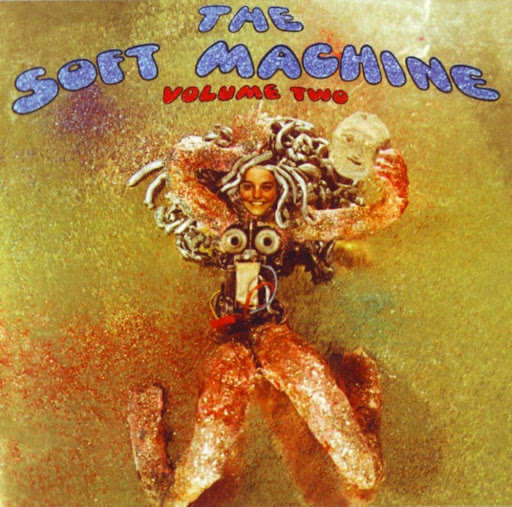
Soft Machine · Album Study
Volume Two
1969
Locally complete events remain open to later consequence as recurrence, reframing, interruption, and inherited capacity bind two contrasting sides through Relational Continuity.
Locally complete events remain open to later consequence as recurrence, reframing, interruption, and inherited capacity bind two contrasting sides through Relational Continuity.
If The Soft Machine captures a group discovering that contradiction can become a musical method, Volume Two begins after that discovery has started to reshape the machine itself. The songs are shorter, the juxtapositions sharper, the instrumental spaces more expansive, yet the album feels less like a collection of fragments than a single restless intelligence changing masks. Mock ceremony gives way to alphabet recitation; absurdist voices open suddenly into intricate ensemble motion; miniature forms acquire consequences far beyond their duration; and remembered material returns without recovering its former meaning. Beneath the wit and theatrical mischief, Soft Machine is learning how to sustain continuity without depending upon conventional song form—first by connecting separated events through recurrence and reframing, then by allowing rhythmic, registral, and textural conditions to accumulate and change across successive states within a more extended compositional field. Volume Two is therefore not simply a bridge between psychedelic song and jazz-rock expansion. It is the sound of a new architecture being invented in motion: comic and rigorous, discontinuous yet deeply connected, always threatening to fly apart and always discovering another way to remain whole.
By Volume Two, Soft Machine’s performing core consisted of Robert Wyatt, Mike Ratledge, and Hugh Hopper, with Brian Hopper’s saxophones enlarging the trio on several pieces. Each musician contributes a different kind of musical agency. Wyatt supplies rhythmic continuity and a volatile human presence; Ratledge organizes harmonic, registral, and compositional space; Hugh Hopper gives the ensemble an active low-register foundation; and Brian Hopper opens the texture through reed color, contrapuntal interaction, and registral expansion. The album’s character emerges from the precision of these individual contributions and from their capacity to interact without losing their distinct identities.
Robert Wyatt brings the album its most immediate sense of life. His drumming holds together music that repeatedly changes scale, direction, and mode of presentation, but it does so without imposing mechanical regularity. He can make an irregular figure feel bodily and natural, preserve forward motion across a sudden interruption, or turn a stable pulse into something elastic and questioning. His playing is therefore more than accompaniment or timekeeping: it is one of the principal means by which discontinuous events remain connected.
Wyatt’s voice performs a parallel function in another register. It moves among singing, recitation, mock announcement, linguistic play, characterization, and comic eruption. These are not decorative additions placed above an instrumental foundation. His changing personae continually redefine what kind of musical event the listener is hearing. A passage can become a song, a speech, a joke, a ceremony, or a theatrical interruption through the way Wyatt inhabits it.
This gives him a unique position within the album. He is simultaneously inside the ensemble and capable of addressing the listener from outside it. His drumming protects musical continuity while his voice repeatedly unsettles the categories through which that continuity is understood. Wyatt brings Volume Two its human volatility: warmth, absurdity, vulnerability, rhythmic buoyancy, and the sense that compositional rigor need never become emotionally impersonal.
Mike Ratledge brings the album its most concentrated architectural intelligence. His organ and piano do not merely furnish chords beneath melody. They establish harmonic fields, define registral boundaries, sharpen rhythmic figures, and create blocks of sound against which the other musicians can position themselves. The keyboards can act as foundation, lead voice, contrapuntal participant, or source of sustained pressure; their function changes according to the needs of each local environment.
Ratledge’s organ sound is especially important because it occupies an ambiguous territory between harmony and physical force. A repeated figure can support the ensemble while simultaneously driving it forward. A sustained sonority can stabilize the field while increasing its tension. When the organ moves into greater prominence, it does not simply “solo” over an accompaniment: it can reorganize the balance of the entire group.
His piano, harpsichord, and occasional flute provide contrasting forms of articulation and color. These changes of instrument help the album move among angular ensemble writing, chamber-like reduction, mock formality, and expanded reed textures without losing its underlying compositional discipline.
Ratledge’s own account of his compositional practice helps clarify the kind of architecture audible here. He described beginning from a “given concept”—for example, a progression or a time signature—as a way of getting himself into the act of composition. Such premises need not remain conspicuous on the surface throughout a piece. They can instead establish a field of constraints and possibilities within which recurrence, asymmetry, harmonic pressure, and instrumental interaction acquire direction.
Ratledge therefore brings more than keyboard virtuosity. He supplies the album with procedures capable of organizing contradiction: asymmetrical figures that acquire momentum, harmonic areas that remain stable without becoming static, and composed structures elastic enough to admit interruption and improvisational pressure. If Wyatt gives the music its changing human face, Ratledge repeatedly constructs—and reconstructs—the environments in which those transformations can occur.
Hugh Hopper’s arrival is the album’s decisive change in instrumental balance. He does not simply replace the bass function previously occupied by Kevin Ayers. He brings a different conception of what the bass can do and, with it, a different model of ensemble organization.
His bass provides weight and continuity, but it rarely behaves as neutral support. Repeated figures can become compositional premises; distorted sonorities can change the density of the entire texture; melodic movement can answer or challenge Ratledge rather than merely reinforce the keyboards. Hopper’s lines often occupy the space between foundation and independent argument. They stabilize the music while introducing pressures that prevent that stability from becoming settled.
This creates one of the album’s defining relationships. Ratledge and Hopper do not form a simple hierarchy of harmony above bass. Their parts can behave as interacting structural voices: one establishes a field while the other redirects it; one repeats while the other varies; both may converge into a single rhythmic mechanism and then separate into competing lines. Wyatt’s drumming moves within and around this relationship, binding it together without erasing its internal tensions.
Hopper also contributes acoustic guitar and alto saxophone, demonstrating that his significance cannot be reduced to the amplified bass sound. The acoustic guitar in “Dedicated to You But You Weren’t Listening” reveals another side of his musical imagination: intimate, exposed, and capable of carrying a complete environment through economical means. Hopper later recalled that he had written the piece roughly a year before joining Soft Machine, originally as an instrumental composition on guitar, with the words added only while Volume Two was being prepared. Its reduced and exposed character should therefore be distinguished from the album-level function it acquires in this particular sequence: the piece did not have to be conceived for that role in order to become formally consequential through placement and realization.
His contribution to Volume Two is therefore both sonic and structural. He gives the new trio a firmer center of gravity while making that center active, mobile, and compositionally consequential.
Brian Hopper’s soprano and tenor saxophones enlarge the album without displacing the trio at its center. His reeds introduce sustained melodic lines, sharper attacks, additional contrapuntal possibilities, and a wider registral span. Where bass, organ, and drums can create a tightly compressed rhythmic-harmonic mechanism, the saxophones allow that mechanism to open outward.
His role should not be understood simply as that of a guest soloist arriving above an already completed backing track. The reeds can participate in thematic definition, reinforce or complicate instrumental figures, answer the keyboards, and alter the perceived scale of a passage. Their presence helps “Hibou, Anemone and Bear,” “Out of Tunes,” and parts of “Esther’s Nose Job” become larger ensemble environments rather than trio performances with incidental ornamentation.
Brian Hopper also points toward an important possibility within Soft Machine’s evolving identity: the core group can admit another instrumental voice without surrendering its internal logic. The added reeds do not settle the music into a conventional jazz arrangement. They increase the number of relationships the music can sustain. Through them, the trio acquires a permeable boundary—capable of remaining recognizable while expanding beyond its nominal size.
What each musician brings to Volume Two remains clearly identifiable. Wyatt supplies rhythmic elasticity and theatrical presence. Ratledge supplies harmonic pressure and compositional architecture. Hugh Hopper gives the music a low-register center whose repetitions, lines, and timbres actively shape form. Brian Hopper enlarges the field through reed color, registral extension, and contrapuntal pressure.
These contributions do not harden into fixed roles. Wyatt’s drumming may carry continuity while another instrument controls attention; his voice may define a local event without governing the process that follows. Ratledge’s keyboards can establish a harmonic environment, provide rhythmic propulsion, or emerge as an independent line. Hugh Hopper’s bass can ground the texture, generate its principal mechanism, or act as a melodic and contrapuntal voice. Brian Hopper’s reeds can move from timbral enlargement to thematic or structural prominence.
The album’s flexibility arises from this combination of recognizable musical identities and variable functions. Each participant brings a distinct capacity to the ensemble, but no capacity remains permanently attached to one formal responsibility. The musicians are therefore more than performers within a predetermined architecture: their interaction supplies the forces from which that architecture is made.
The passage from The Soft Machine to Volume Two began with exhaustion and apparent dissolution. After the group’s second American tour in 1968, Kevin Ayers departed, ending the ensemble’s first configuration. His absence removed not only its bassist but one of its principal songwriters and vocal personalities. Ayers had embodied melodic directness, concise psychedelic form, languid delivery, and a cultivated distance from the music’s increasingly intricate instrumental demands. The group could not continue unchanged because an important part of the system through which its contradictions had previously been articulated was no longer present.
Robert Wyatt and Mike Ratledge consequently reconstructed Soft Machine with Hugh Hopper. Hopper had already contributed the tape-loop construction “Box 25/4 Lid” to the first album and possessed deep connections to the group’s Canterbury history: he had played with Wyatt in the Wilde Flowers, worked as Soft Machine’s road manager, and developed compositional and experimental interests closely related to the band’s changing direction. He was therefore neither an outsider nor a substitute asked to reproduce Ayers’s musical identity. His arrival made possible a different organization of capacities already latent within the group.
The reconstruction became more than provisional while Volume Two was taking shape. During the album sessions, Soft Machine accepted a brief support appearance at the Jimi Hendrix Experience’s Royal Albert Hall concert, their first London performance in roughly a year. The account preserved in the documentary record describes an enthusiastic public reception, but gives particular weight to what happened around the performance: after the soundcheck, musicians and road crew reportedly responded with a spontaneous ovation. The episode helped convince Wyatt, Ratledge, and Hopper that the revived group should continue, and new bookings followed soon afterward. Volume Two was therefore being made at the moment when an attempted reconstruction was becoming a continuing band.
The historical importance of the change lies precisely in the absence of direct replacement. Ayers had often combined bass playing, songwriting, and vocal identity within one musical presence. After his departure, those responsibilities were no longer concentrated in the same person. Wyatt remained the principal vocalist and became a central architect of the album’s linguistic, theatrical, and miniature forms. Ratledge assumed greater responsibility for extended instrumental construction. Hugh Hopper brought new compositions and a bass conception suited to repetition, contrapuntal interaction, and sustained ensemble process.
Compositional authority likewise passed among several hands. Wyatt is the principal shaping intelligence behind much of Rivmic Melodies, where songs, verbal games, recurrences, abrupt transitions, and instrumental expansions form a continuous theatrical sequence. Ratledge’s most substantial extended construction is Esther’s Nose Job, while Hugh Hopper contributes compositions and materials of his own, including the compressed intimacy of “Dedicated to You But You Weren’t Listening.” Shared credits elsewhere confirm that the reconstructed group did not establish a single successor to Ayers’s authorial role. It developed through the coexistence of several compositional imaginations.
The documentary evidence also clarifies an important distinction in the way Esther’s Nose Job appears on the record. Ratledge conceived it as one extended composition, not as five independently conceived pieces. The smaller titles attached to its five indexed sections were supplied because the record company required a long work to be broken into shorter named units; Ratledge recalled taking the titles from descriptions on a sound-effects record available in the studio. The printed subdivisions therefore belong partly to the practical presentation of the LP rather than defining the composition’s fundamental ontology. The music nevertheless possesses genuine internal articulation. Recurring elements—including the persistent importance of 7/8 and an arpeggiated four-note motif identified in the contemporary account—help bind the extended work together while its internal regions continually change their texture, register, instrumental balance, and distribution of responsibility.
This distinction matters for the architecture of Volume Two. Rivmic Melodies assembles heterogeneous songs, verbal miniatures, theatrical interventions, and larger instrumental environments into a continuous side whose coherence repeatedly depends upon juxtaposition, recurrence, and reframing. Esther’s Nose Job, by contrast, begins after the two separate songs “As Long as He Lies Perfectly Still” and “Dedicated to You But You Weren’t Listening” and unfolds as a single extended composition articulated internally into five titled regions. The two sides therefore achieve continuity through different kinds of construction: one through the consequential placement of sharply differentiated events, the other through changing states within a longer compositional field.
This should not be described as a straightforward abandonment of song in favor of instrumental music. Songs remain essential to Volume Two, as do Wyatt’s melodic feeling, verbal wit, characterization, and changing modes of address. What changes historically is the framework surrounding them. Vocal pieces now coexist with instrumental processes that can exceed their initiating premises, while miniature events acquire long-range functions through framing, recurrence, and interruption. The earlier vocabulary survives, but it operates within a configuration no longer organized around the same songwriter-bassist relationship.
Brian Hopper’s participation further enlarges that configuration. His soprano and tenor saxophones extend the trio’s registral and contrapuntal range, particularly in “Hibou, Anemone and Bear,” “Out of Tunes,” and Esther’s Nose Job. Although he was not a permanent fourth member, his presence demonstrates that the reconstructed Soft Machine could admit additional instrumental voices without losing the identity of its core. The trio was therefore compact but permeable—capable of expanding according to the musical requirements of a particular piece.
That permeability points toward later developments without reducing Volume Two to a preliminary sketch for the albums that followed. The album represents a complete historical configuration in its own right: a moment when Soft Machine responded to the loss of a founder by reorganizing its compositional resources, enlarging its instrumental possibilities, and discovering new relationships between song, theatrical miniature, and extended ensemble process.
Volume Two consequently emerges from a break without treating the break as emptiness. Ayers’s departure makes the earlier balance impossible; Hugh Hopper’s arrival enables another balance to arise. Wyatt and Ratledge assume enlarged but different responsibilities. Composition circulates among several hands, and Brian Hopper’s reeds widen the ensemble beyond its nominal trio form. Reconstruction becomes more than a practical response to changing membership. It becomes the historical condition that allows Soft Machine to remain recognizable by changing the relationships through which its identity is produced.
Volume Two builds its architecture from abrupt contrasts that gradually reveal themselves as durable relations. Brief recitations, mock ceremonies, vocal portraits, extended instrumental fields, and sudden withdrawals arrive with sharply different proportions and local behaviors, yet none is sealed off from what surrounds it. Across Rivmic Melodies, recurrence and placement reach backward, changing what completed events can be understood to have done; across Esther’s Nose Job, successive states within an extended composition carry altered capacities and limitations forward. This section traces how those two temporal directions emerge from the ensemble’s shifting authority, the album’s temporary local laws, and the thresholds, interruptions, returns, and transfers that allow consequence to continue after an event has ended.
Volume Two presents itself as a sequence of named tracks, many of them over almost as soon as they begin. Yet the album cannot be understood simply by taking each piece apart and then placing it back in the running order. On Rivmic Melodies, the indexed miniature often functions as a clear local unit: each event has its own sound, scale, and behavior, and each arrives as something distinct from what surrounds it. On Side Two, however, the printed subdivisions do not always coincide with the composition’s deeper formal units. Within Esther’s Nose Job, what matters most is the succession of audible states through which voice, instrumental recurrence, register, density, rhythmic propulsion, and collective authority change their relationships. Across the album, endings do not always contain consequences. Again and again, a gesture completed in one place continues to affect music heard later.
The indexed track therefore remains an important formal unit, especially on Rivmic Melodies, but it is not always the final unit of explanation. On Esther’s Nose Job, the distinction is especially important: the named divisions provide useful points of reference, while the extended composition’s audible internal states supply the more consequential formal boundaries.
The shortest pieces make this immediately audible. “A Concise British Alphabet, Pt. 1” accelerates through its verbal recital and stops. “Hullo Der” turns arrival into a compact act of greeting. “Thank You Pierrot Lunaire” offers its acknowledgment and disappears. None sounds like a fragment of a song waiting to be completed elsewhere. Each enters, performs a concentrated action, and leaves.
The longer events possess equally distinct laws. “Hibou, Anemone and Bear” opens a much broader vocal–instrumental space, gathering density, redistributing attention, breaking apart, and partially recovering its collective force. “Dada Was Here” settles into a more extended condition whose provisional stability gives the next interruption its impact. Within Esther’s Nose Job, successive regions establish equally recognizable local conditions even though they belong to one extended composition. These internal courses matter. The album’s larger design depends upon the differences among them remaining clear to the ear.
Its events are therefore locally intelligible without being architecturally self-sufficient.
Local Completion describes the point at which an event or governing condition fulfills its immediate law. It does not mean that every larger relation involving that event has also ended. “A Concise British Alphabet, Pt. 1” completes its accelerated verbal action in a matter of seconds. Only when the alphabet returns does the listener discover that the first recital also opened a frame around “Hibou.” The miniature was already complete; what remained open was the extent of its function.
Local Completion must be distinguished from an audible ending and a boundary. An audible ending is the point at which an event or governing condition ceases. A boundary marks the difference between one local organization and another. All three may coincide, but Volume Two does not require them to do so. A printed track division may reinforce such a boundary, but it need not create one; conversely, a consequential boundary may arise within a continuously conceived composition when the ensemble enters a recognizably different state.
Sometimes the boundary is sharp enough to feel physical: a compressed recital suddenly gives way to an enlarged ensemble field, or a theatrical address is displaced by music operating at a different scale. Elsewhere the join is more permeable. A remembered procedure, a vocal function, a registral responsibility, or an instrumental capacity may remain effective across the boundary even as it changes form or carrier.
Audible differentiation is therefore necessary without requiring every formal boundary to coincide with an indexed track division. On Rivmic Melodies, named events often make one condition ending and another taking possession of the space unusually conspicuous. Within Esther’s Nose Job, comparable differentiation can occur between successive states of the extended composition. Because the conditions remain distinct, it becomes possible to notice when a function moves between them, when an earlier procedure returns, or when a once-productive capacity begins to weaken. If the album unfolded as one undifferentiated stream, these changes would lose much of their force. If every named subdivision were treated as entirely self-contained, the relations passing through and beyond them would be obscured.
A self-sufficient formal unit would contain the final explanation of its own role: its beginning, internal course, and ending would determine what it means within the album. Volume Two repeatedly exceeds that condition. A later recurrence can reveal an additional function in an earlier miniature. A voice can disappear and return after the intervening music has altered its position. A completed instrumental state can leave what follows with capacities—or limitations—that had not previously been audible in the same form.
Local Completion and Continuing Consequence are therefore complementary. The first concerns what an event or state accomplishes while its immediate law is active. The second concerns what remains formally effective after that action has ended or changed. What crosses a boundary need not be a piece of unfinished material. It may be the memory of a procedure, the posture created by an act of presentation, an instrumental capacity, a distribution of authority, or a limitation that later music must confront.
Those consequences can travel in more than one temporal direction. A later recurrence may reach backward, causing the listener to understand a completed event differently from the way it first appeared. An earlier condition may instead reach forward through the capacities inherited by subsequent music, even after its original materials have vanished. Neither process requires one musical object to remain continuously present. Both depend upon an event or state retaining consequence under a different local law.
This is the basis of Relational Continuity.
Relational Continuity joins events and states without dissolving their separate identities. It does not require uninterrupted sound, continuous thematic development, a single dramatic narrative, or a stable hierarchy between voice and instruments. It arises whenever the function, capacity, or significance of one condition depends partly upon its relation to another beyond its immediate boundary.
Such continuity can be carried by recurrence and memory, but also by transfer, interruption, inheritance, reclassification, attrition, and loss. A function may disappear and later return without regaining its former position. A relation may remain audible even as it weakens, because the listener can hear what it is no longer able to produce. Material need not remain permanently present for formal connection to persist.
Three temporal measures help describe how this works: Chronological Duration, Chronological Distance, and Formal Reach.
Chronological Duration measures how long an event is actually heard. Chronological Distance measures the span separating events that acquire a consequential relation. Formal Reach measures how far beyond an event’s immediate sounding its significance becomes effective in relation to another condition. It describes the scope of that relation, not continuous activity throughout the intervening music.
The three measures are connected, but they are not proportional. The first alphabet recital lasts only seconds, yet its return establishes a relation extending across the complete duration of “Hibou.” The mock-ceremonial introduction is similarly brief, but its later recovery reaches across a longer and more varied succession. In neither case is the intervening music empty time. Its contrasts, detours, and independent local laws create the Chronological Distance that makes recognition consequential.
Formal Reach should not be mistaken for continuous control. The alphabet does not govern the internal course of “Hibou,” nor does the opening ceremony supervise everything heard before its return. Their disappearance is precisely what allows the intervening music to establish its own identity. Only later does recurrence reveal that these brief events have acquired significance across a distance far greater than their Chronological Duration initially suggested.
The same principle extends beyond audible recurrence. An earlier condition may remain consequential because it has changed what the ensemble can sustain, redirect, or transmit afterward. Here nothing needs to come back in recognizable form. The consequence survives as an altered possibility within the music that follows. Remembered identity and inherited capacity can therefore carry continuity in different ways without becoming equivalent operations.
Later relations enlarge an event’s identity; they do not arbitrarily replace it. The first alphabet remains a locally complete comic recital when it also becomes recognizable as the opening boundary of a frame. An instrumental field retains its own internal organization when subsequent states reveal capacities that it made possible. Retrospective reclassification and prospective inheritance remain convincing because they act upon features or possibilities already heard in the music.
Identity and difference consequently depend upon one another. Without a stable local identity, a recurrence could not be recognized, a function could not be heard changing carriers, and an inherited capacity could not be traced to an earlier condition. But if an event’s function remained entirely unchanged, its later appearance would merely confirm what the listener already knew. Volume Two gives its events and states enough definition to make connection audible while leaving their larger roles open to alteration by placement and history.
Its discontinuities are therefore productive. Abrupt shifts of scale, texture, theatrical posture, and ensemble organization keep continuity from turning into sameness. Permeable boundaries allow functions to pass between fields without making those fields identical. Separation sharpens relation: one event or state need not become another’s incomplete preparation or passive aftermath in order to affect it.
Relational Continuity is not seamlessness. Volume Two often makes the crossing itself conspicuous—the quick cut, the altered voice, the sudden widening of instrumental space, or the internal change through which one ensemble condition gives way to another. A boundary may interrupt one behavior, expose a retained function, redistribute responsibility, or reveal that continuity has found a new carrier. The join becomes formally active because the conditions on either side remain different.
Duration alone therefore cannot determine efficacy. A miniature lasting only seconds may change how the listener understands a much longer interval. An extended composition may require time for its relations to accumulate and its capacities to become audible. A named track may end while something it established continues to shape what follows; an internal state may likewise cease within a longer composition while its consequence remains active. Conversely, musical activity may persist even after the field has begun to lose its ability to generate another consequential state.
Volume Two can thus be heard both as a collection of sharply differentiated pieces and as an album whose form exceeds every one of them. Local identity gives its contrasts their clarity, its theatrical gestures their memorability, and its instrumental environments their substance. Continuing Consequence turns those differences into an architecture rather than a succession of unrelated episodes.
The individual track remains important but not universally privileged. On Rivmic Melodies, it often coincides with a locally complete event whose boundary is central to the side’s montage and recurrence. Within Esther’s Nose Job, the named subdivisions provide orientation while the extended composition’s changing internal states supply the more consequential units of formal transformation. In both cases, the album tests what can cross a boundary, what can change while crossing, and what can continue to matter after the sounding event or governing condition has ended.
The architecture of Volume Two begins in this double condition. Its events and states are distinct enough to preserve their local identities, yet permeable enough for their consequences to continue elsewhere. Relational Continuity names the album’s ability to sustain both truths at once.
Relational Continuity operates across both sides of Volume Two, but it does not make them unfold in the same way. Both preserve local identities while allowing consequences to pass beyond the points at which a particular event or state has ended. What changes is the direction in which the listener feels those consequences working.
The conceptual hierarchy is as follows:
Relational Continuity is the album-level principle. Its two foundational conditions are Local Completion and Continuing Consequence: a recital can finish, a voice can withdraw, or an instrumental field can subside without exhausting what it has set in motion. Recursive Recognition and Consequential Inheritance describe the principal temporal directions in which that continuing consequence travels. From them emerge the different architectures of the two sides.
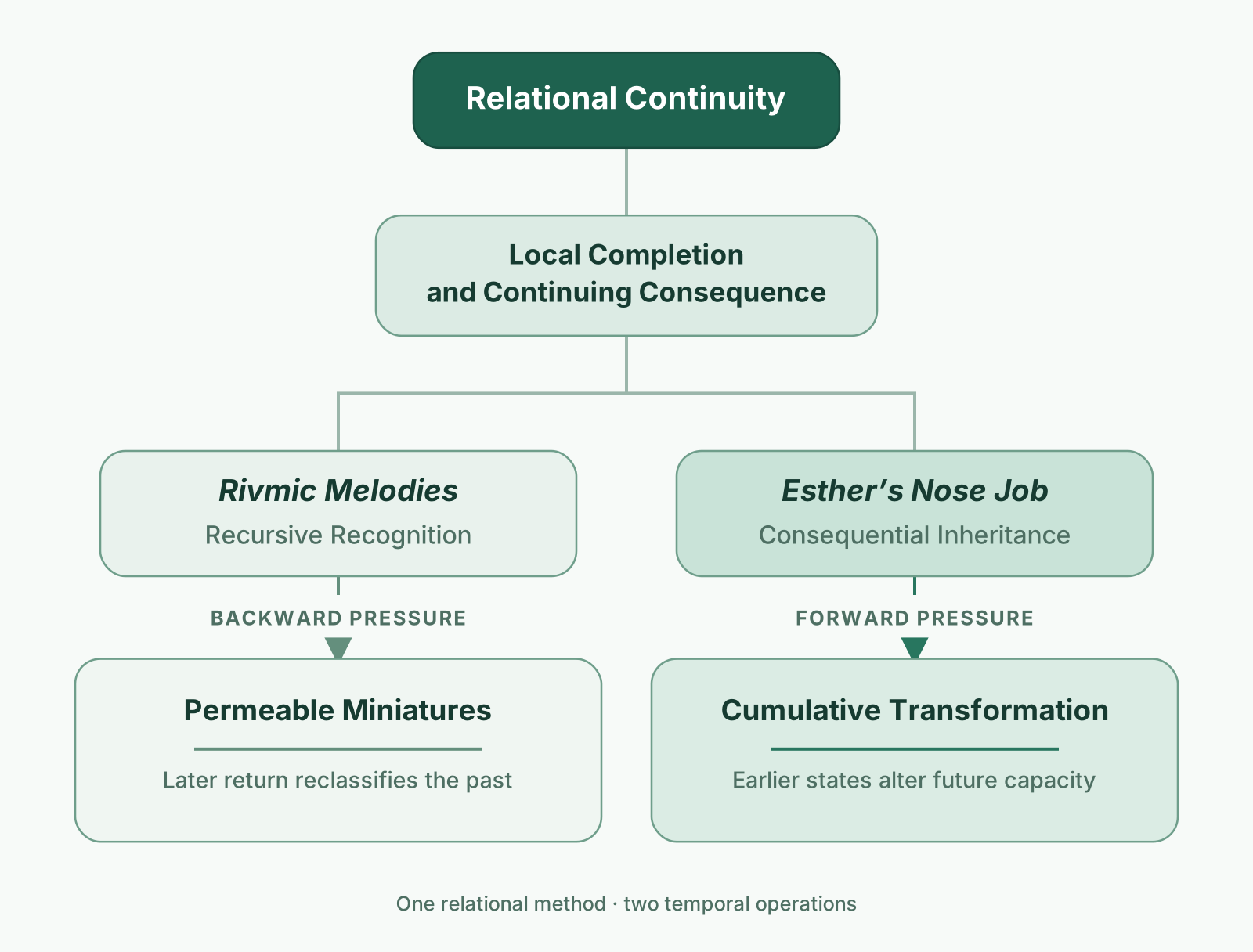
The diagram makes visible the common logic beneath the sides’ contrasting designs. Both begin from the proposition that local completion does not end formal activity. On Side One, that continuing consequence is disclosed by return: the recurrence of a brief earlier event reaches backward, changes how its first appearance is understood, and connects separated regions without erasing their differences. Within Esther’s Nose Job, consequence is transmitted forward through the composition’s differentiated internal states: each region receives musical capacities, pressures, and altered relationships produced by what came before. Recursive Recognition and Consequential Inheritance are therefore not competing explanations of the album. They are the two temporal directions through which Relational Continuity organizes its materials.
On Rivmic Melodies, consequence acts principally backward. A tiny verbal procedure flashes past, an extended musical environment replaces it, and only later does recurrence reveal that the earlier event had opened a relation larger than itself. What first sounded like an isolated miniature becomes a frame, a threshold, or one point in a wider pattern.
The first event’s audible content and immediate action have not changed. Its forward recital from A to Z remains the same accelerated comic act the listener originally heard. Yet the alphabet’s return after “Hibou, Anemone and Bear”—now traversed backward from Z to A—alters the relational identity of that first appearance: it can be heard as the opening boundary of an interval. Its Formal Reach expands even though its local identity remains intact.
This is Recursive Recognition. The completed past remains open to what later music may disclose about it. Side One consequently takes the form of Permeable Miniatures: sharply differentiated, locally complete events whose identities can be enlarged through recurrence, interruption, presentation, and retrospective reclassification. They end cleanly enough to remain distinct, but not so absolutely that later events cannot reveal further dimensions of their formal action.
On Esther’s Nose Job, the ear is drawn in the opposite direction. Consequence acts principally forward. Here the decisive question is not only what a later state reveals about an earlier one, but what the music can still do after an earlier condition has altered the ensemble.
A voice may withdraw, leaving bass, drums, keyboards, and reeds to carry momentum and formal direction without lexical address. A function may later return, but it returns to an ensemble whose capacities have already become audible in its absence. Responsibility may pass into a recurring figure, a register, a pattern of attacks, or a broader collective coordination. The earlier state need not remain materially present; its effects persist in what a later state can sustain, redirect, or no longer recover.
This is Consequential Inheritance. The future emerges from a historically irreversible succession of established, transferred, intensified, weakened, and relinquished capacities within the extended composition. Historical irreversibility does not mean that a material, function, or condition can never return. It means that anything returning must enter a field changed by what has happened in the meantime. It cannot occupy a chronologically equivalent position.
Esther’s Nose Job therefore develops through Cumulative Transformation. Its internal states remain distinct: the listener can hear entrances, withdrawals, textural changes, registral shifts, recurring materials, and new distributions of authority. Yet each state encounters possibilities and limitations created by the music preceding it. Accumulation lies not in the permanent retention of every sound, but in the history the ensemble carries forward through the composition.
These are governing emphases rather than exclusive laws. Side One’s recurrences also affect what follows, just as later states within Esther’s Nose Job can reveal which features of an earlier condition proved consequential. The difference lies in the principal direction of formal pressure. Rivmic Melodies keeps the identity of the completed past open to later recognition; Esther’s Nose Job makes the possibilities of the emerging future dependent upon inherited consequence.
The two architectures can therefore be approached through two questions:
What can a completed event become when a later event changes its relational identity?
What can a later state do after earlier conditions within the extended composition have changed the capacities available to it?
The first question governs Rivmic Melodies; the second governs Esther’s Nose Job. Together, they establish the album’s conceptual architecture. On Side One, later recognition changes what the past has become. On Side Two, inherited consequence changes what the future remains capable of doing. Relational Continuity joins these temporal directions without erasing the audible difference between them.
The relational architecture of Volume Two begins with the way the musicians listen and respond to one another. Robert Wyatt, Mike Ratledge, and Hugh Hopper form the album’s core, while Brian Hopper’s reeds enlarge that core at consequential moments. Their sounds remain recognizable: the weight and repetition of bass, the bite or breadth of keyboards, the restless physical energy of the drums, the projection of the reeds, Wyatt’s many kinds of vocal presence. What refuses to remain fixed is the work each sound performs.
Low-register weight, harmonic definition, propulsion, melodic projection, lexical voice, and non-lexical human sound continually enter new combinations. A figure that supports the music in one passage may lead it through the next. The loudest or most conspicuous participant may not be the one preserving continuity. Authority is audible, but it does not stay in one place.
Hugh Hopper’s arrival changes both the location and organization of the ensemble’s center of gravity. On the first album, Kevin Ayers’s bass playing, songwriting, and vocal persona brought several kinds of musical identity together within one participant. His departure separates those functions. Bass is no longer closely joined to a singer-songwriter’s presence, and a voice moving into the foreground no longer implies control of the complete musical field.
Hopper occupies the newly opened low register without turning it into another permanent center. His repeated figures can lock into place beneath the ensemble, gather pressure through reiteration, or become the principal compositional fact of a passage. Joined by Wyatt’s drums, a bass pattern may harden into a rhythmic mechanism; beneath changing registers and densities, it may preserve an audible thread. At other moments it pushes against Ratledge’s keyboards as an independent line rather than supporting them from below. Bass becomes a producer of form, not a foundation whose function can be taken for granted.
Its weight may nevertheless remain indispensable while someone else gives the passage its most immediate color or initiates its decisive change. A listener may be drawn first to a projecting reed or a bright organ attack while the bass quietly holds the condition together. The question is not simply which instrument sounds most forceful. It is which relation allows the music to persist, turn, or make something available to what follows.
Ratledge’s keyboards are just as mobile in function. Organ and piano can lay out the harmony, mark the pulse, introduce a figure, thicken the texture, or divide the music into high and low zones. A sustained sonority can open a resonant space around the other players. Repeated articulation can tighten that space into propulsion. Elsewhere, the keyboards lose any clear claim to the foreground and become one strand in a texture whose activity belongs to the ensemble as a whole.
Keyboard authority therefore cannot be measured only by melodic prominence. Ratledge may seem to accompany a reed line while actually supplying the harmonic color or timbral resistance that gives the reed its force. Even when organ fills the audible surface, continuity or transformation may depend upon what bass, drums, and reeds are doing around and beneath it.
Wyatt’s drumming is equally form-producing. It can fasten a bass figure into a stable mechanism, then loosen that mechanism with changes of attack and emphasis. It can keep the music moving while the surrounding materials alter, or make a boundary suddenly palpable by thinning, thickening, or changing the articulation. Rhythm on Volume Two is not a neutral frame in which form takes place. It is one of the physical means by which the ensemble establishes a condition, sustains it, unsettles it, or passes its energy elsewhere.
Wyatt’s voice introduces another kind of mobility. Singing, recitation, mock announcement, characterization, invented language, and non-lexical sound do not occupy a theatrical layer floating above the instruments. Each vocal mode changes the event itself. A lyric can draw the listener toward a human center; an announcement can turn entry into ceremony; a comic voice can cut across an instrumental process and momentarily recast its atmosphere.
Yet the voice need not govern everything sounding around it. A sung line can command immediate attention while the instruments pursue a broader course. A spoken announcement may establish a threshold whose consequences outlast the words. A comic intervention can interrupt a process without replacing it, then vanish while the ensemble continues under altered conditions. Voice may initiate or characterize an action that another carrier subsequently sustains.
The distinction is crucial: prominence and architectural responsibility are not the same. What catches the ear may define the immediate character of a passage, while a less conspicuous relation preserves its continuity or prepares its transformation.
Brian Hopper’s reeds make this distribution still more intricate. Their entry expands the register and introduces lines capable of melodic projection, thematic definition, reinforcement, and contrapuntal resistance. But they do not appear uniformly as solo voices set above trio accompaniment. A reed can sharpen a composed figure, answer the organ, strengthen a pattern of attacks, or press into a texture already dense with activity.
The effect is often enlargement rather than displacement. When a reed rises through the ensemble, it need not take the music away from the processes already underway. It may bring an implication within the trio into sharper focus or subject that activity to new registral and contrapuntal pressure. The field becomes larger because more differentiated relations are now active inside it.
Across bass, keyboards, drums, reeds, and voice, the same broad tasks keep changing hands: beginning a condition, holding it in place, interrupting it, pushing against its prevailing direction, redirecting its energy, or preparing what can happen next. None belongs permanently to a single musician or medium. Bass may initiate while organ sustains. Drums may redirect what reeds have enlarged. Voice may interrupt a process that the instruments later resume in changed form. What sounds like accompaniment in one passage may carry the continuity of another.
This redistribution establishes Mobile Authority.
Mobile Authority describes the movement of surface prominence or consequential responsibility among participants and relations. A vocal character, bass ostinato, organ field, rhythmic disturbance, reed line, registral force, or pattern of attacks may become locally decisive. The sound occupying the listener’s attention, however, may differ from the activity that keeps the formal process alive or changes its direction.
Surface prominence concerns what stands out most immediately: a foregrounded voice, a spreading organ sonority, a projecting reed line, or a bass figure made unavoidable through repetition. Consequential responsibility concerns what does the most to sustain, redirect, or transform the governing condition. At times the two coincide. Often they do not. Neither loudness nor foreground position alone determines formal authority.
Mobile Authority does not mean that every passage has a single center passed neatly from one temporary leader to the next. Bass may preserve continuity and low-register weight while drums supply propulsion, organ shapes the harmonic and timbral environment, and reeds extend the register or intensify contrapuntal pressure. No one participant contains the passage’s complete efficacy. It arises from the coordination of their different actions.
This is Composite Instrumental Authority: collective formal capacity produced through differentiated instrumental activity and irreducible to any one participant.
“Composite” does not mean homogeneous. A drum attack does not perform the same work as a sustained organ tone. Low-register weight is not equivalent to reed projection; propulsion differs from harmonic definition or registral overlap. Nor must the players be equally active or equally prominent. Organ may flood the surface while bass carries continuity and drums deliver the redirection that changes the passage. Their functions remain unequal and distinct even as they contribute to one operative condition.
The difference between the two terms is therefore precise. Mobile Authority describes movement: surface prominence or consequential responsibility migrates among changing participants and relations. Composite Instrumental Authority describes organization: the field’s larger efficacy emerges from their differentiated coordination.
The two can operate at once. A drum entrance, bass figure, or reed gesture may redirect the whole field without becoming its sole source of coherence. Conversely, collective coordination does not prevent one action from acquiring unusual local consequence. Responsibility can move within an authority that remains composite.
Voice participates in this organization without standing permanently above it. Wyatt can fill the foreground through language, melody, characterization, or mock presentation, but the instruments are not thereby made structurally dependent upon him. When lexical voice withdraws, their interaction reveals an ability to sustain formal direction without verbal command. When it returns, it enters an ensemble whose self-sufficiency has already become audible. Vocal presence cannot simply restore its former position.
Non-lexical human sound complicates the distinction further. A cry, breath, syllable, or other bodily utterance can join the texture through timbre, register, and attack without restoring lexical address or a stable vocal persona. Composite Instrumental Authority therefore does not require the literal exclusion of every sound made by the voice. It identifies an organization whose operative capacity is collectively generated rather than commanded by language or personality.
These principles shape both sides, though their temporal consequences differ. Rivmic Melodies makes mobility vivid through compressed events, abrupt cuts, sudden instrumental enlargement, shifting theatrical postures, and rapid exchanges between vocal and instrumental functions. Esther’s Nose Job places the same capacities inside the cumulative history of a single extended composition. There, withdrawal, return, instrumental recurrence, and collective coordination change what the ensemble can subsequently sustain as one differentiated state gives way to another.
The personnel are therefore not players assigned stable roles within an architecture established in advance. Their changing relations create the architecture as the album unfolds. Hugh Hopper turns the low register into a mobile formal force. Ratledge shapes harmonic, rhythmic, registral, and timbral environments that the ensemble can sustain or transform. Wyatt alters both the music’s rhythmic conduct and its forms of human presence. Brian Hopper widens the field across which these differentiated functions meet, reinforce one another, and collide.
Volume Two reconfigures authority in both location and organization. Prominence and consequential responsibility can migrate, while collective efficacy arises without erasing the differences among the musicians who produce it. The ensemble’s coherence lies in its ability to sustain Mobile Authority and Composite Instrumental Authority as distinct but compatible forms of musical organization.
The changing distribution of authority explains how the ensemble sustains continuity without assigning permanent roles. It does not yet explain why Volume Two—especially Rivmic Melodies—moves through events that seem disproportionate, anomalous, or almost incompatible. A mock ceremony gives way to a breathless alphabet; theatrical voices interrupt instrumental motion; invented language, sudden enlargement, and abrupt cuts keep changing the scale and posture of the music. Each event seems to invent its own rules, obey them for a few seconds or several minutes, and then surrender the space to something governed differently.
This is the album’s ’pataphysical architecture. ’Pataphysics is not a subject illustrated by the music from outside. It is a formal method: the exception acquires enough internal consistency to become a temporary law.
A conventional unifying procedure establishes a norm and lets variations gather around it. Rivmic Melodies frequently reverses that relation. A singular event arrives with its own tone, proportions, and manner of behaving. While it lasts, its procedure feels complete and sufficient. Then the music turns, sometimes with the suddenness of a door opening, and a different law takes possession.
The result is not disorder. It is a succession of local orders whose differences produce the form.
These orders can be remarkably exact. The opening mock introduction establishes a ceremonial manner of presentation. “A Concise British Alphabet” squeezes a familiar linguistic system into an absurdly accelerated verbal mechanism—first traversing it forward from A to Z, then later returning through the reverse order from Z to A. A vocal characterization creates a temporary bond among persona, text, pronunciation, and ensemble. “Hibou, Anemone and Bear” opens into a much larger vocal–instrumental field, accumulating weight, redistributing attention, breaking apart, and partially recovering its collective force. Each event possesses a recognizable identity even when its dimensions, materials, or tone seem wildly out of proportion to its apparent purpose.
Much of the humor comes from the seriousness with which an unstable procedure is performed. Ceremony is applied to music that will not remain ceremonially settled. The alphabet, one of the simplest systems of linguistic order, approaches caricature through speed and compression. Voices assume authority through announcements, recitations, or exaggerated pronunciation, only to unsettle the authority they perform. An event may arrive dressed in great importance and then disappear before its dignity can take hold.
Yet the procedures are not empty merely because they are comic. A mock announcement can clear a presentational space and make an entrance feel ceremonial. The alphabet can establish a boundary whose significance becomes audible only when the recital returns. A theatrical interruption can pull the ear away from one activity and redirect attention toward another. The claim to dignity may collapse, but the device continues to do real formal work.
That coexistence of absurdity and efficacy is essential. If ceremony, classification, and presentation were only jokes, their action would end as soon as the listener understood the joke. If they were completely stable systems, their distortions would lose their force. Volume Two keeps both conditions alive. The law wobbles; the musical consequence remains.
The album’s ’pataphysical method therefore differs from eccentricity. An eccentric detail might add color to a structure whose governing logic lies elsewhere. Here the strange event can determine how a passage enters, where a boundary is heard, what claims the foreground, or how something completed will later be understood. Exception is not decoration applied to form. Exception becomes form-producing.
For that to happen, each local law must be genuinely effective without pretending to permanence. Its brevity is not a weakness. A temporary procedure can be exact, and its short life may make its identity more vivid: it arrives before the listener can grow accustomed to it, performs its concentrated action, and vanishes. What remains is the memory of a condition that was internally intelligible, locally complete, and always vulnerable to replacement.
Replacement does not expose the earlier event as a failed fragment. The next passage need not correct it, complete it, or absorb it into a larger continuous process. Rivmic Melodies moves among incompatible procedures while allowing each to retain its identity. The cut itself becomes productive. What has just ended changes the position from which the listener hears what follows, while a later event may reach backward and reveal another function in something that had already seemed complete.
The alphabet and ceremonial returns show how far a provisional law can act after it has ceased to sound. When the alphabet reappears in reverse order, the first forward recital acquires a larger relational identity: what initially seemed like a self-contained comic miniature can now be heard as the opening boundary of a directional enclosure around “Hibou.” The return of the “Pataphysical Introduction” creates a wider relation across a more varied succession.
Neither recurrence establishes continuous jurisdiction over the intervening music. “Hibou” follows its own enlarged vocal–instrumental course; the theatrical sequence between the two introductions preserves its changing local laws. Recurrence alters the larger relation among these events without rewriting their internal organization. The returning procedure expands in Formal Reach, not in continuous control.
The ’pataphysical method must therefore remain distinct from a hidden master system. Volume Two does not replace conventional unity with one universal law of exception. Mock ceremony, linguistic compression, vocal characterization, instrumental enlargement, and interruption are not disguises worn by a single concealed procedure. They remain singular organizations. Their temporary efficacy makes their differences consequential.
Once the listener has encountered several such displacements, exception itself begins to feel characteristic—but no particular exception becomes normal. Another local law may arrive at any moment, though its precise form cannot be predicted. What becomes familiar is the act of changing the terms: the album teaches the ear to expect displacement without turning displacement into a fixed grammar.
Humor helps make those changes audible. A parodied announcement exposes framing because the act of presentation has become exaggerated enough to hear. Distorted pronunciation turns linguistic order into physical performance. The implausible compression of the alphabet makes duration and proportion suddenly conspicuous. By weakening the apparent dignity of these devices, humor reveals how actively they organize the listener’s attention.
The listener is therefore asked to recognize order locally without assuming that it will bind the whole suite. Each event must be taken seriously enough for its procedure to register: the ceremony must frame, the recital must compress, the theatrical voice must interrupt, the instrumental field must enlarge. But when another condition replaces it, that change should not be heard as formal failure. Rivmic Melodies repeatedly makes a world intelligible and then moves the listener into a world that requires different terms.
This architecture remains distinct from the album’s forms of instrumental authority. Mobile Authority concerns the migration of surface prominence or consequential responsibility within an active field. Composite Instrumental Authority concerns the collective efficacy created by differentiated coordination among the players. ’Pataphysical architecture operates at another level: it describes the temporary laws through which whole events organize themselves and enter consequential relations with differently governed events.
Its most explicit concentration belongs to Rivmic Melodies. Side Two does not repeat the same quick succession of mock ceremonies, linguistic systems, theatrical characters, and compressed miniatures. The two sides nevertheless share a more fundamental capacity. A local condition can complete itself and be replaced without being invalidated, while something it established remains available to later music.
The album’s ’pataphysical method can therefore be stated precisely: a singular event establishes a local law; that law achieves genuine formal efficacy; another event may replace it without invalidating it; and the relation between those differentiated conditions produces consequences extending beyond their individual durations.
When the exception becomes the method, coherence no longer depends upon conformity. It depends upon hearing the peculiar order of each event—the speed of a recital, the posture of an announcement, the breadth of an instrumental field, the shock of an interruption—while allowing passage among those orders to remain formally active. Volume Two builds its ’pataphysical architecture from temporary laws, effective absurdities, and incompatibilities whose placement changes what the surrounding music can mean and do.
Rivmic Melodies does not become coherent by turning its ten tracks into movements of one continuously developing composition. It proceeds by sharper contrasts. A mock announcement gives way to a breathless recital; a few seconds of compressed speech open into several minutes of vocal–instrumental activity; a greeting clears a space that another piece immediately occupies. Each event has its own scale, sound, and manner of behaving. Yet what it accomplishes need not end when its sound stops.
Procedures disappear. Governing conditions change without warning. Differences of proportion remain impossible to ignore. Even so, recurrence, placement, interruption, and redirection allow consequences to pass among the tracks.
This is the architecture of Permeable Miniatures.
The term applies most immediately to the suite’s brief vocal and theatrical pieces, but it does not mean brevity alone. A miniature is a concentrated formal environment whose immediate law becomes clear within narrow dimensions. It enters, performs a recognizable action, and ends. Its permeability lies in what can happen afterward: although the event remains distinct enough to be remembered, later music may enlarge the extent or alter the direction of its action.
Side One repeatedly places these concentrated events beside much broader musical environments. “Pataphysical Introduction, Pt. 1” and “A Concise British Alphabet, Pt. 1” precede “Hibou, Anemone and Bear.” “Hullo Der” opens into “Dada Was Here.” “Thank You Pierrot Lunaire” and “Have You Ever Bean Grean?” lie along the route toward the returning ceremony and “Out of Tunes.” A few seconds of speech or song can stand beside several minutes of instrumental or vocal–instrumental activity without being swallowed by the larger track’s dimensions.
The opening recurrence network makes this interaction immediately audible. “Pataphysical Introduction, Pt. 1” establishes a mock-ceremonial posture. The first alphabet recital then squeezes language into an absurdly rapid forward movement from A to Z. “Hibou” breaks open that compression, replacing the tight verbal action with an enlarged field in which voice and instruments gather density, redistribute attention, fragment, and partially recover their collective force. When the alphabet returns from Z to A, the listener recognizes the same complete system traversed in the opposite direction across everything that has happened between the two recitals.
That recognition reveals something the first appearance could not disclose by itself. The opening recital, already complete as a miniature action, had also formed one boundary of a much larger interval. Its function has expanded.
Yet “Hibou” does not become subordinate material inside an all-governing alphabet mechanism. While the alphabet is absent, it exercises no continuous jurisdiction. “Hibou” follows its own internal course, and the returning recital does not explain away its accumulated changes. The alphabet makes the interval perceptible without supplying the complete meaning of the music within it.
This asymmetry is essential. “Hibou” remains an internally differentiated composition even as it becomes the enlarged interval across which the alphabet’s latent framing capacity can be heard. The miniature acquires wider consequence, but the longer environment is not reduced to its contents or illustration.
The second recital therefore produces Recognition Without Restoration. The system is unmistakably familiar, but its direction is inverted: A-to-Z progression returns as Z-to-A retracing. The intervening music has changed what recurrence can mean, while reversal prevents the procedure itself from regaining the motion of its first appearance. The first alphabet now possesses an additional framing identity, and the second completes a directional enclosure by drawing the sequence back toward its point of origin. Return connects them; it does not make their actions or positions equivalent.
After this local frame closes, the suite does not simply repeat the design. “Hullo Der,” “Dada Was Here,” “Thank You Pierrot Lunaire,” and “Have You Ever Bean Grean?” form a more heterogeneous theatrical montage. Voices change posture, the proportions expand and contract, and attention passes abruptly between concentrated address and extended musical activity. Their continuity does not depend upon another paired recurrence or upon one musical object traveling intact through the sequence. What passes among them is the activity of presentation itself, continually reassigned to different vocal and instrumental carriers.
“Hullo Der” makes address into an event. Its greeting turns arrival into something the listener can feel, as though a curtain has been pulled aside or a doorway briefly opened. But the greeting does not remain to govern the space it reveals. “Dada Was Here” enters that opening and establishes a longer condition with its own sound and internal law.
It does not finish a sentence begun by “Hullo Der.” What crosses the boundary is not an incomplete musical object but a presentational condition. The miniature makes entry conspicuous; the larger environment takes possession of the opened space under different terms.
The following pieces tighten the dimensions again while altering the manner of presentation. “Thank You Pierrot Lunaire” compresses acknowledgment and cultural reference into a brief theatrical posture. “Have You Ever Bean Grean?” makes altered pronunciation and vocal characterization inseparable from the sound of the event. Words become physical—shaped by accent, mouth, timing, and persona rather than carried as neutral text.
Greeting, acknowledgment, characterization, and ceremony establish different relations among performer, ensemble, and listener. No single theatrical persona persists through them, and voice never secures a permanent rank above the instruments. Each miniature briefly claims the foreground, performs its local action, and leaves behind a changed point of entry for what follows.
These unequal proportions give the montage much of its pacing. After an extended composition, a miniature can pull the field tight with startling speed. After a concentrated address, a longer event can suddenly restore breadth and allow instrumental relations to unfold. Compression sharpens local identity; enlargement gives the music room to accumulate, redistribute responsibility, and establish a more extended course.
The suite never regularizes this contrast into a dependable alternation between interludes and principal pieces. The ear cannot settle into a pattern of small preparation followed by large fulfillment. Each event completes an action of its own while affecting how a neighboring condition is entered, bounded, interrupted, or remembered.
Rivmic Melodies consequently combines local montage with long-range relation. It is a montage because strongly differentiated events stand beside one another without submitting to a single continuous law. It is relationally continuous because their consequences do not remain trapped within immediate adjacency.
The return of “Pataphysical Introduction, Pt. 2” brings those two forms of organization together. The opening ceremonial procedure reappears across a greater and more varied interval than the one separating the alphabet recitals. Between the two introductions lie the local alphabet frame—including the enlarged environment of “Hibou”—and the theatrical montage extending from “Hullo Der” through “Have You Ever Bean Grean?”
None of these events is merely a delay between privileged ceremonial endpoints. Their different local laws create the history through which the returning introduction must now be heard. Since the first ceremony, presentation has moved through recital, vocal–instrumental enlargement, greeting, acknowledgment, and characterization. The form, carrier, and authority of address have repeatedly changed.
The second introduction is recognizable because it recovers the earlier ceremonial posture, but it cannot restore the conditions under which that posture first appeared. Its recurrence produces Recognition Without Restoration, though it does not reproduce the alphabet’s framing action. The alphabet returns to bound an interval. The ceremony returns after a broader history of changing presentation and assumes a different task.
That task is prospective as well as retrospective. “Pataphysical Introduction, Pt. 2” does not complete the suite, because “Out of Tunes” follows. What might have hardened into a closing frame instead becomes another act of presentation. The ceremony looks backward through recognition while opening forward as a threshold.
“Out of Tunes” prevents the return from becoming terminal closure. The introduction makes its entrance conspicuous and changes how the listener encounters the final event, but it does not dictate the course of the music it presents. Ceremony retains formal efficacy without acquiring permanent control.
The two recurrence scales therefore perform different work. The second alphabet recital draws a frame around “Hibou.” The returning ceremony reopens the suite toward another event. One recurrence bounds; the other redirects. Their different materials, degrees of Chronological Distance, intervening histories, and positions within the suite prevent recurrence from becoming a device with one predetermined function.
This distinction clarifies Recursive Recognition. A return can reach backward and enlarge the identity of an earlier event, but it cannot erase the heterogeneous history that made the relation possible. Once the alphabet has disclosed its framing action, the first recital remains both the comic miniature initially heard and the opening boundary recognized later. Once ceremony returns after the theatrical montage, it occupies a position unavailable to its first appearance.
Retrospective change adds function; it does not overwrite history.
Rivmic Melodies therefore does not trace a circle back to its origin. Its recurrences connect unequal positions. The later event remembers the earlier one; the earlier event acquires an architectural role that could not yet be heard when it first appeared. Recognition creates the relation, while non-restoration preserves the difference between the moments it joins.
The suite is best understood as a network of such unequal relations operating at different scales. The alphabet establishes a local frame. “Hibou” expands the vocal–instrumental field without surrendering its independent law. The theatrical montage passes presentational and organizational functions among a succession of sharply contrasting events. The returning ceremony recovers an earlier procedure but turns that recovery into a new threshold. “Out of Tunes” carries the listener through it and prevents retrospective recognition from becoming closure.
No miniature governs the complete side, and no extended track contains the final explanation of the music around it. The miniatures compress their local laws into memorable actions. The longer environments give relations time to persist, gather force, and change. Their unequal scales become mutually consequential without being reconciled under one universal procedure.
Rivmic Melodies thus makes permeability a compositional resource. Its boundaries preserve the differences among ceremony, linguistic order, instrumental enlargement, greeting, acknowledgment, characterization, renewed presentation, and final redirection. At the same time, those conditions remain capable of framing, opening, interrupting, redirecting, and reclassifying one another.
The Permeable Miniature is the decisive relational unit of this architecture: complete enough to fulfill its immediate law, bounded enough to retain its identity, and open enough for later music to change the extent and direction of its action.
Esther’s Nose Job does not reproduce the recursive architecture of Rivmic Melodies. Its relation to what precedes it on Side Two is different as well. “As Long as He Lies Perfectly Still” and “Dedicated to You But You Weren’t Listening” are separate songs; Esther’s Nose Job begins with “Fire Engine Passing with Bells Clanging” and continues as a single extended composition through the four named regions that follow. Ratledge later explained that these subdivisions were imposed because the record company required long pieces to be broken into shorter titled units, even though the music was conceived and heard as one long piece. The printed divisions are therefore useful points of reference, but they cannot by themselves define the composition’s formal ontology.
The music is nevertheless anything but undifferentiated. Voice enters and withdraws; recurring instrumental materials take hold; registers widen or contract; collective activity gathers pressure; functions change carriers; and, in the Volume Two studio realization, relations that have sustained transformation eventually lose some of their capacity to generate another state. These changes articulate the extended composition into internally differentiated regions whose consequences pass forward even when the materials that established them do not.
This is the architecture of Consequential Inheritance.
Consequential Inheritance does not require a theme, figure, text, or procedure to cross an audible boundary intact. What passes forward may be less tangible but no less consequential: an instrumental autonomy exposed by the absence of voice, a new carrier of continuity, a redistributed form of authority, or a limitation revealed when a previously productive relation begins to weaken. The operative unit is therefore not necessarily the indexed track. One differentiated state establishes or exposes a capacity; a later state encounters a field already altered by what has occurred.
These inheritances produce Cumulative Transformation. Consequential Inheritance names the relation through which one state alters the possibilities available to another. Cumulative Transformation names the larger historical change created as successive inheritances reshape the field of possibility. Within Esther’s Nose Job, that history belongs to one extended composition; at the level of Side Two, it also reaches backward into the two songs that precede it, because their different relations between lexical voice and instrumental activity change how the opening of Ratledge’s composition can subsequently be heard.
Accumulation therefore does not mean that the music keeps adding materials to an ever-thickening store. A function may vanish after revealing a capacity that survives it. Something absent may return without regaining its former position. A recurring figure may preserve identity while taking on another responsibility. A relation may remain audible even after it has lost the ability to generate further change. What accumulates is a history of altered possibilities.
Before Esther’s Nose Job begins, Side Two presents two different forms of vocal–instrumental occupation. “As Long as He Lies Perfectly Still” places portraiture and lexical voice inside a differentiated ensemble. The words give the listener an identifiable human center, yet the surrounding instruments do not collapse into accompaniment. Low-register weight, keyboard activity, rhythmic propulsion, and changing instrumental prominence retain responsibilities of their own.
“Dedicated to You But You Weren’t Listening” draws the field more tightly around an exposed act of address. Space opens around the voice; density and collective activity are redistributed. What had been portraiture embedded within a mobile ensemble becomes something more vulnerable and immediate. These two songs are compositionally independent of Esther’s Nose Job, but their placement immediately before it makes their contrasting forms of lexical occupation part of the history through which the extended composition is entered.
“Fire Engine Passing with Bells Clanging” begins Esther’s Nose Job after that history has been established. Its instrumental self-sufficiency matters because the ear has just encountered two distinct relations between lexical foreground and ensemble action. When words fall away, the instruments do not suddenly acquire a capacity they previously lacked. Their existing ability to sustain direction becomes newly explicit.
This is Side Two’s Threshold of Withdrawal: removing a prominent function initially enlarges the audible efficacy of what remains.
The threshold should not be heard as an escape from vocal limitation into instrumental liberation. The two preceding songs are not incomplete stages awaiting a supposedly purer instrumental state, and the opening of Esther’s Nose Job does not invalidate them. Withdrawal matters because it changes the relation between voice and instruments. A different condition has taken possession of the field, yet that condition cannot now be heard as though the preceding forms of vocal occupation had never occurred.
Nor does Esther’s Nose Job proceed toward permanent instrumentality. “Pig” brings lexical voice back, interrupting any simple narrative in which language is progressively evacuated. But voice now enters a composition whose ability to sustain formal direction without it has already become unmistakable. It recovers surface presence, not its earlier historical position.
“Pig” therefore produces Recognition Without Restoration at the level of function. Unlike the alphabet recurrence on Side One, it does not repeat an earlier text, recover a framing miniature, or reproduce a previous procedure. What the listener recognizes is renewed lexical occupation itself. Recognition connects this region to Side Two’s vocal past; non-restoration preserves the consequence of the intervening instrumental autonomy.
Consequential Inheritance is historically irreversible in this qualified sense. A function need not disappear forever, and return remains possible. But nothing can re-enter as though the intervening music had left the field unchanged. Once an instrumental capacity has become audible, later music must be heard in relation to that disclosure. Irreversibility describes a changed historical position, not a predetermined destination.
“Orange Skin Food” then places continuity more conspicuously in instrumental recurrence. Documentary evidence strengthens the sense that recurrence belongs to the compositional fabric of Esther’s Nose Job: accounts of the work identify recurring elements—including a persistent 7/8 organization and an arpeggiated four-note motif—as means by which Ratledge bound the extended piece together. Those documented procedures should not automatically be equated with every recurring figure heard in this particular region; audible function and documented compositional identity must remain distinguishable unless their correspondence can be established. What matters here is that recurrence operates both as a compositional resource within the larger work and, at particular moments, as an audible carrier of continuity.
The recurring instrumental figure heard in “Orange Skin Food” does not recreate Side One’s recursive architecture. It does not disappear across a long interval and then return principally to reclassify a completed event or reveal a frame around intervening music. It works inside an already changing compositional field, one altered by instrumental self-sufficiency and the return of lexical voice.
An instrumental figure can therefore carry identity and continuity without requiring words to organize the foreground. It does not summarize everything that has preceded it. It selects one capacity available within the accumulated history, brings it into greater prominence, and intensifies it.
“A Door Opens and Closes” disperses that capacity across a broader collective organization. The ear may follow a low-register figure, a concentrated attack, a reed entrance, a sustained sonority, or the pull of rhythmic propulsion, but no single element governs the complete field. Formal efficacy arises from the interaction of attacks, registers, overlap, sustained sound, motion, and weight.
Here Composite Instrumental Authority becomes structurally decisive. Bass, drums, keyboards, reeds, and non-lexical human sound retain differentiated identities, yet their coordination produces a collective capacity irreducible to any one participant. Their functions remain unequal. Low-register weight does not do the work of rhythmic propulsion; sustained sonority differs from reed projection; bodily sound contributes another kind of attack and pressure. Composite authority arises through these differences, not through their dissolution.
This collective organization does not suspend Mobile Authority. The listener’s attention continues to move, and so does consequential responsibility. A registral entrance may widen the field; a rhythmic action may redirect it; a sustained tone may hold it open; a bass figure or concentrated attack may become briefly decisive. None must become a permanent center. Mobile Authority describes this movement within the field; Composite Instrumental Authority describes the organization of the field’s larger efficacy.
Instrumental self-sufficiency has therefore changed in meaning. In “Fire Engine,” it becomes explicit when lexical voice is absent. By “A Door Opens and Closes,” it has become the ensemble’s ability to produce differentiated collective form without requiring either lexical occupation or a permanently governing instrumental participant. Non-lexical human sound can enter through timbre, register, attack, and bodily pressure without restoring language, characterization, or song-centered organization.
The composition’s course cannot be reduced to vocal withdrawal. Lexical voice is absent, returns under altered conditions, and recedes again. Recurrence becomes an instrumental carrier. Instrumental autonomy becomes collective and composite. Withdrawal is one operation within this larger history, not its destination.
That accumulated history gives “10:30 Returns to the Bedroom” its particular force. The closing region receives capacities repeatedly exposed and repositioned across the extended composition. Lexical voice, instrumental recurrence, propulsion, instrumental autonomy, and collective coordination have all occupied different places. None reaches the ending with exactly the efficacy it possessed when first established.
The title announces a return, but the album has not previously presented “the bedroom” as an audible musical condition. In that respect, the return remains titular or situational: the title refers to an implied situation beyond what the listener has previously heard rather than restoring an earlier musical “bedroom.” The music itself, however, also looks backward in a different and genuinely audible way. The opening of “10:30” restates earlier riffs before a cyclic bass figure becomes the basis for renewed organ-and-drum activity. Title and music therefore enact two different kinds of return at once: one situational, the other musical.
This distinction separates “10:30” from both recursive relations on Side One without denying its actual recurrence. The second alphabet recital reveals a local frame around “Hibou, Anemone and Bear.” The second “Pataphysical Introduction” recovers ceremony across a wider interval and redirects the suite toward “Out of Tunes.” “10:30 Returns to the Bedroom” does neither of those things. Its title points toward a situation never previously established as an audible musical environment, while its restated riffs establish genuine continuity with earlier material inside Esther’s Nose Job. Musical recurrence and titular return coincide chronologically without becoming the same formal operation.
The closing region therefore looks backward through more than one kind of relation while remaining governed by what the composition’s accumulated history has made possible. Earlier material can recur without restoring the ensemble condition in which it first functioned. The listener recognizes something that has returned, but the surrounding field has changed. Recurrence consequently participates in Recognition Without Restoration without turning the ending into a recovery of an earlier total state.
In the Volume Two studio realization, the music then moves toward its ending through Functional Attrition: the progressive weakening of relations that had remained capable of sustaining, redirecting, or transforming the field. This is not simply a matter of declining volume, thinning texture, slower movement, or disappearing parts. A relation may continue to sound after losing some of its organizing force. Considerable activity may remain even after the music’s capacity to establish another consequential state has begun to diminish.
Attrition is therefore functional before it is textural. A sparse passage need not be undergoing attrition if its remaining relations can still renew or redirect the music. Conversely, an active, crowded texture may be functionally weakening if its components no longer produce a significant redistribution of responsibility. As heard on Volume Two, the composition approaches its recorded ending not merely because less happens, but because relations that previously generated new conditions become progressively less able to do so.
The resulting Terminal Withdrawal differs fundamentally from the earlier withdrawal of lexical voice. That first absence exposes instrumental self-sufficiency and makes another productive state possible. In the album’s closing realization, Terminal Withdrawal reveals no comparably consequential capacity beneath what recedes. It marks the point at which removal and weakening cease to prepare another audible transformation within this recorded version.
The distinction must remain realization-specific. Documentary accounts describe the Volume Two ending as less organically continuous than later live performances and suggest that its final arrangement may have been completed under pressure. Ratledge subsequently supplied “Pigling Bland” as a more substantial concluding section for a later expanded arrangement of Esther’s Nose Job. Terminal Withdrawal should therefore not be projected backward as the composition’s inevitable or only possible ending. It describes the formal action of the version preserved on Volume Two.
The same broad operation thus acquires opposite meanings at different historical positions within that realization. Earlier, the removal of voice enlarges the audible capacity of the remaining ensemble. At the conclusion, the weakening of established relations reduces the field’s ability to produce another inherited condition. Recession alone does not determine the difference. Position and consequence do.
Consequential Inheritance carries limitations forward as well as capacities. Earlier states make new actions possible, but the composition also redistributes, weakens, and partially exhausts relations that cannot remain equally productive indefinitely. Cumulative Transformation is not perpetual enrichment. It is an irreversible change in what the field remains able to do at a given historical moment. Earlier capacities and materials may recur, but never from a position untouched by the intervening history.
Much of that change is driven by Sustained Functional Pressure. A figure persists. Low-register weight bears down beneath the ensemble. Propulsion continues while registers spread apart; attacks accumulate; sonorities overlap and refuse to clear. Through persistence, density, register, rhythm, overlap, and sustained sound, pressure can intensify a capacity, separate it from its original carrier, make it transferable, or begin to wear away its efficacy.
Such pressure is not synonymous with loudness, speed, or density. A sparse figure may exert enormous pressure simply by refusing to release its hold. A dense field may remain functionally stable if its internal relations do not change. Pressure becomes form-producing only when continued activity alters what can sustain, redirect, or transform the governing condition.
Density and register consequently act as formal forces without acquiring permanent meanings. Registral expansion can enlarge the space of interaction, separate simultaneous functions, or expose a new source of prominence. Contraction can isolate a carrier of continuity or make the absence of another relation suddenly palpable. Greater density may intensify collective coordination, but it does not automatically signify culmination. A thinner texture may expose weakness, or it may reveal that one remaining relation has recovered unusual force. Meaning depends upon position within the inherited history.
Esther’s Nose Job therefore gains direction without becoming one undifferentiated process. No theme, groove, texture, or distribution of authority persists unchanged across the entire composition. Its unity does not require such permanence. Direction arises because each differentiated state encounters possibilities and limitations that did not exist in the same form before the preceding states occurred.
Audible differentiation is indispensable to this cumulative architecture; printed segmentation is not its cause. Changes of vocal presence, recurrence, density, register, propulsion, timbre, and authority articulate the extended composition into consequential regions whether or not those articulations coincide exactly with the LP’s imposed titles. Because these conditions remain perceptibly distinct, the listener can hear both what has changed and what the following state receives.
Continuity lies in the altered field carried across those internal articulations. One state establishes or exposes a capacity; another isolates, redistributes, intensifies, or weakens it. A later region can reactivate part of an earlier condition without restoring the position in which that function or material first appeared. Consequence advances through selective inheritance, not through uninterrupted material sameness.
The composition is cumulative but not teleological. Its Volume Two ending need not be understood as a predetermined goal for which every earlier state serves merely as preparation. Each region establishes an audible condition with its own local behavior, yet once that condition has occurred, it changes the circumstances under which every subsequent state—including the recorded ending—can be understood.
Esther’s Nose Job therefore achieves coherence without subordinating its internal differences. Its five named regions belong to one extended composition, but their changing conditions remain audible enough for consequence to pass among them. The imposed titles provide orientation; the music supplies the formal differentiation.
At the level of Side Two, that history begins even before Esther’s Nose Job: the two preceding songs establish contrasting forms of vocal occupation against which “Fire Engine” makes instrumental self-sufficiency newly explicit. Within Ratledge’s composition, the process then continues through lexical return, instrumental recurrence, composite coordination, and—on the Volume Two realization—Functional Attrition and Terminal Withdrawal. Compositional continuity and album-level consequence therefore intersect without becoming the same thing.
Consequential Inheritance names that historically irreversible relation: an earlier condition establishes a capacity or limitation; a later state receives the altered field without needing to reproduce the earlier material; subsequent states selectively intensify, redistribute, reactivate, or weaken what they have inherited; and, in the Volume Two studio realization, the process becomes terminal when those accumulated relations can no longer generate another consequential state.
What crosses an audible boundary is not necessarily a returning object. It is the history carried in the ensemble’s changing capacities.
The two sides draw upon three common resources—interruption, theatricality, and instrumental enlargement—but put them to different architectural uses. On Rivmic Melodies, they place locally complete events within a network shaped by Recursive Recognition. On Esther’s Nose Job, they change the capacities carried forward through a historically irreversible succession of internal states. The resources connect the two sides, but their reassignment prevents the sides from acquiring the same temporal organization.
On Side One, interruption principally marks a change of local law. A recital, greeting, acknowledgment, characterization, or ceremonial announcement can abruptly replace the scale and behavior of its surroundings. The ear is pulled from one self-contained world into another: compressed language gives way to an enlarged ensemble, a brief address opens onto a longer environment, or a theatrical posture cuts across instrumental activity. Each event retains its identity, but the passage between them becomes formally active.
Interruption does not necessarily leave an event unfinished. The first alphabet recital completes its immediate verbal action before its return reveals an additional framing function. “Hullo Der” likewise fulfills its greeting before “Dada Was Here” takes possession of the opened space and establishes a more extended environment. The cut preserves the difference between these conditions while making their placement consequential.
On Side Two, interruption matters chiefly because it changes an inherited field. The withdrawal or return of lexical voice, the recurrence of an instrumental figure, the entrance of a new register, or a shift in collective coordination can alter what the ensemble is able to sustain and transmit. At the threshold into “Fire Engine Passing with Bells Clanging,” lexical voice disappears after the two preceding songs, making instrumental self-sufficiency newly explicit. Its return in “Pig,” now within Esther’s Nose Job, cannot erase that disclosure or recover the historical position voice occupied before it.
The distinction lies in temporal direction. Side One uses interruption primarily to place differentiated events in active relation, allowing something already complete to acquire greater Formal Reach. Side Two also preserves distinct local laws, but its interruptions matter chiefly through the capacities and limitations inherited by what follows. Within Esther’s Nose Job, those changes are articulated through internal transitions and regional shifts rather than through the assumption that each printed subdivision constitutes an independent compositional unit.
Theatricality undergoes a comparable reassignment.
On Rivmic Melodies, it resides mainly in concentrated acts of presentation. Ceremony, recitation, greeting, acknowledgment, altered pronunciation, characterization, and cultural reference briefly change the posture of the music toward the listener. A voice steps forward, assumes a manner, performs its local action, and disappears. These moments do not accumulate into a continuous dramatic narrative, nor do they install a permanent master of ceremonies. Each creates a recognizable relation among voice, ensemble, and listener before yielding to another condition.
Because the action is concentrated, its effect can outlast the voice that produced it. “Hullo Der” makes entry feel like an act of address, but does not remain to govern the environment that follows. The returning “Pataphysical Introduction” establishes another conspicuous threshold without controlling the internal course of “Out of Tunes.” Side One theatricalizes the local law through which an event presents itself.
On Side Two, theatricality moves away from a quick succession of vocal postures and into the changing occupation of the ensemble field. Voice enters, withdraws, and returns under altered conditions. Instrumental functions assume or relinquish continuity, prominence, registral responsibility, and formal direction. The listener hears not merely a change of material but a change in who—or what—is carrying the music.
Theatricality arises here when the entrance, occupation, transfer, return, or withdrawal of a function acquires consequence. Even non-lexical human sound can keep bodily presence within the texture through breath, attack, register, or timbre without restoring linguistic address. Side Two therefore theatricalizes the changing position of functions within an inherited field.
Instrumental enlargement provides the third comparison.
On Side One, enlargement is most conspicuous when a concentrated miniature opens into a much broader environment. “A Concise British Alphabet, Pt. 1” gives way to “Hibou, Anemone and Bear”; “Hullo Der” gives way to “Dada Was Here.” The larger pieces do not simply stretch the miniature’s materials or continue its local law. Instead, they create an interval with audible breadth and weight—time in which the earlier event can recede, remain memorable, and later acquire further consequence.
Enlargement also takes place within these extended environments. Layers accumulate. Registers spread. Voice enters an already active field. Instruments overlap, separate, fragment, and gather again. The change involves more than added duration, density, or volume. What expands is the space of possible interaction: more differentiated functions can act at once, press against one another, exchange prominence, and alter the direction of the whole.
Side Two makes this functional enlargement architecturally central. A field enlarges when an inherited capacity becomes explicit, passes to a new carrier, or enters a broader collective organization. The withdrawal of lexical voice can expose the ensemble’s ability to sustain direction on its own. A recurring instrumental figure can concentrate responsibility for continuity. Register, attack, overlap, low-register weight, reed projection, keyboard activity, and rhythmic propulsion can converge without losing their differences, producing Composite Instrumental Authority.
Enlargement can therefore be heard through subtraction. When a prominent function drops away, the remaining texture may reveal an autonomy or relation that greater density had concealed. Conversely, more sound does not automatically create a larger functional field. During Functional Attrition, the surface may remain crowded and active even as the music loses its ability to produce another consequential redistribution.
What matters is not how much material sounds, but what that material enables. Enlargement occurs when capacity increases or becomes newly audible.
The three resources can therefore be compared directly:
| Resource | Rivmic Melodies | Esther’s Nose Job |
|---|---|---|
| Interruption | Preserves differences among local laws and makes passage between complete events formally active | Alters the capacities carried into subsequent internal states by an inherited field |
| Theatricality | Differentiates concentrated modes of presentation | Stages the entrance, occupation, transfer, return, and withdrawal of functions |
| Instrumental enlargement | Creates unequal environments and intervals across which complete events acquire wider relational identities | Exposes or transforms what the ensemble can sustain, redistribute, or transmit |
These are differences of governing emphasis, not exclusive ownership. Rivmic Melodies contains extended fields whose internal relations accumulate and change. Esther’s Nose Job contains distinct local laws, interruptions, audible transitions, withdrawals, and returns within a single extended composition. The resources are present on both sides; what changes is the direction of their work.
On Side One, interruption preserves differentiated events, theatricality sharpens the manner in which they address the listener, and enlargement opens intervals across which later recognition can alter what those events have become. On Side Two, interruption changes what an inherited field carries forward, theatricality makes the movement of functions perceptible, and enlargement transforms what subsequent states remain capable of doing.
Their reassignment is therefore an expression of Relational Continuity. The same resources recur across the album, but they do not retain fixed functions. Rivmic Melodies directs Continuing Consequence principally backward, toward the changing relational identity of a completed past. Esther’s Nose Job directs it principally forward, toward the changing possibilities of the emerging future.
A boundary separates one condition from another. A threshold makes the passage consequential. The two may coincide at an indexed division, but they are not identical. A boundary can preserve the difference between local laws without transmitting a particular function, and a threshold does not require an independently conceived track boundary in order to become formally active. This distinction is especially important on Volume Two: on Rivmic Melodies, named tracks often coincide with conspicuous changes of local law, while within Esther’s Nose Job consequential thresholds can arise inside a continuously conceived extended composition. A voice enters, an instrument takes hold, a register opens, a recurring figure acquires a new position, or one ensemble state gives way audibly to another.
Thresholds do not constitute another governing architecture alongside Recursive Recognition and Consequential Inheritance. They describe local operations through which those larger temporal directions become audible. On Rivmic Melodies, a threshold often prepares the later reclassification of an event that has already ended. On Esther’s Nose Job, it more often changes what an inherited field can subsequently sustain, redirect, or transmit.
Two supporting—but not exhaustive—distinctions clarify this difference: Presented Threshold and Occupied Threshold.
A Presented Threshold makes entry conspicuous through a concentrated act—an announcement, recital, greeting, or abrupt change of scale. It turns passage into something the listener can feel. A voice steps forward; a compressed verbal action clears a space; the music suddenly seems to point beyond itself. Yet the presenting event establishes only a posture toward what follows. It does not determine everything the entered condition will contain. Its efficacy remains distinct from control.
This operation is especially characteristic of Rivmic Melodies. “Hullo Der” presents entry into “Dada Was Here.” The greeting makes arrival audible, almost as though a door has briefly opened, but it does not remain to govern the extended environment beyond it. The first track stages the passage; the second occupies the space under its own musical law.
A Presented Threshold may acquire greater significance only in retrospect. “A Concise British Alphabet, Pt. 1” initially sounds like a locally complete recital and an immediate passage into “Hibou, Anemone and Bear.” It arrives, races through its compressed linguistic order, and stops. When the alphabet returns, however, that first appearance becomes recognizable as the opening boundary of a larger interval. Presentation is thereby drawn into Recursive Recognition: a completed act acquires a relational identity that could not be fully heard when it first occurred.
“Pataphysical Introduction, Pt. 2” combines the two temporal directions available to presentation. Its recurrence looks backward toward the opening ceremony, while its position directs the ear forward into “Out of Tunes.” The ceremony returns, assumes its familiar posture, and makes another entrance conspicuous. What follows nevertheless exceeds its control. Presentation establishes the threshold; it does not dictate the law beyond it.
An Occupied Threshold develops differently. Here a function enters—or persists within—an existing field and changes what the surrounding relations can do. A voice may settle into the texture; a figure may keep returning; low-register weight may begin to bear upon the ensemble; an instrument may assume responsibility previously carried elsewhere. The occupation becomes threshold-producing only when this presence alters what the field can sustain, redirect, or transmit.
Appearance alone is therefore insufficient, and duration alone guarantees nothing. A function may dominate the surface for some time without changing the possibilities around it. Conversely, a brief entrance may rapidly redistribute responsibility or expose a capacity that had not previously been audible. Duration gives relations time to develop, but consequence—not persistence by itself—defines the threshold.
This operation becomes especially important within Esther’s Nose Job, where functions enter fields already marked by earlier states of the same extended composition. Their significance depends not simply upon what they sound like at the moment of entry, but upon whether their occupation changes the field and what remains possible after they alter or leave it. The relevant threshold may coincide with one of the LP’s named subdivisions, but its formal force comes from audible transformation rather than from the printed division itself.
Threshold-producing occupation can also prepare Internal Transfer: the migration of a capacity from one relation or carrier to another without requiring the same material form to continue. Continuity may first gather around a voice and later be sustained instrumentally. Propulsion may move from one participant into the coordinated ensemble. Registral responsibility, surface prominence, or formal direction may become audible through one carrier, then reappear elsewhere in altered form.
Internal Transfer remains subordinate to Consequential Inheritance. Consequential Inheritance describes the changed possibilities carried forward through the composition. Internal Transfer identifies one means by which a particular capacity changes location or embodiment within that history. It does not imply that the function passes intact, and it does not reduce authority to a relay among isolated leaders.
The withdrawal of lexical voice provides the clearest example of a capacity becoming newly explicit without passing intact from one carrier to another. At the entrance to “Fire Engine Passing with Bells Clanging,” after the two separate songs that precede Esther’s Nose Job, words disappear, yet the music does not lose direction. The instruments continue to press, move, and organize the field without lexical occupation. The Threshold of Withdrawal lies in the newly explicit capacity of the ensemble, not in vocal absence by itself and not in the existence of a printed track boundary.
Nothing simply passes intact from voice to instruments. Rather, formal direction becomes audible as a relational capacity that the instrumental field can sustain under altered conditions. When lexical voice returns in “Pig,” it enters a field whose self-sufficiency has already been exposed. Voice may recover surface prominence, but it cannot recover its earlier position as though the intervening instrumental state had never occurred.
Internal Transfer also operates within Composite Instrumental Authority. A recurring figure may carry continuity for a time. Bass may intensify low-register pressure; drums may renew propulsion; reeds may widen or pierce the field; keyboards may thicken harmonic occupation or hold a register open. Attacks, weight, motion, and prominence migrate among the participants, but the ensemble does not dissolve into a chain of self-sufficient centers. Each function becomes effective through its relation to the others.
Presented and Occupied Thresholds therefore differ chiefly in how their action becomes perceptible. Presentation can establish entry almost instantly: an address, recital, or ceremony points the listener toward another condition. Occupation becomes threshold-producing only when its presence changes the field it enters. Neither category is determined by length. A brief presentation may fail to establish a significant passage, while a sustained occupation may leave the surrounding relations essentially stable.
The distinction between the two sides remains one of emphasis rather than exclusive procedure. Side One contains sustained occupations and Internal Transfers. Side Two contains abrupt entrances, withdrawals, returns, and internal articulations within an extended composition. What differs is the dominant temporal direction in which these operations acquire meaning.
On Rivmic Melodies, thresholds are often understood retrospectively. A later recurrence or placement reaches backward and reveals what an earlier act of presentation has become. On Esther’s Nose Job, thresholds more often act prospectively. Occupation, transfer, withdrawal, or regional change alters what subsequent states remain capable of doing. Presented Thresholds consequently participate principally in Recursive Recognition, while Occupied Thresholds and Internal Transfer participate principally in Consequential Inheritance. None is confined absolutely to one side or temporal direction.
Historical position prevents any threshold operation from possessing a fixed meaning. Earlier on Side Two, withdrawal exposes instrumental self-sufficiency and opens another productive condition. Near the conclusion of the Volume Two realization, withdrawal occurs after Functional Attrition has weakened the field’s ability to generate another consequential state. Terminal Withdrawal therefore does not repeat the earlier Threshold of Withdrawal. The first reveals capacity; the second marks its diminishing efficacy.
The sound of recession may be broadly comparable, but its formal effect has changed. Entry, persistence, transfer, and withdrawal become threshold-producing not because they resemble earlier passages, but because they alter what the field can subsequently sustain, redirect, recover, or no longer accomplish.
Presentation, occupation, and Internal Transfer thus provide a limited vocabulary for hearing how consequence crosses a boundary or emerges within an active field. They do not replace the album’s principal architectures. They clarify how Rivmic Melodies allows later events to change the relational identity of the completed past, and how Esther’s Nose Job allows earlier conditions to change the possibilities of the emerging future.
A threshold preserves the difference between conditions while making passage between them formally active. The listener hears one state end or change position, feels another become available, and later discovers what that passage has made possible. In this way, Relational Continuity joins completion to consequence without requiring sameness, uninterrupted development, permanent control, or an independently conceived track boundary.
The album’s argument converges upon a final problem: how can an event or state end without exhausting its consequences, and how can something return without restoring the condition from which it first emerged?
Volume Two separates the end of an event from the end of its efficacy. A miniature completes its verbal action; a voice withdraws; an instrumental field runs its course; an internal state within an extended composition gives way to another. Each remains recognizable as a distinct local condition. Yet its effects may continue beyond the point at which its own sound or governing law stops. Later music can widen an earlier event’s relational identity, inherit one of its capacities, expose a limitation, or change the conditions under which something can return.
This is Continuing Consequence, and the two sides direct it differently.
On Rivmic Melodies, consequence frequently reaches backward. The first alphabet recital arrives as a complete burst of compressed linguistic order. Only when the alphabet returns, after the breadth and activity of “Hibou, Anemone and Bear,” does the listener hear that first recital as something more: the opening boundary of an interval. The returning ceremony creates a still wider relation across a more varied succession. In both cases, recurrence changes what an earlier event has become. It does not imply that the event remained unfinished or silently governed the intervening music.
Recognition enlarges identity; it does not recover an origin.
The two appearances of a recurring procedure cannot perform the same formal action because they occupy unequal historical positions. The first alphabet recital opens; the second encloses. The opening “Pataphysical Introduction” presents the suite; its return, after recital, ensemble enlargement, greeting, acknowledgment, and characterization, becomes a threshold into “Out of Tunes.” The procedure remains identifiable, but its work has changed.
On Side Two, consequence moves principally forward through inheritance. The two songs preceding Esther’s Nose Job establish contrasting forms of lexical occupation; the extended composition then develops through internally differentiated states in which instrumental self-sufficiency becomes explicit, voice returns under altered conditions, recurrence acquires instrumental carriers, collective coordination broadens, and—in the Volume Two studio realization—relations that once generated change eventually begin to lose efficacy. Later states cannot be heard as though the preceding conditions had never occurred.
Each audible transition preserves a new local law while passing onward a changed history of capacities and limitations.
Within this broader architecture of Continuing Consequence, return assumes several distinct forms. Three remain especially important here: audible procedural return, functional return, and titular or situational return. These belong to the more limited category of Return Without Restoration, but they are not equivalent musical operations and may coexist within a single region.
Audible procedural return occurs when an established musical or presentational procedure becomes perceptible again. The second alphabet recital and the returning “Pataphysical Introduction” belong to this category. In each case, the ear catches something familiar—a compressed recital, a mock-ceremonial posture—and connects it with an earlier appearance. Yet everything heard between the two appearances prevents the returning procedure from doing precisely the same work.
Functional return requires no repeated text, figure, or procedure. In “Pig,” lexical voice occupies the foreground again after “Fire Engine Passing with Bells Clanging” has exposed the ensemble’s ability to sustain direction without it. What returns is a function: words once again claim surface presence within the musical field. But voice now enters a space whose instrumental self-sufficiency has become unmistakable. It recovers prominence without recovering its earlier historical position.
Titular or situational return establishes a relation through an implied situation rather than through the restoration of a previously established musical environment. “10:30 Returns to the Bedroom” belongs to this category because the album has not previously presented “the bedroom” as an audible condition—a texture, procedure, figure, or environment that can now simply be heard again. The title nevertheless posits a return within an implied situation and gives that return formal weight through placement.
In “10:30,” however, titular return does not exhaust the backward relation. The music itself also recalls earlier material: the opening restates previous riffs before a cyclic bass figure becomes the basis for renewed organ-and-drum activity. The title and the music therefore enact two different kinds of return at once. The “bedroom” returns situationally; earlier musical material returns audibly. These relations coincide in the same region without becoming the same formal operation.
“10:30” is thus a compound return. Its title points toward a situation never previously established as an audible musical state, while its recurring riffs create genuine musical recognition within Esther’s Nose Job. What returns materially does not restore an earlier total condition, and what returns situationally has no prior musical “bedroom” to restore.
These distinctions clarify the relationship between Recognition Without Restoration and Return Without Restoration.
Recognition Without Restoration describes the perceptual relation created when an established procedure, function, or identity becomes recognizable again but cannot recover its former formal position. Return Without Restoration describes the temporal condition under which a procedure, function, musical object, or named situation becomes available again after consequential history has altered the field.
The terms are closely related, but not synonymous. Audible procedural, functional, and musical returns can produce recognition because the listener perceives an earlier identity, capacity, or material again. Titular or situational return requires no such prior audible object. Title, placement, and accumulated consequence can make return formally active even when the named situation itself has never previously been heard. “10:30” demonstrates that these possibilities can overlap: musical recurrence can produce recognition while the title simultaneously establishes a different, non-musical return.
Nor does non-restoration mean that materials or functions can never recur. It names historical or relational irreversibility. An earlier procedure may be heard again; voice may resume a familiar function; riffs may recur; a title may announce the revisiting of a situation. But no return can occupy a chronologically equivalent position, because the intervening history has occurred. Recurrence may recover something identifiable. It cannot erase the altered relations through which that identity is now heard.
The two sides emphasize different consequences of this temporal inequality. On Side One, audible procedural return produces retrospective reclassification: a recurrence reaches backward and changes what a completed event has become. On Side Two, functional, musical, and situational returns enter a field already altered by preceding states. These are governing emphases rather than exclusive laws, but both refuse to treat Chronological Distance as empty time. What happens between two related moments changes the relation itself.
That history also distinguishes the two withdrawals on Side Two. When lexical voice first disappears at the threshold into “Fire Engine,” the ear discovers that the instruments can sustain another productive condition. The vacancy opens space; responsibility spreads through the ensemble; a previously present capacity becomes newly explicit. Near the conclusion of the Volume Two realization, withdrawal occurs after Functional Attrition has weakened relations that once sustained or redirected the field. Terminal Withdrawal does not expose another capacity of comparable force beneath what recedes. It marks the declining ability of the remaining relations to generate a further consequential state within this recorded version.
The surface may thin or withdraw in both places, but the formal work is different. The first withdrawal opens possibility. The last registers its exhaustion within the album realization.
The album-level relation can now be stated concisely. Rivmic Melodies demonstrates that the end of an event need not define the limit of its formal identity: later recognition can change what a complete event has become. Esther’s Nose Job demonstrates that the end of a state need not define the limit of its efficacy: later music can inherit what that state made possible without reproducing its materials.
This shared principle resolves the apparent opposition between fragmentation and continuity. Local Completion preserves the differentiated laws of the album’s events and states. Each recital, song, theatrical address, instrumental environment, and internal region remains bounded enough to retain its own identity. Continuing Consequence makes those separations productive. What stops sounding may still alter how a later entrance is heard, what an ensemble can sustain, or what kind of return remains possible.
Continuity therefore resides neither in permanent material identity nor in uninterrupted development. It lies in what events become through placement and in what later states can do because earlier conditions have occurred.
Relational Continuity names the album-wide architecture joining these operations. It encompasses Side One’s retrospective reclassifications, Side Two’s prospective inheritances, and the transfers, interruptions, thresholds, withdrawals, recurrences, and returns through which consequence crosses or arises within boundaries. Return Without Restoration belongs within this architecture, but it does not define every relation through which the album becomes coherent.
A procedure can recur audibly. A function can become active again. Earlier riffs can return without recovering the complete state in which they first appeared. A named situation can be revisited without a corresponding earlier musical environment. In every case, return occurs within an altered history rather than through the recovery of an untouched origin.
Other forms of Continuing Consequence require no return at all. The first alphabet recital acquires a wider relational identity because of its later recurrence, but “Hibou” also changes the scale against which that miniature can act without returning as the miniature’s material. On Side Two, a later state may inherit instrumental autonomy, a carrier of continuity, or a changed distribution of authority without making any earlier procedure or figure perceptible again. Consequence can cross an audible boundary even when nothing comes back.
Volume Two therefore completes itself without recovering its beginning. What has ended remains consequential. What returns enters a changed field. The album’s coherence lies in the relations created by that consequential history; its returns reveal particular forms of the history without defining the whole.
The album’s relational architecture becomes most audible when the unit of analysis follows the music rather than the indexed track list. That principle is especially important on Side Two, where the LP’s printed subdivisions do not always correspond to independently conceived compositional units: Esther’s Nose Job was conceived as one extended composition despite its division into five named sections. The four studies are therefore not portraits of isolated “best tracks,” nor do they divide Volume Two into a hierarchy of major and minor works. Each follows a musically consequential span large enough to reveal one of the album’s characteristic formal behaviors: recurrence operating across multiple scales; discontinuity producing theatrical architecture; vocal–instrumental continuity passing through withdrawal into instrumental self-sufficiency; and acquired capacities undergoing cumulative transformation across the closing sequence.
Taken together, the studies trace a continuous album-level trajectory. Rivmic Melodies establishes coherence through miniature framing, instrumental enlargement, theatrical contrast, recurrence, functional transfer, and retrospective reclassification. Side Two then changes the basis of continuity across the two songs that precede Esther’s Nose Job and the opening of Ratledge’s extended composition: an occupied vocal–instrumental field contracts around a retained voice before “Fire Engine Passing with Bells Clanging” makes instrumental self-sufficiency newly explicit. From there, Esther’s Nose Job carries that altered field forward through lexical return, instrumental recurrence, changing density and register, composite authority, and—within the Volume Two studio realization—Functional Attrition and Terminal Withdrawal. The studies therefore follow audible states and consequential transitions rather than assuming that every printed title defines the music’s primary formal unit.
| Key musical sections | Analytical focus | Role in the album |
|---|---|---|
| “Pataphysical Introduction Pt. 1” through “Pataphysical Introduction Pt. 2,” with particular emphasis on “A Concise British Alphabet Pt. 1” / “Hibou, Anemone And Bear” / “A Concise British Alphabet Pt. 2” | Two scales of recurrence; miniature framing; chronological duration, chronological distance, and formal reach; local enclosure; wide-span reconnection; retrospective reclassification; and remembered relations among preserved differences. “Hibou” receives a macro-regional analysis of its complete audible trajectory, including instrumental enlargement, vocal reorientation, redistributed prominence, composite authority, fragmentation, partial reassembly, and terminal resurgence. | Establishes the fundamental relational logic of Rivmic Melodies. The returning alphabet locally encloses “Hibou,” while the returning ceremony reconnects a wider heterogeneous interval without enclosing or restoring it. Demonstrates that brief events can acquire formal influence disproportionate to their duration and that recognition can create coherence without erasing difference. |
| “Hullo Der” through “Out Of Tunes” | Theatrical montage; provisional stability; changing modes of address; voice as a mobile musical function; discontinuity as formal action; Surface Pivots and Regime Pivots; and functional transfer across voice and ensemble. “Pataphysical Introduction Pt. 2” is considered prospectively as the mock-ceremonial threshold into “Out Of Tunes,” while the closing instrumental field transfers theatrical functions into timbre, register, attack, density, and ensemble interaction. | Shows how the second half of Rivmic Melodies converts abrupt contrast into architecture. Greeting, characterization, cultural acknowledgment, questioning, ceremony, interruption, and instrumental enlargement retain their local identities while organizational responsibility migrates among changing carriers. Extends the opening recurrence network from remembered relation into continuously enacted functional reassignment. |
| “As Long as He Lies Perfectly Still” through “Fire Engine Passing with Bells Clanging” | Three changing bases of continuity across two separate songs and the opening region of Esther’s Nose Job: an occupied vocal–instrumental field, a reduced texture organized around retained voice and remembered relationship, and an instrumentally self-sufficient ensemble. The study develops the Threshold of Withdrawal, Cumulative Reconstitution, Composite Instrumental Authority, and Sustained Functional Pressure, while distinguishing vocal prominence from structural dependence. | Traces a cross-compositional threshold on Side Two. “As Long as He Lies Perfectly Still” and “Dedicated to You But You Weren’t Listening” establish two contrasting forms of vocal occupation; “Dedicated” becomes the threshold’s exposed center and point of maximum withdrawal; and “Fire Engine,” the opening region of Esther’s Nose Job, completes the threshold by establishing continuity, differentiation, and formal direction without lexical guidance. Song is carried into the instrumental field at the album level rather than treated as an opening subdivision of Ratledge’s composition. |
| “Fire Engine Passing with Bells Clanging” through “10:30 Returns to the Bedroom” | Cumulative Transformation by Functional Reclassification across audible internal boundaries within Esther’s Nose Job; Inherited Consequence; the return and reclassification of texted, non-lexical, and wordless voice; recurrence changing carriers; density and register becoming form-producing forces; the documented recurrence of earlier riffs in “10:30”; Return Without Restoration; Recognition Without Restoration; Functional Attrition; and Terminal Withdrawal as properties of the Volume Two studio realization. | Follows Esther’s Nose Job across the full span of Ratledge’s extended composition. The instrumental self-sufficiency established in “Fire Engine” permits voice, recurrence, and collective coordination to return under altered conditions without restoring vocal dependence or an earlier organization. In “10:30,” musical recurrence and titular/situational return coexist without becoming equivalent. Formal responsibility continues to migrate through new configurations of Mobile Authority until the Volume Two realization reaches Terminal Withdrawal, while the later existence of an alternative ending prevents that closure from being treated as the composition’s only possible terminal logic. |
The opening of Volume Two teaches the listener how to hear Rivmic Melodies before its larger design has become visible. A mock ceremonial introduction gives way to an alphabet compressed almost beyond recognition, moving rapidly from A to Z; that miniature act of order opens into the sustained vocal–instrumental world of “Hibou, Anemone and Bear,” before the alphabet unexpectedly returns in reverse, from Z to A. This local recurrence is then carried inside a wider interval: greeting, linguistic instability, modernist acknowledgment, historical recollection, and punning question successively alter the suite’s modes of address until mock ceremony itself returns in “Pataphysical Introduction Pt. 2.”
The study therefore follows two recurrence scales. The opposing alphabet traversals create a concentrated directional enclosure around “Hibou.” The two “Pataphysical Introductions” establish a wider relation across a heterogeneous succession. Neither return restores the conditions of its first appearance, and neither makes the intervening music homogeneous. Each acts retrospectively, revealing that a miniature already complete in itself can acquire a larger function through memory and recurrence. To understand this network, we must begin with the immediate listening experience—ceremony, compression, enlargement, reversed return, and wider reconnection—before asking how those actions remain available across progressively greater chronological distances.
At first, the opening of Rivmic Melodies seems to move too quickly for the listener to decide what kind of composition has begun. “Pataphysical Introduction Pt. 1” presents the music through mock ceremony, giving the entrance an air of exaggerated importance while quietly undermining the authority of the announcement itself. Almost immediately, “A Concise British Alphabet, Pt. 1” contracts language into an absurdly brief act of recitation. The sequence appears to have moved from introduction to system—from a theatrical declaration to the most familiar model of verbal order—but both events vanish before either can settle into a conventional musical role.
Then the scale changes dramatically. “Hibou, Anemone and Bear” does not offer another miniature verbal gesture. It opens a sustained vocal–instrumental environment in which rhythmic momentum, timbral weight, melodic activity, and changing ensemble relationships have time to accumulate. What had seemed like a procession of compressed comic fragments suddenly becomes inhabitable. Bass and drums establish physical continuity; keyboards, reeds, and voice enter changing relations of prominence; density gathers, disperses, and reforms. The sequence begins to breathe—not because humor has been abandoned for seriousness, but because the same musical world has expanded enough for its expressive consequences to become audible.
The alphabet’s return produces another abrupt change of scale. After the breadth and internal activity of “Hibou,” its extreme compression sounds different from the first recital. The words may belong to the same ordered sequence, but the listening situation has changed. What initially seemed like an isolated joke now feels connected to something much larger, while the extended composition between the two alphabet fragments becomes enclosed by events lasting only seconds. The listener hears both recognition and difference: the alphabet has returned, yet it cannot return to precisely the function it possessed before “Hibou.”
The four components therefore resist easy classification. The sequence does not behave like a conventional multi-part composition in which clearly proportioned movements develop a shared body of material. Its differences are too extreme: announcement, recital, extended ensemble composition, recital. Yet it does not feel like four entirely unrelated tracks placed beside one another by chance. The transitions are too pointed, the return is too recognizable, and the contrast in duration is too consequential. Even before the listener can explain the design, the sequence creates the impression that these events belong to a single action.
That impression raises the central question of the opening: how can four events retain such distinct identities while becoming parts of one formal experience? The answer begins in the act of listening itself. Mock ceremony prepares an entrance; the alphabet compresses order into a fleeting verbal object; “Hibou” enlarges the musical field; and the returning alphabet closes that expansion while changing the meaning of its own first appearance. Comedy and musical seriousness are never presented as alternatives. Ceremony, verbal absurdity, rhythmic force, instrumental independence, vocal presence, and emotional breadth all participate in the same unfolding world.
“Pataphysical Introduction Pt. 1” begins by making the act of beginning conspicuous. Wyatt’s voice does not simply enter as the bearer of a lyric or melody; it assumes a ceremonial, declarative posture, as though the listener were being formally admitted into a system whose significance is about to be explained. The delivery gives the miniature the character of an announcement, but the event is so brief and so abruptly contained that the scale of the presentation exceeds the amount of information presented. An imposing frame has been erected around something that disappears almost as soon as it arrives.
That disproportion is the source of the piece’s humor, but it is also its first formal achievement. The introduction does not merely place a joke before the music proper. It establishes that presentation itself can become musical material. Tone of voice, theatrical posture, naming, classification, and the interruption of ordinary expectation all participate in the organization of the sequence. Wyatt’s vocal presence gives the impression that the album is categorizing or defining its own activity, even as the compressed duration prevents that authority from becoming stable. The announcement sounds official enough to command attention but remains too fleeting and too pataphysically inflected to function as a dependable explanation.
The title reinforces this instability. “Introduction” promises orientation: it ordinarily names a preliminary event whose purpose is to clarify what follows. “Pataphysical,” however, places that promise inside a deliberately distorted intellectual world—one in which systems, explanations, and classifications may be pursued with exaggerated rigor precisely so that their absurdity becomes visible. The juxtaposition does not cancel the ceremonial posture. It makes the posture double-sided. The voice sounds as though it possesses authority, while the title encourages the listener to question what kind of authority is being performed.
What can be heard directly is relatively simple: a prominently presented voice, a compressed duration, an emphatic manner of address, and an ending that arrives before the event can expand into a conventional song or developed introduction. To call this an opening frame is already an interpretation. Yet it is an interpretation supported by the way the miniature regulates attention. The voice does not need to supply thematic material that will later be transformed. Its immediate function is presentational: it marks an entrance, establishes a theatrical environment, and prepares the listener for the possibility that a tiny event may govern the reception of much larger ones.
This distinction is essential. In a more conventional opening, introductory material might foreshadow a principal theme, establish a tonal region, or begin a process that later sections complete. Here, the transferable element is not primarily a melody or harmonic progression. It is a mode of action. The voice presents, names, categorizes, and then yields the field. Its authority lies in its ability to redirect attention rather than in its capacity to remain at the center. The album’s later exchanges among voice, instruments, recitation, and ensemble activity are therefore anticipated at the level of function: something may become prominent, perform a sharply defined task, and disappear without exhausting its formal influence.
The abrupt transfer into “A Concise British Alphabet, Pt. 1” makes this logic immediately audible. Mock ceremony contracts into verbal system. The grand posture of introduction gives way to an elementary sequence whose apparent completeness has itself been radically compressed. Announcement and classification are thus placed side by side: first the music formally presents its world, then it offers an absurdly concise model of order within it. Neither event lasts long enough to become conventionally self-sufficient, but together they teach the listener that brevity does not imply insignificance.
“Pataphysical Introduction Pt. 1” therefore establishes conditions rather than supplying content for later development. Its ceremonial voice, compressed scale, and abrupt disappearance authorize a musical world in which disproportion can be coherent, classification can become performance, and sudden functional exchange can produce continuity. Before the alphabet imposes its miniature order, the introduction has already made one crucial proposition: what matters in Rivmic Melodies may be not only what an event contains, but also how it presents, redirects, and releases the listener’s attention.
If “Pataphysical Introduction Pt. 1” establishes the authority of presentation, “A Concise British Alphabet, Pt. 1” immediately applies that authority to the most elementary model of verbal order. Wyatt begins at A and proceeds through the conventional sequence to Z. The alphabet is recognizable and exhaustive in implication: it starts at the accepted point of origin, follows a fixed succession, and reaches an unequivocal end. Few systems appear more complete. Yet Soft Machine presents this familiar order so rapidly and in such an unexpected context that recognition does not produce reassurance. The listener knows exactly what is being recited while remaining uncertain about why it has entered the music or what function it is meant to perform.
The title contains the miniature’s central absurdity. An alphabet is already concise: each letter occupies a fixed place, and the sequence reduces an entire language to a limited inventory of signs. To call it “concise” therefore advertises compression within something that is itself a compressed system. The title behaves as though unnecessary material has been removed from the alphabet, or as though even this irreducible sequence might be made more efficient. Its mock precision extends the classificatory world opened by the “Pataphysical Introduction.” Familiar order is not rejected; it is subjected to such exaggerated economy that its obviousness becomes strange.
That estrangement is intensified by the event’s speed and delivery. Material usually learned through patient repetition is propelled past the listener as a compact verbal object. Individual letters remain recognizable, but the rate of presentation shifts attention from their educational or linguistic function toward the physical act of recitation. Sequence becomes rhythm; pronunciation becomes articulation; completion becomes a feat of compression. The alphabet has not been transformed into an ordinary melody, yet it has unmistakable musical properties: pacing, accent, vocal contour, momentum, and a clearly directed movement from A toward Z.
Its order is therefore audible without behaving like a conventional musical theme. A theme normally establishes an identity through a distinctive configuration of pitch, rhythm, contour, or harmony that can later be repeated, varied, fragmented, or developed. The alphabet brings an identity that precedes the composition. Its sequence is already known, and its coherence does not depend upon musical development. Soft Machine can consequently introduce an immediately recognizable object without first composing its recognizability. What becomes compositional is not the internal order of the alphabet itself, but its speed, placement, scale, delivery, and relationship to the events surrounding it.
At the moment of first hearing, however, that larger relationship remains undisclosed. The recital may sound complete because the alphabet implies an exhaustive passage through a closed system. It may sound detachable, like a miniature comic insertion whose function ends with its delivery. It may instead be heard as a transition, carrying the listener rapidly from the mock announcement into the more extended world of “Hibou, Anemone and Bear.” Nothing in this first appearance alone requires the listener to understand it as one side of an enclosure. That interpretation becomes available only when the alphabet returns.
Preserving this initial uncertainty is essential because the first alphabet already feels finished on the local level. Its later significance does not arise from the completion of something audibly left incomplete. Rather, recurrence will reveal that a completed event can acquire an additional function beyond itself. What initially appears self-contained will become retrospective preparation; what seems detachable will become structurally attached; what sounds transitional will also prove capable of framing the extended composition into which it releases the listener.
The miniature therefore establishes order without yet disclosing the reach of that order. It compresses a complete verbal system into seconds, turns familiar sequence into an estranged musical action, and then disappears before its larger purpose can be known. Its meaning remains incomplete not because the event has failed to finish, but because Rivmic Melodies has not yet revealed how far so small an event can extend.
The first two miniatures create a striking disproportion between the amount of recorded time they occupy and the strength of the conditions they establish. “Pataphysical Introduction Pt. 1” disappears almost as soon as its ceremonial posture has been recognized. “A Concise British Alphabet, Pt. 1” compresses a complete verbal system into an equally fleeting recital. Measured by the clock, both events are extremely small. Heard within the sequence, however, neither is exhausted when its sound ends. Their brevity continues to shape what the listener expects from the music that follows.
This distinction can be described through three related but nonidentical concepts. Chronological duration is the recorded time occupied by an event: the measurable interval between its beginning and end. Chronological distance is the span separating one appearance from a later recurrence. Formal reach is the extent to which an event remains available in memory, enters new relations, and shapes the interpretation of surrounding music beyond its sounding duration. Duration tells us how long something lasts; distance tells us how much music separates related appearances; reach asks how far an event’s consequences extend.
The three can coincide, but they need not remain proportional. An extended composition may acquire influence through relationships accumulated across its full duration. A brief event may perform a local task and relinquish its relevance when it ends. Yet an event can also occupy only seconds, survive across a substantial chronological distance, and acquire new formal reach when the same complete system returns under an altered operation. Here the A-to-Z recital returns as Z to A: correspondence enables recognition, while directional reversal changes the relation. An event may therefore be chronologically finished without becoming formally irrelevant.
The opening of Rivmic Melodies makes that possibility tangible before it explains it. Mock ceremony has already taught the listener to attend to presentation, disproportion, and abrupt transfer. The first alphabet has introduced an object that appears complete, detachable, and immediately memorable. Even after the recital ends, its extreme compression remains perceptually available as “Hibou, Anemone and Bear” begins to expand the temporal and musical scale. The listener does not need to predict the alphabet’s return for its first appearance to influence that transition. Its brevity has established one measure of possible form, against which the breadth of “Hibou” will be felt.
Formal reach should not be confused with hidden thematic development. The alphabet does not need to generate the bass patterns, vocal material, organ lines, reed activity, or rhythmic processes of “Hibou” in order to affect the experience of them. Its influence is relational rather than generative. Because the alphabet has made compression so conspicuous, the sustained ensemble activity that follows registers as enlargement. “Hibou” is heard not only as an extended composition in itself but also as a radical opening of space after two events whose functions were concentrated into seconds.
Nor does this distinction create a hierarchy between miniature and extended composition. To say that the alphabet possesses formal reach is not to elevate it above “Hibou” or to reduce the larger piece to material contained by a clever frame. Conversely, to recognize the internal richness and emotional weight of “Hibou” is not to treat the alphabet as a disposable joke. The two exert influence through different kinds of agency.
The miniatures act through compression, memorability, placement, and recurrence. Their sharply defined identities allow them to be grasped quickly and recalled after they have vanished. “Hibou,” by contrast, acts through persistence and internal transformation. Its duration permits rhythmic momentum to become inhabitable, instrumental and vocal relationships to accumulate, foreground prominence to move or widen, and continuity itself eventually to be interrupted and partially reassembled. The alphabet extends outward through its relation to other events; “Hibou” develops inward through the changing relationships within its vocal–instrumental ensemble field.
These forms of agency remain distinct even when they become interdependent. The first alphabet affects how the listener enters “Hibou,” while the enlarged experience of “Hibou” will affect how the alphabet is heard when it returns. The miniature gains additional significance through enclosure; the extended composition gains a particular scale and position through contrast with its frame. Neither dissolves into the other. Their relationship depends upon the difference between them.
At this point in the sequence, the full extent of the alphabet’s reach is still unknown. Its first appearance has ended, and “Hibou” has not yet disclosed what its return will make possible. What has already become audible, however, is the insufficiency of duration alone as a measure of formal consequence. The opening miniatures occupy little time, yet they establish perceptual conditions that remain active after their disappearance. With those conditions in place, Rivmic Melodies can now cross from compressed verbal order into a radically enlarged vocal–instrumental environment.
The movement from “A Concise British Alphabet, Pt. 1” into “Hibou, Anemone and Bear” creates the opening sequence’s most dramatic change of scale. The alphabet has reduced a complete and universally recognizable system to a few seconds of accelerated vocal activity. “Hibou,” by contrast, opens into an extended composition whose rhythmic, registral, timbral, and eventually vocal relationships require time to become perceptible. The transition feels like a passage from compression into expansion—but not like an escape from one musical world into another. The boundary between the tracks remains audible, while the perceptual conditions established by the alphabet continue to operate across it.
The immediate effect is one of release. After the tightly bounded recital, the arrival of sustained instrumental activity gives the listener room to inhabit the music rather than merely register its rapid passage. Repetition can now persist long enough to acquire physical weight; bass and drums can establish momentum; upper-register activity can gather, separate, and redirect attention. The listener is no longer confronted with an event that announces its order and completes it almost simultaneously. Time opens, and with it comes the possibility of accumulation, redistribution, intensification, and interruption.
Yet “release” alone does not adequately describe the transition. That word might imply that the alphabet had created a tension that “Hibou” simply resolves, or that the extended composition abandons the rigid miniature world in favor of unrestricted freedom. Neither interpretation captures the relationship. “Hibou” does not discard order. It relocates order from an explicitly recited sequence into the interaction of recurring figures, rhythmic persistence, changing density, timbral distinction, and ensemble coordination. The music becomes larger and more volatile, but it does not become formless. What changes is the scale on which organization can be heard.
That rhythmic organization has a documented basis in the piece’s 13/8 metre, identified in contemporary accounts as an early conspicuous instance of Soft Machine’s use of irregular time signatures. The historical significance should not, however, be allowed to become the explanation of the composition as a whole. Ratledge himself later resisted the tendency to treat unusual metre as the defining novelty of the music, noting that audiences had been able to move naturally to such rhythms before journalists elevated them into a supposed breakthrough. The 13/8 organization is therefore best heard here as one component of the field’s underlying order: a rhythmic condition within which repetition, instrumental differentiation, accumulating pressure, and changing authority can unfold.
The entry therefore also feels like displacement. The alphabet has made the voice the sole carrier of an immediately intelligible sequence. As “Hibou” begins, organizational responsibility moves into the ensemble. Low-register weight, rhythmic propulsion, repeated configurations, and upper-register activity now create orientation without requiring verbal explanation. Attention is transferred from a system whose order is named and known in advance to one whose organization must be discovered through listening. The listener moves from recited certainty into enacted process.
At the same time, there is an important kind of continuation. The alphabet and “Hibou” do not share conventional thematic material. The recital does not present a melody that the extended composition subsequently develops, nor does its sequence generate the bass, organ, reed, drum, or vocal material that follows. Their relationship is functional and proportional rather than motivic. One event compresses order into a nearly instantaneous verbal object; the other distributes musical organization across time and among several participants. The contrast between them is not external to the form. It is the means by which the form enlarges itself.
This is the opening sequence’s first clear instance of instrumental enlargement within miniature architecture. The phrase does not mean that “Hibou” is itself a miniature in duration, nor that its internal activity should be reduced to an elaboration of the alphabet. It identifies the larger structural condition in which the composition appears. “Hibou” is given substantially more time and instrumental space than the events surrounding it, yet it remains positioned within a network established by those brief events. Its nearly six-minute field expands inside an architecture whose outer markers can be stated in seconds.
The enlargement is initially instrumental, but it does not remain exclusively so. “Hibou” begins by allowing ensemble relationships to establish the new scale; Wyatt’s later vocal entrance occurs within a field already in motion. The voice does not replace instrumental process with a conventional song structure. It enters an environment whose continuity, weight, and direction remain distributed among bass, drums, organ, reeds, and other active layers. Instrumental enlargement thus creates a space capable of admitting the voice without surrendering its ensemble identity.
This opening also changes the listener’s experience of time. The alphabet’s speed has established compression as an active perceptual reference. Because an apparently complete system has just passed almost instantaneously, the persistence of the first instrumental relationships in “Hibou” feels especially consequential. Repetition acquires breadth; sustained momentum feels more expansive; changes of foreground become more legible because they occur against the memory of an event in which beginning, succession, and completion were forced into extreme proximity.
The alphabet’s rigidity contributes to this temporal effect. Its sequence cannot wander, reorder itself, or distribute its responsibilities among competing voices without ceasing to function recognizably as the alphabet. “Hibou,” however, can preserve coherence while its internal relationships change. Authority may pass among ensemble, voice, organ, and reeds; several layers may become prominent at once; density may accumulate or break apart; continuity may survive through one set of relationships and later be transformed into another. The transition therefore opens not only more time but a different conception of what can happen within time.
The distinction between the tracks must nevertheless remain intact. “A Concise British Alphabet, Pt. 1” ends, and “Hibou, Anemone and Bear” begins. Their separate titles, durations, textures, and presentational identities matter. To describe the boundary as permeable is not to claim that the two events merge into an uninterrupted composition or lose their autonomy. It means that formal influence passes through a boundary that remains perceptually real. The alphabet ends chronologically, but the scale it has established continues to affect the experience of what follows.
This permeability also prevents the transition from becoming a simple opposition between comedy and seriousness. The absurdly efficient alphabet does not function as comic debris that must be cleared away before the substantial music can begin. Nor does the physical force and compositional complexity of “Hibou” invalidate the miniature’s humor. The two events demonstrate different capacities within the same world. One makes order strange by compressing and theatrically presenting it; the other makes order dynamic by distributing it across an extended vocal–instrumental field.
“Hibou” therefore enters as release, expansion, displacement, and continuation at once. It releases the listener from the alphabet’s extreme temporal compression, expands the space available for musical relationships, displaces organization from verbal sequence into ensemble process, and continues the opening concern with how order can be presented, inhabited, and transformed. The miniature world has not been abolished. Its proportions have become the frame against which a larger musical environment can now disclose its weight, mobility, and internal breadth.
Once the enlarged space of “Hibou, Anemone and Bear” has opened, its coherence does not depend upon a single figure remaining in command. The piece establishes itself instrumentally, but no instrument assumes permanent ownership of its direction. Bass and drums give the music propulsion, weight, and persistence; organ and reeds contribute changing forms of contour, color, pressure, and foreground activity. These responsibilities are neither rigidly assigned nor simply interchangeable. Each participant acts differently, and the form emerges from the way those differences are redistributed, intensified, combined, interrupted, and partially recovered.
The opening makes this divided organization immediately tangible. Before Wyatt’s voice becomes structurally prominent, the instrumental ensemble has already established the piece’s scale and physical character. Low-register activity and drumming sustain forward motion while the upper field enlarges through repeated figures, accumulating density, and changing degrees of registral exposure. The music does not sound like an accompaniment waiting for a principal event to arrive. It is already a complete field of action: rhythmically forceful, internally differentiated, and capable of generating change through its own evolving relationships.
This matters because the later vocal entrance does not reorganize “Hibou” into a conventional hierarchy of singer and accompaniment. Wyatt becomes highly prominent, but he enters a musical environment that has already acquired continuity, momentum, and identity. The instrumental layers do not retreat into a neutral supporting role. Bass and drums continue to bear motion and physical weight; organ and reeds retain their own timbral and gestural agency; the voice adds another center of attention without becoming the sole source of form.
Foreground prominence must therefore be distinguished from continuity-bearing responsibility. A participant may command immediate attention because of register, timbre, articulation, or linguistic intelligibility without carrying every dimension of the music’s continuity. Wyatt’s voice can occupy the foreground while the instrumental ensemble sustains rhythmic motion and preserves the field’s density and location. The organ can later become especially salient while bass and drums continue to carry momentum. Reeds can widen the upper texture without assuming control over its entire course. What the listener notices most strongly at a given moment is not necessarily what keeps the composition moving or makes one state intelligible as a transformation of another.
This distinction allows the agency of each instrumental and vocal layer to be described more precisely. The bass is foundational, but not merely supportive. It contributes continuity through repetition and low-register persistence while also shaping melodic identity, attack, and timbral weight. Its function may remain relatively stable for long stretches, yet the meaning of that stability changes according to what gathers above it. Against one texture it acts as propulsion; against another it becomes an anchor; during greater collective intensity it adds force to an already crowded field. After fragmentation begins, the reappearance of low-register depth can carry a memory of the earlier ensemble state without fully restoring it.
The drums likewise do more than maintain tempo. They preserve movement, articulate changes in pressure, and help determine whether repeated activity feels stable, accumulative, or volatile. Their continuity is active rather than mechanical. Wyatt’s playing makes persistence responsive to density and ensemble attack, allowing rhythmic motion to survive changes of foreground without sounding detached from them. Drumming is consequently one of the principal means by which the piece can change rapidly while still being experienced as one continuous process.
Organ and reeds exercise different kinds of upper-field agency. The organ can provide harmonic thickness, repeated insistence, timbral saturation, or a sharply exposed foreground line. Its importance lies not in occupying one permanent role but in altering the distribution of pressure within the ensemble. The reeds add further contour and registral force, sometimes differentiating themselves from the organ and sometimes joining it in a denser collective surface. When these layers overlap, the result is not necessarily a contest that produces a single victor. Their combined activity can become the formal event.
Wyatt’s voice introduces yet another kind of agency. Language attracts attention differently from an instrumental line: it carries semantic possibility, human presence, and an immediately recognizable mode of address. Yet vocal prominence does not suspend the ensemble’s prior organization. The voice enters the existing field and becomes one of its active layers. Its structural importance lies partly in this tension. Wyatt is unmistakably foregrounded, but the music does not reduce itself to his foreground. Vocal identity and instrumental autonomy remain simultaneously audible.
The resulting organization can be described through mobile authority, provided that the term is not treated as a complete explanation. Authority is mobile when perceptual or directional prominence passes from a collective instrumental field to voice, from voice toward organ, and then widens to include reeds and returning vocal activity. These changes matter because they alter how the listener locates the music’s immediate center. No participant retains an exclusive right to initiate, intensify, or redirect the field.
Three related but distinct processes organize the course of “Hibou”: redistribution, accumulation, and transformation. Redistribution changes the location of prominence while preserving the larger ensemble field. Accumulation widens that field by allowing several prominent activities to coexist. Transformation occurs when the sustained basis supporting both processes breaks apart and is replaced by a more discontinuous form of connection.
Mobile authority principally describes redistribution: a new foreground emerges while another recedes, altering the listener’s sense of the music’s immediate center. But not every formal change is an exchange of authority. At several points, the ensemble changes through accumulation rather than transfer. Increased attack, thickening density, registral expansion, and greater overlap can change the musical state without producing a single leader. When organ, reeds, and voice become simultaneously prominent, authority widens and the field acquires a composite foreground: several agents retain distinct identities while contributing to one enlarged area of pressure.
This difference between redistribution and accumulation is crucial. A simple model of mobile authority might imply a succession of leaders, as though “Hibou” passed control from one participant to the next. The audible course is more complex. Sometimes a new foreground emerges while the previous one recedes. Elsewhere, a new layer enters without erasing what is already prominent. The field widens, and responsibility becomes more densely shared. Form is created not only by the movement of attention but by the number and kinds of activity attention must hold together.
The same qualification applies to continuity. For much of “Hibou,” continuity survives considerable redistribution because rhythmic motion, low-register presence, repeated gestures, and timbral persistence remain available in different combinations. No permanent center is required. The ensemble can alter its foreground, density, and registral balance while preserving enough shared activity for each state to remain connected to the one before it.
At approximately 4:39, however, the piece enters the third process: transformation. The sustained composite field breaks into separated gestures, exposed registers, and intervening gaps. Earlier relationships do not merely continue at reduced intensity; their manner of connection has been disrupted.
Before the break, continuity is principally contemporaneous: several layers remain active together, and their overlapping responsibilities connect changing foreground states within a sustained ensemble environment. After the break, continuity becomes increasingly memorial. Register, timbre, rhythmic articulation, and partial reassembly connect exposed fragments by recalling relationships previously heard in combination. Moments of renewed depth may suggest the earlier collective field, but they do not restore its former equilibrium.
“Hibou” thus produces coherence through divided and changing musical responsibilities. Foreground prominence may pass among the instrumental collective, voice, organ, and reeds, while motion, weight, contour, density, and persistence remain distributed across the ensemble. At times authority transfers; at others it widens or becomes composite. Collective intensification can create form without producing a single leader, and fragmentation can change the basis of continuity without destroying the piece’s identity.
The result is more than an extended composition inserted between two miniatures. “Hibou” demonstrates what the opening sequence’s compressed world can contain when its musical responsibilities are expanded across several minutes and several agents. Its scale permits relationships that the alphabet can only imply through sequence and speed: establishment, accumulation, vocal entry, redistribution, overlap, rupture, and incomplete recovery. The next task is to follow that course in time, tracing how the field moves from instrumental enlargement through vocal reorientation and composite authority toward the transformed continuity of its final passage.
The divided responsibilities described above do not remain abstract properties of the ensemble; they become audible as a continuously changing course. “Hibou” begins by establishing an instrumental field, enlarges that field through accumulation and collective intensification, admits Wyatt’s voice without surrendering its instrumental continuity, and later widens prominence across organ, reeds, and voice. Its final passage then breaks the sustained field into fragments and partially reassembles it under a different principle of connection. The following chronology is therefore not a catalogue of isolated musical events, but an account of how the ensemble repeatedly changes the basis of its coherence. The process begins within the opening fifty seconds, as a compact instrumental texture acquires greater registral breadth, physical weight, and internal differentiation.
“Hibou” begins not with a solitary gesture awaiting completion, but with a compact instrumental texture already in motion. Bass, drums, organ, and reeds enter as parts of a coordinated field whose physical identity is immediately clear. The low register supplies weight and continuity, Wyatt’s drumming gives that weight forward momentum, and the upper instruments introduce activity that is more variable in contour and placement. The opening is dense enough to sound collectively established, yet sufficiently differentiated for the listener to hear that its layers are performing unlike functions.
The bass is especially important to this initial orientation. Its repeated low-register motion does not simply support activity occurring above it; it gives the passage a durable center of gravity. Because that foundation persists while the upper field changes, the listener can experience enlargement without losing a sense of location. The bass establishes where the music’s weight resides, but it does not monopolize its direction. Its continuity creates the conditions under which other layers can become more active, more exposed, or more forceful without fragmenting the field.
Wyatt’s drumming works with this low-register continuity while remaining responsive to the ensemble’s changing surface. The drums do not impose a neutral grid beneath the music. They animate the repeated motion, articulate differences in pressure, and prevent persistence from becoming static. Bass and drums together give the opening its bodily force, but their relationship is not simply that of fixed rhythm section and decorative upper instruments. They carry continuity while also participating in the passage’s growth.
Above this foundation, organ and reed activity begin to widen the available space. Their gestures occupy a more exposed register and introduce sharper changes of contour, articulation, and timbral pressure. The listener’s attention may be drawn upward, but the low-register foundation remains audible beneath that activity. Prominence and continuity-bearing responsibility are already separated: the upper field can attract immediate attention while bass and drums continue to sustain the passage’s motion and weight.
The first fifty seconds therefore produce enlargement without requiring a sharply marked formal break. Registral space opens, instrumental functions become more distinct, and the relationship between foundation and foreground grows increasingly legible. What begins as a compact collective texture gradually reveals several interacting planes: low-register persistence, responsive rhythmic motion, and more changeable upper activity. The field becomes broader not merely because more sound is present, but because the ensemble increasingly differentiates the responsibilities contained within that sound.
This is the first practical demonstration of the organizational principle introduced in the preceding section. No single participant needs to assume command for the music to establish direction. Bass, drums, organ, and reeds contribute different kinds of agency, and the opening develops through their coordination rather than through the presentation of a governing theme. By 0:50, “Hibou” has created a stable enough identity to remain recognizable and an open enough structure to admit substantial change. The next passage can therefore reorient and intensify the field without having to replace the conditions established here.
At approximately 0:50, the opening configuration begins to change without losing the foundation established during the first passage. Low-register continuity and rhythmic momentum remain active, but the balance among the upper instruments becomes less stable. Attention moves across organ, reeds, and the collective surface rather than settling upon one permanently dominant line. The music is therefore reoriented from a texture whose internal planes have only begun to differentiate toward a more expansive field in which those planes increasingly overlap and exert pressure upon one another.
This reorientation does not occur as a clean transfer from one leader to another. A new gesture may briefly command attention, but it does not cause the rest of the ensemble to withdraw. Organ and reeds enter changing relationships of exposure, reinforcement, and contrast, while bass and drums continue to give the passage motion and physical location. The foreground remains mobile, yet the music’s development depends just as strongly upon the persistence of activity that does not occupy that foreground. What changes most decisively is not who governs the ensemble, but how much simultaneous activity the established foundation can support.
The organ contributes both continuity and increasing density. Its repeated or sustained activity thickens the middle and upper registers, reducing the amount of open space heard during the initial establishment. At moments it becomes especially prominent, but its larger function is accumulative: it helps convert separated instrumental layers into a more continuously pressurized surface. The reeds add a different kind of agency. Their timbre can cut through the organ’s greater saturation, introducing sharper contour and a more pointed registral presence. The two do not simply alternate as successive solo voices. They can remain perceptually distinct while contributing to the same enlargement.
Bass and drums are crucial to the intelligibility of this growing overlap. The bass maintains low-register weight as the upper field becomes more active, preventing expansion from sounding like dispersal. Wyatt’s drumming sustains propulsion while responding to changes in ensemble density and attack. Together they preserve continuity, but they do not remain unaffected by what occurs above them. As instrumental pressure increases, their repeated motion acquires greater urgency. A foundation that initially established the field now carries the weight of its accumulation.
The passage consequently demonstrates that continuity and change need not be assigned to different layers in any permanent way. Bass and drums provide persistence, yet their articulation helps intensify the music. Organ and reeds introduce changing contours, yet their recurring timbres contribute to the stability of the enlarged field. Each participant may preserve one aspect of the composition while transforming another. Musical responsibility remains divided, but the divisions are permeable.
As the passage continues, overlap becomes more important than isolated prominence. Gestures increasingly arrive before earlier activity has fully receded, and the texture acquires sustained collective pressure. This pressure does not depend upon a single continuous crescendo or the simple addition of more sound. It arises from the decreasing separation among active layers: registral areas become more fully occupied, attacks occur in closer relation, and several kinds of motion must be heard at once. The ensemble enlarges through accumulation because existing responsibilities remain active while new activity joins them.
The result is an expanded field without a permanent center. At different moments, organ, reeds, bass movement, or rhythmic attack may become the most immediately salient feature, but none wholly absorbs the composition’s agency. Attention circulates through a texture whose coherence is maintained collectively. Mobile authority remains audible, yet it describes only one part of the process. The deeper formal change lies in the ensemble’s increasing capacity to sustain several active claims upon the listener simultaneously.
By 2:23, “Hibou” has moved substantially beyond its compact opening state. The registral field is broader, instrumental functions are more densely interwoven, and collective pressure has become a structural force in its own right. The music has not reached this condition by abandoning its opening foundation; it has enlarged that foundation through reorientation and overlap. This expanded state now makes possible a more concentrated intensification, as attack density and rhythmic pressure increase in preparation for Wyatt’s vocal entrance.
At approximately 2:23, the expanded instrumental field enters a more concentrated phase of intensification. The accumulation of the preceding passage has already brought organ, reeds, bass, and drums into increasingly close interaction; now their activity acquires greater attack density and rhythmic pressure. Gestures arrive with less intervening space, accents feel more insistent, and the ensemble’s forward motion becomes more urgent. The passage does not introduce an entirely new musical environment. It compresses and energizes relationships that have already been established.
This change is collective rather than reducible to the emergence of a new leader. No single instrument takes control and directs the others toward Wyatt’s entrance. Bass and drums continue to provide low-register weight and propulsion, while the upper instruments add contour, density, and increasingly forceful articulation. Their combined activity alters the state of the field. What had been sustained pressure becomes active intensification: the ensemble sounds more tightly gathered, more physically emphatic, and more insistently directed.
The distinction matters because this passage cannot be explained adequately as a simple transfer of authority from instruments to voice. Wyatt has not yet entered vocally, and the ensemble does not behave as though it were merely preparing an accompaniment for him. The instrumental field generates its own increase in tension and momentum. Its heightened activity is formally consequential in itself, even though it also shapes the conditions under which the voice will soon be heard.
The drums play a particularly important part in this transformation, not by assuming exclusive prominence but by sharpening the collective pressure. Increased rhythmic insistence binds the denser attacks into a common trajectory. Bass activity preserves the field’s weight beneath that intensification, while organ and reeds make the upper registers feel increasingly occupied and urgent. The passage gains force because these responsibilities converge without becoming identical: motion, weight, contour, and attack all intensify through different ensemble layers.
The approach to 2:50 therefore creates expectation without behaving like a conventional lead-in to a vocal section. There is no sense that the instrumental music has completed its purpose and must now yield to the principal event. Instead, the ensemble reaches a heightened state into which Wyatt’s voice can enter. The vocal arrival will be unmistakably prominent because language and human timbre redirect the listener’s attention, but it will occur inside a continuity already carrying considerable rhythmic and instrumental force.
This brief span demonstrates why mobile authority cannot serve as the sole explanation of form in “Hibou.” Nothing needs to pass from one participant to another for the music to change decisively. Collective intensification itself produces a formal event. By 2:50, the ensemble has not surrendered authority to the approaching voice; it has enlarged and intensified the field sufficiently for vocal presence to become a new force within it.
At approximately 2:50, Wyatt’s voice enters the intensified instrumental field and immediately changes its perceptual organization. Language and vocal timbre create a new center of attention, drawing the listener toward a presence that is more individually identifiable than the collective pressure preceding it. The music is unmistakably reoriented. Yet the vocal entrance does not replace the ensemble process or reduce the instruments to a neutral accompaniment. Wyatt becomes the perceptual foreground while the instrumental field continues to carry motion, weight, density, and textural location.
This distinction between foreground prominence and structural command becomes especially clear here. The voice is the element the listener is most likely to follow, but it does not assume responsibility for every dimension of continuity. Bass and drums preserve the rhythmic propulsion established before the entrance. Their activity keeps the passage connected to the preceding intensification and prevents the vocal arrival from sounding like the beginning of an independent song section. Organ and reeds remain active within the upper field, supplying color, pressure, and changing contours around the voice rather than merely filling space behind it.
Wyatt’s vocal presence therefore reorganizes attention more decisively than it reorganizes the underlying movement. The semantic potential of the words, the physical specificity of the human voice, and the contrast between vocal articulation and instrumental timbre produce strong salience. That salience is real and formally important. It gives the passage a clearer foreground identity and changes how the surrounding instrumental activity is perceived. Figures that previously contributed to a predominantly collective surface may now sound like counterforces, extensions, interruptions, or supports in relation to the voice.
But perceptual prominence is not equivalent to total structural command. The voice does not initiate the field’s momentum, since that momentum was already present; nor does it become the sole means by which the passage remains coherent. If the instruments merely followed or supported a governing vocal line, the music’s organization would have shifted toward a conventional singer–accompaniment hierarchy. Instead, the ensemble retains substantial autonomy. Bass and drums continue to determine the passage’s physical persistence, while organ and reeds maintain an active instrumental environment whose gestures cannot be understood solely as responses to the vocal part.
The passage consequently contains two simultaneous forms of continuity. One is the continuity of the enlarged instrumental field: sustained motion, recurring low-register weight, drumming, and persistent upper activity connect the passage to everything established since the beginning of “Hibou.” The other is the more locally concentrated continuity produced by Wyatt’s vocal line, whose articulation gives the listener a newly prominent path through that field. These continuities overlap without becoming identical. The voice offers an immediate foreground trajectory, while the ensemble preserves the broader process in which that trajectory is embedded.
This overlap also changes the meaning of instrumental activity. Bass repetition now supports a field containing a vocal subject without losing its independent rhythmic and melodic character. Drumming must accommodate the voice while continuing to animate the ensemble’s accumulated pressure. Organ and reeds occupy a more complicated position: they help locate the voice within the existing texture, but they also remain potential foreground agents whose timbre and articulation can redirect attention. The vocal passage therefore does not suspend mobile authority. It introduces a strongly salient participant into a system in which authority remains divisible.
The result is neither a simple transfer from instruments to voice nor an undifferentiated collective texture. Wyatt clearly becomes the principal perceptual foreground, and the music would be misrepresented if that prominence were minimized. At the same time, the ensemble continues to bear responsibilities the voice does not absorb. Motion remains rhythmic and collective; weight remains concentrated largely in the lower field; density depends upon instrumental overlap; and textural continuity persists through the recognizable activity of organ, reeds, bass, and drums.
This is the clearest demonstration in “Hibou” that what occupies the foreground need not govern the whole musical structure. Wyatt’s entrance changes the listener’s route through the field without displacing the field itself. By approximately 3:50, however, that balance begins to shift again. As the vocal foreground recedes, prominence moves toward the organ and subsequently widens through the addition of reeds and returning voice. What follows is therefore not the end of vocal authority and the beginning of an isolated instrumental solo, but a continuous redistribution in which foreground responsibility transfers, accumulates, and eventually becomes composite.
At approximately 3:50, Wyatt’s vocal foreground begins to recede, but the ensemble’s underlying motion does not weaken or restart. Bass and drums continue to sustain rhythmic propulsion and low-register weight while the organ becomes more perceptually prominent. The transition therefore does not divide neatly into a completed vocal section followed by an instrumental solo. It is a redistribution within an already continuous field: attention moves away from the voice while responsibilities for motion, density, and textural location remain active across the ensemble.
The organ’s emergence demonstrates the difference between acquiring prominence and assuming total structural command. Its timbre and activity become increasingly salient, giving the passage a more concentrated instrumental foreground, yet bass and drums continue to bear much of its persistence and physical direction. The organ leads the listener’s attention without becoming the sole source of continuity. Its prominence depends upon the field that remains in motion beneath and around it.
The texture then widens through accumulation. Reed activity enters without simply replacing the organ, creating a more densely shared upper field. The two layers remain timbrally distinct: the organ contributes sustained or repeated pressure, while the reeds add sharper contour and registral penetration. Their combination produces more than an exchange between successive foreground agents. Because the organ remains perceptually active as the reeds enter, authority begins to accumulate.
Wyatt’s return enlarges this configuration still further. Voice, organ, and reeds become simultaneously prominent above the continuing activity of bass and drums. The resulting texture cannot be reduced to a single leader accompanied by subordinate layers. Nor does it become an undifferentiated mass. Each participant retains a recognizable form of agency: the voice supplies human and linguistic salience, the organ provides timbral saturation and persistence, the reeds add contour and registral force, the bass preserves low-register weight, and the drums maintain and intensify motion.
This is the clearest instance of composite authority in “Hibou.” Authority has not merely passed from voice to organ and then from organ to reeds. The foreground has widened until several agents occupy it together. One prominence does not always disappear when another emerges; it may remain active, forcing the listener to hold multiple centers of attention simultaneously. Form is created through the enlargement of shared responsibility rather than through an orderly succession of leaders.
The passage therefore completes a process that began with Wyatt’s vocal entrance at 2:50. The voice first reoriented an instrumental field whose continuity remained distributed across the ensemble. Its recession then allowed the organ to become more exposed, after which reeds and returning voice expanded the foreground into a composite vocal–instrumental configuration. Across these changes, the rhythmic foundation persists, but what it carries becomes progressively broader, denser, and more internally divided.
By 4:39, “Hibou” has reached its most fully accumulated state: several foreground agents remain active within a field still sustained by collective motion and low-register weight. The event that follows is therefore more than a reduction in density. The composite field breaks apart, and the very principle by which continuity has been maintained is altered. Sustained overlap gives way to separation, interruption, and the partial reassembly of previously connected responsibilities.
At approximately 4:39, the composite field breaks apart. Voice, organ, reeds, bass, and drums no longer sustain the densely overlapping relationship reached in the preceding passage. Instead, the music separates into exposed gestures, sharply differentiated registers, and intervening gaps. This is not merely a thinning of texture. The principle that has carried continuity through most of “Hibou”—persistent ensemble motion beneath changing and accumulating foregrounds—is itself disrupted.
The effect is especially striking because the fragmentation follows the music’s most fully shared configuration. Immediately before 4:39, voice, organ, and reeds occupy a composite foreground while bass and drums continue to sustain motion and weight. When that accumulated field breaks, the listener does not simply hear fewer active layers. Responsibilities that had been coordinated within a single continuous environment become detached from one another. Upper-register gestures, lower-register weight, rhythmic activity, and timbral remnants now appear with greater independence, sometimes separated by spaces in which the former ensemble depth is conspicuously absent.
Musical weight consequently moves irregularly between registers. A low-register event may briefly restore physical depth without re-establishing the earlier foundation; an exposed upper gesture may recall the preceding activity without recovering its density. The listener’s attention is redirected vertically as well as temporally, following the alternation between high and low events across the gaps that divide them. Register becomes one of the principal means of connection precisely because continuous overlap can no longer perform that function.
These gestures remain related to the preceding field, but their relationship is retrospective rather than continuously sustained. Familiar timbres, attacks, registral locations, and rhythmic impulses preserve the memory of earlier ensemble activity. The fragments are intelligible because the preceding minutes have established what their components were capable of doing together. Once separated, they retain traces of those functions: low-register sound recalls weight and persistence; upper activity recalls contour and pressure; rhythmic attacks recall the propulsion that previously bound the field into continuous motion.
The passage therefore depends upon partial reassembly. At several moments, enough of the former depth returns for the listener to perceive a brief recollection of collective activity. Layers draw together, registral space becomes more fully occupied, or rhythmic momentum appears capable of resuming its earlier role. Yet these moments do not restore the composite texture that existed before 4:39. They remain unstable and incomplete. The ensemble re-forms only provisionally before separation reasserts itself.
This incomplete recovery distinguishes partial reassembly from formal return. A return would reinstate a recognizable prior configuration or recover the earlier balance of responsibilities. Here, the music recalls the possibility of ensemble coherence without recovering its former equilibrium. The fragments approach collective identity, briefly acquire shared weight, and then disperse again. What returns is not a stable state but the memory of coordination.
Mobile authority consequently becomes less sufficient as an explanation of the ending. Earlier in “Hibou,” attention could move from collective instruments to voice, from voice to organ, and from a concentrated organ foreground toward composite vocal–instrumental prominence. After 4:39, there is often no sustained field across which authority can transfer in the same manner. Prominence may still shift among registers and timbres, but those shifts occur between separated events rather than within a continuously maintained ensemble texture. The organizational question is no longer principally who occupies the foreground, but how discontinuous gestures can remain parts of the same musical process.
Continuity survives through several forms of memory. Register links isolated events to the earlier distribution of weight and activity. Timbre preserves the identities of instrumental agents even when their former relationships have dissolved. Rhythmic articulation recalls the propulsion that previously joined the ensemble. Partial reassembly intermittently renews the possibility of collective action. These connections allow the ending to remain coherent without concealing the depth of the rupture.
The final resurgence gathers these dispersed energies into a renewed collective event. Its force comes partly from the gaps and exposed gestures that precede it: after continuity has become uncertain and ensemble depth has appeared only intermittently, the return of greater weight and coordinated activity feels emphatic. Yet this resurgence should not be mistaken for restoration. It does not cancel the fragmentation or return the music to the stable composite field of 4:39. It brings the piece to its end by concentrating the remaining energies of a field whose internal relationships have already been irreversibly altered.
“Hibou” therefore concludes by changing its principle of continuity. Before 4:39, coherence arises primarily through sustained ensemble motion, even as foreground prominence transfers, widens, and becomes composite. After 4:39, coherence depends upon discontinuous gestures connected through register, timbre, rhythmic memory, and incomplete reassembly. The terminal resurgence provides culmination without recovery: the ensemble becomes forceful again, but it does so as the final consequence of fragmentation rather than as the restoration of the world that fragmentation displaced.
The audible course of “Hibou” thus reveals an organization more complex than a succession of dominant voices. The piece begins by differentiating responsibilities within a compact instrumental field, enlarges through overlap and collective intensification, and then admits Wyatt’s voice as a new perceptual foreground without transferring to it the whole burden of continuity. When that foreground recedes, prominence passes toward the organ but subsequently widens rather than merely moving onward: reeds and returning voice accumulate within the texture until authority becomes composite. Form arises through transfer, but also through simultaneous prominence, increasing density, registral expansion, and the ensemble’s changing capacity to coordinate distinct kinds of agency.
The rupture at 4:39 makes the underlying principle especially clear by withdrawing the sustained field through which those redistributions had previously occurred. Once continuous overlap breaks into separated gestures, coherence can no longer depend primarily upon persistent ensemble motion. Register, timbre, rhythmic memory, and partial reassembly assume greater responsibility for connecting one event to the next. The terminal resurgence confirms that collective force can return without restoring the earlier configuration. Continuity survives, but only by changing the means through which it becomes audible.
“Hibou” therefore does not derive its coherence from a permanent center concealed beneath its changing surface. Its identity resides in the relationships among mobile prominence, distributed responsibility, collective accumulation, rupture, and incomplete recovery. Bass, drums, organ, reeds, and voice remain connected not because one of them continuously governs the others, but because different aspects of motion, weight, contour, density, and persistence can pass among them, coexist across them, or be reconstructed from their fragments.
This has consequences beyond the internal course of the track. The first alphabet established a complete order whose identity depended upon fixed sequence and extreme compression. “Hibou” has now demonstrated another possibility: an extended field can remain coherent while its center moves, widens, disappears, and is only partially reassembled. Yet the return of “A Concise British Alphabet” will not merely place the earlier miniature after this larger process. It will transform the relation between recurrence and continuity, revealing that a fixed event can acquire a new formal function precisely because everything enclosed between its appearances has refused to remain fixed.
The return of “A Concise British Alphabet” is understood before it can be analyzed. Its accelerated verbal delivery and predetermined succession announce themselves immediately, producing recognition without requiring the listener to reconstruct a complex thematic relationship. Yet the alphabet does not return through literal repetition. Part 1 moved forward from A to Z; Part 2 begins at Z and travels backward to A. A universally known sequence is compressed once more into an extremely brief vocal event, but its direction has been inverted.
What recurs is therefore the complete alphabetical system and the concentrated behavior imposed upon it, not the original traversal unchanged. Both miniatures join verbal concentration, extreme temporal compression, and exhaustive passage through a culturally familiar order. Their correspondence makes recognition immediate; their opposing directions preserve difference within that recognition. Soft Machine converts the alphabet first into a fleeting forward mechanism, then into an equally compressed act of retracing whose completion returns the sequence toward its conventional point of origin.
Recognition is immediate, but the circumstances of recognition have changed. When the alphabet first appeared, the listener had encountered it only after the mock ceremony of “Pataphysical Introduction Pt. 1.” Its function remained uncertain. It might have been heard as an isolated verbal joke, a compact act of classification, or a transition into the more substantial music that followed. Nothing within that first appearance disclosed that the recital would return or that it would eventually become one boundary of a larger formal relation.
The second alphabet arrives after “Hibou, Anemone and Bear” has radically enlarged the musical field. Nearly six minutes of vocal–instrumental activity now separate the two recitals. In that interval, organization has ceased to be stated through a predetermined verbal sequence and has instead been enacted through rhythmic persistence, changing density, timbral distinction, vocal entry, instrumental interaction, and mobile relations of prominence. The listener returns to the alphabet carrying the memory of a musical environment whose order had to be discovered through time.
That experience cannot be removed from the act of recognition. The verbal system is familiar, but it is now heard from the opposite side of an irreversible interval and traversed in the opposite direction. The first alphabet moved audibly forward from A to Z while directing attention from compressed order into an unknown expansion. The second moves audibly backward from Z to A while reaching retrospectively toward the earlier recital across the enlarged environment separating the two appearances. Its return creates a relation that could not have been heard when the alphabet first appeared.
This backward action can be described as retrospective reinterpretation or, more strongly, retrospective transformation. Retrospective reinterpretation emphasizes the listener’s revised understanding: an earlier event is heard differently because a later event discloses a relation that was previously unavailable. Retrospective transformation emphasizes the formal consequence of that revision: the earlier event acquires a new structural role within the completed sequence. Nothing in its recorded substance changes. Its letters, duration, and position remain fixed, but its formal classification does not.
Retrospective transformation does not erase the initial hearing. The first alphabet genuinely appeared self-contained or transitional because the later relation did not yet exist perceptually. To describe it as though it had always been heard simply as an opening marker would flatten the temporal experience of the sequence and treat hindsight as though it had been available from the beginning. The recurrence depends upon preserving both understandings: the alphabet as it first appeared and the alphabet as it becomes after returning.
The second recital therefore produces recurrence rather than restoration. Recurrence brings a recognizable system back into the form; restoration would recover its original direction, state, function, and perceptual conditions. The former occurs; the latter does not. The listener’s original uncertainty cannot be reinstated because the alphabet is now known as a recurring element, and its forward motion is not recovered because the order itself has been reversed. What initially appeared to be an unexplained contraction has become the returning edge of a directional enclosure.
This transformation is produced both materially and relationally. Directional reversal differentiates the second recital from the first, while placement, separation, contrast, and memory give that reversal formal consequence. By appearing after “Hibou” and retracing the sequence from Z to A, Part 2 establishes a new responsibility: the alphabet closes an interval whose opening boundary can be recognized only retrospectively.
The return also changes the force of compression. During the first recital, concision was principally an immediate property of the event: an already economical system was made absurdly more economical. After “Hibou,” the same compression becomes a large-scale formal action. An extended environment of interacting voices and instruments gives way almost instantly to a single verbal procedure whose order is predetermined and whose completion is virtually immediate. The alphabet now contracts the temporal and organizational scale that “Hibou” had enlarged.
This contraction does not summarize or resolve “Hibou.” The alphabet cannot translate the extended composition’s rhythmic weight, timbral mobility, instrumental independence, or changing ensemble relationships into verbal order. Its closing force arises instead from proportional contrast and reverse traversal. After a field whose coherence developed through persistence and internal change, the alphabet presents an action whose boundaries are exceptionally clear and whose motion draws the fixed sequence back from Z to A. It encloses “Hibou” without explaining it.
Enclosure must therefore be distinguished from containment in a stronger, hierarchical sense. “Hibou” does not become an elaboration of the alphabet merely because it stands between two recitals. It retains its own duration, processes, expressive weight, and vocal–instrumental identity. The alphabet supplies boundaries around that enlarged environment, but those boundaries do not determine everything that occurs within it. Recurrence connects the three events while preserving the difference between miniature verbal order and extended ensemble process.
The frame is consequently produced by a three-part relation rather than by the alphabets alone. The first recital establishes a memorable compressed object. “Hibou” creates sufficient temporal and organizational distance for that object to recede while remaining available in memory. The second recital reactivates it and closes the relation. Remove the first alphabet, and there is no recurrence; remove the second, and the first cannot be retrospectively confirmed as an opening boundary; remove “Hibou,” and the two appearances lose the distance that gives their relation its enclosing breadth.
“Hibou” therefore does not merely occupy a space established independently by the alphabets. Its enlargement helps produce the formal power of the boundaries themselves. The alphabets make “Hibou” audible as a broad ensemble field opened between moments of extreme compression, while “Hibou” gives their miniature duration an enclosing reach extending across the entire composition. The relation produces a reciprocal transformation of scale.
The second alphabet must likewise retain its identity as an event rather than being reduced to punctuation. Its structural force depends upon its recognizable procedure, humor, speed, and peculiar conception of completeness. To call it merely a closing marker would treat its brevity as emptiness. The recital can close the local frame precisely because it remains memorable as a miniature: a complete cultural system transformed into a performance of impossible concision.
Its humor consequently changes without disappearing. On first appearance, the alphabet makes elementary order strange through exaggerated efficiency. On return, that absurdity acquires formal memory. The listener hears not only the recital again but the improbable reappearance of so small and rigid an event after the expansive, mobile world of “Hibou.” Absurdism has become an internal means of connection. The joke does not interrupt the form from outside; its recognizability helps produce the form.
The two alphabet recitals are therefore not interchangeable repetitions or identical sides of a perfectly symmetrical container. They traverse the same complete system in opposite directions. Part 1 establishes forward compression without revealing how far its consequences will extend; Part 2 confirms recurrence through backward traversal, contracts the scale, and turns the earlier recital into the opening boundary of a local frame. Correspondence makes the relationship recognizable, while reversal makes the difference between the two appearances audible.
This reciprocity clarifies instrumental enlargement within miniature architecture. “Hibou” enlarges the sequence by creating sustained instrumental space and then admitting voice into an ensemble field already in motion. The alphabet recurrences establish the miniature architecture within which that enlargement becomes perceptible, yet that architecture becomes fully audible only after the enlarged field has been traversed. Miniature and enlargement therefore define one another retrospectively.
The first alphabet is reclassified without being reduced to a structural device. It remains a comic verbal miniature with its own procedure, pacing, and local completeness. Retrospective transformation adds a function rather than replacing its identity. The recital becomes simultaneously an autonomous event, a transition into “Hibou,” a remembered point of compression, and the opening term of a recurrence frame.
“A Concise British Alphabet, Pt. 2” thus closes the local recurrence spanning “Hibou” without restoring the opening state from which that span began. The complete alphabet and miniature scale return, but the original direction and the listener’s initial uncertainty do not. Between its two appearances, the suite has passed from forward recited certainty into enacted musical process and back through a reversed compression. The destination reaches the first recital’s point of origin without recovering its motion or meaning.
The return consequently demonstrates the disproportion between chronological duration and formal reach. A recital lasting only seconds can disappear, remain available in memory across a much larger composition, and return with sufficient force to reorganize the listener’s understanding of the entire interval. Yet the alphabet frame is only the first recurrence structure established by Rivmic Melodies. Its local closure prepares the listener to recognize a still wider principle: an opening function may remain formally active across an even longer succession of musical differences before it returns.
The second alphabet closes the local recurrence around “Hibou, Anemone and Bear” by reversing the first recital’s direction: A to Z returns as Z to A. This directional closure does not complete the larger formal action initiated by “Pataphysical Introduction Pt. 1.” Once the alphabet frame has become audible, the sequence moves beyond that comparatively clear enclosure and enters a succession of distinct musical and theatrical identities. The opening ceremony remains absent while other forms of address acquire their own functions.
The wider recurrence is therefore organized differently from the local one. The alphabets connect two closely corresponding verbal procedures across one extended composition; the “Pataphysical Introductions” are separated by the entire alphabet relation and by “Hullo Der,” “Dada Was Here,” “Thank You Pierrot Lunaire,” and “Have You Ever Bean Grean?” Their coherence cannot depend upon the enclosure of a single central event. It depends instead upon the disappearance, mnemonic preservation, and eventual reactivation of a presentational function across accumulated difference.
What follows does not continue that enclosure. “Hullo Der” changes the mode of address from recital to greeting. Its distorted salutation appears to open communication while simultaneously making the act of greeting strange. The voice does not stand outside the music as a neutral announcer, nor does it impose an exhaustive verbal system. It enters as a performed social gesture: familiar enough to establish contact, altered enough to expose the theatrical construction of that contact.
“Dada Was Here” shifts the relation again. Language becomes less a vehicle of stable declaration than a field of instability, association, and comic displacement. The title invokes an avant-garde history in the form of a casual trace—less an explanatory genealogy than a sign left behind. Verbal activity and musical behavior do not settle into a single authoritative statement. They make instability itself communicative.
“Thank You Pierrot Lunaire” adopts yet another posture: acknowledgment. Its address is directed toward a named modernist object, but gratitude does not become stylistic submission or historical summary. The title creates a relation to Pierrot lunaire without claiming that the track can be reduced to quotation, imitation, or homage in a narrow sense. Historical reference becomes a performed act inside the suite—a way of positioning the present through a brief, conspicuous gesture.
“Have You Ever Bean Grean?” combines question, pun, memory, and cultural recognition. Its language addresses the listener while refusing the stability of ordinary inquiry. The question is simultaneously communicative and self-disrupting: spelling, sound, and historical implication interfere with any single literal meaning. What matters for the wider recurrence is not the resolution of the pun but the multiplication of address. The suite can question and remember without returning to the mock-official authority of its opening.
Across these tracks, presentation does not disappear; it changes carriers and functions. The music greets, destabilizes, acknowledges, remembers, and questions. Titles, voices, linguistic transformations, historical references, and instrumental behavior all participate in acts of orientation. No single speaker retains the exclusive right to define the musical world. Presentation becomes distributed across the sequence.
This distribution clarifies why the first “Pataphysical Introduction” can remain formally relevant while absent. It does not secretly govern the intervening tracks, generate their musical materials, or reduce their differences to examples of one idea. Its continued availability is mnemonic rather than supervisory. The opening established a sufficiently distinct performative function—mock-official announcement and theatrical classification—that the listener can recognize its later reactivation after other forms of address have acquired their own identities.
Chronological absence therefore does not entail formal irrelevance. A function can withdraw from the foreground without controlling what replaces it and still remain recoverable in memory. Indeed, disappearance is necessary here. Because ceremony is not continuously maintained, greeting, linguistic instability, acknowledgment, historical recollection, and questioning can become fully audible as alternative behaviors. The wider interval gains its heterogeneity from the absence of a permanent presentational center.
The present study considers these intervening tracks only insofar as they transform the field of address between the two ceremonies. They require and deserve independent analyses elsewhere; here their role is relational. Each demonstrates another way in which voice and language can participate in the suite without restoring the opening posture. Their preserved differences create the chronological distance across which ceremony will eventually return.
That distance differs from the duration of any one event. It includes the entire local alphabet recurrence as well as the subsequent succession of altered addresses. By the time “Pataphysical Introduction Pt. 2” arrives, the listener has not merely waited through more music. The listener has encountered a widening repertoire of presentational behaviors. The return will therefore be recognized from within a field that has changed the meaning of recognition itself.
“Pataphysical Introduction Pt. 1” first assumed its ceremonial posture before the listener could know what kind of musical world was being introduced. Its apparent authority preceded the experience to which it referred. The announcer could classify, dignify, and position the ensemble precisely because the sequence had not yet complicated the implication that a stable identity stood ready to be presented.
By the time “Pataphysical Introduction Pt. 2” arrives, that condition has disappeared. The listener has crossed the alphabet’s extreme compression, the enlarged vocal–instrumental environment of “Hibou,” the alphabet’s return, and the differentiated succession that follows. Voice, instrument, language, humor, historical reference, and formal continuity have repeatedly entered new relationships. Ceremony now returns after its supposed object has demonstrated that it cannot be contained by a single declaration.
The recurrence produces Recognition Without Restoration. The presentational posture is recalled, but the conditions under which it originally functioned cannot be recovered. The listener cannot regain the opening uncertainty in which the announcement seemed to precede the music, and the ceremonial voice cannot reclaim uncontested authority over what has already occurred. The intervening sequence has revealed that identity within Rivmic Melodies is produced through changing relations rather than secured by a title, speaker, or official declaration.
What first appeared to initiate the suite now returns inside it. This shift in position is fundamental. “Pt. 1” could be heard as a threshold: a mock-official act through which the performance entered its theatrical world. “Pt. 2,” however, appears after that world has proliferated into numerous forms of address and organization. Ceremony is no longer simply the means by which the suite begins. It has become one of the suite’s available behaviors—recognizable, recoverable, and capable of reactivation after an extended absence.
The second introduction thereby reclassifies the first. The opening ceremony remains a locally complete miniature, with its own verbal action, comic pacing, and presentational identity. Yet it can no longer be understood only as a preface whose function ended when the next track began. Its recurrence reveals it as the first term of a widely extended relationship. Like the first alphabet, it acquires a formal reach that was not audible during its initial appearance.
The two returns nevertheless perform different actions. The alphabet establishes a comparatively clear local enclosure around “Hibou”: compressed recital, enlarged interval, compressed recital. The “Pataphysical Introductions” do not frame an equally unified interior. Between them lies a heterogeneous succession containing the entire alphabet relation and several tracks with distinct verbal, theatrical, and musical identities.
The second ceremony therefore reconnects rather than exhaustively encloses its interval. It makes the opening posture newly relevant to everything heard since, but it does not imply that the intervening events were merely contents placed inside a pre-existing ceremonial container. Nor does it summarize them. Mock ceremony cannot translate “Hibou’s” ensemble processes, the alphabet’s accelerated order, the altered greeting of “Hullo Der,” the instability of “Dada Was Here,” the modernist acknowledgment of “Thank You Pierrot Lunaire,” or the punning memory of “Have You Ever Bean Grean?” into a single explanatory statement.
Its formal power depends upon those preserved differences. Had ceremonial announcement remained continuously present, its later appearance would possess little capacity to reorganize memory. Instead, the function disappears while other modes of communication proliferate. Its return matters because the listener has learned how many forms presentation can assume in its absence.
The official voice consequently sounds less secure—not necessarily because its delivery has abandoned confidence, but because that confidence can now be heard as one performed role among many. Its authority is theatrical rather than absolute. It can announce the music, but it cannot permanently govern the identities the music assumes. It can classify an event momentarily, but the suite remains free to exceed or transform that classification as soon as another configuration begins.
Here the prefix pata- becomes formally suggestive rather than merely decorative. The ceremony resembles official explanation while functioning as a parody of explanation. It proposes an elevated apparatus of presentation for music whose procedures repeatedly expose the instability of fixed categories. The disproportion between the grandeur of the announcing posture and the volatility of what it presents is not merely comic. It turns classification itself into performance.
Absurdism thus acts from within the form. The returned ceremony is not a joke inserted between otherwise serious compositions, nor external commentary on music that would remain structurally unchanged without it. Its recognizability reconnects separated regions; its brevity gives it reach across a larger chronological span; and its altered position causes the listener to reconsider the opening. Humor, theatricality, and recurrence become inseparable aspects of the same formal action.
Like the returning alphabet, “Pt. 2” acts in two temporal directions. It moves forward by initiating a new presentational moment at its actual position in the suite. Simultaneously, it reaches backward, converting the first introduction from a singular opening gesture into the earlier appearance of a recurrent function. The recorded past has not changed, but its formal classification has.
The relationship is necessarily asymmetrical. “Pt. 1” presents without disclosing that presentation itself will recur. “Pt. 2” presents while recalling the earlier act. The first directs attention into an unknown sequence; the second carries the accumulated memory of that sequence within its address. Their resemblance connects them, but their positions prevent them from performing the same function.
“Pataphysical Introduction Pt. 2” therefore recalls presentation and reclassifies it. What began as a mock-official threshold becomes a mobile formal function capable of disappearing, surviving in memory, and returning within the world it ostensibly introduced. Ceremony survives, but its authority has been relativized. Presentation returns, but now belongs inside an environment of competing and mobile identities.
By the return of “Pataphysical Introduction,” Rivmic Melodies has established two recurrence spans operating simultaneously but not identically. “A Concise British Alphabet, Pt. 1” recurs after “Hibou,” transforming two miniature recitals into the boundaries of an extended vocal–instrumental interval. Mock ceremony returns only after that local frame and the differentiated environments beyond it have unfolded.
These relations may be described as nested recurrences, but not as perfectly symmetrical containers. The alphabet recurrence lies within the chronological span separating the two “Pataphysical Introductions,” yet the two structures recur through different kinds of identity, organize different intervals, and produce different relations among memory, closure, and authority.
The alphabet recurrence depends upon a stable, culturally predetermined sequence, but the two recitals traverse that sequence in opposite directions. Part 1 moves from A to Z; Part 2 returns from Z to A. Recognition rests upon the identity and completeness of the system, while difference is produced through directional reversal. Soft Machine transforms the fixed order through speed, articulation, compression, absurd presentation, and reverse traversal. Mock ceremony returns through a broader functional identity: official announcement, institutional self-presentation, exaggerated authority, and theatrical classification. Recognition there depends upon hearing a mode of address become active again, not upon the traversal of a universally fixed sequence.
The two recurrences consequently make different demands upon memory. The first alphabet survives across one extended composition as a sharply bounded, forward-moving object whose motion is retraced on return. The opening ceremony must remain available across a succession in which presentation itself assumes several other forms. The second introduction recalls a function after the suite has multiplied and complicated the meanings of address.
This difference produces two formal actions. The returning alphabet creates local enclosure. It makes “Hibou” newly audible as an enlarged field positioned between moments of extreme verbal compression. The returning ceremony creates wide-span reconnection. It recalls a presentational posture across several independent events without converting them into the uniform interior of a conventional frame.
The wider relation does not absorb the local one. The alphabet frame retains its proportional logic, material identity, retrospective action, and comparatively strong closing force inside the longer ceremonial span. The result is a nesting of scales without functional subordination. Chronological breadth does not confer formal superiority, and local concentration does not make the alphabet relation a disposable detail.
The intervening tracks likewise retain their autonomy. “Hibou” does not become an expansion of the alphabet; “Hullo Der” does not become a disguised continuation of the opening announcement; the later songs do not become interchangeable stations on the way to a predetermined return. Each establishes a particular conjunction of voice, language, instrumentation, theatrical stance, and duration. Recurrence joins these events without requiring a common musical substance.
Coherence therefore arises through remembered relations among preserved differences. The listener carries an earlier event forward while encountering music that does not reproduce it. When the event or function returns, memory connects the separated moments and reorganizes the interval between them. The connection is genuine, but it does not erase the distance through which it was formed. Its force depends upon that distance remaining audible.
Difference is not an obstacle recurrence must overcome. It is one of recurrence’s enabling conditions. The alphabet boundaries acquire force because “Hibou” is unlike them in scale, medium, and organizational method. Ceremony acquires altered significance because greeting, instability, acknowledgment, memory, and questioning have developed in its absence. Recurrence and difference give one another consequence.
Both return structures operate retrospectively. The second alphabet reclassifies the forward recital as the opening boundary of a local frame while audibly retracing its sequence from Z to A. The second “Pataphysical Introduction” reclassifies the first ceremony as the earlier appearance of a mobile presentational function. Yet neither transformation cancels the first hearing. The alphabet remains the locally complete comic recital it initially appeared to be; the first introduction remains a mock threshold. Recurrence adds a new function without erasing the old one.
This accumulation explains why the miniatures exert influence disproportionate to their duration. They do not abandon local completeness when they enter wider relations. Their formal reach expands because recurrence permits local identity and large-scale function to coexist. At the immediate level, each event possesses its own pacing, texture, verbal character, and instrumental balance. At the local level, the alphabets form a relation across “Hibou.” At the wider level, the two ceremonies connect the suite’s opening with a later recovery of mock presentation.
No scale renders the others irrelevant. The suite’s unity remains behavioral and relational: it emerges through announcement, compression, enlargement, disappearance, return, and retrospective reclassification. These actions connect a heterogeneous sequence without requiring a dominant architecture in which every event serves one continuous material design.
The recurrence network also confirms the mobility of authority audible within “Hibou” and across the surrounding miniatures. The ceremonial voice can announce without permanently governing. The alphabet can monopolize order for seconds without defining all subsequent organization. Within “Hibou,” bass, drums, organ, reeds, and voice assume, share, surrender, and recover prominence. Later vocal events can greet, question, acknowledge, remember, or destabilize rather than command.
Nested recurrence is therefore not a mechanism for imposing sameness upon Rivmic Melodies. It allows difference to accumulate without becoming mere discontinuity. One return encloses through reversed traversal; the other reconnects through recovered ceremonial function. One crosses an extended composition; the other crosses a heterogeneous succession. Both act backward upon earlier events, and both demonstrate that recognition can create coherence without restoring an earlier state.
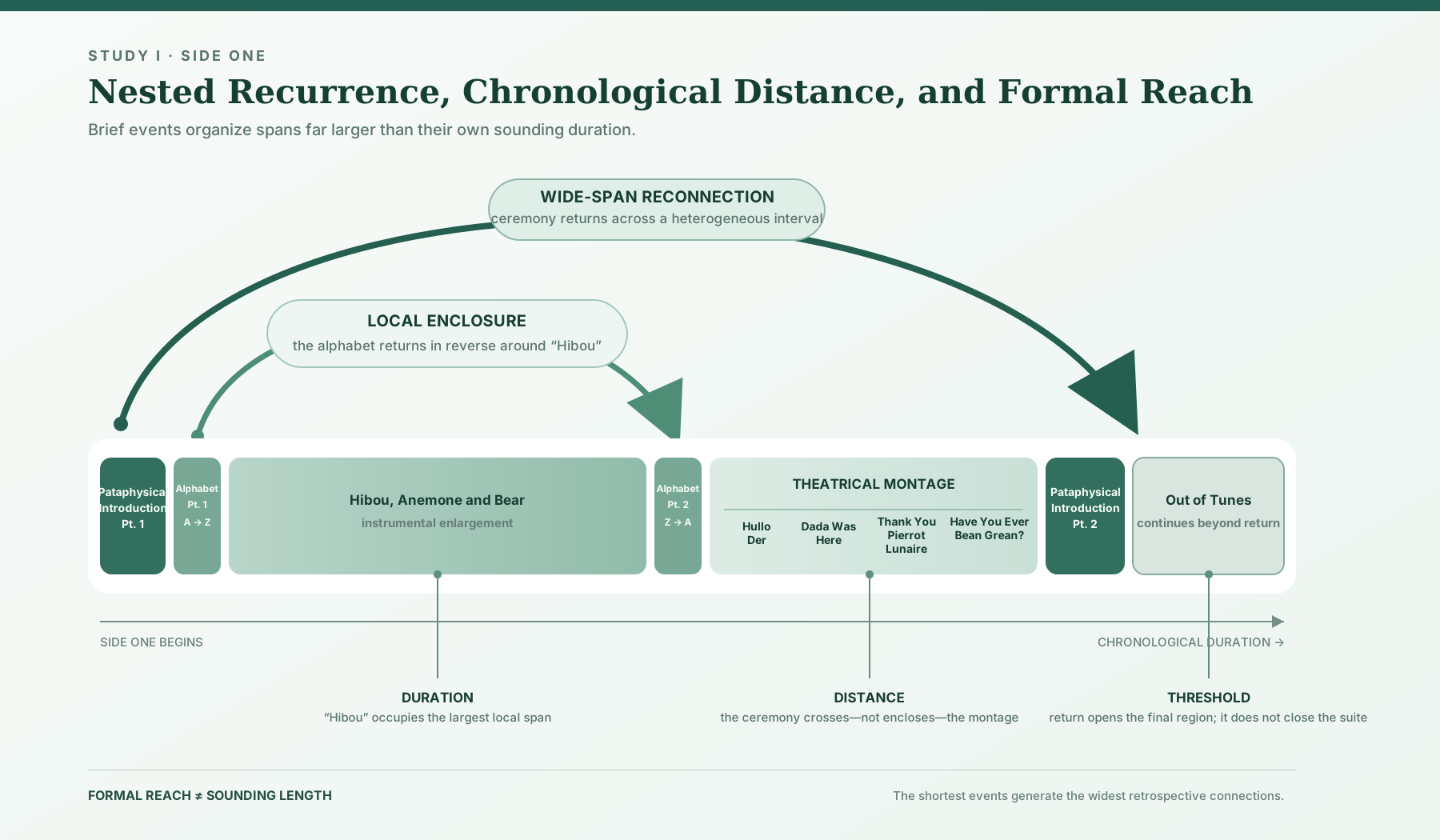
The diagram separates three dimensions that can easily blur together in prose: Chronological Duration, Chronological Distance, and Formal Reach. The alphabet recitals are extremely brief, but their separation across the substantially longer “Hibou, Anemone and Bear” allows the Z-to-A recital to enclose that composition retrospectively and reclassify the earlier A-to-Z recital as the opening half of a frame. The enclosure depends upon correspondence and reversal: both events traverse the same complete system, but the second retraces the first rather than restoring its direction. The return of the “Pataphysical Introduction” operates across a wider interval and performs a different action. It reconnects two ceremonial events across the heterogeneous theatrical montage without converting everything between them into a single enclosed unit. In both cases, recurrence preserves difference while extending the formal influence of a miniature far beyond its audible duration. The position of “Out of Tunes” makes the distinction decisive: the second introduction restores ceremonial recognition, but it does not restore the suite’s beginning or close the complete sequence.
The opening recurrence network distinguishes three measures that musical analysis too easily collapses: chronological duration, chronological distance, and formal reach. Chronological duration is the time an event itself occupies. Chronological distance is the span separating one appearance from a later recurrence. Formal reach is the extent to which an event remains available, enters new relations, and influences the interpretation of music beyond its sounding duration.
These measures need not remain proportional. The alphabet occupies only seconds, yet the relation between its appearances extends across the full duration of “Hibou.” Mock ceremony is similarly brief, but its return is separated from its opening appearance by the entire local alphabet frame and a further succession of differentiated events. In both cases, sound ends long before relational consequence has been exhausted.
The alphabet provides the clearest local demonstration. Its first recital remains memorable through compression, fixed order, forward motion from A to Z, and sharply defined delivery. When the system returns in reverse, recognition turns memory into enclosure. The second recital projects backward in two distinct senses: it reaches retrospectively toward the first appearance, and it audibly reverses the alphabetical direction through which that first appearance proceeded. The earlier event is thereby reclassified as the opening boundary of a frame.
This does not make the alphabet formally superior to “Hibou.” The two possess different kinds of reach. “Hibou” has greater duration and fuller internal reach. Its vocal–instrumental field develops through bass and drum continuity, organ and reed pressure, vocal reorientation, redistributed prominence, composite authority, fragmentation, partial reassembly, and terminal resurgence. Its duration is the condition through which these relationships can accumulate and transform.
The alphabet’s reach is primarily external and relational. It shapes how “Hibou” is entered and remembered without generating or governing its internal processes. Conversely, “Hibou” is not passive content inside a frame completed in advance. Before the second recital, no enclosure has become fully audible. The composition produces the chronological distance and radical difference through which the return gains closing force.
The wider ceremonial recurrence extends the principle without duplicating it. What survives is not a fixed verbal system but a mode of presentation. The opening announcement remains recoverable across greeting, linguistic instability, acknowledgment, recollection, questioning, and changing ensemble behavior. When it returns, it reconnects that heterogeneous field without enclosing or explaining it.
Formal availability is therefore not continuous governance. Neither the alphabet nor ceremony secretly controls the music heard during its absence. Their disappearance allows other identities to acquire full presence. Formal reach becomes audible only when recurrence activates a remembered relation and reveals that an earlier miniature possessed a capacity its first appearance could not disclose.
Absurdism belongs inside this method. Accelerated alphabetic recital and exaggerated ceremony make compression, disproportion, classification, and abrupt transfer memorable. Humor enables formal recognition; it does not interrupt an otherwise serious architecture. The miniatures can remain comic while performing consequential structural work, and “Hibou” can remain substantial without invalidating the absurdist world around it.
The same network makes authority mobile. Ceremony presents without governing permanently. The alphabet embodies order without determining the ensemble’s behavior. “Hibou” redistributes prominence among voice, bass, organ, reeds, and drums. The subsequent songs multiply the possible functions of address. No participant or formal layer owns authority once and for all; authority is produced by the work an element performs within a changing relation.
Chronological duration tells us how long an event sounds. Chronological distance tells us how much music separates it from recurrence. Formal reach tells us how far it can continue to matter—how it may remain in memory, acquire relations not audible at first, and alter the classification of earlier or intervening events without dominating their internal lives.
The alphabet possesses local enclosing reach; ceremony possesses wider connective reach; “Hibou” possesses extended internal reach. None is privileged, because each performs work the others cannot perform. The smallest events organize the memory of larger ones, while the larger and more heterogeneous intervals transform what those miniatures mean when they return.
Volume Two thus begins not by choosing between miniature and enlargement, recurrence and difference, humor and formal consequence, but by making their interdependence audible.
On Volume Two, chronological duration does not determine formal reach.
After the expansive instrumental world of “Hibou, Anemone and Bear” and the returning alphabet that closes around it, Rivmic Melodies changes its manner of movement. From “Hullo Der” through “Out Of Tunes,” the suite begins to resemble a theatrical montage: voices step forward and disappear, languages bend into musical gestures, cultural references flash past, mock ceremony briefly assumes authority, and compact vocal episodes open into longer ensemble fields. The six tracks do not merge into a single style, nor do they behave merely as separate songs placed in succession. Each establishes its own personality and scale long enough to become recognizable, then yields to another kind of event. The pleasure of the sequence lies partly in this quickness—the feeling of moving through a corridor of rooms whose doors open unexpectedly—but its volatility is carefully shaped. Local continuity gives each room an identity; discontinuity turns the passage between them into architecture; and the collision of modernist reference, Dadaist play, linguistic mischief, and instrumental freedom makes that architecture unmistakably theatrical.
The first challenge posed by this sequence is not identifying where one track ends and the next begins. The changing voices, textures, and manners of presentation make those divisions readily perceptible. The more revealing question is how six events of sharply unequal duration and contrasting character come to sound like one sustained passage. An altered greeting, an extended vocal–ensemble performance, a compressed acknowledgment, a punning question, a returning ceremonial introduction, and an instrumental closing field would seem to belong to different musical categories. Yet they tumble into one another with such assurance that their differences begin to feel less like obstacles to continuity than the means by which continuity is produced.
There are three tempting but inadequate ways of hearing this passage. The first is to treat “Hullo Der,” “Dada Was Here,” “Thank You Pierrot Lunaire,” “Have You Ever Bean Grean?,” “Pataphysical Introduction Pt. 2,” and “Out Of Tunes” as six self-contained tracks. The printed divisions encourage that view, and each event possesses an audible identity of its own. But heard only as separate pieces, the sequence loses the cumulative force created by their changing proportions and modes of address. “Dada Was Here” and “Out Of Tunes” receive enough time to sustain internally changing ensemble environments; the four surrounding events operate more abruptly, sometimes establishing and relinquishing a theatrical identity in less than a minute. Those differences of scale are not incidental. They determine how the listener experiences expansion, contraction, interruption, and renewed motion across the whole passage.
A second approach is to hear the shorter pieces as miscellaneous comic interruptions: flashes of verbal play placed between music of greater consequence. Their humor certainly matters. Language is bent, ceremony is exaggerated, cultural authority is invoked with a smile, and the voice repeatedly adopts a character rather than simply delivering a text. Yet comedy here does not stand outside the music as decoration. Vocal accent, timing, exaggeration, and linguistic distortion help determine rhythmic shape and formal proportion. A greeting can initiate a new state; an acknowledgment can arrest the momentum of an extended ensemble passage; a question can redirect attention by changing the relationship between singer and listener. The joke does not interrupt the form. It becomes one of the means through which the form changes direction.
The third inadequate hearing treats these tracks as connective material surrounding more substantial music: a group of transitional sketches following “Hibou, Anemone and Bear” and leading toward the instrumental emphasis of the album’s second side. This view mistakes brevity for secondary importance. The shorter events do not merely occupy the spaces between longer ones. Each reclassifies the musical situation. What has sounded like a song can suddenly become an exposed theatrical acknowledgment; what has seemed like direct address can assume the posture of mock ceremony; what begins under the authority of a voice can open into an ensemble field in which orientation is distributed among several instruments. The sequence moves forward because its miniatures repeatedly alter what kind of event the listener believes is taking place.
The term theatrical montage describes this method of organization. Montage identifies the importance of juxtaposition: contrasting events are placed close enough together that each changes the listener’s understanding of its neighbors. Theatrical identifies the manner in which those contrasts are presented. The sequence continually adjusts who appears to be addressing whom, from what position, and with what degree of authority. Voice may behave as greeting, performance, acknowledgment, question, or ceremonial announcement. The ensemble may support that address, share it, interrupt it, outlast it, or assume its organizing responsibilities after the words have disappeared.
The music’s changing mode of address is therefore inseparable from its changing scale. “Hullo Der” introduces a compact and conspicuously performed vocal identity. “Dada Was Here” allows a more sustained relationship between voice and ensemble to take shape. “Thank You Pierrot Lunaire” contracts that larger field into a brief, exposed act of acknowledgment. “Have You Ever Bean Grean?” turns outward through interrogation and wordplay. “Pataphysical Introduction Pt. 2” momentarily adopts ceremonial authority, while “Out Of Tunes” enlarges the available space and allows instrumental interaction to carry the sequence forward. These are not simply six moods. They are six different arrangements of presence, duration, address, and musical responsibility.
Nor does each track remain internally fixed. An ensemble state is the provisional configuration produced by the current distribution of pulse, density, register, timbre, and prominence. Such a state can persist long enough to acquire a recognizable identity while still changing from within. Instruments may exchange emphasis; a texture may thicken or thin; a rhythmic foundation may continue while the surface is renewed. This distinction is especially important in the longer spans. The montage does not consist of incessant replacement at every moment. Local continuity allows an identity to become audible before interruption, redistribution, or replacement changes its meaning.
Across the full sequence, these operations recur often enough to establish a formal regime. That regime is not a stable sonority, a recurring theme, or a single theatrical character. It is the repeated procedure by which a configuration appears, becomes provisionally intelligible, changes internally, and eventually gives way to another configuration. Some transitions are abrupt; others emerge through contraction, redistribution, or release. Some replace one category with another, while others preserve the existing category but alter its internal balance. What unites them is the listener’s growing recognition that musical identity in this passage is always temporary and always capable of being reclassified.
This process also explains why the sequence feels coherent without becoming homogeneous. Continuity makes each configuration audible; discontinuity makes their succession architectural. The altered greeting of “Hullo Der” does not need to resemble the extended ensemble identity of “Dada Was Here,” nor does the sparse acknowledgment of “Thank You Pierrot Lunaire” need to anticipate the sound of “Out Of Tunes.” Their relationship lies in the repeated pleasure of orientation and surprise: the music gives the listener enough time to recognize a room, then opens another door.
“Pataphysical Introduction Pt. 2” also participates in the wider ceremonial recurrence established earlier in Rivmic Melodies. That backward connection remains important, but it need not be reopened here. Within the present montage, the miniature’s immediate function is forward-facing. Its returning ceremony briefly gathers attention and assumes authority before the sequence expands into the instrumental environment of “Out Of Tunes.” Recurrence therefore does not suspend the montage. It becomes another act of reclassification within it.
The large trajectory can now be heard as more than a rapid succession of charmingly volatile fragments. The voice repeatedly changes character; language moves between communication and musical material; ensemble states expand, contract, and redistribute their weight; cultural seriousness and irreverent humor occupy the same stage. By the time “Out Of Tunes” transfers this mobility into a larger instrumental environment, transformation itself has become recognizable. The sequence has taught the listener how to follow a form whose continuity resides in its changing identities.
That process begins locally with “Hullo Der.” Before the montage can move among different modes of address, its first miniature must create someone capable of addressing us. The greeting’s altered language, rhythmic placement, and performed vocal manner establish personality as a musical function—a fleeting human presence strong enough to open the entire theatrical field.
Recognition occurs immediately, but what is recognized has already been displaced. “Hullo Der” begins from one of the simplest possible acts of contact: a voice offers a greeting. Yet “hullo” or “hello” reaches the listener in an altered form, its familiar sounds bent into the peculiar shape announced by the title. The phrase remains intelligible enough to preserve the warmth and immediacy of direct address, but strange enough to make us attend to the person producing it. We do not merely receive a word. We hear someone step forward and perform the act of saying it.
That small displacement is crucial. An ordinary greeting normally directs attention through itself toward the person being greeted; its language is useful precisely because it requires little interpretation. Here, the altered pronunciation reverses that relationship. The greeting still reaches outward, but it also draws attention back toward the voice—toward its accent, timbre, rhythmic placement, and exaggerated manner. Communication becomes inseparable from characterization. The listener understands the invitation to contact while simultaneously hearing language turned into a theatrical object.
The humor therefore does not reside solely in substituting “der” for “there,” or in any written peculiarity preserved by the title. It emerges from the complete delivery. Pronunciation stretches the familiar phrase just far enough to make it unstable; inflection gives it an attitude; timing allows the greeting to arrive as an entrance rather than as neutral information. Vocal color adds another layer, making the words feel inhabited by a personality whose presence exceeds their literal meaning. Remove that manner of delivery and the verbal alteration would remain a pun. Within the performance, it becomes a miniature scene.
The instrumental setting helps that scene appear. It does not merely continue beneath an independently conceived vocal line, nor does it construct a broad accompaniment over which the singer can establish a conventional melodic center. Instead, voice and ensemble occupy the same compact theatrical space. Instrumental motion gives the greeting somewhere to arrive, while the vocal entrance momentarily changes how that motion is perceived. What might otherwise register as a brief ensemble passage becomes the setting for an encounter. The voice does not need to dominate every moment; its appearance is sufficiently distinctive to reclassify the whole event.
The opening does not establish a long instrumental prelude and then add the voice as a separate layer. Organ, fuzz bass, drums, and vocal activity are presented within the same compressed condition. The ensemble is already forceful enough to possess an identity of its own: the bass gives the lower field unusual weight, the organ supplies a bright, insistent surface, and the drums keep the texture in restless motion. The greeting does not silence or subordinate that activity. It enters against it, acquiring prominence because its articulation differs sharply from the instrumental continuity surrounding it.
This relationship makes the voice’s timing especially important. The words arrive as shaped rhythmic actions rather than as a melody placed smoothly above an accompaniment. Their accents briefly reorganize the listener’s attention, while the instrumental parts continue to articulate their own motion. The voice becomes the perceptual foreground, but not the sole source of momentum. Wyatt’s double role as vocalist and drummer makes the distinction particularly unstable: vocal personality and rhythmic continuity belong to the same performer, yet they operate as different musical functions. The voice characterizes the event from the front while the drums help preserve the field through which that character appears.
As the vocal phrases separate and eventually withdraw, the ensemble does not sound emptied of its organizing principle. Organ, bass, and drums remain capable of carrying the miniature forward, and the ending narrows through their continued activity rather than through a self-contained vocal cadence. Responsibility therefore begins to move before the track has finished. The greeting has made entrance and personality conspicuous, but it does not retain exclusive control over continuation. By the time “Dada Was Here” begins, the listener has already heard a temporary vocal center arise inside an active ensemble and relinquish its prominence without causing the surrounding musical process to collapse.
This is one of the miniature’s most economical achievements. In less than a minute, “Hullo Der” creates the impression that a character has entered, addressed us, displayed a recognizable manner, and vanished. There is no need for an extended lyric, a fully developed melody, or a recurring refrain to secure that identity. Characterization is compressed into vocal behavior. A small alteration of speech, placed with precision inside the instrumental field, accomplishes work that a longer song might distribute across several verses.
The resulting presence may be called theatrical personality: a temporary organizing force created through the audible behavior of a voice. The term does not imply a fully defined fictional character with a biography or a stable dramatic role. It identifies something more immediate and musical. Pronunciation, articulation, inflection, rhythm, and timbre combine to make the voice feel like a particular presence occupying the foreground. For as long as that presence remains active, it gives the listener a point of orientation.
The personality is formed not only through pronunciation, inflection, and vocal color but also through the lyric’s compressed social self-description. Institutional power enters through the references to the FBI and CIA, while the phrase “free, white and twenty-one” places the speaker in an acknowledged position of freedom and advantage. The concluding qualification—power matters particularly when he is broke—abruptly contracts that large political frame into personal inconvenience. The effect is neither a sustained political declaration nor an innocent comic aside. It gives the temporary speaker a recognizable mixture of self-awareness, privilege, limitation, and deflation, allowing social characterization to occur within the same miniature action as greeting and theatrical entrance.
That orientation differs from the authority exercised by a conventional lead singer. A stable lyrical center normally gathers the music around a recurring voice, melody, or narrative perspective. “Hullo Der” offers none of those assurances. Its personality is vivid but fleeting. It organizes the miniature because its manner is unmistakable, not because it establishes a form that subsequent tracks must preserve. The voice can initiate contact, focus attention, and alter the meaning of the instrumental setting without becoming the permanent center of Rivmic Melodies.
Its brevity consequently strengthens rather than weakens its theatrical effect. The personality arrives almost before the listener has had time to prepare for it, and it disappears before familiarity can make it ordinary. The miniature resembles a figure leaning briefly through an open doorway: the encounter is too short to become a conversation, but too sharply characterized to be mistaken for incidental sound. This balance between immediacy and incompletion allows “Hullo Der” to contribute continuity without requiring prolonged stability.
It does so by giving the beginning of the montage a human point of entry. After the larger instrumental environment of “Hibou, Anemone and Bear” and the alphabet’s return, the suite does not simply proceed into another autonomous musical construction. Someone appears to greet us. The sequence acquires continuity through the felt presence of an address, even as the altered wording makes that contact playfully unreliable. Familiarity and estrangement arrive together: the voice welcomes the listener while announcing that nothing in this theatrical field will remain linguistically or formally innocent.
This simultaneous invitation and displacement also reveals how absurdism operates within the music. The humor is not pasted onto an otherwise self-sufficient instrumental event. It is carried by duration, placement, articulation, and context. The greeting is funny because of when and how it appears, because its directness is exaggerated, and because such a modest verbal act is granted the force of a theatrical entrance. Absurdity becomes an organizational resource: it concentrates attention, creates identity, and prepares the listener for another change of category.
“Hullo Der” therefore supplies the montage with its first local mechanism of coherence. It demonstrates that continuity need not depend on recurring thematic material or an enduring formal center. A sufficiently distinctive manner can orient the listener, however briefly. The voice makes the musical present feel inhabited; its personality gives the miniature an identity; and its departure leaves the sequence ready to be reorganized around a different relationship between voice and ensemble.
That relationship changes immediately in “Dada Was Here.” The recognizable vocalist remains, but the compact theatrical entrance expands into a more sustained vocal–instrumental condition. The next question is no longer simply how a voice can create a personality, but how that same voice can change its organizational role without preserving a single stable identity.
The voice that enters “Hullo Der” is immediately recognizable, but recognition does not guarantee stability. Wyatt’s presence remains one of the most distinctive threads running through the theatrical montage, yet the music never requires him to preserve the same character, manner of address, or relationship to the ensemble. Across the following tracks, the voice changes what it is for: it may welcome, participate, acknowledge, question, announce, articulate rhythm, or add another color to the sounding field. Its continuity lies not in maintaining one role, but in remaining audibly capable of becoming something else.
This mobility begins within “Hullo Der.” Wyatt is plainly a singer in the broadest sense—his entrance is pitched, timed, and integrated with the surrounding music—but singing does not exhaust what the voice accomplishes. He also behaves as a speaker making direct contact, a character exaggerating that contact, and a rhythmic presence whose pronunciation helps shape the miniature’s motion. Speech becomes melodic through inflection; characterization becomes rhythmic through timing; an altered word becomes timbral through the grain and contour of its delivery. Several vocal functions occupy the same compressed gesture.
“Dada Was Here” changes that arrangement. The voice no longer appears principally as a brief figure leaning into the instrumental space to greet the listener. It becomes part of a more sustained configuration whose identity depends upon the continuing relationship between vocal activity and ensemble motion. Wyatt remains conspicuous, but the track allows his presence to inhabit an environment rather than simply announce one. Vocal phrases participate in the ongoing balance of pulse, register, density, and instrumental color.
The movement from greeting to participation prevents vocal continuity from being confused with permanent leadership. In “Hullo Der,” distinctiveness gives the voice enough authority to reclassify a compact instrumental setting as a theatrical encounter. In “Dada Was Here,” that authority becomes more relational. The voice helps establish the track’s identity, but its phrases are supported, answered, surrounded, and sometimes absorbed by the instrumental field. What had been an entrance becomes participation.
Fixed vocal categories are therefore inadequate. Wyatt does not cease to be a character when he becomes more fully integrated with the ensemble, nor does he stop being a rhythmic articulator when a phrase assumes linguistic prominence. The voice may carry words while behaving like an instrument, project personality while contributing to texture, or appear to lead while depending upon the ensemble for the conditions that make its gestures intelligible. Singer, speaker, character, and instrumental participant are intersecting possibilities whose relative emphasis can change from phrase to phrase.
Language participates in this mobility. At some moments, words direct attention toward a recognizable act of communication: a greeting is offered, an acknowledgment made, a question posed. At others, pronunciation, repetition, or vocal color draws attention toward the sound of language in motion. The listener need not choose between understanding the voice as language and hearing it as music. Meaning remains available while rhythm and timbre partially detach the words from ordinary speech.
“Thank You Pierrot Lunaire” brings another change. After the greater duration and sustained vocal–ensemble identity of “Dada Was Here,” the voice is placed inside a drastically compressed act of acknowledgment. The expansive relationship contracts; attention gathers around a brief gesture of recognition; and the voice assumes something close to the role of commentator. It appears to acknowledge an artistic presence outside the immediate sequence while simultaneously becoming a musical event within it.
The importance of that moment does not depend upon deciding whether the voice is speaking, singing, or imitating a historical vocal technique. The acknowledgment remains intelligible as language, shaped as performance, and compressed into a formal pivot. Wyatt’s voice does not merely name or thank; it changes the scale of the montage. A sustained configuration gives way to an exposed vocal gesture that makes the surrounding space feel newly open. Commentary becomes architecture through placement.
“Have You Ever Bean Grean?” redirects the voice once more. Acknowledgment turns into interrogation, while language becomes a field of punning instability and cultural memory. The question reaches toward the listener, but it does not restore the elementary contact initiated by “Hullo Der.” Asking, joking, remembering, and performing coexist. Direct address returns in altered form: no longer a greeting, but a more knowing and culturally charged act of inclusion. The voice carries reference into the music through timing, phrasing, and theatrical attitude rather than withdrawing from the performance to explain it.
The montage then gives the voice a more conspicuously institutional posture in “Pataphysical Introduction Pt. 2.” Wyatt does not simply speak as an individual making contact; he assumes the manner of presentation itself. The voice behaves like an announcer, temporarily claiming the authority to frame what the listener is hearing. Yet that authority is inseparable from exaggeration. Inflection, pacing, diction, and ceremonial manner produce the impression of an institution at the moment they reveal it as a theatrical fabrication. The voice acquires authority by performing the sound of authority.
This miniature belongs to the wider recurrence established earlier in the suite, but its immediate significance lies in the new role assigned to a recognizable vocal presence. Within the present sequence, it follows greeting, participation, acknowledgment, and questioning. The same voice now appears to stand before the music and introduce it. Wyatt has not preserved a stable character across these events; he has preserved the possibility that vocal identity can be reorganized around the requirements of each situation.
By the time “Out of Tunes” enlarges the instrumental field, that possibility has become one of the montage’s principal sources of continuity. The voice does not need to retain its earlier prominence for the theatrical process to survive. Functions made conspicuous through vocal behavior—initiation, interruption, rhythmic emphasis, characterization, and the redirection of attention—can now be carried more extensively by the ensemble.
This is not a literal imitation of the voice by the instruments, nor a single handoff in which Wyatt relinquishes a bounded set of duties. Those responsibilities have never belonged to the voice alone. Even in the preceding miniatures, vocal action has depended upon pulse, texture, register, and instrumental response. “Out of Tunes” enlarges that shared condition. Instrumental timbre can project character; a registral entrance can possess the force of an interjection; a rhythmic accent can redirect attention as decisively as a verbal one. The theatrical energy remains, but it becomes less dependent upon a person standing visibly at its center.
The voice is therefore best understood as a mobile musical function. This does not mean that Wyatt’s individuality disappears into an abstract system. The warmth, wit, fragility, exaggeration, and unmistakable color of his singing make each change of role especially vivid. Mobility describes how that personality enters different organizational relationships. The voice can orient the listener without permanently governing the form, create a character without maintaining it, communicate language while turning language into rhythm and timbre, or initiate a responsibility that the ensemble subsequently carries in another way.
This mobility also protects the montage from becoming a parade of unrelated vocal disguises. The listener continues to recognize Wyatt, but that recognition gradually changes its object. At first we recognize the person who greets us. Soon we recognize the participant in a sustained ensemble condition, the commentator offering acknowledgment, the questioner bending language into play, and the announcer assuming ceremonial authority. What becomes familiar is not one stable persona but the activity of vocal transformation itself.
The voice consequently provides a human center that can appear, shift position, share its authority, and recede. Each redefinition prepares the listener for the next by demonstrating that identity may survive a change of function. “Dada Was Here” now submits that principle to a contrasting experience of duration. It allows a vocal–instrumental configuration to remain present long enough to acquire a sustained identity. Having established that the voice can move among functions, the next question is how an ensemble condition can persist without becoming fixed—and how continuity can deepen while its internal balance continues to change.
After the concentrated theatrical entrance of “Hullo Der,” “Dada Was Here” changes the listener’s experience of time. The greeting has barely established its peculiar personality before disappearing; the next event allows a recognizable vocal–instrumental configuration to remain in place, gather weight, and develop an identity of its own. The montage does not suspend transformation, but it slows the rate at which one kind of event replaces another. A doorway briefly becomes a room.
This greater duration makes “Dada Was Here” feel comparatively stable, but its stability should not be confused with stillness or conventional song form. What emerges is a sustained relationship among voice, pulse, repeated gestures, and instrumental activity—a relationship coherent enough to be recognized, yet flexible enough to accommodate internal change. The music preserves a common condition while its components continually adjust their prominence within it.
The beginning makes the contrast with “Hullo Der” immediately audible. The earlier miniature organizes attention through the concentrated force of a vocal personality: the altered greeting steps forward, performs itself, and vanishes. “Dada Was Here” does not simply replace that personality with another. It broadens the space around the voice and allows the ensemble to participate more fully in defining the event. Wyatt remains a vivid presence, but the track’s identity no longer depends upon a single entrance or verbal manner. It arises through the continuing interaction of vocal phrases with an instrumental field capable of sustaining motion beyond any one utterance.
Voice and instruments consequently inhabit a more durable relationship. The ensemble does not function as a passive background waiting for the next vocal statement, and Wyatt does not remain permanently above it as the unquestioned center. His phrases gather attention, add rhythmic impetus, and sharpen the track’s theatrical character, but their force depends upon the movement surrounding them. Instrumental gestures answer, support, frame, and sometimes compete with the vocal surface. At other moments, the voice sounds less like an independent line placed over accompaniment than another agile participant within the texture.
This interaction gives “Dada Was Here” its peculiar liveliness. Vocal expression remains unmistakably human—warm, exaggerated, playful, and occasionally unruly—while its rhythmic and timbral behavior draws it into the ensemble. Words communicate, but their articulation also supplies accents, contours, and changes of color. The instruments preserve their own identities while participating in the same theatrical condition. No single layer completely explains the track; its personality lies in the changing fit among them.
Rhythmic persistence is central to that fit. Beneath the local activity, the music maintains enough forward motion for successive gestures to belong to the same unfolding event. The pulse does not eliminate volatility; it gives volatility a ground against which to register. Vocal phrases shift in emphasis, instrumental details brighten or crowd the texture, and accents disturb the surface, but the listener is not repeatedly forced to begin again. Local continuity survives the changes.
That continuity allows internal events to register as developments within “Dada Was Here” rather than as a sequence of unrelated fragments. It also gives the track room to inhabit its own behavior. A vocal manner can recur, an instrumental response can gather momentum, and a characteristic relationship can be renewed because the underlying configuration has not yet been superseded. After the quick theatrical spark of “Hullo Der,” such persistence feels almost expansive.
Repeated and sustained gestures further consolidate the episode’s identity. Their importance lies less in constructing a closed thematic scheme than in producing familiarity. A rhythmic profile, vocal contour, instrumental color, or ensemble relationship returns often enough for the listener to recognize the territory. Each return confirms that the music still occupies the same local world, even when the internal arrangement has changed.
Repetition is therefore neither mechanical nor conclusive. Gestures return within altered surroundings, acquire different degrees of prominence, or participate in changing densities. What persists is not an exact arrangement but a family resemblance among successive moments. The track repeatedly confirms its identity while refusing to freeze that identity into a single authoritative version. Stability is produced through renewal.
The distribution of prominence is especially important. At one moment, the voice may gather the field around its articulation; at another, instrumental activity claims more of the listener’s attention without dissolving the vocal–ensemble relationship. Rhythmic emphasis moves between layers. A supporting sonority becomes a conspicuous color. The texture grows busier and then regains clarity. These shifts do not reclassify the track each time they occur. They activate the established condition from within.
This distinction separates internal mobility from sequence-wide replacement. Across the theatrical montage, one event can give way abruptly to another mode of address: greeting becomes sustained performance, acknowledgment becomes question, question becomes mock ceremony. Within “Dada Was Here,” changing emphasis does not require the listener to decide that an entirely new category of event has begun. The track demonstrates that local identity can remain audible while authority moves among its components.
Its stability is therefore an ensemble achievement rather than the possession of a single part. Pulse maintains temporal orientation. Repeated gestures create familiarity. The voice supplies character, language, rhythmic articulation, and timbral intensity. The instruments preserve motion, answer vocal activity, and continually redraw the texture. Each contributes to continuity, but none is permitted to convert that continuity into permanent authority.
The title adds another theatrical layer. “Dada” invokes a historical and aesthetic field associated with provocation, incongruity, play, and resistance to settled cultural authority. That association inevitably colors reception, especially within a sequence already filled with distorted language, mock presentation, and abrupt changes of scale. Yet the invocation cannot substitute for close listening. The track is not structurally Dadaist merely because its title names Dada.
The phrase “was here” introduces a more precise tension. It resembles a mark left behind—a compact assertion that someone or something occupied a place before departing. The words imply presence and absence simultaneously: Dada has appeared, but the declaration reaches us in the past tense. Within a track that achieves a comparatively sustained identity, the formulation is particularly apt. The music establishes a condition strongly enough to leave an impression, while the title reminds us that the condition will eventually be known as something that has passed.
The humor arises from the collision of these registers. A major avant-garde inheritance is invoked through the casual language of a scrawled notice. Historical authority meets the informality of “was here.” Meanwhile, the music does not obediently illustrate either phrase. It constructs an animated vocal–instrumental environment whose rhythmic persistence and internal mobility are more precise than the title’s irreverence might suggest. Intellectual recognition is invited and its solemnity immediately displaced.
This is another instance of the montage’s simultaneous invocation and deflation of cultural authority. Dada is named but not placed on a pedestal. Its presence becomes part of a performance that can be serious in its ensemble intelligence without surrendering its delight in absurdity. Rigor and humor do not alternate as though one temporarily cancelled the other. Wit belongs to the track’s timing, vocal color, textual situation, and changing instrumental relationships. Structural intelligence and comic pleasure inhabit the same configuration.
That configuration may be understood as provisional stability: a musical state sustained long enough to become recognizable but not authorized to govern what follows. Provisional does not mean vague, incomplete, or structurally weak. “Dada Was Here” possesses a distinct identity because the ensemble maintains enough continuity for the listener to learn its conditions. Its pulse persists; gestures recur; voice and instruments establish a characteristic relationship; internal changes remain connected to an audible local field.
What makes this stability provisional is not any failure of coherence but the limit placed upon its formal authority. The track can occupy the present fully without becoming the permanent model for the sequence. Its rhythmic persistence does not compel the next miniature to preserve the same pulse. Its vocal–instrumental relationship does not determine every later mode of address. Its relative expansiveness does not reduce the surrounding miniatures to subordinate transitions. The episode is allowed to become itself, but not to legislate the future.
Its ending therefore matters as much as its internal continuity. However substantial the configuration has become, it is eventually superseded. The montage contracts again, and the sustained ensemble environment gives way to the compressed acknowledgment of “Thank You Pierrot Lunaire.” This replacement does not expose the preceding stability as illusory. On the contrary, the change is audible with such clarity because “Dada Was Here” has established something definite enough to lose.
That is the structural value of provisional stability. A montage composed only of undifferentiated disruption would soon make disruption meaningless. Transfer becomes audible only when there is an identifiable condition from which the music departs. “Dada Was Here” supplies that condition. Its extended duration and persistent ensemble relationships allow the listener to settle—not into permanence, but into recognition. The track gives change a meaningful object.
The episode also clarifies the formal regime established by the surrounding sequence. Appearance, stabilization, interruption, and replacement are not isolated effects attached to particular tracks; they are stages in a recurring behavior. “Hullo Der” appears and concentrates attention around theatrical personality. “Dada Was Here” enlarges that presence into a more durable ensemble configuration. Its internal activity demonstrates that stabilization can remain mobile; its eventual supersession demonstrates that even a sustained local identity remains vulnerable to reclassification.
When “Thank You Pierrot Lunaire” replaces this comparatively expansive field with a brief act of acknowledgment, the listener has begun to recognize the larger pattern. A configuration arrives, acquires enough continuity to become intelligible, changes while preserving its local identity, and then yields to another arrangement of voice, scale, and ensemble responsibility. The montage’s volatility is no longer merely surprising. It has begun to reveal its recurrent logic.
By the end of “Dada Was Here,” the listener has encountered two very different ways of making a musical present feel coherent. “Hullo Der” gathers attention around a sharply performed personality: the altered greeting arrives, inhabits its brief instrumental setting, and disappears almost as soon as its character has become clear. “Dada Was Here” distributes that work across a more sustained vocal–instrumental configuration, allowing pulse, repeated gestures, vocal activity, and ensemble interaction to maintain a recognizable condition through internal change. One episode is concentrated and fleeting; the other is comparatively expansive. Their surfaces differ, but their relationship reveals the organizational principle governing the montage.
That principle does not depend upon a theme passing intact from one track to another. Nor does it require the second event to develop material introduced by the first. What connects “Hullo Der” and “Dada Was Here” is more fundamental: each establishes a configuration strongly enough for the listener to recognize what kind of musical situation has appeared, and neither is allowed to become permanent. The first is organized through theatrical personality, the second through provisional ensemble stability. The transfer between them matters more than any surface feature they might share.
“Hullo Der” demonstrates how quickly identity can be established. Its vocal manner needs little time to become unmistakable because pronunciation, inflection, timing, and timbre converge upon a single theatrical act. The greeting gives the miniature an immediate point of orientation. Yet this orientation is not developed into a recurring lyrical perspective or preserved as the governing voice of the sequence. The personality accomplishes its work and vanishes. Its disappearance is not an incomplete ending; it is the first indication that the montage values the power to establish an identity without being obliged to prolong it.
“Dada Was Here” alters the balance. Instead of concentrating identity in a momentary entrance, it allows a collective condition to gather continuity. The voice remains important, but its activity belongs to an ensemble environment whose rhythmic persistence and repeated gestures can survive changes of emphasis. The listener has time to inhabit this configuration, to recognize its characteristic movement, and to feel its internal redistributions as changes occurring within a common musical world.
This greater stability might initially seem to promise a new center. After the playful brevity of “Hullo Der,” the more sustained duration of “Dada Was Here” encourages the ear to settle. The ensemble condition appears capable of continuing, and its local coherence is strong enough to suggest that the montage has found a more durable form. Yet the sequence refuses to turn that possibility into a hierarchy in which longer duration confers permanent authority. “Dada Was Here” is not the destination toward which the preceding miniature was merely pointing. It is another configuration—more extended, more internally differentiated, but equally subject to eventual replacement.
The interruption that follows therefore does more than separate two tracks. It limits the authority of the state that has just been established. “Thank You Pierrot Lunaire” does not inherit the preceding configuration’s scale, pulse, or vocal–ensemble balance. It contracts the musical field and changes its mode of address. The listener is asked to understand not simply that one piece has ended and another has begun, but that the category of the event has changed: sustained participation becomes compressed acknowledgment.
This is reclassification in its clearest formal sense. The term does not mean that the earlier music was misunderstood or that its identity is retrospectively cancelled. It identifies the moment when the sequence asks the listener to adopt a different set of expectations. A state that invited attention to continuing ensemble interaction is replaced by one whose weight lies in brevity, address, and reference. What counts as musical continuity has changed.
Once this has happened more than once, interruption itself begins to acquire a different meaning. At first, the abrupt movement from “Hullo Der” into “Dada Was Here” may feel like another of Rivmic Melodies’ delightful surprises. The passage seems to change its mind before the listener can settle into a single perspective. But as each new event establishes a distinct identity and then relinquishes it, surprise begins to coexist with recognition. We cannot predict exactly what will appear next, yet we begin to understand that another transformation is likely.
A flexible transfer pattern becomes audible:
A configuration appears. 2. Recognition
It acquires enough identity to become perceptually distinct. 3. Destabilization
Interruption, internal redistribution, or reclassification prevents that identity from becoming permanent. 4. Transfer
Another configuration assumes organizational responsibility. 5. Formal Recognition
The recurrence of this transfer becomes recognizable as a property of the sequence.
This cycle is a behavioral model, not a rigid template imposed identically upon every track. “Hullo Der” compresses appearance, characterization, and disappearance into a miniature span. “Dada Was Here” gives stabilization far more time and allows internal change to become part of the state’s identity. A later event may arrive already functioning as an interruption; another may acquire its identity through a reference, a question, a mock announcement, or the enlargement of instrumental space. The stages do not need equal duration, and every event need not display each one with the same clarity.
The model also accommodates different degrees of change. Not every shift within “Dada Was Here” creates a new configuration. Alterations of density, prominence, texture, or instrumental balance can renew an established state without replacing it. Conversely, an extremely brief miniature may change the sequence’s category almost immediately. The crucial question is not simply whether the sound has changed, but whether the listener is still being asked to inhabit the same kind of musical situation.
This distinction leads to the central theoretical difference between a fixed musical state and a formal regime. A fixed state preserves a particular configuration: a recognizable texture, pulse, hierarchy, mode of address, or relationship among voice and instruments. Its continuity depends upon the ongoing identity of that arrangement. A formal regime preserves something more flexible—a way of changing configurations.
The theatrical montage is coherent in the second sense. It does not ask “Hullo Der” to remain present beneath “Dada Was Here,” nor does it require “Dada Was Here” to govern the miniatures that follow. What persists is the process through which musical situations become distinct, acquire temporary authority, and yield that authority elsewhere. The regime preserves transfer rather than position.
This is why discontinuity can become form without becoming mechanically repetitive. The listener recognizes a recurring behavior, but the content and scale of each realization remain open. One transfer may move from concentrated personality to sustained ensemble participation; another may contract an extended field into a tiny acknowledgment; another may replace punning interrogation with mock ceremony. The recurrence lies in the relinquishing and reassignment of organizational responsibility, not in an exact series of sounds.
Predictability therefore develops at the level of procedure rather than outcome. The montage teaches us to expect change, but not precisely what that change will bring. This balance is essential to its pleasure. If every event followed the same proportions and performed the same sequence of functions, the music’s theatrical quickness would harden into a device. If nothing became recognizable before disappearing, the passage would dissolve into undifferentiated novelty. Instead, each configuration is given enough presence to matter, while the regime retains the freedom to replace it in another way.
The difference between stability and permanence is equally important. Stability allows the listener to recognize a condition, enjoy its personality, and hear its internal life. Permanence would authorize that condition to determine what follows. “Dada Was Here” possesses the first without acquiring the second. Its rhythmic and ensemble coherence is not weakened by its eventual disappearance. It is precisely because the track becomes locally stable that its supersession carries formal force.
Interruption likewise need not be understood as destruction. When “Dada Was Here” gives way, the sequence does not simply discard what it has built. The preceding stability remains active in memory, making the sudden contraction of scale more vivid. Each interruption leaves behind a perceptual residue: we hear the new event partly through the dimensions of the one that has just vanished. Montage arises from this charged adjacency. The rooms remain separate, but passing through one changes how the next is entered.
The following miniatures will continue to test this regime by altering both the scale and the cultural posture of the music. “Thank You Pierrot Lunaire” compresses acknowledgment and historical reference into a remarkably small space. “Have You Ever Bean Grean?” redirects vocal presence through questioning, punning, and cultural memory. “Pataphysical Introduction Pt. 2” briefly performs the authority of ceremony, while “Out Of Tunes” enlarges the field and allows instrumental interaction to assume responsibilities previously concentrated in vocal address. Each presents a different kind of identity; none needs to reproduce the configuration of “Hullo Der” or “Dada Was Here” to belong to the same formal process.
The regime can now be heard as the living grammar of the theatrical montage. Continuity resides locally in personality, pulse, gesture, texture, or ensemble relationship. Discontinuity limits the authority of each local condition. Reclassification changes what kind of event the listener believes is taking place. As these transfers recur, the sequence gains a larger identity without smoothing away the vivid differences that give it warmth, wit, and theatrical life.
“Thank You Pierrot Lunaire” provides the next and most compressed test. After “Dada Was Here” has shown how an ensemble condition can acquire provisional stability, this miniature demonstrates that a fleeting acknowledgment can carry comparable formal weight. Its brevity does not merely interrupt the sequence; it changes the category of attention and turns the montage, for a moment, toward a named modernist past.
“Thank You Pierrot Lunaire” arrives almost before the listener has adjusted to the disappearance of “Dada Was Here.” The preceding track has sustained a recognizable vocal–instrumental environment long enough for its pulse, gestures, and changing ensemble relationships to acquire weight. In place of that comparative expansiveness, the new miniature offers an abrupt and concentrated act of acknowledgment. The musical field contracts, a phrase steps forward, and an entire historical frame is introduced in the time required to perform a gesture of thanks.
The change is more substantial than the replacement of a longer track by a shorter one. “Dada Was Here” asks the listener to inhabit a configuration and follow its internal life. “Thank You Pierrot Lunaire” asks the listener to witness an act. Sustained participation becomes acknowledgment; local continuity becomes historical orientation; an environment gives way to a gesture.
The phrase “thank you” is elementary, but it is not neutral. Gratitude presupposes a relationship among the person speaking, the figure or work being thanked, and an audience permitted to overhear the acknowledgment. The voice therefore occupies several positions at once. It addresses Pierrot lunaire, presents that address to the listener, and briefly comments upon the music’s relation to a named modernist inheritance. The montage does not pause to explain that relationship. It makes the acknowledgment itself into the event.
The words are enacted through vocal presence rather than encountered only as printed information. Timing, inflection, articulation, and vocal color determine how the gratitude is heard: not simply as a statement of indebtedness, but as a conspicuous moment of presentation. The voice seems to enter an exposed space, perform its thanks, and withdraw.
Its delivery keeps the phrase suspended among speech, song, recitation, and theatrical gesture. The words remain intelligible, yet their placement prevents them from functioning as transparent conversation. Pitch and contour may draw the utterance toward song; verbal clarity preserves its character as speech; heightened delivery gives it the quality of recitation; and its abrupt appearance turns the complete phrase into a miniature stage action. None of these modes excludes the others.
The recognizable voice has therefore acquired another function. In “Hullo Der,” Wyatt transforms a greeting into theatrical personality. In “Dada Was Here,” he participates in a more durable ensemble configuration. Here, he becomes an acknowledger and presenter, pointing beyond the immediate musical field while remaining active within it. Reference is not something the voice explains; reference is what the voice does.
The gratitude may sound sincere, playful, ceremonious, or delicately exaggerated, and the miniature gains much of its character from the impossibility of reducing it to one attitude. A completely solemn tribute would stabilize the relation by placing the named work at a respectful distance. A merely dismissive joke would empty the acknowledgment of significance. The performed phrase occupies the interval between them. Modernist authority is recognized, but recognition enters the suite through Soft Machine’s compressed theatrical language.
The reference to Pierrot lunaire inevitably changes the listener’s frame of interpretation. It brings early twentieth-century modernism and theatricalized vocal expression into the conceptual vicinity of Rivmic Melodies. It may encourage closer attention to the unstable boundary among speaking, singing, reciting, and acting that the sequence has already explored. It also places Soft Machine’s vocal behavior within a broader history of composed theatrical experiment rather than allowing it to appear as spontaneous eccentricity alone.
That relation should not be inflated into a claim of musical quotation or stylistic imitation. The miniature does not need to reproduce Schoenberg’s harmonic language, instrumental procedures, or vocal technique for the reference to matter. Unless a particular correspondence can be established through audible evidence, the more precise claim is that the title and utterance create a relation of acknowledgment. They name a precedent, position the present music beside it, and allow the theatrical voice to be perceived within an expanded cultural field.
Historical reference consequently operates through address rather than reproduction. The music does not have to become Pierrot lunaire. It turns toward the named work long enough for the direction of attention to change. The reference functions less like borrowed material than like an adjustment of stage lighting: the theatrical field is briefly illuminated by another artistic history.
The wording sharpens this effect. “Pierrot Lunaire” carries the weight of a canonical modernist work, while “thank you” belongs to ordinary social exchange. Placed together, they compress cultural history into a familiar courtesy. Avant-garde prestige meets conversational simplicity, creating a gentle comic disproportion. A major inheritance is not introduced through a manifesto or solemn dedication. It is acknowledged with concise politeness before the performance moves on.
The phrase is nevertheless not structurally expendable. Its abruptness intensifies attention. Because the miniature does not develop its reference discursively, every aspect of presentation becomes exposed: the vocal entrance, the shape of the utterance, the balance between gratitude and theatricality, and the speed of its disappearance. Duration is reduced, but concentration increases.
The event performs several actions almost simultaneously. It interrupts the preceding stability, changes the scale of the montage, directs attention toward a historical precedent, and repositions the voice as acknowledger. These actions give the miniature an identity fundamentally different from that of “Dada Was Here.” The earlier track becomes legible through duration, repeated gestures, rhythmic continuity, and an internally active ensemble state. “Thank You Pierrot Lunaire” becomes legible through concentration.
Its quickness also prevents the historical reference from becoming the sequence’s new governing center. For a moment, Pierrot lunaire seems to offer a lineage through which the montage’s vocal ambiguity might be understood. Then the reference is relinquished. The suite acknowledges a predecessor without surrendering its identity to that predecessor. Historical positioning occurs, but the music preserves its freedom to move elsewhere.
The act of thanks can therefore be heard as retrospective and forward-moving. It looks backward by naming an artistic inheritance, yet its placement advances the montage by introducing another category of event. The past does not appear as a permanent foundation beneath the sequence. It enters as a temporary presence—recognized, performed, and passed through.
This is historical reference functioning as formal action. The name changes what kind of situation the listener believes is taking place; the vocal gesture turns that change into an audible event; and the miniature’s disappearance prevents the new orientation from hardening into a fixed interpretive frame.
What follows changes the mode of address again. Gratitude points toward a named recipient and briefly clarifies the relation it performs. “Have You Ever Bean Grean?” replaces that acknowledgment with a question, but its altered wording unsettles the communicative directness that a question ordinarily promises. The voice still turns outward; what becomes uncertain is precisely what the listener is being asked to understand.
“Have You Ever Bean Grean?” turns toward the listener with the apparent simplicity of a question. After “Thank You Pierrot Lunaire” directs its gratitude toward a named cultural figure, the new miniature seems to restore immediate contact. The voice asks rather than acknowledges; its grammar invites response rather than offering tribute. Yet the question becomes unstable almost as soon as it is recognized. Ordinary speech begins to divide into competing possibilities of meaning, sound, spelling, memory, and performance.
The interrogative form establishes the miniature’s outward direction. “Have you ever” addresses someone directly and creates the expectation that a recognizable experience will be named. The phrase opens a small social space between voice and listener: a question has been posed, and even if no literal answer is required, the listener is placed momentarily in the position of a respondent.
That directness recalls “Hullo Der,” but the relationship has changed. The earlier miniature alters a greeting while preserving its elementary communicative purpose. We recognize that someone has said hello even as pronunciation draws attention toward theatrical personality. “Have You Ever Bean Grean?” creates a more complicated instability. The question remains grammatically familiar, but its crucial words seem capable of belonging to several linguistic and cultural fields at once. Contact is established and then made uncertain from inside the language used to establish it.
The title’s “bean” is central to this process. Heard aloud, it occupies the same phonetic space as “been,” the ordinary word required by the familiar construction “have you ever been.” The pun therefore may not announce itself as an obvious substitution at the instant of performance. A listener encountering the music without the printed title may initially hear a conventional question. Only through repetition, vocal emphasis, reflection, or consultation of the title may “been” become “bean.”
This delayed recognition changes the status of the utterance. What first appeared to be transparent communication reveals another layer in which spelling matters even though spelling cannot be heard directly. The written title inserts a visual distinction into an acoustically ambiguous phrase. “Been” and “bean” may sound alike, but they do not mean alike. The listener must reconcile the audible continuity of the sound with the semantic disruption introduced by the printed word.
The pun does not replace one meaning with another; it permits both to remain active. “Have you ever been green?” is a recognizable question, however open its implications. “Have you ever bean grean?” turns that construction into something linguistically peculiar. “Bean” may evoke an object, a comic grammatical error, or the pleasure of hearing an expected verbal sequence occupied by an unexpected spelling. Because sound does not conclusively choose among these possibilities, semantic meaning and phonetic play coexist.
“Grean” extends the instability. Its spelling keeps “green” audibly available while making the word visually unfamiliar. If “bean” demonstrates how identical sounds can conceal different meanings, “grean” demonstrates how a familiar sound can be estranged by altered graphic form. Language is not destroyed; it is shifted just far enough from correctness for spelling itself to become part of the theatrical performance.
The two altered words therefore behave differently. “Bean” substitutes an existing word for the expected “been,” producing semantic displacement once the spelling is known. “Grean” presents a nonstandard form whose audible identity remains close to “green.” One changes meaning while preserving sound; the other changes appearance while preserving recognizability. The question survives, but its verbal surface no longer appears secure.
Vocal articulation determines how strongly these instabilities register. If the phrase is delivered with conversational fluency, the pun may pass through the ear before the listener notices it. If syllables are emphasized, elongated, rhythmically isolated, or colored by exaggerated pronunciation, the words begin to detach from their ordinary grammatical function. The question remains intelligible, yet its components become conspicuous as sounds produced in a particular theatrical manner.
This creates an important distinction between immediate hearing and retrospective recognition. The listener may first receive the sentence semantically, as a question about having “been green.” A moment later, unusual articulation or the printed title may reopen what was heard. The phrase must be remembered and reclassified: perhaps the voice did not say what the listener assumed, or perhaps the same sound was doing more than one thing from the beginning.
Memory is therefore not merely one possible subject of the question. It becomes part of the listening procedure. “Have you ever” explicitly asks the listener to search backward through experience. At the same time, the pun may require a search backward through the immediately preceding sound. The question activates two kinds of recollection: whatever cultural or personal associations “green” may evoke, and the short-term auditory memory through which “been” can be reheard as “bean.”
This doubling gives the miniature unusual density. Its grammar asks whether something has happened before, while its phonetic behavior asks whether the listener heard the words correctly a moment ago. Past experience and immediate musical memory become entangled. The listener is not only questioned by the voice but drawn into reconsidering the material from which the question was made.
The musical setting gives the utterance the character of an event rather than allowing it to pass as casual conversation. Instrumental placement frames the question, establishes its timing, and helps determine whether the voice feels integrated with the ensemble or exposed before it. A compact accompaniment can give the words rhythmic buoyancy; interruption or accent can separate syllables; a textural change can make the question appear as an interjection within the montage.
The instruments need not illustrate the pun to participate in its effect. Their more important function is to shape the conditions under which language becomes noticeable. A phrase placed inside continuous musical motion may first be heard fluently, with its ambiguity emerging afterward. A phrase surrounded by sharply marked gestures may invite immediate inspection. In either case, the setting controls the degree to which the utterance behaves as communication, rhythmic articulation, or theatrical interruption.
The question’s cultural field is suggestive without being conclusive. “Have you ever been green?” can awaken memories of popular idioms, comic performance, childhood language, psychedelic color, emotional states, and other culturally recognizable uses of “green.” It may also seem to point toward a remembered song, phrase, persona, or manner of address. Such associations matter because the miniature sounds as though it expects recognition even while refusing to specify exactly what should be recognized.
That expectation should not be converted into a single solved reference. Even if one association appears historically persuasive, the miniature’s formal power exceeds the recovery of an intended joke. A listener may recognize a cultural echo, notice the vegetable pun, respond to the altered spelling, enjoy the vocal delivery, or experience the sentence as a strangely bent question. These responses can remain simultaneously available.
Semantic openness is consequently not a gap awaiting correction. It allows the event to connect communication with memory and theatrical behavior. The question reaches outward because its syntax is intelligible, but it does not dictate a single object of recollection. “Green” remains recognizable and indeterminate; “bean” redirects understanding without fixing it; “grean” makes linguistic incorrectness visible without making the phrase inaudible. The miniature presents a field of association rather than an encoded message with one final answer.
This distinguishes its treatment of reference from that of “Thank You Pierrot Lunaire.” The preceding miniature names its cultural object explicitly. Whatever ambiguity remains in the manner of acknowledgment, the listener knows who or what is being thanked. “Have You Ever Bean Grean?” makes reference unstable within the wording itself. It behaves as though shared cultural memory exists but does not identify one authoritative memory that every listener must recover.
Recognition therefore becomes participatory. The listener supplies possible connections, tests them against the sound, and remains aware that another listener may hear a different field of association. The question creates community through apparent familiarity, yet the altered language prevents that community from becoming completely secure. We are addressed as though we should understand, while the performance makes understanding productively incomplete.
The humor lies in this tension. The phrase resembles a joke whose linguistic mechanism can be explained, but explaining the substitutions does not reproduce its complete comic behavior. Timing, inflection, accent, musical framing, and the delayed relation between sound and title determine how the joke reaches the listener. Humor may occur immediately as vocal absurdity, retrospectively as orthographic recognition, or gradually as the question accumulates incompatible meanings.
The pun becomes formal because it changes how listening proceeds. A recognizable question appears; phonetic and graphic instability prevent its identity from settling; the listener reclassifies the utterance as linguistic performance; and the sequence moves onward before one interpretation can become conclusive. Language enacts the larger montage’s pattern of appearance, recognition, destabilization, and replacement.
“Have You Ever Bean Grean?” therefore demonstrates that communication can remain active while its surface is made unstable. The listener is genuinely addressed. The sentence retains grammatical momentum and interrogative force, while its words become audible objects whose spelling, sound, and associations separate from one another. Communication is neither abandoned nor allowed to remain transparent.
The sequence does not remain with the question long enough to stabilize its meanings or receive an answer. The utterance appears, draws the listener into its play of recognition and doubt, and passes authority onward. What remains is not a deciphered statement but the memory of having been addressed by language that became stranger the more clearly it was heard.
The next miniature changes the vocal posture once again. “Pataphysical Introduction Pt. 2” adopts the manner of temporary ceremonial authority. The voice no longer asks the listener to search through personal or cultural memory. It steps forward as though empowered to present the music itself—even as its exaggerated institutional manner ensures that such authority remains a theatrical role.
“Pataphysical Introduction Pt. 2” replaces the unsettled question of “Have You Ever Bean Grean?” with an apparently more organized mode of address. The preceding miniature turns outward while making its own language unstable: the listener receives a recognizable question, but sound, spelling, pun, and cultural association prevent its meaning from becoming secure. The new event seems initially to resolve that uncertainty. Interrogation gives way to introduction; verbal play gives way to classification; and the voice assumes the manner of someone authorized to identify what is about to occur.
The authority is audible before its claims are evaluated. Vocal inflection, pacing, diction, and presentational emphasis create a mock-institutional posture. Wyatt no longer sounds principally like an individual greeting the listener, participating in an ensemble condition, offering thanks, or posing a question. He temporarily occupies the role of announcer, behaving as though he possesses prior knowledge of the event and the standing required to frame it for an audience.
This shift matters because an introduction ordinarily appears to stand outside what it introduces. It names an object, prepares its reception, and implies a distinction between presenter and presented. The speaker seems to know what the audience is about to encounter and to possess the authority to determine the terms of that encounter. “Pataphysical Introduction Pt. 2” invokes this relationship within a montage that has repeatedly transformed vocal behavior into musical action. The voice sounds institutionally empowered because it performs the signs through which institutional authority is recognized.
Authority is therefore staged rather than presupposed. The miniature does not reveal a stable ceremonial structure that has secretly governed the preceding tracks. It creates a temporary impression of order through delivery. The announcer’s manner produces the position from which the announcement seems to be made. Instead of an institution authorizing the voice, the voice theatrically fabricates an institution around itself.
The effect is mock-institutional rather than merely conversational or comic. Wyatt’s presentation resembles an official act closely enough for its ceremonial implications to register. Naming, classification, and introduction appear to possess formal force. Yet the posture is sufficiently exaggerated, compressed, or playfully inflected to make the performance of authority conspicuous. Ceremony is not only used; it is displayed as ceremony.
This self-display does not empty the introduction of consequence. Mock authority can still redirect attention. The vocal manner asks the listener to stop hearing the sequence merely as a succession of miniatures and prepare for the appearance of something formally presented. The ceremonial posture concentrates expectation even while its authority remains theatrically unstable.
Classification becomes musical action in this context. To name or introduce what follows is not simply to attach information to an already complete object. The announcement changes the object’s conditions of arrival. It creates anticipation, separates the approaching event from the preceding question, and gives the transition a conspicuous threshold. Language helps produce form by determining how the listener enters the next musical field.
The title’s “Pataphysical” designation intensifies the instability. It suggests a system of knowledge or classification while placing that system within an absurdist world in which official categories can be extended, inverted, or exposed through their own excessive logic. The introduction sounds as though it were making something orderly and publicly intelligible, but the authority it invokes is already tilted away from ordinary institutional seriousness. Classification is asserted and estranged at the same time.
The ceremony should not therefore be dismissed as a joke. Its exaggeration enables it to organize attention, establish a threshold, and identify a change of category while revealing that such organizational power depends upon vocal manner. Humor does not cancel authority; it makes the construction of authority audible.
The contrast with “Have You Ever Bean Grean?” is especially sharp. A question establishes a relation by admitting incompleteness: it opens a space for response, memory, uncertainty, or interpretation. The punning language of the preceding miniature makes that opening even less stable, since the listener cannot be certain what has been asked or which field of recognition has been invoked. “Pataphysical Introduction Pt. 2” reverses the posture. The voice no longer appears to request knowledge from the listener. It behaves as though it possesses knowledge and is prepared to dispense it.
The reversal remains theatrical rather than absolute. Because authority resides in delivery, it can disappear when the delivery ends. The miniature does not need to maintain a continuing institution, ceremonial space, or explanatory voice. It claims enough certainty to redirect attention and then relinquishes the position from which that certainty was asserted.
Its brevity is consequently essential. A prolonged introduction might establish a durable hierarchy between presenter and presented, with the voice continuing to supervise the interpretation of what follows. Here, ceremonial authority is concentrated rather than sustained. The miniature performs an act of authorization but does not remain present to enforce its terms. Its power is real at the level of transition and sharply limited at the level of duration.
“Pataphysical Introduction Pt. 2” is also a return. Its title and vocal identity recover an event encountered earlier in Rivmic Melodies. Within the present study, however, the importance of that recognition lies in what the returning ceremony does now. The complete interval between the introductions and the second miniature’s retrospective effect upon the first belong to the opening recurrence study. Here, the analytical direction is forward: the reappearing ceremonial manner creates a threshold through which the sequence enters “Out of Tunes.”
Recognition does not produce restoration. The earlier mode of presentation is audible again, but it now occupies a different formal position and addresses material shaped by everything that has intervened. Its return carries accumulated theatrical memory: greeting, sustained vocal participation, acknowledgment, and unstable questioning have expanded the listener’s understanding of what Wyatt’s voice can do. The returning announcer is therefore recognizable without being identical in function to his first appearance.
The word introduction acquires unusual precision. The miniature does not merely occur before the longer instrumental track. It directs attention toward it. The voice shifts the listener from the unstable semantics of the preceding question to the anticipation of a presented object and gives the next entrance the character of an arrival.
Yet the introduced music does not remain subordinate to the introduction. Once “Out of Tunes” begins, the relationship between announcer and announced material changes decisively. The voice’s concentrated act of presentation yields to an expanded instrumental field whose duration, density, and ensemble activity exceed the miniature that preceded it. The announcement prepares that enlargement but cannot contain it.
This is the local instability of ceremonial authority. The announcer seems to stand before the event and define its reception, but the event soon acquires a scale and activity of its own. The introduction’s authority ends precisely when its apparent purpose is fulfilled. What follows does not require a continuing verbal frame to remain intelligible. The ensemble assumes responsibility for sustaining movement, differentiating internal states, and directing attention across a larger span.
The transfer is not simply from voice to instruments. Organizational responsibility has never belonged exclusively to one layer. The more precise change concerns scale and presentational concentration. A brief vocal configuration gathers attention into an act of naming and introduction; “Out of Tunes” redistributes that attention across an extended ensemble environment. What had been concentrated in the announcer’s posture becomes enlarged into instrumental process.
This change of scale also alters temporal expectations. The ceremony works quickly. Its identity is established through a compact set of recognizable signs: presentational diction, staged authority, classification, and the implication of an approaching event. “Out of Tunes” requires a different kind of attention. Rather than understanding a miniature through one concentrated vocal act, the listener must follow an instrumental field capable of sustaining and transforming itself over time.
The disproportion between introduction and introduced event is part of the montage’s theatrical intelligence. A small ceremony opens onto a much larger musical space. The concentrated announcement appears to promise control, but its real function is to enable a transition into conditions that exceed it. The announcer does not govern the enlarged field; he directs the listener toward the moment at which governance passes elsewhere.
“Pataphysical Introduction Pt. 2” therefore converts classification into performance. Naming, framing, and authorization become audible actions carried by vocal timing and manner. The miniature does not stand outside the montage and explain its organization from a secure position. It becomes another configuration within that organization—distinct enough to redirect attention, recognizable as a return, and unstable enough to surrender its temporary authority.
Its principal local consequence is a transfer of scale. The voice gathers the montage into a concentrated act of ceremonial presentation; the ensemble opens that concentration into the extended activity of “Out of Tunes.” What begins as an announcement becomes an instrumental field, and responsibility for organizing the listener’s attention passes from staged introduction to unfolding musical process.
“Out of Tunes” begins not as a repudiation of the ceremony that precedes it but as the fulfillment of that ceremony’s local function. “Pataphysical Introduction Pt. 2” gathers attention into a concentrated act of vocal presentation. Its mock-institutional manner names, frames, and announces; then the authority created by that manner passes into the event being introduced. The transition therefore changes both scale and carrier. A brief vocal configuration opens into an extended ensemble field, and organizational responsibility moves from ceremonial address to instrumental interaction.
The expansion is immediately perceptible. The introduction asks the listener to recognize a role—the announcer—and understand the presentational action that role performs. “Out of Tunes” cannot be grasped through one comparable gesture. It establishes its identity cumulatively, through rhythmic continuation, repeated instrumental behavior, registral differentiation, and changing relationships among bass, organ, reeds, and drums. Attention no longer converges upon a single utterance. It must circulate through a field.
This redistribution does not make the instrumental track less theatrical. It changes the means by which characterization is produced. In the preceding miniatures, a greeting, declaration, acknowledgment, question, or introduction establishes a recognizable mode of address within seconds. Here, instruments acquire similarly distinctive functions through attack, register, persistence, timbre, and placement. A reed entrance can behave like a new character stepping into view. An organ sonority can expand the dimensions of the stage. A bass figure can establish the condition within which other activity becomes intelligible. A drum intervention can interrupt, redirect, or intensify the scene without requiring a verbal explanation.
The entrance from “Pataphysical Introduction Pt. 2” is therefore both a continuation and a reclassification. It continues the forward-directed energy of the announcement: the listener has been prepared for something to arrive, and the ensemble answers that preparation. Yet it also ends the ceremonial configuration. Once the instruments begin sustaining the musical field, the announcer no longer possesses a privileged position outside the event. Any residual vocal presence belongs to the threshold or survives as one color among others; it does not continue to supervise the music. The introduced object assumes responsibility for its own presentation.
Rhythmic continuity supplies the first important source of orientation. After a sequence in which vocal identity and verbal function have often enabled the listener to recognize what kind of event is taking place, pulse and recurrent motion now provide a more durable ground. The drums establish forward movement without reducing the ensemble to a fixed groove, while the bass gives that movement weight, contour, and directional force. Together they create enough persistence for the track to be heard as an unfolding configuration rather than as another succession of disconnected miniatures.
That continuity is active rather than neutral. Wyatt’s drumming does not merely measure time beneath the instrumental lines. Accents, changes of emphasis, local intensifications, and variations in the density of attack continually modify the character of the motion. The drums may preserve momentum while making its surface unstable. They can connect one passage to the next even as they signal that the ensemble’s internal balance is changing. Rhythmic persistence and disruption are therefore not assigned to separate instruments or opposing formal zones. Both can arise within the same part.
Hugh Hopper’s bass participates in a similarly double function. Its repeated or persistent behavior gives the track a low-register identity and supplies a reference point against which the more mobile upper layers can be heard. Yet the bass does not remain an inconspicuous foundation. Its timbre, articulation, and registral presence give it an audible personality. What might conventionally be treated as accompaniment becomes one of the principal carriers of the track’s process.
The bass can stabilize without becoming static. A recurrent figure may preserve continuity across changes in reed activity or organ prominence, but each recurrence takes place within a differently weighted ensemble. When upper-register lines grow more insistent, the bass functions as a ground beneath increasing density. When the texture thins, the same low-register presence becomes more exposed and may seem to direct attention rather than merely support it. Its organizational meaning changes even when its immediate behavior remains relatively persistent.
This is one of the track’s clearest demonstrations of mobile authority. Continuity does not belong permanently to a single instrumental role. The bass may establish it through repetition, the drums through pulse, the organ through sustained harmonic or registral occupancy, and the reeds through the recurrence of a recognizable contour or timbral identity. At other moments, those same instruments may complicate continuity. The bass can introduce friction, the drums can interrupt regularity, the organ can crowd the field, and the reeds can pull attention away from an established center. Function moves more freely than instrumentation.
Ratledge’s organ enlarges the field in another dimension. Where bass and drums strongly define motion and lower-register orientation, the organ can occupy a broad harmonic and timbral space. Its sustained or rapidly articulated sonorities do not simply decorate the rhythmic foundation. They determine how much of the middle and upper register seems active, how tightly the instrumental layers are compressed, and whether the texture feels open, saturated, or internally divided.
The organ’s characteristic tone also gives the ensemble a kind of electrified theatrical surface. Its presence is not anonymous. A sharply defined attack can make a gesture feel declarative; a sustained sonority can turn a momentary event into an environment; a busier line can challenge the reeds for melodic prominence. The instrument can function successively as field, voice, countervoice, intensifier, and structural bridge. No single description exhausts its role because that role changes with the surrounding density.
This mobility becomes especially apparent whenever the organ shifts from environmental support into foreground activity. The listener may initially hear it as the medium within which bass, drums, and reeds interact. As its gestures become more active or registrally exposed, however, the apparent background begins to speak. What had supplied color and continuity acquires initiative. The ensemble does not need to stop and begin a formally separate episode for this transfer to occur. A change in articulation, density, or registral prominence is sufficient to redraw the hierarchy.
The reeds introduce a contrasting kind of presence. Their timbre remains sharply distinguishable from the organ’s electrical continuity and from the more percussive definition of bass and drums. They can enter the texture as pointed lines, cries, responses, sustained tones, or mobile contours whose breath-driven character gives the field another kind of physical energy. Their importance lies not only in what they play but in how immediately their color reorganizes attention.
A reed line can become conspicuous without governing the entire ensemble. Its registral position may place it above the rhythm section and allow it to cut through the organ, but perceptual prominence is not equivalent to permanent structural command. The line may initiate a local intensification, answer an existing figure, or open a new registral region. Once that action has altered the field, initiative can pass elsewhere while the reeds remain present.
The use of more than one reed color further increases the ensemble’s internal differentiation. The listener is not confronted with a homogeneous block placed above bass and drums. Distinctions of register, weight, articulation, and timbre create separate instrumental profiles within the upper field. These profiles may converge, overlap, or move apart. At moments of convergence, the music gains density and collective force; when they separate, the registral architecture becomes easier to hear.
Registral spacing is therefore one of the principal means by which “Out of Tunes” creates orientation without verbal guidance. The bass defines a low plane; the drums distribute attacks across the spectrum while anchoring temporal motion; the organ occupies and alters the middle field; the reeds extend, divide, or sharpen the upper register. This arrangement is never merely a static stack. Each plane can expand, contract, or become more porous as instruments change their degree of activity.
When the registers are clearly differentiated, the listener can follow several simultaneous functions without experiencing the texture as undivided congestion. Bass and drums may maintain motion while organ and reeds pursue more mobile activity above them. The independence of those layers gives the ensemble breadth. The music feels enlarged not only because more sound is present, but because several kinds of behavior can remain perceptually distinct within the same duration.
Greater density changes that relationship. As attacks multiply, registers overlap, and instrumental lines claim attention more insistently, the field becomes less easily divisible into foundation and foreground. Organ and reeds may press into the same perceptual space; drum activity may rise from temporal support into surface prominence; the bass may become timbrally forceful enough to compete with material above it. The ensemble does not simply grow louder or busier. Its hierarchy becomes more contested.
These increases in density should not be heard as a one-directional accumulation toward a single climax. “Out of Tunes” grows, thins, and rebalances. Activity can concentrate in one part of the spectrum, spread across the ensemble, then withdraw sufficiently for previously obscured relationships to reappear. A reduction in one instrument’s activity may expose the persistence of another. A reed withdrawal can enlarge the apparent space of the organ. A thinning of organ texture can reveal the bass-and-drum mechanism with renewed clarity.
Thinning is therefore not a loss of form. It is one of the means by which the form becomes audible. Dense moments demonstrate the ensemble’s ability to sustain several active layers at once; reduced moments reveal which behaviors have survived that saturation. The track repeatedly tests how much activity its configuration can absorb and how little it requires in order to remain recognizable. Identity persists through changing load.
Timbral differentiation makes these density changes legible. The instruments do not merge into a generalized jazz-rock mass. The rough or concentrated low-register force of the bass, the organ’s electrical breadth, the reeds’ breath-driven edges, and the drums’ sharply articulated attacks remain distinct enough for the listener to recognize transfers of prominence. Because the colors are differentiated, a redistribution of activity can be heard as a change in ensemble organization rather than merely as a fluctuation in volume.
This is the instrumental equivalent of the montage’s changing vocal identities. Earlier miniatures differentiate greeting, acknowledgment, questioning, and announcement through wording and manner. “Out of Tunes” differentiates instrumental actions through timbre and register. A new color can alter the category of a moment just as decisively as a new vocal posture. The theatrical montage has not disappeared; its capacity for rapid characterization has migrated into the ensemble.
Repeated figures and persistent processes are essential to that migration. Their function is not necessarily to establish a conventional theme that returns in formally symmetrical positions. They provide local memory. A figure becomes recognizable, survives a change in instrumentation or density, and allows the listener to measure how far the ensemble has moved around it. Repetition establishes continuity while altered surroundings prevent continuity from becoming simple sameness.
A repeated bass or organ behavior, for example, may initially appear to anchor the ensemble. As other layers accumulate, it becomes the persistent element inside a denser field. If the texture later clears, the figure is heard differently again: no longer merely the point of departure, it becomes evidence that something endured through the intervening activity. Its identity has remained audible, but its function has changed with its context.
Persistence may also be distributed rather than concentrated in one literal figure. The bass can relinquish a particular pattern while the drums preserve the underlying motion; the organ can abandon one gesture while maintaining registral continuity; the reeds can recall the contour or intensity of an earlier action without repeating it exactly. What survives is sometimes a behavior rather than a phrase. The ensemble remembers how to continue even when no single instrument reproduces an unchanged object.
This continuity is repeatedly subjected to destabilization. Accents may disturb an established flow. A reed entrance may pull the listener toward a new register. Organ activity may increase the texture’s pressure. The drums may reorient emphasis within an apparently persistent pulse. Such events do not necessarily destroy the configuration or create wholly independent sections. They make the configuration redefine itself from within.
Interruption consequently operates at more than one scale. The theatrical montage has already established interruption as the means by which one miniature can replace another category of event. Within “Out of Tunes,” interruption can become an internal ensemble function. An instrumental gesture may suspend, contest, or redirect the current balance without ending the track’s broader regime. The capacity to interrupt has been absorbed into the enlarged field.
This distinction is crucial. If every change of emphasis were treated as a new formal state, the track would dissolve into an inventory of fragments. If all changes were subordinated to one continuous groove, its internal mobility would disappear from the analysis. “Out of Tunes” occupies the interval between those descriptions. It sustains a recognizable ensemble condition while allowing that condition to be repeatedly reoriented.
Transfers of initiative make those reorientations audible. The bass and drums may initially seem to establish the terms of motion. A reed line then claims attention by opening a new register or introducing a more sharply profiled contour. The organ can answer by broadening the middle field or increasing its own activity. Drumming that had functioned as connective tissue can become the most volatile surface, prompting the other instruments to be heard in relation to its accents. Initiative passes through the ensemble without requiring any one part to withdraw completely.
The resulting authority is relational rather than positional. An instrument leads because its current behavior reorganizes what the others are doing or how the listener hears them—not because its instrumental identity grants it permanent supremacy. A reed may occupy the foreground while the bass remains responsible for continuity. The organ may define the field while the drums determine its moment-to-moment instability. Several forms of authority can coexist because they concern different organizational tasks.
This makes the idea of a single leader inadequate. The ensemble requires rhythmic persistence, registral definition, timbral characterization, interruption, connection, and renewal, but these functions need not converge in one part. They can be divided and recombined. One instrument may initiate a change, another may make that change sustainable, and a third may preserve enough of the preceding condition for the reorientation to remain intelligible.
“Out of Tunes” thus extends the mobile authority already heard within “Dada Was Here.” In the earlier track, voice and instruments participate in a sustained configuration whose identity survives changing prominence. Here, the field is more extensively differentiated and less dependent upon vocal communication. Mobility becomes easier to hear because organizational tasks move among instruments whose timbres, registers, and methods of articulation remain conspicuously different.
The apparent absence of a dominant theatrical speaker does not leave the listener without orientation. Orientation is now an ensemble achievement. Pulse indicates temporal continuity. Repetition creates memory. Register separates simultaneous activities. Timbre distinguishes instrumental personalities. Changes of density mark expansion and release. Interruption identifies moments of internal redirection. None of these functions alone explains the track, but together they allow the listener to follow its unfolding without needing a voice to announce each transformation.
The title “Out of Tunes” adds a final comic pressure to this instrumental intelligence. Its wording may suggest departure from correctness, the loss of stable pitch, or escape from the discrete songs and verbal episodes that have preceded it. Yet the ensemble is not organizationally incoherent. The humor lies partly in the disproportion between a title that appears to confess disorder and a performance whose coordination depends upon acute responsiveness. Being “out of tunes” does not mean being outside form.
Nor should the title be made to authorize a simplistic opposition between tune and abstraction. Recognizable figures, contours, and processes remain active even when they do not consolidate into a single melody governing the whole track. The music can move beyond the miniature song as a stable container without abandoning repetition, memory, or characterization. It does not escape musical identity; it distributes identity across a larger field.
The ending clarifies the nature of that field. “Out of Tunes” does not need to restore the concentrated ceremonial voice from which it emerged, because the introduction’s function has already been completed. Nor does it need to reduce its instrumental relationships to one final authoritative statement. Its closure lies in the cessation or dispersal of an active configuration rather than in the solution of a conventional thematic problem.
To the extent that the ending gathers the ensemble, it does so after authority has circulated among its parts. To the extent that it disperses, the dispersal does not imply that the track has failed to cohere. The regime remains intelligible because the listener has followed its persistent motion, changes of density, registral redrawing, and transfers of initiative. The music can end while leaving the processes that animated it conceptually active.
This quality preserves the track’s connection to the montage. Each preceding miniature establishes a configuration, gives it temporary authority, and passes responsibility onward. “Out of Tunes” enlarges that behavior internally. Configurations now emerge within the ensemble as particular relationships among pulse, register, timbre, and prominence. They acquire local identity, undergo interruption or redistribution, and yield to altered relationships without forcing the entire track to begin again.
Instrumental enlargement may therefore be defined precisely as the transfer of organizational behaviors previously compressed into vocal-theatrical miniatures into a broader duration, a denser texture, and a more differentiated ensemble field. Appearance becomes instrumental entrance. Characterization becomes timbral and registral identity. Vocal timing becomes rhythmic articulation. Interruption becomes internal reorientation. The transfer of theatrical roles becomes the circulation of initiative among instruments. Temporary authority becomes a changing distribution of ensemble functions.
The enlargement changes scale and carrier, not the fundamental intelligence of the sequence. The music has not progressed from trivial comedy to serious instrumental art. Such a reading would misunderstand both sides of the transition. The miniatures are structurally exact in their concentration, and “Out of Tunes” remains theatrical in the vivid differentiation of instrumental behaviors. Humor, classification, discontinuity, and musical rigor belong to the same formal world.
What changes is the amount of space within which those behaviors can operate. A vocal miniature may establish and relinquish an identity in a few seconds. “Out of Tunes” allows identity to be distributed, contested, renewed, and remembered across a sustained instrumental process. The ensemble does not negate the montage. It reveals how much musical activity the montage’s organizational principle can contain.
Once “Out of Tunes” is heard in this way, the next question is not whether instrumental seriousness has replaced vocal absurdism. It is what has migrated between them. The preceding events have already established concentrated characterization, temporary authority, interruption, reclassification, and transfer. “Out of Tunes” shows those same behaviors operating through pulse, register, timbre, density, repetition, and ensemble initiative. Section X can therefore identify the continuity beneath the change of scale: not a shared surface style, but a common method of organizing attention through the appearance, redistribution, and relinquishment of authority.
The six-event sequence from “Hullo Der” through “Out of Tunes” acquires coherence not by preserving one formal type, mode of address, or stable hierarchy, but by allowing organizational responsibilities to pass among changing carriers. Greeting becomes characterization; characterization expands into ensemble interaction; acknowledgment redirects attention toward cultural memory; questioning makes language unstable; ceremony concentrates authority into presentation; and instrumental enlargement redistributes that authority across a sustained musical field. The events remain conspicuously different, yet their differences participate in an intelligible process of transfer.
Functional transfer names this process. A responsibility first made conspicuous through voice, language, or theatrical gesture can survive when its original carrier disappears. It does not survive through literal reproduction. The bass does not “say” the greeting of “Hullo Der”; the organ does not translate “Thank You Pierrot Lunaire”; the reeds do not restate the question posed by “Have You Ever Bean Grean?” What migrates is the capacity to initiate, characterize, articulate rhythm, interrupt, orient, destabilize, or sustain continuity.
A function changes as it moves. Address becomes entrance; inflection becomes timbre; verbal accent becomes attack pattern; interjection becomes textural disruption; naming becomes orientation; linguistic instability becomes metric, registral, or timbral disturbance. “Out of Tunes” therefore does not imitate the preceding vocal events. It transforms responsibilities that those events have made audible according to the possibilities of instrumental interaction.
The clearest initial example is initiation. “Hullo Der” makes arrival audible as greeting. The voice does not merely appear; it turns outward and converts entrance into contact. Altered pronunciation gives the greeting a theatrical identity, but its fundamental action remains recognizable: someone has entered the listener’s attention and opened a relation.
“Dada Was Here” redistributes that initiating force across a more sustained vocal–instrumental environment. Voice remains conspicuous, but instrumental entries and rhythmic behaviors can begin local actions without waiting for verbal authorization. An organ gesture, bass movement, drum accent, or change in ensemble participation can establish a new relationship within the continuing track.
The following miniatures provide three additional vocal forms of initiation. “Thank You Pierrot Lunaire” opens a historical frame through acknowledgment. “Have You Ever Bean Grean?” opens an uncertain communicative space through questioning. “Pataphysical Introduction Pt. 2” opens expectation toward the approaching event. Each directs the listener into a different category of attention: cultural memory, semantic participation, or ceremonial anticipation.
In “Out of Tunes,” initiation becomes fully distributable. The ceremonial voice directs attention forward, but the instrumental entrance assumes the activity that has been announced. From that point, any layer can initiate a local change. A reed may enter a new register and redraw the perceptual field. The organ may increase its activity and transform background into foreground. The drums may alter the pattern of emphasis, causing an established motion to be heard differently. The bass may introduce or renew a persistent figure around which the other parts reorganize.
Initiation has survived without a speaking subject. It has become the ability of an instrumental action to alter the conditions under which subsequent activity is heard.
The same course governs characterization. In “Hullo Der,” characterization is concentrated in vocal inflection. Pronunciation, timing, pitch, and manner establish not only that a voice is present but that a particular theatrical personality has appeared.
In “Dada Was Here,” character is no longer confined to a brief verbal mask. Wyatt participates in an environment whose identity depends upon the interaction of vocal and instrumental behavior. His presence remains recognizable, yet the track’s character also resides in pulse, repetition, ensemble texture, and the changing relation between foreground and surrounding field. Personality begins to migrate from an individual utterance into a collective configuration.
The succeeding miniatures create further temporary roles. “Thank You Pierrot Lunaire” presents the grateful acknowledger; “Have You Ever Bean Grean?” substitutes a questioner whose linguistic behavior makes semantic uncertainty theatrical; “Pataphysical Introduction Pt. 2” produces an announcer who stages institutional authority through diction and manner. These identities are acquired and relinquished according to the action required.
“Out of Tunes” transfers characterization from vocal role to instrumental profile. Bass, organ, reeds, and drums become individually legible through differences of timbre, register, articulation, persistence, and attack. The reeds can enter as incisive, breath-driven presences that alter the upper field. The organ can become expansive, declarative, or saturating. The bass can preserve low-register continuity while maintaining a sharply defined identity. The drums can connect events while continually disturbing their surface.
These profiles are theatrical without requiring personification. No instrument needs to “play” the announcer, questioner, or greeter. The continuity lies in the production of differentiated identity: vocal inflection makes one miniature immediately recognizable, while timbre and register distinguish one instrumental behavior from another. Characterization moves from performed persona to ensemble differentiation.
Rhythmic articulation undergoes a comparable transfer. In the vocal miniatures, language possesses its own temporal organization. Syllables arrive with particular weights; verbal accents make certain sounds prominent; altered pronunciation can lengthen or detach a word. The greeting in “Hullo Der” is semantic and rhythmic. The acknowledgment in “Thank You Pierrot Lunaire” depends upon the timing of gratitude. The question in “Have You Ever Bean Grean?” acquires much of its instability from the placement of its punning sounds. Ceremonial authority in “Pataphysical Introduction Pt. 2” is staged partly through pacing.
Within “Dada Was Here,” temporal responsibility is already shared. Syllabic articulation operates inside a rhythmic condition maintained and modified by pulse, instrumental repetition, accents, and changing degrees of coordination. Voice and rhythm section do not occupy sealed domains of verbal meaning and musical support; each affects how the other is grouped and perceived.
“Out of Tunes” enlarges that shared responsibility into sustained instrumental process. Ostinato, pulse, recurring attacks, and ensemble coordination become the principal carriers of rhythmic intelligibility. Bass and drums establish persistence; organ and reeds articulate against it, intensify it, or redirect its accents. Repetition orients the listener while changes elsewhere prevent it from becoming static.
Rhetorical timing has not disappeared. An entrance can acquire the force of an announcement, a sharp accent can behave like an interjection, and thinning can create the expectancy previously produced by verbal pacing. Instruments assume speech’s capacity to organize attention in time without imitating the sound of speech.
This leads directly to interruption. Across the montage, interruption does more than stop one event and begin another. It changes the category of event the listener believes is taking place. “Hullo Der” interrupts ordinary pronunciation by turning greeting into theatrical behavior. “Dada Was Here” replaces that compact entrance with a more durable ensemble condition. “Thank You Pierrot Lunaire” interrupts the resulting stability through extreme concentration and historical acknowledgment. “Have You Ever Bean Grean?” replaces gratitude with interrogative uncertainty. “Pataphysical Introduction Pt. 2” interrupts that uncertainty by assuming ceremonial certainty.
Voice and language make these reclassifications immediately legible because each new mode of address declares itself rapidly. In “Out of Tunes,” however, interruption moves inside the instrumental field. A break, textural cut, registral displacement, change of density, or transfer of prominence can reclassify a moment without terminating the larger process. A reed entrance may open a new perceptual plane. A forceful organ gesture may transform a transparent texture into a crowded one. A drum accent may disturb the apparent regularity of the pulse while preserving forward motion. The withdrawal of an active layer may interrupt density through absence rather than attack.
No voice announces that the configuration has changed, yet register, timbre, and density make the reclassification perceptible. Between miniatures, interruption separates different kinds of events; within “Out of Tunes,” it becomes one of the means by which a single enlarged configuration remains mobile. The function has moved from boundary to interior.
Orientation also migrates. In the vocal events, it is frequently achieved through address and naming. “Hullo Der” establishes a social relation by greeting the listener. “Thank You Pierrot Lunaire” names an object of acknowledgment and briefly positions the montage within a historical field. “Have You Ever Bean Grean?” directs attention toward a question and the listener’s memory, even while its wording destabilizes what is being asked. “Pataphysical Introduction Pt. 2” frames what follows through ceremonial presentation.
Each act supplies a local point of orientation, but none retains authority for long. “Dada Was Here” begins the movement from verbal to processual orientation. Its greater duration requires more than the recognition of a phrase or role. Repeated behavior, rhythmic persistence, and ensemble interaction allow the listener to remain situated inside a changing field without requiring the voice to identify every internal development.
In “Out of Tunes,” orientation becomes predominantly instrumental. Recurring figures provide memory. Bass can establish a low-register anchor; drums maintain temporal persistence through changing surface activity; organ defines the breadth and density of the middle field; reeds clarify upper-register direction or supply recognizable timbral points within a crowded texture.
No element must remain the permanent center. Bass may orient one passage, a drum pattern another, and an organ sonority a third. Several layers can also orient different dimensions simultaneously: bass defines register, drums define time, organ defines texture, and reeds define local contour. Orientation has become distributed rather than absent.
This distribution prevents the ensemble from solidifying into a fixed hierarchy. If bass and drums permanently owned orientation while organ and reeds permanently owned character and initiative, the instrumental organization would remain comparatively settled. Instead, a supporting part can become perceptually central, while a foreground instrument can preserve continuity or serve as a registral anchor. Function and instrumental identity intersect without becoming identical.
The transfer of destabilization is especially revealing because instability begins inside recognizable language. In “Hullo Der,” pronunciation bends an elementary greeting without destroying its communicative purpose. “Have You Ever Bean Grean?” extends this procedure: “bean” occupies the phonetic position of “been,” while “grean” preserves a familiar sound through altered spelling. Communication remains possible, yet sound, meaning, writing, memory, and theatrical delivery no longer coincide securely.
The other miniatures destabilize different kinds of certainty. In “Thank You Pierrot Lunaire,” the object of reference is clear, but the acknowledgment remains suspended among sincerity, playfulness, ceremony, and comic disproportion. “Pataphysical Introduction Pt. 2” makes authority unstable by displaying institutional presentation as a temporary vocal performance.
Destabilization is therefore not the opposite of communication or organization. It operates upon something that remains recognizable. A greeting must be intelligible before its pronunciation can bend it; a question must retain grammatical momentum before its pun can multiply its meanings; ceremony must be recognizable before its authority can become theatrical.
“Out of Tunes” transfers this principle into metric, timbral, registral, and textural behavior. Rhythmic continuity remains active while accents disturb its apparent regularity. A registral arrangement stays intelligible while new entrances crowd or redraw it. Timbral identities remain distinct while changing prominence unsettles their hierarchy. A persistent figure supplies orientation while surrounding density repeatedly changes its function.
The ensemble establishes enough continuity for disturbance to become meaningful. Destabilization works from inside the process, just as the pun works from inside the question. Linguistic instability has become ensemble instability: a recognizable surface is made uncertain without becoming unintelligible.
The broadest migration concerns continuity. Wyatt’s recognizable vocal presence gives the first five events a recurrent human and theatrical thread even as his roles change. The same voice greets, participates, acknowledges, questions, and announces. What endures is not one stable persona but the capacity of a recognizable carrier to assume different functions.
“Dada Was Here” makes continuity less dependent upon vocal recognition. Its extended ensemble process allows rhythmic and instrumental behaviors to sustain identity while prominence moves among the parts. It is the crucial intermediate case between the vocal concentration of the surrounding miniatures and the instrumental enlargement of “Out of Tunes.”
The following short events test continuity through contrast. Their differences might appear to fragment the sequence, but each inherits the outward-directed behavior of voice while changing what address can accomplish. Gratitude, questioning, and introduction become successive reclassifications of vocal presence.
When “Out of Tunes” assumes responsibility for continuation, coherence no longer depends principally upon the persistence of Wyatt’s voice. Bass, drums, organ, and reeds preserve different dimensions of the musical condition while no part remains permanently dominant. A rhythmic process survives a change of timbral foreground. A registral anchor persists while density increases. A contour or attack pattern returns after interruption and enables the listener to measure transformation.
Continuity has migrated from recognizable vocal presence to sustained ensemble process. It has also become more explicitly collective. One instrument may retain pulse while another changes register; one may sustain timbral continuity while another initiates a new density level. The configuration survives without requiring every element to remain unchanged at once.
The complete progression can therefore be summarized through seven principal transfers:
| Function | Conspicuous vocal manifestation | Instrumental transformation |
|---|---|---|
| Initiation | Greeting, question, announcement | Instrumental entry or assumption of activity |
| Characterization | Vocal inflection and theatrical personality | Timbre, register, articulation, instrumental profile |
| Rhythmic articulation | Syllabic timing and verbal accent | Ostinato, pulse, attack pattern, ensemble coordination |
| Interruption | Verbal interjection or abrupt vocal reclassification | Break, textural cut, density change, or transfer of prominence |
| Orientation | Address, naming, ceremonial introduction | Recurring figure, registral anchor, rhythmic persistence |
| Destabilization | Pun, altered pronunciation, unstable vocal identity | Metric, timbral, registral, or textural disturbance |
| Continuity | Recognizable voice across changing roles | Sustained ensemble process and distributed interaction |
These are not fixed one-to-one translations. A reed entrance can initiate, characterize, and interrupt simultaneously. A drum pattern can preserve rhythmic articulation while destabilizing metric expectation. An organ sonority can define register, increase density, and transfer prominence. Functional categories overlap because musical actions regularly perform several organizational tasks at once.
The same overlap is already audible in the vocal events. A greeting initiates and characterizes. A question addresses and destabilizes. An acknowledgment interrupts, orients, and reclassifies. An introduction names, initiates, and stages authority. Functional transfer begins before voice yields to instruments; the responsibilities have been moving among vocal roles throughout the montage.
Voice should therefore not be treated as the permanent source of form. Words and theatrical roles make particular actions rapidly identifiable, but conspicuousness is not ownership. Voice can initiate a behavior without retaining exclusive control over it. Once pulse, repetition, register, timbre, and ensemble coordination assume that responsibility, the music has not lost address, characterization, or direction. Those functions have acquired new audible forms.
Nor does “Out of Tunes” install the ensemble as a new fixed sovereign. Organizational responsibility remains distributed among instruments whose prominence and function continue to change. Bass may orient without always leading. Drums may preserve continuity while producing disturbance. Organ may define the field and then emerge from it as an active foreground voice. Reeds may dominate attention without governing every other dimension of the process.
Authority remains mobile because no carrier permanently owns the function it performs. Voice announces and disappears; bass anchors and destabilizes; drums connect and interrupt; organ supports and initiates; reeds characterize and reorient. The configuration remains viable because responsibility can pass among these positions without requiring one permanent center.
This does not reduce the vocal miniatures to preparation for “Out of Tunes.” Greeting, acknowledgment, questioning, and ceremony remain distinct events whose verbal and theatrical specificity cannot be replaced by instrumental equivalents. The ensemble likewise does more than illustrate procedures established more clearly by language. Each carrier realizes a function according to its capacities: voice makes social relation, cultural reference, and staged authority explicit; instruments sustain simultaneous responsibilities across a duration in which their relationships continually change.
The sequence’s unity consequently depends upon difference rather than its suppression. Greeting remains unlike acknowledgment; acknowledgment unlike questioning; questioning unlike ceremony; concentrated vocal presentation unlike instrumental enlargement. Their succession is coherent because each event takes up organizational responsibilities, alters their distribution, and makes them available for further transformation.
The montage therefore preserves identity neither by repeating one surface nor by fixing authority in a single role. It survives through reassignment. Temporary centers genuinely emerge, instruments and voices retain recognizable profiles, and some actions become more conspicuous than others. Mobility does not mean equal prominence. It means that prominence does not confer permanent jurisdiction and that a responsibility can outlive the carrier through which it first became audible.
From the listener’s side, the sequence remains intelligible because changes of carrier preserve recognizable functions while altering their form. We follow initiation as it becomes instrumental entrance, characterization as it becomes timbral differentiation, interruption as it moves from boundary to interior, and continuity as it expands into collective process. What holds the sequence together is not the elimination of difference but the intelligibility of transformation itself.
The second half of Side One repeatedly changes what kind of musical object it appears to contain. After the opening recurrence network has established coherence through miniature framing, instrumental enlargement, return, and retrospective reclassification, the theatrical montage develops a more continuously volatile method. A greeting becomes a miniature theatrical entrance; a sustained vocal–instrumental configuration follows; acknowledgment compresses cultural reference into a brief formal action; a question makes ordinary address linguistically unstable; mock ceremony temporarily claims the authority to classify what comes next; and the suite finally opens into the extended instrumental field of “Out of Tunes.” Heard only at the level of surface identity, these changes can seem to divide the montage into incompatible events. Heard in relation to the opening recurrence network and across the complete sequence, however, their incompatibility reveals a larger method.
That method becomes recognizable through repeated listening. On an initial encounter, each transition can register principally as surprise. The listener has barely learned how one event communicates before another replaces its voice, scale, duration, texture, or mode of address. The suite does not provide the reassurance of a stable song form whose familiar divisions explain each change in advance. Its continuity must be discovered while its apparent identities keep disappearing.
Yet disappearance does not result in formal erasure. Each event leaves behind a way of organizing attention. The next may not preserve its words, melody, instrumentation, or theatrical role, but it can inherit an action: initiating contact, establishing character, articulating time, interrupting an existing condition, directing attention, destabilizing recognition, or sustaining continuity. Once these behaviors recur through different carriers, a transition no longer indicates that organization has failed. It becomes evidence that organization is moving.
“Hullo Der” establishes the first terms of this recognition by making theatrical personality a source of continuity. Its greeting remains immediately intelligible, but altered pronunciation prevents it from functioning as neutral speech. Contact and estrangement occur together: the listener is welcomed, yet the manner of welcome makes the act conspicuous as performance.
Because its identity is concentrated, the miniature establishes several behaviors almost at once. Entrance becomes characterization; pronunciation destabilizes language without destroying communication; and vocal personality organizes an event before any extended process has developed. A small theatrical action therefore establishes conditions whose influence exceeds its duration.
“Dada Was Here” changes the scale of those conditions. The recognizable voice enters a more sustained configuration in which bass, organ, drums, and vocal activity contribute to a collective state. What had been concentrated in a greeting becomes distributed across repeated behavior, rhythmic persistence, and changing degrees of prominence.
The resulting stability is provisional. A recognizable condition persists, but no layer must retain permanent control for it to survive. Voice can recede without becoming irrelevant, while instrumental activity acquires initiative without destroying continuity. What remains stable is not one surface or hierarchy, but the ensemble’s capacity to sustain identity through redistribution.
The next two miniatures contract that field into distinct forms of verbal action. “Thank You Pierrot Lunaire” converts gratitude, cultural reference, and presentation into a concentrated interruption. A named figure is invoked, an attitude is staged, and the montage is briefly reoriented without settling into a single relation of homage, parody, seriousness, or distance.
“Have You Ever Bean Grean?” transforms address into uncertainty. Altered spelling, phonetic resemblance, punning association, and vocal delivery allow recognition to persist while destabilizing what has been recognized. The listener is invited to respond, remember, or interpret, but the terms of that invitation shift among sound, spelling, meaning, and cultural association. Linguistic play becomes an organizational procedure: something familiar is altered from within and made newly perceptible through that alteration.
“Pataphysical Introduction Pt. 2” responds by assuming the posture of ceremonial authority. Questioning gives way to announcement; semantic openness gives way to apparent classification. The voice behaves as though it possesses the knowledge and standing required to identify what follows.
That authority is real as a formal action but temporary as a hierarchy. It concentrates expectation, establishes a threshold, and directs attention toward “Out of Tunes,” yet diction, pacing, inflection, and mock-institutional manner produce the authority they appear merely to express. Ceremony stages one configuration of order, uses it to redirect listening, and relinquishes it when the introduced event begins.
“Out of Tunes” enlarges the regime without repudiating the preceding events. The withdrawal of overtly theatrical address changes the carrier through which characterization, interruption, orientation, and continuity become audible. Bass, organ, reeds, and drums now differentiate the field through timbre, register, articulation, persistence, density, and attack.
Its extended span permits these functions to operate simultaneously and undergo repeated redistribution. Rhythmic persistence maintains motion while accents disturb its surface. A bass figure provides orientation without remaining permanently dominant. The organ can define an environment and then emerge from it as an active foreground presence. Reeds can acquire immediate prominence without governing every dimension of the ensemble, while drums connect conditions and provoke internal reorientation.
This enlargement does not represent an ascent from comic miniature to serious instrumental achievement. The vocal events are structurally exact because of their concentration; “Out of Tunes” is consequential because its broader field allows related behaviors to circulate across greater duration and denser relationships. Their different scales demonstrate the adaptability of the underlying procedures.
Vocal withdrawal must be understood with the same precision. Initiation survives as instrumental entrance; characterization as timbral and registral profile; rhythmic articulation as pulse, ostinato, attack pattern, and collective coordination. Interruption enters the ensemble as break, textural cut, density change, or transfer of initiative, while orientation becomes distributed among recurring figures, registral anchors, and rhythmic persistence.
Voice has therefore made these behaviors conspicuous without owning them permanently. Its importance cannot be measured only by the duration of its audibility. The miniatures establish modes of attention that continue after their immediate surfaces have vanished.
The ensemble, in turn, does not become a fixed successor to vocal authority. Bass need not always anchor, drums need not merely keep time, organ need not remain environmental, and reeds need not monopolize the foreground. Authority remains mobile because each instrument’s role depends upon its current relationship to the others.
This mobility clarifies the distinction between stability and permanence. A configuration can remain intelligible while its internal hierarchy changes. Rhythmic continuity can survive a change in the instrument most responsible for articulating it. A registral field can retain its identity while activity moves between its planes. A repeated process can persist while changing density alters its function. Stability is achieved through coordinated survival, not immobility.
Recurrence must likewise be distinguished from literal repetition. The six events do not reproduce one phrase, theatrical role, or formal outline. What recurs is procedural: entrance becomes conspicuous; a temporary identity forms; authority gathers around a carrier; that authority is disturbed, relinquished, or transferred; and the sequence changes scale or category without losing all relation to what preceded it.
These recurring procedures gradually alter expectation. Theatrical identity becomes structurally active rather than ornamental; changing prominence no longer implies the loss of ensemble coherence; a brief acknowledgment can redirect a larger sequence; semantic instability can sustain attention; and ceremonial authority can be recognized as temporary and performed. “Out of Tunes” gathers these lessons into an instrumental process whose organization continually changes hands.
Discontinuity consequently does not mean randomness. Randomness would make each difference equally unmotivated and leave the listener without a basis for understanding why one transformation belongs with another. This sequence instead establishes recognizable forms of change and subjects them to variation. Events remain unpredictable at the level of precise sound, yet their ways of initiating, characterizing, interrupting, orienting, and transferring responsibility become increasingly intelligible.
The architecture is therefore not an external container imposed upon unrelated fragments. Its most consequential relations are produced by the events themselves. Each discontinuity modifies the conditions established by the preceding event and leaves organizational possibilities available to the next.
The tracks remain different because the architecture requires difference as its operative material. Greeting cannot perform the same action as sustained ensemble interaction; acknowledgment cannot be reduced to questioning; a question cannot acquire the same authority as an introduction; and mock ceremony cannot sustain the same temporal field as an extended instrumental process. These distinctions are the contrasts through which reclassification and transfer become audible.
This is why the suite’s mutability becomes recognizable without becoming predictable. Repeated listening does not necessarily reveal the precise timbre, phrase, role, or scale that will appear next. The sequence becomes coherent without ceasing to surprise. Surprise instead acquires formal boundaries: an apparent identity may be temporary, a supporting layer may assume initiative, a miniature may redirect a much larger span, and a function may reappear through another carrier.
The resulting architecture is behavioral rather than merely sectional. Its coherence lies in recurring acts of transformation: contact becomes performance; personality becomes ensemble condition; reference becomes interruption; address becomes linguistic destabilization; classification becomes temporary ceremony; and ceremony opens into instrumental enlargement. None preserves its source unchanged. Each makes continuity audible through alteration.
Side One’s discontinuities are therefore not merely contained by a larger architecture; their systematic recurrence actively produces that architecture. Each event teaches the listener how to hear the next change—not by predicting its sound, but by making reclassification, transfer, redistribution, contraction, and enlargement increasingly recognizable. Changing identity no longer threatens the suite’s organization. It becomes the means by which that organization is made audible.
The opening of Side Two carries continuity through three changing conditions rather than abandoning song in a single break. “As Long as He Lies Perfectly Still” distributes formal activity across voice and ensemble; “Dedicated to You But You Weren’t Listening” contracts song around an exposed, intermittent vocal relationship; “Fire Engine Passing with Bells Clanging,” the opening region of Esther’s Nose Job, reconstructs continuity through accumulating instrumental functions. The first two are separate songs, while the third begins Ratledge’s extended composition. The study therefore crosses a genuine compositional boundary while tracing an album-level continuity among three successive states. Together, they form a Threshold of Withdrawal through which song’s relational logic passes into a newly constituted instrumental field.
The exposed character of “Dedicated to You But You Weren’t Listening” should also be distinguished from its compositional origin. Hugh Hopper recalled that he had written the music roughly a year before joining Soft Machine, originally as an instrumental guitar piece, and added the words only while Volume Two was being prepared. Its position at the center of this threshold is therefore an album-level formal function rather than evidence that the song was originally conceived to prepare the withdrawal into Esther’s Nose Job.
The opening of Side Two presents three sharply different musical environments. “As Long as He Lies Perfectly Still” feels immediately occupied. Wyatt’s voice gives the music a recognizable subject and theatrical personality, while bass, keyboards, and drums keep the surrounding field mobile, weighted, and responsive. The song does not unfold against a neutral accompaniment. Its instrumental activity continually changes the scale, pressure, and direction of the portrait.
“Dedicated to You But You Weren’t Listening” opens a space inside that activity. Drums, electric-bass weight, organ mass, and continuous ensemble occupation disappear. Voice remains, accompanied by acoustic guitar and harpsichord, but phrases repeatedly give way to release and decay. The music can approach silence without losing its identity because each return recovers a remembered relationship among voice, melody, accompaniment, and the resonance of what has just disappeared.
“Fire Engine Passing with Bells Clanging,” the opening region of Esther’s Nose Job, enters with a different kind of incompleteness. The voice is gone, but a complete instrumental field does not immediately replace it. Abrasive attacks, contrasting registers, rhythmic impulses, and sources of weight gather progressively. Their accumulation makes the music feel increasingly occupied, yet this occupation has been built rather than resumed.
The contrast among these three successive states is therefore more consequential than an energetic–quiet–energetic sequence. Each asks the listener to recognize continuity under different conditions. The first allows vocal identity and ensemble motion to coexist without requiring the voice to govern every stage of the form. The second preserves song through recurrence and memory even as its sounding relationships become intermittent. The third develops collective continuity without vocal presence.
Local restraint, recovery, and redistribution prevent this passage from sounding like a smooth transformation. “As Long as He Lies Perfectly Still” reduces pressure; “Dedicated to You” repeatedly renews its exposed vocal relationship; “Fire Engine” gathers, loosens, and gathers again. Across those local changes, the larger direction remains audible: continuity passes from voice and ensemble, through intermittent song, into accumulating instrumental relationships. What disappears from one state changes how the next must establish connection, motion, and identity.
Side Two begins not with Esther’s Nose Job itself, but with two separate songs: “As Long as He Lies Perfectly Still” and “Dedicated to You But You Weren’t Listening.” Ratledge’s extended composition begins only with “Fire Engine Passing with Bells Clanging.” Documentary evidence clarifies the distinction further. Ratledge regarded Esther’s Nose Job as one long piece; its five smaller titles were created because the record company required an extended work to be divided into shorter named units. The LP labels remain useful points of reference, but they should not be mistaken for five independently conceived compositions. In the analysis that follows, audible regions, internal transitions, and changes of state therefore take precedence over the imposed titles as the primary units of formal interpretation.
The change of side nevertheless creates a genuine formal boundary. Side Two neither extends the theatrical montage of Rivmic Melodies nor resumes Side One’s rapid succession of mock announcements, miniature songs, character voices, interruptions, and ceremonial returns. Yet it does not begin by simply opposing instrumental process to song. Wyatt sings in both compositions preceding Esther’s Nose Job, and only with “Fire Engine Passing with Bells Clanging” does lexical voice disappear.
The difference between the two sides is therefore not reducible to vocal Side One and instrumental Side Two. Side One had established continuity through Permeable Miniatures: short compositions retained recognizable identities while gestures, functions, and framing devices reached across their boundaries. Recurrence, interruption, and retrospective change allowed separate events to become mutually consequential.
The opening of Side Two develops a different relational method. Its first three states are compositionally unequal—two autonomous songs followed by the opening region of a larger extended work—but each inherits a formal problem created by what precedes it. “As Long as He Lies Perfectly Still” establishes song through the relationship between vocal portraiture and mobile ensemble activity. Its release makes the reduced environment of “Dedicated to You But You Weren’t Listening” newly meaningful. The second song preserves continuity after most of that activity has been removed, then allows even its exposed vocal relationship to dissolve. “Fire Engine Passing with Bells Clanging,” now crossing into Esther’s Nose Job, receives this accumulated history and must acquire rather than presume the capacities required for instrumental continuity.
Continuity here operates through Inherited Consequence. Withdrawal does not merely subtract material; it changes what the next state must accomplish. “Dedicated to You” cannot depend upon the functional plurality of the preceding ensemble, so continuity becomes intermittent and memory-dependent. “Fire Engine” cannot restore the reduced vocal relationship or assume that a complete instrumental field is already present, so attacks, registers, rhythmic impulses, overlap, and weight must become mutually sustaining through Cumulative Reconstitution.
This is not a steady change in density. Each region contracts and recovers locally; what changes is the basis of formal authority: from Mobile Authority within an occupied vocal–instrumental portrait, through an exposed song whose supporting field has radically contracted, toward Composite Instrumental Authority, the first fully coordinated instrumental configuration of Mobile Authority on the far side of the withdrawal.
The Threshold of Withdrawal names this complete three-state transformation. “As Long as He Lies Perfectly Still” supplies the occupied vocal–instrumental condition from which withdrawal becomes perceptible. “Dedicated to You But You Weren’t Listening” forms the threshold’s exposed center and carries contraction to its maximum extent. “Fire Engine Passing with Bells Clanging,” the opening of Esther’s Nose Job, completes the passage by establishing a cumulatively reconstituted instrumental condition on its far side.
The threshold is therefore neither a single track nor a process contained entirely within one composition. It crosses a genuine compositional boundary. Its analytical unity belongs to the album-level sequence: the condition from which the music departs, the exposure through which it passes, and the new basis of continuity established beyond it remain consequential to one another even though the first two songs are not subdivisions of Ratledge’s extended work.
“Fire Engine” consequently does not restore the opening configuration. It converts withdrawal’s accumulated consequences into a different collective capacity. Once that instrumental self-sufficiency has become audible, Esther’s Nose Job can carry the altered field forward through its own internally differentiated states.
At the opening of Side Two, song thus becomes the means through which instrumental self-sufficiency is made intelligible. Its authority is first distributed, its continuity becomes vulnerable, and its relational possibilities are then reorganized beyond vocal dependence. This three-state passage establishes the threshold through which the listener enters Esther’s Nose Job, while the extended composition that follows develops the consequences of that passage within a form whose internal divisions are musical before they are typographical.
“As Long as He Lies Perfectly Still” opens Side Two with a portrait built from contradiction. Its subject is presented as a figure of repose: physically settled, temperamentally detached, and apparently content to remain untouched by the activity surrounding him. Yet the music refuses to become still. Bass, keyboards, and drums maintain an active ensemble environment around Wyatt’s voice, giving the portrait weight, motion, and gathering intensity. Stillness belongs to the represented figure; it does not describe the behavior of the composition.
The figure is historically recognizable as Kevin Ayers, whose departure from Soft Machine forms part of the album’s immediate background. Wyatt’s characterization is affectionate but not neutral. The song enlarges familiar features of Ayers’s public and musical persona—his languor, sensuality, distance from collective urgency, and resistance to unnecessary exertion—into a gently theatrical vividness. The humor depends upon recognition, but it does not harden into caricature. Wyatt’s performance allows fondness, amusement, admiration, and mild exasperation to coexist. Ayers appears not simply as someone who has left the group, but as a personality whose distinctive relation to effort, pleasure, and stillness can be made musically present.
Identifying the portrait’s subject clarifies the song’s historical resonance, but biography cannot account for its complete formal action. The track is not merely a coded anecdote about a former member, nor should every musical gesture be translated into a fact about Ayers’s life. Once the portrait assumes its place on Side Two, it becomes an architectural event. The important question is not only whom the words describe, but how vocal characterization and ensemble behavior interact. The represented figure may remain perfectly still, but the music must continually move in order to make that stillness perceptible.
Wyatt’s voice supplies the track’s most immediate identity. His delivery defines the portrait’s tone, preserves the intelligibility of its verbal image, and gives the composition its theatrical center. Melody and language make the subject recognizable, while shifts of inflection keep the characterization suspended between tribute and satire. The voice therefore governs several essential functions: it identifies the portrayed figure, establishes the song’s expressive attitude, and provides a recurring point around which the listener can organize the ensemble’s activity.
That prominence does not make the voice the track’s complete structural frame. The instrumental parts do more than support an already finished vocal statement. Bass supplies low-register weight and an independent sense of motion; keyboards enlarge and color the field; drums sustain rhythmic activity and sharpen changes in pressure. Their combined behavior determines how forcefully the portrait occupies musical space. Even when the words remain the listener’s clearest source of recognition, the ensemble controls much of the track’s propulsion, density, and intensification.
This division of labor is crucial. If the instruments simply mirrored the portrayed figure’s repose, the song would become a static illustration. Instead, their mobility creates the contrast on which the portrait depends. The ensemble makes stillness audible by refusing to share it. The subject appears settled because the surrounding music remains active; his apparent withdrawal becomes more vivid because bass, keyboards, and drums continue to generate consequence around him.
The contrast also prevents the portrait from becoming musically isolated. Wyatt does not stand outside the ensemble as a narrator describing an inert object. His voice enters a field already capable of answering, redirecting, and enlarging its expressive implications. At some moments vocal identity comes forward; elsewhere instrumental weight or rhythmic pressure changes the scale of the statement. Authority moves among differentiated functions without settling permanently in one place. The track remains recognizably a song, but its continuity belongs to the relationship between voice and ensemble rather than to either element alone.
“As Long as He Lies Perfectly Still” therefore opens Side Two without immediately announcing an instrumental break from the album’s vocal world. It begins from a more complicated condition: a full-ensemble song in which vocal characterization provides identity while instrumental mobility supplies much of the music’s physical and formal force. Its principal tension can be stated simply:
The portrait depends upon the contrast between the represented figure’s stillness and the ensemble’s continuing mobility.
That tension establishes the occupied field from which the Threshold of Withdrawal will proceed. Before Esther’s Nose Job can test what remains when instrumental plurality is removed, it first demonstrates how fully portrait-bearing voice and mobile ensemble activity can coexist.
“As Long as He Lies Perfectly Still” does not begin by gradually assembling its musical environment. From the opening, the portrait already occupies a full-ensemble field. Wyatt’s voice supplies character, language, and melodic identity, while bass, keyboards, and drums establish the motion against which the subject’s imagined stillness becomes perceptible. The track’s formal course therefore depends less upon the addition or removal of basic functions than upon fluctuations of pressure within a configuration that remains continuously available.
During the immediate portrait field from 0:00 to 0:39, voice and instruments enter into an already active relationship. Wyatt gives the listener a recognizable theatrical figure, but the ensemble prevents that figure from becoming the sole source of continuity. Low-register weight, rhythmic motion, and keyboard activity surround the vocal line from the outset. The portrait is established not as an isolated statement with accompaniment added beneath it, but as a mobile interaction between verbal characterization and instrumental behavior.
This opening region also defines the track’s essential paradox. The words direct attention toward repose, yet the musical field remains alert and responsive. Wyatt can momentarily command the foreground because the voice carries the portrait’s identity, but the surrounding parts preserve their own functional force. The ensemble does not merely decorate the lyric’s image; it produces the active environment through which that image acquires its meaning.
From 0:39 to 1:26, the track enters a period of continuous enlargement. The relationships introduced at the opening gain weight and breadth without being replaced by a fundamentally different configuration. Instrumental activity becomes more assertive, the field feels more densely occupied, and the portrait expands beyond the scale of Wyatt’s individual delivery. What begins as character-bearing song increasingly becomes a collective statement whose force depends upon the interaction of voice, bass, keyboards, and drums.
“Enlargement” here does not mean that every element simply grows louder or more active at the same rate. The field changes through shifting emphasis. Vocal recognition remains available, but instrumental motion can temporarily acquire greater formal weight; rhythmic pressure can intensify the statement without displacing its melodic identity; keyboard and low-register activity can widen the space around the voice. The result is cumulative in effect even though authority continues to move among differentiated functions.
The relative restraint between 1:26 and 1:43 modifies that accumulation without reversing it. Pressure eases, the texture becomes less forcefully occupied, and the music temporarily reduces the intensity established during the preceding enlargement. Yet this is not withdrawal in the sense that will govern “Dedicated to You But You Weren’t Listening.” The ensemble’s functional plurality has not disappeared. Bass, keyboards, drums, and voice remain parts of the track’s available configuration, even when their combined force is locally moderated.
Restraint here is an internal fluctuation within a sustained full-ensemble field. It does not expose the voice by removing the rhythmic and instrumental conditions around it. The music can relax because the larger configuration remains present and recoverable: the degree of occupation changes, not the basis of continuity.
The renewed ensemble assertion from 1:43 to 2:08 confirms that continuing availability. Instrumental activity regains force, and the track again enlarges beyond the scale of an individually governed vocal statement. This return does not introduce a lost ensemble from outside the composition; it reactivates capacities that the period of restraint had temporarily moderated. The effect is therefore one of renewed assertion rather than restoration. The full field had never ceased to exist.
During this renewed occupation, Wyatt’s characterization remains the source of human and theatrical identity, but the ensemble determines the statement’s scale. Rhythmic motion, low-register weight, and keyboard activity press the song outward; its expressive force cannot be assigned permanently to the voice alone.
The terminal concentration and release from 2:08 to 2:34 brings these functions into their final relation. The music concentrates its remaining energy before allowing the occupied field to fall away. This ending does not offer stillness as the fulfilled subject of the portrait, nor does it resolve the tension between vocal identity and ensemble mobility. Instead, it releases the configuration that has sustained that tension throughout the track.
What disappears at the ending is therefore more than sound or intensity. A complete way of organizing continuity—portrait-bearing voice held within active instrumental plurality—is relinquished. That terminal release creates the opening through which “Dedicated to You But You Weren’t Listening” can contract the environment far more radically. The next composition will not merely reproduce the preceding region of relative restraint. It will withdraw drums, electric instrumental mass, continuous propulsion, and much of the functional plurality that remained available throughout the portrait. The ending of “As Long as He Lies Perfectly Still” thus turns local release into architectural possibility: only after the full-ensemble field has been established, enlarged, restrained, reasserted, and finally released can Side Two reveal how much of song may survive when that field is no longer there.
The audible course of “As Long as He Lies Perfectly Still” reveals a song whose organizing authority is distributed rather than fixed. Wyatt’s voice remains indispensable: it identifies the portrayed figure, shapes the affectionate satire, carries the principal melodic material, and gives the track its theatrical presence. Without the voice, the composition would lose both its recognizable subject and the particular tension between fondness, amusement, and mild exasperation through which that subject is presented. Vocal prominence, however, does not mean complete formal control.
Much of the track’s physical and developmental force belongs to the instrumental ensemble. Bass supplies low-register weight and independent motion. Keyboards enlarge the surrounding field and alter its degree of occupation. Drums sustain propulsion and help determine when the music presses forward, relaxes, or renews its collective assertion. These functions do not simply reinforce decisions already made by the vocal line. They govern the density, intensification, and scale of the track’s formal arrivals.
The distinction can be heard most clearly across the movement from continuous enlargement into relative restraint and renewed ensemble assertion. Wyatt’s voice preserves the portrait’s identity through these changes, but it does not alone produce them. When the field gains weight, the portrait expands beyond the scale of individual characterization. When pressure eases, the song remains recognizable even though its collective force diminishes. When the ensemble reasserts itself, the music recovers a breadth and intensity that cannot be attributed to vocal return alone. Identity remains relatively stable while the location of formal force changes.
This is Mobile Authority operating within a recognizable song. Authority moves among functions without requiring every element to become equally prominent or interchangeable. The voice governs who is being portrayed, how the figure is characterized, and how the composition is melodically recognized. The ensemble governs much of how strongly that portrait moves, how densely it occupies musical space, and how forcefully its successive regions arrive. Neither domain is autonomous. Vocal identity acquires scale through instrumental activity, while instrumental intensification remains attached to the subject and expressive attitude established by the voice.
Mobile Authority therefore does not mean the disappearance of hierarchy. Wyatt remains the most immediate theatrical center because language and melody make the portrait intelligible. Nor does it mean that the composition ceases to behave as a song. Its vocal identity persists through changes in instrumental pressure, and its ensemble mobility continues to serve a coherent portrait rather than dissolving into an unrelated instrumental process. What changes is the assumption that the most recognizable element must also govern every important formal function.
The track’s song character depends precisely upon this division of labor. Wyatt can remain the bearer of identity without becoming the permanent center of musical action. Bass, keyboards, and drums can acquire substantial authority without displacing the voice or transforming the portrait into a purely instrumental composition. Continuity arises from their changing relationship: the voice makes the ensemble’s activity belong to this particular song, while the ensemble gives the vocal portrait a mobility and force that the represented figure’s stillness alone could not produce.
This distribution also clarifies why the terminal release matters beyond the end of the track. When “As Long as He Lies Perfectly Still” relinquishes its full-ensemble field, it releases not merely a collection of instruments but an entire plurality of functions. Propulsion, low-register weight, sustained density, and collective intensification have all participated in maintaining the song’s continuity. Their availability has allowed authority to move while the portrait remains intact.
“Dedicated to You But You Weren’t Listening” will retain voice, melodic identity, and song character while withdrawing most of that functional plurality. The question created by the first track is therefore not whether song can survive without instrumental accompaniment in a general sense. It is more precise:
What remains of song when most of the functions among which its authority had moved are withdrawn?
The next composition answers by concentrating continuity within a far more exposed relationship among voice, acoustic guitar, harpsichord, resonance, and silence. Before that contraction can be understood, however, “As Long as He Lies Perfectly Still” establishes the condition from which it departs: a song whose identity remains vocal but whose formal life is collectively governed.
“Dedicated to You But You Weren’t Listening” answers the preceding track’s terminal release by entering a radically reduced musical environment. Voice remains, and with it the recognizable identity of song, but most of the functional plurality surrounding Wyatt in “As Long as He Lies Perfectly Still” has disappeared. There are no drums to sustain propulsion, no electric-bass weight anchoring the lower register, no organ mass enlarging the harmonic field, and no continuously occupied ensemble texture. What remains is a restricted relationship among voice, acoustic guitar, and harpsichord.
Hugh Hopper later recalled that he had written the music roughly a year before joining Soft Machine, originally as an instrumental piece conceived on guitar, and that the words were added only while Volume Two was being prepared. That provenance matters because it separates compositional origin from album function. The song was not necessarily conceived in order to occupy this particular place in Side Two’s architecture. Whatever its prior history, its placement and realization here allow it to function as the exposed center of the larger Threshold of Withdrawal.
“As Long as He Lies Perfectly Still” initiates that passage from within an occupied vocal–ensemble field; “Fire Engine Passing with Bells Clanging” completes it by establishing instrumental continuity on the far side. Between them, “Dedicated to You” receives the first track’s withdrawal without yet possessing the capacities assembled by the third.
The change should not be understood merely as a shift toward quietness or melancholy. Those qualities are audible, but they describe the result more readily than the formal action producing it. The composition contracts around the retained voice. Instead of distributing continuity among vocal characterization, rhythmic propulsion, low-register force, density, and collective intensification, it asks a much smaller group of elements to preserve the identity and expressive pressure of song. Reduction becomes architectural because it changes not only how much sound is present but how the music can continue.
Wyatt’s voice now occupies a more exposed position than it did in the full-ensemble portrait. In “As Long as He Lies Perfectly Still,” vocal identity remained surrounded by instrumental activity capable of redirecting emphasis and enlarging formal scale. Here, the voice has far fewer relationships through which its authority can move. Acoustic guitar and harpsichord provide support, contrast, resonance, and points of renewed entry, but they do not recreate the propulsion or collective pressure of the preceding track. The song remains recognizable while the environment that had allowed recognition to coexist with sustained ensemble motion has been withdrawn.
Exposure does not make the voice continuously dominant. Its phrases enter, recede, and disappear, leaving resonance and decay between statements. With no dense ensemble field to bridge the gaps, every entrance and release becomes consequential, and continuity must survive through remembered relationships that are not always simultaneously audible.
The lyric deepens this condition without resolving it into a stable narrative. Its addressee is unidentified and should not be assumed to be Kevin Ayers simply because the preceding composition presents a recognizable portrait of him. The proximity of the tracks creates a possible association, but not sufficient evidence for identification. The song is more securely approached through the mediated images it presents: songs offered or received, television as a screen of attention, contested truth, promises, and dissatisfaction. Communication repeatedly passes through forms that should connect one person to another yet do not guarantee that connection.
The title supplies the decisive qualification. “Dedicated to You” initially suggests direction, intention, and intimate address; “But You Weren’t Listening” immediately places that address under the sign of failure or incompletion. Dedication does not ensure reception. A song can be written for someone, directed toward someone, and emotionally shaped by that relationship while remaining unheard in the sense that matters. The qualification therefore transforms the song from a completed act of communication into evidence of distance between expression and recognition.
That distance is reinforced by the exposed musical setting. Voice, acoustic guitar, and harpsichord preserve the possibility of address, but they cannot compel an answer or fill every space left after a phrase ends. Release and decay become part of the expressive argument. The music repeatedly allows its sounding presence to thin, as though the act of communication must be renewed without confirmation that it has reached its destination. What persists is not an uninterrupted statement but the pressure to continue addressing someone whose attention remains uncertain.
The harpsichord is especially important to the character of this reduced field. Its sharply defined sonority does not supply the sustained mass associated with Ratledge’s organ. It places discrete color and articulation beside the voice and acoustic guitar, helping the miniature remain differentiated without making it densely occupied. The resulting texture is spare but not empty: each element is more clearly exposed because so few functions remain available to conceal or absorb it.
“Dedicated to You But You Weren’t Listening” therefore preserves song by restricting the conditions under which song can survive. Vocal identity, melodic recognition, accompaniment, and expressive direction remain, but propulsion, electric weight, organ breadth, and continuous ensemble occupation do not. Its apparent fragility should not be mistaken for evidence of a compositional intention to prepare Esther’s Nose Job. Rather, within the realized sequence of Volume Two, the song acquires that architectural function through placement: it becomes the point at which the Threshold of Withdrawal is most exposed.
The governing action is contraction around the retained voice. Song survives under newly exposed conditions, dependent upon recurrence, resonance, renewed entry, and remembered connections across release. Enough of the surrounding field has disappeared to reveal how continuity behaves when voice can no longer rely upon its former functional plurality. The eventual dissolution carries this process to maximum withdrawal, preparing the condition from which instrumental continuity must be reconstituted in “Fire Engine Passing with Bells Clanging.”
“Dedicated to You But You Weren’t Listening” does not unfold through continuous enlargement. Its six regions are connected by a different formal process: statement gives way to release, sounding relationships thin or disappear, and recognizable elements return without rebuilding the full-ensemble environment withdrawn after “As Long as He Lies Perfectly Still.” The composition advances through repeated acts of recovery, but each recovery remains confined to the reduced field of voice, acoustic guitar, and harpsichord.
The first reduced statement, from 0:00 to 0:30, establishes this field immediately. Wyatt’s voice carries melodic identity and the expressive direction of the lyric, while acoustic guitar and harpsichord provide a delicate but differentiated instrumental setting. Their relationship is sufficient to establish the composition as a song, yet it lacks the rhythmic propulsion, low-register weight, organ breadth, and sustained density of the preceding track. Reduction is therefore audible from the opening not as an incomplete introduction awaiting enlargement, but as the governing condition of the miniature.
This initial region also establishes the importance of release. Phrases do not accumulate into an increasingly occupied texture. They are allowed to recede, leaving resonance and decay exposed. The music remains connected because the listener retains the relationship among Wyatt’s vocal line, the accompanying sonorities, and the spaces into which they disappear. Continuity already depends partly upon memory: what has ceased sounding continues to shape the meaning of what follows.
From 0:30 to 0:57, recovery and continuation renew the recognizable song relationship. Voice and accompaniment return with enough familiarity to confirm that the first release did not constitute a break or a formal ending. Melodic identity persists, and the miniature continues its act of qualified address. Yet the recovery does not add new functional weight. Drums do not enter, no electric bass restores a firm lower foundation, and no organ expands the reduced harmonic space. The music resumes without reversing its contraction.
This distinction between recovery and restoration is central to the track. Recovery brings recognizable elements back into relation; restoration would reinstate the larger conditions under which song had operated in “As Long as He Lies Perfectly Still.” The first occurs repeatedly, while the second never occurs. Each renewed statement confirms identity but also makes the absent ensemble field newly perceptible.
The extended thinning and renewed entry from 0:57 to 1:11 makes this dependence upon absence still clearer. The sounding field becomes especially exposed, and continuity can no longer be understood as the uninterrupted presence of voice or accompaniment. Voice itself is not continuously available as a formal center. As phrases withdraw, decay and remembered melodic shape must carry the listener across the intervening space.
The renewed entry near the end of this short region is therefore more consequential than a conventional continuation. It reconnects sounds that have been separated by thinning without pretending that the separation never occurred. The song returns from exposure carrying the trace of its own near-disappearance. Its identity survives because the listener recognizes a relationship across the gap, not because every component has remained continuously present.
The central recovery, from 1:11 to 1:38, provides one of the miniature’s clearest reaffirmations. Voice, melody, acoustic guitar, and harpsichord again form an intelligible song field. The return may feel locally stabilizing after the preceding thinning, but it does not function as a central enlargement. No newly acquired mass accumulates around the vocal line, and the reduced instrumentation does not begin to approximate the preceding track’s occupied ensemble environment.
What recovers is relational identity. Wyatt’s voice resumes its expressive address; the accompanying instruments restore their characteristic colors and supporting functions; earlier melodic relationships become recognizable again. The composition can therefore regain presence without changing its architectural basis. Its continuity remains exposed because the conditions of that recovery are no more secure or extensive than before.
From 1:38 to 2:20, the late statement and gradual loosening extend the miniature’s established vocabulary while allowing its bonds to weaken progressively. The song does not move toward a forceful collective culmination. Instead, vocal and instrumental elements continue to articulate recognizable material as their shared field becomes less firmly occupied. Release begins to exert greater formal pressure, and each remaining connection seems increasingly dependent upon what the listener can retain after the sound itself recedes.
The qualification embedded in the title becomes especially resonant here. Musical address persists, but persistence does not guarantee reception or completion. Each return renews the act of communication while the surrounding spaces preserve uncertainty. The miniature continues because its relationships remain recognizable, not because it overcomes the distance between dedication and listening.
This late region also confirms that recurrence has not been functioning cumulatively. Repeated vocal and instrumental returns do not enlarge the composition’s available resources. No recovery permanently secures a denser texture or a broader distribution of authority. The same restricted elements continue to re-form their relationships under increasingly loosened conditions. Recurrence preserves identity while leaving reduction intact.
The final dissolution, from 2:20 to 2:32, carries withdrawal to its maximum extent within the larger Threshold of Withdrawal. Voice and accompaniment no longer organize a further recovery. Their remaining resonance is allowed to decay, and the song’s sounding continuity approaches disappearance. The ending does not constitute the complete threshold by itself; it marks the point of greatest exposure inside the larger three-state passage. It neither restores the full ensemble nor consolidates the reduced texture. Instead, it releases the relationships through which the miniature has persisted and terminates the possibility of another recovery within the song.
Yet dissolution does not make the preceding continuity unreal. By this point, the listener can recognize the song even when all of its elements are not simultaneously sounding. Voice has receded and returned; accompaniment has supported, colored, and released it; melodic identity has survived across gaps; decay has become part of the connection between separated phrases. What persists across the track is therefore not the continuous presence of Wyatt’s voice, but a remembered relationship among voice, melody, acoustic guitar, harpsichord, release, and decay.
The six regions describe a formal course of statement, thinning, recovery, renewed exposure, and final dissolution. They do not produce cumulative enlargement. Every recovery confirms the miniature’s identity without restoring the instrumental mass and functional plurality relinquished at the end of “As Long as He Lies Perfectly Still.” The composition preserves song by repeatedly reconstructing a restricted relationship, then allowing that relationship to become vulnerable again.
At 2:32, the exposed center of the Threshold of Withdrawal reaches maximum withdrawal. The reduced vocal miniature has demonstrated that song can remain coherent even when its sounding continuity becomes intermittent and memory-dependent. Its dissolution does not complete the larger threshold by itself; it passes the consequences of maximum exposure across a genuine compositional boundary into “Fire Engine Passing with Bells Clanging,” the opening region of Esther’s Nose Job. That new region must now discover how continuity can be reconstituted after voice, melodic address, and the miniature’s delicate acoustic relationships have dissolved, thereby establishing a new instrumental condition on the threshold’s far side.
The formal consequence of “Dedicated to You But You Weren’t Listening” extends beyond its reduced instrumentation. Voice, acoustic guitar, and harpsichord define the composition’s exposed sonority, but reduction alone does not explain how the music remains coherent when these elements repeatedly recede. Its continuity is sustained not by an uninterrupted sounding field but by a cycle of recurrence, release, decay, and renewed entry. Each phrase enters a relationship already made recognizable, relinquishes its immediate presence, and leaves the listener to carry that relationship forward until it can be heard again. Through this process, recurrence preserves remembered relationship while the music moves toward maximum withdrawal within the larger Threshold of Withdrawal.
Release is therefore more than the cessation of a phrase. In “As Long as He Lies Perfectly Still,” local restraint remained enclosed within a full-ensemble configuration whose functions continued to be available. Bass, keyboards, drums, and voice could reduce their combined pressure without placing the composition’s identity at risk. Here, release exposes the absence of such a field. When the voice recedes, no continuous propulsion or instrumental mass assumes its role. Acoustic guitar and harpsichord may leave resonance behind, but their decay cannot provide the stable occupation that the preceding track’s ensemble maintained.
Decay nevertheless does not create empty space in a purely negative sense. It allows a sounded event to remain perceptually active after its attack has passed. The listener hears not only the remaining resonance but the gradual loss of a relationship that was complete only moments earlier. Voice, melody, guitar, and harpsichord continue to influence the music even as their simultaneous presence dissolves. What disappears acoustically is retained formally through memory.
The renewed entries depend upon that retention. A returning vocal phrase does not need to establish the composition anew because its melodic identity and instrumental setting have already become familiar. Acoustic guitar and harpsichord recover their earlier relation to the voice, and the listener recognizes the return as a continuation across separation. The intervening thinning is not erased. On the contrary, recognition gains much of its force from the distance across which the relationship has survived.
This produces a distinctive form of intermittent continuity. The song does not cease to exist whenever the voice withdraws, yet neither can its continuity be located in an element that sounds without interruption. No single part carries the composition across every gap. Connection arises from the listener’s ability to remember how the elements belonged together and to recognize that relationship when only part of it remains audible or when it reappears after release.
The composition preserves the identity and expressive pressure of song while making its continuity intermittent, exposed, and memory-dependent.
Its expressive pressure persists because each recovery renews an address that has not reached secure completion. The qualification built into the title—“But You Weren’t Listening”—prevents dedication from becoming fulfilled communication. In formal terms, the music behaves similarly. Statements recur, but recurrence does not overcome separation. Each return renews the possibility of connection while the following release makes that connection vulnerable again. The song continues to speak without acquiring evidence that its address has been received.
This is why recognition must be distinguished from restoration. Recognition confirms that an identity has survived. A returning vocal phrase, melodic contour, or familiar instrumental relation allows the listener to know that the same song continues across interruption. Restoration would require the recovery of a previously available musical condition. In the context of this sequence, that would mean rebuilding the instrumental mass, rhythmic propulsion, low-register weight, and functional plurality established by “As Long as He Lies Perfectly Still.”
Nothing in “Dedicated to You” performs that restoration. Its recurrences never accumulate into a full-ensemble field. The guitar does not acquire the propulsive authority of drums; the harpsichord does not expand into organ mass; repeated vocal entries do not summon electric-bass weight or collective intensification. The song repeatedly recovers itself, but it does so within the same contracted conditions. Recognition preserves identity while leaving withdrawal intact.
The distinction also clarifies why the track’s repeated recoveries do not produce cumulative enlargement. Each return may increase familiarity and deepen expressive consequence, but it does not permanently enlarge the composition’s available resources. What accumulates is memory rather than instrumental capacity. The listener becomes increasingly able to connect separated events, even as the sounding field remains sparse and vulnerable. Formal coherence grows through remembered relationship while material occupation continues to loosen. Recurrence therefore does not arrest the movement toward maximum withdrawal; it makes that movement intelligible by preserving the relationship whose sounding presence is progressively being relinquished.
By the final dissolution, even renewed entry is relinquished. Voice and accompaniment recede without organizing one more recovery, and decay carries the remaining sonority toward disappearance. The ending does more than continue the established cycle at a quieter level: it terminates the possibility of another recovery within the song. The remembered relationship remains perceptually available, but it will no longer be confirmed by a returning vocal phrase or a renewed conjunction of voice, acoustic guitar, and harpsichord.
This is not simply the quietest point of the passage. It is the point of maximum withdrawal and the moment of greatest exposure within the complete Threshold of Withdrawal. Portraiture no longer commands an active ensemble, propulsion has vanished, instrumental mass has dispersed, and the reduced song relationship itself has been released without recovery. “Dedicated to You But You Weren’t Listening,” the threshold passage’s exposed center, thus carries withdrawal to its maximum extent without constituting the threshold by itself.
The ending therefore leaves Side Two with a remembered relationship that can no longer renew its own sounding presence. “Dedicated to You But You Weren’t Listening” has demonstrated that continuity can survive extensive reduction by becoming intermittent and memory-dependent, but its final dissolution withdraws even the recurrent mechanism through which that continuity had been confirmed. The greatest exposure arises precisely here: the listener can remember how the elements belonged together, yet the music no longer permits them to return.
“Fire Engine Passing with Bells Clanging” cannot answer this exposure simply by refilling the emptied space or restoring the earlier song. As the opening region of Esther’s Nose Job, it must construct a new basis of continuity after the remembered relationship among voice, melody, acoustic guitar, and harpsichord has ceased to sound. The threshold therefore continues across the compositional boundary, toward the cumulative instrumental reconstitution through which a new condition will be established on its far side.
“Fire Engine Passing with Bells Clanging,” the opening region of Esther’s Nose Job, enters at the point of maximum withdrawal created by the final dissolution of “Dedicated to You But You Weren’t Listening.” Voice, melodic address, acoustic guitar, and harpsichord have receded, leaving no continuously sounding relationship to carry Side Two forward. The new region restores instrumental activity, but it does not restore the vocal–ensemble configuration of “As Long as He Lies Perfectly Still.” It begins from the exposed condition left by the reduced miniature and constructs a different basis of continuity.
The contrast is immediate. The delicate spaces, lingering decay, and intermittent recoveries of “Dedicated to You” give way to separate attacks, abrasive registers, and increasingly active instrumental motion. Yet the change should not be mistaken for the instantaneous arrival of a complete ensemble field. “Fire Engine” does not begin with all its functions fully gathered or with collective continuity already secured. Its opening remains restricted. Individual events announce the possibility of instrumental plurality before that plurality becomes capable of sustaining itself.
This distinguishes the region both from the preceding song and from the full-ensemble portrait that opened Side Two. “As Long as He Lies Perfectly Still” began inside an already occupied field: voice, bass, keyboards, and drums were immediately available as differentiated participants in a recognizable song. “Dedicated to You” contracted that field around the retained voice and preserved continuity through recurrence, release, decay, and remembered relationship. “Dedicated to You But You Weren’t Listening” accumulates remembered relationship without acquiring new instrumental capacity; “Fire Engine Passing with Bells Clanging” accumulates ensemble capacity without restoring the remembered vocal relationship.
At first, separate attacks, registers, and functions remain perceptibly distinct. Rhythmic activity does not immediately organize every event into continuous propulsion; low-register weight does not yet anchor a fully constituted collective field; instrumental gestures do not arrive as parts of a stable texture whose relationships can be taken for granted. The opening therefore retains something of the preceding exposure. Voice is absent, but the instrumental ensemble has not yet become sufficiently coordinated to sustain continuity without vocal guidance.
The region’s governing process is Cumulative Reconstitution: differentiated instrumental functions progressively acquire and preserve the ability to act together through gathering, loosening, redistribution, and renewed accumulation. The resulting Composite Instrumental Authority is a configuration of Mobile Authority. Several activities jointly sustain continuity while prominence and responsibility continue to migrate among them. Authority remains mobile, but it now operates without a persistent vocal center.
No instrument assumes the voice’s former identifying or organizing position. Rhythmic propulsion, low-register weight, contrasting registers, repeated attacks, and overlap must create a basis of continuity that none could provide independently. Their combined action makes authority composite; their changing prominence keeps it mobile. Sustained Functional Pressure, examined in the following section, makes this collective capacity durable across changing surface conditions.
“Reconstitution” is more precise than restoration because the music does not recover the configuration relinquished at the end of “As Long as He Lies Perfectly Still.” Vocal portraiture does not return. Song melody no longer supplies the principal identity through which instrumental activity is recognized. The balance among bass, keyboards, drums, and voice is not reconstructed. Instead, the music establishes new relationships among instrumental attacks, registers, rhythmic functions, overlapping activity, and collective pressure.
These relationships become available progressively. An attack that initially appears isolated can later participate in a denser field. A register first heard as a separate layer can acquire a more defined function when low-register weight, rhythmic propulsion, and contrasting instrumental activity gather around it. Repetition can convert an individual gesture into part of a continuing process, while overlap allows differentiated events to occupy the same field without becoming functionally identical. The ensemble acquires continuity by learning, in audible stages, how its parts can act together.
The process is cumulative because each acquisition survives the moment in which it first appears. Once separate attacks have gathered into coordinated activity, later loosening cannot return the region to its original restriction. Rhythmic motion, low-register weight, and contrasting registers remain capable of recombination after they disperse.
“Cumulative” does not mean an uninterrupted crescendo. Activity gathers, loosens, redistributes, and gathers again; pressure and prominence fluctuate. Development lies not in a steady increase of sound but in the growth of ensemble capacity—the power to preserve and renew acquired relationships. Local relaxation may leave the ensemble less forceful than a moment before yet more capable than it was at the opening.
Redistribution is therefore constructive. As the gathered field loosens, rhythmic activity, register, attack, and instrumental weight become newly perceptible as differentiated contributions. Their renewed gathering sounds not like the first coincidence of separate events but like the reactivation of an acquired relationship.
Authority changes accordingly. In “Dedicated to You,” the reduced field remained oriented around the retained voice even when the voice itself was absent. Melodic identity and remembered vocal relationships preserved the miniature across release and decay. “Fire Engine” no longer has that center. No single instrument assumes all the functions previously associated with voice, and no instrumental gesture becomes a substitute portrait. Through Cumulative Reconstitution, differentiated instrumental functions acquire the collective capacity from which Composite Instrumental Authority can arise.
Participants need not hold equal prominence. An attack or register may dominate the surface; propulsion may surge; low-register weight may alter the field’s scale. These changes confirm that Mobile Authority continues within the composite field. The configuration has changed, not the principle of mobility.
Composite authority does not become durable merely because its functions gather once. Their collective consequence must persist while surface emphasis changes. Cumulative Reconstitution produces that capacity; Sustained Functional Pressure allows it to continue without an unchanging density or permanent center.
“Fire Engine” therefore answers the terminal condition of “Dedicated to You” without canceling it. The preceding withdrawal remains architecturally active because the new region begins from incompleteness. Its accumulating instrumental relationships become meaningful precisely because voice, song identity, continuous propulsion, and ensemble mass are not simply restored when Esther’s Nose Job begins. The audible change of condition—not the existence of an LP division—creates the threshold: the exposed vocal relationship has dissolved, and instrumental continuity must now be constituted under different terms.
“Fire Engine Passing with Bells Clanging” thus completes neither a return to the opening song nor a simple reversal of the middle track’s reduction. It establishes a new condition on the threshold’s far side. Continuity, first distributed between portrait-bearing voice and active ensemble and then concentrated within an intermittent vocal miniature, is now reconstituted through instrumental plurality. The result is neither a restoration of voice nor a recovery of the original ensemble hierarchy, but the cumulative acquisition of a collectively sufficient basis through which Mobile Authority operates within Composite Instrumental Authority: a non-centered configuration in which differentiated instrumental functions jointly sustain continuity while responsibility remains mobile among them.
“Fire Engine Passing with Bells Clanging” compresses a substantial formal transformation into less than two minutes. It begins with instrumental activity already audible but not yet collectively secure. Separate attacks, contrasting registers, rhythmic impulses, and emerging sources of weight must establish relationships before they can sustain a continuously occupied field. The region then enlarges, loosens, gathers again, and intensifies. Its course is cumulative, but its accumulation includes redistribution as well as growth.
The restricted instrumental entrance, from 0:00 to 0:14, establishes the region under conditions of incomplete plurality. The contrast with the final dissolution of “Dedicated to You But You Weren’t Listening” is immediate: resonance and exposed decay give way to sharper attacks and more abrasive instrumental presence. Yet the opening does not present a complete ensemble acting with unified purpose. Events remain sufficiently separate for their individual registers and functions to be heard before their collective relation becomes secure.
This restriction is different from the reduced field of the preceding composition. “Dedicated to You” retained song identity through the remembered relationship among voice, melody, acoustic guitar, harpsichord, release, and decay. “Fire Engine” retains none of those organizing elements. Voice is absent, melodic address no longer governs recognition, and the instrumental activity has not yet acquired a collectively sufficient basis. The opening therefore begins after the reduced vocal relationship has dissolved but before instrumental self-sufficiency has been fully constituted.
From 0:14 to 0:29, the gathering of functions begins to make that alternative possible. Previously separate activities enter into more consequential relationships. Rhythmic motion becomes more capable of connecting events; contrasting registers start to define a broader field; instrumental attacks acquire meaning through proximity, repetition, and overlap. The music does not simply add sound. It begins to differentiate the work performed by its sounds.
This functional gathering begins Cumulative Reconstitution. An attack can contribute to propulsion rather than remain isolated; low-register activity can supply weight rather than merely contrast with higher events; repetition and overlap can preserve occupation across changing surfaces. Collective continuity is not yet secure, but its required capacities are becoming available.
The first ensemble enlargement, from 0:29 to 0:39, brings those developing relationships into a more fully occupied configuration. The field gains breadth, weight, and collective force. Separate functions now act together strongly enough for the region to exceed the restricted condition of its opening. Instrumental plurality becomes not merely a collection of simultaneous events but an organized source of continuity.
This enlargement is an acquisition, not merely an increase in intensity. Rhythmic propulsion, contrasting registers, instrumental weight, and overlapping attacks have demonstrated that they can cooperate. That capacity remains formally active even when the texture loosens.
The local redistribution, from 0:39 to 0:55, is therefore analytically essential. The first enlargement does not continue as an uninterrupted crescendo. Pressure changes, the balance among functions shifts, and the ensemble’s previously gathered activity becomes less uniformly concentrated. Some elements recede or assume reduced prominence while others become more exposed. The field loosens without returning to the incompleteness of the opening.
Redistribution prevents Cumulative Reconstitution from becoming simple linear intensification. The ensemble alters its balance after acquiring collective capacity; functions separate partially without losing their ability to recombine. What persists is not maximal density but acquired possibility. Continuity survives because functions can change prominence and regroup, not because every element remains intensified.
From 0:55 to 1:11, renewed accumulation gathers the redistributed functions into another increasingly occupied field. The music does not repeat the first enlargement as though nothing had intervened. Its renewed growth carries the memory of both the earlier gathering and the subsequent loosening. Relationships that were initially discovered can now be reactivated, strengthened, and placed under greater pressure.
The second accumulation therefore differs from the first. Earlier, the ensemble established that collective activity was possible; now it demonstrates that such activity can return after redistribution. Its functions can loosen their connection and renew it without rebuilding the process from the beginning.
From 1:11 to 1:18, composite intensification concentrates these cumulatively acquired functions into an intensified composite field. Coordinated attacks, differentiated registers, rhythmic propulsion, instrumental overlap, and low-register weight become mutually reinforcing. Their interaction makes the field more than a dense collection of simultaneous activities: each function contributes a distinct form of continuity, while their coordination gives the ensemble a collective consequence that none could sustain independently.
This is the point at which Composite Instrumental Authority becomes perceptible. Authority does not belong exclusively to one temporarily prominent instrument, yet it continues to migrate within the coordinated field. Attacks articulate and renew the texture; registers give it breadth and internal contrast; propulsion carries it forward; overlap preserves occupation; and low-register weight gives it scale and material force. The region’s authority belongs to their combined action, while the relative prominence and responsibility of its components remain mobile.
The preceding course has gathered ensemble capacities, preserved them through redistribution, and renewed their relationship. Composite intensification now concentrates them sufficiently for Composite Instrumental Authority to become audible. No function becomes sovereign or remains permanently subordinate; consequential responsibility and surface prominence continue to migrate within their coordinated action.
From 1:18 to 1:43, the music enters Sustained Functional Pressure. The Composite Instrumental Authority heard during the preceding intensification now becomes durable across changing surface conditions, remaining consequential beyond its initial moment of maximum concentration.
Sustained Functional Pressure names the continuous formal force produced when differentiated instrumental activities remain collectively consequential across changing surface conditions. It does not require constant density, uniform intensity, or the uninterrupted prominence of every instrument. Pressure is functional because rhythmic propulsion, registral contrast, articulated attack, overlap, and low-register weight continue to support the field even as their relative emphasis changes. It is sustained because those changes no longer threaten the ensemble’s ability to remain collectively active.
The distinction from the preceding intensified composite field is important. From 1:11 to 1:18, coordinated attacks, registers, propulsion, overlap, and weight make Composite Instrumental Authority perceptible as a concentrated condition. From 1:18 onward, Sustained Functional Pressure carries it across internal variation. The achievement is not intensity alone but the survival of collective consequence beyond that concentrated moment.
The surface continues to change. Particular registers, rhythmic activities, and attacks move forward and recede, yet the ensemble does not lose its ability to continue. No single instrument assumes the equivalent of Wyatt’s earlier vocal role. Authority instead remains composite: differentiated instrumental functions remain collectively consequential through Sustained Functional Pressure, allowing the reconstituted field to govern its continuation without a permanent center.
This seventh region establishes the music’s new basis of continuity: Mobile Authority operating through a collectively sufficient instrumental configuration, Composite Instrumental Authority, made durable by Sustained Functional Pressure.
The terminal release, from 1:43 to 1:50.94, relinquishes that sustained pressure. The ending is brief, but it does not negate what the region has acquired. Collective activity falls away only after the music has established its capacity to gather, redistribute, renew, intensify, and sustain an instrumental field. Release therefore differs fundamentally from the restricted entrance: both may contain less immediate occupation than the central regions, but only the ending carries the formal memory of completed reconstitution.
The large-scale course can be summarized as:
This trajectory does not restore the full-ensemble song that opened Side Two. Voice, portraiture, and melodic identity do not return, and the earlier distribution of authority between Wyatt and the ensemble is not rebuilt. Instead, “Fire Engine Passing with Bells Clanging” constructs a new collective capacity from the condition of exposure left by “Dedicated to You But You Weren’t Listening.”
Its cumulative character lies not in uninterrupted intensification but in the preservation of acquired ensemble possibility. Once differentiated instrumental functions have learned to occupy a collective field, local redistribution cannot return the music to its original incompleteness. Their renewed gathering carries Inherited Consequence, and Sustained Functional Pressure makes the resulting Composite Instrumental Authority durable enough to sustain continuity without vocal guidance.
The title “Fire Engine Passing with Bells Clanging” is unusually descriptive. After the qualified personal address of “Dedicated to You But You Weren’t Listening,” it appears to replace an uncertain human relationship with a sharply defined external event. It encourages the listener to imagine sirens, bells, machinery, alarm, urban movement, and the rapid passage of something heard approaching, crossing the perceptual field, and receding. These associations belong to the region’s experience, but they should not be mistaken for a literal inventory of its sounds or a complete explanation of its form.
Nothing in the music requires the claim that a fire engine was recorded or incorporated into the piece. The region should not be described as musique concrète, nor should particular instrumental gestures be assigned fixed representational meanings—as though one attack were definitively a bell, one register a siren, or one repeated figure a mechanical component. The title provides an interpretive orientation, not a key through which every sound can be decoded into an object.
Its imagery nevertheless matters. Abrasive registers can suggest warning signals; repeated attacks can be heard as bells or alarm; gathering density can evoke something drawing nearer; unstable overlap can create the impression of multiple urban sounds competing within a shared space. The listener may experience motion not because the music narrates a vehicle’s route in literal stages, but because changing intensity, register, repetition, and density activate familiar associations with approach, disturbance, passage, and release.
This perceptual overlay is especially persuasive because the instrumental field is initially incomplete. The restricted entrance does not present a fully formed sonic object corresponding to a fire engine. Separate attacks and registers gather progressively, allowing the imagined event to become more vivid as the music acquires ensemble capacity. The first enlargement may therefore be heard as a sudden increase in proximity or alarm, while the later redistribution can suggest a change in position or perceptual angle. Such impressions are valid responses to the title’s invitation, but they remain associations rather than binding representational claims.
The distinction matters most during the middle and later regions. The local redistribution from 0:39 to 0:55 prevents the music from conforming to a simple program of continuous approach. Pressure loosens after the first enlargement, but the region does not return to its original restriction. Renewed accumulation then gathers previously acquired functions into another composite field, and Sustained Functional Pressure establishes a collective instrumental continuity that cannot be explained solely as the imitation of a passing object. The music has its own developmental logic.
That logic also makes “completely free improvisation” an inadequate description. The surface may sound volatile, abrasive, and unstable, but volatility is not the same as the absence of formal organization. The eight audible regions reveal a directed process: restricted entrance, functional gathering, enlargement, redistribution, renewed accumulation, composite intensification, Sustained Functional Pressure, and release. Even where individual gestures retain improvisatory mobility, their larger consequences participate in a clearly differentiated course.
For the same reason, the region is not an instantaneous eruption of “controlled chaos.” Its entrance may feel shocking after the exposed ending of “Dedicated to You,” but maximum density and a complete ensemble field do not arrive at once. Attacks, registers, and functions must gather before the ensemble can exert Sustained Functional Pressure. Nor does later redistribution erase that achievement: renewed gathering carries the memory of components heard separating, combining, and loosening. Apparent disorder is shaped by acquired capacity and changing functional relations.
The governing distinction can therefore be stated precisely:
The title supplies a perceptual overlay through which abrasive registers, repeated attacks, gathering density, and unstable overlap may be heard as urban motion and alarm; the music’s formal action remains Cumulative Reconstitution.
Programmatic imagery and non-literal formal process coexist without becoming identical. The title influences how the listener may interpret the region’s materials, while those materials develop according to relationships that do not depend upon literal representation. Registers acquire functions through contrast and overlap; attacks become continuous through repetition and gathering; local loosening reveals differentiation; renewed accumulation preserves what earlier enlargement made possible.
Through this process, the music produces Composite Instrumental Authority. No single attack, register, rhythmic activity, or source of weight governs the field; each contributes something the others cannot supply independently. Cumulative Reconstitution assembles this collective capacity, and Sustained Functional Pressure makes it durable across changing surface relationships.
This independent formal logic does not weaken the title’s perceptual influence. It allows the image to remain active without reducing the music to illustration. The passing fire engine becomes one way of hearing the region’s abrasive energy, rapid motion, unstable proximity, and collective alarm. Yet its architectural importance at the opening of Esther’s Nose Job lies elsewhere: after the reduced vocal relationship has dissolved, it progressively constructs the capacity for the instrumental ensemble to sustain continuity without vocal guidance.
The immediate experience may therefore be one of shock, but the internal process is accumulation rather than a single rupture. “Fire Engine Passing with Bells Clanging” does not overturn the preceding miniature in one chaotic gesture. It receives its exposed terminal condition, gathers differentiated functions within that opening, and converts successive instrumental relationships into a collectively occupied field. The descriptive title colors that transformation with the imagery of urban alarm and rapid passage; Cumulative Reconstitution explains how the transformation is accomplished, while Composite Instrumental Authority identifies the new condition established through it.
The passage from “As Long as He Lies Perfectly Still” through “Fire Engine Passing with Bells Clanging” does not replace song with instrumental music in a single break. It changes the conditions under which continuity can be sustained. The first two stages are autonomous songs; the third is the opening region of Esther’s Nose Job. Their compositional status differs, but their placement creates an audible three-state passage in which the first occupies a full vocal–instrumental field, the second withdraws most of that field while retaining voice and song identity, and the third begins after even this reduced relationship has dissolved and constructs a collective instrumental basis.
| Region / composition | Basis of continuity | Resulting condition |
|---|---|---|
| “As Long as He Lies Perfectly Still” | Vocal recognition within sustained ensemble motion | Mobile Authority within a vocal–instrumental field |
| “Dedicated to You But You Weren’t Listening” | Recurrence, release, decay, and remembered relationship | Intermittent, exposed, memory-dependent continuity |
| “Fire Engine Passing with Bells Clanging” — opening region of Esther’s Nose Job | Cumulative Reconstitution, producing Composite Instrumental Authority made durable through Sustained Functional Pressure | Composite Instrumental Authority as a coordinated instrumental configuration of Mobile Authority |
These are not merely contrasting textures. Each state leaves a formal problem for what follows. “As Long as He Lies Perfectly Still” asks whether a song can remain coherent when its most identifiable element is not the permanent center of action. “Dedicated to You But You Weren’t Listening” tests how much of that identity survives after most surrounding functions have been withdrawn. “Fire Engine Passing with Bells Clanging” asks whether continuity can be rebuilt after voice, portraiture, melodic address, and the reduced acoustic field have disappeared.
The first composition answers through Mobile Authority. Wyatt’s voice establishes the portrayed figure, melodic recognition, and theatrical identity; bass, keyboards, and drums govern much of the motion, weight, intensification, and scale. As initiative shifts, continuity belongs neither to voice alone nor to instruments treated as accompaniment. Relative restraint does not threaten coherence because the differentiated field remains available for renewed assertion.
Its terminal release changes that condition. When the full-ensemble portrait falls away, Side Two relinquishes the field across which Mobile Authority operated. “Dedicated to You But You Weren’t Listening” receives the resulting problem: can song remain continuous when most of the functions that previously carried and enlarged it are no longer available?
The second composition answers through contraction. Voice, melodic identity, and expressive address remain, but drums, electric-bass weight, organ mass, propulsion, and sustained ensemble occupation disappear. Acoustic guitar and harpsichord form a sharply reduced setting around Wyatt. Because neither voice nor accompaniment remains continuous, coherence must pass through release, decay, and memory. Renewed entries register as continuations without erasing the exposure between them.
The answer depends upon Recognition Without Restoration. Returning phrases confirm identity but never rebuild the preceding instrumental environment. What accumulates is not mass or functional capacity, but the listener’s memory of voice, melody, acoustic guitar, harpsichord, release, and decay. Each recovery preserves the song while leaving its contraction intact.
The final dissolution carries withdrawal to its maximum extent without constituting the threshold by itself. Sustaining functions have been removed until continuity depends upon remembered relationship; even the reduced miniature relinquishes another recovery. Yet withdrawal does not erase Relational Continuity. Its consequences remain active as “Fire Engine” begins under audibly different conditions.
“Fire Engine” does not present an instantaneous instrumental replacement. Separate attacks, contrasting registers, rhythmic impulses, and sources of weight appear before they can sustain a unified field. Voice and portraiture are absent, but instrumental plurality is initially incomplete.
Its answer is Cumulative Reconstitution: the progressive acquisition and preservation of ensemble capacity across accumulation, loosening, redistribution, and renewed gathering. Repetition and overlap turn attacks into continuity; rhythmic motion develops into propulsion; differentiated registers gather into a broader field. No instrument assumes Wyatt’s former function or rebuilds the earlier vocal–instrumental relationship. Continuity becomes collective without requiring a remembered vocal identity or permanent center.
The result is Composite Instrumental Authority, the passage’s first fully coordinated instrumental configuration of Mobile Authority. Distinct but mutually consequential functions change prominence within a collectively sufficient field. Mobility continues through instrumental plurality rather than the earlier vocal–instrumental relationship.
The local redistribution from 0:39 to 0:55 makes the cumulative process clear. The first enlargement loosens without returning to the entrance’s incompleteness. Acquired relationships survive reduced pressure, so renewed accumulation carries Inherited Consequence: the later field is not merely denser but more capable of combining, separating, and recombining without losing continuity. Sustained Functional Pressure makes the resulting Composite Instrumental Authority durable across those changes.
The relation between maximum withdrawal and Cumulative Reconstitution is consequential rather than merely sequential. Because the exposed center removes the earlier bases of continuity, “Fire Engine” is heard as having to establish a new field from the condition left before it. The formal necessity is audible in the sequence; it need not be attributed to the LP boundary or to an assumption that the pieces were composed as three movements of one work.
The distinction between the middle and third states can be stated precisely:
“Dedicated to You But You Weren’t Listening” accumulates remembered relationship without acquiring new instrumental capacity; “Fire Engine Passing with Bells Clanging” accumulates ensemble capacity without restoring the remembered vocal relationship.
Across the three states, continuity moves from portrait-bearing voice within an active ensemble, through the remembered relation among voice, melody, exposed instruments, release, and decay, to the cumulative interaction of differentiated instrumental functions. Each condition preserves the pressure of what the preceding state relinquished.
The three-state course can therefore be stated as:
This trajectory makes the Threshold of Withdrawal a complete passage rather than a clean division between vocal and instrumental music. Instrumental self-sufficiency does not begin with the permanent disappearance of voice, nor does instrumental continuity arrive fully formed. Vocal initiative is distributed, exposed, and released; instrumental functions then gather, survive redistribution, and acquire collective sufficiency.
“Fire Engine” does not reverse the withdrawal enacted by “Dedicated.” It completes the threshold by making continuity sustainable without vocal guidance. The earlier vocal field remains unrestored, but voice has not been excluded from the future of Esther’s Nose Job. The ensemble’s acquired capacity will remain consequential when voice returns under altered conditions.
The sequence demonstrates the album’s relational method at the point where Side Two crosses into Esther’s Nose Job: identity survives through transferred problems and capacities rather than unchanged materials or permanent centers. Withdrawal removes functions without eliminating consequence; recurrence preserves identity without rebuilding lost conditions; accumulation establishes new capacities without denying the exposure from which they emerged. The Threshold of Withdrawal names that change in continuity’s organizing basis—not an irreversible departure from song, but the condition under which voice can return without again becoming indispensable.
The passage from “As Long as He Lies Perfectly Still” through “Fire Engine Passing with Bells Clanging” reveals that song and instrumental process are not opposing conditions. What passes between them is not an unchanged configuration but a capacity for continuity. Vocal identity, remembered relationship, and collective instrumental interaction provide different means of preserving coherence as Side Two crosses from two autonomous songs into the opening of Esther’s Nose Job.
“As Long as He Lies Perfectly Still” distributes formal responsibility across an occupied vocal–instrumental field while retaining Wyatt’s portrait-bearing voice as its principal source of identity. “Dedicated to You But You Weren’t Listening” contracts that field until continuity becomes intermittent, exposed, and increasingly dependent upon memory. It forms the exposed center of the larger Threshold of Withdrawal, carrying withdrawal to its maximum extent without completing the threshold by itself.
“Fire Engine,” the opening region of Esther’s Nose Job, begins from the incompleteness created by that dissolution. Voice and portraiture have disappeared, but a complete instrumental field does not immediately replace them. Through Cumulative Reconstitution, differentiated attacks, registers, rhythmic impulses, and sources of weight progressively acquire the capacity to sustain continuity together. The resulting Composite Instrumental Authority provides a new configuration of Mobile Authority, one grounded in coordinated instrumental plurality rather than an occupied vocal–instrumental field.
Sustained Functional Pressure makes this acquired authority durable across changing surface conditions. The terminal release relinquishes that pressure without erasing the ensemble capacity established through it. The Threshold of Withdrawal is therefore completed not because voice has been permanently eliminated, but because continuity, differentiation, and formal direction have become sustainable without vocal guidance. Instrumental self-sufficiency means freedom from vocal dependence, not the exclusion or supersession of voice.
That distinction allows “Pig” to return voice under altered conditions within Esther’s Nose Job. Its entrance neither reverses the threshold’s achievement nor reconstructs the earlier relationship between voice and ensemble. Voice can now operate as a semantic, timbral, and melodic resource within an extended composition whose continuity no longer depends upon its presence or command.
Song is therefore carried into the instrumental field rather than left behind. Its organizing capacities are distributed, exposed through contraction, and reconstituted through collective instrumental interaction. What survives the threshold is neither the original song configuration nor a permanently voiceless replacement, but a changed basis from which voice and instruments can enter new relationships.
The threshold’s unity is thus analytical rather than compositional: it crosses two separate songs and the opening region of Ratledge’s extended work. What makes those states belong together is not an imposed LP segmentation or a claim that they were conceived as parts of one composition, but the audible succession through which one basis of continuity is withdrawn and another becomes possible.
“Fire Engine Passing with Bells Clanging” completes the Threshold of Withdrawal by establishing instrumental self-sufficiency. It also supplies Study IV with an acquired capability: the ensemble can sustain continuity, differentiation, and forward motion without vocal guidance. The achievement is neither a permanently instrumental texture nor a fixed distribution of authority. Voice may return, recurrence may pass from words to instruments, and rhythmic articulation may contract and be rebuilt without restoring the relationships that once carried them. The closing sequence therefore develops through Cumulative Transformation by Functional Reclassification. Each successive region receives capacities or pressures established earlier within the extended composition while altering their carrier, distribution, embodiment, or formal responsibility. What accumulates is not one uninterrupted state, but a succession of consequential changes within a composition whose internal articulations are audible even when the LP’s named subdivisions do not correspond to independently conceived pieces.
Cumulative Transformation names the preservation of acquired consequence through change. Functional Reclassification names the principal means by which the extended composition produces that change: a capacity is retained while its carrier, context, distribution, or formal responsibility is altered. The larger process may also include temporary suspension, during which a capacity ceases to organize the immediate state but remains formally consequential and available for later reactivation through Inherited Consequence. The LP titles remain useful coordinates for locating these transformations, but the analysis follows audible regions, internal transitions, and changes of state rather than treating the imposed subdivisions as the source of the form.
Study III ended with “Fire Engine” constructing an instrumental field from the preceding exposure. As low-register grounding, rhythmic activation, and collective movement became coordinated, continuity acquired a basis that no longer required vocal guidance. Study IV begins from that capability and follows its consequences through the remainder of the extended composition.
Yet this crossing must not be mistaken for the beginning of a single instrumental condition that governs everything that follows. The distinction is between an enduring state and an acquired capability. An enduring instrumental state would require the remainder of the extended composition to preserve the texture, organization, and distribution of authority established in “Fire Engine.” “Pig” returns texted voice and establishes stanzaic organization; “Orange Skin Food” transfers recognitional responsibility to instrumental recurrence; “A Door Opens and Closes” admits voice as non-lexical ensemble activity; and “10:30 Returns to the Bedroom” allows wordless melody to assume temporary prominence before articulated motion itself withdraws. Neither vocal absence nor the particular configuration of Composite Instrumental Authority achieved in “Fire Engine” persists unchanged across this sequence.
What endures is the capacity to establish identity, sustain movement, and produce consequence without voice as a permanent guide. In “Pig,” language enters a mechanism already in motion. Later, voice can disappear, return as timbre, or acquire melodic prominence without reversing what “Fire Engine” made possible. Instrumental self-sufficiency excludes neither voice nor song; it provides a changed basis on which their relation to the ensemble can be renegotiated.
The closing sequence of Esther’s Nose Job develops through Cumulative Transformation by Functional Reclassification. Each successive region inherits capacities or pressures from what precedes it while altering how they are distributed, embodied, or made formally consequential. Continuity passes among instrumental momentum, verbal recurrence, repeated reed activity, density and register, keyboard articulation, and wordless melodic contour before persisting residually as sustained resonance. The sequence accumulates consequences without preserving one stable texture, authority structure, or degree of pressure.
Under these conditions, Mobile Authority concerns the migration of formal responsibility among functions rather than merely the changing prominence of instruments or voice. A participant may carry several functions, and a function may pass between different materials or become distributed across the ensemble.
What follows “Fire Engine” is not the prolonged confirmation of an achieved field, but a series of tests made possible by it. Text returns without recovering exclusive authority; recurrence migrates from language to instruments; voice separates into semantic, timbral, and melodic functions; articulated activity breaks and is reconstructed. Each state remains conditioned by its predecessor, but none merely reproduces it.
This is the Side Two form of Relational Continuity: coherence resides in the transfer and reclassification of functions among successive states rather than in the autonomous completeness of each indexed subdivision.
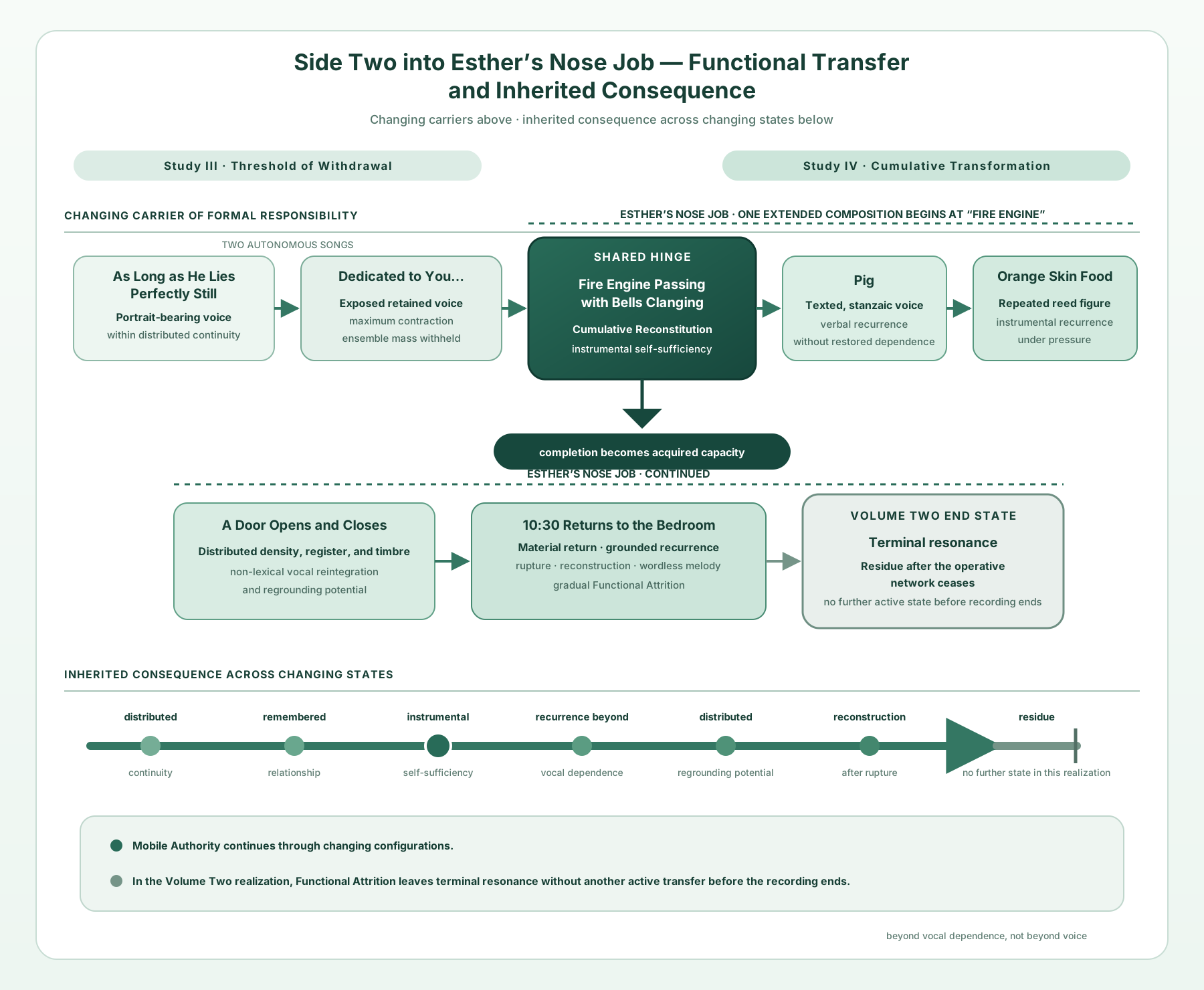
The diagram joins Studies III and IV by showing that their overlap at “Fire Engine Passing with Bells Clanging” is structural rather than repetitive. The first three states establish a capacity: continuity survives the contraction and eventual withdrawal of the portrait-bearing voice, becoming fully sustainable through instrumental relations. The first two states belong to the autonomous songs that precede Esther’s Nose Job; the third, “Fire Engine,” simultaneously completes that album-level threshold and opens Ratledge’s extended composition.
The remaining sequence inherits that achievement without excluding voice. Texted, non-lexical, and wordless vocal forms return, but none restores vocal dependence; formal responsibility continues to move among verbal recurrence, the repeated reed figure, distributed density and timbre, and, in “10:30,” the return of earlier material and its reconstitution as grounded instrumental recurrence. Mobile Authority therefore persists through changing configurations of Composite Instrumental Authority, while each completed region alters what the next can do. In the Volume Two realization, terminal resonance finally breaks this productive chain: gradual Functional Attrition removes the operative network through which another transformation had previously become possible, leaving audible residue without producing a further active state before the recording ends.
“Fire Engine Passing with Bells Clanging” begins from conditions created by withdrawal, but its first action is the progressive construction of renewed instrumental occupation. The reduced ending of “Dedicated to You But You Weren’t Listening” leaves continuity exposed: voice has ceased to command a full ensemble environment, instrumental support has become intermittent, and decay has acquired almost as much formal weight as attack. “Fire Engine” answers that condition by beginning to restore active occupation without restoring the song relationship that preceded it. The ensemble does not return as accompaniment to a retained vocal center. It gradually assembles movement, differentiation, and formal direction on instrumental terms.
Low-register and rhythmic activity are perceptible from the opening, but they do not yet constitute the fully coordinated instrumental ground achieved later in the region. The immediate contrast with “Dedicated” is therefore real without being complete: the music has regained physical activity, but a collectively secure field must still be constructed. Bass weight, rhythmic impulses, keyboard activity, and reed gestures initially register as differentiated presences whose capacity to sustain a common continuity remains incomplete. Through gathering, overlap, and increasing interaction, these activities begin to acquire a shared basis.
Low-register grounding is essential to this development. As bass activity becomes more securely established, it gives the music a physical foundation that replaces the suspended and thinning condition of “Dedicated” with renewed depth and forward pressure. Yet grounding does not mean immobility. The lower register supplies a point of resistance against which other activities can move: drums extend rhythmic activation, keyboard and reed gestures enter the texture with distinct profiles, and the ensemble repeatedly redistributes emphasis without settling around a single permanent leader. The music becomes grounded enough to retain identity, but mobile enough to prevent grounding from becoming a fixed center.
This developing coordination distinguishes instrumental self-sufficiency from mere vocal absence. A voiceless passage can still depend upon the remembered structure of song, functioning as an interlude whose meaning remains subordinate to an expected vocal return. “Fire Engine” does something more consequential. Its continuity becomes internally generated through rhythmic propulsion, registral interaction, changing density, and the temporary prominence of different instrumental layers. No missing vocal line is required to explain why the music continues or how its events acquire direction. By the time the instrumental field has cohered, the ensemble no longer sounds incomplete while awaiting language; it has become capable of producing its own succession of pressures, releases, concentrations, and transfers.
That capability does not depend upon replacing vocal authority with a single instrumental authority. Bass provides increasingly persistent grounding without governing every surface event. Drums sustain momentum without becoming the sole source of formal direction. Reeds and keyboards acquire local prominence, but neither remains permanently central. What emerges is Composite Instrumental Authority, a collective configuration of Mobile Authority in which differentiated instrumental activities jointly sustain continuity and formal direction. The instruments retain recognizable functions, but their relative prominence and responsibility continue to change within the composite field. Composite authority therefore does not arrest mobility; it is the coordinated instrumental configuration within which Mobile Authority operates when several activities exercise consequential responsibility together. The ensemble’s self-sufficiency is therefore relational rather than hierarchical. Continuity arises from the interaction among distinct activities, not from the elevation of one instrument into the position formerly occupied by voice.
The achievement of “Fire Engine” is consequently more precise than a transition from song to instrumental music. “Dedicated” had already separated vocal presence from uninterrupted sounding continuity: voice remained the principal source of identity, but the song persisted across its intermittent absence through recurrence, decay, and remembered relationship. “Fire Engine” completes the separation from the opposite direction by establishing continuity without a vocal center. Low-register and rhythmic activity do not arrive as an immediately finished foundation; they become coordinated through sustained collective activity until identity, coherence, and forward motion are audible as properties of the instrumental ensemble itself. The Threshold of Withdrawal is completed when those capacities no longer depend upon vocal guidance.
As the final stage of Study III, “Fire Engine” therefore completes the process initiated by “As Long as He Lies Perfectly Still” and carried to maximum exposure in “Dedicated.” As the opening condition of Study IV, however, it also establishes the capability whose consequences organize the remainder of Esther’s Nose Job. This double role explains why the region must be considered here without repeating its complete internal analysis. Its importance lies both in the reconstitution it accomplishes and in the new relationships that reconstitution makes possible.
This does not mean that the particular configuration established in “Fire Engine” will govern the remainder of the extended composition. No specific motif can be shown to persist across the closing sequence, and the particular composite configuration formed by bass, drums, keyboards, and reeds is not preserved unchanged. What persists is the ensemble’s acquired capacity to redistribute authority and to form new individual, composite, vocal–instrumental, or timbral configurations as later conditions require. Even its rhythmic pressure will later be interrupted, reconstructed, and finally withdrawn. The lasting consequence lies elsewhere. “Fire Engine” enlarges what the extended composition can subsequently permit without surrendering continuity.
What crosses into “Pig,” then, is not the complete texture of “Fire Engine,” but the capability consolidated within it: the ensemble can now maintain continuity without depending upon vocal guidance. Texted voice will enter an instrumental mechanism already active and capable of proceeding without it. Voice can consequently return with semantic, timbral, or melodic functions without automatically recovering its former authority. “Fire Engine” establishes not the final condition of the composition, but one of its decisive acquired capabilities: instrumental self-sufficiency as the ground upon which the remaining relationships can be transformed.
The transition from “Fire Engine Passing with Bells Clanging” into “Pig” provides the first test of the capability consolidated through the threshold’s completion. “Fire Engine” ends by releasing the particular concentration of Sustained Functional Pressure established in its final region, but that release does not exhaust the ensemble’s acquired capacity or erase all momentum at the audible transition. “Pig” begins before the consequences of the instrumental field have become formally neutral, at a closely comparable level of energy that strengthens the lower concentration rather than replacing it with a contrasting song texture. The arrival of text is therefore unmistakable, but the musical conditions into which it arrives are already active.
This distinction changes the meaning of Wyatt’s entrance. Earlier on Side Two, voice could serve as the most immediately recognizable source of identity: it carried portraiture, language, and the expectation of song even when the ensemble complicated its authority. In “Pig,” voice again introduces words and a clearly directed verbal shape, but it does not summon an inactive ensemble into motion. Bass and drums immediately reactivate a continuity already established as an ensemble capability; the instrumental mechanism does not depend upon the vocal line to establish its rhythmic purpose. Voice enters as a new organizing force within a field whose capacity for self-directed movement has already been demonstrated.
The transition consequently preserves continuity while changing its organization. The acquired capacity for low-register grounding and forward motion remains formally consequential through the release and is immediately reactivated as “Pig” begins, but the distribution of attention is reclassified. What had been sustained through instrumental interaction now acquires a verbal center. Wyatt’s text divides the flow into recognizable statements, creates semantic expectation, and gives recurrence a stanzaic dimension. The instrumental field becomes answerable to a new pattern of phrasing without becoming merely subordinate accompaniment. It continues to exert weight, propulsion, and pressure beneath the words.
The result is neither the restoration of the earlier song relationship nor the continuation of “Fire Engine” with voice added to an otherwise unchanged texture. “Pig” reorganizes the active field. Vocal phrasing creates local boundaries; repeated verbal construction gives the music a more explicit form of recognition; semantic direction draws attention toward the successive reductions of the text. Yet these new functions operate upon instrumental continuity rather than replacing it. The ensemble’s acquired self-sufficiency remains audible precisely because the instruments do not lose their capacity for movement when the voice assumes prominence.
This produces a productive asymmetry between presence and authority. Voice is prominent because it is texted, human, and semantically intelligible. Its recurrence supplies a recognizable framework that the instrumental activity alone does not provide in the same way. But prominence does not amount to complete command. The lower field retains physical insistence, rhythmic activation continues across the vocal phrases, and the ensemble possesses more energy than the words require merely for support. Wyatt becomes a local center without recovering the exclusive structural position that vocal presence might once have implied.
The change is therefore best understood as a transfer of organizational emphasis. “Pig” returns texted voice to a field that has moved beyond vocal dependence. Language becomes formally consequential without again becoming the indispensable source of continuity and direction. The instrumental field becomes the ground from which verbal organization emerges. Text supplies stanza, recurrence, and semantic direction, while the ensemble preserves the independent capacity to carry motion beyond the limits of any individual phrase.
This first internal transition also clarifies what Cumulative Transformation by Functional Reclassification means in practice. The music does not accumulate by adding voice to a stable instrumental state. Nor does it advance by discarding one condition and beginning another from neutral circumstances. A capacity established earlier within Esther’s Nose Job remains available while its function changes. Instrumental self-sufficiency, made explicit in “Fire Engine,” becomes in “Pig” the active ground beneath renewed vocal organization. The ensemble’s acquired freedom from vocal dependence now allows voice to return as a semantic, timbral, and melodic resource without again becoming the indispensable source of continuity and direction.
The consequence will become most apparent near the end of “Pig.” As its language contracts from complete stanzaic statements toward increasingly reduced verbal fragments, the instrumental field does not undergo an equivalent exhaustion. Words approach their limit while instrumental activity retains further capacity. The audible transition out of the “Fire Engine” region has therefore done more than support the entrance of text: it has established the conditions under which verbal and instrumental continuity can later separate again.
The central relation is exact:
Instrumental self-sufficiency becomes the ground for renewed verbal organization.
“Pig” does not reverse the threshold completed through “Fire Engine.” It reveals what that completion has made possible. Voice can once again organize recognition and meaning, but it now enters a musical field that has moved beyond vocal dependence: continuity and direction no longer require voice to remain present or governing.
Within “Pig,” the renewed verbal organization introduced at the boundary assumes a particularly clear form. The text unfolds through three parallel stanzas whose related constructions make recurrence immediately perceptible. Each stanza begins with language capable of describing, qualifying, and directing attention. It then moves toward the same terminal sequence—“nude, bare, naked”—as though verbal elaboration repeatedly exposed a simpler and more irreducible condition beneath itself. Recognition arises not only from the return of individual words, but from the recurrence of an entire movement: statement gives way to reduction, and reduction reaches the same three-part verbal limit.
The stanzas therefore do more than divide the song into corresponding units. They establish a repeated process of semantic stripping away. Each new beginning appears to restore the capacity for complete utterance, yet every stanza is drawn toward the same contracted destination. The return of “nude, bare, naked” is recognizable because the surrounding language changes while the direction of contraction remains constant. Difference occupies the beginning and middle of each stanza; recurrence governs its end.
This repeated descent gives the three words a function greater than that of a refrain. A conventional refrain may stabilize a song by returning intact after contrasting material. Here, the recurring phrase acts as a terminal zone toward which each stanza moves. “Nude,” “bare,” and “naked” are closely related semantically, but their succession does not enlarge the description through new information. It intensifies exposure through accumulation. Each word repeats the condition of the others while removing the need for further explanation. The sequence arrives at semantic concentration by saying nearly the same thing three times.
The vocal structure consequently contains a tension between syntax and vocabulary. Complete syntax can establish relations, describe circumstances, and organize experience across time. The terminal triad contracts that relational capacity into isolated terms. Meaning remains, but its range of action narrows. The words no longer open outward into a developing statement; they gather around a single condition and hold it in place. Each stanza rehearses this change from verbal mobility to concentrated naming.
Because the process occurs three times, recurrence becomes inseparable from depletion. The listener learns not simply to expect the return of familiar words, but to recognize the direction in which language is moving. Each stanza begins again, yet the repeated restart does not overcome the pressure toward reduction. Instead, it confirms that pressure. Renewed syntax provides material for another contraction, and the return of the terminal words makes each apparent recovery of verbal fullness provisional.
The instrumental field does not merely duplicate this stanzaic design. Bass and drums maintain weight and forward motion across the vocal phrases, while the surrounding activity gives the repeated verbal course a continuing physical basis. The ensemble responds to the organization created by voice, but it is not exhausted by it. Its motion extends through and beneath the syntax, preserving the self-sufficient capacity established in “Fire Engine Passing with Bells Clanging.” Voice supplies the clearest pattern of recurrence; instruments ensure that the recurrence occurs within an active field rather than as an unsupported verbal recital.
This relationship keeps authority mobile even while Wyatt occupies the foreground. The text is structurally decisive because it defines the stanzas and makes their parallelism recognizable. Yet the instruments retain rhythmic and registral functions that cannot be reduced to punctuation or accompaniment. They provide continuity between vocal statements and sustain pressure where language creates divisions. Vocal authority is therefore real but bounded: it organizes the song’s verbal architecture without absorbing the complete activity of the ensemble.
The outro makes this difference increasingly explicit. After the three parallel stanzas have repeatedly carried complete statements toward “nude, bare, naked,” the text no longer reconstructs another full syntactic unit. Instead, verbal material returns in fragments. Words and shortened verbal remnants are detached from the grammatical structures that had previously connected them. The process rehearsed within each stanza now overtakes the larger form: contraction is no longer merely the destination of a complete statement but the governing condition of what language can still produce.
This terminal fragmentation retrospectively clarifies the stanzaic recurrence. The three stanzas had appeared to renew verbal order because each began with sufficient syntactic completeness to establish another parallel course. The outro reveals that such renewal cannot continue indefinitely. Language has repeatedly approached reduction and now loses the ability to depart from it. What had functioned as a recurring endpoint becomes the basis of the ending itself.
The contraction is therefore both syntactic and formal. Complete sentences give way to abbreviated utterance; stanzaic parallelism gives way to fragments that can no longer support another full cycle. Recognition survives, because the remaining words belong to the established verbal field, but restoration does not occur. The listener can identify the residues of the text without hearing its earlier organization rebuilt. “Pig” closes by preserving verbal identity after withdrawing the syntax that had allowed that identity to unfold.
The instruments, however, do not reach an equivalent terminal condition. Their activity remains capable of sustaining weight, motion, and continuation after verbal structure has contracted. This does not mean that they ignore the vocal ending or preserve an entirely unchanged mechanism beneath it. Their relationship to the voice has been altered throughout the region. But the capacities consolidated in “Fire Engine”—rhythmic activation, low-register grounding, and continuity without necessary vocal guidance—remain available when the words can no longer produce another complete stanza.
The ending of “Pig” is therefore fundamentally asymmetrical. Language reaches terminal reduction; instrumental activity retains unused capacity. The verbal process has completed its trajectory from syntax through recurrent concentration into fragments, while the ensemble still possesses the means to continue. Closure within the region is produced by the exhaustion of one organizing system rather than by the simultaneous exhaustion of the entire musical field.
That unused capacity prepares the transfer into “Orange Skin Food.” The next region does not need to recover the texted organization of “Pig” in order to preserve something of its formal consequence. Recurrence can therefore survive while changing its carrier. In “Pig,” it had been made recognizable through parallel stanzas and their repeated movement toward “nude, bare, naked.” In “Orange Skin Food,” words and syntax disappear, and an instrumental figure assumes responsibility for producing identity across repetition.
“Pig” thus performs a crucial stage of Functional Reclassification. Instrumental self-sufficiency first becomes the ground for renewed verbal organization; verbal organization then contracts without consuming the field that supported it. The region does not simply restore song after “Fire Engine.” It demonstrates that text can return, organize recurrence, and reach its own terminal limit while instrumental continuity remains capable of being transferred elsewhere.
The transition from “Pig” into “Orange Skin Food” does not require continuity to be reconstructed from silence or inactivity. “Pig” has exhausted its verbal organization without exhausting the instrumental field that supported it. Its three-stanza design can no longer generate another complete cycle; syntax has contracted into fragments, and the recurring movement toward “nude, bare, naked” has reached its terminal condition. Yet momentum remains available. The ensemble still occupies the lower register, rhythmic activity remains viable, and the music retains the capacity to continue after language has reached its limit.
“Orange Skin Food” inherits that capacity while removing the structure through which recurrence had most recently become recognizable. There is no new stanza, no replacement text, and no semantic sequence corresponding to the repeated verbal contractions of “Pig.” The human voice does not guide attention from one statement toward another. Instead, a repeated reed figure becomes the most readily identifiable element in the emerging instrumental field. Recurrence survives the boundary, but the material responsible for carrying it changes.
The transfer is audible because continuity and discontinuity occur simultaneously. Momentum and low-register occupation connect the two regions: “Orange Skin Food” does not sound as though it begins from neutral conditions. It enters a field already charged with the possibility of further motion. At the same time, the disappearance of words changes how that motion can be understood. “Pig” had divided continuity through stanza, syntax, and recurring semantic destination. “Orange Skin Food” offers no comparable verbal segmentation. Recognition must now arise through instrumental return.
The repeated reed figure assumes that responsibility. Its recurrence gives the listener something that can be identified across changing surroundings, just as the parallel stanzas and terminal triad had made the verbal design of “Pig” recognizable. But this is not a literal continuation of the same pattern in another medium. The reed does not translate the words, reproduce the stanzas, or preserve their semantic direction. What passes across the boundary is the function of recurrence—the capacity to establish identity through return—not the specific material or formal organization that had previously exercised it.
This distinction is central to Functional Reclassification. In “Pig,” recurrence belongs to language. It operates across complete statements, guides each stanza toward a familiar verbal limit, and makes semantic contraction into a formal process. In “Orange Skin Food,” recurrence becomes instrumental and non-semantic. The repeated reed activity does not describe, qualify, or name. It marks persistence through its audible reappearance and allows surrounding instrumental changes to be heard in relation to something retained.
The loss of semantic direction does not produce a loss of formal direction. Rather, direction is redistributed. “Pig” tells the listener where its repeated phrases are going: each stanza moves toward the same concentrated vocabulary. “Orange Skin Food” cannot organize expectation in that way. Its recurring figure provides orientation, while bass, drums, keyboards, register, density, and articulation determine how the field develops around it. Recognition becomes less dependent upon progression toward a verbal destination and more dependent upon the changing relation between a recurrent identity and the pressures acting upon it.
The boundary therefore separates two kinds of repetition. Verbal recurrence in “Pig” is articulated through parallel construction and semantic concentration. Each cycle possesses an internal course, and the returning words confirm where that course has arrived. Instrumental recurrence in “Orange Skin Food” is embedded within continuing ensemble activity. The reed figure can return without closing a syntactic unit; its identity persists while the texture around it enlarges, thickens, or redistributes emphasis. Repetition no longer organizes a sequence of statements. It becomes a point of recognition within an active field.
This transfer also changes the relation between recurrence and authority. Wyatt’s text in “Pig” commands attention because intelligible language creates immediate foreground and makes the stanzaic structure explicit. The recurring reed figure possesses no equivalent semantic privilege. It may provide the clearest recurring identity, but it does not thereby become the permanent sovereign center of “Orange Skin Food.” Its function depends upon its interaction with the low-register foundation, rhythmic propulsion, keyboard activity, and the changing density of the ensemble. Recognition is concentrated in the reed figure, while formal pressure remains collectively produced.
The instrumental self-sufficiency established in “Fire Engine Passing with Bells Clanging” is thus tested a second time. “Pig” had shown that text could return without making the ensemble dependent upon vocal guidance. The transition into “Orange Skin Food” now demonstrates the complementary possibility: when verbal organization contracts, the instrumental field can retain continuity and produce a new form of recurrence without rebuilding the preceding song structure. What “Fire Engine” established as a capability becomes the basis for a precise transfer of function.
Nothing at the internal transition suggests that “Orange Skin Food” simply continues the complete state of “Pig.” Text, stanza, and semantic direction are genuinely removed. Their disappearance matters because it changes both the source of recognition and the means by which larger motion can be perceived. Yet the new region is not detached from what preceded it. It begins under inherited conditions: instrumental momentum has survived the verbal ending, the lower field remains occupied, and recurrence remains available as an organizing principle even though its former carrier can no longer sustain it.
The transition therefore preserves neither a song nor an instrumental texture intact. It preserves a formal need and provides that need with different material. “Pig” leaves recurrence exposed at the moment when language loses the capacity to complete another cycle. “Orange Skin Food” answers by relocating recurrence within the ensemble. The reed figure does not restore the verbal order that has disappeared; it makes recognition possible under newly instrumental conditions.
The central relation is therefore:
Verbal recurrence contracts; instrumental recurrence assumes recognitional responsibility.
This is one of the clearest instances of Cumulative Transformation by Functional Reclassification in the closing sequence. The function of return remains consequential while its carrier changes. Language reaches its limit, but recurrence does not end with it. Released from stanza and semantic direction, recurrence enters “Orange Skin Food” as an instrumental principle whose identity will now be tested by the pressure, enlargement, and redistribution of the surrounding field.
“Orange Skin Food” establishes identity through recurrence, but recurrence does not establish complete control. The repeated reed figure is the region’s clearest audible point of recognition: its returns allow the listener to identify continuity even as the surrounding instrumental field changes. Yet the figure does not function as a sovereign theme to which every other activity remains subordinate. It persists within an ensemble whose bass, drums, keyboards, and upper-register gestures continually alter the conditions under which it can be heard. The region is organized not by repetition alone, but by the changing relationship between a recognizable figure and the pressure accumulated around it.
That audible recurrence belongs to a broader compositional architecture documented for Esther’s Nose Job. Contemporary discussion identifies recurring elements—including a 7/8 organization and an arpeggiated four-note motif—as important sources of cohesion across Ratledge’s extended composition. This evidence strengthens the interpretation of recurrence as more than a local feature of “Orange Skin Food,” but it should not be used to collapse every recognizable figure into the same documented object. Without a secure pitch-level identification, the recurrent reed figure heard here should not automatically be equated with the four-note motif. The more defensible conclusion is that “Orange Skin Food” makes recurrence especially conspicuous within an extended composition already known to sustain continuity through recurring rhythmic and motivic elements.
This distinction separates the audible reed recurrence from the verbal recurrence of “Pig.” The three stanzas of “Pig” had supplied relatively explicit units. Syntax established a course, the recurring movement toward “nude, bare, naked” marked its destination, and renewed speech initiated another parallel cycle. The reed recurrence offers no comparable semantic beginning or terminal point. It does not tell the listener that a statement has restarted or reached completion. Instead, it supplies a retained identity within continuous activity. Each return is recognizable, but the larger field does not simply reset around it.
The figure therefore possesses stability without self-sufficiency. Its identity depends upon repetition, yet its formal meaning depends upon what the ensemble does between, beneath, and around its appearances. If heard in isolation, it might seem to provide a stable center. Within the complete texture, however, stability becomes relational. Bass activity determines the weight beneath the recurrence; drums regulate the persistence and intensity of forward motion; keyboards enlarge or complicate the middle field; upper activity changes the figure’s degree of exposure. The reed remains identifiable, but it cannot determine the complete behavior of the music by itself.
Low-register occupation provides the repeated field with physical depth. The bass does not merely reinforce the reed figure or reproduce its contour. It establishes a separate layer of movement whose weight allows recurrence to be heard against continuing instrumental resistance. This grounding preserves the capacity established earlier within Esther’s Nose Job and, behind it, through the threshold completed in “Fire Engine Passing with Bells Clanging”: continuity does not depend upon voice, and it does not disappear when one recurring element momentarily recedes from attention. The lower field remains capable of carrying motion even when recognitional focus lies elsewhere.
The drums contribute a different kind of persistence. Their activity prevents recurrence from becoming static display. The reed figure may return in recognizable form, but rhythmic propulsion keeps each appearance embedded within an ongoing process. The documented importance of irregular metre within Esther’s Nose Job provides useful compositional context for that rhythmic persistence, but the formal point does not depend upon reducing the passage to a metric scheme. Repetition is subjected to time rather than placed outside it. The figure does not recur as an untouched object separated by neutral intervals; it returns within a field already moving forward. Rhythmic activation ensures that every recurrence inherits the energy accumulated since the previous one.
This produces an important tension between cyclical recognition and directional pressure. The reed figure suggests return because it makes something already heard present again. The rhythm section resists any implication that the music has simply come back to the same place. Its continued activity converts repetition into renewed exposure under altered conditions. The recognizable element survives, but the ensemble has moved. Return and development become simultaneous rather than mutually exclusive.
Keyboard activity further enlarges this relationship. Instead of serving only as harmonic support for the repeated figure, it contributes additional weight, color, and internal motion to the middle register. The recurrent reed identity must consequently share the field with sonorities that can thicken its environment or redirect attention away from it. At some moments the figure may appear comparatively exposed; at others it becomes one component within a denser composite surface. Its recognizability remains, but its degree of prominence changes.
Upper-register activity produces another form of disturbance. Gestures above the principal repeated field expand the region’s registral space and prevent recognition from remaining concentrated within a single band. These events need not replace the reed figure to alter its function. Their presence changes the scale of the environment around it. What initially operates as the clearest foreground identity can become a retained strand inside a broader vertical field, heard less as an isolated statement than as one recurring pressure among several.
The ensemble thus subjects repetition to cumulative enlargement. Bass weight, rhythmic propulsion, keyboard density, and upper activity do not merely decorate a stable figure. They change the relationships that make its recurrence audible. Each layer can reinforce the figure’s persistence while simultaneously weakening its claim to exclusive authority. The more fully the surrounding field becomes occupied, the more the repeated identity must coexist with activity it does not govern.
Pressure in “Orange Skin Food” should therefore be understood functionally rather than simply as loudness or density. It arises when several instrumental activities place simultaneous demands upon the recurring figure. The reed must remain recognizable while rhythmic motion continues beneath it, registral space expands around it, and other layers acquire temporary prominence. The pressure lies in the figure’s exposure to changing relationships. Its identity is tested not because it disappears altogether, but because persistence no longer guarantees dominance.
This is why the reed figure should not be described as a permanent center. It provides orientation, but authority remains mobile. At one moment recurrence may command attention because recognition is concentrated in its return. At another, low-register motion or rhythmic insistence may become more consequential to the region’s forward course. Keyboard and upper-register events can enlarge the texture until the repeated figure is heard from within collective activity rather than above it. No single layer permanently absorbs the functions of identity, propulsion, density, and formal direction.
The region’s continuity is consequently distributed across two complementary capacities. The repeated reed figure allows the listener to recognize persistence. The ensemble determines what that persistence means at any particular moment. Without the recurrent figure, the surrounding activity would lose its clearest retained point of reference. Without the ensemble, repetition would lose the pressure through which it acquires formal consequence. Identity and transformation are not assigned to separate, autonomous agents; they arise from the relation between retention and accumulation.
“Orange Skin Food” thereby complicates the reclassification established in the preceding state. Recurrence has passed from verbal syntax to instrumental figure, but the change of carrier also changes what recurrence can do. In “Pig,” repeated language organized parallel courses toward a shared terminal contraction. Here, the reed does not direct the music toward a comparable destination. It creates a point against which enlargement, disturbance, and redistribution can become perceptible. Recurrence no longer determines the whole form; it makes transformation audible by surviving within it.
Its survival is therefore neither literal stasis nor restoration. The figure can remain recognizable while its prominence, density, registral position, and instrumental surroundings change. Each return recalls its earlier identity, but the accumulation around it prevents that identity from recovering its initial condition intact. Recognition persists without cancelling consequence. The repeated material is retained, while its function is continually reclassified by the field it helps to organize.
The documentary evidence now makes an additional distinction possible. Recurrence operates here at two related scales. At the compositional level, Esther’s Nose Job is held together partly through recurring rhythmic and motivic elements whose reappearances contribute to continuity across the extended work. At the local audible level, the recurrent reed figure provides an especially conspicuous object of recognition within “Orange Skin Food.” The two scales may intersect, but they should not be declared identical without further evidence. What matters formally is that recurrence already belongs to the composition’s infrastructure, while this region exposes what can happen when a recognizable recurring object is placed under increasingly consequential instrumental pressure.
This is Cumulative Transformation at the level of an internal state within the extended composition. The music does not develop by abandoning its point of identity and replacing it with unrelated material. Nor does it preserve that identity in an untouched center while change occurs harmlessly at the margins. Transformation enters the conditions of recurrence itself. What repeats becomes progressively inseparable from what has accumulated around it.
The process also confirms the instrumental self-sufficiency established in “Fire Engine.” With voice absent, the ensemble produces identity through recurrence, forward motion through rhythm, grounding through bass, and differentiation through changes of register, density, and instrumental emphasis. Yet self-sufficiency does not result in a permanently unified or leaderless balance. The field remains internally differentiated, and authority continues to migrate among its components. Instrumental self-sufficiency is demonstrated through functional mobility: continuity no longer depends upon vocal guidance, yet neither does one stable instrumental hierarchy replace voice as a permanent center.
By the end of “Orange Skin Food,” recurrence has survived the pressures placed upon it, but it no longer exhausts the music’s available organization. The ensemble has enlarged the field beyond what the repeated figure alone can contain. Identity remains audible, yet density, register, rhythmic propulsion, and collective activity have acquired their own formal force. The region therefore prepares a further reclassification. “A Door Opens and Closes” will receive the accumulated instrumental momentum while suspending stable recurrence as the principal means of orientation.
“Orange Skin Food” occupies a crucial position within Esther’s Nose Job because it proves that recurrence can endure without remaining sovereign. The reed figure gives the region a recognizable identity, while the documented recurring architecture of the extended composition places that local persistence inside a still larger field of rhythmic and motivic continuity. Bass, drums, keyboards, and upper activity do not erase the figure; they make its persistence consequential by enlarging, disturbing, and redistributing the field around it. Repetition survives pressure, but what survives has been changed by the act of surviving.
“A Door Opens and Closes” inherits an ensemble already enlarged beyond the organizing capacity of a single recurrent figure. By the end of “Orange Skin Food,” the reed recurrence remains recognizable, but bass, drums, keyboards, and upper-register activity have accumulated enough independent force to prevent it from governing the complete field. The new region begins within the consequence of that enlargement. Density and propulsion remain active, yet the principle through which the preceding state established identity is no longer preserved as the principal means of orientation.
The change is therefore more precise than a transition from repetition to contrast. “A Door Opens and Closes” does not reject the instrumental continuity established in “Orange Skin Food,” nor does it begin from neutral conditions. It inherits a field already charged by rhythmic motion, registral breadth, and collective occupation. What changes is the distribution of formal responsibility. Stable recurrence recedes, while register, density, timbre, and gesture become increasingly responsible for making the region’s course intelligible.
This suspension of recurrence alters the listener’s relation to continuity. In “Orange Skin Food,” the recurring reed figure provided a retained identity against which instrumental pressure could be measured. Even when density increased or attention migrated elsewhere, the figure made persistence recognizable through return. “A Door Opens and Closes” offers no equally stable object around which its activity can repeatedly regroup. Continuity must instead be heard through the changing configuration of the ensemble: how the texture remains in motion, how registral emphasis shifts, how timbres enter and recede, and how one degree of occupation gives way to another.
The region consequently makes redistribution itself into form. Bass and drums preserve enough grounding and propulsion to connect the music with the active field it inherits, but they no longer operate beneath one recurrent instrumental identity. Keyboard and reed activity contribute to a denser and more mobile surface in which temporary concentrations matter more than the return of a sovereign figure. The music remains continuous because its components keep transferring energy and emphasis among themselves, not because one element repeatedly restores a familiar point of departure.
This is an important development in the sequence’s use of Mobile Authority. In “Pig,” texted voice had supplied stanzaic organization and semantic direction. In “Orange Skin Food,” the repeated reed figure assumed recognitional responsibility without acquiring complete control. Here, even that concentrated instrumental form of recognition is suspended. Authority becomes more fully distributed among rhythmic propulsion, registral movement, changing density, and timbral contrast. No individual layer alone explains the region’s direction, yet their interactions prevent the music from dissolving into undifferentiated activity.
The reappearance of voice occurs within this redistributed field. It does not restore the texted, stanzaic organization of “Pig,” because it brings neither complete syntax nor semantic direction. Nor does it arrive as a stable melodic foreground comparable to the wordless vocal contour that will later emerge in “10:30 Returns to the Bedroom.” The voice enters non-lexically, participating through attack, color, register, and gesture. Human sound returns, but language does not.
This separation is structurally decisive. In “Pig,” the intelligibility of words had made voice an immediate source of formal orientation. Its parallel stanzas created recognizable units, and their repeated movement toward “nude, bare, naked” supplied a recurring semantic destination. In “A Door Opens and Closes,” vocal sound cannot organize the music in that manner. It possesses human presence without verbal syntax and expressive immediacy without a narrative or descriptive course. The voice is recognizable as voice, but it functions inside the ensemble rather than standing before it as a semantic guide.
Vocal reintegration therefore does not reverse the instrumental self-sufficiency established in “Fire Engine Passing with Bells Clanging.” The ensemble does not require the voice to restore movement, identity, or formal consequence. All three are already present when the vocal activity enters. Voice adds another timbral and gestural capacity to a field capable of proceeding without it. Its return enlarges the ensemble’s range of articulation while leaving continuity collectively produced.
The distinction between presence and function becomes especially important here. Voice had disappeared in “Orange Skin Food,” but its return does not recover the organization associated with its earlier presence. The human timbre remains recognizable while its role is reclassified. What had carried words and stanza in “Pig” now contributes accent, texture, and registral energy. Vocal return becomes possible without vocal restoration.
In this sense, “A Door Opens and Closes” occupies the middle condition between two more clearly differentiated vocal states. “Pig” binds voice to text and semantic recurrence. “10:30” will eventually concentrate it into a wordless melodic contour. “A Door Opens and Closes” separates human timbre from both of those functions. Its non-lexical activity belongs neither to verbal statement nor to sustained melodic leadership. It is embedded within collective motion, demonstrating that voice can return first as material—as breath, attack, color, and gesture—before it later acquires a more concentrated melodic role.
The region’s brevity intensifies this effect. It does not establish a new stable vocal–instrumental arrangement and then develop it extensively. Instead, it passes rapidly through a sequence of changing emphases. Dense instrumental occupation, vocal gesture, registral redistribution, and shifts in timbral prominence succeed one another without settling into a durable hierarchy. The region functions less as an independent state than as an active hinge between two different systems of orientation.
Its inherited propulsion is therefore continually redirected rather than interrupted. Rhythmic energy remains available, but its formal meaning changes as recurrence loses sovereignty and the ensemble becomes increasingly organized through vertical and timbral relations. Density is no longer simply pressure surrounding a repeated figure. It becomes one of the means by which the music marks transformation. Expansion and contraction of the field, movement between lower and upper registers, and the changing exposure of individual timbres supply distinctions that recurrence had previously made more explicit.
Register becomes especially important toward the ending. The music moves away from the weightier concentration inherited from “Orange Skin Food” and directs attention upward. This does not amount to the recovery of a recurring theme or the resolution of accumulated pressure into a conventional cadence. Instead, brightness emerges through registral redistribution. Upper activity becomes increasingly exposed, altering the field’s center of gravity and giving the ending a distinctly elevated profile.
That brightness is consequential because it does not close the larger process. It produces a terminal condition within the region while leaving momentum available for transfer. The music reaches upward rather than settling into grounded completion. Its ending therefore feels less like an achieved destination than like the opening of registral space—a condition made especially audible by what follows.
The entrance of “10:30 Returns to the Bedroom” sharply reverses that condition. Its grounded keyboard ostinato establishes a compact, repeated order whose low- and middle-register articulation contrasts with the preceding brightness. Yet the new region does not simply cancel “A Door Opens and Closes.” The force of its grounding depends upon the registral elevation and distributed activity that immediately precede it. Because the hinge has loosened recurrence and shifted emphasis upward, the ostinato arrives with unusual physical and formal clarity. Repetition returns not as the surviving reed identity of “Orange Skin Food,” but as a newly grounded basis for a larger developmental course.
“A Door Opens and Closes” thus performs a double reclassification. Looking backward, it converts the recurrent instrumental field of “Orange Skin Food” into continuity distributed through density, register, and timbre. Looking forward, it converts accumulated propulsion into a bright, unstable terminal condition from which the grounded order of “10:30” can emerge with maximum definition. It does not merely connect two named subdivisions; it changes what can be inherited between successive internal states of the extended composition.
Its vocal activity participates in the same mediation. The return of human sound after the vocal absence of “Orange Skin Food” prepares the later wordless melody without anticipating its precise function. Voice is first reintegrated as one ensemble material among others. Only in “10:30” will it become temporarily concentrated into a more distinct melodic contour. The sequence therefore does not move directly from vocal absence to melodic recovery. It passes through an intermediate condition in which voice is present but neither lexical nor sovereign.
This is why the region possesses formal importance disproportionate to its duration. Without it, the movement from the repeated reed figure of “Orange Skin Food” to the grounded keyboard recurrence of “10:30” might appear to be a simple substitution of one ostinato-based identity for another. “A Door Opens and Closes” prevents that equivalence. By suspending stable recurrence, redistributing continuity, and reintegrating voice under non-lexical conditions, it clears the functional relationships of the preceding state without returning the extended composition to neutrality.
The region’s central function is therefore mediating reclassification through vocal reintegration and registral redistribution. It inherits density and propulsion but changes how they organize the field. It retains instrumental self-sufficiency while allowing voice to return as timbral and gestural activity. It withdraws recurrence from its principal orienting role, ends in registral brightness, and thereby prepares the sharply grounded entrance of “10:30.”
“A Door Opens and Closes” is consequently not an incidental passage between two more substantial compositions. It is the hinge upon which Esther’s Nose Job changes its behavioral state. The door of the title need not be treated as a literal programmatic explanation for the music; the audible structure supplies a more exact relation. One organization is loosened, several capacities pass through altered conditions, and another form of order becomes possible on the other side.
Across four successive internal states, the closing sequence presents three differentiated forms of vocal presence separated by one condition of vocal absence. The return of voice does not reverse the instrumental self-sufficiency established in “Fire Engine Passing with Bells Clanging.” Instead, vocal identity is divided into functions that earlier song had allowed to coincide. Language, human timbre, and melodic contour separate from one another and return under different structural conditions.
These three forms of vocal presence and the intervening condition of absence may be summarized as follows:
| Named region | Vocal condition | Structural function |
|---|---|---|
| “Pig” | Texted and stanzaic | Verbal recurrence and semantic direction |
| “Orange Skin Food” | Absent | Instrumental recurrence sustains recognition without vocal guidance |
| “A Door Opens and Closes” | Non-lexical and embedded | Timbral and gestural reintegration |
| “10:30 Returns to the Bedroom” | Wordless melodic contour | Temporary melodic recognition |
In “Pig,” these vocal capacities remain most closely joined. Wyatt’s voice is recognizably human, linguistically intelligible, and formally organizing. The three parallel stanzas establish verbal recurrence, while their repeated movement toward “nude, bare, naked” gives that recurrence semantic direction. Vocal timbre, text, and formal articulation operate together: the listener recognizes not merely a voice but a sequence of statements whose construction shapes the region’s course.
Yet “Pig” also begins the separation of these functions. Its outro contracts complete syntax into verbal fragments. Human sound remains present, and individual words remain recognizable, but language progressively loses the relational structure through which it had organized complete stanzas. The region therefore does not end by removing voice. It weakens the equivalence between vocal presence and sustained verbal organization. Language reaches terminal reduction while the instrumental field retains the capacity to continue.
“Orange Skin Food” completes that separation by removing voice altogether. Its absence is important, but it should not be treated as the goal toward which the sequence has been progressing. The region does not establish a permanently voiceless condition. It demonstrates that a function previously carried by voice—recognition through recurrence—can pass to instrumental material. The repeated reed figure supplies identity without words, syntax, or semantic direction. Instrumental recurrence thus demonstrates the ensemble’s self-sufficiency precisely where verbal recurrence has reached its limit.
The return of voice in “A Door Opens and Closes” does not revoke this instrumental achievement. The voice re-enters non-lexically and remains embedded within collective activity. It does not rebuild the stanzaic organization of “Pig,” provide semantic direction, or stand before the ensemble as a stable melodic leader. Its contribution lies in timbre, attack, register, and gesture. Human presence becomes audible again, but the organizational functions formerly attached to intelligible language remain elsewhere in the ensemble.
This is vocal reintegration without vocal restoration. The voice is no longer absent, yet neither does its presence recreate song. It participates in the redistribution of continuity through density, register, and timbral contrast. What returns is the sound of the human body rather than the ordering power of verbal syntax. “A Door Opens and Closes” thereby occupies a necessary intermediate position: it separates human timbre from language before “10:30 Returns to the Bedroom” gives the voice a more concentrated melodic function.
In “10:30,” the voice remains wordless but becomes more clearly contoured. Its melodic profile offers a temporary point of recognition within the region’s larger course, distinguishing it from the shorter, more embedded utterances of “A Door Opens and Closes.” Human timbre and melodic continuity are now joined, but semantic language does not return. The voice can assume foreground prominence without recovering the stanzaic or explanatory role it held in “Pig.”
Its prominence is also temporary. The wordless contour does not become the final organizing authority of “10:30,” and it does not govern the extended composition’s closure. The region will pass through rupture, instrumental reconstruction, and eventual withdrawal after the vocal melody has receded. Voice supplies a recognizable phase within that process, not the destination toward which the closing sequence has been moving. Its melodic return enlarges the available field without restoring the earlier vocal condition intact.
The sequence therefore separates three properties that might otherwise be treated as one:
“Orange Skin Food” occupies the negative but indispensable condition between them. By sustaining recurrence and formal identity without voice, it demonstrates that none of these vocal properties remains necessary for instrumental continuity. Their later returns can consequently be heard as functional choices rather than restorations of a missing center.
The larger design is thus not one of progressive vocal disappearance. Such an account would be contradicted first by the non-lexical voice in “A Door Opens and Closes” and then by the wordless melodic contour in “10:30.” Nor is it a progressive return of voice, since each reappearance recovers only selected capacities and assigns them a different relationship to the ensemble. Language disappears; human timbre returns; melody emerges; semantic direction remains absent.
This redistribution is another form of Cumulative Transformation by Functional Reclassification. “Pig” establishes the fullest vocal organization of the sequence, but its contraction releases recurrence to instrumental material. “Orange Skin Food” demonstrates that recurrence can survive without voice. “A Door Opens and Closes” then reintegrates human timbre without restoring language, and “10:30” concentrates that timbre into wordless melody without making it permanent. Each state draws upon capacities made available earlier within the extended composition while altering the material and relationship through which they become active. Some capacities pass directly across an internal transition; others remain formally consequential through Inherited Consequence and return only after an intervening state has suspended them.
The three forms of vocal presence, together with the intervening condition of absence, therefore clarify the consequence of the threshold completed through “Fire Engine.” Instrumental self-sufficiency does not require the permanent exclusion of voice. It permits voice to return in partial, differentiated forms without automatically reclaiming formal command. Language, human timbre, and melodic contour become separable resources within a field whose continuity no longer depends upon their remaining united.
The transition from “A Door Opens and Closes” into “10:30 Returns to the Bedroom” forms the strongest internal boundary in the closing sequence. Earlier transitions had changed the carrier of recurrence, redistributed authority, or altered the function of voice while preserving a comparatively continuous instrumental field. Here, continuity and discontinuity are more sharply divided. Momentum survives the transition, but the organization of that momentum does not. The terminal brightness of “A Door Opens and Closes” gives way to a grounded keyboard ostinato, resetting the register, clarifying the point of orientation, and establishing a new behavioral state.
The force of the entrance depends upon the condition created by the preceding region. “A Door Opens and Closes” ends after recurrence has been loosened as the principal means of recognition. Its course is carried instead by changing density, registral redistribution, timbral contrast, and the reintegration of non-lexical voice. As the music moves toward greater registral brightness, the field becomes elevated without acquiring a stable new center. Propulsion remains active, but its energy is distributed across a changing surface rather than concentrated in a recurrent ground.
“10:30” answers that condition immediately. Its keyboard ostinato does not merely introduce another repeated figure after the reed recurrence of “Orange Skin Food.” It restores a clearly articulated basis for orientation after the preceding hinge has suspended such stability. The repeated keyboard pattern establishes a grounded middle- and lower-register order whose compactness contrasts with the elevated, dispersed ending of “A Door Opens and Closes.” Repetition returns, but it returns under different conditions and with a different formal responsibility.
This contrast makes the transition a Regime Pivot rather than a change of surface alone. A Surface Pivot could alter instrumentation, register, or timbral emphasis while leaving the underlying behavior intact. Here, those audible changes coincide with a more fundamental reorganization. “A Door Opens and Closes” sustains continuity through rapid redistribution: density, register, timbre, and embedded vocal gesture continually redirect the field. “10:30” begins by concentrating continuity around a repeated keyboard mechanism. The music changes not only what it sounds like, but how it maintains identity and generates expectation.
The pivot is therefore produced by regrounding. The terminal brightness of the preceding region does not simply become darker at the entrance of “10:30.” The music acquires a new point of resistance. The ostinato gives rhythmic motion a stable local basis and allows subsequent events to be heard as enlargements, deviations, or transformations of an established condition. Register becomes grounded, articulation becomes more compact, and the field gains a clearer formal orientation. What had been dispersed among several changing parameters is momentarily gathered around a repeatable instrumental action.
Yet regrounding does not mean that motion has stopped and restarted. The ostinato enters with sufficient activity to preserve the extended composition’s accumulated momentum. “10:30” does not sound detached from the pressure accumulated through “Orange Skin Food” and redirected through “A Door Opens and Closes.” Rhythmic energy crosses the internal transition even though its organization changes. The new repetition captures inherited motion and places it within a more sharply defined framework.
This distinction is essential. If the ending of “A Door Opens and Closes” were treated as a complete exhaustion, the entrance of “10:30” would appear to reconstruct continuity after collapse. The audible transition does not support that interpretation. The preceding region leaves propulsion available; what it withdraws is a stable ground. “10:30” supplies that ground without needing to regenerate energy from neutral conditions. The transition therefore preserves kinetic consequence while resetting behavioral orientation.
The keyboard ostinato also differs functionally from the recurring reed figure of “Orange Skin Food.” The reed had carried recognitional responsibility within a field whose surrounding activity continually enlarged and disturbed it. Its recurrence allowed identity to survive instrumental pressure, but it did not determine the complete behavior of the region. The opening keyboard pattern of “10:30” is more foundational. It does not merely recur within the field; it establishes the initial conditions from which the field can develop.
The distinction is between a repeated identity under pressure and a repeated ground capable of generating a larger course. In “Orange Skin Food,” recurrence remains exposed to accumulation around it. At the beginning of “10:30,” recurrence organizes the relation between ground and departure. The ostinato makes later expansion legible because it supplies a compact condition from which expansion can be measured. Its repetition does not foreclose development. It creates the basis upon which development can occur.
This is another instance of Functional Reclassification, but its audible effect is unusually decisive. Recurrence had passed from verbal syntax in “Pig” to the repeated reed figure in “Orange Skin Food.” “A Door Opens and Closes” then suspended stable recurrence, redistributing continuity through register, density, timbre, and non-lexical vocal activity. At the entrance of “10:30,” repetition returns as keyboard grounding. The function of recurrence has changed again: it no longer provides semantic organization or a retained figure within collective pressure. It establishes a behavioral base from which a substantially larger formal process can unfold.
The difference in scale reinforces the pivot. “A Door Opens and Closes” is a compact transformational region. Its importance lies in how quickly it mediates among inherited propulsion, suspended recurrence, vocal reintegration, registral redistribution, and terminal brightness. It does not remain in any one of these conditions long enough to develop a stable internal hierarchy. Its form is the act of passage itself.
“10:30,” by contrast, has room to establish, enlarge, interrupt, reconstruct, and eventually withdraw its materials. Its opening ostinato therefore functions prospectively. It is not simply the first event of another independently conceived miniature but the initial ground of a larger developmental course within the extended composition. The clarity of that ground gives the subsequent transformations something to act upon. Changes in density, vocal prominence, instrumental relationship, and rhythmic continuity can acquire cumulative weight because the region begins from an identifiable behavioral condition.
The transition thus resets formal scale as well as register. The closing brightness of “A Door Opens and Closes” belongs to the terminal stage of a compressed mediation. The keyboard ostinato belongs to the opening stage of an extended process. One region reaches its consequence rapidly; the next establishes a condition whose consequences will unfold over a much wider span. The pivot separates not only two sounds but two temporal organizations: compact transformation gives way to developmental duration.
This enlargement also changes the listener’s expectation. Within “A Door Opens and Closes,” no single configuration remains stable enough to promise extensive development. Its successive redistributions are heard as parts of a hinge whose identity lies in reclassification. The entrance of “10:30” creates a different expectation because the ostinato is sufficiently grounded and recurrent to suggest persistence. The listener can hear the new state as possessing a base that may be maintained, expanded, challenged, or recovered.
That promise will not be fulfilled through simple preservation. “10:30” does not merely sustain its opening mechanism until Esther’s Nose Job ends. Wordless vocal melody will acquire temporary recognitional prominence; articulated motion will undergo rupture; instrumental activity will be reconstructed under altered conditions; and the extended composition will eventually move toward withdrawal rather than restoration. The ostinato matters precisely because it establishes an order capable of being transformed. Its stability is functional, not permanent.
The transition also completes the preparatory work of “A Door Opens and Closes.” That region had reintegrated voice as non-lexical, embedded ensemble activity without allowing it to become a melodic center. It had also lifted the field into registral brightness while preserving momentum. “10:30” begins by regrounding that field instrumentally. Only after this new ground has been established can the wordless voice emerge with a more continuous melodic contour. Vocal melody will therefore arise within an order established by the keyboard rather than supplying the ground from which the region begins.
This sequence preserves the consequence of “Fire Engine Passing with Bells Clanging.” The instrumental ensemble remains capable of creating identity, continuity, and formal direction without vocal guidance. At the entrance of “10:30,” that capability becomes concentrated in the keyboard ostinato. The later prominence of the wordless voice will enlarge and temporarily redirect the field, but it will not retroactively become the source of the region’s initial coherence. Instrumental self-sufficiency remains the condition under which vocal melody can acquire prominence without becoming indispensable.
The pivot is consequently both retrospective and prospective. Retrospectively, the ostinato reveals the terminal brightness of “A Door Opens and Closes” as a condition awaiting regrounding rather than as an autonomous closure. Prospectively, it supplies the behavioral base whose transformation will organize the remainder of “10:30.” The transition gathers consequences from the preceding region and converts them into the starting conditions of a longer process.
The central relation can therefore be stated precisely:
Motion continues, but the behavioral state is regrounded.
Continuity survives as momentum, accumulated energy, and the availability of further transformation. Discontinuity enters through register, articulation, formal scale, and organizing principle. Bright, distributed activity gives way to grounded recurrence; a compact hinge gives way to an extended developmental field; voice embedded as timbre prepares to become wordless melody within a newly established instrumental order.
The entrance of “10:30” does not erase what precedes it, and it does not begin the extended composition’s ending from neutral conditions. It inherits motion while changing the means by which that motion becomes intelligible. That combination—kinetic continuation with behavioral reset—makes this audible internal transition the closing sequence’s strongest Regime Pivot.
“10:30 Returns to the Bedroom” begins from the sharply grounded condition established at its transition from “A Door Opens and Closes,” but that regrounding is not created from entirely new material. Documentary evidence describes the opening as restating earlier riffs before the music settles into the recurrent instrumental mechanism that organizes the region’s first extended phase. The entrance therefore combines return with reorientation: previously heard material becomes active again, while its renewed placement establishes a compact point of departure after the preceding region’s terminal brightness and distributed activity.
This distinction clarifies the title as well. No earlier musical state has been established as “the bedroom,” so the title’s return remains situational and referential rather than the restoration of a previously heard scene. Musically, however, genuine recurrence does occur through the restatement of earlier riffs. The title returns situationally; the music returns materially. These two kinds of return coexist without becoming equivalent: one invokes a named situation that has not previously been heard as such, while the other reactivates recognizable musical material within an altered formal context.
The grounded recurrence that follows is only the initial state of the region. It does not remain intact as a permanent foundation, nor does the music simply enlarge it until Esther’s Nose Job reaches closure. The recurrent ground establishes an articulated order capable of being expanded, interrupted, partially reconstructed, and—on the Volume Two studio recording—eventually relinquished.
The large-scale course unfolds through four phases:
The governing trajectory is:
This course makes “10:30” more than the final named region of Esther’s Nose Job. It gathers several capacities acquired earlier within the extended composition—instrumental self-sufficiency, recurrence without vocal dependence, mobile authority, and vocal return without verbal restoration—and submits them to a further transformation. Earlier riffs can return without restoring the conditions in which they first appeared; recurrence becomes the basis for a new developmental state rather than a recovery of an earlier total organization. What begins through material return and clearly grounded repetition does not, on the Volume Two recording, end through the confirmation of that ground. The studio realization instead transfers continuity away from articulated recurrence and progressively into resonance.
The opening phase, extending approximately from 0:00 to 1:23, begins with return before establishing its new ground. Earlier riffs are restated at the entrance, making recurrence materially audible from the outset rather than merely implied by the title. That return does not restore an earlier total condition. Instead, previously heard material is brought into a new formal position, after which a compact recurrent mechanism establishes the more sustained rhythmic and registral basis from which the region develops. Recognition therefore precedes and helps produce regrounding.
The documentary account also describes a cyclic bass motif around which organ and drums generate further riffs and dissonant arpeggiation. This supports the larger audible impression of a recurrent low- and middle-register ground, but it should not be used to identify every repeated element heard here as the same object without closer verification. What can be stated securely is that the opening combines the restatement of earlier material with the establishment of a cyclic instrumental basis whose repetition gives the ensuing field a stable point of orientation.
This function differs from that of the recurring reed figure in “Orange Skin Food.” There, recurrence persisted within an already active field and remained subject to pressure from bass, drums, keyboards, and upper-register activity. The reed provided a recognizable strand without governing the complete texture. In “10:30,” recurrence is initially more foundational. After the opening material return, the repeated ground establishes the condition from which the ensemble expands rather than merely surviving within expansion already underway.
The recurrent mechanism nevertheless does not monopolize authority. Bass, keyboards, and drums give the repeated field physical depth, articulation, and forward propulsion, while surrounding instrumental activity gradually enlarges it beyond its compact initial organization. Recurrence remains the principal source of orientation, but it becomes increasingly inseparable from the ensemble activity accumulating around it. The opening condition is therefore stable without being closed.
As the texture expands, the repeated ground supports rather than prevents differentiation. Additional layers increase density, broaden the register, and distribute attention across the ensemble. The recurrent basis remains audible as a point of return, yet the field acquires more movement than repetition alone can explain. Grounding and enlargement operate simultaneously: recurrence supplies continuity, while collective activity turns that continuity into a developing state.
This beginning therefore contains two related but distinct forms of return. Earlier riffs provide actual musical recollection, while the cyclic ground converts recurrence into an active basis for further development. Neither should be confused with the “return to the bedroom” named by the title. The bedroom remains an unheard situation; the musical material does not. The title returns situationally; the music returns materially.
The wordless voice emerges within this already established instrumental order. Its entrance does not create the region’s coherence, since recurrent instrumental activity, low-register grounding, and rhythmic motion have already done so. Nor does it restore the texted vocal condition of “Pig.” Without words or stanzaic syntax, the voice cannot provide semantic direction. Instead, its sustained melodic contour introduces a different kind of recognition—one based upon continuity of line rather than recurrence of language or instrumental figure.
This melodic concentration temporarily redistributes attention. The voice becomes prominent because its contour extends across the articulated instrumental ground, producing a distinction between sustained line and repeated mechanism. Yet the instrumental field does not become accompaniment in any simple sense. The recurrent ground retains its orienting function, rhythmic motion continues independently, and the ensemble remains capable of sustaining the region’s direction when the vocal line recedes.
The first phase therefore does not represent the recovery of vocal authority. It presents a layered relationship among distinct functions. Material recurrence reconnects the region with earlier states of Esther’s Nose Job; cyclic instrumental recurrence supplies ground; bass, keyboards, and drums provide weight, articulation, and propulsion; the wordless voice supplies melodic concentration; and surrounding instrumental activity enlarges the available space. Authority is mobile, but the behavioral state remains anchored in articulated repetition.
At approximately 1:23, that anchored condition undergoes a decisive rupture. The change is not merely an increase in density or a temporary disturbance surrounding the recurrent ground. The relationship among material return, cyclic recurrence, and melodic foreground is broken strongly enough that the opening order can no longer continue as the unquestioned basis of the region.
The rupture matters because of the stability established beforehand. Earlier riffs have already been reactivated, and a recurrent instrumental basis has converted that return into a sustained point of orientation. Without that grounded condition, subsequent activity might be heard simply as another episode of collective instrumental movement. Because the region has first established recurrence as both memory and ground, its disruption becomes formally legible. The listener hears not only new activity but the loss of a previously reliable organization carrying the composition’s past within it.
This does not result in inactivity. The field remains occupied, and momentum survives even as the opening organization is fractured. Bass, drums, keyboards, and other instrumental activity continue to produce motion, but they no longer relate to one another through the same clearly grounded recurrence. The ensemble preserves energy while losing the behavioral arrangement that had initially concentrated it.
The passage therefore demonstrates the difference between continuity and restoration. Continuity survives through propulsion, density, and the persistence of instrumental interaction. Restoration would require the opening ground to return with its former structural authority and to recover the relationships through which earlier material had been regrounded. What follows the rupture does not accomplish that. The ensemble reconstructs an occupied field, but the reconstruction proceeds under altered relationships.
Instrumental self-sufficiency becomes especially consequential here. Since the region’s motion had never depended entirely upon the wordless voice, the disruption of melodic concentration does not produce general collapse. The ensemble retains the capacity to reorganize itself after the opening relationship has been broken. The capability first established in “Fire Engine” now operates within a more demanding formal situation: instruments do not merely continue in the absence of voice; they rebuild continuity after the recurrent ground itself has been destabilized.
The reconstructed field is therefore neither a return to the opening nor a wholly unrelated replacement. It inherits the energy, density, instrumental capacities, and formal memory of the first phase while redistributing their functions. Activity that had enlarged a stable ground now participates in producing continuity without that ground’s full authority. What had been supplementary becomes structurally necessary.
This is another instance of Cumulative Transformation by Functional Reclassification. The components of the opening condition are not simply discarded. Material recurrence, propulsion, density, cyclic grounding, and melodic contour become separable capacities whose relationships can be rearranged. The rupture reveals that the region’s initial coherence contained more than one source of continuity; reconstruction makes those latent capacities audible by requiring them to function differently.
The second phase consequently occupies the region’s largest zone of instability. It sustains occupation without recovering the complete order from which that occupation arose. Grounded recurrence has given way to a reconstructed field whose continuity must be produced through ongoing instrumental negotiation. The music remains active, but its activity no longer possesses the same center.
As heard on Volume Two, this reconstructed occupation also becomes part of the path toward the recording’s eventual withdrawal. That later outcome should not be projected backward as the inevitable consequence of the rupture itself. At this stage, the important fact is simply that the opening ground has lost its former authority while the ensemble has proved capable of continuing under altered conditions.
At approximately 2:43, the wordless voice returns to greater prominence. This moment can sound like a recovery because melodic contour becomes newly concentrated after the preceding instrumental reconstruction. Yet the return does not restore the opening phase. The voice now enters a field altered by rupture, and its structural function is consequently reclassified.
Earlier, the vocal contour had enlarged a grounded recurrent mechanism. Its sustained line could be heard against an instrumental basis that remained comparatively secure. Here, melody emerges after that security has been broken and the field has been reconstructed. The same general vocal capacity—human timbre organized into wordless contour—therefore carries a different formal meaning. It no longer appears as one layer added to an established ground. It becomes a temporary concentration within an already transformed environment.
The melodic return produces Recognition Without Restoration. Human timbre and contour are recognizable, but the network of relationships surrounding them has changed. The recurrent ground does not simply recover its initial authority beneath the voice, and the ensemble does not revert to the earlier balance among ground, propulsion, and melodic line. The listener recognizes a vocal condition while hearing it occupy a new structural position.
This distinction completes the sequence-wide separation of vocal properties. “Pig” joined voice to text, stanza, and semantic direction. “A Door Opens and Closes” restored human timbre as non-lexical ensemble activity. “10:30” concentrates that timbre into melody, but even within this single region melodic function is not fixed. Before the rupture, the wordless line enlarges grounded recurrence; after the rupture, it temporarily gathers a reconstructed field around a recognizable contour.
The voice therefore achieves prominence without becoming permanent. Its melodic concentration provides a local center, but it cannot reverse what the rupture has disclosed. The ensemble has demonstrated that continuity can be reconstructed instrumentally, and the vocal return occurs upon that acquired basis. Melody can focus attention, but it does not become the indispensable carrier of what follows.
When the voice withdraws again, the instrumental field remains as an afterstate rather than returning to neutral conditions. The ensemble does not simply resume the opening recurrent ground, nor does it behave as though the vocal phase had been an isolated episode. It inherits the consequences of melodic concentration and recession. The field is now heard as what remains after both rupture and temporary recognition.
This afterstate is essential to the closing course heard on the Volume Two recording. It prevents the wordless voice from becoming the final answer to the instability of the second phase. Melody provides concentration, but not closure. Once it recedes, the instruments retain responsibility for determining how this studio realization can proceed toward its ending without restoring either the original recurrent ground or the later vocal foreground.
From approximately 3:24, “10:30” begins the final withdrawal heard on the Volume Two recording. This is not a sudden termination of motion, nor is it a conventional recapitulation that gathers the earlier materials into a restored closing statement. The studio realization gradually reduces the force of articulated recurrence and allows continuity to pass increasingly into sustained resonance.
The distinction between articulation and resonance is decisive. Articulation defines events through attack, repetition, rhythmic placement, and separation. Earlier in the region, recurrence had made continuity explicit through the restatement of previous riffs and the establishment of a cyclic instrumental ground. Resonance preserves sound differently. It allows what has already been produced to persist through decay, overlap, and lingering vibration without requiring the same degree of renewed attack.
The recorded ending therefore changes the carrier of continuity once more. At the beginning of “10:30,” actual musical return reconnects the region with earlier material, while recurrent instrumental articulation establishes a new ground. During rupture and reconstruction, continuity passes into collective instrumental occupation. The returning voice then concentrates recognition melodically. In the final phase of the album performance, none of these functions is restored as the permanent organizing center. Continuity survives increasingly through the resonance left when articulated activity withdraws.
This withdrawal should not be confused with the exhaustion of the composition’s possibilities. The preceding phases have demonstrated considerable remaining capacity: recurrence can generate enlargement, instrumental motion can survive rupture, and melody can return after reconstruction. Nor does the later history of the work support treating this particular ending as the only possible conclusion. What the Volume Two realization does is more specific. It progressively relinquishes the articulated mechanisms through which its current field has been sustained, allowing their residual sonority to carry increasing formal weight.
Register and density participate in this process. As attacks become less insistent and the field becomes more open, individual sounds acquire greater exposure within the residual space. The music no longer derives pressure from several simultaneously active layers to the same degree. Its final intensity lies increasingly in the persistence of resonance after the mechanisms that produced it have begun to recede.
The result is withdrawal without a return to neutrality. Resonance carries memory. Sustained and decaying sounds preserve traces of the articulated field even after its recurrent mechanisms have loosened. The ending does not erase the preceding developmental course; in this studio realization, it converts that course into an afterimage. What remains is less a final restatement than the audible residue of accumulated transformation.
The opening and later recoveries within “10:30” are therefore clear instances of Return Without Restoration, but the concept requires an important distinction. The title and the music do not return in the same way. No earlier musical state has been established as “the bedroom,” so the title’s “return” remains situational and referential. Musically, however, the opening does contain genuine recurrence through the restatement of earlier riffs. The title returns situationally; the music returns materially. Material return is real, but it does not restore the complete organization in which the recalled material previously functioned.
Return Without Restoration names that formal event: a material, capacity, or recognizable behavior reappears without recovering its previous organization. Recognition Without Restoration names the perceptual consequence: the listener recognizes continuity or identity although the earlier relationship has not been rebuilt.
The “bedroom” of the title should therefore not be treated as an audibly recovered place of security or origin. The situational reference has no previously established sonic state to restore. The music, by contrast, does reach backward through genuine recurrence. Earlier riffs return, but they enter an altered context and become part of a newly grounded developmental state. The region can therefore contain actual musical return without becoming a restoration of an earlier total condition.
Across its four phases, “10:30” gathers the closing sequence’s principal relationships into one extended developmental course. Material recurrence reconnects the present with the composition’s past. Grounded recurrence supplies an initial order. Enlargement distributes activity beyond that order. Rupture breaks its authority without ending motion. Instrumental reconstruction demonstrates continuity under altered conditions. Wordless voice concentrates recognition without restoring the opening field. In the Volume Two realization, withdrawal finally transfers increasing responsibility from renewed articulation into resonance.
The governing trajectory on the album recording is therefore:
As heard on Volume Two, “10:30 Returns to the Bedroom” brings Esther’s Nose Job to an ending not by recovering and sustaining the condition from which the region began, but by progressively reducing the articulated mechanisms through which that condition had been transformed. The resulting Terminal Withdrawal belongs to this studio realization: recurrence, reconstructed occupation, and melodic concentration all remain part of the composition’s available history, while the recorded ending allows their immediate formal force to recede into resonance.
That distinction is essential. The final resonance is not evidence that Ratledge’s composition had exhausted every possible continuation, nor should it be treated as the inevitable terminal logic of Esther’s Nose Job. It is the specific closing behavior preserved on Volume Two: structure heard after the articulated mechanisms of this particular realization have progressively withdrawn.
The terminal organ field brings the Volume Two realization of “10:30 Returns to the Bedroom” to a condition fundamentally different from its earlier reductions. Those earlier passages had disturbed an established organization without eliminating the possibility of further activity. The opening ground could be ruptured, instrumental occupation could be reconstructed, and wordless melody could return within the altered field. In each case, reduction remained transitional: something lost its former authority, but the ensemble retained enough articulated capacity to produce another behavioral state.
In the recorded ending, no further such reconstruction occurs. Articulation recedes without exposing the basis of a renewed phase. Rhythmic segmentation weakens, recurring identity becomes less available, and the ensemble’s differentiated activities no longer regroup around a new center. What survives is not a recovered mechanism but the resonance left after the mechanisms of recovery have ceased to operate within this realization.
The terminal organ is decisive because its closing function reverses the role the keyboard had performed at the beginning of the region:
| Opening | Ending on Volume Two |
|---|---|
| Repeated articulation | Sustained resonance |
| Rhythmic orientation | Temporal extension |
| Ground for enlargement | Residue after withdrawal |
| Cyclical identity | Dissolution of segmentation |
At the opening, keyboard articulation creates a ground. Each repetition renews the pattern, confirms rhythmic position, and makes subsequent enlargement intelligible as activity occurring around an identifiable basis. The keyboard does not merely contribute sonority; it organizes time. Its recurrence divides the flow into recognizable cycles and supplies a local identity capable of surviving increasing instrumental occupation.
At the ending heard on Volume Two, the organ no longer organizes continuity through repeated renewal. Sustained resonance extends sound beyond the moment of attack, weakening the boundaries by which one event can be separated from the next. The keyboard remains audible, but its function has changed. It no longer provides a ground upon which additional layers can accumulate. It becomes what remains after those layers—and the articulated order that coordinated them—have withdrawn.
This is not simply a change from short notes to long notes. Within the album recording, it is a reversal in the keyboard’s relation to form. Repeated articulation had been prospective: every recurrence reopened the possibility of enlargement and made further development imaginable. Sustained resonance is retrospective. It preserves the audible consequence of previous activity without establishing, in this recorded ending, a mechanism through which that activity begins again. The opening keyboard points forward into the region; the terminal organ field lingers after the realization’s articulated developmental capacities have been relinquished.
The distinction can be heard most clearly in the treatment of segmentation. At the beginning, recurrence makes temporal divisions explicit. Repetition identifies units, reinforces pulse, and allows departures to be measured against a continuing cycle. Even when the surrounding field grows denser, the articulated ground retains the possibility of renewed recognition. The listener can hear where the music has been and how far its enlargements have moved from that condition.
The terminal organ field dissolves this cyclical identity. Sustained sound does not repeatedly confirm a shared point of departure. Its duration extends across the spaces that articulation had previously divided, allowing boundaries to blur into resonance and decay. Continuity persists, but it is no longer organized as the recurrence of identifiable units. Time is not marked through repeated return; it is prolonged through the gradual survival of sound.
The recorded ending therefore does not restore the opening keyboard condition in attenuated form. The shared instrumental source makes the transformation more consequential, because apparent continuity of timbre conceals a complete change of function. Keyboard sound remains, but keyboard behavior has been reclassified. What had generated order now records its withdrawal.
This reversal clarifies the difference between reconstruction and the particular form of closure realized on Volume Two. Reconstruction follows disruption while preserving the capacity to establish another active organization. After the rupture at approximately 1:23, the ensemble remains rhythmically and texturally occupied. Bass, drums, keyboards, and surrounding activity redistribute continuity after the opening ground has lost its initial authority. The resulting field is altered, but it remains capable of supporting further differentiation, including the later concentration of the wordless vocal contour.
Closure begins in this studio realization only when that capacity for renewed organization is progressively withdrawn. It does not require every sound to cease immediately. On the contrary, resonance permits sound to continue after active reconstruction has become unavailable. The crucial change concerns function rather than mere presence: attacks no longer generate a developing field, repetition no longer restores orientation, and sustained sonority does not become the basis of another enlargement before the recording ends.
The final withdrawal is therefore terminal within this realization not because it is the most reduced passage in the region, but because reduction has changed its formal consequence. Earlier reductions opened space for redistribution. Here, the recorded ending removes the functions through which redistribution had previously become another active phase. Sound remains, yet the conditions for renewed behavioral organization progressively disappear before the performance concludes.
This process may be described as Functional Attrition. On the album recording, closure is not imposed by a single conclusive gesture, nor achieved through the return and confirmation of a principal theme. It occurs as the music relinquishes, one by one, the active functions that had sustained both its course and the migration of authority within it. Rhythmic articulation ceases to orient time. Recurrent identity ceases to organize recognition. Instrumental differentiation ceases to generate a newly occupied field. Vocal melody has already withdrawn. What remains is resonance without the active functional network required, in this realization, either to redistribute responsibility or to convert that resonance into another beginning.
Functional Attrition must be distinguished from the exhaustion of the composition’s possibilities. The preceding course demonstrates considerable remaining capacity: the opening recurrence supports enlargement; rupture produces reconstructed occupation; vocal contour returns under reclassified conditions; the instrumental field survives its recession. The later history of Esther’s Nose Job likewise warns against treating the album ending as the work’s only possible conclusion: the studio version was not regarded as definitive, and Ratledge later supplied “Pigling Bland” as a more substantial finale in the expanded arrangement. Functional Attrition therefore describes what the Volume Two recording does with its available functions, not a claim that the composition itself had nowhere else to go.
Nor is the terminal organ a sovereign final center. Its prominence results partly from the disappearance of competing activities. As bass, drums, voice, and more sharply articulated keyboard functions recede, the organ becomes increasingly exposed. But exposure after withdrawal is not equivalent to authority within an active ensemble. The terminal sonority does not govern several simultaneous functions or coordinate their relations. It occupies the space they leave behind.
The difference is important for the study’s account of Mobile Authority. The particular configuration of Composite Instrumental Authority established in “Fire Engine” had already been transformed as responsibility passed among texted voice, instrumental recurrence, non-lexical gesture, wordless melody, and rhythmic articulation. Mobile Authority continued while these articulated functions remained available for transfer and recombination. In the Volume Two ending, the withdrawal of keyboard articulation into resonance progressively terminates the operative network through which those responsibilities had migrated. What sounds like concentration is actually the narrowing of available function.
Terminal Withdrawal therefore does not merely dissolve one composite configuration. The configuration established in “Fire Engine” had already been reclassified repeatedly without ending Mobile Authority. In this studio realization, Terminal Withdrawal removes something more fundamental: the active functional network that had allowed authority to migrate and recombine throughout the sequence. Mobile Authority itself ceases to operate when the conditions supporting further transfer are withdrawn before the recording ends.
The ending consequently transforms density without turning reduction into emptiness. Fewer active layers allow the remaining resonance to acquire greater temporal and timbral exposure. The music becomes less densely articulated, but its final sounds can occupy more perceptual space because they are no longer competing with the pressure of the full ensemble. Intensity moves away from simultaneous activity and into duration: attention follows the continued life of a sound that is no longer being rhythmically renewed.
This temporal extension preserves consequence while suspending further development within the recorded ending. Resonance carries traces of the field that produced it, but it does not reconstruct that field before the performance concludes. The final organ sound is therefore neither detached from the preceding music nor, in this realization, made the basis of another active state. It is residue: a surviving acoustic presence whose meaning depends upon the articulated, rhythmically grounded, and collectively occupied states that have now withdrawn.
The Volume Two ending brings the sequence-wide process of Cumulative Transformation by Functional Reclassification to a limit specific to this realization. Recurrence had moved from verbal syntax in “Pig” to the repeated reed figure of “Orange Skin Food,” then been suspended in “A Door Opens and Closes” before returning as the grounded recurrent mechanism of “10:30.” Within “10:30,” that mechanism supported enlargement, lost its initial authority through rupture, and yielded to reconstructed occupation and temporary melodic recognition. Its final transformation on the album is especially radical: keyboard sound remains, but recurrence itself no longer supplies continuity.
Continuity passes instead into resonance. Yet this last transfer differs from the preceding reclassifications because, on Volume Two, it does not open another behavioral state capable of development. When verbal recurrence became instrumental recurrence, the composition continued. When recurrence yielded to registral and timbral redistribution, another ground became possible. When the recurrent ground ruptured, instrumental reconstruction followed. The transfer from articulation to resonance, as realized here, produces no corresponding renewal before the recording ends. It is the point at which reclassification ceases to generate another active organization in this version.
Earlier phases permit Recognition Without Restoration: recurrent grounding and vocal melody become recognizable again without recovering their former relationships. The terminal field moves beyond that possibility in the album realization. Keyboard sound remains, but its articulated and orienting capacities undergo Functional Attrition, leaving resonance without the basis of another reconstruction before the performance concludes. The listener may recognize the keyboard timbre and hear its relation to the region’s opening, but the function attached to that timbre has been reversed. The opening mechanism is not recovered at the end. Its timbral identity remains audible, but it no longer performs its former work.
This is also how the Volume Two recording achieves closure without conventional confirmation. It does not summarize the closing sequence by bringing back its principal vocal, rhythmic, or recurrent materials in a stabilized combination. Instead, it closes by progressively withdrawing the functional supports that had carried the sequence onward. The final resonance is persuasive not because it proves that no further continuation was compositionally possible, but because this realization permits no remaining function to reorganize the residual field into another active phase before the recording ends.
The distinction can therefore be stated directly:
Reconstruction restores the capacity for further transformation; on the Volume Two recording, closure arrives when that active capacity undergoes Functional Attrition.
“10:30 Returns to the Bedroom” does not end simply when sound disappears. In this studio realization, it ends when surviving sound is no longer made the ground of something still to come. The terminal organ extends time while withdrawing segmentation, preserves residue while relinquishing recurrence, and retains acoustic presence after formal recovery has ceased within the recorded performance.
Earlier reductions allowed the music to continue differently. The Volume Two ending allows the current field only to remain—and then to fade. That is the specific sense in which its withdrawal is terminal.
The closing sequence unfolds through distinct behavioral states connected by graded rather than absolute internal boundaries. Each named region establishes a recognizable local organization, yet recurrence, voice, propulsion, density, register, timbre, and authority continue across the transitions between them. What changes at each transition is the distribution, embodiment, or formal responsibility of the capacities carrying continuity forward. The LP’s named subdivisions provide useful coordinates for these changes, but the transformations themselves are produced by audible changes of state within Esther’s Nose Job, not by the existence of the printed divisions.
The four principal internal transitions may be summarized as follows:
| Internal transition | Principal transformation |
|---|---|
| “Fire Engine Passing with Bells Clanging” → “Pig” | Instrumental self-sufficiency becomes the ground for texted voice |
| “Pig” → “Orange Skin Food” | Recurrence transfers from verbal syntax to instrumental figure |
| “Orange Skin Food” → “A Door Opens and Closes” | Continuity shifts from recurrent identity to distributed density, register, and timbre |
| “A Door Opens and Closes” → “10:30 Returns to the Bedroom” | Material return and terminal brightness are regrounded as recurrent instrumental order |
These transitions differ in strength and kind. Some preserve considerable surface continuity while reassigning a function; others produce immediate changes in register, articulation, or formal scale. Each is audible as a change of state, but none erases the consequences of the preceding state.
“Fire Engine” occupies a double position. At the album level, it completes the Threshold of Withdrawal traced from the two autonomous songs that precede Esther’s Nose Job. Within Ratledge’s extended composition, it establishes the first condition inherited by the succeeding states. By demonstrating that the ensemble can sustain continuity, differentiation, and formal direction without vocal guidance, it creates an instrumental self-sufficiency that “Pig” can retain when texted voice returns.
The transition into “Pig” is therefore additive rather than restorative. Wyatt’s voice supplies language, semantic direction, and stanzaic recurrence without again becoming the indispensable source of motion or coherence. “Pig” returns texted voice to a field that has moved beyond vocal dependence, creating a new distribution of responsibility between verbal organization and an instrumentally self-sufficient ground.
At the end of “Pig,” parallel stanzas contract into verbal fragments. “Orange Skin Food” inherits recurrence but transfers its most conspicuous local embodiment from syntax to the repeated reed figure. Recognition no longer depends upon recurring statements or semantic destinations; it resides in an instrumental identity that persists while the surrounding ensemble enlarges and redistributes pressure around it. This local audible recurrence also operates within the broader recurring architecture documented for Esther’s Nose Job, although the reed figure should not automatically be identified with the composition’s documented four-note motif without further evidence.
As the instrumental field accumulates, however, the reed figure can no longer govern the whole texture. “A Door Opens and Closes” inherits the resulting density and propulsion while distributing continuity across register, timbre, instrumental gesture, and changing degrees of occupation. Non-lexical voice participates in this redistribution through attack, color, and register without restoring either the verbal organization of “Pig” or a sovereign melodic center.
The region’s movement toward registral brightness prepares the strongest internal transition. “10:30 Returns to the Bedroom” answers that elevated terminal condition not only with sharply articulated recurrent grounding but with actual musical return: earlier riffs are restated before a cyclic instrumental basis becomes the ground for further activity. Brightness gives way to grounding, distributed activity to compact recurrence, and compressed mediation to developmental duration. The transition is therefore both retrospective and prospective. It recalls material from the composition’s past while reclassifying recurrence as the basis of a new behavioral state.
This Regime Pivot does not interrupt inherited momentum. Rhythmic energy crosses into the new ground, while the preceding region’s non-lexical vocal reintegration prepares the later concentration of human timbre into wordless melody. Earlier material also becomes newly active through recurrence. Inherited capacities survive, but their relationships and formal purposes change.
The four internal transitions consequently produce a cumulative sequence of transfers:
Transformation enters the conditions of every subsequent state. Instrumental self-sufficiency becomes the basis for renewed vocal presence; recurrence changes material, carrier, and purpose; density becomes an organizing parameter; vocal sound returns first as embedded gesture and then as wordless melodic concentration. Within “10:30,” material return and grounded recurrence undergo enlargement, rupture, and reconstruction before, in the Volume Two realization, articulation progressively withdraws into the terminal organ field.
No single carrier therefore remains sovereign across the sequence. The particular Composite Instrumental Authority assembled in “Fire Engine” changes and eventually dissolves, but Mobile Authority continues through new distributions of responsibility. Texted voice carries semantic and stanzaic organization in “Pig”; the reed figure carries local recognition in “Orange Skin Food”; density, register, timbre, and non-lexical voice articulate “A Door Opens and Closes”; and material recurrence, recurrent grounding, wordless melody, and collective reconstruction assume successive responsibilities within “10:30.” On the album recording, the final withdrawal of articulated keyboard function into resonance eventually terminates the operative network through which those responsibilities have migrated.
The capability acquired through “Fire Engine” does not remove voice from the extended composition’s available materials. It removes the necessity that voice remain present or governing. The return of texted, non-lexical, and wordless voice therefore confirms rather than reverses the passage beyond vocal dependence. Instrumental self-sufficiency means freedom from vocal dependence, not the irreversible exclusion or supersession of voice.
Mobile Authority consequently describes more than alternating instrumental prominence. It names the migration of formal responsibility among semantic direction, recurrence, propulsion, grounding, density, register, timbre, melodic contour, and articulated or developing sonority. The internal transitions make these migrations audible by marking the points at which an active relationship changes carrier, becomes insufficient, or yields responsibility to another configuration.
This preservation of consequence across changing states defines Cumulative Transformation. A capacity acquired in one state continues to affect what follows after its original carrier or organization has changed or disappeared. While the sequence remains actively generative, that consequence can become the basis of another transformation. This continuing formal effect of a preceding state is Inherited Consequence.
The sequence is therefore neither a collection of sealed compositions nor an undifferentiated continuum. Its internal boundaries possess structural force because successive regions establish distinct behavioral conditions; they remain permeable because inherited capacities continue under altered materials, distributions of authority, and formal purposes. The imposed LP subdivisions may coincide with some of these audible articulations, but they do not create the compositional continuity or the transformations that occur across it.
By the terminal organ field, the Volume Two realization brings this process to a particular limit. Earlier transformations preserved the active network through which responsibility could migrate and recombine. Functional Attrition now describes the progressive withdrawal, in this recorded ending, of the active functions that had supported further redistribution. Terminal Withdrawal therefore ends Mobile Authority within this realization not by dissolving one temporary configuration or exhausting the composition’s underlying possibilities, but by removing the operative network through which responsibility could be transferred once more before the recording ends.
The album realization consequently closes when Inherited Consequence remains perceptible as resonance and memory but is no longer converted into the ground of another active transformation. Its final resonance is the recorded limit of permeability: accumulated consequence remains audible after the organization capable of carrying it into another behavioral state has withdrawn.
That limit belongs to the ending preserved on Volume Two, not to an assertion that Esther’s Nose Job could only conclude in this manner. The later existence of alternative realizations and of “Pigling Bland” as a more substantial finale makes that distinction necessary. What the album gives us is one especially consequential terminal state: a studio realization in which cumulative transformation finally ceases to generate another active organization and leaves resonance to carry the remaining consequence.
Volume Two occupies a decisive place in Soft Machine’s development because it does not merely stand between the psychedelic song forms of the debut and the extended instrumental structures that followed. It makes that transition audible as a process of reconstruction. Songs, refrains, comic recitations, instrumental passages, abrupt interruptions, and returning figures remain recognizable, but none is permitted to define the album alone. Their functions pass into one another, and the resulting continuity belongs less to any isolated composition than to the relations the album establishes among changing musical states.
This gives the album its distinctive historical position. The group had not yet abandoned the voice, lyrical miniature, or theatrical absurdism, but these elements no longer governed the music by default. Wyatt’s singing can introduce a condition, interrupt it, withdraw from it, or return within an instrumental field already capable of sustaining itself. Ratledge’s organ may provide harmonic space, abrasive mass, mock ceremony, or sustained terminal resonance. Hugh Hopper’s bass can ground the ensemble, propel it, repeat insistently, or move into conspicuous melodic responsibility, while Wyatt’s drums alternately drive, redirect, destabilize, and disappear. Brian Hopper’s reeds enlarge this mobility without settling the group into a fixed hierarchy. What emerges is not a simple exchange of soloists but an ensemble whose internal responsibilities remain open to redistribution.
The album’s two sides preserve different aspects of this achievement. Rivmic Melodies demonstrates how very short pieces can exceed their apparent scale. An alphabet recital, a greeting, a dedication, or a ceremonial announcement may last only seconds, yet recurrence and placement allow it to organize a much wider span. The result is a form in which the miniature remains permeable: it can interrupt its surroundings, be interrupted by them, return after substantial intervening music, and acquire a different meaning when it does. Humor is therefore not ornamental. The album’s absurd classifications, multilingual gestures, mock formalities, and abrupt changes of manner become compositional devices—ways of opening boundaries and altering the listener’s understanding of what has already occurred.
Side Two changes the scale and basis of that continuity. “As Long as He Lies Perfectly Still” and “Dedicated to You But You Weren’t Listening” remain autonomous songs, but their placement prepares a cross-compositional threshold into Ratledge’s Esther’s Nose Job. Once that extended composition begins with “Fire Engine Passing with Bells Clanging,” continuity is carried through successive internal states whose consequences accumulate without requiring the LP’s five named subdivisions to function as independently conceived pieces. The printed titles remain useful coordinates, but the form proceeds through audible changes in recurrence, vocal function, density, register, timbre, propulsion, and ensemble responsibility within a composition Ratledge described as being heard as one long piece.
Esther’s Nose Job therefore carries the album’s relational principle into a more cumulative design. Vocal dependence is withdrawn at the threshold into the composition; instrumental continuity proves that it can sustain itself; texted, non-lexical, and wordless forms of voice then return without recovering their earlier authority. Recurring material passes between changing contexts, while density, register, timbre, and propulsion assume formal responsibilities that a conventional song structure might assign to refrain or harmonic resolution. Documentary evidence also identifies recurring compositional elements—including 7/8 organization and an arpeggiated four-note motif—as sources of cohesion across the extended work. Those recurring elements provide compositional continuity, while the changing functions they enter give that continuity direction.
This is one reason Volume Two resists a tidy description as either a collection of songs or an uninterrupted instrumental suite. Its continuity does not erase separation, but neither does every printed division define an independent compositional unit. On Rivmic Melodies, named miniatures frequently operate as genuine local forms whose consequences cross their boundaries. On Side Two, two autonomous songs lead into an extended composition whose imposed subdivisions mark points within a larger continuity. In both cases, a return can be immediately recognizable without restoring its first setting; an interruption can redirect the sequence without breaking it; and a locally complete event or internal state can continue to exert pressure after it has passed. The album’s unity lies in this traffic between identities rather than in the suppression of difference.
That method would remain central to Soft Machine even as the balance of materials changed. Later music could enlarge instrumental duration, intensify ensemble abstraction, and reduce the prominence of text, but Volume Two had already established the deeper structural possibility: continuity could arise from changing relations among musical functions rather than from the stability of a song, a leader, or a recurring formal template. Ratledge’s own account of composing from a given premise—a progression, a time signature, or some comparable device—also helps place this achievement historically. A stable compositional condition could establish coherence without dictating every subsequent surface event. What mattered increasingly was what such a condition could permit the ensemble to become.
Its legacy is therefore not confined to its position on the road toward jazz-rock. It lies equally in the demonstration that collage, comedy, vocal fragility, instrumental rigor, recurring compositional infrastructure, and formal discontinuity can belong to one coherent musical intelligence. Volume Two discovers that coherence need not depend upon uniformity. Identity can survive interruption; recurrence can change function; vocal presence can be divided into separable capacities; and instrumental independence can emerge without requiring voice to disappear permanently.
The ending heard on Volume Two gathers these possibilities into one particular recorded conclusion without making that conclusion the inevitable terminal logic of Esther’s Nose Job. In the studio realization, the final sustained organ field no longer articulates another recurrence or prepares another transfer of authority. The active network through which responsibility had migrated undergoes Functional Attrition, leaving accumulated consequence audible as resonance after further reconstruction has ceased within the recording. That behavior produces Terminal Withdrawal on the album, but it should not be projected onto the composition as its only possible ending: later performances could realize its continuity differently, and Ratledge would eventually supply “Pigling Bland” as a more substantial finale in an expanded arrangement.
Volume Two therefore ends, as this particular recording has proceeded, not by sealing its materials into a restored order but by allowing completed events to continue altering the space in which they are remembered. Its final resonance is less a declaration that nothing more could follow than the audible residue of a realization that does not generate another state. That distinction captures the album’s larger achievement: continuity survives not because form refuses change, but because change itself becomes capable of carrying memory forward.