Chapter II
The Prologue
The Wilde Flowers & the Canterbury Crucible
(1964–1967)
Mapping the Labyrinth
To return to this formative period is to enter the music before its pathways had settled: when a local circle was becoming a creative environment and shared influences were passing through sharply different personalities. Across changing lineups, rehearsals, performances, and surviving recordings, this chapter follows the habits that moved between configurations, altered by the musicians who carried them. From that exchange, the paths toward Soft Machine and Caravan gradually emerge—rooted in overlapping relationships, yet opening onto strikingly different musical worlds. The Wilde Flowers did not conceal a finished Canterbury style waiting to be uncovered. They inhabited the uncertain ground from which several futures could grow.
In the mid-1960s, a changing circle of friends, schoolmates, and local musicians began making music together in Canterbury. They rehearsed in domestic rooms, played local venues, entered competitions, assembled a repertoire, and recorded professional demos. At the center stood The Wilde Flowers, whose shifting personnel allowed several musical directions to coexist. Rhythm and blues, soul, beat music, and original songs provided familiar foundations, while modern jazz, humor and absurdity, instrumental curiosity, and a desire to stretch compact song introduced less settled possibilities.
These possibilities did not yet form the distinctive languages later heard in Soft Machine or Caravan. They appeared unevenly—in a drummer’s response to a vocal phrase, a mobile bass line, an unexpected harmonic color, an ironic lyric, or an arrangement altered by another musician’s arrival. Friendship gave such details time to circulate: songs passed between singers and lineups, while ideas encountered in one setting resurfaced in another. Within this unstable but fertile environment, the musical questions that would animate the Canterbury scene began to acquire a shared history. To understand how they endured while changing shape, we need a way to trace continuity without mistaking it for sameness.
A Note on the Analytical Framework: Defining the “Canterbury Protocol”
Throughout this journey, the term “Canterbury Protocol” will describe a recurring pattern of musical habits, social relationships, and creative attitudes transmitted through the Canterbury circle and transformed by successive ensembles. The musicians themselves used no such term and followed no common manifesto. What connected them was more fluid: shared listening, repeated collaboration, humor, rhythmic responsiveness, instrumental curiosity, melodic warmth, and a willingness to test the boundaries of compact song. These qualities never appeared identically or developed evenly. They moved with particular musicians, encountered new collaborators and circumstances, and acquired different structural meanings in each group.
The Canterbury Protocol is therefore a way of tracing continuity without reducing the music to a single style. It attends not only to what endured, but to what changed in transmission: conversational interplay becoming extended improvisation, melodic directness coexisting with greater harmonic and formal complexity, or understated humor acquiring lyrical, theatrical, and structural force. Within The Wilde Flowers, these materials remained unsettled. That incompleteness is central to the group’s importance. They brought musicians and possibilities into sustained contact, leaving later ensembles to select, intensify, and recombine what had been discovered together. The story begins here, before the architecture was visible, with friends learning how curiosity could open a familiar song toward several futures.
Formed in 1964 in the cathedral city of Canterbury, Kent, The Wilde Flowers—named in tribute to Oscar Wilde—became an early gathering place for the musical relationships that followed. They performed publicly, entered competitions, played contemporary rhythm and blues, developed original songs, and recorded professional demos, although a commercial recording career eluded them. What survives is fragmentary: studio sessions, demos, home recordings, and related archival material rather than a formally released catalogue. Yet the group’s importance exceeds the size of that archive. Across a succession of changing lineups, young musicians brought R&B, beat music, modern jazz, emerging psychedelia, and increasingly personal approaches to songwriting into close contact. The Wilde Flowers became an environment in which several possibilities of Canterbury music could meet before any of them had settled into a recognizable style.
Canterbury’s distance from London helped determine the rhythm of the group’s development. Beyond the capital’s concentrated world of labels, managers, clubs, and music publications, the musicians relied more heavily upon friendships, shared rooms, local performances, and records passed from one listener to another. Their outlook nevertheless extended far beyond Kent. American rhythm and blues and modern jazz supplied essential points of reference, while competitions, public appearances, and attempts to record brought them into contact with the professional music world. Distance did not produce isolation. It gave outside influences time to circulate within a close community and acquire a local accent.
Music moved through that community along the same paths as everyday life. Friendships, family connections, school relationships, rehearsals, performances, and recording opportunities repeatedly overlapped. The Hopper household became one important meeting place, alongside rehearsal rooms, public venues, and professional studios. A musical relationship could therefore survive a change of lineup because the people involved remained connected beyond the band itself. Continuity belonged less to an institution than to the movement of musicians and ideas among these settings.
Within each new configuration, familiar songs encountered different temperaments. Original material appeared beside rhythm-and-blues covers; jazz interests, humor, and instrumental curiosity entered the working repertoire of a beat group. A new singer could alter the emotional center of a song, a different bassist could change its motion, and a drummer’s response could loosen the feel without breaking its underlying pulse. The habits later associated with Canterbury music appeared here unevenly and provisionally, carried by particular musicians rather than imposed by a common design. The Canterbury sound began not as a declared style, but as a local community absorbing the wider musical world and answering it in increasingly individual voices.
The Wilde Flowers moved continually between informal music-making and the practical demands of a working band. Rehearsals among friends led to public performances, competitions, professional demos, and the maintenance of a repertoire that had to hold together before an audience. Ideas discovered in private could be tested in public; songs prepared for a performance or recording session gave those ideas a form against which the musicians could press. Because the personnel changed so often, the material never became entirely settled. A familiar number might acquire another rhythmic feel, vocal character, or instrumental balance when a new player entered the room.
The band consequently became a laboratory in the most practical sense: its musicians learned by playing together. Rhythmic details, harmonic turns, vocal approaches, and arrangements evolved as songs passed through successive lineups and settings. No experiment needed to announce itself as such. It might begin with a drummer answering the cadence of a vocal line, a bass part becoming unexpectedly melodic, or an arrangement opening just enough space for another instrumental voice to be heard. Repetition did not merely preserve the repertoire; it allowed the musicians to discover what else the material might contain.
Humor belonged naturally to this process. Verbal play, understated irony, private jokes, and flashes of absurdity accompanied serious musical curiosity. Their importance lay not in forming a separate code, but in establishing a balance of attitudes. Melody could remain emotionally direct while a lyric or vocal inflection tilted it toward irony. Careful musicianship could retain the ease of conversation, and a thoughtfully made arrangement could reveal its craft without insisting upon its seriousness. The surviving Wilde Flowers recordings contain this balance in early and varying forms: warmth without sentimentality, ambition without grandeur, and irreverence without detachment.
Its more elaborate consequences would emerge later, when subsequent ensembles carried these attitudes into different combinations of song, improvisation, harmonic complexity, and theatrical wit. Within The Wilde Flowers, however, curiosity, humor, warmth, and musical discipline had already begun to coexist. That coexistence mattered because it gave the musicians room to become more adventurous without severing the human thread of the song.
Between 1964 and 1967, The Wilde Flowers passed through a series of overlapping configurations as musicians joined, departed, changed instruments, or moved toward other projects. Around the band stood a wider circle of friends and fellow musicians whose connections would become important later. Membership and association were not the same, but both helped sustain the network. People, songs, listening habits, and musical ideas moved through this changing circle, creating links among ensembles that had yet to take shape.
Robert Wyatt and Hugh Hopper occupied central positions in its early history. Wyatt’s drumming reflected his close attention to jazz and his instinct for responsive ensemble playing. Hopper’s work as a bassist, guitarist, and songwriter widened the group’s instrumental and compositional range. The rhythmic elasticity, contrapuntal motion, and instrumental dialogue they later developed in Soft Machine had not yet acquired their mature form. Within The Wilde Flowers, those impulses remained folded into shifting mixtures of R&B, beat music, jazz influence, and original song.
Keyboards would become central to several branches of Canterbury music through separate but neighboring paths. David Sinclair joined a later Wilde Flowers lineup and subsequently helped define Caravan’s organ-centered sound. Mike Ratledge belonged to the wider Canterbury circle but not to The Wilde Flowers; his decisive musical role began with Soft Machine. Their contrasting keyboard languages developed within different ensembles, drawing adjacent relationships toward markedly different musical worlds.
The singers and songwriters who passed through The Wilde Flowers likewise belonged to different phases of the group. Kevin Ayers brought a laconic vocal presence and an emerging lyrical eccentricity. Richard Sinclair contributed the melodic warmth and conversational delivery that would later become central to Caravan, while Pye Hastings began developing a songwriting voice that would come more fully into focus after the Wilde Flowers period. Surrealism, domestic observation, understatement, and gentle absurdity would become conspicuous features of their later work. Here, those sensibilities appeared separately, arriving with successive lineups and adding new colors to an evolving repertoire.
The historical importance of The Wilde Flowers lies in this continual rearrangement of people and possibilities. Wyatt and Ayers carried their experience into the founding formation of Soft Machine; Hugh Hopper would join that group later and transform its instrumental balance from within. Hastings, Richard Sinclair, David Sinclair, and Richard Coughlan followed the later route toward Caravan, while Ratledge entered Soft Machine from the adjacent Canterbury circle. No common blueprint passed intact among them. Each ensemble selected from a shared history, introduced new collaborators, and allowed different possibilities to come forward. The Wilde Flowers were generative precisely because so much remained unfinished.
Within The Wilde Flowers, musical influences did not simply accumulate; they changed as they passed from one musician to another. A rhythm drawn from American soul, a phrase absorbed from modern jazz, a melodic instinct shaped by beat music, or a comic turn shared among friends could enter the repertoire and acquire an unexpected purpose. From these encounters emerged habits of listening, playing, writing, and responding that later musicians would develop in markedly different directions. They remained fluid at this stage, distributed across changing lineups and only intermittently audible as a shared aesthetic.
American rhythm and blues, soul, modern jazz, beat music, emerging psychedelia, comedy, and English literary humor all entered the group’s surroundings, but none passed through unchanged. Each musician heard different possibilities within the same material. Wyatt responded to rhythmic freedom and the conversational alertness of jazz; Ayers drew upon melodic directness, laconic delivery, and verbal eccentricity; Hopper explored the independent motion an instrumental line could create; the musicians later associated with Caravan increasingly favored melodic warmth and spacious harmonic color. Their differences mattered as much as their common interests. The emerging vocabulary belonged not to a uniform style, but to the interplay of distinct temperaments within a shared musical environment.
Modern jazz contributed especially to the way these musicians listened to one another. The surviving Wilde Flowers recordings remain grounded largely in rhythm and blues, soul, beat music, and compact song form, yet their instrumental parts sometimes suggest a more conversational ideal. A drum figure can redirect the pulse rather than merely reinforce it. A bass line can generate motion of its own, while guitar or keyboard answers the voice instead of remaining behind it. Such gestures are modest beside the extended improvisation and structural flexibility of later Canterbury groups, but they reveal an important change in attention: accompaniment was beginning to become interaction.
That interaction did not erase the song. Melody remained direct, voices retained their human scale, and the pleasures of concision were not treated as obstacles to musical curiosity. Instead, familiar forms became places where small freedoms could be tested. An instrumental part might loosen its customary role, a rhythmic accent might disturb the expected balance, or an arrangement might briefly open around the vocal line. The music could remain accessible while allowing its internal relationships to become more mobile. Later ensembles would enlarge these openings into extended structures, but their first significance lay in what they made possible within the boundaries of a short song.
Humor altered those boundaries in another way. The Canterbury circle’s enthusiasm for comic and absurdist traditions—including the irreverent sensibility associated with Spike Milligan—encouraged understatement, interruption, verbal play, and gently deflating surprise. A lyric could turn sideways in the middle of an apparently familiar song; a vocal delivery could hold affection and irony within the same phrase. Humor did not stand outside the music as decoration, nor did it diminish the seriousness of the musicians’ purpose. It allowed emotional warmth and artistic ambition to coexist without hardening into solemnity.
This freedom would later assume sharply individual forms. Ayers could turn detachment into surreal intimacy; Wyatt could bring vulnerability, absurdity, and theatrical disruption into uncomfortable proximity; Richard Sinclair and Pye Hastings could draw humor from domestic observation, conversational understatement, or an unexpected lyrical angle. None of these later voices was already complete within The Wilde Flowers. What can be heard is the earlier permission: the sense that a song could be sincere without becoming earnest, playful without becoming trivial, and musically ambitious without announcing its importance.
The musicians’ surroundings helped these affinities deepen. Domestic rooms allowed records to be replayed, phrases imitated, jokes exchanged, and unfinished ideas tried without ceremony. Rehearsals demanded that private discoveries become playable arrangements. Performances tested whether those arrangements could hold together before an audience, while recording sessions forced temporary decisions about balance, duration, and form. Each setting asked something different of the material. An idea could begin casually, gain definition through repetition, and change again when carried into another room or entrusted to another musician.
Three tendencies became increasingly durable within this process: jazz-informed responsiveness, humor and anti-solemnity, and the collaborative circulation of material among friends and successive ensembles. Their importance lay in combination. Rhythmic attentiveness could animate a direct melody; instrumental curiosity could complicate a compact song without overwhelming it; humor could release tension just as the music approached grandeur. These qualities did not yet constitute a stable Canterbury style. They formed an adaptable vocabulary whose elements could be emphasized, subdued, or transformed according to the musicians and circumstances brought together.
The Canterbury Protocol begins to become audible through this movement of selection and recombination. Its early vocabulary included rhythmic responsiveness, melodic warmth, jazz curiosity, verbal eccentricity, and a readiness to let instruments converse within the song. As members and associates moved into Soft Machine, Caravan, and the wider Canterbury network, those habits encountered new personalities, instruments, and ambitions. Some expanded into improvisation or large-scale form; others remained close to melody, lyric, and the intimate proportions of song. What endured was not a prescribed sound, but a way of approaching music: serious without stiffness, ambitious without bombast, and curious without sacrificing warmth.
If The Wilde Flowers helped bring the early vocabulary of Canterbury music into the same room, practice taught the musicians what that vocabulary could do. They learned through listening and imitation, but also through the more exacting demands of rehearsal, local performance, competitions, and recording sessions. A working repertoire had to be remembered, coordinated, and made convincing before an audience. An arrangement had to survive repetition while remaining responsive to the different singers and instrumentalists who passed through the group. With no established model for the music they would later create, the musicians discovered their possibilities by testing familiar songs against changing circumstances. Amateurism did not mean an absence of discipline. It meant that discipline and discovery developed together, each rehearsal turning musical curiosity into practical knowledge.
The working repertoire gave this learning a necessary foundation. Rhythm and blues, soul, beat music, modern jazz, and original songs offered forms the musicians could enter before they possessed a fully developed language of their own. Covers imposed recognizable structures, rhythmic expectations, and standards of ensemble coordination. Original material introduced different problems: how to give an unfamiliar song shape, how to balance the voice against the instruments, and how to make an individual idea function collectively. Rehearsal joined these activities. Whether the material began elsewhere or within the group, it had to become playable by the musicians presently in the room.
Repetition made differences audible. A song played again did not necessarily return in the same form, because the performers themselves might have changed. One singer could make the melody intimate or ironic; another could give it greater force or directness. A bassist might anchor the pulse firmly or introduce a more mobile line beneath it. Guitar, keyboard, and drums could occupy more or less space according to the strengths of a particular lineup. Arrangements therefore evolved not only through deliberate revision, but through the physical and expressive character of the people performing them. The same material became a measure of what each configuration could hear and do differently.
Robert Wyatt’s drumming made rhythm one of the clearest sites of such discovery. His jazz interests encouraged a responsive approach in which a fill could answer the voice, shift the emphasis of a phrase, or momentarily loosen the feel without disturbing the song’s forward motion. The bass, in turn, could do more than reinforce the beat: its weight, mobility, and relation to the drums changed as different musicians and arrangements entered the group. The metric elasticity and rhythmic displacement later developed in Soft Machine still lay ahead. What emerged here was the practical habit beneath them—the expectation that rhythm could remain stable enough to carry a song while becoming flexible enough to register the musicians’ interaction.
Harmony and texture changed through the same process. The organ-centered expanses and intricate keyboard-guitar relationships of later Canterbury ensembles were not yet established, but each lineup offered another solution to the problem of musical space. An instrumental response could briefly step out from accompaniment; a chord voicing could alter the color around the melody; a bass figure could pull the harmony forward; a new voice could change the emotional balance of an entire arrangement. David Sinclair, Pye Hastings, and Richard Sinclair would develop their most distinctive musical languages later. Within The Wilde Flowers, they joined an ongoing practice in which songs were repeatedly adjusted to the abilities and instincts of the musicians available.
Public performance brought another kind of discipline. An idea that seemed promising in rehearsal had to retain its shape before listeners; transitions had to work, beginnings and endings had to be coordinated, and the repertoire had to sustain the practical demands of a set. Competitions and attempts to secure recording opportunities added further pressure. These circumstances did not suppress experimentation. They gave it resistance. The musicians learned how much an arrangement could absorb without losing clarity, how far an instrumental personality could emerge without unbalancing the song, and when an unusual detail became expressive rather than merely accidental.
Learning therefore remained collective even when a particular musician supplied the decisive idea. Songs became places where listening, memory, technique, and personality met under practical conditions. An arrangement could hold the trace of a departed player, be reshaped by a new arrival, and continue into another setting with its identity altered but still recognizable. Through this repeated labor, the musicians discovered that musical continuity need not depend upon preserving a fixed version. It could reside in the capacity of material to change hands, accommodate another voice, and disclose possibilities that no single lineup could exhaust.
Recording changed the nature of this learning because it required a passing arrangement to assume a durable form. The surviving archive associated with The Wilde Flowers and their immediate circle contains studio sessions and professional demos alongside informal home recordings and material made by former members after the group’s active life. Later compilations gather these sources together, but they originated at different times, for different purposes, and under different conditions. They should not be heard as a unified catalogue. They preserve scattered moments at which a song, a lineup, or an arrangement became fixed long enough to leave a trace.
A demo was more than evidence that a song existed. It preserved decisions. The musicians had to settle, at least provisionally, how the performance would begin, how the voice would sit within the ensemble, which instrumental details would remain audible, and how the song would move toward its ending. Choices that might continue to shift in rehearsal became part of a recorded object. Listening back could expose an imbalance, confirm the force of a rhythmic idea, or reveal that an apparently minor countermelody had become essential to the arrangement’s character. Recording allowed the musicians to hear not only what they intended, but what their interaction had actually produced.
Much of the experimentation preserved in these recordings lies within performance and arrangement rather than in radical departures from song form. A bass figure may create unexpected movement beneath a compact melody; the drums may answer the vocal phrasing; a guitar or keyboard line may enter briefly, illuminate the texture, and recede. The melody and chord sequence can remain recognizable while the balance among the performers gives the song its particular identity. In these moments, arrangement approaches composition: not because the inherited form disappears, but because the musicians’ way of inhabiting it determines what the listener hears as consequential.
The archive also preserves several musical priorities before later ensembles separated and intensified them. R&B drive, melodic directness, jazz-inflected phrasing, lyrical eccentricity, and flashes of instrumental openness stand beside one another without settling into a single hierarchy. One recording may draw attention toward the voice, another toward rhythmic interplay, and another toward an instrumental detail whose implications exceed the modest scale of the song. Their unevenness is historically revealing. It catches the music before one possible direction had been chosen at the expense of the others.
Intermittent recording strengthened this sense of openness. Because the group never established a continuous commercial recording career, its development was not organized into a sequence of finished releases through which one public identity steadily replaced another. Long stretches of rehearsal, performance, personnel change, and informal musical exchange survive only partially, if at all. The recordings therefore offer glimpses rather than a complete progression. Between them lie changes we can infer but cannot fully reconstruct: arrangements revised, songs passed to other voices, and musical instincts deepened through repetitions that left no permanent document.
That incompleteness brings us close to the group’s actual condition. The Wilde Flowers were learning while their membership, ambitions, and musical resources continued to change. Their surviving recordings preserve neither a finished Canterbury style nor a simple rehearsal for later achievement. They capture decisions made within an unfinished process—moments when several futures still occupied the same musical space. Some possibilities would open toward the volatility and instrumental transformation of Soft Machine; others would remain closer to melody and song before expanding within Caravan. Here they are not yet separate paths, but pressures within a repertoire being remade each time another group of musicians gathered to play it.
The paths leading away from The Wilde Flowers did not separate at a single moment. In 1966, Robert Wyatt and Kevin Ayers left to form Soft Machine with Mike Ratledge and Daevid Allen, while The Wilde Flowers continued through later configurations. Only after the final Wilde Flowers lineup had run its course did Pye Hastings, Richard Sinclair, David Sinclair, and Richard Coughlan form Caravan in 1968. For several years, departure and continuation therefore overlapped. Songs, friendships, listening histories, and memories of playing together moved into new settings even as the earlier group remained in motion. The divergence was gradual, but its consequences were profound: a shared environment began opening into independent musical worlds.
The formation of Soft Machine marked the first decisive opening. Wyatt and Ayers carried direct experience of The Wilde Flowers into a group whose character would depend equally upon Ratledge and Allen, both drawn from the wider Canterbury circle but shaped by different musical and intellectual histories. Their arrival changed the scale of what could be attempted. Familiar elements—song, humor, melodic directness, rhythmic responsiveness—now encountered Ratledge’s developing keyboard language, Allen’s guitar and theatrical imagination, a stronger attraction to improvisation, and a willingness to let performance itself become unstable.
The Wilde Flowers, meanwhile, did not simply become a remnant of the story. Their later configurations brought other musicians into sustained collaboration and allowed different possibilities to gather strength. Pye Hastings, Richard Sinclair, David Sinclair, and Richard Coughlan developed familiarity through this later phase before regrouping as Caravan. What they carried forward was not a preserved Wilde Flowers style, but experience: knowledge of one another’s timing, voices, instrumental instincts, and ways of shaping a song.
The same early habits could consequently acquire different meanings. Rhythmic responsiveness might open into volatile improvisation or remain within the patient unfolding of a melody. Instrumental independence might disrupt the song’s surface or enlarge it from within. Humor could become theatrical interruption, surreal displacement, conversational understatement, or domestic observation. These possibilities had once stood beside one another within a changing local circle. In the new ensembles, they began to receive the concentration, continuity, and resistance required to become distinct musical languages.
The creative force of the divergence lies in this overlap. Soft Machine began exploring one future before The Wilde Flowers had completed their own history; Caravan arose from relationships consolidated during the later phase of that continuing group. Canterbury music therefore did not descend through a neat succession of bands. It expanded through simultaneous movement—musicians leaving, remaining, returning, and regrouping while shared materials changed meaning around them.
Two primary lineages emerged from this movement. Soft Machine and Caravan remained connected through geography, friendship, personnel, and shared experience, yet neither can be understood as a direct continuation of The Wilde Flowers. Each brought inherited habits into contact with a new combination of musicians. Their kinship lay in the questions they carried forward; their independence arose from the different answers produced by ensemble life.
The first lineage coalesced in 1966 around Robert Wyatt, Kevin Ayers, Mike Ratledge, and Daevid Allen. Wyatt and Ayers brought songs, voices, rhythmic experience, and personal sensibilities formed partly within The Wilde Flowers. Ratledge contributed an increasingly distinctive keyboard language informed by modern jazz and contemporary composition, while Allen brought another history of improvisation, experimentation, and theatrical provocation. In their early work, psychedelic song, extended improvisation, electronic and tape-based experimentation, modern jazz, Dada-inflected performance, and large-form ambition entered volatile contact.
The resulting music could contract into an eccentric miniature, spill outward into instrumental exploration, or permit a theatrical interruption to redirect the course of a performance. Song remained present, but it no longer guaranteed formal stability. Wyatt’s responsive drumming and singular vocal presence could hold intimacy and disruption in close proximity; Ratledge’s organ could supply harmony, attack, propulsion, or sustained pressure; Ayers could anchor the music through melody and laconic restraint even as his songs tilted toward fantasy and absurdity. When Hugh Hopper later joined the group, his amplified bass acquired sufficient weight and mobility to transform the movement of the entire ensemble.
Through these successive configurations, Soft Machine became the Canterbury continuum’s most persistent experimental force. Its development did not follow a straight line from psychedelic song into instrumental jazz. Each change of personnel altered the balance among voice, composition, improvisation, electronics, and ensemble authority. The group’s identity resided in this capacity for mutation: inherited materials were repeatedly subjected to new pressures and reorganized from within.
The second lineage emerged after the final Wilde Flowers formation had ended. In 1968, Pye Hastings, Richard Sinclair, David Sinclair, and Richard Coughlan formed Caravan. Their shared history gave the new group an immediate basis for collaboration, but its musical character had still to be discovered. Hastings’ songwriting and guitar, Richard Sinclair’s mobile bass and conversational voice, David Sinclair’s developing organ language, and Coughlan’s drumming gradually established a balance that belonged to this ensemble alone.
Within that balance, melodic accessibility and structural ambition proved unusually compatible. Pastoral intimacy could open into extended instrumental passages without losing its warmth. Understated humor could inhabit carefully shaped multipart works, while keyboards, guitar, bass, and drums exchanged prominence without dissolving the coherence of the song. The music found room to expand without treating expansion as an escape from melody.
Caravan thus developed an architectural language distinct from Soft Machine’s more volatile transformations. Its longer forms could grow through patient extension, recurring themes, harmonic spaciousness, and shifts between lyrical and instrumental regions. Complexity often appeared hospitable rather than confrontational: the listener could enter through melody, voice, or humor and gradually discover the larger structure opening around them.
The contrast between these lineages reveals the breadth already latent within the Canterbury environment. Soft Machine tested how radically an ensemble could alter the relationships among song, improvisation, jazz practice, electronics, theater, and large-scale form. Caravan joined lyrical eccentricity and melodic warmth to increasingly elaborate instrumental and formal design. Their common ancestry remained audible less as a collection of shared devices than as a disposition: curiosity joined to responsiveness, ambition tempered by humor, and a readiness to let ensemble interaction lead the music somewhere its inherited forms had not anticipated.
Soft Machine and Caravan were the first major formations to emerge from the Canterbury crucible, but they were not its final boundaries. Their importance lies partly in the different futures they made audible and partly in the relationships that continued to extend beyond them. Musicians departed, returned, collaborated under new names, entered one another’s ensembles, and carried ideas into settings increasingly distant from the original Wilde Flowers circle. What began as a divergence between two primary lineages gradually became a network with many points of entry and no single center.
Beneath the differences in emphasis and temperament, the early lineages remained connected to the same social and musical history. That ancestry survives in overlapping personnel, continuing friendships, shared listening, humor joined to musical seriousness, and an openness to instrumental relationships more fluid than the customary division between lead and accompaniment. Keyboard prominence, rhythmic elasticity, extended form, and unusual harmonic color would become important across the continuum, but each acquired a different function within the ensemble that developed it.
The later 1960s therefore mark the movement from a Generative Node toward a Networked Continuum. The Wilde Flowers were generative because their changing lineups and surrounding relationships brought future collaborators into repeated contact. The continuum became networked as musicians, songs, techniques, and ideas circulated through an expanding range of ensembles. Transmission was never passive. Every movement involved selection: some possibilities were retained, others receded, and new collaborators introduced pressures that redirected the music.
The Canterbury Protocol names the continuity created by these transformations. Ensemble responsiveness, melodic warmth, jazz curiosity, humor, anti-solemnity, and a willingness to stretch the boundaries of song did not pass intact from one group to another. They changed scale and function. Conversational interplay could become extended improvisation; instrumental independence could become a principle of large-form development; understated humor could move from vocal inflection into theatrical interruption or structural surprise. What remained continuous was not a fixed collection of devices, but a disposition toward music as something that could be rebuilt through interaction.
As the network widened, no ensemble possessed that disposition completely. One branch might intensify melodic spaciousness, another rhythmic intricacy, another harmonic density, electronic experiment, compositional rigor, or collective improvisation. Former bandmates could meet again under altered conditions; techniques developed in one group could enter another through a particular musician; affinities could become visible between ensembles without direct descent. The paths remained connected, but connection did not require stylistic agreement.
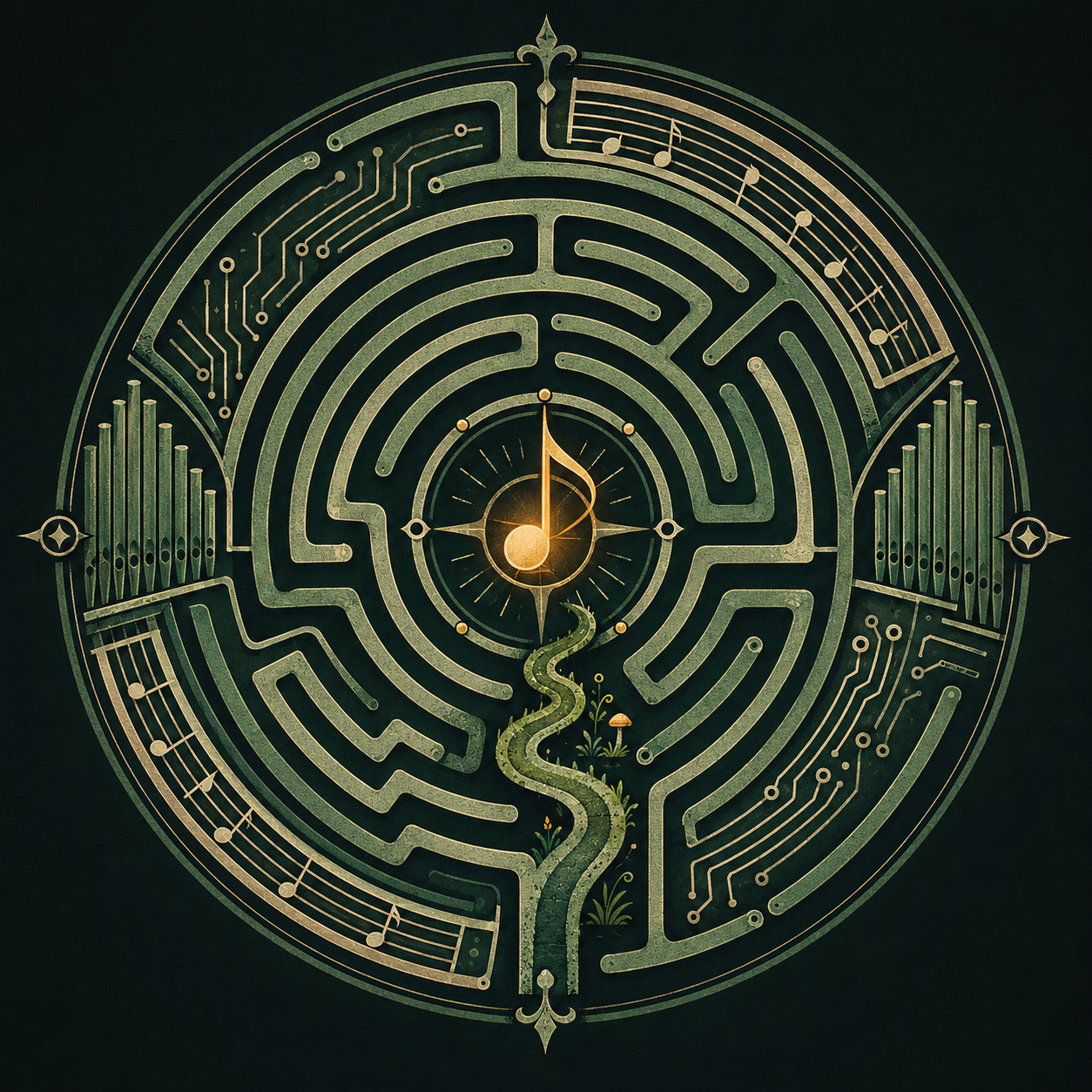
This is where the history becomes a labyrinth. Its routes divide, cross, disappear, and re-emerge elsewhere. A musician may leave one ensemble only to redirect another; an idea first heard within a compact song may return as the organizing principle of an extended composition; a shared inclination toward warmth, humor, or instrumental conversation may survive within music whose surface has changed beyond immediate recognition. Following these movements requires attention not only to origins and destinations, but to what happens in passage.
The chapters that follow will enter this network through successive ensembles and recordings, tracing the changing relationships among song, improvisation, jazz practice, electronic sound, harmonic design, rhythmic complexity, and large-scale form. Along the way, Canterbury musicians will establish new groups, renew earlier partnerships, and encounter collaborators who carry the music beyond its original geography. Some paths will eventually enter productive dialogue with the more austere and oppositional practices associated with Rock in Opposition. Others will preserve melodic intimacy while transforming the architecture around it. The resulting history will not describe the expansion of a single style, but the continuing creation of difference within a field of recognizable relationships.
The Wilde Flowers did not determine these futures or provide a finished blueprint for them. Their deeper importance lies in the human and musical conditions they helped create: a changing circle in which listening, friendship, curiosity, and repeated collaboration allowed several possibilities to coexist before they acquired separate names. The group stands at the entrance to the labyrinth not because every later path begins there, but because its unfinished history reveals how such paths can begin—through musicians carrying shared experience into unfamiliar company and discovering that continuity may depend upon transformation.