Chapter I
Introduction:
The Canterbury/RIO Continuum

Mapping the Labyrinth
The Canterbury/RIO continuum occupies a singular position in the landscape of late‑20th‑century music. It is not a genre, nor a scene, nor a historical curiosity preserved by collectors and archivists. It is a long, intricate interrogation of what musical structure can be: a sustained attempt to dissolve the boundaries between pop, jazz, and contemporary composition, and to replace them with a new kind of creative intelligence. Where mainstream progressive rock often sought grandeur through symphonic scale, and commercial fusion pursued virtuosity through soloist‑centered display, the continuum forged a different path—one defined by structural density, ensemble logic, and a quietly radical sense of humor. Its practitioners built a language that was at once rigorous and playful, architecturally precise yet emotionally warm, capable of sudden surreal turns and moments of luminous stillness.
To understand this continuum, one must begin by recognizing the figure at its center: the Composer‑Performer. This is not the traditional composer who writes for others, nor the performer who interprets a pre‑existing score. It is a hybrid intelligence, one that composes through performance and performs through composition, treating the recording studio as a site of invention rather than documentation. The Composer‑Performer writes with an awareness of ensemble behavior—how lines collide, how registers interact, how rhythmic cells accumulate pressure, how harmonic planes create zones of stability or instability. The music becomes a living architecture, shaped not only by notes and rhythms but by the collective sensitivity of the people who bring it into being.
This architectural quality is what gives the continuum its distinctive atmosphere. The music does not simply unfold in time; it constructs environments. A composition may begin as a sparse landscape, gradually filling with interlocking lines that create a sense of spatial depth. It may thicken into a dense, multi‑layered grid where each part occupies a carefully zoned register. It may suddenly thin, revealing a corridor of transparency that feels like a room emptied of sound. These shifts are not merely stylistic gestures—they are structural events, transitions between what later chapters will describe as behavioral regimes or architectural states. The analytical task is to observe the systematic documentation of observable musical phenomena, allowing the architecture to reveal itself through its own behavior.
Because of this, the usual vocabulary of genre quickly becomes inadequate. Terms like “jazz‑rock,” “prog,” or “avant‑pop” describe surface qualities but fail to capture the deeper logic at work. What matters in this continuum is not the stylistic coloration of a passage but its structural function: how tension is stored and released, how density is modulated, how rhythmic interactions create zones of equilibrium or instability. The continuum’s most intricate works behave less like songs and more like designed habitats—spaces with climates, corridors, plateaus, and thresholds. They invite the listener not merely to follow a narrative but to inhabit an environment.
Yet for all its structural rigor, the continuum never loses its warmth. Even at its most intricate, the music carries a human grain—moments of tenderness, flashes of humor, sudden simplicity that punctures the surrounding density like a shaft of light. The composition is density in open space, a phrase that captures the continuum’s ability to suspend complexity in a kind of luminous stillness. These moments remind us that architecture is not merely a technical construct but an expressive medium, capable of shaping emotional experience as surely as it shapes musical form.
To map the continuum is therefore to engage in a double act of listening. On one level, it requires analytical clarity. On another level, it requires emotional sensitivity: hearing how these structural events create feelings of openness, pressure, release, or suspension. A sudden modulation may feel like a door opening; a thinning of texture may feel like a room emptying; a dense rhythmic convergence may feel like a crowd gathering at the center of the sound. The continuum’s architecture is inseparable from its expressive power.
This chapter serves as the threshold into that world. It introduces the continuum not as a historical phenomenon but as a structural system—one that evolves, adapts, and reveals new possibilities as it moves through different contexts. The chapters that follow will trace this system in detail, examining how compositions initialize themselves, how they build and release pressure, how they transition between regimes, and how they reveal their fault lines. They will explore the proto‑principles that survive across contexts, the constraints that shape ensemble behavior, and the evolutionary pressures that refine the system over time.
The Canterbury/RIO continuum is a labyrinth, but not an impenetrable one. Its pathways are intricate, its rooms interconnected, its architecture rich with hidden logic. Yet it is also welcoming, animated by warmth, wit, and a deep sense of collective creativity. This chapter opens the door. The labyrinth awaits.
The term Canterbury/RIO continuum is used throughout this study as an analytical construction, not as the name of a single organized movement, a universally acknowledged genre, or an uninterrupted historical lineage. Canterbury and Rock in Opposition emerged from different circumstances, involved distinct communities, and were not governed by a shared manifesto. Many of the musicians discussed here would not necessarily have understood themselves as participants in one continuous tradition.
The continuum proposed here instead identifies a network of recurring compositional problems, working methods, and ensemble behaviors across those otherwise distinct musical environments. These include the integration of composition and improvisation, the treatment of the small ensemble as a structural laboratory, the redistribution of conventional instrumental roles, the use of humor alongside formal rigor, and the pursuit of complex musical organization without dependence on symphonic scale or established academic institutions.
The word continuum therefore indicates degrees of relationship rather than fixed membership. An artist or ensemble may occupy it through direct personnel connections, shared working practices, historical influence, or a comparable response to similar organizational problems. These forms of proximity are not identical, and the model does not erase the substantial differences among Canterbury-associated groups, the original RIO collectives, and later related practices.
Accordingly, the Canterbury/RIO continuum should be understood as a critical lens through which affinities, divergences, and transformations can be examined. It describes a field of possible relationships rather than a closed category. Its purpose is not to collapse separate histories into a single movement, but to make visible the musical questions that repeatedly pass between them.
The Canterbury-associated music examined in this study did not arise in a vacuum. It emerged in the aftermath of the British jazz boom of the early 1960s and during the rapid consolidation of the post-Beatles pop industry. British musicians encountered an expanding vocabulary drawn from modern jazz, rhythm and blues, psychedelic pop, European modernism, and the experimental culture of the underground. At the same time, the recording industry increasingly organized popular music around standardized forms, recognizable styles, and marketable personalities. For a small network of musicians in and around Canterbury, these conditions created both an opportunity and a constraint: new musical materials were becoming available, but the dominant professional models offered limited space in which to combine them.
The Canterbury genesis can therefore be understood less as the founding of a unified movement than as the gradual formation of a distinctive musical ecology. Personal friendships, school connections, shared houses, informal rehearsals, overlapping ensembles, and encounters with visiting musicians allowed ideas to pass between people before they hardened into recognizable styles. The Wilde Flowers became an especially important point of convergence, but they were not the product of a predetermined aesthetic program. Their importance lies in the conditions they created: musicians with different temperaments and levels of training could test how song, improvisation, rhythm and blues, jazz harmony, and English eccentricity might coexist within the same small ensemble.
Rather than rejecting popular music, these musicians treated it as material capable of reconfiguration. American modern jazz—particularly the modal freedom and ensemble interaction associated with figures such as Miles Davis and John Coltrane—offered alternatives to the harmonic and formal expectations of conventional pop. These influences encountered a distinctly British rhetorical world shaped by absurdist literature, surreal humor, understatement, and self-conscious resistance to heroic seriousness. A crooked melody could consequently sit beside an extended improvisation; an intricate harmonic passage could be interrupted by an ordinary observation or an absurd joke. This combination did not yet constitute a fixed Canterbury style, but it established a range of possibilities that later groups would develop in markedly different ways.
The social character of this environment was inseparable from its musical development. Many of its participants were self-taught or only partly trained, and few entered through the conventional routes of conservatory education or established professional jazz employment. Yet their distance from those institutions did not entail a casual attitude toward musical craft. What might be called the Professionalization of the Amateur occurred through repeated practice, close listening, collaboration, and the gradual accumulation of practical knowledge. Musicians learned from records, from one another, and from the immediate demands of the ensembles in which they played. Professional discipline emerged from sustained collective activity rather than from a common credential or prescribed curriculum.
This process also changed the functions assigned to familiar instruments. Hammond organ, electric piano, fuzz guitar, bass, drums, reeds, and voices were not confined to the roles normally associated with contemporary pop or blues-rock. Keyboards could define the harmonic environment rather than merely color it; bass and drums could shape form as well as maintain pulse; guitar could move between rhythmic support, melodic interruption, and textural mass; wind instruments could introduce a chamber-like mobility into the amplified group. These changes did not appear everywhere at once, nor did every ensemble employ them in the same way. They accumulated gradually as musicians discovered new solutions to the practical problems of arrangement and interaction.
Rehearsal and recording provided the principal environments in which these possibilities could be tested. Arrangements remained open to revision; improvisation exposed strengths and weaknesses that notation alone could not predict; changes in personnel altered the balance of an entire piece. The studio could sometimes extend this experimentation through editing, overdubbing, balance, and timbral manipulation, although its importance varied considerably from one recording to another. What united these activities was not a single technique but a willingness to regard musical form as something discovered through practice—composed, performed, reconsidered, and reshaped through repeated use.
From this perspective, the Canterbury genesis marks the emergence of a set of recurring questions rather than the birth of a completed system. How could improvisational freedom operate inside carefully organized forms? How could jazz-derived harmony and rhythm coexist with the scale and immediacy of a rock group? How might humor, lyricism, and formal ambition inhabit the same work without neutralizing one another? The early ensembles did not supply one definitive answer. They created the environment in which different answers could be attempted.
The historical importance of this period therefore lies in the network of possibilities it placed into circulation: porous personnel relationships, self-directed musical education, the reworking of jazz and popular forms, the expanded use of electric instruments, and an unusually flexible relationship among composition, improvisation, rehearsal, and recording. These conditions form the foundation from which the later Canterbury pathways emerge. The next section turns from that historical ecology to the architectural principles that this study uses to interpret the music it produced.
The historical ecology described in the previous section produced more than a recognizable collection of sounds. It made possible a distinctive approach to musical organization: one in which the small electric ensemble could operate with the concentration, interdependence, and structural precision of a chamber group. This study uses the term Chamber‑Rock to describe that approach. The term does not designate every Canterbury- or RIO-associated work, nor does it imply a single shared style. It identifies a recurring possibility within the continuum: amplified instruments organized as mutually dependent structural voices rather than as accompaniment surrounding a featured soloist.
Chamber‑Rock begins with a principle of inverse expansion. Instead of demonstrating ambition primarily by enlarging the ensemble or imitating orchestral scale, it concentrates musical information within a compact performing body. Keyboards, guitar, bass, drums, winds, and voices remain recognizably rooted in electric rock and jazz, but their functions become more fluid and structurally interdependent. Harmonic support may become contrapuntal motion; rhythmic accompaniment may become a source of formal change; a coloristic instrument may temporarily assume architectural leadership. Complexity arises from the density of relationships within the group rather than from size alone.
This concentration changes the structural responsibility carried by each musician. Rhythmic figures may interlock like beams; harmonic voicings may establish planes across which independent lines travel; subtle alterations of register, articulation, or dynamics may shift the balance of an entire passage. No part needs to remain subordinate throughout a work. Leadership can migrate among instruments as the music moves from one behavioral condition to another, allowing the ensemble to function as a changing distribution of roles rather than a permanent hierarchy.
The resulting architecture does not necessarily depend upon a single narrative destination. A composition may instead proceed through interconnected musical environments, each defined by its own combination of density, pulse, register, harmony, and timbre. One environment may contract into another; an apparently local gesture may return in a different structural function; a change of instrumental leadership may redirect the music without producing a conventional thematic resolution. Coherence emerges from the relationships among these conditions and from the manner in which the ensemble moves between them.
This is the basis of the project’s central metaphor: the Architecture of the Labyrinth. The labyrinth does not represent confusion, obscurity, or complexity pursued for its own sake. It describes a structure whose coherence is experienced through navigation. The listener encounters corridors, chambers, thresholds, returns, and altered perspectives rather than a single commanding façade. Meaning accumulates as local events reveal their connections, allowing a work to remain intelligible even when it avoids straightforward formal narrative.
Listening within this architecture therefore involves attention to the micro‑gesture as well as the large‑scale trajectory. A displaced accent, a change in chord spacing, the temporary thinning of a texture, or the transfer of a contour from one instrument to another may alter the perceived state of the whole ensemble. Such details are not ornaments applied to an otherwise complete design. They are among the mechanisms through which the design becomes audible. The listener discovers the structure by following these small redistributions of musical weight.
Chamber‑Rock also permits technical rigor to coexist with contrasting emotional and rhetorical qualities. Density need not eliminate warmth; formal discipline need not exclude humor; intricacy need not prevent direct physical or lyrical expression. Different ensembles negotiate these relationships differently, and some works emphasize only part of the paradigm. The importance of the concept lies not in imposing a uniform aesthetic, but in identifying how a compact group can sustain several kinds of musical intelligence simultaneously.
The concentrated architecture of Chamber‑Rock depends upon a musician whose creative responsibility cannot be divided neatly between composition and execution. This study calls that figure the Composer‑Performer. The term does not require every ensemble member to receive equal compositional credit, nor does it deny the presence of principal writers or carefully notated material. It describes a working condition in which the final identity of a piece depends upon performers who understand, test, and help realize its structural logic from within.
Within this paradigm, composition continues through rehearsal. A written idea must survive contact with particular bodies, instruments, techniques, and ensemble relationships. Voicings may be redistributed when their registral weight proves ineffective; rhythmic figures may be adjusted when their intended interaction remains unclear; transitions may be extended, compressed, or reconceived as musicians discover how the form behaves in real time. These changes do not necessarily dissolve individual authorship. They reveal that the sounding architecture is completed through an exchange between compositional design and practical ensemble knowledge.
Improvisation can participate in the same relationship. It need not function as an escape from form or as an isolated solo inserted into a predetermined structure. In many works, improvisational freedom is conditioned by harmonic fields, rhythmic frameworks, registral limits, characteristic contours, or defined textural roles. The performer makes spontaneous decisions while remaining attentive to the behavior of the larger system. Improvisation thus becomes one means of extending, testing, or temporarily destabilizing the composition’s existing conditions.
Performance consequently requires continuous structural awareness. Musicians track changes of density, register, pulse, articulation, and harmonic pressure while responding to the decisions of the players around them. A drummer may clarify a complex meter by changing the distribution of accents; a bassist may stabilize or unsettle a harmonic field through voicing and register; a keyboardist or guitarist may withdraw from a saturated texture so that another line can acquire perceptual prominence. These are interpretive decisions, but they also help determine how the form is experienced from moment to moment.
Recording may provide an additional stage in this process, although its role varies substantially among artists and albums. Editing, balance, overdubbing, and spatial placement can clarify or reorganize relationships first developed through composition, rehearsal, improvisation, and performance. In other cases, the recording remains close to the behavior of the live ensemble. The Composer‑Performer may therefore participate in studio construction, but the paradigm does not depend upon treating the studio as the universal source of form. That broader spectrum of recording practices will be considered in Section 6.
For the listener, the Composer‑Performer paradigm explains why even highly organized music can retain a sense of instability and presence. The structure may be carefully designed, yet its realization remains dependent upon acts of attention, adjustment, and mutual response. A performance is neither a mechanical execution of a closed blueprint nor an unrestricted reinvention of the work. It is an encounter between established conditions and the musicians’ ability to inhabit them.
Chamber‑Rock and the Composer‑Performer together provide the architectural foundation for the analyses that follow. The first concept describes the concentrated organization of the ensemble; the second identifies the human agency through which that organization becomes audible. Their relationship allows the labyrinth to possess both rigor and mobility: its corridors are designed, but their proportions, pressures, and connections are continually disclosed through performance. Section 3 now defines the wider continuum within which these architectural practices recur, diverge, and acquire different historical meanings.
The methodological qualification introduced at the beginning of this chapter established that the Canterbury/RIO continuum is an analytical construction rather than the name of a single historical movement. The present section defines that construction more precisely. The continuum identifies a field of relationships among musicians and ensembles that approached certain recurring organizational problems from different historical, aesthetic, and political positions. It does not require uniformity of style, shared geography, direct personal contact, or conscious membership in a common tradition.
Affiliation with the continuum can arise through several distinct forms of proximity. Some connections are historical and interpersonal: musicians move between ensembles, collaborate on recordings, share rehearsal environments, or transmit working practices through direct contact. Others are genealogical: later groups inherit or transform procedures developed by earlier ones. Still others are analytical rather than demonstrably historical: separate ensembles may arrive at comparable solutions to similar problems of form, density, improvisation, instrumental function, and collective organization. These relationships must not be treated as interchangeable, but together they describe the field examined by this study.
The continuum cannot be defined adequately by a stable collection of stylistic markers. Hammond organ, electric piano, fuzz guitar, woodwinds, irregular meter, surreal lyrics, extended composition, and jazz-derived harmony all appear frequently within the music, but none is either necessary or sufficient for inclusion. An ensemble may employ several of these features while organizing them according to principles quite different from those considered here. Conversely, a work may lack many familiar elements of the so-called Canterbury sound while retaining a closely related approach to ensemble behavior and compositional form.
What creates continuity is therefore not a particular timbre or surface style, but the recurrence of certain musical questions. How can composition and improvisation coexist without one becoming merely decorative? How can a compact ensemble sustain several independent functions without losing perceptual coherence? How can formal change emerge through transformations of density, register, pulse, timbre, or instrumental leadership? How can technically demanding music retain humor, intimacy, physical presence, or lyrical warmth? The continuum encompasses contrasting answers to these questions rather than prescribing one correct solution.
This distinction makes it possible to recognize both affinity and difference. Soft Machine, Caravan, Egg, Hatfield and the North, Gilgamesh, National Health, Henry Cow, Art Bears, Univers Zero, and other related ensembles do not form a stylistically homogeneous body. Their relationships to song, jazz, notation, improvisation, theatricality, politics, and studio construction differ substantially. Even closely connected groups may organize similar materials according to incompatible priorities. The framework is useful precisely because it allows those differences to remain visible while examining the problems and practices that pass among them.
The word continuum consequently describes degrees and kinds of proximity, not a boundary separating insiders from outsiders. Direct personnel exchange provides strong historical evidence of connection, but it is not the only meaningful relationship. Shared compositional procedures may reveal affinity where no personnel link exists; influence may travel through recordings, performances, correspondence, or adjacent musical communities; similar procedures may also arise independently. Each claim of relationship must therefore specify its basis rather than relying upon the continuum as a self-explanatory category.
Nor does the framework require a complete rejection of progressive rock, jazz fusion, popular song, or contemporary classical practice. The musicians examined here repeatedly draw upon those traditions, and the borders between them remain porous. Their distinctiveness lies in how materials are reorganized, not in cultural isolation or stylistic purity. Symphonic breadth, virtuosic display, groove-based improvisation, and conventional song form may all enter the continuum when particular works require them. The analytical question is what function those materials acquire within the work’s larger system.
The continuum is therefore best understood as a comparative field. It brings related practices into view without claiming that every resemblance proves influence or that every difference represents opposition. It also prevents the project’s architectural vocabulary—grids, planes, states, pivots, regimes, and processes—from becoming a definition imposed in advance. Those terms are analytical instruments used to describe observable musical behavior. Their value must be demonstrated separately in each work.
“Canterbury” begins with a real geographic and social history, but the musical field soon exceeds the city whose name it carries. School friendships, shared houses, local rehearsals, and early ensembles created an initial network in Kent and London. As musicians relocated, collaborated, and formed new groups, the network expanded beyond its original setting. Canterbury remained an important point of origin and reference, but geography alone could no longer explain the circulation of its musical practices.
A topological model describes this history more accurately than a purely regional one. In a topology, significance depends upon relationships: who worked with whom, which practices moved between projects, where particular compositional problems reappeared, and how inherited methods changed when placed in new environments. Certain musicians function as especially important points of transmission because their movement between ensembles carries practical knowledge with it. Yet the network has no single center from which every later development can be derived. Different paths overlap, separate, reconnect, or terminate.
What travels through this network is more than repertoire. Musicians transmit habits of rehearsal, approaches to notation, characteristic relationships between written material and improvisation, ways of distributing instrumental roles, and expectations about how an ensemble should respond to formal difficulty. These methods are never transferred unchanged. A procedure developed in one group may become more fluid, more rigorously notated, more song-oriented, more theatrical, or more politically explicit when adopted elsewhere. Transmission is therefore an act of transformation rather than simple inheritance.
Personnel continuity offers the clearest evidence of this process, but the model must also account for distance. Some ensembles stand close to the originating Canterbury network through direct collaboration; others share only selected procedures or aesthetic concerns. The original Rock in Opposition collectives occupy a different historical and institutional position from the Canterbury-associated groups, despite points of contact and significant musical affinities. Continental Chamber‑Rock ensembles introduce still other lineages, political circumstances, and relationships to modernist composition. The continuum does not eliminate these distances. It makes them available for comparison.
Rock in Opposition should consequently not be treated as the inevitable radicalization or final state of Canterbury. RIO emerged as a specific alliance concerned with the institutional conditions under which commercially marginalized music could be produced and circulated. Certain RIO-associated practices extend questions already audible in Canterbury-related music—particularly those involving ensemble interdependence, formal discontinuity, compositional rigor, and resistance to standardized formats. Others arise from political and aesthetic commitments that cannot be reduced to Canterbury precedent. Their relationship is one of partial intersection, not linear succession.
The same caution applies when comparable musical behaviors appear without an established historical link. Similar uses of stratified texture, irregular meter, chamber instrumentation, or collective improvisation may justify analytical comparison, but they do not automatically demonstrate influence or common identity. In such cases, this study treats resemblance as a shared response to an organizational problem. That distinction preserves the difference between documented transmission and structural analogy.
The topology of the continuum is therefore open, uneven, and historically contingent. Some connections are dense and well documented; others are indirect, intermittent, or primarily analytical. Artists may approach the field for a period and then move away from it. Individual works may participate more strongly than the broader catalogue surrounding them. The model gains explanatory value by permitting variable proximity rather than demanding permanent membership.
Defined in these terms, the Canterbury/RIO continuum is neither a closed system nor a disguised genre category. It is a map of relationships among distinct histories, working methods, and musical solutions. Its boundaries remain permeable, and its internal differences are as important as its continuities. This framework allows the chapters that follow to trace direct inheritance, transformed practice, and structural analogy without collapsing them into a single developmental narrative. Section 4 can therefore compare this field with neighboring fusion practices as a study of changing priorities and organizational tendencies, not as an opposition between two uniform musical camps.
The distinction between the Canterbury/RIO continuum and the mid‑1970s jazz‑fusion hegemony is not merely a matter of subgenre preference; it represents a fundamental cleavage in musical philosophy. Where mainstream fusion functioned as a bridge between the high‑fidelity polish of pop production and the technical virtuosity of professional jazz, the Canterbury/RIO continuum functioned as a deconstructive apparatus. By contrasting their respective aesthetic and rhetorical strategies, we reveal two diametrically opposed visions of what electric music could be.
The commercial fusion hegemony of the era—typified by the global success of high‑profile ensembles and studio‑driven projects—was inseparable from the “big budget” mandate. In that world, the recording studio functioned as a precision instrument designed to achieve maximum clarity: pristine frequency response, immaculate stereo imaging, and a clinical separation of instruments that allowed every note of virtuosity to be heard as if under a microscope. The goal was aesthetic transparency. Production aimed to remove all obstacles between the listener and the athletic display of technique, to create a frictionless sonic surface on which speed, accuracy, and polish could be showcased without interference. In this paradigm, the studio’s highest achievement was invisibility; its presence was felt only in the perfection of the sound.
The Canterbury/RIO continuum, by contrast, embraced analog grit as a structural component. Here, the studio was not an invisible conduit but an active, tactile participant in the composition. The sound was shaped by the specific provenance of vintage hardware and imperfect rooms: the unpredictable growl of a Hammond organ pushed into saturation, the mechanical thrum and Doppler sway of a Leslie speaker, the warm, slightly compressed decay of a Fender Rhodes driven through an overdriven amplifier, the dry, close‑miked thud of drum kits recorded with minimal ambience. These qualities were not tolerated as limitations; they were cultivated as materials. The continuum’s productions foregrounded the materiality of instruments and spaces, reminding the listener at every turn that this music was made by bodies interacting with machines, not by disembodied signals floating in a sterile, “space‑age” environment.
This choice of materiality has direct structural consequences. In a dense, high‑information musical system, grit becomes a kind of glue. Slight distortions, tape compression, and the subtle blurring of transients help bind complex, angular lines into a perceivable whole. Harmonic friction is not only written into the chords; it is embedded in the timbre itself. The rough edge of a saturated organ tone can stabilize a cluster of dissonant intervals; the dry impact of a snare drum can anchor a shifting meter; the limited bandwidth of certain amplifiers can prevent the texture from becoming overly bright or diffuse. The continuum’s works often achieve coherence not by smoothing away complexity, but by allowing the physical grain of the sound to carry some of the structural load.
In this sense, the Canterbury/RIO ethos privileges provenance over perfection. The value of a sound lies not in its abstract purity but in its history—where it comes from, how it behaves under pressure, what kinds of interactions it invites. A particular organ, a specific drum kit, a well‑worn amplifier: each becomes part of the compositional palette, with known tendencies that can be exploited or resisted. The studio is a place where these tendencies are discovered and codified, where musicians learn how certain combinations of equipment and technique produce repeatable structural effects. Over time, these discoveries feed back into the writing itself. Composers begin to think in terms of how a passage will sit inside a given sonic environment, how the grain of the sound will interact with the grid of the composition.
This approach also reshapes the listener’s experience. Instead of being invited into a perfectly polished, abstract sonic space, the listener is drawn into a world where the traces of making are audible: the slight hiss of tape, the uneven decay of a room, the way a cymbal bloom momentarily clouds a harmonic detail, the way a bass note rattles a piece of furniture just enough to be felt. These imperfections do not obscure the music’s complexity; they humanize it. They remind us that the labyrinth of structure is built from touch, breath, and the resistant qualities of physical objects. The warmth that listeners often associate with the Canterbury/RIO continuum is not only a matter of harmony or melody; it is a matter of production philosophy—a refusal to erase the evidence of contact between people and sound.
Ultimately, the contrast between perfection and provenance is not a simple opposition between “hi‑fi” and “lo‑fi.” It is a difference in what production is asked to do. In the commercial fusion paradigm, production serves virtuosity by clearing the path, by making the performer’s precision as visible as possible. In the Canterbury/RIO continuum, production serves structure and feeling by thickening the path, by allowing the sound’s material properties to participate in the music’s architecture. The grit is not a veil to be lifted; it is part of the design. It helps hold the labyrinth together, giving complex forms a tangible, lived surface on which listeners can find their footing and, eventually, their way.
The rhetorical posture of a musical movement often determines not only how it is heard, but how it is allowed to exist. In the 1970s, the dominant strain of mainstream progressive rock was built upon a foundation of mythic solemnity. Its lyrics drew heavily from high‑fantasy imagery, pseudo‑medieval allegory, and quasi‑mystical existentialism, inviting the listener to approach the music with a kind of reverent gravity. The songs spoke of quests, cosmic destinies, and timeless truths, and this seriousness functioned as a legitimizing frame for the music’s symphonic scale. If the forms were grand, it was because the subjects were grand; if the suites were long, it was because they were said to grapple with universal questions. The composer was positioned as a visionary author, and the audience as a congregation asked to receive revelation.
The Canterbury side of the continuum, by contrast, was built upon the bedrock of surrealist irony. Drawing from the British tradition of absurdist literature—Lewis Carroll’s logic‑bending whimsy, Edward Lear’s nonsense verse—and the fragmented, non‑linear narratives of postmodern writing, these musicians regarded the mythic register with deep suspicion. They recognized its power, but they also recognized its tendency toward inflation and self‑importance. Their response was to turn away from grand allegory and toward the mundane, the oddly specific, the gently ridiculous. Lyrics lingered on everyday details, private jokes, and self‑deprecating asides; narratives wandered, doubled back, or dissolved into playful non sequiturs. As the introduction notes, the continuum’s language is defined by “structural density, sardonic surrealism, and a rigorous, collective logic”—and that sardonic surrealism is not an ornament, but a core rhetorical stance.
This irony functions as both shield and lens. As a shield, it protects the music from the trap of solemnity, preventing complex structures from being weighed down by grandiose claims about their meaning. Even when the compositions reach extreme levels of technical difficulty—rapid metric modulations, dense contrapuntal textures, harmonically saturated grids—the accompanying verbal and visual rhetoric remains light, playful, and often quietly self‑mocking. The message is clear: complexity does not require the sacrifice of humor. As a lens, irony allows the music to approach serious subjects obliquely, to acknowledge melancholy, anxiety, or disillusionment without resorting to heavy‑handed declaration. A joke can sit beside a moment of genuine tenderness; a surreal image can carry an emotional charge precisely because it refuses to spell itself out.
Within the RIO branch of the continuum, this rhetorical strategy is further radicalized into a mode of political defiance. Here, irony and surrealism are not only tools for resisting mythic solemnity; they become instruments for challenging the broader cultural and economic structures in which the music circulates. Where commercial fusion uses technical prowess to court the industry, and mainstream prog uses myth to enchant the audience, RIO often uses dissonance, fragmentation, and abrasive humor to unsettle, even alienate, the casual listener. The goal is not to be universally palatable, but to carve out a space of autonomy—to make music that refuses to flatter the expectations of the market. In this context, irony becomes a form of critique: a way of exposing the absurdity of certain social and artistic conventions by exaggerating, distorting, or refusing them outright.
Crucially, these rhetorical strategies are inseparable from the continuum’s sonic and structural choices. The embrace of analog grit, the preference for small‑ensemble density over symphonic breadth, the Composer‑Performer paradigm—all of these are reinforced by the decision to speak in a voice that is skeptical of grand narratives and wary of easy heroics. The labyrinthine architectures described elsewhere in this study are not accompanied by proclamations of cosmic significance; they are accompanied by wry smiles, sideways glances, and a willingness to admit that even the most intricate systems are built by fallible, curious people. The ensemble environment is a place where “constraints, failures, and structural instability” are not hidden but acknowledged, and this acknowledgment is often carried by the rhetoric as much as by the notes.
For the listener, this combination of structural seriousness and rhetorical playfulness creates a distinctive kind of warmth. The music invites deep attention—it rewards close listening, repeated encounters, and analytical curiosity—but it does not demand reverent submission. You are allowed to smile at a turn of phrase even as you marvel at a harmonic pivot; you are allowed to feel the emotional weight of a passage without being told exactly what that weight signifies. In the Canterbury/RIO continuum, irony is not a way of avoiding feeling; it is a way of keeping feeling honest, of ensuring that complexity remains human rather than monumental. The labyrinth may be intricate, but it is never austere. It is a place where wit and rigor walk side by side, and where the sound of people thinking together is always accompanied by the sound of people enjoying the strange, beautiful structures they have made.
To clarify the structural divergence between the Canterbury/RIO continuum and the mainstream jazz-fusion model, we must view their outputs not as stylistic preferences, but as distinct technological approaches to the rock format. The following matrix delineates the core differences in compositional logic and aesthetic execution:
| Feature | Canterbury/RIO Continuum | Mainstream Jazz‑Rock/Fusion |
|---|---|---|
| Primary Vibe | Surrealist, conversational, “home‑grown” | Virtuosic, intense, “technically polished” |
| Instrumentation | Hammond/Farfisa, Rhodes, woodwinds, fuzz guitar | Synths, high‑gain electrics, slap bass, complex kits |
| Rhythm/Groove | Asymmetric, complex odd‑meters, polyrhythms | Heavy funk/rock beats, fusion‑based syncopation |
| Vocals/Lyrics | Frequently featured; surreal and self‑aware | Primarily instrumental; emphasis on soloing |
| Composition | Through‑composed suites and dense counterpoint | Modal vamps or circular grooves for soloing |
By the mid‑1970s, it becomes analytically necessary to recognize that the boundary between the Canterbury continuum and the wider fusion landscape grows increasingly porous. Ensembles associated with this world begin to exhibit higher levels of technical precision, tighter ensemble coordination, and more elaborate written structures—developments that, on the surface, resemble the virtuosity celebrated in commercial fusion. Fast passages, intricate unisons, and demanding rhythmic frameworks appear with greater frequency. To a casual observer, this might suggest a stylistic convergence: the Canterbury/RIO axis moving toward the center of the fusion mainstream, adopting its emphasis on instrumental prowess and complexity as a badge of legitimacy.
Yet to interpret this evolution as simple convergence is to overlook a deeper phase transition occurring within the movement. The increase in technical rigor is not aimed at the same goals as commercial fusion. Where the latter often uses virtuosity to court broader audiences and industry approval, the Canterbury/RIO continuum uses it to refine and stress‑test its internal logic. The system develops within a “two‑stage stress environment” in which vulnerabilities and strengths are exposed simultaneously, allowing certain ideas to survive and others to collapse. The growing precision of the mid‑1970s is part of this stress: a way of pushing the architecture to its limits to see what can be sustained.
This trajectory finds its most radical expression in the emergence of Rock in Opposition (RIO). Rather than drifting toward the commercial “crossover” ambitions that define much of the era’s fusion, RIO practitioners take the underlying Canterbury ethos—its structural density, its skepticism toward industry norms, its taste for surrealism—and strip away the remaining layers of pastoral warmth and whimsical charm. In their place, they install a colder, more clinical, and explicitly political framework. The music becomes sharper at the edges: dissonances are pushed further, forms are made more discontinuous, textures are allowed to fracture rather than resolve smoothly. The rhetorical stance shifts from gentle irony to pointed defiance, and the ensemble’s technical mastery is deployed not to seduce, but to confront.
This is not a drift toward the fusion center; it is a deliberate trajectory toward the margins. While mainstream fusion acts refine their craft to align with the production standards and audience expectations of the music industry, RIO groups use their command of complex arrangement to dismantle the very possibility of easy accessibility. Extended forms refuse predictable payoff; harmonic progressions resist familiar cadences; rhythmic structures undermine the comfort of steady groove. The listener is invited into a space where attention is demanded rather than coaxed, where the pleasure of the music lies in the challenge it poses to habitual listening. The system’s internal machinery—its compositional protocols, harmonic grids, and saturation engines—becomes increasingly visible, and RIO chooses to foreground that machinery rather than conceal it behind a veneer of smoothness.
In this sense, RIO represents a radical realization of the continuum’s anti‑commercial potential. What begins in Canterbury as a refusal of symphonic hegemony and mythic solemnity—an insistence on small‑ensemble density, surrealist irony, and analog materiality—hardens in RIO into a militant doctrine of opposition. The music stands not only apart from mainstream fusion, but actively against the values that fusion often embodies: polish as proof of worth, accessibility as measure of success, virtuosity as commodity. RIO codifies the continuum’s skepticism into practice, making the rejection of industry norms a central part of its compositional and performative identity.
Yet even in this radicalized form, the warmth of the original impulse is not entirely extinguished. It is transformed. The sense of play that once manifested as whimsical lyricism and pastoral imagery now appears in the audacity of structural decisions: the unexpected cut, the sudden collapse of texture, the refusal to resolve a dissonance that seems to demand closure. The joy is in the thinking, in the shared recognition that music can be a site of serious, even confrontational inquiry without abandoning its capacity to move, surprise, and energize. The phase transition from Canterbury to RIO is therefore not a break, but an intensification—a decision to follow the logic of the labyrinth to its furthest, most challenging corridors, and to invite listeners who are willing to walk there with it.
The history of the Canterbury/RIO continuum is not a linear chronology defined by release dates, but a field of three recurring analytical configurations. While the eras assigned below provide a useful roadmap for our analysis, it is essential to recognize that these configurations are conceptual archetypes rather than fixed historical blocks. The musical ideas associated with each configuration were often incubated in the margins long before they became prominent, and frequently overlapped as bands simultaneously experimented with different structural approaches.
Taken together, these configurations trace changing centers of emphasis within the continuum: from the song as a compact unit of expression to larger formal systems, without implying that one solution necessarily supersedes another. Their relationships provide an analytical spine for the chapters that follow.
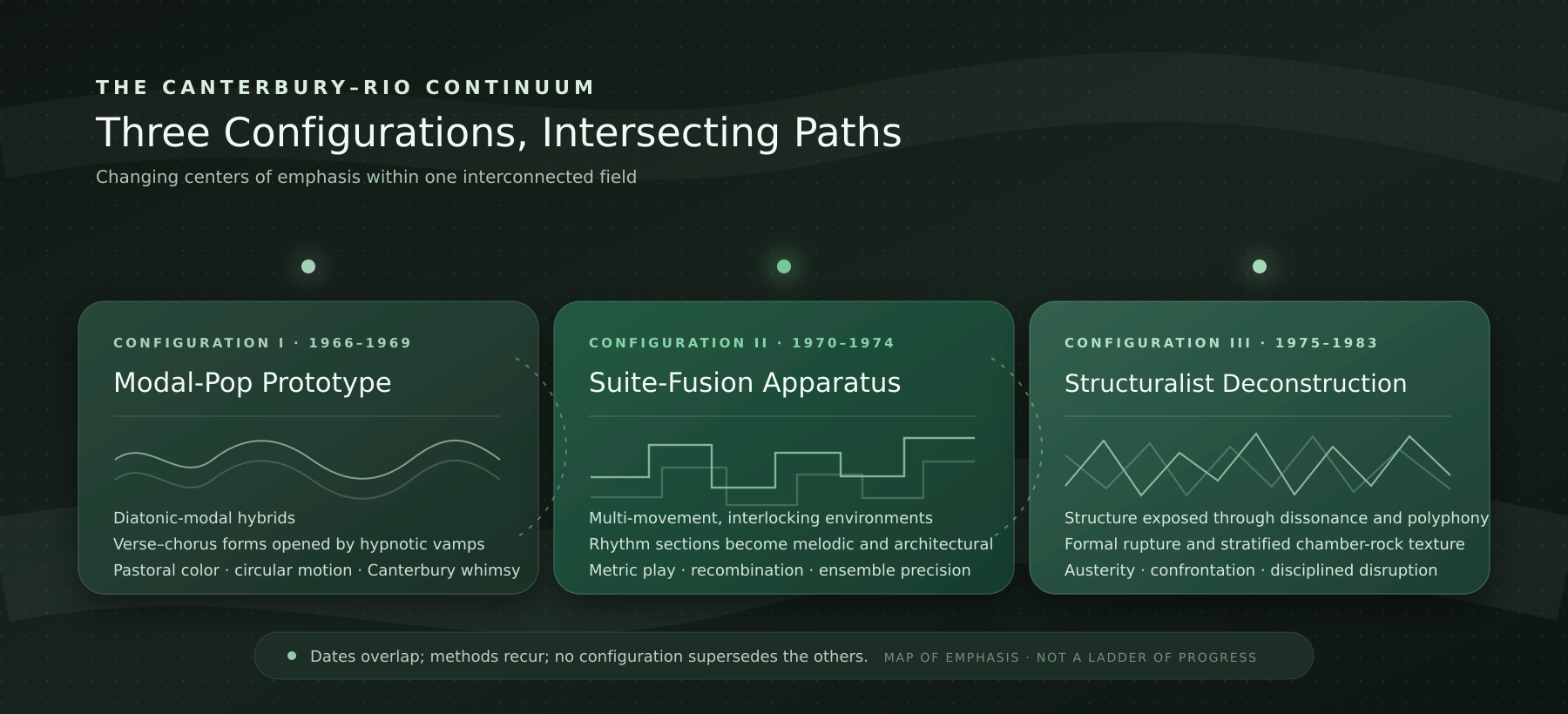
Focus: The origin of the “Whimsy” code.
The first configuration examined here becomes especially visible in the late 1960s, when small, loosely organized bands experiment with a vocabulary situated between American rhythm and blues, emerging jazz modalism, psychedelic pop, and the particular sensibilities of the British underground. The Modal‑Pop Prototype names this cluster of practices rather than a uniform first stage followed by every ensemble. The music remains outwardly close to contemporary pop and rock, yet already displays a subtle shift in attitude. Songs move through diatonic and modal vamps, rhythms are often hypnotic and circular, and textures retain a distinctive lightness. Within these familiar frameworks, musicians begin exploring relationships among melody, harmony, language, and ensemble interaction that will remain available throughout the Canterbury field.
At the heart of this phase is the transformation of the diatonic‑modal vamp into a vehicle for what we might call Canterbury whimsy. Instead of using modal harmony simply as a platform for blues‑derived soloing or psychedelic expansion, these early groups begin to treat it as a canvas for surreal, self‑aware lyricism and gently crooked melodic lines. The “whimsy” is not mere eccentricity; it is a rhetorical strategy. Lyrics drift toward the absurd, the self‑deprecating, the oddly specific. Melodies trace unexpected contours, avoiding the obvious resolutions of pentatonic rock in favor of more floating, pastoral shapes. The continuum’s language is defined by structural density, sardonic surrealism, and a rigorous, collective logic, and in this first phase we hear the earliest articulation of that sardonic surrealism, still wrapped in the softer clothing of modal‑pop.
This emerging Whimsy Code operates on two levels. On the surface, it presents itself as playful, even casual: songs about everyday situations, delivered with a light touch and a sense of humor that refuses grandiosity. Beneath the surface, however, it signals a growing intellectual distance from the blues‑rock mainstream. By prioritizing modal harmony over pentatonic riffing, these musicians quietly shift the center of gravity away from the guitar‑hero paradigm that dominates the era. The keyboard begins to move toward the foreground, not just as a source of color but as a lead voice capable of defining the harmonic environment. This keyboard‑as‑lead tendency, still embryonic in the modal‑pop prototype, will later become one of the continuum’s structural signatures.
Structurally, the compositions of this phase often rely on circular rhythmic patterns that create a sense of gentle hypnosis. Vamps repeat with small variations; grooves settle into steady, unhurried motion; sections loop in ways that invite extended improvisation without demanding dramatic formal shifts. Within these loops, players begin to test the boundaries of the emerging system: how far can a melody bend before it breaks the mood, how much dissonance can be introduced into a chord without disrupting the pastoral atmosphere, how can a keyboard line lead without overwhelming the ensemble? This period functions as an “R&D stage” in which ideas are tried, stretched, and sometimes abandoned, allowing the scene to discover which gestures feel true to its developing identity.
The significance of the modal‑pop prototype lies precisely in this research function. It is the phase in which the scene’s distinct melodic identity—the so‑called “Canterbury pastoral”—is encoded. By choosing modal over pentatonic, whimsy over myth, and keyboard‑centric textures over guitar‑dominated ones, these early experiments establish a set of preferences that will shape everything that follows. The music remains accessible, tuneful, and often charming, but it carries within it a quiet refusal of the prevailing logic of the time. It suggests that pop‑adjacent songs can be vehicles for subtle structural inquiry, that humor can coexist with seriousness, and that small ensembles can begin to think architecturally even before they fully leave the orbit of mainstream forms.
Viewed retrospectively, the Modal‑Pop Prototype establishes one of the continuum’s most durable possibilities: the ability to carry structural curiosity within warmth, melody, humor, and apparently familiar forms. It should not be understood merely as a gentle prelude to the denser architectures discussed below. Its pastoral sonorities and compact songs constitute a complete musical solution in their own right, and their qualities continue to reappear long after more elaborate formal systems become available. The Whimsy Code does not vanish when the labyrinth grows more intricate; it remains one of several routes through it.
Focus: The maturation of metric displacement.
During the early 1970s, another configuration becomes increasingly prominent: the multi‑movement suite. The circular grooves and stable harmonic environments associated with the Modal‑Pop Prototype do not simply disappear; many continue inside larger structures or coexist with them elsewhere in the Canterbury field. The Suite‑Fusion Apparatus identifies a growing emphasis on forms in which contrasting sections are juxtaposed, transformed, and recombined with increasing architectural ambition. Instead of extending a single idea, composers design sequences of interlocking environments, each possessing its own rhythmic logic, harmonic climate, and textural profile. The music begins to think in chapters rather than pages, asking the ensemble to navigate those chapters with precision.
Within this shift, certain ensembles act as engines for change, demonstrating how the small‑band format can sustain large‑scale design. The move from psychedelic jazz‑pop toward rigorous, through‑composed architectures provides a kind of master blueprint for the scene: a proof that the rock‑derived quartet can carry the weight of complex form without resorting to symphonic imitation. Following this lead, groups across the continuum begin to push musicological complexity toward a point where it demands high‑level ensemble coordination. The suite is no longer a loose string of songs; it is a carefully articulated apparatus in which transitions, reprises, and contrasts are all structurally motivated.
The increasing use of the suite is neither an abrupt break with the earlier vocabulary nor the inevitable culmination of it. It represents one response to possibilities already present within the field. Modal harmony, surrealist rhetoric, keyboard‑centered texture, compact song, and pastoral melody remain active even as some composers pursue more intricate rhythmic and formal designs. Within the Suite‑Fusion Apparatus, rhythm increasingly becomes an active parameter of composition: meters change, overlap, and fracture; accents are displaced; and phrases cut against the grain of the underlying pulse. The listener’s sense of “where the beat is” becomes a field of play rather than a fixed reference point.
This evolution gives rise to what we might call the Suite‑Fusion Apparatus: a way of writing in which irregular time signatures, multi‑part counterpoint, and layered rhythmic cells are deliberately integrated into the rock‑quartet format. The apparatus is not fusion in the commercial sense—there is no attempt to smooth over differences between styles—but fusion in a structural sense, where techniques from jazz, contemporary classical music, and earlier modal‑pop experiments are woven into a single, coherent system. Certain works in this period achieve a level of architectural coherence that marks them as turning points in the continuum’s development; the suite‑fusion apparatus is the mechanism by which that coherence is achieved.
A crucial aspect of this phase is the redefinition of rhythm’s role within the ensemble. The period sees a pronounced “rhythm‑as‑melody” shift. Drummers and bassists, particularly within lineages influenced by the more experimental small‑band work of the time, cease to function as mere time‑keepers. They become essential nodes in a complex metric grid, articulating patterns that are as structurally significant as any melodic line. Bass figures outline shifting accents; drum parts trace asymmetrical cycles; the interplay between the two can create the sensation of multiple pulses coexisting. Compositions are designed as narrative machines that can move from pastoral melodic release to jarring, dissonant rhythmic displacement without losing internal continuity. The story is told as much through changes in feel and meter as through changes in theme.
The move toward the suite also forces a profound professionalization of the Composer‑Performer paradigm introduced earlier. To realize these complex forms, bands require intense, chamber‑like rehearsal schedules. Pieces must be internalized not just as sequences of chords and melodies, but as maps of transitions, metric shifts, and textural reconfigurations. Players learn to feel odd meters as natural, to navigate sudden cuts without hesitation, to maintain warmth and expressivity even as they execute demanding structural maneuvers. The ensemble environment becomes a stress field in which the system’s capacities are tested; Phase II is where that stress becomes a daily practice.
The Suite‑Fusion Apparatus therefore represents a major expansion of the continuum’s architectural vocabulary, not the replacement or maturation of everything that preceded it. Metric displacement, multi‑movement design, rhythm‑as‑melody, and the intensified discipline of the Composer‑Performer make new kinds of ensemble behavior possible. Yet compact song, modal circularity, lyrical warmth, and playful rhetoric remain equally viable. Different groups combine these resources in different proportions, and some move freely between them. The labyrinth expands by opening additional corridors rather than by sealing the earlier ones.
Focus: The RIO‑adjacent “Brutalist” architecture.
From the mid‑1970s into the early 1980s, a further configuration becomes particularly visible in RIO and related experimental chamber‑rock practices. The term Structuralist Deconstruction identifies music in which harmonic, rhythmic, and textural organization is exposed with unusual directness. In some works, the fusion‑inflected warmth prominent elsewhere gives way to a cooler and more austere language; in others, severity, humor, lyricism, noise, and theatrical interruption coexist. This Brutalist architecture should not be heard as the final form latent within the preceding phases. It is one radical response to a shared set of compositional questions, pursued alongside other approaches that continue to develop on their own terms.
This intensified structuralism extends certain possibilities of the Composer‑Performer paradigm without constituting its necessary or logical conclusion. When performers participate directly in shaping form, and when notation, rehearsal, improvisation, and studio construction can all become compositional resources, some ensembles choose to subject those resources to unusually rigorous organization. Earlier experiments with dissonance, metric complexity, formal rupture, and stratified texture provide useful precedents, but the later music transforms them according to different aesthetic and political priorities. Harmonic grids, stratified planes, dense counterpoint, and saturation become available as methods—not as the destination toward which the entire continuum had always been moving.
The key characteristic of this period is a deliberate detachment from the fusion warmth that had previously mediated the relationship between complexity and accessibility. Where earlier phases often wrapped intricate structures in pastoral melodies, analog softness, or playful rhetoric, Phase III increasingly strips away these buffers. The harmonic language shifts toward vertical stacks that foreground tension rather than resolution. Chords are built as stratified clusters, with each voice occupying a carefully chosen register; the resulting sonorities can feel stark, even severe, but they are meticulously organized. Dissonance is no longer a side effect of improvisation or a momentary coloristic choice; it becomes the primary material of composition, the substance from which entire sections are carved.
This emphasis on harmonic stratification reshapes the ensemble’s internal economy. Musicians function as specialized nodes within an increasingly rigid, notation‑heavy apparatus. Lines are assigned with surgical precision; registral placement is treated as a structural decision rather than a matter of taste; rhythmic roles are tightly specified to ensure that the vertical stacks remain intelligible even at high density. The music grows more detached, more clinical, more overtly cerebral—but this detachment is not a lack of feeling so much as a shift in how feeling is carried. Emotional weight is transferred from melody and lyric to the experience of navigating complex, sometimes forbidding structures: the sensation of being inside a grid that is both beautiful and demanding.
In parallel, the studio is pushed to its limits and reconceived as an instrument for extreme layering. Multi‑tracking, tape editing, and meticulous overdubbing are used not merely to polish performances, but to construct textures that transcend what a single ensemble could physically realize in real time. Planes of sound are stacked, offset, and interlocked; saturation is carefully controlled; spaces are carved out within dense mixes to allow certain lines to emerge while others remain embedded in the harmonic mass. This period can be seen as a high‑pressure laboratory in which the system’s formal components are tested under conditions of maximum strain. The Brutalist architecture is not only written; it is engineered.
The significance of this configuration lies in its demonstration that small‑ensemble electric music can sustain exceptionally explicit forms of structural rigor while resisting conventional expectations of accessibility and marketability. Its dissonance, stratification, notation, collective discipline, and formal disruption establish a distinctive chamber‑rock language. Yet these practices neither complete nor invalidate the warmer, more melodic, improvisatory, or song‑based approaches found elsewhere in the continuum. They occupy another corridor of the same labyrinth—more austere and deliberately resistant, but neither more final nor more fully developed than the paths running beside it.
These three configurations provide a structural spine for the analysis, but they should not be read as a ladder of artistic progress or as a single evolutionary sequence followed by every ensemble. The Modal‑Pop Prototype, the Suite‑Fusion Apparatus, and Structuralist Deconstruction identify changing centers of emphasis within an interconnected field. Their dates overlap, their methods recur, and none permanently supersedes the others. Together they reveal how related musical questions could generate contrasting solutions—from pastoral song and circular modal play to large‑scale suite architecture and austere chamber‑rock construction—without culminating in one definitive form.
Across parts of the Canterbury/RIO continuum, the distinction between “writing” and “capturing” becomes increasingly porous. The recording studio does not always function simply as a neutral environment in which a completed performance is documented. On particular albums—and to markedly different degrees—it becomes a laboratory for compositional synthesis: a place where sequence, texture, density, timbre, and musical time can be reorganized after the initial act of performance. Tape editing, overdubbing, signal processing, and spatial placement therefore join composition, rehearsal, improvisation, and live ensemble interaction as possible methods of constructing form.
This practice was neither universal nor uniform. Much of the music examined in this study remained fundamentally dependent upon intensive rehearsal, real-time ensemble execution, and the responsive intelligence of the Composer‑Performer. Some recordings closely preserve performances that could also exist onstage; others use the studio more decisively to create relationships that could not be reproduced in precisely the same form. “Studio‑as‑Composer” should therefore be understood as one important tendency within the continuum—a variable compositional resource rather than its single governing methodology.
Where studio construction becomes especially active, tape and multi‑track recording can do more than improve fidelity or clarify an existing arrangement. They can participate in determining the recorded work’s form. Editing may regulate duration and sequence; overdubbing may create instrumental combinations unavailable to the performing ensemble; changes in balance and placement may reveal relationships that would remain less distinct in an untreated recording. The studio becomes not the replacement for performance, but an additional level at which performed material can be selected, combined, and interpreted.
One consequence is the availability of non-linear assembly as a compositional technique. Separately recorded passages can be joined, reordered, abbreviated, or placed in abrupt succession according to the needs of the album. In some works, this permits changes of meter, harmony, texture, or instrumentation to occur with a precision that would be difficult to reproduce continuously in performance. In others, editing is less conspicuous, serving mainly to refine a transition or establish the proportions of a larger sequence. The importance of the technique lies not in the assumption that the music could not be played, but in the possibility that the recorded form may acquire a logic distinct from any single live realization.
Multi‑track recording can likewise contribute to layered frequency stratification. Overdubbed keyboards, guitars, winds, voices, and percussion may be distributed across contrasting registral and timbral zones, allowing the recording to sustain textures denser than those produced by the group’s performing line-up alone. At its most elaborate, this process creates something resembling an engineered acoustic architecture: low anchors, active middle planes, and upper-register tracers remain perceptually differentiated even within a saturated field. Not every recording pursues this degree of stratification, but where it occurs, studio balance becomes integral to the listener’s perception of musical structure.
Techniques associated with musique concrète and electroacoustic practice also enter portions of this rock-derived environment. Tape-speed alteration, reverse playback, looping, filtering, re-amping, and other transformations can change the temporal or spectral identity of recorded sound. A performed phrase may become a sustained texture; an instrumental attack may be reversed into a swelling entrance; a repeated fragment may create continuity without conventional harmonic development. Such devices do not define the entire continuum, and their use varies considerably among artists. Where they do appear, however, they expand the range of structural states available within the recorded work.
The album can consequently become more than a transparent record of ensemble activity. It may establish one fixed and repeatable realization from materials that remain flexible in rehearsal or performance. Edits, balances, overdubs, and sequencing decisions become part of the work’s durable public identity, even when the underlying compositions continue to change onstage. The recording is therefore not necessarily an inviolable or definitive object; it is one authoritative configuration of the music—sometimes largely performative, sometimes extensively constructed, and often situated between those poles.
This interaction between studio construction and ensemble performance helps preserve the human grain of the music. Even highly manipulated passages may retain the touch of a keyboardist, the pressure of breath, the physical character of percussion, or the instability of musicians responding to one another. Studio intervention need not eliminate those qualities. It can frame, repeat, magnify, or reposition them, allowing performed gestures to acquire functions they did not possess at the moment of execution. In this sense, the studio becomes a compositional participant: capable of extending performance without becoming a universal substitute for it.
Within the broader field considered here, Rock in Opposition marks the point at which questions of musical organization, production, and distribution become associated with an explicitly articulated political and economic position. The original RIO participants were distinct musicians and ensembles rather than representatives of a completely uniform aesthetic. Nevertheless, their alliance made visible a shared practical problem: how could formally ambitious and commercially marginal music be created, circulated, and sustained when established industry structures offered it little support?
Some of this resistance can be heard in the music’s refusal of easily standardized formats. Asymmetrical forms, extended durations, abrupt contrasts, dissonant languages, and unusual combinations of composition and improvisation often sit uneasily beside the requirements of radio programming and predictable marketing. These characteristics should not automatically be interpreted as acts of political defiance; they may arise from independent musical priorities. Within the specific institutional context of RIO, however, formal autonomy and economic opposition could reinforce one another. The difficulty of packaging the music became inseparable from the effort to preserve the conditions under which it could exist.
The alternative structures surrounding the music were therefore as significant as any single compositional technique. Independent labels, musician-organized concerts, cooperative distribution, and international alliances provided practical means of operating beyond the most restrictive parts of the commercial system. These arrangements did not abolish leadership, disagreement, or unequal compositional responsibility, nor did every ensemble function as a “laboratory of equals.” They did, however, create spaces in which musicians could exercise greater control over production, presentation, and circulation.
Studio practice could participate in this autonomy, but no particular technique carried an inherently oppositional meaning. An overdub, tape splice, or dissonant cluster was not, by itself, a political refusal; identical procedures could appear in commercial and experimental settings alike. Their significance depended upon the larger system in which they operated: who controlled the recording, what musical possibilities the technique enabled, how the result was distributed, and which institutional pressures it accepted or resisted. Politics resided not in the device alone, but in the relationship among aesthetic choice, collective labor, ownership, and access.
The most austere RIO-associated music can consequently be understood as one form of structural resistance rather than the inevitable political conclusion of the Canterbury/RIO continuum. Its density, discontinuity, and resistance to familiar resolution ask for forms of attention that commercial listening environments do not always encourage. Yet melody, humor, accessibility, and warmth are not inherently compliant, just as difficulty is not inherently radical. Opposition emerges from the way musical and institutional choices operate together, not from a simple contrast between approachable and demanding sound.
The methodology described as “Studio‑as‑Composer” is therefore best understood as a spectrum of practices. For some artists and recordings, the studio primarily preserves the achievements of a performing ensemble; for others, it reorganizes those achievements into forms that exist most fully on record. At certain moments it also supports a wider effort to retain artistic and economic independence. The studio is neither a neutral container nor a universal meta-composer. It is a contingent creative environment whose significance depends upon how particular musicians use it to negotiate performance, construction, collaboration, and control.