“All White”
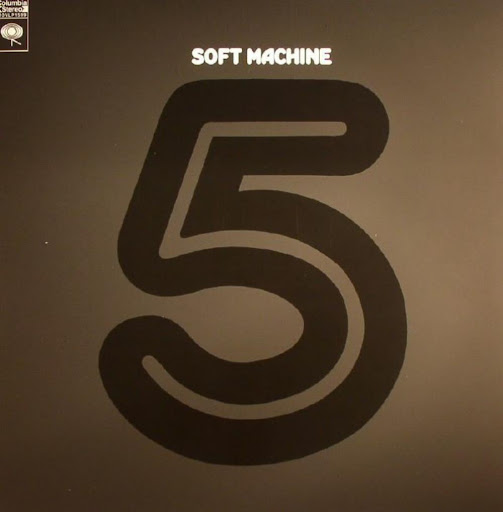
- Artist
- Soft Machine
- Album
- Fifth
- Year
- 1972
“All White” opens Fifth with a music of unusual patience. Its first minutes do not announce themselves through a theme in the conventional sense, a groove, or a dramatic ensemble gesture, but through the gradual accumulation of presence: a melodic line, a lingering shadow of that line, slow movement below, and eventually the arrival of shared time. The track’s direction becomes clear only in retrospect, as elements that first seem simply to coexist begin to acquire increasingly specific relationships with one another. What initially feels spacious and almost suspended will, by the end, have become one of the album’s most tightly coordinated processes.
Within This Track Study
I. Opening — When Stability Does Not Yet Mean Constraint
At first hearing, “All White” can seem to describe a straightforward movement from openness toward organization. Elton Dean begins in an unusually spacious foreground; the ensemble gradually fills around him; pulse, chords, and eventually a tightly coordinated ending emerge. Yet that apparent progression from freedom to constraint mistakes increasing specification for the arrival of structure itself. The opening is already highly organized, and the fuller ensemble that follows does not initially restrict Dean's independence. On the contrary, some of the track's most stable collective relationships make that independence sustainable. The central question is therefore not when organization appears, but what different kinds of stability allow the music to do.
That distinction matters especially because several kinds of regularity become audible without doing the same work. A stable pulse need not produce a strongly projected phrase hierarchy; repetition need not become formally consequential merely because it is audible; and a foreground voice can dominate the listener's attention without carrying every responsibility for the music's continuation. “All White” repeatedly keeps these things apart. Stability can provide orientation without rigidity, and recurrent information can remain local until the behavior of other players begins to change around it. The form becomes intelligible not by measuring how much structure is present at any moment, but by hearing how that structure shapes the space in which the players can continue—what it permits, what it supports, and what it gradually begins to constrain.
The LP recording studied here is Mike Ratledge's composition as realized by Elton Dean on saxophone, Mike Ratledge on keyboards, Hugh Hopper on bass, and Phil Howard on drums. Documentary evidence identifies Dean's instrument in the opening specifically as saxello; where the recording does not otherwise require a more exact instrumental identification, this study retains the broader designation of saxophone.
That distinction points toward the larger paradox of the track without resolving it in advance. “All White” will eventually become more collectively specified, but collective specification is not what first makes the music coherent. Nor does increasing ensemble participation simply replace individual freedom with common order. Instead, the same kinds of stability gradually begin to do different things. Before any shared pulse has been negotiated, before chordal accompaniment has become explicit, and before the ensemble can distribute responsibility among several instruments, one melodic voice already possesses enough identity to make time, harmony, and space audible around it.
II. Before the Ensemble Shares Time
Approximately 0:00–1:57
“All White” begins by locating musical identity almost entirely in Dean's line. Melody, modal centering, long duration, and the residual presence of its delayed image are enough to make the opening feel complete before the ensemble has established any common pulse. What follows is therefore not a passage from disorder into structure, but a gradual redistribution of how structure is carried. Dean first changes the behavior of the material that has defined the opening, compressing melodic identity into increasingly insistent recurrence. Howard then gives that motion an independently recoverable pulse, and Ratledge's arrival makes the harmonic field explicitly chordal. The transformation accumulates rather than replaces: each new layer preserves something of the condition already in progress while adding a form of organization that no longer depends on Dean alone.
a. One Voice, Extended in Time
Approximately 0:00–1:39
Before “All White” acquires a shared pulse, Dean's line already gives the music a strong and surprisingly complete identity. The melody enters almost at once, slow and solemn, and its coherence comes less from literal phrase repetition than from a recurring set of pitch relationships, contours, and returns. E functions as the principal reference pitch, while F-natural repeatedly presses against it from a semitone above. That relationship gives the opening an unmistakable modal tension, but the passage is better heard as an E-centered modal field with pronounced Phrygian coloration than as a strict statement of E Phrygian. The melody does not need to expose an entire scale systematically. Its identity is carried more economically, through the gravitational weight of E, the recurrent friction of F-natural–E, and a vocabulary of stepwise and often descending motion that allows individual phrases to differ while remaining recognizably part of the same world.
Beneath Dean, a low sustained voice moves at a radically slower rate. It does not hold one continuous pedal and does not behave like a conventional bass line. Instead, long tones appear, persist, and eventually give way to other long tones, producing a moving drone-like foundation whose harmonic changes are sparse enough to feel less like a progression than like slow changes in the ground beneath the melody. Its precise source remains unresolved: organ is plausible, bass remains possible, and the recording does not require a firmer attribution. What matters formally is the disproportion between its slow rate of change and Dean's melodic activity. The low voice provides enough continuity and registral grounding for the saxophone to range above it without having to negotiate a sequence of explicit chords.
Dean's direct saxello line is accompanied through the opening by a weaker, left-weighted delayed image roughly half a second behind it. Documentary evidence identifies the effect as Echoplex, confirming that the doubling heard on the LP is an electronically delayed image of Dean's line rather than a second independent instrumental voice. Because the delayed sound can persist after Dean has moved to another pitch, successive melodic events sometimes overlap vertically. A line that is fundamentally horizontal therefore leaves brief harmonic residues in its wake: the present note can coexist with its immediate past. The effect is not simply ambience. It gives the opening greater spatial breadth, prolongs the life of individual gestures, and turns duration itself into part of the sonority. At the same time, the delayed image remains clearly subordinate to Dean's direct sound, so the listener still hears one principal melodic voice rather than two independent lines.
Nothing in this opening requires an explicit beat-bearing layer. There are no drums or cymbals, and the low foundation does not articulate a recurring rhythmic pattern from which a shared pulse can be inferred. Yet the absence of pulse is not an absence of temporal organization. Dean's phrases have shape; held notes, pauses, returns toward the E-centered field, and the persistence of the delayed image all produce expectation. What they do not produce is a regularly recoverable larger cycle. Phrase identity is audible, but phrase periodicity is not. Time is therefore organized through duration and melodic consequence rather than through a common metrical grid.
This is what makes the opening more than a sparse preface to the ensemble music that follows. Dean is highly independent, but that independence does not amount to formlessness. His melody supplies identity; the modal center supplies orientation; the slowly moving low sustain establishes a harmonic floor; and the delayed image allows each gesture to remain partially present after it has sounded. The opening gives one melodic voice enough space to define a world before the ensemble begins sharing its time.
b. Melody Becomes Motion
Approximately 1:39–1:43
Around 1:39, the opening changes first from within Dean's own line. The long, spacious gestures that had allowed pitch relationships and duration to carry the music's identity contract into a short two- or three-note cell. Dean repeats it almost immediately, then shortens the space between successive statements. The pitch world has not suddenly been replaced; what changes is the behavior of material that already belongs to it. Recurrence, which had previously helped make the opening recognizable through returning intervals, contours, and points of repose, now begins to generate forward motion.
That shift is more consequential than simple phrase shortening. The repeated cell starts to organize expectation through its rate of return. Each recurrence makes the next one easier to anticipate, while the accelerating spacing gives the passage a direction that the opening's longer durations had deliberately withheld. The melody is beginning to make time move differently: Dean no longer merely inhabits the opening field but turns one of its characteristic resources—recurrence—into propulsion.
Yet this is still a transition rather than a new stable condition. No independent pulse-bearing layer has appeared, and the music has not yet acquired the shared temporal reference that will shortly allow Dean's phrases to operate against something outside themselves. Dean begins the transition before the rhythm section does. What had been stable enough to sustain melodic spaciousness is now being compressed into motion, preparing a form of temporal organization that his line alone does not yet fully provide.
c. Howard Makes Time Explicit
Approximately 1:43–1:57
Howard enters into a transition that Dean has already set in motion. The saxophone’s repeated cell has begun to accelerate, so the sense of forward motion precedes the drums. What Howard adds is not acceleration itself but an independent temporal reference. For the first time in the track, pulse no longer has to be inferred from the spacing and recurrence of Dean’s phrases. It becomes available as a shared condition.
That distinction gives the entrance more structural weight than a simple increase in density. Dean’s repetition had made time increasingly directional; Howard makes that direction countable. The pulse becomes perceptible quickly enough that the music acquires a new kind of temporal stability even while the transition remains incomplete. Dean continues developing the material above it, and the slowly changing low sustained voice remains present beneath it, so the older condition has not simply disappeared. Instead, a new layer of organization is added to what is already in motion.
The result is cumulative rather than abrupt. Howard does not replace Dean as the source of temporal meaning, nor does the drum entrance erase the spaciousness from which the transition emerged. It changes what Dean is now free to do. Once pulse can persist independently, the saxophone no longer needs to carry temporal legibility through phrase duration alone. Dean generates the acceleration; Howard converts that motion into a shared pulsed condition. The transition has acquired a common temporal infrastructure, but its harmonic articulation is not yet complete.
d. Harmony Becomes Explicit
Approximately 1:57
Around 1:57, Ratledge's percussively articulated chords become unmistakable, completing the transition into the full ensemble field. The change is not from harmony to no harmony, or vice versa. Harmonic identity has been present from the beginning through Dean's modal centering, the slowly changing low tones beneath him, and the temporary vertical intervals created by the delayed saxophone image. What Ratledge adds is a different degree of specification: harmony now becomes audible as a clearly articulated chordal layer.
That difference changes the conditions under which Dean can continue. Howard has already made pulse independently available; Ratledge now supplies an equally explicit harmonic layer while the low register becomes clearer as recurrent support beneath it. Dean remains the foreground voice, but he no longer has to carry so much of the music's harmonic and temporal intelligibility himself. The transition has accumulated its new infrastructure in stages—recurrence, then pulse, then chords—without requiring the preceding world to disappear all at once. Howard makes time explicit; Ratledge makes harmony explicit.
Sectional Conclusion. The opening does not move from formlessness into organization, but from one mode of organization into another. At first, Dean's E-centered modal line carries most of the music's recognizable identity, while the slowly changing low foundation and delayed self-overlap give that identity harmonic depth, temporal persistence, and spatial breadth without establishing a shared pulse. Around 1:39, Dean changes the function of recurrence itself: a feature that had helped preserve melodic identity begins generating propulsion. Howard then makes that emerging motion independently legible as pulse, and Ratledge adds explicit chordal articulation. The transformation is cumulative. Each new layer takes over part of the burden previously carried by Dean's phrasing, so that greater collective stability does not yet diminish his independence; it creates the conditions under which that independence can become more extensive.
From Shared Time to Supported Freedom. By 1:57, temporal and harmonic orientation no longer depend primarily on Dean's line. Pulse can continue beneath him, low harmonic support can persist, and chordal articulation can define a broader field without requiring his phrases to carry the music's entire sense of direction. The next question is therefore not whether the ensemble has become more organized, but what becomes possible once that organization is stable enough to support a foreground that no longer has to explain the world around it.
III. Freedom Inside a Stable Field
Approximately 1:57–4:22
Once the full ensemble field has formed, “All White” enters its longest sustained condition. What holds this span together is not surface sameness. Dean's lines lengthen and loosen their connection to the opening melody; Howard's articulation shifts constantly within the pulse; Ratledge changes chordal color and density; Hopper adjusts locally beneath them; and the ensemble as a whole passes through substantial changes in intensity. Yet those changes do not replace the relationships that make the music intelligible. Howard continues to carry temporal continuity, Hopper preserves a low harmonic reference, Ratledge keeps the harmony mobile but explicit, and Dean remains the principal independent melodic foreground.
The stability of the field therefore lies in differentiated responsibility rather than repeated material. No single layer has to reproduce the same figure, phrase, or cycle for the music to remain coherent. What matters is that each layer continues to provide a dependable kind of information while allowing considerable freedom in how that information is realized. This is the central paradox of the track in its clearest form: the ensemble becomes more fully organized, yet Dean becomes capable of greater independence precisely because pulse, harmonic grounding, and chordal articulation no longer depend on his line to remain legible.
The middle will intensify markedly before 4:22, but intensity alone will not create a new formal condition. Its coherence survives because the responsibilities underneath the changing surface persist. The question for this section is therefore not how many things change, but how much change these stable relationships can absorb before the way the music carries itself forward begins to change.
a. A Field Strong Enough to Be Left Alone
Approximately 1:57–2:30
Once Ratledge's chords become fully present, the ensemble settles into a condition in which several different kinds of stability can coexist without collapsing into one common pattern. Dean remains the principal melodic foreground, but he no longer carries the whole burden of making the music intelligible. Howard keeps a recoverable pulse in place beneath him; Hopper supplies a recurrent low harmonic reference; Ratledge gives that harmonic field a more explicit chordal surface. Each layer now contributes a dependable kind of orientation, and none of them requires Dean to phrase in lockstep with it.
That redistribution of responsibility changes what Dean's freedom can mean. In the opening, his independence was inseparable from the fact that so little else was being asked to organize the field. Here, by contrast, the ensemble is fuller and more explicitly structured, yet Dean can range more freely because temporal and harmonic continuity no longer depend primarily on his line. Early in the span, traces of the opening melody remain audible in his vocabulary, but they are already being stretched, varied, and absorbed into a broader improvisational language. The music retains connection with what came before without requiring Dean to keep restating it.
The crucial point is that increased structure does not reduce possibility. It enlarges it. Howard can preserve the beat without dictating Dean's phrase shape; Hopper can hold the low harmonic field without turning it into a recurring formal cycle; Ratledge can make harmony explicit without forcing a fixed progression. Their functions are stable enough to be trusted and open enough not to prescribe Dean's next move. The ensemble does not surround Dean with freedom by withdrawing structure; it gives him freedom by making certain structures dependable.
By roughly 2:30, the direct thematic pull of the opening has begun to weaken, but the condition that supports Dean's independence remains intact. What has become stable is not a repeated phrase or fixed sequence of events, but a set of relationships capable of continuing while the foreground becomes increasingly less bound to the material that first defined it.
b. Pulse Without Phrase
Howard's stability is easiest to hear at the level of the beat. Once the full ensemble condition is established, a common pulse remains readily recoverable even as the surface becomes increasingly active. What changes most is not the existence of that pulse but the way it is articulated. Accents shift, subdivisions vary, attack density expands and contracts, and local groupings can pull attention away from any simple sense of regularly reinforced strong beats. The underlying temporal stream remains dependable while its internal hierarchy stays comparatively mobile.
That distinction matters because it separates temporal continuity from metric prescription. Howard does not continually announce a fixed downbeat pattern or make a larger bar structure equally obvious from one passage to the next. Individual rhythmic shapes can be clear without combining into a strongly projected recurring phrase cycle. The listener can usually feel that the next beat will arrive without being equally certain where that beat stands inside a larger repeated unit. Beat-level continuity is therefore stronger than phrase-level hierarchy.
That distinction also has documentary support beyond this performance. Contemporary and retrospective accounts of Howard repeatedly describe rhythmic structures that could remain implied beneath several simultaneous layers, and phrases conceived across multiple bars rather than continually reinforced at the bar line. Such descriptions do not prove the organization of “All White” by themselves, but they closely match what the LP makes audible here: common pulse can remain intelligible while Howard's larger phrase articulation moves on a longer and less regularly marked scale.
This gives Dean an unusual degree of temporal independence without detaching him from the ensemble. His phrases can begin, extend, or break across Howard's strongest accents because the pulse does not depend on those accents being reinforced in the same way each time. He can move against the surface organization of the drums while remaining inside the same temporal field. The drumming therefore does not make time unstable; it keeps articulation within a stable pulse highly mobile.
The distinction also helps explain why the middle can sound open without sounding temporally unmoored. Stability here does not mean that every level of time is equally specified. The pulse remains reliable while larger grouping stays comparatively negotiable. The beat persists; what remains less fixed is how that beat is gathered into accents, measures, and longer spans. That asymmetry is one of the conditions that allows the ensemble to remain coherent while Dean's foreground becomes increasingly independent.
c. The Ground Holds Without Becoming a Cycle
Hopper contributes to the stability of the central field by changing less than the layers above him. His low-register activity remains comparatively restricted, returning repeatedly to a small group of harmonically supportive pitches and sustaining them long enough to function as reference points rather than as an independent melodic line. The result is not a conventional ostinato and not a recurring bass pattern that parcels the music into formal units. It is a persistent harmonic floor: a low register against which Ratledge’s changing sonorities and Dean’s increasingly independent phrases can remain intelligible.
That distinction is important because recurrence at the bass level does not automatically become formal periodicity. Hopper’s repeated or sustained pitches can reinforce a harmonic region without announcing where a larger phrase begins or predicting the length of the next one. His function is therefore stabilizing without becoming a clock for the form. He helps preserve continuity without supplying a cycle through which the listener can measure the passage. Even when his placement varies locally, the broader role remains intact.
The two functions are distinct: the drums make temporal continuity available through pulse, while Hopper makes harmonic orientation durable through the low field. The two functions complement one another without requiring their accents to coincide mechanically. A listener can recover the beat through Howard while recovering the harmonic floor through Hopper, even when neither player consistently marks the same larger boundaries. Their stability therefore resides in different dimensions.
Hopper’s importance lies precisely in this refusal to become a formal clock. He stabilizes the floor without drawing the plan. By preserving harmonic grounding without imposing a recurring bass cycle, he allows substantial change above him without forcing that change to sound like departure from one harmonic world into another. The central field can remain open because its ground is dependable without being prescriptive.
d. Chords Without a Fixed Progression
Ratledge’s chords give the central field a more explicit harmonic shape, but they do not organize it as a recurring progression. The sonorities remain mobile: sometimes relatively open and intervallic, sometimes more compact or triadic, sometimes thickened by chromatic inflection or denser voicings. Their coherence lies less in a repeated sequence of functional changes than in the way they keep defining a harmonic environment around Dean as the foreground continues to move.
That distinction allows Ratledge to constrain Dean without prescribing him. The chords limit which pitches or intervallic relations will sound grounded at a given moment, but they do not strongly determine the length of Dean’s phrases, the contour of his lines, or the placement of his attacks. Dean can respond closely to the harmonic field in one gesture and move more obliquely against it in the next without ceasing to belong to the same ensemble condition. The chords can become more clearly defined without Dean’s line becoming correspondingly more fixed.
This marks an important change from the opening without requiring a conventional harmonic narrative. Earlier, the music possessed a strong center without explicit chordal accompaniment. Here, it possesses chords without a fixed progression. Ratledge makes the harmonic field more articulate while preserving enough mobility that no repeated sequence begins to dictate the form from below.
His stability is therefore of a particular kind. Ratledge does not make harmony static; he makes harmonic orientation continuously available. Because that orientation can change without becoming a closed cycle, Dean is free to extend, interrupt, redirect, or intensify his phrases without losing the sense that they still inhabit a common harmonic world.
e. The Melody Outgrows Its Opening
As the middle proceeds, Dean’s connection to the opening melody becomes progressively less literal. Early after 1:57, enough of the original vocabulary remains for the new phrases to sound like an expansion of what has already been established. But by roughly 2:30, that relationship is much weaker. E-centeredness still matters broadly, yet the specifically Phrygian coloration that had given the opening much of its identity no longer governs the foreground with the same force. Dean’s line has moved into a more extended improvisational language.
What changes here is what Dean is playing, not the role his playing occupies. He may no longer sound as though he is continuously developing the opening melody, but he remains the same independent melodic foreground above Howard’s pulse, Hopper’s low harmonic grounding, and Ratledge’s chordal field. Thematic continuity weakens before functional continuity does.
That distinction is central to the coherence of the middle. If continuity depended primarily on motivic persistence, Dean’s increasing distance from the opening would imply a formal break. It does not. The surrounding relationships remain stable enough that his changing vocabulary can still be heard as belonging to the same condition. His phrases can become less recognizably derived from the opening without requiring the ensemble to reorganize around them.
The middle therefore preserves identity at a deeper level than thematic resemblance. What continues is not merely a collection of pitches or contours, but a relationship: Dean remains free to generate the foreground while the other instruments sustain the temporal and harmonic conditions that make that freedom intelligible.
f. Intensity Changes, the Field Does Not
Approximately 2:30–4:22
From roughly 2:30 onward, the middle becomes progressively more active. Dean's phrases grow more expansive and urgent, Howard increases the density and force of his articulation, Ratledge thickens the harmonic surface, and the ensemble as a whole occupies more register and more acoustic space. By around 3:15, the music has reached its strongest local peak of intensity, and the following stretch sustains much of that pressure rather than immediately releasing it.
It would be easy to hear these changes as the beginning of a new section simply because so much at the surface is different. But the relationships that make the music continue remain the same. Howard still carries the pulse; Hopper still supplies low harmonic grounding; Ratledge still articulates a mobile chordal field; Dean still occupies the principal improvisational foreground. The activity increases, but responsibility is not redistributed.
That persistence matters more formally than the rise in density itself. Greater drum activity does not displace the pulse; thicker harmony does not become a fixed progression; Dean's more forceful playing does not make him less dependent on the stable field beneath him or turn the others into followers of a new pattern. The music can become more saturated, more forceful, and less reminiscent of its opening without changing the relationships that shape and support what can follow.
The middle therefore changes extensively without changing what allows it to continue. Its most dramatic fluctuations remain developmental because they intensify an existing field rather than replace the relationships holding it together. Surface transformation is real, but formal transformation would require something deeper: a change in which relationships begin to direct or constrain what can happen next. Through 4:22, that change has not yet occurred.
g. Four Functions, One Condition
Taken separately, the central field can be described through four different responsibilities: Howard carries pulse, Hopper preserves the low harmonic floor, Ratledge articulates the chordal environment, and Dean remains the independent melodic foreground. But the form does not reside in any one of those parts by itself. It resides in the fact that these responsibilities remain distinguishable and dependable while the details of what the players actually do continue to change.
Howard can vary accent and subdivision without surrendering the pulse. Hopper can alter his exact placement without ceasing to provide harmonic grounding. Ratledge can move among different sonorities without converting the field into a fixed progression. Dean can range ever farther from the opening melody without losing his role as the principal independent voice. What persists, then, is not a repeated event but a set of relationships.
That is the deepest source of continuity in the middle. Stability here means differentiated responsibility rather than literal recurrence. The ensemble remains coherent because each player continues to supply a recognizable kind of information while leaving the others room to vary theirs. In the language of the Compass, this is a clear instance of Relational Continuity: identity is preserved through durable relationships even as the musical surface changes extensively.
Sectional Conclusion. The central field demonstrates that stability and freedom are not opposing conditions because the stability itself is distributed across different responsibilities. Howard preserves beat-level continuity without fixing larger phrase hierarchy; Hopper maintains harmonic orientation without turning the bass into a recurring formal cycle; Ratledge keeps harmony explicit while allowing the chordal field to remain mobile; and Dean can move progressively farther from the opening melody without surrendering his role as the independent foreground. Even as density, register, articulation, and intensity increase, those relationships remain intact. The middle therefore changes extensively without changing what allows it to continue. Its coherence lies not in repeated events or sustained thematic resemblance, but in Relational Continuity: differentiated functions remain dependable enough to support increasingly varied local behavior.
From Support to Specification. Up to this point, stability has worked primarily by leaving possibilities open. Pulse, harmonic grounding, and chordal articulation remain dependable without requiring the players to converge on the same material, so the ensemble can absorb substantial change while preserving independent continuation. Around 4:22, Ratledge begins testing a different use of stability. His chordal activity becomes more recurrent and more bounded, raising a new formal question: when does repetition cease to be merely one player’s local behavior and begin to alter what the ensemble as a whole can do next?
IV. Repetition Tests Its Reach
Approximately 4:22–5:28
Around 4:22, the central field begins to acquire a new kind of pressure. Ratledge’s chordal activity becomes more recurrent, more bounded, and easier to recognize as a local pattern rather than simply another realization of the mobile harmonic environment. For the first time since the full ensemble condition was established, one supporting layer starts to sound like something the listener can recognize returning in its own right.
But the significance of that change lies equally in what does not happen. Dean does not immediately reorganize his foreground around Ratledge’s recurrence. Howard continues to carry pulse rather than articulate a new shared pattern, and Hopper remains a harmonic anchor rather than entering a newly coordinated cycle. Repetition has become more explicit, but its consequences are still local. It changes Ratledge before it changes the ensemble.
That distinction is what keeps this span preparatory rather than formally decisive. The recurrence that appears after 4:22 does not simply intensify toward closure in a straight line. It loosens into more exploratory chordal and linear behavior, then gives way again to broader support. The field repeatedly approaches greater specification without yet committing to it. Object-like behavior emerges, recedes, and re-enters the larger environment.
The form therefore does not turn at 4:22 merely because repetition becomes audible. What matters is whether that repetition begins to shape what the other players do around it. Until that happens, the established relationships of the middle remain fundamentally intact. The next minute is a test of reach: Ratledge explores how far recurrence can extend without yet becoming a collective organizing force.
a. Repetition Changes Ratledge, Not Yet the Ensemble
Approximately 4:22–4:37
Around 4:22, Ratledge’s contribution begins to behave differently from the mobile chordal field that has characterized the middle. His chords recur more insistently, with small variations inside a related pitch area, and the keyboard part becomes easier to hear as a bounded local pattern rather than as continuously changing support. The music has not yet acquired a new collective object, but one layer has become more repeatable and more predictable.
What matters is that the change remains largely confined to Ratledge. Dean continues to improvise independently above it; Howard maintains the same broad pulsed condition; Hopper continues to anchor the low register without adopting a new recurring cycle. The surrounding relationships therefore do not reorganize around the keyboard recurrence. A new possibility has appeared, but it has not yet begun to narrow what the other players are doing.
This is why the passage functions as preparation rather than as the beginning of the closing state. Ratledge’s increased recurrence makes a more specified kind of behavior available inside the existing field, but local specification is not yet collective specification. At 4:22 repetition changes Ratledge. It has not yet changed the ensemble.
b. Definition Without Lock-In
Approximately 4:37–4:50
After the more insistent chordal recurrence that begins around 4:22, Ratledge does not simply tighten the pattern further. His playing becomes more mixed: chordal gestures give way at moments to shorter linear or melodic figures, and the keyboard part sounds increasingly defined without becoming correspondingly more fixed. The music is still exploring how much specificity one layer can acquire while the larger ensemble condition remains intact.
That distinction keeps the passage from functioning as a straightforward approach to the ending. Dean continues to improvise independently, while Howard and Hopper retain essentially the same temporal and harmonic responsibilities they have carried through the middle. Ratledge’s behavior has changed, but the other players have not yet reorganized around it. The field therefore becomes more sharply defined in one layer without becoming more collectively coordinated.
What emerges here is best understood as behavioral preparation rather than motivic pre-statement. Ratledge is testing more bounded and repeatable kinds of activity, but the evidence does not require that the final closing object is already being assembled note by note. Definition increases; lock-in does not. The ensemble remains capable of returning to broader, less object-like support because the new recurrence has not yet gained enough pull to make the others fall into line with it.
c. The Field Reopens Before It Closes
Approximately 4:50–5:28
Around 4:50, the increased definition of Ratledge’s playing loosens again. Broader chordal support returns, Dean remains independently active in the foreground, Howard continues to sustain the pulse, and Hopper retains his low harmonic function. The ensemble does not continue along a simple path of ever-increasing specification. Instead, the established field proves capable of reasserting itself after more object-like behavior has already appeared.
That re-expansion is formally important because it prevents the passage from sounding like one uninterrupted contraction beginning at 4:22. Ratledge’s earlier recurrence had made greater local predictability available, but it had not become binding. Once the keyboard part opens back into broader support, the central ensemble relationships remain recognizable: pulse, harmonic grounding, chordal articulation, and melodic independence still coexist without requiring convergence on common material.
The late preparation therefore remains nonlinear. More bounded recurrence appears, becomes less exclusive, and is absorbed again into the wider environment. Even if a similar temporal scale of attack recurrence is becoming available beneath these changes, that regularity does not yet amount to a fixed phrase or demonstrably identical motif. What matters is that repeatability has entered the ensemble’s vocabulary without yet taking over the way the group moves.
This makes the threshold around 5:28 more consequential, not less. The music has already shown that object-like behavior can arise without transforming the field around it. For the closing state to become formally distinct, recurrence will have to do something it has not yet done: begin changing the behavior of the ensemble beyond Ratledge himself.
Sectional Conclusion. The minute before the close prepares a new kind of organization without yet establishing it. Ratledge’s playing becomes more recurrent and more bounded, then loosens into mixed chordal and linear behavior before broader support returns. Throughout those changes, Dean remains substantially independent while Howard preserves the pulsed condition and Hopper continues to anchor the low harmonic field. The preparation is therefore real but local: one layer explores greater predictability without compelling the others to reorganize around it. Just as importantly, the established environment proves capable of reasserting itself after object-like behavior has appeared. Repetition has become more visible and more structurally suggestive, but it has not yet become formally binding.
The following diagram offers a large-scale visual summary of the track’s formal logic. Rather than treating “All White” as a simple movement from openness to order, it shows how the form changes when stable musical information begins doing different work. The crucial shift is relational: at 4:22 recurrence becomes more visible in Ratledge’s part, but only at 5:28 does that recurrence begin reorganizing the ensemble around it. What the diagram makes easy to see is that the closing state emerges not because one player becomes more repetitive in isolation, but because the other parts begin moving toward the same shared object.
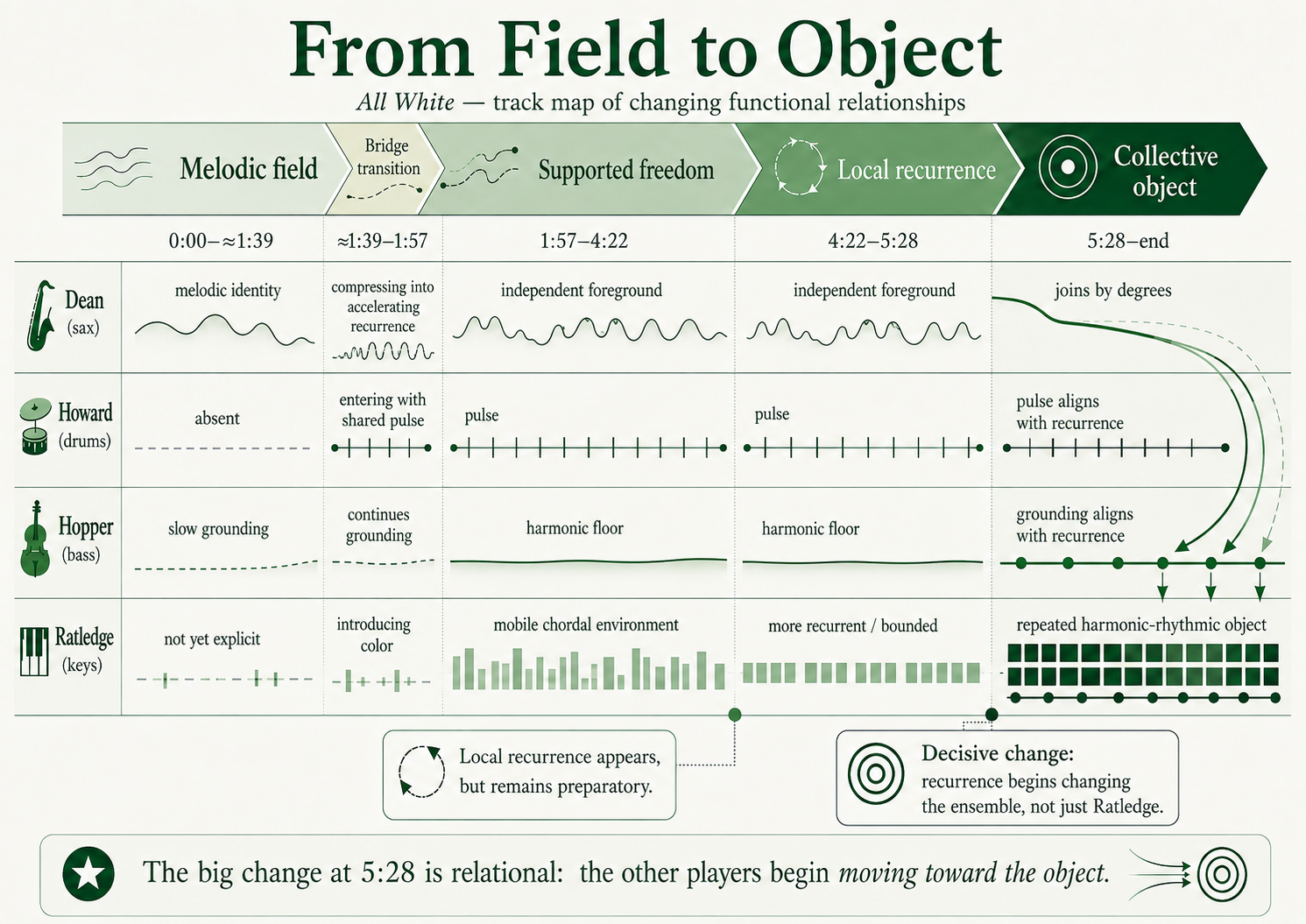
A track map of changing functional relationships. The form moves from a Dean-centered melodic field through a brief transition in which recurrence, pulse, and chordal articulation accumulate, then into a stable ensemble environment that supports independent continuation, a preparatory phase of local recurrence, and finally a collective object. The decisive change comes at 5:28: recurrence stops being principally a feature of Ratledge’s part and begins altering the behavior of the ensemble around it.
From Recurrence to Consequence. The decisive change comes only when recurrence stops being principally a property of Ratledge’s part and begins altering the relationships around it. Around 5:28, a repeated harmonic-rhythmic object becomes stable enough to predict its own continuation, and the other players begin adjusting their behavior in relation to that recurrence. At 4:22 repetition changes Ratledge; at 5:28 repetition begins changing the ensemble.
V. When the Pattern Becomes Collective
Approximately 5:28–end
Around 5:28, the repeated figure finally acquires the kind of presence that the earlier preparatory passages had approached without securing. Ratledge’s harmonic-rhythmic pattern is now bounded enough, regular enough, and stable enough to predict its own continuation. But repetition alone does not make it formal. What matters is that the other players begin to change in relation to it.
Dean does not join all at once. His independence contracts by degrees as more of the object’s information enters his line: first through partial participation, then through rhythmic correspondence, contour, and increasing pitch agreement. Howard retains the pulse-bearing role he has carried through the middle, but now begins to reinforce the pattern’s articulation more directly. Hopper likewise preserves his low harmonic function while aligning his attacks beneath the recurring object rather than simply sustaining the broader field. The ensemble becomes more coordinated without becoming functionally uniform.
The closing therefore takes shape as those consequences spread. Ratledge’s pattern changes relatively little while the relationships around it change more and more. What had previously been a stable environment capable of supporting independent continuation now becomes increasingly organized around a shared object. The object becomes formal because its recurrence begins to shape what the other players are likely to do next.
Closure follows from that narrowing of possibility. Dean’s foreground becomes progressively less independent, Howard’s pulse increasingly participates in the object’s articulation, and Hopper’s grounding becomes more tightly coordinated with its recurrence. The music does not return to the opening melody or resolve through a conventional cadence. Instead, differentiated roles become progressively more specified in relation to the same repeating information until the ensemble reaches its greatest degree of common specification and stops together.
a. An Object Becomes Predictable
Approximately 5:28–5:33
Around 5:28, Ratledge’s recurrence sounds different from the repetitions that preceded it. The harmonic-rhythmic figure now returns with enough consistency of pitch field, attack pattern, and spacing that continuation becomes locally predictable. Small internal variations remain, but they no longer obscure the identity of the configuration. The music has moved from a mobile harmonic environment into something more bounded: a repeatable object.
Its novelty lies less in entirely new harmonic content than in the way familiar harmonic information is now organized. The opening had established a center without explicit chords; the middle had supplied chords without a fixed progression; here, chordal information is compressed into a recurring harmonic-rhythmic form whose next appearance can be anticipated. The harmonic field has not been replaced so much as given a more determinate shape.
That distinction is what separates this moment from earlier recurrence. Dean’s accelerating cell around 1:39 had been transitional, converting melodic identity into forward motion. Ratledge’s repetitions after 4:22 had increased local specification without reorganizing the ensemble. At 5:28, recurrence becomes durable enough to begin affecting more than the keyboard part itself. The object can now do more than repeat itself: it gives the other players something stable enough to hear against, approach, reinforce, or join.
For the moment, the crucial fact is simply that a stable object now exists. Its formal importance will depend on what happens around it, but the condition required for that change has been established: harmonic information has become bounded and predictable enough to function as a common reference.
b. Dean Joins by Degrees
Approximately 5:33–5:52
Dean does not respond to the closing object by suddenly abandoning the independent foreground role he has occupied through most of the track. His convergence happens by degrees. At first, his line remains recognizably separate from Ratledge’s repeated figure even as moments of participation begin to appear. Rhythmic correspondence becomes more frequent; contours begin to align; and only gradually does pitch agreement become strong enough for the two parts to approach near-unison or tightly parallel motion.
That progression matters because it lets the listener hear independence contracting rather than simply disappearing. Dean’s role is not replaced at the moment the object appears. Instead, each repetition gives him another opportunity to surrender some portion of his previous freedom while retaining enough difference for the process of convergence to remain perceptible. What had been an independently generated melodic foreground becomes increasingly defined by information already present in the shared object.
Dean therefore does not simply start doubling Ratledge. He progressively exchanges independent continuation for shared information. The change can be heard first in timing, then more strongly in shape, and eventually in pitch relation. The closer his line comes to the object, the smaller the range of plausible independent continuations becomes.
This gradual contraction is one of the clearest proofs that the track’s form has depended on degrees of independence all along. Earlier, stable collective organization had made Dean’s freedom sustainable. Here, the same capacity for stable coordination begins working in the opposite direction: recurrence becomes sufficiently binding that Dean’s foreground no longer merely exists above the ensemble’s organization but increasingly participates in it.
c. The Rhythm Section Joins Without Doubling
The closing object does not become collective because every player begins reproducing the same figure. Howard and Hopper participate differently, and their differing responses are part of what makes the convergence formally significant. Each retains the function established in the central field while bringing that function into a tighter relationship with Ratledge’s recurrence.
Howard continues to carry the pulse, but his role becomes more explicitly tied to the object’s internal articulation. Salient attacks increasingly reinforce its recurrence, and the drums begin to make its grouping more audible at the pattern level. The change is therefore not from pulse to a new rhythmic vocabulary, but from pulse bearer to pulse bearer plus pattern reinforcer. Time remains stable, yet that stability now does more than sustain independent activity: it helps articulate a common course.
Hopper changes in a parallel but distinct way. He remains the low harmonic anchor rather than taking over the upper contour, but his attack placement becomes increasingly compatible with the object’s recurrence. His grounding therefore acquires a stronger rhythmic relation to the closing pattern without ceasing to be grounding. He becomes a coordinated low underpinning rather than a melodic double.
The ensemble’s growing specification is thus relational rather than literal. Howard and Hopper do not need to abandon their established functions or duplicate Ratledge’s material for the closing object to become collective. What changes is the relation of those functions to recurrence. The same pulse and harmonic support that had previously sustained Dean’s independence are now increasingly organized around a shared repeated object, demonstrating that the ensemble can change decisively even when not every player takes on new material.
d. The Object Changes Less Than the Ensemble
Approximately 5:37–5:52
Once the closing object has become established, its own behavior remains comparatively stable. Ratledge continues to articulate the same bounded harmonic-rhythmic configuration with only modest internal variation. The greater transformation occurs around it. From one recurrence to the next, Dean aligns more closely, Howard reinforces the pattern more explicitly, Hopper coordinates his low attacks more tightly, and the range of plausible independent continuation becomes progressively smaller.
This is what gives the object its formal force. Repetition by itself had already appeared earlier in the track without producing a comparable change. Here, the repeated figure begins to organize relationships beyond the keyboard part that states it. Its identity does not need to grow more elaborate or more insistent in order to become more consequential; instead, the ensemble increasingly treats its recurrence as information that matters for what comes next.
The object therefore changes less than the ensemble. Dean's foreground becomes less independent, Howard's temporal role becomes more closely tied to pattern-level articulation, and Hopper's harmonic grounding becomes more tightly coordinated with the recurrence. Their functions remain distinguishable, but each now has less room to move independently of the same shared reference.
The pattern becomes closing because its effects spread through the ensemble. What had once been a field capable of sustaining several independent continuations is progressively converted into a situation in which fewer such continuations remain plausible. The decisive transformation lies not in repetition becoming stronger in itself, but in repetition becoming increasingly binding for everyone around it.
e. Near-Unison Is a Culmination, Not a New Section
Approximately 5:52–end
By the final seconds, Dean’s relation to Ratledge has reached its greatest degree of correspondence. Their lines approach near-unison or tightly parallel articulation, while Howard and Hopper remain coordinated around the same repeated object. The ensemble is now more collectively specified than at any earlier point in the track, but this does not establish a new formal state. It is the culmination of the convergence already underway.
What changes at this point is degree, not mechanism. Dean has not suddenly entered a different role; his earlier contraction of independence has simply progressed further. Howard continues to reinforce the object temporally, and Hopper continues to support it from below. The same process that began when the object started changing the relationships around it now reaches its strongest expression.
Near-unison therefore matters because it makes the narrowing of possibility most audible. The range of plausible independent continuation has become very small, and the ensemble is increasingly committed to a common course. Yet that condition has been produced gradually through successive adjustments rather than through an instantaneous lock-in.
The final stop completes that process with coordinated cessation. There is no fade and no need for a conventional harmonic resolution or thematic return. The music ends when the ensemble has converged as far as it will and then stops together.
Sectional Conclusion. The closing object becomes formally consequential because its repetitions increasingly reorganize relationships beyond Ratledge’s part. Dean does not simply begin doubling it; he progressively exchanges independent continuation for shared information, moving from partial rhythmic correspondence toward closer contour and pitch agreement. Howard preserves the pulse-bearing role established earlier but increasingly reinforces the object’s internal articulation, while Hopper continues to supply low harmonic grounding even as his attacks become more closely coordinated with the same recurrence. Their functions remain distinct, but the freedom with which those functions can be realized contracts. The object therefore changes less than the ensemble around it. By the time Dean and Ratledge approach near-unison, the music has not entered another state; it has reached the furthest point of a convergence already underway. The track closes when recurrence has become binding enough that independent continuation has narrowed into coordinated cessation.
From Chronology to Realization. The audible form can now be described without further chronological subdivision: a melodic world organized through duration gives way to shared temporal and harmonic infrastructure, that infrastructure sustains differentiated independence, and recurrence eventually changes from local behavior into a collective organizing force. What remains is a different kind of question. Which parts of that architecture can the LP itself establish securely, and which must remain unassigned among Ratledge’s composition, the musicians’ realization of it, and the particular recorded form through which we hear the piece?
VI. Performance and LP Realization — What Can We Actually Assign?
The preceding analysis establishes the form heard on the record more securely than it establishes how that form was prescribed. The LP makes the relationships among the players audible, but it cannot by itself tell us which details were fixed in composition, settled in rehearsal, or determined in performance. The study can therefore describe what happens with confidence while remaining cautious about who shaped each detail, and at what stage.
One recording-specific feature does matter directly to the form as heard. Documentary evidence identifies Dean's opening instrument as saxello and the delayed image surrounding it as an Echoplex effect. The device allows one gesture to remain audible after the next has begun, prolonging the saxello in time and helping give the opening its unusual spaciousness. What listening establishes as temporal overlap can therefore be assigned more securely to the LP realization: one performed line is electronically extended into its own recent past. The effect remains important to the opening sonority without needing to explain the larger formal transformations that follow.
Documentary evidence also offers a useful perspective on the opposite end of the track. One account of Fifth describes “All White” as a piece whose theme is revealed only at the very end. That characterization fits the audible prominence of the bounded material that emerges there, but it does not by itself determine how that material functions in the LP form. Whether understood compositionally as Ratledge's theme or perceptually as the repeated object that becomes unmistakable near the close, its formal consequence still depends on what happens around it: Dean progressively joins it, Howard and Hopper coordinate more closely with its recurrence, and material that initially belongs principally to Ratledge becomes a shared point of organization.
The useful distinction is therefore simple. The recording lets us hear the form; it does not always tell us how much of that form belongs to composition, rehearsal, performance, or recording. Where that remains uncertain, the relationships we can actually hear are enough.
Sectional Conclusion. “All White” supports a strong formal argument without requiring equally strong claims about how every detail originated. Documentary evidence allows two features to be assigned more securely: Dean's opening saxello line is extended through Echoplex, and the bounded material disclosed near the end has been described as the piece's theme. Neither fact determines the larger form by itself. The opening effect acquires formal significance through the temporal space it creates, while the closing material becomes consequential through the way the ensemble progressively reorganizes around it. Where composition and realization cannot otherwise be separated securely, the study continues to stop at what the record makes audible.
From Realization to Principle. With those limits established, the remaining question is no longer how the form was prescribed, but what deeper principles allow changing material and changing degrees of independence to remain intelligible as one continuous process.
VII. What Holds the Six Minutes Together
The coherence of “All White” does not depend on one theme remaining continuously present, one harmonic progression governing the whole piece, or one rhythmic pattern returning often enough to bind its sections together. Many of the most audible materials change or disappear. Dean gradually moves beyond the opening melody; the harmony becomes more explicitly chordal without settling into a fixed progression; intensity rises and falls; and recurrence itself performs different functions at different moments. What persists more deeply is a set of relationships through which changing musical information continues to make sense.
Those relationships are stable without being rigid. Pulse can remain dependable while larger phrase organization stays open. Harmonic grounding can persist without becoming a recurring bass cycle. Chords can constrain a melodic field without determining the shape of every phrase. A foreground voice can retain its function even after its thematic connection to the opening has weakened. In each case, continuity comes from a responsibility remaining intelligible while the notes, attacks, shapes, and placements through which we hear it continue to vary.
This is why stability in “All White” repeatedly enlarges possibility before it narrows it. Through most of the track, dependable temporal and harmonic information removes burdens from Dean rather than placing new ones on him: because other layers can maintain orientation, the foreground is free to become increasingly independent. Only near the end does stable information acquire a different power. When recurrence becomes bounded enough to serve as a shared object, its consequences begin spreading from one part to another, and the same ensemble capacity for coordination that had sustained independence now progressively reduces it.
The governing continuity is therefore relational rather than material. The music remains recognizable as one process because what its parts are responsible for can persist even when what they actually play changes substantially. “All White” holds together because stable musical information can change function: it can orient without prescribing, support without fixing, and finally become specific enough to constrain what can plausibly happen next.
a. Stability Can Enable Freedom
The central field of “All White” overturns the assumption that freedom increases as structure recedes. Dean’s independence does not grow because the ensemble withdraws support around him. It grows because several forms of support become dependable enough that he no longer has to supply them himself. Howard carries beat-level continuity, Hopper preserves the low harmonic floor, and Ratledge keeps a chordal environment available without fixing it into a single repeated progression.
Those constraints remain differentiated. Howard’s pulse does not dictate Dean’s phrase lengths; Hopper’s grounding does not impose a formal bass cycle; Ratledge’s chords do not prescribe Dean’s contour or attack placement. Each layer narrows some possibilities while leaving others open. The result is not freedom from organization, but freedom within an organization whose responsibilities are distributed rather than concentrated in the foreground.
That distinction explains why Dean can become more independent as the ensemble becomes more stable. The surrounding field takes care of temporal and harmonic orientation while leaving melodic continuation comparatively open. Dean can stretch phrases, cross accents, abandon direct thematic resemblance to the opening, and still remain intelligibly inside the same musical world because other players continue to maintain the conditions that make his divergence legible.
Freedom here is therefore not produced by the absence of constraints, but by the persistence of differentiated constraints. Stability does not merely limit what can happen next; it can also remove the need for one voice to keep re-establishing the conditions of coherence. In “All White,” that is what allows collective organization to become the support for individual independence before the same capacity for organization is later turned toward increasing coordination.
This diagram distills the study’s central paradox into a single visual process. The same kinds of stable information that initially provide orientation and support gradually create room for independent action; only later, when recurrence becomes bounded and shared, do those stable relationships begin to pull the ensemble toward a common course. The widening corridor represents the freedom made possible by dependable support, while the repeated markers and narrowing paths at the right show how recurrence progressively reduces the range of independent continuation.
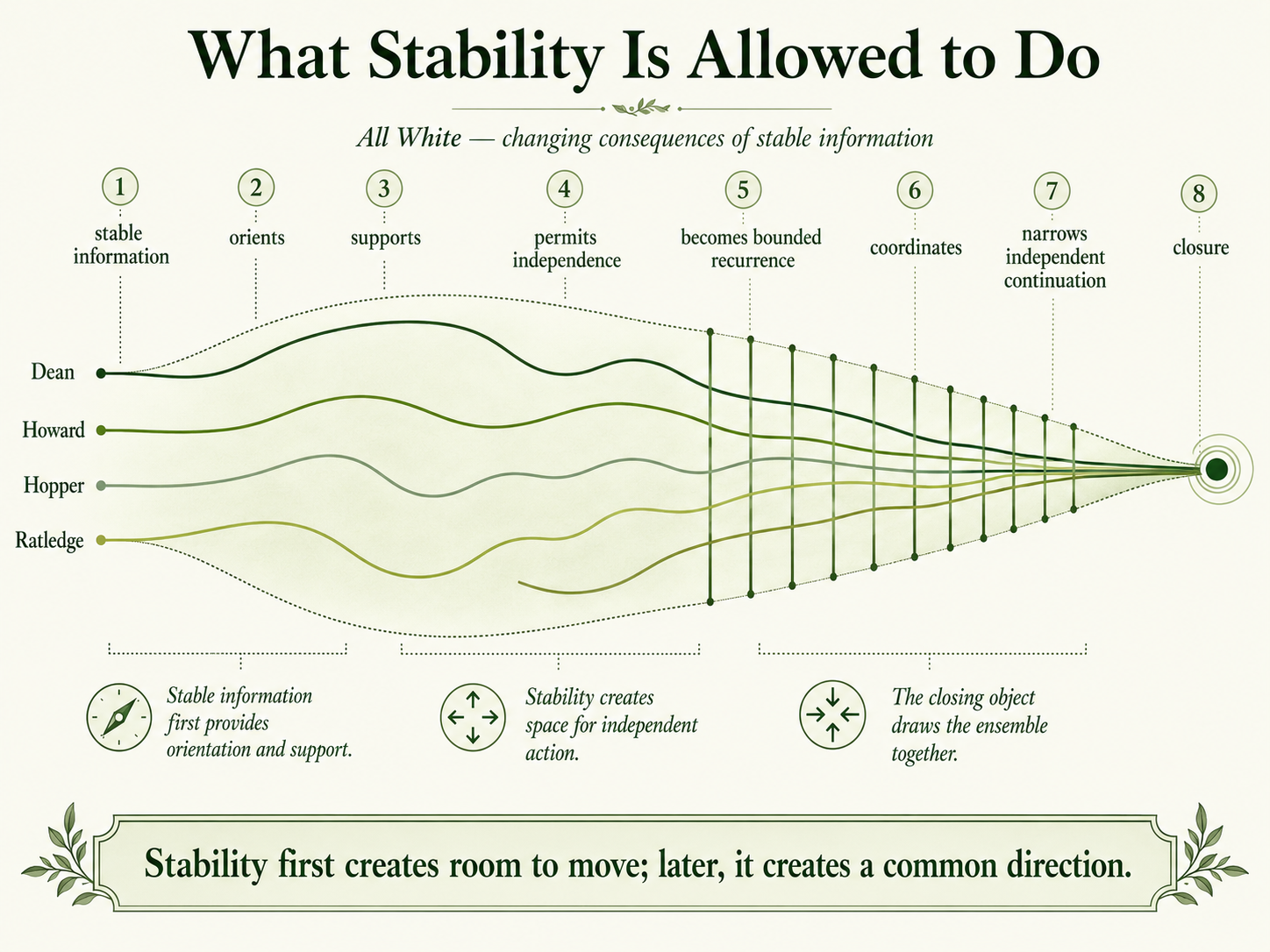
A conceptual map of the track’s governing transformation. Stable temporal and harmonic information first provides orientation, then creates space for increasingly independent action. Once recurrence becomes bounded and collectively consequential, those same differentiated functions begin to converge around a shared object, narrowing the range of independent continuation until the ensemble reaches coordinated closure.
b. Pulse Can Be Stable While Time Remains Open
“All White” separates several temporal functions that are often heard as though they were the same thing. A clear pulse does not automatically produce a rigid accent hierarchy; a stable tactus does not guarantee strongly projected bar structure; and neither requires the larger phrase organization to become equally fixed. The distinction is especially audible because the beat remains dependable even while subdivision, accent placement, attack density, and local grouping continue to shift.
The result is a kind of temporal openness that exists above rather than outside stable time. Dean can phrase across accents, extend gestures beyond expected groupings, or enter at points that do not reinforce a simple larger cycle without becoming detached from the ensemble. The listener continues to recover the underlying beat even when the surface offers several competing ways of hearing how that beat is grouped.
This matters because improvisational freedom is often too quickly associated with temporal instability. Here, the opposite is possible. The beat can remain clear precisely while larger temporal organization stays negotiable. The beat remains clearer than the larger patterns into which it might be grouped, and that difference allows rhythmic freedom to coexist with a durable common reference.
Temporal stability therefore does not have to mean temporal closure. A pulse can constrain one level of time while leaving others comparatively open, giving the ensemble enough common ground to remain coordinated without forcing every phrase into the same metrical or formal shape.
c. An Environment Is Not an Object
The middle of “All White” is organized by an environment rather than by a recurring object. Its coherence comes from persistent relations: Howard maintains pulse, Hopper preserves a low harmonic floor, Ratledge keeps harmony active through a mobile chordal field, and Dean remains free to generate the melodic foreground. Those relationships support and constrain continuation, but they do not require one bounded configuration to return in the same form.
That distinction explains why so much can change without producing a new formal state. The environment remains recognizable even when Dean’s phrases alter radically, Ratledge changes sonority, or the ensemble becomes more intense. What persists is not a fixed event but the way the parts continue to support one another. Continuity comes from dependable conditions rather than from repetition of a specific pattern.
The closing object behaves differently. It is bounded enough to be recognized, repeatable enough to establish expectation, and predictable enough that other players can begin changing in relation to it. Once that happens, the object no longer merely inhabits the environment; it starts to reorganize it.
The decisive transformation is therefore not from organization to more organization, but from one kind of organization to another. The environment sustains differentiated possibility. The object concentrates information into a form whose recurrence increasingly constrains what can follow. That shift—from stability as support to stability as shared specification—lies at the heart of the track’s closing process.
d. Recurrence Changes Function
Recurrence is present throughout “All White,” but it does not perform the same job each time it appears. In the opening, returning pitch relationships and the lingering delayed image help preserve melodic identity and duration. Around 1:39, recurrence becomes more compressed and directional, turning Dean’s melodic material into propulsion. Later, repeated events can remain local—part of the texture, the pulse, or Ratledge’s supporting behavior—without reorganizing the ensemble around them.
That is why repetition alone cannot explain the form. The keyboard recurrence after roughly 4:22 is already clear enough to attract attention, but its consequences remain mostly confined to Ratledge. It adds definition without yet changing the responsibilities of the other players. By contrast, the closing object becomes formally consequential because its recurrence begins to matter beyond the part that states it. Dean aligns more closely, Howard reinforces its articulation, and Hopper coordinates beneath it.
The diagram below places those changing functions side by side. The repeated element remains recognizable; what changes is the work recurrence is able to do within the surrounding ensemble.
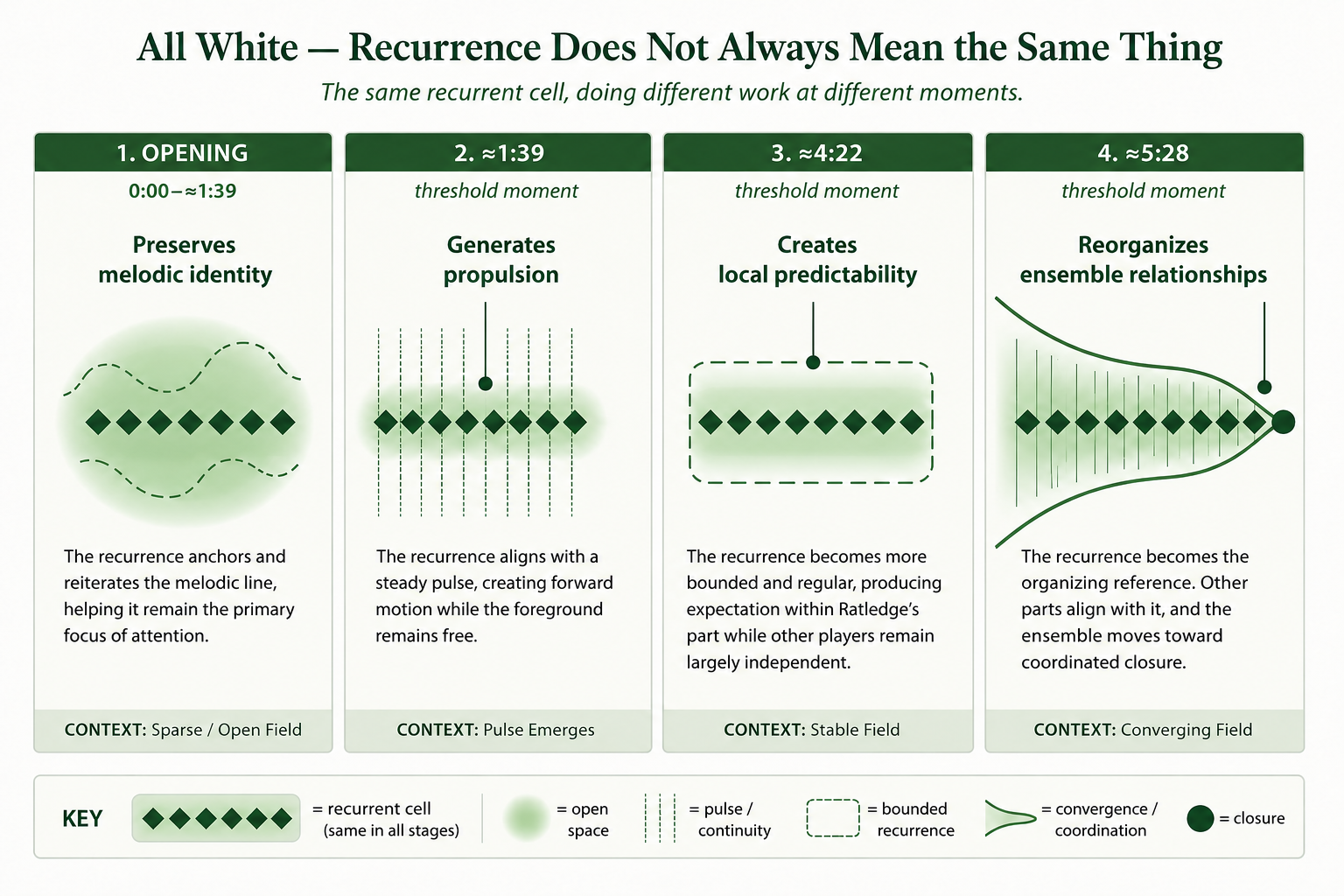
Four changing functions of recurrence across the track. In the opening, recurrence helps preserve melodic identity; around 1:39 it begins generating propulsion; around 4:22 it creates local predictability within Ratledge’s part; and around 5:28 it becomes formally consequential by reorganizing ensemble relationships. The recurring element may remain recognizable, but its formal meaning changes according to what the surrounding music begins to do in response.
The important variable, then, is not simply whether something repeats, but what that repetition is able to do. Recurrence can preserve identity, generate motion, furnish local continuity, or prepare a more bounded kind of behavior without becoming formally binding. Only when its consequences spread across the ensemble does it begin to constrain continuation at a larger level.
Repetition becomes formally consequential only when its consequences spread beyond the layer producing it. In “All White,” recurrence is therefore less a fixed structural device than a resource whose function changes—from persistence, to propulsion, to local support, and finally to collective constraint.
e. Coordination Is Relational, Not Textural
“All White” reaches some of its greatest density before it reaches its greatest coordination. In the central field, several instruments can be highly active at once, attacks can accumulate rapidly, and the texture can become saturated without the ensemble ceasing to preserve substantial functional independence. Dean still generates his own foreground, Howard still carries pulse, Hopper still grounds the low field, and Ratledge still articulates harmony without forcing the others into one common pattern.
That is why density cannot serve as a reliable measure of formal coordination. More simultaneous sound does not necessarily mean that the players are becoming more mutually constrained. A passage can be crowded while leaving several continuations open, just as a sparser passage can become highly coordinated if one layer begins to alter what the others are likely to do next.
The closing process makes the distinction especially clear. Howard and Hopper do not cease performing their established functions, nor do they need to reproduce Ratledge’s exact material. What changes is the relation of those functions to the repeated object. Howard’s pulse increasingly reinforces its articulation; Hopper’s grounding becomes more tightly aligned beneath it; Dean’s foreground progressively absorbs more of its rhythmic, contour, and pitch information. Coordination grows because each player’s next move becomes increasingly tied to what the others are doing.
More sound does not mean more coordination; coordination concerns how one layer’s behavior changes the possibilities available to another. This is why the dense central peak is less formally consequential than the later closing threshold. The earlier passage intensifies an existing condition. The later one changes what the players can plausibly do in relation to one another.
f. Formal Consequence Begins When Relationships Change
Not every audible change in “All White” changes the form. Some events alter color, density, emphasis, or local behavior while leaving the way the music carries itself forward intact. Others matter because they change which relationships can carry the music forward. The distinction becomes clearest when the track’s strongest thresholds are heard in those terms rather than simply as changes in surface activity.
Around 1:39, Dean’s compressed recurrence changes the temporal direction of the music; around 1:43, Howard makes a common pulse available; and by roughly 1:57, Ratledge’s chordal entrance helps stabilize the full supporting environment. Each step matters because it redistributes responsibility. Dean no longer has to carry temporal direction alone, and the ensemble acquires a more durable set of shared references within which independent continuation becomes possible.
The later preparation works differently. Around 4:22, Ratledge’s repetition becomes more bounded, but the underlying relationships among the players remain largely unchanged. Dean continues independently, Howard continues to carry pulse, and Hopper continues to ground the low field. A change can prepare a new form before it actually changes how the ensemble moves forward.
That distinction is decisive at the close. At 4:22 repetition changes Ratledge; at 5:28 repetition begins changing the ensemble. Once the repeated object starts altering Dean’s phrasing and increasing the coordination of Howard and Hopper around its recurrence, the range of available continuation changes with it. Formal consequence begins not when something merely becomes noticeable, repeated, or intense, but when the relationships that shape what can happen next are durably transformed.
g. Closure Does Not Require Return
“All White” does not close by restoring the conditions with which it began. The opening is dominated by one melodic line inside a sparse, pulseless field; the ending is built from several differentiated functions increasingly organized around one repeated object. Whatever broad pitch-field kinship may connect the two, the closing passage does not bring back the opening melody, the opening texture, the opening modal identity, or the absence of shared pulse.
The sense of closure therefore comes from transformation rather than reprise. By the end, Dean is no longer carrying the music’s identity largely on his own, and the ensemble is no longer using stable support chiefly to preserve independence. The same capacity for coordinated organization that earlier allowed different functions to remain relatively autonomous has been redirected toward a more tightly shared course.
That is why the ending can feel conclusive without sounding like a return. Its force lies in what has happened to the relationships among the players. Independent continuation has become progressively less available, recurrence has become collectively consequential, and the ensemble reaches a point at which several distinct functions are committed to the same repeated process.
Closure in “All White” is therefore relational rather than restorative. The track ends not by recovering earlier material, but by changing what its existing organization is able to permit. The final object closes the form because it gathers previously differentiated responsibilities around the same repeated course and narrows their range of plausible continuation to the point of coordinated cessation.
h. Relational Continuity
The continuity of “All White” does not depend on the persistence of one theme, bass pattern, chord sequence, or rhythmic figure. The central analysis has shown something more durable: individual materials can change substantially while the responsibilities through which the ensemble remains intelligible continue. Pulse remains available as pulse, harmonic grounding as grounding, chordal articulation as harmonic articulation, and melodic foreground as foreground even when their exact realizations keep changing.
That persistence is what Relational Continuity describes here. Continuity lies not in literal repetition of events, but in the survival of functional relationships across changing realizations. It is what allows the middle to absorb major changes of intensity, density, phrasing, and sonority without requiring a new formal condition every time the surface changes.
The ending reveals the other side of the same principle. The established responsibilities do not disappear when the closing object becomes consequential; they begin relating differently. Pulse increasingly reinforces recurrence, harmonic grounding becomes more closely coordinated with it, and the melodic foreground progressively gives up independent continuation for shared information. The middle remains continuous because responsibilities persist; the ending becomes consequential because those responsibilities begin relating differently.
Sectional Conclusion. The continuity of “All White” does not depend on a recurring theme, fixed chord cycle, permanent hierarchy, or any single layer remaining unchanged. It depends on stable responsibilities that leave room for different kinds of behavior. Howard can preserve pulse while larger phrase organization remains open; Hopper can maintain harmonic grounding without creating formal periodicity; Ratledge can articulate a mobile chordal field without fixing a progression; and Dean can move farther from the opening melody while retaining his function as the independent foreground. That stability becomes formally significant not simply when something repeats or intensifies, but when relationships begin to change. The middle remains continuous because its differentiated responsibilities persist; the ending becomes consequential because those same responsibilities are increasingly reorganized around a repeated object. Relational Continuity therefore explains both the track’s coherence and its direction: stable functions first sustain independent possibility, then become capable of participating in a more binding form of coordination.
From Analysis to Experience. The analytical mechanism is now established. What remains is to return to the six minutes as a listener experiences them: not as a sequence of technical categories, but as a gradual change in what stability feels capable of doing. The track begins with spacious identity, opens into freedom supported by shared infrastructure, and closes as recurrence gathers increasingly differentiated voices into a common course whose final repetitions leave progressively fewer independent futures available.
Closing Movement — What the Music Learns to Share
At the beginning of “All White,” Dean carries almost all of the music’s recognizable melodic identity. The surrounding field is sparse, but it is not empty. His line has room to unfold slowly enough that individual tensions can linger, and the delayed image lets one gesture remain audible after the next has begun. Even a single foreground voice can therefore occupy more than one moment at once. The opening feels spacious because so little is being asked to move together, yet that spaciousness already has shape.
The first decisive change comes from inside Dean’s own material. Long phrases contract into recurrence, and repetition begins to generate motion where duration had previously carried most of the weight. Howard does not create that motion; he enters into it and gives it a common pulse. Ratledge then gives that shared pulse a more explicit harmonic body. The ensemble becomes more fully present, but Dean does not become less free. The opposite happens.
That reversal is the heart of the track. Once pulse, low harmonic grounding, and chordal support become dependable, Dean no longer has to make each phrase establish the music’s sense of time and place. He can move across the field rather than continually rebuilding it. His phrases can lengthen, break away from the opening melody, resist obvious accent patterns, and pursue their own shapes because the ensemble beneath him continues to provide enough orientation for those departures to remain intelligible.
The music can therefore become denser without becoming less spacious in its possibilities. More notes appear, attacks multiply, the energy rises, and the quartet can sound intensely active, but the underlying responsibilities remain clear enough that no single player has to surrender independence merely because the surface has thickened. The freedom of the middle is not the freedom of an absence. It is the freedom of being supported by things that can be trusted to continue.
When Ratledge begins to repeat more insistently, that freedom does not disappear at once. The listener can hear one layer becoming more defined while the rest of the ensemble still behaves according to the older condition. The repetition attracts attention without yet gathering everyone into it. It can loosen again. The broader field can reopen. Greater definition has appeared, but it has not yet begun to pull the ensemble in the same direction.
Only near the end does recurrence acquire that power. The repeated object becomes stable enough that Dean begins to meet it rather than simply continue above it. He does not abandon his independence in a single gesture. He first touches the pattern, then shares more of its rhythm, then more of its contour, until the distance between foreground and object becomes increasingly small. Howard’s pulse, which had supported so much independent phrasing, now reinforces the same recurrence more directly. Hopper’s grounding, which had made changing harmony feel secure, increasingly falls into the object’s common course.
The striking thing is that no one has to lose instrumental identity for this convergence to happen. Howard remains the drummer, Hopper remains the low foundation, Ratledge remains the principal harmonic articulator, and Dean remains a melodic voice. What changes is not who they are, but how much room each role still has to move independently. The same differentiated functions that once allowed the music to spread outward are gradually drawn into a more specific shared path.
The opening and ending therefore do not mirror one another, but they illuminate each other. At first there is one dominant melodic identity surrounded by possibility. In the middle, several differentiated functions create a stable environment in which independence can flourish. At the end, those functions become progressively organized around common recurrence. The studio makes one voice plural at the beginning, allowing Dean’s line to overlap with its own recent past. The ensemble moves in the opposite direction at the end: several genuinely independent voices become increasingly convergent through performance.
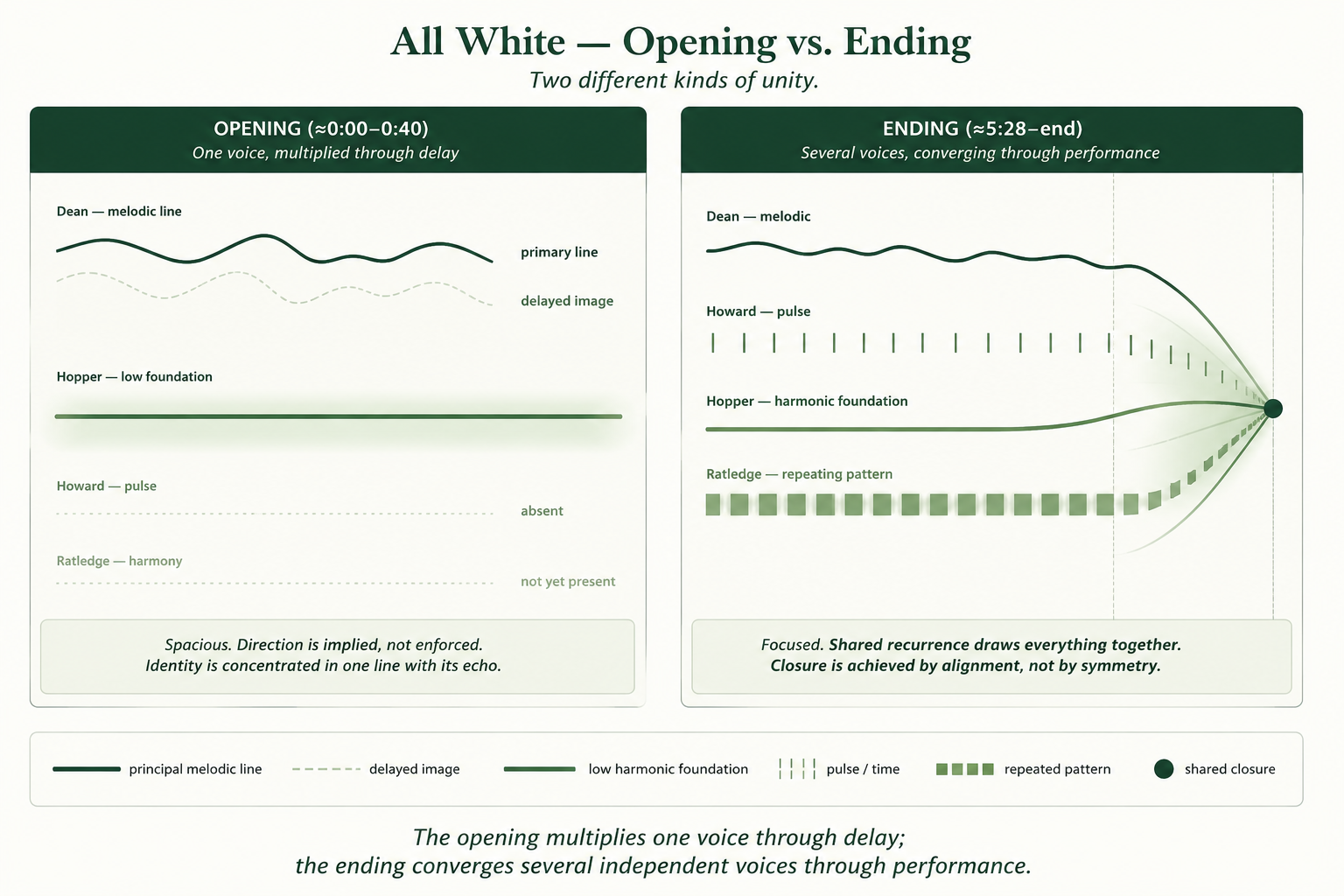
The opening multiplies one voice through delay, allowing Dean’s melodic line to overlap with its own recent past inside a sparse field. The ending works differently: distinct instrumental functions progressively converge around a repeated object and reach closure together. The relation is not symmetrical and does not depend on thematic return; one voice is expanded at the beginning, while several independent voices are drawn into common direction at the end.
The transformation in “All White” is not from freedom to organization, because the music is organized from the beginning and remains organized even at its most independent. What changes is what organization permits. For most of the track, stable pulse, harmonic ground, and chordal support create room for Dean to move beyond them. At the end, a repeated object gives those same functions something more specific to share. Stability stops serving primarily as support and begins serving as common direction.
What first gives the music room to move eventually gives it a reason to stop.