“Darker Brighter”

- Artist
- Gilgamesh
- Album
- Another Fine Tune You’ve Got Me Into
- Year
- 1978
“Darker Brighter” is the point at which the quartet’s architecture first becomes visible as a functioning system rather than a set of instrumental roles. It is the album’s initial load condition, the moment where planes settle, the pressure floor forms, and the grid aligns enough for the building to reveal its internal geometry.
I. A Listener’s Introduction: From Shadow into Light
Before diagrams, timelines, and architectural terms, Darker Brighter invites a simpler kind of attention: the pleasure of hearing a musical world come slowly into focus. The track is welcoming and quietly luminous, and it becomes remarkably easy to follow once one stops waiting for a verse, a chorus, or a dramatic arrival. It unfolds like a landscape at dawn. At first only outlines are visible; then color, movement, and depth begin to emerge. The music brightens, settles into a suspended radiance, and finally returns to a gentler, more reflective shade.
The opening carries a delicate, slightly veiled atmosphere. Alan Gowen’s electric piano places clear, glass‑like harmonies into an uncluttered space, letting each chord linger long enough for its color to bloom. The mood is contemplative rather than dark: “darker” here means shadow, distance, and the soft uncertainty of early morning. Hugh Hopper and Trevor Tomkins enter with exquisite restraint. They do not push the music forward; they give it a floor, a pulse, and a sense of shared presence. It feels as though the quartet is stepping into a room, listening to its acoustics, and discovering how to inhabit it together.
Around the first minute, the piece begins to brighten. The rhythmic foundation firms, the harmonic colors warm, and the ensemble moves with greater confidence. Nothing announces this shift. There is no break between the darker and brighter sides of the track. The change happens through small, almost invisible adjustments — a more definite bass gesture, a clearer rhythmic accent, a fuller voicing, a melodic line that reaches a little farther. The music seems to awaken from within.
Phil Lee’s guitar becomes the track’s most human and exploratory voice. His early phrases feel tentative, as though he is testing the contours of the space. Gradually they lengthen, gaining direction and expressive lift. Lee does not simply solo over a backdrop; his lines invite responses. Gowen opens or reshapes the harmonic plane around him, Hopper gives his phrases weight and elasticity, and Tomkins subtly adjusts the rhythmic pressure beneath them. The beauty lies not only in the guitar’s motion but in the quartet’s quiet, collective responsiveness.
From roughly 2:30 onward, the music reaches its most animated and luminous state. More is happening at once, yet the performance never feels crowded. Gowen’s electric piano sparkles through the middle and upper registers; Lee’s guitar arcs more freely; Hopper’s bass gives the ensemble warmth and buoyancy; Tomkins keeps everything afloat with drumming that is precise but never rigid. This is the “brighter” heart of the piece — not simply because the harmony glows, but because the ensemble feels fully awake, listening, and alive.
One of the track’s quiet achievements is its refusal to treat intensity as something that must continually rise. After reaching this bright center, the quartet alters the balance rather than simply lowering the energy. Familiar gestures return in new colors. One instrument steps forward while another recedes; a dense passage becomes more transparent; a rhythmic figure relaxes and makes room for a melodic one. The music remains alive, but its light begins to resemble twilight rather than midday. Brightness and introspection coexist.
In the final minute, the ensemble gently releases its hold. Lee’s lines soften, the bass and drums lighten, and Gowen’s harmonies once again seem surrounded by open air. The ending does not close the door; it simply withdraws, leaving traces of earlier colors suspended in memory. The opening atmosphere returns, but it has been changed by everything that passed through it.
This is the emotional shape of Darker Brighter: emergence, awakening, illumination, and release. Its beauty lies in the patience with which these states unfold. The track never forces its contrasts or announces its turning points. It allows darkness to contain the possibility of brightness, and brightness to retain a little of the opening shadow. Beneath the analytical language of planes, grids, and density states lies something wonderfully natural — four musicians listening closely, making room for one another, and allowing a musical world to come gently to life.
Having traced Darker Brighter through its unfolding of shadow, illumination, and release, we can now step back from the listener’s vantage point and consider what the track is doing inside the larger architectural engine of Another Fine Tune You’ve Got Me Into. The qualities that feel so natural in real time—the gradual brightening, the emergence of motion, the ensemble’s patient responsiveness—are not merely expressive choices. They are the audible signs of the system coming online.
The track’s emotional arc mirrors the quartet’s structural behavior: planes stabilize as harmonies settle, the pressure floor forms as bass and drums enter, traversal begins as Lee tests the space, and the grid aligns as the ensemble reaches its bright, animated center. Even the gentle release at the end reflects the system easing back into low‑load conditions. What feels like dawn, movement, and twilight is also the architecture learning how to breathe.
In this sense, Darker Brighter serves as more than an opening piece. It is the quartet’s first demonstration of how the closed system behaves under modest load—how it awakens, organizes itself, and prepares for the more demanding environments that follow. The listener hears a landscape coming to life; the analyst sees a structure establishing its operating parameters.
With this dual perspective in place, we can now turn to the track’s formal role within the album’s architecture.
II. Function of the Track Within the System
“Darker Brighter” is the point at which Another Fine Tune You’ve Got Me Into first discloses itself as a closed, functioning architecture rather than a sequence of loosely related compositions. Its position at the head of the album is not merely chronological; it is procedural. The track behaves like an initialization routine in which the quartet’s fundamental parameters are brought online, tested, and stabilized before the system is subjected to more complex and higher‑load configurations. What we hear, in effect, is the quartet discovering and declaring its own operating state.
Gowen’s keyboards begin by sketching out registral territories that quickly harden into planes, giving the vertical dimension of the music a clear stratification: upper voices that carry harmonic color and contour, mid‑range fields that act as gravitational centers, and lower extensions that hint at the pressure floor without yet driving it into saturation. This early stabilization of planes is crucial, because it defines the “ceiling height” and “corridor width” within which all subsequent motion will occur.
Simultaneously, Hopper’s bass and Tomkins’ drums collaborate to form the pressure floor and lock the grid, turning what might otherwise be a harmonic foundation and rhythmic accompaniment into a genuine load‑bearing structure. Hopper’s lines establish the thickness, resilience, and responsiveness of the floor on which the architecture rests. Tomkins articulates a temporal grid that is conspicuously clear and stable in this opening track: subdivisions are intelligible, pulses are firm, and metric expectations are honored just enough to make later deviations meaningful. Together, they define how weight will be distributed, how stress will travel through the ensemble, and how the building will respond when density increases.
Into this emerging structure, Lee’s guitar introduces the first instance of traversal logic. His lines do not float freely over Gowen’s planes; they move through them, testing the permeability of registral boundaries and the responsiveness of the pressure floor. In “Darker Brighter,” traversal is still relatively cautious and exploratory, but it already reveals the basic rules by which the quartet will navigate its own architecture: how a line can lean into the mid‑range without collapsing it, how it can skim the upper plane without detaching from the grid, how it can momentarily withdraw to allow the pressure floor to reassert itself. The result is that the listener begins to understand not only what the building looks like, but how it is meant to be walked.
For these reasons, “Darker Brighter” functions as the album’s entry corridor in a precise architectural sense. It establishes the quartet’s baseline operating state, reveals the initial stabilization of planes, shows how the pressure floor forms and how the grid is aligned, and introduces the traversal behaviors that will later be pushed into far more demanding environments. It is not a mood piece or a thematic overture; it is the system initialization module, the track in which the quartet quietly but decisively demonstrates the grammar of its labyrinth before inviting the listener deeper into regions of higher pressure, denser motion, and more complex temporal framing.
Because Darker Brighter functions as the system’s initialization module—bringing the crystalline grid online, establishing the first registral zones, activating the pressure floor, and revealing the earliest cycles of load and relief—the most direct way to understand its architectural role is to observe the system in motion. Before examining the individual components in isolation, the analysis therefore turns to a real‑time account of how the track activates each domain of the quartet’s architecture: how the vertical planes stabilize, how traversal enters, how density accumulates and dissipates, how Tomkins’ micro‑engineered grid regulates stress, and how the ensemble behaves as a closed organism under moderate load. The following timeline presents this activation sequence minute by minute, allowing the reader to see the system’s behavior before the subsequent sections unpack its mechanisms in detail.
III. Architectural Timeline
Darker Brighter functions as the quartet’s architectural initialization module, and the most direct way to grasp its role within Gowen’s system is to observe how the architecture comes online in real time. The track does not gradually reveal its structural identity; it activates it. Yet this activation unfolds simultaneously as a fluid, melodic fusion composition, and the hybrid timeline below shows how each musical section corresponds to a structural event in the system—how the crystalline grid forms during the introduction, how registral zoning consolidates during the groove build, how traversal becomes possible during the guitar spotlight, how density modulation aligns with the darker bridge, and how full architectural activation coincides with the return and climax. Taken together, these perspectives present a minute‑by‑minute account of how the crystalline grid stabilizes, how motion enters, how density cycles begin, how Tomkins’ temporal engineering supports the system, and how the ensemble behaves as a closed organism under moderate load, revealing Darker Brighter as both a Canterbury spatial system and a through‑composed fusion narrative whose musical and architectural logics reinforce one another.
To understand Darker Brighter at the system level, it is necessary to observe how the quartet’s architectural behavior unfolds across real time—how density accumulates, how textural layers stabilize, how registral planes consolidate, and how the ensemble’s internal turning points mark transitions in load, coordination, and redistribution. These turning points—formalized below as pivot markers—identify the moments when the architecture shifts state: when coordination locks, when traversal activates, when load intensifies, when redistribution occurs, and when dissolution begins. The Global Structural Timeline provides this macro‑level view. It abstracts the track’s minute‑by‑minute evolution into a sequence of surface‑activity states, density conditions, and pivot points, allowing the listener to see how the crystalline grid initializes, how traversal becomes possible, how the ensemble enters and sustains high‑density interaction, and how the system ultimately thins and dissolves. Unlike the more interpretive architectural narrative, the timeline functions as a structural map: a neutral, empirical scaffold that captures the track’s global behavior and prepares the ground for deeper architectural analysis. It shows Darker Brighter not merely as a musical composition, but as a dynamic spatial organism whose phases of activation, redistribution, and dissolution can be traced with precision.
Global Structural Timeline for "Darker Brighter".
| Time | Principal Surface Activity | Density | Texture | Candidate Pivot |
|---|---|---|---|---|
| 0:00 | Initial textural environment established | Low | Sparse, layered | — |
| 0:15 | Additional instrumental interaction emerges | Increasing | Layered | — |
| 0:30 | Rhythmic differentiation increases | Moderate | Multi-layered | — |
| 0:45 | Continued accumulation of surface activity | Moderate–High | Expanding | — |
| ≈1:00 | Ensemble interaction becomes increasingly coordinated | High | Fully developed | P1 |
| 1:15 | Redistribution of foreground activity | High | Stable | — |
| 1:30 | Continued rhythmic and textural differentiation | High | Stable | — |
| 1:45 | Foreground emphasis shifts among instrumental layers | High | Stable | P2 |
| 2:00 | Rhythmic interaction intensifies | High | Stable | — |
| 2:15 | Local surface complexity increases | High | Stable | — |
| 2:30 | Density remains consistently high | High | Stable | P3 |
| 2:45 | Redistribution of surface activity continues | High | Stable | — |
| 3:00 | Sustained multi-layer interaction | High | Stable | — |
| 3:15 | Rhythmic emphasis shifts | High | Stable | P4 |
| 3:30 | Textural redistribution | High | Stable | — |
| 3:45 | Maximum degree of internal interaction | High | Stable | — |
| 4:00 | Coordinated ensemble interaction maintained | High | Stable | P5 |
| 4:15 | Slight redistribution of musical activity | High | Stable | — |
| 4:30 | Continuity maintained into the concluding passage | High | Stable | — |
| 4:45 | Gradual reduction in overall activity begins | Moderate–High | Stable | — |
| 5:00 | Increasing textural transparency | Moderate | Stable | — |
| ≈5:10 | Reduced interaction density | Moderate | More open | P6 |
| 5:30 | Continued attenuation of surface activity | Low–Moderate | Open | — |
| 5:39 | Musical activity ceases | Low | Dissolution | End |
0:00–0:45 — Crystalline Grid Initialization (Musical: Atmospheric Entry / “Darker Phase”)
The track opens in a low‑density, sparsely layered environment that corresponds to the atmospheric, introspective “darker” entry described in the musical timeline. Gowen’s electric‑piano voicings articulate the earliest harmonic planes with crystalline clarity, separating upper and mid‑range layers into distinct vertical strata. Hopper’s bass enters gradually, forming only the embryonic pressure floor, while Tomkins’ understated pulse provides a temporal scaffold without enclosing the grid. Architecturally, this span represents the system’s boot sequence: the crystalline grid asserts itself, but remains fragile, and no pivot has yet occurred.
0:45–1:40 — Registral Zoning Consolidates (Musical: Theme Development & Build; Pivot P1)
As the ensemble transitions from the darker introduction into the first emergence of the main theme, registral zoning consolidates. Gowen’s mid‑range becomes the gravitational center of the system; the upper plane stabilizes into a ceiling; Hopper’s lower plane gains elasticity and weight. Tomkins’ jazz‑inflected rhythmic clarity reinforces this stratification, tightening the groove without sacrificing transparency. Around the one‑minute mark, the system reaches Pivot P1, the moment ensemble coordination locks into place. Architecturally, this marks the first equilibrium: the grid becomes structurally coherent and capable of supporting traversal. Musically, this corresponds to the brightening of the texture, the tightening of rhythmic interplay, and the emergence of the track’s thematic identity.
1:40–2:30 — Escape Vectors Initiate (Musical: Late Theme Development → Improvisational Entry; Pivot P2)
Phil Lee’s entrance with fluid, contour‑driven lines marks the moment traversal becomes architecturally meaningful. His melodic motion functions as horizontal counter‑architecture, probing corridor permeability and revealing how movement interacts with the stabilized registral zones. Density remains high but controlled, and the texture stays stable rather than overloaded. As Lee’s traversal begins circulating through the grid, the system reaches Pivot P2, signaling the activation of escape vectors. Architecturally, this is the moment the building reveals its internal pathways. Musically, this corresponds to the transition into the improvisational core: brighter voicings, increased interplay, and the first signs of soloistic motion.
2:30–3:40 — Density Modulation: First Load Cycle (Musical: Peak Development / Improvisational Core; Pivot P3)
The architecture enters its first load cycle as the ensemble thickens the grid. Gowen expands his mid‑range planes; Lee shifts from probing gestures to streaming traversal; Hopper increases weight and frequency; and Tomkins tightens the micro‑engineered rhythmic lattice. Pressure rises and corridor traffic intensifies, producing the darker harmonic coloration and tighter rhythmic figures characteristic of the bridge. At Pivot P3, the system crosses into a fully loaded state. Architecturally, this is the first density cycle: the crystalline grid demonstrates its capacity to bear coordinated stress without losing coherence. Musically, this corresponds to the track’s brightest and most energetic span—the improvisational heart where harmonic richness, rhythmic complexity, and ensemble luminosity peak.
3:40–4:45 — Density Modulation: Relief and Redistribution (Musical: Variation & Descent; Pivots P4 and P5)
Rather than withdrawing, the ensemble redistributes weight across the registral zones, maintaining high density while altering internal balance. Traversal becomes more continuous, and the crystalline grid adjusts its proportions to accommodate shifting emphasis among layers. The return of thematic material—now varied, fragmented, or reharmonized—corresponds to this architectural relief cycle. Pivot P4 marks the first internal rebalancing point, where the system reorganizes its stresses without reducing density. Pivot P5 follows as the grid undergoes a second redistribution, refining its internal equilibrium while remaining fully active. Musically, this is the “twilight” descent: energy softens, interplay becomes more intimate, and the track blends lingering brightness with renewed introspection.
4:45–5:40 — Full Architectural Activation and System Reset (Musical: Resolution / Outro; Pivot P6)
In the final span, the architecture reaches its peak load state. All domains—crystalline grid, escape vectors, registral zoning, density modulation, and temporal micro‑engineering—operate simultaneously, producing the track’s most unified and organism‑like behavior. Beginning at 4:45, density gradually attenuates, and the system moves into its reset phase. At Pivot P6, the architecture initiates dissolution: traversal relaxes, the pressure floor lightens, and the temporal grid returns to baseline clarity. By 5:39, musical activity ceases entirely, and the crystalline grid dissolves back into equilibrium. Musically, this corresponds to the atmospheric fade‑out: motifs echo, textures soften, and the track resolves with the same contemplative openness that framed its beginning.
Taken together, these phases reveal Darker Brighter as a fully articulated activation cycle in which the quartet brings the crystalline grid online, tests its internal pathways, subjects it to coordinated load, redistributes its stresses, and finally releases the system back into equilibrium. The pivot markers (P1–P6) trace the architecture’s internal turning points—moments when coordination locks, traversal ignites, load intensifies, balance reorganizes, and dissolution begins—showing how the ensemble behaves not as four independent voices but as a single spatial organism responding to changing density conditions. What emerges is a composition whose musical narrative and architectural logic are inseparable: the darker atmospheric entry corresponds to grid initialization, the brighter improvisational core aligns with full traversal and load, and the reflective descent mirrors the system’s gradual reset. By the time the track dissolves at 5:39, the architecture has completed its cycle, demonstrating the coherence, resilience, and expressive clarity of Gowen’s spatial system in real time.
The preceding timeline has traced the activation of Darker Brighter as a sequence of events: the formation of the crystalline grid, the consolidation of registral zones, the entrance of traversal, the accumulation and redistribution of density, and the final return to equilibrium. The Full Activation Sequence Diagram brings these events together within a single panoramic view. By aligning the track’s harmonic planes, traversal pathways, density curve, and temporal grid along a shared timeline, the diagram shows how vertical structure, horizontal motion, rhythmic organization, and changing ensemble weight operate simultaneously. It therefore serves as the master visual summary of the track’s activation cycle and as a bridge between the chronological account presented here and the more detailed architectural levels examined in the following sections.
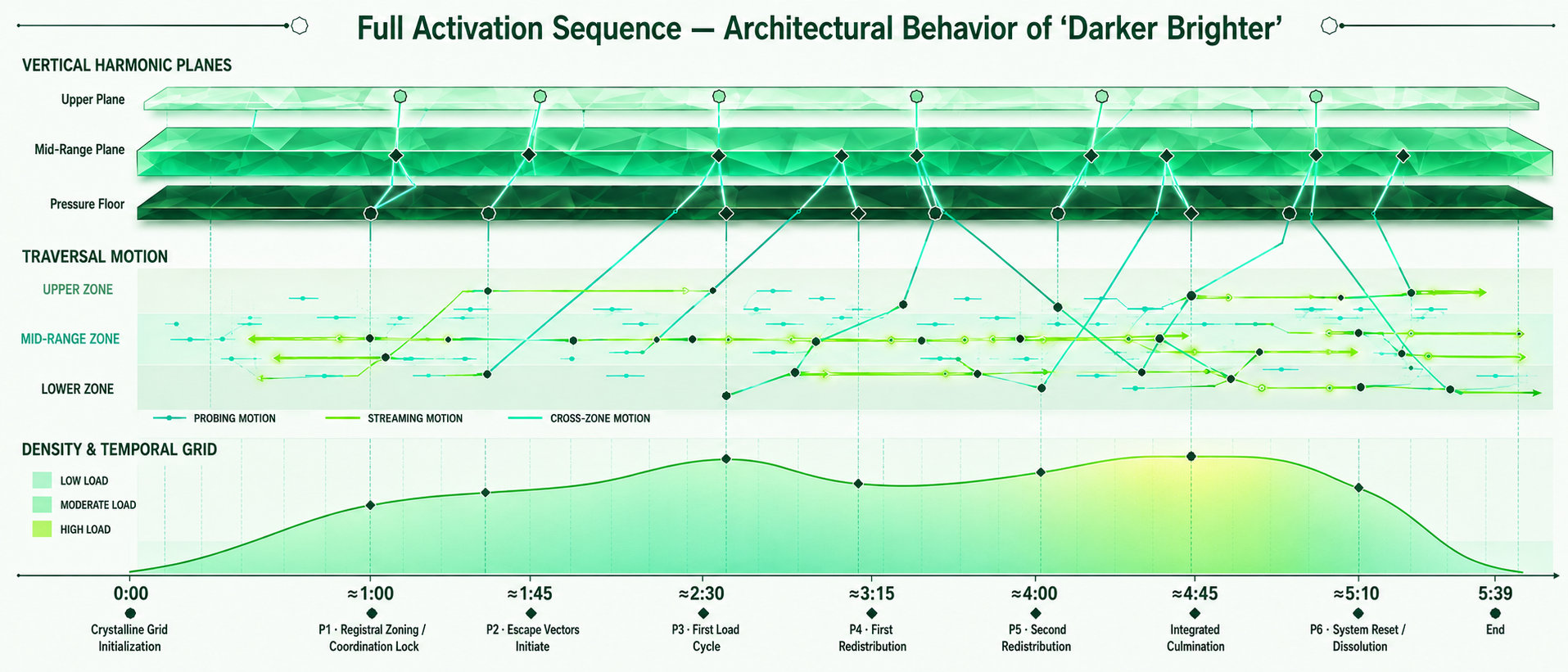
Panoramic representation of the track’s complete activation cycle, aligning its three harmonic planes, traversal pathways, density modulation, and temporal grid across the 0:00–5:39 timeline. The diagram traces the progression from crystalline-grid initialization and registral consolidation through traversal activation, coordinated loading and redistribution, peak integration, and final system reset.
With the activation cycle of Darker Brighter now fully mapped—its pivots identified, its density phases articulated, and its traversal behavior traced—the next step is to examine how these large‑scale architectural events manifest at the micro‑level. The timeline establishes the structural spine of the piece, but the system’s expressive identity emerges from the finer mechanisms operating within each phase: the harmonic planes that support the grid, the contour logic that shapes traversal, the density modulation strategies that govern load, and the ensemble’s coordinated micro‑engineering that sustains coherence under pressure. Section III turns to these internal dynamics, showing how the architecture behaves from the inside—how Gowen’s voicings, Hopper’s pressure‑floor motion, Tomkins’ temporal lattice, and Lee’s contour vectors interact to produce the spatial organism described in the timeline. In doing so, it reveals the underlying principles that make Darker Brighter not only a successful activation cycle, but a model of Gowen’s mature architectural system.
IV. Levels of Architectural Description
Understanding Darker Brighter means listening to how its architecture unfolds across several layers at once: the large emotional spaces the music inhabits, the processes that shape its long ascent and luminous plateau, the internal fields that give each span its color, and the pivots where the ensemble subtly changes direction. Unlike the recursive, climate‑shifting world of Bobberty, Darker Brighter moves with remarkable clarity—one continuous rise, one sustained brilliance, one graceful release. Each analytical level reveals a different facet of that motion: how the ensemble gathers light, how the crystalline grid strengthens, how traversal opens pathways through the texture, and how the music finally dissolves back into the atmosphere from which it emerged.
a. Regime Overview
How the music inhabits its largest emotional spaces
Darker Brighter unfolds through a remarkably clear sequence of large‑scale environments—regimes—that feel less like abstract structural zones and more like distinct emotional spaces the ensemble moves through. Where Bobberty is recursive and climate‑shifting, Darker Brighter is almost ascetic in its linearity: it begins in a fragile, introspective atmosphere, rises steadily into a fully activated crystalline grid, sustains that brightness with poise, and then releases its accumulated energy in a gentle, contemplative fade. The regimes describe this long arc from darkness to luminosity and back to openness, showing how the track’s architecture shapes the listener’s experience of time, density, and color.
The opening regime, from 0:00 to roughly 0:45, is the crystalline initialization—a low‑density, sparsely layered environment where the music feels as though it is quietly assembling itself. Gowen’s electric‑piano voicings trace out the earliest harmonic planes with a kind of glassy clarity, separating upper and mid‑range layers into distinct vertical strata without yet filling them. Hopper’s bass enters cautiously, forming only the embryonic pressure floor, and Tomkins’ pulse is more a suggestion of time than a fully enclosed groove. Emotionally, this space is introspective and slightly distant: the “darker” phase where the grid is present but fragile, and the ensemble seems to be testing the room rather than inhabiting it fully. No pivot has yet occurred; the architecture is still in its boot sequence.
From about 0:45 to around 1:40, the second regime emerges as registral zoning consolidates and the music steps into its first truly inhabited space. The darker atmosphere brightens, the theme begins to assert itself, and the ensemble’s relationship to register becomes decisive. Gowen’s mid‑range takes on gravitational weight, the upper plane stabilizes into a ceiling of light, and Hopper’s bass gains elasticity and presence, turning the lower register into a responsive foundation rather than a mere outline. Tomkins’ jazz‑inflected rhythmic clarity tightens the grid, giving the groove shape without sacrificing transparency. Around the one‑minute mark, the system reaches Pivot P1, the moment when ensemble coordination locks into place and the crystalline grid becomes structurally coherent. This regime feels like the music “arriving” in its own world: the point at which Darker Brighter stops sounding like an atmosphere and starts sounding like a living, breathing piece.
The third regime, spanning roughly 1:40 to 2:30, begins when Phil Lee’s guitar enters and the architecture activates its escape vectors. This is the moment traversal becomes central to the music’s identity. Lee’s fluid, contour‑driven lines move horizontally through the grid, testing its permeability and revealing how motion interacts with the now‑stabilized registral zones. Density is high but never overloaded; the texture remains clear even as interaction intensifies. As Lee’s lines circulate through the crystalline environment, the system reaches Pivot P2, signaling the transition from theme‑based development into the improvisational core. Emotionally, this regime feels like the music discovering its own corridors—finding paths through the harmonic and textural space that were only implied in the earlier phases. The track begins to glow from within.
From approximately 2:30 to 3:40, Darker Brighter enters its fourth regime: the first load cycle, where density and internal activity reach their most concentrated state. Gowen expands his mid‑range planes, Lee shifts from exploratory gestures to streaming traversal, Hopper increases both weight and rhythmic presence, and Tomkins tightens the micro‑engineered rhythmic lattice that underpins the entire grid. Pressure rises, corridor traffic intensifies, and the harmonic coloration deepens into the darker, richer hues associated with the bridge. At Pivot P3, the system crosses into a fully loaded state, demonstrating its capacity to bear coordinated stress without losing clarity. This regime is the track’s energetic heart: the improvisational core where harmonic richness, rhythmic complexity, and ensemble luminosity are all at their peak, yet the crystalline architecture remains intact.
The fifth regime, from about 3:40 to 4:45, is a study in density modulation through relief and redistribution rather than simple withdrawal. Instead of dropping intensity, the ensemble redistributes weight across the registral zones, maintaining high density while subtly altering internal balance. Traversal becomes more continuous and less pressurized; the grid adjusts its proportions to accommodate shifting emphasis among Gowen, Lee, Hopper, and Tomkins. The return of thematic material—now varied, fragmented, or reharmonized—corresponds to this architectural relief cycle. Pivot P4 marks the first internal rebalancing point, where the system reorganizes its stresses without reducing overall load, and Pivot P5 follows as a second redistribution, refining the equilibrium while keeping the grid fully active. Emotionally, this regime feels like a “twilight” descent: the music softens in affect without collapsing in structure, blending lingering brightness with a renewed sense of introspection.
The final regime, from roughly 4:45 to the end at 5:39, is the full activation and system reset—the closing environment where all domains of the architecture operate simultaneously before gradually releasing their energy. At 4:45, the track is still in a high‑density state, but the attenuation has already begun: traversal relaxes, the pressure floor lightens, and the crystalline grid starts to open back into transparency. Pivot P6, around 5:10, marks the decisive turn into dissolution, the moment when the architecture commits to letting go. From there, surface activity continues to fade, and by 5:39 musical motion ceases entirely. Emotionally, this regime feels like a return to the contemplative openness of the beginning, but now with the memory of the journey embedded in the space. The track resolves not with a dramatic cadence, but with an atmospheric fade‑out that lets the crystalline grid dissolve back into silence.
These regimes trace a single, beautifully paced arc: a fragile atmospheric initialization, a brightening and consolidation of the grid, an activation of traversal and improvisational energy, a fully loaded crystalline core, a twilight redistribution of density, and a gentle, thoughtful release. Darker Brighter may be one of Gowen’s most linear architectures, but within that linearity it achieves a rare balance of clarity and emotional depth—moving through its largest spaces with a kind of quiet inevitability that feels both rigorously constructed and deeply musical.
b. Process Overview
How the music grows, gathers, intensifies, and finally lets go
If the regimes of Darker Brighter describe the rooms the music inhabits, the process overview describes how the ensemble moves through those rooms—how it grows, gathers, intensifies, redistributes its energy, and ultimately releases what it has built. Unlike the more recursive, climate‑shifting behavior of Bobberty, the process logic of Darker Brighter is strikingly linear. It behaves like a single long breath: a careful inhalation, a sustained fullness, and a gentle exhalation. Yet within that apparent simplicity, the track reveals a finely tuned sequence of meso‑level behaviors that give its ascent and descent their particular emotional weight.
The first process is one of crystalline initialization. From 0:00 to roughly 0:45, the music does not rush to fill the space; it tests it. Gowen’s electric‑piano voicings sketch out the earliest harmonic planes with a kind of glass‑like precision, placing tones in the upper and mid‑range registers as if he were hanging lights in a dark room. Hopper’s bass enters cautiously, forming only the suggestion of a pressure floor, and Tomkins’ pulse is more a temporal hint than a fully articulated groove. The process here is one of careful assembly: the grid is being booted, but the system is not yet committed to full activation. Emotionally, this feels like the music taking its time to arrive, allowing the listener to acclimate to the atmosphere before anything decisive happens.
The second process, beginning around 0:45 and crystallizing near Pivot P1 at approximately 1:00, is registral consolidation and thematic emergence. Here the architecture stops hovering and begins to inhabit itself. Gowen’s mid‑range becomes the gravitational center of the system, the upper plane stabilizes into a bright ceiling, and Hopper’s bass gains elasticity and weight, turning the lower register into a responsive foundation rather than a mere outline. Tomkins’ rhythmic clarity tightens the temporal grid, giving the groove a sense of inevitability without sacrificing transparency. The process is one of gathering and focusing: the ensemble moves from atmospheric suggestion to coordinated presence. By the time P1 is reached, the system has achieved its first equilibrium—structurally coherent, capable of supporting traversal, and musically defined by the emergence of the track’s thematic identity.
The third process, spanning roughly 1:40 to 2:30 and anchored by Pivot P2, is traversal activation. Phil Lee’s entrance marks the moment the architecture begins to move horizontally through its own space. His guitar lines are not merely decorative; they function as escape vectors, probing the corridors of the crystalline grid and revealing how motion interacts with the stabilized registral zones. Density remains high but controlled, and the texture stays clear even as interaction intensifies. The process here is one of opening pathways: the building that was previously defined by its vertical planes now reveals its internal hallways. Musically, this is the transition into the improvisational core, where brighter voicings, increased interplay, and soloistic motion give the track a sense of inner exploration.
From approximately 2:30 to 3:40, the architecture enters its first load cycle, a process of coordinated intensification anchored by Pivot P3. Gowen expands his mid‑range planes, thickening the harmonic fabric; Lee shifts from probing gestures to streaming traversal, filling the corridors with continuous motion; Hopper increases both weight and rhythmic presence, reinforcing the pressure floor; and Tomkins tightens the micro‑engineered rhythmic lattice that underpins the entire grid. The result is a rise in internal pressure: corridor traffic intensifies, harmonic coloration deepens into darker, richer hues, and rhythmic figures become more tightly interlocked. The process is not chaotic; it is a controlled loading of the system. At P3, the architecture crosses into a fully loaded state, demonstrating its capacity to bear stress without losing clarity. This is the track’s energetic heart, where the improvisational core reaches its brightest and most concentrated expression.
The next process, from about 3:40 to 4:45 and articulated by Pivots P4 and P5, is density modulation through relief and redistribution. Crucially, this is not a simple decrescendo. The ensemble does not drop intensity so much as it redistributes it. Weight shifts among registral zones; traversal becomes more continuous and less pressurized; and the crystalline grid adjusts its proportions to accommodate changing emphasis among Gowen, Lee, Hopper, and Tomkins. The return of thematic material—now varied, fragmented, or reharmonized—corresponds to this internal rebalancing. P4 marks the first significant redistribution, where the system reorganizes its stresses while maintaining high density, and P5 refines that equilibrium further. The process here is one of softening without collapsing: the music retains its structural fullness but allows its emotional profile to tilt toward introspection, blending the lingering glow of the loaded state with a more reflective tone.
The final process, from roughly 4:45 to the end at 5:39 and centered on Pivot P6, is attenuation and system reset. At 4:45, the architecture is still active, but the attenuation has begun: traversal relaxes, the pressure floor lightens, and the crystalline grid starts to open back into transparency. P6, around 5:10, is the decisive moment when the system commits to dissolution. From that point, surface activity continues to fade, registral planes lose their former weight, and the temporal grid returns to a more open, less insistent clarity. By 5:39, musical motion ceases entirely, and the architecture dissolves back into the atmosphere from which it emerged. The process here is not abrupt; it is a gentle letting go, a controlled release of accumulated energy that allows the track to end with the same contemplative openness that framed its beginning.
Across its full span, Darker Brighter thus traces a meso‑architectural narrative that is both rigorously constructed and deeply musical: careful initialization, focused consolidation, activation of traversal, controlled loading, subtle redistribution, and graceful attenuation. The music grows, gathers, intensifies, and finally lets go in a way that feels inevitable but never mechanical. The processes do not merely describe what the architecture does; they describe how the ensemble breathes—how it takes in light, holds it, and then releases it back into silence.
c. Field Analysis
How each musical environment feels from the inside
If the regimes of Darker Brighter describe the large rooms the music inhabits, the fields describe what it feels like to stand inside those rooms—the pressure of the air, the way sound hangs or moves, the kind of intimacy or distance the ensemble creates at any given moment. At the micro‑architectural level, Darker Brighter is not just a crystalline system; it is a sequence of lived environments, each with its own internal climate, its own way of holding time, its own balance between light and shadow.
The opening field, from 0:00 to roughly 0:45, feels like a quiet, crystalline chamber that has only just been entered. Gowen’s electric‑piano voicings place tones with almost ritual care, leaving space around each chord so that the room itself seems to resonate. The upper register is clear but not yet bright; the mid‑range is present but not yet weighted; the lower register is more suggestion than foundation. Hopper’s bass touches the floor lightly, and Tomkins’ pulse is a soft scaffolding rather than a defined groove. From the inside, this field feels fragile and introspective, as though the music is listening to itself before deciding how much of its voice to reveal. Time is spacious, and the grid is visible but not yet fully inhabited.
As the track moves into the next span, from about 0:45 to 1:40, the field becomes a fully inhabited grid. The same room is now filled with more decisive presence. Gowen’s mid‑range chords gain weight and warmth, turning the center of the texture into a stable plane that the rest of the ensemble can lean against. The upper register brightens into a ceiling of light, and Hopper’s bass begins to walk and pivot with greater elasticity, giving the floor a sense of spring rather than mere support. Tomkins’ drumming sharpens the rhythmic contours, making the pulse feel both grounded and flexible. From within this field, the music feels settled and confident: the atmosphere of the opening has become a place the ensemble can move around in, and the listener experiences a clear sense of arrival. The grid is no longer an idea; it is a lived space.
The field that emerges around 1:40, continuing to roughly 2:30, is defined by motion through the grid. Phil Lee’s guitar enters not as an overlay but as a new way of inhabiting the room. His lines trace arcs and contours that move horizontally across Gowen’s harmonic planes, testing how far the texture can stretch without tearing. The density is high, but the clarity remains; each instrument has its own lane, and yet the lanes intersect in ways that feel conversational rather than crowded. From the inside, this field feels exploratory and luminous. The listener is no longer just standing in the room; they are being led through it, shown different angles and perspectives as Lee’s traversal opens pathways between the registral zones. The grid feels permeable, alive with motion.
Between 2:30 and 3:40, the field thickens into the loaded core of the track. Here, the room feels full—almost saturated—but never oppressive. Gowen’s mid‑range becomes more continuous, his voicings overlapping and extending in ways that create a sustained harmonic fabric. Lee’s guitar shifts from occasional arcs to streaming lines, filling the corridors with ongoing motion. Hopper’s bass grows heavier and more rhythmically insistent, and Tomkins’ drumming tightens into a finely articulated lattice that holds the entire structure together. From within this field, the listener experiences a sense of pressure and intensity, but also of remarkable balance. The music feels at its brightest and most energetic, yet the crystalline clarity of the architecture prevents it from becoming dense in a muddy way. It is a field of maximum interaction, where every gesture seems to find its place in a larger, coherent flow.
From about 3:40 to 4:45, the field shifts into a twilight environment of redistribution. The density remains high, but the internal balance changes. The ensemble begins to relax its grip on the grid without abandoning it. Gowen’s chords breathe more, leaving slightly more space between gestures; Lee’s lines become less pressurized, more lyrical; Hopper’s bass redistributes its weight, sometimes stepping back to allow other voices to come forward; Tomkins’ rhythmic lattice loosens just enough to let the texture feel more conversational again. The return of thematic material, now varied or reharmonized, gives the field a sense of memory—like the room recalling what it was earlier in the track, but seeing it through a softer light. From the inside, this environment feels reflective rather than driven. The music is still active, still multi‑layered, but its emotional center has shifted from intensity to contemplation.
The final field, from roughly 4:45 to the end at 5:39, is the dissolving chamber. At first, the room still carries the residue of the previous density: the grid is intact, the ensemble is present, but the edges begin to blur. Traversal relaxes; Gowen’s voicings become more spacious; Lee’s lines thin out or disappear; Hopper’s bass lightens its touch; Tomkins’ pulse returns to a more open, less insistent clarity. As the attenuation continues, the field feels as though it is slowly emptying of motion while retaining its harmonic atmosphere. By the time the music ceases, the listener is left in a space that resembles the opening field, but now with the memory of everything that has passed through it. From the inside, this final environment feels like a gentle release—a room that has been filled with light and sound, now returning to quiet without closing itself off.
Across these fields, Darker Brighter reveals a micro‑architecture that is as emotionally nuanced as it is structurally clear. Each environment has its own way of holding sound and time: the fragile crystalline chamber of the opening, the fully inhabited grid of the early theme, the luminous traversal space of the improvisational entry, the loaded core of maximum interaction, the twilight redistribution of energy, and the dissolving chamber of the outro. To move through the track is to move through these environments from the inside, feeling how the ensemble adjusts pressure, color, and motion in ways that make the architecture not just visible, but deeply musical.
d. Pivot Analysis
How the music turns, brightens, and reshapes its internal balance
At the micro‑mechanical level, Darker Brighter is held together by a series of pivots—precise moments where the ensemble subtly changes its posture, redistributes energy, or commits to a new phase of motion. These pivots are not abrupt cuts or dramatic ruptures; they are finely calibrated turns inside a continuous flow. Each one marks a shift in how the crystalline grid is inhabited, how density is managed, and how the music’s emotional center moves. Taken together, they trace the inner breathing of the track: the way it brightens, concentrates, relaxes, and finally lets go.
Pivot P1, occurring around the one‑minute mark, is the first decisive turn from atmospheric presence to fully coordinated architecture. Up to this point, the music has been assembling itself—testing the room, stabilizing registral zones, allowing the theme to emerge. At P1, that preparatory behavior crystallizes into a coherent ensemble stance. Gowen’s mid‑range voicings settle into a stable plane that feels less like isolated chords and more like a continuous harmonic surface. Hopper’s bass locks into a more defined relationship with the pulse, giving the lower register a sense of elastic weight. Tomkins’ drumming tightens the rhythmic grid, turning suggestion into groove. The pivot does not announce itself with a single gesture; it is felt as a moment when everything suddenly “makes sense,” when the music stops feeling tentative and begins to move with clear intention. Internally, this is the point at which the crystalline grid becomes capable of supporting traversal and sustained interaction.
Pivot P2, around 1:40, marks the activation of traversal as a structural force rather than a decorative layer. Phil Lee’s guitar has already begun to enter the texture, but P2 is the moment when his lines cease to be occasional color and become genuine escape vectors through the grid. The ensemble’s internal balance shifts: Gowen’s harmonic planes now function as corridors rather than static surfaces, Hopper’s bass responds more dynamically to the new horizontal motion, and Tomkins’ rhythmic lattice accommodates increased cross‑register dialogue. The pivot is felt as a brightening and opening from within—the music begins to move through itself, not just within its established planes. Emotionally, this is the turn into the improvisational core, where the track’s energy is no longer just gathered; it is actively circulated.
Pivot P3, at approximately 2:30, is the threshold into the fully loaded state. By this point, traversal is active, density is high, and the grid is clearly inhabited. P3 marks the moment when the ensemble collectively decides to push the system to its maximum sustainable intensity. Gowen’s voicings become more continuous and overlapping, Lee’s lines stream with fewer gaps, Hopper’s bass increases both its rhythmic insistence and harmonic anchoring, and Tomkins’ drumming tightens into a finely articulated mesh that leaves little unused space in the temporal fabric. The pivot is experienced as a subtle but unmistakable increase in pressure: the music feels more concentrated, more focused, yet still clear. Internally, this is the point at which the crystalline architecture proves its resilience, showing that it can bear a high degree of coordinated stress without collapsing into opacity.
Pivot P4, around 3:15, initiates the first significant internal rebalancing of that loaded state. The ensemble does not drop density; instead, it begins to redistribute it. Gowen allows slightly more air into his voicings, Lee’s lines become less relentlessly forward‑driven and more contour‑shaped, Hopper adjusts his emphasis to support shifting foregrounds, and Tomkins relaxes the tightest points of rhythmic interlock. The pivot is felt as a soft turning of the music’s emotional axis: the energy remains, but its focus changes. Rather than pressing outward, the track begins to look inward, using its accumulated intensity to explore more reflective gestures. Mechanically, P4 marks the transition from pure loading to modulation—an internal decision to maintain the grid’s activation while changing how that activation is distributed.
Pivot P5, at around 4:00, refines this redistribution into a new equilibrium. The ensemble has already begun to soften its stance, but P5 is the moment when that softening coalesces into a stable, twilight‑like balance. Gowen’s harmonic planes now breathe with a more spacious phrasing, Lee’s presence alternates between foreground and supportive commentary, Hopper’s bass lines weave in and out of prominence, and Tomkins’ drumming shifts from tight lattice to more conversational pulse. The pivot is experienced as a gentle settling: the music no longer feels like it is emerging from or descending into something; it feels like it is inhabiting a reflective middle ground. Internally, P5 marks the completion of the relief cycle—the point at which the system has successfully redistributed its load without losing the coherence established in the earlier pivots.
Pivot P6, near 5:10, is the final decisive turn: the commitment to dissolution. Attenuation has already begun around 4:45, but P6 is the moment when the architecture stops merely relaxing and starts actively letting go. Traversal diminishes, Gowen’s voicings become more sparse and atmospheric, Lee’s lines either thin to traces or disappear, Hopper’s bass lightens its touch, and Tomkins’ pulse returns to a more open, less insistent clarity. The pivot is felt as a release of tension that has been held for most of the track—a quiet but clear decision to return the music to the openness from which it began. Mechanically, P6 marks the transition from a functioning, fully activated grid to a dissolving structure, one that retains its harmonic memory but no longer sustains its former density or motion.
Across these six pivots, Darker Brighter reveals a micro‑mechanical logic that is both precise and deeply musical. Each turn is a small adjustment in how the ensemble inhabits the crystalline grid: first locking into coherence, then opening pathways, then loading the system, then redistributing its energy, then settling into reflective balance, and finally releasing its accumulated tension. The music brightens, concentrates, and reshapes its internal balance in ways that feel natural rather than engineered, making the architecture not just an abstract design, but a lived experience of how a band can breathe together over five and a half minutes.
V. The Initialization Load: Conditions and Parameters
The initialization load under which Darker Brighter operates is defined by the controlled, low‑to‑moderate density of its opening span (0:00–0:45), where the crystalline grid first asserts itself. In this phase, the ensemble maintains a deliberately sparse textural environment: Gowen’s electric‑piano voicings articulate the earliest harmonic planes with crystalline separation; Hopper’s bass provides only the faintest suggestion of a pressure floor; and Tomkins’ lightly accented pulse establishes a temporal scaffold without enclosing the grid. This restrained density is not merely atmospheric—it is architecturally essential. By keeping the number of active events below the threshold at which the grid would blur, the quartet allows each architectural module to come into focus: vertical planes, pressure‑floor elasticity, traversal corridors, and the temporal lattice. The musical “darker” entry thus becomes the architectural moment when the system boots and the spatial organism first coheres.
As the track moves toward Pivot P1 (≈1:00), the registral spread consolidates into a balanced hierarchy that mirrors the transition from atmospheric entry to thematic emergence. The upper plane becomes active enough to define a ceiling without saturating it; the mid‑range stabilizes into the gravitational hub through which harmonic and melodic information circulate; and the lower register gains elasticity without imposing heavy load. This distribution is crucial to the initialization process. It ensures that no single registral band dominates the texture, allowing the vertical hierarchy to emerge as a set of relationships rather than a foreground/background opposition. When the ensemble locks into coordinated interaction at P1, the grid becomes structurally coherent, capable of supporting traversal without destabilizing the registral balance established in the opening span.
Temporally, the initialization load is defined by the stability of Tomkins’ rhythmic grid throughout the introduction and early development (0:00–1:40). His patterns articulate a clear pulse and intelligible subdivisions; metric expectations are honored; and any syncopations occur within a framework that remains legible. This stability is an architectural choice. By maintaining a firm temporal lattice during the initialization phase, the quartet defines the default temporal environment against which later displacements, accentual shifts, and traversal‑driven counter‑framings will register as genuine structural events. The listener learns what “straight time” feels like in this system—how the grid supports the crystalline planes, how the pressure floor responds to motion, and how traversal will circulate once escape vectors activate at Pivot P2 (1:45).
Within this environment, the pressure floor begins to form in a way that is audible but not yet dominant. Hopper’s bass establishes a consistent presence that gives the music weight and direction, but he avoids driving the ensemble into continuous heavy load. Instead, his lines define the thickness and elasticity of the floor: how much harmonic and rhythmic weight it can bear before strain appears, how quickly it can recover after local surges, and how it interacts with Gowen’s lower extensions. As the track moves into the improvisational core and the first density‑modulation cycle at Pivot P3 (2:30), the pressure floor thickens proportionally, supporting traversal without overwhelming the registral balance established earlier.
These conditions—moderate density, balanced registral spread, stable temporal grid, minimal displacement, and an emergent but not saturated pressure floor—constitute the ideal initialization load for the activation cycle described in Section II. The system is under enough stress to reveal its architectural logic, yet not so much that its behaviors are obscured by saturation or turbulence. In this controlled environment, the musical narrative and the architectural organism reinforce one another: the atmospheric entry becomes grid initialization; the theme development becomes registral consolidation; the guitar spotlight becomes escape‑vector activation; and the darker bridge becomes the first load cycle. Darker Brighter thus functions as a carefully engineered systems‑test in which the quartet demonstrates how its architecture behaves when first engaged—how planes settle, how the floor thickens, how the grid locks at P1, how traversal ignites at P2, and how motion begins to circulate through the corridors before the system is subjected to heavier load later in the album.
VI. Plane Stabilization and Registral Architecture
Before examining how these planes stabilize and begin behaving as architectural entities, it is useful to visualize the vertical structure that “Darker Brighter” brings online in its opening measures. The Crystalline Grid Diagram illustrates the three‑plane harmonic architecture—upper tension surface, mid‑range load‑bearing hub, and lower pressure floor—as a stacked spatial system rather than a set of registral ranges. This schematic makes explicit the vertical proportions, the spacing between planes, and the emerging hierarchy of functions that govern how the track distributes weight, absorbs pressure, and organizes motion. By presenting the planes as architectural slabs with distinct thickness, density, and permeability, the diagram provides a structural map of the environment in which Gowen’s voicings operate and through which traversal will later move. It is the visual blueprint of the registral architecture described in this section.
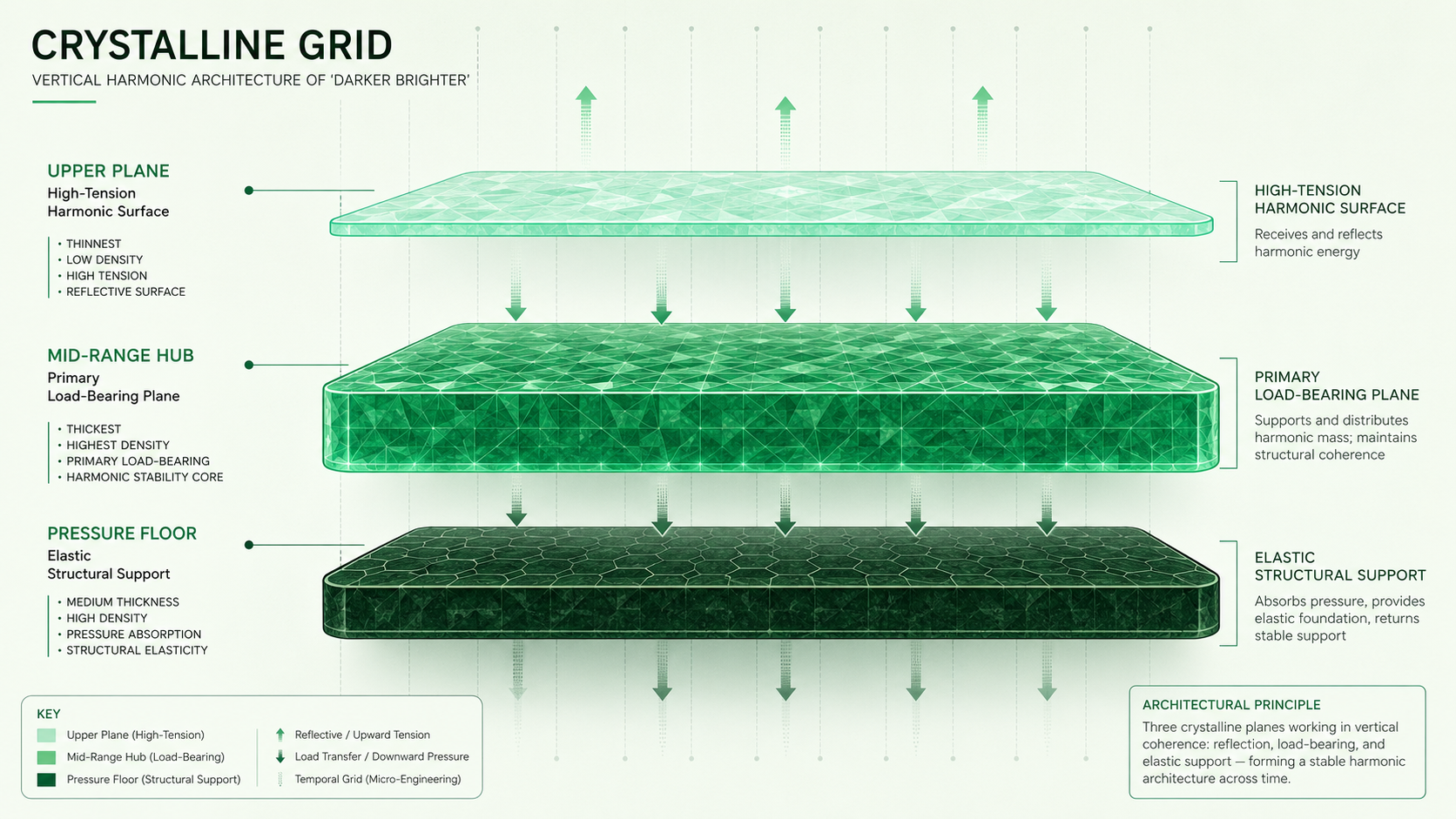
Three stacked harmonic planes—upper tension surface, mid‑range structural hub, and lower pressure floor—forming the track’s foundational registral architecture.
If Darker Brighter is the album’s initialization routine, then Gowen’s handling of registral space is the moment when the blueprint becomes a building—when the atmospheric entry, groove consolidation, escape‑vector activation, and early load phases traced in the architectural timeline crystallize into a coherent vertical architecture. The opening span (0:00–0:45) does more than present harmony; it establishes a three‑plane system whose upper, mid, and lower regions acquire distinct structural roles long before the ensemble reaches Pivot P1. The upper plane, articulated through Gowen’s higher voicings and color tones, appears in measured gestures that define a ceiling rather than a zone of continuous figuration. This ceiling becomes a functional boundary: during the groove build and especially after P1, Lee’s traversal is heard not simply as “playing high,” but as approaching or testing a clearly articulated upper limit. The ceiling gives the architecture vertical containment, allowing the listener to perceive the system as a space with a defined top surface rather than an undifferentiated registral expanse.
The mid‑range is where the gravitational field of the track takes shape, corresponding directly to the registral consolidation that stabilizes at Pivot P1 and supports traversal through Pivot P2. Gowen’s voicings in this band are neither purely accompanimental nor aggressively foregrounded; they form a central zone in which harmonic identity, rhythmic articulation, and textural weight converge. Motifs and chordal centers recur here—not as literal repetitions, but as persistent centers of mass around which motion organizes itself. As the groove stabilizes and traversal begins, this mid‑range becomes the structural hub of the architecture: the place to which lines return, from which they depart, and around which the ensemble’s behavior coheres. In architectural terms, it is the main hall or central stairwell, the space that connects the building’s vertical regions and gives the system its internal logic.
The lower plane, shaped jointly by Gowen’s occasional low extensions and Hopper’s bass, emerges gradually during the introduction and early development, then thickens proportionally as the ensemble approaches Pivot P3, the onset of the first density‑modulation cycle. Rather than saturating the extreme low register, Gowen and Hopper allow the lower plane to appear as punctual vertical impulses—moments that remind the listener of the floor’s presence without forcing the system into heavy load. These impulses demonstrate how downward pressure travels through the architecture, how the floor absorbs or redistributes weight, and how the mid‑range hub responds when the lower plane momentarily thickens. During the darker bridge (2:30–3:40), the pressure floor gains elasticity and begins to support more active traversal, preparing the system for the redistribution cycles that occur at Pivots P4 and P5.
Registral spacing across the three planes defines the corridor width of the track—the vertical span within which motion circulates during the groove build, guitar spotlight, and early load cycles. The distance between ceiling and floor is large enough to permit traversal, yet proportionally constrained enough to prevent the architecture from feeling cavernous or diffuse. Gowen’s voicings avoid extreme compression or dispersion; instead, they maintain proportional spacing that keeps the planes distinct while preserving continuity between them. This proportionality is what makes the architecture feel navigable. The listener can imagine moving through the space—ascending toward the upper plane, descending toward the lower, lingering in the mid‑range—without encountering abrupt voids or congested clusters that would disrupt the sense of coherent volume.
Crucially, the early vertical impulses already attempt coherence. Chords are not thrown into the texture as isolated events; they are placed in ways that reinforce the emerging hierarchy of planes. Upper‑plane gestures tend to relax into the mid‑range hub, lower‑plane touches support or echo mid‑range decisions, and the mid‑range itself mediates between vertical extremes. Over the course of the track, this behavior solidifies into a recognizable pattern: the architecture prefers interdependence over autonomy. The upper plane colors and extends, the mid‑range organizes and stabilizes, and the lower plane grounds and thickens. As the architectural timeline shows, these relationships persist through escape‑vector activation (P2), the first load cycle (P3), the redistribution phases (P4 and P5), and the system reset (P6), becoming the structural backbone of the track’s activation sequence.
By the end of Darker Brighter, the listener has witnessed the first true architectural alignment of the album. The planes have settled into roles that will persist across the record; the corridor width has been defined; the mid‑range gravitational field has taken shape as the central organizing band; and the vertical impulses have begun to behave as components of a single structure rather than discrete events. What begins as registral distribution becomes registral architecture—a system of planes whose relationships are stable enough to bear load, flexible enough to accommodate traversal, and clear enough to make subsequent deformations legible as structural choices rather than accidents of texture.
VII. Pressure Floor Formation and Density Behavior
To make the emerging load behavior of “Darker Brighter” visually legible, the Density Modulation Diagram charts how the system’s weight accumulates, disperses, and stabilizes as the pressure floor comes online. The schematic traces the track’s early density states as a continuous curve, showing how Hopper’s baseline and Tomkins’ rhythmic grid absorb increasing activity from the upper planes, how local surges of texture produce measurable rises in load, and how relief cycles allow the floor to recover and redistribute pressure. By mapping these fluctuations across approximate time, the diagram reveals the architecture’s first functional equilibrium: the point at which the floor can bear moderate weight without strain, respond predictably to changes above it, and maintain structural coherence even as traversal and plane activity begin to intensify. It is the visual counterpart to the system’s earliest experiments in load, pressure, and architectural resilience.
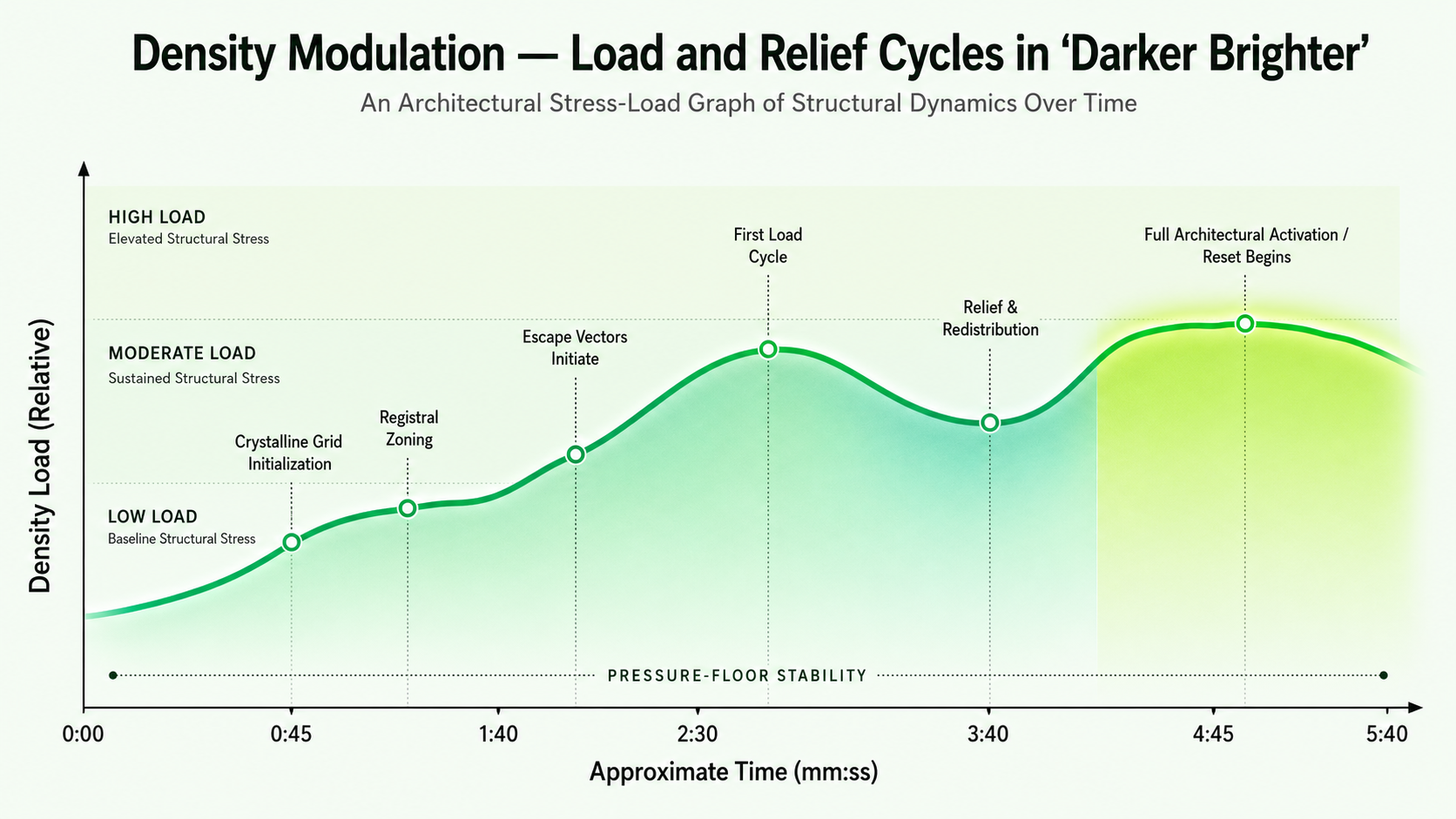
A continuous curve showing how the pressure floor absorbs, distributes, and releases weight as the track moves through its first density states.
If Gowen’s registral architecture gives Darker Brighter its vertical shape, Hopper and Tomkins provide the load‑bearing foundation that allows that shape to function under stress. In the architectural timeline, this foundation emerges gradually through the atmospheric entry (0:00–0:45), stabilizes during the groove consolidation leading to Pivot P1, gains elasticity as traversal activates at Pivot P2, thickens during the first load cycle at Pivot P3, and remains structurally reliable through the redistribution phases at Pivots P4 and P5. The pressure floor is not a static bass presence but a dynamic, responsive surface whose thickness, continuity, and temporal articulation determine how much weight the system can carry at this initialization stage. Hopper’s tone is central to this formation: defined enough to mark the lower boundary of the architecture, warm enough to fuse with Gowen’s lower extensions, and flexible enough to behave as part of the building rather than as an independent voice. This blend of clarity and integration ensures that the floor is audible as a structural element without detaching from the ensemble’s harmonic and rhythmic fabric.
Hopper’s motion refines the pressure baseline in ways that correspond directly to the activation sequence. During the introduction and early groove build, his lines are articulated and moderately paced, preventing the floor from becoming inert while avoiding the continuous driving that would push the system prematurely into heavy load. Each gesture adds weight, but the intervals between gestures allow the floor to breathe, to recover from local stress, and to redistribute pressure across the mid‑range hub. As traversal enters during the guitar spotlight—marked architecturally by Pivot P2—Hopper’s figures begin to interact more actively with Lee’s motion, shaping the contour of the floor without saturating it. This produces a baseline that is firm but not rigid, capable of bearing load yet flexible enough to modulate it. The architecture rests on something that can carry weight, but that weight is never allowed to accumulate unchecked.
Tomkins’ contribution is to transform this evolving floor into a true load‑bearing structure by locking it into a rhythmic grid. His drumming throughout the introduction and groove build is conspicuously clear: pulses are articulated with precision, subdivisions remain consistent, and accent patterns reinforce the sense of temporal orientation. This clarity is not merely stylistic; it is the mechanism by which the floor becomes structurally reliable. When Hopper adds weight, Tomkins’ grid determines how that weight is distributed across time—whether it arrives as a sudden impact, a sustained pressure, or a series of smaller pulses. Because the grid remains stable through traversal (P2) and into the darker bridge (P3), the architecture learns how stress will arrive and how it will be processed. The system becomes predictable in the best sense: impacts can be absorbed, redistributed, or softened without destabilizing the vertical hierarchy.
Within this framework, density states begin to modulate in a way that is both audible and legible. As Gowen thickens or thins his planes, and as Lee intensifies or relaxes traversal, the amount of simultaneous activity above the floor changes, and the system responds accordingly. In the sparser passages of the introduction and early development, Hopper’s baseline and Tomkins’ grid feel almost generous, providing more support than the upper structures strictly require and revealing how much capacity the system has in reserve. During the darker bridge—where the timeline identifies the onset of the first load cycle at Pivot P3—the same baseline begins to feel appropriately loaded, carrying the additional weight without buckling. The listener hears the architecture moving between lighter and heavier states while remaining anchored to a consistent pressure floor. These shifts correspond directly to the timeline’s load and redistribution cycles: density increases, the floor thickens; density relaxes, the floor redistributes.
Over the course of Darker Brighter, these interactions lead to the system’s first stable pressure equilibrium. The quartet discovers, in real time, how much density the floor can bear before strain becomes audible, how quickly it can recover after local surges, and how the grid can be used to smooth or accentuate transitions between states. By the return and climax—marked architecturally by Pivot P5—the pressure floor is no longer a tentative outline but a functioning foundation whose behavior under load is sufficiently predictable to support more complex experiments later in the album. In architectural terms, Darker Brighter is the moment when the building’s ground level is tested and confirmed: the quartet learns how its floor behaves, how its weight is carried, and how its density can be modulated without compromising structural integrity.
VIII. Traversal Logic: How Motion Enters the System
To clarify how traversal first enters and navigates the architecture, the Escape Vectors Diagram maps the motion pathways that Phil Lee activates as “Darker Brighter” transitions from stabilized planes to dynamic circulation. The diagram presents the two fundamental modes of movement—probing and streaming—as distinct vector behaviors within the registral space: short, fragmentary gestures that test corridor permeability, and longer, continuous lines that trace the building’s internal routes. By showing how these vectors cross, lean into, or retreat from the upper, mid‑range, and lower planes, the schematic visualizes the architecture’s responsiveness to motion—where it absorbs, where it redirects, and where it resists. This rendering makes explicit the spatial logic that Lee’s guitar reveals in real time: the corridors, junctions, gradients, and boundaries through which traversal becomes a structural force rather than a decorative one.
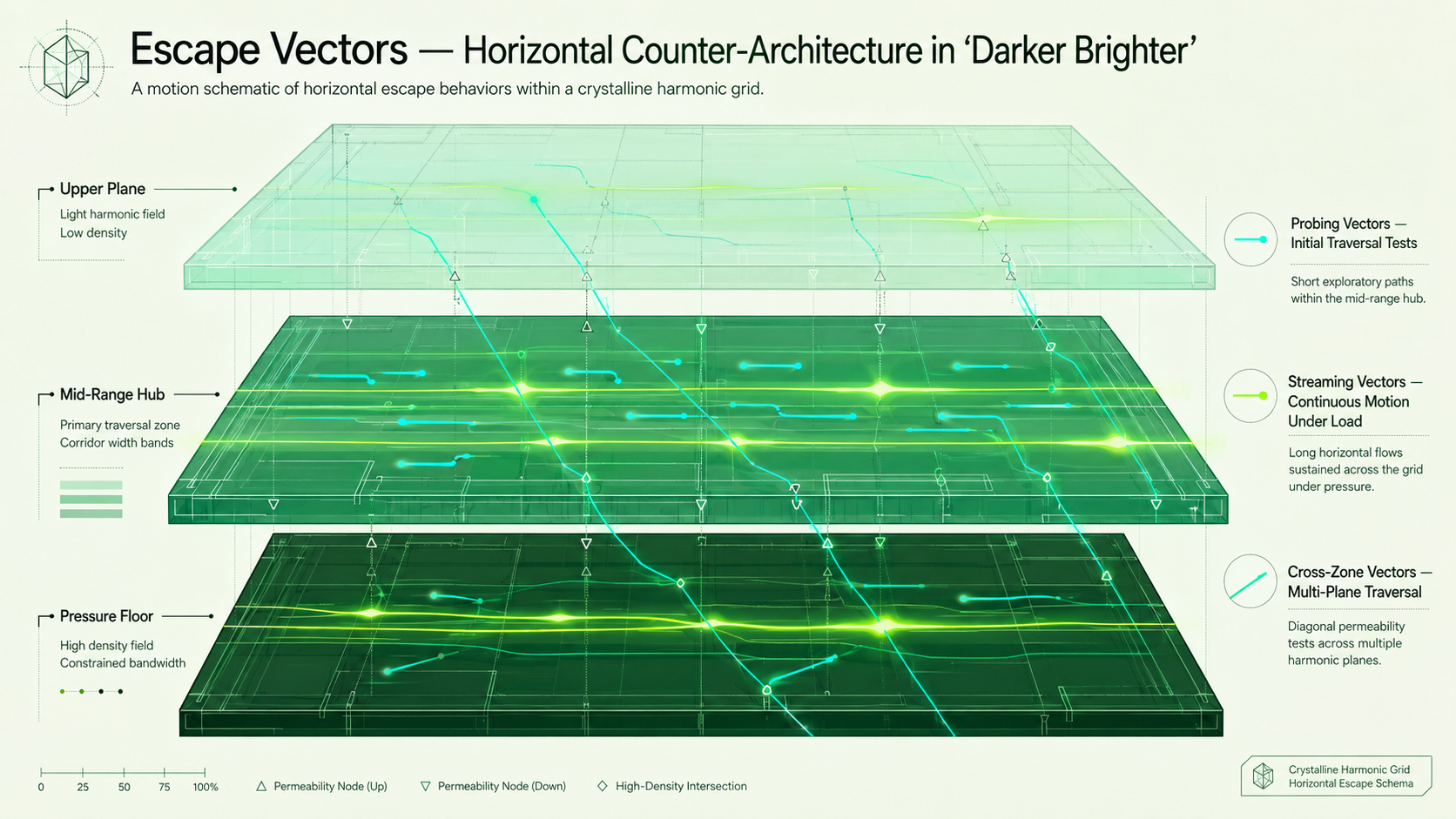
Probing and streaming traversal lines mapped across the harmonic planes, revealing the architecture’s corridors, boundaries, and zones of permeability.
Once the planes have stabilized and the pressure floor has reached equilibrium, Darker Brighter turns to the question of movement—how motion enters, tests, and inhabits the architecture. In the architectural timeline, this transition corresponds to the shift from registral consolidation at Pivot P1 into escape‑vector activation at Pivot P2, the moment when Phil Lee’s role becomes structurally decisive. His guitar is the primary agent of traversal, the element that does not merely occupy a plane but moves through them, tracing routes, measuring distances, and revealing how the building can be walked. In this track, Lee’s behavior oscillates between two fundamental modes—probing and streaming—and the alternation between them provides the listener with the first clear demonstration of how motion will function within the quartet’s system.
During the introduction and early development, Lee’s probing mode establishes the initial logic of movement. His lines are fragmentary, exploratory, and locally focused, testing the responsiveness of the mid‑range hub, leaning briefly into the upper plane, or touching the edge of the pressure floor without committing to sustained motion. These probes behave like architectural inspections: they determine whether a corridor is open, whether a junction can bear traffic, and whether a particular registral band can support additional weight. Because density and load remain moderate in this phase, the system responds with clarity; the listener can hear how each probe is absorbed, redirected, or allowed to dissipate. This makes the architecture legible. Motion is not yet rushing through the building, but the building is already demonstrating how it will handle motion when it arrives.
Streaming mode emerges fully during the guitar spotlight, where Lee shifts from local testing to continuous traversal—an architectural transformation marked by Pivot P2. Lines extend across multiple beats, cross registral boundaries, and begin to trace longer arcs through the space defined by Gowen’s planes and Hopper’s floor. Streaming reveals the length and shape of the corridors in a way that probing cannot. When Lee sustains motion, the listener can feel how far a line can travel before encountering resistance, how the architecture encourages or discourages certain directions, and how the rhythmic grid supports or complicates the journey. A streaming line that circulates within the mid‑range feels as though it is moving through the central hall; one that rises toward the upper plane feels like an ascent toward the ceiling; one that dips toward the lower band momentarily thickens the connection to the floor. In each case, the architecture is not a passive backdrop but an active participant, shaping the path and the experience of traversal.
As the track enters the darker bridge—the first load cycle marked by Pivot P3—the relationship between traversal and the pressure floor becomes more pronounced. Even in streaming mode, Lee’s lines remain tethered to Hopper and Tomkins’ foundation, and the nature of that tether is one of the key revelations of Darker Brighter. When the floor is relatively light, traversal feels weightless, gliding through the corridors with minimal resistance; when the floor thickens, the same lines acquire gravity, as though each step carries more consequence. The interaction between traversal and floor teaches the listener how load and motion are coupled in this system: movement is freer when pressure is low, more deliberate when pressure rises, and always conditioned by the state of the foundation beneath it. The darker bridge makes this coupling audible, revealing how traversal adjusts when the architecture begins to bear more weight.
As the track moves into the return and climax—corresponding to the redistribution cycles at Pivots P4 and P5—traversal begins to articulate internal pathways that will become familiar across the album. Certain routes—mid‑range to upper plane and back, brief descents toward the floor followed by returns to the hub—recur often enough to feel like established corridors rather than improvised wanderings. The listener learns that the building has preferred ways of moving through it, that some transitions are smooth while others require effort, and that the architecture possesses its own logic of circulation. Lee’s guitar is the instrument through which this logic becomes audible: his choices of entry point, direction, and duration map the internal geography of the quartet’s system.
By the end of Darker Brighter—at the dissolution marked by Pivot P6—motion has ceased to be an abstract concept and has become a structural behavior. Traversal is no longer simply “soloing”; it is the mechanism through which the architecture reveals its corridors, junctions, and gradients of pressure. Through the interplay of probing and streaming, through constant negotiation with the pressure floor, and through the gradual establishment of recognizable pathways, the track shows how movement begins inside the system—and how that movement will later be intensified, complicated, and stressed as the album subjects the same architecture to higher loads and more intricate temporal framings.
IX. Grid Alignment and Temporal Stability
If the pressure floor determines how much weight the architecture can bear, the temporal grid determines how that weight is distributed, sequenced, and made intelligible. In Darker Brighter, Trevor Tomkins’ drumming is the primary agent of grid alignment, and his choices are as architecturally consequential as Gowen’s registral design or Hopper’s pressure baseline. From the outset—during the atmospheric entry and early groove build (0:00–1:40)—Tomkins favors a mode of playing in which clarity of pulse and subdivision is paramount. The beat is not merely implied; it is articulated with enough precision that the listener feels the underlying meter as a stable frame rather than a fluctuating suggestion. Cymbal patterns, snare placements, and bass‑drum accents all contribute to a sense that time, in this track, is something the quartet can rely on: a structural resource rather than a variable to be constantly renegotiated.
This early grid clarity corresponds directly to the architectural timeline’s initialization phase leading to Pivot P1, where ensemble coordination locks and the crystalline grid becomes structurally coherent. Because the registral planes are stabilizing and the pressure floor is still forming, Tomkins avoids strong displacement. Syncopations and off‑beat accents occur, but they do so within a framework that remains legible at all times. He does not yet engage in the metric feints, cross‑accents, or polymetric overlays that will later complicate the listener’s sense of orientation; instead, he allows the grid to remain transparent so that the relationship between motion and pulse can be heard without interference. This minimal displacement is a deliberate architectural choice. It ensures that the listener learns what “straight” time feels like in the quartet’s system—how the planes sit on the grid, how the pressure floor locks into it, and how traversal behaves when the temporal environment is stable. Only once this default has been internalized will later deviations register as structural events rather than surface coloration.
As the track moves into escape‑vector activation at Pivot P2 and the first density‑modulation cycle at Pivot P3, Tomkins’ grid becomes the mechanism through which load is processed. Streaming traversal requires predictable temporal support, and Tomkins provides it with unwavering clarity. Even as the darker bridge introduces increased density and pressure, the grid remains firm enough that the listener can hear how stress arrives and how it is absorbed. The temporal frame does not buckle under load; instead, it thickens, becoming more emphatic without losing coherence. This behavior is essential to the timeline’s depiction of the first load cycle: the architecture is bearing weight, but the grid ensures that the distribution of that weight remains intelligible.
Over the course of Darker Brighter, this stable grid coalesces into what can be described as the album’s temporal default state. The quartet collectively adopts a way of inhabiting time that feels characteristic: phrases align with barlines in predictable ways, cadential points fall where the grid suggests they should, and even moments of local rhythmic tension resolve back into a pulse that has never truly disappeared. This default state is not rigid; it is normative. It defines the expectations against which all subsequent temporal behavior will be measured. When later tracks begin to fracture the grid, layer meters, or displace accents more aggressively, the listener will recognize these actions as departures from the Darker Brighter condition—a conscious reconfiguration of a previously stable temporal architecture.
The impact of this temporal stability on plane coherence is profound. Because the grid is firm and intelligible, Gowen’s registral planes can settle into consistent relationships with it. Upper‑plane gestures can lean into or away from the beat with clear expressive effect; mid‑range voicings can articulate harmonic rhythm in ways that feel anchored rather than floating; lower‑plane impulses can reinforce downbeats or create gentle suspensions without threatening the listener’s sense of orientation. The planes thus appear not as free‑floating layers but as time‑bound structures, each with a specific way of attaching to the grid. Hopper’s pressure floor benefits as well: his lines can lock tightly to Tomkins’ pulse, thickening the sense of weight at predictable points, or play slightly around it, introducing micro‑tensions that are audible precisely because the underlying frame remains intact.
In this way, Darker Brighter is the track in which time becomes structural for the quartet’s system. Tomkins’ temporal engineering does more than keep the band together; it defines the conditions under which architectural elements can cohere, interact, and eventually be deformed. By aligning the grid early, minimizing displacement, and establishing a clear default state, he turns meter and pulse into load‑bearing components of the architecture. The listener comes away from the track with a concrete sense of how this building sits in time—how its floors, corridors, and planes are synchronized with the grid—and is thus prepared to understand, in later pieces, how changes in temporal behavior amount to changes in the very structure of the labyrinth itself.
X. First Cycles of Loading and Relief
With planes stabilized, the pressure floor formed, traversal initiated, and the grid aligned, Darker Brighter is finally able to reveal the dynamic life of the architecture—its tendency not simply to exist under a fixed load, but to move through cycles of loading and relief. In the architectural timeline, these cycles correspond directly to the activation of escape vectors at Pivot P2, the onset of the first load cycle at Pivot P3, the redistribution phases at Pivots P4 and P5, and the system reset at Pivot P6. They are the first manifestation of the quartet’s recursive behavior: the way the system returns to and departs from characteristic states in patterns the listener can learn and anticipate. Loading rarely arrives as a sudden, catastrophic event; instead, it accumulates through coordinated changes in density, registral occupation, and rhythmic insistence. Gowen thickens his mid‑range voicings or activates the upper plane more continuously, Hopper increases the frequency and weight of his bass gestures, Tomkins tightens his patterns or adds layers of subdivision, and Lee shifts from probing to streaming traversal. Each action adds stress to the architecture, and together they produce passages in which the building feels more heavily inhabited—its corridors busier, its floor more burdened, its grid more intensely articulated.
Equally important is the way the system releases this load. Darker Brighter does not remain in a single pressure state; it repeatedly thins its texture, relaxes its rhythmic drive, and allows registral space to reopen. Gowen may reduce his voicings to sparser chords or lighter figuration, Hopper may simplify his lines or momentarily withdraw, Tomkins may return to a more open cymbal pattern with fewer internal accents, and Lee may revert to shorter, more exploratory gestures. These coordinated retreats do not dismantle the architecture; they reset it, returning the system to a condition closer to its initial equilibrium. In the timeline, these relief phases correspond to the redistribution cycles at P4 and P5, and the softening that leads into the coda at P6. The listener experiences these moments as genuine release: the building exhales, the corridors clear, the floor feels less burdened, and the grid resumes its role as a stable frame rather than a site of continuous propulsion.
Over the course of the track, the alternation between loading and relief becomes a recognizable pattern—a kind of breathing cycle for the quartet’s system. The architecture learns how far it can be stressed before it must relax, and the listener learns to hear these transitions as meaningful structural events rather than arbitrary changes in intensity. When the texture begins to thicken, the listener anticipates that a loaded state is approaching; when elements withdraw, the listener recognizes the onset of relief. In this way, Darker Brighter establishes architectural expectations: the building will not simply accumulate pressure indefinitely, nor will it remain permanently light. Instead, it will move through recurrent phases in which stress is applied, processed, and released, each phase revealing something about the system’s capacity and resilience.
These cycles are also the means by which the listener begins to grasp the internal logic of the labyrinth. Because loading and relief recur with variations rather than as one‑off events, the listener can compare different instances, noticing how similar configurations of density and motion produce similar sensations of strain or ease. The architecture thus becomes intelligible as a system of states and transitions: there is a recognizable loaded condition, a recognizable relieved condition, and a set of pathways by which the music moves between them. By the end of Darker Brighter, the quartet has not only demonstrated that its architecture can bear and release load; it has shown that these behaviors are recursive, forming patterns that will be expanded, intensified, and complicated across the rest of the album. The track is therefore the first place where the building’s dynamic logic—its way of loading, unloading, and returning to itself—becomes audible as a core feature of Gowen’s emerging system.
XI. Architectural Implications: What “Darker Brighter” Reveals About the System
By the time Darker Brighter completes its arc, the track has done far more than open the album; it has defined the operating parameters of the quartet’s system with a precision that makes its architectural role indispensable. Through the architectural timeline, the listener has witnessed the full initialization sequence: the crystalline grid forming during the atmospheric entry, registral zones consolidating at Pivot P1, escape vectors activating at Pivot P2, the first load cycle emerging at Pivot P3, redistribution occurring at Pivots P4 and P5, and the system resetting at Pivot P6. These events collectively specify the system’s normal functioning. We now know how much density the ensemble can carry under moderate load, how its registral planes are distributed and hierarchized, how the pressure floor behaves when weight is applied and released, how traversal enters and circulates through the building, and how the temporal grid anchors all of these behaviors in a coherent frame. None of these observations are incidental; together they constitute a definition of stability for Gowen’s quartet—what counts as equilibrium, what counts as deviation, and how the ensemble returns to its baseline state once stress has been processed.
In doing so, Darker Brighter establishes the album’s architectural grammar. The listener encounters, for the first time, the basic syntactic units of Gowen’s emerging system: plane stabilization as a precondition for load, pressure‑floor formation as the basis for density modulation, traversal as the means of articulating internal pathways, grid alignment as the temporal substrate on which all other elements depend, and cycles of loading and relief as the recursive pattern through which the architecture lives in time. Each of these behaviors appears in Darker Brighter in a clear, moderate form, making them legible as rules rather than anomalies. Later tracks will bend, stretch, and stress these rules, but their intelligibility will depend on the listener having first encountered them in this initial, less turbulent environment. The architectural timeline ensures that these behaviors are not abstract concepts but audible events tied to specific musical spans, allowing the listener to internalize the system’s grammar through experience rather than explanation.
Most importantly, Darker Brighter reveals the system’s baseline coherence. Under the initialization load, the quartet does not merely avoid collapse; it demonstrates a remarkable capacity to integrate vertical, horizontal, and temporal dimensions into a single functioning architecture. Planes do not drift away from the grid; the pressure floor does not detach from the harmonic structure; traversal does not undermine stability; cycles of loading and relief do not feel arbitrary. Instead, each component behaves as part of a closed system whose internal relationships are consistent enough to be learned and anticipated. This coherence is the precondition for all subsequent experimentation. Without it, higher‑load states would read as chaos; with it, they can be understood as deliberate stress tests of a system whose normal behavior is already known. The timeline makes this coherence explicit by showing how each musical section corresponds to a structural event, reinforcing the sense that the architecture is not metaphorical but genuinely operative.
In this sense, Darker Brighter prepares the listener for higher‑load experiments by quietly teaching them how the building works before subjecting it to more extreme conditions. When later tracks compress the grid, saturate the planes, drive the pressure floor into heavier states, or push traversal into more continuous and demanding motion, the listener will recognize these actions as transformations of a familiar architecture rather than unrelated gestures. The album’s more complex pieces—its multi‑climax designs, its temporal labyrinths, its maximum‑saturation episodes—derive their intelligibility from the fact that Darker Brighter has already shown what the system looks like when it is simply functioning, under moderate stress, according to its own rules.
For all these reasons, this track must be analyzed first in any serious account of the album’s architecture. It is not merely the chronological beginning; it is the conceptual and structural beginning, the point at which Gowen’s quartet declares its identity as a closed system and demonstrates the behaviors that will be recursively developed, challenged, and extended across the record. To understand Another Fine Tune You’ve Got Me Into as an architectural whole is to understand Darker Brighter as its initialization module—the moment when the labyrinth is first lit, its corridors measured, its floors tested, and its temporal frame aligned, so that everything that follows can be heard as a systematic exploration of the possibilities already latent in this opening, quietly rigorous design.