“Drop”
- Artist
- Soft Machine
- Album
- Fifth
- Year
- 1972
“Drop” begins with sounds that seem almost too isolated to belong to a form at all. Metallic impacts appear in open space, each leaving behind just enough resonance to suggest a connection with what might follow, while the listener is still unsure whether these are recorded objects, keyboard sounds, or something suspended between the two. Yet from that exposed beginning, the track gradually teaches itself how to continue: first through overlapping resonance, then through a persistent keyboard field, then through pulse, low-register weight, recurring material, and ensemble interaction. By the time Ratledge’s fuzz organ takes command of the foreground, the music beneath it has become capable of sustaining itself in ways the opening could not. “Drop” is therefore less a sequence of entrances than a study in how continuity can move away from the sound that most immediately commands attention.
Within This Track Study
I. Opening — What Continues When Attention Moves
“Drop” seems, at first, unusually easy to describe. A field of transformed drops and keyboards occupies a long introduction; bass and drums arrive; Mike Ratledge’s fuzz organ takes over the foreground; the performance eventually fades away. That sequence is real, but it does not quite explain the form. The important question is not simply which instrument enters next. It is what each new presence changes about the music’s ability to continue.
That problem begins with the drops themselves. Ratledge later described the opening drops as recorded liquid impacts transformed through tape-speed manipulation until they acquired something of an electric-piano character. That transformation matters because it makes the opening difficult to hear as either recorded object or keyboard sound alone. The drops arrive with the sharpness of physical impacts, yet their altered pitches and metallic decays already lean toward the sound world of electric piano. When prepared or processed Rhodes joins them, the resemblance can become strong enough for attacks and decays to blur into one another even while the two sources remain partly distinguishable.
“Drop,” composed by Ratledge and heard here in its standard LP realization on Fifth, extends that initial ambiguity into an ensemble problem. Ratledge plays the later fuzz-organ solo and appears to shape important parts of the opening keyboard construction; Elton Dean is credited with electric piano, while Hugh Hopper and Phil Howard supply bass and drums. Knowing who is playing, however, does not yet tell us what each sound is doing in the music. A voice can draw the ear without carrying everything that keeps the track moving, just as recognizable material can disappear while pulse, low-register weight, resonance, or interaction elsewhere continue to hold the performance together.
That distinction becomes increasingly important as the track unfolds. Continuity first belongs almost entirely to exposed events and their decays. Later it can persist beneath individual gestures, then become distributed among several simultaneous functions. By the time the fuzz organ commands the foreground, the music no longer depends on that voice to carry every part of its continuity itself. And when earlier material eventually reappears there, recognition changes the direction of the performance without restoring the state from which that material came.
The ending sharpens the same distinction from the opposite direction. The fade does not simply make an otherwise intact performance quieter. By then the playing is already contracting: activity thins, instrumental roles begin to lose their independence, and the remaining sounds have less power to renew the movement that came before them. As the level falls, those relationships become harder to hear and finally cease to function. What disappears is therefore not only volume, but the network of connections that had allowed the track to keep moving.
“Drop” builds its form by changing the relationship between what commands attention and what sustains continuity. At first, every event must renew the music’s existence. By the time the ensemble arrives, continuity no longer belongs to any one event—or even to any one player.
II. When Events Become a Field
Approximately 0:00–2:30
The first two and a half minutes of “Drop” do more than delay the arrival of the ensemble. They change the way the music is able to keep going. At the beginning, there is no independently sustained background: each transformed impact enters open space, leaves behind resonance or decay, and eventually gives way to another attack. When the prepared or processed keyboard joins, it enlarges that world without immediately changing its basic logic. Continuity still has to be renewed from event to event.
What changes around 0:43 is not simply the amount of sound but what remains after a gesture has passed. Overlapping keyboard arpeggiation, resonance, and stereo response begin to create a field that can stay present beneath whatever momentarily attracts attention. The drops do not disappear, and individual attacks still matter, but they no longer carry the full burden of keeping the music alive. For the first time, one gesture can recede while the surrounding field continues without it.
That change becomes especially important when a bounded recurring figure emerges later in the keyboard texture. Something more definite now begins to stand out from the surrounding activity: a shape that can be recognized when it returns rather than simply heard as another gesture inside the field. Yet that recurrence does not immediately bring the ensemble into shared time. The figure is still suspended inside the keyboard environment, while the firmer sense of pulse and low-register weight that bass and drums will later provide has not yet arrived.
The opening span changes from within rather than simply waiting for the ensemble to begin. Continuity first clings to individual attacks and their decays, then spreads into a field that can remain beneath them, and finally makes room for a recognizable recurring object without losing the surrounding texture. By the time the ensemble enters, the music has already learned how to keep going in more than one way.
a. Each Sound Must Begin the Music Again
Approximately 0:00–0:20
“Drop” begins without an independently sustained background. Transformed impacts appear one by one across the stereo field, some leaning left and others right, each carrying a pitched metallic resonance that can approach the color of electric piano. Their spacing is irregular, and the silence between them is substantial enough that each attack remains exposed as an event in its own right. The sounds carry pitch, but their altered timbre and metallic decay make it difficult to hear them as belonging to a settled tonal center. What is immediately clear instead is a shared sonic family: sharp attacks, altered pitch, resonant decay, and a sense of objects sounding into open space.
Those decays give the opening its first form of continuity. An impact can leave an echo or reverberant trace behind it, so the field does not simply alternate between sound and absolute emptiness. One event can remain faintly present while the memory of another is still active, allowing successive attacks to feel related even without literal repetition. But that connection remains fragile. Nothing continues strongly enough underneath the events to hold the space open on its own. There is no recurring pulse to steady the listener, and no sequence of attacks settles into a pattern that can be anticipated like a loop.
The distinction matters because the same sounds that command attention must also keep the music alive. Nothing has yet separated the gesture we hear most clearly from whatever might sustain the music beneath it: the attack, its resonance, and the space it opens all belong to the same process. Silence therefore carries unusual weight. It does not feel like a pause inside an already established field; it reveals that no such field yet exists. Each new impact must restore audible activity rather than simply appear against something already continuing.
At the opening, continuity has nowhere to hide: it exists in the event, its resonance, and the space before the next event arrives. The decays allow one sound to reach toward another, but nothing yet persists strongly enough to relieve the next attack of the responsibility for beginning the music again.
b. A Second Source Learns the First Source’s Language
Approximately 0:20–0:43
Around 0:20, a bright metallic keyboard stream enters strongly on the right. Its connected groupings and more stable sustain distinguish it from the irregular transformed impacts heard at the opening, but the distinction is never absolute. The keyboard attacks share enough of the drops’ metallic brightness and pitched decay that individual events can move in and out of clear source identity. Sometimes the ear hears a played keyboard gesture against a transformed impact; elsewhere the two blur together into a single sonority whose origin is harder to separate. The new source therefore complicates the opening before it stabilizes it.
Ratledge’s account of the drop construction helps explain why that ambiguity is so convincing. Water was first tried and rejected; liquid detergent was then allowed to fall onto metal, and the recorded impacts were altered by changing tape speed until they acquired something of an electric-piano character. That history tells us how the strange opening sonorities were made, but its musical importance lies in how they prepare the ear for what comes next. The drops have already been pushed toward the sound world of electric piano, so when a real keyboard enters it does not arrive as a completely foreign color. Its attacks can seem to grow out of the same metallic environment even when the ear can still tell that another source has joined.
As the passage continues, echo and overlapping decay increase. The prepared or processed Rhodes forms short connected figures, while transformed drops continue to interrupt or merge with them from other parts of the stereo image. As the activity becomes markedly denser, successive resonances begin to crowd the spaces between attacks. Yet the texture can still thin again, and when the attacks recede the sense of continuity weakens with them. The music has learned how to overlap and prolong its gestures, but nothing yet stays present strongly enough to hold the field open by itself.
This is why the image of Rhodes being “engulfed in water” captures only part of what happens. Fusion is certainly audible, but it is not simply a case of one keyboard source disappearing inside an already established drop texture. The relationship works in both directions: the transformed impacts have already been made keyboard-like, while the new keyboard enters with attacks and resonances close enough to the drop family that each can change how the other is heard. What accumulates is not one source swallowing another, but a growing family of sounds whose differences are becoming harder to keep apart.
The prepared keyboard does not escape the drop field; it enters by sounding enough like it to belong there. What it adds is not yet a background that can sustain the music on its own, but another way for one event to reach into the next through resemblance, overlap, and uncertainty.
c. The Field Outlives the Attack
Approximately 0:43–2:11
Around 0:43, the opening changes character. The bright metallic prepared timbre that had been independently prominent begins to lose that identity, while arpeggiated keyboard activity spreads more broadly across the stereo field. Overlapping figures, echo, and resonant decay accumulate until the texture becomes continuous or nearly continuous. The change is not simply that another keyboard or organ has entered. What matters is that continuity no longer has to be recreated by every new attack.
The transformed drops remain audible through much of this span, and individual keyboard gestures continue to emerge clearly enough to attract attention. But their role has changed. Earlier, a sounding event had to carry both its own presence and the continuity that connected it to what followed. Now an attack can occur inside an environment that is already there. One figure may fade, another may answer from elsewhere in the stereo image, and a drop may still interrupt the surface, but the broader keyboard field remains in place through the exchange.
That field is best heard as a stereo keyboard continuum. A sustained organ may also add to its density, but the sense of continuity is already there in the overlapping arpeggiation, echo, resonance, and interaction between keyboard layers. Whatever combination of sources produces it, the important change is easy to hear: the field can now remain present while individual gestures rise out of it and fall back again.
The pitch environment changes with it. The opening had offered isolated pitch-bearing objects whose altered timbres made it difficult to hear a settled tonal center. Here, pitch feels less like something attached to separate events and more like part of a broad keyboard space spread across the middle register. Low-register weight gradually becomes more noticeable as the span approaches its end, but a shared pulse has still not taken hold. Time is carried instead by overlap, duration, and the way one gesture flows into another.
Around 0:43, continuity ceases to be merely the afterlife of an attack and becomes an environment in which attacks can occur. That distinction is the first major formal boundary in “Drop”: individual gestures remain mobile, but the music no longer depends on any one of them to keep the field alive.
d. A Figure Appears Inside the Field
Approximately 2:11–2:30
Around 2:11, the left-weighted keyboard begins to articulate a compact figure that stands apart from the surrounding arpeggiation. Its contour, rhythmic grouping, and sense of closure make it recognizable as a bounded object rather than simply another local gesture within the broader keyboard continuum. The statements vary, but enough of their identity survives for recurrence itself to become audible. For the first time, the field contains something the ear can follow not only because it is prominent, but because it returns.
The appearance of this recurring riff does not displace the field that has formed around it. Contrasting keyboard activity continues elsewhere in the stereo image, and the surrounding resonance remains active beneath the more clearly bounded figure. Recurrence therefore adds another layer of continuity rather than replacing the ones already present. The riff can move into the foreground and then recede again because the broader field no longer depends on it to keep sounding.
Nor does the riff suddenly make the preceding two minutes sound as though they had been waiting for it all along. The earlier field already has its own coherence, and nothing in it points toward a hidden cycle that the riff now reveals. What changes is the range of possibilities ahead. The figure is distinct enough to be recognized without belonging permanently to one timbre or register, so it can later gather other instruments around it, move into the bass, break into fragments, disappear from the surface, and eventually return in another foreground voice.
None of that has happened yet. Low-register weight and percussive activity begin to gather at the edges of the texture, but the music has not settled into a shared pulse. The riff still floats inside the stereo keyboard field rather than pulling the whole ensemble into common time.
Around 2:11, “Drop” acquires recognizable material before it acquires collective time. The recurring figure gives the music something that can travel, but the significance of that mobility will only become fully audible when other players begin to take hold of it.
Sectional Conclusion. The opening has now produced two different kinds of continuity. One is environmental: the stereo keyboard field can remain present without requiring each new attack to recreate it. The other is material: the recurring riff can disappear and still be recognized when it returns. Neither yet gives the music everything it will later need. The field can hold the space open without establishing shared time, while the riff can preserve identity without becoming the only thing that keeps the track moving. What has changed is that continuity no longer has to belong entirely to the event that commands attention. One kind of stability can now remain underneath another kind of activity.
From Field to Distributed Ground. By 2:30, the music is ready for another change. The keyboard field can remain present, and the recurring riff can give the ear something recognizable to follow, but there is still no steady pulse underneath them and no firmly established low-register center. Bass and drums enter that already active space and begin to supply what has been missing, dividing the work of continuity among several simultaneous roles. The question is no longer how the music can survive the spaces between attacks, but what happens when time, low-register weight, and recurring material no longer have to come from the same place.
III. When Continuity Divides Its Labor
Approximately 2:30–3:18
Around 2:30, “Drop” acquires something the preceding keyboard field had not yet provided: a firmer sense of shared time and low-register weight. Bass and drums do more than thicken the texture around the recurring riff. Howard gives the music a pulse that can be followed even when the upper parts move freely, while Hopper settles more clearly into the lower register and gives the field a stronger sense of depth and center. The keyboard texture remains active, and the riff still supplies recognizable material, but the work of keeping the music together is no longer concentrated in one place.
That redistribution changes the meaning of recurrence. Before the ensemble arrives, the riff returns as a bounded object inside a persistent field; now several layers begin to gather around it without having to move in the same way. Howard steadies the time beneath it, Hopper gives it weight from below, and the keyboards continue to carry both the recurring figure and the surrounding texture. Instead of one new foundation replacing the old one, several kinds of support begin to coexist.
This also gives the span more weight than a simple crescendo toward the fuzz-organ entrance. The recurring figure itself begins to move between instruments. For most of the region it remains principally associated with the keyboard texture, but the bass becomes increasingly drawn into its contour and around 3:08 emerges as its clearest carrier. The riff, the pulse beneath it, and the low-register weight around it are now becoming easier to hear as separate things, even while they continue to work together.
By 3:18, “Drop” has built a field in which no single voice has to carry everything. Howard can keep time moving, Hopper can preserve the low center, the keyboards can continue to fill and differentiate the texture, and the riff can pass from one layer to another. That is what makes the coming fuzz-organ entrance possible: a new foreground can rise above the ensemble without forcing everything underneath it to start over.
a. Shared Time Becomes Audible
From approximately 2:30
Around 2:30, the keyboard field acquires something it has not previously possessed: a shared sense of time. Cymbals and drums settle clearly into the texture, bass becomes easier to follow as its own line, and the recurring riff continues across their arrival rather than being displaced by it. The right-side keyboard still maintains its arpeggiated activity, so the earlier field does not simply give way to a conventional rhythm section. Instead, pulse and low-register weight begin to gather underneath a texture that is already in motion.
Howard supplies the clearest change. Before this point, recurrence and overlapping keyboard activity could create local direction, but there was no steady pulse underneath them for the ear to hold onto. Howard now gives the music that pulse. He does not simply copy the rhythm of the recurring figure; he keeps time moving beneath it while the keyboard material continues to vary above. The riff can therefore be heard not only as something that returns, but as something returning inside a shared temporal flow.
Hopper contributes a different kind of stability. His bass gives the lower register a firmer pitch and registral orientation, adding weight beneath a field that had previously been concentrated largely in the keyboards. That role reinforces Howard’s temporal work without simply duplicating it. Howard articulates motion more continuously, while Hopper can leave larger spaces and still preserve the sense of a low center. At several moments their attacks line up closely enough to make the coordination obvious, but they never settle into a fixed unison pattern or behave like one fused rhythm-section voice.
The recurring riff changes function inside this new environment. It remains principally keyboard material, but bass and drums allow it to become something the ensemble can gather around without requiring every player to reproduce it. Howard gives its returns a steady temporal setting, Hopper places more weight beneath them, and the contrasting keyboard layer continues to keep the texture open and differentiated. What had been a recognizable object inside a persistent field is now becoming part of a shared ensemble motion.
The boundary at 2:30 matters for more than the arrival of two instruments. It matters because the work of continuity has begun to spread out. Pulse can continue in the drums, low-register weight can remain in the bass, the riff can retain its identity, and the keyboard field can keep moving around them. Shared time has become audible, but the ensemble does not achieve that stability by becoming uniform.
b. Repetition Becomes Ensemble Activity
Between approximately 2:30 and 3:08
The recurring riff begins to change through repetition. Keyboard statements return against a rhythm section that is now fully active, while the contrasting keyboard continues to preserve a separate arpeggiated or responsive layer. What had first appeared as a bounded object inside the stereo field is now increasingly surrounded by other kinds of motion: Howard keeps the pulse present, Hopper becomes more active beneath the figure, and the texture grows denser without collapsing into one fused gesture.
The passage certainly feels more urgent, but that does not necessarily mean the underlying tempo is accelerating. The riff statements arrive closer together, attacks accumulate more quickly, the drums grow fuller, and the subdivisions become easier to feel. The result is a sense of compression: more is happening inside the same shared flow of time, and the ensemble seems to press forward even without a simple continuous speeding-up of the beat.
That distinction matters because recurrence alone does not explain the change. The riff is not becoming more consequential simply because the keyboard plays it again. Each new statement draws more of the ensemble into its orbit. Hopper becomes increasingly involved beneath it, Howard fills the space with more continuous rhythmic motion, and the contrasting keyboard remains active enough to keep the texture from turning into simple tutti repetition. The players are coordinating more closely without losing the differences between their parts.
Near the end of the span, one keyboard statement changes its ending instead of reproducing the figure mechanically. That small shift makes clear that the riff is behaving as recognizable material rather than as a literal loop. It can bend without losing its identity, and the ensemble can respond to that identity without having to reproduce it exactly.
The riff does not become more important merely because it repeats; it becomes more consequential because an ensemble is forming around it. By 3:08, recurring material, pulse, low-register activity, and contrasting keyboard motion are no longer merely coexisting. They have begun to shape one another.
c. Bass Carries What Keyboard Introduced
Approximately 3:08–3:18
Around 3:08, the recurring riff moves most clearly into Hopper’s bass. What had been introduced and developed principally in the keyboard is now heard in a lower, heavier register, with the figure reshaped by the bass’s articulation rather than simply doubled an octave below. Its contour and grouping change with the instrument, but enough of the earlier shape remains for the connection to be unmistakable.
The shift matters because the riff now arrives with a different kind of weight. Hopper is carrying the recognizable figure in the same low register that has begun to anchor the ensemble, so the bass can preserve the earlier material while also deepening the center beneath the keyboards. For a few moments, what the ear recognizes and what gives the music its strongest low-register pull come together in the same voice.
Howard keeps that concentration from taking over the whole texture. The pulse continues underneath the bass riff, and the drums do not need to copy Hopper’s grouping for the ensemble to stay together. This makes the division especially easy to hear: Hopper carries the figure itself, while Howard keeps the time moving around it.
The keyboard field remains present, but the riff no longer belongs to it alone. Once the bass can carry the figure without breaking its identity, the material has become free to move between instruments while the surrounding pulse and texture continue elsewhere. That mobility will matter increasingly as the track opens into the fuzz-organ improvisation.
When the riff reaches the bass, recognizable material drops into the same register that is beginning to anchor the ensemble. Yet the center remains divided rather than fused. Hopper carries the riff and the low weight; Howard keeps the pulse alive. That separation is already in place when the fuzz organ begins to emerge into the foreground.
Sectional Conclusion. By 3:18, the work of keeping “Drop” together has spread across the ensemble. Howard keeps the pulse moving; Hopper gives the music low-register weight while temporarily carrying the recurring riff; the keyboards preserve the layered texture of the earlier field; and the riff itself has become something that can pass from one instrument to another without losing its identity. None of these elements has to do everything. Their strength comes from remaining active together while each carries a different part of the music’s continuity. The passage from 2:30 to 3:18 therefore does more than bring in the rhythm section. It gives time, low-register weight, texture, and recognizable material enough independence that a new foreground can rise above them without forcing the music underneath to begin again.
From Material Foreground to Sustained Freedom. At 3:18, the fuzz organ becomes the dominant object of attention, but it arrives over a field that is already moving on its own. Howard’s pulse continues without interruption, Hopper keeps the low center present, the keyboard texture remains active through the middle register, and fragments of the recurring riff survive briefly in the bass beneath the new foreground. The next question is therefore not what the organ replaces, but what becomes possible when the voice drawing the most attention is freed from having to keep the time, supply the low weight, and preserve the track’s earlier material all by itself.
IV. The Foreground Moves; the Ground Remains
Approximately 3:18–6:49
At 3:18, the most obvious thing that changes is also the easiest thing to overstate. Ratledge’s fuzz organ becomes the dominant object of attention, but it does not create a new temporal or harmonic world around itself. Howard’s pulse continues beneath it, Hopper remains active in the low register, the right-side keyboard keeps chordal and arpeggiated motion alive through the middle of the texture, and the bass briefly carries fragments of the recurring riff across the threshold. The organ changes what the ear follows most closely without making the music underneath it start over.
That separation defines the long central span of “Drop.” Ratledge can move with considerable freedom because the other layers keep doing work he no longer has to do himself. Howard keeps the time present without pushing the organ into regular phrasing; Hopper preserves low-register weight without settling into a fixed ostinato; and the right-side keyboard remains active enough to prevent the texture from shrinking into soloist above rhythm section. The organ dominates the surface, but the music continues to be held in place from several directions at once.
The recurring riff makes that especially clear by disappearing. For a short time after the organ entrance, recognizable fragments remain audible in the bass, keeping a direct connection with the preceding region. As those fragments gradually lose their shape, the performance does not lose its coherence with them. Howard’s pulse remains, Hopper continues to renew the low field, the right-side keyboard keeps the middle register active, and the players continue to respond to one another without needing the riff to return. Its disappearance reveals that recognizable material was only one of several things holding the track together.
The central improvisation is not a long stretch in which form simply pauses while the organ solos. The ensemble continues to change from within. Howard can build or release pressure, Hopper can restore weight from below, the right-side keyboard can thicken or open the space around the organ, and Ratledge’s own increases in loudness or activity do not automatically create a new section. What persists is not one repeated pattern, but a set of relationships strong enough to let the surface expand, contract, and shift without losing the field underneath.
This is the point at which “Drop” most clearly separates what the listener follows from what allows the music to continue. The fuzz organ occupies the foreground, but the ground remains plural. Its freedom depends on that plurality.
a. An Entrance That Does Not Reset the Music
Around 3:18
At about 3:18, Ratledge’s fuzz organ becomes unmistakable. Its abrasive timbre, sustained phrasing, and upper-register pressure immediately pull the listener’s attention toward a new principal voice where no comparably dominant solo foreground had existed before. The boundary is real, but the change is not a restart. What shifts most strongly is where the ear is drawn: one instrumental voice now rises above a field that is already moving.
What persists across the entrance is just as important. Howard’s pulse continues without interruption, Hopper keeps the low register anchored, and the right-side keyboard remains active rather than disappearing beneath the new solo voice. Most tellingly, recognizable fragments of the recurring riff remain in the bass for a short time after the organ has entered. The new foreground arrives while part of the preceding region is still sounding underneath it.
The organ entrance changes several things at once. Its timbre is harsher, its register adds pressure high in the texture, and its sustained phrases create a more continuous foreground line. But the rest of the ensemble does not have to rebuild itself around that entrance. Howard keeps the time moving, Hopper keeps weight underneath it, and the keyboard field remains present through the middle register. The organ can become the most compelling voice because those other layers are already carrying enough of the music to let it move freely above them.
This is why the entrance does not feel like one section being replaced by another. The organ opens a new foreground inside a field that is already established, and the recurring riff briefly crosses the boundary in the bass at the very moment when the surface of the music is changing most sharply. The contrast is strong, but the connection underneath it remains audible.
The fuzz organ changes what the listener follows without changing what allows the music to continue. From this point onward, the principal foreground voice and the layers sustaining the performance can move with an independence that the earlier regions had only gradually made possible.
b. The Riff Survives Beneath Its Successor
After approximately 3:18
For the first seconds after the fuzz organ takes the foreground, the recurring riff does not disappear with the keyboard texture that introduced it. Hopper continues to carry recognizable fragments in the bass, preserving enough of the earlier contour and grouping for the connection to remain audible beneath Ratledge’s new solo voice. The listener’s attention has shifted upward, but part of the track’s recent past is still moving underneath.
This brief overlap makes the division of labor unusually easy to hear. Ratledge now commands attention, Howard keeps the pulse moving beneath him, and Hopper combines low-register weight with fragments of the recurring material. The bass is doing more than accompanying the new foreground. It is carrying both the low center of the ensemble and the recognizable shape that had previously belonged more clearly to the keyboard.
The riff does not remain equally clear for long. The bass continues to present recognizable varied fragments, but the figure gradually begins to loosen. Its earlier contour mingles with more mobile bass phrasing, until by about 3:35 the ear follows a broader movement through a restricted low pitch field rather than repeated complete statements of the riff. The material does not vanish in one stroke. It gradually loses its outline and dissolves into the more general motion of the bass.
Howard’s pulse remains steady through that change. As the riff loses definition, the sense of time does not weaken with it. Hopper can let the figure dissolve while the drums continue to hold the performance in motion, so recognizable material can recede without taking the ensemble’s momentum with it.
For a few seconds, the new foreground rises above music that is still remembering what came before. The organ draws the ear, the bass carries the last traces of the riff, and the drums keep time moving underneath both. By the time the figure finally loses its shape, the performance has already learned how to continue without it. The riff will not reach the fuzz organ until much later.
c. Howard Keeps Time Open
Within approximately 3:18–6:49
Howard’s drumming gives the central improvisation one of its most important paradoxes: time remains stable without becoming restrictive. Beneath Ratledge’s fuzz organ and Hopper’s mobile bass, the pulse remains easy to feel, but Howard does not keep it in place through one repeated snare-and-tom pattern or by stressing the same short grouping over and over. Cymbal, snare, and tom accents move freely across the surface, sometimes reinforcing a local gesture and sometimes pushing against it.
That freedom keeps the time from hardening into a fixed pattern. Howard can build pressure beneath a sustained organ phrase, punctuate a release, leave a patch of open space after a dense passage, or come back strongly enough to change the direction of what follows. Several of the clearest releases begin in the drums rather than simply confirming a change another player has already made. He is not merely holding the beat in place; his playing keeps shaping the pace and pressure of the improvisation.
That becomes especially clear when the other layers thin. Hopper can leave space without making the pulse disappear, and the organ can release or suspend a phrase without leaving the music weightless in time. Howard keeps enough motion underneath those gaps for the ensemble to remain oriented even when the most prominent voices momentarily fall quiet. At the same time, his accents do not force every phrase into the same shape. Longer stretches can gather pressure and then relax without being pinned to one repeated pattern of emphasis.
Howard supports the solo not by shadowing it, but by keeping time alive underneath it. The organ can stretch, sustain, intensify, or release because that motion remains available beneath every change without telling the solo exactly how it has to move.
d. Hopper Holds the Low Field Without Freezing It
Within approximately 3:18–6:49
If Howard keeps the central improvisation open in time, Hopper gives that openness a lower boundary. His bass repeatedly returns to a comparatively restricted E/B-related pitch field, maintaining a stable low-register presence beneath the wider mobility of organ and keyboards. That stability does not come from repeating one bass line. Hopper’s phrases change length, contour, register, and density, and rests remain part of the playing. What persists is not an ostinato but a familiar low world that can be left, revisited, and renewed.
This makes Hopper’s kind of continuity very different from Howard’s. Howard keeps the pulse alive through changing accents; Hopper keeps drawing the ear back toward a familiar low register through changing phrases. The bass does not need to mark every beat for that center to remain present, and it does not need to sound continuously. A rest can open beneath the upper texture without making the music lose its footing, because the next low attack often returns to territory the ear already knows.
That low world is restricted without feeling closed. Hopper can move outward toward other pitches and registers before returning to E- or B-related areas, while the upper keyboards range more freely above him. The result is a clear sense of harmonic and registral orientation without a conventional chord progression and without the bass settling into a drone. At several points Hopper can also re-enter strongly enough to renew the motion from below rather than simply responding to changes elsewhere.
Its earlier history matters here. Just before and briefly after the fuzz-organ entrance, Hopper had carried the recurring riff itself. Once that figure loses its clear outline, the bass does not lose its importance with it. The same low register that had briefly carried recognizable material continues to anchor the ensemble through freer, more mobile phrases. Something of the riff’s weight remains in that register even after the figure itself has disappeared from the surface.
Hopper holds the center by returning to a familiar low world, not by repeating one line. The bass can move away, leave space, and come back without losing that sense of orientation. Together with Howard’s continuing pulse, that low field gives the organ room to range far beyond either player’s immediate phrase without making the ensemble underneath it feel unmoored.
e. A Second Keyboard Preserves Difference
Within approximately 3:18–6:49
The fuzz organ may dominate the upper field, but it does not occupy that field alone. A cleaner, more sharply articulated keyboard stream remains audible on the right at several points, bringing arpeggiated motion, chords, responsive figures, and intermittent activity into spaces left open by the other instruments. Dean’s Fender Rhodes remains clearly distinct from the fuzz-organ foreground.
Sometimes the right-side keyboard thickens the middle register beneath sustained organ phrases; elsewhere it introduces its own arpeggiated motion, punctuates a change, or comes forward more clearly when the organ releases. Its contribution lies partly in keeping another way of moving alive inside the same space rather than simply reinforcing Ratledge’s line.
That independence keeps the texture from closing around the fuzz organ. Ratledge can sustain, bend, intensify, or project long phrases while the right-side keyboard continues to move beneath and beside him, adding chords, shorter attacks, and a different kind of motion through the middle register. The two do not need to converge for the music to remain coherent, and their difference prevents the central span from shrinking into a simple picture of soloist above bass and drums.
The right-side keyboard therefore keeps something available that neither Howard nor Hopper supplies in quite the same way: continuing movement and color through the middle of the texture. It fills spaces opened elsewhere in the ensemble and keeps the upper field from becoming the property of one voice alone. Its importance lies not in controlling the improvisation, but in making sure that even under the organ’s dominance, another musical path remains open.
f. The Loudest Voice Does Not Control Every Change
Within approximately 3:18–6:49
Ratledge’s fuzz organ remains the most conspicuous upper voice through the central improvisation. Its sustained tones, abrasive attacks, and expanding phrases repeatedly pull the music toward local peaks, and at several moments the other players respond audibly as its pressure increases. But being the loudest and most exposed voice does not mean that every change begins there. The organ may be the easiest layer to follow, yet the performance keeps shifting in ways that come from elsewhere in the ensemble as well.
Howard makes that especially clear. Several releases begin in the drums, where accumulated activity suddenly opens into space before the organ has fully shown where the music is going next. Hopper can renew the motion from below, bringing back low-register weight after the texture has thinned or nudging the ensemble toward another direction without waiting for a decisive cue from Ratledge. The right-side keyboard can fill and reshape the spaces left open in the middle register, even if it does not define the larger sections by itself. The music therefore moves through a constant exchange of pressure, response, and initiative rather than through a simple pattern in which the soloist acts and everyone else follows.
The local peaks make that distinction especially easy to hear. Ratledge can intensify strongly enough to pull the whole ensemble into a moment of collective pressure, yet that pressure can subside without changing the deeper shape of the improvisation. The conspicuous organ peak near 5:59, for example, rises sharply and then passes without disturbing the continuing pulse, the low-register center, or the basic relationship among the players. The dense activity around 6:33–6:35 works in much the same way: the surface becomes more crowded and forceful, but the music does not cross into a fundamentally different kind of behavior. Loudness and density can bring a passage to a peak without turning that peak into a new section.
The reverse is also true. A quieter gesture can matter more than a louder one if it changes what the others are able to do next. Howard can release pressure while keeping the pulse alive; Hopper can restore weight from below with a new bass phrase; the right-side keyboard can step into a space the organ has opened. None of these moments gives one player lasting control. What matters is how each local move changes the space available to the rest of the ensemble.
This is where Relational Continuity becomes most audible. The improvisation holds together not because one voice keeps giving orders, but because the relationships among the players remain strong enough to absorb these shifts of emphasis and initiative. One player may briefly pull the music in a new direction, another may answer or release the pressure, and another may keep the underlying motion intact. Authority can move from moment to moment, but the ensemble does not lose the shared sense of time, weight, and space that keeps those changes connected.
The loudest voice does not control every change. Ratledge can focus attention and sustain the main foreground line, but Howard, Hopper, and the right-side keyboard continue to shape the music from less conspicuous positions. The central improvisation remains coherent because what holds it together is spread across the ensemble rather than concentrated in the voice the listener hears most immediately.
Sectional Conclusion. The central performance remains coherent after the recurring riff disappears from the surface because the things that keep the music moving have spread across the ensemble rather than vanished with it. Howard keeps the pulse alive; Hopper repeatedly restores low-register weight; the right-side keyboard keeps motion and color active through the middle of the texture; and Ratledge’s fuzz organ carries the main foreground line. No one of those layers can account for the whole span. What matters is that they continue to support and reshape one another even as density changes, registers open and close, and initiative passes from one player to another. This is the clearest realization of Relational Continuity in “Drop”: coherence survives not because one musical object remains constantly audible, but because several different kinds of activity continue to keep the same musical space in motion.
From Sustained Freedom to Material Reconnection. By the end of this span, the fuzz organ has been able to move so freely because pulse, low-register weight, and contrasting keyboard activity have continued elsewhere. The recurring riff itself has been absent for several minutes, yet the performance has not needed it in order to remain coherent. The next transformation begins when Ratledge’s foreground line reaches back toward that earlier figure. What matters is not simply that the riff returns, but that the voice which has spent several minutes moving independently above the ensemble now begins to carry material that had previously belonged to keyboard and bass.
V. When the Foreground Remembers
Approximately 6:49–end
Around 6:49, the central improvisation begins to turn back toward material heard earlier in the track. Ratledge’s fuzz organ starts to articulate the recurring riff that had first appeared in keyboard and then passed into the bass, bringing that recognizable shape into the voice that has dominated the foreground for several minutes. Howard and Hopper continue beneath it, and the surrounding keyboard texture remains part of the field, so the return does not wipe away what the ensemble has already built.
What matters is how that return changes the direction of the music. Earlier, the riff had helped gather the ensemble, pass between instruments, and create new kinds of coordination while the performance was still opening outward. Here it arrives after several minutes in which the organ has been free to move above pulse, low-register weight, and keyboard activity sustained elsewhere. Once the foreground begins to carry the earlier figure itself, that freedom starts to narrow. The riff is no longer simply something the music can recognize again; it becomes the beginning of a closing movement in which fewer possibilities remain open.
a. The Riff Returns in a Different Bearer
Approximately 6:49–6:59
Around 6:49, Ratledge’s fuzz organ begins to articulate a recognizable version of the recurring riff. Its contour and rhythmic shape return clearly enough to recall the earlier keyboard and bass statements, not merely the same general pitch area. The figure is varied and slightly developed rather than reproduced mechanically, but after several minutes in which it had disappeared from the surface, its outline becomes unmistakable again.
What makes the moment decisive is where the riff returns. It now appears in the instrument that has dominated the foreground since 3:18, while Howard and Hopper continue to keep pulse and low-register weight active beneath it. The organ does not suddenly take over everything that had been sustained elsewhere during the central improvisation. Instead, the voice the listener has followed most closely begins to carry material that belongs to an earlier part of the track.
That return does not recreate the earlier ensemble state. The full group does not restate the riff as it had sounded around 2:30, the opening keyboard field does not come back, and the players do not fall into their former relationships. What changes is the direction of the performance. Once the organ retrieves the riff, the broad improvisational freedom of the preceding minutes does not reopen. Recognition points backward, but the music continues forward into contraction.
This is a clear instance of Recognition Without Restoration. Earlier material becomes unmistakably present again, but it now sounds through a different voice and inside a different musical situation. What had once helped the ensemble gather and expand now appears in the principal foreground at the moment when the performance begins to narrow.
The foreground does not return to where the riff came from. It remembers the figure from a new position, and that memory begins to close the space around it.
b. Movement Contracts into Pressure
Approximately 6:59–7:08
Around 6:59, the returning riff stops moving as freely as it had only moments before. Ratledge’s fuzz-organ line, which had briefly recovered and developed the earlier figure, tightens into a sustained upper tone. The change is striking because so much else remains active beneath it. Bass and drums continue, the right-side keyboard is still present, and the shared pulse has not yet weakened. What narrows first is the foreground itself.
The organ does not disappear; it becomes less mobile. During the central improvisation it had been the track’s most exploratory voice; at 6:49 it began to carry recognizable earlier material; now that moving figure contracts further until the organ seems less to travel through the ensemble than to press down on it from one sustained place. Its sound remains powerful, but motion has given way to persistence.
That contraction reverses the relationship established during the long central region. Earlier, the ensemble could remain steady underneath while the organ ranged freely above it. Here the ensemble is still moving, but the organ has begun to give up that freedom. Bass and drums continue beneath the held tone, allowing the closing movement to become audible before pulse, low-register weight, or ensemble activity have begun to disappear.
The sustained pitch grows out of the riff’s contraction, but it does not need to be heard as the riff’s literal final note. What matters is the change in motion. A recognizable figure that had briefly returned to the foreground has tightened into a held upper pressure, occupying the same register from which Ratledge had previously projected his most expansive phrases.
The upper voice stops developing before the ensemble stops moving. Closure begins not with silence, but when a foreground that had spent several minutes opening possibilities begins instead to hold its ground.
c. The Fade Begins While the Ensemble Still Functions
From approximately 7:08
Around 7:08, the held upper tone gives way to a chordal event and lighter organ gestures. The change is modest on the surface but important in where the music is headed. Ratledge no longer returns to the full-pressure improvisational behavior of the central span, while bass, drums, and the right-side keyboard remain active beneath him. The ensemble is still moving, but the space around that movement has already begun to close.
That matters because the fade does not create the ending by itself. The recurring riff has already ceased, the organ’s mobility has already tightened into sustain, and the foreground has already become less expansive before the overall level begins to fall. Around 7:08, that decline gradually becomes audible. The decline is gradual rather than sharply marked, but the larger movement is clear: the playing is already pulling inward, and the fade begins to deepen that withdrawal.
The remaining parts are still distinct enough to hear separately. Howard continues to keep the pulse alive, Hopper maintains low-register weight, the right-side keyboard preserves activity through the middle register, and the fuzz organ remains present in the foreground even as its pressure diminishes. The music is quieter, but the relationships that have sustained it have not yet disappeared.
What has changed is the sense that another expansion might still come. Earlier in the track, a release could leave room for fresh accumulation, and a drop in density could still be followed by renewed pressure. After 7:08, that possibility begins to recede. The lighter organ gestures, the continuing but less forceful ensemble motion, and the gradual fall in level all point in the same direction.
Production now begins to work with the contraction already underway in the playing. The fade does not impose an ending on an otherwise unchanged ensemble; it joins a movement that has already started. As the level falls, the remaining parts still function, but they have less and less space in which to assert themselves, making the closing process audible before those roles finally begin to drop away.
d. Playing Thins Beneath Falling Level
Before approximately 7:31
As the fade deepens, it becomes increasingly difficult to separate what the musicians are doing from what the falling level is doing to what we hear. Attacks grow less frequent, phrases shorten, and more space opens between gestures even as the whole performance continues to recede. Bass and keyboard remain audible for part of the span, while Howard still produces directed rhythmic motion rather than simply fading into atmosphere.
The important point is that the ensemble itself is already thinning. The fade is not making an otherwise unchanged performance sound more withdrawn. Fewer attacks are being played, phrases carry less momentum from one gesture into the next, and the texture becomes progressively less able to rebuild the pressure of the central improvisation. The music is not only becoming quieter; it is doing less.
As the level falls, however, the details of that withdrawal become harder to separate. A bass attack may still register while its contour disappears more quickly into the surrounding resonance. A keyboard gesture can blur into what remains of the field around it. A drum stroke can still push the music forward for an instant even as its decay is swallowed by the falling level. The listener can hear the ensemble losing activity, but it becomes increasingly difficult to tell exactly where playing ends and attenuation takes over.
Howard provides one of the last strongly directed gestures in the span. The drum activity still has enough shape to feel like a phrase rather than a remnant, but it arrives in a texture that no longer seems capable of gathering itself for another collective surge. Bass and keyboard remain around it, yet each gesture has less power to renew the motion that came before.
The ending is neither simply played nor simply imposed by the fade. The ensemble is already withdrawing, and the falling level deepens that withdrawal until individual gestures become harder to hold apart. The uncertainty at the end belongs to the sound itself: we hear the performance receding at the same moment that the means of hearing its final separations are being taken away.
e. Continuity Outlasts Its Functions
Approximately 7:31–end
After about 7:31, sound continues even as the things that had given it direction begin to fall away. A clear beat weakens first into something more like the memory of pulse, sustained by increasingly faint and isolated events, and then disappears altogether. The organ has already lost much of its foreground pressure, while bass, fuzz organ, and Rhodes become progressively harder to keep apart as the fade draws them into the same residual texture.
The low register loses its guiding force as well. Earlier, Hopper could leave space and then return strongly enough to restore the familiar E/B-related world beneath the ensemble. Here that no longer happens. Low and middle resonance remain audible, but they no longer point toward a center from which another phrase or accumulation might begin. The sound is still there, yet it no longer seems capable of leading anywhere.
This is where Functional Attrition becomes the most useful description of the ending. The ensemble does not vanish all at once. Different kinds of musical activity disappear at different speeds. The pulse weakens, the foreground loses pressure, individual instruments become harder to distinguish, and the low register stops giving the music a clear sense of orientation. Resonance remains after those more active relationships have begun to fail. What fades, then, is not only volume or instrumentation, but the ensemble’s ability to keep renewing its own motion.
That remaining sound is very different from the field heard earlier in “Drop.” Around 0:43, sustained keyboard resonance opened a space in which new attacks, recurring material, and eventually shared time could appear. The final resonance does the opposite. It lingers, but nothing new grows out of it. No riff returns, no pulse gathers underneath, no low center reasserts itself, and no instrumental voice rises strongly enough to begin another expansion.
Production determines how long that residue remains audible. As the level continues to fall, the final contributions of individual players become increasingly difficult to separate, until resonance matters more than source. But the direction of the ending remains clear. One by one, the things that had allowed the music to move, orient itself, and renew its activity cease to be available, while sound itself persists a little longer.
Continuity outlasts the forces that once gave it direction. What remains at the end is not a new sustaining field, but the fading trace of one whose pulse, weight, differentiation, and capacity for renewal have already disappeared.
The closing process becomes clearest when its losses are heard side by side. After returning, the recurring riff disappears first, organ mobility contracts, the possibility of renewed intensification narrows, and only later do pulse, low-register orientation, source separation, and foreground pressure begin to fail. The fade overlaps with those changes rather than replacing them. What remains longest is not a fully functioning ensemble but residue: sound that continues after the functions that once organized it have begun to disappear.
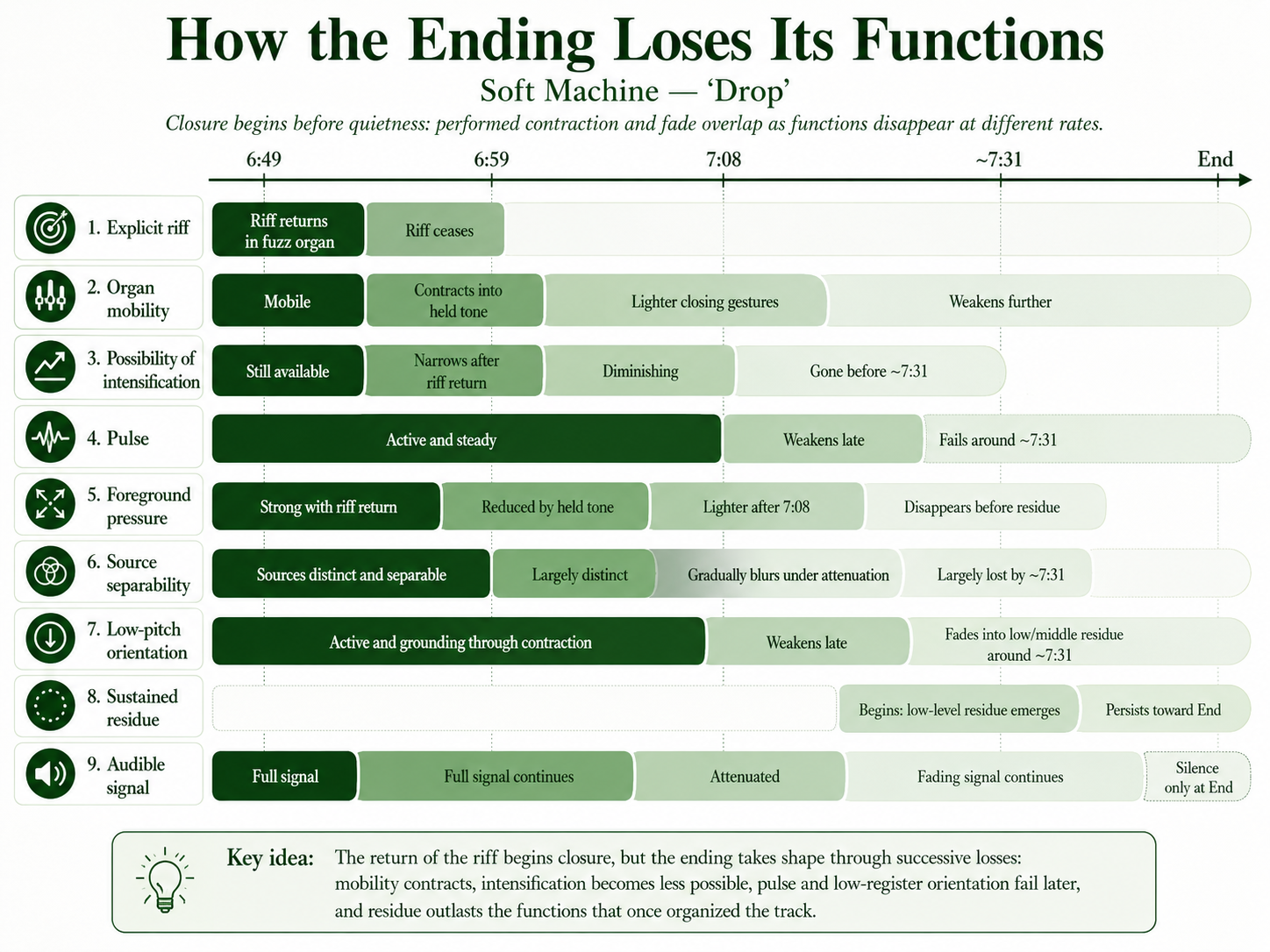
The closing movement as layered subtraction rather than a single fade. The riff returns at 6:49 and begins the closing movement, but different functions disappear at different rates: organ mobility narrows, renewed intensification becomes less possible, foreground pressure and source separation weaken, pulse and low-register orientation fail later, and residual sound persists after the ensemble has largely lost the means to renew its own motion.
Sectional Conclusion. “Drop” does not close by finding a final cadence or by simply allowing its most prominent voice to fade away. The closing movement begins earlier, when the fuzz organ retrieves the recurring riff and brings the foreground back into contact with material heard much earlier in the track. That recognition does not restore the ensemble state in which the riff first became active, nor does the music return to the open uncertainty of its beginning. Instead, the returning figure tightens into sustained pressure, the organ becomes less expansive, the playing begins to thin, and the falling level gradually takes more of the remaining ensemble with it.
Howard’s pulse, Hopper’s low-register weight, the differentiated keyboard field, and the organ foreground all survive for a time, but they do not disappear together. Pulse weakens, low orientation fades, instrumental identities blur, and the foreground loses its power to renew the motion around it. This is Functional Attrition: sound continues after the relationships that had kept the performance moving have begun to fall away. What starts as the return of recognizable material becomes an irreversible contraction. The track closes not when the foreground reaches a final cadence, but when that return begins a narrowing from which the ensemble never fully opens out again.
From Contraction to Realization. The ending has made one distinction especially clear: what the players withdraw and what the recording removes are not the same thing, even though they eventually become difficult to separate. The opening raises a related question from the opposite direction. To understand both ends of the track, the next step is to ask what belongs to instrumental performance and what belongs to the way the LP turns that performance into sound.
VI. Recorded Objects, Played Functions, and the LP Realization
“Drop” depends on studio construction in ways that matter directly to its form, but those interventions are most audible at the points where the identity of sound itself becomes unstable. At the opening, recorded impacts are transformed until they approach the timbral world of electric piano; at the ending, the fade gradually draws formerly distinct instrumental voices into a common residue. Between those two extremes, however, the track is carried less by studio manipulation than by relationships we can hear unfolding in performance: pulse, low-register weight, recurring material, differentiated keyboard activity, and the changing position of the fuzz organ within that field. The useful distinction is not between a “real” performance and a constructed recording, but between what we know about how certain sounds were made and what those sounds actually do in the finished LP.
a. What Ratledge’s Testimony Establishes
Ratledge’s account tells us how the opening impacts came into being. Liquid was recorded striking metal and then altered through tape-speed manipulation until the resulting sounds approached the timbral world of electric piano. That history helps explain why the boundary between recorded object and instrumental sonority becomes so unstable once keyboard material enters. The impacts have already been transformed toward a keyboard-like color, so the ear can hear the two sources overlap and partially merge without their differences disappearing altogether.
Ratledge’s account cannot tell us how that relationship continues once the track is underway. As the keyboard field thickens, it becomes increasingly difficult—and musically less important—to decide whether every bright attack still comes from the transformed drops, from keyboard, or from the interaction of several overlapping sources. What matters in the LP is how the opening identity gradually changes: first as exposed object, then as part of a mixed keyboard environment, and eventually as something absorbed into broader forms of continuity that no longer depend on hearing the original source distinctly.
b. What the LP Lets Us Hear
The LP lets us follow the musical layers more readily than it reveals their exact physical arrangement behind the recording. The transformed drops, prepared or processed keyboard activity, later stereo keyboard continuum, bass, drums, Dean’s Fender Rhodes, and Ratledge’s fuzz organ remain different enough in sound and behavior for their changing roles to be heard even when every opening keyboard event cannot be assigned with complete certainty. Hopper’s bass, Howard’s drums, Ratledge’s fuzz organ, and Dean’s Fender Rhodes are clear enough; the opening keyboard construction is more blended, but the form does not depend on separating every strand of it.
The musical point lies in how differently those layers behave. The opening keyboard continuum can keep the field alive whether that continuity comes from one source, several overlapping sources, lingering resonance, or all of them together. During the central improvisation, Dean’s Fender Rhodes keeps another kind of motion active beside the fuzz organ, preserving a separately articulated middle-register presence even while Ratledge dominates the foreground.
At the ending, that separation gradually becomes harder to maintain. As the fade deepens, bass, keyboards, organ, resonance, and decay begin to draw closer together in the listener’s ear. It becomes increasingly difficult to say exactly when one player has stopped or another sound has disappeared, but the larger change remains unmistakable: parts that had once been distinct enough to carry different kinds of motion are being pulled into the same residual field. The LP first gives us enough separation to hear those relationships form, and then makes the loss of that separation part of the ending itself.
c. What Production Changes at the Ending
Production does not create the closing movement by itself. By the time the fade becomes clearly audible, the performance has already turned inward. The recurring riff has returned in the fuzz organ, its movement has tightened into sustain, the organ has become less expansive, attacks have grown less frequent, and more space has opened between phrases. The ensemble is already withdrawing before the falling level begins to deepen that withdrawal.
The fade works with this contraction rather than replacing it. As the level falls, weaker gestures lose definition, formerly distinct instruments become harder to keep apart, and their final contributions recede into the surrounding resonance. Production determines how long that withdrawal remains audible and how gradually the ensemble passes from separate instrumental activity into a residue in which pulse, low-register weight, foreground pressure, and interaction can no longer be clearly sustained.
The ending is neither simply played nor simply produced. The musicians give the withdrawal its direction; the fade changes how that withdrawal reaches the listener. What begins as thinning activity inside the ensemble gradually becomes a loss of separation itself, until the last stage of the ending is heard less as distinct instruments receding than as the remaining field slipping into silence.
Sectional Conclusion. Studio construction gives “Drop” its transformed opening objects and shapes the final stages of its disappearance, but it does not replace the musical relationships that carry the track between those points. The LP matters because it is the place where recorded sound and instrumental action become inseparable from the form we actually hear: transformed impacts can merge into a keyboard field, distinct players can sustain different kinds of continuity, and the fade can finally draw those differences back into residual sound.
From Realization to Continuity. Once the opening and ending are heard as parts of the recorded form rather than problems of source reconstruction, the larger question can return: what, across all these changing conditions, allows “Drop” to remain one continuous form?
VII. What Holds the Seven and a Half Minutes Together
The continuity of “Drop” is easiest to misunderstand if we imagine that the same thing must remain present from beginning to end. Nothing does. The transformed drops gradually lose their separate identity; the keyboard field changes what it is able to sustain; the recurring riff disappears through most of the central improvisation; bass and drums enter only after the opening has already found a way to continue without them; the fuzz organ dominates attention without becoming the only thing holding the performance together; and near the end even the pulse, low-register weight, and instrumental separation begin to fall away while sound itself still lingers. What persists is not one object or one layer, but the music’s ability to keep its bearings while the means of doing so change.
Those means do not have to arrive together. At the opening, resonance can let one event reach toward the next before there is any pulse. Later, the keyboard field can remain present beneath individual attacks without needing a recurring figure to sustain it. The riff can disappear and still remain recognizable when it returns. Howard can keep time moving while Hopper repeatedly restores weight from below, and Dean’s Fender Rhodes can keep another kind of activity alive through the middle register while Ratledge’s fuzz organ draws the ear above it. “Drop” becomes most secure not when all of those roles gather in one voice, but when they have become independent enough that one can change or disappear without everything else having to begin again.
The recurring riff has a special place in that process because it can travel. It survives changes of instrument, register, timbre, surrounding texture, and prominence without needing to remain constantly audible. Its importance lies precisely in that mobility. It can first emerge from the keyboard field, gather the ensemble around it, pass into Hopper’s bass, disappear for several minutes, and then return in Ratledge’s fuzz organ without bringing its earlier surroundings back with it. Howard and Hopper can still carry time and low-register weight beneath that return, so recognition can change the direction of the performance without restoring an earlier state.
What holds “Drop” together is neither continuous repetition nor one unchanging background. It is the way one kind of continuity can give way to another without breaking the music’s sense of connection: resonance becomes field, field makes room for recurring material, pulse and low-register weight spread the burden across the ensemble, and those relationships continue beneath a foreground free enough to move independently of them. At the ending, the process reverses. Those same supports begin to disappear one by one, until sound remains for a moment after the music has lost the means to renew itself. “Drop” remains one continuous form because its way of continuing can change without requiring the music to start over.
One diagram helps clarify the study’s central distinction at a glance. “Drop” does not unfold as a simple sequence in which one foreground replaces another. Instead, what the listener follows most closely and what actually keeps the track continuous separate from one another, overlap, and later thin out at different rates. The opening binds continuity to exposed attacks and their decays; the keyboard field then allows continuity to persist beneath individual gestures; bass and drums divide temporal and low-register responsibility; and the fuzz organ takes the foreground without absorbing those other functions. Near the end, the recurring riff returns in the organ, but that recognition begins contraction rather than restoration.
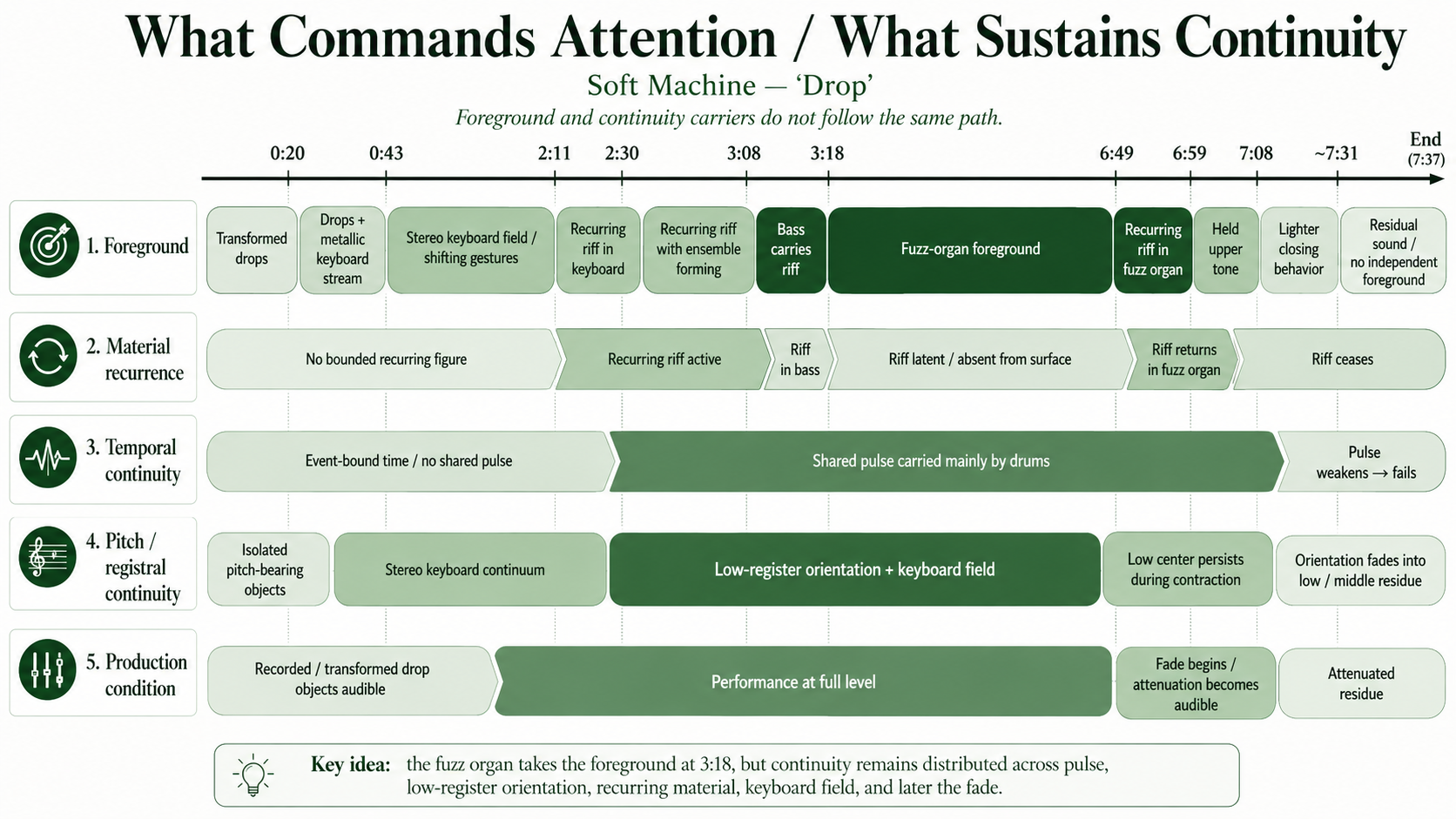
A full-track map of the study’s governing distinction. The diagram separates foreground from the different carriers of continuity—recurring material, pulse, pitch and registral orientation, and production condition—showing that these functions do not follow the same path. The fuzz organ takes the foreground at 3:18, but continuity remains distributed across drums, bass, keyboard field, and later the changing interaction between performed contraction and fade.
a. Continuity Is Not One Thing
“Drop” remains coherent because continuity never has to mean the same thing for very long. At the opening, it is carried by resonance: an attack survives through decay, echo, and the memory of where it sounded in open space. Around 0:43, continuity becomes more textural, as overlapping keyboard activity creates a field that can remain present beneath individual gestures. When the recurring riff appears, another kind of connection becomes possible: a figure can disappear and still be recognized when it comes back.
Once bass and drums enter, time and low-register weight become easier to hear as separate sources of stability. Howard keeps the pulse alive even as his accents move freely, while Hopper repeatedly draws the music back toward a familiar low pitch world without having to repeat the same bass phrase. During the fuzz-organ improvisation, continuity depends less and less on any one recurring object. The performance holds together because several different kinds of motion remain active at once, each supporting the others without having to behave in the same way.
None of these forms simply replaces the one before it. One can continue underneath another, become less obvious, lose its former prominence, or survive in a changed form. The riff can fragment and then disappear from the surface without weakening the ensemble’s coherence; the pulse can remain through bass rests; the low center can stay familiar without a fixed ostinato; and the organ can dominate attention without taking over everything that keeps the music moving. The ending reveals the same plurality in reverse, as those supports begin to fall away at different speeds while resonance continues after they can no longer generate another phrase or renewal.
The form of “Drop” depends not on one permanent source of continuity, but on the way several kinds of connection can take turns carrying the music. What holds the track together is not that one of them always survives, but that they do not all disappear at the same time.
b. A Ground Must First Become Independent
What matters most about the opening is that it establishes one crucial possibility: the music can continue underneath whatever happens to be drawing the ear.
That possibility becomes clearly audible around 0:43. Before then, transformed drops and prepared keyboard activity can overlap, accumulate resonance, and briefly fill the gaps, but continuity still weakens when the attacks thin. Once the stereo keyboard continuum stabilizes, individual gestures no longer have to recreate the field each time they appear. A drop, an arpeggiated figure, or later the recurring riff can rise into attention while a broader environment remains present beneath it.
The ensemble later extends that principle by spreading it across different players. Howard keeps the pulse alive; Hopper supplies low-register weight and orientation; the keyboards preserve texture and internal difference; and recurring material can pass from one instrument to another without becoming the only thing holding the track together. By the time the fuzz organ takes the foreground, what sustains the music is far more complex than the opening keyboard field, but the underlying logic is the same: the voice that draws attention no longer has to carry everything that keeps the performance moving.
This is why the opening matters to the whole form without needing to be heard merely as preparation. It discovers a way for the music to support one action with something that can continue underneath it, and later regions expand that possibility across the ensemble.
The opening does not supply one permanent ground; it teaches the track how a ground can exist.
c. The Center Is Divided, Not Fixed
The central stability of “Drop” does not reside in one repeated bass figure or one invariant drum pattern. It is divided between Howard and Hopper, whose roles remain complementary precisely because they are not identical. Howard keeps the pulse alive even when accents shift, phrases cut across local groupings, or other instruments leave space. Hopper gives the music a different kind of steadiness, repeatedly drawing it back toward a familiar low pitch world through changing contours, rests, and returns without settling into a fixed ostinato.
Their relationship matters as much as either part by itself. Bass and drums repeatedly restore a sense of shared motion after the texture has thinned, but they do not need to lock into one composite pattern for that recovery to feel convincing. Howard can continue through a bass rest; Hopper can return with enough low-register weight to give the music its footing again without having to mark every beat. Stability comes from the way time and low weight keep finding one another, not from their remaining permanently fused.
That is what allows the upper layers to stay so mobile without making the ensemble feel unstable. Ratledge does not need a rigid rhythmic grid beneath him, and the right-side keyboard does not need to reinforce a conventional harmonic progression continuously. The center holds because Howard and Hopper keep renewing different parts of it. What “Drop” preserves, then, is not a fixed foundation but a divided one: pulse and low-register weight can separate, leave space, and reconnect without either becoming mechanically repetitive.
d. The Riff Is Portable but Intermittent
The recurring riff matters because its identity survives changes of instrument, register, timbre, surrounding texture, and prominence without needing to remain continuously audible. That mobility allows the figure to connect very different parts of the track, while its long disappearance through the central improvisation shows that the music does not depend on hearing it all the time.
Because the riff is not tied permanently to one instrument or one texture, it can carry memory across changing ensemble conditions. When it passes from keyboard to bass, disappears, and later returns in the fuzz organ, the surrounding music does not have to recreate the state in which the figure first appeared. Recognition alone is enough to make the connection. What returns is the material itself, not the earlier texture around it.
The track is equally clear about what the riff does not do. For most of the central improvisation, it is absent as a clearly bounded figure, yet the performance remains coherent. Howard keeps the pulse alive, Hopper continues to renew the low field, the right-side keyboard preserves another layer of motion, and the organ sustains the foreground. The riff is one way the track remembers itself, not the only thing that keeps it together.
The riff can leave the surface because other kinds of continuity have learned to carry the track without it.
e. Foreground Authority Is Not Structural Authority
After 3:18, Ratledge’s fuzz organ becomes the most obvious place to listen. Its timbre is the most abrasive, its phrases are the most exposed, and its changes in intensity repeatedly draw the ear toward it. But one of the central distinctions in “Drop” is that the voice attracting the most attention is not necessarily the voice doing everything that keeps the music together.
Howard continues to keep the pulse alive. Hopper maintains low-register weight and repeatedly draws the music back toward a familiar pitch world. Dean’s Fender Rhodes preserves a separate layer of middle-register activity through chords, arpeggiation, and responsive figures. Ratledge carries the main foreground line, but becoming louder and more exposed does not make those other kinds of support migrate into the organ with him.
The distinction becomes especially clear when the ensemble changes direction. The voice the listener is following most closely may not be the one keeping time underneath it. A local response can begin in one instrument while another continues to hold the low center, and a release can begin in the drums even while the organ remains the principal foreground voice. Conversely, a spectacular rise in organ intensity may bring the music to a peak without changing what happens underneath. What draws the ear and what changes the ensemble’s possibilities do not always come from the same place.
Initiative can move from player to player. Howard can open a release, Hopper can restore weight from below, Ratledge can pull the ensemble toward a collective peak, and the right-side keyboard can enter a space another voice has left open. Mobile Authority describes these local moments when one player temporarily has greater influence over what happens next. But beneath those shifting initiatives lies Relational Continuity: the music remains coherent because time, low-register weight, foreground motion, and middle-register activity continue to support and respond to one another even as emphasis moves around the ensemble.
Foreground authority is only one kind of authority in “Drop.” The organ can dominate attention without dominating everything beneath it. The central span remains open and mobile because the things that keep the music moving are spread widely enough across the ensemble that a change in one voice does not require all the others to follow it.
f. A Return Can Narrow the Future
The recurring riff does not mean the same thing each time it appears in “Drop.” When it first emerges, it opens new possibilities. A bounded figure takes shape inside the keyboard field; bass and drums later gather around it; the figure passes between instruments; and its movement into the low register shows that the material can survive outside the keyboard source that first introduced it. Recurrence helps the ensemble become more differentiated because the music is still expanding.
At 6:49, the same recognizable figure has the opposite effect. The fuzz organ retrieves the riff after several minutes of absence, but the earlier texture does not return with it. Howard and Hopper remain in their established roles, the full ensemble does not restate the figure, and the open improvisational field of the preceding minutes never resumes. The foreground reaches back toward earlier material, but the music does not return to the place where that material first became active.
This is why Recognition Without Restoration is especially apt here. The listener hears enough of the earlier contour and rhythmic shape to recognize the riff immediately, yet recognition now points toward contraction rather than expansion. The figure tightens into a held tone, the organ becomes less expansive, attacks grow less frequent, and the fade gradually deepens a withdrawal already underway in the playing.
The closing process is not caused by thematic return alone. Its significance lies in what the return begins to change. Movement becomes sustain, sustain gives way to lighter and more isolated gestures, and the ensemble gradually loses the ability to build pressure again. What had once helped the music open outward now marks the point from which it no longer does.
g. The Opening and Ending Carry Opposite Kinds of Uncertainty
The opening and ending of “Drop” both contain moments when source identity becomes difficult to determine, but the uncertainty points in opposite directions.
At the beginning, the question is what can still emerge. A transformed impact enters open space, another source joins, resonances begin to overlap, and the listener does not yet know what will eventually hold the music together. The ambiguity is productive because the field is still being built. The music remains open to addition: another attack, another register, another layer, another way of keeping the sound alive.
At the ending, the uncertainty concerns what remains. Bass, organ, Fender Rhodes, resonance, and the last traces of pulse become progressively harder to separate, not because the field is expanding, but because the distinctions inside it are falling away. The listener can hear the ensemble weakening before it is always possible to say exactly which player has stopped or which source has become inaudible. Ambiguity now comes from subtraction.
The two ends of the track face opposite futures. Opening uncertainty asks what can still become possible. Ending uncertainty asks how much of what was possible is still there. The first is unformed; the second is residual.
Sectional Conclusion. “Drop” remains continuous not by protecting one identity, but by allowing different kinds of support to carry it at different moments. Resonance can connect exposed events; a keyboard field can sustain presence beneath them; recurring material can preserve memory; pulse and low-register weight can spread support across the ensemble; and the relationships among the players can keep the central improvisation coherent after the riff itself has disappeared. The form becomes audible whenever one way of continuing gives way to another—when a field forms, a figure travels, the foreground separates from the ground, earlier material returns in a new voice, or the remaining supports finally begin to fall away.
From Explanation to Experience. The argument is now complete. What remains is to hear that changing continuity as a single movement—from exposed events, through distributed support and foreground freedom, to recognition, contraction, and residue.
Closing Movement — What the Music Leaves Behind
“Drop” begins with the physical shock of sound arriving in empty space. An impact appears to one side, another somewhere else, each surrounded by enough silence for its metallic resonance to acquire unusual weight. The ear can hear pitch in those sounds without always knowing whether it is hearing a recorded object, an instrument, or something that has already crossed the boundary between them. Nothing yet feels guaranteed to continue. Each new event seems responsible for making the music exist again.
Gradually, that burden begins to ease. Attacks overlap, echoes remain behind them, and keyboard sound increasingly fills the spaces that had separated one object from another. A field forms almost without announcing the moment when it has become stable enough to outlive the gesture that brought it into focus. Sound can now remain present without demanding constant attention. Within that persistence, the recurring riff appears as something newly definite: a shape the ear can recognize when it comes back.
Bass and drums alter that world without erasing it. Their arrival gives the music kinds of stability it had not possessed before—weight below, time within, and a stronger sense that recurring material can move from one instrument to another without losing its identity. The listener can begin following one layer while trusting others to keep the music alive underneath. What had once depended on every attack renewing the music can now continue through several simultaneous forms of support.
When the fuzz organ enters, it seems at first to take command of everything. Its sound is harder, more exposed, and more mobile than the layers around it. Yet its freedom is possible because so much of the music can now continue elsewhere. The organ can press forward, suspend a phrase, rise into intensity, or leave space because time continues beneath it, the low register remains available, and another keyboard keeps the surrounding field from becoming empty. Attention belongs largely to one voice; continuity does not.
For several minutes, the earlier riff can disappear without leaving a hole. That absence becomes part of what makes its return so striking. Near the end, the organ finds the figure that had first belonged to the keyboard and later passed through the bass. The recognition is immediate, but nothing around it returns to an earlier state. The figure has travelled too far through the track for that. In the organ, it no longer opens the ensemble outward. It begins to close the available space.
The riff contracts into a held sound while bass and drums continue underneath it. The organ lightens. Attacks become fewer. Phrases leave more space around themselves. Then the recording begins to recede with the performance, making it increasingly difficult to tell where one source ends and another begins. The ensemble does not vanish at once. It thins by degrees: first the possibility of renewed foreground motion, then the clarity of pulse and low center, then the independence of the remaining instrumental voices.
What survives for a moment longer is simply sound. Resonance remains after it can no longer lead into another phrase, support another return, or gather the music toward another accumulation. In this sense, the ending resembles the opening only from a distance. Both leave the listener among lingering sounds whose sources can become uncertain. But the uncertainty faces in opposite directions. At the beginning, the music is waiting to discover what can enter next. At the end, nothing remains that can make it begin again.
At the beginning, each sound opens a space in which something else may happen; at the end, sound remains only after those possibilities have disappeared.