“Kings and Queens”

- Artist
- Soft Machine
- Album
- Fourth
- Year
- 1971
“Kings and Queens” does not announce its complexity. It moves slowly, almost patiently, giving the impression that very little needs to happen for the music to remain alive. A melody rises out of an already settled world of bass, harmony, and pulse; it is clear enough to be remembered almost immediately, yet spacious enough to change without losing itself. As the piece unfolds, Dean can restate it, stretch it, relinquish it, move into freer development, and eventually bring it back, while Hopper, Ratledge, and Wyatt keep enough of the surrounding musical world intact for each change to feel connected to what came before.
That is where the track’s richness lies. Hopper does not fill these five minutes with a succession of new themes or sharply contrasting environments. Instead, he draws remarkable consequence from a small number of clearly defined materials and relationships. The bass can vary without losing its grounding role; the harmonic and temporal field can remain recognizable without becoming static; the melody can change its phrasing, freedom, and formal purpose while still carrying the memory of its first appearance. What initially sounds simple is therefore anything but empty. “Kings and Queens” finds its depth in discovering how many different things familiar material can become without ceasing to belong to the same musical world.
Within This Track Study
I. Opening — A Form Built from Changing Roles
“Kings and Queens” presents a peculiar kind of formal richness. Hugh Hopper’s composition contains genuine written distinctions, changes of meter, passages of greater improvisational freedom, recurrence, shifts in orchestral weight, and a separately conceived closing procedure. Yet the LP does not sound like a succession of sharply contrasted sections. It unfolds instead as an unusually continuous five-minute world, one in which change is often registered not because the underlying environment has been replaced, but because something already present has begun to do a different job.
That continuity depends partly on the economy of Hopper’s materials. The piece does not require a large inventory of competing themes, bass patterns, harmonic regions, or rhythmic systems. A strongly identifiable principal melody, a family of related bass figures, a slowly moving harmonic environment, and a remarkably persistent temporal ground provide much of what the form needs. But persistence here is not immobility. Hopper’s bass does not repeat one invariant ostinato; Wyatt does not reproduce one fixed rhythmic pattern; Ratledge’s harmonic support can change in voicing and exposure; and the principal melody itself remains recognizable through changes of articulation, duration, continuation, and purpose. What persists most securely is often not the literal event, but the relationship that allows a changing event to remain intelligible.
The melody is crucial because its identity is unusually durable. It is not a compact riff whose recognizability depends mainly on immediate repetition, but a long-breathed phrase whose contour, pacing, internal punctuation, and alternation of motion with sustained arrival give it a profile strong enough to survive transformation and absence. That strength allows the same material to acquire different meanings as the piece proceeds. It can establish identity, confirm it, become generative, recede from explicit foreground, and later return without behaving as though the intervening music had never occurred. Recognition and formal function are therefore not the same thing: something can come back unmistakably while no longer doing what it did before.
The ensemble operates by the same principle of differentiated responsibility. Dean can dominate the melodic foreground without carrying every dimension of the form. Hopper preserves low-register orientation; Ratledge sustains the harmonic interior; Wyatt keeps the temporal field legible while continually varying its local articulation. Nor does greater orchestral weight necessarily produce congestion. The LP enlarges the quartet with Mark Charig and Nick Evans, and the written passages can become vertically dense, yet their richness remains transparent because the parts occupy complementary rather than competing functions. Precision here is therefore not literal duplication. It is the ability to preserve structural relationships while allowing phrasing, attack, duration, density, balance, and orchestral detail to remain alive.
The score and personnel evidence sharpen that picture without displacing the recording itself. “Kings and Queens” is a Hugh Hopper composition performed by the Soft Machine quartet of Mike Ratledge, Hugh Hopper, Robert Wyatt, and Elton Dean, with Mark Charig on cornet and Nick Evans on trombone enlarging the LP ensemble. Hopper’s surviving score reveals a more explicitly organized design than the recording’s smooth surface might at first suggest, but it tells us how the composition is constructed rather than exactly how every written part is distributed among the instruments on the record. The analysis that follows therefore stays with the recorded performance first, turning to the score when its written structure, metric design, or changing degrees of freedom help clarify what we hear.
What makes that continuity remarkable is how much formal consequence Hopper draws from so few durable resources. Hopper’s economy makes subtle change easier to perceive. When melody, bass, harmonic support, and pulse remain familiar, changes in their exposure, freedom, prominence, or responsibility acquire unusual weight. A reassignment of function can therefore matter as much as the arrival of new material would in a more sectional design. The apparent simplicity of “Kings and Queens” is achieved rather than given.
And the piece demonstrates that principle before its principal melody has even arrived. By the time Dean gives the composition its most memorable identity, the musical environment in which that identity will operate is already being assembled.
Before following “Kings and Queens” through its successive changes, it helps to see how little of its musical world is ever truly discarded. The track moves by allowing familiar materials to change their place in the listener’s attention: the ground gathers before the melody arrives, the melody takes shape and begins to loosen, the supporting framework briefly steps forward, and the returning phrase is finally absorbed back into the ensemble that made it possible. The map below traces that larger movement across the five minutes, showing how melody, bass, temporal and harmonic continuity, authority, and degrees of freedom continually change their balance without breaking the sense of one continuous musical world.
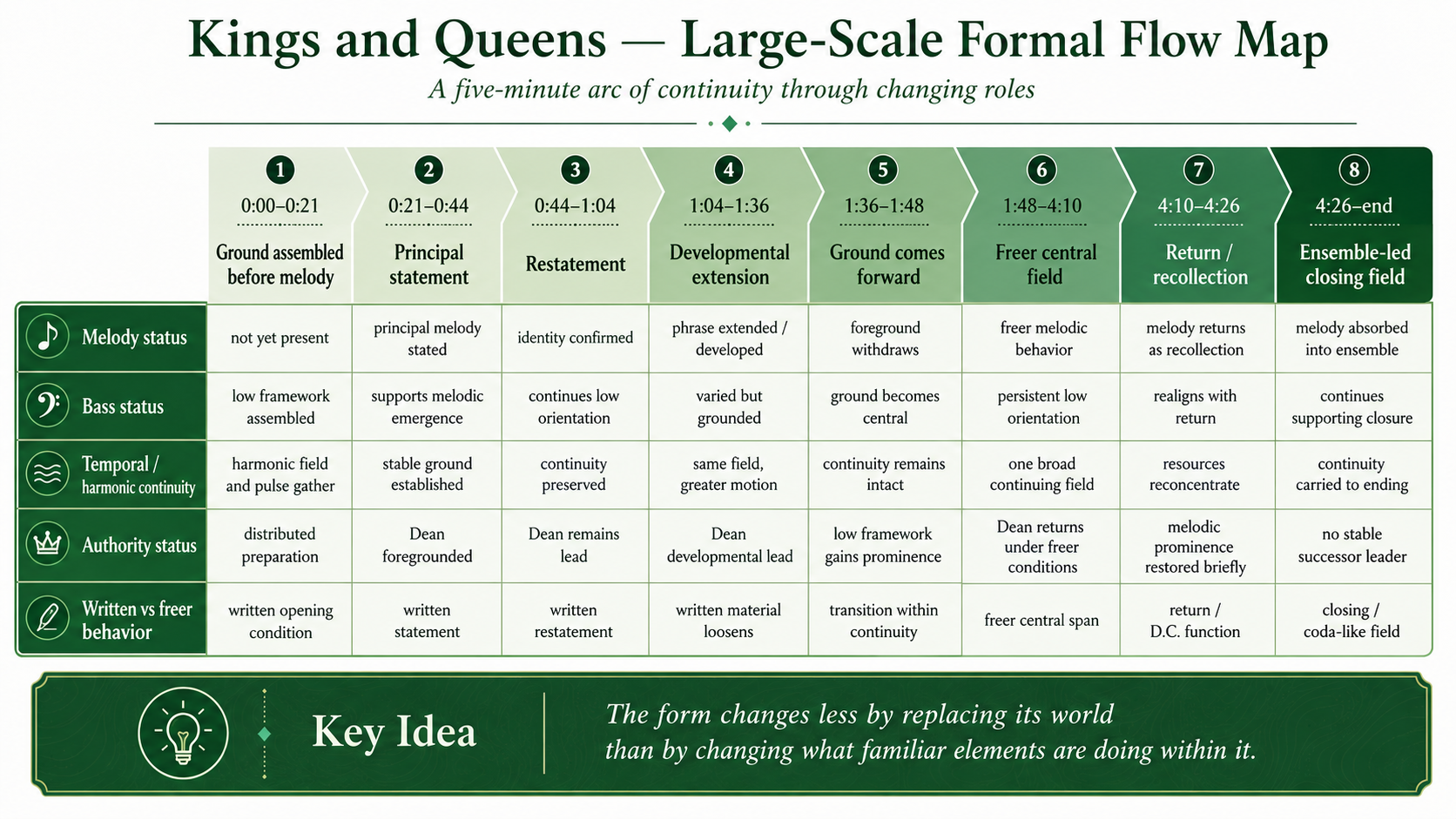
The five-minute form as a changing distribution of roles. Rather than moving through sharply separated musical worlds, “Kings and Queens” repeatedly alters the prominence, freedom, and responsibility of materials that remain familiar: ground becomes foreground, melody moves from statement to freedom and recollection, and the closing ensemble absorbs what had once stood apart.
II. The Ground Appears Before the Melody
Approximately 0:00–1:36
The first minute and a half of “Kings and Queens” establishes considerably more than a theme. It begins by assembling the harmonic, low-register, and temporal conditions in which that theme will matter, then introduces a principal melody strong enough to remain recognizable even as its function begins to change. Statement, close restatement, and development consequently belong to one continuous opening process. The melody first acquires identity, then confirms that identity without being mechanically reproduced, and finally begins to generate further music from within the world that has already formed around it. Hopper, Ratledge, Wyatt, and the expanded wind-brass ensemble preserve that world with remarkable clarity even while articulation, duration, rhythmic detail, voicing, and local balance remain flexible. From the outset, the music therefore establishes a principle that will govern much of what follows: continuity depends less on repeating events exactly than on preserving the relationships through which their differences can still be understood.
a. Before the Melody Has a Name
Approximately 0:00–0:21
“Kings and Queens” begins before its principal melody does. Ratledge’s sustained electric-keyboard sonority first gives the opening a harmonic interior; Hopper then supplies a low-register orientation, while Wyatt’s softly articulated cymbal and mallet work, followed by gradually fuller percussion, makes the slow temporal organization increasingly legible. The score confirms that this is already composed material rather than a free prelude, but the recording allows it to function perceptually as a process of establishment. No single entrance declares that the piece has begun in earnest. Instead, the conditions that will make everything later intelligible emerge in stages.
Ratledge is particularly important here because his contribution becomes structurally consequential without ever needing melodic prominence. His sustained middle-register electric-keyboard sonority establishes harmonic location before there is yet a principal line to accompany, filling the space between Hopper’s emerging bass foundation and the register Dean will soon occupy. Hopper gives that environment a firmer floor through more articulated low attacks, while Wyatt does more than append rhythm to a texture that has already been defined. His softly articulated percussion gradually converts sonority into temporal orientation: the music begins not only to occupy a harmonic space but to move within a clearly felt, unhurried span of time.
By the time the first major melodic entrance arrives, the listener therefore already knows a surprising amount. The harmonic interior is present; the low foundation has acquired definition; the temporal field has become intelligible. What is still missing is the line that will give this environment a memorable face. The first structural fact of the piece is thus not the melody itself, but the world prepared to receive it. The conditions of continuity become audible before the principal melody does.
b. A Melody Strong Enough to Carry the Form
Approximately 0:21–0:44
When Dean’s principal phrase enters, it does not displace the world assembled during the opening twenty seconds. Hopper’s low framework, Ratledge’s sustained harmonic interior, and Wyatt’s slow temporal organization remain in place. What changes is the hierarchy of attention: an environment that had previously been defined mainly by ground, sonority, and pulse acquires a melodic identity. Upper ensemble support enlarges that identity without obscuring it, while Dean’s line occupies a clear middle-to-upper register above Hopper’s articulated bass. The transition is therefore additive rather than substitutive. The underlying world persists; what has appeared is something distinctive enough for the listener to remember against it.
That distinctiveness does not arise from the kind of compact repetition associated with a riff. The full statement takes roughly twenty-three seconds to unfold, and its identity accumulates across that duration. The line initially moves downward toward a lower settling point, then recovers height, develops into a broader rising trajectory, and eventually arrives on a sustained upper tone. Smaller reversals complicate the path without weakening its direction. Much of that journey proceeds through relatively connected motion, with modest skips redirecting the contour rather than breaking it into spectacular leaps. The line therefore remains singable as one continuous thought even while its direction repeatedly changes. What the ear retains is not merely a collection of characteristic pitches, but the memory of a phrase that has travelled somewhere.
Its pacing matters just as much as its contour. Shorter moving tones alternate with longer-held notes, allowing some pitches to carry the line forward while others are given time to register as temporary destinations. Internal spaces divide the melody into connected gestures without breaking the continuity of the larger phrase. Those pauses and sustained points of arrival are especially important against the comparatively slow harmonic and temporal environment beneath them. The surrounding music does not hurry Dean toward the next event; it gives each turn of the phrase enough space to acquire weight before the next gesture changes its direction.
Dean’s attacks reinforce that internal hierarchy. They do not give every note equal emphasis: some simply carry the line onward, while others more clearly initiate a gesture or give weight to a point of arrival. The phrase is therefore shaped not only by what pitches occur and how long they last, but by the changing degree of emphasis with which its successive gestures enter the musical field.
The result is a melody whose spaciousness gives it unusual formal flexibility. Its longer tones can feel like arrivals without bringing the larger field to a decisive close, so the phrase can settle for a moment and still remain open to restatement, extension, or transformation. Its identity therefore lives not in a single cell, but in the larger shape created by contour, pacing, internal punctuation, and proportion. The principal melody derives its identity from a shaped phrase trajectory rather than from mechanical repetition of a compact cell.
That gives Hopper an unusually durable formal resource. Because the phrase is so strongly profiled, it can later survive altered articulation, freer continuation, prolonged absence, and eventual return without needing to be continually restated in full. “Kings and Queens” can afford architectural economy precisely because its principal melody carries enough perceptual identity to remain consequential long after its first appearance has ended.
c. The Same Statement, Not Quite the Same Event
Approximately 0:44–1:04
The second presentation returns so closely to the first that its identity is immediate, yet the resemblance is anything but mechanical. Dean preserves the large contour, the ordering of the principal gestures, the relative weight of moving tones and sustained arrivals, and the same broad relationship to Hopper’s bass and Ratledge’s harmonic support. The internal grouping remains equally recognizable. But the performance itself breathes differently. Attacks change; individual tones receive different lengths; the spacing between gestures shifts; phrase endings are released somewhat differently; Wyatt reshapes his accents and fills; and the keyboard and surrounding ensemble do not reproduce the first realization in detail. The second statement is also somewhat more compressed. What returns is therefore not a frozen event, but a clearly preserved melodic architecture.
That distinction matters because it tells us what the melody actually needs in order to remain itself. Dean does not have to reproduce every attack or duration literally. The deeper proportions of the phrase are sufficiently strong that its internal hierarchy survives those changes. Moving notes still behave as movement; sustained tones still carry greater weight; the principal gestures retain their ordering even though their exact temporal dimensions shift. Durational identity is proportional rather than literal. The phrase can inhabit time differently and still preserve the shape by which it is known.
Wyatt’s changing detail makes the same point from another direction. The slow tactus remains stable, but the drumming beneath the restatement is not a copy of the first pass. Accents, fills, and local attack density are redistributed around the recurring phrase. Dean therefore phrases flexibly inside a stable temporal environment rather than against an unstable one, while Wyatt maintains the underlying sense of time without reducing his contribution to a repeated accompaniment pattern. The same melodic structure can consequently sit within a different rhythmic realization and remain fully coherent.
This is the opening’s first decisive demonstration of precision without rigidity. The restatement proves the melody’s identity without freezing its performance. What is reproduced precisely is the hierarchy that makes the phrase recognizable, not every event through which that hierarchy is realized. By the end of the second statement, the listener has learned more than what the melody is. The listener has learned that it can alter its breath, attack, and local timing while remaining unmistakably itself.
d. Restatement Becomes Development
Approximately 1:04–1:25
After the close restatement, the principal phrase no longer behaves chiefly as something to be confirmed. Dean remains in the foreground, and the melodic language is still recognizably descended from the material established at 0:21, but the line begins to move beyond the proportions that had previously defined it. Continuations lengthen, the contour is redirected, and the phrase-family starts to behave less like an object being shown again than like a source from which further motion can be generated.
The surrounding ensemble adjusts to that change without abandoning the established world. Additional wind and brass color adds weight around Dean, while Hopper and Ratledge continue to maintain the slow-moving low and harmonic framework. Wyatt’s role also begins to change subtly. During the initial statement his playing had helped articulate a relatively bounded written phrase; now, as Dean’s line becomes more developmental, the rhythmic surface grows correspondingly more responsive. Wyatt can fill more actively around extensions, vary subdivision, and alter attack density while preserving the same broad tactus underneath.
Nothing here requires a new theme, a new harmonic environment, or a new rhythmic regime. The form advances because familiar material has begun to behave differently. The melody that first established identity and then proved that identity capable of surviving rephrasing now becomes capable of producing consequences beyond its own restatement. The same melodic identity is no longer merely being reaffirmed; it is becoming generative material.
That change is modest in outward scale but crucial in formal meaning. “Kings and Queens” has begun opening itself outward without needing to introduce a second durable thematic object. The phrase does not disappear in order for development to begin; development grows from the accumulated knowledge of what the phrase already is.
e. A Written Detour Before the Ground Steps Forward
Approximately 1:26–1:36
The next ten seconds introduce genuine contrast, though not a new musical world. Dean remains the principal foreground voice while the texture around him is redirected: Ratledge becomes more chordal, the surrounding wind and brass writing adds weight, and Hopper’s low material shifts into a locally different configuration. The score confirms that this passage still belongs to the coordinated written complex. Its significance therefore lies less in sectional separation than in the way an established hierarchy can be altered from within.
Hopper’s part makes that distinction particularly clear. The exact bass figure changes, and the local pitch emphasis is genuinely redirected, but his responsibility for defining the low register does not disappear. Ratledge likewise changes local harmonic detail without becoming the agent of a wholesale harmonic break. His sustained interior continues through a passage whose contrast is being generated elsewhere. The ensemble voicing is therefore different enough to be heard as a redirection, yet the principal relationships remain readable: Dean is still the melodic foreground, Hopper still defines the floor, and Ratledge continues to bind the interior of the texture.
This is one of the first places where the track shows how much difference it can produce without complete replacement. Bass material, chordal weight, and orchestral balance all change, but none of those changes destroys the responsibilities already established. The passage is therefore more consequential than incidental coloration, yet less categorical than a new regime. Its importance lies partly in what it prepares. At 1:36, the music will no longer merely alter the configuration beneath Dean; it will allow the low framework itself to occupy the listener’s attention.
f. Six Players, One Clear Hierarchy
Across approximately 0:21–1:36
The written opening can become surprisingly full without becoming difficult to follow. Dean carries the principal melodic trajectory, but the other players do not simply crowd around him with competing lines. Each adds something different to the texture. Charig most plausibly enlarges the upper contour and adds brass color; Evans is most plausibly heard contributing lower-middle harmonic depth and inner weight; Ratledge sustains the harmonic interior; Hopper articulates the low foundation; and Wyatt gives the phrase temporal definition through pulse, accent, punctuation, and changing degrees of rhythmic activity. The result is a rich ensemble sound in which several layers can remain active at once without competing equally for the listener’s attention.
Part of that lucidity comes from register. Hopper remains sufficiently low for his articulated line to stay distinct from Evans’s darker inner support and Ratledge’s sustained middle-register sonority. Above them, Dean’s phrase remains legible not only because its contour has already been strongly defined, but because the surrounding voices generally reinforce or frame that contour rather than continually competing with it. Charig can enlarge the upper profile without becoming a second continuous melodic owner. Evans’s probable contribution strengthens the depth of the sonority without functioning as another bass. Charig enlarges contour and color; Evans enlarges depth. Between them, Ratledge occupies one of the most structurally useful positions in the whole arrangement: he fills the interior of the texture without filling the foreground.
But vertical spacing is only part of the explanation. The players are also differentiated by activity, duration, and degree of independence. Some lines move while others sustain; some reinforce a melodic direction while others provide harmonic weight. Hopper’s articulated attacks remain legible beneath the more sustained layers above him. Wyatt contributes density selectively, becoming more active around phrase events without turning the drums into an unbroken screen of rhythmic information. Ratledge, by contrast, can sustain through places that Wyatt articulates more strongly. The two therefore provide different kinds of continuity: Wyatt helps shape phrase boundaries, while Ratledge prevents every phrase boundary from becoming a harmonic boundary.
This is why the opening can be vertically dense without becoming contrapuntally confused. The written ensemble distributes density across complementary roles rather than multiplying equivalent melodic claims. Its richness comes from several kinds of activity fitting together without competing for the same space or function. The six-player texture is dense in sonority but economical in function.
The close restatement reveals that organization especially clearly. What the ensemble reproduces most faithfully is not every attack, duration, fill, voicing detail, or local balance, but the hierarchy itself. Dean remains the melodic center; Hopper preserves the low orientation; Ratledge maintains the harmonic interior; Wyatt keeps the temporal field intelligible while changing its surface articulation; the surrounding winds and brass continue to enlarge rather than obscure the phrase. The restatement reproduces the ensemble relationship more precisely than it reproduces the ensemble events.
This establishes an important distinction for everything that follows: density and hierarchy are separate variables. The opening can be vertically rich and highly integrated because the musicians’ responsibilities are clearly differentiated. Later, the center of the track will become more rhythmically and contrapuntally active while those relationships loosen in other ways. That increase in activity will matter, but it will not automatically mean that the form has entered a new state. The opening has already taught the listener that complexity of surface and clarity of organization can coexist.
Sectional Conclusion. The first ninety-six seconds do more than establish a ground and place a melody above it. They assemble almost all the durable resources from which the rest of “Kings and Queens” will be made. A low, harmonic, and temporal environment first becomes perceptible; into it enters a long-breathed principal phrase whose contour, pacing, internal punctuation, and sustained points of arrival give it enough identity to remain memorable across later transformation and absence. That phrase is then restated without mechanical duplication, allowed to grow into development, and carried through a brief written redirection in which bass material, harmonic weight, and ensemble voicing can change without destroying the hierarchy already established. Around it, the expanded texture remains lucid because its density is distributed among distinct responsibilities rather than competing foregrounds. The opening therefore establishes not only the track’s principal materials but the manner in which they will continue to live: relationships remain clear while their local realizations remain flexible.
From Statement to Reallocation. Up to this point, Dean’s melody has remained the clearest foreground even as its behavior changes from statement to close restatement, development, and brief written redirection. Beneath it, Hopper, Ratledge, and Wyatt have kept the low, harmonic, and temporal framework sufficiently stable for those changes to register without breaking the musical world apart. At 1:36, the composition alters that balance more fundamentally. Nothing entirely new needs to enter. Instead, a layer that has been carrying structural responsibility from underneath is suddenly allowed to become the event itself.
III. When the Ground Steps Forward
Approximately 1:36–4:10
At 1:36, “Kings and Queens” reveals that the continuity established in the opening does not depend on Dean remaining continuously in front. The principal melodic foreground withdraws, and material that had functioned mainly as support becomes newly exposed. When Dean returns shortly afterward, he does so in a freer developmental role rather than by restoring the opening statement. From that point to the late return, the music remains one broad field whose coherence depends on several different kinds of persistence operating at once. Hopper keeps the low register intelligible while varying his actual figures; Ratledge sustains the harmonic interior without continually redrawing it; Wyatt preserves the temporal world while changing subdivision, density, and articulation around Dean’s increasingly flexible phrasing. The center therefore gains freedom without requiring a succession of new formal states. What changes most is the relationship among melodic foreground, structural ground, and temporal activity, while enough of the framework remains in place for each local intensification to register as development within the same musical world.
a. The Background Becomes the Event
Approximately 1:36–1:48
At 1:36, the piece changes without introducing a new musical world. Dean’s continuous melodic foreground falls away, and the low-register framework that had previously supported him becomes newly exposed. Hopper’s bass, Ratledge’s sustained harmonic interior, and the surrounding ensemble bring that lower material into perceptual focus while Wyatt preserves the slow tactus beneath the change. The passage therefore does not replace the principal melody with a second theme. It changes the status of material that was already present.
The distinction matters because the low framework is related to bass material heard earlier without being a literal note-for-note recurrence. Hopper’s exact configuration changes, but the family resemblance is strong enough for the listener to hear continuity rather than substitution. The important event is not the arrival of a new object but the sudden exposure of an existing structural resource in a role it had not previously occupied. Material normally functioning as support becomes foreground.
Ratledge’s contribution makes the transition especially clear because he does not announce it. There is no conspicuous new keyboard gesture that tells the listener the form has turned. His importance is almost the opposite: while Dean withdraws and Hopper’s material acquires greater perceptual consequence, Ratledge continues to hold the harmonic interior together. Wyatt likewise keeps the temporal world intelligible beneath the change. The shift is therefore heard sharply precisely because several other dimensions remain familiar.
This is one of the track’s clearest instances of functional reassignment. Dean’s thematic prominence recedes; the low framework assumes greater weight; yet the harmonic and temporal conditions remain recognizably continuous. That reassignment is audible only because the original low-register function was established clearly enough to become a stable expectation. The music does not need to invent a new section in order to alter its hierarchy. It simply allows the background to become the event.
b. The Melody Returns with More Freedom
Approximately 1:48–2:19
When Dean re-enters at 1:48, the principal melodic foreground returns, but not in the form it had taken earlier. Hopper’s low framework remains in place, Ratledge continues to sustain the harmonic interior, and Wyatt preserves the same broad temporal world. Nothing beneath the saxophone needs to disappear or be rebuilt. The framework simply resumes its supporting role as Dean moves back into prominence.
What changes is the degree of freedom attached to that prominence. Earlier, Dean had carried a strongly specified principal statement whose identity depended on a clearly shaped written phrase. Now the saxophone line is more developmental and improvisational: phrase length, density, continuation, and local contour become less tightly bounded, while the underlying framework remains sufficiently stable to keep the music located. The return of the melodic voice is therefore not a restoration of the opening condition. It is the reappearance of melodic agency under looser constraints.
The force of the transition lies in that asymmetry. At 1:36, Dean’s withdrawal exposed the framework that had been supporting him. At 1:48, the same framework does not have to be displaced so that the saxophone can return. It merely recedes once more into structural support while Dean acquires a new degree of behavioral freedom above it. The transition changes what Dean is allowed to do without changing the world in which he does it.
c. Wyatt Makes the Ground Responsive
Within approximately 1:48–4:10
The central field is not adequately described as a saxophone solo laid over passive accompaniment. Dean remains the principal melodic and developmental foreground, but Wyatt continually shapes the way that foreground inhabits time. The underlying tactus remains remarkably stable while his subdivisions, accents, attack density, and degree of activity change around Dean’s phrasing. What persists, then, is not one repeated drum pattern but a temporal framework flexible enough to respond without losing orientation.
That responsiveness was already present in the written opening, where Wyatt helped articulate phrase endings without mechanically duplicating his part from one statement to the next. In the freer central span, the same capacity becomes more consequential. Around 2:18–2:26, Dean’s melodic activity grows markedly denser and Wyatt’s rhythmic activity rises with it, creating a clear local co-intensification without producing a new formal state. Comparable waves occur later, around 3:14–3:22 and again near 3:40–3:48. In each case, rhythmic pressure increases and then relaxes while the same broad temporal ground remains recoverable underneath.
The important point is not that every drum gesture answers a particular saxophone note. Their interaction operates at the level of phrase shape, density, and momentum. Dean can lengthen or compress a phrase, increase activity, leave more space, or intensify locally; Wyatt can thicken subdivision, sharpen accents, open space, or reduce attack density without needing to establish a new groove. The central field consequently breathes through coordinated changes in melodic and rhythmic activity while remaining formally continuous.
Their responsibilities are complementary rather than equivalent. Dean gives the central span its melodic direction, while Wyatt continually shapes the way that direction moves through time. The saxophone carries most of what the listener follows as developing melodic thought, while the drums determine how firmly, loosely, densely, or spaciously that thought sits inside the pulse. Dean carries the principal melodic trajectory while Wyatt continually adjusts the temporal articulation around that trajectory.
Wyatt’s precision is therefore quite different from mechanical regularity. It lies not in repeating a rhythmic pattern, but in keeping the temporal field clear while continually adjusting his articulation to Dean’s changing melodic behavior. Through that responsiveness, the ground becomes an active part of the development without ceasing to function as ground.
d. The Ground Moves Without Leaving
Within approximately 1:48–4:10
The stability of the central field does not come from a single unchanging accompaniment. Hopper and Ratledge preserve different dimensions of the music, and they do so by contrasting means. Hopper keeps the low register oriented through a family of related figures whose exact pitches, spacing, articulation, and rhythmic shape can change substantially from moment to moment. Ratledge changes less dramatically. His sustained middle-register presence continues to bind the bass to the upper voices even as local voicing, attack density, and exposure shift around it.
Hopper’s role is therefore one of controlled variation. He does not repeat one fixed ostinato beneath Dean’s improvisation; he continually reconfigures the bass while preserving the responsibility that allows those changes to belong to the same structural ground. Hopper preserves function more consistently than material. The line remains flexible enough to breathe with the ensemble, yet stable enough in register, orientation, and harmonic relation to keep the field from losing its location.
Ratledge achieves continuity almost by the opposite method. His harmonic layer is less volatile than the melodic and rhythmic surface above it, and that relative restraint is structurally useful. He can alter voicing, add or withhold attacks, or become more audible as other layers thin without needing to redefine the harmonic environment. Those local attacks can sharpen an accent or add momentary density, but the sustained layer carries the deeper continuity: articulation changes on the surface without replacing the harmonic function underneath. Ratledge supports change by remaining comparatively stable through it. His harmonic support changes less than the surface above it, and that difference in rate of change helps preserve coherence through Dean’s greater freedom.
Together, Hopper and Ratledge make the central field mobile without making it unstable. Hopper supplies articulated low orientation through controlled variation; Ratledge supplies sustained harmonic continuity through restraint. Because those responsibilities are different, the music can become more active, spacious, or unsettled above them without forcing the ensemble to establish a new structural ground every time the surface changes.
e. Intensity Changes, the Field Does Not
Approximately 2:19–4:10
The long central span repeatedly grows more active without breaking into a succession of new formal states. Dean’s note density rises in local waves; Wyatt answers with greater subdivision and attack density; additional breath-driven lines become more audible; contrapuntal activity thickens and thins; guest responses surface and recede; and the sense of meter comes in and out of sharper focus. Yet none of those changes dislodges the framework established after Dean’s freer re-entry. Hopper continues to define the low register, Ratledge preserves the harmonic interior, the tactus remains recoverable, and Dean remains the principal melodic and developmental foreground.
The distinction is clearest in the local intensifications. Around 2:18–2:26, Dean and Wyatt rise together in activity, and similar surges recur later around 3:14–3:22 and 3:40–3:48. These moments matter because they alter the pressure of the music, but they do so inside a continuing field. Wyatt’s responsiveness differentiates the surface without installing a new rhythmic regime, just as increased guest activity or thicker wind interaction does not create a stable collective foreground. The music becomes more animated without changing who carries its principal structural responsibilities.
This also clarifies what kind of density the center produces. The written opening can be vertically rich while remaining highly integrated: several players sound together, but their roles are tightly coordinated and clearly differentiated. The center can feel busier even when its vertical organization is looser because rhythmic and contrapuntal activity have become more independent. The opening is vertically dense but highly integrated; the center can become rhythmically and contrapuntally denser while remaining less vertically integrated.
What changes, then, is intensity rather than the governing condition. Surface activity expands and contracts, but there is no durable replacement of the sax-led developmental field by a new collective regime. Greater activity is not equivalent to new form. The long center remains coherent because its principal responsibilities persist even as energy is continually redistributed among them.
f. One Framework, Different Degrees of Freedom
Across the central field
The score draws distinctions inside this long span more sharply than the recording does. Hopper marks a Solo ad lib. region, later moves into 6/8 organization, and eventually returns to 3/4. Those categories matter compositionally because they show that both meter and degree of prescription are changing. But the LP does not convert each written distinction into an equally strong audible boundary. The broad temporal world remains related, Hopper continues to provide low-register orientation, Ratledge sustains a connected harmonic interior, and Dean’s developmental line carries across the written divisions rather than repeatedly stopping and restarting with them.
Wyatt is crucial to that continuity. His playing allows accent, subdivision, and phrase articulation to change without making every metric or prescriptive shift sound like the beginning of a new section. The written framework can therefore become looser or more explicit while the heard field remains recognizably continuous. What changes most is not the identity of the musical world but the amount and kind of freedom available inside it.
Heard this way, the center remains continuous even as the amount of freedom written into it changes. Degree of prescription changes more than the heard musical world does. The improvisational freedom of “Kings and Queens” comes not from leaving the framework behind, but from loosening some of its constraints while other parts remain stable enough to keep the music oriented. Freedom is generated by loosening specification within an existing framework rather than by abandoning the framework.
Sectional Conclusion. The central span reveals why “Kings and Queens” cannot be understood as a simple alternation between written material and improvisation. At 1:36, the low framework becomes perceptually central without becoming a new theme; when Dean returns, he resumes the foreground in a freer role while the musical world beneath him remains intact. From there, Hopper, Ratledge, and Wyatt preserve different dimensions of continuity: Hopper maintains low-register orientation through controlled variation, Ratledge sustains harmonic location through comparative restraint, and Wyatt keeps the temporal field intelligible while continually reshaping its articulation around Dean’s phrasing. Local surges of rhythmic, contrapuntal, and ensemble activity consequently create motion within the same broad field rather than a sequence of new formal worlds. Even the score’s changes in meter and degree of prescription are smoothed into the heard continuity because freedom is generated by loosening parts of an existing framework rather than discarding it. The center remains alive because each player preserves a different structural responsibility while allowing the local realization of that responsibility to keep changing.
From Freedom to Recognition. Nothing in the central field requires “Kings and Queens” to abandon the musical world established at the beginning. Hopper’s low orientation, Ratledge’s harmonic interior, and Wyatt’s temporal continuity remain available even as Dean’s phrasing becomes progressively freer and the ensemble surface grows more active. Their persistence is precisely what makes the late return possible. At 4:10, however, recognition comes from more than the reappearance of a familiar melody. Several relationships that have remained continuous or comparatively loose through the center tighten around that melody at once. The next section therefore begins not with the reconstruction of something that had vanished, but with a reconcentration of resources that had remained present all along.
IV. The Melody Returns to Lose Its Lead
Approximately 4:10–end
The return at 4:10 is unmistakable precisely because the principal melody has been absent as explicit written identity for so long. More than two minutes of developmental freedom have passed without erasing its contoural memory, and when Dean brings that material back into focus the effect is immediate. Yet the music does not rebuild the opening from scratch. Hopper’s low orientation, Ratledge’s harmonic interior, and Wyatt’s temporal framework have remained consequential throughout the central field; the return works by drawing those persistent resources into a more tightly coordinated relationship around the melody.
Recognition, however, is only the first part of the ending. Almost as soon as the principal phrase regains its earlier clarity, the hierarchy begins to loosen again. Dean ceases to remain the continuous foreground, the low and middle registers acquire greater consequence, and no new soloist steps forward to inherit his place. Recurrence therefore becomes the point of departure for another transformation. A melody strong enough to reactivate the memory of the opening returns only to surrender the position that once made it dominant there. The final problem of “Kings and Queens” is thus not whether the melody comes back, but what happens when a genuine return is allowed to lose its lead.
a. The Return Is a Reconcentration
Approximately 4:10–4:26
At 4:10, the principal melodic material returns explicitly. The resemblance to the opening is not vague or merely atmospheric: its contour, internal profile, characteristic alternation of motion and sustained arrival, and familiar relation to the underlying framework make recognition immediate. The score’s D.C. procedure strongly supports hearing the passage as part of Hopper’s prescribed return design, although the exact bar-to-timestamp alignment remains unresolved.
What changes between the two appearances is not the identity of the melody but the work that identity now performs. At 0:21, the phrase gives the listener a first clear melodic reference point and establishes the profile by which later recurrence can be recognized. At 4:10, the same material arrives carrying the memory of everything that has happened since: close restatement, development, withdrawal, framework exposure, and more than two minutes of freer sax-led activity. At 0:21 the melody creates identity; at 4:10 it activates memory. The written correspondence can therefore be strong while the formal meaning is entirely different.
That difference is reinforced by the ensemble around Dean. Hopper’s bass settles back into the familiar low relationship; Wyatt’s previously flexible rhythmic articulation becomes more closely aligned with the phrase; Ratledge helps the harmony gather again around the returning line. None of those resources has had to return from absence. They have remained active throughout the central field, but in looser and more open relationships, less explicitly organized around the principal written material. At 4:10, several of those relationships tighten at once.
This is why the return can feel decisive without sounding like a restart. The music sounds as though something has returned even though most of the ensemble never left. The bass, harmonic interior, and tactus have persisted through the developmental span; what changes is the degree to which those resources once again converge around a familiar melodic configuration. The return is achieved by tightening relationships rather than rebuilding the ensemble.
As the returned phrase approaches its end, Wyatt’s articulation also helps release that reconcentrated state rather than prolong it into another developmental climax. The same temporal agency that helped gather the return now helps open it into the closing field.
b. Recurrence Is Not Restoration
Approximately 4:26 onward
The principal melody has already returned. What changes after approximately 4:26 is not the fact of recurrence but the amount of formal privilege that recurrence is allowed to retain. Dean ceases to operate as a continuous foreground. His line becomes more intermittent and more embedded within the surrounding texture, while low- and middle-register material gains proportionally greater consequence. The ensemble grows more atmospheric, but no new soloist steps forward to inherit the role Dean has relinquished.
That shift prevents the return from becoming simple recapitulation. The melody has reactivated the opening strongly enough for recognition to be secure, but the music does not remain organized around its renewed prominence. Instead, the returned material begins to be absorbed into a broader ensemble condition in which the resources that had supported it once again become increasingly audible in their own right. Recognition has occurred; what now changes is the hierarchy through which that recognition is presented.
The returned melody does not end; its privilege ends. The distinction matters. Dean’s material does not simply vanish at the boundary, nor is it replaced by a second thematic object. Its foreground status loosens while the rest of the ensemble remains active around it. The return therefore completes one formal task—making identity explicit again—only to initiate another, in which that identity can become part of the closing texture rather than continue to govern it.
c. The Ensemble Takes Over Without a New Leader
Across the closing field
Once Dean’s continuous foreground recedes, “Kings and Queens” does not solve the resulting vacancy by appointing another leader. Low- and middle-register material becomes more prominent; Ratledge’s sustained presence is easier to hear; individual wind or brass gestures can briefly attract attention. But none of those events establishes a durable replacement foreground. The hierarchy has changed more fundamentally than a simple transfer from one soloist to another. The music moves from a clearly centered melodic lead toward an ensemble-led process in which closure itself becomes the principal organizing tendency.
Ratledge is particularly easy to misread here. As the texture thins, his harmonic layer becomes more exposed, but that increased audibility does not amount to a new keyboard-led state. Greater exposure does not imply new authority. His role remains largely continuous with what it has been throughout the piece: sustaining the interior of the harmonic field while other layers change around him. The closing texture simply removes enough surrounding activity for that longstanding responsibility to become more obvious.
A probable Charig cornet gesture around 4:47.5–4:52 offers a similar lesson. It rises briefly from within the ensemble and acquires local prominence, but it does not reorganize the music around itself. The line is best heard as a momentary emergence within the closing field rather than as a transfer of leadership from Dean to Charig. Other exposed details should be treated with the same care. A voice can become more audible because the texture has changed around it without thereby becoming the principal determinant of the form.
The ending therefore does not move from saxophone authority to cornet authority, or from saxophone authority to organ authority. It moves instead toward a condition in which no single voice consistently carries the listener’s attention. The ensemble has not lost its organization; rather, the music no longer needs a stable foreground to make its direction clear. What earlier depended on the presence of a strongly profiled melody can now be carried by the changing balance of the ensemble as a whole.
d. Closure by Reduction, Not Deceleration
Across the final moments
The closing field does not reach its end by allowing the basic temporal world to collapse. Wyatt’s tactus remains perceptible while the quantity and density of activity carried by the ensemble gradually diminish. Fewer events insist on the foreground, the texture becomes more porous, and the spaces between gestures acquire increasing weight. The sense of ending therefore comes not from a major slowing of the pulse, but from the gradual reduction of what the music continues to generate within that pulse.
This distinction matters because temporal persistence has been one of the track’s most durable structural conditions. To close by radically changing the basic pace would introduce a new principle at the very moment the piece is gathering its existing resources toward cessation. Instead, the coda-like passage narrows the possibilities available inside a familiar temporal environment. Dean no longer sustains developmental continuity, no replacement lead emerges, and the remaining gestures begin to feel less like openings onto further development than like sounds being allowed to settle, recede, and leave space behind them.
The result is an atmospheric contraction toward cessation. Time remains intelligible even as the amount of musical consequence placed within it diminishes. What disappears first is not pulse but developmental possibility. The ending becomes terminal because each new gesture sounds less capable of opening another path forward.
“Kings and Queens” therefore closes through reduction rather than deceleration. The underlying temporal world survives long enough for the listener to hear the music withdrawing from it.
e. The Opening and Ending Use the Same World Differently
Across the large-scale form
The opening and ending of “Kings and Queens” are related because they organize the same durable resources in opposite directions. At the beginning, the low, harmonic, and temporal environment becomes perceptible first, and the principal melody then emerges from within it. Near the end, that melody returns strongly enough to reactivate the listener’s memory almost immediately, but it does not retain the foreground it has recovered. Instead, it recedes into an ensemble-led closing field in which the low and middle registers once again acquire greater structural consequence.
That relationship should not be mistaken for symmetry. The opening is generative. Its framework creates the conditions from which melodic identity can emerge, be confirmed, and begin to generate development. The ending is terminal. Melodic identity returns carrying the accumulated history of the piece, then relinquishes its privilege as the ensemble contracts toward cessation. The brief foregrounding of the framework at 1:36–1:48 anticipates this logic in miniature, since Dean’s dominance also decreases there while lower material becomes more consequential. But the two passages lead in opposite directions. Earlier, exposing the framework prepares a freer return of the saxophone; at the end, the renewed prominence of the surrounding ensemble closes off the possibility of further development.
The resemblance is therefore functional correspondence, not literal recurrence. The same broad resources can participate in different formal consequences because their relationship has changed.
The force of that final transformation depends upon how securely the principal phrase has established itself in memory. The listener does not require another complete twenty-three-second statement before recognizing it at 4:10. Enough of its contour, pacing, characteristic sustained arrivals, and familiar relation to the low and harmonic environment reappears for identity to become explicit quickly. The phrase can therefore return in compressed form because the opening has already taught the listener how to hear it.
The large-scale arc can consequently be understood as two related but unequal processes: ground → melody at the beginning, and melody → ground/ensemble at the end. What makes the closing convincing is not restoration of the opening, but the discovery that the same musical world can support a radically different distribution of consequence. The melody that once gave that world its most memorable face finally becomes part of the world again.
Sectional Conclusion. The late principal phrase is a genuine return, but its significance reaches beyond the recurrence of familiar written material. Its long-breathed identity has survived development and absence strongly enough to reactivate memory almost immediately, while Hopper, Ratledge, and Wyatt tighten relationships that have remained consequential throughout the central field. The return is therefore achieved by reconcentration rather than reconstruction. Yet the recovered hierarchy lasts only briefly. Dean loses continuous foreground privilege, Ratledge becomes more exposed without assuming leadership, local brass gestures surface without reorganizing the form, and the ensemble gradually contracts while the underlying temporal world remains intelligible. The ending completes the track’s economy by showing how the same durable resources can create both recognition and closure through a change in relationship: the melody first returns to the world that has sustained it, then relinquishes its privileged place and becomes part of that world again.
From Chronology to Construction. By the end of the recording, the audible argument has run its course. The principal melody has emerged from an already active framework, moved through restatement and development, receded from explicit written foreground, returned in freer form, recovered its written identity, and finally surrendered its lead to the ensemble. The remaining question is no longer what happens, but how those transformations are built. Section V therefore turns from chronology to construction: from the track’s unfolding in time to the distinction among Hopper’s compositional design, the musicians’ realization of that design in performance, and the particular orchestral sonority through which those relationships are heard on the LP.
V. Hopper’s Design and the LP Realization
The continuity heard across “Kings and Queens” is not simply the result of an ensemble smoothing over a loose compositional sketch. Hopper’s surviving score shows a design with substantial written specificity: melodic and bass materials are notated, degrees of freedom are explicitly differentiated, metric organization changes, and return and coda procedures are built into the composition itself. Yet the LP also makes clear that prescription is only one level of the piece. Written relationships can remain recognizable while their articulation, duration, balance, rhythmic detail, and degree of exposure change in performance. The recording therefore preserves those relationships without sounding like a literal realization of fixed events.
The expanded LP ensemble adds another layer that must be kept distinct from both composition and performance. Charig and Evans enlarge Hopper’s written relationships through brass color, reinforcement, and inner harmonic weight, producing a six-player sonority richer than the underlying architecture requires in order to remain intelligible. The score can tell us which relationships Hopper prescribed, but it cannot by itself determine every instrumental assignment heard on the record. Conversely, the richness of the recorded texture should not be mistaken for evidence that every orchestral detail belongs to the composition’s irreducible structure.
The more revealing distinction, then, is not simply between what is written and what is improvised. It lies in hearing how three layers continually meet without becoming identical: Hopper’s compositional design, the musicians’ flexible realization of that design, and the LP’s particular orchestral enlargement of it. Distinguishing them reveals that the track’s economy is not a lack of specification. Hopper specifies enough to make its essential relationships durable, then leaves enough room for those relationships to remain responsive in performance.
a. What the Score Makes Certain
The surviving Hopper score confirms that much of the architecture heard on the LP is compositionally specified rather than improvised into existence. The opening material is written, including the upper-line relationships and an active bass part; the initial condition is notated in 3/4; a later Solo ad lib. designation explicitly changes the degree of freedom; a subsequent framework is written in 6/8 before the score returns to 3/4; and the large-scale design includes both D.C. al Coda and a separately written coda. Written statement, greater openness, recurrence, and closure are therefore not merely categories imposed afterward by analysis. Hopper has already differentiated them within the design.
The bass writing is especially revealing. The score does not establish one figure and ask the rhythm section to preserve it unchanged. It contains several related configurations whose pitches, rhythms, and contours differ while remaining part of the same broader low-register language. That written variability supports what the recording has already made audible: the bass framework is designed to retain structural responsibility without becoming an invariant ostinato. Hopper can alter and redirect low material without forcing the composition to acquire a wholly new foundation every time the surrounding function changes.
The score also clarifies something more fundamental about the relationship between freedom and design. Greater improvisational latitude is not simply something the musicians impose on an otherwise fixed composition. Hopper explicitly builds changes of specification into the piece. Some dimensions become freer while others remain written: even after the Solo ad lib. designation, the score introduces a 6/8 framework with specifically notated bass material, so melodic freedom continues inside a compositional scaffold rather than replacing it. Metric organization can remain defined while foreground behavior opens, and bass responsibility can remain prescribed while the upper line becomes less constrained. Openness and organization therefore coexist inside the same architecture rather than appearing as mutually exclusive states.
Hopper’s own compositional context helps place that economy in perspective. His acknowledged interest in Erik Satie is relevant here not as a claim of direct stylistic imitation, but as evidence of an attraction to clarity, economy, and the formal consequence that can arise from relatively spare materials. “Kings and Queens” remains unmistakably Hopper’s own construction, but the comparison helps explain why its apparent simplicity should not be confused with structural thinness. The score shows a composer drawing large-scale consequence from a deliberately limited set of materials, clearly differentiated functions, and carefully controlled changes in freedom.
What the score cannot provide is a literal map of how those written distinctions must sound on the LP. Its upper parts reflect an adaptable instrumental conception rather than a fixed transcription of the Dean–Charig–Evans combination heard on the album, so written relationships among voices cannot automatically be converted into exact instrumental assignments. More broadly, the notation tells us what Hopper has fixed, what he has left more open, and where those conditions change; it does not tell us how strongly each change must register as a formal boundary in the listener’s ear. The score therefore shows how Hopper has differentiated the design, while the recording reveals how those distinctions are realized, blended, and carried through in performance.
b. What the Recording Smooths Together
On the page, several conditions are more sharply separated than they are in the performance. The composition moves through written 3/4, explicitly freer ad-lib territory, a later 6/8 framework, a return to 3/4, the D.C. procedure, and the coda. Heard on the LP, however, these categories do not become a procession of equally strong formal boundaries. The basic temporal world remains closely related, Hopper continues to supply low-register orientation, Ratledge preserves a connected harmonic interior, and Dean’s developmental line can pass across changes of notation without sounding as though one musical environment has been discarded and another installed in its place.
Wyatt is central to that continuity. He does not react to every change of written category by resetting the rhythmic surface. Subdivision, accent, attack density, and phrase articulation remain flexible around a tactus that continues to be felt. A written metric distinction can therefore become a change in emphasis or organization inside an existing temporal world rather than the declaration of a new section. The notation differentiates conditions that the performance allows to overlap.
That is why the long span from approximately 1:48 to 4:10 remains one formal field despite the score’s internal distinctions. Different degrees of freedom and different metric categories are real, but the LP preserves enough low-register, harmonic, temporal, and melodic continuity to bind them together perceptually. Two score-defined conditions can belong to one audible behavioral field. The recording does not erase Hopper’s design; it allows categorical distinctions on the page to become behavioral differences inside a larger continuity.
The score may mark these conditions separately, but the recording allows the music to move through them without repeatedly sounding as though it has crossed into a new section. Hopper can alter the conditions under which the musicians operate while the bass, harmony, pulse, and developing melodic line continue to carry the listener across the change. Written differentiation remains real, but performance carries it through a continuity strong enough for one condition to grow out of another.
c. What Performance Keeps Alive
The LP also makes clear that fidelity to Hopper’s design does not require literal reproduction. What matters is that different dimensions of the composition remain secure even as their local realization changes. Melodic identity, low-register orientation, temporal intelligibility, and harmonic location can each be preserved without fixing every phrase, figure, accent, voicing, or attack. What persists most consistently is therefore not a stable surface, but the way the players continue to hold the same musical responsibilities even as the details through which they carry them out keep changing.
The close restatement offers the clearest early demonstration of that principle. Its importance here lies not in rehearsing the differences between the two statements, but in recognizing what those differences make possible. The melodic architecture and ensemble hierarchy remain secure even though the realization breathes differently. Variation at the level of event does not threaten identity because the relationships that make the phrase intelligible remain stable enough to absorb it.
The freer central field extends the same principle into a more open condition. As Dean’s phrasing becomes less tightly bounded, the surrounding framework does not have to become less precise. Instead, different dimensions of stability continue to operate underneath greater melodic freedom. The bass can move without surrendering its grounding role, the harmonic interior can remain comparatively steady while the surface becomes more mobile, and the temporal field can respond without losing orientation. Freedom therefore emerges not from weakening structure, but from allowing some responsibilities to remain dependable while others become more flexible.
This is why precision in “Kings and Queens” cannot be assigned to a single kind of exactness. Precision is distributed by function. No single player has to preserve every dimension of the music, and that division of responsibility is precisely what allows the ensemble to remain responsive without making the form unstable.
The performance remains exact at the level of relationship while remaining flexible at the level of event. Hopper’s design is therefore neither mechanically reproduced nor simply loosened in performance. What performance keeps alive is not a fixed version of the composition, but the network of relationships through which the composition can continue to remain itself.
d. What Belongs to the LP’s Orchestral Enlargement
The LP’s six-player sonority adds weight, breadth, and dimensionality to Hopper’s design, but that richness should not be mistaken for the form itself. Documentary evidence securely establishes Mark Charig on cornet and Nick Evans on trombone as the two track-specific guests, alongside the core quartet of Ratledge, Hopper, Wyatt, and Dean. What the documentation does not establish is their exact audible deployment: personnel credits tell us who participated, not which player owns every inner line, doubling, entrance, or withdrawal heard in the recording.
Within that limitation, the recording supports a broader functional distinction. Charig’s cornet is most plausibly heard as upper reinforcement, harmonic support, and brass coloration around the written melodic field, while Evans’s trombone adds a lower brass register capable of occupying the space between the upper reeds and Hopper’s bass foundation. Evans’s contribution is therefore especially useful as vertical depth rather than as a second bass or permanent front-line voice, while Charig can enlarge the upper contour without simply duplicating Dean’s role. These are stronger claims about register and function than about ownership of individual notes, which often remains partly blended in the LP texture.
The written opening makes that distinction especially clear. Dean’s principal line remains legible even as Charig and Evans enlarge the ensemble around it. Charig can brighten or reinforce the upper contour without becoming a second continuous melodic owner; Evans can deepen the lower-middle sonority without becoming an alternative formal lead. The additional voices enrich the vertical field while leaving its hierarchy readable. The six-player texture is dense in sonority but economical in function.
This is also why the score cannot be treated as a literal orchestration chart for the LP. Its upper writing belongs to an adaptable instrumental conception rather than a fixed transcription of the particular Dean–Charig–Evans combination heard on the record. The published arrangement itself preserves that flexibility: the original conception involved two alto flutes, while the published version substitutes two B-flat instruments and permits alternative combinations. The score therefore establishes relationships among written voices without determining the LP’s precise instrumental realization.
More broadly, the guests can materially affect brightness, depth, vertical mass, and local balance without becoming necessary explanations for the form beneath those changes. Local prominences can emerge from within the enlarged sonority without amounting to a transfer of structural control.
Charig and Evans therefore enlarge the LP realization rather than define the composition’s irreducible architecture. Their documented presence helps explain why the recording can sound far richer than its relatively small structural inventory might suggest, while the governing relationships remain intelligible through the ensemble roles established elsewhere in the track. What belongs specifically to the LP is not the existence of the form, but the distinctive way its written relationships are distributed through cornet, trombone, reeds, keyboards, bass, and drums.
e. What the Studio Does Not Need to Explain
Nothing in the present evidence requires studio construction to account for the track’s form. No hard edit, splice-built architecture, impossible overdub, abrupt ambience reset, montage procedure, or repeated identical recorded block has been demonstrated. The layering is real, but the documented ensemble is already sufficient to account for the number and type of functional parts heard on the LP.
That matters because the recording’s smoothness might otherwise invite an editorial explanation for its continuity. Yet the form is already intelligible through the musical relationships established elsewhere in the track. Changes of foreground, recurrence, metric organization, and degree of prescription can all be heard as transformations within an ongoing ensemble process rather than as evidence of hidden reconstruction.
Studio intervention remains possible in the ordinary sense that any recorded performance may involve production choices not recoverable from listening alone. But no current formal argument depends on such an explanation. The demonstrated form can be explained musically without assigning formal authority to studio construction.
That distinction would remain important even if later documentary evidence revealed an overdub or edit. Technical construction and perceived musical construction are different analytical levels. A studio procedure would still need to be understood in relation to the audible form rather than substituted for it.
f. Composition, Performance, Orchestration
By this point, three different layers of “Kings and Queens” have come into clearer view, even though they remain closely intertwined in the finished record. The point is not to pull them apart artificially, but to hear the different work each one does. Hopper’s score establishes the compositional relationships from which the piece proceeds; performance determines how those relationships live and change in time; and the LP gives them the particular instrumental weight, balance, and color through which we finally hear them.
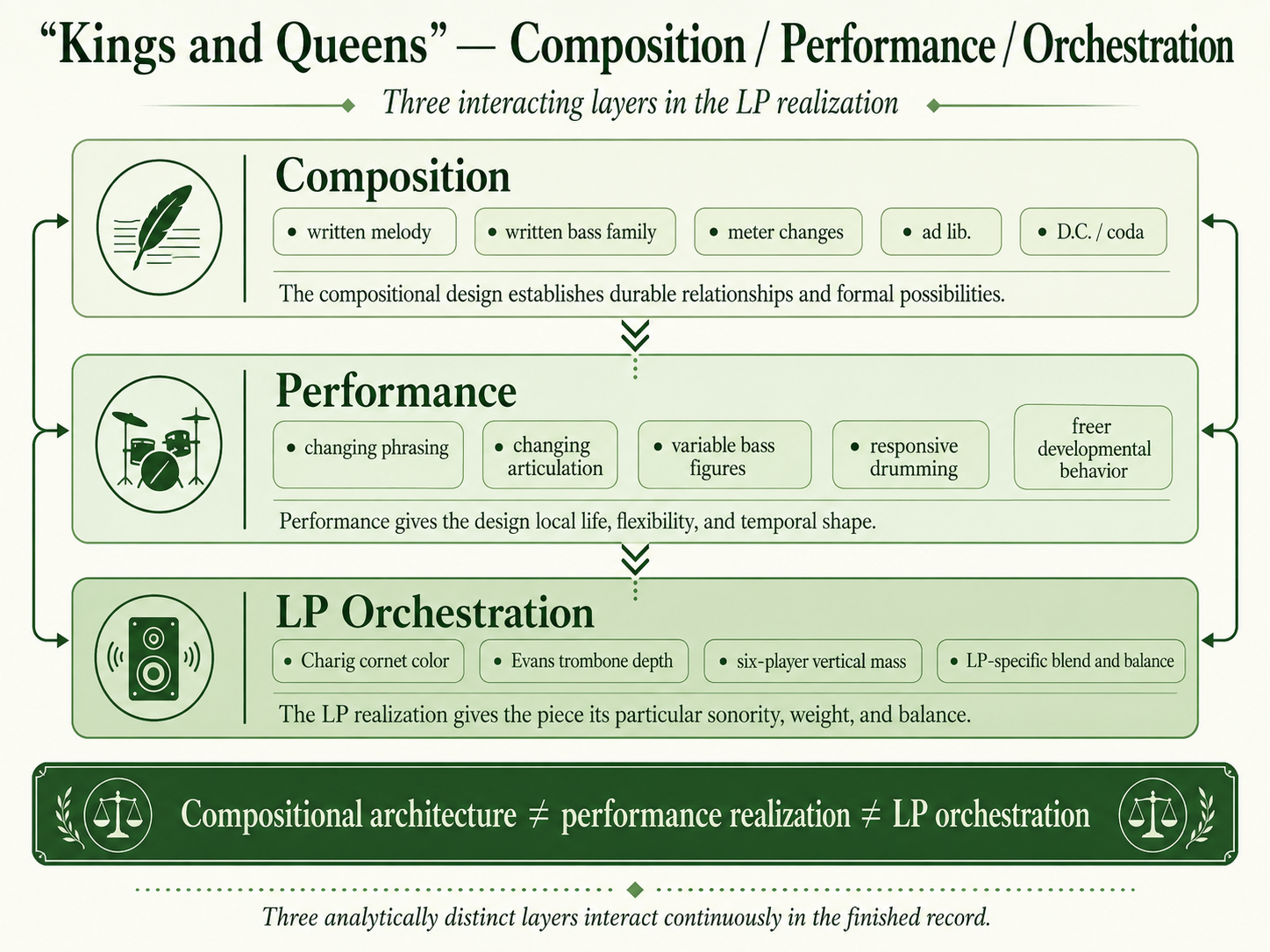
Three interacting layers in the LP realization. The composition provides durable melodic, bass, metric, and return relationships; performance gives those relationships phrasing, flexibility, and temporal life; and the LP orchestration gives them the particular color, weight, and balance of the six-player recording. The point is not that these layers are heard separately, but that the finished track draws its richness from their continual interaction.
At the compositional level, Hopper defines the architecture the musicians inherit: principal melodic and bass materials, written upper relationships, metric organization, changing degrees of prescription, recurrence, and coda. Those elements establish durable constraints and possibilities without fixing every detail of their realization. The score determines what must remain structurally available, but not the exact shape every event will take in performance.
Performance turns that architecture into a living process. Written relationships can be stretched, rearticulated, intensified, exposed differently, or carried through freer behavior without losing their identity. The significance of performance therefore lies not in decorating a fixed structure, but in determining how that structure breathes—how long events last, how strongly they are articulated, how players respond to one another, and how much freedom particular relationships can absorb while remaining legible.
Orchestration adds a further dimension without changing the underlying distinction. Charig and Evans enlarge the written texture through brass color, vertical depth, and inner weight, while their blend with Dean, Ratledge, Hopper, and Wyatt gives the LP a sonority that belongs specifically to this recorded realization. The composition can prescribe relationships among voices without prescribing the exact instrumental balance through which those relationships will be heard on Fourth.
Keeping the three levels distinct prevents several kinds of analytical confusion. Something can belong firmly to Hopper’s design without being reproduced literally; something can arise through performance without becoming arbitrary; and something can be specific to the LP’s timbre or balance without generating the form beneath it. Yet the finished recording never presents these levels separately. Composition supplies the durable relationships, performance gives them temporal life, and orchestration gives that life its particular physical presence.
Compositional architecture ≠ performance realization ≠ LP orchestration.
In the finished track, those three levels are never heard apart; their force comes from how completely they work together. None is sufficient by itself: the score provides the durable architecture, performance keeps that architecture responsive in time, and orchestration gives the resulting relationships their particular physical presence on the LP. What the listener finally encounters is therefore one continuous musical object whose richness comes from layers that can be distinguished in analysis but are never heard in isolation.
Sectional Conclusion. Hopper’s score confirms that “Kings and Queens” is carefully differentiated at the compositional level, but the LP does not translate every written distinction into an equally strong heard boundary. Instead, compositional design, performance realization, and orchestration remain distinct while continually interacting. Hopper provides the relationships that give the piece its architecture; the musicians preserve those relationships without reproducing their surface mechanically; and the expanded LP ensemble gives them a particular depth, color, and weight without becoming necessary to explain the underlying form. The recording’s continuity therefore arises not from collapsing these levels into one fixed object, but from allowing each to contribute differently while the essential relationships remain clear. Nothing in the audible evidence requires studio construction to account for that architecture. What the track finally demonstrates is a design specific enough to remain intelligible, flexible enough to remain alive in performance, and open enough to acquire a recorded sonority richer than its underlying structural economy might initially suggest.
From Design to Principle. The chronological analysis has shown how “Kings and Queens” changes over time, while the score and LP have clarified how composition, performance, and orchestration participate differently in that process. What remains is to ask why so little material can sustain so much consequence. Section VI therefore turns from construction to principle: from the sources of the track’s organization to the way a small set of durable relationships can continue to acquire new functions without exhausting their identity.
VI. What Holds the Five Minutes Together
Across the complete track
By this point, the continuity of “Kings and Queens” can no longer be explained simply by saying that a theme returns or that the rhythm section maintains a steady ground. Its coherence depends on something more economical and more flexible: a limited set of relationships remains intelligible even as the functions carried by those relationships continue to change.
What holds the five minutes together, then, is not invariance but the clarity with which change occurs inside persistence. Materials can move between foreground and background, degrees of freedom can expand or contract, and familiar relationships can assume new formal responsibilities without losing their identity. Because so much remains legible, relatively small shifts of prominence, function, or realization can carry unusual weight.
The apparent simplicity of “Kings and Queens” is therefore not the absence of formal complexity. It is the result of making a limited set of relationships clear enough that their changing functions can become the form itself.
a. A Ground Can Persist Without Staying Still
The continuity of “Kings and Queens” depends on a ground that remains recognizable without becoming fixed. Hopper and Ratledge sustain that continuity in contrasting ways. Hopper’s bass remains active and changeable, yet its changing figures continue to orient the low register. Ratledge, by contrast, preserves the harmonic interior through comparative restraint, allowing voicing, articulation, and exposure to shift without continually redefining the field. Hopper preserves function more consistently than material; Ratledge preserves harmonic location more consistently than surface detail.
What matters here is the different way each player makes persistence possible. Hopper keeps the lower frame alive through controlled movement, showing how a foundation can remain recognizable while its details continue to change. Ratledge provides continuity by moving less: his comparative stability holds the harmonic interior together even as the melodic and rhythmic surface becomes more mobile.
Together, those two kinds of persistence give the listener a remarkably stable sense of place. Even when what is happening there changes substantially, the music still feels located. The ground can alter its figures, degree of exposure, and local weight without becoming a new foundation. It can support, step forward, recede, and later realign with returning melodic material while remaining part of the same structural field.
Persistence in “Kings and Queens” therefore cannot mean the survival of identical events. Persistence is functional, not literal. What endures is a network of relationships strong enough to remain legible while its components change at different rates. A bass figure can vary without ceasing to ground; a harmonic interior can shift without creating a new harmonic world; material can move between background and foreground without losing its structural identity.
This is where Relational Continuity becomes especially useful. The track remains coherent because low foundation, harmonic interior, melodic foreground, and temporal field continue to define one another even as their local realization and relative prominence change. The ground is therefore not a stationary layer beneath the form, but a durable relationship capable of movement, exposure, withdrawal, and renewed consequence. What holds the piece together is not that the ground stays the same, but that it can keep changing without ceasing to provide the bearings from which the rest of the music is understood.
By this point, the continuity of “Kings and Queens” can be understood less as the persistence of any single event than as the persistence of a set of relationships. Melody, bass, harmonic interior, and temporal field do not remain fixed in one form, but they continue to define one another even as their prominence, freedom, exposure, and authority change. The diagram below gathers those layers into a single view. It shows why the piece can keep changing without losing its identity: what survives is not a rigid surface, but a network of musical roles that remains recognizable while its balance keeps shifting.
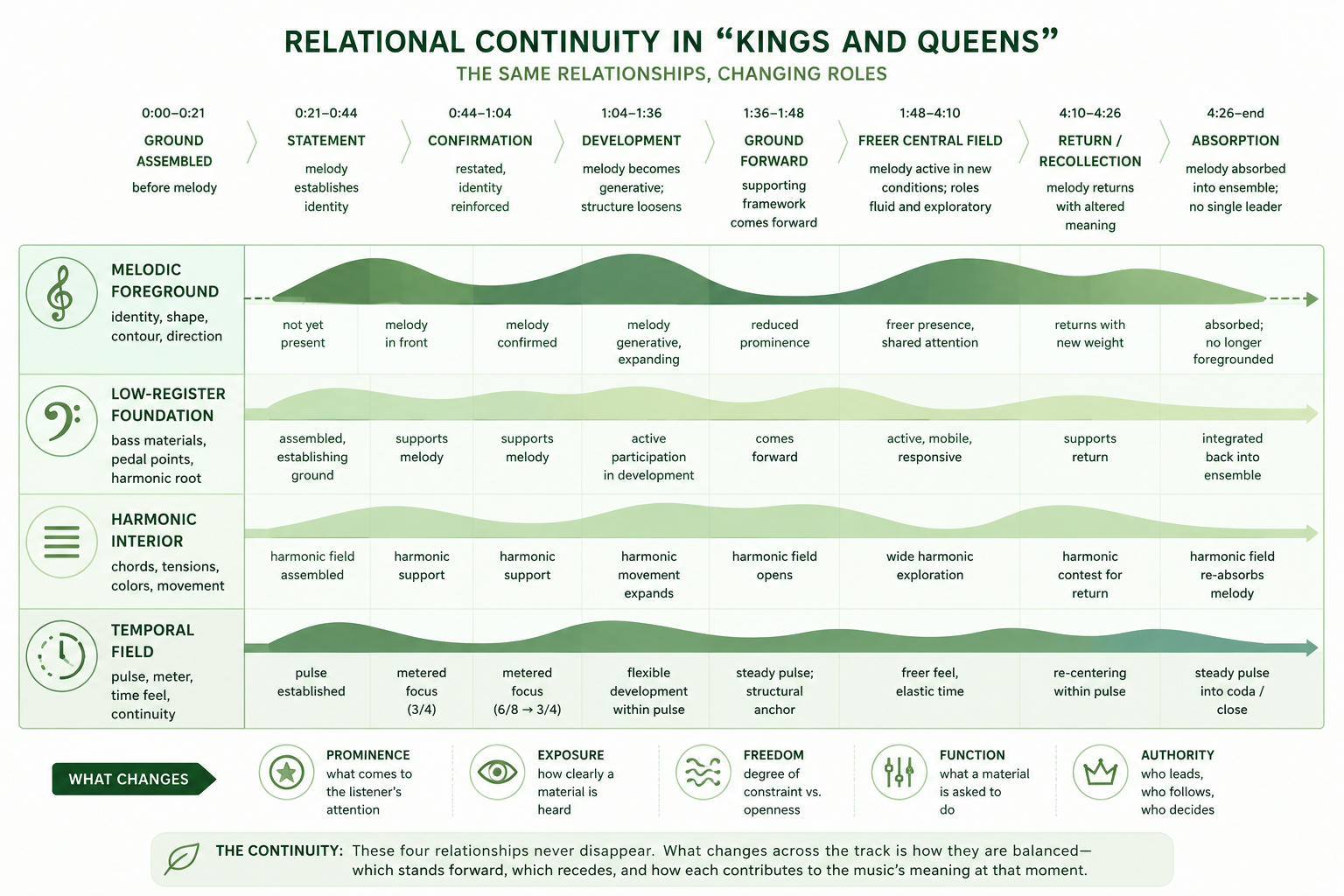
A schematic view of the track’s four persistent layers—melodic foreground, low-register foundation, harmonic interior, and temporal field. What changes across the five minutes is not the existence of these relationships, but their balance: one layer can come forward while another recedes, freedom can expand while orientation remains secure, and authority can shift locally without dissolving the continuity of the whole.
Seen this way, the track’s coherence comes not from sameness, but from the listener’s continuing ability to hear how these four layers remain related while their roles keep changing.
b. The Melody Changes What It Means
The principal melody carries so much of “Kings and Queens” because its identity is strong enough to survive changes in use. Its long-breathed shape, internal pacing, and alternation between motion and sustained arrival give it a profile that can remain recognizable even when its exact realization changes. What matters at this stage is less the specific contour already established in the opening than the fact that the phrase has become durable enough to persist in memory without constant restatement.
That durability allows the same phrase-family to perform a sequence of different formal jobs. It first establishes identity, then confirms that identity through close restatement. From there it becomes generative material, disappears as explicit foreground, returns in a freer developmental and improvisational role, later reappears as recollection, and finally loses its privileged status as it is absorbed into the closing ensemble. The material remains related to itself across those stages, but what the piece asks that material to do changes dramatically.
The principal melody does not remain formally important because it is repeated without change. Its strength lies in the opposite possibility: once its identity has been established clearly enough, the same phrase can pass through several different roles without losing its connection to what the listener first heard. Statement becomes confirmation, confirmation opens into development, explicit presence gives way to memory, recollection returns under altered conditions, and the melody is finally absorbed into the ensemble rather than restored to permanent command. The figure below traces that changing formal life, showing how one recognizable identity can remain continuous while what it means to the form keeps changing.
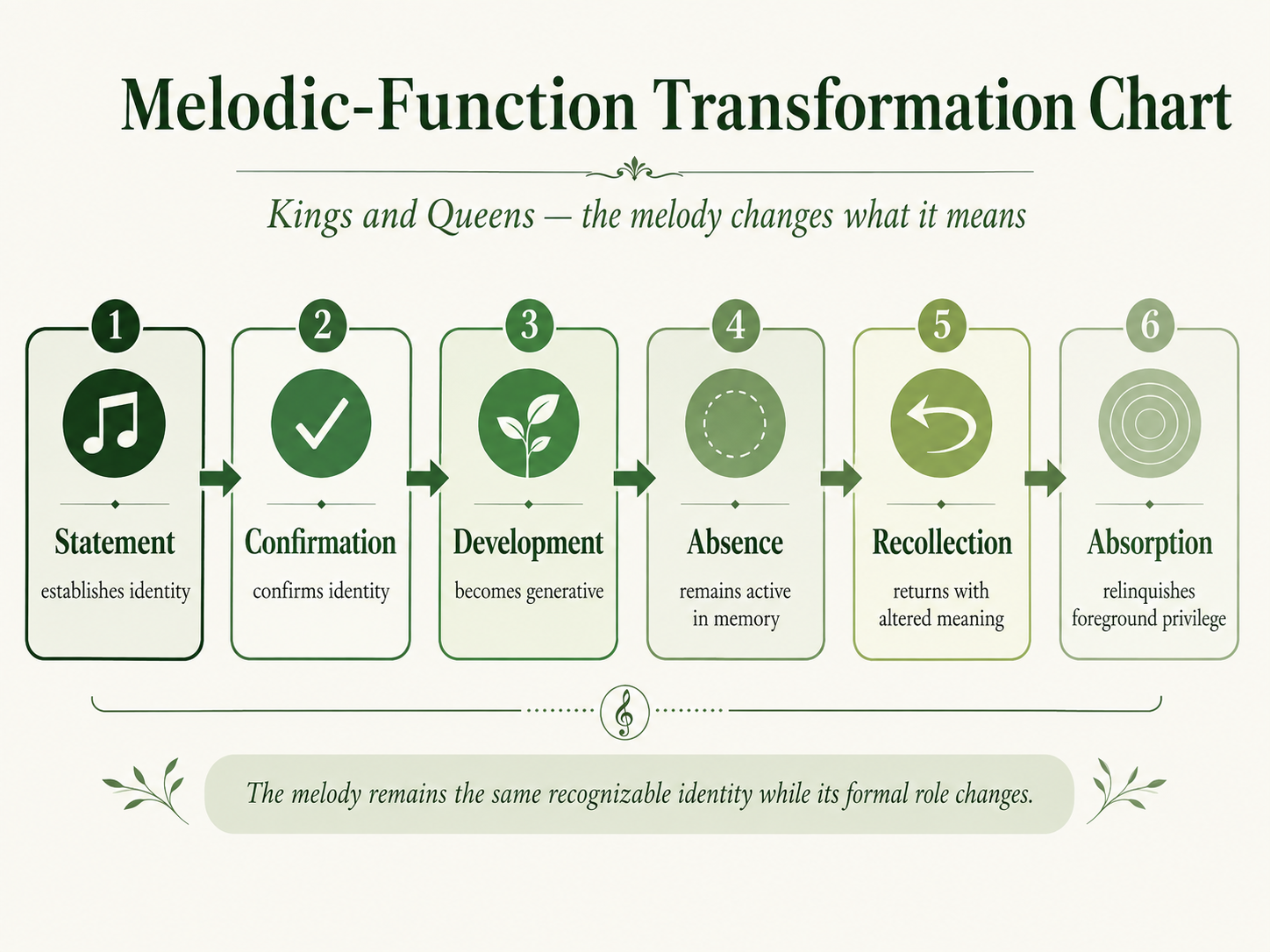
The principal melody remains recognizable while its formal role continually changes. It first establishes and confirms identity, then becomes generative, persists in memory during its absence, returns carrying the history of what has happened in between, and finally relinquishes foreground privilege as it is absorbed into the closing ensemble.
This is one of the reasons the track can remain so economical without becoming static. Hopper does not need a succession of new themes to mark every formal development. Once the principal phrase has been established strongly enough, its remembered profile becomes a resource in its own right. It can be absent yet consequential and transformed yet traceable because the listener no longer needs its identity to be continually refreshed.
The value of that durability becomes clearest when the melody falls silent. Once the phrase has been established, the music can withdraw it from the foreground without removing it from the listener’s sense of the form. Its remembered shape remains available while the ensemble explores other possibilities within the surrounding field, so absence itself becomes part of the melody’s formal life rather than a break in it. By the time the phrase returns, the listener already carries enough of its identity forward for a relatively compressed reappearance to become immediately meaningful.
What matters at this stage is that the melody can remain present in memory even while it is absent from the sound. Its remembered shape can bridge statement, transformation, disappearance, and eventual return, allowing all four conditions to remain attached to the same identity.
The melody can carry so much formal responsibility because it remains recognizable without requiring literal repetition. Its memorability is therefore not an ornamental quality added to the structure. It is one of the conditions that makes the structure possible.
c. Precision Without Rigidity
Precision in “Kings and Queens” does not come from holding every detail still. It comes from knowing what must remain clear even as the surface continues to change. Dean can preserve melodic identity without fixing every attack or duration; Hopper can maintain low-register orientation through changing figures; Wyatt can keep the temporal field intelligible while reshaping its surface; Ratledge can sustain harmonic location without reproducing every voicing or articulation. Stability at the level of form therefore coexists with considerable freedom at the level of event.
The opening restatement first demonstrates that principle, but its importance here lies in what it reveals rather than in the details of the comparison itself. What returns most precisely is not the complete acoustic event but the organization behind it. The phrase remains intelligible because its hierarchy and ensemble relationships remain intact even while the realization changes. The restatement reproduces the ensemble relationship more precisely than it reproduces the ensemble events.
The central field carries the same principle into a more open condition. Dean can move far beyond the proportions of the opening statement because the surrounding relationships remain secure enough to support greater freedom. Precision has not disappeared; it has shifted away from the reproduction of local events toward the preservation of the conditions that keep those events intelligible. The same is true of the six-player opening, where density remains lucid because the layers are differentiated strongly enough to coexist without making equivalent claims on the listener’s attention.
These examples point to the same underlying distinction. Precision in “Kings and Queens” is relational rather than mechanical. The musicians do not need to preserve every detail in order to preserve the form; they need to preserve the relationships through which variation continues to make sense. That leaves room for phrasing to breathe, rhythmic activity to intensify or recede, harmonic support to change in exposure, and orchestral density to expand without making the organization ambiguous.
The musicians do not create variety by constantly abandoning their structural responsibilities. They create variety by realizing those responsibilities differently. The clarity of “Kings and Queens” does not come from rigidity. It comes from preserving enough structural certainty for local freedom to remain meaningful.
d. Economy Makes Change Audible
The formal richness of “Kings and Queens” depends partly on how little material Hopper needs to keep in circulation. The track’s durable inventory is small: one principal melodic phrase-family, one related bass-framework family, a slowly changing harmonic field, a stable temporal ground, a clearly differentiated ensemble texture, a framework capable of supporting greater developmental freedom, and a return/coda procedure. These are not seven equivalent themes or motifs. They operate at different levels of the design. Their importance lies in the fact that the piece rarely needs to replace all of them at once.
That economy becomes clearest at the major articulations. At 0:21, melodic identity is added to a ground already in place. At 0:44, the same phrase returns through varied realization. At 1:04, familiar material becomes developmental rather than confirmatory. At 1:36, low material that had served as support becomes perceptually central. At 1:48, Dean returns without restoring his earlier written role. At 4:10, resources that have persisted through the central span reconcentrate around the returning melody. Shortly afterward, that melody loses its privilege and becomes part of the closing ensemble.
What changes from one point to the next is usually not the entire inventory but the relationship among a few of its members. A foreground is added or removed; a supporting layer becomes exposed; a familiar phrase becomes freer; several persistent resources tighten around recurrence; an established lead dissolves into the ensemble. Formal change is therefore achieved by reallocating consequence rather than by continually introducing new objects.
This economy increases rather than reduces formal legibility. If Hopper continually introduced new themes, new bass grounds, new harmonic regions, and new rhythmic systems, the listener would have more objects to identify but fewer opportunities to hear subtle changes in what any one of them means. Here, the opposite is true. The smaller the inventory of durable resources, the more clearly the listener can hear changes in what those resources are doing.
That economy is not something the performance has to overcome. It is what allows small differences to carry so much weight. A change of phrasing matters because the melodic identity remains secure; a shift in low-register prominence matters because the ground has already become familiar; a local intensification matters because the temporal world does not have to be rebuilt around it. The piece can therefore generate substantial formal distance from comparatively modest adjustments in function, exposure, and degree of freedom.
The same principle shapes the transitions themselves. Most preserve several dimensions while changing only one or two decisive relationships: a foreground is added, withdrawn, loosened, restored, or absorbed while bass, harmony, pulse, or ensemble organization continues across the boundary. Precision at the joins means changing exactly enough to alter the formal relationship while preserving enough to maintain continuity. The transitions feel economical because they rarely announce themselves with more information than they need.
In “Kings and Queens,” formal depth comes not from multiplying resources, but from making each change in their relationship matter.
e. Authority Matters Most When Roles Change
“Kings and Queens” does not continually pass authority from one player to another. Most of the time, its responsibilities remain differentiated: Dean carries the principal melodic trajectory, Hopper preserves low-register orientation, Ratledge sustains the harmonic interior, and Wyatt keeps the temporal field intelligible. Authority becomes most revealing at the moments when that established hierarchy changes—when a familiar layer acquires new prominence, when a foreground returns under altered conditions, or when leadership itself begins to dissolve.
The shift at 1:36 provides the clearest early example. Dean’s continuous melodic foreground withdraws, allowing the low framework to become perceptually central without requiring the rest of the musical environment to be rebuilt. When Dean resumes the foreground shortly afterward, he returns under different conditions, with greater developmental freedom than before. What changes across these moments is therefore less the identity of the underlying field than the status attached to particular layers within it.
The late return sharpens that distinction. At 4:10, the principal melody again acquires clear thematic prominence as several persistent resources reconcentrate around it. Yet that regained privilege is temporary. As Dean ceases to function as a continuous lead, the piece does not replace him with another dominant voice. Instead, melodic authority gradually gives way to an ensemble-led closing process in which structural responsibility remains distributed even as stable foreground leadership disappears.
These changes reveal why foreground prominence and structural responsibility are different variables. A layer can become more audible without taking control of the form, just as material that normally serves as support can acquire temporary foreground consequence without ceasing to belong to the underlying framework. Local prominences therefore matter only when they alter the relationships through which the music is organized; increased exposure by itself is not enough.
Authority in “Kings and Queens” is thus less a chain of leadership transfers than a way of hearing changes in status. What matters is not simply who is most audible, but whether a change of prominence redistributes formal responsibility. Some moments do so decisively; others merely expose a layer that was already structurally active. Hearing that difference is crucial: some changes of prominence reshape the hierarchy of the music, while others simply bring an already active layer into clearer view.
Mobile Authority is useful for describing these selective shifts of status, but it does not define the track as a whole. The deeper condition is the continuity of the relationships against which those shifts become legible. Authority matters here precisely because it moves only at certain consequential moments, and because those movements acquire their force from a musical field that otherwise remains remarkably continuous.
f. Recurrence Changes Function
The return at 4:10 is one of the clearest structural events in “Kings and Queens,” but recurrence alone does not explain the form. The principal melody is recognized quickly because its identity has already become durable enough to survive prolonged absence. By 4:10, the listener no longer needs the opening evidence repeated in full: the melody returns carrying a history it did not possess at 0:21. It has already been confirmed, developed, withdrawn, and transformed into freer melodic behavior, and that accumulated history changes what recurrence can mean.
The ensemble makes that difference audible. Hopper, Ratledge, and Wyatt do not reconstruct an opening state that had disappeared; they reconcentrate around the returning phrase from relationships that have remained active in more flexible form throughout the central span. The return therefore feels decisive because familiar materials and familiar responsibilities momentarily tighten around one another again.
But that recovered hierarchy lasts only briefly. After approximately 4:26, Dean no longer remains the continuous foreground, and the returned material is absorbed into the ensemble-led closing process rather than allowed to govern an extended recapitulation. The same phrase that once established the piece’s first durable melodic identity now becomes the means by which memory is activated before stable melodic leadership is relinquished.
Recurrence therefore changes function. What comes back carries its earlier identity but not its earlier responsibility. What returns matters, but what the return is allowed to do matters more.
g. Written Difference, Heard Continuity
The same principle of continuity can be heard in the relationship between Hopper’s score and the LP. Hopper’s score and the recording do not offer competing accounts of the form; they reveal different levels of it. The score marks changes of meter, prescription, return, and coda with compositional clarity, while the recording allows several of those distinctions to pass within a more continuous heard process. Both can be true because degree of compositional specification and degree of perceptual/formal separation are different variables.
A written change can matter structurally without producing an equally strong audible boundary. A shift in meter can be compositionally real while the tactus remains closely related, and an ad-lib designation can alter the amount of melodic freedom while bass, harmony, and temporal orientation continue underneath. The exact LP timestamps of the written metric changes remain unresolved, and the analysis does not depend on forcing them onto artificial perceptual boundaries. Likewise, a D.C. can prescribe recurrence without requiring the LP to sound like an abrupt reconstruction of the opening.
Conversely, the recording can preserve continuity without erasing Hopper’s distinctions. What the LP smooths is not the existence of written difference, but how strongly that difference is heard as separation. Those distinctions still matter, yet the performance carries them through relationships stable enough for one condition to grow naturally out of another rather than simply replace it. Heard continuity therefore does not contradict the score’s differentiation; it shows how those written changes are absorbed into the life of the performance.
This is another expression of the track’s economy. Hopper can change the terms under which the musicians operate without requiring the listener to experience each change as the beginning of a new musical world. Written differentiation and heard continuity are therefore not opposing descriptions of “Kings and Queens.” They are two views of the same design: one reveals how carefully Hopper changes the conditions of the music, while the other reveals how successfully those changes can be carried through relationships that remain recognizable across them.
Sectional Conclusion. The continuity of “Kings and Queens” does not depend on one unchanged riff, one permanent hierarchy, one meter, or a fixed boundary between composition and improvisation. It resides instead in a small set of exceptionally legible relationships that remain intelligible even as their realization, prominence, and formal function change. The ground can move without ceasing to ground; the principal melody can retain its identity while acquiring different formal meanings; performance can remain precise without becoming mechanically fixed; and written distinctions can remain compositionally real without dividing the LP into equally strong perceptual sections. Because those relationships are established so clearly, Hopper can draw unusual consequence from a remarkably economical design. A supporting layer can become foreground without becoming a new object, a familiar melody can return without restoring its former function, and changes of prescription or authority can matter precisely because so much of the surrounding musical world remains recognizable. The small inventory of durable resources does not limit the form. It makes changes in what those resources are doing unusually easy to hear. The track’s economy is therefore not a lack of architecture, but the condition that allows subtle changes of function, prominence, freedom, and recurrence to acquire architectural weight. Relational Continuity names the deeper principle beneath those changes: identity survives not because events remain the same, but because the relationships that make those events intelligible remain available as the music continually reconfigures them. What holds the five minutes together is not sameness, but the persistent intelligibility of relationships through change.
From Analysis to Experience. The analytical argument is now complete. What remains is to return to the track as it unfolds in time—not as a sequence of mechanisms, but as the experience those mechanisms create: a musical world quietly assembled before its principal melody appears, a phrase spacious enough to become memory, freedom opening outward without severing continuity, and a return that closes the piece not by restoring the beginning, but by allowing the melody to become part of the ensemble from which it first emerged.
Closing Movement — The Melody Returns to the World That Made It
By the time “Kings and Queens” ends, its five minutes feel less like a sequence of sections than like the life of one musical environment. It begins by assembling that environment quietly, before its most memorable voice has appeared. A harmonic and low-register field gathers itself first; time gradually becomes audible within it; only then does the principal phrase step forward. The order matters. The melody does not arrive as an isolated theme laid over an empty background, but as the first fully memorable shape to emerge from conditions already capable of sustaining it.
And the shape itself seems made to be remembered. The line unfolds slowly enough for its gestures to register as parts of a larger motion: movement gives way to sustained tones, those sustained tones become temporary points of arrival, and the spaces within the phrase allow it to breathe rather than press continuously forward. Its identity accumulates through direction, pacing, and proportion. The ear remembers less a sequence of individual notes than the sense of a phrase travelling through space and gradually finding its points of rest. Even before the music begins to transform it, the melody already sounds capable of carrying memory.
Yet the melody never becomes independent of the environment that made it possible. Hopper’s low foundation, Ratledge’s harmonic interior, and Wyatt’s living sense of time remain part of how the line is heard, while the surrounding ensemble gives its pauses, movements, and arrivals greater scale. The melody gives that world a memorable face, but the world gives the melody its spaciousness and its ability to remain consequential beyond the moment of statement. From the beginning, each defines the other.
That relationship is tested almost immediately. The close restatement confirms the identity the listener has just learned, but it does not turn that identity into something rigid. The phrase returns with the unmistakable familiarity of something already known, yet it breathes as a new event. What the ensemble preserves is less a fixed surface than a shared sense of how the material belongs together. Recognition does not depend on copying.
From there, the melody’s role begins to loosen. What had first appeared as a clearly bounded statement becomes capable of extension and development; then, for a brief moment, the melody recedes and the ground itself comes forward. That shift reveals how much of the piece had already been present beneath Dean’s foreground. The low framework does not suddenly arrive—it becomes visible because the melodic layer that had drawn attention away from it has stepped aside.
When Dean returns, he does so with more freedom. The center of “Kings and Queens” opens outward, but it never feels unmoored. The saxophone can move farther from the proportions of the opening phrase because the field beneath it remains recognizable enough to sustain that freedom. Wyatt keeps time alive rather than merely fixed; the lower and middle layers retain a sense of location even when the surface becomes more mobile. The foundations do not disappear. They become spacious enough to support behavior that could not have occurred at the beginning.
The freedom of the central span therefore feels less like escape than expansion. The music can travel farther because the listener has already learned what belongs to it. Familiar relationships do not need to be restated continually in order to remain active in memory. Their presence can become less explicit while still giving the developing music a sense of location, as though the track were testing how far it can move without losing contact with the conditions from which it began.
That is why the late return can be understood before it has fully explained itself. The music does not need to reconstruct the whole opening before the earlier identity comes suddenly into focus; the listener has carried enough of the phrase forward for recognition to precede explanation. What was once heard as the creation of a melodic world is now heard as recollection. But recollection does not turn the piece backward. The phrase has already lived through too much to become simply what it was at the beginning. Its renewed clarity carries the memory of development, withdrawal, freedom, and absence with it.
Almost as soon as the melody has reclaimed its identity, it begins to relinquish the foreground again. Dean becomes less continuously dominant, the surrounding ensemble absorbs more of the musical weight, and the low and middle registers regain consequence. The melody that once gave the piece its clearest face no longer needs to remain separate from the environment around it. Its return is therefore not the restoration of an earlier state, but the moment at which a remembered identity can finally be heard differently.
The ending completes a relation that was present from the first moments. At the opening, the world comes first and the melody grows out of it: ground → melody. Near the end, that melody returns and is gradually given back to the world that sustained it: melody → ground/ensemble.
The relationship is easier to hear if the opening and ending are placed beside one another. At the beginning, bass, harmony, and pulse gather first, creating a field from which the principal melody can emerge and claim attention. Near the end, the direction is reversed: the melody returns with its identity intact, but instead of remaining apart from the ensemble, it is gradually folded back into the low, harmonic, and temporal world that had sustained it from the start. The figure below shows that the resemblance is not literal symmetry, but a deeper correspondence of function—one process brings the melody into the world, while the other returns it to that world.
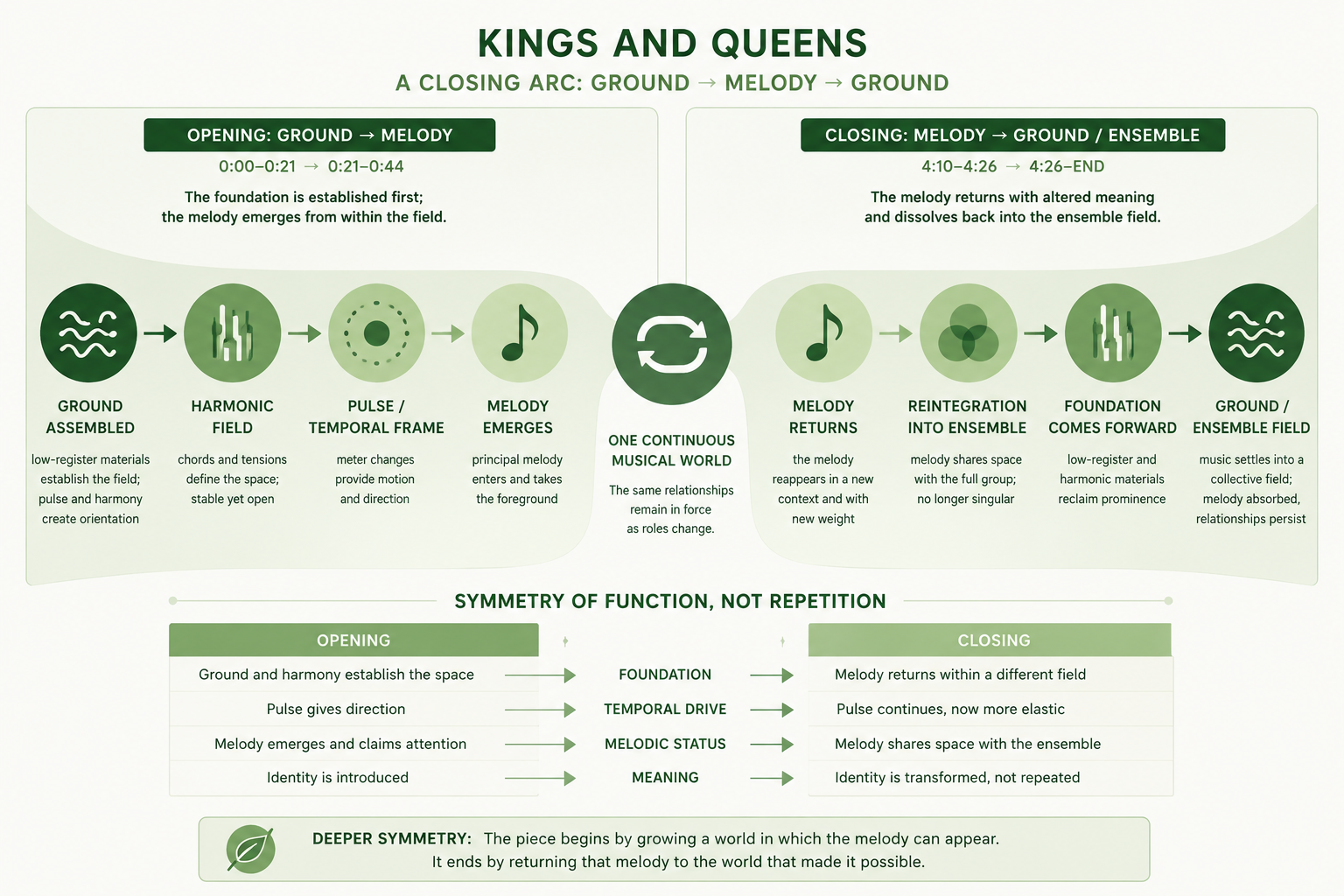
The opening and ending form a symmetry of function rather than repetition. The piece begins by assembling a low, harmonic, and temporal field from which the principal melody can emerge; near the end, that melody returns carrying altered meaning and is gradually reintegrated into the ensemble. What begins as the creation of melodic identity closes as the return of that identity to the musical world that made it possible.
The two processes answer one another, but they are not mirror images. The opening is generative; it creates the conditions from which melodic identity can emerge and begin to expand. The ending gathers toward closure; the recovered identity is folded back into the ensemble as the possibilities for further development gradually contract.
What initially seemed like the track’s central object is therefore revealed as one possibility contained within a larger continuity. That does not diminish the melody. It explains why it can bear so much weight. Its identity is strong enough to emerge from the ground, survive variation, remain present in memory during prolonged freedom, return unmistakably, and finally cease to require the privilege of standing apart.
The journey of “Kings and Queens” has never depended on a succession of dramatically contrasting formal objects. Its depth comes from hearing familiar relationships become capable of different things. The same melody can define, loosen, disappear, return, and recede; the same broad ground can support, step forward, and finally absorb; the same temporal and harmonic field can remain recognizable while the music above it acquires very different degrees of freedom. Formal distance is created not by replacing one environment with another, but by discovering new possibilities inside conditions the listener already knows.
That is why the track’s economy never feels impoverished. Familiarity gives consequence to small changes. Because so much remains recognizable, the music does not need wholesale replacement in order to travel a considerable formal distance. A slight redistribution of weight, a loosening of melodic behavior, a renewed recognition, or a gradual surrender of foreground can matter as deeply as a new section would elsewhere. The apparent simplicity of “Kings and Queens” is therefore achieved rather than given.
Its continuity does not come from preventing change. It comes from allowing change to occur without destroying the relationships from which the music derives its meaning. The melody can matter differently at every stage because enough of the surrounding world remains recognizable for those differences to be heard.
The melody enters a world already in motion; five minutes later, after statement, freedom, and return, it disappears back into that world.