“Moon in June”
- Artist
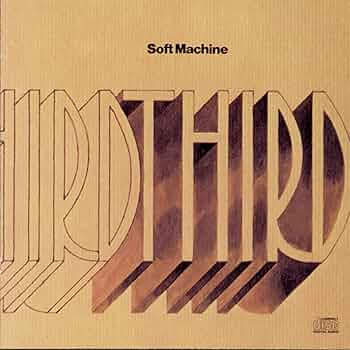
- Soft Machine
- Album
- Third
- Year
- 1970
“Moon in June” does not divide cleanly into a song followed by instrumental music. From the opening seconds, Wyatt’s lyric voice occupies the principal semantic and melodic foreground within an active, spatially differentiated construction: keyboard layers supply harmonic breadth, compact patterning, and low-register support, while the drums preserve a tactus beneath vocal phrases shaped more by syntax than by symmetrical song periods. Yet the prominence of the voice should not be confused with compositional dependence upon it. The instrumental architecture was already substantially established in earlier versions of the piece, and Wyatt later described the work as something built from instrumental sections to which melodies and lyrics were added. The opening therefore presents a perceptually voice-centered music whose pulse, harmonic support, patterned motion, melodic resources, and capacity for continuation already possess identities of their own.
Across the track, musical functions initially heard in close relation to the singer become increasingly separable from that perceptual center. Intelligible language can withdraw while vocal timbre remains; melody can continue through instrumental lines; repeated words can acquire rhythmic and recurrent force; harmonic and patterned activity can persist beyond vocal endings and assume formal direction. Some composed material also recurs literally across substantial changes of texture and personnel, giving thematic identity its own long-range continuity. These processes unfold unevenly, allowing the voice to remain emotionally central even as the surrounding music becomes increasingly capable of proceeding without sustained semantic leadership.
The track’s changing mode of production makes that separation especially tangible. Much of the first ten minutes was constructed by Wyatt through multitracking his own voice and instrumental performances, creating several simultaneous musical bodies from one performer; Hugh Hopper’s composed melodic contribution at approximately 1:26–2:03 forms an important documented exception. The principal instrumental passage then brings Ratledge and Hopper into a genuinely collective trio with Wyatt, while the late coda establishes yet another configuration through Wyatt’s processed materials and Rab Spall’s violin. Successive Reconstruction through Functional Redistribution therefore occurs not only as musical functions change bearer, but as those functions pass between different kinds of performing bodies and different modes of coordination.
This process also reflects the composition’s broader history. “Moon in June” existed in substantially different forms before Third, with lyrics, personnel, sonority, and realization changing across versions even while its underlying instrumental architecture showed considerable durability. The album version does not simply replace one fixed form with another. It repeatedly reorganizes inherited material and musical functions under new instrumental, rhythmic, harmonic, spatial, and interpersonal conditions. Its long form arises through Successive Reconstruction through Functional Redistribution: functions can persist after the configuration that first made them audible has changed, while recurring composed themes provide additional points of recognition across those reconstructions.
This figure condenses the track’s large-scale movement into a single visual trajectory. Rather than treating its major sections as sealed compartments, it shows how each region grows from functions and materials already made available by the one before it: voice, pulse, melody, recurrence, harmonic support, and formal direction separate, persist, and reassemble under changing conditions. The result is a form shaped less by abrupt replacement than by Successive Reconstruction through Functional Redistribution, as functions move through Wyatt’s multitracked self-ensemble, the later trio, and the processed violin coda while thematic memory and altered functional relations preserve continuity.
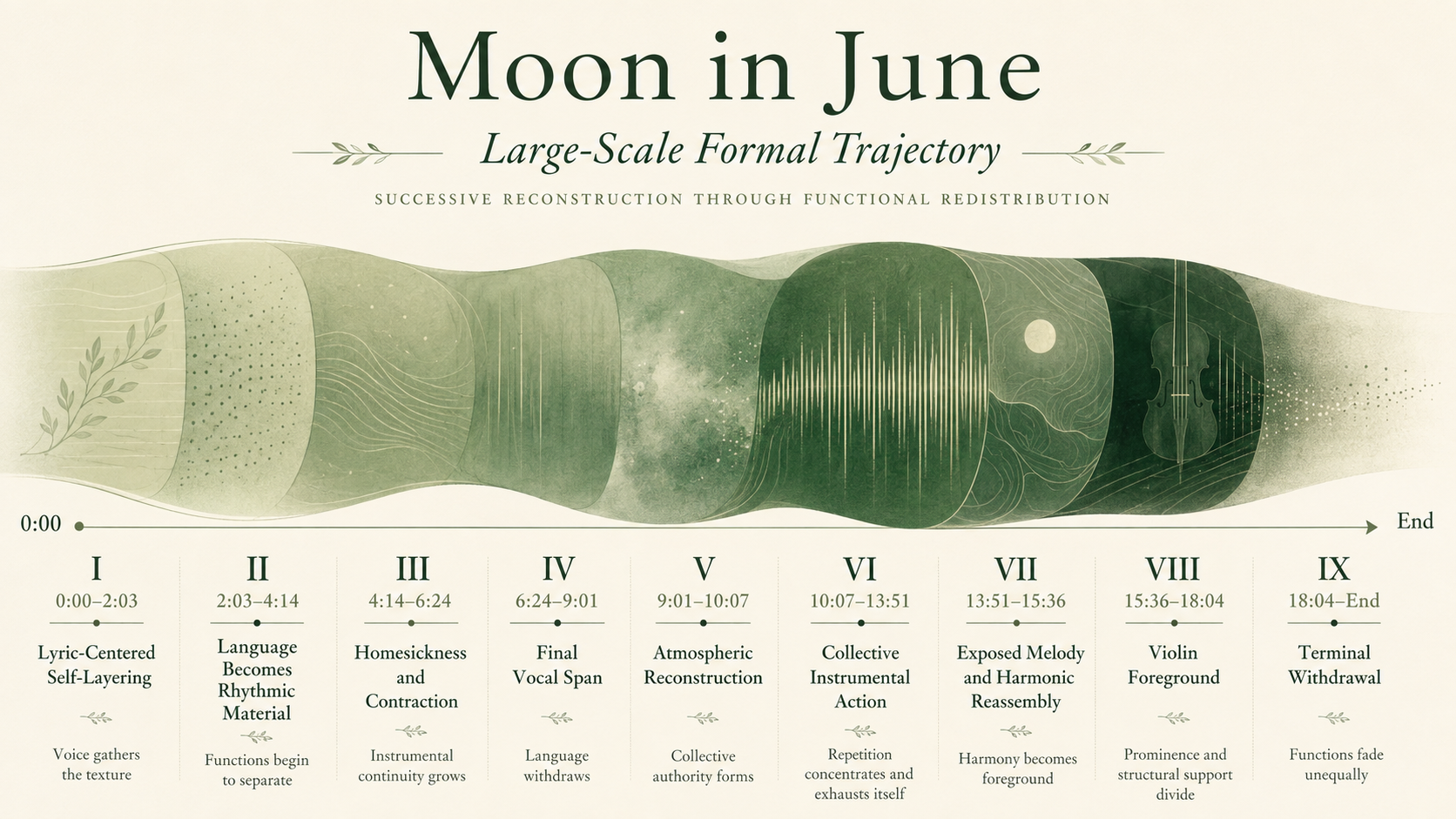
The nine permeable regions show how “Moon in June” sustains continuity through successive reconstruction. Musical functions separate from their initial bearers, persist across overlapping boundaries, and recombine under changing vocal, instrumental, harmonic, rhythmic, and spatial conditions.
Within This Track Study
I. One Voice, Several Musical Bodies
Approximately 0:00–2:03
The first two minutes establish the paradox governing the track’s opening: everything gathers around one intimate vocal presence, yet the music is already divided among several distinct bodies. Wyatt’s voice gives the texture its human center, while his drums maintain the tactus and spatially separated keyboard and low-register layers divide harmonic breadth, compact recurrence, and bass-like support among themselves. Documentary evidence confirms that Wyatt constructed almost all of the first ten minutes in this way, overdubbing drums, keyboards, bass, and studio instruments including Hammond organ; the principal exception within this opening span is Hugh Hopper’s composed melodic contribution from approximately 1:26 to 2:03. The early E-major-related orientation gives way to a more B-centered and minor-inflected region, but the deeper continuity lies in this persistent division of labor. Several musical functions are coordinated around one largely singular lead voice, creating the impression of expressive unity from differentiated recorded parts.
This diagram clarifies the opening condition on which the study’s argument depends. The beginning of “Moon in June” feels intimate and unified, yet that unity is already distributed across a spatially differentiated field. Wyatt’s voice occupies the perceptual center, while the left and right channels carry distinct supporting functions: sustained keyboard breadth and melodic-harmonic support to the left, compact recurrence and growing bass-like weight to the right, with drums spread broadly beneath the vocal center. The figure makes visible how one apparently singular presence is already composed of several musical bodies. The distinction is principally functional rather than instrumental: Wyatt’s overdubbed layers can sound like separate ensemble members even when several originate from the same performer.
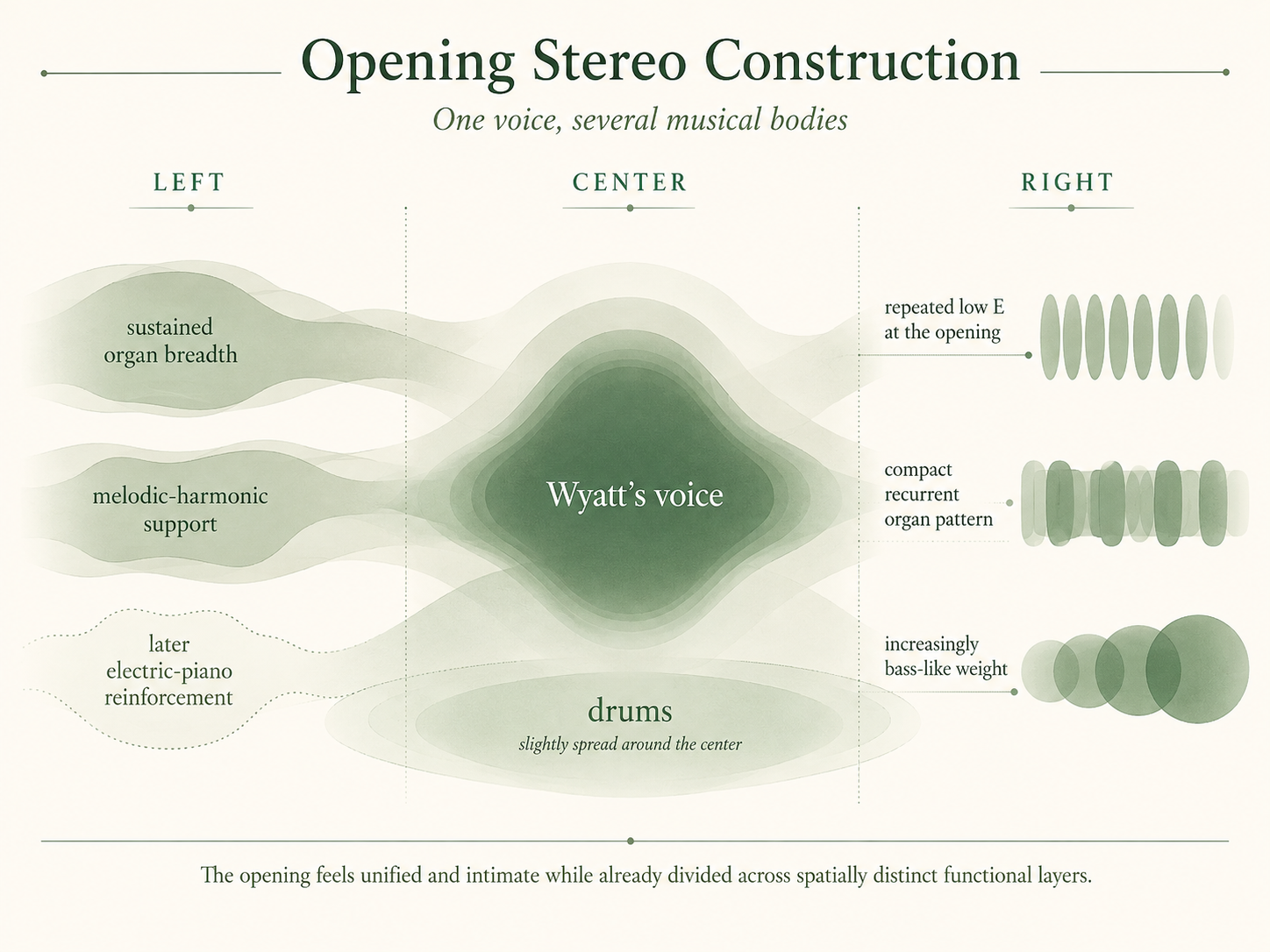
The opening feels singular and intimate, but its functions are already distributed across a differentiated stereo field: centered voice and drums, left-channel keyboard breadth and support, and right-channel recurrence and growing bass-like weight. Most of this opening field is Wyatt’s own multitracked construction.
a. The Voice Enters an Active Field
Approximately 0:00–0:38
Wyatt’s voice arrives almost immediately within music already in motion. His drums articulate a clear tactus, a left-side keyboard layer supplies sustained harmonic or melodic-harmonic breadth, and a right-side keyboard layer begins by repeatedly articulating a low E. Wyatt later recalled using studio instruments available to him during these sessions, including Hammond organ, while building the first ten minutes through overdubbing. The exact registration of every local keyboard layer should therefore not be forced beyond what the recording makes audible, but the performer is no longer in doubt: these opening instrumental bodies belong to Wyatt’s self-constructed studio ensemble.
The overtone-rich right-side registration gives the repeated E a broader, almost dyadic profile, though the opening repetition is built from a single pitch rather than a two- or three-note melodic pattern. As the harmony begins to move, the layer changes pitch while retaining its compact, repetitive function. The two keyboard parts occupy different positions in the stereo image and perform different kinds of work: the left side opens space and supports the vocal contour, while the right side contributes recurrence and a more tightly bounded patterned identity. Beneath them, Wyatt’s drums preserve continuity without forcing the voice into regular, symmetrical phrase lengths.
The line beginning “On a dilemma…” becomes the principal semantic and melodic foreground because it gives this active instrumental field a human direction. Its compact, speech-inflected contour and clear intelligibility draw attention toward the singer, making the surrounding layers sound song-directed. Yet their existence does not depend upon the voice determining every local event. The phrases enter and settle against a pulse that continues beyond them, while the recurring keyboard figure retains an identity extending beyond accompaniment. The harmony is broadly E-major-related, though the exact opening voicing remains uncertain. Harmonic breadth, patterned recurrence, tactus, and vocal melody remain distinct even as the voice gathers them perceptually into one expressive surface.
That differentiation is inseparable from the recording’s construction. Wyatt later described playing the first ten minutes himself, recording drums, keyboards, bass, and other available studio instruments in successive passes. One performer therefore creates an apparent ensemble of separate functions, yet the result retains perceptual coherence rather than sounding like an exposed collage of overdubs. The lead voice binds those recorded selves into one intimate presence, while the studio makes their functional independence audible from the beginning.
b. The Pattern Remains while the Song Changes
Approximately 0:38–1:26
At the first major change, the opening arrangement is reconstituted with different material. Wyatt’s vocal melody shifts, the harmony moves from the initial E-related brightness toward a more B-centered and minor-inflected region, and the compact right-side keyboard figure gives way to another pattern. The larger division of labor remains intact. One keyboard layer continues to provide harmonic or melodic-harmonic breadth, another retains a shorter and more repetitive function, and the drums preserve the tactus beneath increasingly extended vocal phrases.
The low-register activity should be understood first by function rather than assigned automatically to a single instrument. Documentary accounts indicate that Wyatt used both bass and keyboards in constructing the vocal section, while other evidence suggests that some apparently bass-like parts were realized on electric piano. The important audible fact here is therefore not whether every low event comes from bass or keyboard, but that a distinct low and recurrent function persists beneath the voice within Wyatt’s multitracked field.
The voice remains clearly foregrounded, though its relation to the accompaniment becomes less compact. Phrases such as “Now I’m here…” stretch across recurring instrumental gestures without resolving with them. Their lengths are governed by syntax, breath, and emphasis, while the instrumental layers sustain a more regular underlying motion. Vocal phrasing and instrumental grouping therefore operate at different scales: one follows the duration of thought, the other preserves continuity beneath it.
No stable refrain or repeated formal block establishes the passage securely as a conventional chorus. Continuity instead lies in a recurring procedure: new melody, new harmonic color, and a new patterned figure enter the same broad relationship among voice, pulse, harmonic breadth, and repetitive support. The material changes while the self-layered organization persists.
c. When Words Recede, Another Performer Carries the Line
Approximately 1:26–2:03
The first extended withdrawal of intelligible lyric leaves the musical current intact, but documentary evidence now clarifies an important change in who carries it. From approximately 1:26 to 2:03, Hugh Hopper plays the low-register melodic theme that moves into prominence. Hopper himself later emphasized that this was part of Wyatt’s composition rather than an improvised solo. The exact instrument producing the line remains less securely documented than its performer and compositional status, so its timbre should not be forced into a definite bass, organ, or guitar identification without further evidence.
Hopper’s entrance is especially significant because it forms a documented exception to Wyatt’s broad recollection that he played the first ten minutes himself. The larger opening remains overwhelmingly a Wyatt-built multitracked construction, but for this short span melodic function passes to another performer before the main Ratledge–Hopper–Wyatt instrumental section has begun. Functional redistribution therefore becomes interpersonal unusually early: a composed melodic function associated with Wyatt’s musical architecture is carried by Hopper while Wyatt’s own recorded layers continue around it.
Wyatt’s voice remains present as wordless sound, separating human timbre from verbal meaning. Hopper’s low-register theme carries melodic prominence, while the recurring keyboard layer and drums continue to organize pattern and motion beneath it. Language, melody, vocal presence, pulse, and harmonic support—closely coordinated at the opening—are now heard as separable strands, and one of those strands has acquired a different human bearer.
The harmony remains broadly connected to the preceding B-centered and B-minor-related area, with movement through D-, A-, C-, and F-sharp-related colors, though exact chord identities remain uncertain. The passage sustains orientation through Hopper’s composed melody, patterned support, tactus, and harmonic continuity without relying on lyric recurrence or cadential reset. Full Instrumental Self-Sufficiency has not yet been reached, but its underlying capacities are already audible.
Sectional Conclusion. Wyatt’s layered opening is perceptually unified but functionally divisible. His multitracked voice, drums, keyboards, and low-register support establish several simultaneous musical functions before the first lyric withdrawal makes their separability explicit. Hopper’s composed theme at 1:26–2:03 sharpens that process further: melody can leave the singing voice and even pass to another performer while the surrounding musical current continues intact.
From Vocal Return to Rhythmic Transformation. When intelligible singing returns at approximately 2:03, it re-enters a texture that has already demonstrated two kinds of independence: Wyatt’s self-layered instrumental functions can continue without sustained verbal direction, and melodic function can temporarily pass beyond Wyatt altogether. Extended syntax will now contract into shorter, more rhythmically exposed cells.
II. Language Becomes Musical Material
Approximately 2:03–4:14
The return of intelligible singing restores the voice to the foreground under altered conditions. Wyatt’s multitracked instrumental field has already continued through lyric withdrawal, and the renewed vocal line now enters above a current with its own pulse, low-register support, and harmonic motion. The instrumental source remains principally Wyatt’s own studio construction in this part of the track, even when separate keyboard and bass-like functions occupy different places in the stereo field. Wyatt’s phrases remain clearly semantic and emotionally exposed, yet their long syntax crosses recurring instrumental units without determining every local boundary.
Across the section, that separation becomes a transformation within the voice itself. Longer melodic sentences first extend through B-, D-, and G-related areas while low-register keyboard or bass-like activity assumes a more evident supporting role and the drums preserve the tactus beneath them. With “Oh, wait a minute” and the repeated “Over, up…” units, language then contracts into shorter events aligned more closely with pulse and subdivision. Speech remains intelligible while taking on the functions of rhythmic and melodic material.
a. The Voice Returns to a Changed Current
Approximately 2:03–3:13
When intelligible singing returns, the voice again supplies the clearest melodic and semantic line, and phrase-level intelligibility remains strong. It enters, however, a texture that has already demonstrated its ability to proceed without continuous lyric. The surrounding instrumental current remains part of Wyatt’s multitracked construction: a low-register layer carries a more evident harmonic or bass-like function, while other keyboard activity and drums maintain motion beneath and between vocal phrases.
The exact instrument responsible for every low event should remain locally cautious. Documentary evidence confirms that Wyatt played drums, keyboards, and bass during the first ten minutes, while other testimony indicates that some apparently bass-like parts were realized on electric piano. What is secure here is the functional organization: a distinct low-register support continues beneath the voice while separate keyboard activity maintains harmonic breadth and patterned motion.
Wyatt’s melody remains compact and speech-inflected, though the lines become longer and more continuously exposed. Their contours rise and settle according to syntax, while the tactus persists independently of those verbal lengths. Phrases cross recurring instrumental units without closing neatly with them; when the voice pauses, the instrumental layers continue without waiting for a new beginning. The singer governs narrative perspective more completely than musical continuation.
The harmony moves through broadly B-, D-, and G-related regions, linked by shared tones and changing low-register emphasis rather than one repeated progression. Exact voicings remain uncertain. The return is harmonically mobile and formally open, and the voice regains expressive focus while pulse, low support, and sectional direction remain distributed across the surrounding texture.
b. When Language Joins the Pulse
Approximately 3:13–4:14
The passage beginning “Oh, wait a minute” interrupts the preceding flow of extended vocal sentences. With “Over, up…,” language contracts into short directional cues whose identity depends increasingly on attack, repetition, and placement. The words remain intelligible, but each becomes a compact musical event: more closely aligned with pulse and subdivision, more percussive in articulation, and more readily absorbed into the instrumental surface.
The tactus that had supported flexible phrasing becomes more exposed as the vocal attacks meet it with greater regularity. Exact meter remains uncertain, but the change in scale is clear: long clauses give way to cells separated by brief gaps, and repeated words create their own local patterning. Low-register support continues beneath them, while the other keyboard activity enlarges and moves around the principal melodic material. Voice and keyboard begin to approach one another functionally, not because they become timbrally identical but because both now participate in recurrence, attack, and local rhythmic definition.
The harmonic color darkens through a broadly G- or G-minor-related area, with E-flat- and C-minor-related inflections entering the texture. These changes reinforce the reorganization, whose decisive features are rhythmic and timbral. As the semantic span contracts, attack, contour, repetition, and vocal color carry greater weight.
This is the first point at which Functional Redistribution becomes especially audible within the voice itself. A function previously associated with instrumental patterning now operates inside the vocal line, while Wyatt’s surrounding keyboard layers continue to preserve recurrence, harmonic support, and motion. The voice narrates, articulates pulse, and supplies recurrence at once.
Sectional Conclusion. The voice becomes functionally divisible before it is displaced. Extended syntax first moves across an instrumental current already capable of proceeding independently; repeated verbal cells then bring recurrence and rhythmic articulation inside the vocal line itself. Because the surrounding pulse, low support, and keyboard activity remain part of Wyatt’s multitracked construction, the section intensifies the paradox of the opening: one performer sustains several differentiated musical functions while the voice changes what part of that organization it temporarily carries.
From Rhythmic Cell to Recurrent Longing. The compact “Over, up…” units give way to longer descriptive phrases that repeatedly turn toward the same melodic and emotional point. Recurrence now gathers voice, harmony, and accompaniment around the returning “home again” material.
III. Return, Contraction, and the Growth of Instrumental Continuity
Approximately 4:14–6:24
The homesickness passage brings the voice into its clearest recurrent organization. Longer descriptive lines such as “Living can be lovely…” repeatedly turn toward the shorter “home again” phrases, creating a recognizable cycle of departure and return within a broad C-major-related shared-tone area. The narrative lines stretch across the tactus with flexible lengths, while the recurrent response gathers melody, harmony, and pulse into a more predictable shape.
As the section proceeds, felt motion contracts through longer phrases, fewer attacks, wider spacing, and sustained harmony. The instrumental texture simultaneously becomes more consequential. Wyatt’s keyboard layers increasingly reinforce melodic and harmonic functions already associated with the voice, darker minor-related colors gather around the final vocal contraction, and an instrumental line eventually assumes melodic prominence after the voice withdraws. Because the first ten minutes remain principally Wyatt’s own multitracked construction, this redistribution takes place largely within a single performer’s layered studio body rather than through the entrance of Ratledge or Hopper. Functions concentrated around the voice become increasingly audible elsewhere before the later trio section has begun.
a. Each Departure Finds Its Way Home
Approximately 4:14–5:44
The passage beginning “Living can be lovely…” establishes the clearest recurring vocal design heard so far. Its stability arises from the relation among unequal phrases rather than from a fixed verse pattern. Each cycle begins with a longer descriptive line shaped by the text, then turns through “Ah, but…” toward a shorter wish-for-home phrase and the repeated “home again” cells. The descriptive phrases open outward; the recurrent return gathers the music back. Their differing lengths prevent the passage from becoming metrically square, while the repeated response provides a predictable point of orientation within the continuing tactus.
That recurrence changes the character of motion. The voice remains fully foregrounded and broadly intelligible, but attack density falls, phrase endings grow heavier, and the spaces between statements become more consequential. The “home again” cells are shorter and more pulse-linked than the lines that precede them, yet they do not increase propulsion. Each return concentrates attention on a narrow contour and allows the surrounding resonance to linger. Wyatt’s drums sustain the beat as subdivision recedes from the foreground; motion is carried increasingly by phrase length, harmonic sustain, and the alternation between departure and return.
The harmonic basis is a strong C-major-related shared-tone collection, with E often important in the lower support. Depending on emphasis, portions of the passage can suggest a C-major sonority over E or an E-minor-related field persistently colored by C, though no single chord label fully accounts for the texture. One keyboard layer supports melody and harmonic breadth, while another low-register part maintains bass-like continuity beneath the variable vocal phrases. Documentary evidence confirms that Wyatt used both keyboards and bass in constructing this portion of the track, while some apparently bass-like material may also have been realized on electric piano; the local function is therefore more secure than the precise instrumental identity of every low event.
The words identify the cycle, and the music gives it formal weight. “Living can be lovely…” initiates a fresh departure; “Ah, but…” redirects it; “home again” contracts the phrase into recurrence. With each repetition, the return becomes more predictable and the supporting instrumental structure more exposed.
b. The Texture Deepens as Motion Recedes
Approximately 5:44–6:04
The final homesickness return contracts further, while the sound itself grows denser. Vocal phrases lengthen and settle more heavily, attacks become less frequent, and the spaces between them widen, with the tactus still available beneath the slowing surface. The return toward home becomes a place where momentum gathers into sustain.
Around 5:51, electric piano enters or becomes newly audible in the left channel, shadowing or reinforcing the existing melodic contour with a softer and more percussive color. This attribution is consistent with the documentary evidence that Wyatt used electric piano for some low and supporting functions during the first ten minutes. The texture therefore grows denser at the moment rhythmic activity is diminishing: more sound accumulates, while less of it is devoted to propulsion.
The earlier C-major-related shared-tone collection begins to darken toward G-minor- and C-minor-related colors. The precise voicings remain uncertain, but the change is audible as a contraction of brightness and openness rather than as a sharply articulated progression. Keyboard layers increasingly share the melodic-harmonic space, while low-register support preserves continuity beneath the voice.
“Back in West Dulwich again” gives the idea of home its most specific verbal form. Musically, the line settles into a sustained instrumental texture in which the voice remains expressive foreground while its melodic identity is reinforced from within Wyatt’s own multitracked keyboard field. The growing independence of those instrumental layers does not yet constitute a change of personnel; it reveals how much of the song’s musical infrastructure already exists apart from the voice within Wyatt’s self-constructed arrangement.
c. The Line Passes into the Keyboard
Approximately 6:04–6:24
After the final localization of home, the voice withdraws and a keyboard line moves into melodic prominence. The transition is functional rather than a literal note-for-note handoff: a function concentrated in the vocal line is now carried instrumentally, while Wyatt’s drums and low-register support preserve the tactus beneath it. The music continues without pausing for the singer’s return.
The precise keyboard identity should remain cautious. Wyatt later recalled using Hammond organ and other studio keyboards while constructing the first ten minutes, but the documentary evidence does not require every local line to be assigned to a specific instrument. What is clear is that this melodic continuation still belongs to Wyatt’s multitracked opening environment rather than to Ratledge’s later participation.
The harmonic color shifts from the preceding C-major-related and darker minor-inflected areas toward D-minor-related and suspended B sonorities. Exact voicings remain uncertain, but the change releases the passage from the weight of the homesickness return. Attack activity also increases. The instrumental line becomes more active, the pulse feels less contracted, and the texture recovers forward motion without an abrupt change of tempo or meter.
This is a clear instance of Functional Redistribution. Melodic function passes from voice to keyboard while semantic meaning remains inseparable from the words Wyatt has just sung. The transfer does not require a new performer: one of the central formal properties of the opening is precisely that several distinct musical functions can separate and change prominence within Wyatt’s own layered studio construction.
Sectional Conclusion. The passage’s strongest vocal recurrence makes its supporting instrumental capacities increasingly audible. Electric piano and other keyboard layers reinforce material associated with the voice, instrumental melody continues after the lyric withdraws, and Wyatt’s drums and low-register support preserve tactus and motion beneath both. Instrumental Self-Sufficiency is therefore prepared from within the most song-like span before the later entrance of the Ratledge–Hopper–Wyatt trio.
From Instrumental Continuation to a Voice That Comments on Its Own Song. When the lyric returns at approximately 6:24, it enters a current already redirected by Wyatt’s instrumental layers. The voice now steps partly outside the song and comments upon music that has demonstrated its ability to continue without it.
IV. The Voice Comments, Returns, and Loses Exclusive Control
Approximately 6:24–9:01
The final vocal span begins with the voice entering a current already redirected by Wyatt’s own instrumental layers. “Just before we go on…” gives him a new kind of prominence: he names the song’s continuation and organizes the listener’s perspective while pulse, harmonic motion, and momentum proceed beneath him. Because this passage still belongs to the first ten minutes that Wyatt described as principally his own multitracked performance, the increasing independence of the instrumental texture does not yet depend upon the later Ratledge–Hopper trio. The voice then returns to more intimate melodic phrasing, passes briefly into wordless sound, and completes its last intelligible lines within a self-sustaining instrumental environment already capable of continuing beyond them.
The section moves through changing degrees of propulsion, density, phrase extension, repetition, and embedding. Shorter phrases periodically restore local clarity, while longer syntax crosses the tactus amid increasingly active keyboard and drum layers. Harmonic movement through D-, B-, E-, and related modal areas leads toward an E-minor-related orientation near the larger boundary; no continuous E pedal governs the span.
Across these changes, intimacy and rhetorical force remain strong while the voice’s control over continuation weakens. Intelligible lyric gives way briefly to wordless melody, returns within the active texture, and ends around 8:52. Residual vocal sound may persist toward 9:01, separating semantic closure from the disappearance of human timbre. The important change is therefore not yet one of personnel but of internal hierarchy: functions that remain part of Wyatt’s own recorded construction increasingly cease to depend upon the voice occupying their center.
a. The Voice Steps Outside the Song
Approximately 6:24–6:58
With “Just before we go on…,” the voice changes role while the instrumental current continues its established motion. Wyatt becomes more declamatory, narrowing the melodic contour and allowing dense verbal syntax to cross the tactus. The phrase “the next part of our song” gives him conceptual authority: he names the form and alters how the listener understands music already underway. At the same time, the vocal line draws on the opening notes of Wyatt’s earlier “You Don’t Remember.” The self-referential lyric therefore coincides with the reappearance of pre-existing melodic material: Wyatt comments on the continuation of the song while carrying that commentary through music already present in his compositional vocabulary. His keyboard and drum layers retain their pulse, harmonic movement, and accumulated momentum beneath it.
The vocal line gains prominence through speech-like framing rather than lyrical expansion or refrain. The borrowed opening material is absorbed into Wyatt’s flexible delivery, while repeated pitches and small inflections preserve broad intelligibility and longer phrases extend across expected points of repose. Two temporal scales coexist: the instruments sustain forward motion, while the voice stretches and compresses language according to syntax. The final questioning inflection hangs above the current without closing it.
Harmonically, the passage moves through D-, B-, E-, and related modal colors without settling into one stable area. The voice stands partly outside the song by naming it, yet it does so through melodic material drawn from an earlier Wyatt composition. Musical memory and present-tense commentary therefore occupy the same vocal gesture, while direction remains distributed across the surrounding texture. Wyatt occupies two roles at once: he is the person commenting on the form and, through his overdubbed instrumental layers, one of the principal means by which that form continues independently of the comment.
b. Intimacy Returns to a Moving Ground
Approximately 6:59–7:52
“Now I love your eyes” restores a shorter and more lyrical vocal shape after the metasong declamation. Keyboard layers and drums sustain the momentum already established, allowing the phrase to change the expressive scale without initiating a new musical one.
The voice remains narratively central, though its phrases no longer govern every instrumental boundary. Longer lines stretch across the tactus while Wyatt’s instrumental layers maintain their own articulation beneath them. Attack density rises, spaces between phrases narrow, and the instrumental surface recedes less fully after each vocal statement. The result is renewed propulsion following the earlier contraction, not a continuous acceleration from the opening.
The paired material around “before this feeling dies” and “distance…lies” provides a local point of return. Its shorter and more recognizable shape briefly regathers attention around the voice before longer syntax resumes above the instrumental current. The passage continues through D-, B-, E-, and related modal colors without settling into a closed progression or continuous pedal. Lyrical intimacy now unfolds within music operating beyond the scale of accompaniment.
This distinction matters because the independence of the ground is not yet evidence of ensemble transfer. It remains primarily the product of Wyatt’s multitracked self-construction. The music can outlast individual vocal phrases because pulse, low support, and keyboard activity have already been separated from them in the recording process.
c. When Words Fall Away but the Voice Remains
Approximately 7:52–8:08
At approximately 7:52, intelligible lyric withdraws again while the voice remains. Wordless singing continues alongside keyboard-carried melodic activity, with drums and low-register support preserving the tactus beneath them. Semantic address gives way to vocal presence without language.
The voice retains timbre, contour, and expressive immediacy, but no longer organizes the passage through syntax or narrative perspective. Melodic continuity is shared with the instrumental layers, whose activity remains audible throughout the gap. The surrounding harmony stays within the mobile D-, B-, E-, and modal vocabulary of the section. Vocal sound and instrumental melody coexist without requiring intelligible text.
Because the accompanying material still belongs principally to Wyatt’s own multitracked performance, the passage produces an especially literal separation between person and function. The same performer remains present as wordless voice while other recorded versions of his activity carry pulse, low support, harmonic continuity, and melodic motion. Human presence survives, but it no longer contains all of the musical functions formerly concentrated around it.
d. The Last Words Enter an Independent Current
Approximately 8:08–8:52
When intelligible singing returns at approximately 8:08, it enters the most self-sustaining instrumental texture yet heard in the vocal span. Complete phrases remain broadly understandable, but individual words become less evenly exposed as keyboard and drum layers occupy a parallel foreground. Longer lines cross the continuing tactus amid sustained tones and instrumental attacks that no longer recede to frame each statement.
The difference between intelligibility and prominence becomes central. The voice still governs narrative perspective, though not the entire acoustic hierarchy. Phrase openings remain recognizable, while internal words are more readily masked by registral overlap and increasing density. Short repeated material cuts through more effectively than extended syntax. “And you’re winning…” becomes a compact rhythmic-melodic cell whose recurrence briefly regathers attention within the ongoing instrumental motion.
The harmony passes through D6/9- or B-minor-over-D-related color and moves gradually toward an E-minor-related orientation near the end of the lyric. These sonorities form a mobile progression rather than one continuous pedal, supporting a passage whose direction has become increasingly instrumental.
The final return toward “before this feeling dies” and the brief homesickness reference remain identifiable. They produce no cadence and do not restore vocal command; the last phrase completes within a texture already capable of continuing beyond it. The music has therefore reached a point at which semantic foreground and formal continuation can clearly diverge without yet requiring a change in performing personnel.
e. After the Words, a Human Trace
Approximately 8:52–9:01
When the final intelligible phrase ends, semantic continuity stops before vocal presence does. Wyatt’s keyboard and drum layers continue without interruption, carrying pulse and harmonic direction through the brief interval before the larger atmospheric change. The voice remains as a non-lexical or residual sound—possibly sustained, echoed, whistled, or blended with the keyboard texture—without providing a decipherable line of thought.
The E-minor-related orientation approaching the boundary remains part of the ongoing texture. Voice timbre, keyboard sonority, percussion, and E-related pitch persist together, while intelligible language has already withdrawn. The boundary does not yet mark the entrance of a new ensemble; instead, it exposes how far Wyatt’s own multitracked instrumental field has become capable of continuing after semantic leadership has ended.
Sectional Conclusion. The final vocal span demonstrates unequal withdrawal within Wyatt’s own layered construction. The voice loses exclusive control before lyric ends, and human timbre persists after semantic continuity has ceased, while drums, low-register support, and keyboard activity sustain enough momentum and harmonic direction for the music to proceed without them. Instrumental independence is therefore already fully prepared before the documented transition into the later Ratledge–Hopper–Wyatt trio.
From Residual Voice to Reconstructed Space. At approximately 9:01, the surviving keyboard layers, drums, vocal timbre, and E-related orientation enter a more open spatial and timbral order. The music is still principally Wyatt’s self-constructed field, but its internal hierarchy has changed decisively; over the following minute, that reconstructed environment will approach the documented transition from solitary multitracking to collective trio performance.
V. After Language: Atmospheric Reconstruction and Collective Entry
Approximately 9:01–10:07
At approximately 9:01, the track reorganizes the elements that have survived the end of intelligible language. Wyatt’s keyboard layers, drums, vocal or vocal-like sound, and an E-related orientation remain, but their relationships change abruptly. Sustained sonorities open into greater spatial depth, active percussion continues beneath them, and the voice loses stable persona while persisting as whistle, wordless trace, or blended timbre. The result is atmospheric while retaining rhythmic life.
This passage still belongs principally to the self-performed opening that Wyatt later described as occupying the first ten minutes of the track. The change at 9:01 therefore need not be explained by the entrance of Ratledge or Hopper. It is first an internal reconstruction of Wyatt’s own multitracked field: keyboard sonority widens, drums retain motion, vocal sound becomes one layer among several, and an open E/B-related frame replaces the denser organization approaching the boundary. The exact studio action producing the change—edit, mix alteration, overdub organization, or some combination—remains uncertain, but the personnel evidence no longer requires a change of performing constitution here.
By approximately 9:44, this expanded texture contracts into a slower instrumental melody whose expressive weight no longer depends upon words. The passage stands at the end of Wyatt’s self-constructed opening and approaches the documented point at which he brought Ratledge and Hopper into the recording for the main instrumental section. Around 10:07, the audible organization changes accordingly: separate instrumental parts begin to interact as a trio rather than as differentiated layers created principally through one performer’s successive overdubs.
a. The Voice Dissolves into Space
Approximately 9:01–9:44
At approximately 9:01, the voice survives only in altered form. Intelligible language is gone, no stable persona remains, and clear melodic leadership gives way to a dispersed texture of whistle, wordless sound, and vocal-like resonance. Spacious keyboard harmony opens around these traces, several keyboard-like layers occupy different depths of the stereo image, and a compact recurring pattern gives the passage an internal temporal identity. Around 9:26, another note sequence drawn from “You Don’t Remember” is repeated three times, giving that recurrence a more specific compositional identity within the widening texture. Human sound remains present, though no longer as the point from which the music is spoken.
The keyboard attribution should be understood in light of Wyatt’s account of the session. He recalled using instruments available in the studio, including Hammond organ, while overdubbing the first ten minutes himself. The passage should therefore not be assigned to Ratledge’s Lowrey merely because of its timbre. What is secure is the layered keyboard function: sustained sonority creates spatial breadth while a more compact pattern preserves recurrence within that space.
The passage sounds suspended, yet Wyatt’s drums remain highly active beneath the sustained sonorities. Atmospheric stillness and rhythmic stasis therefore separate. Pulse and attack continue below upper layers that appear to float more freely, producing a new division of function: drums preserve motion, keyboards supply spatial breadth and patterned return, and vocal residue carries human timbre without syntax, stable melody, or formal command.
Harmonically, the texture opens around a strong E/B-related frame. The relation is clearer as a broad structural orientation than as one exact chord voicing, and its exposed fifth and major-related color contribute to the widened space following the denser E-minor-related approach. Keyboard sonority, percussion, vocal timbre, and E-related pitch all survive the boundary under altered functions.
The earlier voice-centered hierarchy has now dispersed across depth, register, and timbre. The precise production mechanism remains unresolved, but the constitution of the passage is clearer than before: this is still principally Wyatt reorganizing materials and functions within his own multitracked environment, not yet the fully interactive trio heard in the following section.
b. The Melody Gathers in the Stillness
Approximately 9:44–10:07
The dispersed atmosphere contracts into a slower and more concentrated instrumental line. Attack density falls, sustained tones carry greater weight, and the drums recede from their earlier activity without disappearing altogether. Attention narrows toward melodic contour, register, and duration.
The relation to the earlier homesickness music is expressive and functional rather than demonstrably thematic. The documentary evidence establishes important literal recurrences elsewhere in the composition, but it does not by itself identify this 9:44 melody as one of them. The safest reading therefore remains that the new line assumes a role once carried by singing, concentrating expressive weight into a restrained instrumental contour while sustained harmony gathers around it.
Instrumental melody now occupies the foreground directly, without words, stable vocal persona, or lyric recurrence. The broad E/B-related orientation remains, though no single fixed sonority accounts for the passage. Sustained keyboard color and the concentrated line preserve the spaciousness introduced at 9:01 while drawing it toward firmer shape. Melody, harmonic space, and rhythmic continuation now operate independently of vocal command within a texture that is still principally Wyatt’s own construction.
Its formal position is nevertheless crucial. Wyatt later described the first ten minutes as the portion he performed himself before bringing Mike Ratledge and Hugh Hopper in “to make a proper trio record.” The 9:44–10:07 passage therefore occupies the immediate approach to a documented change in performing constitution. What has so far been achieved through solitary multitracking is about to be redistributed among separate musicians capable of responding to one another in real time.
Sectional Conclusion. The 9:01 reconstruction preserves keyboard sonority, percussion, vocal timbre, and E-related orientation while redistributing their former hierarchy entirely within Wyatt’s self-layered field. By 9:44, instrumental melody has emerged independently of language, and the opening’s functions are sufficiently self-sustaining that the music can approach a change not merely of texture but of performing constitution.
From Suspended Survival to Collective Motion. Around 10:07, the track reaches the documented transition from Wyatt’s principally self-performed first ten minutes toward the Ratledge–Hopper–Wyatt instrumental trio. Organ, bass, and drums now begin to shape one another through mutual response, transforming capacities first separated by multitracking into collective instrumental action.
VI. From Self-Layering to Collective Instrumental Action
Approximately 10:07–13:51
At approximately 10:07, the music acquires a kind of coordination fundamentally different from Wyatt’s preceding multitracked construction. Wyatt later described the first ten minutes as principally his own performance and recalled that he then brought Mike Ratledge and Hugh Hopper in “to make a proper trio record.” The audible change corresponds closely to that documentary boundary. Organ, bass, and drums begin to act as mutually responsive parts of an ensemble: Hopper gives the pulse a firmer lower contour, Wyatt shapes motion through changing attack and subdivision, and Ratledge moves among harmonic support, recurring figure, and melodic intervention. The passage begins in an E-minor-related region, passes through D-, C-major-, C-over-B-, and A-minor-related colors, and eventually gathers into a recurrent G–C process increasingly concentrated around G before loosening toward a less stable transitional sonority.
This collective condition develops capacities already prepared in Wyatt’s self-layered opening under a different mode of coordination. Earlier, several musical functions could coexist because one performer had separated them through overdubbing; here, Hopper’s bass, Ratledge’s organ, and Wyatt’s drums can affect one another as distinct performers within the same ensemble process. The change is therefore more than an increase in instrumental density. The track moves from solitary multiplicity into interpersonal musical action.
The documentary evidence also complicates any idea that the trio simply replaces what came before. Composed thematic material crosses the change in performing constitution: a theme associated with the earlier part of the composition is heard again after Ratledge and Hopper enter. Functional redistribution is therefore accompanied by literal thematic continuity. New performers assume functions within a musical architecture whose composed identities have not been abandoned.
a. Many Hands Enter the Current
Approximately 10:07–12:46
At approximately 10:07, the reconstructed texture settles into unmistakable ensemble coordination. Ratledge’s organ carries recurring or composed melodic material above Hopper’s bass and Wyatt’s drums, which now form a clearly interdependent ground. Hopper gives the pulse a firmer lower contour, Wyatt’s drumming becomes increasingly active, and Ratledge moves among statement, repetition, and elaboration. The instruments sound as parts of a responsive trio rather than as separately recorded functions occupying the same space.
This distinction is supported directly by Wyatt’s description of the session. After constructing the first ten minutes largely by himself, he added an organ solo and brought Ratledge and Hopper in for what he called the “proper trio” portion of the track. Contemporary comparison also suggests that their contribution on Third was shorter and less aggressive than their playing on the 1969 version. The album performance should therefore be heard not as the sudden arrival of an unrestricted jam, but as a bounded collective realization within an already established composition.
The passage begins in an E-minor-related area, but its harmonic motion resists reduction to one prolonged pedal. D-related color, C-major sonority, C over B, and A-minor-related regions pass beneath the organ material, changing the meaning of recurring pitches without dissolving rhythmic orientation. Hopper participates in these reorientations instead of anchoring one center, while Wyatt increases attack density through more active subdivision and response. Felt motion grows through interaction rather than continuous acceleration.
Ratledge supplies the most readily identifiable melodic thread, though he is not the sole structural agent. His recurring material gains force from the way Hopper and Wyatt tighten or loosen the surrounding ground. As the music approaches the recurrent G–C process, organ pattern, bass placement, and drum articulation increasingly define the passage together.
The presence of recurring composed material is important here. Documentary evidence indicates that thematic material heard before Ratledge and Hopper enter reappears after their arrival. The transition into trio performance therefore preserves more than abstract function: recognizable composition can cross the change of personnel while acquiring a new ensemble realization. The bearer configuration changes without requiring thematic identity to disappear.
Wordless voice enters around 11:20 as an additional color within this ensemble fabric. It restores neither language nor the earlier vocal hierarchy. Human timbre sometimes emerges from the texture and sometimes blends back into it, without commanding pulse, melody, or formal direction.
The contrast with the opening is now especially clear. Wyatt’s earlier layers demonstrated that melody, pulse, recurrence, harmonic support, and low-register orientation could exist independently of sustained vocal leadership. The trio makes those differentiated capacities interdependent in another way: separate performers now shape one another’s timing, weight, and direction within a common instrumental process.
b. The Pattern Draws the Ensemble Together
Approximately 12:46–13:08
Repetition moves decisively into the foreground through a recurrent organ process centered on G and C, with E-related material interrupting or redirecting it. Short G–C exchanges gradually gather around repeated G, which becomes the passage’s clearest point of harmonic and rhythmic concentration. Hopper’s bass gives these returns weight and location, while Wyatt’s drums intensify their physical presence through increasingly dense articulation. Wordless voice remains audible as an added strand without leading the passage.
The pattern is therefore less a single invariant ostinato than a recurrent process of alternation, return, and concentration. Ratledge defines the principal pitches and their repetition, Hopper strengthens the changing lower orientation, and Wyatt turns each recurrence into renewed motion. By approximately 12:56, repeated G dominates strongly enough for the trio’s differentiated functions to acquire a common direction.
This is the track’s clearest instance of Composite Instrumental Authority. Ratledge’s recurrence, Hopper’s grounding, and Wyatt’s rhythmic intensification remain distinct activities, yet their coordination becomes strong enough that no single player adequately explains the passage’s harmonic-rhythmic force. The authority of the pattern belongs to the relation among them.
That convergence also demonstrates how the trio differs from Wyatt’s earlier self-layering. The opening could distribute functions among several recorded bodies, but their coordination was constructed through successive performances by one musician. Here, repetition becomes collectively consequential because three performers continually reinforce and modify one another’s contributions.
After the sustained concentration on G, the pitch focus begins to move through C and E while drum activity presses against the pattern’s regularity. The strongest convergence is already beginning to loosen.
c. The Pattern Slows into Resistance
Approximately 13:08–13:51
After the G-centered process reaches its strongest collective concentration, repetition begins to resist the propulsion it created. Ratledge’s recurring figure expands into more aggressive melodic activity, Hopper and Wyatt continue to answer it, and the trio initially intensifies the same process. Gradually, attacks separate, spaces widen, and shared forward motion becomes harder to sustain.
The change is perceptible as progressive deceleration, though its mechanism cannot be fixed. The documented varispeed belongs to the later violin coda and should not be projected backward onto this passage without separate evidence. Here, no tape slowing needs to be assumed. Phrase lengths broaden, articulations become less closely packed, and Wyatt’s drums cease to generate the same continuous momentum. Bass and organ retain weight, but their gestures increasingly land as isolated events rather than as parts of an uninterrupted recurrent process. The earlier G-centered stability gives way to a more unsettled harmonic condition whose precise sonority remains difficult to reduce.
The trio approaches arrest by exhausting the relation that had bound it together. Ratledge, Hopper, and Wyatt remain coordinated, but that coordination now tends toward disintegration rather than renewal. The functions that briefly acquired a common direction begin to separate as attack density falls and propulsion weakens.
By the end of the passage, collective action has spent itself without fully resolving. The remaining melodic, harmonic, and rhythmic gestures stand exposed within the thinning texture. The trio has not simply replaced Wyatt’s opening world; it has taken inherited functions and composed identities into a new mode of interaction, intensified them through collective response, and carried that particular configuration to the point where it can no longer sustain its previous momentum.
Sectional Conclusion. Ratledge, Hopper, and Wyatt transform capacities first differentiated within Wyatt’s self-layered opening into genuine ensemble interaction. Documentary evidence confirms this as the track’s principal “proper trio” passage, while recurring composed material preserves continuity across the change in personnel. Their convergence is strongest in the G-centered process, where repetition acquires Composite Instrumental Authority, then weakens as the shared relation loses propulsion.
From Exhausted Motion to the First New Line. The trio loses the force that held its recurring parts together. The next reconstruction begins from exposed melody, reduced rhythmic activity, and unstable harmonic material, while the composition prepares to move beyond the bounded Ratledge–Hopper ensemble span into another mode of organization.
VII. Reassembly: From Exposed Melody to Harmonic Pulse
Approximately 13:51–15:36
After collective propulsion has nearly spent itself, the track rebuilds from exposed materials. A low-register melodic line emerges against sparse rhythmic support, making register, attack, and interval newly audible after the density of the preceding trio passage. Around 13:58, the harmony passes through an unstable collection involving E-flat, G-flat, and B. The accompanying change in level, spatial placement, and harmonic character may indicate an edit or substantial mix intervention, though the precise studio mechanism cannot be determined from the available evidence.
Around 13:55, the emerging tune bears an audible harmonic resemblance to the repeated “You Don’t Remember” sequence heard around 9:26. It is not the same pattern, and no literal thematic recurrence should be claimed. The relationship is better understood as a partial resemblance within a new formal environment: familiar harmonic tendencies are audible without the earlier sequence being reproduced.
From this unsettled threshold, a strong E-major-related orientation gradually takes shape. The persistent E–G-sharp–B core establishes a long-range tonal relation to the track’s beginning without recreating its original texture or voice-centered hierarchy. Exposed melody, sustained sonority, sparse rhythmic activity, and measured recurrence acquire a new organization in which harmonic articulation itself begins to carry pulse and formal direction. The passage therefore rebuilds continuity through Functional Redistribution while allowing earlier harmonic relationships to remain faintly recognizable under altered conditions.
a. A Low Melody Rises from the Ruins
Approximately 13:51–14:52
After the trio’s decelerating collapse, the music returns in stripped form. A low-register melody stands exposed within a spacious texture, with attacks widely separated and the preceding slowdown still audible in the distance between gestures. Wordless vocal sound remains present without language or stable persona, while keyboard sonority gradually joins or reinforces the line. Melody, human timbre, and harmonic support have reappeared outside the earlier singer-centered coordination.
Around 13:55, the tune is harmonically close to the repeated “You Don’t Remember” sequence heard around 9:26. The resemblance is audible, but the material does not reproduce that earlier sequence exactly. What returns is therefore not a securely identifiable thematic object but a related harmonic and melodic character emerging under substantially changed conditions.
The exposed line also recalls the slow instrumental melody heard near 9:44 through register, spacing, and formal function, although that relationship need not imply literal thematic identity. The two passages share a reduced texture in which restrained melodic contour gathers attention after a more diffuse or active condition.
Around 13:58, the harmony passes through an unstable collection involving E-flat, G-flat, and B. Together with the marked change in level and spatial placement, this reorientation may suggest an edit or substantial mix intervention. The audible consequence is clearer than its cause: the preceding trio sonority gives way to a more distant and exposed space in which individual pitches carry unusual weight. The documented varispeed associated with the later violin coda should not be projected backward onto this transition without additional evidence.
From that unstable collection, keyboard sonority gradually clarifies a strong E-major-related orientation around E, G-sharp, and B. Familiar pitch orientation returns under altered conditions. What once belonged to a voice-centered opening now supports exposed instrumental melody and non-semantic vocal presence, while repeated articulation begins to emerge from the strengthening harmonic focus.
b. The Chords Begin to Carry the Form
Approximately 14:52–15:36
By approximately 14:52, the E-major-related orientation has consolidated around the persistent E–G-sharp–B core, and pulsating keyboard chords move into structural prominence. Their repeated attacks articulate tactus, define the prevailing sonority, and direct the passage forward. A more spacious secondary keyboard layer widens the register, while rhythmic activity restores motion around the pattern.
The precise instrumental and personnel attribution should remain more cautious here than in the preceding trio section. Documentary evidence describes Ratledge and Hopper’s contribution as concentrated in the main instrumental passage, while the late coda returns to a Wyatt-centered studio construction with Rab Spall’s violin. The audible functions are secure—pulsating harmony, spatial keyboard breadth, and rhythmic articulation—but their bearers should not be extended automatically from the earlier trio without independent support.
This is one of the track’s most consequential acts of Functional Redistribution. In the opening, keyboard harmony helped create the space within which the lyric voice projected melody, syntax, and perspective. Here, harmonic articulation itself assumes functions formerly divided among accompaniment, rhythmic ground, and melodic foreground. Repeated sonority becomes rhythmic event, formal marker, and principal bearer of continuation.
The change is therefore not simply harmonic. A function that earlier helped support melodic and semantic foreground now carries much of the passage’s temporal and formal burden itself. Harmonic pulse becomes a principal means of continuation, while melody no longer depends upon a sustained lyric center.
Rhythmic activity answers and intensifies the chordal pattern, preventing the stable E-major-related area from becoming static. At the same time, the more spacious keyboard layer preserves depth around the sharply articulated chords. One layer defines harmonic pulse, another sustains breadth, and rhythmic attack animates the spaces between them.
The chords themselves now carry harmonic identity, tactus, and sectional direction. A stable ground has been rebuilt from functions that earlier served primarily as support. The track does not reconstruct its beginning; it allows familiar harmonic resources to assume a new distribution of functions.
Sectional Conclusion. The passage reassembles continuity from exposed melody, wordless voice, sparse rhythmic activity, and strengthening keyboard sonority. The tune emerging around 13:55 bears an audible resemblance to the repeated “You Don’t Remember” sequence heard around 9:26, but does not reproduce it exactly. As the E-related field stabilizes, harmonic support becomes rhythmic and formal foreground, allowing Functional Redistribution to carry the reconstruction without requiring a literal thematic return.
From Harmonic Ground to a New Kind of Foreground. The reconstructed E-related ground is now strong enough to support the track’s final major change of musical body. Rab Spall’s violin enters the late coda as an atonal and increasingly processed foreground above a durable harmonic environment, while Wyatt’s studio manipulation, borrowed vocal material, and varispeed begin to reshape the conditions under which that ground is heard.
VIII. Temporary Foreground, Persistent Ground
Approximately 15:36–18:04
Rab Spall’s violin changes what commands attention without becoming the sole bearer of the form. Documentary evidence identifies this late passage as an added atonal violin coda, with Spall the only musician other than Wyatt heard in it. Beneath the violin, Wyatt’s own studio-built ground persists through organ chords, low sustained or fuzz-bass sonority, and processed vocal material. The personnel configuration has therefore changed again: after the central Ratledge–Hopper–Wyatt trio, the track contracts into a late Wyatt-centered construction enlarged by Spall’s violin.
This separation between prominence and structural support gives Mobile Authority its clearest late form. The violin directs the ear through timbre, contour, registral freedom, and harmonic instability, while Wyatt’s recurring organ sonority and low-register ground preserve a more durable sense of location and continuation beneath it. The passage is not simply an instrumental solo above an unchanged rhythm section. Its organization depends on the contrast between an increasingly unstable foreground and a comparatively persistent studio-constructed ground.
The production evidence also changes how the violin’s instability should be understood. Wyatt varispeeded the tape during the coda, producing deliberate and unsettling changes of key. The resulting pitch movement therefore belongs partly to studio transformation rather than solely to Spall’s performed line. At the same time, Wyatt recites or hums borrowed material in the background, including a passage from Kevin Ayers’s “Singing a Song in the Morning”; documentary evidence also identifies “Hat Song” material elsewhere in the coda. These are not merely accidental vocal residues. They introduce remembered song fragments into a region whose principal foreground has otherwise become instrumental and increasingly abstract.
a. A New Voice Rises above Wyatt’s Rebuilt Ground
Rab Spall’s violin enters over a structure already capable of sustaining itself. Wyatt’s organ chords continue to articulate a persistent E-related harmonic environment, while a low sustained or fuzz-bass layer gives the texture additional depth and weight. The earlier trio configuration is no longer the appropriate model: the coda is organized principally from Wyatt’s own instrumental and studio materials, with Spall added as the sole other performer.
The violin becomes the most conspicuous melodic and timbral voice because it behaves differently from the ground beneath it. Its line rises into a more exposed register, stretches across longer contours, and resists the compact recurrence of the organ. Its documentary description as atonal is significant, not because the entire passage loses harmonic orientation, but because the violin operates with substantially greater pitch freedom than the E-related sonority sustaining the background.
Its authority is therefore local and partial. Spall commands attention, but Wyatt’s underlying materials continue to carry persistence. The contrast recalls an earlier principle of the track in a new form: the most prominent voice need not be the element responsible for keeping the musical environment intact.
b. Atonal Motion above an E-Related Ground
The violin widens the pitch field sharply while the underlying organ continues to preserve an E-major- or E/B-related orientation. G natural presses against G sharp, D natural against D sharp, and further pitches—including C, B-flat, and F—enter the surface. These relations can be heard as friction against the more stable harmonic ground, but the documentary evidence warns against treating every apparent modulation as the result of ordinary harmonic motion.
Wyatt’s use of varispeed deliberately alters pitch during the coda. Some of the unsettling changes of key and register therefore arise from transformation of the recorded material itself. Performance and studio process become difficult to separate cleanly: Spall supplies an already freely pitched violin line, while varispeed further destabilizes the tonal and registral relationships through which that line is heard.
The result is not simply chromatic embellishment of an E-major field. Two kinds of organization coexist. The underlying organ and low-register sonority preserve enough harmonic identity for E to remain perceptible as a point of reference, while violin and tape manipulation continually disturb the stability of that reference. Surface instability and harmonic persistence are therefore produced by different musical agents.
c. Borrowed Words inside the Instrumental Coda
Wyatt’s voice remains present within the coda, but its function has changed again. Documentary evidence identifies a background passage borrowed from Kevin Ayers’s “Singing a Song in the Morning,” and other evidence identifies material from “Hat Song.” The vocal activity should therefore no longer be described simply as possible residual or unintelligible sound.
The borrowed material does not restore the earlier lyric persona of “Moon in June.” Wyatt is no longer carrying the composition through sustained semantic narrative, nor do the quotations reconstruct the opening song hierarchy. Instead, remembered fragments of other songs enter the coda as embedded vocal objects inside a texture governed by organ sonority, low-register sustain, violin, and studio transformation.
This produces another form of Recognition Without Restoration in preparation. The human voice returns with words or recognizable borrowed material, but not with the identity or formal authority it possessed at the opening. Memory enters the track as quotation rather than reprise.
The distinction is important. Earlier wordless singing demonstrated that vocal timbre could survive after language had disappeared. Here the reverse becomes possible: language or recognizable song material can return without restoring the voice as the principal organizing center.
d. The Foreground Moves while the Ground Holds
Spall’s violin supplies the principal melodic and timbral foreground, while Wyatt’s organ chords and low-register sonority sustain the deeper continuity of the coda. The violin can move with considerable pitch and registral freedom because it does not have to preserve the passage’s underlying harmonic location by itself. Wyatt’s varispeed further destabilizes its apparent key and register, making the foreground even less fixed while the recurring background remains comparatively durable.
Authority is mobile because attention passes decisively toward the violin without transferring every structural function to it. Spall gives the passage its most distinctive surface identity; Wyatt’s organ and low-register material preserve continuity; borrowed vocal fragments introduce another layer of memory; studio manipulation changes how all of these elements are perceived.
The resulting condition differs from the earlier Composite Instrumental Authority of the G-centered trio process. There, Ratledge, Hopper, and Wyatt converged upon one increasingly shared harmonic-rhythmic action. Here the functions remain more sharply stratified: violin supplies unstable foreground, organ and low sonority provide persistent ground, borrowed voice carries memory, and varispeed acts upon the recorded relationships among them. The passage remains coordinated without requiring those functions to converge upon one common ostinato or one collective pulse.
Sectional Conclusion. The late coda establishes another reconstruction of the track’s performing body. The Ratledge–Hopper–Wyatt trio gives way to a Wyatt-centered studio environment with Rab Spall as the sole additional performer. Spall’s atonal violin acquires Mobile Authority as the principal foreground, while Wyatt’s organ and low-register sonority preserve a more durable harmonic ground; borrowed Ayers material reintroduces the voice as memory rather than restored lyric command, and documented varispeed makes studio transformation itself part of the coda’s instability.
When the Brightest Voice Falls Away. As Spall’s violin eventually withdraws, the coda exposes the Wyatt-built materials that had persisted beneath it. The ending will therefore proceed not through the fading of an ensemble rhythm section, but through the unequal survival of organ sonority, low-register sustain, borrowed or residual voice, and the E-related harmonic field.
IX. What Remains after the Foregrounds Withdraw
Approximately 18:04–end
After the violin withdraws, the ending proceeds through subtraction, but the surviving ground is no longer an ensemble rhythm-section texture. Documentary evidence identifies Rab Spall as the only musician other than Wyatt heard in the coda, while Wyatt supplies the remaining organ, low-register or fuzz-bass sonority, and vocal material. The late texture should therefore be understood as a reduced Wyatt-centered studio construction rather than as the continuation of the earlier Ratledge–Hopper–Wyatt trio.
What remains after the most conspicuous foreground has disappeared is a combination of organ resonance, low-register sustain, vocal trace or quotation, and the late E-related harmonic field. Their survival recalls the opening at the level of performer, material, and function: Wyatt is again responsible for most of the sounding environment, voice and keyboard remain present, and E-related orientation provides a long-range point of reference. Yet intelligible lyric leadership, the opening melodic hierarchy, and the earlier song-directed tactus do not return.
The close therefore approaches Recognition Without Restoration through Terminal Withdrawal. Familiar materials and even the predominance of Wyatt as performer re-emerge, but under relations transformed by everything that has intervened. The track ends not by reconstructing the opening song, but by exposing a reduced set of functions that can persist after its lyric, ensemble, and foreground identities have fallen away.
a. The Ground Remains after the Violin
Once Spall’s violin withdraws, the structure beneath it becomes more exposed. Organ sonority continues within a broad E/B-related field, while a sustained low-register or fuzz-bass layer gives the remaining texture depth and weight. Wyatt’s vocal material may also remain within the field, but no separate rhythm-section activity should be assumed: documentary evidence identifies Spall as the only other performer in the coda.
The organ’s sustained and repeated sonorities provide the clearest continuing harmonic location after the most conspicuous timbre has disappeared. What had functioned as a relatively stable ground beneath the violin now becomes the principal audible structure in its own right. The low-register layer reinforces that persistence without creating the kind of mobile bass-and-drum propulsion associated with the central trio passage.
Rhythmic continuity is therefore increasingly carried by recurrence and duration rather than by drumming. Repeated or sustained organ articulation can preserve a weak sense of temporal spacing even as the texture becomes less eventful, while low-register sustain extends continuity between attacks. The ending thins by allowing fewer functions to remain active rather than by reducing an ongoing ensemble groove.
b. The Human Trace Becomes Memory
The remaining voice should no longer be described simply as an indeterminate residue. Documentary evidence establishes that Wyatt introduces borrowed vocal material within the coda, including a passage from Kevin Ayers’s “Singing a Song in the Morning,” while other evidence identifies “Hat Song” material as well. The precise intelligibility of each fragment may vary in the mix, but the vocal presence is at least partly intentional quotation rather than merely breath, vowel, or accidental vocal-like sound.
This changes the function of the late voice. Wyatt no longer narrates “Moon in June” through sustained lyric, nor does he recover the persona that governed the opening. Instead, remembered material from other songs enters a texture whose principal continuity is carried elsewhere. Human presence survives as quotation and memory rather than as semantic command.
That distinction completes a transformation prepared throughout the track. The voice first carried semantic foreground and principal melody; later, short verbal cells joined the pulse, wordless singing survived the withdrawal of language, and vocal sound became one layer within increasingly autonomous instrumental organization. In the coda, language can reappear in fragmentary borrowed form without reclaiming the structural authority once associated with it.
The voice therefore remains humanly specific while formally peripheral. Organ and low-register sustain carry location and continuation; vocal quotation colors that ground with memory without redirecting it.
c. The Beginning Returns as a Distant Shape
The ending recalls the opening through a constellation that is both familiar and transformed. Wyatt again supplies most of the musical environment; voice and keyboard sonority remain present; low-register support persists; and E-related pitch once again provides a broad point of orientation. Yet none of these elements resumes its original function.
At the beginning, lyric voice governs semantic and expressive foreground while Wyatt’s drums, keyboards, and low-register layers construct a song-directed field around it. At the end, the voice is fragmentary and partly borrowed, the earlier tactus has disappeared, and organ sonority now carries the clearest sense of harmonic location and formal continuation. Low-register sustain supports that remaining field without recreating the active rhythmic ground of the opening.
The similarity is therefore stronger than a simple return of pitch material but weaker than literal restoration. The track has moved from Wyatt’s multitracked self-ensemble, through genuine trio interaction, and back toward a reduced Wyatt-centered studio environment. What returns is partly the mode of musical construction itself: one performer again supplies several differentiated functions. But the hierarchy is reversed. The person who once centered the music through his own lyric now appears only fragmentarily within an instrumental and studio environment capable of continuing without sustained verbal leadership.
This is Recognition Without Restoration. The late E-related field, Wyatt-centered construction, voice, keyboard sonority, and low-register support make the opening historically perceptible again, while the relations that once made those materials a song remain absent.
d. The Last Functions Fade Unequally
Closure arrives through progressive subtraction, though the exact order of every disappearance should not be asserted more precisely than the recording allows. Spall’s violin has already withdrawn, removing the coda’s most conspicuous instrumental foreground. Wyatt’s borrowed or residual vocal presence then diminishes within a texture increasingly dominated by sustained organ and low-register resonance. The remaining attacks become less consequential as duration and decay take over more of the formal work.
Organ and the broad E-related field appear to provide the most durable sense of location. The low-register or fuzz-bass sonority contributes weight beneath them, while vocal material becomes increasingly intermittent or remote. The ending therefore loses foreground identity before it loses harmonic orientation.
This is Terminal Withdrawal because musical functions disappear at unequal rates. The atonal violin foreground is removed; vocal quotation and human presence become less prominent; low-register support and organ resonance remain available longer; and harmonic sustain carries the final sense of persistence. The process does not return the track to silence by undoing its history. It reveals which functions have become capable of surviving after the configurations that once carried them have disappeared.
Studio process is integral to that late condition. Wyatt’s documented use of varispeed has already destabilized pitch relations within the coda, so the final resonance should not be imagined as a neutral preservation of an untouched harmonic state. What persists has itself passed through transformation. The closing E-related orientation remains recognizable despite, rather than outside, the studio processes that have altered the surface around it.
Sectional Conclusion. The ending exposes a final hierarchy very different from both the opening and the central trio passage. After Spall’s violin withdraws, Wyatt’s organ, low-register or fuzz-bass sonority, and fragmentary borrowed voice form the remaining field. Human presence survives as memory rather than lyric command, while organ and E-related resonance carry the most durable sense of location and continuation. Terminal Withdrawal therefore leads toward Recognition Without Restoration not by recreating the opening song, but by returning to a Wyatt-centered musical body whose internal functions have been permanently redistributed.
From the Last Surviving Functions to the Method of the Whole. The unequal survival of organ resonance, low-register sustain, fragmentary voice, and E-related orientation reveals the track’s larger method. Functions can pass between voice, self-layered studio bodies, composed themes, collective trio interaction, violin foreground, and processed residue without requiring one bearer or hierarchy to remain continuously intact.
X. Successive Reconstruction through Functional Redistribution
“Moon in June” sustains its long form by allowing musical functions to separate from the bearers and configurations that first make them audible. Melody moves between voice and instruments, recurrence shifts from keyboard pattern and verbal cell to reused composed material and collective process, vocal presence survives the loss of sustained lyric leadership, and harmonic support eventually becomes rhythmic and formal foreground. These functions do not pass cleanly from one source to another. They overlap, persist, weaken, and recombine under altered conditions, so that later passages grow from what earlier ones have made available without simply reproducing them.
The track’s large-scale method is therefore Successive Reconstruction through Functional Redistribution. Each major passage inherits enough from preceding activity to remain historically connected, but reorganizes that inheritance under a different balance of voice, melody, recurrence, pulse, harmony, instrumental function, and studio construction. Stable tactus can underlie flexible syntax; reduced attack density can coexist with increasing timbral weight; collective propulsion can emerge from functions first separated through overdubbing; and harmonic articulation can later assume a rhythmic function of its own. Coherence does not depend upon one continuously preserved hierarchy.
Nor, however, does functional redistribution exclude literal reuse of composed material. Hugh Hopper carries a Wyatt-composed theme from approximately 1:26 to 2:03. At approximately 6:24, Wyatt’s line under “Just before we go on…” uses the opening notes of “You Don’t Remember,” and around 9:26 another note sequence from that earlier song is repeated three times. Documentary evidence further indicates that recurring thematic material crosses different parts of the composition, including material heard on both sides of the later Ratledge–Hopper entry and an early theme reprised shortly before the coda, although those later documentary references cannot yet be mapped securely onto exact passages in the album recording. The form therefore combines two kinds of continuity. Musical functions can survive by changing bearer and relation, while recognizable composed materials can reappear under altered conditions. Functional Redistribution explains why such recognition does not require restoration of an earlier hierarchy.
The changing constitution of the performing body makes this process unusually tangible. Wyatt described the first ten minutes as principally his own multitracked performance, using voice, drums, keyboards, bass, and studio instruments including Hammond organ, with Hopper’s 1:26–2:03 theme providing an important documented exception. Ratledge and Hopper then join Wyatt for the principal instrumental passage, producing what Wyatt called a “proper trio record.” The late coda establishes another configuration again: Wyatt supplies the underlying studio environment while Rab Spall, the only other musician heard there, contributes the atonal violin foreground. Functions therefore move not only between instruments but between different modes of musical organization: solitary multitracking, interpersonal trio interaction, and a processed late studio construction.
This process also explains the recurring separation between prominence and structural command. The lyric voice can dominate semantic attention while Wyatt’s instrumental layers preserve pulse and harmonic continuity; the G-centered trio process can acquire Composite Instrumental Authority; Spall’s violin can dominate the late surface while Wyatt’s organ and low-register sonority preserve the deeper ground. What develops across the side is not the replacement of one central voice by another, but the increasing capacity of different musical functions to remain consequential after the configuration in which they were first concentrated has changed.
The figure below presents that process visually. Rather than tracing only sections or instruments, it follows the changing bearers of the track’s major musical functions across the full span of “Moon in June.” Semantic foreground, melodic prominence, recurrence, tactus and motion, harmonic orientation, formal continuation, and human presence do not remain fixed in a single source. The overlapping bands show how these functions can persist, separate, and recombine as the music moves from Wyatt’s self-layered opening through trio interaction and into the processed violin coda, making Functional Redistribution the means through which successive reconstruction becomes possible.
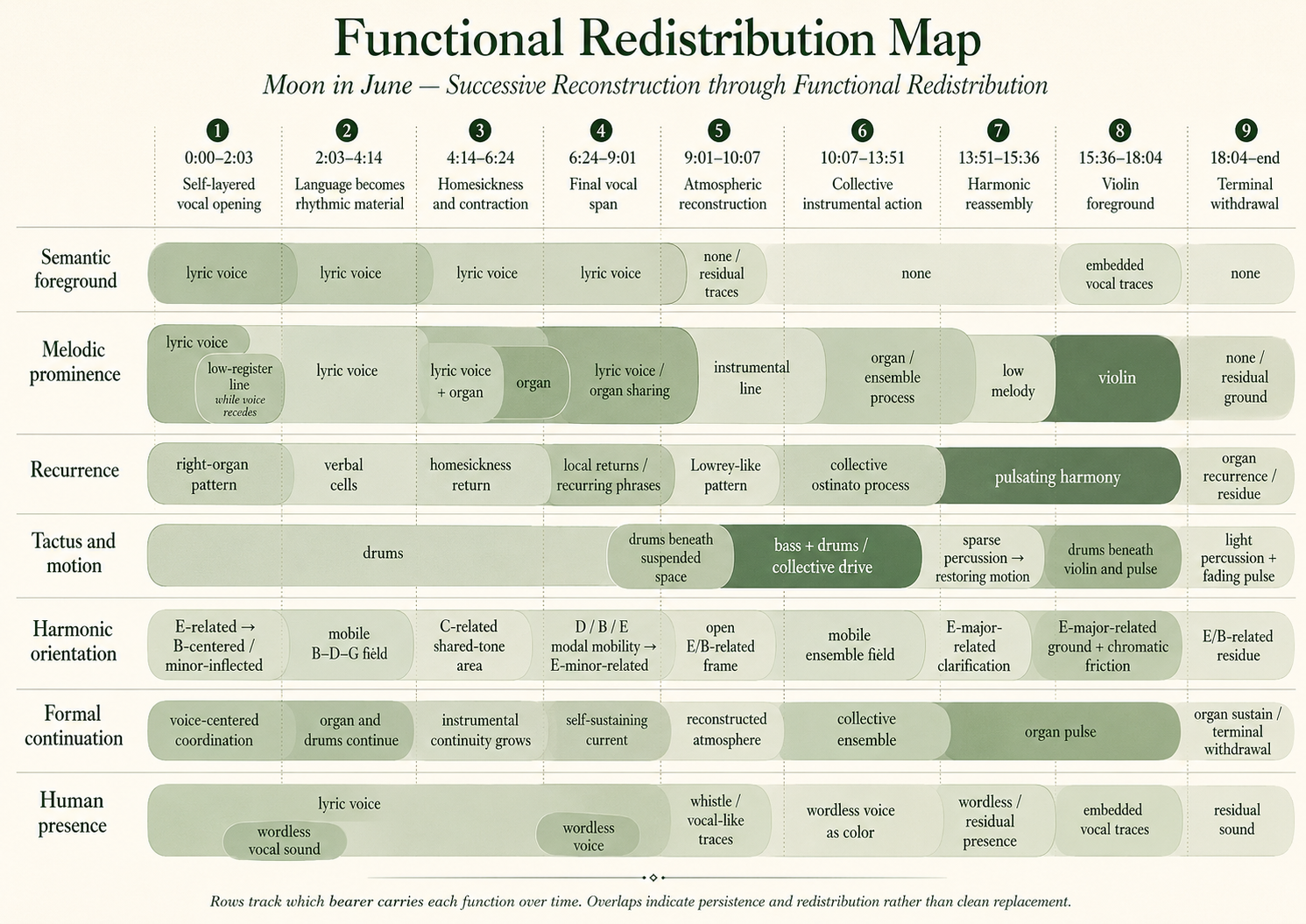
Rows show which bearer carries each major function over time. Their overlaps make visible the track’s central process: musical functions persist, change bearer, and recombine across Wyatt’s multitracked self-ensemble, the Ratledge–Hopper–Wyatt trio, and the late Wyatt–Spall studio construction, allowing successive reconstruction without requiring one stable configuration to endure.
a. Functions Outlast Their Bearers
The track’s transformations depend on unequal timing. Language, melody, rhythmic articulation, recurrence, expressive presence, and formal orientation do not withdraw together, even when they have been closely coordinated around the same voice. A bearer can remain audible after one of its functions has ended, while a function can become active elsewhere before its earlier source has fully disappeared. This staggered separation is one of the principal ways “Moon in June” changes without repeatedly starting again.
The voice provides the clearest example. Intelligible lyric can recede while wordless singing preserves human timbre and contour; later, semantic continuity can end before vocal presence disappears. Elsewhere, Wyatt remains the expressive and narrative center while his drums and keyboard layers sustain tactus, recurrence, low support, and harmonic motion across phrase endings. Vocal presence and vocal authority therefore diminish at different rates.
Melody and recurrence separate in similar ways. At approximately 1:26, melodic prominence passes from the sung line to a composed theme played by Hugh Hopper, even while Wyatt’s vocal timbre and surrounding studio layers remain present. Later, keyboard material assumes melodic function after the voice withdraws. Composed material can also reappear without reproducing the complete circumstances in which it was first heard: the opening notes of “You Don’t Remember” support Wyatt’s self-referential vocal passage at 6:24, while another sequence from the same song becomes a threefold repeated pattern around 9:26. Recurrence is therefore mobile in more than one sense: a keyboard figure, repeated verbal cell, reused melodic fragment, ensemble ostinato, or pulsating chord can each organize local time through a different bearer.
Functional Redistribution therefore occurs through overlap rather than substitution. Voice can remain after language has gone, melody can continue elsewhere while vocal timbre persists, and pulse or recurrence can survive within passages still centered expressively on the singer. Functions may migrate; persons do not. Hopper can carry Wyatt’s composed melody, Ratledge can carry later organ material, and Spall can become the dominant late foreground, but none becomes a replacement for Wyatt’s human presence.
b. Instrumental Self-Sufficiency Is Prepared
The boundary around 9:01 makes unmistakable a capacity that has been developing throughout the vocal span: pulse, melody, harmonic motion, and sectional direction can continue when intelligible singing recedes. That independence is not suddenly created at the boundary. It has been prepared whenever the instrumental texture has carried continuity across vocal absence, interruption, or change.
During the first lyric withdrawal, Hopper’s composed low-register theme, Wyatt’s patterned keyboard activity, and drums preserve musical direction without sustained semantic leadership. In the homesickness passage, electric piano and other keyboard layers reinforce material associated with the vocal line, and instrumental melody later continues after the voice withdraws. During the final vocal span, Wyatt’s drums, low support, and keyboard activity sustain motion beneath syntax that no longer determines every local boundary. Around 9:26, the repeated “You Don’t Remember” sequence provides another example: recognizable composed material has become part of an instrumental recurrent process within a texture no longer governed by intelligible lyric. By the time the last intelligible phrase has passed, wordless voice can remain within the texture without being required to govern melody, rhythm, or formal continuation.
This development is especially significant because it occurs largely before the central trio enters. Wyatt’s own multitracked construction has already separated the functions necessary for the music to continue independently of sustained lyric leadership. The arrival of Ratledge and Hopper does not create Instrumental Self-Sufficiency; it changes its mode of realization. Functions previously coordinated through one performer’s successive overdubs become available for interpersonal ensemble interaction.
Instrumental Self-Sufficiency is therefore a prepared condition rather than a sudden break with the vocal world. The transition from Wyatt’s self-layering into the trio demonstrates how functions already capable of independent continuation can acquire new bearers and a new kind of responsiveness without losing their earlier history.
c. Successive Reconstruction at Two Scales
Reconstruction operates within “Moon in June” at two related scales. Within the album recording, temporary organizations repeatedly weaken or lose their former balance, leaving particular functions and materials available for renewed use. Vocal withdrawal can leave pulse, keyboard recurrence, low melody, or wordless timbre behind; the 9:01 region redistributes Wyatt’s surviving keyboard, drum, vocal, and E-related materials within a more spacious hierarchy; the principal instrumental section transforms previously separated capacities into Ratledge–Hopper–Wyatt trio interaction; after that collective process approaches arrest, exposed melody and sparse articulation become the basis from which a more stable E-related harmonic pulse can emerge. The late coda reconstructs the musical body once again around Wyatt’s organ, low-register sonority, borrowed vocal material, studio processing, and Spall’s violin.
These reconstructions do not produce equivalent states. Each begins from a different inheritance and establishes a new relation among melody, pulse, harmony, timbre, recurrence, and instrumental function. Lyric can return without undoing instrumental development; vocal sound can persist without semantic command; material drawn from an earlier composition can acquire a different formal use; motion can be rebuilt through harmonic pulsation rather than renewed trio ostinato; and the coda can return to a Wyatt-centered mode of construction without restoring the voice-centered hierarchy of the opening. Successive Reconstruction therefore names a repeated formal action without implying repeated musical content or identical means.
The composition’s broader history follows a related but more qualified principle. “Moon in June” existed in extended form by 1968 and appeared in substantially different lyrical and performance realizations before the Third recording. Yet documentary evidence also indicates that its underlying instrumental architecture remained remarkably durable. The work’s history should therefore not be described as wholesale reconstruction at every level. What changes are lyrics, personnel, sonority, balance, studio realization, and the distribution of functions around an instrumental architecture capable of surviving those changes.
The 1970 album version internalizes that combination of durability and mutability. A principally Wyatt-constructed opening, the bounded Ratledge–Hopper–Wyatt trio passage, recurring composed materials, and the Spall violin coda place inherited resources inside several distinct modes of coordination. Successive Reconstruction therefore describes not continual replacement of the composition itself, but the repeated rebuilding of its sounding organization around musical materials and functions durable enough to survive altered circumstances.
d. From Solitary Multiplicity to Mobile and Composite Authority
The opening is already multiple. Wyatt’s successive layers distribute voice, drums, harmonic breadth, recurring keyboard pattern, bass or bass-like support, and melodic activity among distinct parts, yet their multiplicity remains principally the product of one performer’s studio construction and is perceptually coordinated around the lyric voice. Hopper’s composed theme at 1:26–2:03 provides an early exception, demonstrating that one important melodic function can already pass to another performer without dissolving the larger Wyatt-centered field.
The main instrumental passage establishes a different kind of multiplicity. Ratledge’s organ, Hopper’s bass, and Wyatt’s drums distribute functions among separate musicians capable of responding to one another within the same performance. The recurrent G–C process, increasingly concentrated around G, brings that relation into especially clear focus. Organ recurrence, bass grounding, and drum intensification acquire a common direction, making repetition the principal organizing force. This is Composite Instrumental Authority in its narrowest sense: several differentiated functions converge strongly enough that no single part can account for the passage’s harmonic-rhythmic identity.
The late coda produces a different configuration again. Spall’s atonal violin becomes the most conspicuous surface voice, while Wyatt’s organ and low-register or fuzz-bass sonority preserve a more durable harmonic ground and borrowed vocal fragments introduce another layer of memory. Documented varispeed alters the pitch relations through which these materials are heard. The passage remains coordinated, but its authority is stratified rather than collectively convergent.
This distinction clarifies Mobile Authority. Prominence can move among lyric voice, Hopper’s early composed theme, Wyatt’s keyboard patterns, rhythmic vocal cells, Ratledge’s organ, collective trio repetition, harmonic pulsation, and Spall’s violin without establishing one permanent successor. Mobile Authority concerns the changing location of perceptual or local organizing prominence; Composite Instrumental Authority concerns moments when differentiated functions become sufficiently coordinated that formal consequence belongs to their relation rather than to one bearer alone.
e. Harmony Changes Bearer and Function
The track’s long-range relation to E is real but discontinuous. The opening establishes an E-related orientation within a song-centered texture, then moves through B-, D-, C-, G-, and other modal or minor-inflected regions whose changing lower emphasis and shared tones loosen that initial center. Near the end of the vocal span, E returns as part of a threshold rather than as a continuously governing pedal. After the unstable post-trio reassembly, a more decisive E-major-related field takes shape, recalling the opening pitch world without recreating its harmony, lyric melody, or voice-centered hierarchy.
Around 13:55, the emerging tune bears an audible harmonic resemblance to the repeated “You Don’t Remember” sequence heard around 9:26, though it does not reproduce that sequence exactly. The resemblance therefore contributes a faint sense of historical connection without requiring a literal thematic return. More consequentially, the surrounding harmonic organization itself begins to change function.
Early in the track, Wyatt’s keyboard harmony contributes breadth and support beneath vocal melody and syntax. Later, repeated keyboard chords become a principal rhythmic and formal agent: their attacks articulate temporal spacing, define sectional direction, and provide a comparatively stable ground against which Spall’s atonal violin and Wyatt’s varispeed manipulation can produce increasing instability.
By the coda, the broad E-related field belongs to a different performing constitution again. The underlying organ and low-register sonority are Wyatt’s, while Spall supplies the principal instrumental foreground. Harmonic persistence therefore does not imply continuity of personnel or hierarchy. A pitch environment first associated with Wyatt’s lyric-centered self-ensemble becomes capable of sustaining a late studio construction in which the voice is fragmentary, borrowed material enters as memory, and violin operates with substantially greater pitch freedom above the ground.
Harmony thus changes both bearer and formal function. What first helps sustain a song eventually contributes harmonic location, temporal recurrence, and the last durable sense of place after the song-directed hierarchy has disappeared.
f. Recognition Without Restoration
The ending gathers several recognizable conditions from the opening—Wyatt as the principal maker of the sounding environment, voice, keyboard sonority, low-register support, studio-created multiplicity, and an E-related harmonic orientation—but places them in relations the opening could not have produced. The central trio has passed, Spall’s violin has supplied and then relinquished the principal late foreground, and Wyatt’s voice no longer carries the sustained lyric persona of “Moon in June.” Instead, borrowed Ayers material and residual vocal presence inhabit a texture whose continuation lies principally with organ and low-register resonance.
Recognition therefore operates at several scales. Earlier composed material has already entered new contexts at 6:24 and 9:26; the late E-related field recalls the opening pitch world; the tune around 13:55 can resemble earlier harmonic material without literally reproducing it; and the coda returns, in a transformed sense, to Wyatt as the principal constructor of several simultaneous musical bodies. None of these relationships restores the configuration from which its familiarity arises.
The late relation to the opening is therefore recognition without reprise in the conventional sense. Through Terminal Withdrawal, Spall’s foreground, fragmentary vocal presence, and other late activities diminish while organ, low-register sustain, and E-related resonance remain comparatively durable. What once functioned as support beneath a lyric center becomes the principal carrier of the ending.
This is Recognition Without Restoration. “Moon in June” does not close by returning the listener to its beginning. It makes the beginning audible through everything that can no longer be restored: the voice is no longer the same kind of center, the performing body has passed through solitary multitracking and trio interaction, familiar materials have acquired new contexts, and harmonic resources now carry functions they did not possess when first heard. The ending preserves those consequences rather than reversing them.
Closing Movement
“Moon in June” begins by multiplying one performer into several musical bodies without dissolving the impression of a single intimate presence. Wyatt’s voice stands at the perceptual center, while his drums, keyboard layers, bass or bass-like support, and recurring figures already carry distinct functions around it. The opening feels immediate and personal even as its apparent unity is assembled through successive overdubs: what sounds like one person speaking from within the music is surrounded by several versions of his own musical activity, coordinated closely enough that their multiplicity deepens rather than fragments the sense of intimacy. Hugh Hopper’s composed theme at approximately 1:26–2:03 forms an important early exception, showing that melodic function can already pass beyond Wyatt before the later trio has begun.
Across the vocal span, that coordination gradually loosens. Language, melody, recurrence, tactus, and expressive presence cease to move as one, though they do not separate all at once. Wordless singing can survive the withdrawal of intelligible lyric; low-register lines and keyboard material can continue melodic activity; electric piano can reinforce material still associated with the voice; drums can preserve motion across phrases whose lengths increasingly follow thought rather than instrumental grouping. Wyatt remains emotionally central even as the music becomes progressively less dependent upon his continued speech, and the transition away from language therefore feels less like the disappearance of the opening world than like its internal relationships beginning to acquire independent lives.
That independence does not require composed memory to disappear. At approximately 6:24, Wyatt’s line under “Just before we go on…” draws on the opening notes of “You Don’t Remember,” placing pre-existing melodic material inside one of the track’s most explicitly self-referential vocal moments. Around 9:26, another note sequence from the same song appears as a threefold repeated pattern. Familiar material therefore enters new functions even before the principal instrumental section has begun: what once belonged to an earlier composition can become commentary, recurrence, or structural resource inside the changing world of “Moon in June.”
When intelligible language finally recedes, the human presence remains but becomes harder to locate. Whistle, vowel, breath, or vocal-like resonance lingers inside spacious keyboard sonorities while Wyatt’s drums remain active below, allowing something of the earlier intimacy to persist after its verbal center has gone. Yet the voice is no longer the point from which the whole passage seems to be spoken. It has become one presence among several inside a wider space. Around the ten-minute mark, the mode of musical coordination itself changes: Ratledge and Hopper enter the principal instrumental passage with Wyatt, turning capacities first separated through one performer’s multitracking into genuine trio interaction.
Organ, bass, and drums begin to shape one another’s weight and direction until repetition acquires a force that no single part controls. The G-centered process briefly draws Ratledge, Hopper, and Wyatt into the track’s strongest condition of Composite Instrumental Authority, but the convergence brings no stable release. Insistence becomes resistance, attacks separate, spaces widen, and the momentum holding the trio together approaches arrest. The central instrumental span therefore extends the track’s continuity not by preserving the opening hierarchy, but by giving already differentiated musical functions a new, genuinely interpersonal mode of coordination.
The track rebuilds from what remains. Exposed melody reappears in a more spacious field, and around 13:55 the emerging tune bears a harmonic resemblance to the repeated “You Don’t Remember” sequence heard around 9:26 without reproducing it exactly. The relationship is suggestive rather than literal: familiarity survives as resemblance rather than confirmed reprise. Unstable harmony gradually clears toward a stronger E-related orientation, while repeated keyboard chords begin to carry harmonic location, temporal recurrence, and formal direction at once. What earlier served principally as part of the environment around the voice has become capable of bearing the structure more directly.
The late coda establishes another musical body again. The central trio gives way to a Wyatt-centered studio construction with Rab Spall as the only other performer heard there. Spall’s atonal violin rises as the brightest and most unstable foreground, ranging above Wyatt’s organ and low-register or fuzz-bass ground without having to sustain the whole form. Wyatt’s documented use of varispeed further unsettles the violin’s apparent key and register, while borrowed fragments associated with Kevin Ayers enter the background through Wyatt’s voice. Human presence therefore returns in another form: not as restored lyric command, but as quotation, memory, and timbre inside a processed instrumental space.
When the violin withdraws, the Wyatt-built ground beneath it becomes newly audible. Organ resonance, low-register sustain, fragmentary vocal material, and the broad E-related field remain after the most conspicuous foreground has gone. They do not reproduce the opening hierarchy. Wyatt is once again responsible for most of the sounding environment, but the voice that once gathered the music around intelligible language is now only one fragile component within it. The return is therefore partly one of musical construction as well as material: the track comes back toward a world made largely from Wyatt’s own layered activity, but under relations transformed by everything that has intervened.
The ending grows increasingly spacious without becoming empty. Voice and keyboard sonority are still recognizable from the opening, E-related orientation again provides a sense of place, and the low register continues to give the texture weight. Yet the earlier song-directed tactus, sustained lyric persona, and opening hierarchy do not return. Through Terminal Withdrawal, prominent functions disappear at unequal rates until the most durable kinds of continuity—harmonic resonance, low-register sustain, fragmentary memory—stand exposed.
The ending therefore does not recover the intimacy with which “Moon in June” began. It lets that intimacy remain audible at a distance, after the functions once gathered around it have passed through self-layered independence, reused composed material, interpersonal trio action, harmonic resemblance, studio transformation, and late subtraction. What the analysis has described as Successive Reconstruction through Functional Redistribution is heard here as something more gradual and human: closeness loosens, speech gives way to sound, familiar materials acquire new purposes, collective force rises and nearly exhausts itself, and the music rebuilds from increasingly exposed remnants until recognition survives without the hierarchy that first made it possible.
Functions may migrate; persons do not. Hopper can carry Wyatt’s composed theme, Ratledge can become the principal instrumental foreground, collective repetition can take on shared authority, and Spall’s violin can dominate the late surface, but none becomes a substitute for Wyatt’s human presence. What changes is the musical world around that presence and the functions it no longer needs to carry.
What remains is less a restoration than an afterglow, which is why the inward journey of the track deserves to be heard alongside its formal one.
Inner Passage: From Intimate Speech to Wordless Persistence
The figure that follows traces this inward journey as a changing current: intimacy loosens into playfulness, deepens into longing, gathers pressure, breaks into release, and passes through collective force and exhaustion before opening into spacious renewal and a final luminous residue.
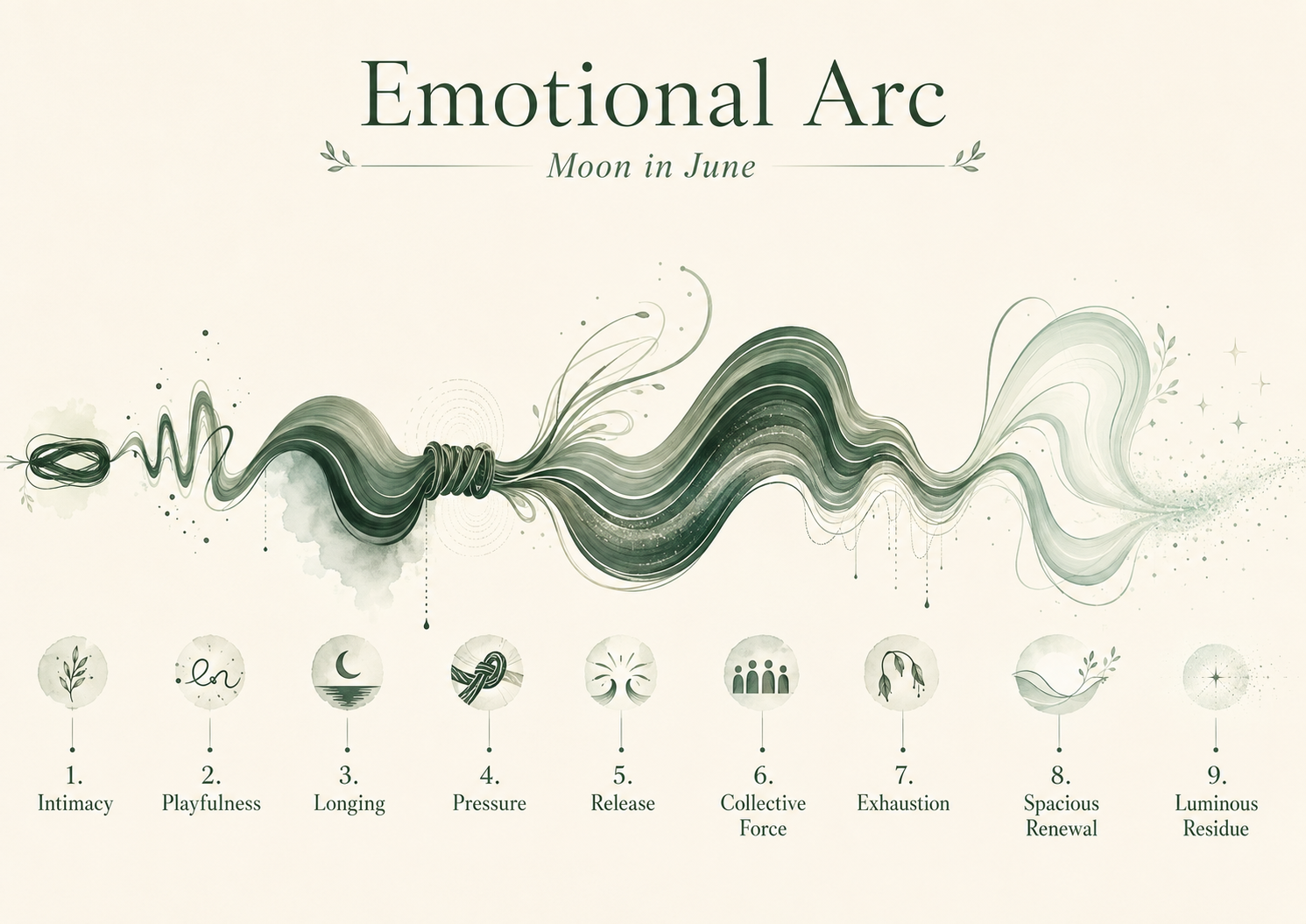
A visual summary of the track’s experiential movement from intimacy to luminous residue. The ribbon’s changing shape, weight, and openness suggest emotional transformation without treating the passage as a measured graph.
The opening of “Moon in June” draws the listener into a state of unusual emotional proximity. Wyatt feels exposed without sounding fragile, intimate without becoming settled. Every hesitation seems to belong to thought still taking shape, while the surrounding presence deepens that inwardness rather than disturbing it. The effect is one of divided but continuous selfhood: several impulses move at once, yet all seem to arise within the same private emotional space.
That closeness soon becomes playful and unstable. Earnestness gives way to awkward humor, as though intimacy has suddenly become conscious of its own performance. Feeling remains genuine, but it can no longer proceed without embarrassment, exaggeration, or self-mockery. The song briefly discovers the comedy inside vulnerability—the strange moment when private emotion hears itself spoken aloud and recoils, amused and embarrassed, from its own exposure.
Playfulness then yields to longing. The emotional world narrows around a wish that becomes more powerful each time it returns. Nothing is resolved; the repeated turning back only makes absence more palpable. Longing gathers through patience rather than climax, becoming heavier as the surrounding space seems to widen around it. Home begins to feel less like a destination than something already lost: familiar enough to imagine, yet too distant to recover through desire alone.
From this exposure comes pressure. Intimacy resumes, but it is no longer protected by the closeness of the opening. The private world has begun to open outward, and what once seemed held within a single consciousness is increasingly surrounded by forces it cannot contain. The emotional center remains present, but its authority weakens. Tenderness continues under strain, pressed forward by a movement that seems less and less answerable to the person who first set it in motion.
When words finally recede, the effect is release rather than disappearance. The need to explain, confess, persuade, or name what is being felt falls away. Presence expands beyond personality, becoming less definite but not less affecting. What had seemed enclosed within one person now drifts outward into a larger emotional space. Meaning blurs, yet feeling remains, freed from the effort of making itself understood.
A broader confidence begins to gather from that release. For a time, uncertainty appears to have been overcome by shared purpose. The music no longer feels solitary or inwardly divided; it moves with the assurance of something larger than any one presence. There is exhilaration in this collective force, a sense of separate energies discovering that they can carry one another forward.
But confidence gradually hardens into insistence. What first felt liberating becomes difficult to escape. Shared purpose turns into pressure, and determination becomes a burden sustained beyond its natural limit. The movement continues because it no longer knows how to stop, until its own intensity begins to consume it. Exhaustion arrives not as rest, but as the collapse of a will that has demanded too much from itself.
Out of that exhaustion comes a slower, more spacious renewal. Nothing rushes to replace what has fallen away. The song seems willing to remain exposed, allowing uncertainty to exist without immediately turning it into motion or explanation. Calm returns in a form unlike the intimacy of the beginning: less sheltered, less personal, and more able to endure what cannot be resolved. A sudden brightness rises within this openness like a glimpse of freedom—vivid, restless, and briefly weightless, yet held above something deeper and more lasting.
When that brightness disappears, it leaves no darkness behind. What remains has been stripped of urgency, certainty, and the need to command attention, but it has not been emptied of feeling. Familiarity returns in fragments without becoming comfort; presence remains without recovering its earlier identity or control. The ending seems suspended between remembrance and disappearance, luminous precisely because nothing tries to make it whole again.
What survives is not the shape the music first possessed, nor the person who once seemed to gather it around himself, but the emotional imprint of having passed through intimacy, longing, pressure, release, and loss. “Moon in June” ends with feeling dispersed through the space it leaves behind—fragile, radiant, and still alive after the forms that once contained it have loosened and fallen away.