“Slightly All the Time”

- Artist
- Soft Machine
- Album
- Third
- Year
- 1970
Mike Ratledge’s “Slightly All the Time” sustains its side-long span without relying on a single theme, an uninterrupted groove, a fixed tonal center, or a stable instrumental hierarchy. Its opening 11-based material is stated, enlarged through improvisation, and gradually loosened into a transitional field in which instrumental functions begin to shift; from approximately 8:00, material identifiable with “Mousetrap” establishes a more clearly delineated recurring framework within which foreground authority can move from reeds toward Ratledge’s organ without disturbing the underlying organization. Later, the compact statement of “Noisette” gives way to the spacious lyrical world of “Backwards,” which itself develops toward collective intensification before “Noisette” returns at the close. Across these changes, musical functions persist, acquire new bearers, or change structural weight without requiring one instrumental hierarchy to govern the entire side.
This Mobile Authority is not simply a succession of prominent soloists, nor does it arise through functional transfer alone. Organizing functions change location, form, and scale: through functional transfer, as an activity assumes a new structural role; through the overlapping or contested distribution of melodic, rhythmic, harmonic, and repetitive functions; and, at the culmination of “Backwards,” through their coordination within a Composite Instrumental Authority. The track’s changing speed is equally relational. It does not continually accelerate; felt motion changes through the interaction of tactus, subdivision, meter, accent, attack density, articulation, harmonic pace, and Wyatt’s drumming.
Local continuity does not eliminate rupture. The first twelve minutes proceed through changing degrees of continuity: the opening theme generates improvisational enlargement; the flute-led passage between approximately 5:44 and 8:00 reorganizes the field without yet establishing a securely separate composition; and “Mousetrap” then provides a recurring framework within which foreground prominence can change while its underlying organization remains intact. “Noisette,” beginning around 12:03, introduces another compact composed identity. When “Backwards” enters around 12:50, however, harmony, rhythm, texture, density, phrasing, and expressive atmosphere change together, leaving no secure musical material intact across the boundary.
Yet “Backwards” renews a broader developmental tendency already established earlier. A distinct composition provides orientation; improvisation enlarges its implications; and instrumental authority becomes increasingly distributed before the ensemble gathers into collective intensification. The passages therefore share a way of developing without following an identical sequence or preserving the same materials. When “Noisette” returns at approximately 17:33, its recognizable profile has been placed under altered formal conditions, allowing recurrence to reconnect musical histories that the preceding rupture had separated.
Unlike “Facelift,” “Slightly All the Time” is not a collage assembled from edited concert recordings. It is a studio performance and construction in which Ratledge’s extended composition incorporates and connects several identifiable composed materials, including “Mousetrap,” Hugh Hopper’s “Noisette,” and “Backwards.” Studio layering enlarges the available instrumental texture—most notably through overdubbed reed parts and Jimmy Hastings’s additional wind colors—but the side’s principal formal relationships remain intelligible through composition and ensemble behavior rather than through montage. Its unity arises from the way composed materials enter ongoing development, redistribute instrumental functions, become separated by genuine rupture, and acquire new formal meaning through return.
The track’s large-scale organization can therefore be understood through the interaction of two kinds of continuity. Within individual passages, composed definition opens into improvisational enlargement, recurring organization can survive changes of foreground bearer, and musical functions become increasingly distributed across the ensemble. Across the side-long form, however, continuity must also survive the decisive Behavioral Regime change at approximately 12:50. “Backwards” does not continue the active material or governing behavior of “Noisette,” but renews a comparable capacity for composed identity to generate improvisational enlargement and eventually collective intensification. The final reprise brings these scales together: “Noisette” returns as recognizable material, while its compressed and intensified realization preserves the consequences of the music that has intervened. The following diagram summarizes this relationship among local development, rupture, procedural inheritance, and Recognition Without Restoration.
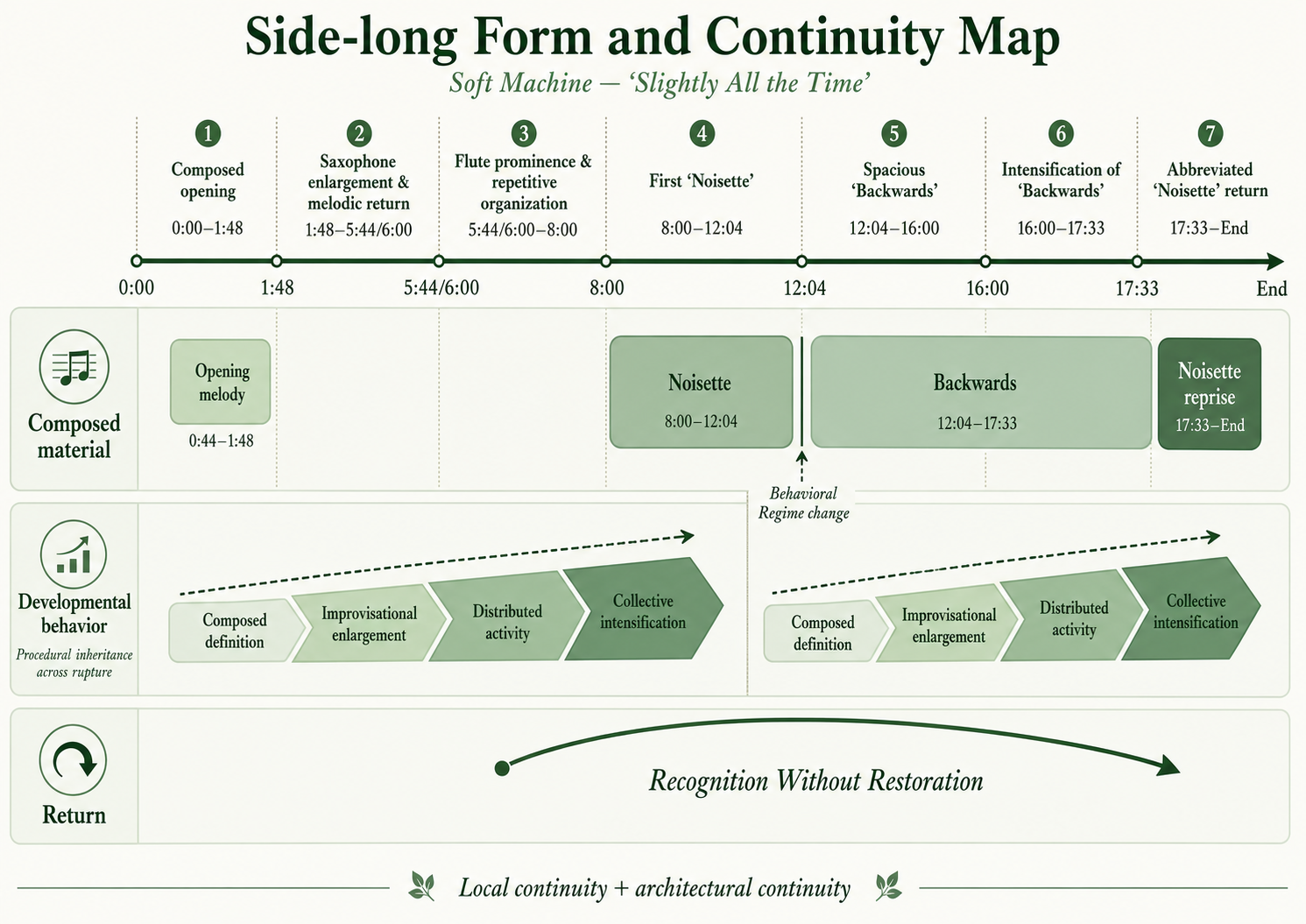
The upper timeline identifies the eight principal chronological regions: opening 11-based material, saxophone enlargement and melodic return, flute-led transition and repetitive organization, material identifiable with “Mousetrap” from approximately 8:00, the compact statement of “Noisette” from approximately 12:03, spacious “Backwards” from approximately 12:50, intensification of “Backwards” from approximately 16:00, and the abbreviated return of “Noisette” around 17:33. The central layer traces two related developmental arcs: across the opening half of the side, composed definition opens into improvisational enlargement, recurring organization, and changing foreground authority; after the rupture at approximately 12:50, “Backwards” unfolds through composed spaciousness, lyrical enlargement, and collective intensification. The entrance of “Backwards” establishes a genuine Behavioral Regime change: procedural inheritance continues across the rupture without implying continuous musical material. The lower arc connects the first statement of “Noisette” with its abbreviated reprise, where recognizable material returns without restoring its earlier proportions, ensemble condition, or formal function.
Within This Track Study
I. Composition as a Point of Departure
Approximately 0:00–1:48
“Slightly All the Time” begins with its principal composed world already taking shape, though not all of its relationships are immediately exposed. Openly spaced bass tones, an emerging rhythmic foundation, Ratledge’s spare, off-center piano chords, and gradually accumulating reeds enter into relation before the ensemble’s full melodic and metric condition becomes secure. Density grows through addition rather than abrupt contrast. The composition is documented as operating predominantly in 11/4 and 11/8, and the opening belongs to this predominantly eleven-based temporal world, though Wyatt’s flexible accents and phrases extending across the beat often make the larger grouping less immediately obvious than the underlying pulse. Rhythmic continuity therefore develops through an asymmetric framework whose surface remains supple rather than mechanically articulated.
Harmonic orientation develops alongside that pulse. The opening settles around a D-centered modal space, with A acting as a strong supporting pitch. Its foundation can often be heard provisionally as D5 or Dm(add9), although the frequently obscured third prevents the music from assuming an unequivocally major or minor character. Its stability is therefore spacious rather than closed. Ratledge’s piano chords widen and color this foundation through open intervals and deliberately displaced attacks, giving the harmonic field breadth without reducing it to a fixed chord progression.
When the principal composed melody becomes fully clear around 0:44, it emerges into an environment already alive with rhythmic and harmonic possibility. Dean states the theme through a layered reed texture associated with alto saxophone and saxello, giving the line a breadth extending beyond the impression of a single spontaneous voice. Its angular modal contour combines forward movement with a searching lyricism, while the surrounding piano resonance and low-register support give its sharper turns room to breathe. The melody brings the passage into focus, but it does not create coherence by itself: it draws expressive force from the rhythmic, harmonic, and registral environment already established around it.
The opening consequently establishes a clear but interdependent distribution of musical functions. Hopper’s bass and Wyatt’s drums sustain rhythmic motion within the asymmetric framework; Ratledge’s piano helps define and color the modal space; Dean’s reeds provide the most recognizable composed profile. No single instrumental layer governs the whole. The reeds may command the listener’s attention once the melody is fully exposed, but organizing authority resides more broadly in the composition, which coordinates melodic definition, eleven-based temporal organization, harmonic orientation, and ensemble spacing. The supporting texture gains direction from the melody, yet its pulse and harmonic orientation remain capable of continuing when the melodic foreground changes or withdraws.
Composition therefore functions here as a point of departure rather than a completed formal object. The theme supplies definition and local orientation, but the composition acquires authority through the ensemble relationships that embody it. Because rhythm, harmony, and melody are established as distinguishable but interdependent functions, their relative organizing weight can later change without the musical environment losing coherence. The opening prepares Mobile Authority without yet fully activating it: those functions have not begun to move decisively through the ensemble, but the composed organization has already established the relationships that will make such movement possible.
The saxophone’s movement away from the composed melody is not an abandonment of form, but the first revelation of what that melody can generate.
II. Improvisational Enlargement and Recurrence
Approximately 1:48–5:44/6:00
Across the remainder of the opening six minutes, the composed melody generates improvisational continuation, briefly withdraws, and returns as a point of reconnection. The predominantly eleven-based organization established at the opening remains an important underlying condition even when Dean’s increasingly free phrasing and Wyatt’s shifting accents make the larger grouping difficult to follow continuously. Composition and improvisation remain distinct, but the theme continues to orient the developing ensemble texture without needing to remain constantly present. The divided ending time reflects an intentional overlap: rhythmic reorganization begins around 5:44, while the change of melodic foreground toward Hastings’s flute becomes fully apparent closer to 6:00.
a. The Melody Generates Improvisational Continuation
Around 1:48, the angular modal melody begins to loosen from within. Dean does not step forward as though the composed statement had ended and an unrelated solo had begun. His freer saxophone phrasing retains the theme’s measured lyricism while becoming increasingly exposed, searching, and impassioned. The composition remains a source of orientation and an eventual point of reconnection, without requiring every improvisational gesture to derive demonstrably from the theme’s precise intervals.
The surrounding harmony sustains that connection without confining the improvisation. A D-centered modal environment continues through neighboring colors related approximately to E minor, with occasional C and E-flat inflections, before repeatedly gravitating back toward D. These shifts are better heard as changes of modal shade than as a sharply directed chord progression. Hopper’s bass and Ratledge’s keyboard support preserve harmonic depth while Dean ranges more freely above them.
The rhythmic framework is equally persistent without remaining mechanically exposed. The composition is documented as operating predominantly in 11/4 and 11/8, and the improvisation remains connected to that asymmetric temporal world even when phrase length, accent placement, and Wyatt’s drumming blur the larger cycle. Dean frequently phrases across the apparent bar line, while Wyatt answers and redirects accents rather than simply marking the grouping. The predominantly eleven-based organization therefore functions less as an audible grid than as a durable temporal condition through which increasingly free activity can move.
A short ascending harmonized reed response periodically regathers the passage around recognizable material. Sometimes prepared by a clipped keyboard gesture, it briefly focuses rather than interrupts the improvisational flow. Its recurrence provides a point of collective coordination within the freer development and reminds the listener that improvisational expansion remains connected to composed identity.
Dean grows more insistent as his phrases become quicker, denser, more sharply accented, and more forcefully articulated. Wyatt’s drumming is central to this intensification, answering the saxophone’s gestures and agitating the spaces around its phrases, while bass and keyboard maintain the conditions connecting the passage to the composition. Felt speed therefore increases without forming a simple trajectory of continuous acceleration. The asymmetric framework remains available beneath a surface whose density and accentual complexity increasingly conceal it.
b. When the Reeds Fall Away
Around 4:38, the foregrounded reed voice briefly falls away. The surface thins, but the music neither concludes nor begins again. Drums and bass preserve rhythmic orientation while the keyboard layer maintains harmonic breadth over a D-and-A foundation, heard less as a directed progression than as an open D/A suspension within the continuing modal space.
The withdrawal exposes functions that had been less conspicuous while Dean occupied the foreground. Wyatt’s drumming sustains forward motion, Hopper secures the low-register movement, and Ratledge preserves harmonic orientation. The temporary reduction of the melodic foreground makes the underlying rhythmic support more exposed. Thematic presence can lapse because rhythmic, harmonic, and low-register functions continue to carry the music across the brief absence.
c. The Melody Returns in Motion
Around 4:48, the angular melody returns in the reeds. Its contour is recognizable, but its earlier condition is not restored. The line re-enters a texture already altered by improvisational intensification and by the brief exposure of bass, drums, and keyboard as independent bearers of continuity. What first provided presentation now provides reconnection and renewed propulsion.
The returned melody initially reinforces the D-centered orientation, while the surrounding sonorities move approximately through C/D, G/D or G, and toward increasing E-centered weight. Sustained tones, common pitches, and open voicings soften the boundaries among these areas, producing a gradual redirection of modal emphasis rather than a sequence of firmly separated chords.
Beginning around 5:44, the rhythmic environment starts to reorganize before the melodic foreground has fully changed. Wyatt’s drumming becomes more forceful, subdivision grows denser, articulation firms, and the common pulse becomes easier to project even as the earlier eleven-based identity begins to loosen as an immediately audible organizing frame. The resulting increase in felt motion may suggest double time without establishing a literal doubling of tempo.
This is best understood as the beginning of a transitional field rather than the entrance of a new composition. Material associated with the opening world remains consequential while the balance among rhythmic activity, reed foreground, and ensemble density changes around it. As Dean’s prominence recedes and Hastings’s flute becomes increasingly clear closer to 6:00, the music begins moving toward a different distribution of melodic and repetitive functions without yet reaching the securely identifiable Mousetrap material that will emerge later.
Sectional Conclusion. The first six minutes establish that continuity does not require any musical function to remain permanently in the foreground. The opening theme can generate improvisation, recede, and return because rhythmic orientation, harmonic support, low-register grounding, and ensemble interaction remain active beneath its changing visibility. The predominantly eleven-based composed environment supplies a durable temporal condition without functioning as a rigid grid, while Dean’s improvisation demonstrates how far that environment can be enlarged before the music begins reorganizing toward a new instrumental and rhythmic condition.
From Saxophone Expansion to Flute-Led Transition. Beginning around 5:44, the opening field does not simply end. Its rhythmic and thematic relationships begin to loosen while Hastings’s flute acquires increasing prominence and repetitive organization gradually becomes more consequential. Mobile Authority becomes more explicit as melodic, rhythmic, and orienting functions begin to separate from the configuration in which they were first established.
III. Overlapping Functional Transfer
Approximately 5:44–8:00
The passage’s new condition begins rhythmically around 5:44, before Jimmy Hastings’s flute becomes fully prominent around 6:00. This overlap with Section II is deliberate: rhythmic reorganization begins while the opening eleven-based field is still relinquishing its earlier configuration. Wyatt’s drumming becomes more forceful, subdivision grows denser, and the common pulse becomes easier to project, but the passage does not yet establish a securely separate composition. Instead, saxophone prominence gives way to flute; Hastings’s improvisation gradually settles into repeated written activity; returning reed material overlaps with that recurrence; and keyboard weight increases as the music moves toward the clearly delineated Mousetrap material at approximately 8:00. The transition therefore changes the distribution of musical functions before it changes the composition securely enough to be named.
a. A Lighter Voice Enters the Current
Around 5:44, Wyatt’s drumming becomes stronger, subdivision quickens, and the pulse emerges with greater clarity even as the asymmetric organization inherited from the opening becomes more difficult to hear as a single stable grouping. The music consequently feels more propulsive without requiring a simple or continuous acceleration. When Hastings’s flute becomes prominent around 6:00, it enters a rhythmic environment already being reorganized rather than initiating that reorganization by itself.
The flute assumes melodic and improvisational prominence as Dean’s saxophone recedes, but it does not securely restate or inherit the opening theme. What passes between the two voices is primarily foreground prominence. Hastings introduces a lighter, more mobile timbre while remaining embedded in the heightened ensemble current inherited from the preceding passage.
Harmonic motion is comparatively restrained. The passage settles increasingly around an E-centered pedal, with D, A, and B active around it and a surrounding sonority that can be heard provisionally as E5 or Em7. This stable modal orientation supports the changing foreground without turning the flute entrance into a sectional restart. The opening field is being redirected rather than replaced all at once.
The documentary description of the recording identifies Hastings’s flute as an important stage in this progression: his solo does not simply occupy a temporary improvisational slot but develops toward written repetitive activity. That distinction becomes increasingly audible as the passage proceeds. Flute begins as an individual foreground voice but gradually acquires an organizing function that can persist even as other reed material re-enters around it.
b. Improvisation Settles into Repetition
From approximately 6:49, recurring attacks and contours become increasingly prominent within Hastings’s flute activity. The change is gradual: improvisation does not stop so that repetition can begin. Freer phrasing increasingly settles into a repeated figure, converting an initially mobile foreground voice into a more persistent source of orientation.
The documentary evidence strengthens what was previously only an audible inference. Hastings’s flute solo is described as developing into a written repeating flute figure, and that repeated activity continues while saxophone material returns. Recurrence therefore does not arise through an anonymous transfer among indistinguishable upper voices. A more specific process is audible: Hastings’s flute acquires a repetitive function while Dean’s reeds re-enter the texture around it.
This overlap matters formally. The flute can continue to organize the passage through recurrence even after it is no longer the only conspicuous upper-register voice. Dean’s returning material does not displace the repeated figure; the two coexist. Melodic recognition and repetitive orientation therefore become partially separable.
The meter remains less securely exposed than the repeated activity itself. Recurring attacks clarify points of emphasis, but Wyatt’s accents, the continuing bass movement, and overlapping reed phrases prevent a single grouping from becoming unequivocal throughout the passage. The safer conclusion is therefore functional rather than metric: repetition becomes progressively more consequential while the rhythmic field remains in transition.
c. Repetition Acquires Greater Harmonic Weight
Toward the final minute of the transition, keyboard activity becomes increasingly consequential within the recurring organization. By approximately 7:45, the harmonic and repetitive ground has acquired greater weight, while flute and returning reeds remain active above and around it. The passage begins to sound less like an improvisational foreground supported by accompaniment and more like several differentiated functions moving toward a common compositional field.
The change remains overlapping. Hastings’s repeated flute activity, Dean’s returning reed material, Hopper’s low-register support, Wyatt’s increasingly forceful rhythmic organization, and Ratledge’s growing keyboard presence do not replace one another in sequence. They coexist while their relative structural importance changes. Mobile Authority therefore becomes increasingly explicit: melodic prominence, recurrence, harmonic orientation, and rhythmic propulsion are distributed among different bearers rather than concentrated in one instrumental voice.
Crucially, this accumulation should not be mistaken for the beginning of Mousetrap merely because the music is moving toward it. The passage from approximately 5:44 to 8:00 remains best understood as a transitional field. Elements of the opening eleven-based world remain consequential while flute-led recurrence, returning reeds, and increasing keyboard weight create the conditions against which the different organization beginning around 8:00 becomes especially clear.
At approximately 8:00, the transitional processes give way to a much more clearly delineated composed identity. The musical object that enters there can be identified as part of Mousetrap, and the recurring ground that will support first the reed foreground and later Ratledge’s organ becomes structurally explicit. The transition has therefore not simply increased density or changed soloists; its overlapping changes make the new organization at 8:00 especially perceptible without requiring those changes themselves to belong to Mousetrap.
Sectional Conclusion. Between approximately 5:44 and 8:00, continuity is preserved through overlapping functional transfer rather than through the immediate entrance of a new composition. Hastings’s flute assumes melodic prominence, improvisation develops into a written repeating figure, Dean’s reed material returns around that recurrence, and increasing keyboard weight strengthens the harmonic field. Because these changes begin and overlap before the preceding relationships have disappeared, Mobile Authority resides in the changing distribution of melodic, repetitive, harmonic, rhythmic, and orienting functions. The passage leads toward Mousetrap without requiring Mousetrap itself to begin before its clearly delineated material appears around 8:00.
From Flute-Led Transition to Mousetrap. At approximately 8:00, the transitional field resolves into a securely recognizable composed framework. Material identifiable with Mousetrap establishes a recurring ground strong enough to survive a subsequent change of foreground bearer: reeds initially occupy the melodic surface, while Ratledge will later assume improvisational prominence without displacing the organization beneath him.
IV. “Mousetrap”: A Recurring Ground and Changing Foreground Authority
Approximately 8:00–12:03
At approximately 8:00, the transitional field resolves into a much more clearly delineated composed identity. The material beginning here can be identified with “Mousetrap,” and the passage from 8:00 to 12:03 is best understood as its LP realization within “Slightly All the Time.” What distinguishes the new region is not simply the entrance of another melody, but the establishment of a recurring framework strong enough to remain intact while the foreground changes around it. A repeating seven-note piano figure supplies one of the passage’s principal points of orientation; bass, drums, and additional wind activity reinforce the field; and the upper foreground initially belongs to Dean before Ratledge’s subdued organ assumes increasing prominence around 9:50. “Mousetrap” therefore places the overlapping redistribution of the preceding section within a more stable relationship between persistent ground and mobile foreground authority.
a. A Composed Field Becomes Explicit
At approximately 8:00, the new material is audibly more sharply delineated than the transitional activity that precedes it. The change does not require silence or a complete rhythmic restart: bass, drums, reeds, and keyboard continue from an already active ensemble texture. What becomes newly secure is the identity of the recurring framework itself. The seven-note piano figure gives the passage a persistent patterned ground against which changing upper activity can be heard.
This distinction matters because repetition had already become increasingly consequential before 8:00. Hastings’s flute improvisation had developed toward written repeated activity, returning reeds had begun to overlap with that recurrence, and keyboard weight had increased. Yet those processes remained transitional. At 8:00, recurrence no longer functions principally as something emerging from improvisation. It becomes part of a clearly identifiable composed field.
The repeating figure does not operate alone. Hopper’s bass contributes low-register orientation, Wyatt’s drumming gives the recurring organization physical momentum, and the wind texture adds another recurrent layer. The passage therefore acquires coherence through several differentiated functions acting around a durable patterned center.
One of those supporting colors can now be identified more securely. The low-to-middle-register wind voice heard prominently toward the right channel, previously considered possibly trombone or bass clarinet, is documented as Jimmy Hastings’s bass clarinet. Its darker register adds weight beneath the upper reed foreground and helps make the recurring field feel thicker than the piano figure alone would suggest.
b. Reed Foreground over a Persistent Ground
From approximately 8:00 to about 9:50, the principal melodic and improvisational foreground remains with Dean’s reed voice, heard as saxophone or saxello within the layered texture. His line moves with considerably more freedom than the recurring material beneath it. The contrast is structural: foreground phrasing can expand, bend across accents, and increase in density because the recurring ground continues to provide local orientation.
The recurring ground therefore does not function merely as accompaniment. It supplies a stable reference against which Dean’s freer activity can be heard as expansion rather than dissolution. Bass and drums reinforce that stability without reducing the passage to a fixed groove, while Hastings’s bass clarinet contributes a darker recurrent presence in the surrounding wind texture.
This separation between foreground freedom and structural ground is one of the clearest examples of distributed formal responsibility in the track. Dean may dominate immediate attention, but he does not carry the entire organization of the passage. Repetition, low-register support, rhythmic propulsion, and harmonic orientation remain active elsewhere.
The result is a form of Mobile Authority in which foreground prominence can be highly expressive without requiring the underlying framework to move with it. Dean shapes the immediate melodic surface while the composition itself continues to govern the conditions through which that surface remains intelligible.
c. Ratledge Takes Over without Replacing the Field
Around 9:50, the balance changes. Dean’s foreground recedes and Ratledge’s unusually subdued, constricted organ becomes the principal improvisational voice. The documentary description characterizes this organ solo as occurring over the repeating seven-note piano figure, and the recording supports continuity of the recurring ground across the change: the foreground bearer changes, but the patterned framework remains active.
This is not a new composition and not a new Behavioral Regime. The strongest evidence for continuity is precisely that the recurring framework survives the change of soloist. What changes is the location and character of improvisational authority.
The difference between Dean’s reed foreground and Ratledge’s organ is substantial. The reed line carries a more vocal and mobile melodic profile; the organ produces a denser, more compressed timbral presence whose sustained electrical weight can merge more closely with the surrounding texture. Yet both occupy the same underlying composed field. The change therefore alters the passage’s surface and instrumental balance without requiring the music to relinquish its organizing ground.
Mobile Authority becomes especially clear here because authority separates by function. Ratledge assumes foreground and improvisational prominence, but recurring patterned activity continues to provide orientation; Hopper and Wyatt preserve low-register and rhythmic support; Hastings’s bass clarinet contributes to the surrounding instrumental fabric without needing to remain continuously present throughout the span. Authority moves, but it does not move wholesale.
d. A Stable Framework Supports Increasing Density
As Ratledge’s solo develops toward 12:03, the ensemble becomes progressively more crowded and forceful. Organ activity thickens, attacks become more frequent, and Wyatt’s drumming increases the physical pressure surrounding the recurring ground. Felt motion intensifies, but this need not imply substantial acceleration. Greater attack density, stronger articulation, overlapping instrumental activity, and denser subdivision account for much of the change in perceived speed.
The important formal fact is that the recurring organization remains available across this intensification. “Mousetrap” does not generate development by abandoning its framework; it allows changing instrumental activity to accumulate around something comparatively durable. The recurring ground therefore acquires greater structural significance as the passage becomes denser: the more crowded the foreground becomes, the more consequential the persistent framework is as a point of orientation.
By the final approach to 12:03, several instrumental domains are active simultaneously, but their functions remain differentiated. Ratledge carries much of the foreground weight; bass and drums sustain low-register and temporal force; recurring patterned activity continues beneath them; and the wind texture contributes additional color and pressure. The passage approaches a more collective condition without requiring all of these functions to become identical or equally authoritative.
Sectional Conclusion. “Mousetrap” converts the transitional redistribution of the preceding passage into a stable composed field organized around persistent recurrence and changing foreground authority. A repeating seven-note piano figure provides an important element of the durable ground while Dean’s reed foreground gives way around 9:50 to Ratledge’s subdued organ without disrupting the composition beneath them. Hastings’s documented bass clarinet contributes recurrent low-wind weight, while Hopper and Wyatt preserve rhythmic and low-register orientation. Mobile Authority therefore operates within a framework strong enough to survive changes of foreground bearer: the music changes who occupies its surface without having to change what holds the passage together.
From Persistent Ground to Compact Statement. At approximately 12:03, the recurring framework of “Mousetrap” gives way to the brief composed statement of “Noisette.” Unlike the overlapping transfer that has governed much of the preceding development, this entrance introduces a newly identifiable composition whose compact duration makes the much more decisive change into “Backwards” around 12:50 especially clear.
V. “Noisette”: Compact Statement Before Rupture
Approximately 12:03–12:50
At approximately 12:03, the persistent ground of “Mousetrap” gives way to a much more compact composed statement. “Noisette” does not open into another extended improvisational field. Instead, it presents a concise melodic-harmonic object in which mixed-meter organization and modal relationships are unusually concentrated. Its brevity is structurally important: after several minutes in which continuity depended on recurring ground and changing foreground authority, “Noisette” gathers composition back into a short, clearly bounded form.
The score identifies its characteristic metric organization as phrase-length spans of 5/4 and 3/4 rather than a single continuous asymmetric cycle. These changing bar lengths alter the proportions of the phrase while allowing the underlying pulse to remain comparatively stable. The result is asymmetry without metric instability: expansion and contraction occur within an organized composed framework rather than through continual rhythmic disruption.
Harmonically, the score centers the passage around recurring relationships between E minor and G, with a broader movement through E minor, F, and A minor. In the recording, these sonorities are not always exposed as sharply separated chordal blocks; sustained tones, overlapping voices, and freer ensemble realization soften their boundaries. The recording remains compatible with this harmonic profile, even where individual sonorities are less sharply exposed. “Noisette” establishes a compact modal world whose internal movement is strong enough to be recognized again when the material returns at the end of the track.
Dean’s reed voice carries the principal melodic identity with a more poised, lyrical contour than the denser activity that precedes it. The line is shaped enough to establish “Noisette” immediately as a composition rather than as another phase of the preceding improvisational process. Bass, drums, and keyboard do not merely accompany that statement, however. They support its metric and harmonic organization, giving the melody a collective framework whose organization is more tightly specified than the mobile foreground-ground relationship of “Mousetrap.”
This tightening of compositional definition changes the track’s scale of action. Earlier sections had generated continuity through enlargement, overlap, recurrence, and the redistribution of functions. “Noisette” instead compresses those processes into a short statement whose identity depends on the coordinated relation of melody, mixed meter, and modal harmony. Its function is therefore disproportionate to its duration. It becomes a new point of reference immediately before the most decisive rupture on the side.
Nothing in the passage yet requires the larger Behavioral Regime change. “Noisette” remains rhythmically organized, melodically legible, and harmonically connected to a stable composed framework. But precisely because its identity is so compact and clearly bounded, the entrance of “Backwards” around 12:50 can register with unusual force. The coming change does not merely alter prominence, density, or instrumentation within an existing field. It replaces the governing manner in which the ensemble organizes time, harmony, texture, and expressive space.
Sectional Conclusion. “Noisette” condenses composed identity into a brief mixed-meter statement organized through phrase-length spans of 5/4 and 3/4 and recurring harmonic relationships around Em–G and Em–F–Am. Its melody, meter, and harmony form a compact reference object rather than another extended improvisational environment. Because that identity is established so clearly before the next boundary, the transition into “Backwards” can function as a genuine Behavioral Regime change rather than another instance of Mobile Authority within a continuous field.
From Compact Identity to Behavioral Rupture. At approximately 12:50, “Backwards” enters under conditions that no longer preserve the active organization of “Noisette.” Harmony, rhythm, texture, phrasing, and expressive atmosphere change together. Continuity therefore has to operate at a different level: not through shared material across the boundary, but through the renewed capacity of a distinct composition to generate its own enlargement and collective consequence.
VI. “Backwards”: Rupture, Spaciousness, and Lyrical Renewal
Approximately 12:50–16:00
“Backwards” forms the track’s most decisive internal rupture and provides its clearest center of lyrical exposure. The compact mixed-meter statement of “Noisette” gives way to a radically more spacious musical world in which sustained harmony, reduced attack density, and Dean’s exposed saxello melody reorganize the listener’s experience of time. From this restraint, the melodic foreground gradually gathers urgency, drawing renewed momentum from conditions fundamentally different from those of the preceding composition.
a. The Texture Opens
At approximately 12:50, “Backwards” enters with a striking contraction of musical activity. The comparatively compact and metrically articulated profile of “Noisette” gives way to sustained sonority, greater separation among attacks, and substantially more space around individual gestures. Wyatt’s rhythmic presence becomes reduced or less insistently foregrounded, while sustained keyboard harmony spreads across the newly opened texture. Instead of organizing motion through mixed-meter phrase blocks and a concise melodic statement, the music now allows resonance, sustain, and decay to become structural components of the passage.
The change encompasses several musical dimensions at once. Attack density falls, rhythmic articulation becomes less insistent, harmonic movement slows, instrumental sustain increases, and phrases unfold across considerably longer spans. The music therefore seems to decelerate profoundly even though no extreme change of measurable tempo needs to be asserted. Time feels wider because fewer events occupy it and because individual sounds remain perceptible for longer.
This is more than another redistribution of foreground prominence. Rhythm, harmony, texture, density, phrasing, instrumental relations, and expressive atmosphere are reorganized together. No theme, metric pattern, pulse condition, or harmonic progression securely continues from “Noisette” into the new composition. An E-oriented modal environment may remain available at a broad pitch-centered level, but even that continuity operates under radically altered conditions. What had been articulated through compact mixed-meter organization is now experienced through sustain, separation, and slowly unfolding harmonic space.
“Backwards” therefore constitutes the side’s clearest Behavioral Regime change. The governing manner in which the music acts has altered, and continuity can no longer depend upon the persistence or transfer of active local material across the boundary.
b. Composed Spaciousness and Harmonic Orientation
Soon after the entrance of “Backwards,” Dean’s wistful saxello melody becomes the principal source of melodic definition. Its phrases unfold with unusual patience, each rise and fall made more audible by the space surrounding it. Where “Noisette” had established identity through compact melodic, metric, and harmonic coordination, “Backwards” depends upon extension and restraint. Notes are allowed to settle before the line moves onward, giving the melody a lyrical clarity that feels calm, tender, and unusually exposed.
Beneath the melody, slowly shifting keyboard harmony gives the passage direction and proportion. Its recurring harmonic regions appear broadly centered on E minor, moving through D-related and C-related areas, with occasional B-related tension drawing the music back toward E. This reduction should remain provisional: these relations are more securely heard as recurring harmonic regions than as a definitive chord-by-chord progression, and sustained voicings often blur the boundaries among them.
The passage’s spaciousness is therefore composed rather than merely atmospheric. It arises from the coordination of melodic pacing, slowly changing harmony, reduced rhythmic activity, increased sustain and decay, and the deliberate separation of instrumental gestures. Pauses and resonance become part of the design. Harmonic recurrence provides orientation where rhythmic insistence has receded.
The identification of the passage as “Backwards” is also supported by its distinctive composed profile and by the documentary description of Dean’s wistful saxello statement. Within “Slightly All the Time,” its formal importance lies not merely in introducing another composition but in changing the scale on which musical action is perceived. After the compact definition of “Noisette,” the melody seems almost suspended in newly available space.
c. Lyricism Gathers Urgency
As the passage develops, Dean begins to draw greater urgency from the spacious framework of “Backwards.” The melody initially retains considerable restraint, but freer phrasing gradually stretches beyond its most clearly shaped contours. Phrases lengthen, ascents become more searching, attacks acquire greater expressive force, and the balance between sound and silence begins to change.
This growth proceeds from the composition rather than abandoning it. The modal rise and fall of the melody continues to orient the developing line, while the slowly recurring E-minor-centered harmonic regions provide a durable local ground. Improvisation enlarges the composition by extending a contour, intensifying an ascent, lingering over a sonority, or pressing a phrase beyond the point at which the written statement might have settled.
The sustained keyboard harmony remains essential to this enlargement. It preserves direction beneath Dean’s increasingly extended movement, allowing the foreground to grow more adventurous without leaving the passage harmonically unmoored. Harmonic planes that initially seemed almost static begin to function more actively as surfaces against which the saxello can lean, rise, and redirect its line.
Authority consequently begins to move again, but under very different conditions from those of “Mousetrap.” There, a persistent recurring ground had remained stable while foreground authority passed from reeds to organ. Here, composed melody and sustained harmony initially define the field together; as Dean expands the melodic material, improvisational prominence increasingly shapes pacing, intensity, and expressive direction. Mobile Authority is renewed, but its mechanism has changed.
The texture nevertheless remains comparatively open for much of the passage. Longer phrases and increasingly frequent attacks gradually narrow the spaces that defined the entrance of “Backwards,” but they do not immediately erase them. The music derives its intensification from the tension between lingering spaciousness and growing melodic urgency.
By the approach to 16:00, restraint has generated expansion. Felt motion strengthens through extended phrasing, increasing attack activity, and the beginnings of greater ensemble involvement rather than through simple acceleration. The inward space opened at 12:50 has not disappeared, but it is no longer static. Tenderness has gathered urgency, preparing the denser ensemble condition that follows without yet reaching the coordinated Composite Instrumental Authority of the culmination.
Sectional Conclusion. “Backwards” preserves no secure thematic, metric, rhythmic, or harmonic organization across the rupture from “Noisette.” Instead, its newly established spaciousness becomes the basis for renewed growth: composed definition opens into improvisational enlargement, while increasing melodic and ensemble activity begins to transform the restrained conditions with which the passage entered.
From Lyrical Exposure to Renewed Ensemble Intensity. As Dean’s phrases lengthen and acquire urgency, they occupy more of the space opened by the sustained harmony. Rhythmic activity and ensemble weight begin to increase, preparing a denser texture in which authority will no longer belong so clearly to one exposed lyrical voice.
VII. Intensification of “Backwards”
Approximately 16:00–17:33
After approximately 16:00, “Backwards” remains the passage’s compositional foundation, but its spacious realization gives way to increasing rhythmic and ensemble intensity. Faster subdivision, denser attacks, stronger accents, more forceful drumming, and growing instrumental overlap transform its expressive character. Some limited acceleration may occur, but it need not account for most of the change in felt motion. As Dean’s reed foreground, Ratledge’s keyboard, and Wyatt’s drums exert different but overlapping forms of force within the continuing harmonic framework, exposed lyricism grows into collective intensification.
a. The Harmonic Framework Tightens
The increase in motion does not introduce another composition or establish another Behavioral Regime. The recurring E-minor-centered harmonic regions of “Backwards” remain perceptible, continuing to include D- and C-related areas, with occasional B-related tension drawing the harmony back toward E. These relations are more securely understood as recurring harmonic areas than as a verified chord-for-chord repetition of the earlier passage. They preserve the composition’s broad orientation even when dense overlap makes their precise succession difficult to trace.
What changes most decisively is the way this harmonic framework occupies time. Earlier, sustained sonorities opened gradually into one another, leaving space around Dean’s exposed phrases. Now subdivision quickens, attacks arrive more closely together, accents acquire greater force, and Wyatt’s increasingly continuous drumming fills the spaces between melodic and harmonic events. Some limited acceleration may occur, but the intensification arises more securely from the multiplication and compression of surface activity.
The harmony consequently seems to move more quickly even where its broad regional organization remains comparable. This does not mean that every sonority becomes shorter or that harmonic rhythm accelerates uniformly. Felt pacing contracts because multiplied attacks increasingly occupy the spaces within and around the recurring regions.
Dean carries the passage’s earlier lyricism into this denser condition. His phrases become more crowded, forceful, and impassioned, yet tenderness is not simply replaced by aggression. The lyrical character established by “Backwards” remains orienting even when its exposed melody is no longer literally present or continuously traceable. What began as inward expression changes in density, articulation, rhythmic force, instrumental balance, and expressive intensity while the composition continues to provide a recognizable basis.
b. Lyricism Enters the Struggle
The intensification changes the distribution of authority within “Backwards.” In the passage’s earlier state, Dean carried the exposed melodic line, sustained keyboard harmony supplied spacious orientation, and the drums maintained motion without strongly contesting either role. After approximately 16:00, these functions become less clearly separated. Dean presses forward with increasing melodic and improvisational urgency; Ratledge’s keyboard acquires greater timbral and foreground weight; and Wyatt’s drumming increasingly determines the momentum against which both are heard.
This is not a clean transfer from reeds to keyboard. Dean remains active as Ratledge becomes more forceful, while Wyatt’s drumming compresses the space around both. Stronger accents, denser surface activity, and more closely spaced attacks do more than accompany the foreground instruments: they govern the passage’s accumulating physical intensity. At different moments, reeds, keyboard, or drums may command attention, although the integrated texture sometimes prevents their contributions from being securely isolated.
Mobile Authority therefore operates through shared and contested prominence: Dean exerts melodic and improvisational force, Ratledge contributes harmonic, registral, and timbral weight, and Wyatt reshapes the pace and physical intensity of their interaction.
c. Separate Forces Find a Common Direction
As the passage approaches its culmination, shared and contested prominence begins to acquire a more coordinated purpose. Dean enlarges the lyrical implications of “Backwards”; Ratledge contributes increasing harmonic and timbral weight; and Wyatt’s drumming gives the gathering activity a common physical momentum. Their functions remain differentiated, but they increasingly press toward the same result.
This is the point at which Composite Instrumental Authority emerges. Mere simultaneity or overlap is not sufficient to produce it. Authority becomes composite when melodic, harmonic, rhythmic, and intensifying activities acquire a shared direction that cannot be attributed to any single participant. “Backwards” remains the composed basis of the passage, but its culmination belongs to the ensemble because each instrument intensifies a different dimension of its character.
The composition remains orienting without requiring its earlier exposed melody to remain literally present. Its broadly E-minor-centered harmonic framework is still perceptible, though less continuously traceable within the densest overlap, while its lyrical character persists as an expressive memory within the intensified playing. Faster subdivision, stronger accents, denser attacks, and instrumental overlap do not erase that character; they place it under sustained collective force.
The passage has therefore moved from spacious composed presentation through lyrical enlargement into ensemble intensification. “Backwards” does not preserve every detail or change uniformly across every parameter. It is transformed principally in density, articulation, instrumental hierarchy, felt pacing, and expressive force, while its compositional definition and lyrical character continue to orient the music.
Sectional Conclusion. “Backwards” demonstrates that a composed character can survive extensive internal transformation. Its recurring harmonic regions and lyrical quality continue to provide orientation even when dense overlap makes their exact succession and the earlier exposed melody less continuously traceable. As Dean, Ratledge, and Wyatt redistribute prominence before coordinating in a collective climax, continuity depends neither upon an untouched melody nor upon chord-for-chord repetition, but upon a composition capable of remaining consequential as several dimensions of its realization change.
From Collective Intensification to Composed Return. At approximately 17:33, the abbreviated and more forceful return of “Noisette” receives the momentum accumulated within “Backwards.” The reprise does not interrupt the climax or restore its earlier conditions. It gathers the intensified ensemble texture into a concentrated return of recognizable material, preparing an ending whose authority depends upon inheritance rather than restoration.
The movement of authority across “Slightly All the Time” depends upon the redistribution of several overlapping functions rather than a simple succession of soloists. That process carries the track from opening melody and improvisational enlargement through the flute-led transition, “Mousetrap,” the compact statement of “Noisette,” and the intensification of “Backwards.” The following diagram summarizes that distribution and its convergence into Composite Instrumental Authority near the culmination of “Backwards,” before being redirected through the returning “Noisette.”
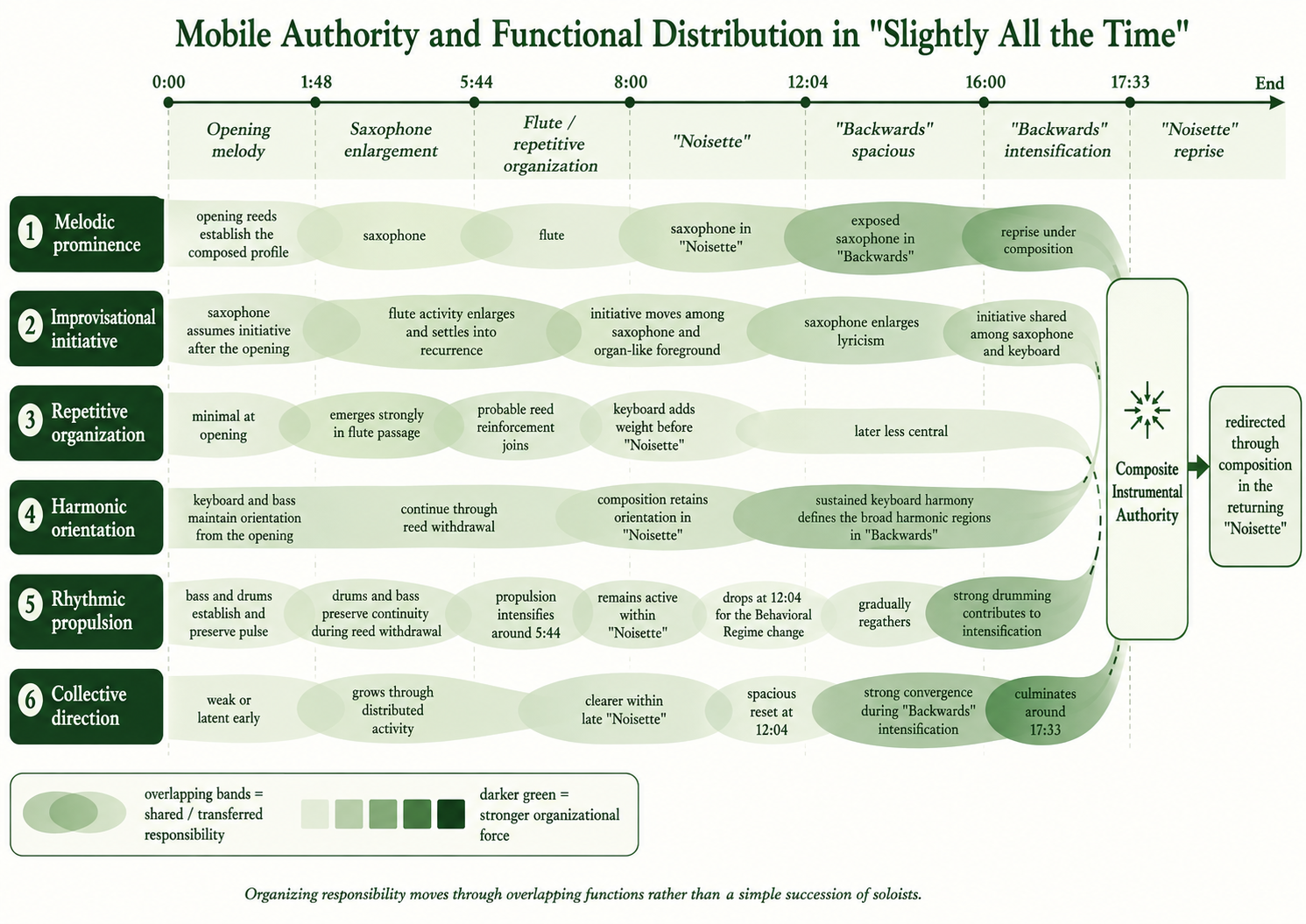
The diagram maps six organizing functions—melodic prominence, improvisational initiative, repetitive organization, harmonic orientation, rhythmic propulsion, and collective direction—across the track’s eight principal formal spans. Overlapping bands indicate that functions are transferred, shared, or redistributed rather than passed through clean instrumental handoffs. The corrected form distinguishes the flute-led transitional field, material identifiable with “Mousetrap,” the compact statement of “Noisette,” and the Behavioral Regime change into “Backwards” at approximately 12:50. Within “Mousetrap,” foreground prominence can shift while the recurring ground remains active; within “Backwards,” melodic, harmonic, rhythmic, and improvisational functions increasingly converge toward a common formal direction. Near the culmination of “Backwards,” that convergence forms Composite Instrumental Authority. In the final reprise, this collective force is not dissolved but redirected through the returning “Noisette.”
VIII. The Return of “Noisette”: Recognition Without Restoration
Approximately 17:33–end
At approximately 17:33, the momentum accumulated during “Backwards” is gathered into a recognizable return of “Noisette.” Its broad melodic and harmonic identity, together with renewed rhythmic asymmetry, reconnects the ending with the compact statement first heard around 12:03. Yet the reprise is abbreviated and enters under radically altered conditions: denser attacks, faster subdivision, firmer articulation, and much greater collective intensity replace the comparatively contained presentation of the earlier statement. Recognition is secure, but the earlier musical condition is not restored.
a. Relationships Return, Recognition Awakens
The reprise becomes recognizable through several relationships acting together rather than through exact reproduction. Its sonorities remain compatible with the modal-harmonic vocabulary associated with “Noisette,” including the earlier Em–G and Em–F–Am relationships, but the closing passage has not been transcribed closely enough to establish an exact recurrence of that harmonic course. Freer ensemble voicings, sustained tones, and dense articulation further blur the boundaries among individual sonorities.
The rhythmic surface likewise suggests renewed asymmetry. The earlier statement is score-supported as moving through phrase-length spans of 5/4 and 3/4, but the reprise has not been transcribed closely enough to establish whether the same measures or metric sequence recur. Unequal phrase spans and displaced accents nevertheless contribute to a rhythmic character compatible with the mixed-meter identity of the earlier “Noisette.”
Melodic resemblance contributes to recognition without bearing its entire weight. The closing material is shorter, denser, and more forcefully articulated than the first statement, and it does not reproduce the earlier realization note for note. Broad contour, modal character, harmonic affinity, and rhythmic asymmetry converge strongly enough to make “Noisette” recognizable through a network of returning relationships rather than through literal recovery of its former surface.
b. The Past Returns Under New Conditions
The first appearance of “Noisette” had already been compact. Its identity was concentrated within a brief composed statement whose melody, mixed meter, and harmonic relations were tightly coordinated before “Backwards” displaced them. The reprise compresses that identity still further and, more importantly, places it inside an ensemble condition transformed by everything that has occurred since 12:50.
Its greater force is inherited directly from “Backwards.” The return follows the collective culmination without a neutral interval in which the preceding energy can dissipate. Faster subdivision, more closely spaced attacks, firmer articulation, and intensified ensemble interaction continue across the boundary even as recognizable composition redirects them.
The contrast between the two appearances is therefore not principally one of development versus abbreviation. The first “Noisette” establishes a compact reference object; the reprise recalls that object after “Backwards” has transformed the scale, density, and collective weight of the music surrounding it. What returns is recognizable identity. What has changed is what that identity is now required to contain and accomplish.
This distinction is central to the form. “Noisette” first functions as a brief composed presence immediately before rupture. At the ending, the same recognizable profile becomes a means of gathering accumulated momentum into closure. Recurrence changes its formal function without requiring the returning material to cease being itself.
c. Collective Force Finds Composed Direction
The reprise gathers instrumental authority into a coordinated composed statement. Reeds, keyboard, bass, and drums contribute distinct kinds of activity, though the dense texture does not permit every final role to be assigned categorically. Shared ensemble coordination is more secure than a precise division of melodic, harmonic, rhythmic, and closing functions among individual instruments.
This coordination develops from the forms of Mobile Authority established throughout the track. Melodic presentation, improvisational initiative, repetitive organization, harmonic orientation, and rhythmic momentum have repeatedly changed location or become distributed among several voices. The reprise does not restore a fixed hierarchy of soloist and accompaniment. Instead, recognizable composition supplies a common framework through which differentiated functions can act together.
The Composite Instrumental Authority emerging at the culmination of “Backwards” is therefore not dissolved by the return. It is redirected through composition. Collective intensity remains active, while “Noisette” gives that intensity a shared melodic, harmonic, rhythmic, and formal trajectory toward closure.
That closure is compositionally clear even though its recorded realization remains less transparent. The music reaches a formally conclusive destination whose exact harmonic voicing, instrumental distribution, and final articulation need not be assigned more precisely than the recording permits. The force of arrival has already been established by the convergence of recognizable return and inherited collective momentum.
d. Remembered, but Not Restored
The ending’s governing process is Recognition Without Restoration. “Noisette” returns through a converging network of melodic, harmonic, rhythmic, and modal relationships, but it does not recover its exact earlier surface, harmonic course, metric sequence, proportions, articulation, or ensemble balance.
The difference between the two appearances is functional rather than deficient. The reprise is not an incomplete recapitulation from which portions have merely been removed. Material that first served as a compact reference immediately before rupture now receives the accumulated consequences of “Backwards” and converts them into arrival.
Recognition makes the intervening transformation perceptible. The earlier “Noisette” supplies a remembered profile against which the consequences of “Backwards” can be measured: greater density, faster subdivision, altered articulation, collective weight, and a newly closing purpose. The composition survives without being retrieved intact, and everything that cannot be restored gives the return its historical and expressive force.
Sectional Conclusion. The return of “Noisette” establishes that recognizable material can acquire closure through altered function rather than literal recapitulation. Its broad melodic, harmonic, modal, and rhythmic relationships reconnect the ending with the compact statement heard around 12:03, while compression and inherited ensemble force preserve the consequences of “Backwards.” Recognition therefore depends upon the survival of relational identity, while closure depends upon the changed conditions under which that identity returns.
From Chronological Return to Continuity at Two Scales. The closing reprise completes the track’s audible sequence while revealing a larger formal relationship. Locally, continuity survives through the transformation and redistribution of musical functions; across the side-long architecture, separated compositions become consequential to one another through procedural inheritance, rupture, recurrence, and altered formal purpose. Section IX turns from what happens to how these two scales of continuity sustain the whole.
IX. Relational Continuity at Two Scales
“Slightly All the Time” achieves continuity without preserving a single theme, meter, pulse condition, harmonic framework, or instrumental hierarchy across its entire span. Its coherence depends instead upon relationships that survive change at two scales. Locally, musical functions persist by being redistributed among instrumental layers, assuming new structural roles, or remaining active while other functions recede. Architecturally, continuity crosses the decisive rupture at approximately 12:50, where “Backwards” replaces both the active material and the governing behavior of “Noisette” but renews a broader developmental tendency already established earlier in the side: composed definition provides orientation, improvisation enlarges its implications, organizing functions become increasingly distributed, and differentiated instrumental forces can eventually gather into collective intensification. The final return of “Noisette” brings these scales together, allowing material recurrence and procedural inheritance to converge without erasing the rupture between them.
a. Functions Outlive Their Bearers
At the local scale, continuity depends upon the unequal timing of musical change. Melody, pulse, repetition, harmony, timbre, and instrumental prominence rarely transform at the same moment, and that lack of synchronization is one of the principal ways the music remains connected while changing direction. In the opening texture, bass and drums can preserve rhythmic orientation as Dean’s composed melody recedes into freer playing. Later, Hastings’s flute improvisation settles gradually into written repetitive activity while returning reeds overlap with it and keyboard weight increases. Repetition becomes structurally consequential before any new composition has securely begun.
“Mousetrap” makes this principle especially clear. From approximately 8:00, a recurring ground organized in part around a seven-note piano figure provides a durable framework while the principal foreground initially belongs to Dean and then, around 9:50, passes to Ratledge’s subdued organ. Hastings’s bass clarinet contributes recurrent low-wind weight, while bass and drums preserve low-register and temporal orientation. The framework remains recognizable even though the foreground bearer changes. Improvisational prominence moves; recurrence does not have to move with it.
Local Relational Continuity therefore depends less upon preserving one musical object in one instrumental location than upon the survival of relationships among functions. Pulse can outlast melodic withdrawal; repetitive organization can persist while foreground authority changes; harmonic support can remain active while timbral prominence shifts. What survives is not necessarily a phrase or sonority intact, but an organization whose component functions can be redistributed without losing their mutual consequence.
b. A Way of Growing Crosses the Rupture
Functional transfer, however, cannot explain the whole side. “Noisette,” beginning around 12:03, establishes a compact composed identity through its mixed-meter organization, characteristic Em–G and Em–F–Am relationships, and clearly shaped melodic profile. When “Backwards” enters around 12:50, those active relationships do not continue securely across the boundary. Mixed-meter articulation gives way to sustained spaciousness; attack density contracts; rhythmic insistence diminishes; phrases lengthen; and the expressive atmosphere changes with the texture itself.
“Backwards” establishes its own harmonic environment, provisionally centered on E minor and moving through D- and C-related regions with occasional B-related tension. These recurring areas cannot securely be heard as a continuation of Noisette’s harmonic course. Nor does the previous metric organization remain operative. The transition is therefore a genuine Behavioral Regime change, not another redistribution of functions within the same musical condition.
What crosses the rupture is broader than material continuity. “Backwards” renews a developmental tendency already encountered earlier in the track: a distinct composition supplies orientation, improvisation enlarges its expressive and structural implications, authority becomes more widely distributed, and an initially differentiated instrumental field can gather toward collective intensification.
The similarity should not be overstated. “Mousetrap” generates enlargement through a persistent recurring ground strong enough to support changing foreground authority. “Backwards” generates enlargement from lyrical spaciousness, sustained harmony, and initially reduced rhythmic force. Their materials, proportions, instrumental relations, and expressive trajectories differ. What recurs is therefore not an identical formal sequence but a comparable capacity for composed identity to generate consequences beyond its initial presentation.
This is the point at which local Relational Continuity reaches its limit and architectural continuity must operate at another scale.
c. Musical Time Changes from Within
The track’s changing speed cannot be described adequately through tempo alone because rhythmic experience arises from the interaction of several partly independent parameters: tactus, meter, subdivision, accent, attack density, articulation, harmonic pace, and felt motion.
The opening composition is documented as operating predominantly in 11/4 and 11/8, yet Wyatt’s accentuation and Dean’s cross-bar phrasing often make that larger asymmetric organization less immediately perceptible than the underlying continuity of pulse. In the flute-led transitional field, recurrence becomes more explicit even while metric grouping remains difficult to resolve securely. “Mousetrap” then establishes a recurring patterned ground whose continuity can survive a change of foreground bearer.
“Noisette” presents a different temporal condition. Its score-supported organization moves through phrase-length spans of 5/4 and 3/4, with the changing bar lengths contracting and expanding the composition’s proportions without requiring equivalent changes of tactus. Meter therefore becomes one element of a compact composed identity rather than the principal determinant of felt speed.
These distinctions explain why “Backwards” can feel markedly slower at its entrance without requiring a simple or extreme tempo change. Attacks become fewer, phrases lengthen, sustained sounds linger, and harmonic movement acquires greater spaciousness. Later, increasing subdivision, attack density, stronger articulation, and Wyatt’s more continuous drumming compress felt motion again while the broader harmonic and lyrical identity of “Backwards” remains available.
Rhythmic character therefore persists without rhythmic invariance. What the listener experiences across the track is not one continuous tempo trajectory but a changing relationship among several dimensions of musical time.
d. Authority Moves, the Field Holds
Composition and improvisation do not occupy separate territories within “Slightly All the Time.” Composed material supplies definition, orientation, and constraint, while improvisation enlarges that definition and changes its expressive and formal consequence.
The opening theme can generate freer saxophone development without disappearing as a reference. Hastings’s flute can move from improvisational foreground toward written repetition. “Mousetrap” can preserve a recurring ground while foreground authority passes from reeds to organ. “Backwards” can retain its lyrical and harmonic orientation while Dean’s increasingly urgent improvisation draws the ensemble toward a denser collective condition.
This reciprocity clarifies Mobile Authority. Authority is not identical to whichever instrument is loudest or most soloistic because the function organizing a passage may reside somewhere other than the foreground. Dean can command melodic attention while the recurring ground helps hold Mousetrap together. Ratledge can assume improvisational prominence without becoming the sole bearer of the passage’s structure. Wyatt can exert decisive control over physical momentum without assuming melodic or harmonic functions.
Authority can therefore be melodic, rhythmic, harmonic, repetitive, compositional, improvisational, or collective, and several kinds can coexist without becoming equivalent.
The culmination of “Backwards” makes this especially clear. As melodic, harmonic, rhythmic, and intensifying functions begin to coordinate toward a common result, authority belongs increasingly to the composite instrumental field rather than to a single leader. Composite Instrumental Authority names that condition, but it remains one possibility within Mobile Authority rather than a separate or superior principle. The ensemble is still internally differentiated; what has changed is that several functions now point in the same formal direction.
Relational Continuity and Mobile Authority therefore describe different aspects of the same process: one concerns how changing relationships remain consequential, while the other concerns how organizing functions move within those relationships.
e. Return Changes the Meaning of Distance
The return of “Noisette” at approximately 17:33 brings the track’s two scales of continuity into contact. Its broad melodic and harmonic identity, together with renewed rhythmic asymmetry, reconnects the ending with the compact statement first heard around 12:03 without requiring an exact harmonic, melodic, or metric reconstruction.
At the same time, the reprise carries the denser, firmer, and more collectively charged condition inherited from the culmination of “Backwards.” Material recurrence and procedural inheritance therefore arrive together: the composition is recognizable because enough of its earlier identity returns, but its new formal role depends upon the history accumulated outside that identity.
The return also changes the meaning of what preceded it. The first “Noisette,” initially heard as a brief composed statement immediately before rupture, becomes retrospectively an architectural reference point. Its brevity is part of its strength: because the material was presented with such compact definition, it can later be recognized after a substantial intervening span under radically altered conditions.
“Backwards,” meanwhile, remains a genuine Behavioral Regime change across which no secure theme, meter, pulse condition, harmonic progression, or ensemble configuration survives intact. Yet its movement from lyrical spaciousness toward Composite Instrumental Authority becomes consequential to the reprise rather than merely contrasting with it. What intervenes is not cancelled by the return; it becomes part of what the return now means.
This is Recognition Without Restoration. The composition becomes recognizable without recovering its exact earlier proportions, complete melodic surface, harmonic course, metric sequence, articulation, or ensemble balance. Recognition restores relation, while non-restoration preserves the consequences of distance.
The return therefore joins the side’s two scales of continuity without collapsing them. Local functional survival remains distinct from architectural procedural inheritance, yet both become audible within the same closing event. “Slightly All the Time” remains coherent not because change is prevented, but because redistribution, recurrence, rupture, inheritance, and return continue to alter the significance of one another across the full span of the side.
Closing Movement
The return of “Noisette” completes the track by gathering the consequences of everything that has happened since its brief first appearance into a single recognizable event. The earlier statement had not opened an extended field for improvisational development; it had established a compact identity through melody, mixed meter, and recurring harmonic relationships immediately before the rupture into “Backwards.” The reprise does not enlarge that earlier statement so much as reveal what the intervening journey has made of it. Its compressed proportions, denser articulation, and greater collective force make the return feel at once familiar and transformed. What had first functioned as a concise point of reference now becomes a means of arrival, and the intensity accumulated through “Backwards” is not discarded when the older composition reappears. It is carried into the reprise, so that recognizable material and the force generated beyond its earlier boundaries become audible together.
That change in purpose is reinforced by the ensemble itself. Reeds, keyboard, bass, and drums do not simply recover the balance they occupied during the first “Noisette,” nor does composition suddenly replace the collective momentum established near the end of “Backwards.” Instead, that momentum is redirected through recognizable melodic, harmonic, and rhythmic relationships. The result is a return that feels less like restoration than concentration: the composition provides a recognizable shape through which accumulated energy can be gathered and focused. Even the final sonority, whose precise harmony, voicing, instrumental distribution, and cessation remain difficult to determine categorically, matters less as an isolated closing gesture than as the end of this larger process. By the time it arrives, the music has already created the sense of completion.
The track therefore closes through Recognition Without Restoration, but the concept is most useful here as a description of the listening experience rather than another analytical claim. “Noisette” reconnects the ending with an earlier musical identity strongly enough for recognition to be immediate, yet its altered proportions, ensemble condition, articulation, density, and formal purpose preserve the distance through which the music has travelled. Nothing between the two appearances is cancelled by the return. Instead, a composition first heard with compact clarity becomes capable of carrying the history that now lies behind it. The side reaches closure not by undoing change, but by allowing change to remain audible inside recognition.
Emotional Journey: From Searching Motion to Remembered Arrival
Beyond the structures that hold “Slightly All the Time” together lies the experience of being carried through it. The track does not ask the listener to remain in one emotional place. It moves from curiosity to release, from exhilaration toward concentration, from tenderness to urgency, and finally toward an arrival colored by memory.
These feelings do not pass like separate scenes. Each leaves something behind in the next. Curiosity opens into excitement; excitement acquires greater persistence; concentrated recurrence gives way to brief lyrical definition; that definition is displaced by vulnerability; and vulnerability gathers enough force to become collective urgency. The track deepens because it never entirely sheds what it has felt before. Even when the music changes direction, an emotional trace remains.
The opening feels searching but never lost. Bass, drums, keyboard, and winds gradually gather into focus, as though a landscape were emerging through mist. Nothing is fully settled, yet the uncertainty is spacious rather than anxious. When Dean begins to move beyond the opening melody, that quiet curiosity becomes more exposed and impassioned. The music starts to press against the boundaries of the world it has created. Wyatt’s drumming adds urgency, while Dean sounds increasingly determined to discover how far the feeling can go.
The entrance of Hastings’s flute changes the atmosphere. Its lighter voice brings lift, motion, and a sudden sense of air, even as the music grows more insistent beneath it. As repeated activity begins to gather beneath the freer lines and the surrounding instruments increasingly participate in the same current, the excitement becomes communal. What first sounds like an individual impulse begins to feel shared, as though the whole group has caught hold of something capable of carrying them together. The pleasure comes not simply from speed or energy, but from hearing an activity spread through the ensemble without losing its freshness.
As “Mousetrap” takes shape, that shared motion acquires greater persistence. The repeating ground creates a sense of something durable beneath the changing foreground, allowing one voice to recede and another to press forward without the music losing its footing. The emotional effect is less one of arrival than of absorption. The ensemble seems caught inside a current it can inhabit from several angles, discovering how much expressive change can occur without giving up the condition that holds the passage together.
“Noisette” then brings that persistence into sudden focus. Its melody has a quiet beauty, but its appearance is more concentrated than expansive. The compact statement, mixed-meter organization, and distinctive harmonic profile seem to gather the music briefly into a memorable shape. After the longer persistence of “Mousetrap,” the effect is almost clarifying: something lyrical becomes sharply visible, remains just long enough to establish its identity, and then gives way before it can open into a broader world of its own.
The arrival of “Backwards” feels like a release into a more private world. The compact articulation of “Noisette” falls away, leaving sustained harmony and a patient saxello line surrounded by newly audible space. Every gesture seems exposed. The music becomes tender, suspended, and intimate, as though it has stepped inward and allowed itself to speak without protection. Its restraint does not make it less emotional. The space around each phrase makes every rise, hesitation, and settling note feel more vulnerable.
That tenderness gradually gathers urgency. Dean reaches further, Ratledge grows heavier, and Wyatt’s drumming begins to close the spaces that had made the passage feel so open. The climax is moving because it does not abandon the vulnerability from which it grew. It carries that vulnerability into something larger. The music becomes more forceful without becoming less exposed, as though private feeling were being drawn outward until the whole ensemble could bear it together.
When “Noisette” returns, recognition is immediate, but this is not the earlier statement simply brought back unchanged. It is denser, more forceful, and more collectively charged, shaped by everything that has happened since its first appearance. The earlier compactness is still recognizable, but it now carries a weight it did not possess before. The listener hears something familiar, but also hears what time has done to it.
The journey therefore ends not with recovery, but with recognition deepened by experience. The returning music carries the warmth of familiarity and the ache of distance at once. Nothing that has intervened is erased: the searching openness of the beginning, the shared momentum gathered around the flute, the persistent current of “Mousetrap,” the brief clarity of “Noisette,” the exposed tenderness of “Backwards,” and the urgency that grew from it all remain present in the final feeling. The music does not fade into an indefinite distance; it gathers that history and comes to an end. “Slightly All the Time” leaves the listener with the sense that memory has not restored the past, but made it more precious—and that completion comes not from recovering what has been lost, but from accepting what experience has made of it.