“Teeth”
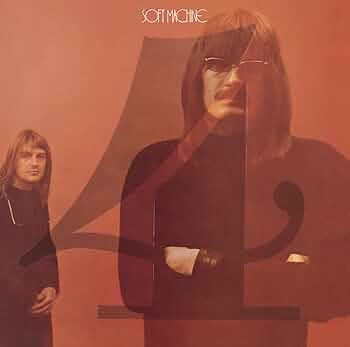
- Artist
- Soft Machine
- Album
- Fourth
- Year
- 1971
“Teeth” begins with almost nothing: an exposed low string, a brief ensemble response, then a short saxophone phrase that seems to know exactly where it belongs. But the certainty does not last. Each time the phrase returns, the music around it opens a little farther, and before long the track has moved into a world far less stable than the object that first set it in motion.
That tension between what remains recognizable and what begins to change shapes the whole piece. Order returns in different forms, instrumental roles shift, textures expand and contract, and familiar musical ground can reappear without ever being restored exactly as before. “Teeth” keeps moving without repeatedly wiping the slate clean; one condition seems to grow out of another even when the surface has changed dramatically.
What ultimately gives the track its continuity is not one recurring theme, one instrumental leader, or one fixed method of organization, but the changing way control passes through the music. “Teeth” is a form in which stability can release freedom, order can transform itself, and continuity can survive even as the forces that once held it together begin to loosen.
The LP realization makes those questions especially rich. “Teeth” is a Mike Ratledge composition performed by the Soft Machine quartet of Ratledge, Hugh Hopper, Robert Wyatt, and Elton Dean, augmented in the studio by Roy Babbington, Nick Evans, Jimmy Hastings, and Alan Skidmore. Yet that expanded instrumentation should not automatically be equated with the composition itself. The LP’s reed, brass, and low-string colors are better understood as one realization of a structure whose relationship to its particular orchestration will need to be considered separately. Orchestration can intensify the form, redistribute its functions, and alter the weight of particular moments without necessarily defining the relationships on which the form depends.
Within This Track Study
I. Opening — When the Material Stays Put but the Form Moves
Once the opening has begun to unfold, the difficulty is deciding what exactly has changed. In “Teeth,” a recurring musical object may remain materially stable while its formal function changes, just as an instrument may move into the foreground without assuming control of the larger process. These distinctions—between material identity and formal function, and between foreground authority and formal authority—are essential to hearing the track’s continuity. A new instrumental bearer, a denser texture, or a more active rhythmic surface does not necessarily announce a new formal state; the deeper relationship may persist even as its realization changes around it.
Mobile Authority describes the way formal initiative can pass among fixed or strongly pre-organized material, improvisatory development, repetition, and ensemble interaction without settling permanently in any one of them. Relational Continuity describes the complementary process by which coherence survives those transfers. Continuity may reside not in literal thematic sameness, but in a shared field, a preserved relationship, a continuing function, or a consequence carried forward from what preceded it. Together, the two ideas make it possible to hear transformation in “Teeth” without assuming that every conspicuous change of texture, activity, or instrumental foreground creates a new formal state.
That is also why the familiar opposition between composition and improvisation is too blunt for this piece. Fixed material can open directly into freedom; repetition can emerge inside an ongoing development rather than interrupt it; and a strongly organized field can continue even while the instrument carrying its foreground changes. The more useful question is not simply whether a passage is “composed” or “improvised,” but how organization is operating at that moment, where its authority resides, and what remains continuous as that authority changes hands.
The LP realization makes those questions especially rich. “Teeth” is a Mike Ratledge composition performed by the Soft Machine quartet of Ratledge, Hugh Hopper, Robert Wyatt, and Elton Dean, augmented in the studio by Roy Babbington, Nick Evans, Jimmy Hastings, and Alan Skidmore. Yet that expanded instrumentation should not automatically be equated with the composition itself. The LP’s reed, brass, and low-string colors are better understood as one realization of a structure whose relationship to its particular orchestration will need to be considered separately. Orchestration can intensify the form, redistribute its functions, and alter the weight of particular moments without necessarily defining the relationships on which the form depends.
That distinction becomes audible almost immediately. Before any large ensemble process has established itself, “Teeth” opens with an exposed low string. Soon afterward comes a compact saxophone statement whose identity will remain strikingly stable even as the consequences of its return begin to change. The piece’s central problem is therefore present almost from the start: what happens when the material stays put, but the form begins to move?
II. The Fixed Object Learns to Let Go
Approximately 0:00–3:12
The opening of “Teeth” builds its continuity around a short recurring saxophone statement whose identity remains remarkably stable even as its formal role changes. Rather than developing the object itself, the music repeatedly changes what can follow from it: each return restores the same point of reference, while the space released afterward becomes progressively less constrained. The object’s importance therefore lies not in how much it changes, but in how much freedom an unchanged statement can generate.
a. Before the Argument Begins
Approximately 0:00–0:06
“Teeth” does not begin by displaying the complexity of its expanded ensemble. It begins with almost the opposite: a plucked low string, exposed enough that its isolation becomes the first structural fact of the piece. The sound is most plausibly acoustic or double bass; Babbington is documented on the track and is therefore a plausible player, though the recording does not justify treating that attribution as certain.
For these few seconds, the bass possesses authority simply because nothing competes with it. But its authority here is merely presentational, not yet the deeper formal authority that will organize the track. The gesture does not establish a recurring system or initiate a developed process; it opens the space in which such processes can begin. When the brief coordinated ensemble announcement follows, isolation immediately gives way to collective organization, and the exposed low string becomes a threshold rather than a self-contained regime.
“Teeth” therefore begins not with complexity already in motion, but with a single voice standing just outside it. Only after that threshold does the recurring saxophone object arrive and the track’s central argument begin.
b. The Statement Returns, the Consequence Changes
Approximately 0:06–0:43
At about 0:06, the first clearly recurring object of “Teeth” appears: a short saxophone statement, compact enough to function almost like a fixed marker within the opening texture. The same statement returns around 0:23 and again around 0:39. What matters is how little the object itself changes. Its contour and identity remain stable enough for each recurrence to be recognized immediately, while the music that follows behaves differently each time.
The development therefore lies less in the statement than in its consequences. Each return re-establishes the same point of reference, but the continuation opens differently around it. The saxophone object is best understood as fixed or strongly pre-organized material, yet its formal function is not to impose a complete structure on what follows. Instead, it repeatedly creates the conditions from which freer activity can emerge. The statement returns, establishes order, and then relinquishes control.
This is the first clear instance of Mobile Authority in the track. Formal initiative passes from a recognizable pre-organized object into a more variable continuation without requiring a new thematic idea. At the same time, Relational Continuity keeps the opening intelligible: the repeated statement binds the successive expansions together even as those expansions become less tightly constrained. The crucial transformation is therefore functional rather than thematic. The object does not need to change for the form to move; what changes is how much freedom the same object is allowed to release.
c. Repetition Tightens the Frame
Approximately 0:43–0:50
At about 0:43, the opening changes its method of control. The freer continuations that have followed the recurring saxophone statement give way to a compact keyboard-led exchange: a short electric-piano figure is answered by the ensemble, and the relation repeats several times with only minor variation.
What matters is not simply that another organized passage has appeared. The governing force is now the recurrence of the exchange itself. The material is probably fixed or strongly pre-organized, but repetition is what makes its syntax authoritative in real time. Each return reinforces the same relation—keyboard statement, ensemble answer—until the pattern temporarily constrains the freedom that had been opening around the saxophone object.
Repetition has therefore changed function. Earlier, recurrence restored a familiar object before allowing the music to move outward again. Here, recurrence becomes an organizing mechanism in its own right. For the first time, the opening is held together not merely by the return of something recognizable, but by the repeated enforcement of a relation.
d. The Frame Begins to Give Way
Approximately 0:50–0:59
The repeated exchange does not simply stop. It begins to loosen. The recurrence that had briefly stabilized the passage weakens, the responses become less tightly bounded, and the saxophone starts to move more freely through the texture. What had been a compact recurrent syntax gradually loses its ability to regulate what follows.
This short transition matters because it shows that authority in “Teeth” can diminish before another behavior fully takes its place. The frame does not break; it loses its grip. By the time the saxophone object returns at 0:59, the opening has already begun moving away from the tightly controlled relation heard only seconds earlier.
e. The Fourth Statement Opens the Field
Approximately 0:59–3:12
At about 0:59, the short saxophone object returns for the fourth time. For a moment, the opening’s fixed point is restored. What follows, however, is no longer another compact expansion around it. The statement opens into more than two minutes of continuous improvisatory development, by far the most extensive release of freedom the object has yet produced.
The saxophone occupies the perceptual foreground, but the passage is not simply a solo laid over stable accompaniment. Ratledge’s organ supplies changing harmonic support; Hopper’s probable electric bass moves melodically rather than maintaining a fixed ground; and Wyatt remains highly active, continually reshaping the passage’s momentum. No recurring bass ostinato has been established, nor does a stable repeating harmonic cycle appear to govern the field. The music remains in motion because the ensemble keeps responding to itself.
That distinction is essential. The saxophone may be the most immediately prominent voice, but prominence does not amount to formal ownership. Its line develops within a network of changing harmonic, rhythmic, and melodic responses, so the improvisatory field is produced relationally even while one instrument remains in front. Mobile Authority therefore operates at more than one level: the fixed object relinquishes control to improvisation, while responsibility within that improvisation is distributed across the ensemble. In this more limited sense, the passage also approaches Composite Instrumental Authority—not because every player is equally foregrounded, but because no single voice can account for the development on its own.
The fourth statement completes the process begun by the first. The object itself has scarcely needed to change; what has changed is the extent of the world it can release. By 3:12, the fixed statement has yielded more control than at any earlier point in the track, while Relational Continuity still allows the long improvisatory field to be heard as a consequence of the recurring object that organized the opening. The process has reached its widest expansion. What follows will not extend that freedom further. It will stop it.
Sectional Conclusion. The opening of “Teeth” establishes continuity by keeping its central object stable while changing the degree of freedom that object can release. The short saxophone statement remains recognizable across its returns, but its formal function expands: first as a point of departure for bounded continuation, then as the source of a much longer improvisatory field. What develops is therefore not primarily the object itself but the authority attached to it. Stability repeatedly gives way to freedom without disappearing as the condition that makes that freedom intelligible.
From Release to Reassertion. By 3:12, the opening process has reached its widest expansion. The recurring object has yielded immediate control to sustained ensemble improvisation, and the music has become continuously variable. Section III begins by reversing that direction. Instead of allowing freedom to expand further, a compact repeated bass-and-ensemble relation abruptly restores fixed syntax and re-establishes order through recurrence.
III. Order Returns, Then Changes Its Method
Approximately 3:12–4:50
At 3:12, “Teeth” reverses the opening trajectory. The long improvisatory field is cut off by a compact repeated bass-and-ensemble relation, and organization returns with unusual force. Yet the restored order does not settle into one stable method. Recurrence gives way to long-form development; repetition then grows inside that development; the foreground shifts without breaking the larger process; and the field contracts before related material reappears in a different syntax. The importance of this span lies precisely in that mobility. In “Teeth,” organization is not simply the opposite of freedom; it can change the way it operates while remaining formally continuous.
a. Repetition Reclaims Control
Approximately 3:12–3:25
At 3:12, the continuously changing improvisatory field stops with unusual decisiveness. In its place comes a short plucked acoustic-bass gesture, repeated roughly four times and answered each time by essentially the same ensemble response. The contrast is immediate: continuous change gives way to recurrence.
The bass initiates each cycle, but the organizing force is larger than the instrument itself. Order is re-established through the fixed relation between statement and response—the bass gesture returning, the ensemble answering, and the whole unit recurring with little change. Repetition now does more than recall familiar material; it becomes the mechanism through which formal control is restored. This is one of the clearest Regime Pivots in “Teeth.” Unlike the gradual loosening heard around 0:50, the governing behavior changes abruptly as improvisatory continuity yields to a compact, strongly pre-organized syntax whose authority depends on recurrence.
The acoustic bass also begins to acquire a secondary structural significance. It first appeared as the isolated opening voice; here it returns not as threshold but as an agent of reorganization. The instrumental color is similar, but its formal responsibility has changed.
b. A Melody Takes the Long Way Forward
Approximately 3:25–4:04
At about 3:25, the compact repeated module opens into a much broader kind of organization. The winds move into the foreground in a slow, continuously developing melody whose coherence depends not on immediate recurrence but on sustained direction. The ensemble thickens around that line, producing a dense low- and middle-register sonority in which the winds remain the clearest melodic body while the surrounding texture supplies harmonic weight and color.
The contrast with 3:12 is fundamental. There, order was made audible through exact recurrence: the same bass gesture, the same response, the same fixed relation. Here, organization works across a longer span. The melody unfolds continuously, and the harmonic environment evolves with it. This passage and the increasingly repetitive music that follows remain within the same evolving pitch and harmonic environment, making them better understood as phases of one developing field than as separate blocks. What holds the span together is therefore developmental continuity rather than repetition alone.
A conspicuous fuzzy or distorted sonority adds density to the middle of the texture, though its source remains unresolved; keyboard contribution or a composite low-middle sonority remains at least as plausible as Hopper’s bass alone. Nor does the absence of an authoritative score allow us to say exactly how much of the passage was fully notated. What matters more is that the music is strongly organized and that its broad melody is not simply an enlarged version of the opening saxophone object. Some affinity of pitch vocabulary may exist, but direct thematic derivation has not been demonstrated. What begins at 3:25 is better heard as a new extended melodic construction—one in which order governs through sustained development rather than fixed recurrence.
c. Repetition Enters the Development
Approximately 4:04–4:28
Around 4:04, the broad melodic field does not give way to a new section. Its behavior begins to change from within. Repetition becomes more insistent, rhythmic activity grows more concentrated, and the ensemble starts to articulate the same larger field with greater pressure and regularity. The pitch and harmonic environment remains continuous with the 3:25–4:04 span rather than opening into a separate musical world.
The crucial point is that repetition does not replace the developmental field; it grows inside it. What had unfolded through longer melodic motion becomes increasingly organized by recurrence and rhythmic insistence, while the deeper material remains continuous with what came before. This is precisely the kind of change for which a Surface Pivot is useful: the audible behavior shifts conspicuously without producing a deeper formal reset.
By about 4:23, the bass contributes a more clearly repeating rhythmic figure, further concentrating the field. That figure should not, however, be confused with the piano material that soon moves into the foreground. The two are rhythmically related, not identical. What carries forward is therefore not a literal motive transferred from bass to piano, but a shared tendency toward tighter rhythmic organization. Repetition gains greater authority from within the continuing development rather than by replacing it.
d. The Foreground Changes, the Process Does Not
Approximately 4:28–4:37
At about 4:28, the piano moves decisively into the foreground. Heard in isolation, the change might suggest the beginning of a new keyboard-led section. In context, however, it is better understood as the culmination of the development already under way. The rhythmic concentration building since about 4:04 continues, and the larger melodic-harmonic field remains connected to what preceded it.
What changes is therefore the bearer of attention rather than the governing process. The piano becomes the most prominent voice without establishing a new formal condition. This is another clear Surface Pivot: the audible surface shifts sharply while the deeper organization remains intact. The distinction will become still more important later, when the foreground passes from winds to organ without interrupting the larger field. Here, the piano concentrates the existing process rather than replacing it.
e. The Bass Narrows the Field
Approximately 4:37–4:40
At about 4:37, the ensemble contracts abruptly to an exposed plucked acoustic-bass voice. After the dense developmental span and its piano-led culmination, the reduction is striking: a single low-register gesture is left to carry the transition.
The bass has already occupied important structural positions in “Teeth,” but never with exactly the same function. At the opening, it served as an exposed threshold; at 3:12, it initiated the repeated module that restored order. Here, it does something different again. It does not begin another recurrent syntax but briefly carries the form by itself, narrowing the field before the next ensemble relation appears.
This is a particularly clear local instance of Instrumental Self-Sufficiency. After the larger texture has withdrawn, one voice is enough to preserve formal consequence. The acoustic bass is becoming a recurring structural presence, but its significance lies precisely in the fact that each appearance performs a different job.
f. The Same World, a Different Syntax
Approximately 4:40–4:50
At about 4:40, the music rebuilds from the bass hinge into a compact exchange between two contrasting functions. A stable lower unit—bass, drums, and possibly organ—responds with substantial regularity, while the winds answer with greater local variation. The result is neither simple repetition nor free interaction. Stability and variability coexist within the same syntax.
The passage remains strongly related to the material heard just before it, especially the 4:04–4:28 span, without reproducing that material literally. What returns is not a conventional theme but a familiar musical environment reorganized according to a different behavioral logic. Related material is reorganized into a new syntax: the earlier developmental field has been compressed into a dialogue between a recurrent lower response and a more flexible wind answer.
That makes the passage a particularly clear instance of Relational Continuity. Its connection to the preceding harmonic and pitch environment survives even as the material begins to behave differently. Authority is likewise divided: repetition stabilizes the lower unit, variation remains active in the winds, and the larger form belongs to the relation between them rather than to either side alone. In this local sense, the passage also exemplifies Composite Instrumental Authority. No single voice governs it independently; the syntax emerges from the cooperation of fixed and variable functions, allowing the same musical world to persist under a new organizational method.
Sectional Conclusion. Section III shows that the return of order does not mean the return of one fixed mode of organization. Repetition first reclaims control through the compact bass-and-ensemble module, then gives way to long-range development; within that development, recurrence grows increasingly insistent, the foreground shifts to piano without breaking the larger process, and the ensemble contracts before related material reappears in a different syntax. What changes across the span is not simply the material, but the method by which organization makes itself felt. “Teeth” remains coherent while order itself passes through recurrence, development, rhythmic concentration, redistribution, and reduction.
From Reorganization to Continuity by Transfer. At 4:50, that mobility reaches a more radical threshold. The compact exchange does not lead directly into another articulated ensemble state; it contracts until a single sustained pitch remains. Section IV asks whether continuity can survive when almost everything that has carried it—syntax, density, and instrumental foreground—falls away, and when the field that emerges from that reduction later passes from winds to organ without breaking.
IV. Continuity Changes Bearers
Approximately 4:50–8:09
The next span pushes continuity further than anything heard so far. What survives from one state to the next is no longer secured mainly by a recurring object or a stable syntax, but by a field capable of changing almost every aspect of its realization without losing its identity. The ensemble can contract to a single sustained pitch, expand again around the winds, pass its foreground to organ, and accelerate into a far more active texture while the underlying melodic-harmonic environment remains continuous. Here, “Teeth” makes one of its strongest claims: formal continuity can persist even when its bearer, density, activity, and speed all change.
Just as important, continuity can become almost minimal. At both ends of this span, a complex ensemble process contracts until one surviving pitch is enough to carry consequence forward. Between those reductions, the music demonstrates that a field need not depend on one instrument, one texture, or one level of activity in order to remain itself. What persists is the relationship that allows one realization to grow into another.
a. When One Pitch Is Enough
Approximately 4:50–4:57
At about 4:50, the compact call-and-response relation collapses until only a single sustained pitch remains. The note is closely related to the end of the preceding wind phrase and retains a wind-like timbral quality, though its exact source cannot be identified with confidence. That uncertainty matters less than the formal effect: what had been carried by an exchange among several ensemble functions is suddenly entrusted to one continuous sound.
The reduction is extreme, but it does not produce a break. Persistence itself becomes the carrier of continuity. The sustained pitch preserves enough of the preceding field to make the transition audible as consequence rather than interruption, even after the syntax that produced it has disappeared. A complex ensemble relation has been reduced to the smallest form in which continuity can still survive.
This is a particularly concentrated instance of Instrumental Self-Sufficiency, understood functionally rather than as a claim about a specific player or instrument. For these few seconds, one surviving pitch is enough to hold the form together until a new field begins to gather around it.
b. The Field Re-Forms Around the Winds
Approximately 4:57–6:02
Around 4:57, the sustained pitch begins to gather a new environment around itself. The winds move into the foreground, shaping a slow, continuously developing melodic-harmonic field whose organization is clear even if its exact balance of notation and improvisation cannot be established. The passage is therefore better heard not as obvious free improvisation or demonstrably fully written composition, but as an organized continuous field with the winds in the foreground.
The surviving pitch has not functioned as a dead stop. It has carried enough consequence across the reduction for the new field to emerge as continuation rather than restart. What changes at 4:57 is the governing behavior: persistence gives way to sustained melodic development, while the relation between the two states remains audible.
That makes this a defensible Regime Pivot, but one whose force depends equally on Relational Continuity. The music enters a new mode of organization without severing what came before. Authority passes from a residual carrier to a broader wind-led field, and continuity survives the transfer.
c. The Field Changes Hands Without Breaking
Approximately 6:02–6:30
Around 6:02, the organ moves into the foreground, taking over a melodic responsibility previously carried by the winds. The change is immediately audible, but the deeper field does not reset. The same melodic-harmonic environment continues through the transfer, now realized through a different instrumental bearer.
This is one of the clearest places in “Teeth” where foreground authority and formal authority diverge. The organ becomes more prominent, but it does not create a new section by doing so. It assumes a function that is already active. The bearer changes; the field does not.
The moment therefore provides perhaps the strongest local demonstration of Mobile Authority in the track. Formal initiative can pass from one instrumental voice to another without breaking the larger process, while Relational Continuity preserves the connection across the transfer. The change of foreground is best understood as a Surface Pivot rather than a deeper formal replacement: what changes is who carries the field; what remains stable is the field’s identity and direction.
d. Acceleration Without Replacement
Approximately 6:30–8:03
Around 6:30, the field becomes dramatically more active. Ratledge’s organ intensifies its motion, the winds join, answer, and harmonize more insistently, and the rhythm section contributes increasing momentum. The surface is transformed, but the underlying melodic-harmonic environment remains continuous with what preceded it.
Greater speed and activity do not, by themselves, create a new formal state. Here they alter the behavior of an existing field rather than replace it. The organ remains the principal foreground voice, but the surrounding ensemble becomes increasingly consequential, so authority broadens from a single bearer toward a more interactive collective realization.
This is another clear Surface Pivot: activity, density, and instrumental interaction change sharply while deeper continuity persists. The passage also exerts a form of Sustained Functional Pressure. Acceleration, fuller ensemble participation, and increasing rhythmic energy progressively intensify the field without dislodging the organization already in place. What changes most radically is the way the field is realized, not the field itself.
e. The Field Contracts to Its Last Note
Approximately 8:03–8:09
At about 8:03, the accelerated ensemble field contracts again until only one sustained pitch remains. This time the surviving tone is much more securely identifiable as organ: Ratledge appears to hold the final pitch of the preceding development after the surrounding activity has fallen away.
The procedure recalls the reduction at 4:50, but the instrumental bearer is different. Earlier, a probable wind-related tone survived the collapse of the call-and-response; here, organ alone carries the consequence of a much more active ensemble field. The recurrence therefore lies not in instrumentation but in function: an active ensemble contracts until only one pitch survives.
That distinction is central to the span. “Teeth” can repeat a formal operation without repeating the voice responsible for it. Instrumental Self-Sufficiency again becomes audible at the point of maximum reduction, while Relational Continuity allows the sustained note to preserve consequence across the contraction.
As at 4:50, however, reduction points forward as much as backward. The pitch does not merely close the preceding field; it becomes the threshold through which an earlier musical condition can return.
Sectional Conclusion. Section IV demonstrates that continuity in “Teeth” can survive transformations far more radical than thematic variation alone. The field contracts to a single pitch, re-forms around the winds, passes its foreground to organ, accelerates into a denser and more interactive texture, and finally contracts once more to one surviving tone. Across those changes, the deeper melodic-harmonic environment remains intelligible. Continuity therefore depends less on preserving a fixed bearer or surface behavior than on preserving the relationships that allow one state to grow from another.
From Transfer to Return. By 8:03, continuity has again been reduced to its minimum: one sustained organ pitch carrying the consequence of the preceding field. Section V begins when that residue opens not into an entirely new environment, but into the return of an earlier one. The problem now changes. Continuity no longer depends primarily on surviving a transfer of bearer or speed, but on whether a familiar condition can return without literal restoration—and what happens when that recovered order begins to lose its grip.
V. The Field Returns to Lose Its Grip
Approximately 8:09–end
At 8:09, “Teeth” does not simply move on. The slow melodic-harmonic environment heard earlier returns strongly enough to be recognized, yet without literal restoration of the same melody. The piece therefore re-enters a familiar condition rather than restating a fixed object. What matters is the return of a field—its harmonic world, pacing, and broad behavioral identity—even as the surface is newly realized.
But the restored order is temporary. From this point onward, the music begins to loosen from within: recognizable patterns persist, yet their ability to govern the whole texture weakens as freer interaction grows around them. The ending is therefore not a clean passage from composition into improvisation, but a gradual erosion in which organized material remains locally audible after it has ceased to control the whole. What begins as the recovery of a familiar field becomes a study in how long that field can remain recognizable while its authority progressively weakens.
a. The Return Is Recognizable but Not Restored
Approximately 8:09–8:31
At about 8:09, the sustained organ pitch opens into a slow melodic-harmonic environment that is immediately familiar. Its resemblance to the earlier 4:57–6:02 field is exceptionally strong at the level of broad pitch organization and harmonic atmosphere, yet the melody itself is not literally restated. What returns is therefore not the earlier object in fixed form, but the condition that made that earlier field recognizable.
This matters because recurrence in “Teeth” operates at more than one level. In the opening, continuity depended on the literal return of the same short saxophone statement. Here, the local melodic surface has changed, but the broader harmonic and behavioral world has returned closely enough for the ear to recognize where it has arrived.
This is where Recognition Without Restoration becomes the most precise description. The music recovers identity without reproducing exact material, while Relational Continuity allows the connection to survive through similarity of field rather than sameness of phrase. What comes back is not the melody itself, but the network of relationships that made the earlier passage sound like a coherent place.
For a brief moment, the restored field appears capable of re-establishing order. But that recovery will not hold. The very patterns that make the return recognizable are about to begin losing their authority from within.
b. Order Begins to Loosen From Within
From approximately 8:31
From about 8:31, the restored field begins to lose stability without disappearing outright. Recognizable patterns remain audible, but they no longer organize the whole texture with the same consistency. Their recurrence becomes less secure, responses overlap more freely, and collective interaction begins to loosen the framework from within.
The change is gradual rather than sectional. There is no convincing point at which organized material simply stops and a separate free-improvisation episode begins. Instead, the earlier field remains locally recognizable even as its ability to govern the ensemble as a whole weakens. In that sense, the passage magnifies a process already glimpsed around 0:50: authority can diminish before another behavior fully takes its place.
Here, however, the consequences are greater. Organization loses global control before it loses local recognizability. Fragments of the established field continue to surface, but they no longer determine everything around them. This is the clearest instance of Functional Attrition in “Teeth”: the functions that once held the field together are not removed all at once, but weaken unevenly, leaving recognizable material behind after its larger organizing force has begun to fail.
c. Fragments Survive Inside Freedom
Within the same closing erosion, freer collective interaction becomes increasingly prominent. Yet the organized field does not simply vanish. Organ and winds continue to produce recognizable fragments, traces of the earlier melodic-harmonic world surfacing inside a texture no longer governed by that world as a whole.
This is where the distinction between presence and authority becomes especially important. Pre-organized material can remain audible after it has ceased to control the larger continuation. The fragments still matter because they preserve memory and local identity, but they no longer determine the behavior of everything around them. What survives is residue rather than command.
The governing argument of “Teeth” reaches one of its most revealing forms here. Organization does not disappear at the moment it loses control; it persists locally after its larger authority has begun to disperse. The earlier field therefore remains audible not as a restored structure, but as fragments carried inside a freer interaction that increasingly determines the surrounding texture.
d. What Is Left After Authority Withdraws
Final phase
The closing process does not end with freer interaction simply taking over from organization. That freer interaction also begins to disappear. Winds, organ, drums, and the other active ensemble functions progressively withdraw, leaving fewer and fewer agents capable of sustaining either organized pattern or collective improvisation.
The final trajectory is therefore not a victory of freedom over order, but the exhaustion of both:
Final Trajectory
- organized field
- freer collective interaction
- surviving fragments
- loss of ensemble functions
- isolated low string
This is where Terminal Withdrawal becomes the strongest description. Formal activity is reduced not by one abrupt cutoff, but through successive disappearance until only a bowed low acoustic string remains. Double bass is the most plausible instrumental identification, and Babbington is a possible player, but neither attribution is secure enough to state as fact; some degree of processing also remains possible.
The surviving low string can be heard as a final instance of Instrumental Self-Sufficiency, but its deeper significance lies in what has vanished around it. By the end, authority has not passed to another system. It has withdrawn from the ensemble almost entirely, leaving one residual voice after the larger structures of both organization and improvisation have fallen away.
Sectional Conclusion. Section V completes the closing process by showing that continuity can survive even after organization has begun to lose its governing force. The earlier slow field returns without literal melodic restoration, then weakens gradually from within as freer interaction becomes more prominent. Yet organized material does not vanish when its authority begins to fail: fragments remain recognizable after the larger field has ceased to control the whole texture. Eventually both organized pattern and improvisatory interaction recede through successive withdrawal, leaving only a residual low-string voice.
From Erosion to Identity. With the audible form now complete, the question changes from how “Teeth” behaves to what belongs to “Teeth” as a composition. The LP’s expanded winds, brass, double bass, keyboard colors, and possible studio treatments give this realization much of its character, but the piece also existed in reduced performance configurations. Section VI therefore asks which formal operations are likely to belong to Ratledge’s underlying design, and which may belong specifically to the orchestration and studio realization heard on Fourth.
VI. Composition and Orchestration — What Belongs to “Teeth”?
The LP recording makes “Teeth” sound inseparable from its expanded ensemble. Reeds and brass thicken the middle register, double bass adds another low-string color, and changing instrumental combinations continually reshape the surface. But none of that tells us, by itself, which features belong to Ratledge’s composition and which belong specifically to this studio realization.
In a work with an authoritative score, that distinction could be tested directly against notation. Here, no such source is presently available, so the evidence has to work in the opposite direction: from the audible architecture outward. The question is not what a score prescribes, but which formal operations seem persistent enough to belong to the piece’s structural identity, and which may depend on the particular orchestration heard on Fourth.
That distinction matters because documentary evidence establishes that “Teeth” was performed outside this exact instrumental configuration. A quartet performance took place in Amsterdam on 25 October 1970, close to the period in which Fourth was being recorded, without the LP’s additional guests. That fact is enough to show that the expanded studio sonority should not automatically be treated as identical with the composition itself. It does not, without analysis of the alternate performance, establish which specific formal operations survived unchanged or how the quartet realization differed from the LP. Documentary evidence can establish which musicians and instruments were involved in particular realizations, but it should not determine formal invariants that listening has not established. The task, then, is to separate structure from embodiment as cautiously as the evidence allows: to ask what appears essential to the way “Teeth” unfolds on the LP, what may belong to its orchestral realization, and what the studio need not be invoked to explain at all.
a. What Seems Structurally Compositional
Without an authoritative score, the strongest candidates for the compositional identity of “Teeth” are not individual voicings or instrumental colors, but the formal operations that shape the track’s course.
The contemporaneous quartet performance provides a useful documentary limit on that inference. Its existence establishes that “Teeth” was performed without the LP’s expanded guest ensemble, but without detailed analysis of that realization it cannot tell us which formal operations remained invariant, which were altered, or how closely its architecture corresponded to the LP. The evidence therefore supports distinguishing the composition from the LP’s specific orchestration without using the alternate performance to define the composition’s structural identity.
The opening saxophone object is one such candidate. Its repeated return, and especially the ordering of those returns before increasingly expansive continuations, is too structurally consequential to treat as incidental orchestration. The same is true of the compact bass-and-ensemble syntax at 3:12, where fixed recurrence abruptly restores organization after the long improvisatory field.
The larger developmental span from 3:25 to 4:37 also appears likely to belong to the underlying design. What matters is not only the broad melody itself, but the way its behavior changes: long-form development gradually admits greater repetition and rhythmic concentration before culminating in a change of foreground. Likewise, the call-and-response relation at 4:40 seems more structurally significant than the exact instruments assigned to its two sides.
From 4:57 onward, the strongest candidates become broader still. The slow melodic-harmonic field, its continuity through the wind-to-organ foreground transfer, its later acceleration without replacement, and the return of a closely related field around 8:09 all describe relationships that appear structural rather than merely orchestral. Even the closing destabilization may belong to that identity if the progressive weakening of organization forms part of the design rather than arising only from this particular performance.
Contemporary comments by Ratledge also support a broader compositional practice built from given structural premises and increasingly complex structures. They provide useful context for the kind of organization heard in “Teeth,” but they cannot be tied securely enough to this particular piece to establish which passages were written, cued, or otherwise fixed.
These remain probable structural features rather than notation-level facts. Until an authoritative Ratledge score is found—or alternate realizations are compared closely enough to show which operations persist across different configurations—we cannot say exactly what was written, what was cued, or what was left open. But the recurring objects, developmental trajectories, changes of syntax, transfers, returns, and erosions heard on the LP remain the strongest candidates for what “Teeth” is beneath this particular orchestration.
b. What May Belong to the LP Orchestration
If those larger operations are candidates for the identity of the composition, many of the LP’s most vivid details belong more plausibly to its particular orchestral realization. The exact reed and brass doublings are the clearest example. Nick Evans on trombone, Jimmy Hastings on bass clarinet, and Alan Skidmore on tenor saxophone are documented participants, but the recording does not allow their individual lines to be mapped securely enough to treat those assignments as structural necessities of the piece itself.
The performance history strengthens the need to keep composition and LP orchestration separate at the documentary level. The October 1970 performance used the quartet without the LP guest complement, while a BBC performance at the Paris Theatre on 11 March 1971 used a different expanded lineup, including Roy Babbington, Mark Charig, Paul Niemann, and Ronnie Scott. These records establish that “Teeth” was performed under substantially different personnel configurations. They do not, without analysis of those recordings, establish what formal relationships survived from one realization to another. What they do show securely is that the LP’s specific reed, brass, and low-string configuration was not the only personnel configuration in which the composition was performed.
The same caution applies to Roy Babbington’s role on the LP. His double-bass participation is documented, and several exposed acoustic-bass moments are plausible points of involvement, but the exact distribution of those gestures—and any moments of simultaneous electric and acoustic bass—remains unresolved. Those low-string colors may sharpen important structural hinges without being indispensable to the underlying design.
The dense sonority around 3:25 is similarly difficult to divide cleanly between composition and orchestration. Its broad low- and middle-register mass is clearly part of the LP’s dramatic character, but the exact register distribution, reed-and-brass weighting, and source of the conspicuous fuzzy sonority remain uncertain. That fuzz may involve keyboard, bass, or a composite texture; none of those possibilities should be promoted into a compositional claim.
Other details belong even more clearly to the level of realization rather than demonstrated structure: the precise source of the sustained pitch at 4:50, the instrumental balance within the 4:40 call-and-response, and any processing applied to the final bowed low string. These details may intensify transitions and shape their perceptual effect, but the form does not depend on our identifying them exactly.
The distinction is therefore less between important and unimportant details than between function and embodiment. The LP orchestration can magnify, distribute, or color the formal process without necessarily creating it. The performance history reinforces the need for that distinction by documenting substantially different personnel configurations, while leaving open which formal relationships remained constant across them.
c. What the Studio Does Not Need to Explain
The LP realization belongs to the broader production context of the Fourth sessions at Olympic Studios, engineered by George Chkiantz and produced by Soft Machine. That establishes the environment in which the recording was made, but it does not identify any track-specific editing, overdubbing, tape assembly, or other studio procedure responsible for the form of “Teeth.” The exact recording date of the track and its detailed construction history remain unresolved.
The form itself does not presently require a studio-built explanation. The two transitions most likely to invite such an interpretation already possess convincing musical continuity. Around 4:50, a wind phrase contracts to a related sustained pitch before the next field forms; around 8:03, the organ-led development contracts to its final note before the slower related field returns. Neither passage requires a hard splice, montage, or edit-controlled sectional succession in order to make formal sense.
Studio construction may therefore shape the realization of “Teeth” through timbre, layering, distortion, instrumental balance, or other recording decisions without acting as an independent formal authority. Nothing in the current evidence supports tape-loop architecture or splice-built form, and no demonstrated editing or overdubbing process is needed to explain the track’s succession of states. The continuity already established by listening can be accounted for through musical relationships alone.
Sectional Conclusion. Section VI separates the structural identity of “Teeth” from the particular richness of its LP realization. Documentary evidence establishes that the piece was performed both by the quartet and later with a differently augmented BBC lineup, confirming that the LP’s personnel configuration was not the only one associated with the composition; without detailed analysis of those alternate recordings, however, it does not establish which specific formal relationships remained invariant. The recurring objects, developmental spans, changes of syntax, continuity across foreground transfer, large-scale return, and final erosion heard on the LP therefore remain the strongest candidates for features of the underlying design. By contrast, the LP’s particular reed and brass deployment, double-bass contribution, register distribution, fuzzy sonorities, sustained-tone color, and terminal low-string treatment belong more plausibly to the level of orchestral and studio realization. The distinction remains provisional, but the central point is clear: the LP’s expanded instrumentation intensifies and colors the form without, by itself, defining the relationships on which that form depends.
From Embodiment to Principle. Once structure has been separated from its particular orchestral realization, the larger question can come fully into view. What holds “Teeth” together is not one instrument, one texture, or one permanent method of organization, but the movement of function across changing musical conditions. Section VII turns from the question of what the composition is made of to the deeper question of how continuity survives while authority keeps moving.
VII. Changing Authority — What Holds the Nine Minutes Together
By this point, the central problem of “Teeth” is no longer how to divide the track, but how to explain its coherence. Material changes, instrumental roles shift, density expands and contracts, activity accelerates, fixed organization gives way to improvisation and later reappears in altered form. Yet these changes do not accumulate into a sequence of disconnected states.
What holds the nine minutes together is not one theme, one texture, or one permanent hierarchy of instruments, but the persistence of relationships across changing forms of control. A fixed object can release freedom; repetition can reclaim or concentrate order; a melodic field can pass from winds to organ; and organized material can remain recognizable after it has ceased to govern the whole texture. The means of control keep changing, but the consequences of one state remain audible in the next.
This is where Mobile Authority and Relational Continuity finally converge as the track’s deepest organizing principles. Authority remains mobile because no single bearer or process owns the form for long; continuity remains relational because coherence survives through preserved functions, fields, and consequences rather than through literal sameness alone.
Heard across the full span of “Teeth,” those two principles can be seen operating together:
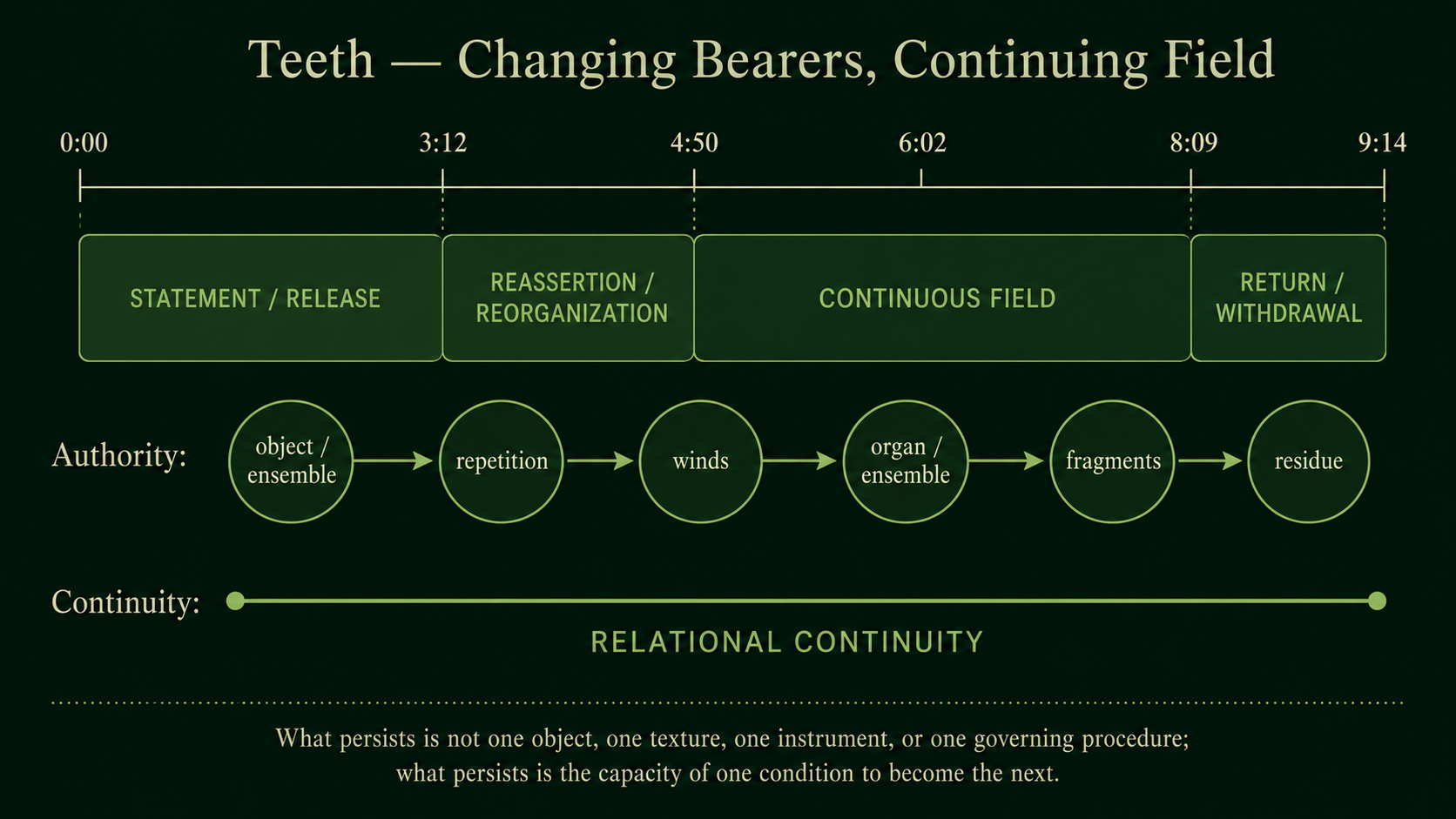
The diagram combines the track’s large-scale phases with its changing centers of authority. Above, local prominence passes from recurring material and ensemble organization to repetition, winds, organ, fragments, and residue. Below, the uninterrupted line represents Relational Continuity: what persists in “Teeth” is not one object, texture, instrument, or governing procedure, but the capacity of one musical condition to become the next without continuity breaking.
a. Authority Is a Function, Not a Possession
The deepest implication of Mobile Authority in “Teeth” is that formal control never belongs permanently to a single instrument or musical process. Authority is better understood as a function that can be assumed, shared, relinquished, concentrated, or weakened as the piece moves forward.
The opening saxophone object provides the clearest early example. Its fixed identity briefly establishes control, but its real formal power lies in what it releases: increasingly expansive improvisatory continuation. At 3:12, that freedom is checked when repetition itself becomes authoritative, restoring order through the fixed bass-and-ensemble relation. Later, the piano can move into the foreground without creating a new formal field, and around 6:02 the organ can take over from the winds while the underlying melodic-harmonic environment continues unchanged.
These moments make an essential distinction audible: foreground authority and formal authority repeatedly diverge. The instrument most prominent to the ear is not necessarily the force controlling the continuation. A voice may carry the surface while deeper coherence resides in recurrence, ensemble relation, or a field that survives the change of bearer.
Near the ending, authority becomes less possessive still. As the restored field erodes, no single instrument or process simply takes control in its place. Formal initiative becomes increasingly diffuse before withdrawing almost entirely. What “Teeth” demonstrates across these changes is that authority is not something an instrument owns; it is a function the music continually redistributes.
b. Continuity Does Not Require Sameness
If Mobile Authority explains how control moves, Relational Continuity explains why the music does not fall apart when it does. “Teeth” repeatedly remains intelligible across changes that might otherwise suggest a new section: a familiar object produces a different consequence, repetition grows inside an existing field, related material adopts a new syntax, or a different instrument carries a function already in progress.
The opening establishes this principle in its simplest form. The short saxophone object returns with remarkable stability, yet each recurrence releases a different continuation. Later, the broad developmental span from 3:25 remains coherent even as repetition becomes more insistent and the piano moves into the foreground. At 4:40, related material is reorganized into call-and-response without losing its connection to what preceded it. Around 6:02, the winds yield the foreground to organ while the field continues; around 6:30, that same field accelerates without being replaced.
The return at 8:09 pushes the principle furthest. The earlier slow melodic-harmonic environment becomes recognizable again even though the precise melody does not. Literal thematic identity has weakened, yet formal recognition survives because the broader relationships have returned.
Continuity in “Teeth,” then, does not depend on preserving sameness at every level. Material can change function, foreground can change bearer, surface behavior can intensify or contract, and literal recurrence can give way to resemblance of field. What remains stable is the network of relations and consequences that allows one state to be heard as emerging from another.
c. Repetition Changes What It Does
Repetition is one of the most persistent organizing forces in “Teeth,” but it never performs only one job. Its importance lies precisely in the way its function changes from one context to another.
At the opening, recurrence acts as a launching condition: the same saxophone object repeatedly re-establishes stability before releasing a new continuation. Around 0:43, repetition briefly does the opposite, tightening the frame and limiting the freedom that had begun to expand around it. At 3:12, it becomes more decisive still, abruptly restoring order after the long improvisatory field through the repeated bass-and-ensemble module.
Later, repetition no longer arrives as a separate controlling block. From about 4:04, it grows inside the existing developmental field, concentrating its rhythmic behavior without replacing the larger melodic-harmonic environment. At 4:40, recurrence becomes one half of a more complex relation: the lower ensemble unit remains stable while the winds answer with greater variability. Stability and change are now built into the same syntax.
By the closing passage, repetition has changed function once again. Familiar patterns still surface, but their recurrence becomes less secure as the field erodes. What once launched freedom, constrained it, restored order, and stabilized ensemble relations now survives only fragmentarily inside a texture it can no longer govern.
Repetition in “Teeth” therefore cannot be treated as a single formal principle. It repeatedly changes what it does: launching condition → temporary constraint → restoration of order → rhythmic concentration → stable half of a fixed/variable dialogue → unstable residue. Its changing function is one of the clearest demonstrations that material identity and formal function are separable.
d. Continuity Can Become Minimal
One of the most distinctive features of “Teeth” is its ability to reduce continuity almost to nothing without actually breaking it. Several of the track’s most important transitions occur not through accumulation or replacement, but through extreme contraction.
At 4:37, the ensemble narrows to exposed acoustic bass. At 4:50, an even more radical reduction leaves only a sustained pitch. At 8:03, the accelerated field again contracts to a single surviving organ tone. In each case, a complex ensemble condition gives way to one residual carrier that preserves enough consequence to connect what has just happened with what follows.
The procedure reaches its most austere form at the ending, when the ensemble itself withdraws and a bowed low-string residue remains. By then, continuity has ceased to depend on sustained collective activity altogether. One gesture, one pitch, or one isolated voice can temporarily carry the form on its own.
This is another expression of Relational Continuity, and locally of Instrumental Self-Sufficiency. The important point is not that reduction creates a new formal system, but that the track can contract almost to emptiness while preserving a meaningful relation across the gap. In “Teeth,” continuity does not require continuous ensemble presence; sometimes the smallest surviving trace is enough.
Sectional Conclusion. Section VII brings the track’s governing principles into focus. What holds “Teeth” together is not one recurring object, one instrumental leader, or one permanent method of organization, but the mobility of function across changing musical conditions. Authority can pass from fixed material to improvisation, from repetition to developmental process, from one instrumental bearer to another, or into a single residual pitch. At the same time, continuity survives because relationships, consequences, and fields remain intelligible across those changes. Even repetition changes function, and even extreme reduction need not produce discontinuity. The form remains coherent because control keeps moving without erasing what one state leaves behind for the next.
From Principle to Experience. The final section no longer needs to prove these mechanisms individually. It can ask what they add up to when the track is heard as one continuous trajectory. The Closing Movement returns to the exposed low string at either end and considers what becomes audible when these movements of authority are heard not as separate analytical events, but as the larger experience of “Teeth.”
Closing Movement — Control Changes Before the Music Does
Heard as a whole, “Teeth” does not travel from one stable state to another so much as through changing degrees of control. Its most consequential transformations often begin before the music has clearly become something else: a fixed object starts releasing more freedom, repetition begins to reshape a field from within, a new instrument takes the foreground while the underlying process continues, and organized material remains recognizable even after it has begun to lose its governing force. The form does not wait for one condition to disappear completely before another begins. Control shifts first, and the audible surface catches up afterward, so that what we experience is not a sequence of separate blocks but a succession of overlapping states in which one way of organizing the music is already weakening, expanding, or changing hands before the next has fully emerged.
Seen from that distance, the opening and ending finally belong to the same trajectory. At the beginning, “Teeth” seems to know exactly where it is. The short saxophone statement returns with almost stubborn clarity, each appearance restoring the same small point of stability even as the space beyond it grows progressively less constrained. By the fourth return, what began as a compact recurring object has opened into the long improvisatory field. The object itself scarcely needs to change; what changes is what it permits. Stability becomes a source of possibility rather than a defense against change, and the more securely the statement can return, the farther the music can move beyond it. The opening therefore asks how much freedom stable organization can release without ceasing to provide the point from which that freedom becomes intelligible.
When organization reasserts itself at 3:12, however, it no longer arrives in a single recognizable form. Exact recurrence can restore control, long melodic development can sustain it, and repetition can grow inside that development without forcing the field to become something else. The foreground can shift to piano and later from winds to organ while the deeper process continues; acceleration can transform the surface without replacing the field beneath it; and, at the most extreme points of reduction, a complex ensemble condition can contract until one sustained pitch is enough to carry consequence forward. The middle of “Teeth” therefore makes any simple opposition between composition and improvisation increasingly inadequate. Organization is not one fixed state from which freedom departs, but something capable of changing method, bearer, density, and degree of explicit control while remaining formally consequential.
At 8:09, the direction begins to turn. The earlier slow field becomes recognizable again without literally returning: its broad harmonic and melodic condition is restored closely enough for the ear to recover the same world, though the precise surface has changed. What follows is not another abrupt replacement but a gradual weakening from within. Patterns lose stability, freer interaction grows around them, and fragments of the established field remain audible even after they have ceased to govern the texture as a whole. In this sense, the closing reverses the opening process. There, stable organization repeatedly made greater freedom possible; here, organization survives increasingly as a local trace inside freedom after its larger authority has begun to fail.
Yet the ending does not stage a simple victory of improvisation over composition. Improvisatory interaction becomes increasingly prominent, but it too is temporary. As the ensemble withdraws, freer interaction disappears along with the organized patterns it had begun to overtake. Winds, organ, drums, and the remaining active layers fall away until neither fixed organization nor collective improvisation remains capable of governing the field. What remains is not a new dominant system but residue—the sound left after both order and freedom have lost their hold.
That residue gains particular force because another exposed low string stood at the beginning. “Teeth” opens with a plucked acoustic-bass-like presence and ends with a bowed, possibly transformed low acoustic string. The exact player, and even the precise instrumental identity of the final sound, remain uncertain, but the formal relation does not depend on resolving them. Across the track, that broad low-string presence repeatedly changes function: at the beginning it acts as threshold; at 3:12 it helps reorganize the music through fixed recurrence; at 4:37 it becomes an isolated hinge; and at the end it remains after the larger ensemble has withdrawn. The instrumental family may recur, but its formal responsibility never remains the same. Articulated opening presence becomes abstract terminal residue.
The opening and ending therefore face one another without forming a perfect mirror. Early in the piece, stable organization repeatedly releases freer continuation. Near the end, established organization is progressively absorbed into freer interaction before freedom itself disappears through withdrawal. Between those poles lies the larger movement of “Teeth”: the many intermediate ways control can be restored, redistributed, concentrated, weakened, or transferred without forcing continuity to break. The middle is what prevents the outer relation from becoming schematic. The piece does not move simply from order to freedom or from stability to dissolution; it explores how one condition can begin changing into another while still carrying something of its previous function forward.
The resulting relation is therefore one of partial procedural inversion rather than symmetry:
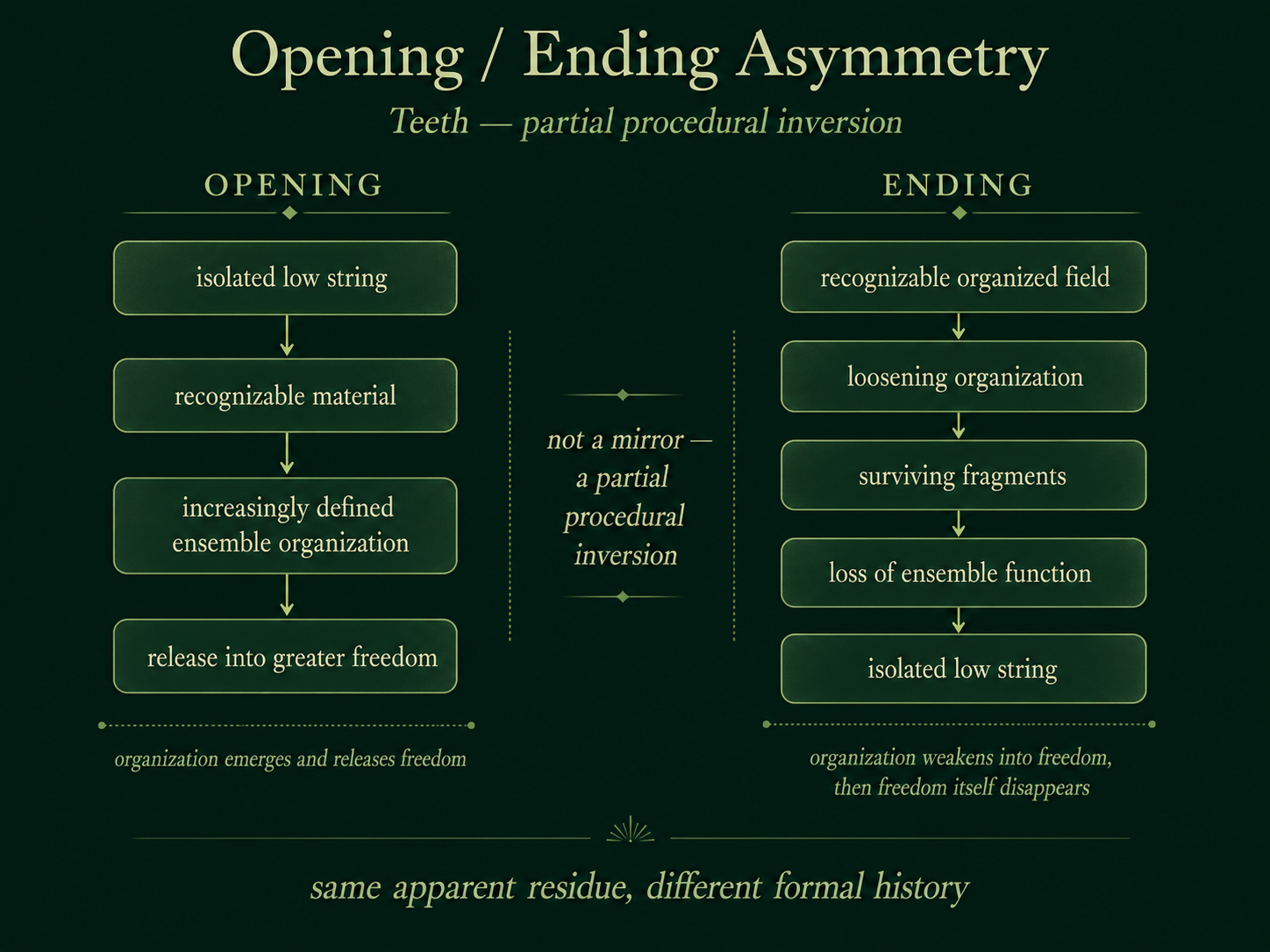
The beginning and ending of “Teeth” arrive at related low-string states through different formal processes. The opening moves from sparse, incompletely defined organization toward increasingly articulated ensemble identity before releasing greater freedom; the ending begins from an already established musical world and progressively removes organization, surviving fragments, and ensemble function. The relation is therefore a partial procedural inversion rather than a literal mirror: similar surface residue carries a different formal consequence because it has been reached through a different history.
What makes “Teeth” difficult to divide, then, is not an absence of articulation but the fact that its deepest changes so often begin before continuity has disappeared. A melodic field can become increasingly repetitive without ceasing to be the same field; another instrument can take the foreground without creating a new formal state; a single sustained pitch can preserve consequence after the ensemble has fallen away; and organized material can remain recognizable even after it has lost the power to govern everything around it. The track’s continuity resides less in the persistence of fixed objects than in the persistence of relationships through changing conditions. Its form moves because control moves first, and by the time the surface has clearly altered, the deeper transfer is often already under way.
The isolated bass that opens “Teeth” appears before this movement of authority has begun; the low string that remains at the end arrives after every larger system of control has withdrawn.