“Virtually”
- Artist
- Soft Machine
- Album
- Fourth
- Year
- 1971
“Virtually” occupies almost an entire LP side, yet its twenty-minute span never settles into a single way of continuing. Recurring material changes shape and responsibility, improvisation opens and closes around shifting instrumental relationships, and textures that initially seem capable of continual expansion are eventually stripped toward increasingly dominant repetition. The four indexed Parts divide that journey unevenly. What joins them is less a continuous surface than a persistent capacity for the music to reorganize itself while remaining recognizably part of the same design.
Within This Track Study
I. Opening — One Composition, Four Unequal Parts
“Virtually” appears on Fourth as four separately indexed tracks, but they do not behave like four independent compositions—or even like four equivalent movements within one. Part 1 lasts 5:16, Part 2 7:06, Part 3 4:33, and Part 4 3:23, yet those durations conceal striking differences in formal weight. Some of the indexed boundaries coincide with substantial changes of material and behavior; elsewhere, enough survives the division that the new track begins inside a process already under way. The four Parts matter, but they matter differently.
Hugh Hopper’s published score confirms that the work was conceived as a continuous composition and distinguishes broadly among more fully written passages, open or Solo regions, a later Organ Solo, and written material toward the close. That information is valuable, but it answers only one kind of question. It tells us something about how tightly particular regions were prescribed; it does not determine how those regions behave in performance. A written passage can alter its formal role as the ensemble reshapes it, while an open passage can remain strongly organized by recurrent material or by relationships among the instruments.
The recording therefore resists a simple alternation between composition and improvisation. More revealing is what happens to musical responsibilities as the piece proceeds. Material that begins as a statement may later become support; an answering voice may be absorbed into the statement itself; a function associated with one instrument may pass to another while the larger relationship remains recognizable. These possibilities are not yet an abstract system at the beginning of “Virtually.” They are introduced as something much more immediate: a sound and its answer.
Part 1 opens with the reference from which everything else will begin to move: two ensemble chords, followed by a bass response.
II. Part 1 — The Riff Changes Hands
Part 1 builds its continuity around a recurrent two-chord riff—Object A—whose identity remains recognizable even as its instrumental setting and formal role keep changing. Rather than belonging permanently to one voice or one arrangement, the riff passes through different configurations, sometimes occupying the foreground and sometimes helping organize activity around it. Its durability will depend not on remaining unchanged, but on how much change it can absorb.
a. The Answer Changes Hands
Approximately 0:00–1:00
“Virtually” begins with a compact relation: two coordinated ensemble chords answered by plucked double bass. The sequence repeats, establishing a clear contrast between collective statement and low-register response.
From about 0:12, that relation begins to move. The riff quickens, and the winds assume the answering role previously carried by double bass. The bass remains active, but its responsibility changes, shifting into a more melodic supporting position beneath the exchange. The material remains recognizable and the statement–response relation survives, even though one of its functions has passed to a different bearer.
By roughly 0:42, double bass reclaims the response as the drums become increasingly involved. What first sounds like a change of orchestration therefore proves more consequential. Response persists even when the instrument responsible for it changes, while the bass itself can move from response to support and back again. From the opening minute, Object A is already showing that its identity does not depend on a fixed instrumental arrangement.
b. The Answer Enters the Riff
Approximately 1:00–1:23
The exchange established during the opening minute now begins to lose its clean division between statement and response. Short harmonized wind figures enter around Object A, but the winds no longer function only as an answering voice. They begin to participate in the recurring two-chord gesture itself, folding material that had occupied the responsive side of the texture into the collective statement.
The change is subtle but more consequential than another transfer of responsibility between instruments. Until this point, the response could migrate while the underlying relation remained intact: one layer stated the riff and another answered it. Here, that relation itself begins to change. The winds contribute to Object A while retaining traces of the answering role they had just assumed, making the distinction between primary gesture and response increasingly permeable.
The functions themselves are beginning to reorganize. A voice that had answered Object A becomes part of its composite embodiment, and what began as a relatively clear call-and-response structure starts to behave as a more integrated ensemble field.
c. Two Basses, Two Responsibilities
Approximately 1:23–2:45
The clearest early demonstration of “Virtually” separating musical function from instrumental identity arrives when the bass itself divides into two simultaneous responsibilities. From about 1:23, one bass voice, heard toward the left, moves freely through an improvising line while a second, toward the right, continues to carry Object A. Cymbals remain around them, but the essential formal distinction is now internal to the low register: recurrence persists in one bass while improvisational freedom unfolds in another.
A published account independently describes this passage in terms of Roy Babbington and Hugh Hopper conversing on acoustic and electric bass. That identification strengthens the audible evidence for two distinct bass presences without requiring every stereo position or moment-to-moment line to be assigned with certainty. What matters formally is already clear in the recording: two instruments from the same broad family sustain different responsibilities simultaneously.
That separation overturns any simple equation of written material with collective statement and improvisation with an individually foregrounded soloist. Here composition and improvisation do not alternate. They coexist. More strikingly, they coexist through two instruments of the same broad family, making their difference primarily functional rather than timbral. One bass preserves the recurrent object as a strong point of formal reference; the other moves freely around it without severing the connection to the larger field. Responsibility has been distributed rather than transferred.
At roughly 2:00, the balance changes again. The riff-bearing bass drops out, but the improvising bass remains. Object A is no longer continuously present, yet the texture does not collapse with its disappearance. The music removes the bearer of recurrence while preserving the bearer of freedom, revealing that two functions which had coexisted can also be separated by subtraction.
This is the first point in “Virtually” where subtraction becomes formally consequential, though it is not yet the governing process it will become later. For the moment, it functions as a local test of what the music can lose without losing continuity. The recurrent ground disappears; the improvisational line remains.
d. The Riff Returns in Another Body
Approximately 2:45–3:20
Object A returns, but not by restoring the arrangement that first defined it. The right-channel bass re-enters, organ joins the recurrent figure, and the low-register texture reorganizes around a new division of responsibility. What had begun as an ensemble statement answered by plucked bass is now carried through an organ-and-bass configuration, while the other bass contributes a responding or harmonically complementary role.
The importance of the return lies in that altered embodiment. The riff is recognizable enough to recover its structural presence, yet the functions surrounding it have been reassigned. Recurrence no longer depends on the original collective attack, and bass no longer occupies only the answering position established at the opening. Organ has entered the embodiment of Object A itself, while the two bass voices assume differentiated responsibilities around it.
“Virtually” therefore restores the recurrent object without restoring its original configuration. What comes back is the object, not the instrumental arrangement that first carried it. Continuity is preserved through re-embodiment: familiar material returns in a new instrumental body, bringing with it a newly distributed set of functions.
e. The Riff Moves Behind the Music
Approximately 3:20–4:40
At about 3:20, Object A undergoes a more consequential transformation than any change of instrumentation heard so far. Saxophone enters melodically into the foreground while organ and bass retain the riff-derived pattern beneath it. The recurring object has not disappeared, but its formal role has changed. What had functioned as the principal statement of the music now becomes structural ground: a recognizable support over which another voice can assume greater melodic freedom. As the drums intensify, the riff remains essential without needing to remain prominent.
Around 4:00, that relationship begins to reverse. The winds take up Object A more directly, drawing the recurrent material back toward the foreground. The saxophone briefly withdraws and then returns in a more improvisational capacity, while the bass becomes increasingly mobile beneath the ensemble. The same object that had receded into accompaniment can therefore reclaim a more exposed collective role without restoring the instrumental arrangement of the opening.
This is the central discovery of Part 1. Object A survives because its identity can remain stable while its formal role changes: statement, response, structural ground, accompaniment, and collective foreground are not permanent properties of the material but functions it can successively assume. By this point, “Virtually” has moved beyond changing who carries the riff. The riff itself can now change what it is for.
Object A becomes most intelligible when heard not simply as a recurring riff, but as a stable material identity whose instrumental embodiment and formal responsibility keep changing. Across Part 1 and into Part 2, the object remains recognizable while the layers around it are repeatedly reorganized: the answering role changes hands, the two-bass passage separates recurrence from improvisation, organ and bass reconstruct the object in a new body, and later the same material recedes into structural support beneath a foregrounded saxophone line. What gives the music continuity is therefore not a fixed arrangement, but the capacity of one object to persist through changing bearers and changing functions.
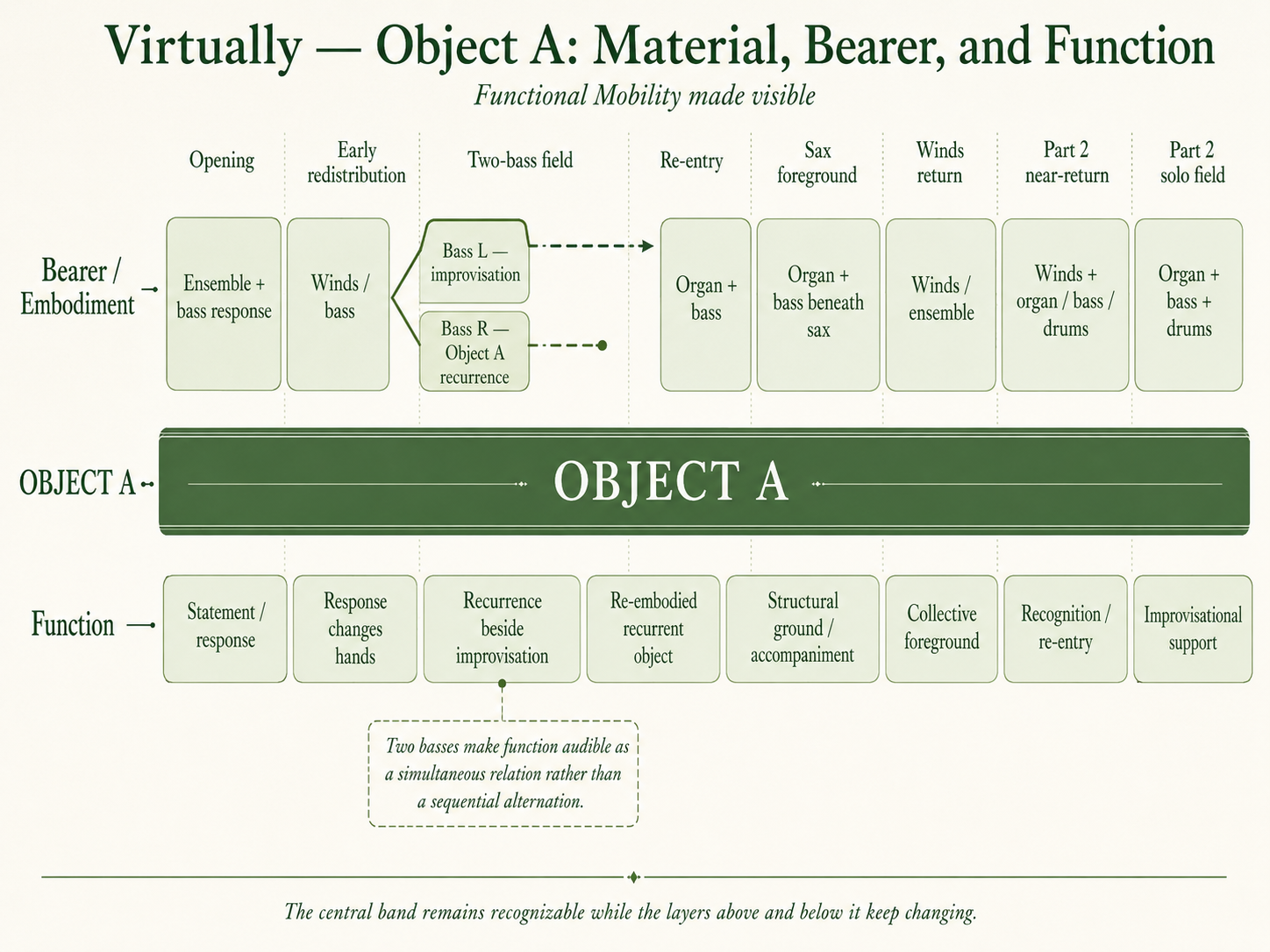
The central band represents the continuing recognizability of Object A, while the upper layer tracks its changing instrumental embodiment and the lower layer tracks its changing formal role. The figure makes visible the distinction between material, bearer, and function that governs the opening half of “Virtually”: the object remains identifiable even as response changes hands, recurrence coexists with improvisation in the two-bass passage, the riff is re-embodied through organ and bass, and later returns in altered formal capacities ranging from structural ground to improvisational support.
f. Saturation of a Mobile Object
Approximately 4:40–5:16
The closing stretch of Part 1 does not introduce a new formal idea so much as intensify the possibilities Object A has already acquired. Winds enter and withdraw around the riff, bowed double bass adds another register and timbral weight, and the ensemble grows increasingly active without abandoning the recurrent object that has organized the Part from the beginning. The sense of culmination comes from accumulation rather than replacement.
By this point, Object A can be stated collectively, answered, supported, transferred, submerged beneath improvisation, and recovered in the foreground. In the closing span, several of those possibilities begin to crowd together. The result is a denser and more saturated ensemble state in which the riff remains identifiable even as its instrumental embodiment and surrounding functions multiply.
Part 1 therefore reaches its peak not through the arrival of fresh thematic material, but through the expansion of functional embodiment around an already established object. What began as a compact statement-and-response relation has become a mobile field of instrumental possibilities, preparing the way for the more plural organization of melodic authority that follows.
Sectional Conclusion. Part 1 preserves identity by refusing fixed embodiment. Object A remains recognizable while statement, response, support, improvisational ground, and collective foreground repeatedly change hands, separate, and recombine. Its continuity depends less on stable instrumentation than on the capacity of an established object to survive functional reassignment. By the end of the Part, the riff has accumulated an expanding range of possible embodiments; Part 2 will test continuity under more radical conditions, when the governing material itself changes.
From Mobile Riff to New Field. Part 1 has tested how far a recurrent object can change bearer and function without losing its identity. Part 2 begins by removing that object from the foreground altogether. Continuity must now survive not another redistribution of the same riff, but the emergence of a different modal field with a different organization of melodic responsibility.
III. Part 2 — A New Field, Then an Old Riff in a New Role
Part 2 begins by removing the object that had organized nearly every transformation of Part 1. In place of Object A, saxophone and organ enter a new modal field, moving independently through the same underlying material and periodically approaching one another before separating again. Bass and drums remain active beneath and around them, but the melodic foreground is no longer organized around a single recurrent gesture or a single dominant voice. Part 2 opens instead into a more plural field of simultaneous activity.
A published account of the recording characterizes this opening as a long, improvised, slow-tempo organ-led passage colored by saxophone and bass, with Wyatt filling around the other players. That description supports the distinction already audible in the performance: openness here does not mean the absence of organization, but a field in which several instrumental functions remain active without being subordinated to one recurrent object.
The later reappearance of riff-derived material reconnects this new environment to Part 1 without restoring the earlier order. Object A becomes recognizable again, but it returns to a field whose relationships have already changed. The question is no longer simply how the riff can change hands, but what can happen when familiar material re-enters a musical world organized according to different principles.
a. One Field, More Than One Voice
Approximately 0:00–3:37
Part 2 replaces the compact recurrence of Object A with a more spacious modal field. Saxophone and organ move through the same underlying melodic environment, but they do not settle into a conventional soloist-and-accompaniment relationship. Each sustains an independent line, sometimes approaching the same pattern closely enough to create momentary convergence before separating again into distinct trajectories. Their relationship is shared without becoming fixed: both voices inhabit Object B while preserving considerable freedom within it.
Bass and drums remain strongly involved in shaping the field. They do more than sustain a neutral background beneath the two upper voices; their activity continually alters the weight, direction, and density of the texture, and at moments the bass itself enters the melodic discourse. Object B provides these simultaneous lines with a common modal orientation without forcing them into unison or a single hierarchy.
The formal difference from Part 1 is significant. There, a recurrent object could migrate among successive bearers and assume different functions. Here, one melodic field can sustain simultaneous independent realizations. Melodic authority is no longer simply transferred from one voice to another; saxophone and organ can exercise it at the same time, while bass and drums remain consequential participants in the larger field.
b. The Old Riff Enters a New World
Approximately 3:37–4:15
Near 3:37, the modal field begins to turn smoothly toward something already familiar. The change is not abrupt enough to feel imposed from outside the ongoing improvisation, yet the emerging chordal-rhythmic pattern is strongly related to Object A. Winds bring the recurrence into clearer focus while organ, bass, and drums gather around it, restoring a degree of coordinated ensemble definition after the more independent melodic trajectories of the preceding minutes. The relationship is close enough to register as a near-return of the opening riff, though not as an exact note-for-note restatement.
Recognition, however, is only the first consequence. Object A reappears after Object B has established a different organization of the musical field, one in which melodic authority has been shared among independent voices rather than concentrated in a recurrent ensemble gesture. The earlier material therefore cannot simply resume its original role. It enters a texture whose expectations have already changed.
This makes the passage the hinge of Part 2. The recurrence reconnects the new modal environment to the material of Part 1 without restoring the earlier formal order. The old riff returns to a musical world that has learned to use it differently. What began “Virtually” as a principal statement is now poised to become the ground beneath continuing improvisation.
c. The Riff Steps Behind the Soloist
Approximately 4:15–6:38
As the additional winds recede, saxophone assumes a clearer melodic foreground, but the material beneath it is anything but neutral. Organ, bass, and drums continue to work with variations of Object A, preserving the earlier riff as an active structural ground while the saxophone moves more freely above it. The increasing motion of the ensemble does not displace the recurrent object; instead, recurrence becomes the condition that allows another voice to occupy the foreground.
A published description similarly hears this later span as centered increasingly on Dean’s saxophone above a simple keyboard figure and descending bass motion. Its comparison with “Out-Bloody-Rageous” is best treated as a stylistic observation rather than a claim of thematic identity, but the underlying instrumental relation is useful corroboration: the saxophone becomes the most conspicuous melodic voice while keyboard and bass continue to provide a consequential supporting field.
This is a more fundamental transformation than the changes of bearer heard in Part 1. There, Object A was repeatedly stated, answered, redistributed, reconstructed, or brought back into collective prominence. Here, the riff is no longer principally what the listener is being asked to follow. Its recognizable identity persists beneath the saxophone, but its formal purpose has changed: it now supports and organizes improvisational activity whose melodic surface belongs elsewhere.
The most consequential return in “Virtually” is therefore not a recapitulation but a change of status. Material that once occupied the center of the form becomes the ground beneath another voice. Object A has already survived changes of instrumentation; now it survives a change in formal purpose. Recurrence and identity remain intact even as prominence and responsibility separate, allowing the riff to organize the form without continuing to command its foreground.
Part 2 thus carries the mobility established in Part 1 into a more consequential domain. The riff does not merely return in altered form: what once had to be stated can now make someone else’s improvisation possible.
d. The Soloist Becomes a Crowd
Approximately 6:38–7:06
The closing seconds of Part 2 loosen the saxophone-centered hierarchy that emerged after the riff moved into a supporting role. Additional wind-like voices enter the field, joining the saxophone in closely related variations and thickening the melodic surface into something increasingly collective. What had been organized around a clearer foreground line begins to spread laterally across several simultaneous pitched voices.
The change is gradual rather than abrupt. Individual contours remain audible at first, but the voices increasingly approach one another until the final moments move toward a more unified, near-unison statement. Part 2 therefore closes by partially reversing the hierarchy of its middle span: a single dominant melodic foreground gives way first to plural activity and then to increasing coordination among the upper voices.
The currently documented personnel for Part 2 list only the core quartet, and the new documentary description likewise names saxophone, organ or piano, bass, and drums rather than identifying additional guest winds. The multiple pitched voices heard near the close therefore remain an audible fact whose precise instrumental or production origin is unresolved. They should not be converted into additional personnel assignments without stronger evidence.
Formally, the passage completes Part 2’s movement toward pluralized melodic authority. The saxophone does not simply relinquish the foreground; the foreground itself becomes collective. What had been concentrated in one voice spreads across several simultaneous lines before converging, allowing Part 2 to end not with a restoration of the earlier hierarchy but with a temporary coordination of previously differentiated melodic functions.
Sectional Conclusion. Part 2 expands the mobility established in Part 1 into pluralization. Where the first Part kept a recurrent object recognizable while its bearers and responsibilities changed, the second allows a new melodic field to sustain several independent authorities at once, then brings earlier material back with a different formal purpose. Documentary evidence that the Part was realized through an improvised organ-, saxophone-, bass-, and drum-centered field reinforces rather than replaces that audible architecture. Continuity now depends not only on who carries the material, but on how several voices and functions can coexist within the same field.
From Pluralization to Rupture. By the end of Part 2, the musical field has become crowded with possibilities: independent voices coexist, familiar material can return in a new role, and the foreground itself can become collective. Part 3 breaks that expansion. The accumulated density suddenly gives way to a more exposed world in which the question is no longer how many relationships the music can sustain, but what can remain when those relationships begin to disappear.
IV. Part 3 — Rupture and Subtraction
Part 3 opens by suspending the recurrent grounds and instrumental relationships that had carried continuity through the first half of “Virtually.” Familiar points of reference disappear, pulse loses its previous security, and processed sound with freer wind activity takes their place.
From that rupture onward, the music does not rebuild the earlier system. It moves in the opposite direction. Rhythmic, timbral, and ensemble functions are progressively withdrawn until the texture settles into a much more reduced field, where coherence depends less on recurrence than on what remains after so many earlier resources have fallen away.
a. The Ground Falls Away
Approximately 0:00–0:26
Part 3 begins by removing the conditions that had made the first half of “Virtually” intelligible. The riff-based organization of Part 1 and the modal solo-ground relationships of Part 2 vanish almost at once. In their place comes a short, unstable field of reversed-sounding, loop-like processed material and freely sounding winds. Drums and cymbals are absent, and with them disappears the pulse-bearing framework that had helped organize even the most open passages.
The processing intensifies the rupture, but it is not the principal formal event. More consequential is the simultaneous loss of several functions that had previously anchored the music: recurrent ground, sustained pulse, and a stable distinction between foreground improvisation and supporting ensemble. What had been redistributed or pluralized across Parts 1 and 2 is no longer reassigned. It is suspended.
For these few seconds, continuity is carried less by recognizable material than by the force of its removal. The probable brief tape manipulation contributes to that dislocation, but the deeper change is structural: the ground itself has fallen away.
b. Free Atmospheric Dispersion
Approximately 0:26–1:55
Once the brief processed rupture subsides, Part 3 does not recover the rhythmic and recurrent organization that preceded it. Instead, the music opens into a more spacious field: organ hangs in the texture with a diffuse, atmospheric presence, bass remains active toward the right, and saxophone and other wind voices move freely across the middle and upper registers. Bowed double bass further loosens the sense of attack and release, while light cymbal coloration provides only intermittent temporal definition.
A published description of this movement similarly emphasizes improvised clarinet and double-bass activity before the texture turns toward a more exposed fuzz-bass field. The exact identity of every wind line remains difficult to establish from the recording alone, but the documentary account strengthens the broader picture of a region organized through dispersed instrumental activity rather than through the stable recurrent mechanisms of the earlier Parts.
The result is not formlessness. Relationships remain audible, but they are no longer coordinated by the mechanisms that governed Parts 1 and 2. Harmonic atmosphere persists without a strongly directive progression; low-register activity continues without hardening into a fixed recurrent ground; wind lines enter and withdraw without settling into a stable foreground hierarchy. Formal responsibility is therefore dispersed rather than hierarchically distributed.
Part 3 changes the terms under which organization can be heard. Instead of recurrence, pulse, or a clear solo-support relation holding the field together, continuity now depends on the coexistence of timbral, registral, and harmonic tendencies whose connections remain perceptible even as their functions become less securely assigned.
c. Subtraction Clarifies the Field
Approximately 1:55–4:33
From about 1:55, the dispersed texture of Part 3 begins to lose voices. Multiple winds recede until one clear saxophone remains, while fuzz bass becomes more prominent on the right and organ assumes greater weight on the left. Drums and cymbals are absent. What emerges is not emptiness but a more sharply differentiated three-part field, with saxophone near the center moving melodically between two strong instrumental poles.
The identification of the right-channel bass as Hopper’s fuzz bass is strengthened by documentary description of a fuzz-bass solo over sustained organ chords in the third movement. That evidence does not determine every moment of the passage, but it supports the audible division of responsibility already present in the recording: bass becomes increasingly exposed as an independent foreground force while organ sustains the broader harmonic field.
The paradox is that the music becomes more defined as it becomes less populated. Bass supplies low-register and harmonic weight while also assuming greater melodic independence; organ sustains a broad spatial and harmonic presence while pressing toward the foreground; saxophone retains considerable melodic mobility. None of these functions settles into an absolute hierarchy. Bass and organ both exert substantial perceptual force, while the saxophone remains freer in contour and movement. Clarity arises from differentiation rather than domination.
There is an audible modal affinity with the environment established earlier in Part 2, but not enough evidence to claim a literal return of Object B. What survives is better understood as a shared atmosphere than as thematic recurrence. The formal change lies elsewhere: Part 3 no longer organizes continuity by multiplying functions around recognizable objects. It begins to clarify the field through their removal.
Subtraction here is constructive rather than merely reductive. As layers disappear, the remaining responsibilities become easier to hear. Part 3 achieves a new kind of coherence not by rebuilding the ensemble, but by narrowing it until bass, organ, and saxophone stand in increasingly exposed relation to one another.
Sectional Conclusion. Part 3 is governed by subtraction. Pulse, wind density, ensemble weight, and the number of simultaneous functional possibilities are progressively reduced, yet the music does not become less organized. As layers fall away, the responsibilities that remain become more exposed and more clearly differentiated. Subtraction concentrates the field rather than emptying it, preparing the reduced configuration that will continue across the boundary into Part 4.
From Subtraction to Contraction. By the close of Part 3, bass, organ, and saxophone occupy a stripped field whose relationships have become clearer precisely because so much surrounding activity has disappeared. Part 4 does not overturn that condition. It carries the reduced configuration forward and subjects it to a different pressure: not further removal of instrumental layers, but the gradual narrowing of what the surviving material can still do.
V. Part 4 — When Variation Becomes Repetition
Part 4 does not establish a new field so much as inherit the reduced one already formed at the end of Part 3. Organ and bass remain the principal anchors, saxophone continues to enter intermittently, and the underlying harmonic atmosphere changes less than the new track index might suggest. The boundary therefore marks continuation more than rupture.
What changes is the range of behavior available within that surviving field. Variation, interaction, and local freedom remain possible at first, but their scope gradually narrows. Part 4 is governed not by further subtraction of instrumental layers, but by a contraction of possibility in which repetition increasingly determines what the remaining material can still do.
a. The Boundary That Barely Divides
Approximately 0:00–1:40
The beginning of Part 4 is less a new departure than a continuation of the reduced field already established at the end of Part 3. Organ and bass remain the principal points of weight, while saxophone appears intermittently with repeated melodic figures rather than reasserting a sustained solo foreground. The modal atmosphere also persists, so the change of LP index is heard more as further thinning and rebalancing than as the opening of a fundamentally different behavioral world.
That continuity makes the Part 3→4 boundary the most permeable of the three divisions within “Virtually.” The index remains meaningful as a practical and perceptual marker, but it does not correspond to a deep formal reset. Unlike the earlier boundaries, which introduced stronger changes of material or behavior, this one allows an already-reduced configuration to continue almost intact across the division.
Part 4 therefore begins by sustaining variation within conditions already narrowed by Part 3. The new process will emerge not from another large-scale change of field, but from what happens as the remaining range of variation itself begins to contract.
b. When Possibility Narrows to Repetition
Approximately 1:40–end
The final contraction does not announce itself with another boundary. It emerges gradually from the reduced field already in motion. Organ, bass, and intermittent saxophone continue to vary their material, but the range of those variations begins to narrow. Patterns that had remained flexible start to recur with greater insistence, and the music increasingly exchanges open-ended interaction for repetition. The change is behavioral rather than thematic: no new object arrives to impose closure, and no earlier state is restored.
This narrowing reverses much of what “Virtually” has made possible. Earlier, recognizable material could migrate between instruments, divide statement from response, retreat into structural ground, or support independent improvisational voices. Even after Part 3 removed many of those layers, the surviving instruments retained considerable freedom within the reduced field. Now that freedom itself begins to diminish. Repetition increasingly determines what can happen next because fewer alternatives remain available within the configuration that survives.
The closing texture nevertheless remains internally differentiated. Sustained organ sonority, floating fuzz-bass activity, restrained hi-hat, and repeated saxophone figures continue to occupy distinct roles within the increasingly recurrent field. Repetition becomes more directive without reducing the ensemble to a single literally identical gesture. Light rolling drums and cymbal activity add temporal definition without reversing the contraction, while a very brief reversed-sounding disturbance near the close momentarily unsettles the surface without redirecting the process.
The new documentary evidence changes how the recorded endpoint must be understood. Hopper later recalled that he had not conceived a fixed ending for “Virtually,” and that the musicians were still playing the end section essentially live when the record was faded. The contraction heard in Part 4 is therefore real, but the point at which the LP ends does not prove that the performance itself had exhausted every remaining possibility. What the recording establishes securely is a narrowing field in which repetition becomes increasingly dominant; the fade determines where that audible process is cut off on record.
The ending of “Virtually” is therefore best understood as a contraction of possibility within the audible LP realization. Material that earlier supported an expanding range of instrumental and formal functions is progressively confined to fewer behaviors until repetition becomes the dominant remaining condition. The piece does not close by recovering its beginning, and the recorded ending should not be treated as evidence that the surviving relationships had literally reached a necessary point of cessation. The contraction is internal to the performance; the final stopping point belongs to the way that performance was realized on the LP.
Sectional Conclusion. Part 4 is governed by contraction rather than further subtraction. In Part 3, instruments and functions disappeared, concentrating responsibility among what remained. Here, the surviving material itself loses behavioral range: variation diminishes, repetition becomes increasingly dominant, and the field narrows without requiring another major reduction in personnel. The distinction is crucial. Subtraction changes what remains; contraction changes what the remaining material can still do. Hopper’s account of the fade further clarifies that this contraction should not be confused with a demonstrably exhausted or predetermined endpoint.
From Chronology to Architecture. Across the four Parts, a recurrent object changes hands, melodic authority becomes plural, ensemble functions are stripped away, and the surviving field loses behavioral range. These are not four arbitrary labels attached to four LP indexes, but four different responses to successive formal problems. Heard together, they reveal the larger architecture of “Virtually”: not a sequence of equivalent movements, but a continuous design in which each stage changes the conditions inherited from the one before it.
VI. Four Parts, Four Operations
Heard across the full span of “Virtually,” the four Parts do more than present contrasting textures. Each responds to a different formal problem created by what precedes it. Part 1 asks how a recurrent object can remain identifiable while its bearers and responsibilities change; Part 2 asks how continuity can survive when a new field supports several independent melodic authorities and earlier material returns with a different role; Part 3 asks what remains when pulse, density, and ensemble functions begin to disappear; Part 4 asks how a reduced field can narrow without restoring what has been lost.
The resulting architecture can be summarized as:
Complete Architecture
- Redistribution
- Pluralization
- Subtraction
- Contraction
These are four distinct operations. Each reorganizes the relationship among material, function, and possibility in a different way, while carrying forward conditions created by the stage before it.
The four-part design of “Virtually” becomes clearer when its operations are viewed across the unequal spans of the LP indexes. Part 1 redistributes responsibility around a recurrent object; Part 2 expands the field into simultaneous melodic authorities; Part 3 reduces the number of active resources; and Part 4 narrows the behavioral range of what survives. The boundaries between those Parts are equally unequal: the first marks a substantial change of material and organization, the second produces the composition’s strongest behavioral rupture, and the third allows an already reduced field to continue almost intact. Seen together, the four operations describe not a sequence of equivalent movements but a changing field of possibility—first expanding, then pluralizing, then losing resources, and finally losing alternatives.
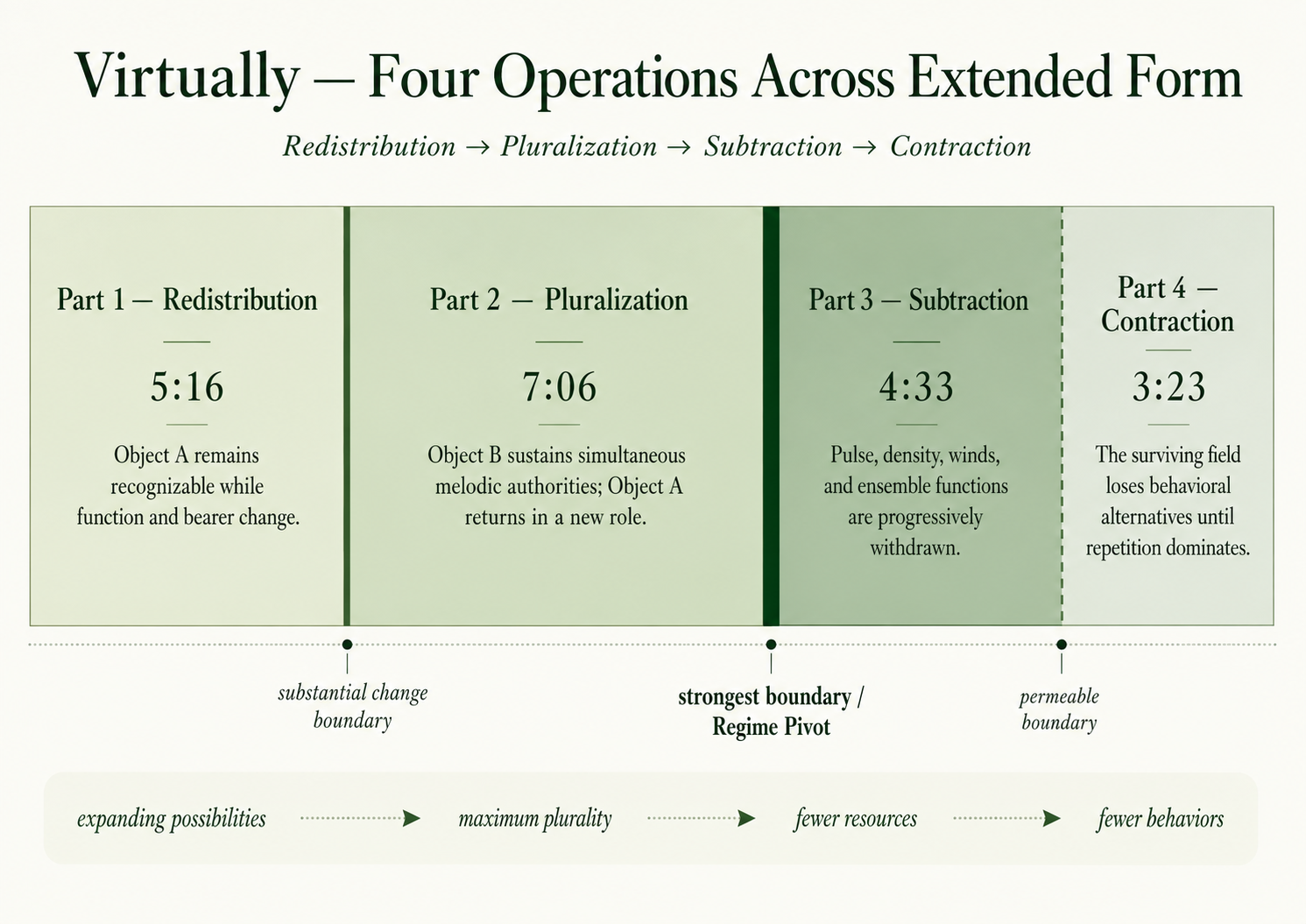
The widths of the four fields reflect the relative durations of the LP Parts, while the boundary treatments indicate their differing formal strength. Part 1 redistributes functions around Object A; Part 2 pluralizes melodic authority and returns Object A in a changed role; Part 3 withdraws pulse, density, and ensemble functions; and Part 4 contracts the behavioral possibilities of the surviving field toward increasingly dominant repetition. The lower trajectory summarizes the larger movement from expanding possibilities through maximum plurality to fewer resources and, finally, fewer available behaviors.
a. Redistribution — Part 1
Part 1 tests how many different functions a single recurrent object can assume without losing its identity. Object A remains recognizable while responsibility around it is repeatedly reassigned: response changes hands, recurrence and improvisation divide between simultaneous bass voices, the riff acquires a new instrumental embodiment, and later the same material becomes structural support beneath saxophone improvisation.
Redistribution therefore concerns more than the movement of material among instruments. It describes the mobility of formal responsibility around an object stable enough to survive changes of function. Object A retains continuity not because its role is fixed, but because statement, response, support, recurrence, and foreground prominence can all be reorganized around it.
b. Pluralization — Part 2
Part 2 changes the terms of that mobility. Object B does not circulate through successive bearers in the manner of the opening riff; it permits several independent realizations to coexist within the same modal field. Saxophone and organ can both exercise melodic authority without collapsing into a single line, while bass and drums remain consequential enough to prevent the texture from resolving into a simple foreground-background hierarchy.
Pluralization therefore names an expansion in the number of simultaneous authorities the field can sustain. The later near-return of Object A sharpens that principle: familiar material can enter this expanded environment without reclaiming its former status, becoming support beneath improvisation rather than restoring the hierarchy of Part 1.
c. Subtraction — Part 3
Part 3 reverses the previous expansion by testing what can remain after structural resources begin to disappear. Pulse, recurrent ground, ensemble density, and multiple wind layers are no longer redistributed among a full field; they are progressively withdrawn.
Subtraction does not produce formal collapse. It concentrates responsibility among fewer surviving elements. As the texture narrows toward bass, organ, and saxophone, harmonic weight, spatial presence, and melodic mobility become more exposed. The field grows clearer not through the addition of new organizing material, but through the removal of competing functions and bearers.
d. Contraction — Part 4
Part 4 inherits that reduced field and applies a different pressure. The surviving instruments remain capable of interaction and local variation, but the range of possible behavior progressively narrows. Repetition becomes increasingly directive, not because more elements disappear, but because the elements that remain have fewer available ways to continue.
Contraction therefore concerns the restriction of possibility rather than the removal of resources. Part 3 changes what remains; Part 4 changes what the remaining material can still do. The movement from variation toward increasingly dominant repetition brings that distinction to its audible limit on the LP, while the fade determines where that narrowing process ceases to be heard.
e. The Unequal LP Boundaries
The four indexed Parts of “Virtually” are musically meaningful, but they do not function as equivalent autonomous movements. Each boundary marks a change, yet the depth and character of those changes differ substantially. The move from Part 1 into Part 2 replaces the recurrent logic of Object A with a new modal field and a more plural organization of melodic authority, making the boundary a strong change of both material and behavior.
The transition from Part 2 into Part 3 is more radical. Here the accumulated resources of the first half—stable pulse, recurrent ground, and clearly distributed solo-support relations—are suspended together. The processed opening and freely sounding winds do not simply introduce new material; they establish the strongest behavioral discontinuity in the composition. Of the three indexed joins, this is the clearest candidate for a true Regime Pivot.
The Part 3→4 boundary behaves almost oppositely. Rather than replacing one field with another, it allows the reduced bass–organ–sax configuration to continue across the index with further thinning and rebalancing. The formal process is already under way before the track number changes, making this the most permeable boundary in the work.
The LP divisions therefore reveal four distinct phases without imposing four equal formal units. Their significance lies not in equivalent autonomy, but in the different kinds of transition they articulate: change, rupture, and continuation.
From Behavior to Prescription. The four-part architecture emerges from the recording’s changing distribution of material, function, and possibility. Hopper’s score confirms that these changes unfold within a single continuous composition, but its categories of written material, Solo, and Organ Solo describe only part of what the performance actually becomes. The next question is therefore not whether the score matches the recording, but what kind of information each can legitimately provide.
VII. Hopper's Score — Prescription Is Not Behavior
Hugh Hopper’s score clarifies the compositional framework of “Virtually,” but it does not provide a complete account of the form heard on the LP. In broad outline, the notation moves through written ensemble material, a more open Solo field, written material again, a later Organ Solo or open region, and written material toward the close. That sequence is valuable because it establishes differing degrees of prescription within a single continuous composition.
The recording, however, has already shown that prescription and behavior are not the same thing. Written material can change function once it enters performance; open regions can remain strongly organized by inherited material and distributed instrumental responsibility; and a nominal solo field can contain several simultaneous centers of activity. Hopper’s later recollection of the ending introduces a further distinction: a written closing region need not imply a fixed performed endpoint. He recalled that he had not conceived a definite ending for the piece and that the musicians were still playing the final section essentially live when the LP was faded. The score is therefore most useful not as a map to be imposed on the recording, but as one layer of evidence within a form whose prescription, performed behavior, and recorded realization do not always coincide.
a. What the Score Confirms
The score confirms that “Virtually” was conceived as a single continuous composition whose internal regions differ substantially in their degree of prescription. The material associated with Part 1 is substantially specified, while the area corresponding broadly to Part 2 belongs to a deliberately more extensible Solo or open domain. Later regions return to more explicitly written material, and Hopper also marks an Organ Solo as a distinct open field within the larger design.
Just as importantly, the score builds elasticity into the composition rather than treating duration as fixed. Repeat-count instructions allow certain passages to expand or contract in performance, confirming that openness is part of the work’s design rather than merely a by-product of improvisation. The notation therefore describes a continuous form in which tightly specified writing and extensible regions coexist by design rather than a sequence of rigidly bounded episodes.
That evidence gives the LP a useful compositional frame. It confirms that the contrast between written and open behavior is intentional and structurally embedded, while leaving unresolved the more difficult question of how those prescribed categories are transformed and prolonged in performance.
b. What the Recording Adds
The recording complicates each of the score’s broad categories by showing that degrees of prescription do not determine degrees of behavioral stability. Part 1 may be substantially written, but its internal life is anything but fixed: Object A continually changes bearer and function, moving among statement, response, structural ground, and accompaniment. The notated status of the material therefore says little by itself about how mobile its formal responsibilities can become in performance.
The distinction becomes even clearer in Part 2. A Solo or open designation might suggest a single improvising foreground above relatively stable support, but the LP produces something more plural. Saxophone and organ occupy the same modal field as independent melodic authorities, bass and drums remain highly active, and the near-return of Object A later changes the function of earlier material from principal statement to improvisational support. Openness here concerns more than freedom of invention; it allows the relationships among material, hierarchy, and responsibility to be reorganized.
Part 3 resists an equally simple description as a written re-entry. Its processed opening, free wind activity, loss of pulse-bearing drums, and subsequent reduction toward bass, organ, and saxophone create a behavioral world defined less by renewed specification than by subtraction. The score may indicate where more prescribed material resumes, but the recording determines how that return is experienced—and the audible result is not a reconstruction of the earlier ensemble order.
The later Organ Solo presents the same problem from another angle. Organ is certainly prominent, but it does not possess sole formal authority. The field continues from the reduced configuration of late Part 3, with bass and intermittent saxophone remaining consequential, while the late process is heard not as the assertion of a single solo voice but as a gradual contraction of variation toward increasingly dominant repetition.
The ending makes the separation between prescription and behavior clearest of all. On the LP, the surviving field narrows audibly around repeated behavior, but Hopper’s testimony shows that the recorded endpoint was not simply the inevitable completion of that contraction. The musicians were still playing the end section when the fade was applied, and Hopper recalled that the passage could have continued longer. The recording therefore contributes something neither the score nor the performed process alone supplies: the point at which the LP realization ends an ongoing musical condition.
The score and recording therefore describe different dimensions of the same composition. The score tells us how material is prescribed, made extensible, or explicitly opened for solo activity; the recording reveals how those conditions become changing relationships among instruments, materials, and functions; and Hopper’s testimony clarifies that the recorded endpoint can belong to realization rather than compositional necessity. Degree of prescription, degree of behavioral change, and recorded closure are different variables.
c. What the Score Cannot Resolve
The score leaves several questions open that the recording alone does not fully settle. The riff-derived passage near Part 2 3:37 is strongly related to Object A, but neither notation nor listening establishes exact note-for-note identity. The precise correspondence between score bars and LP index points likewise remains uncertain, making any exact one-to-one mapping premature.
Other ambiguities lie outside what the score can explain at all. The closing passage of Part 2 contains multiple simultaneous pitched voices heard as wind-like, yet the currently documented personnel for the track lists only the core quartet. The exact procedure behind the reversed-sounding or loop-like processing at the opening of Part 3 also remains unresolved.
The new evidence does, however, narrow one earlier uncertainty. Hopper’s testimony establishes that the final recorded section was still being performed when the LP faded and that he had not conceived a fixed stopping point for the composition. What remains unresolved is the exact relationship between the repeated behavior heard near the end, the written closing material in the score, and the amount of further development that the live performance might have sustained. The evidence therefore clarifies how the recording ends without establishing that the underlying musical process had reached a necessary terminal state.
These uncertainties do not weaken the larger reading. They simply mark the boundary between what notation, documentation, listening, and production history can each establish securely.
From Prescription to Function. The score clarifies how “Virtually” distributes written and open material, but those categories do not by themselves explain what sustains the piece across twenty minutes—or where the performed process itself had to end. The recording points instead toward a deeper continuity in the changing distribution of musical responsibility, while Hopper’s testimony distinguishes that continuity from the point at which the LP chooses to leave it. The next step is not to revisit the chronology, but to isolate the different ways that responsibility can migrate, divide, persist, or remain consequential after recurring material has disappeared.
VIII. Functional Mobility — What Actually Holds the Twenty Minutes Together
What holds “Virtually” together across twenty minutes is not the persistence of one theme, one instrumental hierarchy, or one stable relationship between written and improvised material. Its deeper continuity lies in the mobility of musical responsibility itself. A recurrent object can change bearer without losing identity; a familiar bearer can assume a different formal role; several voices can share authority without collapsing into a single foreground; and later the music can remain coherent even after recognizable recurrence has largely fallen away.
Musical function is never permanently bound to one material, one bearer, or one degree of improvisational freedom. That principle has already shaped the piece at every scale. The task now is to isolate its clearest manifestations and show how they account for continuity even when the materials, hierarchies, and behavioral conditions of “Virtually” keep changing.
a. Material Without a Fixed Bearer
Object A provides the clearest example of bearer mobility. Its identity remains recognizable while its instrumental embodiment changes repeatedly: first as an ensemble gesture, then through double-bass response, later through wind participation, and eventually through an organ-and-bass reconstruction. None of these configurations possesses the material permanently. What remains stable is the object itself; what changes is the instrumental body through which it is heard.
That mobility matters because “Virtually” never treats instrumentation as the guarantor of identity. The riff can survive transfer from collective statement to low-register response, from wind articulation to an organ-and-bass realization, without losing its formal recognizability. Material continuity therefore depends on the capacity of an object to persist through changing bearers rather than through fixed possession by any one of them.
b. Bearers Without Fixed Functions
Functional mobility also works in the opposite direction: an instrument can remain present while its responsibility changes. The bass makes this especially clear. Across “Virtually,” it can answer Object A, move into melodic support, become an independent improvising voice, or carry the recurrent riff itself. Its continuity as an instrumental presence therefore does not depend on a permanent formal task; the bass remains consequential precisely because its role can change with the relationships around it.
Organ undergoes an equally revealing transformation. In Part 1 it participates in the embodiment of Object A; in Part 2 it becomes an independent melodic voice within the shared modal field; later, after much of the ensemble has been stripped away, it helps sustain the harmonic and spatial field itself. The same instrumental voice can thus move from carrying recurrent material to exercising melodic independence and finally to becoming one of the principal structural presences in a reduced texture.
The continuity of “Virtually” consequently depends on more than material migrating among instruments. The instruments themselves remain formally mobile. Bass and organ persist across radically different environments because their responsibilities are not fixed: they remain part of the larger design by changing what they do within it.
c. Foreground Without Sole Formal Authority
“Virtually” repeatedly separates what is most prominent from what is most formally responsible. Part 2 makes that distinction especially clear. Saxophone and organ can occupy the melodic foreground simultaneously, moving independently within the same modal field rather than resolving into a single soloist–accompaniment hierarchy. Authority is therefore composite: neither voice possesses the field exclusively, and the form depends on their simultaneous but differentiated activity.
Later, when saxophone becomes the clearest foreground voice above organ, bass, and drums working with riff-derived material, prominence and structural responsibility separate still further. The saxophone commands attention, but the recurrent ground beneath it continues to organize the field and make that improvisational freedom possible. What is most audible is not necessarily what carries the greatest formal weight.
This distinction is central to the piece’s Mobile Authority. Foreground position can migrate, divide, or become shared, while formal responsibility remains distributed across several layers. “Virtually” therefore resists any reading in which the most exposed voice automatically becomes the sole center of the form.
d. Function Without Recurring Material
Part 3 reveals why thematic recurrence alone cannot account for the continuity of “Virtually.” Object A has disappeared, and the modal relationship to Object B remains an affinity rather than a secure return. Yet the music does not become formally indeterminate. Its organization shifts to other kinds of relationship: voices withdraw, the field concentrates, and the responsibilities that survive become more exposed as the ensemble thins.
What remains coherent is therefore not a recurring object but a changing distribution of function. Bass retains low-register and harmonic weight, organ sustains a spatial and harmonic field, and saxophone preserves melodic mobility even as earlier pulse and ensemble mechanisms fall away. The form continues to articulate difference, hierarchy, and consequence without depending on thematic recognition.
This makes Functional Mobility a deeper principle than recurrence. Recurring material is one way the piece carries function forward, but it is not the only one. Even after recognizable objects disappear, continuity can survive through the withdrawal, concentration, and reassignment of the functions that remain.
e. When Repetition Becomes Authority
Part 4 carries Functional Mobility toward its most restrictive audible condition. Earlier in “Virtually,” instruments carried functions through changing material relationships: a riff could move between bearers, become support, divide authority, or disappear while other responsibilities survived. Near the end, that flexibility contracts. The surviving pattern repeats with increasing insistence, and repetition itself begins to determine the range of what the remaining instruments can do.
Authority has therefore shifted again. It no longer belongs primarily to a particular instrument, nor even to a recurrent object in the earlier sense. Instead, the repeated behavior of the field increasingly governs the music from within. Variation remains possible, but only within a progressively narrowing set of choices.
The late state is therefore not simply repetitive; it is structurally restrictive. A system that once generated expanding functional possibilities now permits fewer and fewer alternatives until recurrence becomes the dominant remaining condition within the audible LP span. Hopper’s recollection that the musicians were still playing the end section when the record was faded prevents that dominance from being treated as proof that no further transformation was possible. The field has narrowed substantially, but the fade—not an internally demonstrated exhaustion of behavior—determines where the recorded realization ends.
From Function to Experience. Functional Mobility explains how “Virtually” sustains continuity while material, bearer, authority, and degree of freedom keep changing. What remains is to hear the cumulative effect of those changes across the full span of the piece—not as another analytical sequence, but as a changing sense of musical possibility.
Closing Movement — From Multiplication to Contraction
For much of its first half, “Virtually” seems continually to discover new things its material can become. A bass can answer a riff, preserve it while another bass moves freely beside it, abandon it, or help re-embody it in another instrumental form. Winds can answer the same object and then enter into its statement; organ can reinforce it before emerging into a melodic freedom shared with saxophone. Nothing seems confined to a single permanent purpose. Each new configuration enlarges the field of possibility because an established relationship can always be redistributed, divided, or heard from another angle.
The effect is not simply one of increasing complexity, but of available alternatives. A recurrent object does not dictate one future; it opens several. An instrument entering the foreground does not require the others to become passive. Even repetition can change its meaning according to what surrounds it. The first half of “Virtually” consequently feels expansive not because it moves continuously outward, but because each established condition seems capable of becoming something else.
Part 3 changes that direction. The sudden loss of the earlier ground is followed not by another proliferation but by a gradual thinning of the world that had made proliferation possible. Pulse becomes less secure. Voices disappear. Relationships once crowded with overlapping responsibilities become exposed between fewer instruments. Freedom remains within that reduced space, but it no longer generates the same breadth of alternatives; it is increasingly confined to what survives.
The final Part carries that narrowing further without requiring another rupture. Organ, bass, and intermittent saxophone continue to move, but increasingly within boundaries that seem to close around them. Variation begins to circle back upon itself. Repetition, which earlier could serve as statement, support, memory, or point of departure, becomes progressively more directive. It increasingly defines the path the music is taking.
The large-scale trajectory of “Virtually” can therefore be heard as a changing field of possibility. During Parts 1 and 2, musical relationships proliferate: materials change function, authority divides among simultaneous voices, and established patterns repeatedly open into new configurations. Part 3 reverses that expansion by removing layers and concentrating responsibility among fewer surviving elements. Part 4 narrows the field further, not principally by removing more instruments, but by reducing the range of behaviors still available to what remains. The movement across the full composition is therefore experiential as well as structural: the first half continually generates alternatives, while the second progressively restricts them.
Hopper’s later account of the ending places an important limit on that trajectory. He recalled that he had not conceived a fixed ending for “Virtually,” and that the musicians were still playing the end section essentially live when the record was faded. The contraction heard in Part 4 is therefore not evidence that the music had reached an absolute state in which no further transformation was possible. What the LP preserves is a field whose behavioral range has narrowed substantially and in which repetition has become increasingly dominant; the fade determines where that process ceases to be audible.
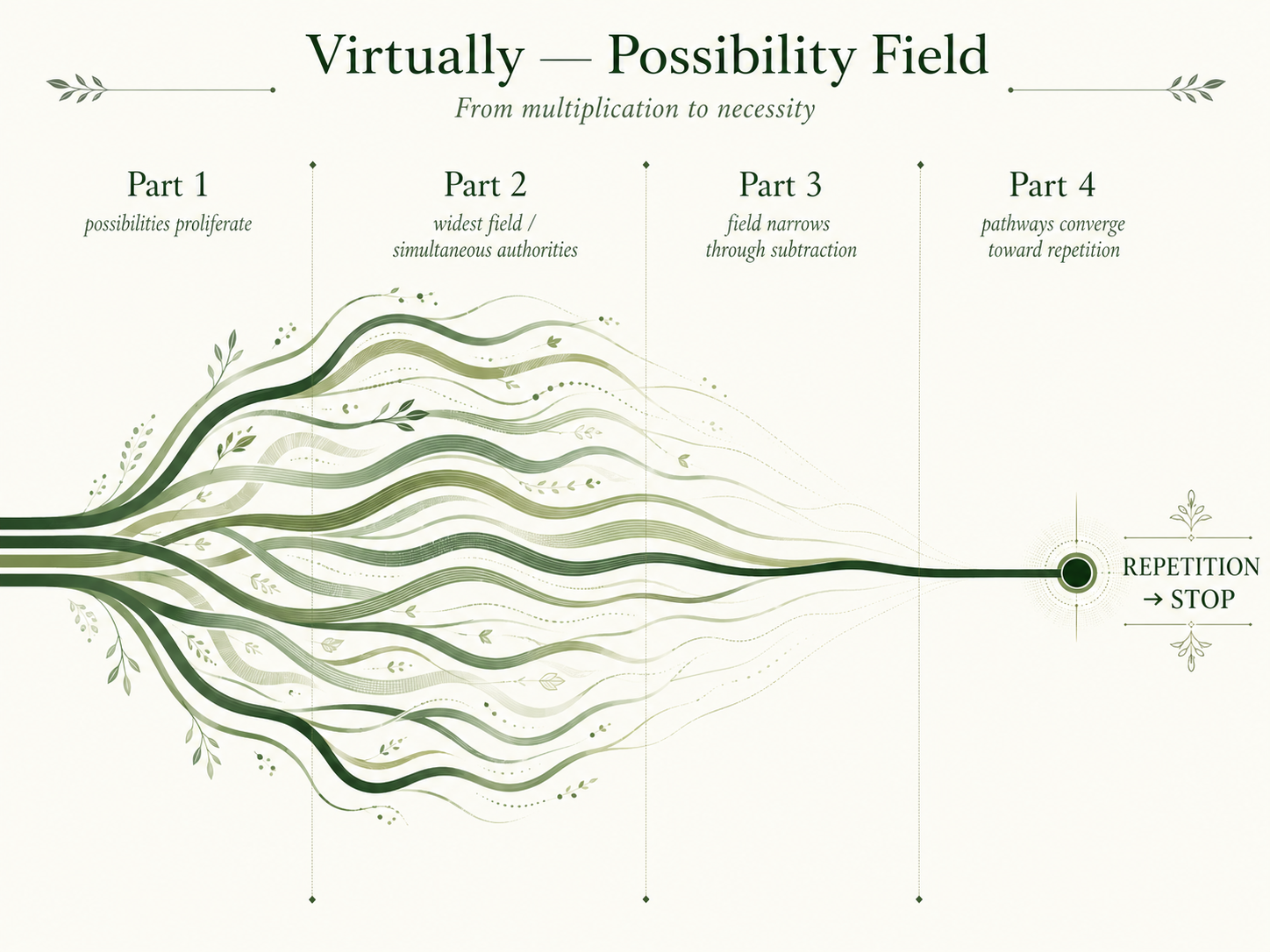
The branching pathways represent the expanding range of musical possibilities through Parts 1 and 2, reaching their greatest breadth when several authorities and functions can coexist simultaneously. In Part 3, pathways progressively disappear as pulse, density, and ensemble resources are withdrawn; in Part 4, those that remain contract toward an increasingly narrow field in which repetition becomes the dominant audible condition. The LP fade marks the recorded boundary of that process rather than its necessary musical exhaustion: the faint continuation beyond it reflects Hopper’s recollection that the musicians were still playing when the record faded, leaving open what the performance itself might still have become.
That reversal gives the twenty-minute form its particular emotional weight. “Virtually” begins with material capable of multiplying its own uses and ends on record in a field where those uses have progressively narrowed. The movement is not simply from freedom to rigidity, nor from improvisation back to composition. It is from an abundance of possible relationships toward a condition in which fewer alternatives remain and repetition carries increasing structural weight.
“Virtually” closes on the LP after material that once supported an expanding range of functions has contracted toward increasingly dominant repetition. The narrowing is audible; the fade leaves open what the performance itself might still have become.